




Abstract
Organizational climate, that is, the atmosphere surrounding an organization, unites features with individual, organizational, and environmental characteristics that affect the behaviors of individuals within the organization. Burnout is accepted as a syndrome that often occurs in people who work together with others. Faculty members in universities are potential burnout candidates due to their relationships with many students, employees, and administrators. To reduce burnout of the faculty members, it is crucial to maintain a healthy organizational climate. It is also projected that discrepancies in organizational climate can manifest differently between public and private universities. So, the purpose of this study is to examine the effect of organizational climate on the burnout of faculty members at both state and private universities. By using the survey method, 984 responses were collected from faculty members. A covariance-based structural equation modeling was constructed to test the reliability and validity of both the measurement and the structural model. The results of the study supported the hypotheses mostly and indicated that all dimensions of organizational climate negatively influenced faculty members’ emotional exhaustion. While the balanced workload, clarity of task, cohesion, and the ethical dimensions within the organizational climate produced a negative effect on the depersonalization of faculty members, the lack of clarity of task and ethical dimensions contributed negatively to the diminished personal accomplishment. In addition, the study demonstrated that state university faculty members having cohesion dimension of organizational climate were less likely to be exhausted emotionally, whereas cohesion among private university faculty members negatively influenced the depersonalization. Theoretical and practical implications regarding organizational climate dimensions and burnout levels of faculty members were discussed.
Introduction
Burnout is described as “a psychological syndrome that is characterized as a negative emotional reaction to one’s job as a consequence of extended exposure to a stressful work environment” (Marek et al., 2017; Maslach et al., 2001; Maslach & Jackson, 1984; Yildirim & Dinc, 2019). According to this definition, employees who work in stressful jobs are more likely to display higher levels of burnout. In addition, burnout has been observed in individuals who have high ideals and many interactions with other people (Evers et al., 2005). One of the most stressful professions is frequently cited as teaching (Kyriacou, 2001; Naghieh et al., 2015) with the need for intensely personal interactions with people, especially students and other teachers who also suffer from high stress, which creates a higher level of burnout, absenteeism, and eventual exit from the teaching profession (Betoret, 2006; Chang, 2009; Jepson & Forrest, 2006).
Faculty members, as teachers of higher education, are also exposed to burnout. Their relationships with many students, staff, and administrators make them prime candidates for burnout (Blix et al., 1994). They also tackle with many issues including “pressures, conflicts, demands, and too few emotional rewards, accomplishments, and successes” (Harrison, 1999, p. 26), as well as having unrealistic goals and expectations which are set for them without their input and becoming frustrated in achieving professional growth (Lackritz, 2004). Faculty members who encounter the issues above are more likely to have burnout; those with higher levels of burnout can display their intention toward turnover as well as poor job performance, and absenteeism (Blix et al., 1994; Singh et al., 1998). So, burnout is a losing situation within faculty members as well as universities as a whole.
One of the countries which have been suffering from burnout is Turkey. According to a study that included workers from 35 European countries, the highest burnout scores among the non-EU countries were found in Turkey (Schaufeli, 2018). The employees that suffered most from burnout in Turkey have been teachers and academic staff. In the literature of education, recent studies that have focused on the burnout of teachers and faculty members show that one out of three teachers experience burnout syndrome, with 10% leaving this profession every year (Can & Tiyek, 2015). Due to these serious effects of burnout, it has become crucial to research methods that reveal insights on how to reduce or prevent the probability of burnout and to identify the main factors of faculty burnout in Turkey. While there is ample research examining the burnout, literature focusing on faculty burnout within universities in Turkey has been severely limited (Okray, 2018). Much of this research has concerned factors influencing burnout of faculty members, such as age, gender, academic title, teaching load, and marital status (Demir et al., 2015; Kulavuz-Önal & Tatar, 2017), personal characteristics and emotional intelligence (Arslan & Acar, 2013; Taşlıyan et al., 2014), organizational citizenship behavior and organizational silence (Çankır, 2017; Kahya, 2015). As Maslach and Jackson (1981) proposed that the primary reasons for burnout were workplace factors rather than the personal characteristics exhibited by employees, the focus of this study has been placed on the main workplace factor that might reduce the burnout of academicians: organizational climate.
Organizational climate (OC) is defined as “a set of measurable properties of the work environment, perceived directly or indirectly by the people who live and work in this environment and assumed to influence motivation and behavior” (Litwin & Stringer, 1968, p. 1). OC is the atmosphere that surrounds an organization. This atmosphere affects the moral levels of the organization members as well as the intensity of their goodwill, feeling, and belonging. A positive OC in universities enables faculties to be satisfied with their jobs, increase their productivity, and thus prevent their burnout. In this regard, there has been a scarcity of research concerning the relationship between the dimensions of OC and the consequent burnout level. Also lacking are empirical studies exploring these relationships at state and private universities separately.
State universities have been considered expert at providing higher education through experienced academics for the last decade, but the number of private universities that provide better educational opportunities and infrastructures has increased enormously. The increased demand by students, the deficiency of state universities regarding research and teaching are some of the reasons for this upsurge (Dinc, 2018). This has newly created a competitive environment between private and state universities, causing new challenges to universities as well as to academic staff. While private universities have demanded that their faculties produce productivity in research as well as provide quality education and participation in administrative duties such as committee memberships, faculty members in state universities have been exposed to increased teaching and service load demands (Demir et al., 2015). These demands within both private and state universities have the potential to damage “personal and professional competencies of faculty members, reduce their productivity and lead to burnout experiences” (Sabagh et al., 2018, p. 132). The potential implications can produce hazardous effects on faculty members’ performances, student learning, and, finally, institutional productivity (M. Byrne et al., 2013). In this regard, investigating the factors preventing the likelihood of faculty burnout at both private and state universities has been crucial. OC is one of these factors. Thus, the purpose of this study is to explore the impact of OC dimensions on the burnout levels of faculty members within both state and private universities in Turkey.
This article is structured in the following manner. Following a review of the literature on burnout and OC, hypotheses are proposed, based on the relevant literature. After the “Research Methodology” section describes the survey administration and systems used to measure variables in the study, the results of the model are presented. Finally, the discussion section explains the theoretical and managerial implications of the study, reveals the limitations, and offers suggestions for future research.
Theoretical Framework and Hypotheses Development
Burnout
Freudenberger first described the concept of burnout in 1974 as “a state of exhaustion that results from failure, attrition, loss of energy and power, or unfulfilled wishes on human internal resources” (Freudenberger, 1974, p. 160). For the last 20 years, many researches have been done in different business areas. The most common definition of burnout is the definition made by Maslach and Jackson (1986), which perceives burnout as a three-dimensional concept. These three dimensions are named as emotional exhaustion, depersonalization, and personal accomplishment. Emotional exhaustion refers to the depletion of emotional and physical resources where the individual feels a lack of the necessary energy to perform the work. Depersonalization refers to an uncaring and negative attitude toward different aspects of the job, and related to the lack of connection with the job at emotional and cognitive level. Personal accomplishment refers to feelings of incompetency, lack of achievement, and productivity at work. Maslach and Jackson (1984) suggest that the dimensions are not dependent on each other and they could occur at any time.
Reports in the literature state that sources of stress are generally related to burnout in occupations that serve the public (Maslach & Jackson, 1981). It has been observed that individuals with high ideals who also have many interactions with other people suffer from burnout (Evers et al., 2005). Faculty members at universities that have a relationship with a large number of students, staff, and administrators are prime candidates for burnout, and those faculty members who sustain higher levels of burnout have more tendency to change their jobs (Blix et al., 1994). To prevent and reduce burnout, understanding its determinants is very important (Lambert et al., 2013). However, in the last three decades, an integrated model of burnout has described the dimensions of the relationships between the potential antecedents and outcomes of burnout and burnout with its dimensions (B. M. Byrne, 1994). A study that was conducted in the context of education suggested that burnout studies should concentrate solely on the impact of environmental factors (Friedman, 1991). In addition, burnout is the result of the interaction between the work environment and the individual; it has been discussed in the prior burnout literature that the solutions to burnout should be sought in the social environment of the workplace (Leiter & Maslach, 1988; Maslach, 1999). Therefore, the focus of this study as one of these work-related environmental factors is the OC.
Organizational Climate
OC “represents the worker’s perceptions of his objective work situation, including the characteristics of the organization he works for and the nature of his relationships with other people while doing his job” (Churchill et al., 1976, p. 324). There are many studies in the literature concerning OC that concentrate on the shared and learned perceptions that arise from formal and informal organizational policies, practices, and procedures (Sparrow & Gaston, 1996). The following variables regarding OC are investigated in this study: managerial competence, balanced workload, clarity of task, cohesion among coworkers, ethics, and participation.
Managerial competence includes the attitude and behaviors shown by managers toward employees, which includes keeping their promises and communicating with their employees (Rogg et al., 2001).
Balanced workload relates to the extent to which a sufficient amount of time is required by employees to perform their tasks in accordance with predetermined performance standards (Koys & DeCotiis, 1991). The ability of employees to work without feeling time constraints, allowing sufficient time to solve problems related to their work and the required volume of work combined, creates the weight of their workload.
Clarity of Task means that employees know exactly what is expected of them concerning their jobs (Eberhardt & Shani, 1984).
Cohesion refers to the level of mutual trust and respect between employees and management (Koys & DeCotiis, 1991). Respect combined with friendly relations among employees, both inside and outside an organization, expresses the degree of mutual support and assistance they provide.
Ethics refers to the way in which official and written ethical rules, which are valid within an organization, expresses how sensitively the management complies with these rules and sanctions that are to be applied to their employees if they do not follow them. This aspect of climate assists employees to identify ethically appropriate actions within an organization (Koys & DeCotiis, 1991).
Participation expresses the relationship between manager and employee in decision-making and a transparent and flexible discussion environment (Eberhardt & Shani, 1984).
Theoretical Foundation
The Job Demands–Resources theory (Demerouti et al., 2001) has become one of the leading approaches in predicting antecedents of burnout. According to Demerouti et al. (2001), job demands are social, organizational, and physical aspects of the job that require continuous mental or physical efforts and, therefore, are related to potential psychological or physical problems such as exhaustion. To the contrary, job resources are aspects of an occupation that (1) diminish job demands at associated mental or physical costs, (2) stimulate an employee’s development, and (3) assist in achieving work-related goals (Demerouti et al., 2001, p. 501). The Job Demands–Resources theory suggests that “excessive job demands lead to strain and burnout that, in turn, leads to poor performance. Burnout is, therefore, expected to fully or partially mediate the relationship between job demands and maladaptive outcomes” (Demerouti et al., 2001; Sabagh et al., 2018). This mediation process is designated as the health impairment process in the Job Demands–Resources theory. It suggests that lack of resources will cause a higher level of exhaustion and burnout, while an abundance of job resources is presumed to decrease the negative effect of job demands on burnout levels (Demerouti et al., 2001; Sabagh et al., 2018; Schaufeli & Taris, 2014). Empirical studies strongly support the suggestion that job demands (e.g., work overload, control, value) and job resources (e.g., participation, supervisor support) predict burnout (Maslach & Leiter, 1997; Schaufeli & Taris, 2014). In the present study, the Job Demands–Resources theory is relied on as the guiding framework to explain the relationship between OC dimensions and faculty burnout levels.
Relationship Between Organizational Climate and Burnout
Several studies in the literature have supported the relationship between OC and burnout (Cordes et al., 1997; Dinc et al., 2020; Kaya et al., 2010; Lubranska, 2011; Maidaniuc-Chirila & Constantin, 2017; Martinussen et al., 2007; Yildirim & Dinc, 2019; Vallen, 1993). A strong correlation between OC and burnout was described in a study conducted on the service sector (Lubranska, 2011). A recent study also discovered that OC is strongly and negatively correlated with burnout in public organizations (Pecino et al., 2019). With regard to studies focusing on OC dimensions and job burnout levels, Cordes et al. (1997) showed that a lack of the subordinate-manager relationship as well as an attempt to achieve success in a job with insufficient resources, inadequate management, and coordination problems, all result in emotional exhaustion and depersonalization. In another study, it was demonstrated that stressful relationships with supervisor increased emotional exhaustion (O’driscoll & Schubert, 1988). In the context of higher education, researchers found that OC is negatively connected to the burnout of faculty members (Anbar & Eker, 2008; Maidaniuc-Chirila & Constantin, 2016; Taka et al., 2016). For example, in a study of 300 academics in China (Zhong et al., 2009), the role of management predicted total burnout scores. Also, findings in a study conducted on academic staff in South Africa showed that higher levels of support from one’s superiors predicted lower levels of reported burnout (Tytherleigh et al., 2008). Based on the literature discussed above, the following hypothesis is posited:
Balanced workload is the extent to which sufficient time is provided to faculty members to perform their tasks, according to predetermined performance standards. The workload required at a university represents the relative amount of time which is dedicated to teaching, research, service, and professional development of faculty members (Gonzalez & Bernard, 2006). Studies in the literature found that high workload was a positive predictor of faculty burnout (Barkhuizen et al., 2014; Navarro et al., 2010). For example, in a study conducted with 265 university faculty members in the United States, the amount of burnout showed a significant correlation to the number of students taught, the time invested in various activities, and numerous student evaluations (Lackritz, 2004). Another study result demonstrated that faculty members with a more balanced workload, experiencing lighter teaching loads, reported significantly lower levels of emotional exhaustion in comparison with those with heavy teaching loads (Gonzalez & Bernard, 2006). Based on the above literature, the following hypotheses are suggested:
Clarity of Task concerns the knowledge by employees concerning expectations of their job performance. Lack of clarity regarding job performance has been found to result in emotional exhaustion and depersonalization (Cordes et al., 1997; Kim, 2008). Lack of task clarity and role ambiguity were reported to lead to lower perceived accomplishment and greater depersonalization within the university environment (Ghorpade et al., 2011). For instance, in a large-scale study of 1,067 academics in Netherland, lack of task and role clarity was shown to predict greater emotional exhaustion (Van Emmerik, 2002). These previous findings suggest the following hypothesis:
Cohesion is defined as the level of mutual trust and respect between employees and management. Cohesion can only be established within a university if faculty members and management mutually support each other. A lack of cohesion among colleagues results in emotional exhaustion and depersonalization (Cordes et al., 1997) and predicts total burnout scores (Zhong et al., 2009). Findings from the studies conducted in South African and Dutch universities noted that greater support from one’s organization as well as one’s colleagues reduced reported burnout by academic staff (Tytherleigh et al., 2008; Van Emmerik, 2002). Drawing on this literature, the following hypotheses are posited:
The aspect of ethics within the OC is an instrument that shapes the ethical nature of the organization by creating norms and expectations guiding behavior (Schneider & Reichers, 1983). Therefore, this climate dimension helps members to determine ethically appropriate actions within an organization. In the literature, the relationships between organizational ethics and employees’ outcomes have become fundamental issues (Dinc & Plakalovic, 2016; Kaya et al., 2010). Research findings showed that employees who felt stressed as a result of insincerity within organizational values combined with the conflict of ethical understandings, in turn, were led toward burnout (Maslach et al., 2012; Maslach & Leiter, 1997). Based on this literature, the following hypothesis is postulated:
Participation refers to the working relationship between managers and employees within the decision-making process. Participation in decision-making influences the possibility of burnout, resulting in an increased sense of personal accomplishment in particular (O’driscoll & Schubert, 1988). In the higher education context, it was found that participation in decision-making predicted greater perceived accomplishment (Pretorius, 1994). Drawing on this literature, the following hypothesis is posited:
Private universities differ from state universities in terms of infrastructures and educational opportunities. The demands and expectations of administrations of private universities concerning research productivity and providing quality education also differ from state universities. Due to these differences, the perceptions of academic staff employed in private and state universities regarding their organizations have differed. Several studies have shown that the perceptions of faculty members working within private and state universities differ significantly regarding the dimensions of their learning organization (Balay, 2012; Dinc, 2018). Based on the literature, the following hypothesis is suggested:
Research Methodology
A covariance-based structural equation modeling (CB-SEM) was employed to test the proposed hypotheses. CB-SEM methodology, which is a multivariate analytical methodology, can be used to test and estimate the complex causal associations among the latent variables simultaneously even when the associations are hypothetical or not observable directly (Williams et al., 2009). CB-SEM follows a maximum likelihood estimation by reproducing a covariance matrix to minimize the difference between the observed and the estimated covariance matrix without focusing on the explained variance (Hair et al., 2011). CB-SEM offers many benefits compared with first generation statistical approaches such as regression analysis, which do not directly allow the assessment of measurement characteristics, so that the latent variables must be converted to the average of individual measures. Therefore, CB-SEM-based approaches include the evaluation of individual measures (Astrachan et al., 2014; Hair et al., 2010).
The proposed model illustrated in Figure 1 shows the proposed association between OC and Burnout. The latent variable, OC, had six subdimensions, including Managerial Competence, Balanced Workload, Clarity of Task, Cohesion, Ethics, and Participation, while the latent variable, Burnout, had three subdimensions including Emotional Exhaustion, Depersonalization, and Diminished Personal Accomplishment.
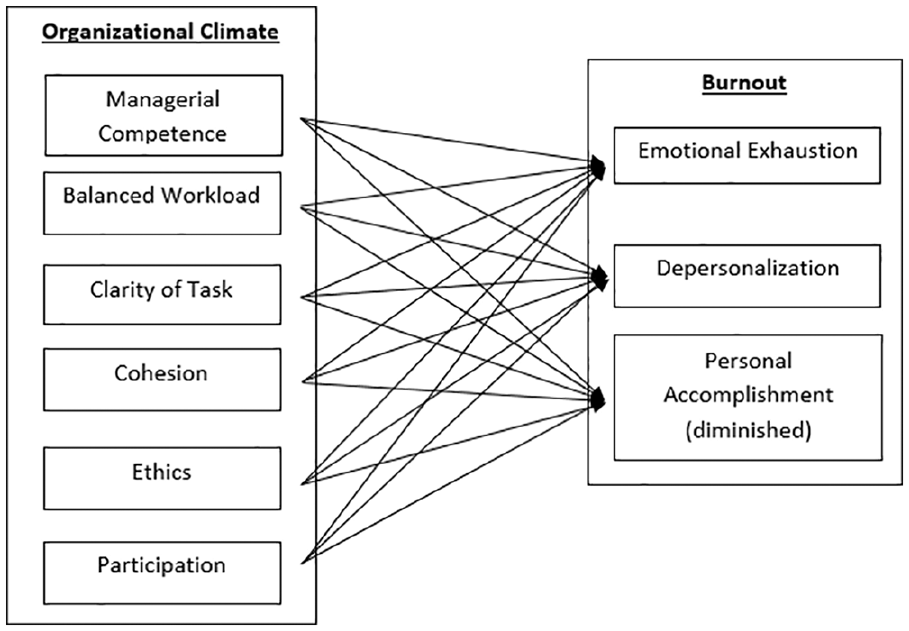
Proposed model.
The summary of the sample, Exploratory Factor Analysis, Confirmatory Factor Analysis, and the Structural Equation Modeling for testing the hypothesis are described in the methodology section.
Research Design and Instrumentation
A three-page questionnaire with three sections was used to collect data for the study. The first section included questions about OC adapted from the scales developed by Rogg et al. (2001), Koys and DeCotiis (1991), and Eberhardt and Shani (1984). The second section contained questions on burnout, adapted from the Maslach Burnout Inventory developed by Maslach and Jackson (1981). It included three components: “emotional exhaustion,” ‘personal accomplishments,’ and “depersonalization.” The items of these variables are shown in Table 1. Finally, the last section consisted of demographic questions such as age group, gender, marital status, academic title, institution type, and duration of employment.
Measurement Table.

The items of the constructs were in English. Therefore, the survey questions in the English language were translated into the Turkish language using a back-translation methodology (Brislin, 1986). The survey items were investigated by experts and professors in this field before distribution to the participants to ensure the content and the face validity of the constructs. All items were measured on a 5-point Likert-type scale, where one represents strongly disagree, while five represents strongly agree. The final form of the survey was then distributed.
Sample and Data Collection Procedure
The study targeted academicians from private and state universities in Istanbul, Turkey. The total number of faculty members in Istanbul was retrieved from the Council of Higher Education, which lists 6,572 academicians within private universities and 12,656 academicians within state universities. The total number of academic staff in Istanbul was 19,228 (Council of Higher Education, 2019).
The survey instrument was developed using an online survey tool (Survey Gizmo); the web link of the survey was distributed to all academic members in the sample via e-mail. As the target population was huge, it was not possible to deliver the surveys by hand to faculty members and collect them back again. Therefore, the convenience sampling approach, which is a common nonprobability approach (Vehovar et al., 2016), was used to collect data. The survey was sent to 12,509 participants; 7,816 participants were from state universities, and 4,693 participants were from private universities. The e-mail addresses of the academic staff were accessed from the websites of the respective universities. These members were sent a follow-up notice electronically 2 weeks later. After approximately 4 weeks, a second follow-up was sent to participants via e-mail. When respondents completed the online survey, they were able to click on a button labeled “Submit Responses.” A note of thanks then appeared on the screen, and the responses were registered in the appropriate data file. The participants were required to answer all questions: They were not allowed to move to the next question if the current one was not answered. As a result, there were no missing values in the obtained sample data set. A total of 430 participants from the state universities responded, being a 5.50% return rate, while 554 participants from the private universities responded, having an 11.80% return rate. As a result, 984 participants in total responded to the survey, with a 7.86% return rate. Based on the table developed by Sekaran (2000), which indicates the minimum sample size that can represent the population, the minimum sample size for the state universities was 375, and the minimum sample size for the private universities was 364, to represent the target population. Thus, the 984 sample size adequately represented the target population of this research (Sekaran, 2000).
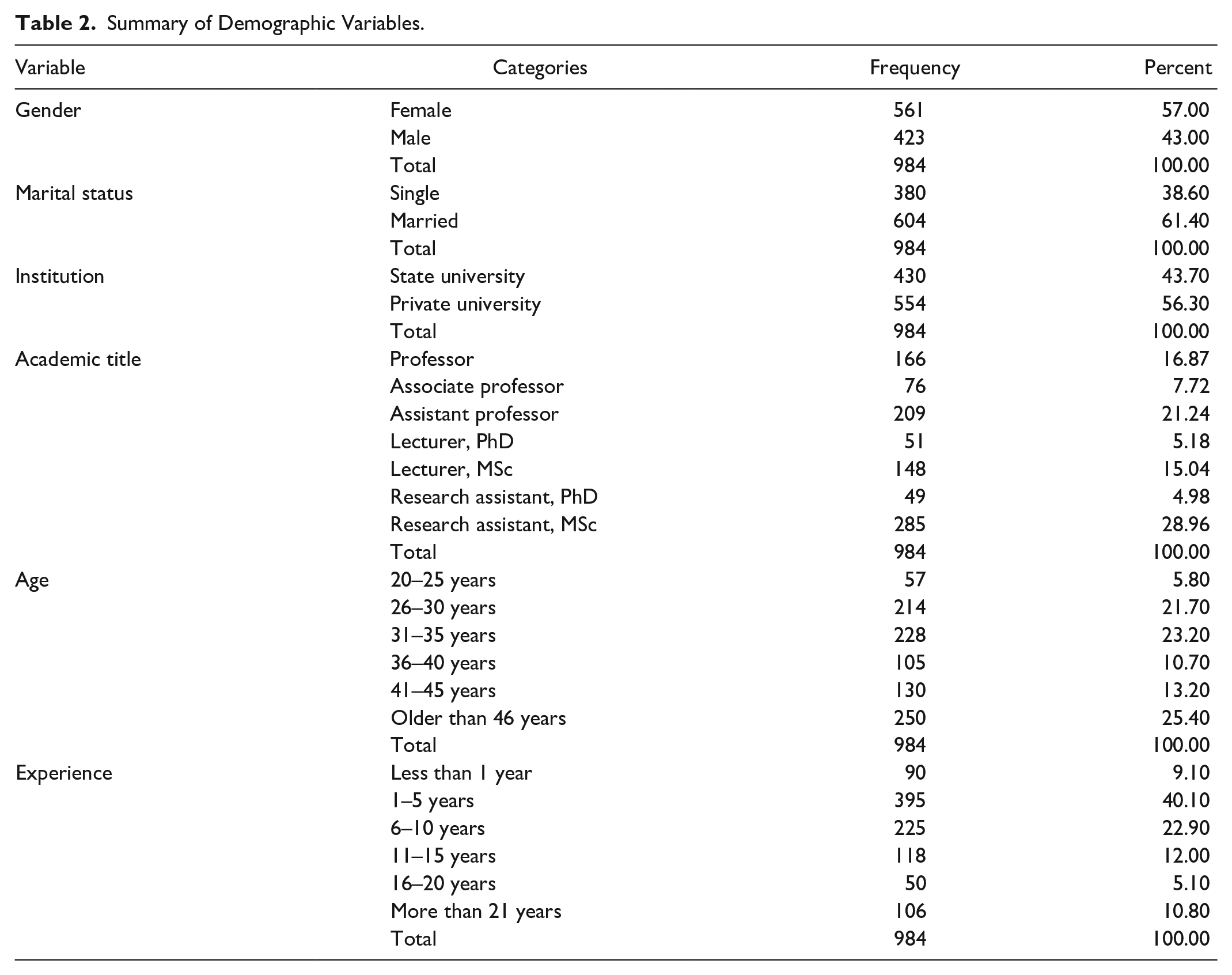
The summary of the demographic variables is shown in Table 2. The results indicated that 57% of the participants were female, and 43% were male; 61.4% were married; 56.3% worked in a private university, 43.7% worked in a state university; 7.7% were associate professors, 16.9% were full professors, 21.2% were assistant professors; almost 6% were younger than 25 years old, and 25.4% were older than 45; and finally, 40.1% had between 1 and 5 years of experience, while 10.8% had more than 20 years of experience.
Summary of Demographic Variables.
Exploratory Factor Analysis
Before testing the hypothesis, the items were subjected to Exploratory Factor Analysis (EFA) to find the underlying factor structures. To extract the factors, Principal Axis Factoring (PAF) analysis as the factor extraction method and Promax as the factor rotation were employed. The EFA results are provided in Table 3. Initially, 52 items from the adapted scales were subject to EFA, from which nine items were eliminated from the analysis due to low or cross factor loadings. As a result, 43 items were left for further analysis, with seven items measuring Personal Accomplishment, six items measuring Ethics, Managerial Competence, and Emotional Exhaustion, four items measuring Cohesion, Balanced Workload, and Depersonalization, and three items measuring Participation and Clarity of Task. In addition, the percent of total variance accounted for each factor ranged between 1.59 and 34.08, with Ethics being the highest and Clarity of Task being the lowest. The nine factors together accounted for 61.02%, which is higher than the recommended threshold value of 60% (Hair et al., 2010; Hinkin, 1998). Also, the Eigenvalues of the constructs after rotation ranged between 4.03 and 10.35. The descriptive statistics of the items with Mean and Standard Deviations are also provided in the same table. Moreover, the Kaiser–Meyer–Olkin (KMO) test statistics revealed that the sample data was adequate for the EFA (KMO = 0.951), while Bartlett’s Test of Sphericity test statistics indicated that the variables of interest sufficiently related to each other to enable running the EFA (Bartlett’s Test of Sphericity = 28338.92, df = 903, p value = .001). The convergent validity was met, as the items within each of the extracted nine factors were highly associated. In addition, the discriminant validity was satisfied as the factors were distinct and uncorrelated where the items had high loadings within each factor, and there were no major cross-loadings between factors. Finally, the reliability measures using Cronbach’s alpha ranged between .71 and .94, which were greater than the cutoff value of 0.70 (Cortina, 1993; Cronbach, 1951; Hair et al., 2010).
Exploratory Factor Analysis.

Note. “α” represents Cronbach’s alpha; Kaiser–Meyer–Olkin Measure of Sampling Adequacy = 0.951; Bartlett’s Test of Sphericity = 28338.92, df = 903, p value = .001.
Confirmatory Factor Analysis (CFA)
Following the EFA, the nine latent variables in a single model were subject to Confirmatory Factor Analysis (CFA) to investigate the reliability and validity, as well as the model-fit of the constructs (Fornell & Larcker, 1981). The model-fit performance measures, which indicated how well the factor structure accounts for the associations between the variables in the sample data as well as the standardized regression weights and t-statistics of the latent variables’ items, are shown in Table 4. For the CFA, the maximum likelihood estimator was selected during the CFA analysis. The results revealed that χ2/df was 2.07, the comparative fit index (CFI) was 0.97, the incremental fit index (IFI) was 0.97, the Tucker–Lewis index (TLI) was 0.96, the relative fit index (RFI) was 0.964, the goodness of fit index (GFI) was 0.93, and the root mean square error of approximation (RMSEA) was 0.033. The provided measure of model-fit performance values was completely satisfied, based on the suggested cutoff values (Bagozzi &Yi, 1988; Hu & Bentler, 1999). Thus, the model-fit measurements showed a good fit of the proposed model.
Confirmatory Factor Analysis.

Note. χ2(784) = 1620.1.01, χ2/df = 2.07, comparative fit index = .97, incremental fit index = .97, Tucker–Lewis index = .96, relative fit index = .94; goodness of fit index = .93 root mean square error of approximation = .033.
Measurement Model
Before testing the hypothesis using SEM, it was crucial to investigate the internal consistency and reliability as well as the validity of the constructs (Hair et al., 2010). In Table 5, the correlation coefficients between each pair of the latent variables, the descriptive statistics, the average variance extracted (AVE) values, the composite reliability (CR), the Cronbach’s alphas, and the square root of AVEs on the diagonal of the correlation matrix are given. The correlation analysis also indicated that there was no high bivariate correlation between each pair of the latent variables. The reliability of the constructs was satisfied as the Cronbach’s alpha scores (ranges between 0.71 and 0.94) and CR (ranges between 0.81 and 0.95) were more than the suggested threshold value of 0.70 (Bari et al., 2019; Nunnally & Bernstein, 1994). In addition, the values of AVE ranged between 0.52 and 0.85, which indicated that the convergent validity was met as the values of AVE were above the recommended value of 0.50 (Bari et al., 2019; Hair et al., 2010; Meng & Bari, 2019). Finally, the discriminant validity was satisfied as the square root of AVE values (range between 0.72 and 0.92) at the diagonal of the correlation matrix was well above any intercorrelation values of the latent variables.
Correlation Analysis and Reliability Measures of the Variables (N = 984).

Note. The elements on the diagonal are the square root of AVE, while the elements off-diagonal are the correlations between the latent variables. AVE = average variance extracted. Bold values are the square root of AVE scores. They are not coefficients of correlation. There is no sgnificance level assciated with the square root of AVE scores.
p < .01.
Structural Equation Modeling
The CB-SEM methodology was utilized to test the research hypotheses. There was no multicollinearity issue among the independent variables as the variable inflation factors (VIFs) were all less than the suggested (Hair et al., 2010) cutoff value of 10 (ranging between 1.48 and 2.47).
The results of SEM are provided in Table 6. According to the revealed results, Managerial Competence only had a significant negative association with Emotional Exhaustion (p < .05); Balanced Workload had a significant negative relationship with Emotional Exhaustion (p < .001) and Depersonalization (p < .001); Clarity of Task had a significant negative association with Emotional Exhaustion (p < .001), Depersonalization (p < .001), and Personal Accomplishment (p < .001); Cohesion had a significant negative association with Emotional Exhaustion (p < .05) and Depersonalization (p < .05); Ethics had a significant negative relationship with Emotional Exhaustion (p < .001), Depersonalization (p < .001), and Personal Accomplishment (p < .001); finally, Participation only had a significant negative association with Emotional Exhaustion (p < .001). The results showed that H3 and H5 were fully accepted, while H1, H2, H4, and H6 were partially accepted.
Structural Equation Modeling Results.

Note. R2EmotionalExhaustion = .445; R2Depersonalization = .206; R2PersonalAccomplishment = .147.
p < .05. **p < .01. ***p < .001.
Moreover, 44.5% of the variance in Emotional Exhaustion, 20.6% of the variance in Depersonalization, and 14.7% of the variance in Personal Accomplishment were explained by the variances in Managerial Competence, Balanced Workload, Clarity of Task, Cohesion, Ethics, and Participation (see the footnote in Table 7).
Comparison of the Proposed Model Between State Universities and Private Universities.

p < .05. **p < .01. ***p < .001.
Comparison of Models Between State and Private Universities
The same proposed model was tested by comparing state universities with private universities. Thus, a multigroup analysis based on bootstrapping results was utilized to compare the proposed model between state and private universities as the grouping variable. As previously shown, the sample size of the state universities was 430, while the sample size of the private universities was 554. The comparison of the proposed model is given in Table 7. Accordingly, the results indicated that Balanced Workload had a significant negative association with Emotional Exhaustion and Depersonalization in both state and private universities. In addition, Clarity of Task had a significant negative relationship with emotional exhaustion, depersonalization, and personal accomplishment in both groups. Moreover, Cohesion had a significant negative relationship with depersonalization in the private university group, while it had a significant negative relationship with emotional exhaustion at the state university level. Ethics had a significant negative association with emotional exhaustion, depersonalization, and personal accomplishment at both private and state university levels. Finally, Participation had a significant negative association with emotional exhaustion at both the private and state university levels.
The difference between the betas of the state and private universities and the corresponding t-statistics are shown in Table 8. The results indicated that there was a significant difference between the coefficients of the groups in testing the association of participation with personal accomplishment, while there was no statistically significant difference between any other coefficients of the state and private universities.
The Coefficients’ Difference Between State and Private Universities.

p < .05. **p < .01. ***p < .001.
Discussion
The findings of this study show that the Managerial Competence and Participation dimensions of OC have a significant and negative influence on the emotional exhaustion level of faculty members’ burnout. The ability of managers to communicate effectively, combined with their attitudes and behaviors toward employees, is vital to provide a positive OC for employees. This type of climate creates a transparent organization and encourages employees to participate fully in the decision-making process. These two dimensions are critical, especially in the higher education institutions, in which the productivity of the academic staff is vital. Psychological health is crucial to create productivity. According to the results of the study, faculty members who held positive perceptions of Managerial Competence in their administrators and were invited into a Participation opportunity in the decision-making processes, within both the state and private universities, were less likely to be exhausted emotionally. This result is consistent with the findings of Tytherleigh et al. (2008) and Van Emmerik (2002), which indicate that high levels of support from one’s superiors will predict lower levels of reported burnout. The result of Pretorius’s (1994) study, showing that participation in decision-making was significantly correlated with perceived accomplishment in South African academics, is consistent with the findings of this study. On the other hand, these two dimensions of OC did not influence the depersonalization and the decreased personal accomplishment level of burnout in the study. Therefore, Hypotheses 1 and 6 are partially accepted.
The findings of the study also indicated that the Balanced Workload and Cohesion dimensions of OC affected the emotional exhaustion and depersonalization levels of faculty burnout negatively. Workload refers to the absolute amount of work required and the time frame within which that work must be completed (Cooper et al., 2001). Cohesion is mutual trust and respect between employees. Employees who have friendly relations with their coworkers in an organization possess a sense of support and security. The study findings demonstrated that faculty members who reported higher levels of the Balanced Workload and Cohesion OC dimensions within both state and private universities were less likely to report emotional exhaustion and a depersonalization level of burnout. These findings are consistent with several studies which found that workload and time pressure are strongly related to burnout, in particular, to the dimension of exhaustion (Leiter et al., 2010; Maslach et al., 2001; Reid et al., 1999; Vesty et al., 2018; Yildirim & Dinc, 2019). This specifies that while the total numbers of students in teaching and supervisory roles in academic life are positive predictors of both Emotional Exhaustion and Depersonalization of faculty members, teaching load, the amount of time required for grading, office hours, service time, the number of service activities, and the overall time spent as a faculty member are positively correlated with Emotional Exhaustion (Lackritz, 2004). However, the study did not find a negative effect arising from the Balanced Workload and Cohesion dimensions on the decreased personal accomplishment level of burnout experienced by faculty members. At the decreased personal accomplishment stage of burnout, a person feels like a failure. Lack of relationship between this level of burnout by faculty members and the Balanced Workload and Cohesion indicates that fairness by the administration in terms of delivery in teaching and service loads, accompanied with respect and friendly relations among the academic members does not reduce feelings of failure in their jobs by faculty members. Therefore, Hypotheses 2 and 4 are partially accepted.
Another finding in the study demonstrates that the Clarity of Task dimension of OC has an important negative effect on the emotional exhaustion, depersonalization, and diminished personal accomplishment level of burnout experienced by faculty members. Clarity of Task means that employees know exactly what is expected from them on the job. Universities are educational institutions where all the rules and regulations are well written and documented. Therefore, academic staff always know what is expected, clearly, especially in teaching and research activities. Thus, the study shows that faculty members who perceived a higher clarity of task within the state and private universities were less likely to demonstrate emotional exhaustion, depersonalization, or experience a decreased personal accomplishment level of burnout. Several study results that are in line with this finding have indicated that lack of task clarity and role ambiguity would lead to lower perceived accomplishment and greater depersonalization (Ghorpade et al., 2011) and greater emotional exhaustion (Van Emmerik, 2002) in a university environment. Therefore, Hypothesis 3 is accepted.
Furthermore, the study demonstrates that the Ethics dimension of OC has a significant negative impact on emotional exhaustion, depersonalization, and the diminished personal accomplishment level of job burnout. Ethics in OC is the sensitivity of management to comply with official and written ethical rules which are valid within the organization. Employees who have a positive perception regarding the ethicality of their organizations are less likely to show burnout symptoms. Faculty members who reported receiving higher levels of ethical sensitivity within the state and private universities were less likely to report experiencing emotional exhaustion, depersonalization, and a decreased personal accomplishment level of burnout at work. This result is consistent with Maslach et al.’s (2012) and Maslach and Leiter’s (1997) research findings, which showed that employees felt stressed by insincerity within organizational values as well as conflict with ethical understanding, which in turn lead to burnout. In addition, Siegall and McDonald’s (2004) findings that found person-organization value congruence to be negatively correlated with emotional exhaustion and depersonalization levels of burnout among U.S. faculty are in line with the results of this study. Therefore, Hypothesis 5 is accepted.
Moreover, regarding differences between the perceptions of faculty members who work in either the state or private universities concerning the impact of OC dimensions on their burnout levels, this study finds that faculty members working at state universities, where there is a Participation OC dimension, were less likely to report a decreased personal accomplishment level of burnout in contrast to faculty members within the private universities. This result may stem from the research context. When a faculty member starts to work at a state university in Turkey, it can be inferred that he or she becomes a permanent academic staff who may be fired by the university only under very extraordinary conditions. Due to this approach, especially experienced faculty members such as associate professors or professors in the state universities may not be motivated to focus on personal accomplishment. They are more concentrated on teamwork within their universities. All of the success stories within their universities to which they have made enormous contributions by participating in the decision-making process may enhance their happiness and therefore reduce the possibility of a decreased sense of personal accomplishment that contributes to burnout and emotional exhaustion. The study findings showing a negative relationship between Cohesion in the state universities and the relative emotional exhaustion of faculty members support this. On the contrary, faculty members in the private universities must concentrate on their academic and personal accomplishments in order not to be laid off. Participation in meetings and teamwork may be considered to be a waste of time for them; therefore, the study found no relationship between Participation in private universities and their decreased personal accomplishment. In addition, the availability of Cohesion in these universities only reduced the depersonalization level of burnout of faculty members. Due to the aforementioned characteristics of the faculty members in private universities, faculty members who enjoy respect and friendly relations with their colleagues are less likely to have a tendency to dehumanize their students and colleagues, often delivered by way of a cynical, callous, and uncaring attitude. The theoretical and practical implications of the study are highlighted in the following paragraphs.
Theoretical Implications
This research has theoretical implications. First, it finds support for the relationship between OC and burnout. Although many empirical studies have researched the relationship between OC and burnout (Bronkhorst et al., 2015; Cordes et al., 1997; Idris & Dollard, 2014; Kaya et al., 2010; Lee et al., 2013; Lubranska, 2011; Maidaniuc-Chirila & Constantin, 2017; Martinussen et al., 2007; Thompson & Rose, 2011), there has been a gap in terms of linking OC dimensions to burnout levels. At the same time, there was a scarcity of research examining these relationships among academic staff within universities. This study tries to fill these gaps in the literature. This research indicates that clarity of task and the ethical dimensions of OC were significant predictors of emotional exhaustion, depersonalization, and lack of personal accomplishment level of burnout experienced by faculty members. In addition, Balanced Workload and Cohesion had negative effects on emotional exhaustion, and depersonalization levels, whereas Managerial Competence and Participation dimensions solely influenced negatively the emotional exhaustion creating the burnout of faculty members.
Another contribution of this study to the literature concerns exploring the effect of the OC dimensions on burnout levels within state and private universities separately. Whereas few studies in the literature examine the perceptions of academic staff about employee behaviors within private and state universities (Balay, 2012), little research has concentrated on linking the dimensions of OC to faculty burnout levels within state and private universities. This research attempts to fill this gap in the literature. This study demonstrates that while faculty members who work within the state universities which have a Cohesion OC dimension are less likely to be exhausted emotionally, the availability of Cohesion in the private universities negatively affects the depersonalization burnout level of faculty members. However, the decreased personal accomplishment level of faculty members within state universities where they were involved in the decision-making process was low. This relationship was not found among faculty members who worked within private universities.
Managerial Implications
Several implications are arising from this study for administrators in both state and private universities who must be concerned about the mental state of their faculty members. First, these results suggest that state and private universities can enhance the health and productivity of their staff while reducing emotional exhaustion, depersonalization, and a sense of a lack of personal accomplishment by always being sensitive and complying with the official and written ethical rules within the organization and maintaining clarity toward what is expected of the faculty concerning the tasks in departments and colleges. Another implication of the study is the negative effect of the Balanced Workload and Cohesion OC dimensions on emotional exhaustion and depersonalization, causing burnout of the faculty members in both types of universities. The teaching load and the number of students under the supervision of the faculty members are directly correlated with burnout. Therefore, the reduction of the teaching load and the number of students can be a preventive tool for faculty members (Lackritz, 2004). With regard to Cohesion in the universities, effective training and socialization, including family members, can enhance the faculty members’ relationships with their colleagues. The final implication concerns the different approaches of the faculty members in state and private universities toward the Cohesion and Participation dimensions of OC. The study results demonstrated that while faculty members who work at state universities which have a Cohesion OC were less likely to be exhausted emotionally, the availability of Cohesion in the private universities did not affect the emotional exhaustion of faculty members, but influenced their depersonalization burnout level negatively. However, the decreased personal accomplishment level of faculty members in the state universities, where they were encouraged to participate in the decision-making process, was low. This relationship was not found among faculty members in private universities. These study findings suggest that private universities should focus more on Cohesion among faculty members at the university, college, and department levels. University administrators can encourage faculties to do research jointly with their colleagues who are working in the same department, to enhance both cohesion and personal success. This can also contribute to reducing the emotional exhaustion of faculty members. The private university administrators should also concentrate on the participation of faculty members in the decision-making process. Rewarding faculty members who contribute greatly to the decision-making process may be very useful for these universities.
Limitations and Further Research
This study has several limitations. First, the study results were obtained from a limited sample. Similar surveys with higher sample sizes may provide different results. Second, self-reported issues may form a limitation in this type of sensitive study. However, with this in mind, the survey was designed and administered carefully to minimize this potential limitation. Another limitation is that the faculty members participating in this study were mainly from the state and private universities in Istanbul. To enhance generalizability, future research might include faculty members from other cities in Turkey. The final limitation of this research article is the insufficient number of variables in the literature. A future study might incorporate individual variables such as job satisfaction and turnover intentions as well as some other variables such as organizational citizenship behavior and organizational commitment components.
Conclusion
This study has examined the impacts of OC dimensions on the burnout levels of faculty members within both state and private universities. The study results demonstrate that all dimensions of OC influence the reduction of the emotional exhaustion of faculty members. Several dimensions of OC such as balance within the workload, clarity of task, cohesion, and ethical dimensions may produce a negative effect on the depersonalization dimension of faculty burnout. Finally, lack of clarity of task and the ethical dimensions of OC succeeded in decreasing the dimension of diminished personal accomplishment of faculty burnout. The study provides several recommendations for both state and private university administrators.
Footnotes
Declaration of Conflicting Interests
The author(s) declared no potential conflicts of interest with respect to the research, authorship, and/or publication of this article.
Funding
The author(s) received no financial support for the research, authorship, and/or publication of this article.
