




Abstract
The payment for ecosystem services (PES) scheme shows great poverty alleviation potential and recognizing this connection contributes to enhancing the development of residents in ecologically endowed areas. However, the literature has not clarified the extent of the promotion and moderating factors of PES on income yet. This study pursues the goal of identifying the effect of PES on household income in rural China from the income structure perspective. Methodologically, this research conducts a literature review of 28 papers to outline the effect of PES on agricultural production, off-farm, and total income, and it applies a meta-analysis and meta-regression analysis of 13 papers to identify the influencing degree and interference factors. The findings reveal four issues. Overall, the effect of PES on agricultural production income was negative, while the effect on off-farm and total income was positive. Second, the PES schemes boosted farm household income by 0.15 weighted average effect size. Third, farm household participation area, subsidized unit prices, and urbanization level played positive moderating effects, while farm household age was a negative moderating variable. Lastly, PES risk exacerbated income inequality among farm households. The study also integrates the PES and the SDGs, proposing that advancing climate action involves the assistance of sustainable communities, decent work, and protection from conflict with social equity. Finally, the paper provides recommendations in terms of government-led PES projects that should be inclusive of economic, social, and ecological objectives, provide job security for smallholders, and quality urbanization.
Plain language summary
The purpose is that clarifying the extent of the promotion and moderating factors of PES on income well. The methods are that literature search plus meta-analysis. The findings reveal four issues. Overall, the effect of PES on agricultural production income was negative, while the effect on off-farm and total income was positive. Second, the PES schemes boosted farm household income by 0.15 weighted average effect size. Third, farm household participation area, subsidized unit prices, and urbanization level played positive moderating effects, while farm household age was a negative moderating variable. Lastly, PES risk exacerbated income inequality among farm households. Moreover, the study discusses the role of PES in SDGs. Finally, this paper provides advice for balancing the eco-social objectives of the PES project and promoting high quality urbanization.
Introduction
Ecosystem services are the advantages that people obtain from ecosystems, including merchandise, culture, regulating and supporting services (Costanza & Liu, 2014; Deal et al., 2012; Jack et al., 2008; Kaiser et al., 2023). This was initially an ecological concept. However, since ecological economists have found that ecosystem services to have usage value, the research focus has gradually shifted to how to monetize and commoditize ecosystem services (Costanza et al., 1997; Fan et al., 2022; Gómez-Baggethun et al., 2010; Howell, 2022; Villalobos et al., 2023). Currently, payment for ecosystem services (PES) is perceived to convert ecosystem services into a tradable commodity thus generating a “new market” (Bennett & Gosnell, 2015; Kaiser et al., 2021; Wegner, 2016). Researchers have found that, during the implementation of PES, poorer farmers tend to be in the group with greater potential for providing services. As poor farmers tend to own land of poorer soil quality and with higher slopes, they have more potential to increase ecosystem services (Milder et al., 2010). Based on actual geographical distribution, many developing countries, such as Tanzania, Vietnam, and China, have begun to associate PES with poverty alleviation (Kwayu et al., 2014; Z. Liu & Lan, 2018; Nguyen et al., 2021). In this situation, PES is gradually being bundled with the Sustainable Development Goals (SDGs), which attempt to jointly advance climate action and poverty alleviation targets.
China was one of the earlier countries to implement a PES project, which can be traced back to the 1999 Sloping Land Conversion Program (Xu et al., 2006). Since then, China has applied successive schemes and covered more natural resources and a wider range of farmers. One common characteristic of these programs is that the government acts as the buyer, to purchase ecosystem services from the forest, grassland, and other ecological land tenure holders (specifically, the farmers; Y. Chen et al., 2021). There are differences between China’s PES schemes and the original expectation of PES theories. Generally, PES has five necessary criteria: (1) a voluntary transaction, (2) a well-defined [ecosystem service] (or land-use likely to secure that service), (3) “bought” by (minimum one) buyer, (4) from a (minimum one) provider, and (5) if and only if the [ecosystem service] provider secures [ecosystem service] provision (Wunder, 2005). The criteria originate from the environmental economics approach and the basis is the application of market principles to ecosystem services (Bennett & Gosnell, 2015). Furthermore, some scholars have noted the Coase logic behind the criteria (Gómez-Baggethun et al., 2010; Huber-Stearns et al., 2017). Concretely, externalities can be overcome through voluntary negotiation between its generators and recipients (Coase, 1974).
Nevertheless, Chinese behavior seems to conflict with theory, leading to the following concerns: (1) The schemes may be compulsory, with farmers negotiating in an unequal situation. The government can rigorously and directly formulate the compensation price (Xu et al., 2010). (2) Payment may be opaque in nature, which induces official corruption and elite capture (Thompson, 2017). In that event, a poorer farmer will hardly be able to increase revenue. (3) The government may prefer environmental goals, rather than a socioeconomic target, and this expands the scope of compensation to land with better soil quality (Xu et al., 2010). In a nutshell, this government-led PES shocks the principle of voluntariness and whether or not the PES still improves the welfare of farmers has turned into a topic of academic debate.
Presently, scholars have explored the connection between PES and farmers’ income in China from the perspectives of sustainable livelihood, cost-effectiveness, resilient governance, and risk society (Fan et al., 2022; Jimoh et al., 2020; Long et al., 2020; Ren et al., 2020). These topics have been considered a large amount of literature. The findings of these studies were mixed, where some concluded that PES has a positive impact on income, or no significant impact or even a negative impact (J. Li et al., 2011; H. Li et al., 2018; Sheng et al., 2019; Xu et al., 2010; For more information, see Section 2–3). Even though there were differences in the results, these studies still reached some degree of consensus. The main agreement is that researchers in this field need to subdivide the types of farmers’ incomes, instead of directly discussing the total income. In this study, total income is divided into agricultural production and off-farm (L. Li et al., 2021; Song et al., 2014). Specifically, agricultural production income refers to the income obtained by farmers from the cultivated fields, forestry, etc. The rest is classified as off-farm income. In terms of off-farm income, in addition to paying attention to the subsidies, the researchers in this study also focus on the impact of rural–urban migration on income (Lin & Yao, 2014).
Although previous studies have provided valuable information on types, forms and outcomes, due to the complex income structure, the differentiated migration willingness and ability of farmers, as well as a variety of econometric methods, there are still unresolved issues in the existing literature (Shang et al., 2018). The first gap is that the connection between PES and income remains unclear, which has drawn various arguable conclusions. The second gap is the lack of refined knowledge about the mechanism that connects PES to positive or negative outcomes. Lastly, to the best of our knowledge, no study has systematically reviewed the connection from the income structure perspective and carried out a new analysis based on the arguments. Resolving this issue would not only determine the significance of government-led compensation but would also have reference value for poverty alleviation in other developing countries.
To straighten out the connection between a number of quantitative studies, this paper aims to present a systematic review of empirical research that links PES with farm household income in China. First, by reviewing the trends in the peer-reviewed literature. Second, by applying the Cite Space software to obtain the information about the authors, keywords, word frequency, topic preferences, etc. Third, by examining 13 papers that engage the topic conceptually and identifying the influence mechanisms, and, by adopting the meta-analysis to test them. In the discussion, we reflect on how to enhance the poverty alleviation effect of PES programs and how to improve the criteria of PES. In this study, we use a literature search plus meta-analysis approach because we believe that given the size of the literature, it is difficult for individual studies to explain such causes in a cohesive way cohesively. However, reanalysis of the diverse literature can better resolve existing differences. With the above approaches, we expect to be able to clarify the extent of the impact of PES on income and the factors that interfere with the effect of PES on poverty alleviation.
This review purports to answer to the following questions:
RQ1. What is the extent of the impact of PES on the income of farm households?
RQ2. What factors contributed to the mixed results in the existing studies?
RQ3. What China’s PES practices imply for the SDGs?
The main contributions of this study include the following: (1) Analyzing the effect of PES on the three structures of income qualitatively, and estimating the degree of impact of PES on total income to clarify the connection; (2) Identifying the moderating effects of urbanization, the intensity of subsidies, and some individual characteristics on income in the PES program with applying the meta-regression analysis. The discovery will address to the mixed results; (3) Using a meta-analysis approach to combine previous studies to address the vulnerability of single studies to contradictory views.
The next section briefly introduces the methodology used, and then the Findings section will discuss the influence level and mechanism of China’s PES on three types of income and we will apply the meta-analysis to examine it. Afterward, the dialog with existing literature and reflections on the sustainable development goals are presented in the Discussion section. Finally, in the Conclusion section, suggestions for improvement are offered.
Methodology
Literature Search
This study tracked the existing literature of Webster and Watson (2002) to execute an unbiased search for applicable quantitative studies of PES and household income in China. From the time that the study’s method was proposed, it has been applied in many social science areas, such as economics, education, sociology, etc. (Arcidiacono et al., 2018; Arnold & Sangrà, 2018; Sharma et al., 2021). This broad usage ensures the rigorous quality of the review. The search, which was conducted on worldwide bases, was carried out from June 19th to July 25th, 2022, and March 1st, 2023.
The first step is to define the scope of the review. This paper identifies three specific characteristics of existing literature. (1) They must adopt quantitative methods, while case studies and theoretical discussions are not included. (2) The PES schemes must be top-down, rather than bottom-up. For example, this paper does not cover carbon credits. (3) The existing literature must be peer-reviewed journal papers, covering the years from 2005 to 2022; they must be written in English, and all conference papers and reports are out of scope. The reason this period was chosen is that the quantitative research before 2005, the survey sample size of which is commonly less than 100, and is far fewer than the true number of people covered by the program.
The second step is to identify the keywords. Different PES terminologies are used in literature. For this reason, and possibly even directly adopting the name of the schemes, it is necessary for this study to rely on a keyword search. Based on recommendations from influential scholars, the following string was drafted: (“income”) AND (“sloping land conversion program” OR “the conversion of cropland to forest program” OR “natural forest protection program” OR “eco-compensation” OR “ecological compensation”). In addition, the keyword “income” was replaced with “welfare” or “livelihood” to repeat the search.
The third step is a literature search. This study relied on Web of Science, Scopus, and EBSCO databases to guide computerized searches.
According to the above steps, 258 pieces of literature were initially locked in. Some studies have since been removed, specifically, those that did not use econometric methods or did not focus on China, based on the title and abstract. Meanwhile, literature that did not adopt PES and household income as key variables, or those in which the sample size was less than 100, were also removed. After filtering, 42 essays remained. Moreover, we read the full text and finally identified 28 papers that are highly relevant to the study. To prevent omissions, the above steps were repeated twice. Among the 28 pieces of literature, Land Use Policy (6) is the journal with the most publications on this topic, followed by Ecological Economics (5) and Journal of Cleaner Production (3). In addition, Forest Policy and Economics, Journal of Rural Studies, Journal of Environmental Management, and others also have included related articles. Eventually, this study drew on the method of Goldman and Schmalz (2004) to describe the matrix table of literature reviews, which extracts the authors, publication year, study area, sample sizes, econometric methods, and results of the 28 articles (Table 1) and the briefly analyzed in the Findings section.
Literature Review Matrix Table.

Meta-analysis
Meta-analysis is defined as a statistical re-examination of the existing empirical literature, which is increasingly used as a key source of evidence synthesis (Balundė et al., 2019; B. Li et al., 2022; Wallace et al., 2009). The meta-analysis idea is to construct standardized associations between independent and dependent variables through statistical information, such as t-values to produce effect size indicators Fisher’s Z (Glass, 1976). Thus, the use of meta-analysis is based on the presupposition that the collected literature provides sufficient statistical coefficients for various variables. In the above literature, a total of 15 papers could not meet the requirements as they often did not develop descriptive statistics.
For the remaining 13 papers (i.e., see Findings), we will use random effects to estimate the average effect size. This is because in social sciences, it is often difficult to generate a unique common effect size due to economic structure, social environment and other factors, and it is more realistic to use the random effects approach (Q. Wang & Guan, 2023). Lastly, we summed the effect sizes for each paper to obtain the weighted average effect size, where the extent of PES programs has an impact on income.
Meta-Regression Analysis
Heterogeneity issues may arise in meta-analyses, that is, different findings from different studies or significant differences in effect size estimates from the same study. As mentioned above, the effect of PES on income produces mixed results, so heterogeneity is expected. For this reason, this paper will apply the meta-regression analysis to identify potential moderating variables to explain the systematic variation in effect sizes. The equations are as follows:

where
Findings
Combining the articles retrieved in this review, this study first analyzes and summarizes the existing findings qualitatively, and then uses a quantitative approach to identify the connection between PES and income.
Descriptive Findings
Figure 1 displays an annual frequency plot of studies in which PES was found to affect household incomes in China. One can reasonably judge that Uchida et al. (2005) produced the first work in this field. In addition, 2014 and 2020 are the years in which such articles were most frequently published, and 50% of articles were published in the last 5 years. This upward trend reflects that now is a great time to evaluate progress in the field.
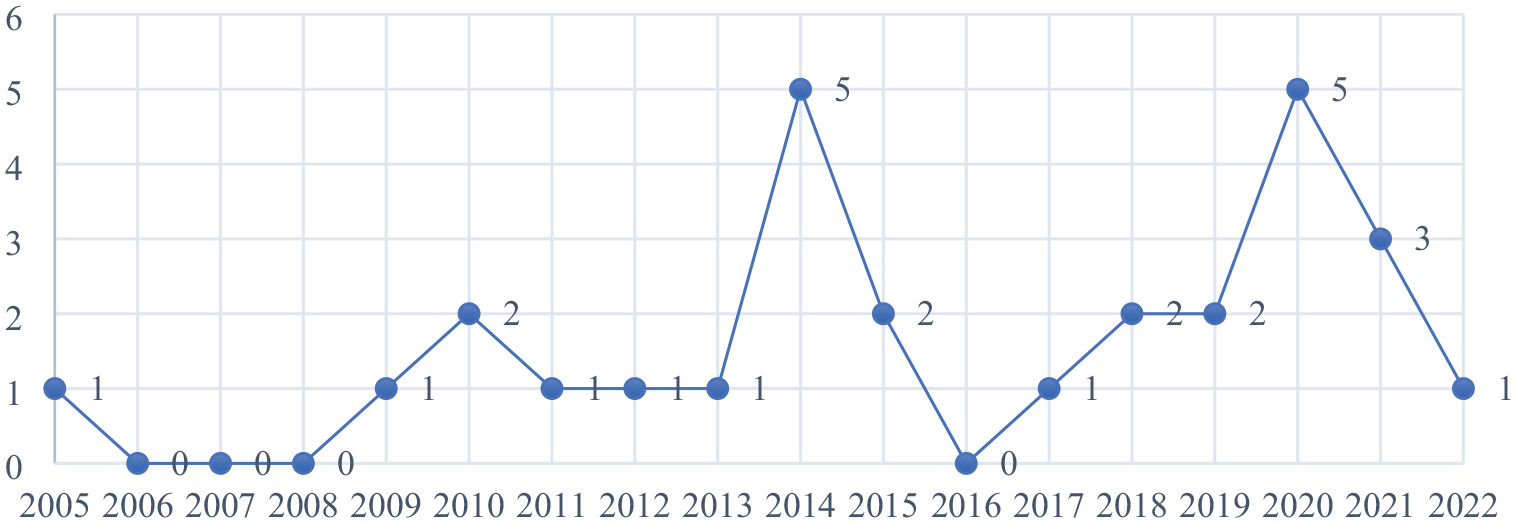
Annual publication frequency of PES effects on household income.
In addition to Table 1, keywords analysis is an effective way to clarify the main content and focus issues of the literature. This study used Cite Space to obtain keyword cooccurrence graph (Figure 2) and keyword clustering table (Table 2) for the 28 papers. Figure 2 reflects the high-frequency and centrality keywords, with a larger circular node indicating a higher frequency of occurrence. By combining Figure 2 and Table 2, cluster analysis divides the keywords into 8 groups and numbers them starting from #0 based on the number of keywords within the group, the focus and composition of these papers can be determined based on the clustering group size and the keywords it contains, and this study is further summarized into three main aspects.

The keyword co-occurrence graph of PES on farm household income.
The Keyword Clustering Table.

Firstly, #0 loess plateau is the group with the largest cluster size, containing keywords such as loess plateau, grain-to-green program, and grain for the green program. At the same time, #6 economic development also includes keywords with similar meanings to #0, such as northern Shaanxi, the sloping land conversion program, which collectively reflects the research objects, especially the specific regions, and projects targeted. This study collected more interesting information. The survey samples of 11 studies were taken from Shaanxi, followed by Sichuan, with eight studies. These two areas are located in western China, with an altitude of more than 1,000 m, and much of the land is unsuitable for cultivation. Specifically, Shaanxi is located on the Loess Plateau, which is one of the regions experiencing the most serious soil erosion in the world (Chang et al., 2011). The low opportunity cost and unique geographical features caused PES to be carried out quite early in the local area, which in turn attracted the attention of scholars. In addition, Sichuan is located in the upper reaches of the Yangtze River. Since the major flood of 1998, the government has expected the local area to take more responsibility for soil and water conservation. However, compared with Shaanxi, which has been suffering from an increasing loss of soil fertility for a long time, Sichuan may have a higher opportunity cost in terms of providing ecosystem services.
And then, the scales of #1 ecological restoration, #2 agent-based modeling, and #3 payment for ecosystem services are similar, the same as the keywords included in terms of type and nature, such as labor reallocation, income, and opportunity cost, propensity score matching and agent-based modeling. And the keywords in #7 livelihood assets also have the above characteristics, while it has the smallest scale. These four groups collectively reflect the characteristics of research design about influencing factors, variable selection, methods, and models.
Of the 28 papers, only seven used panel data, while the rest employed cross-sectional data. This phenomenon made it difficult to observe the income effect of PES programs on the time dimension. Among the 21 papers with cross-sectional data, logistic and Tobit regression methods were the most popular, being used in over one-third of the paper. Four papers used ANOVA. Notably, however, few studies have used frontier methods, such as structural equation modeling or social network analysis. Almost all of the panel data articles used the fixed effects model or Difference-in-differences (DID).
At last, #4 collective forest areas and #5 natural forest conservation programs including the keywords such as forest income, forest policy, and community-based natural resources management, reflect the analysis and explanation of typical cases in China’s PES study.
The results of the 28 pieces of literature vary widely. Whether examining agricultural production, off-farm, or total income, three discoveries are made: increase, decrease, and no significant effect. However, seven papers found that PES will exacerbate income inequality, and this conclusion has the biggest consensus. Below, the arguments over the results are deeply discussed.
Moreover, the same analysis also reveals the collaboration and influence between authors through the author collaboration graph (Figure 3), the number of published articles is presented in terms of node size, and the degree of collaboration between authors is presented in the form of a line. It can be seen that the authors located at the center of the graph have significant influence in this field and research topic, such as Song Conghe, Bilsborrow Richard, Yao Shunbo, and Liu Can, forming four sets of author collaboration networks.
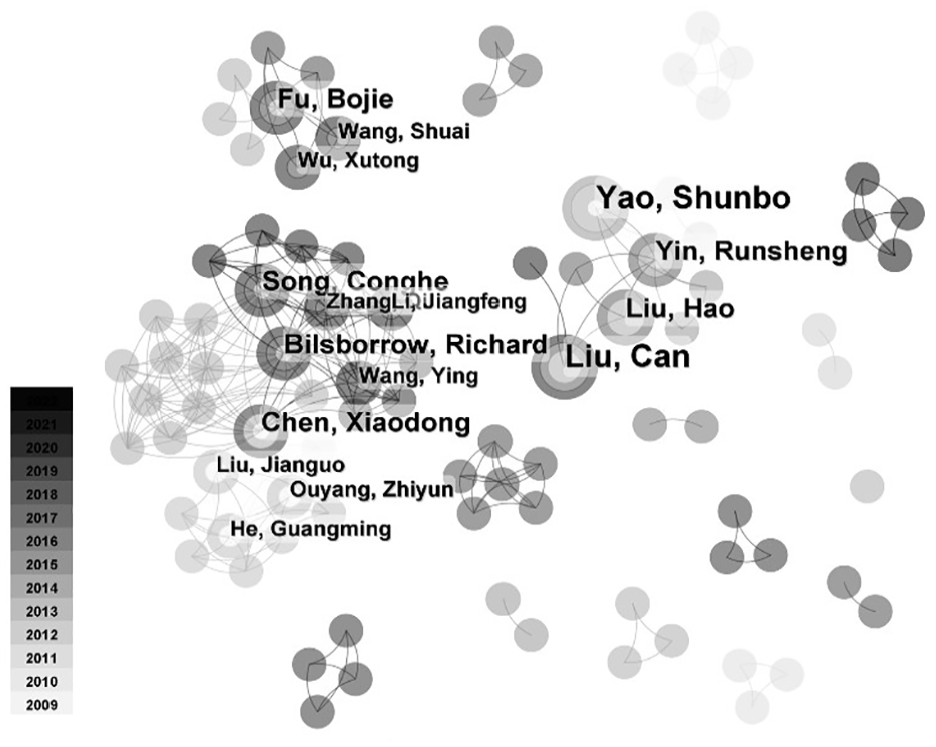
The author’s collaboration graph.
PES Effect on Agricultural Production Income
The effect of PES on agricultural production income is the most intuitive. According to Qu et al. (2011), the Sloping Land Conversion Program is the main reason for the sharp shrinking of cultivable land area in China, to an even greater degree than urbanization and soil erosion. Therefore, 16 papers agree that, due to the reduction in the area of cultivable land held by farmers and the decline in the total amount of grain produced per household, agricultural production income has declined (X. Chen et al., 2009; Uchida et al., 2005).
However, some literature has raised strong challenges to this seemingly obvious result. The most typical literature came from Lin and Yao (2014). The study claimed that PES did not significantly reduce farmers’ agricultural production income and that the existing literature overestimated the opportunity cost of participating in PES. This quantitative finding tends to have two explanations: (1) In some PES schemes, to prevent farmers from effectively becoming addicted to subsidies, the government allowed a portion of forest land to be used for fruit cultivation. (2) The government encouraged farmers to participate in forestry cooperatives, which was also a way to increase agricultural production income (Zhang & Paudel, 2019). Under these circumstances, forest land has a substitution effect on cultivable land, and the conclusion was reached that there was no significant decline in production income. However, this view was refuted by subsequent studies. Duan et al. (2015) claimed that some PES programs have a compensation period of 6 to 8 years. Poor farmers lost almost all of their income when subsidies ended. To maintain their livelihoods, these farmers are likely to choose to reconvert the cultivable land from which they had previously withdrawn. Once the investigation period was too long, the income from re-cultivation may have been recorded as agricultural production income, so the effect of increasing income may have been exaggerated. Finally, a few studies have inferred that PES promotes agricultural production income. The logic of this thinking is that forestry cooperatives have a stronger substitution effect (C. Wang et al., 2017; Zhen et al., 2014).
PES Effect on Off-Farm Income
According to Table 1, the most complex and controversial path that can be taken to increase income is off-farm income, which in turn is divided into subsidy and migration income. Specifically, the subsidy reflects the short-term guarantee of the PES programs to farmers’ livelihoods, while the migration income considers the long-term effect of these measures. In theory, neither income can be a negative number, so studies could easily infer that the program will have a positive effect. 22 articles provided such affirmative views. However, some literature has suggested that the studies that estimate only average effects are superficial.
In the field of subsidies, scholars have analyzed the potential effect from both horizontal and vertical time scales. Horizontal refers to differences within a region, while vertical shows the changes in subsidies over the years. In general, due to the clear subsidy criteria, no significant differences in income will exist within the same PES scheme (Xu et al., 2006). However, in their research on the Loess Plateau, Hua Li et al. (2015) found that the more farmland area farmers withdrew from, the higher the subsidy per unit area would be. This shows that, in practice, the government has established a flexible subsidy mechanism that encourages farmers to withdraw from more land. The incentive mechanism also directly affected the income increase effect. Sheng et al. (2019) argued that the subsidy measures lead to negligible subsidies for farmers who have less cultivable land. On the contrary, wealthy farmers will occupy funds, even if incremental income results are available in the estimated average. This phenomenon is also known as “elite capture.” Differentiated subsidy mechanisms are also seen as a core factor in exacerbating income inequality (Peng et al., 2022; L. Wu & Jin, 2020). Vertically, the study found that subsidies will be heterogeneous in line with the degree of farmers’ active response to the program. On the whole, during the period from 1999 to 2011, the earlier the farmers participated in the PES, the higher the fund they would receive, thereby forming an efficiency drive, more than fairness. The farmers who participate in the latest scheme may even be only half the number of those who participated in the earlier ones, and the statistics do not take inflation into account (Yin & Zhao, 2012). Further, some frontier studies also found that farmers who plant rice get fewer subsidies than those who plant corn (Y. Yang et al., 2020). This is because, in China, rice is more expensive to plant, which delays farmers from withdrawing from the land. However, these scholars did not deny the role of PES in promoting off-farm income.
Eighteen of the sampled papers show that PES has a positive effect on migration income. The fundamental logic is as follows: PES eases the constraint of land on agricultural labor, reduces the marginal productivity of agriculture, improves the mobility of labor factors, and finally improves income (Yin et al., 2014). During the PES program, some regions also used supporting channels, such as providing training, improving credit availability, and providing urban medical insurance, to stimulate migration (X. Wu et al., 2019). However, a few studies that are based on cross-sectional data have also raised questions. They claimed that some farmers only changed from farming to forestry and other agricultural production activities, and these farmers have not migrated to the cities (S. Lu et al., 2020). One possible explanation could be the price index. Y. Yang et al. (2020) considered that it is difficult for farmers to maintain an income that would cover the expenditure on food, housing, etc. in the city. A higher cost of living hinders labor mobility and ultimately affects income growth. Moreover, some advanced studies have also carried out heterogeneity analysis for sample characteristics. Peng et al. (2022) found that PES did not significantly increase off-farm income for elderly and unhealthy farmers. Y. Yang et al. (2020) inferred that cities may struggle to provide these farmers with sufficient employment opportunities.
According to the Pedi-Clark theorem, with the development of the economy, the income elasticity of the primary industry will decline and ultimately become smaller than that of the secondary and tertiary industries. The above dilemma reflects that the improvement of off-farm income also requires sustainable urbanization in China.
PES Effect on Total Income
The argument over how PES affects agricultural production and off-farm income has directly led to a discussion of the effectiveness of total income. According to Table 1, some scholars support the growth theory, the no significant effect theory, and the decline theory. Moreover, this study also shows heterogeneity at the regional scale and household characteristics.
The basic idea of the total income growth theory is as follows: by relying on the PES to drive the rural-urban migration and subsidy, the growth rate of farmers’ off-farm income is much higher than the decrease in agricultural production income. Therefore, the PES promotes an increase in total income (H. Li et al., 2015). This view is supported by 15 papers, which show that the relevant scholars generally agree that the growth driver of total income is off-farm income, rather than agricultural production. Combined with the information shown in Table 1, no studies can be found in which non-farm income decreased but total income increased. Literature on total income growth, such as C. Wang et al. (2017) and Hao Li et al. (2018), generally affirmed PES’s contribution to labor transfer. The studies believe that farmers have gradually turned peasants into urban workers due to PES. Two papers by Uchida et al. (2005) and Song et al. (2014) argued that total income growth comes from subsidies. This result reflects the authors’ disapproval of the labor transfer function of urbanization.
The basic idea of the “no significant effect” is as follows: the agricultural production income lost due to PES forms an offset effect with off-farm income. The ultimate result is no significant change in total income (S. Lu et al., 2020). According to the findings of Uchida et al. (2005), PES in China could increase total income. However, after removing the subsidy variable in the empirical estimation, the effect on total income would be insignificant. On the contrary, opposing voices have claimed that government subsidy revenue was simply a “drop in the bucket” and did not indemnify farmers for the lost agricultural production income (L. Li et al., 2021).
Scholars who hold the theory of declining total income are particularly concerned about migration income. According to the above analysis, the increase in migration income is dependent on the contribution of urbanization to the restructuring of employment. Once urbanization failed to achieve the expected transfer of the agricultural population, total income showed a decline. Furthermore, the individual characteristics of farm households also affect the growth of off-farm income. Existing literature has found that PES is more likely to reduce the total income of females, the less educated, and older farmers, thereby reflecting the inequity of PES in China (Song et al., 2014).
The above analysis is summarized in Figure 4. Obviously, the following basic findings have been obtained: (1) In the discussion of PES on farm household income, it is important to focus not only on the increase in income but also to pay attention to incidences of inequality. Currently, heterogeneous subsidies and underemployment are the primary reasons for income inequality, and they are both caused by the impact of PES on off-farm income. (2) Five cause analyses are related to urbanization. This suggests that the vital factor in the effect of PES on farm household income is likely to be migration income. (3) Individual frontier studies have provided a renewed response to the cause analysis.

The impact of PES on farm household income.
Empirical Strategy: Meta-Analysis and Meta-Regression Analysis
In this paper, we first apply meta-analysis to estimate the weighted effect sizes of the original studies (13 articles), and then test the publication bias, finally identify moderating variables through meta-regression models. Due to the quality of data in the original literature, this study only estimates the impact of PES on total income.
In accordance with the above, this paper uses a random effects model to estimate the extent of the impact of PES on farm household incomes, See the Figure 5. To test whether random effects are practicable, the study first calculates individual-level chi-squared and I -squared statistics. The results reveal that the heterogeneity chi-squared is 76.44 (p = .00), which indicates the feasibility of random effects. Furthermore, we plot the effect sizes of 13 studies with random forest plots. shows that there is indeed heterogeneity in the findings of the existing literature. Through weighting, the study confirms that the PES program has a boosting effect on the total income of farm households, with an increased level of 0.15 average effect size (p = .02). This finding effectively responds to the existing mixed results.

Individual-level random forest graph.
Additionally, this paper needs to test the publication bias, which may lead to misjudgment of results or an exaggeration of the relationship between variables. Accordingly, we test the publication bias using the Egger and Begg approaches. The results (Table 3) reveal that there is no significant publication bias in the study and the meta-analysis results are credible.
The Publication Bias Test.

Further, it is necessary to identify the factors that contribute to the heterogeneity of the study results. As mentioned above, the following factors may have influenced the effectiveness of PES for poverty alleviation: (1) Subsidy intensity. Subsidies are an important component of off-farm income. According to the above, farmers with more participating areas (hm2) may receive more subsidies and the subsidized unit prices vary by region (RMB/hm2). (2) Investigation period. Too long a survey period may overestimate the effectiveness by including income from land reclamation as agricultural production income. (3) Urbanization. The urbanization level directly affects farmers’ employment opportunities and thus has a moderating effect on off-farm income. (4) Farmers’ individual characteristics. A typical example is older farmers may be discriminated against in migration, thereby reducing off-farm income. Therefore, we collected relevant variables from the literature. In addition, we obtained the variables of urbanization level from the Chinese Urban Statistical Yearbook. The urbanization rate is measured as the annual average of the local cities during the implementation of PES. If the study involved multiple regions, the data were averaged again. Lastly, we choose the sample size as a control variable. All data are taken logarithmically to overcome heteroskedasticity.
We apply Equation 1 to estimate the effect and Table 4 presents the results. The study reveals that almost all variables are as expected in significance at the 10% level. (1) Subsidized unit price. The higher the PES schemes for the variable, the higher the increase in the total farm household income. This finding challenges the opinion that farmers may be addicted to subsidies and thus refuse access to migration income; (2) Urbanization level. The result reveals that the effect of PES on poverty alleviation requires higher urbanization as a complementary initiative. After PES increases the mobility of labor factors, it is important to promote the flow of labor to cities rather than other agricultural production work; (3) Participation area. The result shows that farmers who withdraw more acreage from cultivation are subsidized. This suggests that the government has differentiated subsidy incentives in place. (4) Farmers’ individual characteristics. The study reveals negative correlation between age and farmers’ income growth. The results supports the Y. Yang et al. (2020)’s claim as well and reflects that PES has exacerbated inequalities among farm households.
Meta Regression Analysis.

, **, and *** represent significance at the 10%, 5%, and 1% levels, and the standard deviation in brackets.
Finally, investigation period does not significantly affect the effectiveness of PES. It is not surprising as some studies claimed that the investigation period has a positive correlation with agricultural production income. However, individual pre-post data were usually obtained from the farmers’ memories usually (G. Lu & Yin, 2020). This means that excessively long periods may cause insignificant meta-regressions by affecting data quality.
Discussion
Since the introduction of ecosystem services into the social sciences, the effect of PES on farm household income is found to be an issue of ongoing debate. Despite the many empirical studies that have been undertaken to test the effect of PES on poverty alleviation, some mixed results have been obtained. Take the China’s experience as an example, we argue that government-led PES can increase total incomes, even if it has room for improvement on distributional equity. Thus, in addition to poverty alleviation, the contribution of PES to the other SDGs also deserves deeper reflection. We believe this study has advanced the SDGs field in at least two aspects.
First, our research echoes the finding by Rosa da Conceição et al. (2015) that government is emerging as a major PES initiative. Rosa da Conceição et al. (2015) argued that in the PES project, the government played the function of gathering public awareness and providing supportive services. Besides, public recognition and supportive services are essential for No Poverty (SDG1) and Sustainable Communities (SDG11). Surprisingly, current research did not answer the issue at the micro level of how public recognition is shaped and what the targeted supporting services are. Based on empirical analysis, this paper visualizes the incentives for public participation, and the content of supporting policies. Specifically, the government’s primary tools for inducing citizens to recognize PES as well as environmental protection are the expansion of employment opportunities, and the promotion of subsidies based on the level of participation of the land area. Moreover, the government’s main supporting mechanism is urbanization. It shows that the PES program is not only aimed at environmental protection, but also needs to take into account Decent Work (SDG8), and Industry, Innovation and Infrastructure (SDG9).
Second, we recognize that the main conflict point for Climate Action (SDG13) is not economic growth, but social equality (SDG10). The synergy of the various missions is a great challenge for sustainable development. In conventional wisdom, the biggest challenge to advancing climate action is economic growth. Along with the popularity of concepts such as green total factor productivity (Lee & Lee, 2022), eco-industrialization (Z. Li & Liu, 2023), and clean energy (Qi & Wu, 2013), there is widespread agreement that the 17 development tasks can be advanced simultaneously. However, Given China’s practices, we raise concerns about whether advancing climate action can at the same time ensure social equality, including endowment equity and intergenerational equity. For one thing, residents who retain more land receive higher unit price subsidies, which will exacerbate income disparities among farm households. For another thing, older farmers are less likely to realize income gains through PES. Presently, the risk of inequality due to PES also occurs in Nepal (Kolinjivadi et al., 2015), Kenya (Bedelian et al., 2024), Cameroon (Tegegne et al., 2021),and Mexico (Bee, 2019). We argue that the inequality is both based on the initial arbitrary land distribution and related to the lack of linkage between PES policies and the social security system. In summary, our discussion echoes the insights of Benra et al. (2022), and they pointed out that it was not enough to consider only ecological strategy goals in PES design, and that social goals were another responsibility.
Conclusion
PES has been widely implemented in the Global South as a key scheme to motivate the inhabitants to participate in the environmental protection (Bedelian et al., 2024). In particular, there is a growing acceptance of the usefulness of PES in realizing the SDGs. China, as one of the first countries to apply PES to improve farmers’ incomes, its experience will directly assist other countries in linking climate action and poverty alleviation. Thus, this study has collected literature on the effect of PES on farm household incomes in China over the past 20 years by Webster and Watson’s (2002) literature search methodology, meta-analysis and meta-regression analysis. The following conclusions were drawn: Overall, the PES program reduced income from agricultural production, but boosted off-farm and total income. Second, PES boosted total income by 0.15 weighted average effect size and the result passed the literature bias test. Third, the participating area, the unit price of the subsidy, the level of local urbanization and the age of farmers affect the effect of PES on poverty alleviation. Concretely, the former three factors have positive effects while age has negative. Moreover, flexible off-farm income generation mechanisms may increase inequality. Besides the elite capture from the participating area, inequalities also include discrimination against farmers’ health, age, and choice of crops grown qualitatively and this paper has identified the age quantitatively.
In response to these conclusions, this paper provides the following policy recommendations. First, before implementing a government-led PES scheme, it should incorporate a combination of resident income enhancement, social equity and environmental objectives. Second, in the PES program, the government provides an employment support mechanism for small-scale land holders to balance the widening income gap caused by the scale of participation. Third, the government needs to use quality urbanization as a support service for PES projects. In the process of urbanization, employment equity for all people must be guaranteed, and discrimination based on age, health, gender, etc. must be prevented.
Admittedly, this study has limitations in terms of the literature collection. First, the amount of literature collected was small, although the growth in the number of related studies in recent years is perceivable. Second, the study area of the literature is quite concentrated, mostly located in the western part of China. In reality, PES fully covers China, which means the conclusions of this study are not necessarily applicable to the eastern part of the country. Third, in the latest study, it was found that the PES can also boost farmers’ income through industrial upgrading (Z. Li & Liu, 2023). This path will probably reverse the way we classify non-farm income. However, with only one paper, we were unable to develop an in-depth analysis of the channel. Moreover, we identified a dilemma in China’s PES program that makes it difficult to balance multiple economic, social, and ecological goals. However, there is less existing literature devoted to the study of China’s PES program from an inequality perspective, making it difficult to conduct a highly relevant bibliometric analysis in this paper. In summary, the following studies are yet to be conducted on the connection between the PES program and farm household incomes, including a broad scale exploration of the connection, especially the impact of cross-regional PES schemes on the incomes of farm households in different regions, or an analysis of the impact of PES on the stratification of farm households by categorizing social equity into multiple dimensions in the future.
Footnotes
Acknowledgements
This research acknowledged the financial support from the Department of Education of Jiangsu Province, the People’s Republic of China, and China Institute for Rural Studies, Tsinghua University.
Author Contributions
Each author contributed to the study conception and design
Writing – original draft, Software, and submit the article were performed by Bohao Jin; Writing—review and editing, data processing, and conceptualization methodology were performed by Heming Wang.
Declaration of Conflicting Interests
The author(s) declared no potential conflicts of interest with respect to the research, authorship, and/or publication of this article.
Funding
The author(s) disclosed receipt of the following financial support for the research, authorship, and/or publication of this article: This research is supported by The Scientific Research Innovation Program Project for Philosophic Doctor of Jiangsu Province (No. KYCX22_0788); The PhD Dissertation Scholarship of China Institute for Rural Studies, Tsinghua university (No. 202209).
Ethics Statement (Including the Committee Approval Number) for Animal and Human Studies
The authors declared no animal experiments were conducted.

Data Availability Statement
Data will be made available on request.