




Abstract
Due to the increasingly fierce competition in recent years, the e-retailers try to establish cooperation alliance. In this paper, we study a profit allocation problem in the multiple-channels order fulfillment system of an e-retailers cooperation alliance. The aim of the cooperation is to maximize the total profit of the alliance by sharing the orders and inventories of goods of all e-retailers, which also helps to increase the profit of each e-retailer. After cooperation, a Rule-utilitarianism core (RUC) profit allocation mechanism is designed to fairly allocate the total profit of the alliance. RUC mechanism is compared with well know Shapley allocation and Egalitarian core allocation. The effectiveness of the RUC mechanism is verified by numeric experiments. The results show that the cooperation can bring more profits for all e-retailers and the RUC mechanism can insure the stability of the alliance on the basis of the contribution measure of each e-retailer to the alliance.
Introduction
Along with high speed development of the e-commerce business in recent years, the online orders from customers have risen sharply and many e-retailers have emerged. Meanwhile, the competition in the service market is increasingly fierce for the e-retailers. Different from the good-product market, the service market emphasizes more from the standpoint of customers. And the service supply should be timely and fast and the service companies must connect the production, retail, and consumption locations together to provide the products. Therefore, how to fulfill the large amount of orders from customers with a lower cost and a faster speed has become a major challenge for the e-retailers. As one of the major e-commerce market of the world, many famous e-retailers have appeared in China. One type of these retailers is the e-commerce company, such as Alibaba, Jingdong, Meituan, etc. Another type of the retailers is the traditional retailer (large supermarket or department store), such as Carrefour, Walmart, RT-MART, and Auchan. Both the two types of companies have set up the online and offline business, which can be regarded as e-retailers. For the sake of fast fulfilling the orders and earning larger profits and avoiding lost sales and the expirations of the commodities (Bijvank & Vis, 2011), the e-retailers in China try to establish cooperation alliances, especially in service market as foods are often at high risk of expiration. For example, FRESHIPPO from Alibaba, RT-MART and Auchan have set up an alliance, Jingdong, Pinduoduo, and Yonghui have also built another alliance.
During the cooperation, the alliance has to well address two issues. The first is how to organize the cooperation, and the second is how to keep the stability of the cooperation. The two issues are also the central topic of cooperative game theory. In this paper, we study a profit allocation problem happens in the multiple-channels order fulfillment system of an e-retailer alliance, where the orders and inventories of all e-retailers are shared in the alliance. Here, multiple-channels mean that each order from customers can be fulfilled by any stock of any e-retailer in the alliance.
In the literature, the cooperative game theory has been studied for many years (Branzei et al., 2008; Curiel, 2013), where multiple cooperators (player) take part in the cooperation. It has widely applied into different research areas, such as inventory management (Fiestras-Janeiro et al., 2011), environmental issues (Parrachino, 2006). As an important issue of cooperative game theory, profit or cost allocation problem has been investigated by many researches (Lemaire, 1984; Wu et al., 2017). In addition, the profit allocation games were used to deal with the different types of cooperation in supply chain and logistics, where all cooperators form a grand coalition (alliance) to seek larger profits. Fox example, the collaborative transportation planning (Audy et al., 2011; Dai & Chen, 2012, 2015; Fiala, 2016; Gansterer & Hartl, 2018; Guajardo & Rönnqvist, 2016; Krajewska et al., 2008; Verdonck et al., 2016), the supply chain coordination and cooperation (Chen et al., 2007; Frascatore & Mahmoodi, 2011; Jaber et al., 2006; Li et al., 2023; Liu et al., 2018; Vatanara et al., 2024; Wang et al., 2023; C. Yang et al., 2019; Yao & Ran, 2019), the virtual enterprises management (Deng & Liu, 2009; Zhong et al., 2019), the e-commerce logistics service (Lozano et al., 2013; Shapley, 1953; Zhang et al., 2024), etc.
Various approaches were proposed to solve profit or cost allocation problem in previous studies. Some well-known and famous methods were designed, that is, Shapley value (Shapley, 1953), Core allocation (Gilles, 1959), Kalai-Smorodinsky (KS) allocation (Kalai, 1977), Egalitarian allocation (Kalai, 1977), Nucleolus (X. Yang et al., 2022), etc. Shapley value computes the profit of each cooperator by considering its contribution to each sub coalition of the grand coalition. KS allocation calculates the profit of each cooperator by considering its cooperation with each other cooperator in the grand coalition. Egalitarian allocation equally distributed the total profit of the grand coalition among all cooperators. Core allocation assures that a cooperator wants to stay in the alliance because it will not obtain a larger profit when leaving the alliance. Thus, the alliance is stable. By contrast, the allocations of Shapley value, KS and Egalitarian are not stable at all time.
In recent years, retailers more and more concern about their order fulfillment costs due to the fierce competitive environment (Hamdan et al., 2023; Ishfaq & Bajwa, 2019; Roodbergen et al., 2016). Retailers start to explore multiple-channels operation for reducing order fulfillment costs. Some researchers have proposed various multiple-channels business models (Amrouche et al., 2023; Dai et al., 2021; Gallino & Moreno, 2014; İzmirli et al., 2021; Luo et al., 2019; Sun et al., 2015). For example, Ishfaq and Raja developed a framework for the online order fulfillment process of a large American retailer to evaluate various order fulfillment options (Ishfaq & Raja, 2018). Pathakota et al. (2023) studied a cost-to-serve problem in electronic commerce and proposed a reinforcement learning based method. But previous studies mainly focused on the multiple-channels order fulfillment for one retailer. In this paper, we study a multiple-channels order fulfillment system that includes multiple e-retailers. In addition, the profit allocation problem is not discussed in the order fulfillment of multiple retailers in literature.
The new contributions of this study are summarized underneath.
Firstly, as far as we know, no studies have discussed the profit allocation problem for multiple e-retailers in service market, especially between e-commerce companies and traditional retailers.
Secondly, a rule-utilitarianism core profit allocation mechanism is proposed, which is formulated to a bi-objective programming model. The mechanism can find a core or approximate core allocation that fairly allocates the profit among e-retailers (cooperators) based on the contribution measure of each cooperator, which is more reasonable than the existing famous profit allocation mechanisms.
The structure of the paper is introduced as follows. Section “Problem Description” gives the problem description. Section “Multiple-Channels Order Fulfillment System Modelling of the E-Retailers Alliance” models the e-retailers cooperation problem and Section “Profit Allocation Mechanism Design of the E-Retailers Alliance” presents three profit allocation mechanisms. Section “Experimental Results” compares the performances of three mechanisms by computational experiments. Section “Conclusions and Future Works” summarizes the paper and proposes the future directions.
Problem Description
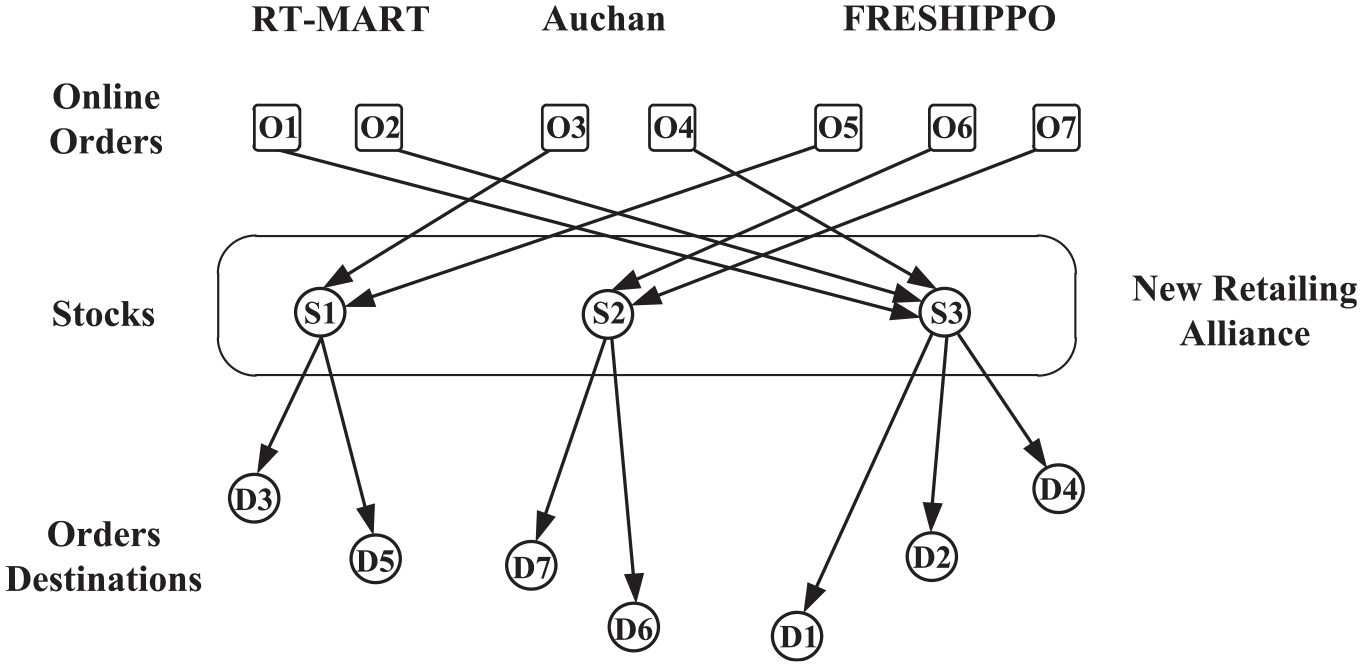
A common order fulfillment system for e-retailing in service market is explained in Figure 1. At first, a customer makes an order through the online platform of an e-retailer. Then an order with a group of goods (such as snacks or fresh products) is generated from this customer to a supermarket store (stock or stock location) of a retailer, such as FRESHIPPO, RT-MART and Auchan. Initially, e-retailer has independent orders, stocks and order destinations. For example, RT-MART has order O1 and O2, stock S1 and order destination D1 and D2. Each stock of the e-retailer holds a preset inventory quantity of each goods. Then the stock fulfills the order and sends the commodities to the order destination, for example, the line from stock S1 to order destination D1 in Figure 1. As each e-retailer may get orders with different destinations from multiple customers, sometimes the retailer has to serve an order with long transportation such as the line from stock S3 to order destination D5 in Figure 1. Without cooperation, each e-retailer fulfills its orders respectively. Thus, more operation costs are needed in the order fulfillment system for an e-retailer.

A common order fulfillment system of the e-retailers before cooperation.
In this study, we consider an e-retailers cooperation problem in service market, where multiple e-retailers form a retailing alliance and a cooperation game (Kalai, 2008). The goal of the cooperation is to serve the orders more efficiently. And each e-retailer is regarded as a cooperator. Initially, each stock of the e-retailer holds a preset inventory quantity of each goods. The cooperation is organized in a centralized cooperation mode where each e-retailer shares all orders and inventories of all stocks to the alliance. And the alliance is in charge of scheduling the order fulfillment.
The multiple-channels order fulfillment system of the alliance can be showed in Figure 2. The alliance selects the most suitable stock to fulfill each order based on the inventories of all stocks. Then the alliance decides the distances between the stocks and the orders destinations so as to minimize the total distances of serving all orders. For example, the line from stock 1 to order destination 5 in Figure 2 replaces the line from stock 3 to order destination 5 in Figure 1. A retailer can fulfill other e-retailers’ orders. The goal of order fulfillment is for the sake of maximizing the whole profit of the alliance by serving all orders.
An order fulfillment system of an e-retailer alliance with cooperation.
As we can see from Figure 1, stock S1 of RT-MART serves its own order O1 and O2 with order destination D3 and D5. Stock S2 of Auchan serves its own order O3 and O4 with order destination D3 and D4. Stock S3 of FRESHIPPO serves its own order O5, O6, and O7 with order destination D5, D6, and D7 before cooperation. But in Figure 2, stock S1 of RT-MART serves order 3 and 5 with order destination D3 and D5. Stock 2 serves order 6 and 7 with order destination D6 and D7. Stock 3 serves order 1, 2, and 4 with order destination D1, D2, and D4 in cooperation. The order fulfillment solutions before and after cooperation are totally different. Namely, the orders are reallocated among e-retailers during the cooperation. Obviously, the multiple-channels order fulfillment solution in Figure 2 is more reasonable, where the sum of distances to serve all orders is much shorter.
In the order fulfillment system, the orders of all retailers are in the same day and can be served at the same time. Each order is allowed to be served with other orders. If the inventories of all stocks can not satisfy the required quantities of the orders, the stock-out will happen. Thus, both stock-out cost and transportation cost are considered.
Multiple-Channels Order Fulfillment System Modelling of the E-Retailers Alliance
In this section, a mathematical model is formulated for the multiple-channels order fulfillment system of the e-retailers alliance. At first, the notations employed in the model for the studied problem are given.
Indices
i: stock index, i = 1,…, I, I indicates the number of stocks owned by all cooperators.
j: goods index, j = 1,…, J, J indicates the number of goods.
k: order index, k = 1,…, K, K indicates the number of orders.
l: destination index, l = 1,…, L, L indicates the number of destinations.
n: cooperator index, n = 1,…, N, N indicates the number of cooperators.
Parameters
SSn: the set of stocks belong to cooperator n.
SOn: the set of orders belong to cooperator n.
dk: the destination of order k.
LN: a large number, LN > 0.
Variables
Next, we formulate the order reassignment problem for retailing alliance as a mixed-integer programming model ORP.
Model ORP:

Subject to:



The objective function (1) is to seek the maximal total profit of serving all orders by the alliance. Constraints (2) indicate the order balance equation. If the quantities of each goods in all stocks can not satisfy the demand of the goods from customers, the stock-out may happen. Constraints (3) indicate the quantities of each goods of all orders supplied from a stock should not exceed the initial inventory quantity of this goods in this stock. Constraint (4) denote the relationship of the two decision variables
Profit Allocation Mechanism Design of the E-Retailers Alliance
After solving model ORP, we can obtain the total profit of the e-retailers alliance. Based on the solution of the model, three profit allocation mechanisms are proposed for the alliance to allocate the total profit by adding the following notations.
Parameters
n: cooperator index, n = 1,…, N, N indicates the number of cooperators.
CN: Set of N cooperators.
SCN: Subset of CN.
P({n}): the profit of cooperator n before collaboration.
P(CN): the total profit of the alliance with all cooperators.
P(SCN): the total profit of the subcoalition in CN.
Cn: the contribution measure of cooperator n to the alliance.
Variables
Shapley Allocation Mechanism
Shapley value is a well-known profit/cost allocation method in cooperative games (Shapley, 1953). But it is not always in the core of the game so that the alliance is not stable. Thus, a cooperator may leave the alliance because it is possible to obtain a larger profit. In Shapley allocation, the profit of each cooperator is calculated by equation (6).

Egalitarian Core Allocation Mechanism
Egalitarian allocation declaimed to equally allocate the whole profit of the alliance among all cooperators but it was not always in the core of the game (Dai & Chen, 2015). Then egalitarian core (EC) allocation was proposed to find an egalitarian core allocation (Arin & Inarra, 2001; Arin et al., 2008). EC allocation can be generated through solving the following mathematical model ECM.
Quadratic programming model ECM:

Subject to:




The objective function (7) minimizes the quadratic sum of the profits of all cooperators to find an Egalitarian allocation. Constraints (8) insure that the alliance is stable and the allocation is in core. Constraints (9) make sure that the allocation is efficient, which means that the total profit of the alliance is equal to the sum of the profit of each cooperator through collaboration. Constraints (10) denote the individual rationality of the allocation, which indicates that the profit each cooperator after collaboration is larger or at least equal to its profit before collaboration. Constraints (11) present the range of the variables. Because of constraints (8), EC allocation may be infeasible as the core of the game is sometimes empty.
Rule-Utilitarianism Core Allocation Mechanism
Utilitarianism is one of morality theory which declares that the goal of morality aims to make life better by increasing the amount of good things and decreasing the amount of bad things. And rule-utilitarianism thinks that one can maximize utility only by establish a moral code that has rules (Harsanyi, 1982). In this study, multiple retailers (cooperators) form a retailing alliance to serve the orders faster and earn higher profit. It is a commercial cooperation (rule) among multiple companies which have profit-seeking motivation. Inspiration by the former theory, we propose a rule-utilitarianism core allocation mechanism, whose solution can be found by solving the following mathematical model RUC.
Mathematical model RUC:


Subject to:


And constraints (8) to (11).
The objective function (12) maximizes the value of variable
In equation (14),
Furthermore, model RUC has two objectives (12) and (13) which is a bi-objective programming model. Since the objective (12) is associated with the conditions of core allocation that assures the stability of the allocation, it is the primary optimization objective of model RUC. Therefore, we can solve model RUC in two steps. In the first step, we solve model RUC only with the objective (12) and get the value of
In addition, the comparisons of three mechanisms are analyzed as follows.
Firstly, as discussed above, the Shapley allocation may be not in the core of the profit allocation game. Then the egalitarian core (EC) allocation may be infeasible. Our proposed rule-utilitarianism core (RUC) allocation can avoid these shortcomings.
Secondly, both Shapley allocation and RUC allocation are formulated as linear programming models, which are easier to be solved compared with the quadratic programming model of EC allocation.
Thirdly, since multiple retailers that are profit-seeking individuals participate in the cooperative game under a competitive business environment, it is naturally that the retailers are more likely to accept the contribution-based allocation (Shapley and RUC) not the egalitarian allocation (EC). Furthermore, Shapley allocation only considers the contribution of a retailer for serving the orders to the alliance. But RUC considers the contribution of a retailer from both serving and providing the orders to the alliance.
Experimental Results
To compare the above three mechanisms, we carry out the following computational experiments. First of all, two sets of instances are designed, where each set includes 10 instances. In each instance, the number of e-retailers is set to 3, and the number of goods (products) is set to 3. Each e-retailer has 1 stock and 2 orders. Each order has own destination. The demand quantity and demand variance quantity of each product in each order, the stock-out cost, the sales price and the volume of each product are set according to the data of Alibaba and the parameter settings given by Dai et al. (2021). Initial inventory quantity of each product at each e-retailer is generated based on the demand quantity and demand variance quantity of the product at all e-retailers.
In order to effective solve the models of each instance, we use the famous optimization solver ILOG Cplex 12.9 which is run in a PC. Tables 1, 2, and A1–A6 in Appendix A show all experimental results. The computation time of solving each model is in several seconds, so the solution method is not considered in this study.
Total Profit Comparisons in the First 10 Instances.

Total Profit Comparisons in the Second 10 Instances.

Tables 1 and 2 show the tested results of all instances. In these tables, “Before” indicates the total profit of the alliance before cooperation. “After” indicates the total profit of the alliance after cooperation. And “Increase” denotes the total profit increase, that is, Increase = (After − Before)/Before. From the results, the total profit of the alliance is increased in each of 20 instances, where the increase percentage is from 3.7% and 20.2%. Thus, the cooperation can bring more benefits for all e-retailers (cooperators).
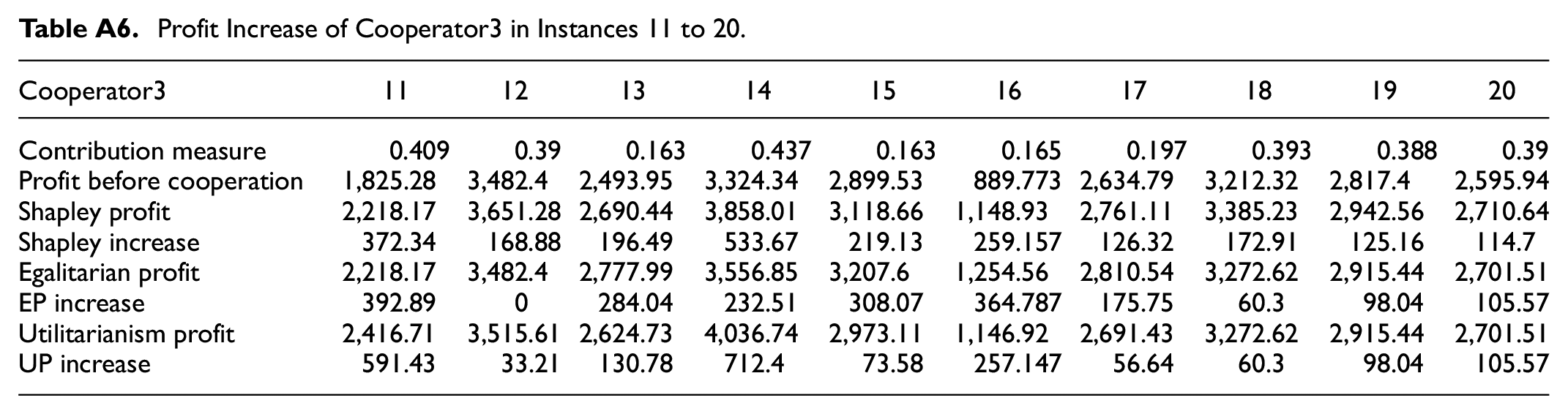
Tables A1 to A6 in the Appendix A display the profit increase of each e-retailer in each instance. “Contribution measure” indicates the contribution measure of each e-retailer (cooperator) to the alliance. “Profit before cooperation” denotes the profit of each cooperator obtained without cooperation. “Shapley Profit” presents the profit of each cooperator generated by using Shapley allocation mechanism. “Egalitarian Profit” and “EP Increase” indicate the profit of each cooperator and its profit increase compare with “Profit before cooperation” gained by applying Egalitarian core (EC) allocation mechanism. “Utilitarianism Profit” and “UP Increase” present the profit of each cooperator and its profit increase compared with “Profit before cooperation” gained by applying Rule-utilitarianism core (RUC) allocation mechanism.
By careful checking the experimental results in the Appendix A and B, we obtain the following findings. Figures B1 to B10 in Appendix B give the profit increase comparison of each cooperator in EC allocation and RUC allocation for instance 1 to instance 20, where there are 60 cooperators. The profit increase of a cooperator generated by RUC allocation is strictly based on its contribution measure for 29 cooperators under the core constraints (10). Meantime, the profit increase of a cooperator generated by Shapley allocation and EC allocation are strictly based on its contribution measure only for 13 cooperators and 8 cooperators, respectively. Even the profit increase of a cooperator with smallest contribution measure can achieve largest profit increase by using both Shapley allocation in 9 instances and EC allocation in 12 instances.
From the above results, we can see that both Shapley allocation and EC allocation ignores the contribution measure of each cooperator to the alliance although the core constraints (3) are considered. The profit increase of a cooperator with smallest contribution measure is allocated the largest profit increase by Shapley allocation in 9 instances and EC allocation in 12 instances. Obviously, this will lead to the unsatisfication of other cooperators and makes against the stability of the alliance. Instead, Rule-utilitarianism core (RUC) allocation distributes the profit of each cooperator according to its contribution measure to the alliance which may be more acceptable by the cooperators and easy to apply in practice.
Conclusions and Future Works
In this paper, we study a multiple-channels order fulfillment profit allocation problem among e-retailers in service market, which is rarely studied in literature. The orders and inventories of products are shared in the alliance to maximize the whole profit of the alliance which needs to be fairly allocated after cooperation. The cooperation can bring more profits for e-retailers. Shapley allocation, Egalitarian core (EC) allocation are compared with our proposed Rule-utilitarianism core (RUC) allocation. The numeric tests verify the superiority of the RUC allocation in comparison to the other two mechanisms, which is more acceptable by e-retailers and provides a reasonable profit allocations solution for e-retailers alliance. However, there are some limitations for this study. For example, the e-retailers alliance in this paper is organized in a centralized collaboration framework where all orders and commodities inventories are shared. In addition, the e-retailers with strong competition are also less likely to cooperate each other. Therefore, in our future works, we can consider the multiple-channels order fulfillment system of an e-retailers alliance in decentralized cooperation mode, where the e-retailers may reserve some private information such as some orders or the inventories of some rare supplies. Thus, novel collaboration frameworks and more profit allocation models can be investigated. Furthermore, RUC allocation is a novel profit allocation mechanism, which can also be applied to tackle the cost or profit allocation games in other research topics.
Footnotes
Appendix A
Profit Increase of Cooperator3 in Instances 11 to 20.
| Cooperator3 | 11 | 12 | 13 | 14 | 15 | 16 | 17 | 18 | 19 | 20 |
|---|---|---|---|---|---|---|---|---|---|---|
| Contribution measure | 0.409 | 0.39 | 0.163 | 0.437 | 0.163 | 0.165 | 0.197 | 0.393 | 0.388 | 0.39 |
| Profit before cooperation | 1,825.28 | 3,482.4 | 2,493.95 | 3,324.34 | 2,899.53 | 889.773 | 2,634.79 | 3,212.32 | 2,817.4 | 2,595.94 |
| Shapley profit | 2,218.17 | 3,651.28 | 2,690.44 | 3,858.01 | 3,118.66 | 1,148.93 | 2,761.11 | 3,385.23 | 2,942.56 | 2,710.64 |
| Shapley increase | 372.34 | 168.88 | 196.49 | 533.67 | 219.13 | 259.157 | 126.32 | 172.91 | 125.16 | 114.7 |
| Egalitarian profit | 2,218.17 | 3,482.4 | 2,777.99 | 3,556.85 | 3,207.6 | 1,254.56 | 2,810.54 | 3,272.62 | 2,915.44 | 2,701.51 |
| EP increase | 392.89 | 0 | 284.04 | 232.51 | 308.07 | 364.787 | 175.75 | 60.3 | 98.04 | 105.57 |
| Utilitarianism profit | 2,416.71 | 3,515.61 | 2,624.73 | 4,036.74 | 2,973.11 | 1,146.92 | 2,691.43 | 3,272.62 | 2,915.44 | 2,701.51 |
| UP increase | 591.43 | 33.21 | 130.78 | 712.4 | 73.58 | 257.147 | 56.64 | 60.3 | 98.04 | 105.57 |
Appendix B
Acknowledgements
The authors would like to thank the editors for their hard work and the reviewers who dedicated their time for providing valuable and constructive comments.
Declaration of Conflicting Interests
The author(s) declared no potential conflicts of interest with respect to the research, authorship, and/or publication of this article.
Funding
The author(s) disclosed receipt of the following financial support for the research, authorship, and/or publication of this article: This study is supported by the National Social Science Foundation of China (23BGL046), the Major Program of the National Natural Science Foundation of China (71991463), the Natural Science Foundation of Hunan Province (No. 2022JJ30204), the Key Scientific Research Project of Hunan Education Department (No. 22A0465), the Social Science Achievements Appraisal Committee Foundation of Hunan Province (No. XSP21YBC477).

Data Availability Statement
Data sharing not applicable to this article as no datasets were generated or analyzed during the current study.