




Abstract
In this paper, the customer to manufacturer (C2M) platform in e-commercial business which connects the customers and the manufacturers is studied. The platform is organized in a centralized collaboration framework where an e-commercial company and multiple manufacturers form a collaborative alliance to satisfy the product orders of multiple customers and maximize a total profit of the alliance. The key issue of the C2M platform is to seek a fair allocation of the profit among the manufacturers. A profit allocation mechanism is proposed for the platform that can assure the stability of the alliance and the sustainability of the platform. The mechanism is based on core allocation and considers each manufacturer’s contribution in fulfilling orders. The effectiveness of the mechanism is evaluated by numerical experiments on 60 instances generated from real data of Alibaba. The experiment results display that the participation of more manufacturers in the C2M platform is profitable. The proposed mechanism can create a profit allocation that keeps in the core in 31 of 60 instances and produce a feasible profit allocation in other 29 instances, which is more reasonable than the current mechanism of C2M platform and easier applied in practice.
Keywords
Introduction
Nowadays, with the changing of customers’ consumption pattern, the fierce competition, the increase of labor cost, and the increase of raw material cost, how to fabricate high-quality products that satisfy the variable and customized needs of customers in a lower cost has become a very crucial issue for e-commercial companies and manufacturers. This has brought great challenges to the traditional supply chain where there are several intermediate levels between customers and manufacturers, such as wholesalers and retailers. As we know, e-commerce business is booming in the past 10 years. In recent years, a new e-commercial business model called customer to manufacturer (C2M for short) has appeared. C2M connects to the customer in one end, and connects to the manufacturer in the other end. C2M subverts the traditional retail mode, where manufacturing is driven by customer orders through the e-commerce platform. C2M is a new ecommerce variant that links users and the factory directly to remove all unnecessary channels (Luo et al., 2019).
There are some evident advantages to C2M. Firstly, C2M bring cost savings or profits for retailers, manufacturers, and even customers (Fan et al., 2021). C2M realizes the direct connection from customers to the manufacturers and removes the middlemen and possible price increase links (Hsieh et al., 2019). Thus, customers can obtain good quality products with civilian price. Manufacturers can reduce a large amount of inventory cost based on the pre-sale orders from customers which naturally reduce the cost of the customers to purchase the products. Secondly, C2M is a customer demand driven mode that realizes private customized production as customers can participate in the production process. Manufacturers can achieve a fast respond to the changing of customers’ consumption pattern.
Because of the above advantages, C2M are widely applied in recent years, especially in e-commercial business. In this paper, a collaboration problem of customer-to-manufacturer platform in e-commercial business is studied, where an e-commercial company and multiple manufacturers set up a collaborative alliance and a well organization of the collaboration among them is very important. Otherwise, the alliance may be unstable. To deal with this problem, we propose a centralized collaboration framework, where the e-commercial company determines the orders fulfilled by each manufacturer in collaboration by solving a centralized production planning problem which can be formulated as an integer programing mathematical model. After collaboration, the issue of fairly allocating the post-collaboration total profit of the manufacturers is solved by proposing a γ-approximate profit allocation mechanism. The mechanism considers the contribution of each manufacturer in fulfilling orders, and it is evaluated by numerical experiments on 60 instances. Different from the former studies, we study a profit allocation problem for a C2M platform from the perspective of core allocation in cooperative game theory, which has not been studied in literature. The motivation of this study is to provide a reasonable profit allocation mechanism for the C2M platform that can effectively manage and keep the stability of the collaborative alliance.
The novelty and main contribution of our mechanism can be concluded as below:
To our best knowledge, the profit allocation problem happened in C2M platform is rarely investigated in previous studies.
A stable allocation can be provided by our proposed mechanism that integrates the core concept, which can assure the sustainability of C2M platform.
The proposed mechanism considers the contribution of each manufacturer in fulfilling orders, which reflects the fairness of the profit allocation.
The structure of the paper is organized as follows. Section 2 shows the literature review. Section 3 describes respectively the studied problem and introduces a centralized cooperation framework for the studied problem. Section 4 presents a profit allocation mechanism and related models. Section 5 estimates the performances of the mechanism by testing six sets of instances in numerical experiments. Section 6 summarizes the paper with comments for our future study.
Literature Review
In the past years, due to the strong market competition, customization (Ansari & Mela, 2003; Pallant et al., 2020), on-demand production (Anderson, 2004; Li et al., 2019), and personalization (Kotras, 2020; Vesanen, 2007) were extensive discussed to better satisfy the customer demand and control of costs. C2M business model integrates the above thoughts and is already applied in business, which has gradually attracted attentions in recent years. Some large manufacturing companies of China, such as Haier (Sun et al., 2015) and Red Collar Group (Hu et al., 2016; MacCarthy et al., 2016), had utilized the C2M model to gain more end consumers. In addition, Zhang et al. (2019) presented computational framework for designing and optimizing custom compression casts or braces. They proposed a C2M design model that started from a 3D scanned human model expressed by mesh and ended with the 3D printed cast or brace.
However, there are still some difficulties that restrict the implement of C2M. It takes time for manufacturers to produce products after receiving pre-sale orders, which lengthens the process cycle of products to customers. The customers’ buying interest will be weakened in a long cycle, which is crucial to a sustaining business (Hsieh et al., 2019). In addition, if the order quantity of the C2M platform is not enough for the manufacturer, it is not profitable for him in most situations. In order to ensure the on time delivery of small orders, the manufacturer may be at a loss and reluctant to stay in the C2M platform. Therefore, the horizontal and vertical cooperation among the members of C2M platform are an effective solution to solve the above difficulties. Through vertical cooperation with big e-commercial company, the manufacturers can obtain larger orders. Through horizontal cooperation among manufacturers, they can fulfil more production orders in less process cycle. Therefore, cooperation is a promising way for the implement of C2M.
The most important issue for the cooperation of C2M platform is to allocate the total profit among all manufacturers reasonably in a collaborative alliance (grand coalition). Thus, the alliance is beneficial to all manufacturers and stable and the C2M platform is sustainable. This issue can be regarded as a profit allocation problem, which is generally studied in the framework of cooperative game theory. For a profit allocation game with N players (grand coalition), SN denotes the sub coalition of N, let n denotes the player index, pn indicates the allocated profit of player n, TPSN represents the total profit of subset SN, then some properties of an allocation can be defined, such as Pareto optimality and individual rationality (Dai & Chen, 2015). Pareto optimality of an allocation means that no player can obtain a larger profit than that in another allocation. Individually rationality of an allocation means that each player can obtain a profit at least the same as it can get before collaboration. A fair allocation should satisfy the above two properties (Dai & Chen, 2015) so that the allocation is stable.
Many methods have been designed to solve the profit allocation problem, such as the Core allocation (Gillies, 1959), Shapley value allocation (Shapley, 1953), and Kalai-Smorodinsky (KS for short) allocation (Kalai, 1977), etc. The Core allocation is the unique allocation that is stable and fair. If an allocation is not in the core, some players in the game may be leave from the alliance so as to seek a larger profit. Both Shapley value and KS allocation cannot guarantee that their allocations are always stable. Furthermore, profit allocation problem have been intensively studied in many areas, such as in collaborative logistics where multiple shippers and carriers cooperate each other in transportation planning (Audy et al., 2011; Dai & Chen, 2012, 2015; Gansterer & Hartl, 2018; Krajewska et al., 2008), in various supply chain (Frascatore & Mahmoodi, 2011; Jaber et al., 2006; Yang et al., 2019; Yao & Ran, 2019), in virtual enterprises (Chen et al., 2007; Deng & Liu, 2009), in e-commerce logistics service (Zhong et al., 2019), etc. But the studies of profit allocation problem in C2M platform are rarely.
In literature, most studies about C2M generally focused on strategic planning and empirical analysis (Gallino et al., 2014; Hu et al., 2016). Wang et al. (2018) discussed the motivation and evolution mechanism of business model innovation. To deal with the practical problems the enterprises faces under the “internet+” situation, they proposed a C2M (customer to maker) model that balanced the clients needs and the products and services of the enterprises, where a linkage platform mechanism was constructed between enterprises and customers. But they just studied the C2M business model innovation in the field of strategic management not the profit allocation problem. Liu et al. (2018) studied the information sharing between the manufacturer and the distribution company in a C2M e-commerce supply chain. They showed that a good revenue reallocation mechanism can improve the efficiency of information sharing, achieve the rationality and effectiveness of supply chain profit allocation, and maximize the value of information sharing in the C2M supply chain (Liu et al., 2018). But they considered the simple profit function and the game model of Stackelberg not a cooperative game model with integrating core concept.
In this paper, a profit allocation problem for a C2M platform is investigated by using cooperative game theory, which is obviously different from previous studies. The purpose of the paper is to design an acceptable profit allocation mechanism for the C2M platform, which makes sure that the members in the platform are willing to cooperate with each other for better operating in e-commercial business.
Theoretical Aspects of C2M For Example
In the studied customer to manufacturer (C2M) business platform, an e-commercial company and multiple manufacturers form a collaborative alliance to satisfy the product orders of multiple customers. The collaboration is organized in a centralized collaboration framework. The e-commercial company is in charge of receiving, organizing, and fulfilling the product orders of customers, which acts as a coordinator in the alliance. The manufacturers are responsible for fabricating the required products from the coordinator. The collaborative alliance is given in Figure 1.
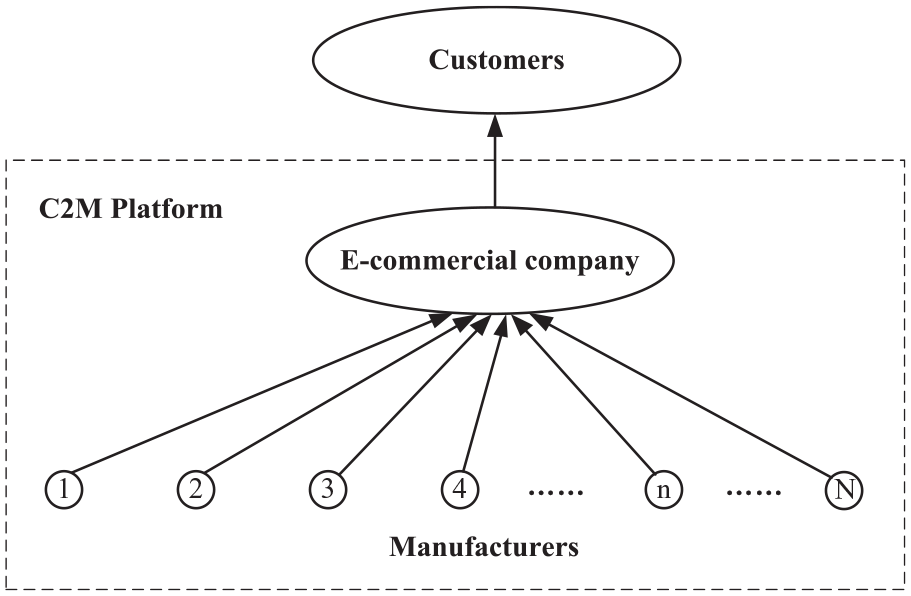
The collaborative alliance in customer to manufacturer business.
Initially, the coordinator has acquired certain product orders from the customers through the C2M platform. Each order (demand) is consist of an order quantity and an order delivery time (days) of each product, where a sale price of each unit product paid by a customer to the coordinator for obtaining the product and a ask price of each unit product paid by the coordinator to the manufacturer for producing the product are also given.
In particular, the framework includes the following three steps.
Before collaboration, the coordinator and the manufacturers have signed a binding cooperation agreement. Each manufacturer submits its manufacturing cost of fabricating each product and its production capacity of each product per day to the coordinator.
During collaboration, a centralized cooperative production planning is made by the coordinator to maximize the total profit of the alliance, where the product orders are allocated among manufacturers by the coordinator. Thus, the total profit of the alliance after collaboration can be generated. Here, shortage cost of per unit each product is estimated by the coordinator.
After collaboration, according to the cooperative production plan, the total profit of the alliance is allocated among all manufacturers by applying a profit allocation mechanism.
The proposed centralized cooperation framework for C2M business is practical as it has been explored by some famous e-commercial companies of China. For example, Alibaba has established C2M business unit in its Taobao business group at the end of 2019. Then Taobao has built a new online platform with C2M customized products as the core supply in 2020. In addition, other Chines e-commercial companies such as JD, NetEase have also established the similar platforms. These e-commerce giants already have certain market and customers, so it is easier to establish such platforms for them. Thus, manufacturers are more willing to cooperate with them. Manufacturers may approve a centralized and fair profit allocation if they have the possibility of obtaining profit through collaboration. This is also the original intention of the profit allocation mechanism design for C2M platform in our study.
As mentioned above, there are two important issues for the cooperation in C2M platform. The first issue is to make a collaborative production planning which aims to seek a production plan for each manufacturer that satisfy the order quantity and an order delivery time of each order, the production capacity constraints of each manufacturer so as to maximizing the total profit of the alliance. The second issue is to find a fairly total profit allocation among all manufacturers in which each manufacturer can obtain a larger or at least the same profit after collaboration compared with its profit gained before collaboration. Then all manufacturers will continue to participate in the collaboration. Note that, the fairness definition of an allocation is not unique (Dai & Chen, 2012). In this study, the second issue is mainly focused.
For simplicity and without loss of generality, some assumptions are considered for the studied problem. At first, all customer orders are allocated among manufacturers by the coordinator. Secondly, all customer orders must be fulfilled under the constraints of the production capacities of the manufacturers, which mean that not all orders can be fulfilled. Thirdly, each order can be fulfilled by multiple manufacturers. Fourthly, different manufacturers may have diverse manufacturing costs and diverse production capacities. Finally, the transportation cost and time of each order are not considered as they are organized by the coordinator and completed by other logistics companies.
Note that the proposed profit allocation mechanism in this study is also suitable for the other kind of C2M platforms without the above assumptions. These assumptions are only used to formulate the centralized cooperative production planning model in next section.
Profit Allocation Mechanisms for C2M Platform
In this section, a centralized production planning model is proposed for the C2M platform, where a post-collaboration total profit of the alliance can be generated based on the objective value of the model. In addition, a profit allocation mechanism (model) is designed for fairly allocating the total profit of the alliance among all manufacturers. Firstly, the notation of formulating the two models is given as below.
Indices
i = 1,. . .,I, product index, I is the number of products
n,m = 1,. . .,N, manufacturer index, N is the number of manufacturers
Parameters
MCin, manufacturing cost of product i of manufacturer n
PCin, production capacity of product i of manufacturer n per day
SCi, shortage cost per unit product i
SPi, ask price per unit product i
OQi, order quantity of product i from customers
OTi, order delivery time (days) of product i from customers
TPN, post-collaboration total profit of C2M platform
TPSN, post-collaboration total profit of subset of manufacturers,
Variables
si, shortage quantity of product i which is an integer
qin, quantity of product i allocated to manufacturer n by the coordinator in collaboration which is an integer
pn, post-collaboration profit of manufacturer n
γ, a positive real number,
Centralized Production Planning Model for C2M Platform
With above notation, a centralized production planning model CPP for C2M platform is formulated as the following linear integer programing mathematical model.
Model CPP:

Subject to:



Objective (1) aims to maximize the post-collaboration total profit of the alliance. Constraints (2) assure that the order quantity of each product is equal to the sum of the allocated quantity of each product to each manufacturer and the shortage quantity of each product. Constraints (3) indicate the production capacity constraint of each product for each manufacturer. Constraints (4) define the value ranges of all variables.
Profit Allocation Model for C2M Platform
After solving model CPP, the post-collaboration total profit of the alliance is generated, which needs to be fairly allocated among manufacturers. Thus, a post-collaboration profit allocation problem (PAP) happened in C2M platform. The cooperative game theory is widely used method to solve the problem in reference. Many famous profit allocations have been studied in literature, such as Core allocation (Gillies, 1959), Shapley value allocation (Shapley, 1953), Kalai-Smorodinsky allocation (Kalai, 1977). The core is the set of imputations (Kalai, 2008) that no coalition has a value larger than the sum of its members’ payoffs (Dai & Chen, 2012). So the core allocations can assure the stability of the alliance. Sadly, neither Shapley value allocation nor Kalai-Smorodinsky allocation can always stay in the core. Therefore, the two kinds of allocations may be not stable. Besides, the core maybe empty so that the core allocation is not existent. To deal with the case of empty core, Caprara and Letchford (2010) proposed a γ-budget balanced allocation method.
Inspiration by above methods, we design a γ-approximate core guaranteed profit allocation mechanism in this section, which can create a stable profit allocation when the core of the studied problem is empty. If the core is empty, our mechanism can create a γ-approximate and non empty core in which γ is a value in range [0, 1].
Model PAP:

Subject to:




Objective (5) aims to maximize γ and assure that the profit allocation is always existent. Constraints (6) ensure the individual rationality of the profit allocation. Constraint (7) makes sure that the sum of the post-collaboration profit of each manufacturer is equal to the post-collaboration total profit of C2M platform, which means that the allocation is efficient. Constraints (8) guarantee that the alliance is stable where Pareto optimality is also included. Constraints (6), (7), and (8) together assure that the profit allocation stays in the core or γ-approximate core. Constraints (9) and (10) assure that a manufacturer who fulfils more valuable production orders will be allocated more or at least the same post-collaboration profit compared with other manufacturers. Here,
After solving model PAP, a γ-approximate non empty core allocation can be obtained. The fairness in our mechanism has four meanings. Firstly, the post-collaboration profit of the alliance (grand coalition) is all allocated among all manufacturers. Secondly, the profit of each manufacturer after collaboration is larger than its profit before collaboration. If the grand coalition (alliance) include N manufacturers, then each manufacturer will obtain a larger post-collaboration profit in the alliance compared with its profit gain in any sub coalition of N. Thirdly, the manufacturer who fulfils more production orders will obtain larger profit under the condition of achieving the above three meanings. Therefore, our mechanism is relative fair and keeps the stability of the alliance for C2M platform in some sense. Note that, the profit of manufacturer n before collaboration is zero as it will not gain profit if he does not participate in collaboration.
Numeric Experiments
To evaluate the performances of our proposed profit allocation mechanism, numerical experiments are done in this section. Six sets of instances are designed from real data of Alibaba. The ask price of each product, the shortage cost of each product, the order (demand) quantity of each product are set in the same way with the paper (Dai et al., 2019, 2021).
For the instances generated, the number of products is set to 1 (I = 1), 5 (I = 5), or 10 (I = 10), the number of manufacturers is set to 5 (I = 5) or 10 (N = 10). By combining 3 possible numbers of manufacturers, 2 possible numbers of products, six sets of instances are generated as showed in the following table, where each set contains 10 instances. Then each set of instances is indicated by its number of manufacturers and its number of products. For example, the instance set 1 × 5 contains 10 instances with 1 product and 5 manufacturers, and the instance set 1 × 10 contains 10 instances with 1 product and 10 manufacturers.
The models involved in the numerical experiments are solved by employing Ilog CPLEX 12.9 on a personal PC with i7-8565U CPU and 16GB RAM. As the computation time of solving each instance is quite short and usually in several seconds, it is not recorded in these tables. The computational results of six sets of instances are given in Tables 1 to 8. In the tables, column “Post-collaboration total profit” represents the total profit of model CPP with objective (1) found by CPLEX MIP solver. Column “The value of γ” denotes the value of model PAP with objective (2) found by CPLEX MIP solver. Column “Product shortage” denotes that whether there is any product shortage in the solution of model PAP, where “Y” means product shortage and “N” means no product shortage.
Six Sets of Instances.

Results of the Instances Set 1 (1 × 5).

Results of the Instances Set 2 (1 × 10).

Results of the Instances Set 3 (5 × 5).

Results of the Instances Set 4 (5 × 10).

Results of the Instances Set 5 (10 × 5).

Results of the Instances Set 6 (10 × 10).

Results of the Instances Set 5 (10 × 5) with Larger Order Quantities.

Tables 2 to 7 present the results of six sets of instances, where we can observe the following more results.
By comparing Tables 1 and 2, Tables 3 and 5, and Tables 6 and 7, respectively, we found that: if the number of products is given, the post-collaboration total profit of the C2M platform increases notably along with the increase of the number of manufacturers, and the product shortage decreases or even disappears in 20 of all instances. Therefore, the participation of more manufacturers in the C2M platform are profitable.
If the number of manufacturers is given, the post-collaboration total profit of the C2M platform increases notably along with the increase of the number of products and their order quantities. However, if the number of products and their order quantities are increased too much and far exceed the production capacity of each product of all manufacturers, the post-collaboration total profit will decrease. This is showed in Table 8, where the order quantity of each product in each instance is 1.2 times of that in original instances set 5 in Table 6.
Our proposed mechanism can output a profit allocation which is in the core (γ = 1) in 31 of 60 instances and create a feasible profit allocation (γ-approximate core allocations) for the other 29 instances (0.73 < γ < 1). The core allocations can ensure the stability of the alliance and the sustainability of C2M platform. The γ-approximate core allocations can achieve the similar effect in some sense.
In addition, we compare the results of the current mechanism by C2M platform and our proposed mechanism in this study. For each instance of instance set 2, Tables 9 and 10 list the post-collaboration profit of each manufacturer generated by current mechanism and our proposed mechanism in detail, respectively.
Post-Collaboration Profits of the Manufacturers by Current Mechanism in Instances Set 2 (1 × 10).

Post-Collaboration Profits of the Manufacturers by Proposed Mechanism in Instances Set 2 (1 × 10).

In Table 9, the post-collaboration profits of 18 manufacturers are zero in 10 instances. It means that these manufacturers participated in the collaboration of the C2M platform without any profit increase, which will bring negative effects for the stability of the collaboration. As everyone knows, a player (manufacturer) easily withdraws from the cooperation if it receives no profit. In Table 10, the profit of each manufacturer is increased through joining the collaboration of the C2M platform. With constraints (9) and (10), the manufacturer who fulfils more valuable production orders is allocated a larger profit after collaboration under the condition of core or γ-approximate core constraints. Thus, the fairness of our proposed mechanism can be demonstrated. If two manufacturers perform the same valuable production orders, they may be allocated the same profit.
After a careful check on the data files and the experiment results, we also find that the manufacturer who has lower manufacturing cost and larger production capacity of each product are allocated more production order quantities and obtain more profit in collaboration. The same observations can be found in other instance sets, they are not showed here due to the page limit.
In conclusion, our proposed mechanism has three advantages. Firstly, each manufacturer gains profit increase after collaboration. Secondly, no manufacturer can gain a larger post-collaboration profit in any sub coalition of the grand coalition (alliance). Thirdly, the contribution of each manufacturer to the alliance is considered. If a manufacturer finishes more production orders, it will be allocated a larger profit under the condition of core or γ-approximate core constraints. Thus, the proposed mechanism will be easily accepted by all manufacturers in the C2M platform and the collaboration can be sustained, which can provide a good collaboration solution for C2M platform.
Conclusion and Limitations
Along with the changing of customers’ consumption pattern, the customer-to-manufacturer (C2M) business model has attracted more and more attention. C2M are mainly applied in e-commercial business, where both e-commercial company and manufacturers exist. How to organize a collaboration between them is crucial for C2M platform. In this study, we consider a profit allocation problem for C2M platform in a centralized collaboration framework, where an e-commercial company and multiple manufacturers are included. Compared with previous studies, we design a γ-approximate core guaranteed profit allocation mechanism for C2M platform by using cooperative game theory. The mechanism can assure the stability of the alliance and the sustainability of C2M platform. Numerical experiments on 60 instances generated from data of Alibaba are tested to evaluate the mechanism and relevant models. The experimental results show that our proposed mechanism considers the contribution of each manufacturer to the alliance which is more reasonable than the current mechanism of C2M platform. Then the mechanism is easier applied in practice.
In addition, the proposed mechanism is designed in a centralized collaboration framework, where the e-commercial company is in the leading role who can obtain large amount of orders from customers. Thus, the e-commercial company can organize such collaboration with multiple manufacturers. If the C2M platform has multiple e-commercial companies and multiple manufacturers at the same time, then the customers orders are provided by multiple e-commercial companies. Then our proposed profit allocation mechanism needs to be extended by considering the contribution of each e-commercial company to the collaboration. Therefore, our future work is to explore other kind of collaboration frameworks and corresponding profit allocation models for C2M platform.
Footnotes
Declaration of Conflicting Interests
The author(s) declared no potential conflicts of interest with respect to the research, authorship, and/or publication of this article.
Funding
The author(s) disclosed receipt of the following financial support for the research, authorship, and/or publication of this article: This study is supported by the Social Science Achievements Appraisal Committee Foundation of Hunan Province (No. XSP21YBC477), the Philosophy and Social Science Foundation of Hunan Province (No. 17YBQ100), the Youth Foundation of Social Science and Humanity of China Ministry of Education (Grant No. 19YJC630074), the Scientific Research Project of Hunan Education Department (Nos. 18B329 and 19C1053), and the Innovation-Driven Foundation of Hunan University of Technology and Business (No. 2020QD02).
