




Abstract
With the rapid development of e-commerce, logistics distribution has become the bottleneck of its development. It is urgent to study how to optimize the cooperation between e-commerce platforms and logistics service providers. Based on Stackelberg game theory, this research first studies the decision making of two-stage logistics service supply chains consisting of the e-commerce mall and the logistics service provider without cooperative distribution, in which decentralization and centralization are analyzed, respectively. Then, it is extended to the decision making of three-stage logistics service supply chains consisting of e-commerce malls, express delivery companies, and terminal distributors. The results show that the profit, sales volume, and logistics service effort of the centralized decision-making system are higher than those of the decentralized decision-making system, regardless of the two-stage or three-stage logistics service supply chain. Therefore, it is vital to formulate a reasonable profit distribution scheme based on revenue-sharing contract to achieve the cooperation among the partners of logistics service supply chain, so as to achieve a win-win situation in which all of their profits increase. Finally, a numerical example is presented to verify the results, and some issues are proposed for future research.
Keywords
Introduction
Industry Background
The e-commerce and online transactions have developed rapidly in mainland China. According to the data released by the National Bureau of Statistics, China’s net retail sales reached RMB 7,180 billion in 2017, and the nationwide online retail sales increased by 32.2% over the same period. Meanwhile, according to the statistics of the State Post Office, in 2017, the volume of business of the national express delivery service enterprises reached to RMB 40 billion, an increase of 28% compared with the same period last year. China’s express delivery business continues to maintain a rapid growth trend, and ranks the first in the world for four consecutive years. Specifically, its parcel express volume is more than that of the United States, Japan, Europe, and other developed economies. It can be seen that the rapid development of e-commerce has also promoted the prosperity and development of the logistics industry. It is changing and reconstructing China’s logistics and distribution system (Jiang & Prater, 2002). Moreover, superior logistics services, whether self-built or outsourced, are conducive to enhancing customer loyalty (Etokudoh, Boolaky, & Gungaphul, 2017; Ramanathan, 2010; Yuan, Shi, & Li, 2014).
The e-commerce logistics includes many aspects such as cargo warehousing, order division, trunk transportation, and urban distribution. In recent years, e-commerce companies such as Tmall and JD.com started to collaborate with convenience stores, supermarket chains, postal newsstands, and other community outlets to establish a new type of e-commerce logistics delivery terminal self-pickup points, forming a collection-and-delivery points (CDPs) network. For example, express delivery is completed at the trunk line from the distribution center to the terminal network first, and then uses the CDPs to provide nearby residents with 24-hr self-promotion services to solve the “last mile” delivery problem. Thus, through the integration of convenience stores, chain supermarkets, post newsstands, and other community network resources, the CDPs provide convenience and diversification of logistics services for customers, bring benefits and passenger flow, and increase the turnover of stores. This is one fundamental application of sharing economy in supply chain.
It can be seen that the terminal self-lifting network has the advantages of sharing community resources effectively, reducing the cost of delivery, improving the efficiency of operation, and the quality of service. For instance, Chabot, Bouchard, Legault-Michaud, Renaud, and Coelho (2018) proposed to develop partnerships between shipping companies and to synchronize their shipments, and showed that a collaborative approach between companies offered important benefits. However, online shopping mall, express delivery company, and CDPs are independent entities. Their pricing decisions tend to maximize their interests, and lack of coordination results in a similar loss of double marginalization in supply chain (Spengler, 1950). At the same time, the fair distribution of value-added income and incremental costs brought by the improvement of service level is the key factor for the sustainable cooperation between the three parties. After all, express delivery companies and CDPs do not have enough incentive, and their excessive reliance on online shopping mall’s package orders, and discourse power is in a weak position, resulting in lack of motivation to work together with online shopping centers. Therefore, the logistics outsourcing model, such as online shopping mall, express delivery company, and CDPs, has certain vulnerability.
Based on the above background of the operation of the e-commerce logistics service supply chain (LSSC) in China, this study focuses on the coordination of revenue sharing between online shopping mall, express companies, and CDPs from different points of view. With the collaborative operation of e-commerce LSSC revenue sharing under the cooperative distribution model, it will help improve the operation system of the entire e-commerce LSSC and promote the two industries of e-commerce and logistics fusion development in mainland China.
Theoretical Background
In the e-commerce LSSC, the express delivery companies and CDPs jointly provide online shopping malls with outsourcing services for transportation, distribution, and warehousing, which is equivalent to acting as the role of third-party logistics (3PL). In the past 20 years, more and more companies in different industries have begun to use 3PL services to perform some or all of their logistics operations (Marasco, 2008). The logistics outsourcing strategy has a positive impact on the company’s marketing performance and indirectly promotes financial performance (Green, Whitten, & Inman, 2008). Therefore, e-commerce enterprises need to actively improve their logistics system operation ability. No matter what strategy or path to take, there is a positive relationship between logistics capability and company performance in e-commerce logistics system (Cho, Ozment, & Sink, 2008).
Recently, scholars have gained a lot of conclusions and achievements in the research of supply chain contract, which mainly covers the research points such as quantity discount contract, wholesale price contract, buy-back contract, two-part tariff contract, and quantity consultants (Bernstein & Federgruen, 2005; Chen, Federgruen, & Zheng, 2001; Gerstner & Hess, 1995; Taylor, 2002; Weng, 1995). In the study of revenue-sharing contract, Dana and Spier (2001) discussed the application of revenue-sharing mechanism in the DVD rental industry. Cachon and Lariviere (2005) proved that the revenue-sharing contract could coordinate the two-stage supply chain of one or more retailers. After that, Giannoccaro and Pontrandolfo (2004), Ding and Chen (2008), and Feng, Moon, and Ryu (2014) extended the application of revenue-sharing mechanism to multistage supply chain. Most recently, Zhang, Fu, Zhao, Pratap, and Huang (2019) investigated horizontal carrier coordination with revenue sharing in e-commerce logistics.
With the prevalence of logistics business outsourcing, the 3PL companies are increasingly involved in the overall operation of the manufacturing supply chain, and some scholars have included 3PL in the coordination of the supply chain framework. For instance, Lei, Wang, and Fan (2006) added the role of transporter in the channel coordination analysis of suppliers and buyers and verified the superiority of the cooperative relationship over the noncooperative relationship. Hu and Feng (2017) studied the optimization and coordination of one-supplier-one-buyer supply chain under supply and demand uncertainty. Gong, Kung, and Zeng (2018) analyzed a 3PL provider’s IT investment and provided 3PL buyers and providers guidance in terms of using contract structures to motivate IT investment in logistics outsourcing. Cai, Chen, Xiao, Xu, and Yu (2013) studied a fresh product supply chain. The 3PL undertakes the task of long-distance transportation between producers and distributors. The market demand is influenced by both sales price and product freshness. It is found that the 3PL is effective for the supply chain, and has a significant impact, and proposed an incentive mechanism that includes two contracts to coordinate the supply chain. Based on the assumption that market demand is affected by the retail price and logistics service level, Liu, Qiao, Qi-Hui, and Pang (2011) considered the supply chain structure composed of suppliers, retailers, and logistics service providers (LSPs) and realized channel coordination and systematic Pareto improvement through two contracts. It was also found that improving the optimal logistics service level can effectively stimulate cooperation. Recently, Choi, Wallace, and Wang (2016) investigated how to coordinate a service supply chain with risk considerations. Zhang, Pratap, Huang, and Zhiheng (2017) studied the collaboration of multiple LSPs forming alliances in e-commerce logistics networks.
Previous studies have proved the effectiveness of the supply chain contract coordination mechanism. In the existing researches, the effect of adding 3PL is to make the supply chain more practical and complete. However, there is still less literature on the outsourcing relationship between e-commerce enterprises and 3PL providers, and the theory of principal-agent is more applied to maximize the interests of the service demand side. There is a lack of systematic and holistic design of the profit-sharing coordination mechanism between e-commerce and logistics providers, which will be taken into account in this study.
This research is structured as follows. In “Literature Review” section, the existing related literatures are reviewed. “Problem Statement and Formulation” section states the research problem and formulates it. Then, the two-stage and three-stage LSSC with decentralized and centralized decision making is analyzed based on game theory in “Model Analysis of LSSC” section. “Numerical Analysis” section provides some numerical examples to test the feasibility of model analysis. Finally, in “Conclusions and Future Research” section, the main results are concluded with suggestions for future research.
Literature Review
Literature which is closely related to this research can be summarized and classified in three broad and diverse categories: the distribution service points of e-commerce logistics, revenue-sharing contract, and game theory in supply chains.
In the e-commerce logistics delivery cycle, customers cannot stay home all the daytime, and many packages are not suitable for mailboxes. Thus, the courier’s home delivery service cannot be successful at one time and has to be repeated, thereby increasing the cost of logistics (Weltevreden, 2008). As a result, European and American countries developed a delivery device near the residential area or transportation site, called collection-and-delivery points (CDPs), which supplemented or even replaced home delivery services. Customers can use this equipment to take the package of online shopping and also initiate reverse logistics operation of return. Most recently, this type of CDPs has been widely applied in China’s e-commerce terminal distribution network and has become an important form of China’s sharing economy.
Weltevreden (2008) introduced two types of CDPs: one of which is unattended lock point (ULP) and the other is an attended service point (ASP). ASP is based on the service resources of residential community and campus, such as chain convenience store, campus service center, and property management center. It establishes e-commerce logistics terminal distribution outlets for resource sharing. Comparing the two types, ASP can provide customers with better online shopping experience, including more payment choices and flexible package size, less operational knowledge, and so on. Furthermore, Weltevreden (2008) systematically summarized the literature and used questionnaires and interviews to empirically analyze the application of CDPs in the Netherlands. It was found that the CDPs were very popular and the number grew rapidly, bringing additional benefits to the retail outlets participating in self-financing services.
Research on the CDPs mainly focuses on its advantages with respect to traditional delivery methods, and the acceptance willingness of customers. The former includes reducing the risk of cargo loss, alleviating urban transportation pressure, increasing the attractiveness of retail outlets, and so on (Foresight and Retail and Consumer Services Panel, 2000). Edwards, Mckinnon, Cherrett, Mcleod, and Song (2010) used a carbon audit model to perform simulations and found that most of the carbon emissions from traditional distribution methods came from individuals who repeatedly dispatched parcels and demonstrated that the CDPs can reduce the negative impact and create lower carbon emissions. Collins (2015) also studied the performance of CDPs from environmental impacts, and proposed that service pricing, service quality, and location selection will affect CDPs in unlike proportions. This type of e-commerce logistics uses the “last mile” pickup method for ecological protection.
For another, there are some existing literatures about customer willingness to use pickup self-service of CDPs. Edwards et al. (2010) investigated the use and development of CDPs of the lock points and service points in Holland and the United Kingdom in Winchester area, respectively. Most recently, Tan, Yi-Lun, Chen, and Liu (2016) took the Cainiao alliance of CDPs as an example in mainland China, and investigated the spatial layout of CDPs from the perspective of residents’ behavior. According to the result, the spatial layout of pickup points is closely related to the social attributes, residential and employment behavior, and the differences of behavior mode will lead to various space mode.
As for the research on revenue sharing, there also exist some related studies. Interestingly, due to an industry attempt, the revenue-sharing contract began to attract academic attention. Dana and Spier (2001) concluded that the revenue-sharing contract helped weaken the internal competition of distributors and achieve the industry’s overall optimal output through research on the imaging leasing industry. Warren and Peers (2012) reported that Blockbuster Inc.’s market share increased from 24% in 1997 to 40% in 2002, resulting from a revenue-sharing mechanism that undermined the virtuousness of the DVD rental industry. Mortimer (2002) showed that revenue sharing brought about 7% of total profit growth for the entire image rental industry. Cachon and Lariviere (2005) demonstrated that revenue-sharing contracts can coordinate the two-stage supply chain of one or more retailers and can make systemic profits randomly distributed. Koulamas (2006) analyzed a standard form of newsboy model in a supply chain consisting of a single manufacturer and a single retailer. The study showed that the revenue-sharing contract can help retailers to obtain more profit than the traditional ordering environment by completely eliminating the double marginal effect. Fu and Zhang (2010) used the revenue-sharing mechanism between airports and airlines and found that it could bring positive externalities to the coordination system and enhance overall benefits.
Moreover, some researches extend two-stage supply chain to multistage ones. For instance, Giannoccaro and Pontrandolfo (2004) built a two-tier revenue-sharing system model, that is, manufacturers to distributors and distributors to retailers, respectively, to provide them with a contract, to achieve the three-stage decentralized supply chain coordination. Feng et al. (2014) discussed the reliability of members in an N-stage supply chain, improved the revenue-sharing contract through reliability measures, realized the overall coordination of supply chain and system profit arbitrarily distributed among members, and could motivate supply chain members to improve the reliability of their operations, thereby increasing the highest possible overall system benefits.
Furthermore, there are in a variety of forms of demand in the research of supply chain coordination. For example, Hou, Zeng, and Zhao (2009) combined revenue sharing and agreement pricing as a means of coordination and realized inventory decision optimization under a decentralized control for a lead-time sensitive two-stage supply chain. Xie and Wei (2009) established a two-stage model under the conditions of noncooperative game and cooperative game, and analyzed the pricing decision and advertising investment decision of manufacturer–retailer system, and found that the cooperation mode can obtain lower selling price and more advertisements. Kunter (2012) studied a two-tiered supply chain consisting of a single manufacturer and a single retailer, in which demand was influenced by retail price and marketing efforts, and proposed a concession payment contract. Through the sharing of revenues and cost-sharing efforts between manufacturers and retailers in a certain proportion, the overall coordination of the channels is achieved. Recently, researchers have applied Stackelberg game theory in a different research setting. For example, Yang et al. (2015) proposed joint configuration of a product family and its supply chain as a leader–follower Stackelberg game. Nagurney, Daniele, and Shukla (2017) proposed a supply chain network game theory model with nonlinear budget constraints. Hua, Tang, and Lai (2017) conducted game theoretical analysis between a single model and a joint model in a two-echelon reverse supply chain.
So far practice of LSSC with cooperative distribution has been faster than theoretical research. However, success of the practice should be supported by academic research. Hence, this research aims to study the coordination of revenue sharing in two-stage and three-stage LSSC with cooperative distribution based on Stackelberg game theory.
Problem Statement and Formulation
Problem Description
This study investigates the impact of decentralized and centralized decision making on the overall profit based on the two-stage supply chain (an e-commerce platform and LSP) and the three-stage supply chain (an e-commerce platform, an express delivery, and a terminal distribution).
Model Symbol Description
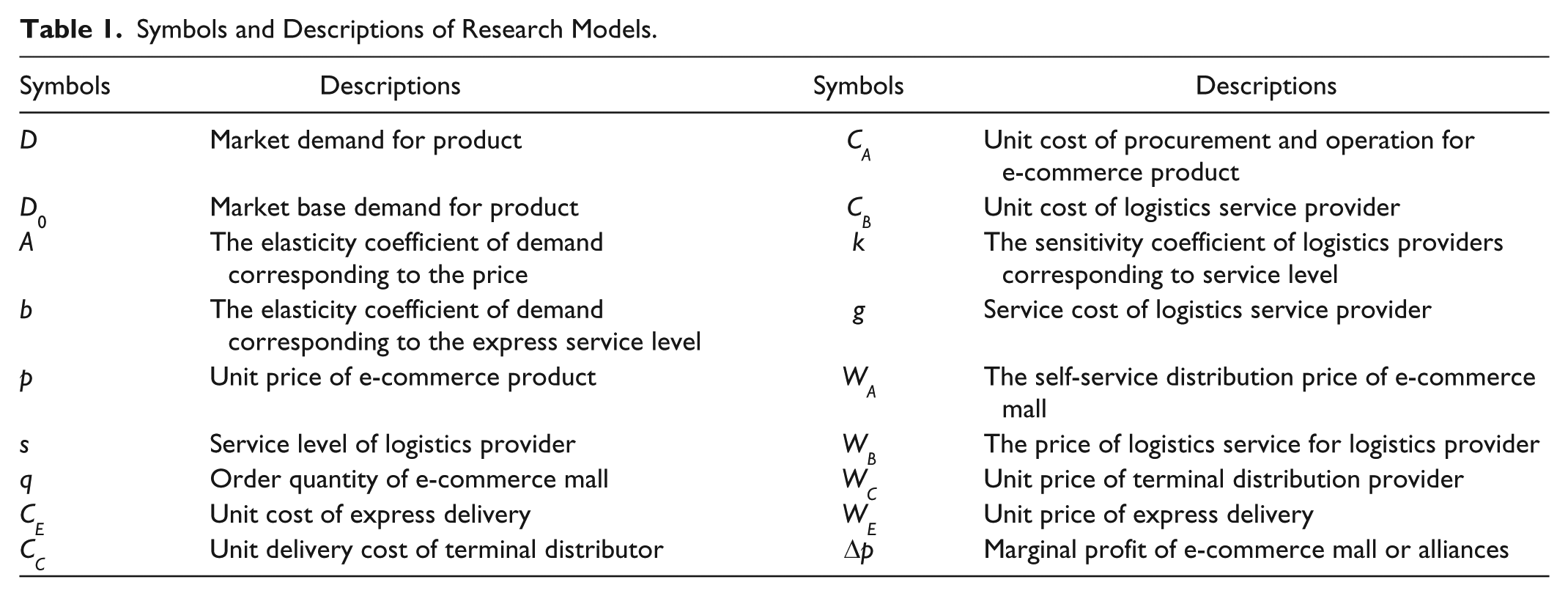
To make the model clear, some related symbols are introduced as follows (see Table 1).
Research Assumptions
All the members of the e-commerce LSSC system are risk neutral.
All the members of the logistics system are rational, and they make their own decisions with maximum self-interest.
The market demand of product is affected by the price and logistics service level.
The effort cost function of logistics services,
Market demand
Symbols and Descriptions of Research Models.
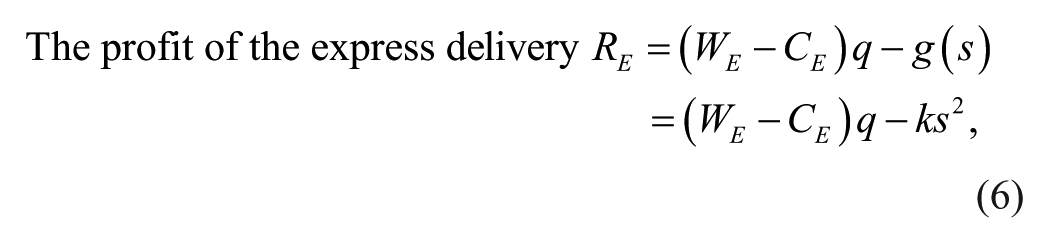
In the two-stage supply chain consisting of an e-commerce enterprise (A) and a LSP (B), A plays a dominant role in the supply chain. The market demand (D) of A is affected by the price (p) and logistics service level (s). It decreases with the increase of price and increases with the rise of service level.
A will determine product orders based on market demand. That is,


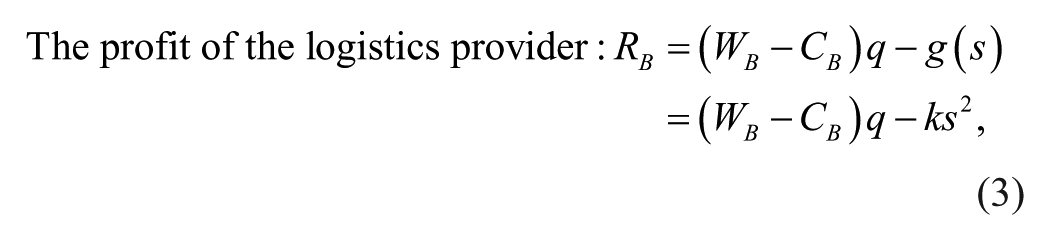

In the following, the corresponding models are based on the three-stage supply chain consisting of an e-commerce mall A, an express delivery E, and a terminal distribution C. It is assumed that A sells only one product and the terminal distribution cost is undertaken by the e-commerce mall, which is consistent with the reality that Tmall subsidizes the rookie posts. A plays a dominant role in the supply chain, and the market demand D is affected by the price p and the express service level s, which decreases with the price increasing and is positively correlated with the service level of express delivery and terminal distributor. According to the market demand, A decides the order quantity, then
The express delivery determines its own logistics service level, whose unit operating cost is



Model Analysis of LSSC
It is assumed that the e-commerce mall only produces and sells one product. In the whole LSSC, the e-commerce mall is the leader, and the logistics service–related subjects are followers. The e-commerce mall decides the price of the product, and the logistics service–related subjects decide the quotation of logistics service and their own service level.
This section first investigates the decision making under the decentralized and centralized two-stage supply chain, that is, prices of the e-commerce mall and service levels of the LSP when they make decentralized and centralized decisions, respectively. Second, it will focus on the case of three-stage supply chain.
Decision Analysis of Two-Stage LSSC
Decentralized two-stage LSSC
Assume that the e-commerce mall is the decision maker and the LSP is a follower. Based on Stackelberg game theory, the e-commerce mall decides the order quantity to satisfy the market demand, and the LSP determines

The objective functions of the e-commerce mall and the LSP are as follows:

The inverse induction method is used to solve the problem. First, calculation of the first-order partial derivatives of
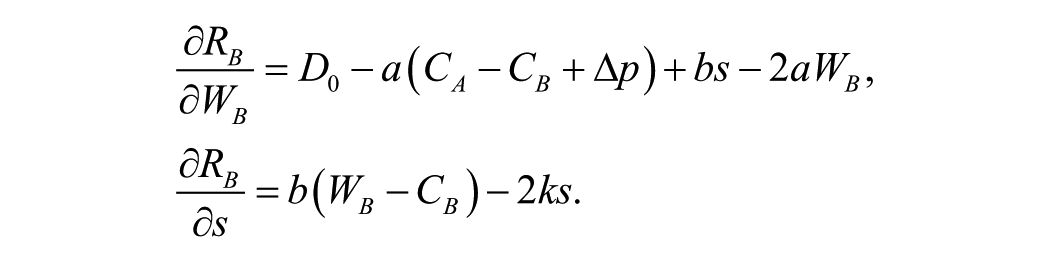
The second-order partial derivative of

The corresponding Hessian matrix is
Let


With Equations 11 and 12, the expressions of
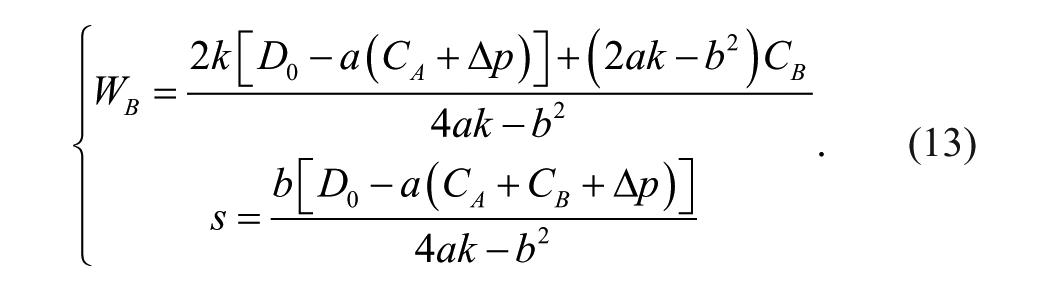
Apply Equation 13 into Equation 10, then

The first-order partial derivative of

Apply Equation 15 into Equation 13, then


Apply Equations 15, 16, and 17 into Equations 1 and 9. Thus,

Hence, the optimal profits of the e-commerce mall, LSP, and the whole decentralized supply chain are derived below:

Centralized two-stage LSSC
In the centralized two-stage LSSC, the e-commerce mall and the LSP are viewed as a whole.
Bring Equation 1 into Equation 4, then

Similarly, the first-order partial derivatives of R over p and s in Equation 18 are as follows:

The second-order partial derivatives of R over p and s in Equation 10 are as follows:

The Hessian matrix is
Let


With Equations 12 and 13, it is obvious that

Therefore, the optimal solution and total profit are given below:
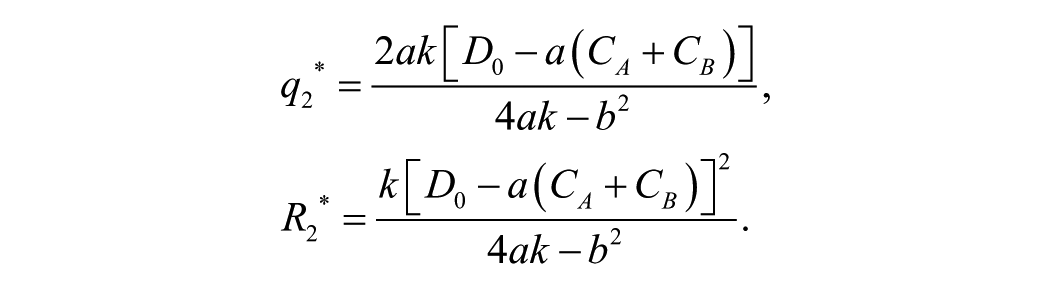
Comparative analysis of decentralized and centralized LSSC
Table 2 lists the decisions and the profits of decentralized and centralized models of two-stage LSSC. According to the above model analysis, some propositions are obtained as follows.
Decisions and Profits of Decentralized and Centralized Models of Two-Stage LSSC.

Note. LSSC = logistics service supply chain.
It is proved as follows:
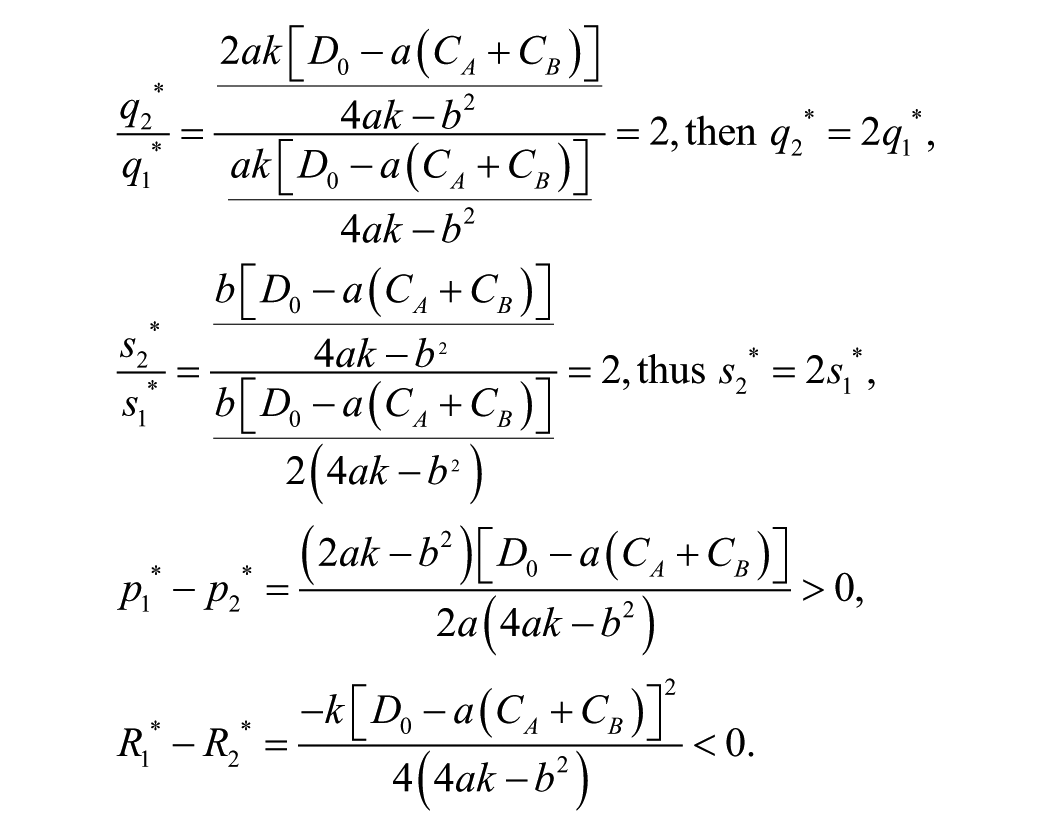
It is proved below.

It is proved as follows:


Based on Equations 21 and 22, it is easy to get
Decision Analysis of Three-Stage LSSC
In the three-stage LSSC, the corresponding profits are presented in the following:

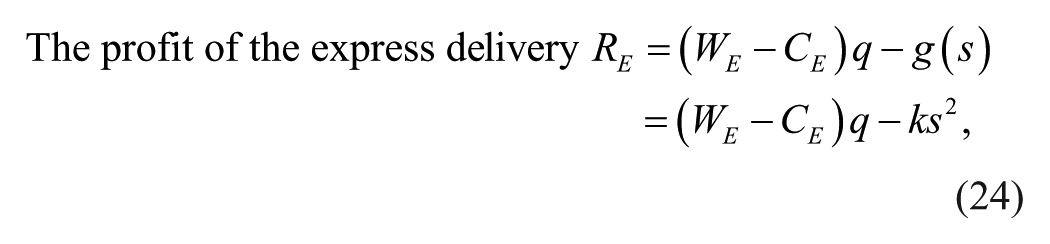


Assuming that the e-commerce mall is the decision maker of the order quantity, the express delivery and the terminal distributor are followers. According to Stackelberg game theory, the e-commerce mall determines sales price p to meet market demand, and the express delivery decides the unit price of transport service

Decentralized three-stage LSSC
Similarly, in the three-stage LSSC, the e-commerce mall, the express delivery, and the terminal distributor make their own decisions according to the principle of profit maximization.

The objective functions of the e-commerce mall, the express delivery, and the terminal distributor are listed below.

First, calculate the first-order partial derivative of

Take Equation 30 into Equation 29 about

The second-order partial derivatives of

The Hessian matrix is
Make


With Equations 31 and 32, the expressions of


Bring Equations 33 and 34 into Equation 30, then

Put Equations 33, 34, and 35 into Equation 29, the expression of

Calculate the first-order partial derivative of

Take Equation 37 into Equations 33, 34, and 35, then

Bring the optimal decision variables into Equations (27) and (28) and obtain

Then the corresponding profits are presented as follows:

Centralized three-stage LSSC
In the centralized three-stage LSSC, the e-commerce mall, the express delivery, and the terminal distribution provider are considered as an entity and explored as the total profit maximization.
Bring Equation 27 into Equation 26, then

The first-order derivatives of R over p and s in Equation 38 are below.
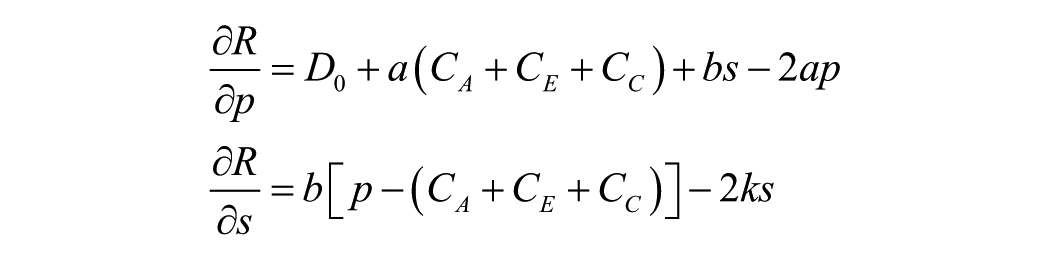
The second-order partial derivatives of R about p and s in Equation 38 are as follows:

The Hessian matrix is
Make

Bring the optimal decision variables into Equations 27 and 28 and get:

Comparative analysis of decentralized and centralized three-stage LSSC
Table 3 lists the decisions and the profits of decentralized and centralized models of three-stage LSSC. Propositions 5-8 are proposed as follows.
Decisions and Profits of Decentralized and Centralized Models of Three-Stage LSSC.

Note. LSSC = logistics service supply chain.
It is proved as follows:

It is proved in the following.

It is proved as follows:


Based on Equations 39 and 40, it is easy to obtain that

The Relationship Between Two-Stage and Three-Stage LSSC
In the decision-making process of online purchasing service supply chain system, the two-stage decentralized decision making is essentially equivalent to the situation in which the express delivery and the terminal distributor form an alliance to provide service. The centralized decision making of the two-stage supply chain is the same as the substantive decision making of the three-stage supply chain. When the sum of the unit cost of the express delivery and that of the terminal distributor in the three-stage supply chain is equal to the unit cost of the logistics distributor in the two-stage supply chain, that is,
It is proved as follows:

So
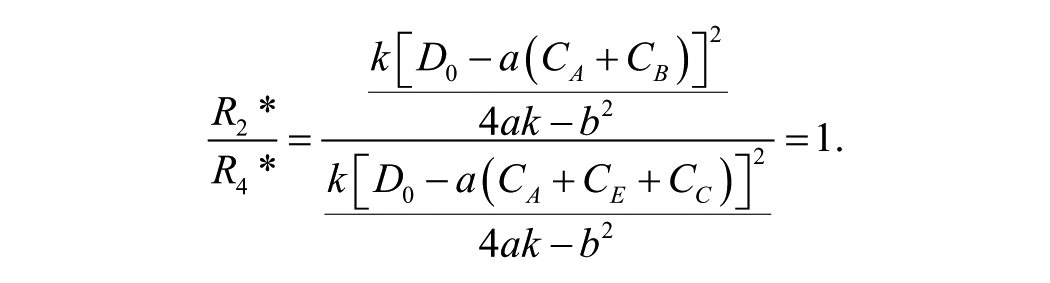
Hence,
Numerical Analysis
Numerical Example of Two-Stage LSSC
To test the feasibility of model analysis in “Model Analysis of LSSC” section, a numerical example is presented in this section. Assuming D0 = 300, a = 6, B = 8, and k = 20, the order demand function of the e-commerce mall D = 300 – 6p + 8s, and the effort cost function of LSP g(s) = 20s2. Let CA = 20 and CB = 10. Due to the balance of supply and demand, there is sales q = D = 300 – 6p + 8s. According to the model in “Model Analysis of LSSC” section, the corresponding variables and profits are obtained in Table 4.
Variables and Profits of Decentralized and Centralized Two-Stage LSSC.

Note. LSSC = logistics service supply chain.
From the above numerical analysis, it can be seen that the effort of the LSP is lower when the e-commerce mall and the LSP make decisions individually, and the profits of both sides and the overall profits of the system are lower than the profits when the two sides make decisions collectively. To maximize the overall profit of the two-stage LSSC, the LSP should work harder than before to help the e-commerce mall receive more orders. At this point, both sides need to reach a reasonable profit distribution ratio to promote cooperation so as to maximize the overall profit of the system. Within the scope of revenue-sharing contract parameters, the profit of the e-commerce mall and the LSP will coordinate with reasonable distribution ratios (Table 5). Finally, the e-commerce mall and the logistics provider get the equilibrium point of profit through game theory.
Profit Margins Under Different Profit Distribution Ratios.

Numerical Example of Three-Stage LSSC
Assuming D0 = 300, a = 6, b = 8, and k = 20, the order demand function of the e-commerce mall is D = 300 – 6p + 8s and the effort cost function of the LSP is g(s) = 20s2. Let CA = 20, CE = 8, and CC = 2. Similarly, based on the equations in “Model Analysis of LSSC” section, the corresponding variables and profits are presented in Table 6.
Variables and Profits of Decentralized and Centralized Three-Stage LSSC.

Note. LSSC = logistics service supply chain.
The results show that the performance of the decentralized LSSC is worse than that of the centralized LSSC. Specifically, in the centralized system, the effort of the express delivery is higher, the sales volume is more, and the price is lower, and the profits of each participant and the overall profits of the system are higher than those in the decentralized system. When CB = CE + CC, the profit in the three-stage LSSC is lower than that of the two-stage system. To maximize the overall profit of the three-stage LSSC, the express delivery should improve service quality to help the e-commerce mall get more orders. Hence, it is necessary for the partners to reach a reasonable ratio of income distribution to facilitate cooperation so as to maximize the overall profit of the system. Within the scope of revenue-sharing contract parameters, the profit of the e-commerce mall, the express delivery, and the terminal distributor will also coordinate with reasonable distribution ratios (Table 7). Finally, the e-commerce mall, the express delivery, and the terminal distributor get the equilibrium point of profits through game theory.
Profit Margins Under Different Profit Distribution Ratios.

Conclusions and Future Research
In the era of e-commerce, more and more e-commerce malls seek the cooperation with LSPs to share the revenue strategy. According to Stackelberg’s game theory, this study first investigates the two-stage LSSC with decentralized and centralized decision makings. By comparison, it is found that the optimal overall profit of the centralized LSSC is significantly higher than that of the decentralized two-stage LSSC. However, the optimality cannot provide a distribution mechanism to achieve a win-win situation. Thus, this work introduces a revenue-sharing contract to coordinate the cooperation between the two partners. They can cooperate within the range of the profit distribution ratio.
Second, based on the reality of the division of labor between express delivery and terminal distribution in logistics service, this study develops the three-stage LSSC consisting of the e-commerce mall, the express delivery, and the terminal distributor. Then, decentralized and centralized decision makings are investigated, and the range of profit distribution ratio is analyzed.
The findings are summarized as follows. (a) In the decision-making process of online purchasing service supply chain, the decision making of decentralized two-stage LSSC is essentially equivalent to the situation of three-stage LSSC in which the express delivery and the terminal distributor form an alliance to provide service. (b) The centralized decision making of the two-stage LSSC is the same as the substantive decision making of the three-stage LSSC. Therefore, its overall profit is higher than that of the decentralized three-stage LSSC when the distribution cost of the LSP in the two-stage LSSC is the same as that of the express delivery and the terminal distributor in the three-stage LSSC. (c) All the partners in the three-stage LSSC can achieve the global optimum with the coordination of the revenue-sharing contract.
The above research results suggest that it is vital and necessary for decision makers to develop a centralized LSSC. Furthermore, in real business world, decision makers should design several coordination mechanisms to promote the co-operations within the partners so as to achieve the win-win situation. In addition, according to the findings in this research, a generic N-tier supply chain, including suppliers, manufacturers, distributors, retailers, express delivery, and terminal distribution, can also achieve the best possible performance through the centralized decision making under some precise coordination. This implies that it is fundamental and beneficial to integrate the whole supply chain.
There exist some potential issues for future research. Consumer demand is assumed to be linear of unit price and logistics service level in this study, and the random or nonlinear factors will be taken into account in the future research. Furthermore, in real business, decision makers should deal with the issue of the shortage (not considered in this research), which affects the order decision of the e-commerce platform and the overall profit.
Footnotes
Declaration of Conflicting Interests
The author(s) declared no potential conflicts of interest with respect to the research, authorship, and/or publication of this article.
Funding
The author(s) disclosed receipt of the following financial support for the research, authorship, and/or publication of this article: This research is supported by Macau University of Science and Technology Foundation (Grant FRG-17-044-MSB), Humanities and Social Sciences foundation of Ministry of Education in China (Grant 17YJC630230), and Social Sciences Federation of Guangdong in China (Grant GD17XGL11).