




Abstract
Appointed officials in municipalities influence policy decisions and the distribution of services that affect everyday life. So stability or turnover of appointed officials is likely to affect efficiency and effectiveness of critical services like police protection, fire fighting and prevention, land use regulation, and public utilities. Seeking to explain the relationship between four groups of variables and appointed officials’ long or short terms in office, quantitative data collected from a random sample of appointed municipal officials in North Carolina were analyzed using hierarchical logistic regression. Tenure in office divided at median years in office was the dichotomous dependent variable. Four groups of independent variables related to the person, the job, the city, and election systems were entered hierarchically in four logistic regression models. Qualitative data collected from the same appointed officials further explain the results of the quantitative analysis. Results show that competence in formulating and implementing budgets and city government experience lead to longer terms in office, higher education leads to shorter terms in office, and political variables have no significant effect on appointed officials’ job security in North Carolina. This is useful information for city managers setting long-term career goals, citizens judging local governments’ service delivery, and elected officials making decisions about appointments and terminations.
Introduction
When a North Carolina local government manager resigned in 2001 under the threat of being fired, the manager commented that the elected officials, who were all elected by districts, had become more concerned about what was good for their district than the policy needs of the broader jurisdiction (Carter, 2001). One year prior to this resignation, a local manager within that same political jurisdiction was fired over personnel policy disputes with elected officials—a dispute rooted in one district’s citizens’ concerns over crime reports and public safety there. Then a second city manager 1 in the jurisdiction was relieved of his duties over policy disputes involving, among others, economic development and the future direction of growth. Typifying routine policy disputes between elected and appointed officials, the above referenced firings and resignations adversely affected distribution of public services. With more positive effects on the efficiency and effectiveness of service delivery, the next city manager served more than 7 years. Did the person, the job, the municipality, or election system explain the long and short tenures of these appointed officials? The objective of this analysis is to measure the effects these four groups of independent variables have on appointed officials’ tenure in office. That is, does an assessment of variables related to the person, the job, the municipality, and election systems enable one to predict whether an appointed official will serve a longer or shorter time than the median years appointed officials in the state of North Carolina serve? Given that turnover affects effectiveness and efficiency of local government, the results of the analysis could lead to strategies for improving policy implementation in municipalities in North Carolina. Furthermore, the results provide useful information for city managers setting long-term and short-term career goals, citizens judging local governments’ service delivery, and elected officials who make decisions about appointments and terminations.
Literature Review
Seeking to explain why some city managers spend more time in office than others, four groups of independent variables related to the person, the job, the city, and election systems were entered hierarchically in four logistic regression models. Following is a summary of prior scholarly research related to these variables.
The Person
The National Civic League (2003), in the Model City Charter stressed the appointment of educated and well-trained managers whose qualifications provide a “qualified professional executive.” Level of professionalism is generally measured by administrators’ education and salaries or in terms of skills, experience, training, activities, and the manager’s career (Barrilleaux, Feiock, & Crew, 1990; Sherwood, 1997; Sigelman, 1976; Stillman, 1977). Over time, scholars have found that city managers’ tenure will be shortened when they are pulled to another location by offers of higher salaries or the desire to serve and build experience in a larger municipality (DeHoog & Whitaker 1990; Green, 1987; Kammerer, Farris, DeGrove, & Clubok, 1962). City managers with graduate degrees in public administration or prior experience in local government have more options and often shorter tenures as city managers (Feiock & Stream, 1998).
The Job
Scholars have found that city managers’ tenure will be shortened when they are pushed from office due to political instability or competition for control of city resources (DeHoog & Whitaker 1990; Green, 1987; Kammerer et al., 1962).
Montjoy and Watson (1995) saw government power divided between the expression of will—by elected officials—and execution of will—by public administrators. Although, in principle, city managers are not policy makers, they inevitably become involved in the policy-making process as they choose issues for council agendas, provide analyses of policy alternatives, and lead city employees who implement public policy. So it is not surprising that political conflict could affect their tenure (McCabe, Feiock, Clingermayer, & Stream, 2008). City managers do make policy but elected officials, often driven by citizens’ concerns, dominate the process and managers must draw a line that respects that dominance. According to Nalbandian (2004), “sustained efficient and effective administrative action and service delivery depend largely on a productive relationship between elected officials and the professional administrative staff” (p. 200). An earlier study by Morgan and Watson (1992) recognized the policy role performed by city managers but found (in their research sample) that approximately 39% of city managers performed a caretaker role, having little effect on policy outcomes. A 1999 study by Svara recognized distinct roles between council and manager but suggests that these roles overlap more and more.
McCabe et al. (2008) argued that city managers, once viewed as “neutral technicians” with narrow roles in policy making, do influence policy outcomes so tenure as well as roles and relationships with elected officials are important. For example, budgets influence policy outcomes and increased authority in the budget process tends to increase city managers’ tenure (Renner & DeSantis, 1994). Policy disputes, as well as tenure rates, have been linked to government structure, the power and responsibility of managers, and representation by districts (Benton, 2002; Feiock & Stream, 2002; Menzel, 1996; Svara, 1996; Svara, 1991). Tenure of managers grow shorter as levels of conflict increase (Feiock, Clingermayer, Stream, McCabe, & Ahmed, 2001; McCabe et al., 2008). Although his sample size was small, Kaatz (1996) concluded as the result of interviews that compared with city managers who have conflict resolution skills, tenure is shorter for city managers who lack skills needed to resolve conflicts among city council members. Building on Kaatz’s (1996) dissertation research, Kaatz, French, and Prentiss-Cooper’s (1999) research results with a larger sample revealed that conflict shortens city managers’ tenure when psychological burnout leads to voluntary turnover. Whitaker and DeHoog (1991) studied turnover of city managers in Florida. They also found that managers who left office, voluntarily or involuntarily, had experienced a great deal of conflict. Conflicts may have been over policy issues or the managers’ style. Although their research related county rather than city managers, Tekniepe and Stream (2012) also found a relationship between political conflict and county manager turnover in large counties. Banovetz (1994) suggested that managers in the future may find that relationships with the elected council change as the objectives and expectations of those elected officials change. Without this realization or recognition of change, conflict may be heightened. In any event, turnover creates political uncertainty and it alters the transaction costs of policy decisions.
According to Svara (1991), contemporary city managers have wide-ranging responsibilities that bring together professionalism and the public interest, that is, the policies that citizens want from their government. Within a framework of controls set by their elected boards, managers should be active in developing the policy agenda. Furthermore, the Model City Charter (National Civic League, 2003) recommended strengthening the role of managers in policy-making, recognizing inherent policy implications in preparing and submitting budgets, reporting on financial matters dealing with administrative activities and operations, and planning for future needs.
With regard to personnel decisions, Renner and DeSantis (1994) found that city managers’ tenure in office was unrelated to their authority to appoint department heads. But in North Carolina the reality of shared responsibility for policy and administration—such as when elected officials intervene in personnel decisions—has likely pushed a city manager to explore career options. City managers may resign after disagreements with elected officials if it is apparent that they will be fired if they do not leave voluntarily. Or they may anticipate political turmoil and leave voluntarily, especially when the composition of the council changes (Feiock & Stream, 1998).
The Municipality
Often considered the government closest to the people, city governments historically have been structured by the states to meet the desires and needs of a local community (Liner, 1995; Svara, 1996; Wicker, 1995). Therefore, it is the jurisdiction, it might reasonably be argued, whose policy decisions most clearly affect the everyday lives of the citizens. Citizens know that water treatment, police protection, fire fighting and prevention, youth and recreational activities, and land use planning are provided by local government. But citizens often do not understand the workings of local governments or the variables that translate into being “governed well” (Bowman & Kearney, 2002, p. 274).
Feiock and Stream (1998) found that racial, ideological, and community growth conflicts—not partisan or role conflicts—shortened managers’ tenure, and increases in the population proportion living below the poverty level increased city managers’ tenure. Tenure of managers grows shorter as the economic well-being of the community decreases and grows longer as communities thrive economically, perhaps, because growing cities are more affordable and more attractive places to live (Feiock et al., 2001; McCabe et al., 2008). Although their research related to counties rather than cities, Tekniepe and Stream (2012) found no relationship between county managers’ tenure and a counties’ unemployment and poverty rates.
The Election System
Cities may vary in board size and terms in office, methods of selecting mayors, or election systems, that is, election by district at-large or hybrid systems. Progressive reformers believed that the use of at-large election systems would create a broader focus in policy decisions. Use of at-large elections later came under attack after the Voting Rights Act of 1965 and the judicial interpretations of that law. In the 1960s, communities began to see the need to improve minority representation so they changed from at-large election systems to district elections or some hybrid systems (Welch, 1990). Contemporary scholars recognize that a fundamental issue in modern democracies is how the election systems—for example, district or at-large—facilitate the representation of diverse and multiple interests (Gerber, Morton, & Rietz, 1998).
Consistent with the argument of the North Carolina appointed official who relocated to another jurisdiction, district election systems have been attacked as having potential for motivating intraboard competition for geographical benefits (Sokolow, 1993; Welch, 1990). Trounstine and Valdini (2008) noted that although “electoral rules certainly have an effect,” context also matters.
Most research on representative bureaucracies is focused on the effect of district and at-large election systems on elected officials (Welch, 1990). When Feiock and Stream (1998) studied the effects election systems have on city managers’ tenure, they found no significant relationship. Nevertheless, there seems to be agreement that electoral outcomes—that is, the stability of mayors and council members’ reelection rates—are important determinants of city manager turnover (McCabe et al., 2008; Renner & DeSantis, 1994).
Local government scholars contend that more research is needed to better understand election systems, functional responsibilities, and relationships between managers and their elected boards (DeSantis & Renner, 2002; Frederickson, Wood, & Logan, 2002). Svara (1989) noted the need for further research about a manager’s characteristics and the institutional arrangements within which they work. Research about relationships between elected and appointed officials, and election systems, is often narrowly focused on single-city case studies such as Newfarmer’s (1995) work in Cincinnati and Haeberle’s (1997) study of Birmingham—thus, the importance of further research, especially this study in North Carolina.
Method
Letters, surveys, and stamped self-addressed envelopes were mailed to 100 city managers in a random sample of all the cities in North Carolina with populations greater than 2,500. 2 There was no upper limit on cities’ populations. Approximately 1 month later, those who had not responded were sent a reminder post card. Those who did not respond the following month were sent a second letter, a second copy of the survey, and a stamped self-addressed envelope. Ninety city managers responded—a 90% response rate. Although the proportions of women and minorities are smaller than the proportions of men and nonminorities, they compare favorably with national data, 3 and it seems likely that the responses from these managers accurately reflect the opinions and characteristics of all city managers in North Carolina.
Frequency distributions and descriptive statistics summarize responses to questions related to variables in the hierarchical logistic regression models and several other questions included on the survey and described in this analysis. The level and frequency distributions of variables 4 analyzed determined the inferential statistics appropriate for bivariate and multivariate analyses. For example, all cases fell in three of the five salary categories: US$0 to US$50,000; US$50,001 to US$100,000; and US$100,001 to US$150,000. The middle category included 60% of the cases and served as the reference category, while the other two categories were coded as two dummy variables. This is acceptable treatment for a categorical independent variable in multivariate regression analysis. Treatment of the dependent variable, as previously explained, serves as another example. Values for each variable are based on response options on survey questions. See Note 4 for more specific information about coding of variables. A qualitative analysis of the officials’ comments about strategies for establishing positive, productive relationships with elected officials enhances the quantitative analysis.
Research Questions
Did the person, the job, the municipality, or election system explain the long and short tenures of these appointed officials? Do demographic characteristics or professional qualifications of managers affect their tenure? Does their level of engagement in their jobs—that is, decision making about the budget, personnel, policy making—or their job satisfaction or relationships with elected officials affect their tenure? Do the characteristics of the municipality—that is, the size as reflected in the population and budget—or the economic well-being of the citizens as reflected in the percentage of the population living below the poverty level or median household income affect city managers’ tenure? Does the number of their council or board members, elected at-large, affect their tenure? This analysis is unique for using hierarchical logistic regression to measure four groups’ of variables effects on tenure of appointed municipal officials. Managers’ self-reported strategies for maintaining positive relationships with their elected boards also are described.
Hierarchical Logistic Regression
After examining the frequency distributions of each variable and running five separate multiple regression models, a single four-stage hierarchical logistic regression model was developed. This model seems most parsimonious and consistent with the theoretical framework for the analysis. As previously explained, the dichotomous dependent variable in the model is length of time in years—with the distribution divided at the median, 5 years—each city manager had been in his or her job. Logistic regression is appropriate for dichotomous dependent variables, and the result of hierarchical logistic regression reveals more than a single model. So the independent variables were entered hierarchically in four stages as follows. First, variables related to the person—that is, sex, age, race, education, length of service in local government, and salary—were entered. Variables related to the job—that is, involvement in budget, personnel, and policy decisions, job satisfaction and relationships—were entered in the second stage. Variables related to the municipality—population size, poverty rates, median household income, and the size of the city’s budget—were entered in the third stage, and number of officials elected at-large was entered in the fourth stage. This method mathematically nests variables entered in each stage in subsequent models. That is, the B coefficients for each independent variable in a model are included in computation of the B coefficients for the independent variables added to the model in the following stage (Wong & Mason, 1985). For example, one study of utilization of angioplasty within 90 days of patients’ heart attacks analyzed variance in the dependent variable caused by patients’ age, gender, race, and comorbidity (the presence of diseases in addition to the heart disease) in Stage 1 and variation caused by state in Stage 2. The results revealed variation in angioplasty procedures performed—a yes or no dichotomous dependent variable—state by state, given the characteristics of the patients (Gatsonis, Epstein, Newhouse, Normand, & McNeil, 1995). In this analysis of city managers’ tenure in office, first we measure the effects the incumbents’ characteristics have on tenure; second, the effects their job responsibilities, relationships, and satisfaction have on tenure given incumbents’ characteristics; third, the effects the characteristics the municipality have on tenure, given the variables entered in the first two stages; and fourth, the effects the number of officials elected at-large has on tenure, given the effects of variables entered in the first three stages.
Hypotheses
Dependent Variable: How Long Have You Held Your Position?
The dependent variable in the regression models is the length of time the city manager held his or her position. The distribution of the variable is skewed with half the city managers having served less than 5 years and half of them having served 5 to 35 years. So the responses were divided at the median, 5 years, creating a dichotomous variable to serve as the dependent variable. Because the dependent variable is dichotomous, logistic regression is best suited for this analysis (see Table 1).
Frequencies and Descriptive Statistics.

Over the years, the mean number of years a city manager serves has increased from 3.5 in 1965 to 7 in 2011, an average within a wide range, according to The International City/County Management Association (ICMA)—these are national data (Gottfried & Reese, 2004). For this random sample of managers in North Carolina, the mean years served is 7.33 but bear in mind the mean was pulled up by the skewed distribution.
About the Person
For the purpose of comparison with prior studies of appointed officials in municipalities, statistics describing the gender, age, race, highest level of education completed, and major fields of study for this sample are presented (see Table 1). Education, amount of city government experience, and salary 2 have traditionally been used to measure professionalism so this group of variables serves as independent variables in the first logistic regression model, and a positive relationship is expected. That is, it is expected that city managers with more education, more experience in city government, and higher salaries have longer tenures in their appointed offices as city managers. Considering prior research, one might expect inverse relationships between the dependent variable, tenure in office, and the independent variables gender and race. That is, as females and minorities have shorter tenures, the B coefficient would be negative for gender and positive for race. But the small numbers of female and minority officials in North Carolina make it difficult to find significant relationships and draw generalizable conclusions about these variables. Demographic variables gender, race, and age are controlled in these models.
About the Job
The next tier in the hierarchical logistic regression model analyzes variables related to the job. Considering past research on push and pull factors, one would expect quality of work relationships with elected officials and job satisfaction to be positively correlated with city managers’ tenure. The direction of the relationships between involvement in personnel, budget, and policy decisions and tenure in office is expected to be positive. Levels of involvement in personnel and budget decisions are expected to be high and less variable—generally elected and appointed officials consider human and financial resource management to be primary responsibilities of administrators not politicians. Although questionable decisions or failure to make decisions related to personnel and the budget may shorten tenure in office, it is expected that more competent city managers with greater involvement in these areas would be retained and serve longer.
Many of the city managers and elected officials surveyed added comments that city managers make recommendations to elected officials, but it is not the responsibility of appointed officials to make policy. Although they may not have elected officials’ power to vote in favor of municipal statutes, city managers’ decisions during the budget formulation and policy implementation process affect policy so this variable also is included in the model. A positive relationship is expected.
The managers also were asked for their strategies for establishing positive, productive relationships with elected officials. To enhance the logistic regression analysis, a summary of their comments, including the number of managers who made each suggestion, is included.
About the Municipality
If an appointed official would like to stay, then a city’s attractiveness would be a pull factor and would lengthen tenure, but if it is an undesirable place to live this would be a push factor and would shorten tenure. The third tier of variables in the hierarchical regression model is municipal characteristics, with an emphasis on characteristics related to the economy and budget: the city’s population, the percentage of the population living below the poverty level, the median household income, and operating budget. With the exception of the percentage of the population living below the poverty level for which a negative relationship is expected, positive relationships are expected for the other three variables in this tier.
About Election Systems
The fourth and final tier of the hierarchical logistic regression models explores the possibility that election systems affect appointed officials’ tenure in office. About 74% of the municipalities’ elected officials are elected at-large, and there is a strong inverse relationship between the number of officials elected at-large and those elected by ward or district. So the number of officials elected at-large is the final independent variable entered in the models. Consistent with the literature and the suspicions of one appointed official, who left his job in an area where most officials were elected by ward or district, a positive relationship between the number of officials elected at-large and appointed officials’ tenure in office is expected.
To enhance the logistic regression analysis, further analysis of North Carolina’s at-large, district by district, and hybrid election systems is presented in a cross-tabulation. The Cramer’s V statistic measures the association between officials’ opinions of effective election systems and elections systems used in their jurisdictions.
Although most city council elections are nonpartisan, is it possible the ideology of voters and candidates influence elections in a way that affects appointed officials’ tenure in office? A surrogate measure for ideology in each city, party identification of registered voters, is also examined. The numbers of Democrats, Republicans, and Unaffiliated voters are related so only the proportion of registered voters who are Democrats is presented. These data were available for 64 municipalities.
The hypotheses all relate to the previously stated research questions and the objectives of the research—that is, to identify factors that affect appointed officials’ job security. Given that turnover affects effectiveness and efficiency of local government, the results of the analysis could lead to strategies for improving policy implementation in municipalities in North Carolina as well as city managers’ career management decisions.
Results
There is considerable variation in the amount of time these appointed officials served in their jobs. Responses ranged from less than 1 week to 35 years in their jobs, 5 is the median years, and 7.33 is the mean number of years served.
About the Person
The demographics of the city managers do not differ greatly (see Table 1). More than 75% of the city managers who responded to the survey are above 40 years of age. The overwhelming majority of the survey respondents are White men, which is similar to the proportion of the White male city managers nationwide. Nearly 87% of them are male and nearly 98% of them are White (see Table 2, Model 1). Race, sex, and age are not significantly related to city managers’ tenure in office.
Logistic Regression: Dependent Variable Is City Manager in Office More or Less than 5 Years.

Note. HH = household; Govt = government.
p < .05. **p < .01. ***p < .001.
Some indicators of professionalism in the field (an objective term not an assessment of individual behavior) are education, experience in the career field, and salaries. Logistic regression analysis reveals that education and city government experience, but not salary, affect tenure in office (see Table 2, Model 1).
Many students who aspire to city manager positions pursue Master of Public Administration degrees. Sixty-two percent of these professionals reported having master’s or professional degrees (see Table 1). However these credentials do not necessarily increase their time in the job. A city manager with a master’s or professional degree is one fifth as likely as one who does not to spend more than 5 years in the job, b = −1.587; exp(B) = .205. Stated another way (because the coefficient is negative), compared with those with graduate degrees city managers without graduate degrees are about 4.5 times as likely to spend more than 5 years in the job. The inverse relationship with education suggests the variable is a pull factor that can open more windows of opportunity for city managers (see Table 2, Model 1).
Years of city government experience also affect appointed officials’ tenure in office. For each increase of 5 years experience in city government, the likelihood that a city manager will spend more than 5 years in his or her job increases. More specifically, the odds a city manager with 11 to 15 years of city government experience will stay in the job for 5 years or more is 1.632 times the odds of a city manager with 6 to 10 years of experience (see Table 2, Model 1). City government experience is relevant.
Although choosing government service as a profession may be a lifelong career choice, accepting a position in a city is not. According to these managers’ responses, they chose professional careers in public service before they became city managers. More than one-half of the city managers have more than 15 years of city government service and half of them served 5 or more years in their current positions.
One might expect a high-paid administrator to stay longer, hoping to hold a job with a high salary in times of adversity and finding it difficult to find a competitive offer. And one might expect a poorly paid administrator to be enticed by a higher salary offer in another jurisdiction. If so, there will be a positive relationship between tenure and salary.
As previously explained, city managers who responded to this survey categorized their salaries as US$50,000 or less, more than US$100,000, or somewhere between those two categories. Sixty percent of the respondents chose the middle category, US$50,001 to US$100,000—so this category served as the reference category in the logistic regression model. Compared with the reference category, neither of the other two salary categories had a significant effect on the dependent variable, so salaries of appointed officials in North Carolina are not significantly related to tenure in office.
About the Job
When variables related to job responsibilities, satisfaction, and working relationships are added to the model with variables related to the city managers’ characteristics and qualifications, the results change slightly (see Table 2, Model 2.). The odds ratios for education and length of city government experience increase slightly but still are significant, whereas salary still is not.
Budget
In addition to education and city government experience, involvement in decisions related to the budget—a critical part of managers’ jobs—is significantly related to city managers’ tenure. There were two survey questions related to budgets. The first question asked who had primary responsibility for developing the budget. More than 80% of the city managers responded that they have primary responsibility for developing the budget. Some respondents added comments and explained that although the elected officials approve or modify the budget, the decisions to prepare and recommend the budget are made by the manager. Other managers added that members of their staff also were involved in budget formulation. The second question served as an independent variable in Model 2 and asked, “On a scale of 1 to 7, where 1 is not at all and 7 is totally responsible, to what extent are you involved in decisions related to the budget?” More than 95% of the city managers indicated that their involvement in decisions related to the budget is 5 or greater. For each increase of 1 on this scale, the likelihood that a manager will spend 5 or more years in the job more than doubles, exp(B) = 2.28.
Although important to the individual in the job, the relationships between tenure and job satisfaction, working relationships, and involvement in personnel and policy decisions are not significant. Unexpectedly, the relationship to job satisfaction is not significant so, given the B coefficients in Model 1, those with more experience as city managers are able to retain their appointed positions longer, even if conflicts with elected officials lower the satisfaction in their jobs somewhat (see Table 2, Model 2).
Personnel
The survey question related to involvement in decisions related to personnel was similar to the one related to budget decisions. The managers were asked to rate their involvement on a scale of 1 to 7, where 1 is not at all and 7 is totally responsible. Ninety-seven percent of the city managers indicated that their involvement in these decisions is 5 or more. There was general agreement, according to comments, that the appointed official is responsible for all personnel decisions except for selections of elected officials (sheriff and registrar of deeds) and political appointments made by the board or council (police chief).
One might expect that managers whose personnel decisions are respected would stay in their jobs longer or that controversial decisions in these areas might shorten the city managers’ tenure. One might also expect that longer tenure as a city manager could facilitate development of these skills. But the analysis reveals no relationship between the length of time these officials served in their jobs and involvement in personnel decisions. Given the coefficients in Model 1 of the variables added in Model 2, only involvement in budget decisions is significant (see Table 2, Model 2). That skills in this area are critical but not significantly related to job retention could suggest that some baseline skill level is a criterion in the selection process.
Policy making
The city managers reported having less involvement in policy making than in making decisions about the budget or personnel. On the same 7-point scale ranging from not at all to totally responsible, about 75% of the managers reported that their level of involvement in policy making is 5 or greater. The higher ratings of some city managers may have been influenced by their perceptions that budget decisions reflect policy decisions.
It was expected that ratings of job satisfaction and work relationships would increase with the city manager’s tenure in office but this is not the case in North Carolina. There is no significant relationship between tenure and either of these variables. Rather than staying in one location, some effective, experienced, well-educated city managers in North Carolina may be pulled to jobs in more desirable places to live, while others choose to stay where they are satisfied and have positive work relationships. Other factors not measured and controlled in this survey, such as family concerns, could lead to such unpredictable results.
One might expect city managers who have unproductive work relationships with elected officials to leave, voluntarily or involuntarily. When asked to rate their relationships with elected officials, 79% of the city managers gave ratings greater than 5 on a scale that ranged from 1, very negative and unproductive work relationships, to 7, very positive and productive work relationships.
How can city managers maintain positive, productive work relationships? The first suggestion was given in a follow-up telephone call. The official explained that there is a “honeymoon” period for city managers. That is, soon after they are appointed, the city managers will be serving elected officials that chose them for their jobs. At that time, it is likely that their relationships with those elected officials will be positive and productive. Consistent with this comment, another city manager said, “My situation may be unique . . . The council created the position of Administrator, and I am their first. There is probably no other manager who has more support than I have right now.”
Later the composition of the city council is likely to change. Then the “honeymoon” period is over, and the city managers must establish positive working relationships with the newly elected officials. One city manager whose “honeymoon” seemed to be over said, “I think brighter days are ahead for me because my Board is changing in my favor, but for other small town managers it seems unfair that three votes can put you on the street without good reason.”
Is it true that the problems of some city managers relate to the qualifications of elected officials? Several managers made comments about the qualifications and, therefore, the credibility of elected officials. “I am convinced that we as a public discourage some of the more qualified people from running for office . . . I continue to respect those elected but must wonder about those who did not run,” said one manager. Another one said, “It would be nice if elected officials were required to pass a competency test before running for office. Politics are Hell!” Another said, “Our board is entirely white male, middle-to-upper class. They see things through their own perspectives—which are identical . . . They do not see their own faults.”
Disagreements, bias, lack of role clarity, and lack of direction from the elected officials make it more difficult to establish positive relationships. Nevertheless, city managers offered many strategies for sustaining positive work relationships (see Table 3). They mentioned communication and trust most frequently. Also mentioned was the need to understand the roles and political agendas of elected and appointed officials, the need to understand procedures, leadership skills, honesty and integrity, experience in the job, education, and professionalism. Several city managers gave specific suggestions for establishing positive relationships with elected officials.
City Managers’ Strategies for Establishing Positive, Productive Relationships With Elected Officials.

Trust is most important. Both parties must be willing to listen. Both parties must be courteous and respectful in all dealings with each other. Both parties must keep what is best for the town and its citizens in proper perspective.
City managers must have skills in mediation, interaction, and must keep the council abreast of all important issues. Never let the elected officials “get blindsided.”
City managers must be alert to problems with “chemistry,” not only with individual council members but also when caught in the middle of problems between different council members.
Implementation, motives, the press, technical competency, ethics, and experience are factors.
City managers must always ensure that each council member is fully and equitably informed with high-quality information.
About the Municipality
In the third tier of the hierarchical logistic regression model, variables related to characteristics of the municipality were added to the variables related to the person and the job that were included in the first two models (see Table 2, Model 3). An appointed official may want to stay in an attractive community like the warm resort areas on the Outer Banks or the Mountain Region of North Carolina. Or one might want to leave a jurisdiction with a high poverty rate and go to a more prestigious position in a municipality, with a larger population and budget and a higher median household income. In North Carolina, there is no significant relationship between these four variables and the length of time city managers spend in their jobs. But the relationship between experience in city government persists and grows slightly stronger in Model 3.
About Election Systems
The variables included in the first three models are mathematically nested in Model 4, with the final variable of interest, officials elected at-large. 5 Figure 1 graphically displays the odds ratios for variables in each of the four logistic regression models, including Model 4 (see Figure 1). The odds ratio for the number of officials elected at-large is near one—that is, this variable has little effect on the likelihood that a city manager will spend 5 or more years in office.
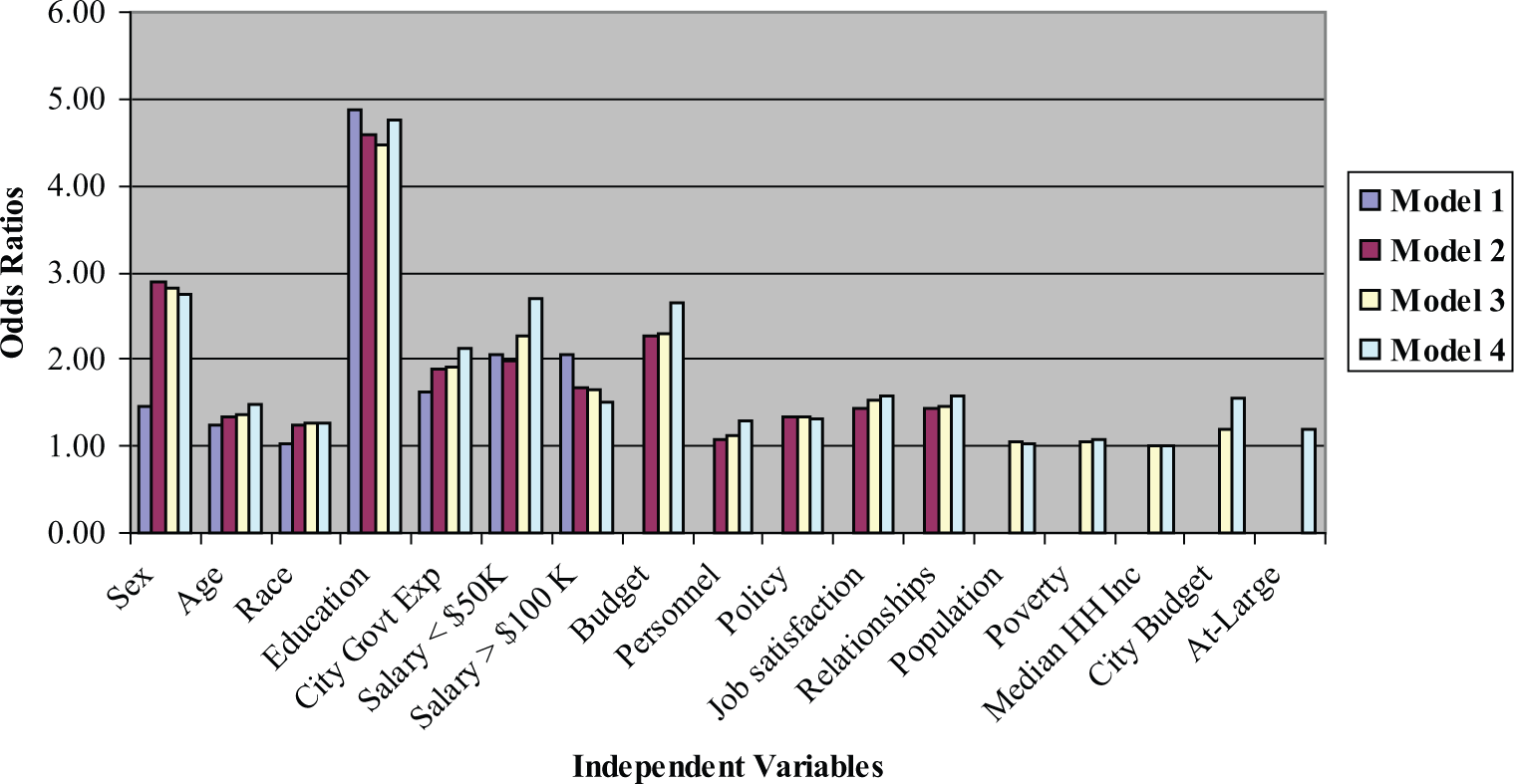
Logistic regression: In job more or less than 5 years.
Sixty-one of the 83 city managers who responded to the question about election systems reported serving with a council elected entirely in at-large systems (see Table 2, Model 4). Model 4 analyzes the effect the number of officials elected at-large has on tenure in office. Number of officials elected another way is not included to avoid multicollinearity. A positive relationship was expected but there is no significant relationship. The relationships between education, city government experience, and involvement in budget decisions persist—of the three, only education is slightly less influential in this model (see Table 2, Model 4).
Compared with a city manager with a graduate degree, one without a graduate degree is 4.76 times more likely to remain in the job 5 or more years, b = −1.58; exp(B) = .21.
For each additional 5 years of city government experience, the likelihood that a city manager will remain in the job 5 or more years more than doubles, b = .75; exp(B) = 2.12.
For each increase of 1 on a scale of 1 to 7 measuring involvement in budget decisions, a city manager is 2.65 times more likely to remain in the job 5 or more years, b = .98; exp(B) = 2.65.
Note the pseudo R2 measures, Cox and Snell R2, and Nagelkerke R2 increase from Model 1 to Model 2 to Model 3 to Model 4. Model 4 is the best model according to the goodness-of-fit measure, −2 log likelihood, and chi-square which increases from 21.87 for Model 1 to 29.01 for Model 4 (p < .05). That is, added predictors make significant contributions to predicting the dependent variable.
The chart presented in Figure 2 shows no systematic trends between election systems and appointed officials’ tenure in office. Why is there so much concern about election systems? Some reasons may not be revealed in this analysis because so many council members are elected at-large in North Carolina. Logistic regression would not reveal the intensity of conflict that could be caused by a few officials elected by district.

Tenure by number of at-large and ward/district elected officials.
One manager suggested that there was a great deal of conflict among elected officials where he worked because each one was elected to represent one of six single-election districts or one of three combined (two single-election) districts. Each one tended to vote for policies that would benefit their own constituents, sometimes at the expense of other single-election districts or the jurisdiction as a whole. Board meetings were, in this manager’s opinion, highly contentious and unprofessional. He believed that at-large elections would lead to more effective governance.
This manager sought and found another job. Is it likely that he would find the same situation elsewhere in the state—that is, where most board members are elected by ward or district? Would other appointed officials agree with his opinion that governance is more effective when officials are elected at-large rather than by ward or district? Are their opinions influenced by the type of election system in their jurisdictions (see Table 4)?
Cramer’s V for Cross-Tabulation of Type Election System and Opinions About Which Election System Results in More Effective City Governance.

Note. Cramer’s V = .321.
p < .01.
Of 83 responses, only one jurisdiction reported using district elections exclusively, 21 reported using hybrid systems, and 61 of them reported that all elected officials in their jurisdiction were elected at-large (see Table 4). Furthermore, in 26% of the cities with hybrid systems, one-half or fewer city council members are elected at-large. Note that some city managers commented that there are variations in election systems that are not clearly reflected in data describing at-large versus ward or district representation. Several city managers said that elected officials must live in the district that they represent even though they are elected at-large.
Table 4 displays a cross-tabulation of elections systems in jurisdictions by managers’ opinions of the most effective systems. Forty-two of 46 managers, more than 91%, believe that at-large systems are the best of the three systems of governance. These 42 managers serve in municipalities where all elected officials are elected at-large. About half of those who favor the other two options (1 of 2 and 18 of 35, respectively) were elected in at-large systems.
Some would say that the most appropriate election system for a community is the one that best serves the needs of the community. Which system does truly serve the needs of the community as a whole? If representatives elected by ward or district constantly fight for the needs of their own ward or district then council meetings are less likely to be productive. In these situations the appointed officials are very vulnerable because they cannot serve all their masters and the needs of the municipality as a whole.
What defines the needs of the community as a whole? For some communities the issue is diversity and at-large elections—these, according to the literature, better serve needs of a diverse community. For some communities the issues relate to crime in certain areas—this could lead to contentious discussions among elected representatives who represent single districts. Hybrid systems seem to address both the needs of specific areas of communities and the needs of the community as a whole.
There is a need to explore the relationship between party affiliation of registered voters and the tenure of appointed officials because the ideology of voters might affect expectations for government in that area. More specifically, in a conservative area, voters might elect city council members whom they expect to limit what government does, whereas in a more moderate or liberal area, voters might elect city council members who they expect would expand services or more actively address problems such as poverty or crime.
One might expect that the warm resort areas on the East coast, where off-season unemployment rates rise, might be more liberal and that the cooler Mountain Region might be more conservative. Even though most local elections are nonpartisan, one indicator of ideology in a region is the party identification of registered voters because Republicans tend to be more conservative than liberal, and Democrats tend to be more liberal than conservative. Figure 3 shows no systematic relationship between the proportion of voters who registered as Democrats on the y-axis (to avoid the multicollinearity problem present when both parties are included in a regression model and to eliminate problems due to variations between large and small councils) and tenure in office on the x-axis.
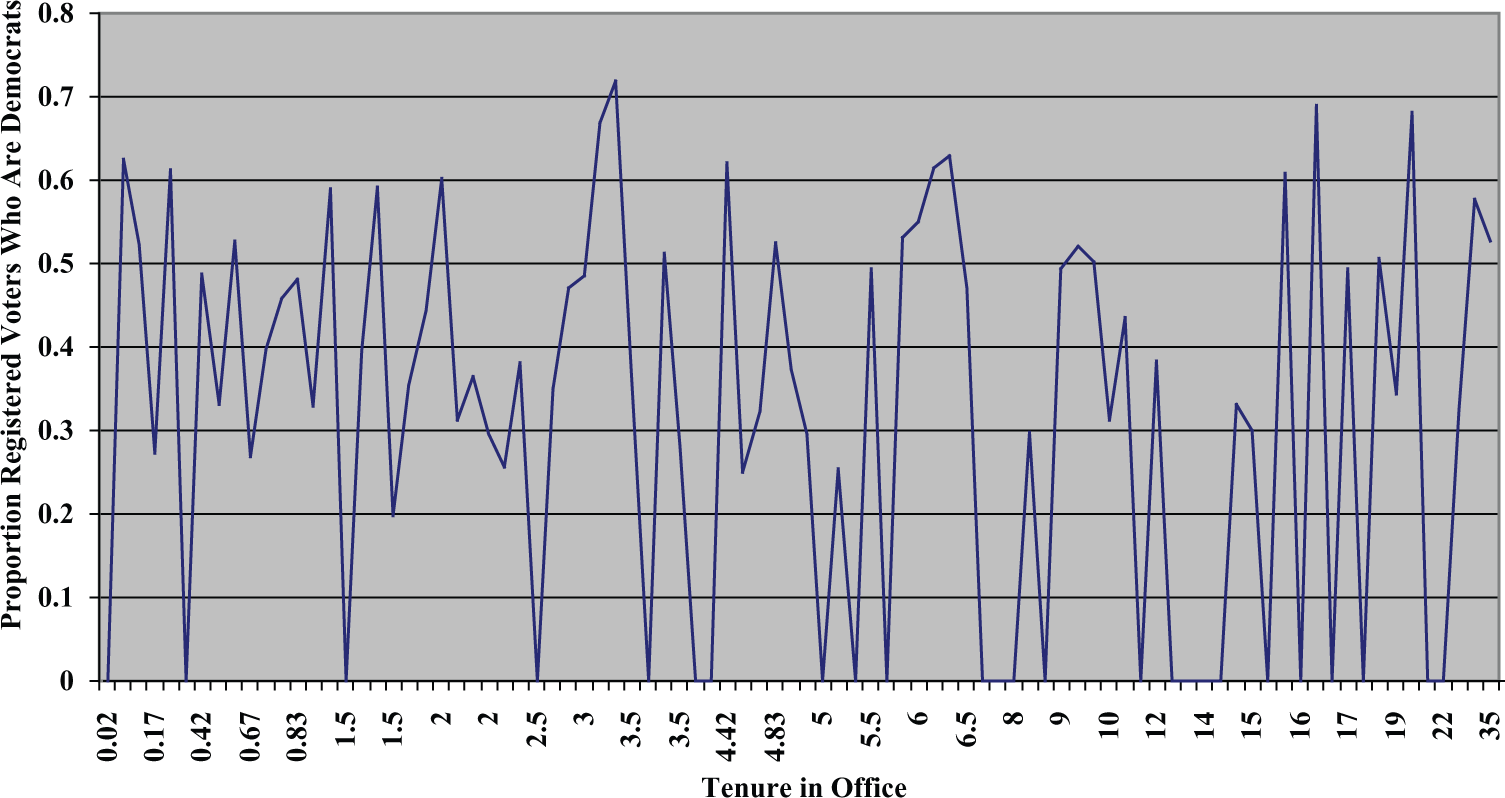
Proportion voter registered democrats by tenure in office.
Conclusion
Many city managers are committed to professional careers in public service and are willing to move to advance their careers. It seems that few managers work their way up in one municipality. They more likely are hired from outside the jurisdiction where they work. Data describing the length of time city managers have served in their jobs and have lived in their jurisdictions suggest that this is true. For example, 43 of the 90 city managers surveyed in North Carolina have been in their current positions less than 10 years and have lived in their jurisdictions less than 10 years. Ten of the city managers have been in their current positions between 11 and 20 years and have lived in their jurisdictions the same amount of time. That is, over half of them may have moved into their jurisdictions when they were selected for the jobs they now hold. Also note that experienced managers with higher levels of education are more mobile—that is, they may not be forced to move by elected officials but may move voluntarily to pursue better opportunities.
Fewer city managers ranked their levels of responsibility in policy making as high as they ranked their levels of responsibility for decisions related to the budget. Elected officials would say this is fitting because elected officials are the policy makers. With regard to professionalism, well-educated, experienced managers who understand their roles and responsibilities, who make good decisions related to the budget, who implement strategies to maintain positive relationships, and who do not overstep the boundaries set by elected officials are likely to be successful.
When considered with their comments, the city managers’ ratings of job satisfaction and work relationships suggest that their job security depends on process as well as content. That is, how the managers do their jobs—ethical behavior, trust, effective communication skills, respect for others—is as important if not more important than what the managers do—such as the budget decisions that they make. For example, personality and style are not examined in this study but one might expect extroverts to be more comfortable than introverts interacting with citizens and elected officials, collecting feedback about city services, addressing problems and following up with those who raise issues about cities’ efficiency and effectiveness.
More than 90% of city managers believe that at-large elections lead to better governance. When the council is comprised of officials elected by ward or district decision making may be slow, meetings may be contentious, and it may be more difficult to win the support of the majority of elected officials and to keep one’s job. When officials are elected at-large, there may be more discussion of proposed statutes and city services but one would expect more input and buy-in from those who were part of the decision making process and, therefore, better outcomes.
This case study of local government managers broadens our understanding of local governments. There is a need for additional research analyzing data from a national sample of elected and appointed officials in counties and cities to determine whether the reasons for turnover among appointed officials are unique to North Carolina. For example, we know there are important differences in priorities, policy issues, and leadership in male and female public officials. It is likely that a national sample would include a much larger number of women—a mere 14% of those who responded to this survey were female. And nearly 98% of the city managers who responded to the North Carolina survey are White suggesting a need to explore the extent to which election systems in this state address minority needs. A larger data set is likely to include greater variation in city size. This data set included on four cities with populations between 50,001 and 100,000 and one city with a population between 100,001 and 250,000. Therefore, the ability to analyze variations based on population size is limited in this study of municipalities in North Carolina.
Are not city managers in fact professional public administrators affected by politics with a small “p” but not politics that reflect citizens’ ideology? Would not a well-educated, experienced city manager who makes sound decisions about the budget and competently fulfills his responsibilities for implementation of policies determined by elected officials be fairly safe to make his or her own decisions about staying a long or short time in one municipality? According to this case study of appointed officials in North Carolina both answers would be affirmative.
Footnotes
Declaration of Conflicting Interests
The author(s) declared no potential conflicts of interest with respect to the research, authorship, and/or publication of this article.
Funding
The author(s) received no financial support for the research and/or authorship of this article.