




Abstract
Language legislation, given its importance in language rights, has received increasing attention over the past decades. This study offers a comprehensive bibliometric analysis of the literature on language legislation from 2005 to 2023. By utilizing VOSViewer and CiteSpace, we have visualized and analyzed the scientific outputs, intellectual structure, and evolving research trends in this field. The main findings are summarized as follows. First, there has been a notable increase in the number of publications on language legislation over the past two decades, with “The Language Situation in Luxembourg” emerging as the most influential publication. Eva Pons Parera stands out as the most prolific author, while the Journal of Language and Law is identified as the most impactful journal. The University of Barcelona and Spain are recognized as the leading institution and country in terms of productivity. Second, the central areas in language legislation research include language and law, and the sociology of language, with the multilingual legislation, the multi-domain application of language legislation, and the advocacy for language rights among minority groups are pinpointed as the hotspots. Third, future research is likely to center on the formulation, implementation and evaluation of language laws, especially concerning minority and disabled groups; the protection of language rights; and the management of linguistic pluralism on an international scale. Overall, these findings provide a valuable resource for researchers, policymakers, and stakeholders, offering insights into the current state and future directions of language legislation research.
Plain language summary
The study examines academic publications on language legislation from 2005 to 2023, revealing the scientific outputs, intellectual structure, and evolving research trends in this field. It finds that interest in language legislation has surged, with “The Language Situation in Luxembourg” being the most impactful publication. Eva Pons Parera is the most productive author, and the Journal of Language and Law is the most influential journal. The University of Barcelona and Spain are the leading institution and country in this area of research respectively. Besides, key areas of focus in language legislation research include the relationship between language and law and the sociology of language. The study highlights multilingual legislation, the broad application of language legislation, and the advocacy for minority language rights as key areas of interest. Finally, the study suggests that research will focus on the development, implementation, and evaluation of language laws; the protection of language rights; the management of linguistic diversity; and the examination of language legislation within international organizations.
Introduction
With the rise of interdisciplinary research, language legislation studies have experienced rapid growth. Language legislation is defined as a substantial form of legal intervention in the field of language, encompassing three primary criteria: the level, mode and content of intervention (Calvet, 2007). The terms “Language Law” (Turi, 2012), “Language Act” (Landqvist & Spetz, 2020; Ramuedzisi, 2022), “Language/Linguistic Legislation” (Matos & Carvalho, 2023; Turi, 2012), and “Constitutional Language Provisions” (Rakgogo & Zungu, 2022) can be used to denote the various legal regulations within a country related to language provisions, and they represent variations of the broader concept of language legislation. The aim of language legislation is to protect or promote the status and usage of one or more designated or identifiable languages through legal language obligations and language rights (Turi, 2012). This suggests that language, initially served as a symbol, has become a medium for legal or regulatory intervention. Language legislation has gradually developed an indispensable connection with the national and social development. For instance, Cardinal and Sonntag (2015) suggested that the success or failure of language legislation is influenced by national traditions. Therefore, the study of language legislation cannot be separated from the context of national development. Language legislation is the product of national language management, revealing the interactive relationship between national language law and language practice (Matos & Carvalho, 2023).
Recently, language legislation has gained increased attention across various domains. Researchers are not only concerned with language legislation in specific countries (Berezkina, 2017; Koeva, 2023) and groups of people (Lo Bianco, 2020; Wells, 2019), but also explore the application of language legislation in non-traditional linguistic domains, including social services (Kalayci & Duru, 2024) and business (Sanden, 2020). Furthermore, with the integration of neoliberal ideologies emphasizing “freedom” and “equality,” language law has provided a more authoritative legal foundation and regulatory framework for the contemporary multilingual and multicultural world. Scholars are engaged in understanding the authority of language status as endowed by law from a linguistic perspective (Ali, 2021), while also examining the fairness and justice of language legislation from a political standpoint (Gazzola, Wickström & Fettes, 2023). However, despite the significance and growing interest in this topic, there remains a scarcity of systematic and quantitative reviews on language legislation. In light of this gap, this research endeavors to shed light on the prevailing trends in the study of language legislation by employing a bibliometric analysis. Specifically, the current study seeks to provide a comprehensive overview of the academic landscape by revealing the scientific outputs, intellectual structure, and research trends within the domain of language legislation.
This article is organized into several sections. The first section provides a summary of previous studies on language legislation. It critically examines existing studies, highlighting gaps in the literature and potential areas for further exploration. The second section outlines the research methodology utilized in this study. It details the procedures, tools, and techniques employed to achieve the specific objectives. The third section presents the findings of the study, supported by rigorous data analysis. It discusses the implications of these findings in the context of language legislation, providing a critical interpretation of the results. The final section offers a conclusion that encapsulates both the contributions and the inherent limitations of the research.
Literature Review on “Language Legislation” Research
The first stage of language legislation research typically focuses on addressing practical language-related issues and providing a foundational description of the current national legislation in each country. The inception of this field can be traced back to the establishment of emerging nation-states and their subsequent decolonization and modernization processes. In this stage, states adopt a clear-cut approach by incorporating language regulations into their constitutions or language laws. These regulations deliberated on the status of languages, the role of English, language educational practices, and even language legislation as exemplified in Fishman’s (1983) works. Besides, they provide an overview of the country’s language policy (Luk, 2017; Taylor-Leech, 2009; Verschik, 2005), examining language usage among diverse language groups (Kozhemyakina, 2020), and investigating regional data organization (Kozhemyakina et al., 2022). Throughout this stage, written documents are the primary source of research.
The second stage of language legislation study is typically characterized by a critical approach. Drawing upon planning and critical theories, explicit language provisions or language laws in the constitutions have evolved into instruments for examining language ideology and political underpinnings (Tollefson & Pérez-Milans, 2016). From the 21st century onward, ethnographic and discourse analysis methods (Johnson, 2011) have progressively shifted toward the construction of multi-level language policy texts and discourses. This focus highlights the initiatives of various subjects, thereby imbuing language practice within legislative research with dynamism. These characteristics are exemplified in interdisciplinary fields such as education (Chimirala, 2022; Ntshangase & Bosch, 2020; Rakgogo & Zungu, 2022), jurisdiction (Braverman, 2007; Lell, 2017; Mokoena, 2018), media (Docrat & Brits, 2021), and healthcare (Prys & Matthews, 2023). Simultaneously, a wealth of online-obtained media (Vessey, 2021) and static policy texts serve as crucial data sources for triangulatory verification.
The third stage of language legislation research is significantly influenced by normativism, with a greater emphasis on the relationships between language, power, and ethics. In recent years, the rising trend of social justice and decolonization has also penetrated into the study of language legislation, making its connotation more diversified (Gazzola, Grin et al., 2023). This has led to a deeper understanding of “fairness” and “justice.” Evaluation serves as a vital step in reflecting on language legislation research. The scope of evaluation has expanded to encompass a wider range of objects, from the implementation of official language laws (Lachance & Parent, 2023) to psychological assessments in educational institutions (Joner et al., 2022), and even the impact of legal communication (Beebeejaun, 2023). The availability and utilization of legal databases (Humphries & Ayres-Bennett, 2023) have significantly facilitated the reconstruction of knowledge structures, such as the concept, system, and framework of language legislation (Zhang et al., 2022). To date, there exists one review article on the subject of “language legislation,” authored by Matos and Carvalho (2023) in Portuguese. This work discusses the concept of “language legislation” and its practical application, critically examining several key themes: the naming of languages, the juridical and political roles that languages fulfill, the protection of language rights, and the establishment of language-related obligations. While this study offers a comprehensive analysis of language legislation, there remains certain limitations. Specifically, the research methodology, currently limited to qualitative analysis, could be expanded to include quantitative visualization techniques for a more robust approach. Additionally, the literature review, heavily reliant on non-English sources, could benefit from a more inclusive examination of relevant English-language literature. Overall, there is a notable absence of prior work that offers a comprehensive examination and mapping of scientific production in the field of language legislation. To fill this gap, the present study aims to apply the bibliometrics technique to analyze the literature in language legislation field.
Bibliometrics, as a quantitative analytical technique, is predominantly employed to identify the main patterns of the selected publications. Additionally, the network mapping of bibliometrics allows for the visualization of the underlying intellectual structure (Yan & Wu, 2024). As such, this study aims to present a thorough review of language legislation research by visualizing the landscape and evolution of literature published between 2005 and 2023. The research questions are listed as follows:
What is the landscape of scientific outputs in the field of language legislation, as measured by items such as publications, authors, journals, institutions, and countries?
What is the intellectual structure in the field of language legislation in terms of the influential references, authors, journals, and keywords?
What is the emerging research trend of works on language legislation?
Methodology
Bibliometric Analysis
Bibliometric analysis has become a crucial tool for measuring the scientific outputs across various scientific items, such as publications, authors, journals, institutions, and countries. By examining the relationships and interactions between these items, bibliometric analysis offers insights into the development and structure of a specific research field (Donthu et al., 2021). With this analysis, researchers primarily aim to recognize, evaluate, and comprehend the literature (or part of the literature) within a specific research field (Öztürk, 2021).
Two main analytical procedures are applied in bibliometric analysis: performance analysis and science mapping (Donthu et al., 2021). Performance analysis is the assessment of scientific output in terms of quality and quantity indicators regarding the items (publication, author, journal, country, institution) related to the researched field. It aims to evaluate the “publication” and “citation” performances of these items (Öztürk & Dil, 2022). On the other hand, science mapping is the visualization of the relationship between authors, keywords, and citations (in terms of references, authors, or journals), which aims to reveal and examine the relationship networks between these scientific items (Öztürk et al., 2024).
In this study, we have employed VOSViewer and CiteSpace to conduct a comprehensive bibliometric analysis of the language legislation research. Firstly, we conducted a performance analysis, meticulously detailing the contributions of publications, authors, journals, institutions, and countries. This approach has allowed us to present a holistic view of the language legislation field, capturing its general landscape and key players. Secondly, we utilized VOSViewer as our primary instrument for science mapping. Through co-citation analysis and keyword co-occurrence analysis, we have visualized the knowledge structure and identified the hotspots within the domain of language legislation. This mapping has provided a clear representation of the field’s intellectual structure and areas of concentrated scholarly activity. Finally, to further our understanding, we utilized CiteSpace for evolutionary analysis, which has enabled us to trace the historical trajectory and expansion of the subject area over time. Additionally, a keyword burst analysis was performed, revealing emerging trends and highlighting the dynamic shifts within the field. Figure 1 outlines the methodological framework employed in this study.

Methodological framework of the paper.
Data
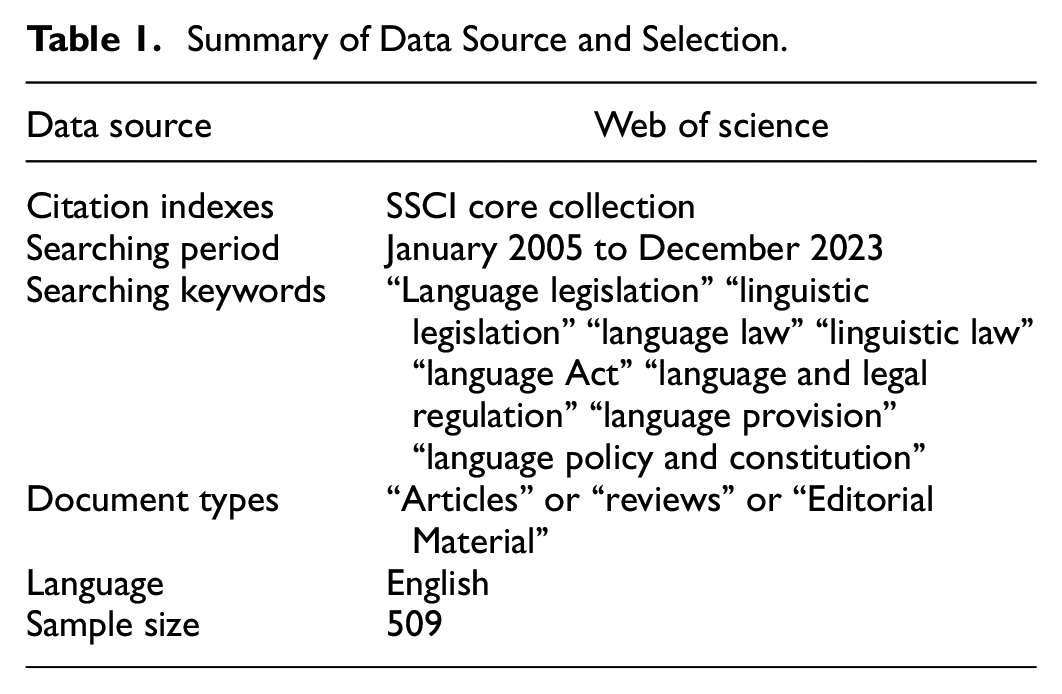
The dataset for this investigation was sourced from the Core Collections of the Web of Science (WOS-CC) database, encompassing the Science Citation Index-Expanded, Social Sciences Citation Index, and Arts & Humanities Citation Index. The WOS-CC stands out as the leading global database for accessing comprehensive published data, including substantial collections of high-impact journal articles, conference proceedings, and books (Liu, 2019). The present study included publications from 2005 to 2023, considering the first post-2000 article on language legislation emerged in 2005. By utilizing the given keywords, we retrieved a total of 792 articles. After excluding those unrelated to the field, we ultimately included a final sample size of 509 for subsequent analysis. Overall, we established a unique, large-sample database of current research on “language legislation.” A summary of the data source and selection process is presented in Table 1.
Summary of Data Source and Selection.
The specific parameters employed for CiteSpace were configured as follows: time slicing (spanning from January 2005 to December 2023; with a yearly slice duration), text processing (comprising title, abstract, author keywords, and keywords plus), node type (one category selected at a time from country, institution, author, co-cited journal, co-cited author, or co-cited reference), link strength (utilizing cosine), link scope (restricted to within slices), selection criteria (g-index, with k = 25), and pruning (none applied). All other parameters were maintained at their default settings.
Results and Discussion
RQ1: What Is the Landscape of Scientific Outputs in the Field of Language Legislation, as Measured by Items Such as Publications, Authors, Journals, Institutions, and Countries?
Descriptive Statistics
Our dataset comprises 509 publications, which were produced by a collective of 662 authors affiliated with 411 distinct institutions across 75 countries. These works have been published in 258 different academic journals and collectively cite an extensive body of 16,253 referenced works (see Table 2 for details).
Descriptive Statistics of the Database.

Publication Trend
There is a mounting interest in language legislation with a surge in research output since 2019. Figure 2 illustrates the temporal distribution of publications within the field of language legislation research. The first traceable article emerged in 2005, marking the inception of scholarly engagement in this area. Subsequently, there has been a consistent upward trend in the number of publications. The growth pattern can be divided into three distinct stages. The initial stage spanned from 2005 to 2007, witnessed the publication of fewer than or equal to 10 articles annually, signifying the nascent recognition and burgeoning interest in the field during this period. The second stage, extending from 2008 to 2018, saw a stable and balanced development in the number of published papers, indicative of a growing cohort of scholars delving into this subject, thus culminating in a phase of steady growth. The third stage, spanning from 2019 to 2023, witnessed a substantial rise in the publication count, with the number of papers doubling in comparison to the preceding stage. This surge suggests an intensifying interest in related topics, signifying a period of rapid development. Consequently, these findings highlight a growing interest in language legislation over the examined years, as indicated by the escalating number of publications. This trend can be attributed to several factors. A key factor is the research’s expanding interdisciplinary scope, which is evident in the heightened focus on language legislation, as noted by J. E. C. Cooper (2019). Additionally, the globalization of publication languages is contributing to this trend, moving beyond the confines of English and the official languages of various nations. There is an increasing demand for the inclusion of minority languages in academic discourse (Dzogovic et al., 2021). Specifically, a surge of research has been directed toward language legislation in non-English speaking countries. For instance, studies have delved into the language identity in Afghanistan (Leake, 2023), explored language use and attitudes in Iraq (Al-Obaidi & Nofal, 2022), and examined the evolution of Slovenian legal terminology (Novak, 2021). These investigations underscore the importance of understanding and addressing the complexities of language legislation in a globalized world.

The distribution of publications from January 2005 to December 2023. The blue bars indicate the annual volume of published articles, with the precise number displayed atop each bar. The orange dashed line denotes the regression line that best fits the data points. The publication trend is divided into three distinct phases based on the output: Initiation, Expansion, and Consolidation.
Key Publication
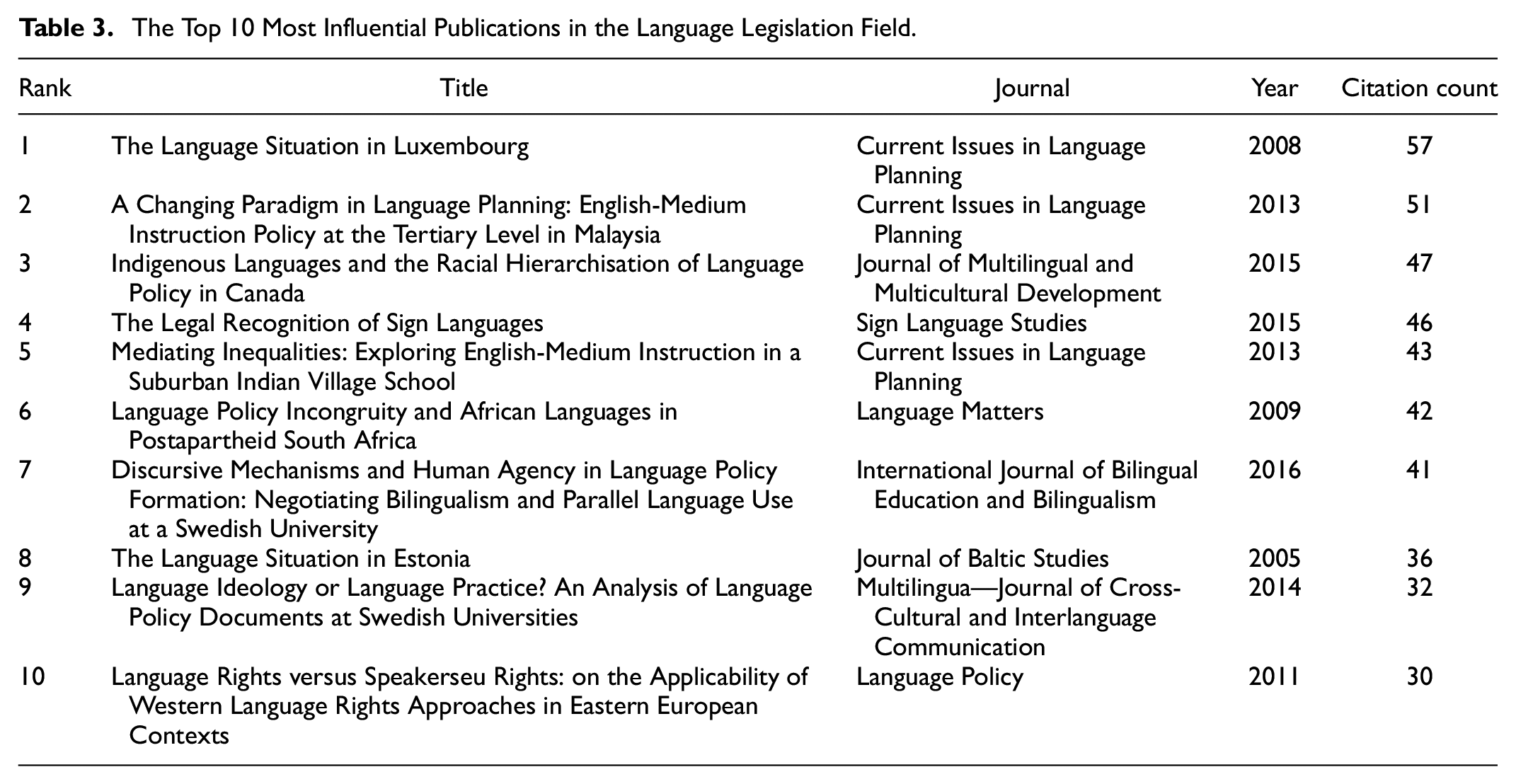
This study identified the publications with the highest number of citations in the WOS-CC database. The number of citations is regarded as a metric for the research’s influence or its perceived quality (Aksnes et al., 2019). A publication with a higher citation rate is often interpreted as having a more significant impact or being of higher quality. Table 3 provides a comprehensive list of the top 10 most cited publications. This table showcases the citation counts, titles, journals, and years of publication, offering valuable insights into the influential works in the field. The most cited article was Horner and Weber’s (2008)“The Language Situation in Luxembourg,” which was referenced 57 times. This publication delineates the multidimensional research perspective and dynamic characteristics of language policies in this multilingual country located in Western Europe. The second, fifth, and ninth articles pertain to the specific implementation of language education policies. In these works, language legislation assumes an indispensable and authoritative role as normative policy texts. Although schools should utilize these legal norms as guiding principles for language practice, there are contradictions with policies in their specific operations, reflecting the gap between language practice and language legislation. The third most cited article, “Indigenous Languages and the Racial Hierarchisation of Language Policy in Canada” (Haque & Patrick, 2015), addresses language policy and policymaking in Canada as forms of discourse produced and reproduced within systems of power and racial hierarchies. It also describes the logic imposed by colonial constitutional arrangements on indigenous language promotion, revitalization, and mobilization in Canada. De Meulder’s (2015) fourth most cited article, “The Legal Recognition of Sign Languages,” provides an overview of five distinct types of legal recognition for sign languages and introduces three types of implicit sign language policies. Additionally, the sixth and seventh most cited articles focus on language commission institutions, which serve as intermediate agencies in implementing national language legislation and play an active role in coordination and consultation. The study’s key topics, including the current situation of language, language status, medium of education language choice, linguistic rights, and linguistic awareness dynamics, offer strong evidence of the shift from a macro-level analysis to meso-level and micro-level perspectives over time.
The Top 10 Most Influential Publications in the Language Legislation Field.
Productive Authors
Table 4 presents an overview of the most productive authors in this field, highlighting the names, publications, and research areas of the top 9 out of a total of 662 contributors. It is noteworthy that the research domains of these distinguished authors are predominantly centered on public law and linguistics. Within the domain of public law, their scholarly contributions are largely concerned with the exploration of language rights, fundamental rights, and the status of languages within legal systems.
The Most Productive Authors in the Language Legislation Field.
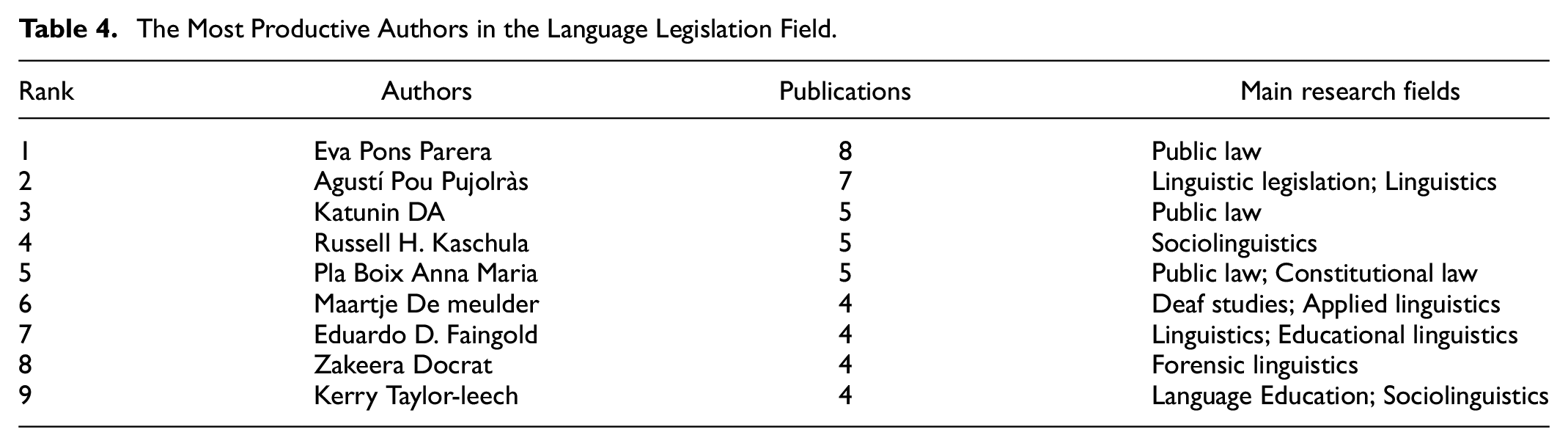
Regarding the field of linguistics, particularly sociolinguistics, these authors delve into a variety of topics including language policy and planning, language development, linguistic identities, and multilingual literacies. The wide-ranging disciplines of the authors underscore the multifaceted, cross-cultural, and indeed interdisciplinary nature of the research perspectives on this subject matter.
Productive Journals
The productivity and impact of a journal are often gaged by the volume of papers it publishes and the number of citations it attracts (Ding & Yang, 2022). This study conducted a thorough analysis of the publication output and citation metrics across a sample of 258 journals. Table 5 spotlights the top 10 most productive journals in the field of language legislation, which are also recognized for their high citation rates. Interestingly, the journal with the highest publication volume but the lowest citation rate is the Revista de Llengua i Dret—Journal of Language and Law. This journal is listed under the “Law” category in the Journal Citation Index (JCI) and is unique in that it publishes in non-English languages, including Catalan, Valencian Spanish, and Castilian. In contrast, the majority of other journals in the list predominantly use English for their publications. The top-ranked journals from second to ninth place are predominantly categorized under “Language & Linguistics” or “Linguistics.” Prominent among these are the International Journal of Bilingual Education and Bilingualism, Journal of Multilingual and Multicultural Development, Current Issues in Language Planning, Language Policy, Language Matters, and Language Problems & Language Planning. These journals are influential in publishing research on language policies, multilingualism, language issues in education, and related themes, which likely contributes to their high citation rates. Furthermore, the South African Journal of African Languages and Southern African Linguistics and Applied Language Studies are noteworthy for their focus on the diverse languages of southern Africa. This focus may be linked to South Africa’s intricate national language landscape, which boasts over ten official languages, sparking a heightened interest among scholars in the study of language legislation. Lastly, Tydskrif vir Geesteswetenskappe, a comprehensive humanities journal with a focus on Africa, underscores the significance of language legislation as a crucial subject within the humanities, reflecting the journal’s commitment to the interdisciplinary study of this field.
The Top 10 Journals With Most Publications in Language Legislation Field.

Productive Institutions and Countries
The sample for this study comprises 411 institutions across 75 countries. Table 6 highlights the top 6 most productive institutions in this area. The findings indicate that research institutions located in multilingual countries, particularly in Europe, lead the rankings. These institutions are distinguished as prominent public universities within their respective nations. However, it is observed that these institutions do not collaborate extensively with one another.
Top 6 Most Productive Institutions in Language Legislation Field.
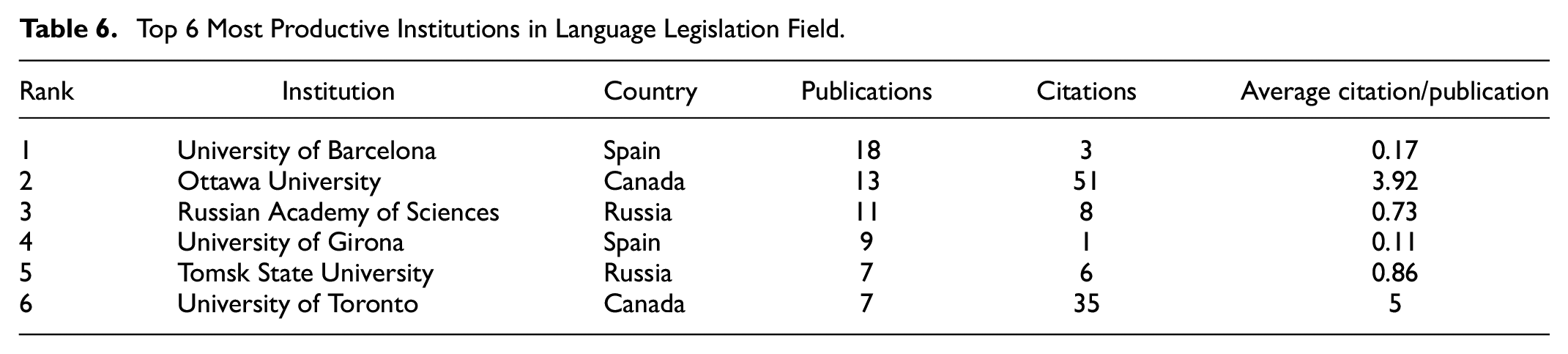
In an effort to identify the nation that stands out in language legislation research, a country-level analysis was conducted. Table 7 reveals the top 10 most productive countries in this specialized field. Spain emerges as the most prolific contributor to language legislation research. Significantly, the majority of the top 10 countries are European, suggesting a collective emphasis on this area of study within the continent. Furthermore, the countries that are most active in publishing research on language legislation are typically multilingual or are grappling with multilingual challenges, reflecting the practical relevance and urgency of language legislation in these contexts.
The Top 10 Most Productive Countries in Language Legislation Field.

RQ2: What Is the Intellectual Structure in the Field of Language Legislation in Terms of the Influential References, Authors, Journals, and Keywords?
Co-Citation Analysis on Cited Reference
Co-citation analysis is an essential tool for identifying and establishing a cluster of literature that defines a specific academic specialty. It is particularly instrumental in mapping the architecture of scientific disciplines, offering a means to track their progression and to gage the interconnectedness among various fields of study (Small, 1973). In order to explore the underlying patterns within the domain of language legislation, we undertook a co-citation analysis encompassing a dataset of 16,253 cited references. By applying a threshold criterion of a minimum of five citations, we extracted a select group of 54 references that have been highly influential within the network of citations. This analysis illuminated the keystone works that have shaped the discourse in language legislation, identified thematic clusters of research, and traced the field’s intellectual structure.
As shown in Figure 3, the most frequently cited works within the language legislation research field are Spolsky (2004) with 27 citations, R. L. Cooper (1989) with 24 citations, Shohamy (2006) with 18 citations, and Skutnabb-Kangas (2000) with 15 citations. Leveraging the 54 most-cited references, we have developed a co-citation network that provides a visual representation of the interconnectedness among these influential texts. The co-citation network analysis has revealed that these 54 references can be categorized into six distinct clusters, each distinguished by a unique color.
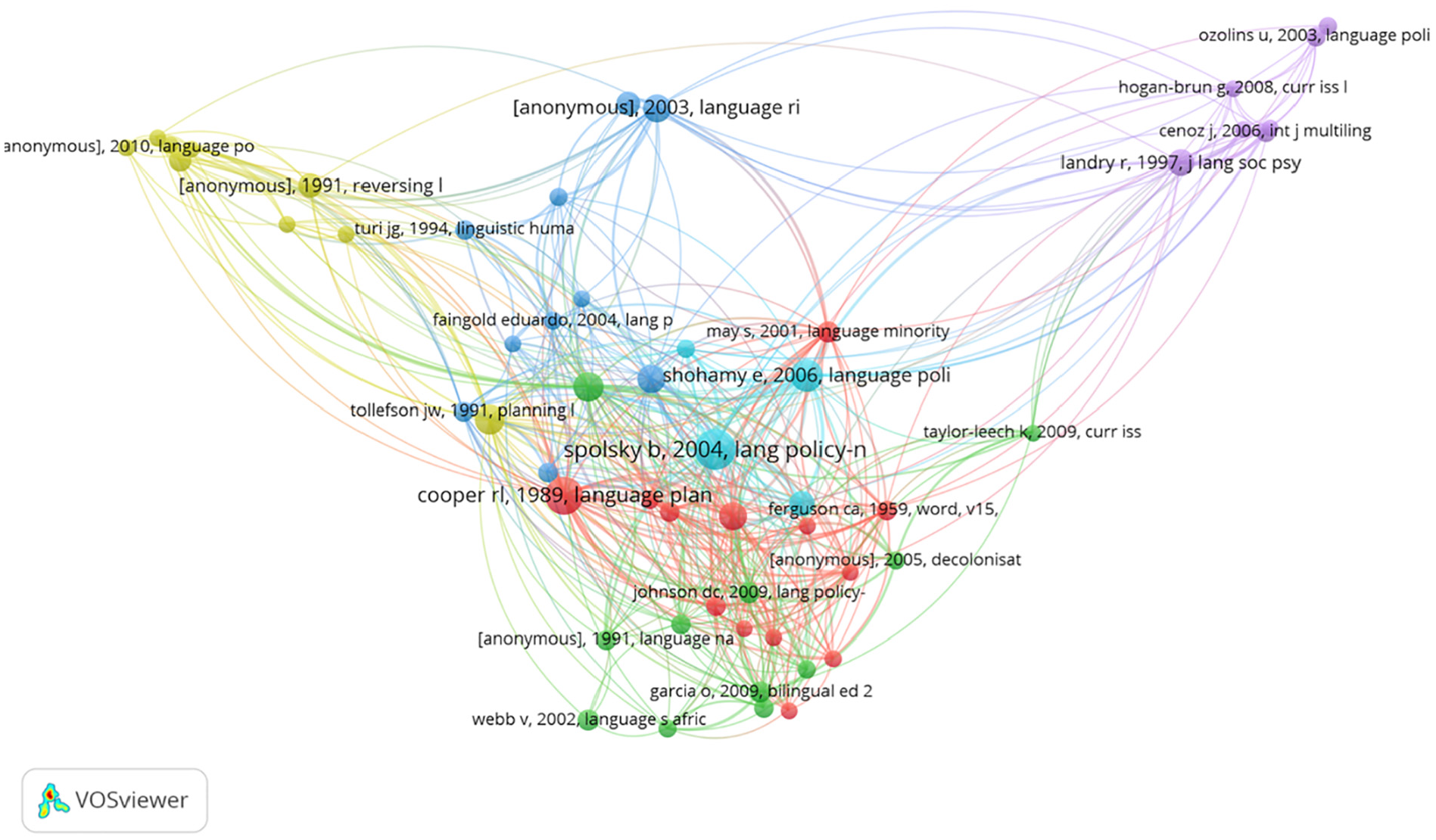
Co-citation of cited reference.
As shown in Table 8, Cluster 1 delineates the frameworks and models pivotal to language policy and planning. Cluster 2 represents diverse research fields and methodologies that intersect with language legislation. Cluster 3 focuses on language rights and language ideology in the context of language legislation. Cluster 4 examines language legislation among specific groups, with a particular focus on individuals with disabilities. Cluster 5 explores the practical applications of language legislation in various contexts, such as language landscapes and area studies. Cluster 6 consolidates classical theories in language policy and planning, establishing a foundational base that is essential for the progression of subsequent research in the field. Each cluster includes research on language legislation and other disciplines that have contributed to its development.
Co-Citation Analysis Clusters and Citation Counts of Influential References in Language Legislation.

In general, the preponderance of representative works by authors within these clusters gravitates towards language policy, covering a spectrum of aspects including the research framework of language policy, the interplay between language and social change, the implicit mechanisms of language policy, and the inextricable link between language policy and politics. This concentration indicates a pronounced inclination of language legislation research towards the broader field of linguistics, reflecting the complex interdependencies between language use, policy, and societal structures.
Co-Citation Analysis on Cited Authors
To uncover the most impactful scholars in the field of language legislation research, we began with an extensive dataset that included 10,371 authors cited in a total of 11,767 publications. Employing a rigorous criterion of a minimum of 20 citations, we refined our list to a select group of 24 authors. After excluding non-individual entities like UNESCO and the Council of Europe, we arrived at a final sample of 18 distinguished authors. A co-citation analysis of this list revealed a structured graph with four clusters (Figure 4). Dominating the citation rankings are the following leading figures: Spolsky, B with 64 citations, Skutnab-Kangas, T with 34 citations, Hornberger, N. H with 31 citations, Blommaert, J with 30 citations, and Shohamy, E, who shares the same citation count with Blommaert.
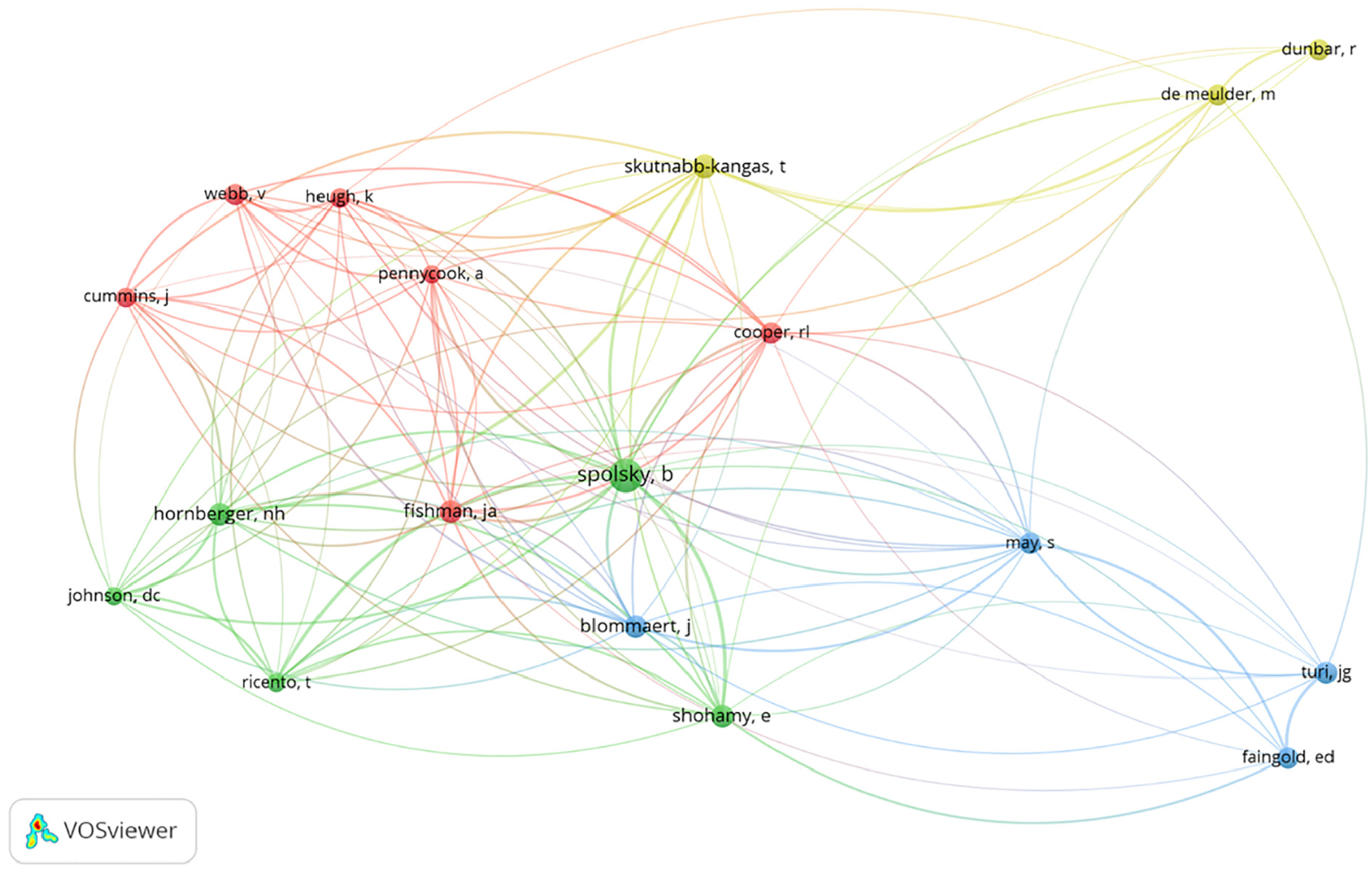
Co-citation of cited authors.
Cluster 1 is comprised of experts in the sociology of language, including Fishman with 29 publications and Cooper with 27, both renowned for their work in language policy and planning. Webb, with 26 publications, and Cummins with 23, are recognized for their contributions to language development. Additionally, Heugh with 24 and Pennycook with 20 are noted for their research in language education and multilingualism.
Cluster 2 comprises authors with a focus on the theoretical underpinnings of language policy, such as Spolsky with 64 citations; critical methodology, represented by Hornberger with 31 citations and Johnson with 21; and the study of language ideology, with contributions from Shohamy with 30 citations and Ricento with 20.
Cluster 3 highlights prominent sociolinguists like Blommaert with 30 citations, and experts in the field of linguistic legislation and language politics, including Faingold, May, and Turi, each with 27 citations.
Cluster 4 is dedicated to scholars whose research primarily revolves around minority languages, exemplified by Skutnabb-Kangas with 34 citations. It also includes De Meulder, who has 25 citations for her work on sign language policy and planning, and Dunbar, recognized for his 25 citations on the advocacy for language rights.
Co-Citation Analysis on Cited Journals
We also conducted a co-citation analysis on a dataset of 11,767 cited sources to explore the most influential journals in the field of language legislation. By setting a threshold of 20 citations, we narrowed down the list to 35 key journals for our analysis. This process led to the formation of a network divided into three distinct clusters (Figure 5).

Co-citation of cited journals.
The top 6 most cited journals are as follows: Revista De Llengua I Dret-Journal of Language and Law with a significant 119 citations, Language Policy (Netherlands) with 105 citations, International Journal of the Sociology of Language with 104 citations, Current Issue in Language Planning with 89 citations, Journal of Multilingual and Multicultural Development with 78 citations, and Language Problem and Language Planning with 74 citations. These findings underscore that the co-cited journals in language legislation tend to concentrate on language policy issues. The dataset further bifurcates into two thematic groups: one featuring journals with a “language and law” focus published in languages other than English, and the other comprising journals with themes related to the “sociology of language,” especially in the areas of language policy and planning, multilingualism, and bilingual education, which are predominantly published in English. This distribution also underscores the multidisciplinary nature of language legislation studies, which highlights the importance of diverse perspectives in shaping language legislation discourse.
Co-Occurrence Analysis on Keywords
Finally, in order to further explore the most salient topics in language legislation field, we executed a keywords co-occurrence analysis utilizing the VOSViewer tool (Figure 6). This analytical approach not only maps the current intellectual landscape of language legislation research but also provides a snapshot of the areas that are garnering the most attention. Out of a total of 1,488 identified keywords, we identified 30 that recurred with a frequency exceeding 10 instances. A selection of the top 15 most recurrent keywords is presented in Table 9, with the understanding that greater frequency is indicative of heightened interest within the domain of language legislation research.

Co-occurrence of keywords.
High-Frequency Keywords and Occurrences in Language Legislation Field.

As shown in Figure 6, “language policy,”“language rights,” and “language law” emerge as central nodes, aligning with their status as high-frequency keywords in Table 9. These central nodes are indicative of the most dominant themes in the field. Conversely, peripheral nodes, such as “jurisprudence,”“Catalonia,” and “rights,” among others, represent themes that, while significant, are less central to the mainstream discourse. Besides, the co-occurrence analysis has yielded a network divided into five distinct clusters, each representing a significant facet of the language legislation field. Firstly, cluster “language legislation” is dedicated to the advancement of multilingual and multi-domain legislative frameworks. It emphasizes the development of policies and laws that support linguistic diversity and inclusivity across various sectors of governance and society. Secondly, cluster “language policy” delves into the intricacies of national language policy-making. It may encompass discussions on the normativity and fairness of national language(s) legislation (Jimenez-Salcedo & Carbonneau, 2021). Thirdly, cluster “language law” pertains to the broader application of language laws, which could be specific to individual countries or extend to the level of international organizations. It underscores the universality of language regulations and their implementation across different jurisdictions. Fourthly, cluster “official language” is particularly relevant in emerging areas such as public health and safety, as well as law enforcement and the judicial system. As noted by Humphries and Ayres-Bennett (2023), the intersection of these fields with language legislation is becoming increasingly significant. Lastly, cluster “minority language” concentrates on the delicate balance between national interests and the ethical and cultural considerations of minority language communities. It aims to address the unique challenges faced by these groups in maintaining their linguistic heritage while navigating the dominant national language landscape (Kovnyi et al., 2023).
RQ3: What Is the Emerging Research Trend of Works on Language Legislation?
The integration of evolution analysis and burst detection methodologies serves as a robust framework for a comprehensive examination of research Themes and their trajectory over time (Bicheng et al., 2023). In the following sections, we will delve deeper into these analytical techniques, explicating their application and significance in the context of language legislation research.
Evolution Analysis
This method involves tracking the development of research topics over a period, identifying shifts in scholarly interest, and pinpointing the maturation or decline of certain areas of study. To uncover the development trajectory of language legislation research, we employed the timezone view function in CiteSpace for an evolution analysis. Figure 7 illustrates a notable increase in research centered on language policy as a central theme post-2005, with a significant rise in studies emerging after 2008. Prior to this period, research was more focused on the political aspects of language legislation, particularly concerning minority groups (Cardinal & Denault, 2007; Dunbar, 2006) and national governance (Argemi, 2007; Somniso, 2007). From 2008 to 2018, the field of language legislation experienced a phase of diversified development. Within the domain of language policy, language legislation is seen as a comprehensive framework encompassing several key components, including the standardization of legislative languages (Barnes, 2010), the preparation of the language legislation process (Murray, 2015), the certification of language law (Druviete & Ozolins, 2016), the execution and implementation of language law (Treneska-Deskoska, 2017). Simultaneously, the educational system has been identified as a critical mechanism for addressing the language rights of various linguistic communities, serving as a direct means to balance linguistic pluralism and cultural diversity. The choice of medium in language education is closely linked to language legislation, acting as a key instrument for executing language planning and influencing the success of language policy implementation (Bhattacharya, 2013), as well as the protection of language rights through legislative measures (Björkman, 2014). More recently, since 2019, the evaluation of the overall language legislation system has come into focus (Landqvist & Spetz, 2020). A primary goal of national language legislation is to safeguard language rights, which are fundamental for diverse groups in seeking their rights and interests. Effective implementation of these provisions and the establishment of a fair distribution of resources and benefits are essential for genuinely protecting the language interests of minority groups (Kovnyi et al., 2023; Warhol, 2011). Language legislation is recognized as an inherently political process, influenced by various factors. It is a continuous and reflective process that evolves in tandem with the political landscape (Ali, 2021; Mochalov, 2020). This understanding underscores the dynamic and interconnected nature of language legislation, highlighting its significance in shaping the linguistic rights and cultural identity of communities.

Map of timezone view in language legislation field.
Burst Detection
Complementary to evolution analysis, burst detection is particularly useful for identifying sudden surges in the publication of research on specific themes. These “bursts” may indicate new and rapidly growing areas of interest, potentially pointing to emerging trends that are capturing the attention of the academic community (Chen, 2006). In this paper, we executed the burst detection feature of CiteSpace to meticulously trace the evolution of language legislation research, focusing on the shift in emphasis from 2005 to 2023. Figure 8 provides a snapshot of the temporal dynamics within this field, where “strength” denotes the prevalence of a keyword, and “begin” and “end'” signify the start and end years of bursts, respectively. The red lines delineate the time frame during which a particular burst was observed. The analysis reveals a progression of research foci, commencing with a concentration on “language politics,” reflecting early scholarly interest in the political dimensions of language legislation. Over time, the bursts transition toward terms such as “language law,”“language situation,”“linguistic law,”“linguistic pluralism,”“language,” and “policy,” which have emerged as contemporary research hotspots. The transition from “language politics” to these newer hotspots suggests a maturation of the field, moving from an initial emphasis on the political underpinnings of language legislation to a more nuanced exploration of the legal, situational, and pluralistic aspects of language use and policy. This shift underscores the complexity of language legislation as it intersects with various societal domains, including law, policy, and the lived realities of linguistic communities. Future research in the domain of language legislation is poised to concentrate on several pivotal areas, reflecting the multifaceted nature of the field and the evolving needs of global communities. Here are the key areas that are anticipated to be the focus of upcoming scholarly work: the formulation, implementation and evaluation of language laws for both national and other languages, with particular emphasis on legislation for minority and disabled populations; the protection of language rights; addressing linguistic pluralism; and expanding the scope of research to international organizations.

Keyword citation bursts from 2005 to 2023.
Conclusion
Language legislation is a topic that has been extensively examined over the years, yet there remains a notable absence of comprehensive and quantitative reviews on this topic. This study aims to fill that gap by offering an in-depth bibliometric analysis of research in the field of language legislation, spanning nearly two decades from 2005 to 2023. The key findings are summarized as follows: (1) there is a mounting interest in language legislation field, with a surge in research output since 2019. The work of Horner and Weber (2008) stands out for its multidimensional examination of language policies in a Western European multilingual context, while Eva Pons Parera leads in publication count, reflecting her expertise in Constitutional Law and language rights. The University of Barcelona and Spain emerge as the most productive institution and country, respectively. (2) Intellectually, the central areas in language legislation research include language and law, and the sociology of language, with the multilingual legislation, the multi-domain application of language legislation, and the advocacy for language rights among minority groups are pinpointed as the hotspots. (3) Future research is anticipated to concentrate on the formulation, implementation, and evaluation of language laws, especially concerning minority and disabled groups; the protection of language rights; and the management of linguistic pluralism on an international scale. Despite these robust insights yielded, the study’s limitations, including a potential database bias and an overreliance on English literature, suggest a need for broader database inclusion, integration of classic books and theses, and a more inclusive approach to non-English literature in future research endeavors. This will ensure a comprehensive understanding of the global landscape of language legislation research.
Footnotes
Declaration of Conflicting Interests
The author(s) declared no potential conflicts of interest with respect to the research, authorship, and/or publication of this article.
Funding
The author(s) disclosed receipt of the following financial support for the research, authorship, and/or publication of this article: This work was supported by the Doctoral Research Startup Funding [Ningbo University of Technology] [2023KQ045], the “2023 Word Language and Culture Research” project [China Center for Language Planning and Policy Studies] [WYZL2023SH0001], the Open project of the Key Laboratory of Language Science and Multilingual Artificial Intelligence [Shanghai International Studies University] [KLSMAI-2023-OP-0004], the Fundamental Research Funds for the Central Universities [East China University of Science and Technology] [JKS02232202], and the National Social Science Foundation of China [23BYY171].

Data Availability Statement
The data that support the findings of this study are available from the corresponding author upon reasonable request.