




Abstract
Psychological contract breach is widespread at work and is a major cause of employee silence. This study presents organizational identity and emotional exhaustion variables and creates a model to explain the mechanism of the effect of psychological contract breach on employee silence based on the cognitive-affective system theory of personality. The model is empirically examined using the partial least squares structural equation modeling approach, with 247 grassroots employees of the company as the research subjects. The main findings are as follows: psychological contract breach has a positive effect on employee silence; psychological contract breach can indirectly contribute to employee silence by decreasing organizational identity and increasing emotional exhaustion, respectively; optimism not only weakens the negative effect of psychological contract breach on organizational identity, but also weakens the positive effect of psychological contract breach on emotional exhaustion; furthermore, optimism negatively moderates the mediating effect of organizational identity and emotional exhaustion on the relationship between psychological contract breach and employee silence. This study enriches the research on the formation, triggering mechanisms, and boundary conditions of employee silence in the Chinese context. The findings contribute to the understanding of employee silencing behavior in Chinese companies from the perspective of employee emotions and organizational identity.
Keywords
Introduction
Employees, as the “soldiers” on the front lines of a firm, are more likely to identify problems and challenges compared to managers (Jolly & Lee, 2021). In the fiercely competitive landscape of the market, the role of employee voice behavior becomes crucial for organizations, allowing them to stay updated with dynamic information, enhance the science of decision-making, and maintain competitiveness (A. N. Li & Tangirala, 2022; Soomro et al., 2020). Nevertheless, most employees tend to keep silent on organizational issues (Dong & Chung, 2021; Hassan et al., 2019; Milliken et al., 2003). Employee silence is commonplace in organizations, but failure to address this issue can lead to many missed opportunities for improvement and growth (Dong & Chung, 2021; Srivastava et al., 2019). While there has been a wealth of research exploring employee voice, relatively few studies have investigated employee silence (Srivastava et al., 2019). What exactly causes employee silence? How can this “problem” be overcome? It is worth reflecting on.
The increasingly diverse benefits sought by employees today, as well as the economic impact of the epidemic in recent years, have resulted in companies being difficult to deliver on all the promises made to employees when they joined (Nemteanu et al., 2021; Perkins et al., 2022). As a result, it’s prevalent across all industries to witness the occurrence of breaches in the psychological contract of employees (Botha & Steyn, 2020; Wiechers et al., 2022). However, scholars have analyzed the antecedents of silence mainly from the perspectives of leadership style (Duan et al., 2018; Hassan et al., 2019), organizational climate (Razmjooei et al., 2018; Wang & Hsieh, 2013) and social culture (A. Ambele & Boonsuk, 2018; Islam et al., 2023; Knoll et al., 2021). Indeed, psychological contract breach is another crucial factor that contributes to employee silence, and several scholars have conducted research on this topic (Bari et al., 2020; Khan et al., 2021; Rai & Agarwal, 2018; Wang & Hsieh, 2014). However, these studies do not reveal the transmission mechanism between the psychological contract breach and employee silence. Therefore, analyzing the impact of psychological contract breach on employee silence can help us understand the underlying mechanism and fill the existing research gap.
Cognitive-affective system theory of personality (CAPS), states that individuals are complex integrators of reason and emotion, not reacting passively to their environment, but actively and systematically executing their responses to change (Borman et al., 2003; Mischel & Shoda, 1995). The intervention of the external environment stimulates the individual’s rational cognition and emotional impulse responses and ultimately influences the individual’s behavioral choices (Mischel & Shoda, 1995). This provides a theoretical basis for systematically uncovering the underlying mechanisms of psychological contract breach and employee silence. Organizational identity is the cognitive process by which individuals establish a connection with the organization (Mael & Ashforth, 1992) and reflects the cognitive mechanisms by which individuals face the effects of a psychological contract breach. Self-emotional exhaustion is the state of emotional resource depletion that results from the overuse of mental and emotional resources (Lin & Johnson, 2015) and reflects the emotional mechanisms by which individuals are affected by the breach of their psychological contracts. Thus, a mediation model of the role of psychological contract breach on employee silence can be developed by introducing organizational identity and emotional exhaustion as mediating variables.
In addition, individuals’ cognitive evaluations and emotional responses to the psychological contract breach can be influenced by individual traits (Hughes et al., 2020). However, there is still a lack of boundary effects that explores the role of psychological contract breach on employee silence in terms of individual traits (Chaudhary & Islam, 2022; X. Liu et al., 2020; Yao et al., 2022). Optimism as a positive personality trait means that individuals are more confident that events will turn out for the better (Scheier & Carver, 1985). According to the emotion regulation process model proposed by Gross and John (2003), optimism, as a positive personality trait, can mitigate and defuse negative emotions. Previous evidences have also emphasized that optimism can mitigate the negative effects of various external triggers on individuals (Carver et al., 2010; W. D. Li et al., 2019). Henceforth, this research delves into the optimism’s moderating influence in the mechanism of the correlation between psychological contract breach and employee silence.
In summary, by introducing the insights of CAPS theory and emotion regulation process model, and employing psychological contract breach as a triggering condition, this study explores how psychological contract breach triggers employee silence through the mediating roles of organizational identity and emotional exhaustion and examines the moderating role of optimism. The results of the study can not only provide new insights into the “black box” of the formation process of employee silence, expanding the research perspectives and boundary conditions of the mechanism of the formation of this behavior, but also enrich the theoretical study of psychological contract breach and employee silence.
Review and Hypothesis
Employee Silence
Silence is considered a collective phenomenon and refers to the behavior of employees within an organization who consciously choose to withhold their voices (Milliken et al., 2003). In this climate of collective silence, employees intentionally refrain from sharing information, ideas, and opinions related to organizational problems or improvements (Bari et al., 2020; Milliken et al., 2003). Currently, most studies follow Pinder and Harlos (2001) in defining employee silence as the phenomenon where employees, despite their ability to address organizational issues or enhance organizational performance, choose to withhold their thoughts, evaluations, and opinions regarding various aspects of the organizational environment - behaviors, cognitions, or emotions, driven by specific motivations.
Based on different motivations, scholars have distinguished between the dimensions of employee silence. Pinder and Harlos (2001) divided employee silence into two dimensions, quiescent silence and acquiescent silence. Quiescent silence is the behavior of employees who choose to keep their views to protect themselves from the interpersonal barriers of expressing their opinions; acquiescent silence is the passive behavior of employees who realize that they are not capable of making a change and reserve their views or passively submit to the opinions of others. Dyne et al. (2003) classified employees’ silent behavior into three dimensions based on their behavioral motivations, acquiescent silence, defensive silence, and prosocial silence. The former two have the same connotations as acquiescent silence, and quiescent silence, respectively, as proposed by Pinder and Harlos (2001); prosocial silence, by contrast, is the behavior of retaining relevant information and views for the benefit of others and the organization, based on altruistic or cooperative motives. Knoll and van Dick (2013) proposed that employee silence should also include opportunistic silence in which employees strategically hold back work-related ideas to achieve their dominant goals. As this study focuses on the extent to which psychological contract breach leads to the manifestation of employee silence, a division of the motivational dimension behind the behavior is not required.
Psychological Contract Breach and Employee Silence
The psychological contracts consist of individuals’ beliefs about their mutual obligations to themselves and their employers (Ng et al., 2014). These psychological contracts are breached when employees believe that their employers are not fulfilling their obligations or promises (Ng et al., 2014; Robinson & Wolfe Morrison, 2000). In other words, a psychological contract breach is a subjective perception by the employee that the organization has failed to meet its responsibilities or obligations (Robinson, 1996). Extant evidence has shown that the breach of psychological contracts can engender unfavorable work attitudes and behaviors, such as diminished trust in the organization, increased propensity to leave, and reduced displays of organizational citizenship behavior (Abdalla et al., 2021; Al-Abrrow et al., 2019; Griep & Vantilborgh, 2018).
Social exchange theory can help us understand employees’ reactions to the psychological contract breach (Ng et al., 2014; Rai & Agarwal, 2018). Social exchange theory states that an individual’s behavior can be understood as a social exchange in which the individual decides whether to continue the exchange behavior based on the perceived gain or give (Homans, 1958). The psychological contract is an explicit or implicit commitment formed by the individual through interaction with the organization and reflects the belief in a reciprocal commitment between the employee and the organization (Morrison & Robinson, 1997). As a result, organizations need to return the efforts of their employees for the principle of reciprocity (Homans, 1958). The principle of reciprocity and the “contractual relationship” between the two parties can be broken when the company fails to meet its stated commitments or responsibilities, leading to negative reciprocal behavior on the part of employees (Afshan et al., 2021; Ng et al., 2014). For example, there would be a response with more aggressive voice behavior and less constructive voice behavior (Afshan et al., 2021; Bari et al., 2023; Ng et al., 2014). As a result, when employees perceive a breach in the psychological contract, they choose to remain silent even though they can provide information that could help the organization develop and improve, thereby seeking revenge against the organization and its leaders (Bari et al., 2020; Chaudhary & Islam, 2022; Qiao et al., 2023). Based on this discussion, we predict:
The Mediating Role of Organizational Identity
Organizational identity is defined as the degree to which an individual perceives congruence with the organization and reflects the extent to which individuals internalize organizational values (Ashforth & Mael, 1989). In an increasingly diverse work environment, organizational identity can promote the consistency of perspective and employee voice behavior (Dick & Haslam, 2012; Guo et al., 2022). However, for employees with low levels of organizational identity, their psychological connection with the organization will be undermined (Zhao et al., 2019). Consequently, they will disregard the organization’s interests and remain indifferent to its prestige (Zhao et al., 2019). And psychological contract breach is an important cause of reduced organizational identify of employees (Tufan & Wendt, 2020). This is because breach of contract violates the basis of the employment relationship, and when the employee perceives this to be against their values or preferences, they become deidentified with the group (Jahanzeb et al., 2021; Robinson, 1996; Tufan & Wendt, 2020).
Based on CAPS theory, interventions from the external context stimulate individuals’ rational perceptions, which in turn influence their behavioral choices (Mischel & Shoda, 1995). Existing research has demonstrated the negative impact of negative contexts (e.g., psychological contract breach) on organizational identity (Abdalla et al., 2021; Tufan & Wendt, 2020). And the reduction of organizational identity weakens the collectivism of employees, who are more focused on their own interests, and when confronted with important issues, these employees often choose deafness and evasive hiding (Zhao et al., 2019). Therefore, this paper argues that the psychological contract breach can make it difficult for employees to integrate into organizational membership role, which in turn provoke employee silence.
Specifically: On the one hand, employees’ psychological contract breach weakens the employee’s perception of identification with the organization (Epitropaki, 2013; Tufan & Wendt, 2020). Employees work to receive the corresponding rewards promised by the organization for their efforts. When the psychological contract is breached and employees believe that the organization has failed to deliver on its promises and obligations, employees have a subjective perception of being “cheated” (Matthijs Bal et al., 2010; Morrison & Robinson, 1997). This psychological gap can prevent employees from gaining a sense of responsibility and belonging to the organization, which in turn reduces their identification with the organization. On the other hand, when individuals have a low level of-identity with the organization, they perceive themselves to be inconsistent with the organization’s values, which can lead to negative emotions leading to disengagement from the organization (W. Liu et al., 2016). Employees who feel disconnected from the organization on a psychological level will develop animosity toward it and rationalize their psychological detachment by withholding necessary knowledge and information from the organization (Jahanzeb et al., 2021). As a result, a lack of organizational identity can prompt employees to conceal their knowledge and maintain silence when faced with existing problems within the company (Jahanzeb et al., 2021; Zhao et al., 2019). We therefore propose:
The Mediating Role of Emotional Exhaustion
Emotional exhaustion is a vital dimension of the concept of burnout and a central variable in understanding the burnout process, which refers to a state of burnout in which an individual feels that emotional and physiological resources have been depleted and exhausted by overuse, as evidenced by a lack of energy and a feeling that the emotion of a particular thing has disappeared (Maslach, 2018). Job stress, role conflict, lack of organizational support, lack of control, and a sense of fairness can all lead to emotional exhaustion (Alexander Hamwi et al., 2011; Collie, 2021; Kyei-Poku, 2019). Furthermore, emotional exhaustion is not only associated with individual emotions but also with the organization, as it can predict employees’ work attitudes and behaviors, such as organizational commitment, job performance, voice behavior, organizational citizenship behavior, and turnover intention (Cropanzano et al., 2003; Demerouti et al., 2014; Zhao et al., 2019).
Organizations may not always fulfill all responsibilities and obligations toward their employees (Young et al., 2021). When organizational obligations are breached, emotional and affective reactions may be triggered due to perceived unfairness, job stress, etc (Achnak et al., 2018; Eckerd et al., 2013; Suarthana & Riana, 2016). Gakovic and Tetrick (2003) reported that the failure to fulfill organizational obligations significantly contributes to emotional exhaustion. When an organization fails to deliver on its promises, continued psychological contract breaching can lead to an excessive depletion of psychological resources, which can ultimately manifest as emotional exhaustion (Yu et al., 2022). Therefore, we can speculate that the psychological contract breach can lead to the emotional exhaustion.
Over the long term, persistent emotional exhaustion can deplete the mental and physical reserves of employees, resulting in mental health issues such as depression, anxiety, and melancholy (Schaufeli, 2017; Zhang et al., 2020). Individuals with exhausted resources will try to avoid further resource loss or exhaustion and preserve what is left by adopting a defensive posture rather than an active coping strategy (He et al., 2018). As a typical exit strategy, silence in the workplace is a natural response and a relatively safe way for employees to conserve remaining resources and relieve psychological discomfort when they feel emotionally exhausted (Xu et al., 2015). Furthermore, according to CAPS theory, when a stimulus from the environment triggers an individual’s emotional response which in turn affects the individual’s behavior (Borman et al., 2003; Mischel & Shoda, 1995). Therefore, this article argues that the psychological contract breach can lead to emotional exhaustion and consequently employee silence. In summary, the following hypothesis is proposed:
The Moderating Role of Optimism
Optimism is a positive personality trait. Individuals who possess this characteristic are more likely to hold the belief that things will progress in a favorable direction (Scheier & Carver, 1985). Some evidence suggests that optimists are healthier, happier, and more inclined to interpret events positively than pessimists (Kaida & Kaida, 2019; Zaslavsky et al., 2015). As a result, they may attribute negative events or experiences to external, unstable, concrete factors (Schueller & Seligman, 2008). Especially in a bleak economic climate, when companies can’t fulfill their obligations, they will understand the company’s difficulties, which in turn will weaken the impact of the psychological contract (Costa & Neves, 2017) and increase organizational identity. Therefore, optimism can enhance employees’ organizational identity and weaken the negative impact of the psychological contract breach on organizational identity.
According to emotion regulation process model, when employees are faced with the psychological contract breach, they will initiate an assessment process that differs between optimists and pessimists (Carver & Scheier, 2001; Gross & John, 2003). In general, employees who are optimistic in the workplace tend to have a greater capacity for career adaptation (Haratsis et al., 2015). They incline to have a positive attitude toward their careers and to be well-prepared for the future. There is evidence that optimistic employees have higher levels of self-efficacy, which leads to lower levels of emotional exhaustion (Azila-Gbettor et al., 2023; Sabouripour et al., 2021). Thus, optimists perceive less stress than pessimists when faced with the same negative situation (Jobin et al., 2014). Even in the face of the psychological contract breach, optimists are not exhausted of their emotional resources by negative situations. In summary, the following hypotheses are proposed:
Hypothesis 2 and 4 combined constitute a moderated mediating effect. That is, organizational identity mediates the effect of psychological contract breach on employees’ silent behavior, and the magnitude of this mediating effect is dependent on the level of optimism. Specifically, when the level of optimism is relatively high, the weaker the negative relationship between psychological contract breach and organizational identity, the less the effect of psychological contract breach transmitted through organizational identity on employee silence. When the level of optimism is low, the negative relationship between psychological contract breach and organizational identity becomes stronger, and the effect of psychological contract breach transmitted through organizational identity on employee silence increases.
Similarly, hypotheses 3 and 5 constitute a moderated mediating effect. That is, emotional exhaustion transmitted the effect of the psychological contract breach on employee silence, and the degree of this mediating effect was also influenced by optimism. Specifically, the relationship between psychological contract breach and emotional exhaustion was weaker when the level of optimism was higher, and the weaker the effect of psychological contract breach transmitted through emotional exhaustion on employee silence. The relationship between psychological contract breach and emotional exhaustion was stronger when optimism levels were lower, and the effect of psychological contract breach transmitted through emotional exhaustion on employee silence was stronger.
In summary, this study explores the mechanisms of psychological contract destruction on employee silence and the effects of optimism, with the theoretical framework model shown in Figure 1.

Research model.
Research Methodology
Sample Selection
This study focuses on the grassroots employees of Chinese enterprises, and aims to obtain primary data through a questionnaire survey. Due to the issues of low questionnaire retrieval rate and difficulties in controlling the quality when conducting online surveys, we have opted for a hybrid approach by distributing the questionnaires online and offline. Offline, the data collected through paper questionnaires distributed on-site, while online, employees are invited to fill in the questionnaire through the Questionnaire Star platform. The questionnaires were collected between 15th and 30th May 2023, with the main areas of research focusing on Guangxi and Guangdong. Prior to the investigation, consent was obtained from the managers of each company. The enterprises surveyed mainly cover the healthcare services, processing and manufacturing, and education fields. Before the formal survey, 10 employees were invited to conduct the survey and semi-structured interviews, and the presentation of the measurement questions was amended based on their comments. Furthermore, two experts in the field of organizational behavior were consulted to provide guidance on adjusting the item design.
This study was conducted in strict accordance with the Helsinki Declaration. The Youjiang Medical University For Nationalities Research Ethics Committee confirmed that our study does not fall within the scope of the Human Subjects Research Act in the People’s Republic of China (ROC). This committee approved the study protocol (Approval number: 20230601301). All respondents signed an informed consent and agreed to participate in the study. There was no unethical behavior during the research process because this study did not involve human clinical trials or animal experiments. A total of 295 questionnaires were collected for the formal survey and were screened according to DeSimone et al.’s (2015) recommendations for data processing. Questionnaires with seven consecutive questions with the same answers and more than five unfilled questions were excluded, and 247 valid questionnaires were collected. The demographic characteristics of the respondents were as follows: 129 (52.23%) were male and 228 (47.77%) were female; in terms of age, 68 (27.53%) were aged 16 to 25, 91 (36.84%) were aged 26 to 35, 56 (22.67%) were aged 36 to 45, and 32 (12.96%) were aged 45 and above; as for marital status, 72 (29.15%) were unmarried, 171 (69.23%) were married and 4 (1.62%) were divorced.
Measures
This paper adopts well-established scales that are widely available internationally, all using a 7-point Likert scale (1 = strongly disagree, 7 = strongly agree). Due to the utilization of English measurement scales in our study, we employ a process of translation and back-translation within the Chinese context to ensure the accuracy of the assessment items (Triandis & Brislin, 1984).
Psychological contract breach was measured utilizing five items developed by Robinson and Wolfe Morrison (2000), three of which required reverse scoring. Sample items are “So far, my employer has done an excellent job of fulfilling its” and “Almost all the promises made by my employer during recruitment have been kept so far”. In this study, the Cronbach’s α for the scale was 0.900.
Organizational identity was measured using six questions developed by Mael and Ashforth (1992). Sample items are “The success of the organization is my success” and “I am very interested in what others think of my organization.” In this study, the Cronbach’s α for the scale was 0.908.
Emotional exhaustion, adopting the scale developed by Lin and Johnson (2015), contains a total of five items. An example item from this scale is: “I feel like my willpower is gone.” In this study, the Cronbach’s α for the scale was 0.901.
Optimism, measured by Scheier et al. (1994), has six items, three of which require reverse scoring. Sample items are “If something can go wrong for me, it will” and “I rarely count on good things happening to me.” In this study, the Cronbach’s α for the scale was 0.897.
Employee silence was measured utilizing the scale developed by Tangirala and Ramanujam (2008), which contains five items. An example item from this scale is: “When I became concerned about my work, I chose to remain silent.” In this study, the Cronbach’s α for the scale was 0.899.
Analytical Strategies
This study was analyzed using partial least squares (PLS), one of the analytical techniques for structural equation modeling (SEM), which is based on regression analysis. The PLS-SEM method has several features: First, it requires less data volume and does not emphasize that the data or residuals must conform to a normal distribution; Secondly, complex measurement models and structural models with multiple causes and effects, as well as latent variables containing formative or reflective indicators, can be dealt with; Finally, it can effectively deal with missing data and interference data, and can better explain and predict the dependent variable (Urbach & Ahlemann, 2010).
PLS-SEM is more applicable and practical than the general linear analysis methods and covariance-based SEM (CBSEM). As a result, it is gradually gaining popularity among scholars. PLS-SEM was chosen for this study mainly because (1) the models involved in this study contain complex variable relationships and the research aim is to explore new models rather than to validate existing models; (2) PLS also has strong explanatory and predictive effects for small sample analysis. In addition, to ensure the stability of the estimation of each variable, the data analysis was carried out using a bootstrap resampling check procedure with a setup count of 5000 (Hair et al., 2012).
Results
Multicollinearity and Common Method Bias Test
The presence of co-linearity between latent variables can lead to biased predictions of path coefficients. Before evaluating the structural model, we use the indicator Variance Inflation Factor (VIF) to determine whether there is co-linearity between endogenous constructs. The analysis showed that the VIF values for each latent variable and all observed variables ranged from 2.052 to 2.594, less than the threshold value of 5 (Hair et al., 2021), indicating that the model did not have serious co-linearity problems.
The adoption of self-reporting for data acquisition is considered to be prone to the problem of common method bias (CMB). In this study, the CMB problem was tested by the Harman one-factor method. The results showed that the variance explained by the first-factor rotation was 38.456%, which was below the 50% threshold (Podsakoff et al., 2003). This indicates that there is no severe CMB in this study.
Measurement Model Analysis
Next, the reliability of the measurement model and the construct validity of the scale are tested. Reliability refers to the degree of consistency or stability of the data and is generally tested by Cronbach’s α coefficient and composite reliability (CR). When Cronbach’s α value is greater than 0. 7 and CR greater than 0. 8 indicates that the items reflect the construct well and that the measure has a high level of consistency and stability (Hair et al., 2011). Table 1 shows that Cronbach’s α values for each construct are greater than 0. 7 and the CRs are greater than 0. 8, indicating that the scale can meet the requirements of the study.
Measurement Model Test.
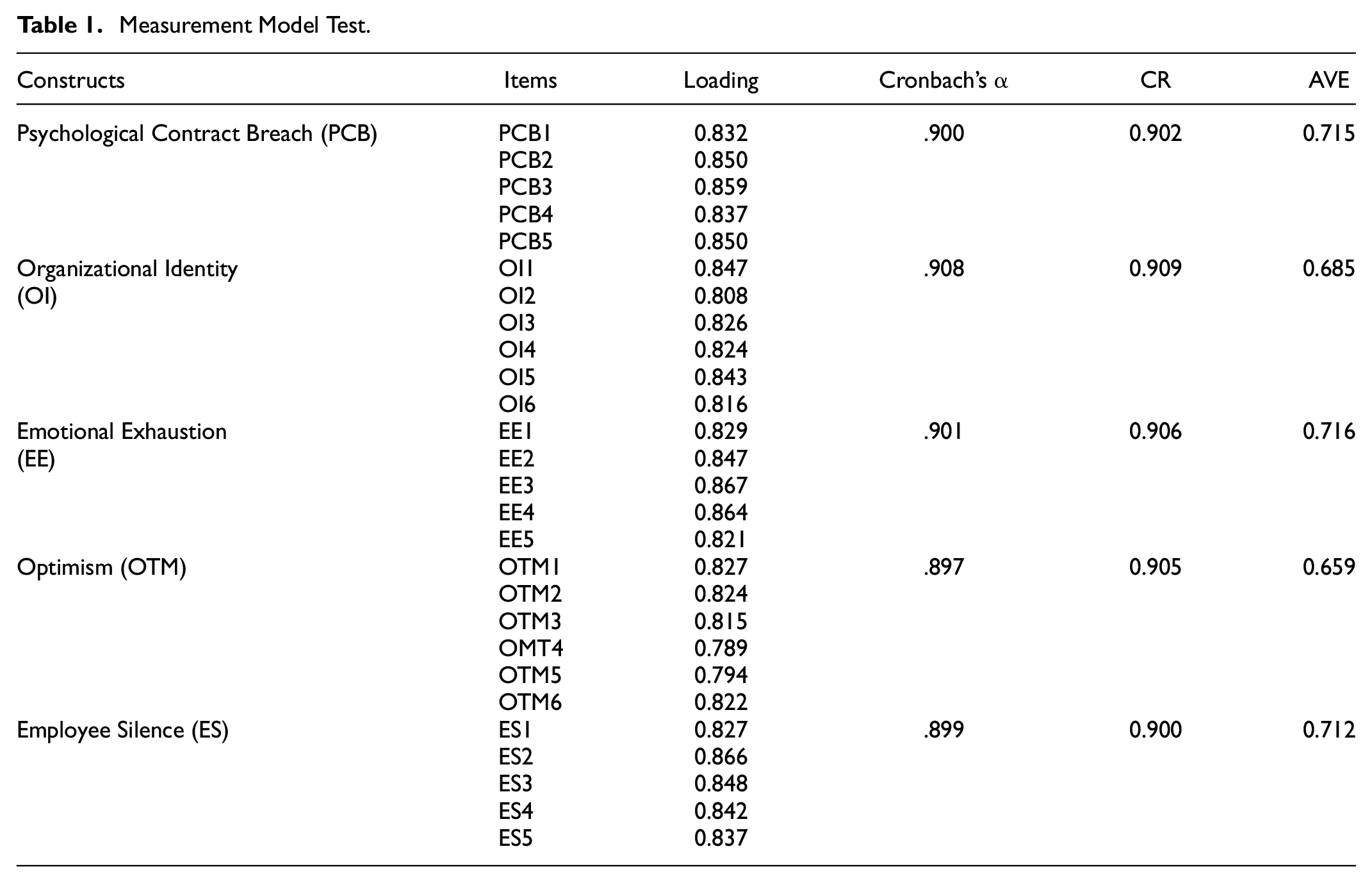
Validity includes convergent validity and discriminate validity. In terms of convergent validity, both the standard factor loadings of the measured items and the average variance extracted (AVE) of the latent variables need to be above 0.5 (Hair et al., 2019). As shown in Table 1, the AVE values and loading factors for five latent variables were greater than 0.5, indicating that the scale had high convergent validity. Discriminant validity reflects whether there is a difference in connotation between potential variables. Discriminant validity can be examined by utilizing the Fornell-larcker criterion. It means that discriminant validity is tested by calculating the correlation coefficient matrix between the variables. As shown in Table 2, the square root of all constructs of the AVE is greater than the absolute value of the correlation coefficient of the row or column in which they are located, indicating that the scale has good discriminant validity (Bagozzi, 1981).
Model Divergent Validity Table.
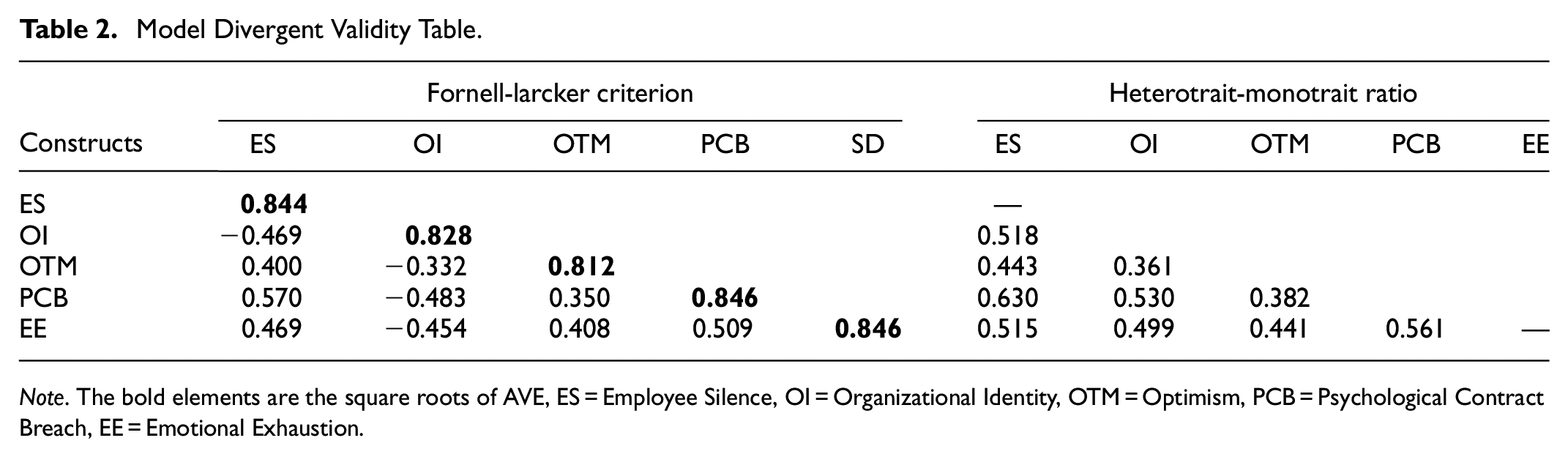
Note. The bold elements are the square roots of AVE, ES = Employee Silence, OI = Organizational Identity, OTM = Optimism, PCB = Psychological Contract Breach, EE = Emotional Exhaustion.
The PLS approach overestimates the standardized factor loadings, that is, the AVE values will be higher than the actual values (Henseler et al., 2015). Therefore, Henseler et al. (2015) suggested adding an estimate of the heterotrait-monotrait ratio (HTMT) to analyze discriminant validity. Typically, the value of HTMT less than 0.85 is considered to have good discriminant validity (Henseler et al., 2015). In this study, the HTMT values were all less than 0.85, indicating good discriminant validity between the variables.
Structural Model Analysis
The structural model analysis was based on three main indicators of fit evaluation: Standardized Root Mean Square Residual (SRMR), coefficient of determination (R2), and cross-validation redundancy (Q2). The results showed that the value of SRMR was 0.061, which was less than the criterion of 0.08; the R2 values of .307, .330, and .397 for organizational identity, emotional exhaustion, and employee silence, respectively, were all greater than 0.19; and the Q2 values of .280, .307, and .358 for organizational identity, emotional exhaustion, and employee silence, respectively, were all greater than 0 (Hair et al., 2019). In summary, it indicated that the model had good goodness of fit.
The results of the structural model analysis are shown in Figure 2 and Table 3. The results of the path analysis showed that psychological contract breach (β = .378, p < .001) had a positive effect on employee silence. H1 holds. Psychological contract breach was indirectly influencing employee silence through organizational identity (β = .087, p < .01). In addition, emotional exhaustion mediated the same effect between psychological contract breach and employee silence (β = .078, p < .05), thus supporting H2 and H3.

The moderating effect of optimism (H4).
Direct and Mediated (indirect) Effects Test Results.

Notes: ES = Employee Silence, OI = Organizational Identity, OTM = Optimistic, PCB = Psychological Contract Breach, EE = Emotional Exhaustion.
According to Chin et al. (2003), we used the PLS method to test the moderating effect. The interaction between optimism and psychological contract breach (β = .228, p < .001) has a positive effect on organizational identity. This indicated that organizational identity weakens the negative impact of psychological contract breach and increases organizational identity. Thus, the higher the level of optimism, the weaker the negative relationship between psychological contract breach and organizational identity. H4 was established. The interaction between optimistic and psychological contract breach (β = −.115, p < .05) has a negative effect on emotional exhaustion. This indicated that optimism can weaken the negative impact of psychological contract breach and decreases emotional exhaustion. Thus, the higher the level of optimism, the weaker the negative relationship between psychological contract breach and emotional exhaustion (Table 4). H4 was supported.
Moderating Effects Test Results.

Note. ES = Employee Silence, OI = Organizational Identity, OTM = Optimism, PCB = Psychological Contract Breach, EE = Emotional Exhaustion.
Figure 3 showed the moderating effect of optimism among psychological contract breach and organizational identity. When optimism is high (+1 S.D.), the influence of psychological contract breach on organizational identity is weaker. It is stronger when optimism is low (−1 S.D.). Figure 4 showed the moderating effect of optimism among psychological contract breach and emotional exhaustion. When optimism is high (+1 S.D.), the influence of psychological contract breach on emotional exhaustion is weaker. It is stronger when optimism is low (−1 S.D.).

The moderating effect of optimism (H4).

The moderating effect of optimism (H5).
In addition, Table 5 showed the moderated mediator values calculated by the researchers in this study using the bootstrapping technique at a sample size of 5,000, as suggested by Hayes (2017). When the interaction between optimism and psychological contract breach influences employee silence through organizational identity, the path coefficient is -0.036 (t = -2.424, p < 0.05), with a confidence interval of [-0.068, -0.011], which does not include zero, indicating that this indirect effect is statistically significant. This result supported H6, suggesting that at higher levels of optimism, the negative impact of psychological contract breach on employee silence is somewhat mitigated through the indirect effect of organizational identity. The path coefficient for the interaction between optimism and psychological contract breach influencing employee silence through emotional exhaustion is -0.016. Although the confidence interval is [-0.039, -0.001], which does not include zero, the t-value is 1.619, indicating relatively weaker significance. This finding implies that at higher levels of optimism, the indirect impact of psychological contract breach -induced emotional exhaustion on employee silenceis slightly alleviated, though the effect is weaker. This result supported H7.
Moderated Mediation.

Note. ES = Employee Silence, OI = Organizational Identity, OTM = Optimism, PCB = Psychological Contract Breach, EE = Emotional Exhaustion, LL-CI = lower-level class interval, UL-CI=upper-level class interval.
Discussion
This research constructs a theoretical model of the effect of psychological contract breach on employee silence, utilizing CAPS theory as a framework, and examines the moderating role played by optimism. The main findings are as follows: psychological contract breach has a positive effect on employee silence; organizational identity and emotional exhaustion respectively play a mediating role in the effect of psychological contract breach on employee silence; optimism not only weakens the negative effect of psychological contract breach on organizational identity, but also weakens the positive effect of psychological contract breach on emotional exhaustion; furthermore, optimism negatively moderates the mediating effect of organizational identity and emotional exhaustion on the relationship between psychological contract breach and employee silence.
Theoretical Implications
This study enriches the research on the formation, triggering mechanisms, and boundary conditions of employee silence in the Chinese context. The findings contribute to the understanding of employee silencing behavior in Chinese companies from the perspective of employee emotions and organizational identity. In addition, it also expands the study of psychological contract breach in organizational behavior.
In the rapidly changing business environment, psychological contracts have become a means of understanding the complex relationship between employees and organizations (Kutaula et al., 2020). As social competition intensifies and the contract becomes progressively more difficult to fulfill, scholars have begun to focus on the negative impact of psychological contract breach on employee voice behavior (Afshan et al., 2021; Bari et al., 2020, 2023). However, there is still a lack of research on the relationship between psychological contract breach and employee silence (Islam et al., 2023; Srivastava et al., 2019). Based on the social exchange perspective, we not only verified the negative impact of psychological contract breach on employee silence in the Chinese context (Bari et al., 2020; Khan et al., 2021; Rai & Agarwal, 2018), but also enriched the research related to employee silence.
In addition, although there have been several studies analyzing the relationship between psychological contract breach and employee silence (Bari et al., 2020; Khan et al., 2021; Wang & Hsieh, 2014). However, these studies have not revealed the underlying mechanisms between psychological contract breach and employee silence. There are still many gaps as to what mediating effects exist between psychological contract breach and employee silence. Based on CAPS theory, this study reveals the underlying influence mechanism between psychological contract breach and employee silence in terms of two influence pathways, cognitive and emotional (Borman et al., 2003; Mischel & Shoda, 1995). The findings confirm the mediating effects of organizational identity and emotional exhaustion between psychological contract breach and employee silence, respectively. The findings facilitate the understanding of employee silencing behavior in Chinese companies from the perspective of organizational relationships and employee emotions and provide a new perspective for the exploration of employee silence.
Finally, this study further explored the moderating role of optimism in the mechanisms of employee silence formation. Research has shown that optimism can weaken the negative effects of psychological contract breach, thereby increasing organizational identification and reducing emotional exhaustion. Furthermore, the weaker the negative relationship between psychological contract breach and organizational identity when the level of optimism is high, the less the impact of psychological contract breach transmitted through organizational identity on employee silence. The findings further explain the role of optimism in mitigating the negative impact of external triggers on individuals (Carver et al., 2010; W. D. Li et al., 2019). The results of the study expanded the boundary conditions for the arising of employee silence and further deepened the study of employee silence.
Practical Implications
How to encourage employees to voice has long been a concern of organizational managers. This study also provides some valuable implications for managers.
It is evident from the findings that the psychological contract breach can not only reduce employees’ organizational identity and exacerbate their emotional exhaustion but can also result in employee silence. Therefore, organizations should take employee commitment seriously and adopt effective measures to prevent or reduce the occurrence of psychological contract breaches. Primarily, organizations need to handle attribution properly. Due to changes in the internal and external environment, it is sometimes inevitable that the organization will break the original contract (Gong & Sims, 2023; Nemteanu et al., 2021; Perkins et al., 2022). The agent of the organization should explain the reasons for the non-fulfillment of the contract to reach an understanding between the employee and the organization. Secondly, organizations should improve communication between management and employees. Organizational managers should maintain communication with their employees to ensure that all aspects of important information are specified so that both parties have a closer understanding of the content of the contract in terms of responsibilities, obligations, and rights. Lastly, it is crucial to emphasize fairness within the organization. Promote fairness in management procedures or processes in the organization wherever possible, recognize employee effort and performance, and provide timely performance feedback (Restubog et al., 2009).
In addition, the results indicate that optimism can weaken employees’ tendency to engage in silent behavior. Therefore, organizations need to implement a new model of positive Human Resource Management (HRM) practices. Specifically, first of all, in the human resources management chain, in addition to focusing on the external professional knowledge and business skills of employees, enterprises also need to pay attention to the diagnosis and training of the psychological quality of employees. In particular, when recruiting new employees, optimistic personality traits should be included in the psychological evaluation indicators of the competency model. Secondly, companies should also consider the positive personality traits of their employees, especially the optimistic explanatory style, as an important “character indicator” for good employees. Finally, integrating psychological qualities into performance appraisal and promotion management systems is crucial. This institutional approach will guide employees toward conscious development of positive personal psychological qualities, aligning their efforts with organizational goals and values.
Limitations
While the finding supported the hypothesized relationship, there are still some limitations that need to be acknowledged.
There are various dimensional classifications of employee silence behavior based on different motivations (Brinsfield, 2013; Dyne et al., 2003; Pinder & Harlos, 2001). As this study is concerned with the extent to which psychological contract breach leads to the manifestation of employee silence. Therefore, there is no classification of the dimensions of employee silence behavior. Different basis of classification can lead to differences in research on the understanding, measurement tools, antecedents, and consequences of employees’ silence constructs. In future research, the dimensions or categories of employee silence can be classified from a wider range of perspectives, depending on the purpose of the study.
This study is based on social exchange theory and CAPS theory to explain the formation mechanism of employee silence, which to a certain extent deepens the study of employee silence. However, whichever theoretical perspective is applied in explaining the mechanisms of influence of employee silence and its boundary conditions, there are certain limitations. Therefore, it is possible to introduce new theoretical perspectives or combine multiple theoretical perspectives on employee silent behavior in future research.
In this study, employee silence was mainly examined in the form of employee self-reports. A single research methodology may limit the explanatory power and generalizability of the findings. In the field of organizational behavior, more diverse and cutting-edge research paradigms should be adopted to explore research questions. In future research on employee silence, experimental research, qualitative comparative analysis (QCA), meta-analytic structural equation modeling (MASEM), or a combination of these methods could be considered to explore the mechanisms of silence formation and influence.
Footnotes
Declaration of Conflicting Interests
The author(s) declared no potential conflicts of interest with respect to the research, authorship, and/or publication of this article.
Funding
The author(s) disclosed receipt of the following financial support for the research, authorship, and/or publication of this article: This research was supported by Guangxi Research Center for the Protection and Inheritance of Ethnic Cultures Key Project of Open Subjects in 2020 (2020KFZD01) and Project on Enhancement of Basic Research Ability of Young and Middle-aged Teachers in Guangxi Higher Education Institutions (No.2020KY1300).
Ethics Approval and Consent to Participate
This study was conducted in strict accordance with the Helsinki Declaration. TheYoujiang Medical University For Nationalities Research Ethics Committee confirmed that our study does not fall within the scope of the Human Subjects Research Act in the People’s Republic of China (ROC). This committee approved the study protocol (Approval number: 20230601301). All respondents signed an informed consent and agreed to participate in the study. There was no unethical behavior during the research process because this study did not involve human clinical trials or animal experiments.

Data Availability
[REAGENTS/TOOLS/MATERIALS] generated in this study are available from the corresponding author upon request.