



Abstract
This study examines the buffering role of a psychological contract breach in the process leading from façade creation (i.e., suppressing one’s own values and pretending to hold organization values) to workplace bullying through leader–member exchange (LMX). This study predicts that façade creation, particularly when the level of psychological contract breach is high, produces high LMX, which reduces bullying in the workplace. In total, 302 employee–employer dyads (265 males, 37 females; average age 46.07 years) from a large bank in Taiwan were surveyed. Surveys were conducted at two time points for employees and at one time point for their employers who volunteered. The findings of this study found significant relationships between facades of conformity and workplace bullying. This study further found that LMX mediates the relationship between façade creation and workplace bullying and demonstrate that a perceived breach of psychological contract moderates this mediating pathway. Strong psychological contract breach increases the relationship between façade creation and LMX. A time-lag design of two time periods and two different sources (i.e., employers and employees) were utilized to diminish common method variables (CMV) in this study. Implications and directions for future study are discussed.
Keywords
Introduction
Employees frequently use tactics for survival and success in organizations, especially those experiencing a negative workplace event such as psychological contract breach (Zhao et al., 2007). When employees encounter negative interpersonal acts, they might exhibit inauthentic behaviors to maintain job security (Hewlin et al., 2017). Oldham (1998) indicated that the survival and success of employees at work depend on how effectively they conform to the dominant values and norms of their leaders and colleagues. Research has also illustrated that job-insecure employees exhibit facades of conformity with their leader to preserve their organizational membership (Hewlin et al., 2016). Employees may suppress their personal values and engage in fabrication to conform to the perceived values of the leader or organization (Hewlin, 2003). In addition, when employees realize that a leader is an important relationship resource in an organization, they may choose to engage in self-presentation to elicit agreement at work (Huang et al., 2010). Therefore, employees may suppress their own values and pretend to share the organization’s values to elicit beneficial treatment and support from leaders to reduce potential negative outcomes in the organization such as workplace bullying. In particular, unfulfilled promises, or the degree to which employees perceive a breach of psychological contract in environmental behaviors on the job, have been emphasized as relevant to organizational research, given its implications for how employees are perceived (Zhao et al., 2007). Paillé and Mejía-Morelos (2014) emphasized the role of psychological contract breach (PCB) as a moderating effect in the relationship between perceived organizational support and pro-environment behaviors.
This study extended the theoretical relationship between facades of conformity and workplace bullying by using impression management theory (Jones, 1964), thereby contributing to a more thorough understanding of employees’ self-presentation in the organizational context. Although existing research has shown how impression-management strategies motivate conformity (Hewlin, 2009), this study focuses on how employees use false behavior and conformity to avoid workplace bullying. In addition, this study contributes to the relevant research by revealing whether a reciprocal relationship with leaders is a potential mechanism between facades of conformity and bullying in an organization. Prior studies suggested approaches for encouraging members to maintain the quality of their relationship with the leader and organization (Kowalski & Leary, 1990; Wang et al., 2005). Graen and Uhl-Bien (1995) defined leader–member exchange (LMX) as the quality of the relationship between leaders and members. Leaders express role expectations to their followers and possess the organizational authority to provide rewards to those who maintain positive relationships with them. LMX has been classified using other leadership theories that address the dyadic connection between a leader and members in an organization (Gerstner & Day, 1997). According to impression management theory (Kowalski & Leary, 1990), members’ intentions have implications for leaders’ perceptions, evaluations, and treatment. Members conform to leaders’ perceived values to meet their expectations and maintain high-quality relationships with them. Members might use specific tactics to create particular impressions to satisfy leaders’ perceptions. Therefore, this study extended the theoretical relationship between conformity and LMX using impression management theory.
This study assessed whether employees conform to their leaders’ values to help them gain high-quality LMX, and explored the main consequences of employees’ facades of conformity to provide a comprehensive interpretation of the experiences of employees and employers. Although previous studies investigated co-worker conflict–bullying relationships (Ågotnes et al., 2018), research that explores the processes within such employee–employer relationships are limited. The high employee–employer relationships may play an important role in reducing workplace bullying (Porter et al., 2017). Therefore, LMX is likely to be a critical mechanism between facades of conformity and workplace bullying. This study attempts to introduce LMX in a mediating role that provides an additional clarification of how employees with facades of conformity influence workplace bullying through LMX. As such, this study describes a theoretical framework and a model that explains facades of conformity and extends LMX studies.
In addition, PCB is perceived as a negative workplace event (Zhao et al., 2007) and environmental behavior (Paillé & Mejía-Morelos, 2014). When a negative event occurs in an organization, employees may exhibit decreased mutual trust, respect, and obligation (Robinson & Morrison, 1995), which may further influence the quality of LMX. In accordance with impression management theory, employees may create strong facades of conformity to enhance LMX in a negative workplace event when they perceive PCB. Employees who perceive PCB are likely to gain more support and decrease the experience of workplace bullying to gain job security. Although considerable efforts have been made in management areas (e.g., organizational behavior and human resource management), few studies have investigated the moderating role of PCB, which has explored the role of unfulfilled promises in a workplace environment. Therefore, this study aimed to examine the moderating effect of PCB on the relationship between facades of conformity and the corresponding responses.
In summary, this study intended to address four gaps in the literature on facades of conformity. First, the existing research ignores the phenomenon that employees using false behavior may produce a higher level of LMX with their leaders, resulting in low workplace bullying. This study is a first step toward investigating whether employees with facades of conformity are likely to reduce workplace bullying. Second, employees with facades of conformity may strive to increase the quality of LMX to reduce workplace bullying. However, the existing research has yet to meaningfully examine the mechanism through which LMX mediates the relationship between facades of conformity and workplace bullying. The current study intended to fill this gap by exploring whether the tactic of facades of conformity, practiced by employees to survive in organizations, diminishes workplace bullying. Third, it is unclear how PCB alters the self-presentation of employees in conforming to leaders’ values at work. Thus, this study investigates whether LMX may mediate the moderating effect of PCB on the relationship between facades of conformity and workplace bullying. It postulates that the relationship is stronger for individuals with high PCB than for individuals with low PCB, testing this by employing a mediated moderation model. This study contributes to the literature on facades of conformity by providing a comprehensive understanding of the individual and organizational features likely to generate employees’ intentions when they suppress their values and conform to their employers’ values. Finally, prior research suggests that banking employees play an essential role in financial institutions (Robert, 2018). The failure of banking employees could collapse the entire banking sector; therefore, it is important to examine the workplace environment and psychological status of banking employees.
Theory and Hypotheses
In pursuing survival and success in an organization, employees may use suitable tactics to maintain a high-quality relationship with their employer. According to LMX theory (also known as vertical dyadic linkage theory), a leader is an important resource constraint in an organization (Buch, 2015). To elicit beneficial treatment from leaders, followers may choose to create a false interaction of self-presentation and conformity to obtain their leader’s attention and acceptance at work. In addition, leaders play an important role in delivering emotional support to members and helping them manage work-related strain (Huang et al., 2010). Therefore, employees may attempt to create desired and undesired identity images for their employers.
Self-presentation implies the procedure by which people use impression tactics to influence others’ perception of them in impression management research (Jones, 1964). A previous study on impression management made general theoretical and practical contributions by investigating the role of impression management in interpersonal behavior (Leary & Kowalski, 1990). For instance, Ibarra (1999) suggested that members manage impressions with broad targets including their colleagues, employers, and employees. Leary and Kowalski (1990) defined impression motivation and impression construction as a two-factor model of impression management.
Specifically, impression motivation includes three factors: the goal relevance of impressions, value of the desired goals, and discrepancy between the desired and current image (Leary & Kowalski, 1990). Leary and Kowalski (1990) also indicated that “situational and dispositional factors interact to determine how attentive people are to information regarding how they are coming across to others” (p. 36). In addition, impression construction is a function of five factors: role constraints, target values, self-concept, desired and undesired identity images, and current or potential social image. Consistent with the conceptualization of facades of conformity, impression construction includes the target of personal values and self-presentation. It involves the creation of facades of conformity by suppressing individual values and expressing values that the individual cannot suppress (Hewlin, 2003, 2009; Hewlin et al., 2016). Therefore, this study believes that members create facades of conformity to gain acceptance by suppressing divergent views and creating a false interaction to indicate their acceptance of their leaders’ values.
Facades of Conformity and Workplace Bullying
Hewlin (2003) explained that “facades of conformity are false representations created by employees to appear as if they embrace organizational values” (p. 634). Employees who pursue survival in an organization consider how to suppress their personal values and conform to their employers’ values (Hewlin, 2003). When members enter an organization, they start to follow their leader’s values. If employees’ personal and organizational values differ from those of their leader, employees are required to suppress their own values and pretend to embrace the values of the organization (Hewlin et al., 2017). Therefore, employees with facades of conformity may pretend to agree with the leader’s values and suppress their individual values to diminish workplace harassment and aggression.
Workplace bullying is recognized as a type of workplace harassment that involves regular aggression (e.g., aggressive behaviors) and harmful effects (e.g., hostile behaviors) toward victims by an individual or a group (Nielsen & Einarsen, 2012; Park & Ono, 2017; Raja et al., 2018; Samnani et al., 2013). Prior studies reported that workplace bullying is a serious situation of interpersonal conflict at the workplace where victims are exposed to aggressive and unfriendly social actions from coworkers or managers over a continued period (Einarsen et al., 2011; van de Vliert et al., 2013). Bullying at the workplace is not only related to the poor health of the targets (Einarsen et al., 2018), but also to organizational-level outcomes such as organizational performance (Glambek et al., 2015). Five types of workplace bullying have been identified: (1) inhibiting the target’s potential to contribute to work assignments, (2) assailing the target’s reputation, (3) demonstrating personal behaviors of physical pressure or threat, (4) degrading social conditions, and (5) attacking the target’s communication with colleagues (Einarsen, 2000; Leymann, 1990).
In addition, prior studies have examined antecedents of workplace bullying, including gender and race (McCord et al., 2018), interpersonal conflict at work (Ågotnes et al., 2018), and autocratic and laissez-faire leadership styles (Samnani & Singh, 2012). Based on the impression management model (Jones, 1964), the bullied targets may withhold their own values and pretend to agree with organizational values for job security and a positive work life. Likely, the chance of being bullied at the workplace strongly decreases for employees with facades of conformity because they act as desired to pretend to conform to organizational values to diminish harassment and aggression. Such identity images may provide resources that support and develop positive relationships with employers that can help employees feel less harm in organizations (Hewlin et al., 2017). Similar to the aforementioned theoretical statements, members who choose to engage in conformity to gain agreement in the organization may reduce the bullying they experience at work. Thus, this study proposes the following hypothesis:
Facades of Conformity and Leader–Member Exchange
Hewlin (2003, 2009) indicated that facade creation is a strategy for suppressing an individual’s values and pretending to accept organizational values. This tactic can be a product of overlearned patterns or behaviors (Hewlin, 2003; Tetlock & Manstead, 1985), or can be deliberately planned and employed (Hewlin, 2009; Liang, 2017). Facades may include specific expressions of conformity or general gestures such as choices of attire and signs of agreement. Untruthful statements by employees create pretended conformity to falsely indicate their support for their leaders’ values. Therefore, employees may imply statements to fulfill others’ perceptions and values, and may engage in facades of conformity to meet leaders’ expectations and maintain relationships with them. When employees find a unique resource of leadership in the workplace, they may choose to conform to the leader’s values by suppressing their individual values to gain high LMX.
LMX theory postulates that an interesting relationship develops between leaders and members. It assumes that leaders exhibit a different leadership style for each subordinate, and leadership style can significantly affect employees’ emotions and behaviors. For example, leaders develop differentiated relationships with employees, ranging from low-quality transactional relationships with most employees to high-quality socio-emotional relationships with a few “reliable subordinates” (Yu et al., 2018). As such, variability in the quality of LMX is a natural consequence of developing high-quality relationships with some in-group employees but not all workers in an organization. Prior research shows that more than 90% of workgroups include members from multiple exchange groups (Liden & Maslyn, 1998). In addition, previous studies investigated how members use tactics to increase their relationships with leaders, such as supervisor-subordinate demographic similarity and supervisor-subordinate work relationships (Duarte et al., 1994). Given that employees use suitable tactics to maintain a high-quality relationship with their employer, based on LMX theory, leaders may accept the degree to which employees express opinions and values at work (Hewlin et al., 2017), and may consider employees as part of the in-group (Huang et al., 2010). Therefore, this study explored the antecedents of LMX and argued that employees might use tactics to meet a leader’s expectations and maintain a reciprocal process in the dyadic relationship between leaders and members. Thus, this study proposes the following hypothesis:
Mediating Role of Leader–Member Exchange in the Relationship Between Facades of Conformity and Workplace Bullying
Conformity is defined as adopting a conflicting opinion by suppressing one’s own personal opinions and values to avoid the occurrence of negative workplace events (Kiesler & Kiesler, 1969). For example, Liang (2017) opined that prevention-focused members can follow leaders’ values and preserve their personal values by avoiding negative workplace events. Employees may choose suitable tactics or behaviors to gain trust and mutual interaction with their employers. In addition, Wayne and Ferris (1990) showed that impression management involves leader-focused ingratiation strategies or behaviors such as performing personal services for the leader and embracing the leader’s values. Although LMX is a positive connection represented by mutual support, belief, and interaction (Reb et al., 2019; Uhl-Bien et al., 2000), from a follower-constructed perspective, employees engaging in conformity may exhibit appropriate behaviors to promote the desired relationships with employers to support their survival at work.
Impression management is the process of achieving one’s goals (Jones, 1964). A previous study indicated that people use impression management strategies such as conformity to affect other people and decisions and to achieve their goals (Hewlin, 2009). Impression management can also be used to avoid losses at work (Liang, 2017). When a leader forms a high-quality relationship with employees, they may feel safe in the organization and maintain a positive relationship with their leader. Therefore, the mediating role of LMX in the relationship between facades of conformity and workplace bullying is based on the notion that LMX is the goal of employees engaging in conformity. Such LMX may be an evolution of traditional LMX, including mutual trust and respect. This study argues that LMX is a specific goal for employees engaging in conformity to reduce bullying at the workplace. Thus, a structural path from facades of conformity to workplace bullying exists in this model. As such, this study proposes the following hypothesis:
Moderating Effect of PCB on Facades of Conformity and Workplace Bullying
Hewlin et al. (2016) found that a perceived threat to the continuity of the work relationship with one’s organization, which is job security, is positively related to facades of conformity. In an organization, a psychological contract provides an essential bridge between employees and employers (Robinson & Morrison, 1995). A psychological contract is defined as a set of promises obligating one to fulfill future engagement and is considered a necessary element of employment relationships (Robinson & Rousseau, 1994). Prior research identified PCB as the difference between what is encountered and what is expected in the organization (Morrison & Robinson, 1997). Because beliefs in reciprocal and promised obligations are broken and unfulfilled, one party may experience distrust, possibly resulting in the dissolution of the relationship (Rousseau, 1989). In addition, Zhao et al. (2007) argued that PCB is perceived as a negative workplace event related to the experience of an unmet expectation. After PCB occurs, a sense-building response begins and consequently generates an employee reaction (Robinson, 1996). Therefore, this study suggests that PCB can increase and moderate the relationship between facades of conformity and LMX. During a negative workplace event, employees may considerably suppress their personal values in congruence with the pretense of expressing organizational values and may increasingly maintain LMX for survival at work.
The creation of a facade of conformity is defined as a false representation made by organizational members to maintain the pretense that they consider organizational values important (Hewlin, 2003; Hewlin et al., 2017). Employees with facades of conformity may generate untruthful expressions of conformity to maintain a relationship with their employer and to survive a negative workplace event. If employees engage in behavior that conflicts with their real experience, they may feel safe and supported in organizations (Hewlin, 2009; Hewlin et al., 2017). Therefore, bullied employees may create a fake image and behavior to facilitate positive interpersonal interactions with their leader at the workplace, because this is where they may develop social relationships and avoid workplace bullying.
It is crucial to investigate how experiencing PCB moderates the relationship between employees’ conformity and LMX, which results in reduced workplace bullying in organizational settings (Figure 1). This study assumed that LMX is a possible relationship for survival at work and that employees with facades of conformity are likely to experience PCB, decreasing workplace bullying. Therefore, the following hypothesis is proposed:

Structural equation modeling in the theoretical model.
Methods
Research Approach
A quantitative research approach was used in this study to examine that façade creation is negatively related to workplace bullying and increases the quality of LMX. The quantitative approach was applied to assess a mediated moderation model, which LMX mediates the moderating effect of PCB on the relationship between facades of conformity and workplace bullying. It also assumes that the relationship is stronger for employees with high PCB than for employees with low PCB through correlation and regression analyses.
Sample and Procedures
The participants in this study were employers and employees in multiple divisions at a large bank in Taiwan. The author privately connected the senior director of the human resources department in this organization to request the participation in this study. This study collected data from two independent sources (i.e., employers and employees) at two time points to avoid common method variance. This study obtained the approval of the research ethics committee from a Human Research Ethics Committee in Taiwan before sending the survey packets to participants.
Surveys were conducted at one time point for their managers and at two time points for employees who volunteered. A total of 20 managers/supervisors in the organization were asked to fill in the manager surveys at Time 1. Subsequently, a total of 550 direct full-time employees of these managers were recruited as participants. Each division includes the number of employees ranged from 12 to 23. Each manager was asked to complete a questionnaire to assess LMX for his or her immediate employees. Each employee completed a questionnaire to measure facades of conformity, PCB, LMX, and workplace bullying. Each manager was asked to rate the LMX scale for their employees, thereby potentially leading to common method bias (Podsakoff et al., 2003). Follow-up data were collected 3 months after the first survey, as described in previous studies (Ng et al., 2010; Rosen et al., 2009). All managers provided the numbers of their employees to identify the supervisor–subordinate dyads at the end of each survey in this study.
This study collected 475 survey packets from the supervisor–subordinate dyads in this company. In total, 475 supervisor–subordinate dyads (86% response rate) returned the surveys at time 1. Three months after time 1, all 475 dyads completed the second survey, and the supervisors completed separate surveys. A total of 356 dyads returned surveys at time 2. The final 302 dyads (55% response rate) comprised 265 male employees (88% response rate) and 37 female employees (12% response rate) with an average age of 46.07 years. The employees of this study worked an average of 43 hours per week (SD = 6.70) and had between 0 and 4 children. All scales of this study were rated on a 5-point scale ranging from 1 (strongly disagree) to 5 (strongly agree).
Research Instruments
Facades of conformity
This measure was used by Hewlin’s (2009) facades of conformity survey with a six-item scale to examine the level of façade creation at time 1. Two examples of the items are as follows: “I behave in a manner that reflects the organization’s value system even though it is inconsistent with my personal values,” and “I withhold personal values that conflict with organizational values.” Cronbach’s alpha was .83.
Psychological contract breach
This study used a five-item subscale from Robinson and Morrison’s (2000) PCB survey to assess the level of PCB based on employees’ perceptions at time 1. An example item is as follows: “Almost all the promises made by my employer during recruitment have been kept so far” (reverse scored). Cronbach’s alpha was .89 for the total scale.
Workplace bullying
This study used the eight-item Negative Acts Questionnaire (NAQ), a self-evaluation tool developed by Einarsen and Raknes (1997) to evaluate the experience of workplace bullying to measure workplace bullying at time 2. A total of 22 items was rated to examine the degree of bullying in the workplace. An example item is as follows: “Someone hides information that affects your work performance.” Cronbach’s α value for the scale was .93 for work-related bullying.
Leader-member exchange
At Time 2, the four-dimensional scale was used and developed by Wang et al. (2005) to assess the Chinese participants. It measured leaders’ level of agreement with 12 items about the relationship with their subordinates. This scale was rated on a five-point scale ranging from 1 (strongly disagree) to 5 (strongly agree). Cronbach’s alpha for the 12-item scale was high (α = .91). An example item is as follows: “My subordinate is the type of person one would have as a friend.” This measure was distributed to supervisors and subordinates to provide evidence of the measure’s validity.
In this study, employer ratings of LMX were provided by the employee’s leader to avoid common method bias. The correlation between the employee and employer ratings of LMX was 0.46 (p < .01). Therefore, this study used only the supervisor’s responses to assess the hypotheses regarding LMX. The intraclass correlations (ICCs) was related to LMX—ICC (1) = 0.13, which is more than the recommended 0.10 value. Furthermore, the ICC (2) is 0.28, which is also high on average (0.12) and indicates an even moderate nesting effect (LeBreton & Senter, 2008).
Control variables
The author controlled for respondents’ sex (1 = male, 2 = female), age, marital status, work hours, and number of children to diminish false results, because the possible effects of demographic characteristics have frequently been used in organizational research (Bolger et al., 1989; Hewlin et al., 2017). Specifically, age, work hours, and number of children were calculated using open-ended questions.
Results
Data Statistical Analyses
This study conducted confirmatory factor analyses (CFAs) to evaluate the distinctiveness of the constructs before testing the hypotheses of this theoretical model using LISREL 8.8 (Jöreskog & Sörbom, 2006). Several fit indicators of the model be used and recommended: the chi-square, root mean square error of approximation (RMSEA), comparative fit index (CFI), goodness of fit index (GFI), and parsimony goodness of fit index (PGFI) (Bentler & Bonett, 1980; Hu & Bentler, 1998). This study used Fuller et al. (2016) and Preacher and Hayes’ (2008) fit indices to determine model fit: chi-square test, RMSEA (0.05 < RMSEA ≤ 0.08: reasonable fit), CFI (0.90 ≤ CFI < 0.95: good fit), and adjusted GFI (0.05 < PGFI ≤ 0.08: good fit). The sobel test and bootstrapping approach was used to examine the hypothesized mediation model (Preacher & Hayes, 2008).
In the context of the theoretical model of this study, four factors were measured using the ratings of employees and employers, and the researcher conducted CFAs to test the distinctiveness of the constructs. Table 1 shows the results of the CFA, indicating that the baseline four-factor model fitted the data closely (χ2 = 1,089.81; df = 224; RMSEA = 0.07; CFI = 0.95; and PGFI= 0.62). In addition to the baseline model, this study evaluated four alternative models. Alternative model 1 had a significantly poorer fit (χ2=3142.17; df = 227; RMSEA=0.10; CFI = 0.85; and PGFI = 0.43) than the baseline model in accordance with the significant chi-square and model fit index differences. Alternative model 2 had a poorer fit (χ2 = 3813.39; df = 227; RMSEA = 0.12; CFI = 0.80; and PGFI = 0.39). Alternative model 3 had a poorer fit (χ2 = 5045.75; df = 229; RMSEA = 0.15; CFI = 0.73; and PGFI = 0.34). Finally, alternative model 4 had the poorest fit (χ2 = 5134.97; df = 230; RMSEA = 0.16; CFI = 0.70; and PGFI = 0.34). For providing support of convergent validity, all factor loadings in the baseline model of this study were significant and normalized loadings ranging from 0.48 to 0.93.
Comparison of Measurement Models.

Note. PCB = psychological contract breach; FC = facades of conformity; LMX = leader-member exchange; WB = workplace bullying.
Baseline model was compared with models 1-2, respectively.
p < .01.
Main Effects
Table 2 shows the means, standard deviations, and reliability coefficients of the samples (N = 302) at time 1 and 2. Only the demographic characteristic of work hours was significantly related to any outcome variable. Facades of conformity were significantly related to workplace bullying (r = −0.18, p < .01) and positively related to LMX (r = 0.16, p < .01).
Means, Standard Deviations, Cronbach’s Alpha, and Intercorrelations among Study Variables.
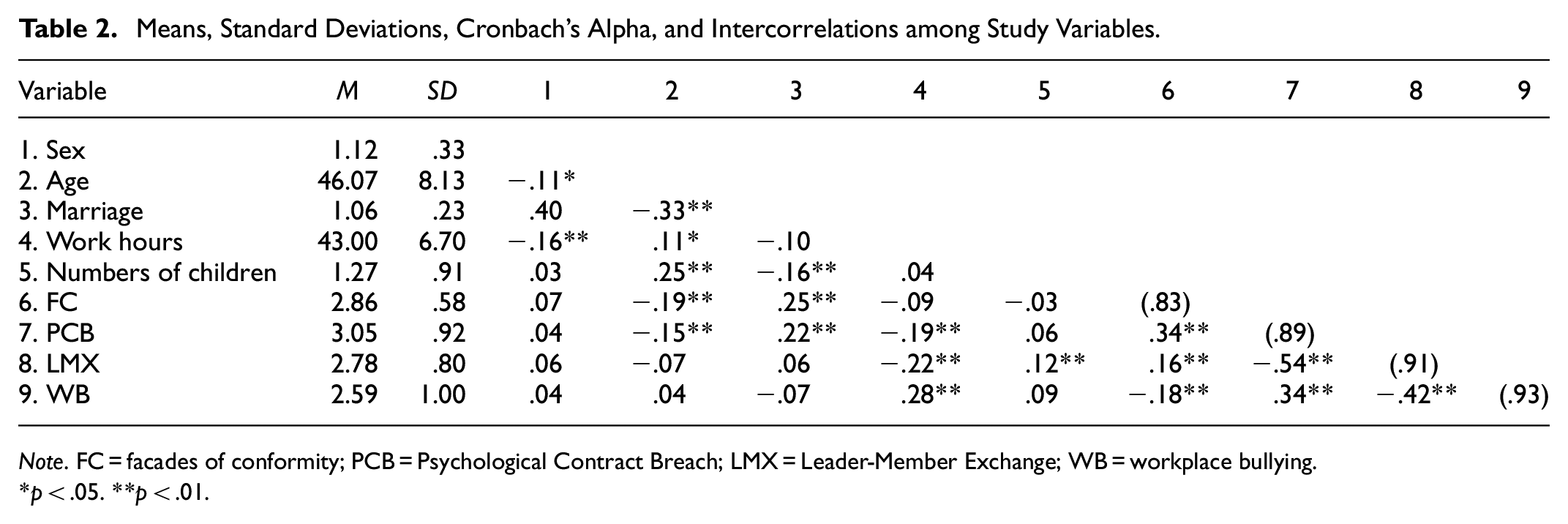
Note. FC = facades of conformity; PCB = Psychological Contract Breach; LMX = Leader-Member Exchange; WB = workplace bullying.
p < .05. **p < .01.
The structural equation models were used to test the hypotheses for this theoretical model (Jöreskog & Sörbom, 2006). According to the results of the structural equation models, the theoretical model of this study can be divided into two types: a mediated moderation model and partially mediating model. Table 3 shows that this theoretical model (χ2 = 15.50; df = 1; RMSEA = 0.05; CFI = 0.95; and GFI = 0.97) showed the best fit. However, according to the findings of this study, the alternative model showed a poorer fit to the data in the structural analysis (alternative model: χ2=37.07; df = 2; RMSEA=0.13; CFI=0.87; and GFI = 0.94). Therefore, based on the principle of model parsimony, these results suggest that the theoretical model best fits the data of this study.
Comparison of Structural Equation Models.

Note. FC = facades of conformity; LMX = leader-member exchange; PCB = psychological contract breach; workplace bullying = WB.
p < .01.
The results of the structural equation model for the theoretical model indicate that facades creation was significantly related to workplace bullying (β = −.43, p < .01). In addition, based on the bootstrapping approach (sample size = 1,000) of Preacher and Hayes (2008), the results reveal that the direct effect of facades creation on workplace bullying was significant (t = −3.14, p < .01), supporting H1. The results of the structural equation model show that a higher level of facades of conformity tended to produce LMX and that facades of conformity were significantly related to LMX (β = .47, p < .01). According to the bootstrapping approach (Preacher & Hayes, 2004), in addition, the results show that facades of conformity were significantly associated with LMX (t = 2.84, p < .01), supporting H2.
This study indicates the paths from facades of conformity to workplace bullying through LMX. The findings of this study show that LMX partially mediated the relationship between facades of conformity and workplace bullying, supporting H3. The bootstrapped 95% confidence interval of the indirect effect ranged from −0.22 to −0.39, not including zero. In addition, there was a significant indirect effect shown by the Sobel test, which highlighted the indirect effect of LMX (z = −2.69, p < .01), thus supporting H3. Therefore, LMX mediates the relationship between facades of conformity and workplace bullying. Overall, H1, H2, and H3 were supported.
Moreover, this study found evidence that PCB moderated the relationship between facades of conformity and LMX in relation to workplace bullying, as Table 4 shows. The control variables were inputted in the first step, the main effects in the second step, and the interaction in the third step. The total effect and magnitude of this result were significant effects of the mediator in the mediated moderation model. In addition, the effect of this finding did not depend on the moderator (Muller et al., 2005). As Table 4 shows, this study found that the indirect effect of facades of conformity on workplace bullying was significant for high degrees of PCB (β = −.41, p < .05). In addition, LMX significantly mediated the relationship between facades of conformity and workplace bullying when the effect of PCB was not moderated (β = .25, p > .05). Figure 2 shows the interaction effect, depicting the stronger positive effect of facades of conformity on LMX for those with high PCB. Thus, H4 was supported.
Results of a Mediated Moderation.

Note. PCB = psychological contract breach; FC = facades of conformity; LMX = leader-member exchange; WB = workplace bullying; Med = mediator.
p < .05. **p < .01.

The moderating effect of PCB on the relationship between facades of conformity and LMX.
Discussion
Workplace bullying continues to be a very timely topic, influencing employees in organizations and industries worldwide. This study investigated the effect of facades of conformity on workplace bullying. Despite the general research on the negative consequences of façade creation, little attention has been paid to understanding how employees with facades of conformity pretend to agree with the leader’s values and suppress their individual values to diminish workplace harassment and aggression. The findings of this study show that LMX was a mediating effect between facades of conformity and workplace bullying. This study investigated whether the relationship between facades of conformity and workplace bullying, mediated by LMX, is moderated by PCB. The results of this study exemplified the general idea that employees’ facades of conformity decrease their experience of workplace bullying. Consistent with the results of Hewlin et al. (2016), employees are likely to create false behaviors if they perceive job insecurity that threatens their relationships with organizational members. Façade creation may manage self-presentation through conformity to avert being isolated in an organization. Therefore, members with higher degrees of facades of conformity are more likely to experience a lower level of bullying in the workplace. In addition, they are more likely to pursue support and gain a positive relationship if they perceive that conformity is seen as a favorable tactic (Liang, 2017).
This study also investigated LMX as a mediating effect of façade creation on workplace bullying. In particular, the author examined whether members use conformity to increase LMX, which leads to a lower level of workplace bullying in an organization. The findings indicated that members rated themselves as having higher levels of conformity for the following organizational values and for suppressing their own values. A higher degree of a facade of conformity is likely to result in a higher degree of supervisors’ LMX. LMX is considered a valuable resource in organizations. Members may use implied statements and innuendo to elevate themselves in others’ perceptions and to pretend allegiance to various values, or they may engage in facades of conformity to meet leaders’ expectations and maintain relationships with them. Therefore, to ensure their survival and avoid workplace bullying, employees may endeavor to gain scarce resources through any possible tactics including facades of conformity. The results of this study showed that employees with facades of conformity have a decreased likelihood of workplace bullying because they suppress their personal values and pretend to agree with organizational values for job security and a positive work life.
This study also advanced the LMX literature by classifying a negative workplace event under which organizational members use facades of conformity to embrace the leader’s values. The findings of this study contribute to a valuable body of research on LMX. For example, previous studies on LMX mostly focused on dyadic relationships (e.g., respect, trust, and mutual obligation) between the leader and follower (Gerstner & Day, 1997; Graen & Uhl-Bien, 1995). This study provides the relevant research to increase understanding of the impression of a specific type of LMX on employees. This study demonstrated that employees may display reasonably high degrees of façade creation for employee survival in an organization.
Theoretical Implications
This study explored the implications of facades of conformity by using impression management theory. Based on this theory, regarding three theoretical implications, this study found that employees used the tactic of facades of conformity to gain higher levels of LMX. First, the results support the suggestion that employees choose to be involved in conformity to obtain their supervisors’ values at work. In addition, as predicted, workplace bullying was the main outcome of facades of conformity in this study. This finding supports the suggestion that experiences of façade creation may decrease workplace bullying. Little research has examined the argument that individuals’ suppression of their values is likely to generate workplace bullying. In addition, the results of this study are consistent with Robert (2018) research that banking employees play an essential role in financial institutions. The banking sector executes monetary policies and brings financial stability. The failure of banking employees could collapse the entire banking sector; therefore, it is important to examine the workplace environment and psychological status of banking employees.
Second, this study begins to elucidate the potential influence of the organization on employees who hide their personal values and pretend to hold organizational values. This study expands the application of impression management theory by exploring how the organizational situation may cause employees to adopt approaches that conflict with their own values. Regarding practical implications, this study highlighted that facades of conformity as a tactic are likely to increase supervisors’ acceptance of and identification with employees in work interactions. Based on impression management theory, this study showed that members choose appropriate tactics to survive in a work environment.
Finally, this study suggests a perception of the potential interaction effect of PCB on the relationship between facades of conformity and LMX by applying both employees and employers for the essential theoretical contribution. The findings of this study extend prior research by Deng et al. (2018), which suggested that PCBs are positively associated with employees’ interpersonal harm toward coworkers. This result is important because it shows that PCB moderates the relationship between employees’ conformity and LMX, which results in reduced workplace bullying in organizational settings.
Practical Implications
In the practical implications, this study provides three suggestions. First, this study shows that employees may create a fake image and behavior to facilitate positive interpersonal interactions with their leader at the workplace, because this is where they develop social relationships and avoid workplace bullying. Therefore, it is suggested that leaders in organizations should provide suitable support when employees need help. Second, leaders should consider investing in more endeavors to show concern about relationships with employees. Regardless of the style of tactics used, LMX is an important organizational resource. Therefore, when employees find a unique resource of leadership in the workplace, they may choose to conform to the leader’s values by suppressing their individual values to gain high LMX. Finally, this study suggests that the fulfillment of promises made by employers is crucial for an effective employment relationship with employees. The findings of this study imply that PCB can increase and moderate the relationship between facades of conformity and LMX. During negative workplace events, employees may considerably suppress their personal values in congruence with the pretense of expressing organizational values and may increasingly maintain LMX for survival at work.
Limitations and Future Directions
Although this study provides some implications for the facades of conformity and LMX fields, three limitations should be addressed. First, some data in this study were collected from the same source using self-reported questionnaires for employees, although LMX was assessed by employers. Common method bias might occur; therefore, this study used a time-lag design to collect data, which diminished demand features and unreliable patterns for minimizing common method bias (Podsakoff et al., 2003). Common method bias might not have greatly influenced this research; however, data on individual behaviors was suggested to collect from different resources and from various participants in future research.
A second potential concern is that the items used to examine facades of conformity may not capture behaviors that truly correspond to the tactics used toward the employer. Given that the respondents worked in an organization in which they needed to exist and survive, they might have been motivated to conceal unpopular truths when responding to the surveys. The occurrence and consequences of individual facades of conformity in relation to LMX may be entirely different in other samples of employees. Thus, additional studies should use a sample that is more representative of the general population.
A third limitation is the incapability of this study to rule out other outcomes such as turnover intention in organization. Façade creation is likely to directly affect the intention to leave the organization. As Hewlin et al. (2016) showed employee with job insecurity were more likely to withhold their own values, and lead to turnover intention in the organization. Therefore, future research should intend to test individual behaviors or the consequences of the strategies that organizational members may use to conduct their links with co-workers and their employers.
Finally, the data collection was conducted in a large private bank in Taiwan. The results of this study may contain a generalizable issue to all employees in other countries, although the results of this study found that façade creation was positively related to workplace bullying and LMX was an important mechanism between façade creation and workplace bullying. However, it should be noted that the theoretical approach of this study is not tied to a specific cultural context. Prior research has verified the validity of social exchange theory in the Chinese context (Ng et al., 2010). Therefore, future research investigating whether these prototypes differ in other countries would select diverse cultural samples to reduce generalizability issues.
Conclusion
In conclusion, this study contributes the theoretical understanding of the detrimental effect of façade creation on workplace bullying in organizations. Furthermore, this study provides how the employees with facades of conformity strive to increase the quality of LMX to reduce workplace bullying. The findings of this study support the notion that employees use conformity to increase LMX, which leads to a lower level of workplace bullying in an organization. In addition, the results of this study find that LMX is a possible relationship for survival at work and that employees with facades of conformity are likely to experience PCB, decreasing workplace bullying. All in all, this study has provided some new directions (i.e., façade creation process and its outcomes, that is, workplace bullying) by drawing on impression management theory.
Footnotes
Declaration of Conflicting Interests
The author declared no potential conflicts of interest with respect to the research, authorship, and/or publication of this article.
Funding
The author disclosed receipt of the following financial support for the research, authorship, and/or publication of this article: The funding of Ministry of Science Technology in Taiwan was received (MOST 107-2410-H-344-001 -SSS).
Ethical Approval
All procedures performed in studies involving human participants were in accordance with the ethical standards of the institutional and/or national research committee and with the 1964 Helsinki declaration and its later amendments or comparable ethical standards.
Informed Consent
Informed consent was obtained from all individual participants included in the study.
