




Abstract
This descriptive pilot study investigates and evaluates nursing students’ perceptions of their learning gains and the factors contributing to academic integration within a one-week Intensive Programme (IP) course, part of the Nordplus Programme. Nordplus encourages mobility and curriculum development across Nordic and Baltic higher education. The study used a short-term mobility program involving eight nursing education institutions as its setting. Students’ experiences were captured using an evaluation form inspired by the Student Assessment of Learning Gains (SALGs) questionnaires. The results reveal positive student responses to the IP course, particularly regarding interactions with peers and teachers. The study underscores the potential of short-term IP courses in providing concentrated learning experiences, broadening nursing topics, and fostering active engagement. The implications suggest that nursing education institutions should consider incorporating more short-term mobility programs to enhance student learning and intercultural experiences. By investing in such initiatives, institutions can cultivate an enriching and supportive learning environment.
Plain Language Summary
This study explores the experiences of nursing students who participated in a one-week intensive program as part of the Nordplus Programme, which encourages educational mobility and development across Nordic and Baltic countries. The research aimed to understand the students’ perceived learning gains and the factors that helped them integrate academically into the program. Using a survey inspired by the Student Assessment of Learning Gains questionnaire, the study found that students had a positive experience, particularly in their interactions with peers and teachers. The results show that short-term intensive programs can provide rich learning experiences and encourage active engagement, suggesting that they could be beneficial to include more widely in nursing education. This could help enrich the learning environment and support students in their studies.
Keywords
Introduction
According to the International Council of Nurses (ICN), the shortage of nurses in 2020 was 5.9 million (International Council of Nurses (ICN), 2021). In the Nordic countries, we currently experience challenges with falling youth cohorts. We also experience a drop in applicants for nursing education. This calls for initiatives to make higher education attractive and to prevent student dropouts during the program (Wang, 2022).
In nursing programs, the integration process, both within the program and with peers, can be more complex compared to standard academic degrees (Hovdhaugen et al., 2023). Nursing programs span across multiple sites and involve interactions with various peers, teaching staff, and professional colleagues. This can result in an ongoing integration process where students often feel uncertain and disconnected. The continuous period of disruption and disintegration may lead students to doubt their ability to complete their degree and become nurses (Sweetman et al., 2023). Self-efficacy and motivation are key factors that influence academic performance and can also predict the likelihood of a student considering dropping out (Morelli et al., 2022). Consequently, many nursing education institutions seek ways to prevent attrition by addressing the needs of students through strategic activities, such as facilitating student exchanges, which aim to improve program quality (Allam, 2018, 2020), support students’ nurse identity and boost their self-confidence (Torbjørnsen et al., 2021).
Expanding the scope of nursing education to include various internationalization activities can bring about positive transformations, offering distinct learning experiences for students and educators (Johnston et al., 2022; Kunaviktikul & Turale, 2020).
The benefits derived from exchange programs appear to enhance nursing students’ personal and professional skills (Hsiao et al., 2021). This improvement is likely to ease their transition from student to practicing nurse. According to a cross-sectional study conducted with 565 Swedish nursing students, those with international study experience rated their nursing competence significantly higher in areas such as legislation in nursing and safety planning, leadership and development of nursing, and education and supervision. Additionally, the majority of students who had educational experiences abroad reported that it positively contributed to their competence development (Nilsson et al., 2014). A Norwegian study from 2021 (Hovland & Johannessen, 2021) indicates that nurses who participated in a student exchange found it easier to develop their personal qualities, cultural competencies, and communication skills in their nursing practice. This is important, as nurses who have completed their education under the Bologna criteria are eligible to work throughout the European Union (European Commission, 2021). Therefore, it is essential for nursing students to develop an understanding of practices in other countries. Cultural competence and sensitivity are key components of this understanding. Even when practicing nursing in their home country, nurses will encounter patients and co-workers from different cultures.
Successful internationalization in healthcare education requires strategic thinking, sufficient resource allocation, commitment from nurse educators and institutions, and the establishment of solid relationships with suitable international partners (Gimbel et al., 2017). Traditionally, students` exchange opportunities offered in nursing programs have been clinical practice placements, often in the global south. Establishment of international programs such as the Erasmus Plus Foundation in Europe has the since late eighties facilitated student exchange (European Commission, 2024). However, the requirement of at least a 12-week stay to obtain a scholarship has complicated mobility, as certain groups of students, due to social and/or economic circumstances, find it challenging to stay abroad for extended periods. As such, the most common reason nursing students do not apply for exchange during their study program is a lack of finances (Sierra-Huedo et al., 2022). Therefore, to promote internationalization in higher education and make it more inclusive, alternative models for mobility and international network building have emerged. Among other measures, providing financial support to facilitate educational cooperation through short-term student and teacher exchanges is a concept being promoted. In the Nordic and Baltic countries, the Nordplus mobility and network program, financed by the Nordic Councils of Ministers, fosters collaboration between educational institutions across borders. The aim is to stimulate innovative teaching strategies through the exchange of experiences and good pedagogical practice (Nordplus, 2023).
According to Hsiao et al. (2021), studying abroad enables students to see themselves as part of the global community and, in turn, increases their cultural competence. This exposure cultivates the ability to share and gain knowledge from others and to view other cultures positively, which has a beneficial impact on nurses with international experiences. Both short-term and long-term exchange programs receive positive evaluations (Bønløkke & van der Linde, 2021; Johnston et al., 2022), as they broaden students’ horizons (Turale et al., 2020), and subsequently strengthening their determination to become a nurse and to remain in the program (Granel et al., 2021; Pereira et al., 2018). In larger academic programs, students often report feelings of loneliness and experience difficulties with integrating into the program and the institution (Hovdhaugen et al., 2023). Short-term exchange programs can be of significant help in this context, making the transition process more manageable for students. These programs involve traveling in small groups and interacting with peers from different regions and cultures, providing students with opportunities to connect with others who are having similar experiences.
Short-term mobility programs offer exposure to different healthcare systems and cultural perspectives, thus enhancing students understanding in the nursing field (Bønløkke & van der Linde, 2021). Because these courses often have broader perspectives that consider social, economic, and cultural factors, students can gain a more comprehensive understanding of global health and be better equipped to address the complex challenges encountered in diverse healthcare settings (Gimbel et al., 2017). However, evaluating such programs in nursing education is infrequent and scarce, leaving a gap in fully assessing their effectiveness and identifying potential areas for improvement (Johnston et al., 2022).
The aim of this descriptive pilot study is to investigate and evaluate nursing students’ perceptions of their learning gains from a one-week Intensive Programme (IP) course in a short-term exchange program in nursing education. Secondly, the study seeks to identify the factors that contribute to academic integration and enhanced student learning.
Material and Methods
Funded by Nordplus, eight nursing education programs in the Nordic and Baltic countries (Nordsam) brought together students and teachers for a transnational dialogue in an intensive course. The course focused on strengthening nursing students’ commitment and academic integration across a cross-national sample. This was achieved by exploring how health technology empowered young people to enhance control over and improve their health during the COVID-19 pandemic. To assess the impact of this initiative, we conducted a descriptive pilot study. As outlined by Siedlecki (2020), descriptive research designs aim to depict the characteristics of a population or phenomenon without altering variables. This approach provides a comprehensive understanding of various aspects of the short-term mobility program, including its structure and perceived outcomes. Such designs are exploratory, allowing for hypothesis generation and identifying areas for further investigation. This is particularly valuable given the variability in short-term mobility programs objectives, implementation, and outcomes.
Since 1993, Nordsam has been facilitating student and teacher mobility, curriculum development, and arranging several IP courses. These efforts focus on developing and implementing innovative pedagogical approaches to enhance students’ awareness of their professional role within the cooperating nursing education institutions across the Nordic and Baltic countries. The partner institutions take turns coordinating and hosting the IP course. The group of educators was a mix of experienced teachers and researchers. We held five online meetings, each lasting approximately 1.5 to 2 hr, to discuss and develop the course content. The teachers more experienced in sociocultural learning approaches took time to generously share their knowledge and suggestion for group learning activities with the more unexperienced teachers. Providing a foundation for IP course program development. Due to the pandemic, no in-person meetings were conducted prior to the course.
For this study, students were recruited at each institution through various methods, including distributing flyers, organizing information meetings, and utilizing snowball sampling. Students received financial support to attend the course and were required to demonstrate their motivation for participating through a letter of motivation or application interviews. Each institution was responsible for assessing which students would benefit from participation based on their specific program structure, and therefore no general inclusion criteria were utilized. The majority of the included students were in their second year of study.
IP Course Structure and Development
The current project aimed to arrange a 3 ECT (European Credit Transfer and Accumulation System) course, including 2 weeks of pre-and post-course work, and one intensive course week (i.e., 6 days) in October 2022, which took place in Latvia, focusing on 1) the response of young people to health technology and COVID-19 in the Nordic and Baltic countries and 2) the structure of the health care systems and how health technology enables young people to increase control over and improve their health during the pandemic. The content of the course was purposefully chosen to spark interest among students by focusing on lived experiences during the recent pandemic that are relevant to students across all countries.
Students were assigned and introduced to their cross-national groups at a Zoom kick-off event 2 weeks before arriving in Latvia. To facilitate the social and academic learning process during the week, we emphasized a balance of female and male students from different countries in the cross-national groups. To spark the transnational dialogue, the students prepared a presentation about their country’s health care system with their institutional peers (i.e., pre-course mandatory work) supervised by the teachers at each institution providing a common ground for group collaboration during the week. For their group assignments during the week, the students had the opportunity to choose between several topics. The topics presented were: (1) How does health-related technology support patients and caregivers? (2) How are public health and supporting health technology ecosystems organized? (3) What role did public health and health technology play in the COVID-19 pandemic? In addition, all groups had to explore (4) how young adults have adopted communication technology and assistive devices to improve their health during COVID-19. The web-based learning management system was Canvas (Instructure Community, 2023). The platform was built before the course, and students and teachers were enrolled. Canvas was used to communicate with the participants before and during the IP course, and all assignments were submitted and shared on Canvas. To social interactions, all students and teachers had to introduce themselves on Canvas prior to arrival. During the course, all students and teachers were engaged in variety of activities based on student-centered learning approaches in addition to arranged social events to promote an inclusive community (Figure 1).
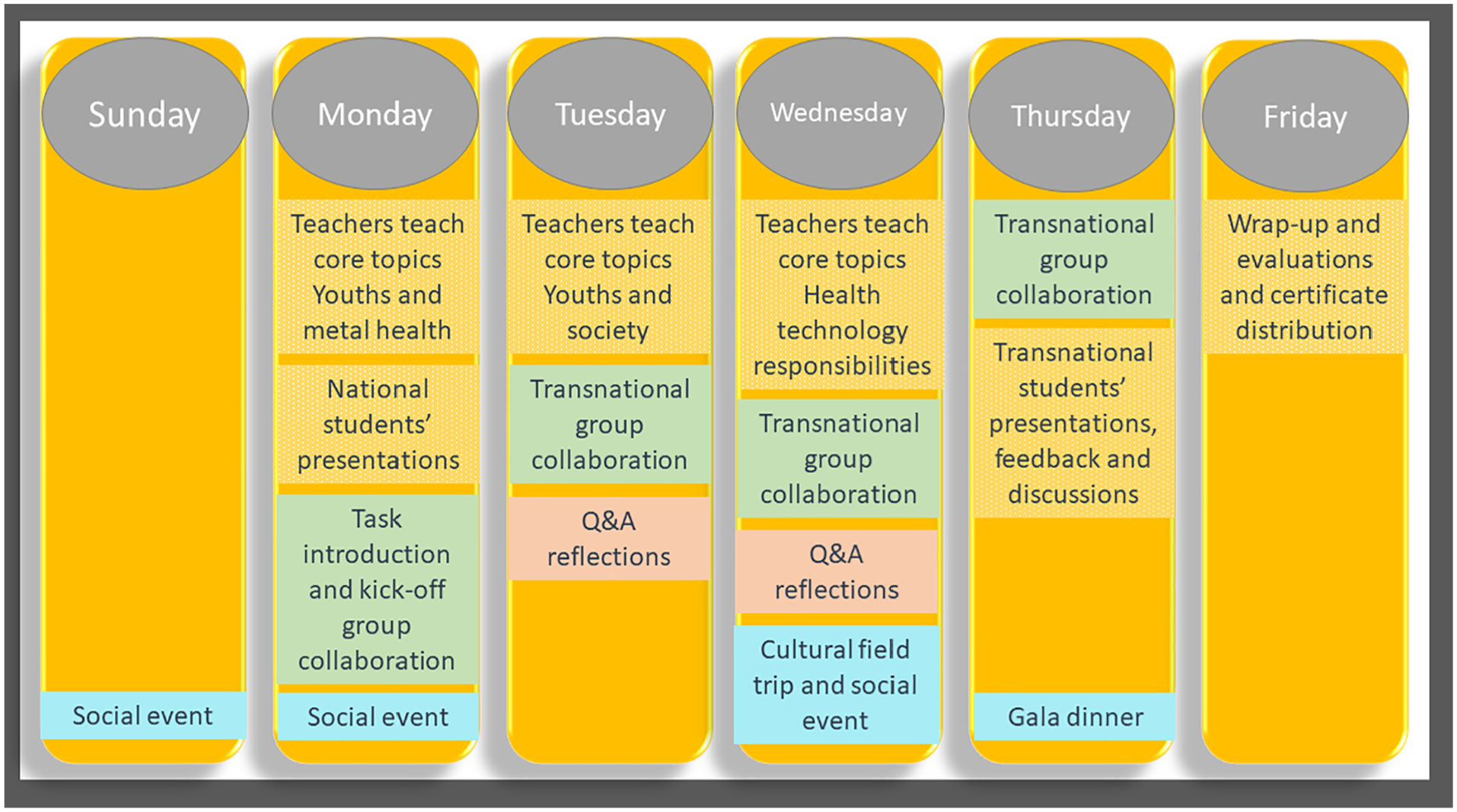
Course content structure description.
Course Assignment Outcomes
At the end of the week, each cross-national group created an infographics poster/ slide, a 1-page executive summary, and a 3-minute video with combined multicounty findings based on their chosen topic. The videos, infographics, and executive summaries were circulated through Canvas. The executive summary (1 page) should be concise and have distinct sections: (1) Introduction (What?) highlighting the problem and the questions the group are answering, (2). Methods (how?) describing how and where the group collected the information, (3). Findings or description of what the group have learned (so what?), and (4) A clear Conclusion as bullet points that emphasizes the key takeaways.
Course Evaluation and Assessment
To explore students’ perceptions of learning gains and identify factors supporting learning during the IP course, we developed a descriptive evaluation form inspired by the Student Assessment of Learning Gains (SALGs) questionnaire (Seymour et al., 2000). The SALG instrument consists of a series of closed questions that explore perceived student gains in skills, cognition, and attitudes on a Likert scale. Our cross-sectional assessment was constructed in accordance with this premise. The simplicity of Likert scales aids in increasing response rates and minimizing potential misinterpretation. The survey is outlined in Table 1. The Cronbach’s Alpha, calculated in SPSS version 26, was .85, which may indicate good internal reliability. However, it must be interpreted with caution due to the low number of respondents to the questionnaire with a need for further pilot studies of the reliability. The students anonymously completed the survey on the course’s last day. In addition, we evaluated and assessed the course in a plenum session on the last day. The teachers had an ongoing evaluation throughout the week based on the feedback from the students during the day and scheduled times for reflection and questions. This study does not require ethical approval as it focuses on a program evaluation and therefore data collected does not involve any demographic characteristics or sensitive information about individuals. The results are therefore presented as frequencies.
Course Evaluation Survey Inspired by the SALG Assessment.

Note. aAnswered with a 5-point Likert Scale No help to Great help, 1–5.
Answered with a 5-point Likert scale Not at all to A great deal 1–5.
Open-ended questions.
Results
In total, 26 students and 10 teachers from five countries and six nursing education institutions attended the IP course. The students were divided into five to six persons in each group. Five groups worked together in three different rooms during the group sessions. Every day, the students worked in cross-national groups, and each group was assigned two teachers from two different institutions who supervised the group during the week. During the dedicated time for student group work, the teacher met and shared knowledge/experiences and discussed different pedagogical possibilities and challenges related to supervising cross-national groups.
Course Assignment Collaboration Description
We purposefully considered the topic study questions as a broad frame for the student’s work during the week. The topics could be answered from many different perspectives. The students were free to select the perspectives or approach for their group work. The group interaction and discussions among the peers were one of the week’s most important outcomes. The week was structured to facilitate and promote student interactions with the program from 9 to 17, including a 1.5-hour lunch break and two 30 min breaks with refreshments. The tutors stimulated class reflection and developing common ideas on the topic during the week and were available for student consultations. The structure of the course enhanced student’s engagement creating an atmosphere of high level of intensive activity as well as frequent teacher and student interactions both in the learning activities and in the social program. The cross-national collaboration among teachers during the course inspired pedagogical discussions and made sure that the teacher role throughout the week was to facilitate the learning process allowing the students to work collaboratively without being instructed on how to solve the problem.
Results from the Survey Assessment
Table 2 presents the findings of evaluating learning activities to facilitate and support learning. Twenty-three students answered the post-course evaluation. Overall, the students evaluated the course positively and highly appreciated the interaction with their national and international peers and teachers. The learning activity reported to be the most effective among the students was participating in cross-national group discussions (Figure 2). Furthermore, the evaluation results regarding social experiences revealed that 73% of students responded, “a great deal” when asked to rate the statement “Being social with students from their own country during the week was great,” while 18% responded “a lot,” and 9% responded “somewhat.” When asked to rate their social experiences with students from other countries during the week, 64% of students responded, “a great deal,” 23% responded “a lot,” and 14% responded “somewhat.” None of the students responded “Just a little” or “Not at all” on the above two statements. The open comments about the experience were positive and aligned with these answers. However, a few students (four) experienced the week as work-intensive and recommended a less intensive program. The evaluation responses corresponded well with the students’ feedback and engagement during the week, as well as the oral evaluation. Overall, the students reported being well prepared, the content was engaging and relevant, and the course well-coordinated and organized.
Post-Course Evaluation: “How Much Did the Following Learning Activities Help Your Learning?” (N = 23).


Survey results post evaluation, how much did discussions in transnational groups help your learning?
Discussion
The current paper presents findings from a descriptive pilot study examining the outcomes and expectations of nursing students who choose to participate in an intensive course aimed at enhancing students’ knowledge and awareness of the international nursing community during and after the Covid-19 pandemic. The focus on health technology and mental health of young people were deemed to be highly relevant by the students, and the post-evaluation confirmed that they were highly satisfied with the outcome of the course. Indicating that content relevance is important for students learning and satisfaction (Cant et al., 2023). The anticipation of success goes beyond merely perceiving one’s overall competence; it embodies a forward-looking belief that individuals can achieve the task they envision in the future (Cook & Artino, 2016). Cook and Artino (2016) emphasize the need for educators to foster a sense of relevance and value in the tasks assigned to students, provide feedback that enhances learners’ self-efficacy, and promote mastery-oriented goals.
Collaborative learning in groups is part of the pedagogy in the nursing programs. During the pandemic, much of this collaboration took place digitally or not at all. Students who applied for the IP course said they looked forward to meeting other student in real life for several days in a foreign country. To experience something new, to travel abroad, is known as a motive for international exchange. As shown in a qualitative evaluation of Hsiao et al. (2021), who found that exchange students encouraged others to experience “this fun once-in-a-lifetime opportunity” after completing a short-term mobility program.
Students in general have little influence on their course of study, as the curriculum is generally preselected for the entire bachelor’s program to ensure that all graduates of the program possess the necessary knowledge and competencies expected. The topic of IP courses can therefore be a motivating factor. Through their letter of motivation for participation, or through application interviews, it became clear that the applicants thought there had been too little focus on young people’s health in nursing education. Now, they had an opportunity to study this field closer. During the course, we provided students with the opportunity to choose their own perspective. By trusting the process and allowing students to choose, educators also empower students to take ownership of their learning. This sense of responsibility and accountability can lead to a greater sense of self-confidence and self-efficacy. Students become active participants in their own education and are more likely to take pride in their achievements (Bønløkke & van der Linde, 2021). The mobility experience can also alleviate feelings of loneliness and create time for reflection. This is particularly important within the context of the regular nursing program, where students are rapidly introduced to new challenges and experiences. Often, there is a lack of “breathing room” or time for reflection built into the structure of this program itself. This lack of time for reflection is significant when considering integration theories that underscore the importance of reflection as a means to fully close the learning loop and foster a greater sense of academic and social integration. However, participating in an exchange program can provide students with necessary space and opportunity to reflect and integrate their experiences (Sweetman et al., 2023).
Research implies that students seeking exchange want challenges. They want an understanding of other cultures and expertise in global health and the international community (Gower et al., 2016). These students also show motivation to leave their comfort zone, enter a challenging environment, and have high adaptability (Hsiao et al., 2021). This was also evident for the participating students. They demonstrated a willingness to step out of their comfort zone, they engaged in discussions and shared their perspectives on loneliness, lack of control, and symptoms of anxiety associated with the Covid-19 lockdown. The education systems may be similar between the different countries, although the pedagogical approaches can diverge. Furthermore, teachers worked in pairs during the week. The pairs were from different educational institutions with diverse pedagogical experiences, providing a foundation for sharing. The teachers gained knowledge about education in neighboring countries, enrichening the teaching experience (Lock et al., 2016). It is important to recognize that frustrations can arise from both students and teachers when implementing the open approach we utilized in this course. We solved this by incorporating frequent check-ins and fostering a supportive and coordinated teacher team. This ensured that students receive the individualized attention and support they needed while embracing the benefits of the open approach.
In healthcare post-pandemic, there is a focus on taking advantage of the knowledge gained during the pandemic on how to continue to work efficiently with digitalized care (Svensk Sjuksköterskeförening, 2022). Therefore, the insights gained by the students in this course are highly relevant for their future nursing careers as emphasized by Nilsson et al. (2014) who claims that education experiences abroad positively contributed to nursing students’ development of competences. All students, across the countries, recognized the importance of combining health technology with a person-centered approach acknowledging the course content and relevance. Person-centered care and knowledge are rapidly growing on how vital this approach is in digitalized care to capture a person’s suffering, find the right treatments and flexible support, and provide high-quality healthcare prerequisites for a successful outcome in digital care (Boström et al., 2020; Botrugno, 2018; Gonçalves & Raimundo, 2017) highly relevant for the Nordic and the Baltic countries. Students and teachers shared and discussed clinical cases and research before and during the pandemic, of how health technology enables people to increase control and improve their health and well-being using different applications to support health and to communicate with nurses (Fagherazzi et al., 2020; Hellzén et al., 2022; Öberg et al., 2018; Socialstyrelsen [National board of health and welfare], 2018). Through the course, the students may have gained insights into how to address the challenges facing young people today and how digital solutions can support healthcare services. Supporting young person’s health is a possible area where this could be suitable due to young person’s ability to use digital care and is in line with the global strategy on digital health (World Health Organization, 2021). While we did not directly evaluate these aspects, we observed during students’ presentations at the end of the week that they had engaged in learning and group collaboration and developed a comprehensive understanding of the given topic. The students were able to integrate their previous experiences and knowledge gained so far in their respective programs, creating a common understanding of nursing across countries during an intensive collaboration. Although short-term mobility program evaluation is limited, according to Johnston et al. (2022) student exchange in nursing education is associated with favored outcomes in relation to students` professional practice and critical thinking. The ultimate goal of all nursing education.
Harding (2019) found three perspectives in a review about international exchanges; “understanding of different cultures, improving expertise in nursing” and “awareness of the international community” and concluded: “Strategies that will enhance students’ understanding of diverse cultures are needed to increase their awareness of international exchange.” The way we see it, Nordsam is an example of such a strategy. Although the course resulted from a Nordic-Baltic collaboration, it aimed to enhance students’ understanding of diverse cultures by making them discuss similar healthcare challenges among youths in their respective countries. The transnational aspects of the student groups seem to have successfully facilitated the exploration of common issues and an increased awareness of an interconnected world. Interestingly, according to the recent review of 56 studies reporting outcomes of nursing and midwifery students participating in international educational programs, the length of programs was not associated with outcomes related to increased cultural awareness, personal development, or professional skills (Johnston et al., 2022). This indicates that short term exchange embedded in the nursing program enhance cultural sensitivity. Our positive results also correspond with the results of Granel et al. (2021), evaluating a one-week exchange course including 118 nursing students. Their results confirmed that a one-week course enabled nursing students to develop cultural competences enhancing complex interactions in health care, which were sustained 1 year later.
One of the advantages of short-term courses like our IP course, is their ability to provide a concentrated learning experience. Students can engage in intensive study, focusing on key concepts and practical applications within a relatively short timeframe. This concentrated learning approach can enhance retention and understanding of topics not covered extensively in the overall nursing program curriculum. In the Nordic and Baltic, the nursing education traditionally focuses on core clinical skills, critical thinking, and patient care delivery. While these areas are essential, the integration of health technology into nursing practice is becoming increasingly important. By incorporating health technology as a topic in this IP course we filled a reported gap in the curriculum across nursing education in the Nordic and Baltic countries, equipping our students with knowledge and skills to navigate the increasingly digital healthcare environment, leverage technology to provide high-quality care, and spark their interest to explore the subject further (Ali et al., 2022).
Strength and Limitations
The present study describes the initial implementation of an IP course, and future Nordsam IP courses will be further developed based on the experiences gained from this study. Our research was conducted within a real-life setting characterized by its complex nature. Despite the challenges, this environment provided us with invaluable experiences that can be applied to similar situations. A cross-sectional survey inspired by the SALG questionnaire (Seymour et al., 2000), was developed for this study and used to evaluate the course. Cross-sectional studies are a type of descriptive design, as Siedlecki (2020) highlighted, which captures data at a single point in time, offering insights into participants’ immediate experiences and perceptions. These designs also allow flexibility in data collection methods, enabling researchers to employ surveys with both closed and open-ended questions, facilitating a comprehensive understanding of the program’s impact and effectiveness. It should be noted that this was a pilot study, indicating a preliminary exploration of the program’s efficacy and feasibility with a small sample.
In addition, the course was developed during the pandemic, which made in-person meetings impossible during the preparations. The teachers had to familiarize themselves with each other and agree on pedagogical principles online, which could have limited pedagogical creativity and the shared approach to course implementation. However, we had time together during the week and discussed the pedagogical approach as matters arose. The group of teachers was a mix of experienced educators and researchers, which likely contributed to a positive learning environment for both students and teachers during the week. Our frequent meetings before the IP course week and the willingness to share and engage in student activities likely contributed to the students’ positive evaluation of the course.
Conclusion
Student exchange opportunities is important for nursing students, as they contribute to their future professional roles as nurses. Short-term courses provide concentrated and flexible learning experiences, introducing students to additional nursing topics that may not be extensively covered in their regular curricula. They also provide opportunities for active student engagement. While group collaboration proved to be highly beneficial for student learning, a mix of different learning activities seems valuable. Cross-national collaboration among teachers before and during the course was important to facilitate the learning process.
Footnotes
Acknowledgements
We want to thank the students who were willing to spend a week during their tightly scheduled semester attending the Nordsam IP course in autumn 2022. In addition, thanks to Riga Medical College of the University of Latvia, who facilitated a great stay.
Author Contributions
AKB had the idea, designed the objectives, wrote the grant application that is the foundation of this study, and drafted the manuscript together with AT. AKA/MHR, MG/ALN, MLBM/KGS, and HS/NM worked in pairs and drafted passages in the introduction, results, and discussion sections. All the authors revised and approved the final manuscript.
Declaration of Conflicting Interests
The author(s) declared no potential conflicts of interest with respect to the research, authorship, and/or publication of this article.
Funding
The author(s) disclosed receipt of the following financial support for the research, authorship, and/or publication of this article: The IP course was funded by The Nordplus Programme (The Nordic Council of Ministers, #NPE-2022/10365).
Ethical Approval
This study does not require ethical approval as it focuses on a program evaluation and the data collected does not involve any personal or sensitive information about individuals.

Data Availability Statement
We are able to freely share our findings with other researchers, institutions, and interested parties to contribute to the broader knowledge and understanding in our field.