



Abstract
This study aimed to examine the influence of different categories of consumption consciousness and purchasing behaviors on subjective well-being (happiness and life satisfaction) using two sets of data from Japanese samples. Dataset 1 comprised data from a random sample of 1,123 Japanese aged 20 to 69 from the Tokyo metropolitan area obtained from a questionnaire survey focusing on the influence of purchasing behaviors on subjective well-being conducted by mail in 2021. Dataset 1 revealed that social experiential consumption positively influenced both happiness and life satisfaction, sustainable consumption positively influenced only happiness, and conspicuous consumption negatively influenced both happiness and life satisfaction. Dataset 2 used the open data of 5,348 Japanese aged 15 to 64 from the Tokyo metropolitan and the Kinki metropolitan areas acquired in 2022 and focused on the influence of consumption consciousness on subjective well-being. Dataset 2 revealed that consumption consciousness involving others, such as prosocial orientation, sustainable orientation, and social orientation, had positive and significant effects on happiness and life satisfaction. This study deepens our understanding of the relationship between consumer behavior and well-being in the Japanese context. It highlights the influence of consumer behaviors that are related to others, such as sustainable consumption, on enhancing the meaning people find in their lives.
Keywords
Subjective well-being is a comprehensive concept that reflects people’s “good mental states, including all of the various evaluations, positive and negative, that people make of their lives, and the affective reactions of people to their experiences” (Organization for Economic Cooperation and Development [OECD], 2013, p. 29). People in a state of positive affect, such as happiness, can cope with the stresses in their lives, living more actively and working more productively, allowing society as a whole to develop a virtuous cycle (Fredrickson & Cohn, 2008; Lyubomirsky et al., 2005). Therefore, in the fields of sociology and psychology, subjective well-being is a topic that has received much attention. However, in the field of marketing, consumer well-being has not received sufficient attention compared to consumer satisfaction (Dhiman & Kumar, 2023; Grinstein et al., 2022; Sirgy, 2021).
Consumer satisfaction is the degree of a consumer’s satisfaction with a product, service, or shopping experience. High consumer satisfaction contributes to long-term sales and profits and is therefore highly valued in marketing (Sirgy, 2021). However, Sirgy (2021) also noted that from a macro-marketing perspective, consumer well-being should be considered the ultimate goal of marketing, as it influences multiple aspects of consumer quality of life, such as happiness and life satisfaction, and as it also relates to broader societal welfare. With the explosion of COVID-19, consumers and marketers became increasingly focused on personal well-being. Moldes et al. (2022), through content analysis on Twitter, showed that shopping as a way to relieve stress or improve personal well-being trended upward for both users and brands during the COVID-19 pandemic compared to the pre-pandemic period. Therefore, exploring consumer well-being and its influencing factors from more perspectives is important for enriching marketing theory and practice.
Research on the relationship between consumption and subjective well-being is mainly focused on the following perspectives: (1) the relationship between a particular form of experiential consumption and subjective well-being (See Gilovich et al., 2015); (2) the relationship between specific types of goods, such as voice assistants (Kang & Shao, 2023), and subjective well-being; (3) the relationship between single-category consumption patterns (e.g., conspicuous consumption) and subjective well-being; and (4) the comparison of the effects of material goods consumption and experiential consumption or relational consumption on subjective well-being (e.g., Gilovich et al., 2015; Van Boven & Gilovich, 2003). However, consumer well-being is not limited to specific categories of products or services but is a generalized concept that needs to be studied in a broader context (Dhiman & Kumar, 2023). Consumers’ daily lives encompass various types of consumer behavior. Consumer well-being may vary considerably between different categories of products or services (Sirgy, 2021). While focusing on specific types of products or services, or a single category of consumption patterns (e.g., conspicuous consumption), or on a comparison of two categories of consumption patterns (e.g., consumption of material goods vs. experiential consumption) helps us to gain insight into the influence of specific categories of consumption and consumer well-being. However, it also restricts the broadness of the research. By considering and empirically examining the effects of various categories of consumer behavior on subjective well-being, we can further expand the scope of research on consumer behavior and well-being.
Subjective well-being refers to “people’s evaluation of their lives, including cognitive judgments of satisfaction and affective evaluations of emotions and feelings” (Kesebir & Diener, 2009, p. 61). According to existing studies, subjective well-being can be broadly categorized into two main components: a cognitive component and an affective component (Iyer & Muncy, 2016; Kesebir & Diener, 2009; Schimmack, 2008). The cognitive component focuses on the individual’s overall life evaluation, such as life satisfaction, and the affective component involves the individuals’ perceived feelings toward their lives, such as positive and negative affect, and subjective happiness. Existing research tends to focus solely on either the cognitive or affective component of subjective well-being, and relatively few studies consider both. The cognitive and affective components serve as separate components of subjective well-being, and research findings on one component may not be generalizable to the other (Haller & Hadler, 2006; Schimmack, 2008; Schimmack, Schupp, & Wagner, 2008). Studies have shown that different factors influence these two components and that the effect of the same factor varies between the two. For example, Schimmack, Schupp, and Wagner (2008) showed that the personality trait of neuroticism influences affective well-being more than it does cognitive well-being, whereas unemployment and regional differences influence cognitive well-being more strongly. Wu and Zhang (2024) found that the effect of environmental uncertainty on life happiness is moderated by social density but did not find that social density moderates the effect of environmental uncertainty on life satisfaction. Tsurumi et al. (2021) showed that the marginal effects of total, material, and relational consumption on cognitive and eudaimonic dimensions of subjective well-being are all stronger than their effects on the affective dimension. Finally, compared to Western countries, many important consumer issues in Asia have yet to be studied (Xiao et al., 2021) and even less research has been done on consumer well-being in Japan.
Given the limitations of the existing literature in marketing, this study expands the scope of the research object. Regarding consumption, we considered not only experiential consumption, but also consumption behaviors that positively impact others and society, such as prosocial consumption and sustainable consumption. At the same time, we also considered consumption behaviors that may have negative effects, such as conspicuous consumption. This study aims to comprehensively explore the influence of multiple consumption behaviors on subjective well-being; therefore, in addition to consumption behaviors involving others, we also considered consumption behaviors that do not involve others, such as solitary experiential consumption. Moreover, to deepen the understanding of the relationship between consumer behavior and subjective well-being, this study also considered consumers’ general shopping attitudes and the influence of those attitudes on subjective well-being. To deepen our understanding of subjective well-being, this study subdivided it into happiness (affective component) and life satisfaction (cognitive component) and explored the differences in the influence of different consumer behaviors on these two aspects. In summary, the purpose of this study is to examine the influence of different types of consumption (e.g., experiential, prosocial, sustainable, and conspicuous) on subjective well-being and to explore how these effects differ with regard to happiness and life satisfaction.
Literature Review and Hypothesis Development
Prosocial Consumption and Subjective Well-Being
In a broad sense, there are two types of prosocial consumption: spending money to benefit others (e.g., gifts and donations) and spending money on the sustainable development of society (e.g., purchasing environmentally friendly products). The former is consumption that benefits others from a personal micro perspective, while the latter benefits others from a social macro perspective. Since the nature of these two forms of consumption is different and many scholars define only the former as prosocial consumption, this study refers to the former as prosocial consumption and the latter as sustainable consumption.
Previous studies have demonstrated that spending money on prosocial consumption is associated with greater well-being. For example, previous research (Dunn et al., 2008; Geenen et al., 2014; Hang & Zhong, 2023) showed that people feel more happiness when they spend money on others than when they spend it on themselves. Moreover, Aknin et al. (2012) analyzed data from 136 countries and found that the relationship between charitable donations as an indicator of prosocial consumption and subjective well-being was robust in 120 countries and existed regardless of the wealth of these countries. Consumers seem to feel more happiness from prosocial consumption, perhaps because they may feel the value of their help or existence to others and, thus, gain more meaning in their lives. Therefore, the following hypothesis is proposed:
H1: Prosocial consumption leads to higher subjective well-being.
Sustainable Consumption and Subjective Well-Being
Sustainable consumption refers to spending money on the sustainable development of society. Around the world, sustainable development is increasingly gaining attention. In Japan, the Consumer Affairs Agency is actively promoting sustainable consumption. Previous studies have shown the influence of sustainable consumption on life satisfaction in various dimensions. For example, sustainable consumption related to environmental and social issues (Chéron et al., 2022), purchase intentions and actual purchases related to environmentally friendly products (Xiao & Li, 2011), and purchase intentions for environmentally friendly products and socially conscious purchasing (Dhandra, 2019) all had a positive impact on life satisfaction. Consumers seem to be able to feel their own value to society through sustainable consumption, gaining self-affirmation and satisfaction, and, thus, more happiness. Therefore, the following hypothesis is proposed:
H2: Sustainable consumption leads to higher subjective well-being.
Social Experiential Consumption and Subjective Well-Being
Social experiential consumption refers to spending money to create enjoyable or fulfilling experiences with others. Many studies have demonstrated that experiential consumption, such as travel and excursions, brings consumers well-being. For example, Van Boven and Gilovich (2003) and Choung et al. (2021) found that experiential purchases (those made with the primary intention of acquiring a life experience) lead to greater subjective well-being than material purchases. Zhang and Xiong (2015) also showed that as the percentage of leisure expenditure increased, so did the promotion of subjective well-being among Japanese consumers. Thus, experiential consumption is considered to lead to greater well-being. Therefore, the following hypothesis is proposed:
H3a: Social experiential consumption leads to higher subjective well-being.
Previous research exploring the relationship between experiential consumption and subjective well-being has been largely centered around its impact on interpersonal relationships. For example, Howell and Hill (2009) demonstrated that experiential consumption improved interpersonal relationship satisfaction and contributed to subjective well-being among American university students. This finding was corroborated by Yamaguchi et al. (2016), who revealed that experiential consumption in a Japanese university student population improved subjective well-being by enhancing social relationships. More recent studies have diversified the contexts in which this phenomenon is observed. Ni and Ishii (2023) found that consumer behavior in teahouses and cafes contributed to consumer social capital, thereby increasing subjective well-being. This line of inquiry has been extended into the digital sphere, with recent work showing that online multiplayer gaming can similarly fortify social capital and enhance well-being (Ni et al., 2023). These studies suggest that well-being gains are derived from experiential consumption by building social bonds with the surrounding people.
An important aspect of building social bonds is trust. It plays a pivotal role in interpersonal interactions and cannot be ignored in the relationship between experiential consumption and subjective well-being. General trust means information, knowledge, or beliefs regarding people in general, not specific individuals (Yamagishi, 2011). General trust plays an important role in purchase behavior. Consumers with a higher level of trust appear to be less fearful of social uncertainty and more willing to actively contact salespeople and other consumers to experience more hedonic value or build relationships. According to Ni and Ishii (2019), the relationship between shopping and interpersonal relationship satisfaction is stronger when one trusts strangers more. Therefore, the following hypothesis is proposed:
H3b: Higher general trust levels lead to a stronger relationship between social experiential consumption and subjective well-being.
Conspicuous Consumption and Subjective Well-Being
Previous researchers have investigated two types of conspicuous consumption. The first type involves purchasing goods that might be easily visible to others (e.g., outdoor clothes, cell phones), while the second involves purchasing premium goods to distinguish oneself ( it should be noted that here we are specifically referring to consumers who purchase luxury goods beyond their financial means to display to others). Different definitions of conspicuous consumption can produce different outcomes. For example, previous studies have shown that the former type is positively associated with subjective well-being (Brown & Gathergood, 2020; Wang et al., 2019), while the latter is negatively associated with subjective well-being (Linssen et al., 2011; Okulicz-Kozaryn et al., 2015).
The latter type of conspicuous consumption was examined in this study: one purchases expensive goods to show one’s social status. Linssen et al. (2011) found that individuals in India who spent more on conspicuous consumption had lower subjective well-being. Okulicz-Kozaryn et al. (2015) found that in the United States, controlling for income and housing status, those who purchased good cars (worth between $23,000–$35,000) had higher subjective well-being than those who purchased luxury cars (worth over $35,000). The pretense of spending on over-income luxury goods does not promote happiness; rather, it may do harm due to potential debts incurred. Spending more on luxury goods to display to others increases consumers’ mental fatigue and decreases their happiness. Therefore, the following hypothesis is proposed:
H4: Conspicuous consumption leads to lower subjective well-being.
Shopping Attitudes and Subjective Well-Being
As mentioned in the introduction, shopping is an integral part of daily life. The more consumers consider shopping as an enjoyable activity, the more happiness they tend to feel. Indeed, Oropesa (1995) showed that if one perceives shopping as fun, one’s level of subjective well-being increases. Therefore, the following hypothesis is proposed:
H5: A favorable attitude toward shopping has a positive effect on subjective well-being.
Shopping Attitudes, Purchase Behavior, and Subjective Well-Being
According to the broaden-and-build theory devised by Fredrickson and Cohn (2008), experiencing positive emotions broadens one’s momentary thought-action repertoire (expanding one’s way of thinking and the range of activities one is willing to engage in), builds development and access to a variety of personal resources, and ultimately enhances one’s overall well-being. Hence, a favorable attitude (e.g., enjoyment) toward shopping promotes various purchase behaviors, ultimately increasing a consumer’s subjective well-being. People who like shopping seem motivated to purchase goods related to prosocial consumption, sustainable consumption, and conspicuous consumption. For example, people who like shopping may want to buy gifts to promote relationships with others, buy goods that benefit the environment or society to gain recognition from others or themselves, and show off their social status through material things. Moreover, people who enjoy shopping may not just like purchasing goods but may also enjoy shopping as a pleasant experience in and of itself. Therefore, people who like shopping may also highly engage in the purchase of experiential consumption. Combining hypotheses 1 to 5, the following additional hypotheses are proposed:
H6a: The relationship between favorable attitudes toward shopping and subjective well-being is mediated by prosocial consumption.
H6b: The relationship between favorable attitudes toward shopping and subjective well-being is mediated by sustainable consumption.
H6c: The relationship between favorable attitudes toward shopping and subjective well-being is mediated by social experiential consumption.
H6d: The relationship between favorable attitudes toward shopping and subjective well-being is mediated by conspicuous consumption.
Altruism, in this study, is defined as being interested in helping others. According to Andreoni's (1989, 1990) warm-glow giving theory, people acquire a rewarding warm glow when they have performed a role for the benefit of others. This warm glow indicates the selfish pleasure or satisfaction derived from doing a good deed. For example, people could acquire such a glow after making a gift for the public good. Spending money on others could satisfy a consumer’s need to help others to achieve self-worth. Hang and Zhong (2023) showed that prosocial consumption leads to both relatedness need satisfaction, and beneficence (a subjective feeling or evaluation about the actor’s personal sense of having done good things for others). Therefore, it is assumed that the more people with high altruism enjoy shopping, the more they will be willing to spend on or for others. Therefore, the following hypothesis is proposed:
H7: Higher levels of altruism lead to a stronger relationship between favorable attitudes toward shopping and prosocial consumption.
The Conceptual Model
Figure 1 shows the proposed conceptual model based on this study’s hypotheses. Age, gender, marital status, education, and household income were included as control variables for all the endogenous variables in the model. In order to better understand the role of consumer behavior involving others, the model includes both consumer behavior involving others as well as consumer behavior not involving others.

Conceptual model.
Methods
We used two sets of data to better validate the proposed conceptual model. Dataset 1 contains data we actively collected. Dataset 2 was drawn from publicly available data (https://www.yhmf.jp/aid/data/data_aid_2022_later.html). Dataset 2 makes up for some of the shortcomings of Dataset 1, for example, in Dataset 1, some variables we used were only measured with a single questionnaire item and the data only included participants from the Tokyo metropolitan area. In Dataset 2, however, the adopted variables used were all measured using multiple-item scales and the participants were from both the Tokyo metropolitan area and the Kinki metropolitan area. Dataset 1 was used to examine the influence of purchase behavior on subjective well-being, and Dataset 2 was used to examine the influence of consumer consciousness on subjective well-being.
It should be noted that, in Dataset 2, family members were categorized as belonging to the “others” group. However, both our general life experience and existing studies show that family members are different from others (see Walters, 1982). Spending on family members and spending on those outside the family each have different meanings for consumers. For example, buying a gift for a family member is different than buying a gift for a friend or colleague in terms of the feeling of spending money. Moreover, Menon et al. (2018) showed that the importance to the service user of other consumers in a cafe is negatively correlated with going to cafes with family. Sandstrom and Dunn (2014) demonstrated that for community members, the more daily interactions one has with weak ties, the greater the sense of belonging, while strong ties do not exhibit this effect. Experiential activities with family members may influence a consumer’s contact with unfamiliar others. Due to these particularities with regard to family members, and despite their inclusion in the “others” category of Dataset 2, we excluded them from the category of “others” in Dataset 1.
Dataset 1
Data Collection
A survey company was commissioned to conduct a questionnaire using a two-stage stratified random sampling method based on Basic Resident Registration. In the first stage, prefectures within the targeted area were selected as initial stratification units. Subsequently, in the second stage, a random sampling of individuals was carried out within each selected municipality to ensure a representative sample across the different local administrative divisions (city, ward, town, village). The questionnaire was conducted from October 7, 2021, to November 18, 2021. During that period, copies of the survey were mailed to 3,300 individuals of Japanese nationality aged 20 to 69 in the Tokyo metropolitan area (within a 40 km radius centering on Shinjuku Station). The survey procedure was as follows: (1) request letters, survey forms, and return envelopes were sent; (2) reminder postcards were sent; (3) survey forms were resent to those who had not returned the first form; and (4) an honorarium (a 500-yen QUO card) was sent to those who had participated. The number of valid responses was 1,237 and the valid response rate was 37.5%. The number of responses used in the final analysis was 1,123 after missing variable values were excluded through model validation.
The average age of the individuals in the sample was 46 years (SD = 13), with the percentages of those in their twenties, thirties, forties, fifties, and sixties being 13%, 19%, 24%, 25%, and 20%, respectively. The percentages of males and females were 45% and 55%, respectively, and the percentages of participants who had never married and those who had (including divorcees and those whose spouses were deceased) were 26% and 74%, respectively. Participants with a college-level education or above accounted for 50%, and persons employed full time accounted for 80% of respondents. Regarding annual household income, 22% earned between 4 million and 6 million yen, 36% earned between 6 million and 10 million yen, and 23% earned over 10 million yen.
Measures
Prosocial consumption was measured with the following questionnaire item: “I often spend money on non-family members (gifts, donations, etc.).” Sustainable consumption was measured with four items referencing Sustainable Development Goals: (1) “I choose products with environmental labels such as an Eco mark,” (2) “I try not to buy things that have a negative impact on the environment,” (3) “I avoid products that lead to animal abuse,” and (4) “I sometimes buy fairtrade products (a form of purchasing that benefits people in developing countries),” which had an alpha coefficient of 0.74. Before the question about experiential consumption, the term itself was explained as, “spending money to experience a pleasurable or fulfilling time (hobbies, leisure, cultural activities, etc.).” Social experiential consumption was then measured with the item, “I often engage in experiential consumption with peers or friends (drinking, traveling, hobbies, etc.),” and solitary experiential consumption was measured with the item, “I often engage in experiential consumption alone (reading, traveling, gardening, etc.).” Conspicuous consumption was measured with three items: (1) “I sometimes buy luxury or unusual things to show to others,” (2) “I want to buy something better than the people around me buy,” and (3) “I sometimes overreach by buying expensive things that are not commensurate with my income,” which had an alpha coefficient of 0.75. The following item measured the degree of favorable attitude toward shopping: “I generally like shopping.” Responses for favorable attitudes toward shopping and each type of purchase behavior were measured on a four-point scale ranging from 1 = “disagree” to 4 = “agree.”
The following item measured altruism: “How interested are you in being useful to others in your daily life?” on a four-point scale from 1 = “uninterested” to 4 = “interested.” General trust was measured with the item, “Overall, most people in the world can be trusted” on a four-point scale from 1 = “disagree” to 4 = “agree.” Happiness was measured with the item, “Taking everything together, how happy or unhappy would you say you are?” on an 11-point scale from 0 = “very unhappy” to 10 = “very happy.” Life satisfaction was measured with the item, “Overall, how satisfied are you with your current life?” on a 5-point scale from 1 = “dissatisfied” to 5 = “satisfied.” General trust, happiness, and life satisfaction measures were adapted from the World Values Survey 6 (www.worldvaluessurvey.org/WVSDocumentationWV6.jsp).
Dataset 2
Data Collection
Dataset 2 was obtained from an online survey pool of individuals aged 15 to 64 in the Tokyo metropolitan area (Tokyo, Kanagawa, Saitama, and Chiba) and the Kinki metropolitan area (Osaka, Kyoto, Hyogo, Shiga, Nara, and Wakayama) based on Basic Resident Registration between October 14 and October 19, 2022, with a total sample size of 5,348.
The average age of individuals in the sample was 41 years (SD = 13), with the percentages of those in their teens, twenties, thirties, forties, fifties, and sixties being 7%, 18%, 20%, 26%, 21%, and 9%, respectively. The percentages of males and females were 50% and 50%, respectively, and the percentages of unmarried and married were 54% and 46%, respectively. Persons employed full time accounted for 70%. Regarding annual household income (3,840 valid samples), 18% earned less than 3.6 million yen, 28% earned between 3.6 million and 6 million yen, 23% earned between 6 million and 8.4 million yen, and 31% earned more than 8.4 million yen.
Measures
The terms prosocial orientation, social experiential orientation, and self-gratification orientation are respectively based on Arnold and Reynolds's (2003) terms role shopping (the enjoyment that shoppers derive from shopping for others), social shopping (the enjoyment of shopping with friends and family), and gratification shopping (shopping for stress relief, shopping to alleviate a negative mood, and shopping as a special treat for oneself). These items were measured on a 7-point scale ranging from 1 = “strongly disagree” to 7 = “strongly agree.” The sustainable orientation questionnaire was adapted from Sustainable Development Goals and consisted of 15 items measured on a 5-point scale ranging from 1 = “not at all interested” to 5 = “very interested.” The happiness measure was based on spirit (positive affect and good mood) in Shuv-Ami and Bareket-Bojmel's (2021) meaning in life, and measured on a 5-point scale ranging from 1 = “strongly disagree” to 5 = “ strongly agree.” Life satisfaction was measured with a Japanese version of Diener et al.'s (1985) satisfaction with life scale translated by Hashimoto and Koyasu (2011) and measured on a 5-point scale from 1 = “ strongly disagree” to 5 = “ strongly agree.” Please refer to Appendix A1 for specific items.
Data Analysis
SPSS 29 was used for descriptive statistical analysis, and SmartPLS 4.0.8.6 (Ringle et al., 2022) was used to validate the model by adopting Partial Least Squares Structural Equation Modeling (PLS-SEM). When validating the model, 5,000 bootstrap samples were established. Structural equation modeling (SEM) can be divided into two main categories: covariance-based SEM (CB-SEM) uses a maximum likelihood method based on covariance, while PLS-SEM uses a partial least squares method based on variance. Compared to CB-SEM, PLS-SEM is more suitable for models with small sample sizes, models containing non-normally distributed variables, complex models containing many variables and paths, and data containing variables measured by a single item (Hair et al., 2017). Given the complexity of our model and the characteristics of our data, we adopted PLS-SEM for analysis in this study.
Results
Results for Dataset 1
Descriptive Statistics
The means and standard deviations for each variable used in the model are shown in Table 1. The mean of favorable attitude toward shopping was greater than three (on the four-point scale). This result suggests that, overall, Japanese consumers like shopping. Among consumption behaviors, only the mean of conspicuous consumption was less than two. This finding implies that Japanese consumers refrain from flaunting their spending. Although sustainable consumption is a relatively new type of consumption, its mean was over two, indicating that it is growing. The correlation between life satisfaction and happiness was .63.
Means and Standard Deviations (N = 1,123).

Note. The means of conspicuous consumption and of sustainable consumption are the means of their constituent items, respectively.
Model Results
A Standardized Root Mean Squared Residual (SRMR) value below 0.1 is usually considered a good fit for a model (Hooper et al., 2008). The SRMR for Dataset 1 was 0.087, indicating that the model was a good fit. The collinearity assessment tests for the Variance Inflation Factor (VIF) should present values of less than five (Hair et al., 2017), and in this study, all the VIF values were less than two. Table 2 shows the standardized path coefficients, t-values, and R2 values.
Results of Model (N = 1,123).

Notes. β for standardized path coefficients. *p < .05. **p < .01. ***p < .001. Gender: 1 = males, 2 = females. Marital status: 1 = never married, 2 = married (including divorcees and those whose spouse is deceased). Only the variables associated with the hypothesis and the control variables that were found to be significant are shown in the table.
The total effect of favorable attitude toward shopping on happiness was positive and significant (β = .088; t = 2.9; p < .01), and the influence of shopping attitudes on life satisfaction was insignificant. Thus, H5 was supported. This result implies that people would be happier if they could enjoy shopping as a pleasure activity or hobby.
The effect of favorable attitudes toward shopping on sustainable consumption was positive and significant (β = .11; t = 3.7; p < .001), and the effect of sustainable consumption on happiness was positive and significant (β = .09; t = 2.9; p < .01), but the influence of sustainable consumption on life satisfaction was not significant. The indirect effect of sustainable consumption on happiness was significant (95% bootstrap CI [0.002 to 0.019]). Thus, H2 and H6b were supported.
The effect of favorable attitudes toward shopping on social experiential consumption was positive and significant (β = .13; t = 4.3; p < .001), and the effects of social experiential consumption on both happiness (β = .10; t = 3.0; p < .01) and life satisfaction (β = .08; t = 2.6; p < .05) were positive and significant. The indirect effect of social experiential consumption on happiness was significant (95% bootstrap CI [0.004 to 0.025]). Thus, H3a and H6c were supported.
The effect of favorable attitudes toward shopping on prosocial consumption was positive and significant (β = .15; t = 5.0; p < .001), while the effects of prosocial consumption on both happiness and life satisfaction were not significant. Moreover, neither the effect of favorable attitudes toward shopping on solitary experiential consumption nor the effect of solitary experiential consumption on happiness were significant. However, the effect of solitary experiential consumption on life satisfaction was positive and significant (β = .08; t = 2.5; p < .05).
The effect of favorable attitudes toward shopping on conspicuous consumption was positive and significant (β = .29; t = 10.6; p < .001), and the effect of conspicuous consumption on both happiness (β = −.07; t = 2.0; p < .05) and life satisfaction (β = −.08; t = 2.4; p < .05) were negative and significant. The indirect effect of conspicuous consumption on happiness was significant (95% bootstrap CI [−0.04 to −0.0002]). Thus, H4 and H6d were supported.
Altruism moderated the effect of favorable attitude toward shopping on prosocial consumption (β = .08; t = 2.7; p < .01). General trust moderated the effect of social experiential consumption on happiness (β = .06; t = 2.0; p < .05). To enable a clear understanding of the moderating effects of altruism and general trust, the results of the simple slope analysis are shown in Figures 2 and 3, respectively. As shown in Figure 2, the higher the altruism, the stronger the effect of favorable attitude toward shopping on prosocial consumption. As shown in Figure 3, the higher the general trust, the stronger the effect of social experiential consumption on happiness. Thus, H3b and H7 were supported.

Moderating Effects of Altruism.

Moderating Effects of General Trust.
Results for Dataset 2
The internal consistency, convergent validity, and discriminant validity were used to evaluate the measurement model (Hair et al., 2017). The internal consistency was measured using Cronbach’s alpha and composite reliability, convergent validity was measured using factor loadings and average variance extracted (AVE). The internal consistency and convergent validity are shown in Table 3. The Cronbach’s alpha coefficient and the composite reliability (CR) for all variables were above .8, indicating that all variables’ internal consistencies were reliable (Hair et al., 2017). The factor loadings of all variables were above 0.7, and the AVE of all variables was above 0.6, indicating good convergent validity (Hair et al., 2017).
Construct Validity for Model (N = 5,348).

The Fornell-Larcker criterion (Fornell & Larcker, 1981) was utilized to confirm discriminant validity. The results of the Fornell-Larcker calculation clarified that the square root of AVE between each pair of factors was higher than the correlation estimated between constructs, thus indicating that discriminant validity was acceptable (Fornell & Larcker, 1981). All the AVEs were higher than the diagonal correlation values in this data, indicating adequate discriminant validity (Table 4).
Discriminant Validity for Model (N = 5,348).

Note. In the Fornell-Larcker criterion, the bold numbers on the diagonal are the square roots of the AVEs. The off-diagonal elements are correlations between constructs.
An SRMR value below 0.1 is usually considered a good fit for a model (Hooper et al., 2008). In this study, the SRMR was 0.073, which indicates that the model is a good fit. The collinearity assessment tests for the VIF should present values of less than five (Hair et al., 2017). In this study, all the VIF values were less than two. Table 5 shows the standardized path coefficients, t-values, and R2 values. Prosocial orientation positively influenced happiness (β = .20; t = 10.5; p < .001) and life satisfaction (β = .10; t = 5.3; p < .001). Sustainable orientation positively influenced happiness (β = .18; t = 10.7; p < .001) and life satisfaction (β = .09; t = 5.7; p < .001). Social experiential orientation positively influenced happiness (β = .14; t = 7.2; p < .001) and life satisfaction (β = .21; t = 11.0; p < .001). The influence of self-gratification orientation on happiness or life satisfaction was not statistically significant.
Results of Model (N = 5,348).

Note. β for standardized path coefficients. ***p < .001.
Gender: 1 = males, 2 = females. Marital status: 1 = unmarried, 2 = married.
Discussion and Conclusion
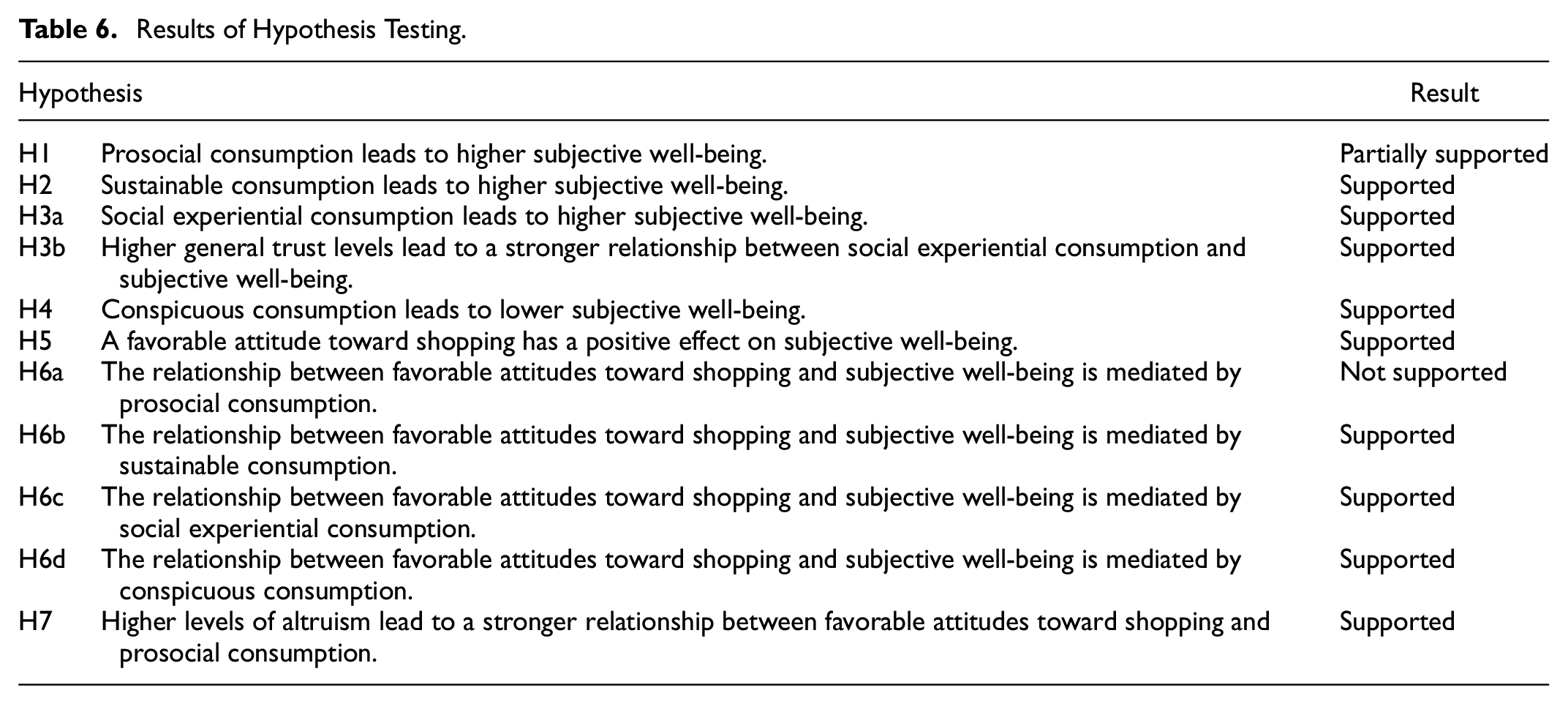
The results of the hypothesis testing are summarized in Table 6. Most of the hypotheses were supported. This study examined the relationship between various consumer consciousness/purchase behaviors and subjective well-being. Dataset 2 showed that the effects of a prosocial orientation, in which a consumer likes shopping for others, a sustainable orientation, in which a consumer shops with the environment in mind, and a social experiential orientation, in which a consumer enjoys shopping with others, on happiness (affective dimension) and life satisfaction (cognitive dimension) were all positively significant, while the effects of self-gratification orientation, which does not involve others, on happiness and life satisfaction were all insignificant. This finding implies that shopping as a means of relieving one’s negative emotions while promoting relationships or contributing to society through shopping gives consumers sustainable long-term happiness. Dataset 1 showed that only social experiential consumption significantly influenced happiness and life satisfaction. Sustainable consumption only significantly and positively influenced happiness, while prosocial consumption did not significantly influence happiness and life satisfaction. Conspicuous consumption significantly and negatively influenced both happiness and life satisfaction. Solitary experiential consumption that does not involve others only positively influenced life satisfaction. In addition, favorable attitudes toward shopping positively influenced happiness, yet no significant influence on life satisfaction was found. Conspicuous consumption, sustainable consumption, and social experiential consumption mediated the relationship between shopping attitudes and happiness. A higher level of altruism led to stronger effects of favorable attitudes toward shopping on prosocial consumption. Meanwhile, a higher level of general trust led to social experiential consumption having a stronger effect on happiness. These findings not only provide a broader understanding of the relationship between consumer behavior and subjective well-being, but also reveal the influence of a collectivist culture on consumption choices and subjective well-being, thus emphasizing the multiple roles that consumer behavior may play in human societies and individual lives.
Results of Hypothesis Testing.
Dataset 2 showed that sustainable orientation influences happiness more than life satisfaction. Dataset 1 showed that the purchase behavior of sustainability-related goods influences happiness, but an influence of sustainable purchasing behavior on life satisfaction was not found. Tay and Diener (2011) demonstrated that different types of subjective well-being are associated with different needs. In the association between the fulfillment of needs and subjective well-being, positive feelings (an indicator of subjective well-being) were most often associated with social needs (experiencing love or receiving help from others in an emergency) and respect needs (feeling respected or proud of something). Life evaluation was most often associated with fulfilling basic needs. Hedonic enjoyment (or hedonic happiness) refers to a variety of positive emotions (e.g., pleasure, enjoyment) experienced when people engage in pleasurable behaviors (e.g., leisure activities) focusing on short-term pleasure. Eudaimonia refers to a fulfilling life (e.g., self-acceptance, personal growth, positive relationships with others, sense of purpose in life) that brings lasting happiness, focusing on the meaning of life (OECD, 2013; Ryff, 1989). Sustainable consumption enables consumers to feel they can contribute to society while at the same time bringing meaning to their own lives. This study reveals that sustainable consciousness or purchasing behavior may play only a small role in improving a consumer’s quality of life, but it plays an important role in enriching consumers’ emotional well-being or their sense of meaning of life. This highlights the importance of focusing on sustainable consumption and its potential to positively impact people’s lives.
Although experiential consumption provides consumers with a sense of fulfillment or an enriched spiritual experience, our study shows that solitary experiential consumption only influences life satisfaction; we did not find that solitary experiential consumption influenced happiness. That is, solitary experiential consumption improves consumers’ quality of life, but its contribution to their emotional well-being is slight. In Dataset 2, no significant associations were found between self-satisfaction orientations not involving others and either happiness or life satisfaction. These findings may be related to the collectivist culture in Japan. Many studies (e.g., Howell & Hill, 2009; Van Boven & Gilovich, 2003) have examined experiential consumption without distinguishing between consumption with others and solitary consumption. Although Caprariello and Reis (2013) and Yamaguchi et al. (2016) did divide experiential consumption into social experiential consumption and solitary experiential consumption, they mainly considered which type of consumption leads to greater happiness. Our findings, however, showed not only that social experiential consumption leads to more happiness than solitary experiential consumption, but also that different types of experiential consumption have different effects on different types of subjective well-being, supporting previous research (Haller & Hadler, 2006; Schimmack, 2008; Schimmack, Schupp, & Wagner, 2008).
Our results also showed that greater general trust leads to a stronger relationship between social experiential consumption and happiness. This result implies that engaging in consumption activities that involve social interactions with others (i.e., social experiential consumption) is more effective for enhancing an individual’s well-being when their general level of trust in the social environment is high, revealing the important role that general trust plays in the relationship between consumption experiences and personal well-being. Consumers with higher general trust are more likely to trust strangers (salespeople and other consumers) and more likely to actively communicate and build relationships with strangers, leading to greater satisfaction and happiness during social experiential consumption. The results suggest that consumers not only further develop established relationships through social experiential consumption but also encounter a variety of new people and potentially develop new relationships, demonstrating the role of general trust in consumer behavior.
The results of Dataset 2 showed that prosocial orientation (including family) positively influences happiness and life satisfaction, while the results of Dataset 1 showed no significant influence of prosocial consumption (excluding family) on happiness or life satisfaction. The findings of Dataset 1 differ from those both of Dataset 2 and of previous research (Dunn et al., 2008; Geenen et al., 2014; Yamaguchi et al., 2016), possibly because prosocial consumption in this study excluded consumption for family members. Although family could be considered part of the “others” category, they differ from individuals outside the family. Indeed, Walters (1982) used empirical evidence to show that family members differ from other individuals that could be categorized as “others.” Therefore, spending on family members may differ from spending on others who are not family members in terms of how this influences consumers’ subjective well-being. In other words, it is possible that spending on others (including family members) could lead to greater subjective well-being, but spending on people outside the family may not necessarily lead to greater subjective well-being. These findings reveal that prosocial consumption that includes family and that which does not influence subjective well-being differently. These findings further deepen our understanding of the relationship between prosocial consumption and subjective well-being.
Our results also show that consumers who like shopping experience lower subjective well-being through conspicuous consumption with which purchases are flaunted. This finding supports the results of previous studies (Linssen et al., 2011; Okulicz-Kozaryn et al., 2015) and indicates that the more one tries to display one’s social status or identity through luxury goods, the lower one’s subjective well-being becomes. Zhang et al. (2022) also showed that although luxury consumption can help consumers realize an ideal image, when this image does not match the consumer’s true image, the inconsistency between the inner self and outer behavior can make people feel inauthentic, which reduces their well-being. These findings suggest that while a positive affective attitude toward shopping plays an important role in pursuing happiness, if one’s attitude promotes consumption that is incommensurate with income and involves ostentation, it hinders the acquisition of happiness. Therefore, the results of this study lead to a recommendation that consumers reconsider the way they spend money and endeavor to use consumption as a means to attain happiness beyond owning things.
We found that a favorable attitude toward shopping is positively associated with social experiential consumption, whereas we found no association with solitary experiential consumption. We also found that favorable attitudes toward shopping promote other forms of consumption involving others (conspicuous, prosocial, and sustainable consumption). In individualistic cultures, one tends to focus on oneself and try to maintain one’s independence from others by discovering and expressing one’s unique internal attributes, whereas in collectivist cultures, people insist on connection, pay attention to others, demonstrate harmony with others, and display interdependence (Markus & Kitayama, 1991). Ni (2021) showed that guanxi networking orientation (a value that emphasizes the development of interpersonal relationships with a sense of reciprocity) positively influences collaborative consumption attitudes in China, a collectivist culture. As a country, Japan is also a collectivist culture, and it is believed that compared to Western consumers, Japanese consumers are more strongly influenced by others in their consumer behavior. This study’s results indicate that the presence of others is embedded in Japanese consumers’ cognition of shopping. Moreover, a favorable attitude toward shopping appears to be related not only to conspicuous consumption but also to consumption that benefits others and society (prosocial or sustainable consumption). These results suggest that fondness for shopping is not limited to material pursuits; it also promotes purchase behaviors that contribute to society and to others. In summary, when discussing consumer behavior in a country with a collectivist culture, such as Japan, it is necessary to consider the presence of others and the influence of interpersonal relationships. This study has also shown that among those with more interest in helping others, a favorable attitude toward shopping has a stronger effect on prosocial consumption. These results imply that the more altruistic people like shopping, the more likely they are to fulfill their desire to help others through prosocial consumption, such as giving gifts and making donations. Consumption is not only a way to satisfy personal needs, but it can also be a way for consumers to show their consideration of others.
Theoretical Contribution
This study makes the following three contributions to this field. First, it extends existing research into the relationship between consumer behavior and subjective well-being to include the Japanese cultural and social context, further enriching the understanding of this topic within a global or multicultural context. Second, as mentioned in the introduction, when examining consumer behavior, most studies have either focused on specific types of products or services, or a single category of consumption pattern, or have compared two different consumption patterns, such as material consumption versus experiential consumption. However, few studies have synthesized and empirically explored how various categories of consumer behavior commingle to influence subjective well-being. Moreover, in exploring consumers’ subjective well-being, most studies focus on either the cognitive or the affective component of well-being, and rarely consider both simultaneously. Such research tendencies may limit the extent of understanding of how consumer behavior influences an individual’s well-being. This study explicitly divides subjective well-being into two sub-dimensions, happiness and life satisfaction, and reveals how different types of consumer behaviors (e.g., sustainable consumption, prosocial consumption, social experiential consumption, and conspicuous consumption) are related to these two different dimensions of well-being, thus building a more comprehensive and detailed analytical framework. For example, this study reveals that consumer behaviors related to others (e.g., social experiential consumption and sustainable consumption) positively contribute to an individual’s subjective well-being. In contrast, however, individually focused consumption (e.g., conspicuous consumption and solitary experiential consumption) has no significant effect, and, indeed, can even negatively influence subjective well-being. These findings emphasize that different categories of consumer behavior influence subjective well-being differently and demonstrate the importance of valuing consumption related to others. In addition, in both Dataset 1 and Dataset 2, sustainable consumption had a significant positive influence on enhancing consumer happiness, compared to its relatively small effect on life satisfaction. This finding highlights the differences in the effects of consumer behavior in promoting the different components of individuals’ well-being, emphasizing that the different components of well-being should be explored separately. Finally, this study enhances the reliability of the findings by using two sets of data for empirical validation. This method allows us to validate the research hypotheses from different perspectives, ensuring robustness and broad applicability of the results. Overall, this study provides unique and valuable insights into the study of consumption and subjective well-being.
Practical Implications
The results of this study reveal different effects of various consumption categories on subjective well-being, particularly emphasizing the important role of consumption that promotes relationships and societal contributions (e.g., social experiential consumption and sustainable consumption) in enhancing consumer well-being, which is important for guiding consumption trends and promoting sustainable development. Moreover, this study found that individual-focused consumption (e.g., conspicuous consumption and solitary experiential consumption) have weak or negative effects on subjective well-being. This study reveals how individuals can be benefited through consumption. It also provides important insights that can aid companies in developing positive marketing strategies and aid the government in formulating relevant policies. In addition, although our study provides insights specific to the Japanese context, the implications of our findings have global relevance, especially in the context of increasing global concerns about sustainability and well-being.
First, policymakers and companies should raise public awareness of sustainable consumption and social responsibility through social media promotion and education, emphasizing that sustainable consumption is not only good for the environment and society but also has a positive effect on consumers’ well-being. This will help raise public awareness of social contributions and consumer interest in sustainable lifestyles and promote more positive and healthy consumption habits. Second, policymakers should consider providing more incentives to encourage companies to develop and consumers to adopt more products and services conducive to sustainable development, such as eco-friendly materials and packaging. Policymakers should also consider creating more public gathering places and supporting community shopping activities, such as bazaars, to promote interpersonal communication and social cohesion. Third, companies should consider designing products and services focusing more on social interaction while developing products that comply with sustainability principles to attract consumers who seek emotional satisfaction and social contribution. Through these measures, companies will not only be able to enhance their brand image but will also be able to occupy a more favorable competitive position in the marketplace. In summary, this study provides a new perspective for understanding the relationship between consumption and subjective well-being and offers practical guidance for policymakers, companies, and individuals, which can help to promote individual well-being and sustainable social development.
Limitations and Future Research
The present study has several limitations. First, the data and analyses used were limited to a single culture. However, as Diener et al. (2018, p. 253) note, “at the community and societal levels, cultures differ not only in their levels of well-being but also to some extent in the types of subjective well-being they most value.” Indeed, Americans associate well-being with personal achievement, while the Japanese associate it with social harmony (Uchida & Kitayama, 2009). Although no association between solitary experiential consumption and happiness was identified in this study, this was probably due to the influence of culture. Therefore, future studies could be conducted in countries with individualistic cultures, such as the United States. Second, this study shows that sustainable consumption is associated with happiness, and it may be assumed that consumers gain self-fulfillment by contributing to society through sustainable consumption, which ultimately enhances happiness. However, what consumers gain through sustainable consumption needs further exploration and robust evidence. Third, the influence of spending on other people on subjective well-being may vary depending on the degree of one’s relationship with others. Future researchers could further divide people within the “others” category according to their closeness or importance to the consumer, for example, by grouping them as families, acquaintances, or strangers. Fourth, this study only examined Japanese people. Due to the differences between individual and collective cultures, the influence of interpersonal relationships on consumption may differ between European and American countries on the one hand and Asian countries on the other; therefore, future studies could be conducted by introducing international comparisons. Finally, in Dataset 1, attitudes toward shopping, happiness and satisfaction were measured with a single item, which might affect the measure’s reliability. Future studies should employ multiple items to measure attitudes and subjective well-being.
Footnotes
Appendix

| Variable | Item | |
|---|---|---|
| Prosocial orientation | PO01 | I like shopping for others because when they feel good I feel good |
| PO02 | I enjoy shopping for my friends and family | |
| PO03 | I enjoy shopping around to find the perfect gift for someone | |
| Sustainable orientation | SO01 | The elimination of poverty and hunger |
| SO02 | Healthy lives for all | |
| SO03 | Opportunities for quality education for all | |
| SO04 | A world where men and women are equal | |
| SO05 | Clean water and sanitary toilet facilities for all | |
| SO06 | Cleaner energy for all | |
| SO07 | A society in which everyone has a job that fulfills their needs and the economy grows | |
| SO08 | A society in which industry and technology progress | |
| SO09 | Reduction or elimination of inequality among countries and people | |
| SO10 | Build a community where people can live forever | |
| SO11 | A society in which the producers of goods are responsible for their production and the users are responsible for their consumption | |
| SO12 | Taking proper measures to cope with climate change | |
| SO13 | Protecting life in the sea and on land | |
| SO14 | A peaceful and just society for all | |
| SO15 | A society that works together to achieve a goal | |
| Social experiential orientation | SEO1 | I go shopping with my friends or family to socialize |
| SEO2 | I enjoy socializing with others when I shop | |
| SEO3 | Shopping with others is a bonding experience | |
| Self-gratification orientation | SGO1 | When I’m in a down mood, I go shopping to make me feel better |
| SGO2 | To me, shopping is a way to relieve stress | |
| SGO3 | I go shopping when I want to treat myself to something special | |
| Happiness | H01 | Generally, I see myself as a happy person |
| H02 | In comparison to my friends, I see myself as a happier person | |
| H03 | I enjoy life and get the best out of every situation | |
| Life satisfaction | LS01 | I am satisfied with my life |
| LS02 | In most ways my life is close to my ideal | |
| LS03 | The conditions of my life are excellent | |
| LS04 | So far I have gotten the important things I want in life | |
| LS05 | If I could live my life over, I would change almost nothing |
Acknowledgements
We want to thank Takao Mamada (professor emeritus of Rikkyo University), the Global Consumer Culture Study Group leader, and the other group members for their various help and comments.
We are also very grateful to Yoshida Hideo Memorial Foundation for providing the data.
Declaration of Conflicting Interests
The author(s) declared no potential conflicts of interest with respect to the research, authorship, and/or publication of this article.
Funding
The author(s) disclosed receipt of the following financial support for the research, authorship, and/or publication of this article: This work was supported by JSPS KAKENHI Grant Number JP19H01574.
Ethical Approval
Dataset 1 in this study was collated by Nippon Research Center Ltd, a SO9001 and ISO20252 certified company. The survey was conducted in compliance with the Personal Information Protection Law and the Marketing Research Code of Conduct of the Japan Marketing Research Association.
Informed Consent
A statement regarding the content of the survey was mailed to participants along with the questionnaire. Dataset 1 does not contain information that may identify individuals.
Permission to reproduce material from other sources
Not applicable.
