



Abstract
This study employed structural equation modeling (SEM) to explore the connections between EFL learners’ perceptions of L2 writing classroom goal structures, engagement with teacher written corrective feedback (WCF), and self-reported writing proficiency. Data were collected from 590 EFL college students in Taiwan using the Learners’ Perceived L2 Writing Classroom Goal Structures Scale and the Student Engagement with Teacher Written Corrective Feedback Scale. The results indicated a predominant preference for mastery goal structures over performance goal structures in the classroom. Among the types of engagement with teacher WCF, behavioral engagement emerged as the most prevalent, followed by affective, cognitive, and social engagement. Notably, affective engagement was found to predict behavioral, social, and cognitive engagement, with behavioral engagement serving as a mediator between affective and cognitive engagement. Furthermore, cognitive engagement was directly linked to writing proficiency, a key finding that highlights its importance in the learning process. Other forms of engagement were shown to facilitate this relationship. The study contributes to our understanding of the interplay between classroom goal structures, engagement with teacher WCF, and writing proficiency. It offers valuable insights for English teachers on how to shape classroom goal structures and foster a learning environment that promotes active engagement, particularly in the context of feedback utilization.
Plain language summary
This study looked at how college students in Taiwan perceive their English writing classes and how they engage with feedback from their teachers. We wanted to see if students thought their classes focused more on learning and improving (mastery) or on getting good grades (performance). We also examined how students interacted with the written feedback their teachers provided, and how this affected their writing skills. We found that students generally felt their classes were focused more on learning and improving. When it came to engaging with teacher feedback, students were most involved in actually using the feedback to improve their writing. They also showed strong emotional engagement, meaning they cared about the feedback and valued it. This emotional engagement was important because it led to other types of engagement, such as discussing feedback with classmates and thinking deeply about the feedback. Interestingly, we found that thinking deeply about the feedback (cognitive engagement) was directly linked to better writing skills. This means that when students really understand and process the feedback, they tend to become better writers. Other forms of engagement, like caring about the feedback and using it practically, helped support this process. Our study suggests that teachers should focus on creating a learning environment that emphasizes improvement and mastery. By doing so, they can encourage students to engage more deeply with feedback, which in turn can improve their writing skills.
Keywords
Introduction
The body of research on written corrective feedback (WCF) has seen substantial growth, largely due to its ease of manipulation in experimental studies (Ellis, 2010). WCF is commonly assumed to play a role in enhancing language learning and improving student writing (Z. Zhang & Hyland, 2018). However, the findings in this area have been inconclusive, as indicated by research conducted by Ferris (2015), Lee (2016), Lim and Renandya (2020), Mohebbi (2021), and Truscott (2016, 2020), raising pertinent questions about its effective implementation. Recognizing the significance of learner engagement in deriving value from feedback (Ellis, 2010), there is a clear necessity to focus on the engagement aspect when considering feedback (Higgins et al., 2001; Price et al., 2011; Zheng & Yu, 2018). Recent empirical work on teacher WCF has used various approaches, including Ellis’s (2010) framework to conceptualize learner engagement with teacher WCF (Han & Gao, 2021), further highlighting the importance of student engagement with teacher WCF (Tsao, 2021; Zheng & Yu, 2018).
Student engagement plays a crucial role in the L2 learning experience, representing a pivotal element within the realm of self-motivation (Dörnyei, 2009, 2019). This learning experience, identified as the quality of perceived engagement (Dörnyei, 2019), encapsulates the motivations that operate within the immediate learning environment (Dörnyei, 2019). In this context, the classroom environment assumes a significant role in shaping engagement dynamics (Patrick et al., 2011), a fact fundamental to understanding its nuances and delivering effective support (Janosz, 2012). Examining the relationship between engagement and the classroom setting leads to an exploration of achievement goal structures, which mirror the perceived motivations within the classroom. These structures assess various outcomes, including adaptive engagement, cognitive processes, motivation, and self-concept (Bandura, 1997; Bardach et al., 2019; Meece et al., 2006; Patrick et al., 2011; Ryan & Patrick, 2001; Vasalampi et al., 2020). A diverse array of classroom goal structures exists, encompassing categories such as mastery-approach, mastery-avoidance, performance-approach, and performance-avoidance goals (Peng et al., 2018). These structures interrelate with personal achievement goals and academic performance (Lüftenegger et al., 2014; Meece et al., 2006) and significantly influence levels of student engagement (Diseth & Samdal, 2015; Roeser et al., 2000). Despite these extensive studies, little research has been conducted on how classroom goal structures in EFL contexts influence students’ engagement with teacher WCF and their writing proficiency.
Given the critical role of learner engagement for effective teacher WCF, which links “the provision of WCF and its effects on students’ writing development” (Zheng & Yu, 2018, p. 13), it is essential to explore how students respond to WCF and how these responses influence writing achievement (Ellis, 2010), including how different aspects of engagement interrelate. Moreover, as student engagement is adaptable and responsive to context (Fredricks et al., 2004, p. 59), research emphasizes the importance of students’ perceptions of their learning environments (Schunk & Meece, 1992). This dynamic is magnified by the potential influence of classroom goal structures on students’ interpretations of and engagement with teacher WCF practices. Notably, EFL contexts have often overlooked these aspects. Addressing this gap, our study employed structural equation modeling (SEM) to examine the intertwined connections between EFL learners’ perceived L2 writing classroom goal structures, their engagement with teacher WCF practices, and their self-reported writing proficiency.
Understanding the connections between these variables is crucial for several reasons. First, insights into how classroom goal structures influence engagement (affective, social, behavioral, and cognitive) can help writing teachers design better learning environments that foster higher levels of student engagement. Second, understanding the impact of engagement with WCF on writing proficiency can lead to more effective feedback practices that enhance student learning outcomes. Finally, this study aimed to contribute to the broader field of language learning by providing empirical evidence on the interconnectedness of classroom goal structures, engagement, and writing proficiency in EFL contexts.
Literature Review
Classroom Goal Structures
Definition and Categorization
Achievement goal theory, a social cognitive motivation model, delineates students’ persistent preferences for educational engagement (McGrew, 2007). As a motivational framework (Johnson & Kestler, 2013), it encompasses two core components: (1) personal achievement goals, signifying persistence and task engagement, and (2) classroom goal structures (CGS), spotlighting teacher messages and student interpretations (Ames, 1992; Bardach et al., 2019; Michou et al., 2013). In this study, CGS takes center stage, categorized by informational cues—self-referenced (mastery goals) and self-evaluated relative to others (performance goals and feedback)—and their cognitive impact (Ames & Ames, 1984; Bandura, 1994). Mastery goal structures (MGS) foster competence, whereas performance goal structures (PGS) cultivate competence relative to peers. The CGS model, broadened by the inclusion of approach and avoidance motivations, now comprises the four-dimensional CGS framework: mastery-approach (MAPGS), mastery-avoidance (MAVGS), performance-approach (PAPGS), and performance-avoidance (PAVGS; Lin & Cherng, 2007; Peng et al., 2018; Wu, 2017). MAPGS urges self-comparison for desired performance, MAVGS sustains performance and minimizes errors, PAPGS prioritizes enhanced grades, and PAVGS underscores avoiding errors and appearing inept. This nuanced CGS model enhances ecological validity by encompassing diverse teaching contexts (Luo et al., 2011).
Previous Research Findings
As mentioned earlier, existing literature has expanded the Classroom Goal Structures (CGS) framework by incorporating approach and avoidance motivations, resulting in a trichotomous model (Schwinger & Stiensmeier-Pelster, 2011) and a four-dimensional model including mastery goal structures (Lin & Cherng, 2007; Peng et al., 2018). Several studies have explored the relationship between CGS and student engagement and academic achievement. For instance, Zaleski (2012) observed improved cognitive engagement with mastery or performance goal structures among high school students, and Uçar and Sungur (2017) found positive associations of mastery evaluation with behavioral, emotional, and agentic engagement among seventh-grade students. Mastery goal structures were also linked to behavioral engagement in Gonida et al.’s (2009) study with seventh- and ninth-graders. M. T. Wang and Holcombe (2010) found that mastery goal structures predicted positive indicators of school engagement (e.g., participation and use of self-regulation strategies), while performance goal structures had negative effects on engagement indicators. In terms of emotional engagement, Shim et al. (2013) revealed that perceived mastery goal structures positively predicted emotional engagement, while performance goal structures had a negative impact. Similarly, mastery goal structures correlated positively with science achievement (Uçar & Sungur, 2017), mathematics achievement (Guo & Hu, 2022), and grades (GPA; M. T. Wang & Holcombe, 2010), while performance goal structures were negatively associated with grades (GPA; M. T. Wang & Holcombe, 2010). The literature also covers studies on CGS’s connections with self-efficacy (e.g., Bardach et al., 2019; Khajavy et al., 2018; Klug et al., 2016), goal orientations (e.g., Fokkens-Bruinsma et al., 2020; Guo & Hu, 2022), motivation (e.g., Meece et al., 2006), teacher immediacy and relevance-making (e.g., Iaconelli & Anderman, 2021), emotions (e.g., Baudoin & Galand, 2017), learning strategies (Ames & Archer, 1988), and teacher support (Fejes, 2023).
Learner Engagement With WCF in L2 Writing
Definitions
Written Corrective Feedback (WCF)
Corrective feedback or error correction, defined as “any explicit attempts to draw a learner’s attention to a morphosyntactic or lexical error” or an error that is not pragmatically acceptable (Ellis, 2008; Polio, 2012, p. 376), has deep roots in second and foreign language teachers’ pedagogical practices and beliefs, especially in writing courses (i.e., WCF). Generally, WCF (which refers to learner errors of all kinds in regard to accuracy, fluency, and appropriateness) provided to learners proceeds from one of two sources: teachers and peers. Teacher feedback is viewed as essential in supporting ESL/EFL learners’ progress toward improving their writing skills, and the supportive role of peer feedback has also been confirmed in empirical research (Ferris, 2006; H. C. Wang, 2009). In addition, different WCF strategies (provided either by teachers or by peers) have also been typologized (Ellis, 2009) into direct (i.e., providing the correction) or indirect (i.e., pinpointing the error without providing the correction), (2) focused (i.e., correcting specific errors) or unfocused (i.e., correcting all errors), (3) local (i.e., affecting only individual segments in a sentence without inhibiting a reader’s comprehension) or global (i.e., affecting the overall meaning of the text), and (4) the use of written comments (e.g., “This is a well-written paper”). Overall, the purpose of offering WCF is to improve learners’ competence as writers by minimizing the errors in and maximizing the clarity of their written work (Alhosani, 2008), by guiding them (Brannon & Knoblauch, 1982, as cited in Corpus, 2011) and by facilitating their effective self-expression (Hyland & Hyland, 2006).
Student Engagement
Due to varied research contexts and focal concerns, student engagement, a complex construct involving multiple dimensions, is still not clearly defined (Reschly & Christenson, 2012). According to Philp and Duchesne (2016), engagement can be defined as “a state of heightened attention and involvement” (p. 51) in which students participate in cognitive, social, behavioral, and affective dimensions. Further, Kuh (2009) argued that engagement indicates the quality of and participation in authentic learning contexts. In other words, when students are fully engaged, they are dedicated to their learning (Z. Zhang & Hyland, 2018) such that they persist despite encountering challenges or problems. Moreover, as Price et al. (2011) claimed, engagement with feedback means seeing feedback as a long-term dialogic process in which teachers and students engage together, rather than as a product or one-way process whereby students see themselves only as receivers of feedback. Lastly, student engagement with WCF, an insufficiently researched topic in L2 writing (Z. Zhang & Hyland, 2018), can be defined as the degree to which learners respond to the feedback they receive (Ellis, 2010) and their involvement in decision making during the writing process (Myhill & Jones, 2007).
Categorization of Student Engagement With WCF
Categories of student engagement have been defined in multiple ways, such as participation/identification (Finn, 1989), authentic/ritual/passive/retreatism/rebellion (Schlechty, 2002), behavioral/emotional/cognitive (Fredricks et al., 2004), behavioral (objective)/self-reported (subjective) (Jang et al., 2010), agentic/behavioral/ emotional/cognitive (Jang et al., 2010), and behavioral/affective/cognitive (Lam et al., 2014). These classifications indicate the importance of accounting for the interdependence of different dimensions of human experiences (Larsen-Freeman & Cameron, 2008). In the field of L2 WCF, some researchers have endeavored to shed light on the multifaceted and interdependent ways in which students engage with WCF. For example, Ellis (2010) scrutinized the construct from three perspectives: cognitive (the learner’s conscious engagement with feedback), behavioral (the learner’s uptake of and revisions prompted by feedback), and affective (the learner’s attitudinal responses to feedback). Svalberg (2009, 2012) made a crucial addition to the categories—social engagement defined as the extent to which the learner is interactive with the support of others.
Previous Research Findings
Research establishes a link between student engagement and academic achievement. Notably, Daniels et al. (2016) discovered a positive correlation between emotional and social engagement, while ElSayary et al. (2022) identified a significant positive association among various engagement dimensions that effectively enhance preservice teachers’ digital competency. Within the literature, numerous studies delve into student engagement with written corrective feedback (WCF) and its intricate connections. For instance, examining L1 writing feedback engagement, Sommers (1982) emphasized how teachers’ comments could impede students’ revision attempts. Cramp (2011), on the other hand, highlighted the importance of respectful dialog for fostering effective feedback engagement. Gabrion (2011) unveiled how engagement with teacher feedback bolstered confidence and performance. Turning to the realm of L2 writing, Mahfoodh (2017) highlighted the influence of emotional responses on feedback uptake. Han (2017) established a link between students’ beliefs and cognitive, behavioral, and affective engagement. Moreover, various factors, such as prior linguistic knowledge, play a role in shaping engagement decisions (Tian & Zhou, 2020). Notably, language proficiency can create imbalances among different dimensions of engagement (Zheng & Yu, 2018). Additionally, L2 writing self-efficacy emerges as a predictor of engagement (Tsao, 2021). In terms of feedback response, H. W. Zhang (2017) found that indirect feedback tended to generate greater engagement compared to direct feedback. Furthermore, Alshahrani’s (2011) research showcased how thinking-aloud protocols mediated engagement, which led to improvements in L2 writing. Collectively, engagement with teacher feedback significantly enhances writing proficiency, as affirmed by Tsao, Tseng et al. (2021).
Although the literature provides valuable insights into classroom goal structures and student engagement with written corrective feedback (WCF), there remains a distinct gap in understanding these dynamics within the context of L2 writing in EFL environments. Existing studies have primarily concentrated on general or L1 writing contexts, leaving a notable void in the exploration of these factors in L2 writing settings. Furthermore, comprehensive instruments specifically designed to measure these variables in relation to L2 writing in EFL contexts are lacking. This deficiency highlights the need for more focused research.
Writing Proficiency and Self-Reported Writing Proficiency
Writing proficiency, a critical aspect of language learning, involves producing coherent, structured, and contextually appropriate text. A plethora of factors contribute to writing proficiency, such as linguistic competence, cognitive processes, metacognitive strategies, motivation, environmental influences, and teacher feedback (Vacalares et al., 2023). Self-reported writing proficiency refers to learners’ own assessments of their abilities, providing insights into confidence and perceived competence. Research shows a correlation between self-reported writing proficiency and actual performance, although the strength of the correlation varies (Mojica, 2010). Understanding this relationship is crucial for interpreting self-reported data. Additionally, engagement with written corrective feedback impacts writing proficiency, with studies indicating that active engagement with feedback leads to greater improvements in self-reported writing proficiency (Tsao, Tseng et al., 2021). This highlights the need to further examine both engagement and writing proficiency in the context of the effects of classroom goal structures.
Particularly, there has been insufficient exploration into how classroom goal structures influence student engagement with teacher WCF in EFL settings, and the ways in which these interactions directly and indirectly impact students’ writing proficiency. Moreover, the potential mediating factors in these relationships have not been adequately examined. Therefore, addressing this significant gap, the present research employed a structural equation modeling (SEM) approach as the analytical framework. This study aimed to explore the interwoven relationships between EFL learners’ perceptions of L2 writing classroom goal structures, their engagement with teacher WCF, and their self-reported writing proficiency.
Research Questions
Based on the literature review, the defining research questions explored in the present study are as follows:
To what extent do participants respond to statements regarding L2 writing classroom goal structures and their student engagement with teacher written corrective feedback (WCF)?
What are the relationships between the participants’ perceptions of L2 writing classroom goal structures, engagement with teacher written corrective feedback, and their self-reported writing proficiency, and what are the mediating factors in these relationships?
Methodology
The purpose of the study was to establish a SEM model that could unveil the intertwined relationship between EFL learners’ perceived L2 writing classroom goal structures, engagement with teacher WCF, and self-reported writing proficiency. Thus, this section introduces the research participants, research procedures, data collection method, analytical framework, instrumentation, and data analysis procedures.
Participants
The pilot study took place over a 4-month period from March to June 2021, involving a small sample of 184 first-year students in an Applied English department. A questionnaire comprising two scales was developed and subjected to preliminary testing. Both the reliability and validity of the instruments were confirmed, as detailed in the instrumentation section. The formal study was conducted from September 2022 to June 2023, with the participation of 590 first-year undergraduate students across 13 departments in Taiwan related to English language studies. A combination of random and convenience sampling methods was employed to recruit participants: 252 students from the Northern, 179 from the Central, and 159 from the Southern regions of Taiwan. Participants in both the pilot and formal studies had been studying English as a compulsory subject since Grade 3 in elementary school. Despite differences in curriculum planning among these departments, first-year students are generally required to take English writing courses aimed at developing essential writing skills. These skills include brainstorming techniques (e.g., free writing and mapping), paragraph construction (including topic and supporting sentences), and composing texts across various genres such as description and narration. Additionally, these students typically complete written assignments in English for other courses when necessary. Lastly, this study adhered to strict ethical guidelines. Informed consent was obtained from all participants, who were informed of their right to withdraw at any time. To ensure confidentiality, personal identifiers were removed, and data were anonymized.
Analytical Framework
The Structural Equation Model
The study employed a structural equation model (Figure 1) to investigate the interconnected relationships among EFL learners’ perceptions of L2 writing classroom goal structures, student engagement with teacher WCF, and self-reported writing proficiency. SEM was chosen for this study because it is particularly well-suited to examining complex relationships among multiple variables simultaneously, allowing for the analysis of both direct and indirect effects. This approach is crucial for testing the hypothesized relationships and understanding the mediating factors involved (Tarka, 2018). This model, grounded in relevant literature, aimed to predict relationships based on specific hypotheses. Notably, a negative relationship was anticipated between mastery goal structures (MGS) and performance goal structures (PGS). Additionally, it was hypothesized that PGS would negatively impact affective engagement with teacher WCF (AETWCF), social engagement with teacher WCF (SETWCF), behavioral engagement with teacher WCF (BETWCF), cognitive engagement with teacher WCF (CETWCF), and SRWP (self-reported writing proficiency). Conversely, positive relationships were posited between MGS and AETWCF, SETWCF, BETWCF, CETWCF, and SRWP.
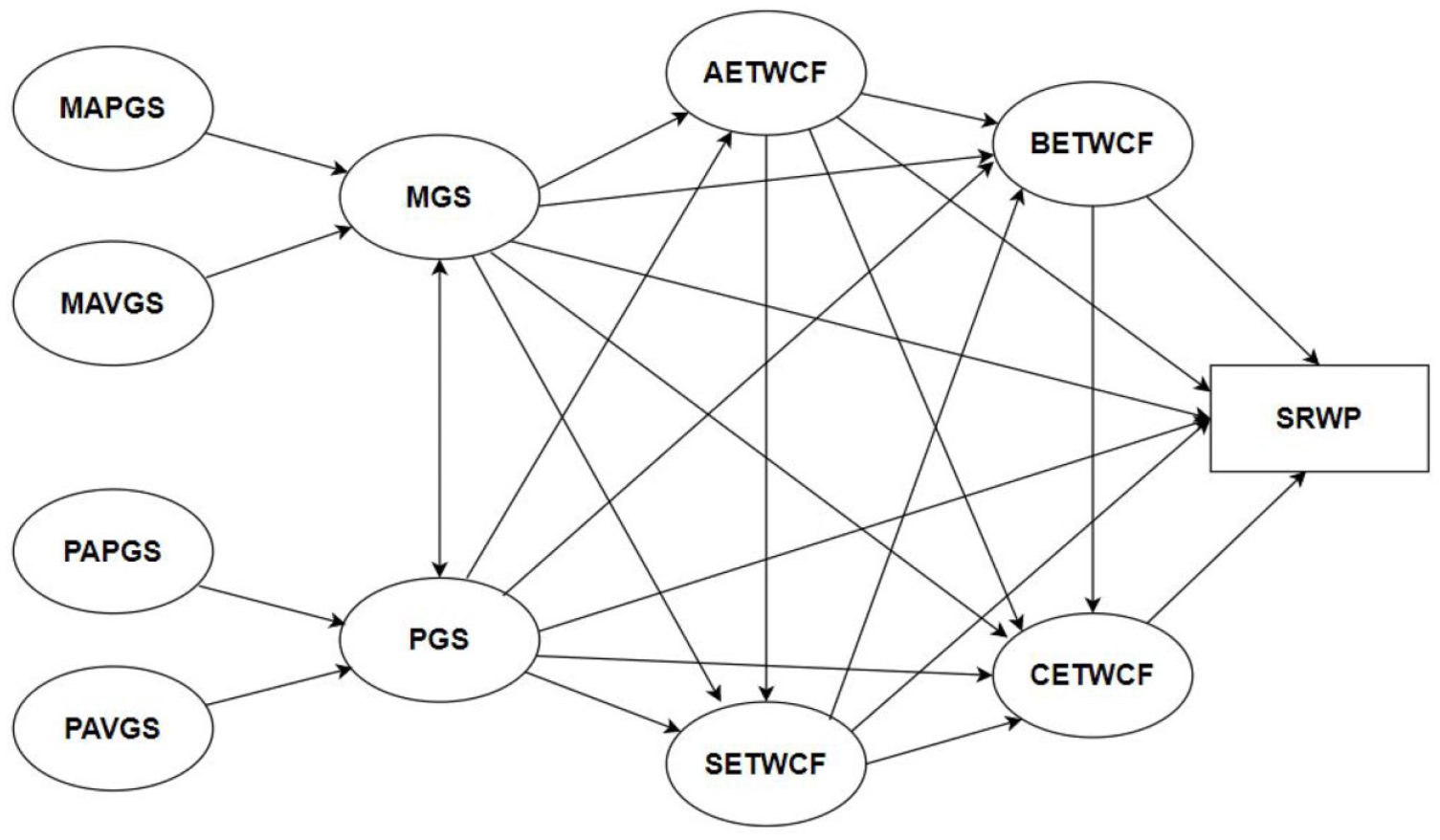
Theoretical Structural Equation Model of the Study.
Figure 1 below illustrates the theoretical structural equation model used in this study. It visually represents the hypothesized relationships among the key variables: MGS, PGS, and various forms of student engagement with teacher WCF (affective, social, behavioral, and cognitive), culminating in SRWP. The figure includes directional paths indicating the hypothesized positive or negative relationships between these constructs, as informed by the literature review. This visual representation serves as a guide for understanding the complex interactions we aim to explore, and provides a clear framework for our SEM analysis.
Data Collection and Analysis
To ensure accurate and reliable data collection, research assistants provided teachers with instructions on administering the questionnaires to first-year undergraduate students from 13 departments in Taiwan related to English language studies. The teachers were instructed to explain the purpose of the study and emphasize the importance of maintaining data integrity. After collecting and entering the questionnaire data (590 valid questionnaires) into SPSS, confirmatory factor analysis (CFA) was conducted to test the reliability and validity of the instruments. Structural equation modeling (SEM) was then utilized to analyze the relationships between observed and latent variables. In the case of missing data, mean imputation was employed, where missing values were replaced with the mean of the respective variable. This method, executed in SPSS, helped maintain the integrity of the dataset for subsequent analyses.
Instrumentation
Two instruments were used in the formal study: the Learners’ Perceived L2 Writing Classroom Goal Structures Scale (PWCGSS) and the Student Engagement with Teacher Written Corrective Feedback Scale (ETWCFS). To elicit participants’ responses from the survey questions, a 6-point Likert scale (1 = strongly disagree; 2 = disagree; 3 = somewhat disagree; 4 = somewhat agree; 5 = agree; 6 = strongly agree) was employed because it is better than 5- point or 7-point Likert scales in terms of discrimination and reliability (Chomeya, 2010). More details of how the two instruments were developed and validated are provided below.
The Learners’ Perceived L2 Writing Classroom Goal Structures Scale (PWCGSS)
The PWCGSS (26 items) was adapted from previous studies (Lin & Cherng, 2007; Peng et al., 2018). As shown in Table 1, the reliability and validity of each subscale in the instrument were tested and verified by performing EFA and CFA on the pilot study sample according to the criteria presented in Table 3. Four factors were identified in the PWCGSS. Two factors were in the mastery goal structures scale (the MGS scale): mastery-approach goal structures (6 items, e.g., My English writing teacher encourages us to try to express ourselves in different ways when writing) and mastery-avoidance goal structures (4 items, e.g., In order to prevent us from making little progress in writing, my English writing teacher will ensure that we have totally understood the content of the textbook). The other two were in the performance goal structures scale (the PGS scale): performance-approach goal structures (4 items, e.g., In class, my English writing teacher hopes students can compete with each other to improve our grades) and performance-avoidance goal structures (4 items, e.g., My English writing teacher tells us that the purpose of learning to write well is to avoid letting others think that our abilities are poor).
The Composite Reliability and Average Variance Explained of the PWCGSS.

Note. MAPGS = mastery-approach goal structures; MAVGS = mastery-avoidance goal structures; PAPGS = performance-approach goal structures; PAVGS = performance-avoidance goal structures.
The results of the analysis indicated that the four factors identified in the PWCGSS were reliable and valid measures (Table 1). Specifically, the mastery-approach goal structures scale (MAPGS) had a high level of reliability (α = .93) and composite reliability (.93), with an average variance extracted (AVE) of .68. The mastery-avoidance goal structures scale (MAVGS) had a lower level of reliability (α = .78) and composite reliability (.80), but still had a good AVE of .53. The performance-approach goal structures scale (PAPGS) had high reliability (α = .88) and composite reliability (.89), with an AVE of .66. Lastly, the performance-avoidance goal structures scale (PAVGS) had the highest level of reliability (α = .93) and composite reliability (.93), with an AVE of .77. Overall, these results suggested that the PWCGSS was a valid and reliable instrument for measuring the four identified factors in college students’ goal structures related to writing.
Furthermore, confirmatory factor analysis was conducted to test whether the measurement models of the MGS and the PGS scales fit the data. As shown in Table 2, the goodness of fit indices for the MGS scale were good (Bagozzi & Yi, 1988; Polit & Yang, 2016), with χ2/df = 2.08 (<3), CFI = 0.98 (>.90), TLI = 0.98 (>.90), RMSEA = 0.06 (<.08), and SRMR = 0.04 (<.08). The 10 items of the mastery-approach and -avoidance goal structures were found to have good factor loadings and were retained for further analysis, with all items’ factor loadings under each factor larger than .52. Additionally, there was a positive correlation between the mastery-approach and -avoidance goal structures (r ;= .64, p < .001). The goodness of fit indices for the PGS scale were found to be good, with χ2/df = 2.59, CFI = .99, TLI = .99, RMSEA = .05, and SRMR = .02. Moreover, all eight items of the performance-approach and -avoidance goal structures were retained for further analysis as they demonstrated good factor loadings, with all items’ factor loadings under each factor greater than .75. Furthermore, a positive correlation was found between the performance-approach and -avoidance goal structures (r ;= .88, p < .001), indicating a strong relationship between these two factors.
The Goodness of Fit Indices of the MSG and PGS Models.

Note. MGS = the mastery goal structures; PGS = the performance goal structures.
The Student Engagement With Teacher Written Corrective Feedback Scale (ETWCFS)
The ETWCFS (33 items) was developed by the researcher according to theories proposed by Ellis (2010) and Svalberg (2009, 2012). Similarly, after performing EFA and CFA on the same data set, there were also four factors identified in the ETWCFS as displayed in Table 3: affective engagement with teacher WCF (AETWCF: 5 items, e.g., I like to carefully read teacher feedback), social engagement with teacher WCF (SETWCF: 5 items, e.g., I will discuss with the teacher his or her feedback), behavioral engagement with teacher WCF (BETWCF: 4 items, e.g., When revising my writing, I will definitely follow my teacher’s feedback), and cognitive engagement with teacher WCF (CETWCF: 4 items, e.g., After reading teacher feedback, I will check relevant materials (e.g., English writing-learning websites, writing or grammar textbooks and essay examples) first and then start to revise).
The Composite Reliability and Average Variance Explained of the ETWCFS.

Note. ETWCFS = The Student Engagement with Teacher Written Corrective Feedback; BETWCF = behavioral engagement with teacher WCF; SETWCF = social engagement with teacher WCF; CETWCF = cognitive engagement with teacher WCF; AETWCF = affective engagement with teacher WCF.
The results of the analysis indicated that the four factors identified in the ETWCFS were reliable and valid measures as indicated in Table 3. Specifically, the affective engagement with teacher WCF scale (AETWCF) had a high level of reliability (α = .88) and composite reliability (.88), with an average variance extracted (AVE) of .60. The social engagement with teacher WCF scale (SETWCF) had good reliability (α = .90) and composite reliability (.90), with an AVE of .64. The behavioral engagement with teacher WCF scale (BETWCF) had good reliability (α = .88) and composite reliability (.89), with an AVE of .67. Lastly, the cognitive engagement with teacher WCF scale (CETWCF) also had high reliability (α = .88) and composite reliability (.88), with an AVE of .58. These results suggested that the ETWCFS was a reliable and valid instrument for measuring the four identified factors in college students’ engagement with teacher-written corrective feedback in English writing.
Confirmatory factor analysis was performed to assess whether the measurement model of the ETWCFS was adequate for the data. The results, as presented in Table 4, indicated the good fit of the model with χ2/df = 2.59, CFI = .99, TLI = .99, RMSEA = .05, and SRMR = .02. All 18 items of the ETWCFS showed good factor loadings, with all items’ factor loadings under each factor greater than .54, and so they were all retained for further analysis. Moreover, there were significant positive correlations among the four variables, with r values ranging from .56 to .77.
The Goodness of Fit Indices of the ETWCFS Model.
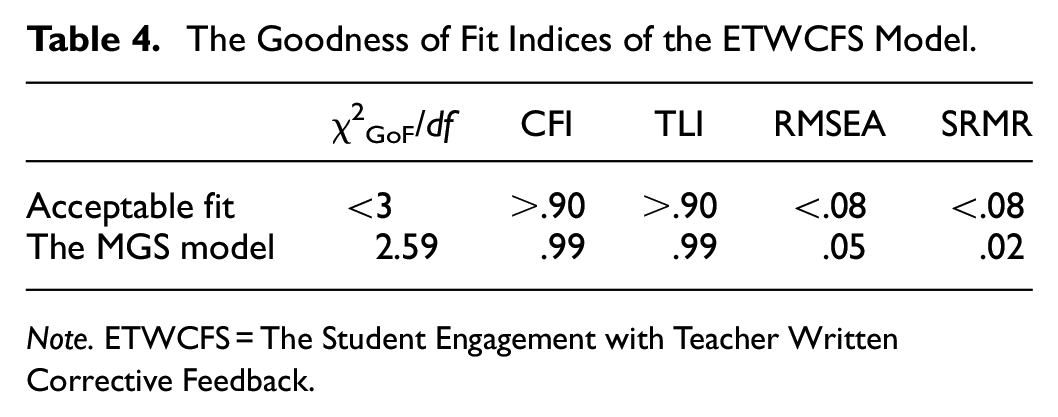
Note. ETWCFS = The Student Engagement with Teacher Written Corrective Feedback.
Self-Reported Writing Proficiency
The participants were asked to self-rate their English writing abilities based on a 5-point writing rubric adapted from the 6-point rubric of The Language Training & Testing Center (2018), Taiwan. The rubric was a list of criteria comprising content, organizational structure, expression (vocabulary and sentence structure), grammar, and mechanics skills (i.e., spelling, contractions, capitalization, and punctuation), with articulated gradations of quality for each criterion from full competence to incompetence (5 = full competence, 4 = fair competence, 3 = limited competence, 2 = little competence, 1 = incompetence). The result showed that the average level of participants’ writing proficiency was between limited and fair competence in writing based on the rubric used the present study (M = 3.32, SD = 0.65). This means that this group of participants reported having some writing skills, but may still need to improve their writing abilities in certain areas based on the rubric criteria.
Rating Scheme
To provide an accurate representation of the participants’ responses to the scales used in the present study, their ratings were based on mean scores (Pimentel, 2019) using the following rating scheme: strongly disagree (1.00–1.82), disagree (1.83–2.65), slightly disagree (2.66–3.48), slightly agree (3.49–4.31), agree (4.32–5.14), and strongly agree (5.15–6.00).
Findings
Research Questions 1: To what extent do participants respond to statements regarding L2 writing classroom goal structures and their student engagement with teacher written corrective feedback (WCF)?
Table 5 provides a summary of how participants responded to statements about classroom goal structures. The results showed that participants generally agreed that the English writing classroom was focused on mastery goal structures, with a mean score of 4.61 (SD = 0.72). More specifically, participants viewed the classroom as being more oriented toward mastery approach goal structures (M = 4.81, SD = 0.81), as opposed to mastery avoidance goal structures (M = 4.32, SD = 0.85). For example, participants reported that their English writing teacher viewed mistakes as a natural part of the learning process and did not blame students for making them (Item 4; M = 4.88, SD = 0.91). Additionally, the teacher ensured that students acquired new writing knowledge and skills in class to prevent them from making little progress (Item 2: M = 4.57, SD = 0.95). On the other hand, participants generally disagreed that the English writing classroom was focused on performance goal structures, with a mean score of 2.56 (SD = 1.16). More specifically, while they tended to slightly disagree that the classroom was oriented toward performance avoidance goal structures (M = 2.71, SD = 1.26), they also showed disagreement with a focus on performance approach goal structures (M = 2.48, SD = 1.19). For instance, participants reported that their English writing teacher was not primarily concerned with improving their writing grades (M = 2.69, SD = 1.40) and did not emphasize avoiding low grades as their main target (M = 2.73, SD = 1.39).
Descriptive Analysis of Participants’ Responses to Statements Regarding Classroom Goal Structures.

Note. MGS = the mastery goal structures; PGS = the performance goal structures; MAPGS = mastery-approach goal structures; MAVGS = mastery-avoidance goal structures; PAPGS = performance-approach goal structures; PAVGS = performance-avoidance goal structures.
In Table 6, participants’ responses regarding their engagement with teacher written corrective feedback are summarized. The results showed that participants engaged with feedback in a sequence of behavioral (M = 4.75, SD = 0.78), affective (M = 4.70, SD = 0.80), cognitive (M = 4.67, SD = 0.76), and social (M = 4.28, SD = 0.94) ways. Specifically, they revised their writing based on teacher feedback (Item 1 in the subscale of behavioral engagement; M = 4.88, SD = 0.84), read the feedback several times before revising (Item 2 in the subscale of behavioral engagement; M = 4.86, SD = 0.85), and tried to understand the feedback first (Item 3 in the subscale of cognitive engagement). This was because they valued teacher feedback (Item 3 in the subscale of affective engagement; M = 4.85, SD = 0.91). Additionally, they shared with their classmates the importance of using teacher feedback when revising English writing (Item 3 in the subscale of social engagement; M = 4.38, SD = 1.10).
Descriptive Analysis of All Participants’ Responses to Engagement with Teacher WCF.

Note: ETWCFS = The Student Engagement with Teacher Written Corrective Feedback; AETWCF = affective engagement with teacher WCF; SETWCF = social engagement with teacher WCF; BETWCF = behavioral engagement with teacher WCF; CETWCF = cognitive engagement with teacher WCF.
Research Question 2: What are the relationships between the participants’ perceptions of L2 writing classroom goal structures, engagement with teacher written corrective feedback, and their self-reported writing proficiency, and what are the mediating factors in these relationships?
To address this research question, the researcher employed structural equation modeling (SEM). However, the initial analysis revealed that the SEM model failed to converge, likely due to a high level of collinearity between performance-approach goal structures and performance-avoidance goal structures (r ;= .88), as previously demonstrated. In consultation with experts in the field of TESOL, the researcher made the decision to exclude the variable of performance-avoidance classroom goal structures from the theoretical model. This decision was based on the rationale of focusing on the positive aspects of classroom goal structures that have been consistently linked to favorable outcomes, such as mastery and performance-approach goal structures (Darnon et al., 2018; as indicated in the Literature Review section). The subsequent analysis demonstrated that the model exhibited satisfactory goodness of fit, as indicated by the achieved indices reaching desirable levels (CMIN/df = 1.93 [<3.0]; CFI = 0.97 [>.90]; TLI = .96 [>.90]; RMSEA = .04 [<.08]; SRMR = .04 [<.08]; Bagozzi & Yi, 1988; Polit & Yang, 2016). To further validate the assumptions of multivariate normality, the Mahalanobis test was conducted, and skewness and kurtosis values were examined, ensuring the data’s compliance with the normality assumption. In summary, the fit criteria for the structural equation model were met, indicating that the final modified model provides a plausible representation of the underlying structural relationships in the population (Figure 1).
To examine the causal relationships among latent variables, effect size (ES), which quantifies the magnitude of a phenomenon (Kelley & Preacher, 2012), was calculated using Cohen’s (1992) formula (f2 = R2/1 – R2) to aid in the interpretation of the findings. To guide the interpretation, the following guidelines were used: f2 = 0.02 for a small effect, f2 = 0.15 for a medium effect, and f2 = 0.35 for a large effect. Based on the analysis presented in Table 7, mastery-approach goal structures were found to have a significant and direct influence on affective engagement with teacher WCF (β = .55, R2 = .30, f2 = .43, large effect size). In contrast, mastery-avoidance goal structures showed only a small predictive power for affective engagement (β = .24, R2 = .06, f2 = .06, small effect size), behavioral engagement (β = .14, R2 = .02, f2 = .02, small effect size), and social engagement (β = .13, R2 = .02, f2 = .02, small effect size) with teacher WCF.
Effect Sizes of Direct and Indirect Paths Among the Variables.

Note. MAPGS = mastery-approach goal structures; MAVGS = mastery-avoidance goal structures; PAPGS = performance-approach goal structures; AETWCF = affective engagement with teacher WCF; SETWCF = social engagement with teacher WCF; ETWCF = behavioral engagement with teacher WCF; CETWCF = cognitive engagement with teacher WCF; SRWP = self-reported writing proficiency.
p < .01. ***p < .001.
Upon examining the causal relationships between different types of engagement, affective engagement with teacher WCF was identified as a significant predictor, demonstrating varying degrees of influence: a medium to large effect size for behavioral engagement (β = .47, R2 = .22, f2 = 0.28), a medium effect size for social engagement (β = .36, R2 = .13, f2 = 0.15), and a small effect size for cognitive engagement with teacher WCF (β = .20, R2 = .04, f2 = 0.04). Furthermore, social engagement with teacher WCF exhibited a small-to-medium predictive power for behavioral engagement (β = .30, R2 = .09, f2 = 0.10, small to medium effect size) and a small predictive power for cognitive engagement with teacher WCF (β = .25, R2 = .06, f2 = 0.06, small effect size). Moreover, behavioral engagement with teacher WCF demonstrated a moderate-to-strong predictive power for cognitive engagement with teacher WCF (β = .46, R2 = .21, f2 = 0.27, medium-to-large effect size), which, in turn, moderately impacted participants’ self-reported writing proficiency (β = .36, R2 = .13, f2 = 0.15, medium effect size).
Additionally, behavioral engagement with teacher WCF was identified as a mediator between affective engagement and cognitive engagement with teacher WCF (β = .22, R2 = .05, f2 = 0.05, small effect size), indicating that behavioral engagement plays a mediating role in the relationship between affective and cognitive engagement.
Discussion
The results presented in Table 5 indicated that participants generally perceived the English writing classroom to be focused on mastery goal structures. They viewed the classroom as oriented toward mastery approach goal structures, which emphasized the importance of learning writing skills and concepts step by step, valuing the process of learning over grades, and encouraging self-expression and self-improvement. Additionally, participants noted that their English writing teacher took measures to prevent little progress in writing by ensuring a solid understanding of the textbook content, emphasizing the acquisition of new knowledge and skills during class, encouraging clarification of taught content to prevent deterioration of writing skills, and highlighting the significance of retaining learned material to avoid insufficient writing knowledge and skills. On the other hand, participants disagreed with the presence of performance goal structures, indicating that their English writing teacher did not prioritize improving writing grades or emphasizing avoidance of low grades. The aforementioned findings are in alignment with Jerrim and Vignoles’s (2016) research, which suggests that teachers often prioritize fostering a comprehensive understanding of concepts taught throughout the entire class, reflecting a focus on mastery goal structures. This emphasis on comprehensive understanding, characteristic of mastery goal structures, has been found to foster motivation, engagement, and metacognitive processes in other studies (Moning & Roelle, 2021; Patrick et al., 2011; Skaalvik & Skaalvik, 2013).
Moving on to engagement with teacher written corrective feedback, the results in Table 6 revealed that participants engaged with feedback in different ways, with behavioral engagement being the highest, followed by affective, cognitive, and social engagement. In other words, participants actively revised their writing (e.g., read feedback multiple times and double-checked for corrected mistakes) based on teacher feedback, valued and appreciated the feedback, and endeavored to comprehend and apply the feedback provided by consciously engaging in cognitive processes, such as understanding feedback, critically evaluating its accuracy and consistency, learning from mistakes, and reflection. Furthermore, participants recognized the significance of referring to teacher feedback during the revision process; therefore, they proactively engaged in direct discussions with the teacher regarding the feedback and actively supported their classmates by encouraging them to use the feedback and providing assistance when needed. The obtained results correspond to previous research, which underscores the interconnection and interactivity of all dimensions of engagement (Han & Hyland, 2015). Consequently, the manner in which students engage with teacher written corrective feedback—emotionally, socially, behaviorally, and cognitively—may vary due to various factors. These factors include individual reactions and attitudes toward written corrective feedback, the types of feedback provided, the methods employed to correct feedback, the specific errors addressed, and the students’ proficiency levels (Cheng & Liu, 2022; Lira-Gonzales et al., 2021; Zheng & Yu, 2018).
The analysis of the structural equation model in Figure 2 provides further insights into the relationships between the variables. The findings indicated that mastery-approach goal structures had a substantial impact on affective engagement with teacher written corrective feedback. This suggests that when students adopt a mastery-approach orientation (i.e., valuing learning, improvement, and the process of writing), they are more likely to experience positive emotional engagement with the feedback provided by their teacher. This aligns with previous research, such as the studies by Uçar and Sungur (2017) and Shim et al. (2013), which highlighted the positive effects of mastery goals on emotional engagement. Although the effect sizes for mastery-avoidance goal structures were smaller in comparison to mastery-approach goal structures concerning the effect on affective engagement, the findings revealed that mastery-avoidance goal structures still exerted a direct influence on behavioral and social engagement. This indicates that students who prioritize avoiding obstacles to their progress in the mastery-avoidance classroom (i.e., inadequate understanding of the content, insufficient writing knowledge and skills, or deteriorating writing skills) demonstrate engagement in terms of their actions and interactions with the teacher or peers regarding how to respond to teacher feedback. While affective engagement may be less prominent in the mastery-avoidance goal structure, the observed engagement in behavioral and social dimensions underscores the intricate relationship between different mastery goal structures and dimensions of engagement.

Structural model of the relationships between L2 writing classroom goal structures, engagement with teacher written corrective feedback, and self-reported writing proficiency.
Based on the findings in Figure 2, I argue that to promote student engagement and growth as writers, we need to implement pedagogical strategies such as fostering a mastery-approach mindset, providing targeted feedback, encouraging self-reflection, cultivating a supportive learning community, and recognizing the importance of affective engagement (Svinicki, 2009). Additionally, it is necessary to address the concerns of students with mastery avoidance goal structures by explaining the benefits of overcoming obstacles to their progress (i.e., inadequate understanding of the content, insufficient writing knowledge and skills, or deteriorating writing skills), providing guidance on learning from mistakes, incorporating self-reflection activities to help them identify areas for improvement, and tailoring instruction to support their needs to help them progress as writers (Svinicki, 2009; W. Wang et al., 2021). These strategies create a positive and inclusive learning environment that enhances engagement, fosters growth, and promotes mastery in writing skills.
In terms of the relationships between different types of engagement, affective engagement with teacher feedback was found to be a significant predictor of behavioral, social, and cognitive engagement. This implies that when students value and appreciate feedback, it positively impacts their behavioral engagement in revising their writing, their social engagement in discussing and sharing feedback with peers, and their cognitive engagement in processing and applying the feedback. Hence, it can be argued that affective engagement plays a pivotal role in driving other forms of engagement, a finding that may parallel the results of Leppert et al.’s (2022) study concerning the underlying concepts of engagement and the significance of affective involvement, despite the variations in contexts. This implies that individuals who are emotionally engaged are more likely to engage in active communication, idea sharing, participation, and effort, such as utilizing teacher feedback. Moreover, their positive attitude and emotional investment have the potential to enhance cognitive processing, attention, and information retention, findings that mirror those of Joshi et al.’s (2022) empirical study. This indicates that emotionally engaged students are more likely to actively engage in cognitive processes, such as understanding feedback, critically evaluating its accuracy and consistency, learning from mistakes, and reflection, as discussed earlier.
Furthermore, social engagement with teacher feedback was found to have a small-to-medium predictive power for behavioral engagement and a small predictive power for cognitive engagement individually. This finding suggests that when students actively participate in social interactions related to feedback, such as engaging in discussions and assisting peers with their revisions, it can have a positive impact on their own behavioral and cognitive engagement with feedback. These findings coincide with the broader literature on student engagement, including studies that highlight the role of social interactions in promoting overall student engagement (Joshi et al., 2022). Specifically, by engaging in dialog and receiving input from their peers, students are more likely to actively revise their work based on teacher feedback and ensure complete correction of identified mistakes. The social component creates a sense of accountability and encourages students to take ownership of their learning process (Ayish & Deveci, 2019; Conley & French, 2014). This results in an increase in students’ behavioral engagement with the feedback. Similarly, social engagement supports cognitive engagement by facilitating knowledge exchange, critical thinking, and reflection (Ford & Yore, 2012). When students engage in discussions and help their peers with their revisions, they are exposed to different perspectives and alternative approaches to writing. This exposure enhances their cognitive processes as they consider different ideas, evaluate feedback, and make informed decisions in their own writing revisions. Engaging in peer discussions and seeking guidance from the teacher enhances students’ understanding of feedback, which in turn promotes reflection on principles and their application in their own work. Thus, social engagement fosters cognitive engagement by promoting active thinking, analysis, and metacognitive awareness (Jaswal & Behera, 2024).
Additionally, behavioral engagement with teacher feedback was identified as a mediator between affective and cognitive engagement. This suggests that students’ active involvement in revising their writing based on teacher feedback plays a mediating role in the relationship between their emotional engagement feedback and cognitive engagement. To be specific, the influence of students’ affective engagement with teacher written corrective feedback on their cognitive engagement can be enhanced by their active involvement in thorough revision, prompt attention to teacher feedback, and a focus on complete mistake correction.
It is noteworthy that while cognitive engagement with teacher written corrective feedback directly impacted writing proficiency, this engagement was facilitated by affective, social, and behavioral engagement. Therefore, to promote the development of writing skills and proficiency, it is crucial to cultivate all forms of engagement among students. On the other hand, the results indicated that mastery-approach or avoidance goal structures and performance-approach goal structures did not show significant effects on self-reported writing proficiency. This might be attributed to their emphasis on the learning process and overall improvement, rather than exerting a direct impact on specific writing outcomes. Other factors, such as instructional quality, individual differences, and the specific measurement of self-reported proficiency, could also contribute to these results.
Furthermore, it is worth noting that performance-approach goal structures demonstrated a positive influence on social engagement with teacher written corrective feedback. This suggests that these goal structures can motivate students to compete and strive for higher grades, resulting in increased social engagement as they interact and discuss feedback with their peers. Thus, in order to foster an optimal learning environment, teachers should focus on creating a supportive and collaborative classroom atmosphere where students are encouraged to improve their attitudes and motivation toward writing, share their knowledge and insights, and work together to effectively apply teacher feedback during the revision process (Liu et al., 2023). By promoting a positive and helpful learning environment (Goegan & Daniels, 2022), students can enhance their social engagement with feedback and further develop their writing skills.
This holistic analysis underscores the importance of classroom goal structures and interconnected engagement types. Classroom goal structures influence affective, social, and behavioral engagement, which collectively enhance cognitive engagement and, in turn, improve writing proficiency. By understanding and leveraging the interconnections between classroom goal structures and different types of student engagement (affective, social, behavioral, and cognitive), writing teachers can better support students’ writing development and create more effective instructional strategies.
Conclusion
This study examined the interplay between EFL learners’ perceived L2 writing classroom goal structures, their engagement with teacher written corrective feedback, and their self-reported writing proficiency. Key findings indicated a predominant preference for mastery goal structures over performance goal structures. Behavioral engagement was the most prevalent, followed by affective, cognitive, and social engagement. Notably, affective engagement predicted other forms of engagement, with cognitive engagement directly linked to writing proficiency.
However, this study has its limitations. The methodological approach, which did not include interviews, may have limited the depth of understanding regarding learners’ personal experiences and attitudes. Additionally, without diversity of participants, the current study may not be able to offer a broader perspective or increase the generalizability of the findings.
Future research should incorporate qualitative methods, such as interviews, to provide richer data and a more nuanced understanding of the learners’ experiences. Investigating additional factors such as writing anxiety and cultural influences can offer a more holistic view of effective writing instruction. Specifically, future research directions include exploring the role of writing anxiety in EFL learners’ engagement with feedback and writing proficiency, examining how cultural background influences perceptions of feedback and engagement strategies, and conducting longitudinal studies to observe changes over time in learners’ engagement and writing proficiency. By broadening the scope of such studies, we can further advance educational practices and provide more effective guidance for students in their writing endeavors. Overall, this study not only enriches the field of language learning, but also proposes practical ways to improve EFL writing instruction, thereby enhancing overall educational outcomes.
Footnotes
Declaration of Conflicting Interests
The author declared no potential conflicts of interest with respect to the research, authorship, and/or publication of this article.
Funding
The author disclosed receipt of the following financial support for the research, authorship, and/or publication of this article: This research was supported by the Ministry of Science and Technology, Taiwan (ROC), under Grant No. 111-2410-H-130-021-.

Data Availability Statement
Data sharing not applicable to this article as no datasets were generated or analyzed during the current study.