




Abstract
Written corrective feedback (WCF) in enhancing writing proficiency has been the subject of numerous studies, but few studies have examined students’ perceptions about the value of feedback on their written errors. Language teachers use global tools and techniques to give students feedback on their written work. How feedback is delivered and received by students is valued differently. The current study concentrated on how students interpret written corrective feedback and which WCF tactics they favor in writing classrooms. To examine these objectives empirically, the researchers employed a self-administered questionnaire to collect data from 180 participants from a high secondary school in Multan, Pakistan. At the same time, 40 participants were interviewed for their opinions about written corrective feedback (WCF). Some participants expressed concerns about ambiguous feedback that confuses them about their errors, whereas most participants favored the feedback process as beneficial. The most preferred strategies were meta-linguistic explanation and direct written corrective feedback that facilitated writing proficiency and language knowledge. Overall, WCF guides errors to avoid and how to adapt their writing style for composing compelling manuscripts.
Keywords
Introduction
Feedback helps instructors inculcate students’ critical thinking regarding academic assessment; its effectiveness depends upon how it is presented (Niu & You, 2020; Patra et al., 2022). Böttcher (2011) has regarded feedback as crucial in helping learners write better, and its objective is to highlight the positive aspects of writing rather than only point out its flaws. This feedback can be oral as well as written. However, the present study will only discuss written corrective feedback. In L2 (Second Language classes), written feedback is frequently given on the language organization and structure. Likewise, Written feedback is considered an effective tool for students’ enhancement of their comprehension level, and in this way, they may improve the existing gap in their knowledge (Gholami, 2022; Patra et al., 2022; Sarandi, 2020). However, most of the study has concentrated on Written Corrective Feedback, as Russell and Spada (2006) discussed. Many researchers suggested a typology for providing written corrective feedback in different ways involving three categories broadly: direct, indirect, and metalinguistic. For example, a teacher may supervise the feedback in various ways to provide feedback for inaccurately using the present perfect tense.
1. Direct feedback: The teacher may replace the wrong form “had” with the proper form “has.”
2. Indirect feedback: The teacher may underline or circle the wrong form without providing any other comment or error information.
3. Metalinguistic feedback: the teacher may identify the error and explain its nature by pointing out “present perfect tense” or some clues about the error
Different theorists have defined the term WCF in different ways. One theory related to feedback dates back to the 19th century called formative assessment by Benjamin Bloom in his seminal 1968 article, in which he described the benefits of students’ regular feedback on their learning through formative classroom assessments. Bloom described specific strategies teachers could use to implement formative assessments as part of regular classroom instruction to improve student learning, reduce gaps in the achievement of different subgroups of students, and help teachers adjust their instruction (Bloom, 1973; Guskey, 2019). Further, the feedback process was linked to opportunities for learning (e.g., Guskey, 2019; Sadler, 1989).
Corrective feedback is a stimulus that helps students “notice the gap” between their interlanguage output and the target language’s input (Schmidt & Frota, 1986; Ünlü, 2015). (i.e., the comments made). Similarly, from a sociocultural standpoint, Vygotsky’s (1978) Sociocultural Theory contends that interaction with “more informed entities” who are more fluent in the language mediates language learning. This intervention is a remedial one and may be provided in the form of feedback. Such feedback must align with the learners’ zone of proximal development to enhance L2 learning (ZPD). This area lies between their present and potential levels (Johnson & Golombek, 2016; Vygotsky, 1978). Scaffolding aids in gradually advancing the student toward greater comprehension and autonomy.
DeKeyser’s (2007a, 2007b) Skill Acquisition Theory suggests that corrective feedback energizes students’ declarative knowledge, converting it into procedural knowledge (Bitchener & Ferris, 2012). The student eventually moves from controlled to automated processing more quickly, accurately, and with less focus. It further gives explicit knowledge and avoids the procedural and automatic execution of inaccurate information (Polio, 2012). While emphasizing substantial and meaningful learning, DeKeyser (2007b) emphasizes that while practice is essential to achieving accuracy, more research is needed to establish the amount and kind of valuable feedback during practice.
Another supporting theoretical concept explains how learners’ differences at the individual level (such as age, motivation, learning style, and beliefs) may interact with contextual components (such as learning settings) to mediate learning outcomes between oral and written feedback. This concept is given by Ellis (2010) framework for corrective feedback. Three perspectives are used to analyze student engagement: cognitive (how learners pay attention to corrective feedback), behavioral (how learners take in or revise information after receiving it), and attitudinal (how learners feel about receiving corrective feedback, such as aversion or anxiety). After discussing the early perspective in support of the WCF, there is now a need to study further the WCF’s effectiveness in recent studies and research.
Literature Review
Students’ Perceptions of WCF
The present research has explored the importance of the student’s perceptions of feedback in L2 writing classes utilizing WCF, and these perceptions ultimately determine the effectiveness (Bitchener, 2008; Bitchener & Knoch, 2010; Lim & Renandya, 2020; Li & Roshan, 2019; Sheen et al., 2009) or harmfulness (Lee, 2019; Li & Vuono, 2019; Truscott & Hsu, 2008). Various studies have concluded that students seemed enthusiastic about using WCF in L2 writing classes (Ashrafi & Foozunfar, 2018; Chen et al., 2016; Kim et al., 2020). Kim et al. (2020) conducted a study on the effects of direct and indirect feedback, indicating that accuracy in writing could be achieved using both types of feedback. Moreover, they argued that the students perceived WCF positively by effectively employing it in collaborative writing, as it positively impacts the students’ final writing product. Furthermore, foreign language instructors “might consider providing SWCF as long as it does not negatively impact students’ writing process” (p. 20). In various studies, students perceived feedback negatively, considering it as negative criticism, which demotivated them in the writing development process (Zumbrunn et al., 2016). Even though at various events, they also considered it illegible, ambiguous, impersonal, and unhelpful (Higgins et al., 2002; Mustafa, 2012). Likewise, Ashrafi and Foozunfar (2018) conducted a study employing a mixed-method approach utilizing a questionnaire and interviewing students. They concluded that most students responded positively to all types of investigated feedback. Similarly, Chen et al. (2016) found that students like to get rectified their errors which helped them to improve their writing skills.
Considering the whole discussion, it can be inferred that though there are studies regarding learners’ perceptions, there is still limited research on students’ perceptions of WCF’s efficacy in second language acquisition. As a result, numerous researchers agree that a significant vacuum in our knowledge of WCF must be filled immediately. The learners’ preferences and opinions about WCF have received little research despite their potential impact on their ability to receive corrective feedback and, as a result, learn the target language.
Students’ Preferences Regarding WFC Types
When a person prefers one option to another, considering it better, the selection process is called “preferences” in the present context (Aydin & Ayranci, 2018). Therefore, the instructors should categorize learners’ preferences in the EFL/ESL setting while providing feedback (Diab, 2015; Han, 2017). Although in the previous literature, researchers have focussed on various strategies for feedback, however, direct and indirect WCF has been considered at a significant level (Aseeri, 2019; Eslami, 2014; Ganapathy et al., 2020; Iswandari, 2016; Karim & Nassaji, 2020; Kim et al., 2020; Li & He, 2017; Lira-Gonzales & Nassaji, 2020; Nicolás–Conesa et al., 2019; Saragih et al., 2021; Suzuki et al., 2019; Van Beuningen, 2010). However, the literature shows contradictory results in implementing direct and indirect feedback strategies. According to some researchers, most students prefer direct WCF (Aseeri, 2019; Karim & Nassaji, 2020; Kim et al., 2020; Nicolás–Conesa et al., 2019; Saragih et al., 2021) for rectification and improvement of their writing skills. On the contrary, according to some researchers, the students prefer indirect WFC (Eslami, 2014; Iswandari, 2016; Li & He, 2017; S. S. Mao & Crosthwaite, 2019; Z. Mao & Lee, 2020). Additionally, the indirect feedback group scores seemed significantly better in the result of the delayed post-test (Eslami, 2014). Therefore, indirect feedback may be considered ineffective for those students who study a language as a foreign/second language lacking linguistic skills.
The present research explores the importance of the perceptions of the students relevant to feedback in L2 writing classes utilizing WCF, and these perceptions ultimately determine the effectiveness or harmfulness. The students seemed enthusiastic about using WCF in L2 writing classes. Moreover, they argued that the students perceived WCF positively by effectively employing it in writing tasks, as it positively impacts the students’ final writing product. Furthermore, foreign language instructors might consider providing WCF as long as it does not negatively impact students’ writing process.
Research Questions
This research aims to address the following questions:
1: How do L2 learners perceive written corrective feedback?
2: What WCF strategies do L2 learners prefer in writing classrooms?
Hypothesis
The present study has looked into the following hypothesis regarding students’ perceptions and preferences about WCF tested through PLS-SEM.
HP1 Direct feedback is negatively perceived.
HP2 Direct feedback is positively perceived.
HP3 Indirect feedback is negatively perceived.
HP4 Indirect feedback is positively perceived.
HP5 Meta-linguistic feedback is negatively perceived.
HP6 Metalinguistic feedback is positively perceived.
Methodology
The study explored EFL/ESL students’ perceptions and preferences about written corrective feedback strategies to enhance their writing abilities. The current study has collected data through a perception questionnaire and interview sessions about students’ preferences, opinions, perceptions, and attitudes related to present issues in education. The data was processed using descriptive analysis through (SPSS) version 23.
Study Instrument
A survey was conducted with two sections: the first investigated students’ perceptions of WCF, and the second was about students’ preference for WCF strategies. The five Likert-scale questionnaire tool was adapted and modified from Marrs et al. (2016), Rowe and Wood (2009) and Salami and Khadawardi (2022). The reliability of the questionnaire was assured using Cronbach’s Alpha of .88 for section one and Cronbach’s Alpha of .89 for section two. The statistical analysis was conducted via SPSS 23 and PLS-SEM, often used in several social science fields, including applied linguistics, management and organizational sciences. The survey instruments are explained in Table 1 in detail. The questionnaire was divided into two sections consisting of 15 items in total. Section one has six questions, and section two has nine questions respectively. Items 2, 4, and 5 of section one are related to learners’ positive feedback perceptions, and items 1, 3, and 6 concern negative feedback perceptions. Section two consisted of nine questions; direct feedback type, indirect feedback type and metalinguistic explanation were each allocated three questions. Responses under the neutral category were not included in the descriptive analysis.
Survey Instrument.

Note. 1, 2, 3 refer to no. of survey questions as three questions related to every to each perception and preference type. DF = Direct Feedback; IDF = Indirect Feedback; ME = Meta Linguistic Explanation; PFP = Positive Feedback Perception; NFP = Negative Feedback Perception.
The study utilized a qualitative interview tool to enhance validity and reliability. The qualitative content analysis (QCA) tool was adapted and modified from Rasool et al. (2022, 2023a) and Rasool, Aslam, Mahmood, et al. (2023) employing to analyze participants’ interview responses. Qualitative content analysis helps develop conceptual frameworks, schematic models and theories as to the most frequently used approach in data analysis (Vaismoradi et al., 2013) that may further be developed by refining and testing using Qualitative Content Analysis (Elo & Kyngas, 2008). The unit of analysis is Interviews and responses reported by 40 interviewees. Each participant was interviewed separately, for approximately 8 to 10 min.
Participants
The study was conducted on 180 senior high school students consisting of 101 boys and 79 girls. The participants were aged between 16 and 18 years. Their first languages were Urdu, Siraiki, and Punjabi, and they learned English as a foreign language throughout their academic years. All the students were in their first semester of high school. The original pool included a total of 259 students from six classes. With the consent of their teachers, the research assistant(s) visited each class to give a brief presentation to the students, explaining the purpose of this study, the tasks involved, and the expected time length of each task. They asked for their voluntary participation. The students were assured that all their information would be kept confidential and their performance on any tasks would not affect their grades in this course. The researcher promised to give each participant a special bookmark in appreciation of their participation. Those who volunteered to participate in the study signed a consent form indicating their willingness.
Data Analysis
The results of the perception questionnaire and interview responses were analyzed in this section.
Negative Feedback Perceptions
Three items of the perception questionnaire section one are related to negative perceptions about written corrective feedback. The descriptive analysis of negative perceptions is presented in Table 2. It can be seen that (item 1: M = 3.52, SD = 1.10) when participants were asked about their feelings as when they are provided with the feedback they feel frustrated, 60.5% of students agreed that they feel upset about feedback provided by teachers and 21.1% disagreed. It shows that some students feel feedback to be negative in effect. Additionally, when they were asked whether feedback demotivates them to write or improve in the future (item 3: M = 3.64. SD = 1.10), 62.7% of participants again agreed; however, 18.9% disagreed that feedback makes them feel like giving up. Only 7.2% of participants disagreed with feedback confusing, resulting in 85% of students agreeing to the statement (item 6: M = 4.04, SD 0.89) that learners do think feedback, if not clearly and descriptively given, makes learners feel demotivated and discouraged to improve their writing proficiency further and sometimes quitting writing. A noticeable number of participants feel confused about the feedback process if learners do not comprehend provided feedback in unclear codes.
Statistical Analysis of Negative Perceptions.
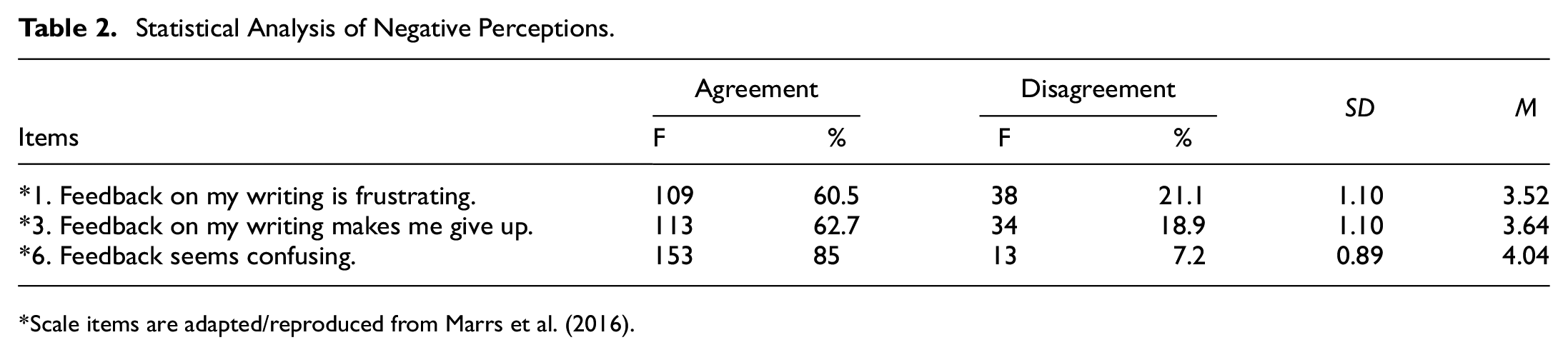
Scale items are adapted/reproduced from Marrs et al. (2016).
Positive Feedback Perceptions
Items 2, 4, and 5 of section one relate to positive feedback perceptions (See Table 3). It was found that 89.4% of participants think feedback motivates them to see what they did well in their writing (item 2: M = 4.20, SD = 0.75) opposed to 3.9% of students.
Statistical Analysis of Positive Perceptions.
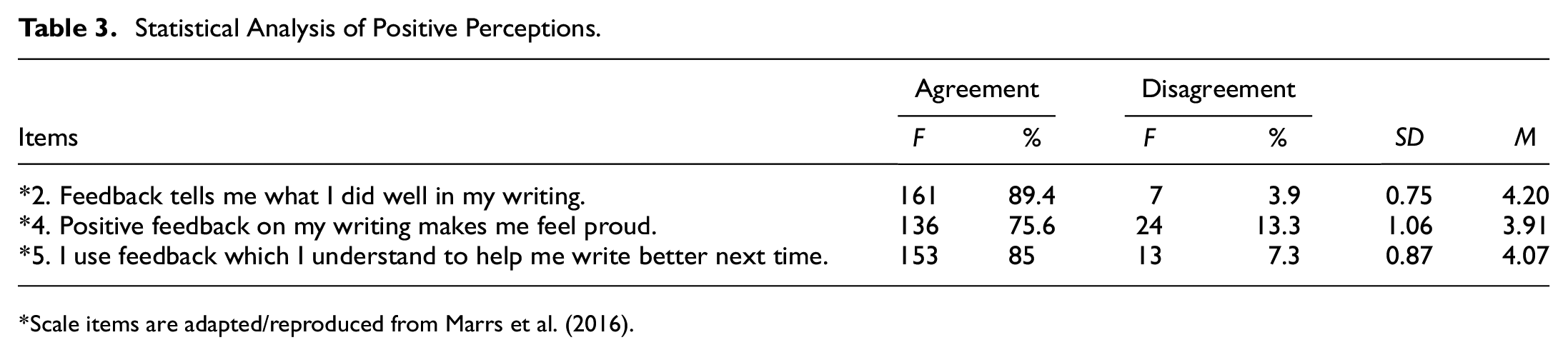
Scale items are adapted/reproduced from Marrs et al. (2016).
Furthermore,75.6% feel proud after getting positive feedback from their teachers on their writing (item 4: M = 3.91, SD = 1.06). Eighty-five percent of participants think feedback encourages them to be better writers in the future if they comprehend feedback provided by their teachers (item 5: M = 4.07, SD = 0.87). As a whole, it can be concluded that the majority of the participants feel positive about the feedback provided by instructors.
Direct Written Corrective Feedback
Section two of the questionnaire concerns learners’ preferences about written corrective feedback (see Table 4), and three items are related to direct feedback type (items: 9, 11, 14). 78.3% of participants agreed to the point that corrections through written corrective feedback provided by teachers are encouraging (M = 3.93, SD = 0.87). Participants do feel corrections or the right forms of their mistakes help in improving their writing capacity, with 80% agreement (item 11: M = 3.86, SD = 0.93). One important point that has been brought forth is the learner’s willingness to be provided with natural words and phrases through correction that may help in learning effectively (item 14: M = 4.02, SD = 0.84). In summary, it can be said that participants like to have errors corrected on their written productions.
Statistical Analysis of Direct WCF Type.

Scale items are adapted/reproduced from Rowe and Wood (2009) and Salami and Khadawardi (2022).
Indirect Written Corrective Feedback
Section two of the perception questionnaire consists of three items related to the learner’s opinion about indirect written corrective feedback (See Table 5). When learners were asked whether underlining or circling errors without corrections makes the learning process hard for them, 76.7% participants agreed with the statement (item: 7 M = 3.88, SD = 0.78). Additionally, 72.2% of participants agreed to the statement that error location only confuses them (item 10: M = 3.73.SD=0.85) which can relate to negative perceptions of item 6 where 85% of participants feel feedback to be confusing. Underlining or circling can also demotivate them, with 73.3% agreement (item: 13 M = 3.77, SD = 0.96). Furthermore. 79.5% of participants want important errors to be located (item: 16 M = 3.92, SD = 0.83). According to item 1, negative feedback perception and learners find feedback frustrating when they see a lot of red marks on their written production.
Statistical Analysis of Indirect WCF Type.

Scale items are adapted/reproduced from Rowe and Wood (2009) and Salami and Khadawardi (2022).
Meta Linguistic Explanation
This questionnaire section asks participants their opinion about Meta linguistic explanation as the third feedback type. According to Table 6, 88.8% of participants favored explanations provided on their errors for better understanding and learning (item: 8 M = 4.07, SD = 0.78) supporting explanations with corrections. 82.7% of participants think this way of feedback motivates and enhances learning morale (item: 12 M=4.00, SD = 0.82). Most learners like to improvise their writing ability and linguistic knowledge by getting native-like language corrections and explanations with feedback to be better writers (item: 14 M=3.80, SD = 0.83).
Statistical Analysis of Meta Linguistic Explanation.

Scale items are adapted/reproduced from Rowe and Wood (2009) and Salami and Khadawardi (2022). The data collected through the survey questionnaire was further analyzed using SEM-PLS to explore the probability of the hypothesis.
Measurement Model Assessment
In the first stage, the measurement model was assessed following the suggestions of Hair et al. (2006) to confirm the reliability and validity of the constructs and their dimensions. Consequently, 16 indicators (question statements) were included in the final measurement model, and all the factor loading was above or close to the recommended value of 0.60. Table 7 indicates that all factor loading exceeds the recommended value of 0.60. Similarly, the average variance extracted (AVE) and composite reliability (CR) of all the constructs equal or exceed the recommended values of 0.50 and 0.70, respectively. Thus, convergent validity and reliability are established. Moreover, as shown in Table 8, discriminant validity is also confirmed according to the criterion suggested by Fornell and Larcker (1981).
Item Loadings, Reliability, and Validity.

Discriminant Validity Using Fornell-Larcker Criterion.

Note. DF = Direct Feedback; IDF = Indirect Feedback; ME = Meta Linguistic Explanation; PFP = Positive Feedback Perception; NFP = Negative Feedback Perception.
Descriptive Statistics
The data presented in Table 9 has a minimum limit of 1.0 and a maximum limit of 5.0 concerning the Likert scale used for the research instrument, which has a scale of 1 to 5, representing Strongly Agree, Agree, Neutral, Disagree and Strongly Disagree respectively. It shows the summary statistics for the explained measurement items for the research. The acceptable values of skewness fall between −3 and +3, and kurtosis is appropriate from −10 to +10 (Brown & Glover, 2006). Therefore, this suggests that the measurement items are normally distributed.
Respondents’ Descriptive Statistics.

Note. 1, 2, 3 refer to no. of survey questions as three questions related to every to each perception and preference type. DF = Direct Feedback; IDF = Indirect Feedback; ME = Meta Linguistic Explanation; PFP = Positive Feedback Perception; NFP = Negative Feedback Perception.
Structural Measurement Assessment
After mandatory measurement model assessment, structural model analysis was performed in the second stage. The hypotheses were tested in a series of steps. After running a PLS model, Hair Jr et al. (2014) mentioned that estimates are provided for the path coefficients, representing the hypothesized relationships linking the constructs. Path coefficient values are standardized on a range from −1 to +1, with coefficients closer to +1 representing strong positive relationships and coefficients closer to −1 indicating strong negative relationships. The Bootstrap resampling method (Ringle et al., 2005) was used to determine the significance of direct paths and estimate standard errors. The minimum cut-off of the R2 values of the endogenous variables is above 0.1, as Falk and Miller (1992) proposed. The combined effect of Meta explanation, negative feedback perception, and direct and indirect feedback was R2 = .395. The combined effect of Meta explanation, direct feedback, indirect feedback, and negative feedback perception was R2 = 0.280. Moreover, the direct relationship between Meta explanation and positive feedback perception and the direct relationship between direct feedback and positive feedback perception (R2 = 0.280) do not meet the cut-off of 0.33 and are therefore considered to show weak effects.
Hypothesis Testing
The hypotheses tests revealed an insignificant effect of direct feedback (β = −.072, t = 0.959, p = .338) while indirect feedback (β = .456, t = 5.375, p = .000) and Meta explanations (β = .309, t = 3.254, p = .000) revealed significant effects on negative feedback perception. Therefore, H1 was rejected and H3 was accepted, and H5 was. Lastly, the hypothesis test revealed that significant effects of direct feedback (β = .216, t = 2.242, p = .000) and Meta explanation (β = .306, t = 3.077, p = .000) while indirect feedback (β = .115, t = 1.299, p = .195) revealed insignificant effects on positive feedback perception. Therefore, H2 and H6 were accepted, and H4 was rejected as shown in Table 10. The structural equation model of bootstrapping results to show relationship between feedback types and learners’ perceptions is presented in Figure 1.
Direct Effect/Relationship.

Note. DF = Direct Feedback; IDF = Indirect Feedback; ME = Meta Linguistic Explanation; PFP = Positive Feedback Perception; NFP = Negative Feedback Perception.

Bootstrapping results of structural equation model.
Interview Data
Interviews with participants aim to attain in-depth data about learners’ perceptions and preferences about written corrective feedback. Seven semi-structured questions were asked to the participants, and sometimes follow-up questions were added according to their responses to clarify their opinion. The interviews were conducted in students’ study rooms to create a friendly environment and make them feel comfortable. The researcher approached 60 participants for the interview session using convenience sampling, and 40 agreed to give the interview. Each interview of 8 to 10 min was recorded. The responses were categorized and further distributed into subcategories. Data analysis of the interview responses generated three main categories: Positive feedback perceptions, negative feedback perceptions, and finally, preferred feedback types and 11 subcategories.
Category One: Positive Feedback Perceptions
Participants expressed their feelings about written corrective feedback straightforwardly, and four further subcategories were formed about their positive feedback perceptions as learning speed, motivation to learn, skill development and time-saving.
Learning Speed
The first subcategory from students’ positive feedback perceptions was learning speed. According to interviewees, what affects the learning process is how fast learners improve after their writing is assessed. From participants’ responses, it can be seen that learning speed is something students pay attention to. For instance,
Student participant 9 stated, “Obviously, I prefer more explanatory feedback, what the teacher feels should tell, and it will save our time to find out why mistakes. This way, we can learn faster.”
Student participant 37 shared, “According to me, the feedback should be in detail because it can clear all of the errors clearly and the writer also can understand their mistakes easily with reasons and suggestions. This way, I can improve speedily.” The most crucial concern shown by participants was quick and effective learning.
Motivation to Learn
Most students expressed willingness to have written feedback because they think it keeps them motivated to learn and improve. Most of the students do want their teachers to provide them with corrections and explanations. They think if teachers give reasons and logic behind their errors in their written production, it will be far easier for them to understand what they have to do in future compositions.
Participant 5 expressed, “Yes, different feedback types can have different effects on different people; for example, correcting errors can help motivate the person to do better, and only underlining can demotivate the person and do the same thing.”
Here, the participant’s statement indicates insufficient morale and learning motivation. They do want their errors to be corrected thoroughly.
Student participant 27 explained, “I prefer detailed feedback because when you read the details and reasons for your errors, you will understand it better, and you can proceed better. It keeps me motivated and moving on.”
Learners will likely get Meta linguistic explanations for their errors and understand the importance of feedback on their writings for their own betterment.
Skill Development
The main purpose of the whole language learning process is skill development. The majority of the participants focused on writing skill development as they think it helps in their prospects professionally, and it can only happen through a teacher’s efficient feedback.
Student participant 19 stated that writing skills could be critical in our daily life as they can improve our writing skills and composition writing. For example, we must compose CVs and go through many interviews, so at least we should know how to write for such reasons. Writing skills can benefit professional development, “especially where documentation and communication are involved”.
Students understand and perceive what and how they want to improve their writing, which will contribute to their future jobs and academic life.
Feedback to be Less Time Consuming
An interesting subcategory of positive feedback perception seemed to be saving time in locating mistakes and reasons. Students did share that they really want their errors to be corrected and explained because it will be easy for them to comprehend their mistakes rather than look for the reasons.
Student participant 33 said, “written feedback is very effective because I want to improve my English writing, spelling mistakes and grammar. For this, I need more time. But if teachers take pain to pay attention to writing mistakes, we can save time to find mistakes and give more attention to learn about them and practice.”
Category Two: Negative Feedback Perceptions
Participants also shared some of their concerns about negative feedback perceptions too. Some students showed their opinion about feedback being confusing and hard to understand. Three subcategories were generated from negative feedback perceptions.
Difficult to Comprehend
Some participants expressed their concerns about the understanding of feedback provided by teachers. As every teacher has their own style and way of giving feedback, some students stated that many circles and underlining mistakes without corrections sometimes make it hard for them to understand. Sometimes teachers mention codes of errors, for example, VB for verb mistakes, which causes students to get confused if they do not have a clear idea about codes.
Student participant 17 said, “Some students get discouraged if they have more errors in their writing and get criticized in an unclear way, and students may doubt their abilities. Teachers should adopt a clear and easy way to give feedback because it will help avoid confusion and be easy to understand.”
Demotivating
Another aspect of negative feedback perceptions interviewees elaborate through their responses was demotivation. Students expressed that sometimes if they do their level best in writing and when they get it back after feedback full of red marks, it causes discouragement and frustration.
Student participant 29 stated, “it does discourage students sometimes, and it depends on how they take it. If feedback is confusing and uncomprehending, students will get discouraged and lose their hearts. Positive comments and encouraging feedback will be helpful, not only criticism.”
Dependent on Teachers
An interesting opinion of interviewees was too much explanatory and descriptive feedback may make students dependent on teachers, and they will not try to step ahead to learn themselves.
Student participant 12 expressed, “I have seen some of my friends always rely on teacher’s feedback and only pay attention to what teachers comment. They never try to learn beyond this, which is a little lame.”
Category Three: Preferred Feedback Subcategories
When learners were asked about feedback types they preferred to have on their writing compositions, most of the students preferred detailed and explanatory feedback and corrections.
Detailed Explanations
Students want their teachers to correct their mistakes with detailed explanations. They shared many reasons behind this expectation to improve their skill effectively in less time and effort.
Student participant 31 stated, “it varies from person to person, but I prefer detailed explanation far better than only locating or indicating errors. This way you get to know more detailed feedback about the reasons for errors I have made and correct forms too. This way is quite useful.”
Encouraging Criticism
Many students opined that feedback should be a kind of criticism, not only negative but also positive and encouraging. Students are always in the learning phase; no matter how hard they try, there is still a lot more chance to improve. So if teachers also give encouraging feedback along with corrections and locating errors, it will be far better for the learning process.
Student participant 11 said, “many types of students tend to take feedback negatively, so it proves destructive for them. If teachers also write some encouraging comments with circling errors and underlining the writing, that will be a great effort for students by teachers.”
Feedback Types
By interviewing participants, their awareness of the importance of written feedback and its effects has been brought forth. Learners fully know what type of feedback they want on their writing.
Student participant 17 shared, “ma’am, direct written feedback is excellent because it improves my English and my spelling mistakes. Teachers also take pain to help students improve their writing skills faster, so if only mistakes are circled, it takes time. Sometimes I feel if teachers explain the mistakes also it will be a great help”
However, some examples exist where students want their teachers to point out their mistakes and errors instead of any explanation or reasons. They want to explore the reasons by themselves and think that through this process, they can be better learners and will be able to think critically. For example, student participant 22 said, “detailed feedback, I prefer detailed feedback, I would say, because you can write anything you want. If I’m writing something, I need to get feedback. I will just ask that person to just point out my mistakes. Whatever I have done wrong, I just point it out so I can improve it.”
Interview questions helped to explore in detail how learners want to receive feedback, and many ideas and perceptions about WCF came up where some students were reluctant to get much criticism in the form of feedback. They want to improve but do not want to be circled and underlined much. They may get demotivated by many red ink marks on their writings. Such as,
Student participant 31 stated, “I think it should be straightforward and precise, and I do not want them to criticize me a lot. I just want to improve myself if they think they can write something to help me, so I will improve myself.”
Grammatical and Vocabulary Corrections
After analyzing interview data, it seemed quite clear that students want two important language aspects to improve: grammatical accuracy and wide vocabulary. Most participants indicated they want all grammatical and vocabulary errors to be pointed out and explained.
Student participant 28 described, “I always get worried about the grammar mistakes. I want my sentence structure to be perfect and try to use relevant vocabulary words. That is why my priority is getting feedback on such errors in my writing so I may improve more.”
Findings and Discussion
The results found through two research tools have brought forth some findings about learners’ way of taking feedback from their teachers on their writings.Perception is defined as “how students and teachers perceive the usefulness of written corrective feedback” (WCF). Secondly, preference means “the type of WCF students like more than another type.” The study found that the students positively perceived WCF and preferred metalinguistic explanations and direct WCF provided by their instructors. This finding aligns with those who found that students perceive using WCF in their writing positively.
Learners’ Perceptions of WCF Effects
Various studies have concluded that students seemed enthusiastic about using WCF in L2 writing classes(Ashrafi & Foozunfar, 2018; Kim et al., 2020). The findings of the current study support who found that students have favorable perceptions of WCF and frequently associate written feedback for their writing with happiness and joy and found that students felt optimistic about using written corrective feedback in their EFL online writing classrooms as they found it a helpful tool to improve their writing. According to Questionnaire statement 4, 75.6% of participants consider positive feedback to cause proud and confident feelings. Interview responses support this finding as the participants think writing skill significantly improves academic performance in foreign language learning. Feedback can be constructive as it can help us remove language and content mistakes, and proper feedback helps us learn effectively. By responding to statement 5, 85% of participants said feedback is effective if understood, which means it leaves them confused if they do not understand the errors and corrections made by the teachers. According to the study, students have a favorable opinion of adopting WCF in their EFL writing classroom. Several earlier investigations have found similar results (Ashrafi & Foozunfar, 2018; Chen et al., 2016; Hamouda, 2011; Higgins et al., 2002; Mustafa, 2012; Zumbrunn et al., 2016).
Despite this, several studies have shown that students have a negative attitude toward feedback, viewing it as unfavorable criticism, which demotivates them while developing their writing (Marrs et al., 2016). Occasionally, teachers give their students codes and signify errors in a manner in which they will not fully comprehend what they have done incorrectly. In this manner, it creates confusion, particularly for low language proficiency learners, and students may view the WCF to be inefficient and impersonal. According to some participants, students get discouraged if many errors and red marks are seen on their writing tasks. However, with time, they realize that feedback from teachers is beneficial. It can be observed by the findings of the perception questionnaire that when asked about feedback perceptions,60.5% of learners feel frustrated by provided feedback, whereas 85% of learners opined that feedback might confuse if students do not understand the way it is provided.
Learners’ Preferences About WCF Effects
WCF is usually linked to unpleasant feelings like fear as unfavorable evidence (Yu et al., 2020), while it is also linked to pleasant feelings like delight and motivation for L2 learning. Even though learners frequently come into WCF scenarios, little is known about how it affects learners’ preferences for WCF types. Students’ preferences will indicate much about how they want to learn to write. While some students like the errors pointed out, others would instead do it themselves. Because preferences reflect how learners feel about the value of feedback, feedback has the potential to make an impact. The participants expressed that they always get anxious with the teacher’s feedback but then try to understand mistakes through the teacher’s corrections. The learner responses show that most of them clearly know about their preferred feedback type. It was quite understandable that some students shared their opinion of WCF preference to be direct, whereas others favor detailed explanations in metalinguistic explanations. In written feedback studies about students, it is necessary to combine the opinions of both students and teachers to consider students’ preferences. The significance of considering the points of view held by both educators and learners within the context of the educational dimension. However, it is emphasized that the differences between student preferences and teaching practice may negatively impact WCF’s effectiveness in writing in a second language (Junqueira & Payant, 2015). It is because different students prefer different teaching practices (L2). It can be seen from the descriptive analysis of the questionnaire that more than 80% of participants want to have their errors to be corrected
Learners clearly know the feedback types they require for their writing compositions. Additionally, they feel demotivated and discouraged by complex feedback in circles and underlining without corrections. It makes them feel frustrated, whereas some think corrections and codes that are not explained also lead to confusion. feedback provided by teachers in the explanatory method is always favored by learners. More than 70% of participants did not favor indirect WCF through the perception questionnaire. 88.8% of participants favored their teachers to provide corrections and explanations so they could understand better.
The collaborative findings of the interview session and questionnaire support that participants want their errors corrected as it saves them time to look for the reasons and makes it easy to comprehend. When participants asked about their errors to be underlined or circled without any correction, they showed their concerns about this type of feedback. Participants also favored that their teachers to provide corrections and explanations so that they could better understand. Participants responded to interview questions the same way as wanting detailed feedback.
Discussion on SEM Analysis
The data from the perception questionnaire was analyzed through PLS-SEM to check the hypothesis mentioned in the previous section. The HP1 that direct feedback is negatively perceived, was rejected, meaning learners think direct feedback is better for learning, followed by HP2, which proved true as direct feedback is positive. HP3 about indirect feedback type is negatively perceived is accepted, which means the relationship between negative feedback perceptions and indirect feedback type is positive. HP4 is rejected as indirect feedback has positive effects on learning. HP5 and HP6 have been supported, showing learners have mixed opinions about meta-linguistic explanations. They do think positively about the metalinguistic explanation in their writings as well as some think providing explanations may lead learners to be dependent on teachers all the time and make students less motivated to learn by themselves. The analysis done through PLS-SEM has shown a relationship between learners’ perceptions and preferences about WCF in detail, supporting the findings of both research tools, questionnaires and interviews.
Study Contribution
The study’s significant contribution is for L2 instructors to ensure their feedback is comprehensible for learners. The survey results confirm that written corrective feedback (WCF) perception is significant to learners and that most aspire to write clearly. They all think they learn something when they receive written comments and criticism. As was evident from the findings, some students do not pay attention to their instructors’ identification of the errors, and only recognizing WCF does not mean that they comprehend and apply the rules in their following work. With the help of teachers’ feedback, the learners are inspired and reinforced.
Future Implications
The study’s findings of the student’s opinions about WCF will also assist L2 instructors in planning feedback strategies for their classes. For instance, students’ support of WCF, demonstrates their eagerness to delegate the duty of error correction to teachers. The overarching objective of language pedagogy, which should be to increase student autonomy and provide them with techniques to improve the accuracy of their own writing, is in direct conflict with this desire to transfer responsibility to teachers. Research is therefore required to determine the optimum method for addressing the disparities between teachers’ and students’ expectations. According to the findings’ pedagogical implications, teachers should be transparent with their students about using WCF and make sure that they comprehend its goals, and accept responsibility for error correction. Of course, it is equally crucial for teachers to be aware of students’ attitudes and beliefs because any differences between students’ and teachers’ beliefs might make remedial feedback less effective. As a result, it is wise for teachers to consult with their students on corrective feedback procedures, modify their WCF practices to enhance learner autonomy, and consider their students’ preferences to inspire and empower them to take charge of their language acquisition.
Conclusion
The present study has explored the widely researched subject with still inconclusive findings in second language acquisition. The researchers explored the effects of WCF on improving the writing proficiency of EFL/ESL and found mixed results. Learners clearly know the feedback types they require in their writing compositions. Additionally, they feel demotivated and discouraged by complex feedback in circles, underlining, and without corrections. It makes them feel frustrated, whereas some think corrections and codes that are not explained also lead to confusion. Feedback provided by teachers in the explanatory method is always favored by learners. The hypothesis involved in the current study also supported the interview responses for perceptions and preferences. Learners feel positive about direct and negative about indirect written corrective feedback. However, the metalinguistic explanation displayed mixed feelings as some think it benefits fast learning.
On the other hand, some participants think it makes students too dependent on teachers, and self-learning is ignored. The study focused on senior high school learners as this time of their academic journey is best to have functional command over foreign languages later in their careers. They ought to opt for many professional courses and need to focus on those technical subjects. Despite the previous findings that WCF strategies were generally perceived to be beneficial to writing, they were divided in their conclusions about the effectiveness of feedback. The present study sought to address the issue of inconclusive results about WCF efficacy. The results of the study demonstrate that the students viewed WCF optimistically. This study can be helpful for teachers and students if feedback can be beneficial and help learners in effective learning.
Footnotes
Declaration of Conflicting Interests
The author(s) declared no potential conflicts of interest with respect to the research, authorship, and/or publication of this article.
Funding
The author(s) received no financial support for the research, authorship, and/or publication of this article.
Ethical Consideration
The researchers considered ethical issues as suggested by  . Therefore, the researchers informed and got the consent (ethical approval letter) from the school administration informing about the study’s purpose ensuring that participant participation was voluntary during data collection. We also informed them that the data should be used only for research purposes. We used codes (numbers) for participants’ direct quotes throughout the data analysis to keep anonymity. For instance, assigned roll numbers to students at the school were used without revealing their identities.
Consent
The participants provided their consent and were assured that all their information would be kept confidential and that their performance on any tasks would not affect their grades in this course. Those who volunteered to participate in the study filled out a consent form indicating their willingness to publish responses.