




Abstract
Public servants have faced substantial accountability pressure during the public emergency. It was evident during the pandemic. However, the factors that influence accountability pressure remain to be examined. In this study, we attempt to demonstrate that the Robbins pressure theory provides a useful conceptual framework on how factors affect accountability pressure, and a regression method using primary survey data was applied to investigate how external pressure, the public servants’ capacity, accountability awareness, and communication between superiors and subordinates influence accountability pressure in the fact of a pandemic emergency. The findings show that external pressure had a positive impact on accountability pressure, the public servants’ capacity and communication between superiors and subordinates had a negative impact on accountability pressure, and accountability awareness played a negative moderating role in the effect of external pressure on accountability pressure. This study contributes toward the limited research base, and offers the suggestion that accountability pressure would be alleviated through optimized training and learning.
Introduction
Today, the world is in the context of a risk society, and there are many public emergencies hidden in the society, among which the COVID-19 pandemic is a major public crisis event. Since the initial outbreak of COVID-19 in Wuhan, Hubei province at the end of 2019, the pandemic has rapidly spread to other parts of the country and developed into another major public health event of global impact after the SRAS incident in 2003 (Peng et al., 2023; Ye et al., 2024). During the pandemic, public servants were an important force in the fight against COVID-19 (Vogel, 2021). They fought on the front lines of the pandemic, checked data, implemented various policies, and safeguarded people's lives and health. However, due to lifestyle and work patterns, public servants have already suffered from pressure from both their work and society at large (Zhang et al., 2016). Moreover, the impact of the pandemic has caused the work of public servants to become more complex, bringing greater challenges and pressure (Schuster et al., 2016), especially accountability pressure (Ran et al., 2021). Against the background of great pressure, public servants have become prone to career slackness (Schuster et al., 2016) and have even quit their jobs (Mitani, 2018). This makes it difficult for public servants to maintain their mental health and good work performance. Then, the effectiveness of public management will be reduced, which isn’t conducive to creating a better service environment, but also conducive to social development and progress. Thus, the effects of high accountability pressure deserve our attention.
Current studies have paid attention to the factors that influence pressure, emphasizing external pressure would affect pressure (Ahmad et al., 2022). Meanwhile, there are studies that mention relevant personal capacities such as professional knowledge (Woods, 2000) and dispositional factors (Mak et al., 2000) that can be expected to have an effect on pressure. Among them, good professional knowledge can relieve people’s pressure and a negative personality is more likely to generate pressure (Yip et al., 2022). Furthermore, some studies have also argued that attention should be paid to ways in which information communication modes affect pressure (Brouard et al., 2017). Communication modes between different people are complex. If one party misinterprets the information provided by the other party, it can lead to bias, which can lead to pressure. This is particularly the case for communication between superiors and subordinates (Tanner et al., 2016). Good communication between superiors and subordinates has a buffering effect on pressure. At the same time, some studies have shown that awareness can have an impact on pressure, and awareness is indeed known to play a very important role in human behavior (Mingke et al., 2020). But what about accountability pressure? Accountability pressure is the conflicting pressure that public administrators perceive when they take part in participatory governance (Jung et al., 2014).
Scholarship on accountability pressure has mainly focused on three aspects. First, it is about the understanding of accountability and accountability pressure. The understanding of accountability becomes more complex (Lupson et al., 2011). Accountability is regarded as not only as a macro-institutional matter but also as being about psychology (Han et al., 2020) and collaboration (Page, 2004). Accountability can be seen as a means rather than a burden (Karsten, 2015). The concept of accountability has been used in a rather narrow sense: a relationship between an actor and a forum, in which the actor is expected to explain and justify his or her conduct, the forum can pose questions to the actor and pass judgment, and the actor may face consequences (Bovens, 2007). It has been pointed out that public servants’ accountability pressure comes from oversight by the law, civil society, and the media (Laebens et al., 2021), and fluctuates with regulatory requirements (Ahmad et al., 2023). Second, it is about the behavior of public servants who are under accountability pressure. Greater accountability pressure reduces the public servants’ intrinsic motivation to serve the public, leading them to mechanically follow top-down instructions (Tu et al., 2021). In such a situation, public servants exhibit two behavioral strategies to cope with accountability pressure, which were high-effort and low-effort strategies (Aleksovska et al., 2021). Some public servants may distort or re-frame their responsibilities to cope with accountability pressure and thereby engage in behaviors of stalling and inaction. This behavior distinguishes three major patterns: evading responsibility, shifting responsibility, and reframing responsibility (Tu et al., 2022). Finally, it is about ways to relieve the public servants’ accountability pressure. There are multiple paths for doing so. Public servants’ accountability pressure could be relieved by means of adopting digital governance tools (Gasparyan, 2024), training (Lee et al., 2018), integrating an error-tolerance mechanism (Wang et al., 2021), increasing organizational transparency (Schnell, 2023), or helping them be clear about the specific work objectives of the organization (Morin, 1992).
Scholars have neglected to study the influence factors of accountability pressure. Therefore, this study attempts to demonstrate that the Robbins pressure theory provides a useful conceptual framework, examines public servants’ accountability pressure from an overall view, and tries to find out whether external pressure, the public servants’ capacity, communication between superiors and subordinates, and accountability awareness all affect accountability pressure. Actual survey data was used to test the hypotheses, providing an understanding of the internal logic linking the various factors. It is hoped that this research will help to effectively learn from the pandemic, relieve the accountability pressure on public servants, and further reduce their psychological pressure. Meanwhile, public servants can improve their performance in pandemic management and better cope with the normal high-pressure work in the post-pandemic era.
The paper is structured as follows: The section “Conceptual Model and Hypotheses” introduces the study’s conceptual model. Section “Methods” introduces the methods for data collection and processing. Sections “Results” and “Discussion” describe the data used and the empirical results, respectively. Finally, Section “Conclusions” presents the study’s conclusions.
Conceptual Model and Hypotheses
The theoretical model of pressure proposed by Robbins has been recognized by many scholars and has been used to understand pressure in various fields of research. The theory explained that the source of the pressure and individual differences produce pressure together. Pressure sources can be divided into environmental factors, personal factors, and organizational factors. Environmental factors include the uncertainty of the external environment. Personal factors include the individual’s own capacity. Organizational factors include task demands, roles, interpersonal relationships, and organizational structure. Individual differences include the individual’s awareness and experience (Robbins et al., 1997). In the past, the application of this theory has mainly focused on the assessment of pressure (He et al., 2017) and measures to reduce pressure (Aziz et al., 2006). On the basis of existing studies, this paper applies Robbins’ theoretical model to explore the factors affecting public servants’ accountability pressure during the COVID-19 pandemic. We use external pressure, the public servants’ capacity, and communication between superiors and subordinates as independent variables and accountability awareness as a moderating variable. We hypothesize that these variables are important predictors of accountability pressure. Among them, external pressure is an environmental factor. The public servants’ capacity is a personal factor. Communication between superiors and subordinates involves interpersonal relationships and is an organizational factor. Accountability awareness is a form of individual differences (see Figure 1).

Conceptual model.
External Pressure (EP)
The external pressure (EP) faced by individuals refers to the psychological uncertainty caused by changes in the external environment (Pervaiz et al., 2021). The environmental factors in Robbins’ model include the uncertainty of the environment, corresponding to EP. When facing the pandemic, the EP on public servants is reflected in the regional pressure (Dahl et al., 2006), that is, the severity of the regional pandemic, which can be reflected in the number of regional pandemic cases (Zheng et al., 2022). If the severity of the pandemic is high in a particular region in the sense that the region has many pandemic cases, the public servants become busier (Jimenez-Fonseca et al., 2022), and should undertake more prevention and control tasks. Therefore, their accountability risk becomes higher, and the situation easily generates greater AP. Public servants have a responsibility to reduce the number of confirmed cases when facing a pandemic. They are expected to make every effort to control the pandemic, keep it at a low-risk level, and reduce the number of cases to relieve people’s psychological tension, so as to ensure social stability. However, when the number of confirmed cases remains high, the public servants are liable to be held accountable, bringing greater AP. The following hypothesis is thus proposed:
Hypothesis 1. EP has had a positive impact on AP during the pandemic.
Public Servants’ Capacity (PSC)
Public servants’ capacity (PSC) refers to the abilities that enable them to serve the people and implement public policy (Edlins et al., 2018), including their own creativity (Houtgraaf et al., 2022), problem-solving ability, knowledgeability, understanding of their job (Rao, 2013), etc. The personal factors in Robbins’ model include the individual’s capacity, which corresponds here to PSC. Facing the new situation of the pandemic, the government has accelerated its change in orientation toward service, as evidenced by the fact that its policies are flexible and the number of newly introduced policies has increased dramatically (Pastarmadzhieva et al., 2022). The latest prevention and control policies have been updated in a timely fashion with the development of the pandemic, giving public servants greater freedom in their implementation. In this process, if PSC isn’t good and the public servants lack strong political responsibility and the moral capacity to obey the law, they are vulnerable to the temptation to abandon the original intention to protect the interests of the people and instead abuse their power (Luk, 2012). As a result, they bear high AP and face accountability for negligence and malpractice. However, if public servants have a higher capacity and the ability to innovate and learn, they have a higher motivation to serve (Rosa et al., 2020). This enables them to handle many difficult tasks during the pandemic, and thus they have lower AP. The following hypothesis is thus proposed:
Hypothesis 2. PSC has had a negative impact on AP during the pandemic.
Communication Between Superiors and Subordinates (CBSAS)
Communication between superiors and subordinates (CBSAS) refers to a way of promoting a healthy work environment (Grill et al., 2014). The organizational factors in Robbins’ model include interpersonal relationships. CBSAS is closely related to interpersonal relationships (Abu Bakar et al., 2010), so the organizational factors of Robbins’ model correspond here to CBSAS.
During the pandemic, a certain percentage of public servants have not conducted timely and effective CBSAS, thus causing them to miss the best time point for pandemic prevention and control. This affects public health and can lead to incalculable consequences (Kreps, 2021). Therefore, no doubt that these public servants should be called to account and face AP. Under AP, the public servants’ behavior is continually reshaped and the public servants have a low working efficiency (Van der Meer et al., 2022). Moreover, some public servants lack CBSAS. They are arranged by superiors to do other tasks when they fail to do their tasks well, leading to a fault in work and results in AP. The following hypothesis is thus proposed:
Hypothesis 3. CBSAS has had a negative impact on AP during the pandemic.
Accountability Awareness (AA)
Accountability awareness (AA) refers to public servants’ understanding of accountability and is affected by informal discussion and observation (Mutazam et al., 2021). AA includes the awareness of information, reasonability, and the necessity of accountability (Dhillon, 2022). The individual differences in Robbins’ model include personal awareness, of which AA is a part.
During the pandemic, when public servants have faced high EP, their work tasks have been heavy and have brought high AP. However, if the public servants have the right understanding of accountability, they will have high motivation to complete difficult work (Illessy et al., 2014), which will in turn result in less AP. At the same time, if PSC is low, the public servants will not be able to work efficiently and thus will have high AP. If their AA is clear, the public servants will be able to devote their all energy to work, improving their work efficiency so that they will face less AP (Rasche et al., 2006). Moreover, low CBSAS can easily cause public servants to drift away from the organization’s targets, provoking high AP. But, if the public servants understand accountability, they will focus on the appropriate target. As a result, work malpractice will not spread and the public servants will bear less AP (de Ruiter, 2019). Therefore, we propose the following hypotheses:
Hypothesis 4. AA has had a moderating effect on the relationship between EP and AP during the pandemic.
Hypothesis 5. AA has had a moderating effect on the relationship between PSC and AP during the pandemic.
Hypothesis 6. AA has had a moderating effect on the relationship between CBSAS and AP during the pandemic.
Methods
Data Collection
All data for this study were collected using an online questionnaire, administered from February 5, 2020 to February 10, 2020. The online questionnaire was designed to explore Chinese public servants’ experiences of accountability pressure during the COVID-19 pandemic. The online questionnaire was then sent by Credamo (a platform for conducting questionnaire surveys) to public servants in China. We used snowball sampling to send questionnaires to public servants among MPA students. A total of 1,428 questionnaires were sent, and 1,371 valid questionnaires were recovered, with a questionnaire recovery rate of 96%. To ensure data reliability, the data were further cleansed, and some responses were excluded due to a lack of value. Ultimately, valid data from 1,293 respondents were analyzed, giving a net response rate of 94.31%.
Data Measurement
All variables were measured using the online questionnaire. The variables and items are listed in Table 1, and all the items came from the international authoritative measurement scale. We used Stata software to test the reliability and validity, and the results passed the test. Most of the variables were quantitative in nature. In addition to the control variables, the variables AP, EP, PSC, CBSAS, and AA were assessed, and each variable was measured using the aggregation of each of its indicators. AP is measured by a combination of “I strictly abide by laws, rules, and procedures to carry out my work,” “I strictly implement the principles and methods of higher authorities’ instructions,” and “In response to this epidemic, we attach great importance to publicity work for the media and society.” EP is measured by the “Number of confirmed cases per 10,000 population in cities where the public servants live.” PSC is measured by a combination of “I am well aware of the responsibilities and roles of my department in epidemic prevention and control,” “I have the courage to innovate working methods,” “In general, no matter how much epidemic information I received, I could grasp the key information points,” and “What is your highest education level (including your current level of study)?”. CBSAS is measured by a combination of “I always report my achievements to my superiors in a timely manner” and “I attach great importance to the deployment of subordinate units and personnel.” AA is measured by a combination of “I would pay particular attention to information related to accountability,” “I think much of the accountability that actually happened in the response to the pandemic is needed,” and “I think much of the accountability that has actually occurred in the response to the pandemic is justified.” Each item was answered using a five-point Likert scale, ranging from 1 = strongly disagree to 5 = strongly agree.
Descriptive Statistics of the Variables (n = 1,293).

Data Analysis
All data were analyzed using the statistical software Stata/MP, version 16.0 (StataCorp LP., Texas City, USA). The main analysis steps were as follows: First, we generated descriptive statistics of all variables. Second, we adopted ologit regression models to explore the effects of EP, PSC, and CBSAS on AP. Finally, we used the moderating effect test model to test whether AA played a moderating role in the influence of EP on AP, PSC on AP, and CBSAS on AP. This study selected the commonly used threshold of P, that is, p < .1, and all of our regression models passed the significance test.
Results
Descriptive Information
Descriptive statistics of the explained and explanatory variables are shown in Table 1. There were a total of 1293 participants in this study. In terms of gender, 50.27% of the participants were male and 49.73% were female. In terms of age, 45.86% of the participants were aged between 20 and 30 years, 39.52% were between 31 and 40, 11.52% were between 41 and 50, and 3.09% were older than 50. In terms of leading position, 21.27% of the participants were leaders. In terms of political affiliation, 76.95% of the participants were members of the Communist Party of China, while 23.05% were non-party members. According to the calculation of software Stata/MP, version 16.0 (StataCorp LP., Texas City, USA), the average of AP is 12.45, the average of EP is 0.581, the average of PSC is 8.24, the average of CBSAS is 3.581, and the average of AA is 5.644.
The Ologit Regression Models
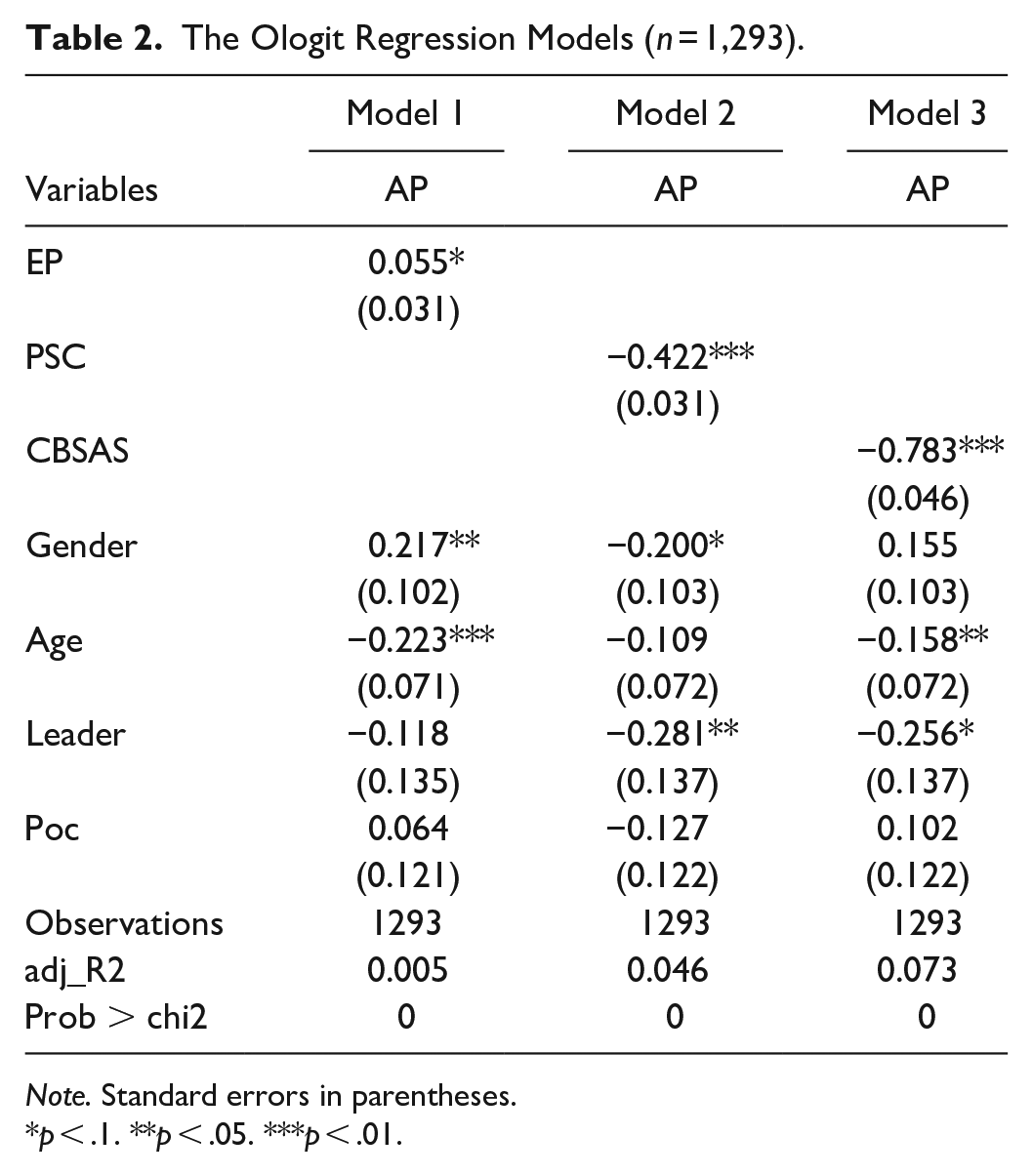
As shown in Table 2, EP, PSC, and CBSAS all significantly predicted AP at a confidence level of 90% in the present sample. In Model 1, when EP increased by 1%, AP increased by 0.055%. The confidence level is 90% in the present sample. In Model 2, when PSC increased by 1%, AP decreased by 0.422%. Therefore, improving PSC could relieve AP during the pandemic. The confidence level is 99% in the present sample. In Model 3, when CBSAS increased by 1%, AP decreased by 0.783%. The confidence level is 99% in the present sample. Therefore, hypotheses 1, 2, and 3 are verified.
The Ologit Regression Models (n = 1,293).
Note. Standard errors in parentheses.
p < .1. **p < .05. ***p < .01.
The Moderating Effect Test Model
To further explore the internal mechanism by which AA had played a moderating role in the effects on AP during the pandemic, models 4 to 7 were used to conduct a moderating effect test of AA and results are shown in Table 3. In order to eliminate correlations between interaction terms when building variables, interaction terms were centralized prior to interaction. In model 5, the interaction term between EP and AA was added to the model. The interaction term was significant and the confidence level is 95% in the present sample. So hypothesis 4 is verified. In addition, the interaction term’s direction was different from that of EP, indicating that AA plays a negative moderating role in the influence of EP on AP. That is to say, when AA was higher, the influence of EP on AP was weakened. In Model 6, the interaction term between PSC and AA was added to the model, and the interaction term was not significant. Therefore, hypothesis 5 is not verified. In model 7, the interaction term between CBSAS and AA was added to the model, but the interaction term was not significant. Therefore, hypothesis 7 is not verified.
The Moderating Effect Test Models (n = 1,293).

Note. Standard errors in parentheses.
p < .1. **p < .05. ***p < .01.
Robustness Test
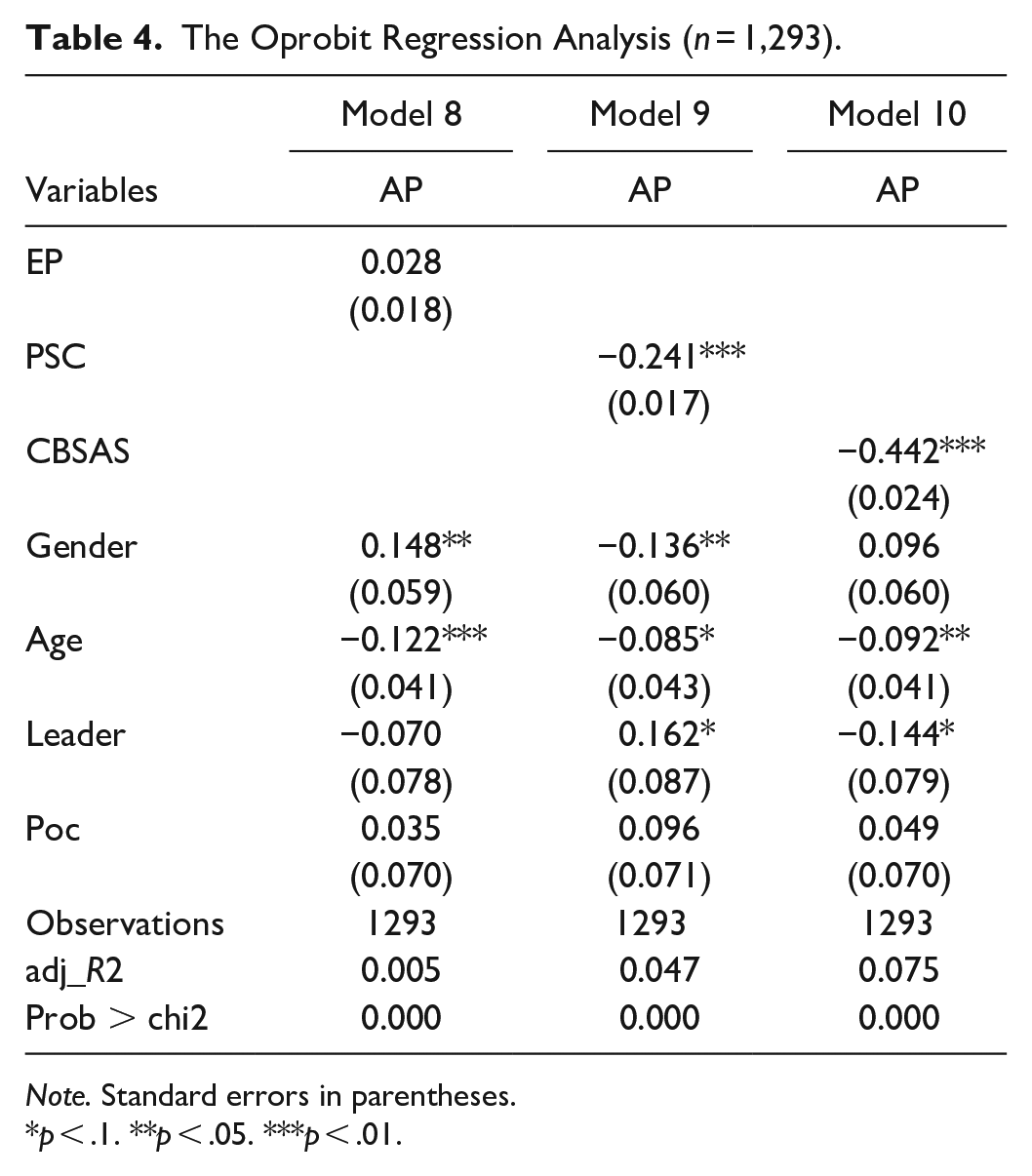
We used an oprobit regression model to test the robustness of the regression effects. The results for models 8–10 in Table 4 show that the direction levels of the independent variables did not change in either the ologit regression model or the oprobit regression model, indicating strong robustness.
The Oprobit Regression Analysis (n = 1,293).
Note. Standard errors in parentheses.
p < .1. **p < .05. ***p < .01.
Discussion
The pandemic response has the characteristics of continuous innovation (Bian et al., 2023), so we need to conduct specific analyses based on specific actual data. According to the background of AP in this study, we adopted the Robins’ model. The results demonstrated that the ways that the various factors produced AP were similar to what was described in Robbins’ model. EP, PSC, and CBSAS could all be used as factors to relieve the public servants’ AP, and AA played a moderating role in the influence of EP on AP.
The Robbins Model Shows the Influence Mechanism of AP
In this model, there are three paths, which together form a tight influence network of AP. First, this study found that EP had a positive effect on AP and AA played a moderating role in it. Previous studies haven’t effectively linked EP to AP. However, it is confirmed by concrete data that as EP increases, AP increases as well. However, through the effect of AA, the public servants with high EP were able to produce low AP. Second, this study confirmed that PSC has had a negative impact on AP. Prior studies have analyzed the impact of PSC on pressure. If the PSC is higher, public servants will be able to deal with various matters effectively and will have less pressure. This study found that PSC could produce similar effects on AP. As PSC increases, AP decreases. Third, this study found that effective CBSAS has had a positive impact by reducing AP. Prior studies have found that information exchange can have an impact on pressure (Brouard et al., 2017). If the higher the CBSAS, public servants can effectively understand the spirit of the superior policy and better implement specific tasks. Therefore, there will be less pressure. This study found that CBSAS could produce similar effects on AP. As CBSAS increases, AP decreases.
Explanation of the Factors Affecting AP
EP had a positive effect on AP. Some possible explanations are as follows. A high number of confirmed COVID-19 cases in a region administered by a public servant will cause higher EP. In the case of high EP, because the number of public servants is limited, they are familiar with what they are good at. Therefore, they are prone to fatigue under high loads (Austin et al., 2020). This can lead to professional burnout, which is not conducive to the completion of the heavy work tasks of prevention and control and can cause deviations from duty. AP will be increased as a result (Jaracz et al., 2017).
PSC has had a negative impact on AP. Government management is currently changing as it takes a new, scientific, and digital direction (Castelnovo et al., 2021). This means that public servants must now have more professional knowledge and higher capacity. During the pandemic, public servants with high political and moral capacity could reduce their AP (Schnakenberg, 2021). They could distinguish between right and wrong. Meanwhile, they could maintain a clear understanding at critical moments and stand firm. As a result, they could effectively reduce their own AP. Moreover, during the pandemic, public servants with a high capacity to learn and innovate were better able to complete tasks that their organization assigned (Jiang et al., 2006). The completion of the task allows them to avoid accountability to a certain extent. This lets the public servants significantly reduce the psychological burden of AP.
CBSAS has had a negative impact on AP. During the pandemic, if the CBSAS was timely and effective, the public servants could reduce uncertainty, increase their feelings of control, and relieve AP (Bordia et al., 2004). Under the bureaucratic model, the organization has the disadvantages of being bloated and inflexible (Piore, 2011). This makes it easy for policy implementation to become obstructed. However, CBSAS can reduce the rigidity of policy implementation (Shane, 1992). With the help of leadership authority, relevant instructions can directly convey requirements and arrangements to subordinates, which can let national spirit, policy interpretation, and policy implementation connect excellently. When subordinates communicated with superiors during the pandemic, they had a clearer understanding of their tasks when CBSAS was good. Moreover, when CBSAS was good, superiors could get effective feedback from subordinates. Combined with clear understanding and irregular communication with superiors, public servants can be more comfortable in advancing their tasks. After that, the they could accomplish their tasks smoothly (Pongratz, 2002), and they could avoid being called to account, easing their AP to some extent.
AA, meanwhile, has often been studied as a moderating variable (White et al., 2009). It can be divided into two situations: originally, one party will produce negative results on the other party, but through the adjustment of AA, one party will produce positive results on the other party; Originally, one party will produce positive results on the other party, but through the adjustment of AA, one party will produce negative results on the other party. In this study, AA has played a moderating role when EP has influenced AP. High EP produces high AP. However, through the effect of AA, the public servants with high EP were able to produce low AP. There were three situations. First, if public servants facing high EP understood accountability and knew relevant systems, that would have generated positive attitudes and behaviors (Coyle-Shapiro et al., 2003). As a result, AP would have been reduced. Second, public servants with high EP could be clearer about their work objectives by strengthening AA, which was conducive to achieving a higher level of working performance and having low AP (Supramaniam et al., 2021). Lastly, if public servants with high EP could effectively internalize accountability systems, they would tend to strictly limit the losses of work fault to a controllable range (Han et al., 2020) and be able to focus more on their work. So they could complete their work tasks more efficiently during the pandemic. As a result, AP would be controlled at an appropriate level.
Public Servants’ Psychological Problems in Pandemic Governance
When the pandemic broke out, AP became more prominent. Now that we understand the factors influencing public servants’ AP, the following policy implications can be proposed.
Public servants should improve their own political and moral capacity. The prevention and control of public health events is a risky endeavor, so public servants should stand firm and take the whole situation into account (de Graaf, 2011) Meanwhile, public servants should insist on serving the public heart and soul (Edlins et al., 2018) to accomplish their daily tasks. Whether at work or in life, public servants should make every effort to improve their political literacy and moral ability (Wu et al., 2020). As a result, the public servants’ AP will be relieved.
In addition, strengthening public servants’ learning practices could also reduce their AP. Establishing a learning society is a necessary response to changing times (Su, 2010). The government plays the main role and undertakes the function of dynamic surveillance when an emergency public health event happens (Elliot et al., 2020). It requires public servants to exert their subjective initiative (Daly et al., 2024). Therefore, learning is particularly important to public servants. Learning can make public servants recognize their own strengths and weaknesses, so as to improve their own ability. Public servants should not be satisfied with using their old experience to deal with new problems. They need to maintain a continuous state of learning and their innovation would be strengthened (Litre et al., 2020). As a result, AP could be effectively reduced.
In addition to these two approaches, it is critical that organizational communication mechanisms be improved to optimize CBSAS. There are three ways. First, the government should be clear about the specific work objectives of the organization (Morin, 1992). Goal-oriented practices could help public servants increase their awareness of accountability and set manageable tasks (Di Malta et al., 2019), enabling them to adapt to work tasks better and relieving their AP to a large extent. Second, the government needs to open communication channels between superiors and subordinates. It should set up regular meeting mechanisms to facilitate communication between superiors and subordinates. Finally, the government should make good use of modern communication media using advanced media communication technologies in ways suitable to the actual situation (Todisco et al., 2021).
Moreover, it is also important to change the training pattern and enhance the public servants’ AA in order to relieve AP. Prior studies have shown that the accountability of public servants has complex meaning (Maione et al., 2021). Intermittent training can’t make a fundamental change, and public servants can only realize the specific connotation of accountability and the way to relieve their own pressure in the short term. However, with the development of time, the content and form of accountability are constantly changing, and their AP is also prominent. Therefore, the training of public servants should be transferred from intermittent training to continuous training (Suleimenova et al., 2018). Four main changes should be made. First, training resources should be coordinated (Schuchter et al., 2015). The personnel departments at all levels of the government should strengthen their leadership and coordinate their education resources. Second, attention should be paid to classified training. The content of training should be classified according to different levels of the public servants’ AA to enhance its effectiveness. Third, the training content should be enriched. Training for public servants should focus on the content of teaching cases (Chetkovich et al., 2001) to strengthen their AA. Finally, innovative training methods should be developed. Digital training should be adopted (Dulkadiroglu, 2019) to enhance efficiency.
Conclusions
This study developed a conceptual model to explain the factors affecting public servants’ AP in light of the COVID-19 pandemic. Based on questionnaire data collected from 1293 public servants in China, our research found that EP, TPSC, and CBSAS significantly impacted the public servants’ AP. Moreover, the survey found that AA played a moderating role when EP affected AP. The main innovation of this study is that this paper, based on Robbins’ model, verifies that EP, TPSC, and CBSAS have a mechanism to influence AP and discovers the moderating role of AA in this process. In the end, this study also provides government departments with suggestions and hopes the government will take appropriate measures to ease the public servants’ AP.
This study has some limitations. First, due to limited time and cost, the sample size for the questionnaire was small. This may lead to a slight deviation between the actual situation and the calculation results. Second, the questionnaire was mainly completed by MPA students, so the representativeness of the samples needs to be improved. Lastly, as the data were only from China, data from other countries should be gathered and analyzed in terms of the specific situation in each country. In the future, the study should expand the number of samples, increase the way of field interviews, and radiate more types of public servants to make the samples more representative.
Footnotes
Acknowledgements
Special thanks to the participants who participated in this study.
Data Availability

Declaration of Conflicting Interests
The author(s) declared no potential conflicts of interest with respect to the research, authorship, and/or publication of this article.
Funding
The author(s) disclosed receipt of the following financial support for the research, authorship, and/or publication of this article: This work was supported by the [National Social Science Fund of China] under Grant [22BZZ052], [Fuzhou University Research Base of Xi Jinping Research Center for Socialist Thought with Chinese Characteristics in the New Era in Fujian Province] under Grant [23FZUJDB03] and [Fuzhou University Research Initiation Program].
Ethics approval
This study has been approved by the Ethics Committee of the School of Economics and Management, Fuzhou University.
Statement regarding research involving human participants and/or animals
Informed consent was obtained from all individual participants included in the study.