




Abstract
Nigeria is often described as a land flowing with milk and honey in reflection of the rich endowment of natural and mineral resources embedded in the country. Sadly, few of its people have benefited from these abundant resources as a large percentage of its population remains poor, particularly in rural areas. Hence, this present study assessed the awareness and utilisation of the natural and mineral resources in 24 selected southwest rural communities. The study adopts the mixed method to elicit responses from rural and urban respondents in four of Nigeria’s southwest states. Findings from the study revealed a high level of awareness of available resources in rural communities but gross underutilisation of the resources. The study concludes that the available resources in the southwest rural communities if tapped into, could transform the rural economy and ameliorate the level of underdevelopment in those areas. The study recommends that the government at all levels needs to recognise the rural areas as the fulcrum of national economic development and should be given utmost priority regarding infrastructural provisions and adequate funding.
Plain language summary
The purpose of the study is to examine the level of awareness and utilisation of natural and mineral resources for the development of rural economy. The study adopts the mixed method to elicit responses from rural and urban respondents in four of Nigeria’s southwest states. Using in-depth interview guide and questionnaire as research instruments. The study concludes that the available resources in the southwest rural communities if tapped into, could transform the rural economy and ameliorate the level of underdevelopment in those areas. The study has implication for policy by encouraging government and relevant stakeholders to focus more on the rural economy rather than the current urban bias toward them. The study is limited in its coverage as it those not cover the entire communities in Southwest Nigeria. This could affect the generalisability of its findings.
Introduction
Nigeria is one of Africa’s economic and demographic hubs, with an estimated population of 210 million people in 2021 (Frankema, 2021; National Bureau of Statistics [NBS], 2018). Over 65% of Nigeria’s population is under 35, with 35% of the population between the ages of 15 and 30 (Population Reference Bureau [PRB], 2018). As Imhonopi and Urim (2018) averred, Nigeria is a major African country with a large youth population and abundant resources. More so, enormous mineral and natural resources abound in many rural communities of Nigeria with the capacity for wealth creation (Adeniyi et al., 2021). However, despite these abundant humans and natural resources, many Nigerians believe their condition worsens daily (Adepoju, 2019; Oxfam, 2017). The youths, most significantly, are victims of unemployment, poverty, and social exclusion (Olonade, George, Imhonopi, et al., 2022), which has rendered them helpless and unable to contribute productively to the country’s development (Dajo & Akor, 2022; Ebobo & Akujobi, 2022).
A sizeable proportion of individuals live in poverty globally (Crespo et al., 2018; Ellis & Stam, 2018; Lakner et al., 2022). These people reside in rural areas with indescribable hardship from lacking basic social amenities (Imo et al., 2020). This position was corroborated by Food Agriculture Organisation (FAO) in 2017, which affirmed that there is massive rural poverty where most farming ideas are conceived, produced, harvested, and transported for urban consumption (Uma et al., 2013). In 2021, Nigeria ranked as the 2nd poorest in food affordability despite its massive agricultural land (Nnamonu et al., 2021; Owoo, 2021). Most significantly, the youths in rural areas are primarily challenged by the poverty situation in their regions. These people represent a sizable proportion of the entire world population (Ikuteyijo, 2020; Osabuohien et al., 2020).
In the latest released by the national bureau of statistics, 82.9 million, representing 40.1% of Nigerians, are poor, most of whom reside in rural areas (National Bureau of Statistics [NBS], 2021). This presents a paradox of suffering amid plenty, considering the vast human and material resources that these areas are endowed with (Odusola, 2021). This situation depicts a gross underutilisation of available human and natural resources in rural areas. Meanwhile, enormous wealth in terms of mineral and natural resources abounds in the southwest rural communities of Nigeria, which, if properly harnessed, will transform the economy of the areas and reduce the increasing youth migration to urban centres (Osasumwen, 2021). Adeniyi et al. (2021) averred that southwestern Nigeria is blessed with natural resources, with over 209 natural resources being mined in Nigeria and a large chunk of it from the southwest part of the country.
Studies have affirmed that the region is one of the most endowed regions in the country (Osabohien et al., 2021). Frankema (2021) identified the following as part of the natural resources in southwest Nigeria that could bring about economic prosperity when harnessed, empowering the youths and discouraging them from migrating out of the rural areas into an already saturated urban population. These resources include precious metals, stones, fossil fuels, crops, animal byproducts, waster, solar wind, wheat, livestock, copper, oil, natural gas, coal, and bitumen. Also, D. Busari and Odetoyinbo (2021) reported that pottery production in southwest Nigeria, when revived and combined with modern technology, could be a significant source of revenue that could transform the rural economy, thereby engaging the rural youths and discouraging rural-urban migration in the region. Hence, this study seeks to assess the level of awareness and utilisation of the available natural and mineral resources in selected southwest rural communities in Nigeria.
To achieve a balanced society where the consequences of rural-urban drift are curtailed, there is a need to identify the various natural resources domiciled in the rural areas that can be revitalised and harnessed to develop the rural economy. This will reduce the constant rural-urban migration into the city where there is already surplus labour. The remaining part of the manuscript is structured thus. Section “Literature review and theoretical framework” reviews the literature on rural societies and the economic potential of natural and mineral resources in rural areas; it concludes with the dependency theory of development as a theoretical framework. Section “Methods” focuses on the study methodology, while the fourth section concerns the results. Section “Discussion of findings” discusses the study findings, while the last section concludes and offers recommendations.
Literature Review and Theoretical Framework
Rural Environment in Developing Nations
Rural communities are identified by their population size, accessibility to urban features, provision capacity of human needs such as recreation facilities, food, and tarred roads, and the level of development and services available for personal and societal growth (Food and Agriculture Organisation [FAO], 2016). A society must possess the following characteristics to be defined as rural. These include an expanse of land for agricultural produces and as the only sources of income and food, nearness to natural life, social mobility, solidarity, stratification, interaction, the relatively average size of an environment, density and homogeneity in terms of population (Nguyen et al., 2015). Peculiar to rural society is clan, kinship, communities, and villages, but urban life, according to D. A. Busari et al. (2019), epitomises town, cities, industrial hub, modern world, and commercial centres where there are daily business enterprises. These features distinguish urban centres from rural communities (Adhikari & Hobley, 2015).
According to Nnamani et al. (2019), rural areas possess place-based homeliness shared by people with common ancestry or heritage who inhabit traditional, culturally defined areas or places statutorily recognised as rural. Rurality shared the commonality of low population, inadequate infrastructural facilities, and predominantly rural settlements with thick forests and farmlands for subsistence and commercial farming. For administrative and statistical purposes, rurality can be defined as a condition or situation with homogeneity, low population size, proximity of people to nature, and elements of rural life (Ajaero & Onokala, 2013). International researchers and local scholars discover that about sixty percent (60%) of the Nigerian populace lives in rural society (Nguyen et al., 2015). The low population is peculiar to rural communities, usually perceived as rustic, serene, and isolated from the world’s socioeconomic issues and challenges. However, this reality may not necessarily be so as it was perceived by many. In Nigeria, several rural areas are noted for unemployment, underemployment, poverty, low wealth generation, few socioeconomic opportunities, limited education campaigns, agrarian, and low utilisation of resources, among others (Danaan, 2018).
The rural environment emphasised kinship relationships, culture preservation, and family bloodlines (FAO et al., 2014). People hardly access quality in all social services provided in the rural environment. Scholars have concluded that structural and institutional gaps may constitute short lapses that could spur many able youths and even some ages to engage in rural-urban migration, thereby contributing negatively to the decay in rural growth (Gabaccia et al., 2021; Ojo & Ojewale, 2019; Paerregaard, 2018). Rural agencies and ministries in some developed societies ensure that resources, financial aids, loan deals, rural electrifications, and other support systems make the place habitable for dwellers, communities, and commercial purposes (Yabiku & Agadjanjan, 2017). However, rural communities in developing nations are bedevilled with numerous challenges with the lack of access to infrastructural facilities. There is also significant exposure to hazardous farming lifestyles, infectious diseases, infirmities, polluted waters, air, and lands due to improper disposal of solid and toxic wastes and inadequate sanitation exercise, among others (OECD, 2016).
Many of the policies and programmes targeted at rural development have been a top-down approach where they are made at the central level, and instructions and procedures for execution are not necessarily felt at the grass-root level. These approaches to rural development have debarred rapid growth and development such that rural areas need help to curb youth rural-urban drifts (Yabiku & Agadjanian, 2017). Another factor hindering rural development is policy inconsistencies (Yamamoto & Esteban, 2017). For instance, the rural electrification project by Jonathan Administration was abandoned by Buhari Administration. This has led to massive darkness in many parts of the southwestern states that are notable for raw materials, grains, mineral resources, and local artistry in handcrafts. There are also non-inclusive, comprehensive, and sustained plans for rural life; this indirectly sends those who drive development to urban life. Hence, this has a slow pace on the nation’s growth and makes youth rural-urban migration a recurring issue.
Rural development provides infrastructural facilities to upgrade such an environment to a modern one where people dwell and live everyday life without necessarily considering moving to other towns and cities for residency (Melzer & Muffels, 2012). The basis for this definition is that when basic facilities such as healthcare, motorable roads, recreational centres, electricity, job opportunities, and enabling environment are provided, a development could transform the so-called rural life. Also, rural dwellers and communities can be transformed into a global urban world where dwellers easily access nearly all the features of the modern world (Ricard-Guay & Maroukis, 2017). This is even a rewarding factor to make rural lives attractive and inviting, thereby placing invincible restrictions on people’s mass movement to the cities where survival can be hard to come by. Several studies have remarked that rural areas are one of the most critical sectors of a nation’s economy (Nwosu et al., 2017; Olonade, Adeleke, Olaniyi, et al., 2022). The rural area is a vital source of income for many nations’ capital formation, a platform for raw materials, and domestic industrialisation.
Potential Wealth in the Rural Communities
Wealth is an accumulation of possessions, assets, and claims which could take financial or economic form (Birch & Muniesa, 2020; Spash, 2020). Rural studies researchers, scholars, and writers like (Atkinson, 2018; Basu, 2017; Benson, 2017; Betts et al., 2017) have affirmed that rural societies are blessed with natural resources and are vital to socioeconomic and political development. Wealth has been identified as a contributory factor to people’s welfare ranging from health to necessities of life (Davis & Jennings, 2018). It goes beyond amassing more income, but the proper usage of an existing one is instrumental to providing economic resilience across the divide. Even though the wealth of nations or geographical zones is not evenly distributed, one can hardly find a region that is not blessed with human and natural resources (Ogunjobi et al., 2021). Hence, the unravelling and awareness of the wealth sources in Nigeria’s rural communities are paramount to rural development.
Living within rural enclaves is believed to be more desirable due to its economic viability (Kaba, 2020). It could be a fact that rural life depends on little economic activity or government assistance but is also loaded with untapped potential and wealth (Abasilim et al., 2017). Much of the economic activity is subsidised, and so is the infrastructure. However, several cities depend on rural output for economic survival (Fox et al., 2017). The productive economy produces and adds value to city lives and livelihood. People in rural areas experienced inadequate infrastructural facilities and modular homes, leaving deep wealth untapped (Awumbila, 2017).
In less-urban areas, you can make the same living in a decentralised work environment while living in a more comfortable place with lower taxes and low crime, lower stress and higher moral and ethical standards (United Nations, 2020). Rural areas have lovely hilly landscapes and other natural monuments with clean air and beautiful trees. Water droplets in the air are so free that they are easily managed for consumption. In terms of education, take a survey to ask farmers about dirt composition, which fertiliser can be used at certain times, which seeds are better, how to fix a tractor or build irrigation systems, and they are likely to take one historical trek (Wang & Maduako, 2018). This attests to the fact that the rural area also equips dwellers, directly or indirectly, with native intelligence.
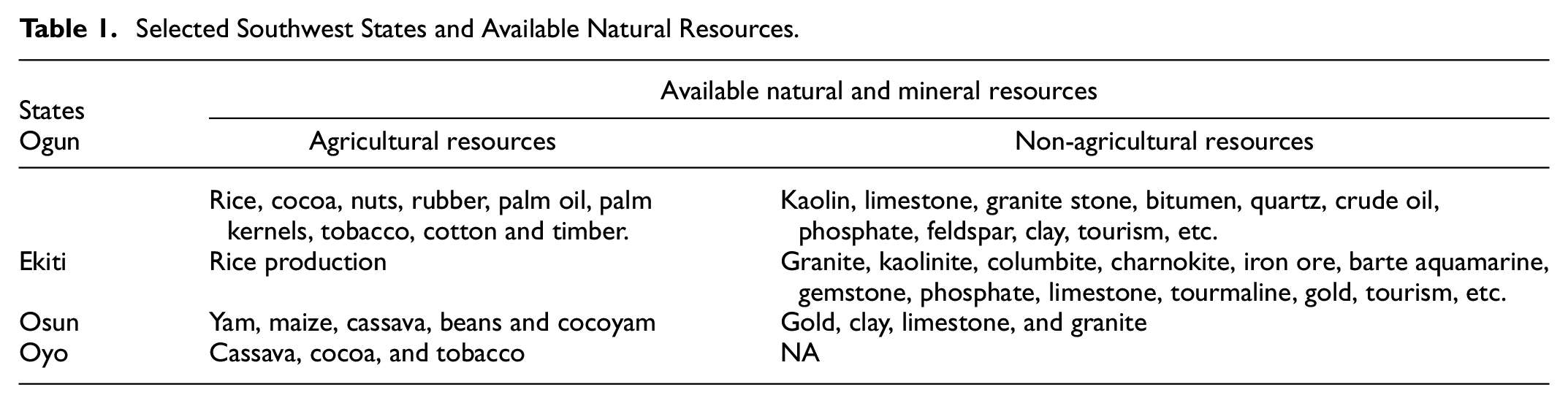
Nedelcu and Ciobanu (2016) opined that people in rural areas are notable for primary economic activities, with the capacity to promote national economic development. These rural areas are naturally endowed with the mineral resources and raw materials needed for industrial use and exports, which invariably contribute to the gross domestic products (GNPs) (Adesina, 2018; Ogundipe et al., 2020; Osabohien et al., 2019; Qurani et al., 2020; World Bank, 2018). Unfortunately, the rural communities that should be of interest to the government, investors, public administrators, and other stakeholders are often neglected and made to contend with underdeveloped challenges (Olonade, Adeleke, Olaniyi, et al., 2022). This ultimately leads to youths’ rural-urban migration in southwest Nigeria, leaving the untapped rural wealth for the scarcity in the urban centres. In southwest Nigeria, many natural resources have been identified in the rural communities, listed in Table 1 below.
Selected Southwest States and Available Natural Resources.
Urban-biased Theory
Michael Lipton developed the Urban-biased theory and became famous in 1994, even though the idea has existed for years. For instance, in 1920, the rulers and decision-makers of the defunct Soviet Union considered the need to evaluate the missing balance in the rural-urban sectoral economies that can affect growth and development. Author Lewis also looked at the apparent bias in favour of urban-industrial development models in the 1950s and 1960s. He suggested that rural areas of impoverished countries, where the marginal productivity of labour is sometimes relatively low, have hidden unemployment or underemployment.
The theory of urban bias mirrors the pains, challenges, and issues of people living in economically disadvantaged areas. Urban bias theory is relevant today in micro-economic policies, agriculture, trade, poverty, migration, and other socioeconomic endeavours. The urban bias theory has shown fundamental significance for rural-urban economic development. Lipton termed the attribution of poverty to rural areas as urban bias, resulting in unequal distributions of common natural and human patrimony.
The uneven distribution of the commonwealth has propelled endemic agricultural and infrastructural decay in rural areas (Osabohien et al., 2020). Urban bias has driven people from rural to urban centres under the cliché that life is fresher, sweeter, and more accessible in commercial or industrial centres (Anyanwu et al., 2018). This phenomenon continues to leave an indelible mark. It underscores the tendency for rural societies to grow and develop in consonance with the raw materials and agricultural skills available (Osabohien et al., 2020). It is sacrosanct to state that agricultural produce provides the raw materials perceived to deride the rural environment of growth and development and offers the urban settings with per capita income, job opportunities, economic upturn, small, medium, and large scale commercial hubs (Shittu et al., 2017).
The rural environment builds the market structure of urban life. The theory expresses that several policies and programmes are conceived, formulated and executed in many developing countries to depict the rural environment as the den of poverty, backwardness, and low-life dwellers whose major occupational endeavour rests solely on agricultural activities. This explains why many rural development programmes are often conceived as agrarian development, neglecting other viable rural economic sectors like pottery, craft, tie, dye, mining, and tourism. This perpetuates the spirit of poverty, the pain of underdevelopment, and a pang of low economic activities.
The theory of urban bias explains how rural poverty becomes a retrogressive phenomenon in the lives and livelihood of many rural dwellers because of several misconceptions. This states that investing in rural areas is tantamount to wasting one’s efforts and resources as nothing good, other than raw materials, can emanate from the villages and communities in a rural setting. Many have this preconceived notion that the rural environment is not worth investing in resources, energy, and time. In history, there have been imbalances in the numbers and magnitude of resources allocated to the rural and urban society.
As an illustration, public procurement for investment allocation, provision, infrastructural facilities, and environment upgrades has chiefly favoured urban residents. The urban residents have good road networks, healthcare, quality education, an averagely constant power supply, job and wealth creation, rail, and multi-purpose markets. For rural settlements, several governments, stakeholders, and politicians pay lip service to the economic activities of the rural environment. Many government parties’ commitment toward rural communities’ development is very little. Based on this, most rural societies suffered untoward hardship, neglect, and decay compared to the urban area.
Methods
Study Area
The study was conducted in the southwestern part of Nigeria, one of the six geopolitical zones of Nigeria. It comprises six States: Ekiti, Lagos, Ogun, Ondo, Osun, and Oyo States. The people in the region are mainly Yoruba-speaking, with several dialects within each State. It houses over 45 million people (National Bureau of Statistics [NBS], 2018). The weather condition is dynamic as it varies between Nigeria’s two distinct seasons: the rainy season (March–November) and the dry season (November–February). The dry season usually comes with the Harmattan dust, which brings cold, dry winds from the northern deserts to the southern regions. The region is notable for agricultural resources (rice, cocoa, nuts, rubber, tobacco, palm kernels, yam, cassava, etc.) and non-agricultural resources (kaolin, limestone, granite stone, bitumen, etc.). The region is notable for glitz and glamour, sights, and experiences. It offers Lagos beach life, Osun natural springs, Oyo’s historical nature, and the mountainous lifestyle of Ondo and Ogun States. Ekiti is known as the fountain of knowledge; notable leaders and professors who have impacted the region and Nigeria emanate from there. However, for this study, five (4) of the southwestern states, Ekiti, Ogun, Osun, and Oyo, were considered as study areas based on the fact that all the southwest states have similar cultural backgrounds, occupations, and lifestyle characteristics (Akanji et al., 2022; Agboola, 2022). The rural communities were purposively selected from each of the four States in southwestern Nigeria. Figure 1 below shows the map of Southwest Nigeria.

Map of Southwest Nigeria with the selected study areas.
Research Design and Study Population
The study employed the triangulation method using qualitative and quantitative research methodology. Karakara et al. (2021) adopted the mixed-method approach in their study on youth employment and large-scale agricultural land investment in Africa. The process helps understand agricultural land investment’s interrelatedness in bridging the youth unemployment gap. The qualitative data involved in-depth interviews (IDI), which elicited first-hand information from key stakeholders in the rural communities. The quantitative research method involved a self-prepared questionnaire administered to city-based rural-urban migrants to complement the qualitative data.
Two rural communities each were chosen from 12 local government areas in Ekiti, Ogun, Osun, and the Oyo States, making 24 rural communities, while Lagos and Ibadan metropolis was chosen as the urban population for the study. The rural communities were selected based on their senatorial districts and purposely selected based on identifiable natural and mineral resources. One stakeholder, also known as an opinion leader, was chosen from each of the 24 rural communities to form the participants for the rural population. The use of the purposive sampling method in selecting the rural respondents is due to its ability to gather qualitative responses for better insights and more concise research outcomes. The opinion leaders interviewed include community leaders/chiefs, serving and former local government chairmen, supervisory councillors and farmers.
Sampling Procedures
The qualitative sample size was purposively determined based on the study’s senatorial district in each of the selected States. Each of the chosen States has three senatorial districts, and one local government area was selected from each of the districts making 12 local governments. Two communities were selected from each local government area, totalling 24 communities, after which one respondent was selected from each of the 24 communities. Hence, the sample size of 24 respondents. A total of 555 copies of the questionnaire were administered in the urban areas (Lagos and Ibadan metropolis) to elicit information from migrants of rural origin on their awareness of the available natural resources in their place of origin. The capacity of the resources to retain them in their community, youth empowerment programmes, motivations for migration and their real-life experiences in the city were also considered.
A total of 216 copies of the questionnaire were distributed in the Ibadan metropolis comprised of Ibadan North and Ibadan North East LGA, while a total of 339 copies of the questionnaire was distributed in the city of Lagos, comprised of Alimosho and Ikeja local government areas. Lagos and Ibadan metropolis represents cities in southwest Nigeria because of their cosmopolitan nature, population size and high-level socioeconomic activities in these cities (Olonade, George, Imhonopi, et al., 2021). At the end of the fieldwork, 425 copies of the questionnaire were returned and found helpful for analysis. Data were analysed using frequency distribution tables and percentages, while the qualitative data was analysed thematically. Ethical clearance was also received, with a waiver of patients’ consent from an established ethical board.
Results and Findings
Table 2 depicts the distribution of respondents’ socio-demographic traits. The table shows that the respondents within the age category of 20 to 34 have the highest frequency, 319, representing 75%. This indicates that the majority of respondents for this study are in their active youth age and duly qualify for this study. Only 65 out of the 425 respondents, representing 15.3%, were between 15 to 19, while 41 respondents, representing 9.6 % of the total respondents, were 35 years and above. In other words, respondents below 19 and aged 35 and above constitute the lowest percentage of the study participants. From the table, 232 (54.6%) of 425 respondents, the highest, were male, while 193 (45.4%) were female out of the total of 425 respondents. This indicates that the research adequately covers both the male and female populations. The table also shows that only 11 (2.6%) did not go to school at all, 9 (2.1%) had primary school education, and the highest of the respondents, 329 (77.4%) had secondary education. In contrast, the remaining 76 of the respondents, representing (17.9%), had tertiary education. On respondents’ place of birth, 213 (50.1%) of respondents, the highest, were born in the village, 165 (38.8%) were born in the town, while the remaining 47 (11.1%) of the respondents, which is the lowest, were born in the city.
Selected Study Areas.

Also, 330 (77.6%) out of the 425 respondents, which is the highest, were single, 13 (3.1%) were previously married, 70 (16.5%) were still married, 8 (1.9%) had been separated, while only 4 (0.9%) were divorced. From the table, it is evident that 421 (99.1%) of respondents were Yoruba, 3 (0.7%) were Igbo, while the remaining 1 (0.2%) were people from other ethnic groups, including foreigners. This may not be unconnected with the fact that the study was conducted in the country’s southwest region, a predominantly Yoruba-speaking part of Nigeria. Also, one of the participants’ recruitment criteria specifies in-migrants of southwest rural origin. On respondents’ religious affiliation, 324 of the respondents, representing 83.3%, which is the highest, are Christians, 63 of the respondents, representing 14.8%, practice Islam, while the remaining 3, representing 0.7%, practice other religions like atheism.
Table 3 shows the socioeconomic characteristics of respondents. On their employment status, only 99 of the respondents, representing 23.3%, are employed, 102 of the respondents, representing 24.0%, are underemployed, 55 of the respondents, representing 12.9% are unemployed, while 169 of the respondents, representing 39.8%, which is the highest, are self-employed. This means the majority of the respondents are self-employed. On respondents’ occupations, only 60 of the respondents, representing 14.1%, are civil/public servants. The majority of the respondents, 274, representing 64.5%, are entrepreneurs (individuals with their businesses). Also, 56 of the respondents, representing 13.2%, are petty traders, and the remaining 21 of the respondents, representing 4.9%, were bankers, while the remaining 14 of the respondents, representing 3.3%, have other means of income like working in the private establishments. On monthly income, the highest respondents, 213, representing 50.1%, earn less than N50,000 monthly, while only 38 of the respondents, representing 8.9%, earn above N151,000 monthly. On respondents’ type of apartment, 150 of the respondents, representing 35.3%, which is the highest, live in one-room apartments, 87 (20.5%) live in a room and parlour/mini flat, 57 (13.4%) live in two bedrooms, 83 (19.5%) live in three bedrooms, 12 (2.8%) live in Mini-Duplex, 18 (4.2%) live in a duplex while 18 (4.2%) live in other types of apartments like the face-to-face apartment.
Percentage Distribution of Respondents by Selected Socio-demographic Characteristics.

Source. Authors’ survey, 2022.
On the number of persons living in an apartment, 167 of the respondents, representing 39.3%, are one to two in an apartment, 85 (20.0%) of two to three persons are living in an apartment, 127 (29.9%) of four to five persons are living in an apartment while 46 (10.8%) of five persons and above are living in an apartment. On the type of toilet, the table shows that 40 (9.5%) use pit latrine, 7 (1.1%) use the bush, 376 (88.9%), which is the highest, use water closets while 2 (0.5%) have no specified toilet they use. On the number of years spent in the city so far, the highest of the respondents, 326, representing 76.6%, have spent 10 years and above in the city, while the remaining 99 of the respondents, representing 23.4%, have lived in the city between 5 and 10 years. This means that most of the respondents have lived well enough in the city to understand their environment and thus provide valuable data for this study. Also, on the number of years lived in the village/town before moving to the city, 294 of the respondents, representing 69.4%, lived for 10 to 20 years in the village/town before moving to the city, while 120 of the respondents, representing 28.3% lived for less than 10 years and the remaining 10 of the respondents, representing 2.3% lived for 21 years and above in the village/town before moving to the city. This implies that the respondents met the requirement for participating in this study.
The descriptive frequency Table 4 was used to analyse this objective which focuses on the percentage distribution of respondents by awareness and utilisation of available natural resources. On their knowledge of the available natural resources in their community, 59 of the respondents, representing 13.9%, do not know of natural resources, while the highest of the respondents, 366, representing 86.1%, know of natural resources. On respondents’ participation in the utilisation of the natural resources in their place of birth, 280 of the respondents, representing 65.9%, which is the highest, have never engaged in the utilisation of natural resources in their place of origin, while only 145 (34.1%) have ever been part of the utilisation of natural resources in place of origin. This shows that most of the respondents have never been part of utilising the available natural resources in their rural areas before moving to the city.
Percentage Distribution of Respondents by Selected Socioeconomic Characteristics.

Source. Authors’ survey, 2022.
Table 5 shows the respondents distribution by awareness and utilisation of natural resources. For those who have engaged in the utilisation of natural/ mineral resources, 60 (14.1%) respondents have engaged in farming, 40 (9.4%) have engaged in clay and pottery production, 30 (7.1%) have engaged in mining, while 15 (3.5%) have been part of oil and gas. With farming taking 14.1%, farming is the most utilised natural resource in rural communities. However, the majority of the respondents, 65.9%, have never been part of natural/mineral resources utilisation. On respondents’ experiences in the utilisation of natural resources, 115 (27.1%) respondents, which is the highest, find the experience in the utilisation of natural resources interesting, 42 (9.9%) respondents find the experience challenging, 15 (3.5%) respondents find the experience horrible while the remaining 253 (59.5%) respondents could not describe their experience in the utilisation of natural resources. This is because most of these respondents have not been part of utilising natural resources in their place of birth; hence they could not describe their experiences.
Percentage Distribution of Respondents by Awareness and Utilisation of Natural Resources.

Source. Authors’ survey, 2022. Here is the citation for Table 5
Also, only 84 respondents, representing 19.8%, will not like to take part in utilising any natural resources, while the highest of the respondents, 341, representing 80.2%, will want to take part in utilising any natural resources if given the opportunity. This shows that youths are ready and willing to be part of resource utilisation, provided they have the necessary support and enabling environment for resource utilisation in their place of birth. The table above shows that 158 (37.2%) respondents would like to take part in farmland, 85 (20.0%) will want to take part in oil and gas, 81 (19.1%) would like to take part in clay and pottery production, 29 (6.8%) will like to take part of tourism while 72 (16.9%) will want to take part of mining. This shows that farming remains one of the leading resources in the southwest that many youths are interested in if adequate support exists. On whether the community is benefitting well enough from the available natural resources, 280 respondents, representing 65.9%, do not think that their community is benefitting well from the available resources in their place of birth. Only 145 of the respondents, representing 34.1%, feel that their community is benefitting well from the available resources in their place of birth. On whether the government is doing enough for the community in the utilisation of their natural resources, 350 of the respondents, representing 82.4% respondents, which is the highest, do not think that the government is doing enough in the utilisation of these resources while only 75 of the respondents, representing 17.6% believes that the government is doing enough in the utilisation of these resources.
The below excerpts from the in-depth interview conducted further reaffirm these findings and are presented in themes and sub-themes below:
Natural Resources and Intervention
This theme has two sub-themes: the availability of natural resources and challenges in the utilisation of natural resources.
Availability of Natural Resources
All the study participants affirmed that their communities have abundant natural and mineral resources. One respondent, an indigene of the Aba Odo community who is above 70 years old, identified the natural resources in their community as thus:
Farmland, water, and rocks are some of the natural resources in the area. The rocks serve as quarrying (mining) activities and prayer mountains for some churches. The farmlands are fertile due to water availability in the community and can help the farms during dry seasons.
Also, another respondent from the Atiba community was a former local government chairman and has lived in the community for more than 40 years. He pointed out the following as the available natural resources in the community and their importance to the community:
Atiba community has cocoa, kola nut, palm kernel and plantain. Also, there are forests with big trees for carpentry works for buildings. We also plant large quantities of food crops like yam, maise, and cassava. We have many such resources in the community. These resources were our primary source of revenue in those days, but many people were discouraged due to a lack of support. They are abandoning these resources to look for jobs outside the community. There is no government institution here at all. The only school here is about 3 km away from the community. Our roads are bad, and no social amenities. If they can come to our aid, I think life will be better for our people.
Another respondent, a civil servant from Orun Ekiti, believed that the community predominantly farms food and cash crops. They also engage in plank business due to the abundance of forests in their community. Below are his views on the available natural resources in the community:
Well… Our people are predominantly farmers. They are particularly into rice farming. We have many sawmills within the community, where carpentry and wooding works occur after farm work. This is because the community has a large forest where trees are cut for wooding and planks. We supply planks to the neighbouring communities from our sawmills. There are also farming activities taking place in this community. Our farmers produce rice, yam, and cassava as food crops. The cash crop is cocoa. There is a cocoa plantation. Our community can grow these crops in large quantities if there is support for mechanised farming. Particularly in rice production, if we can be assisted with stoning machines, it will help in the easier removal of stones from the rice and lead to rice production in large quantities. As it is, the stones are being removed manually from the rice, which takes time, reducing its production capacity. The time spent manually removing the stones could have been spent producing more rice. Likewise, other cash crop productions. It is also crucial for the government to regulate tree-falling activities in the communities. There is so much illegal cutting of trees going on that should be considered.
The preceding shows that in many of these rural communities, there are available natural resources. However, many of these natural resources are yet to be tapped into to their full benefit. The following excerpts under the second sub-themes buttress this:
Challenges in the Utilisation of Available Natural Resources
Most of the study participants lamented over the underutilisation of the available natural resources in their communities and identified specific challenges hindering the community from benefiting maximally from the natural resources in their communities. One respondent, a farmer and indigene of Ode Omu, 64 years old, explains some of the challenges farmers are faced in his community and are presented thus:
The lack of irrigation farming is affecting productivity among our farmers in this community. Where there is a lack of irrigation, it would be tough for farmers to succeed there. It impedes sufficient yield. For instance, maise will fail after many days without water/rain. But the government can assist with irrigation that farmers can use to wet their crops without rain. If there is no irrigation system in place, it will reduce crop yield and will not help farmers produce commercially. Also, we need government support to acquire storage facilities so that farmers can preserve some of their harvests before the next harvest season when farmers have a good yield. When farmers cannot keep their harvest, farming will remain unsustainable.
Another respondent, a former councillor and an elder statesman in the Inisa community of Odo Otin local government area of Osun State emphasised the need to diversify and focus on other natural resources in the community asides from arming. Below are his words:
Our major problem is a lack of diversification; even with farming, other things must be added because we have many of these natural resources in large quantities in our community here. For instance, the river we have here, if it were to be an advanced country, the white people would have turned it into a big lake for the fishery business. Even our rocks it’s one of the resources we have in large quantity here, but not much attention is being paid to them. So many things can be gotten if only more attention is paid to them. The government needs to do more by investing in the various sectors of this community. The youths are ready to work, but many don’t have anything to do after the senior school certificate, which is why many leave for Lagos to look for what to do. The few that remain are into Okada and some other social vices in the community.
Another respondent, a retired teacher and currently a farmer, decried the consequences of the underutilisation of the available natural resources in the Oosi Sooko community of Ife south local government of Osun State:
The neglect has not been to the advantage of the community because many youths who are supposed to build the community are leaving. Even though some still come to their farm once in a while, the poor road condition is very discouraging. Some will even be afraid to go home during the rainy seasons because once it rains and you are in the community, there is no way you can go anywhere again. Most houses are dilapidated since no one is staying there again. The houses have been abandoned for a long time and are dilapidating now. When rain falls, the place is usually not accessible for people. So, how can one utilise any resources in such an unconducive environment? Nobody wants to live in such a place. So, we have a large expanse of land wasting away in the community due to the lack of infrastructural facilities that could make people stay.
Another participant says:
Well, much still needs to be done by the government. They don’t tap into the brain of those in this community because if they have tapped into the indigenous knowledge, they will have realised the need to set up a mechanised farming system that can assist the community in producing in large quantities and probably be able to export outside the State and be able to feed the whole country. We just heard they are giving loans; we don’t know who is collecting them from them. Instead of them coming and discussing with those of us in the community that can provide them information about the available resources, they sit down in their houses and dish out policies that do not impact the community’s wellbeing. So, that area is lacking and affecting the potential of the resources in the community. They need to create an enabling environment and give us a standard of the stoning machine to remove stones from the rice and go entirely into mechanised farming. Apart from these, other farm institutions must be established like a settlement and green revolution.
From the preceding, it can be established that the available natural resources in many rural communities in southwest Nigeria are underutilised, which is one of the main reasons for the increasing rural-urban migration and the attendance consequences in southwest Nigeria.
Discussion of Findings
Several studies affirmed that rural areas are naturally blessed with the mineral resources and raw materials needed for industrial use and exports, which invariably contribute to the gross national product (GDP) (Adesina, 2018; Ogundipe et al., 2020; Osabohien et al., 2019; Qurani et al., 2020; World Bank, 2018). Nedelcu and Ciobanu (2016) opined that rural people are notable for primary economic activities and are an essential foundation for national economic development. However, the results of this study indicate that even though the natural/ mineral resources are abundant, particularly mining and farmland, in many of the southwest rural areas, they are often underutilised due to a lack of infrastructure and adequate support from the government. From the descriptive statistics, 86.1% of the respondents are aware of the available natural/ mineral resources in their place of birth, and only 34.1% have ever been part of utilising the natural resources.
Also, 65.9% of the respondents do not think that their community is benefitting well enough from the available natural/ mineral resources in the rural communities, and 82.4% do not believe the government is doing enough to utilise the available natural/mineral resources. The qualitative responses also support this finding that natural/ mineral resources are available with great potential, but they are not taken advantage of by business organisations /institutions, including the government. This shows that even though natural/mineral resources are available, people are not interested in being part of their exploration and exploitation due to the lack of adequate support and infrastructural deficit in the rural communities. This finding is in tandem with other studies positing that rural areas are one of the most critical sectors of a nation’s economy. The rural areas represent a vital source of income for many countries, capital formation, a platform for raw materials, and domestic industrialisation. Unfortunately, rural areas suffer the diminishing of talent and potential mainly due to the infrastructural deficit, degrading environment, and lack of paid employment responsible for people’s movement into the metropolis (Uma et al., 2013).
Other challenges impeding the utilisation of available natural/ mineral resources in rural areas include little or no infrastructural facilities, environmental degradation, low employment opportunities other than farming, little or no access to healthcare facilities, potable water, and security services (Ocello et al., 2015; Okorafor et al., 2014). These and many other factors fueled youths’ rural-urban migration in Nigeria, making the situation very worrisome (Ogunmakinde et al., 2015). Even in favourable aspects like a large expanse of land for agriculture, tourism, and other local economies are available, they are often left untapped and undeveloped (Alozie et al., 2019). These findings discredit the current policy framework of rural development programmes as many of such policies have not yielded much in alleviating the suffering of the rural people. The urban bias has limited the conception of ideas toward rural development programmes to agricultural-related activities rather than diversifying the rural economies to focus on other resources like arts and tourism. These different sectors have been found in this study to be more viable and potentially transform rural economies.
Conclusion and Recommendation
This study assesses the awareness and utilisation of available mineral and natural resources in the southwest rural communities in Nigeria and finds that the available mineral and natural resources are underutilised to a greater extent. There is an abundant mineral and natural resources in most of the southwest rural areas. These resources span the rural economy’s mining, agricultural, and tourism sectors. However, they have been grossly underutilised mainly due to inadequate support from the government in terms of infrastructural provisions and financial investment from the private sector to fully maximise the benefits of these resources for the communities and the Nigerian society at large.
Based on the study findings, it was recommended that the government at all levels recognise the rural areas as the fulcrum of national economic development. The rural economy should be given utmost priority regarding infrastructural provisions and adequate funding. There is a need to create the right and enabling socioeconomic environment to attract private sector investors to set up industries in these rural areas. Also, full autonomy must be given to the local government council authorities for adequate utilisation of the available natural resources. The reason is that the local government is the nearest to rural people. From the study, the local government appears to be helpless in initiating any laudable projects in these communities as they are not equipped enough to do so. Lastly, there is a need to establish a farm settlement in each of the local governments in the Southwest area of Nigeria. This is a government intervention programme for efficiently utilising land resources and engendering dignity in farming by providing basic social needs. This will help farmers access modern farming equipment needed for mechanised/commercial agriculture.
Study Limitations and Suggestions for Further Research
Firstly, the fact that the study does not cover all the southwest States in Nigeria could raise the question of the representativeness and replicability of findings. Secondly, this study focused on 24 rural communities from 12 local governments in four States in Southwest Nigeria, which could raise questions about its generalisability. Other communities in the southwest region and different geopolitical zones were not included in the study. However, despite the above limitations, the researcher ensured the strict adherence required for any scientific enquiry and provided adequate representation of respondents, which improved the validity and reliability of the study findings. Based on the above study limitations, it is incumbent for other researchers to embark on studies to fill the lacunas created. These include:
I. Further studies could be expanded to cover all the communities in the southwest region, including Ondo State, that were not part of this study. This will address the challenge of representativeness and applicability of findings
II. Also, studies could be conducted to properly profile the resources available in each rural community and seek investors to fund them. A purely qualitative study will be most helpful for this kind of study.
Footnotes
Acknowledgements
The authors used this medium to appreciate Covenant University for providing enabling environment for research activities and commitment for research sponsorship. All participants in this study are also appreciated.
Declaration of Conflicting Interests
The author(s) declared no potential conflicts of interest with respect to the research, authorship, and/or publication of this article.
Funding
The author(s) received no financial support for the research, authorship, and/or publication of this article.
Ethical Approval
Ethical clearance was received, with a waiver of patients’ consent from the Covenant University Health Research Ethics Committee (CUHREC). The ethical approval was issued under certificate number: CHREC /108/2021.

Data Availability Statement
The data for this research are embedded in the manuscript and available on request.