




Abstract
Researchers have been investigating the effects of different planning conditions on learners’ second language (L2) writing performance. However, whether such effects differ regarding specific planning conditions and task complexity has remained underexplored. This study examined the effects of pre-task planning (PTP) versus unpressured online planning (OLP) on L2 writing, particularly in relation to task complexity manipulated in terms of the reasoning demands. Participants were 60 low-intermediate Chinese English as a Foreign Language (EFL) learners who were divided into a PTP group and an unpressured OLP group. Each group completed two writing tasks differing in complexity manipulated as more or less reasoning demands. The participants’ texts were examined in terms of lexical and syntactic complexity, accuracy, and fluency. The results revealed that there were no significant differences between PTP and unpressured OLP in lexical and syntactic complexity. However, unpressured OLP benefited accuracy and fluency, and the benefits reached a significant level. In addition, its effects on accuracy were affected by task complexity in that it was much more beneficial to a simple task than to a complex one. For lexical and syntactic complexity and fluency, no such effects were found. The pedagogical implications and limitations of the study were discussed.
Plain language summary
This study examined the effects of pre-task planning (PTP) versus unpressured online planning (OLP) on second language writing, particularly in relation to task complexity manipulated in terms of the reasoning demands. The study found that students under unpressured OLP condition could compose writings of higher accuracy and fluency than students under PTP condition. The study also found that students under unpressured OLP condition could compose more accurate writings when they did a simple task than when they did a complex task. The results of this study suggest several pedagogical implications. First, manipulating cognitive aspects of writing is important because of the different effects of planning conditions on student writing. Second, EFL teachers should be aware of the role of task complexity in writing instruction and assigning writing tasks through appropriate sequence. Several limitations in this study should be noted. First, this study only investigated immediate effects of planning conditions, so future research can use longitudinal design to investigate long-term effects of such conditions on student writing. Second, future research should delve into what students actually do when they are under various planning conditions to perform writing tasks of different complexity levels because such research can help explore how students do writing tasks cognitively and affectively. Third, it should be acknowledged that the students’ low-intermediate English proficiency level might prevent them from benefiting from PTP condition. The condition experienced by students with more advanced proficiency level might lead to different effects on their writing.
Introduction
In the domain of task-based language teaching/learning, task planning can be manipulated as a feature of task complexity and can have an impact on learners’ writing performance in terms of complexity, accuracy, and fluency (CAF) (Johnson, 2020). The topic of task planning has been drawing first language (L1) and second language (L2) writing researchers’ attention for several decades probably due to its potentially self-evident role in helping learners improve writing performance. The significance of exploring the potential effects of task planning on writing can be attributed to a theoretical factor and a pedagogical one. Theoretically, there are some theoretical frameworks suggesting that planning time can facilitate writing performance, such as Limited Attentional Hypothesis (Skehan & Foster, 2001), Cognition Hypothesis (Robinson, 2001, 2003), Attentional Funneling (Kellogg et al., 2013). One essential tenet posited by these frameworks is that planning time prior to writing can help improve learners’ writing performance through saving their limited attentional resources for translation stage. Pedagogically, Ellis (2022) attached great importance to the crucial role of pre-task planning (PTP) in L2 writing context and proposed an option-based approach through which both teachers and students can work together to find best PTP options for students to benefit most.
Johnson et al. (2012) categorized task planning into pre-task and online planning (OLP), with the former referring to a planning condition where learners dedicate time to planning before writing and the latter referring to a planning condition where learners plan during writing. Many empirical studies have centered on exploring the impacts of the two types of planning on CAF measures of learner writing (see Johnson & Abdi Tabari, 2023 for a review). Although it seems that PTP has great potential to lead to better writing performance on the part of learners, relevant research has reported inconsistent findings about its effects on writings (e.g., Ellis & Yuan, 2004; Ong & Zhang, 2010). In addition to such findings, Ellis (2022) further pointed out the necessity of further research on the interaction effects between different types of planning conditions and different levels of task complexity on learner writing, particularly research on the effects of PTP and unpressured OLP on a demanding writing task. More recently, Johnson and Abdi Tabari (2023) also claimed that the extent to which task complexity interacted with planning conditions was worth exploring because different levels of demands of a writing task (i.e., task complexity) needed to consume different number of attentional resources generated from different types of planning conditions. However, to the best of our knowledge, no research has been conducted to address such effects. The reason for the necessity of such research is that PTP might fail to manifest any potential advantages in completing a demanding task as learners are likely to “engage in deeper online planning if they have the chance, resulting in a loss of fluency and negating any effect that PTP might have had” (Ellis, 2022, p. 81). Therefore, the aim of this study is to examine whether planning conditions, operationalized as unpressured OLP and PTP, can have differential impacts on CAF measures of student writing as far as a demanding writing task is concerned.
Literature Review
Studies About PTP and Unpressured OLP
Starting from Ellis and Yuan (2004) study, many studies have examined the effects of pre-task planning on students’ writing performance (see Abdi Tabari, 2022 for a review). However, only several studies have explored the effects of different planning conditions (i.e., pre-task planning, unpressured online planning, and/or no planning) on students’ writing performance operationalized as CAF measures (Abdi Tabari, 2016, 2017; Ellis & Yuan, 2004, 2005; Ghavamnia et al., 2013; Golparvar & Azizsahra, 2023; Piri et al., 2012; Rahimpour & Safarie, 2011; Rostamian et al., 2018), and the findings of the studies have been inconsistent.
Specifically, for the studies examining students’ writing fluency, all of them showed that PTP was significantly more beneficial to the improvement of writing fluency than unpressured OLP. In contrast, the studies about writing accuracy produced mixed findings. Among them, five studies (Ellis & Yuan, 2004, 2005; Ghavamnia et al., 2013; Golparvar & Azizsahra, 2023; Rostamian et al., 2018) reported that unpressured OLP was significantly more helpful to the improvement of students’ writing accuracy than PTP, whereas the other four studies (Abdi Tabari, 2016, 2017; Piri et al., 2012; Rahimpour & Safarie, 2011) reported no difference between the two planning conditions in writing accuracy. Two studies (Ghavamnia et al., 2013; Rostamian et al., 2018) presented the results that PTP could lead to greater syntactic complexity compared to unpressured OLP, and one study (Ellis & Yuan, 2005) reported the opposite results, with the remaining six reporting no difference between the two planning conditions.
Although multiple factors (e.g., writing tasks, proficiency level, etc.) might lead to the inconsistent findings, the findings might also necessitate the need to further exploring the effects of PTP and unpressured OLP on student writing. In addition, based on Robinson’s (2011) task complexity framework, task complexity can be operationalized as ±few elements and ±reasoning along the resource-directing variable. Most studies examining the effects of the two planning conditions on student writing used a narrative or descriptive task, which is concerned with ±few elements, leaving argumentative writing tasks concerning ±reasoning underexplored. An argumentative writing task is of great importance in that it is widely used in both domestic and international English proficiency tests for Chinese tertiary students (Y. Huang & Zhang, 2020). Thus, it might be likely for students to be motivated to write on such a task because of the deeply exam-oriented educational system in China. Moreover, Teng and Zhang (2020) proposed that an argumentative writing task can be used to accurately measure L2 students’ writing performance. Therefore, it is worthwhile to explore the effects of the two planning conditions on argumentative writing tasks.
Studies About Planning Conditions and Task Complexity
In recent years, there has been a tendency in the research of planning conditions to explore the interaction effects of such conditions and task complexity. Several studies have examined whether such effects play a role in measuring CAF of student writing (e.g., Abdi Tabari, 2019; Abdi Tabari & Wang, 2022; Fazilatfar et al., 2020; Ong, 2014; Rahimi & Zhang, 2018), but the studies were differential from each other because of the different operationalizations of the planning conditions and task complexity. Specifically, Rahimi and Zhang (2018), Abdi Tabari (2019), and Abdi Tabari and Wang (2022) operationalized planning conditions as strategic planning and no planning conditions, whereas Fazilatfar et al. (2020) and Ong (2014) operationalized planning conditions as different durations of planning time (i.e., 0, 10, and 20 min). In terms of task complexity, Rahimi and Zhang (2018) used two argumentative writing tasks differing in reasoning demands and number of elements. Abdi Tabari (2019) used three writing tasks of different genres sequenced through different complexity levels, while Abdi Tabari and Wang (2022) used two different writing tasks based on topic familiarity. Ong (2014) study, approximately replicated by Fazilatfar et al. (2020), categorized task complexity into the provisions of topic, topic and ideas, and topic, ideas, and macro-structure. Obviously, the different operationalizations of the planning conditions and task complexity might be one reason leading to inconsistent or even contradictory findings of the studies. In addition, the interaction effects of some planning conditions (e.g., PTP and unpressured OLP) and task complexity dimensions (e.g., ±reasoning) left underexplored.
Compared to the studies exploring the main effects of planning conditions (e.g., Abdi Tabari, 2016; Ghavamnia et al., 2013) and the main effects of task complexity dimensions (e.g., Golparvar & Rashidi, 2021; Zhan et al., 2021), studies examining their interaction effects on student writing can shed light on how they simultaneously influence students’ writing performance and, therefore, are expected to suggest effective ways that can be used to improve it. However, to the best of our knowledge, there has been little research that has examined the interaction effects of planning conditions and task complexity on students’ writing performance, particularly with the former operationalized as PTP and unpressured OLP and the latter operationalized as the degree of reasoning demands. It seems that PTP might be more effective in helping students improve their writing performance of a complex writing task as they could have more time to prepare for what they are going to write. For example, while doing a complex writing task, students under PTP condition are expected to use generative language system to optimize the use of their inter-language knowledge, which can subsequently improve the complexity of their writings (Abdi Tabari, 2019). This view is also echoed by the notion of attentional funneling proposed in Kellogg et al. (2013) study. Based on this notion, when writers are assigned a complex writing task, they generate and organize ideas during PTP stage, relieving pressure on their working memory capacity and enabling them to make use of more attentional resources to focus on language-related aspects while writing (Ellis, 2021), which could help improve their writing performance.
However, some studies (e.g., Kang & Lee, 2019; Salimi & Fataoolahnejad, 2012) did not observe this type of positive role of PTP in dealing with complex writing tasks. Indeed, as Ellis (2022) contended, complex writing tasks might make it more likely for students to deeply engage in OLP, particularly unpressured OLP, which would subsequently offset any potential benefits brought about by PTP. Complex writing tasks often lead to relatively high cognitive demand on the part of students, and unpressured OLP can provide them with ample time to carefully conceptualize, formulate, and produce their language output (Ellis, 2005). According to Interaction Hypothesis (Kellogg, 1996), during the process of writing, it is expected that learners are offered opportunities to plan, translate, and review their ideas in an interactive and recursive way. It is assumed that allowing students to write on a complex writing topic under unpressured OLP condition might be more beneficial to their written production than under PTP condition, although the PTP condition has some seemingly self-evident advantages concerning writing such a topic. In this sense, the question remaining to be answered might be whether there is any differential effect of planning conditions on students’ writing performance as far as a complex writing task is concerned. Therefore, it could be worthwhile to investigate the interaction effects of planning conditions (i.e., PTP and unpressured OLP) and task complexity on students’ writing performance.
The two research questions of this study are as follows.
Does planning type (i.e., PTP vs. unpressured OLP) affect Chinese EFL learners’ writing task performance? If so, in what ways?
Do the effects of planning type vary depending on task complexity?
Methods
Design
This study used a mixed design, including planning condition (PTP or unpressured OLP) as a between-participant variable and task complexity (more, or less, reasoning demands) as a within-participant variable. The independent variables were planning condition and task complexity and the dependent variables were CAF measures of student writing. This design was adopted because the main purpose of this study was to investigate whether there were any effects of planning condition on student writing and whether the effects of planning condition vary depending on task complexity. This study assigned students to two groups each of which completed the same two writing tasks differing in reasoning demands. To eliminate any possible exercise effects, the ordering of the two tasks were counterbalanced, with one group performing the tasks through the order of more reasoning demands and less demands, and another group performing the tasks through a reverse order. In addition, because of the potential relationship between WMC, task complexity, and planning conditions, this study also explored how WMC might influence the students’ writing performance through relating to task complexity and planning conditions.
Participants and Context
A total of 60 non-English major sophomores (34 males, 26 females) from a Chinese university voluntarily participated in this study. The student participants came from two parallel intact class and were recruited through a convenience sampling method (Dörnyei, 2007). Their ages ranged from 19 to 21, with the average age of 19.87. They have been learning English for about 9 years, and none of them had any experience in living or studying abroad. They were from two classes, with each class having 30 participants. An instructor with 19 years of English teaching experience and a master degree in applied linguistics taught both classes based on the same textbook and syllable. According to the participants’ scores on their final English test of the previous semester and the discussion with the instructor, their English proficiency was low-intermediate. In addition, the participants’ scores on College English Test Band 4 (CET-4), which is a nationally standardized English test for non-English majors, were collected to gauge their English proficiency at the beginning of the study. This test is exclusively designed to measure non-English majors’ proficiency in terms of English listening, reading, and writing. The validity and reliability of using CET-4 to gauge EFL students’ English proficiency has been well documented in literature (e.g., Gao & Min, 2021; S. Huang & Renandya, 2018). The study performed two independent samples t-tests to examine whether the students’ English proficiency and English writing proficiency were comparable at the outset of the study, and the results were reported in the “Results” section.
During the study, the student participants were enrolled in a course called College English, which is a compulsory course for all non-English majors in the university. The course lasts the whole semester of 16 weeks. The students of this course are exposed to comprehensive training on basic skills of English learning, with special focus on reading and writing.
Writing Tasks
The students in this study were divided into two groups in which they were asked to do either PTP or unpressured OLP. The students in each group were invited to complete two writing tasks with different levels of task complexity operationalized as more or less of reasoning demands (see Appendix 1). Specifically, a narrative task with less reasoning demands and an argumentative task with more reasoning demands were selected as the two writing tasks in this study based on the following considerations. First, a more cognitively complex writing task can assume more reasoning demands (Rahimi, 2019). Second, an argumentative task may require more reasoning demands from students than a narrative task (Zhan et al., 2021). Third, cognitive task complexity might be related to reasoning demands and genres (Ruiz-Funes, 2015). Therefore, this study adopted a narrative task and an argumentative one, with the former being considered as a simple task and the latter as a complex one.
Both writing topics were adapted from CET-4 bank, and the students were familiar with the topics since they are closely related to their daily life. Researchers (e.g., Gao & Min, 2021; Zhan et al., 2021) have been using such writing topics as writing tasks in their experimental studies due to the well-documented validity and reliability of CET-4 in relevant literature. To ensure the reliability of task complexity manipulation in this study, 10 experienced EFL writing teachers were invited to evaluate the simple task and the complex task through rating a scale ranging from 10 to 100. The lower a score is, the less complex a writing task is. The narrative task was a simple task because it involved fewer reasoning demands through only asking students to describe several aspects of studying abroad, and the argumentative task was a complex task because it involved more reasoning demands through asking students to reason benefits and challenges of studying abroad.
Experimental Procedures
This study was conducted in regular classrooms at four different class periods, and the students completed one writing task at each period. Prior to writing the first task, the students under the two planning conditions were informed in Chinese of how they should plan and compose their essays. To determine the time allocated to the students under the PTP condition to complete the simple and complex writing tasks, a pilot study with 10 low-intermediate students who had a similar profile to the students in the present study was conducted at two class periods in which the students completed a simple task and a complex one, respectively. The two class periods were not consecutive to prevent students from being exposed to potential writing fatigue. The results showed that the fastest time to complete the simple writing task was 25:35 min and the fastest time to complete the complex writing task was 32:30 min. Thus, the students under the PTP condition were offered these two time limits to compose their essays after planning, which was set as 10 min following previous studies (e.g., Ellis & Yuan, 2004; Rostamian et al., 2018).
During the 10-minute planning time, the students were allowed to take notes about the writing topic; however, the notes were taken away when they started to write. Then, they were required to write a minimum of 120 words for each of the topics. This requirement was expected to enable them to focus on writing. In contrast, the students under the unpressured OLP condition were given unlimited time to compose the essays, but they had to start composing immediately without planning. Unlike their counterparts under PTP condition, they were not required to write a minimum of 120 words as such a requirement might prompt them to write quickly. Besides, the students of both groups were asked to self-record and write down the time they had actually spent in completing each of the essays (see Table 1).
Time Spent by the Two Groups in Completing the Two Writing Tasks.

Data Analysis
This study employed complexity, accuracy, and fluency (CAF) measures to analyze students’ writing performance since the three measures were effective in gauging learners’ performance when doing a certain task (Skehan, 1998). As for analyzing lexical complexity, two metrics were considered: measure of textual, lexical diversity (MTLD) and log frequency of content words (LCW). MTLD was chosen because, unlike type-token ratio, it is a metric of lexical diversity that is least affected by text length (McCarthy & Jarvis, 2010). LCW demonstrates the average of the log frequency of content words in the CELEX database (Graesser et al., 2004), a large corpus that can be used to examine lexical sophistication of student text more rigorously than frequency band metrics since it can detect students’ writing gains at different levels (Kyle & Crossley, 2015). Both the MTLD and LCW were computed by Coh-Metrix 3.
This study used Lu’s (2010) L2 Syntactic Complexity Analyzer (L2SCA) to analyze syntactic complexity of student writing through two metrics, namely, the mean length of T-units (MLT) and the ratio of clauses per T-unit (RCT). According to Wolfe-Quintero et al. (1998), the two metrics can accurately assess syntactic complexity in student writing. For accuracy, this study adopted the measure of error-free clause ratios (EFC/C), which is calculated as the percentage of error-free clauses per clause. This measure was used because it is highly correlated with different error measures (Polio & Shea, 2014) and is more suitable for evaluating accuracy of low-intermediate EFL student writers than other measures, such as error-free T-units (Wolfe-Quintero et al., 1998). Following Zhan et al.’s (2021) accuracy measure, errors in the present study were operationalized as errors relating to syntax, morphology, lexical choice, or word order, without taking into account errors of capitalization, spelling, and punctuation. A higher ratio refers to an essay with higher writing accuracy. To ensure inter-rater reliability, both authors independently hand-coded 10% of the dataset. After obtaining a reliability coefficient above .85, the authors independently hand-coded the remaining data which were equally distributed between them. For fluency, this study assessed fluency through calculating the total number of words produced by students during the allotted time.
This study collected 120 student writings in total. The hand-written writings were typed into a computer and stored as Word documents by a research assistant and were checked against the original documents by the first author. During the checking process, any formatting issues and typing mistakes were addressed. After that, all student writings were analyzed for CAF measures.
To answer the first and the second research questions, this study checked histograms, normal Q_Q plots, and Kolmogorov-Smirnov tests for the normal distribution before conducting a repeated measure multivariate analysis (MANOVA), finding that the normal distributions of some measures were violated. Therefore, parametric and non-parametric tests were employed in this study to examine the effects of task complexity and planning conditions on student writing (as in Rahimi & Zhang, 2018; Tao & Wang, 2022). To reduce the likelihood of Type I error, this study used Bonferroni correction to adjust the a level as .0083 (i.e., .05/.06) for the analyses of all measures of student writing. This study adopted Cohen’s (1988) benchmarks for interpreting effect sizes of partial η2, (small = .01, medium = .06, large = .14) for mixed ANOVA tests and used Cohen’s (1992) guidelines for interpreting effect sizes of r (small = .10, medium = .30, large = .50) for the Wilcoxon and Mann–Whitney tests.
Results
After collecting all students’ scores of CET-4, an independent samples t-test was run. The results indicated that PTP group had a mean score of 430.37 (SD = 53.79) and unpressured OLP group had a mean score of 407.87 (SD = 49.68). There was no significant difference in English proficiency between the two groups (t(58) = 1.683, p > .05). In order to ensure the comparability of the students’ writing proficiency at the beginning of the study, their scores of writing part of CET-4 were collected. The results showed that PTP group had a mean score of 136.60 (SD = 18.04) and unpressured OLP group two had a mean score of 130.80 (SD = 18.96). There was no significant difference in writing proficiency between the two groups (t(58) = 1.279, p > .05), so we may conclude that the two groups were at a similar writing proficiency level at the outset of the study.
Table 2 illustrates the descriptive statistics for the CAF measures for each group under the PTP and unpressured OLP conditions, respectively.
Descriptive Statistics for Simple and Complex Tasks for the Group Under the PTP Condition and the Group Under the Unpressured OLP Condition.
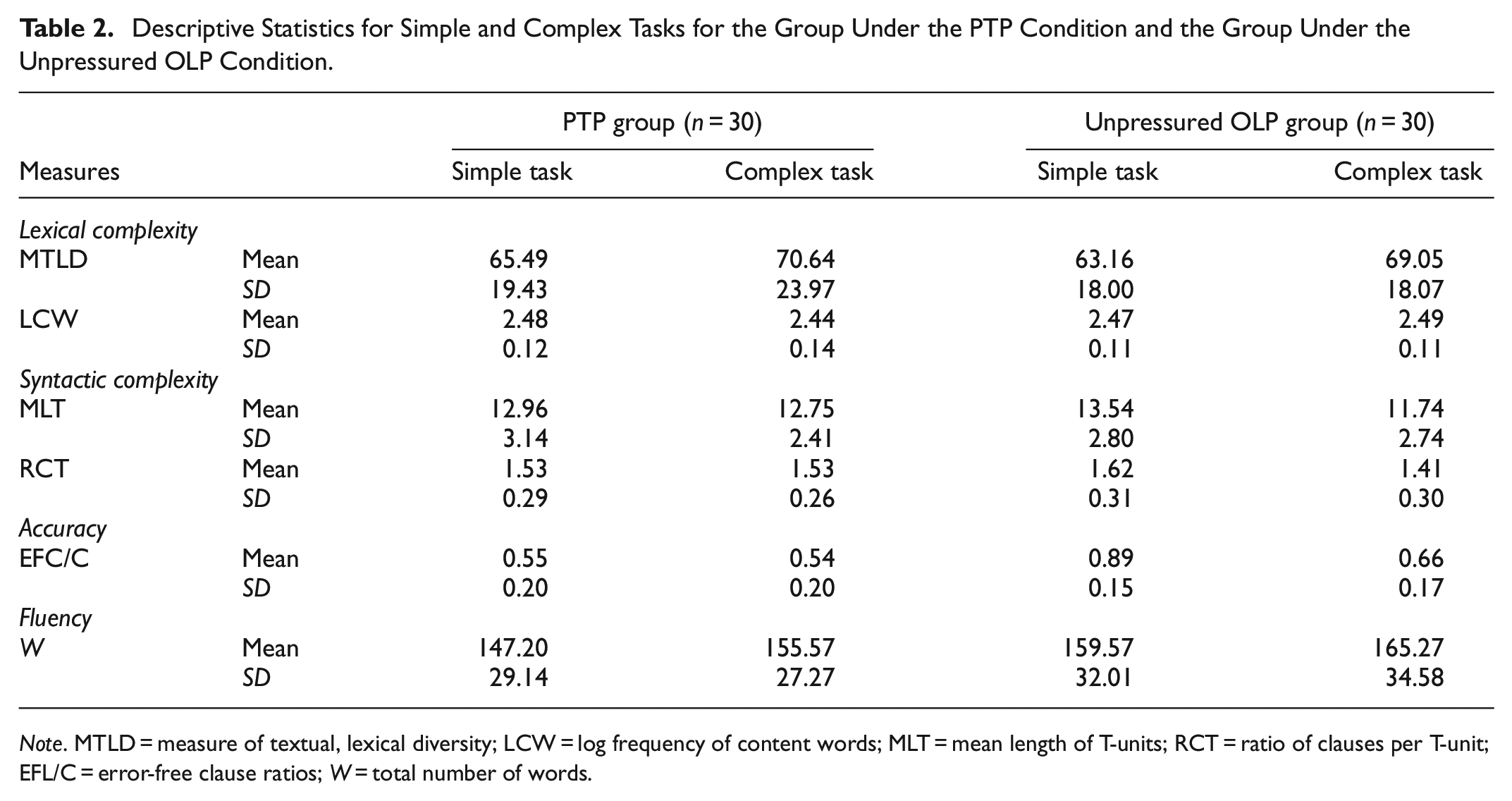
Note. MTLD = measure of textual, lexical diversity; LCW = log frequency of content words; MLT = mean length of T-units; RCT = ratio of clauses per T-unit; EFL/C = error-free clause ratios; W = total number of words.
Effects on Lexical Complexity
Mixed ANOVA showed no main effects of task complexity (p = .668, partial η2 = .003) and planning conditions (p = .503, partial η2 = .008) on LCW. There was also not an interaction between task complexity and planning conditions on LCW (p = .055, partial η2 = .062). In terms of lexical diversity, two Mann–Whitney tests demonstrated that PTP and unpressured OLP did not have significantly different effects on the MTLD of the simple task (Z = −.651, p = .515, r = .08) and the complex task (Z = −.059, p = .953, r = .01). Two Wilcoxon signed-rank tests showed that the students’ MTLD did not differ significantly in the simple versus complex task when they were under PTP condition (Z = 1.368, p = .171, r = .18). The same insignificant results were found when the students were under unpressured OLP condition (Z = −1.368, p = .171, r = .18). The results revealed that neither the different levels of task complexity nor the different types of planning conditions could have significant effect on lexical complexity, and lexical complexity production was not contingent upon the allocation of planning time.
Effects on Syntactic Complexity
Mixed ANOVA indicated neither main effects of task complexity (p = .023, partial η2 = .086) nor main effects of planning conditions (p = .808, partial η2 = .001) on RCT in student writing. Also, an interaction between task complexity and planning conditions on RCT was not found in this study (p = .021, partial η2 = .088), suggesting that neither the different levels of task complexity nor the different types of planning conditions could significantly influence the RCT of student writing. Moreover, RCT production was not contingent upon the allocation of planning time. Two Mann–Whitney tests showed that PTP and unpressured OLP did not have significantly different effects on the MLT of the simple task (Z = .577, p = .564, r = .07) and the complex task (Z = −1.227, p = .220, r = .16), indicating that different planning conditions did not lead to different MLT in either the simple task or the complex task. However, two Wilcoxon signed-rank tests revealed inconsistent results, with the one indicating that the students’ MLT did not differ significantly in the simple versus complex task when they were under PTP condition (Z = −.123, p = .902, r = .02) and the another indicating that the students’ MLT differed significantly in the complex versus simple task when they were under unpressured OLP condition (Z = 3.73, p = .000), with an effect size close to the large value (r = .48). The median score of MLT increased from the complex task (Md = 11.77) to the simple task (Md = 13.01). This result revealed that the students under unpressured OLP condition could compose writings with higher MLT in the simple task than the complex task.
Effects on Accuracy
Two Mann–Whitney tests showed a significant advantage of unpressured OLP over PTP regarding the EFC/C of the simple task (Z = 2.345, p = .000) and the complex task (Z = .133, p = .000), with effect sizes reaching the levels of medium (r = .30) and small (r = .02), respectively. In terms of accuracy for the group of students under PTP condition, a Wilcoxon Signed Rank Test showed that the students’ EFC/C did not differ significantly in the simple versus complex task when they were under PTP condition (Z = −.251, p = .802, r = .03). In contrast, to the group of students under unpressured OLP condition, a Wilcoxon Signed Rank Test revealed a statistically significant increase in the EFC/C of student writing (Z = 3.59, p = .000), with an effect size approximal to the benchmark of the large (r = .46). The median ratio of EFC/C increased from the complex task (Md = .655) to the simple task (Md = .885), suggesting that the latter could lead to better accuracy than the former. Taken together, the results indicated that the students under unpressured OLP condition composed writings with higher accuracy than did the students under PTP condition. Furthermore, the effects of unpressured OLP on accuracy were affected by task complexity in that it was much more beneficial to a simple task than to a complex one.
Effects on Fluency
Two Mann–Whitney tests revealed significant advantage of unpressured OLP over PTP in the total number of words of the simple task (Z = .710, p = .000, r = .09) and the complex task (Z = .163, p = .000, r = .02), and the effect sizes for both the tasks were small. Two Wilcoxon signed-rank tests found no significant difference in fluency from the simple task to complex task to the students under PTP condition (Z = 1.784, p = .074, r = .23) and from the complex task to simple task to the students under unpressured OLP condition (Z = .144, p = .885, r = .02). The results suggested that the students under unpressured OLP condition composed writings with higher fluency than did the students under PTP condition.
Discussion
This study explored whether there were differential effects between PTP and unpressured OLP on student writing since both planning conditions had distinctively potential benefits to a writing task, particularly to a relatively complex one. Regarding the first research question, the findings of this study did not reveal any advantages of either PTP or unpressured OLP in the complexity measure of student writing. However, for the measures of accuracy and fluency, the findings showed a significant difference between the two conditions, with the students under unpressured OLP condition outperforming the students under PTP condition. For the second research question, the results indicated that the effects of planning condition did not vary depending on task complexity.
These results were inconsistent with the results of Ghavamnia et al. (2013) and Rostamian et al. (2018) in which PTP led to higher complexity of student writing. Also, the results differed from Rahimpour and Safarie’s (2011) finding that PTP resulted in better fluency. However, the results were in line with some studies (e.g., Ellis & Yuan, 2004, 2005; Golparvar & Azizsahra, 2023; Liang & Xie, 2023) reporting that unpressured OLP was more beneficial to accuracy than PTP.
First, one reason for the advantage of unpressured OLP in accuracy was that it could offer students additional time to access their explicit knowledge of language, which could lead to better accuracy through editing or monitoring language production than implicit knowledge of language (Ellis, 2005). Together with monitoring process, unpressured OLP can influence the formulation stage to enable students to produce writings of better accuracy (Ellis, 1987; Hulstijn & Hulstijn, 1984; Yuan & Ellis, 2003). In contrast, when students were under PTP condition where they were provided limited time to write, they could tend to access their implicit knowledge of language (DeKeyser, 2003). Second, based on Hayes’s (2012) writing process model, unpressured OLP may help improve accuracy in student writing through triggering the proposer, translator, and evaluator processes and increasing the numbers of them; however, when students are pressured to write under PTP condition, they were less likely to enhance accuracy since they do not have sufficient time that was needed for them to benefit from monitoring, revising and editing their writings of the translation process (Abdi Tabari, 2017; Golparvar & Azizsahra, 2023), Similarly, in light of Skehan’s (1998) dual-mode system proposal, unpressured OLP may also free students from any pressure imposed on them while writing and enable them to reach the rule-based system where they can access their linguistic knowledge and use it to promote accuracy, whereas students under PTP condition may find it hard to reach the system because of insufficient time and attention. Third, the finding of Rostamian et al. (2018) study could also provide an explanation about the positive role of unpressured OLP on accuracy. According to that study, the students under unpressured OLP condition demonstrated more instances of self-repair for written errors during translation process than the students under PTP condition, leading to the better accuracy of writings produced by the students under unpressured OLP condition. In terms of L2 writing pedagogy, teachers should pay attention to the manipulation of cognitive aspects of writing because different planning conditions can have different effects on student writing.
This study did not observe more significant effects of the PTP on syntactic and lexical complexity of student writing than unpressured OLP. The possible reasons for this finding might be as follows. First, referring to Hayes’s (2012) model of text processing, students can use the 10-min planning time to propose and retrieve useful sentence structures and vocabularies. This can help relieve the pressure on their working memory during translator and transcriber stages so that they are likely to use more attentional resources to produce relatively complex writings. However, this potential advantage was not found in the study. One possible explanation might be that EFL students’ mentally conceived vocabularies and structures are inherently insufficient in terms of capacity, completeness, and organization (Skehan, 2009), so it was difficult for them to make proposed vocabularies and structures accessible in translator stage (Temple, 2000). Second, the students’ use of L1 during the planning time might have a negative impact on the syntactic and lexical complexity in their writing. All students in this study used their L1 to take notes during the planning time although they were told to choose either L1 or L2 prior to the study. It could be predicted that they might have difficulty encoding their notes into written texts in the translator and transcriber stages due to their limited L2 proficiency, which led to a decay in writing complexity. Third, the other possibility about the ineffectiveness of PTP on writing complexity was that the students in this study did not receive training on how to plan their writings. Elder and Iwashita (2005) claimed that training in how to effectively use planning time enhanced L2 students’ speaking complexity. In L2 writing domain, researchers have been stressing the importance of such training in improving writing complexity (e.g., Ellis, 2022; Kellogg, 2008). Particularly, Ellis (2022) pointed out that researchers tended to assume that students may know how to plan, but in fact they do not have experience in doing it. It was also noted that such training benefits EFL students with limited L2 writing proficiency (Gauthier, 2007). Therefore, lacking such training may prevent the students in this study from producing more complex writings.
In addition, the result of this study was inconsistent with the result of Liang and Xie’s (2023) study finding the advantage of unpressured OLP over PTP in syntactic complexity of student writing. A possible explanation might be that in Liang and Xie study the students were asked to do collaborative planning prior to writing, while the students in the present study were asked to do individual planning. The development of syntactic complexity requires students to elaborate on their interlanguage system (Skehan, 1996), which can be extended when students share linguistic knowledge through collaborative planning. Fourth, Skehan and Foster’s (2001) Limited Attentional Hypothesis, which is based on information processing theory, posits that trade-off effects derived from learners’ limited attentional resources could make it hard for them to simultaneously focus on complexity, accuracy, and fluency of language production. Thus, it might be assumed that the students under unpressured OLP could only improve the accuracy and fluency of their writings at the cost of complexity, which would serve as the reason for the insignificant effects of unpressured OLP on the students’ writing complexity. Lastly, the characteristics of writing task might be the other reason for the result. In Ghavamnia et al. (2013) and Rostamian et al. (2018) studies, the students were asked to compose a narrative writing task based on a set of pictures; however, in the present study, the students were asked to compose a narrative writing task and an argumentative one. Although both the two studies and the present study adopted a narrative task, they were different in that the present study only offered a writing topic, without any pictures given. It might be possible that students could compose more complex writings when being required to do a narrative writing task based on pictures.
In addition to the effects of planning conditions, this study also revealed that the students under unpressured OLP had better accuracy in the simple task than the complex one. A possible explanation might be that, regarding a complex task, insufficient attentional resources caused by relatively higher pressure would make it hard for students to produce writings with appropriate level of accuracy (Frear & Bitchener, 2015), although students under unpressured OLP had relatively ample time to engage in the task. In other words, the potential advantages of unpressured OLP might be offset by the difficulty of a complex task. In contrast, a simple task might help relieve students’ working memory capacity so that they are more likely to retrieve linguistic resources stored in their language knowledge pool to produce writings with higher accuracy, and such superiority of a simple task to a complex one could be augmented by unpressured OLP. Referring to L2 writing, teachers should be aware of the role of task complexity in writing instruction and assigning writing tasks through appropriate sequence. Specifically, when sequencing tasks, teachers may want to take into consideration cognitive demand imposed on the tasks since simple tasks tend to be more beneficial to writing accuracy and syntactic complexity than do complex tasks.
In terms of fluency, two explanations can address why unpressured OLP could result in better fluency in student writing than PTP. First, Chinese EFL students under unpressured OLP condition may be characterized as students who are accustomed to simultaneously dealing with planning and writing processes (Wang & Wen, 2002), which can then arm them with higher automaticity than their counterparts under PTP condition through reducing cognitive demand imposed on them. This automaticity makes it more likely for the students to access their procedural linguistic knowledge and may lead to better fluency. Second, as claimed by Ortega (1999), students under unpressured OLP condition are more likely to produce writings with better fluency than students under PTP condition because the former group of students tended to focus on meaning, whereas the latter group of students tended to focus on form.
Conclusion
The purpose of this study was to examine the effects of PTP and unpressured OLP on CAF measures of student writing, and whether such effects varied depending on task complexity. The findings of the study revealed that there were no differential effects of PTP and unpressured OLP on complexity measure; however, unpressured OLP seemed to be more helpful than PTP for the improvement of accuracy and fluency measures. Furthermore, the study did not find interaction between planning conditions and task complexity. In sum, unpressured OLP could facilitate writing accuracy through enhancing the likelihood of retrieving explicit linguistic knowledge, accessing the rule-based system, and increasing the numbers of proposer, translator, and evaluator. It could also be conducive to students’ writing fluency because of some characteristics inherent in students under this planning condition. In contrast, the insufficiency of mentally conceived vocabularies and structures and training and the use of L1 in PTP were among the possible reasons why PTP did not result in better complexity in writing. However, it should be acknowledged that the participants of this study were EFL students with low-intermediate English proficiency and the genre of the writing task was argumentative essays with 120 words, so the findings of this study should be cautiously generalized to other instructional contexts.
Several limitations in this study should be noted. First, this study only investigated immediate effects of planning conditions, so future research can use longitudinal design to investigate long-term effects of such conditions on student writing. Second, future research should delve into what students actually do when they are under various planning conditions to perform writing tasks of different complexity levels because such research can help explore how students do writing tasks cognitively and affectively (Johnson & Abdi Tabari, 2023). Third, it should be acknowledged that the students’ low-intermediate English proficiency level might prevent them from benefiting from PTP condition. The condition experienced by students with more advanced proficiency level might lead to different effects on their writing.
Footnotes
Appendix 1
Simple Task: Write an essay about your interest, expectation, and purposes of studying abroad.
Complex Task: Study abroad can be beneficial to students, but it can also bring about some challenges that they may go through. What do you think benefits and challenges of studying abroad? You should use reasons to back up your argument.
Declaration of Conflicting Interests
The author(s) declared no potential conflicts of interest with respect to the research, authorship, and/or publication of this article.
Funding
The author(s) disclosed receipt of the following financial support for the research, authorship, and/or publication of this article: This work was supported by the Funding of Post-doctoral fellow research at Zunyi Medical University under Grant FB-2022-2.
Ethical Approval
The ethics issue is not applicable to the country where the study was conducted.

Data Availability Statement
The data of this study are available upon request.