




Abstract
As organizations search for low-cost and complementary resources and capabilities from external partners, the development of strategic outsourcing becomes an increasingly complex task. Without having well-developed outsourcing processes and task complexity management capabilities in place, opportunities for improvement of outsourcing practices are largely unrealized. This study aims to investigate the influence of task complexity on outsourcing practices and explore the appropriate supplier management approaches for managing outsourcing task complexity. This study suggests a research model that addresses the moderating roles of supplier governance and supplier development in the relationship between task complexity and outsourcing performance. We collected data from Chinese manufacturing firms to test the proposed hypotheses. The results of this study reveal that: (1) task complexity negatively relates to outsourcing performance; (2) both contractual and relational governance play an important role in weakening the negative effect of task complexity on outsourcing performance; (3) supplier development also weakens the negative effect of task complexity on outsourcing performance. The findings of this study provide valuable insights into the ways that firms operating in China manage task complexity effectively and achieve desired outsourcing performance.
Introduction
Mobilizing the resources and capabilities of external partners has increasingly become important in the promotion of manufacturing firms’ operational efficiency and innovation capability (Kang et al., 2021). Previous studies have also emphasized the benefits of outsourcing, such as cost reduction, improved productivity, product quality, strategic focus, and quick access to new technology (Kotabe et al., 2008; Le Bon & Hughes, 2009; Lee et al., 2018). Despite its various potential benefits, outsourcing also incurs numerous risk factors such as the loss of internal know-how, the loss of control over outsourced activities, suppliers’ opportunism, and overlooking hidden costs (Lair, 2019; Lee et al., 2017; Li, Lee et al., 2017). Thus, contracting out internal tasks to external partners inherently includes simultaneous benefits and risks. Previous studies related to outsourcing have also provided inconsistent results regarding the effects of outsourcing (e.g., positive effects (Bengtsson et al., 2009), negative effects (Bengtsson et al., 2009; Hoecht & Trott, 2006), and negative curvilinear effects (Grimpe & Kaiser, 2010; Kotabe & Mol, 2009; Un & Rodríguez, 2018)) due to the pros and cons of outsourcing, and the contextual differences associated with outsourcing activities (Awe et al., 2018; Kang et al., 2012). Such inconsistent results call for further research to clarify the critical antecedent and contextual factors that influence effective outsourcing. Especially, the effective management of risk factors due to outsourcing is important for achieving expected outsourcing performance.
Given the increasing complexity of outsourcing tasks due to product variety and complexity in manufacturing sectors (Shou et al., 2017), this study focuses on outsourcing task complexity as a critical risk factor. Higher task complexity indicates higher uncertainty (Jayaraman & Liu, 2019; Li, Lee et al., 2017), resulting in increases in transaction costs, and provoking supplier opportunism, which offsets the cost savings and quality improvements pursued in outsourcing (Liu et al., 2017). Therefore, the higher the task complexity, the more negative its impact on outsourcing performance (Zhang et al., 2018). Outsourcing has increasingly been becoming a strategic tool to obtain cost and operational efficiency through utilizing the economies of scale of suppliers as well as accessing external partners’ strategic resources (Park et al., 2018). But, without the proper handling of outsourcing task complexity, the potential for outsourcing risk can increase, resulting in operational inefficiency, high coordination costs, and disappointing outsourcing performance. From the perspective of the transaction cost theory (TCT), complexity leads to behavioral uncertainty that can further lower inter-firm collaboration performance outcomes (McIvor, 2009; Schneider et al., 2013; Williamson, 2008). Thus, the task complexity-outsourcing performance relationship can be explained by TCT. Further, this study suggests that supplier management can be used to mitigate the transaction costs (behavioral uncertainty) of complex outsourcing transactions, thereby resulting in desired outsourcing performance. Specifically, the concept of supplier management in this study includes supplier governance (i.e., contractual and relational governance) and supplier development. Drawing on TCT, this study aims to examine the negative effect of outsourcing task complexity on outsourcing performance and suggest effective ways of managing task complexity by examining the contingent role of supplier management in the relationship between task complexity and outsourcing performance.
Figure 1 presents a conceptual research model that illustrates the proposed relationships between outsourcing task complexity, outsourcing performance, and supplier management (i.e., supplier governance and development). Drawing on empirical findings combined with a literature review, this study explores the important role of supplier management in reducing the uncertainties that occur from outsourcing task complexity to achieve the expected outsourcing performance. In particular, this study empirically examines the proposed research model by focusing on the outsourcing practices of manufacturing firms operating in China. The major criteria for outsourcing decisions include cost arbitrage, availability of skillful manpower and technological capability, and infrastructure (Parmigiani, 2007; Ruamsook et al., 2009; Wieland et al., 2020). Since China scores high on these criteria and has become one of the attractive global sourcing destinations (Lee et al., 2017), it is interesting and meaningful to study outsourcing relationship management in the context of China. This specific empirical context also can make an important contribution to the extant literature mainly developed from the perspectives of advanced economies.
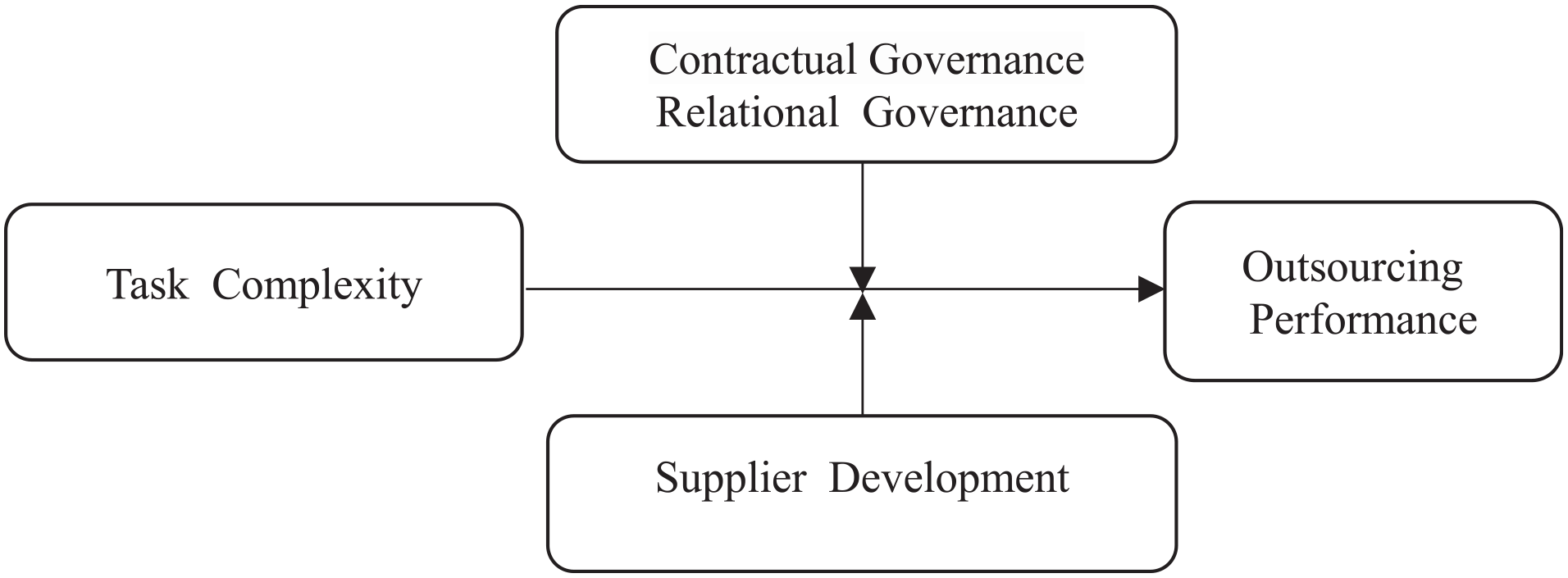
Conceptual research model.
Theoretical Background and Hypotheses Development
Task Complexity and Outsourcing Performance
The task complexity of outsourcing practices consists of task difficulty and task variability (Bai et al., 2010). The former can be defined as the degree of complexity of the decision-making process and the latter as the numbers and types of exceptional tasks that require different procedures (Bai et al., 2010). Task complexity is a critical concept in determining whether to use outsourcing or insourcing and directly relates to the difficulties of monitoring outsourcing activities and measuring performance due to high levels of information load and uncertainty (Bai et al., 2010; Handley & Benton, 2013). The more complicated the outsourcing task, the more difficult it is to standardize, the greater the required expertise is to perform the task, the more different departments are interdependent, and the more difficult it is to predict performance (Bai et al., 2010). From the perspective of TCT, the risk of opportunism in the inter-organizational relationship is greater in the presence of uncertainty (Williamson, 1979). The higher the complexity of the task, the harder it is to complete a contract, and the higher the possibility of suppliers’ and partners’ opportunism resulting from the inability of the performance-reward system to operate effectively in the transaction (Poppo & Zenger, 2002). Furthermore, the completion of complex tasks requires increased information, communication, and cooperation, resulting in higher transaction costs (Handley & Benton, 2013). On the contrary, lower complexity simplifies outsourcing tasks through routine processes which are characterized by precise specifications and requirements for quality assurance on the contract (Sen & Shiel, 2006). Due to the above factors, the higher the task complexity, the lower the outsourcing performance is, which reduces the benefits of outsourcing. Also, existing studies have found that task complexity negatively influences the degree of outsourcing satisfaction (Zhang et al., 2018). Based on the above literature review and existing research results, we propose the following hypothesis:
Hypothesis 1: Task complexity is negatively associated with outsourcing performance.
The Moderating Effect of Supplier Governance
Existing studies have found that governance mechanisms can be divided into two categories: contractual governance and relational governance. Contractual governance is specified in the form of written agreements and refers to the extent to which exchange partners rely upon these written agreements (Abdi & Aulakh, 2017). It emphasizes the use of formal and legally binding agreements and contracts to govern inter-organizational relationships (Lee & Cavusgil, 2006; Lee et al., 2018). As a vital safeguard in inter-organizational transaction relationships, contractual governance executes its control, coordination, and adaptation functions (Schepker et al., 2014; Weber & Mayer, 2011) through formal structure and third-party enforcement (Yan & Zhang, 2020). The control function operates through the responsibility and obligation of both parties and has specific clauses of penalties for performing opportunistic actions (Cavusgil et al., 2004). The more complicated the contract, the more specifically it reflects the commitments, obligations, and conflict resolution procedures. TCT argues that contractual governance, which is written and implemented for all risk factors, is an effective mechanism for controlling risks and opportunistic behaviors by providing criteria for both parties in a transaction (Carson et al., 2006; Liu et al., 2009).
The contractual functions provide a basis for mutual post-negotiation, leading to effective negotiation results (Cheng et al., 2021). Thus, a precise contract is more likely to prevent renegotiation costs responsibilities, and obligations will be fulfilled. It promotes mutual relationships and elicits cooperation through a flexible coordination framework (Schepker et al., 2014). The primary characteristics of task complexity are the complexity of the decision-making process and the number of exceptional cases, which are likely to be somewhat moderated by the control and coordination functions of the contract. One of the characteristics of task complexity is the difficulty in measuring performance due to uncertainty and decision complexity (Bai et al., 2010). When performance measurement is easy, the outsourcer firm can provide an effective performance-rewarding system to motivate the outsourcing supplier. Conversely, when measurements of performance are complex and uncertain, the supplier’s motivation to effectively implement the contract requirements is reduced due to unclear criteria. However, if the outsourcers indicate clear measurements of performance in the contract, detailing both parties’ responsibilities and obligations, the difficulty of performance measurement could be reduced to some extent (Fjermestad & Saitta, 2005). Furthermore, by specifying the clauses of post-negotiation to the parts of the contract, suppliers’ opportunistic behaviors that occur from outsourcing tasks with high complexity can be reduced (Cheng et al., 2021), develop partnerships (Lee et al., 2018) and provide a basis for future negotiation (Cheng et al., 2021). Thus, the negative impact of task complexity on outsourcing performance can be moderated by the control and coordination of contractual governance. In other words, the negative impact of task complexity on outsourcing performance may be weakened by increasing contractual governance. Thus, we propose the following hypothesis:
Hypothesis 2: The relationship between task complexity and outsourcing performance is moderated by contractual governance, such that the negative relationship is lower as utilization of contractual governance increases.
Besides uncertainty, the bounded rationality of human beings is another key issue in TCT (Williamson, 1979). Although formal contracts play an important role in inter-organizational collaboration, both parties cannot consider all possible conditions due to bounded rationality, especially for complex tasks (Handley & Benton, 2013). Scholars have also observed that inter-organizational transactions are to some extent influenced by relational factors (Handley & Benton, 2013; Poppo & Zenger, 2002). Relational governance is the degree to which an outsourcing relationship is governed by trust and relational norms (Poppo et al., 2008). Relational governance originates from the values and agreement upon processes in social relationships where repeated inter-organizational transactions are embedded (Lu et al., 2015). Although previous studies have used various dimensions to explain relational governance, trust and relational norms are most commonly used (Poppo & Zenger, 2002; Wallenburg & Schäffler, 2014). Trust can be defined as faith in each other’s integrity, credibility, and benevolence in a risk-potential exchange relationship (Cao & Lumineau, 2015). Trust has been used as an important indicator in supply chain relationships. The trust built between parties can improve inter-organizational exchange performance, reduce negotiation and monitoring costs, and produce mutually beneficial agreements (Khalfan et al., 2007). In inter-organizational transactions, parties confirm their credibility by demonstrating their engagement in transaction relationships by fulfilling obligations and inputs (Lambe et al., 2001). Thus, they must follow the reciprocity principle; otherwise, they will be punished in social relationships (Cropanzano & Mitchell, 2005). Consequently, trust derived from social interaction and socially embedded relationships can be effective for inter-organizational relationships (Liu et al., 2009). A relational norm is a shared expectation of the actions of both parties in a transaction, which provides a reference for enterprises to act in a manner that meets expectations (Lu et al., 2015). Relational norms include flexibility, solidarity, and information exchange (Huo et al., 2016). Flexibility emphasizes the ability to adapt to future situations, solidarity emphasizes joint responsibility and benefits, and information exchange emphasizes information symmetry (Huo et al., 2016).
In contrast to contractual governance, relational governance performs control and coordination functions through self-enforcement driven by trust and relational norms (Yan & Zhang, 2020). Buyers’ trust in suppliers can reduce opportunistic supplier behavior through psychic costs and motivate both parties to achieve maximum competitive advantage. Mutual trust can reduce negotiation and monitoring costs, and produce reciprocal agreements (Khalfan et al., 2007). Information exchange in relational norms can decrease information asymmetry problems which can minimize transaction costs. Solidarity and flexibility elicit bilateral engagement and cooperation by ensuring timely problem resolution and mutual coordination, which may positively influence performance (Wang et al., 2020). It is challenging to measure and standardize performance based on task complexity, requiring interdependence between various departments and expertise. Complexity requires effective communication, active cooperation, and timely responsiveness between buyers and suppliers. In this situation, relational governance is expected to moderate the above problems by reducing opportunism through trust, transferring knowledge through information sharing, cooperation through solidarity, and timely responses through flexibility (Wallenburg & Schäffler, 2014). Consequently, through the above roles of relational governance, the provision of aligned incentives (Krishnan et al., 2006), responsibilities, and obligations, would reduce uncertainty, minimize losses arising from transaction risk, and thereby moderate the negative impact of task complexity on outsourcing performance. In other words, the negative impact of task complexity on outsourcing performance would be weakened as the level of relational governance increases. Thus, we propose the following hypothesis:
Hypothesis 3: The relationship between task complexity and outsourcing performance is moderated by relational governance, such that the negative relationship is lower as the utilization of relational governance increases.
The Moderating Effect of Supplier Development
The term “supplier development” was first used by Leenders (1966), who defined it as a manufacturer’s activities to secure a potential supplier base and improve supplier performance. To support the sustainable development of enterprises, buyers should maintain long-term cooperation with suppliers to continuously upgrade and improve suppliers’ technology, quality, delivery, and price competitiveness (Li, Kang et al., 2017). In the short term, buyers can provide limited support, such as formal supplier evaluation to improve performance (Carmeli et al., 2021; Li et al., 2012). In the long term, buyers can provide proactive support, such as the training and education of suppliers’ human resources departments and investment in the supplier’s operating system (Khan & Nicholson, 2014; Mohanty et al., 2014). In terms of transaction mutual interrelationships, supplier development is driven by buyers because of tangible benefits such as improved cost savings, quality, flexibility, and delivery (Li, Kang et al., 2017). Buyers obtain these benefits by investing directly in information sharing, technical support, training, and the supplier’s operating system. In return, the supplier will allocate human resources toward information sharing and improvement activities and invest in specific equipment. This process enables both parties to benefit from each other and improve supply chain performance by building stable and long-term relationships (Busse et al., 2016). Supplier development enables buyers to continuously receive valuable products and services from suppliers and effectively conduct time-based strategies, such as just-in-time, flexibility, and inventory management (Golmohammadi et al., 2018). Accordingly, supplier development can be defined as “buyer’s activities for upgrading and continuously improving supplier technology, quality, delivery and price competitiveness in outsourcing transactions” (Lee et al., 2018).
Supplier development can be used to reduce the uncertainties of complex outsourcing transactions. Supplier development is motivated by continuous improvements in the flow of quality products and optimal transaction processes with suppliers (Lee et al., 2018). Thus, supplier development may increase the efficiency of particularly complex outsourcing transactions through the improved technological and operational capabilities of suppliers. Also, supplier development can be viewed as a transaction-specific investment from the perspective of TCT (Lee et al., 2018; Li et al., 2012). This transaction-specific investment can generate a lock-in relationship in which the value is only present in the relationship between particular transaction partners. Therefore, investing in transaction-specific supplier development may increase the incentive to maintain long-term relationships that can help reduce suppliers’ behavioral uncertainty and deal with the decision-making difficulties of complex outsourcing tasks. Thus, supplier development is expected to moderate the negative impact of task complexity on outsourcing performance to some extent. We propose the following hypothesis.
Hypothesis 4: The relationship between task complexity and outsourcing performance is moderated by supplier development, such that the negative relationship is lower as a firm invests in supplier development.
Research Method
Samples
This study focuses on outsourcing transaction relationships and targets manufacturing firms performing outsourcing practices in China. To collect reliable data, we hired a professional and reputable marketing research firm that has provided online survey services to many Chinese universities for academic research and large companies such as Ford, Walmart, McKinsey & Company, Huawei, and the Bank of China. To collect data from reliable sources, we required the marketing research firm to only survey those who could provide information on the two types of outsourcing: manufacturing and R&D. Participants included top and middle managers from the departments of production, R&D, purchasing, and quality control. We dropped the responses that were considered as completed too quickly (i.e., under 240 seconds) to remove haphazard responses. All respondents were required to evaluate the outsourcing practices and relationships with their key suppliers in the outsourcing transaction that is most familiar to them. Since China’s economic development across regions is uneven, we collected data primarily from manufacturing firms located in the coastal areas that best represent China’s national economy (Huo et al., 2015). The marketing research firm sent 2268 emails to those who met the conditions of the survey. Of this, 252 responses were collected, but 8 responses were dropped due to insincerity, resulting in 244 usable responses with a response rate of 10.8%. Table 1 presents the summary of the frequency analysis for respondents.
Company Profile.

Measurement
This study hypothesizes and presents a research model to verify the effect of task complexity on outsourcing performance and to examine the moderating effects of contractual governance, relational governance, and supplier development. Based on the items used in the research conducted by Narayanan et al. (2011), considering outsourcing contexts in China, we measure task complexity with seven items: (TC1) Necessity of cooperation among different departments, (TC2) Necessity of expertise in different fields, (TC3) Difficulty of standardization, (TC4) Frequency of the occurrence of difficult problems, (TC5) Time spent in problem resolution, (TC6) Result predictability, and (TC7) Time required to confirm success.
The outsourcing performance is measured by seven items based on a study conducted by Handley and Benton (2009): (OP1) Cost reduction, (OP2) Quality, (OP3) Delivery date, (OP4) Reliability, (OP5) Responsiveness to market change, (OP6) Innovation speed, and (OP7) Overall outsourcing performance.
Based on governance studies conducted by Abdi and Aulakh (2017) and Lee and Cavusgil (2006), we measure contractual governance by six items: (CG1) Degree of compliance with official written contracts, (CG2) Degree of agreement specification, (CG3) Degree of responsibility and rights specification, (CG4) Degree of specification of the corresponding strategy to exceptional situations, (CG5) Degree of specification of conditions and responsibility for defaults, and (CG6) Degree of penalty for non-achievement.
According to the items used in governance studies conducted by Cochet et al. (2008) and Abdi and Aulakh (2017), relational governance is measured by six items: (RG1) Degree of responsiveness to change, (RG2) Degree of influence through informal norms and procedures, (RG3) Degree of short-term and long-term plan sharing, (RG4) Degree of information supply, (RG5) Degree of suggestion consideration, and (RG6) Degree of trust.
Based on the study by Liao et al. (2010), supplier development is measured by six items: (SD1) The improvement of supplier capability through strategic investment, (SD2) Supplier performance evaluation, (SD3) Performance encouragement, (SD4) Training and education, (SD5) Strategic partnerships, and (SD6) Technology support.
In this study, a 7-point Likert scale ranging from 1 (“strongly disagree”) to 7 (“strongly agree”) was used. The scale used in this study was developed in English based on previous research and was then into Chinese. The Chinese questionnaire was reviewed by three experts and was then translated back into English to ensure language consistency. Before conducting the survey, we further revised the Chinese questionnaire through a pre-survey test involving 10 purchasing managers to ensure understanding in a Chinese context.
The control variables of firm size, annual sales volume, outsourcing type, and relationship length were included in our research model. The firm size and annual sales volume are associated with resource availability (Gualandris & Kalchschmidt, 2014), and may influence inter-organizational collaboration performance. Firm size was measured by the natural logarithm of the number of employees. Sales volume was measured on a scale from 1 (i.e., less than 5 million RMB) to 4 (i.e., more than 300 million RMB). Outsourcing type was measured by a dummy variable: 0 = manufacturing outsourcing; 1 = R&D outsourcing. The relationship length was measured as the period of a manufacturing firm’s outsourcing of tasks to a major supplier.
Reliability and Validity
In this study, we conducted an exploratory factor analysis and used Cronbach’s α to refine measurement items and assess the reliability. After removing those items with low factor loading values, the results of subsequent exploratory factor analysis revealed a five-factor structure. As presented in Table 2, Cronbach’s α values are larger than .814, indicating satisfactory reliability of measurement (Nunnally, 1978). We conducted a confirmatory factor analysis to assess the convergent validity of constructs. The model fit indices are CMIN/DF = 1.501, GFI = 0.910, NFI = 0.934, RFI = 0.922, IFI = 0.977, TLI = 0.972, CFI = 0.977, and RMSEA = 0.045, indicating a good model fit. All the factor loadings are larger than 0.719 (Table 2), demonstrating good convergent validity. To assess the discriminant validity, we conducted an average variance extracted (AVE) analysis according to Zaiţ and Bertea (2011). As shown in Table 3, all the square roots of the AVE values are larger than the corresponding correlations, demonstrating good discriminant validity.
Results of Confirmatory Factor Analysis and Reliability Analysis.

Correlations and AVE.

p < .01.
Further, we conducted Harman’s one-factor test to assess the common method variance (Hochwarter et al., 2004). The results of the exploratory factor analysis showed that five distinct factors with eigenvalues above 1.0 explained 72.094% of the total variance and the first factor explained 18.574% of the variance, indicating that common method variance is not a serious problem in this study.
Results of Analysis
We examined the hypothesized relationship by conducting a regression analysis. Table 4 shows the results of the regression analysis. Model 1 includes the control variables and independent variable (i.e., task complexity) to investigate its relationship with outsourcing performance. Models 2, 3, and 4 examine the moderating effects of contractual governance, relational governance, and supplier development on this relationship respectively. Regarding the control variables, the results reveal that relationship length is positively associated with outsourcing performance, but firm size, sales volume, and outsourcing type do not have a statistically significant effect.
Hierarchical Regression Analyses.
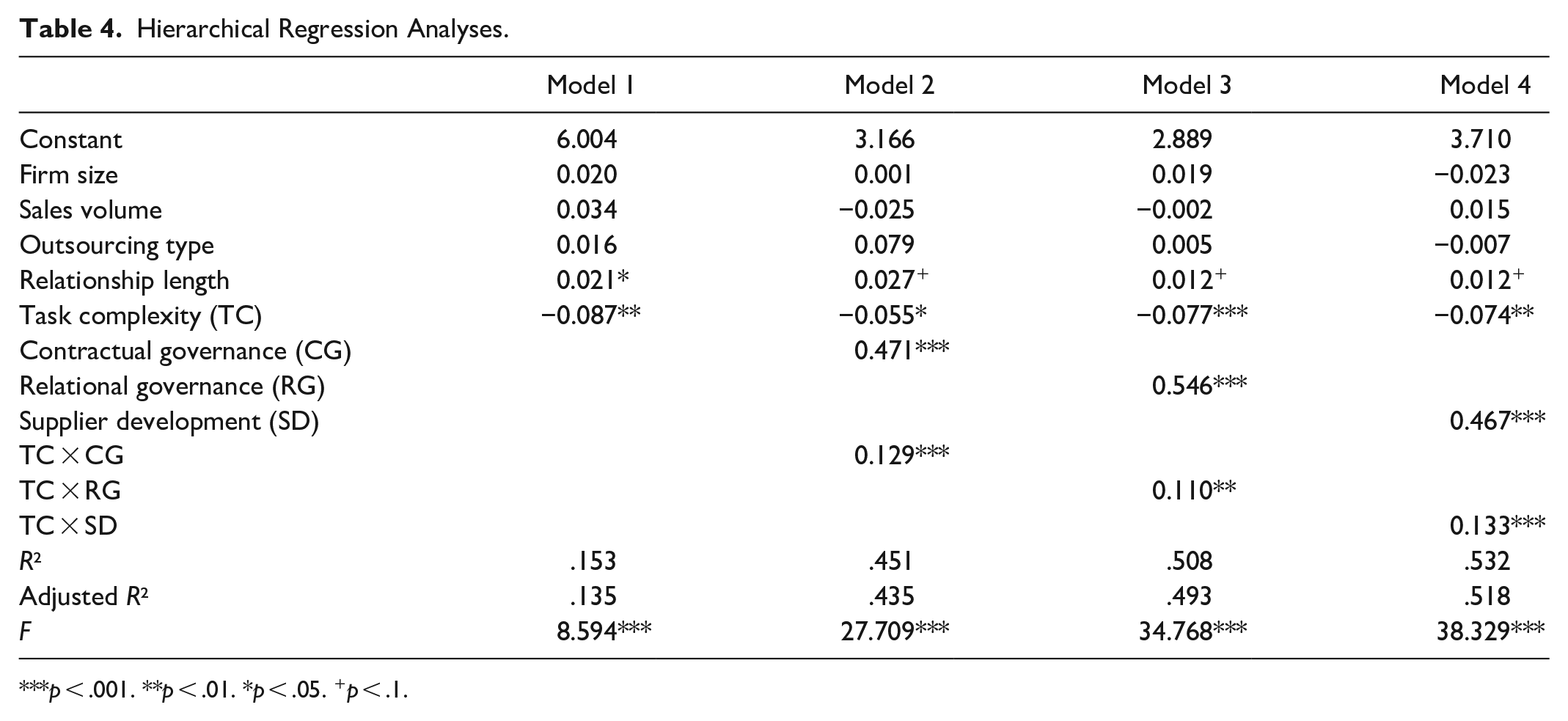
p < .001. **p < .01. *p < .05. +p < .1.
Hypothesis 1, which proposes that task complexity would be negatively related to outsourcing performance, was supported (regression coefficient = −0.087, p < .01 in Model 1). Hypothesis 2, 3, and 4 predict that contractual governance, relational governance, and supplier development would positively moderate the negative relationship between task complexity and outsourcing performance. The results show that Hypothesis 2 (regression coefficient = 0.129, p < .001 in Model 2), Hypothesis 3 (regression coefficient = 0.110, p < .01 in Model 3), and Hypothesis 4 (regression coefficient = 0.133, p < .001 in Model 4) were respectively supported. Additionally, we plotted the figures to illustrate the moderating effects. Figures 2 to 4 show that the negative relationship between task complexity and outsourcing performance is clear when the contractual governance, relational governance, and supplier development are low, while the slopes of the relationship are flat or even positive when the three moderating variables are high. These results demonstrate that contractual governance, relational governance, and supplier development moderate the negative effect of task complexity on outsourcing performance.
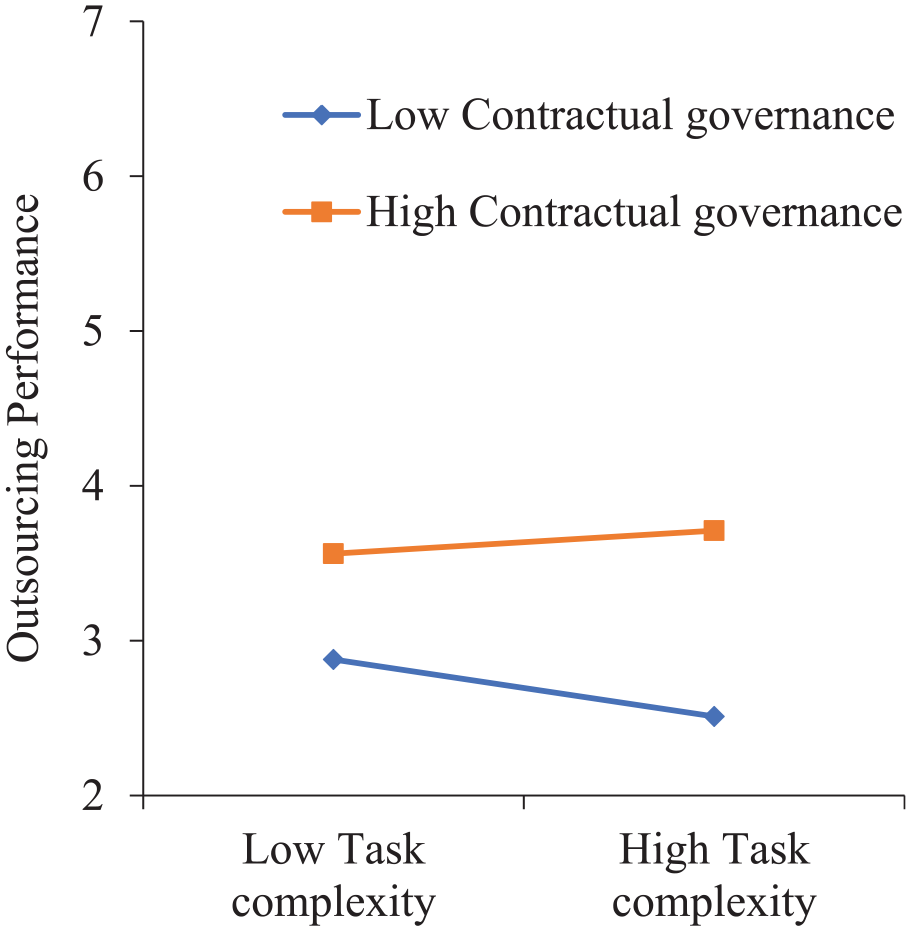
The moderation effect of contractual governance.

The moderation effect of relational governance.

The moderation effect of supplier development.
Discussions
Theoretical and Practical Implications
This study focused on the outsourcing activities of manufacturing firms operating in China and examined the moderating role of supplier management on the link between task complexity and outsourcing performance. The findings of this study extend those of previous studies, which have mainly focused on the antecedents of outsourcing (Kotabe & Murray, 1996), benefits and risks of outsourcing (Bengtsson et al., 2009; Hoecht & Trott, 2006; Kotabe & Mol, 2009; Un & Rodríguez, 2018), and outsourcing processes (Handley & Benton, 2009; Selviaridis et al., 2011). Despite that the increasing complexity of outsourcing tasks in the manufacturing sector is considered a potential risk factor, there is a lack of clear understanding of how a firm manages and reduces such risks occurring from outsourcing task complexity. The findings of this study provide valuable insights into how manufacturing firms manage task complexity effectively to achieve the desired outsourcing performance.
A key finding of this study is that outsourcing task complexity has negative effects on outsourcing performance, which is in line with the previous studies that addressed the harmful effects of task complexity in outsourcing practices (Handley & Benton, 2013; Larsen et al., 2013). Drawing on the perspectives of TCT, this study suggests that the complexity of outsourcing tasks increases uncertainties in the inter-organizational collaboration that leads to difficulties in measuring performance, efficient operations, and decision making, thereby resulting in high transaction costs and unexpected outsourcing performance. Thus, firms applying an outsourcing strategy need to not only weigh the economic and strategic benefits of outsourcing but also carefully understand the possible risk factors stemming from task complexity and apply appropriate supplier management measures to moderate and reduce the negative impact of these risks.
More importantly, supplier governance (contractual governance and relational governance) and supplier development play distinct roles in moderating the negative effects of outsourcing task complexity. First, this study finds the negative relationship between task complexity and outsourcing performance is significantly reduced with the implementation of supplier governance. Well-designed and implemented contract governance is a useful measure to prevent and reduce suppliers’ behavioral uncertainties occurring from task complexity by ensuring clarity in outsourcing goals, processes, responsibilities, obligations, and specifications. These findings are broadly consistent with previous literature (Abdi & Aulakh, 2017; Lee et al., 2017; Lu et al., 2015), which emphasizes the important role of contractual governance in handling uncertainty and partners’ opportunism. Especially in the relatively high level of environmental uncertainty in transient economies such as China (Li, Lee et al., 2017), contractual governance may play a more important role in handling the task complexity of outsourcing relationships. Second, this study suggests relational governance plays an important role in moderating the negative impact of task complexity on outsourcing performance. Due to the uncertain nature of complex outsourcing tasks and the bounded rationality problem, the entirety of the outsourcing practices may not be clearly specified in the contract (Handley & Benton, 2013; Lu et al., 2015). Thus, although contractual governance is important, it may not be enough to remedy issues resulting from complex outsourcing tasks. Specifically, China is well known as a relationships-based society. In this context, it is important to cultivate trusting relationships with partners for inter-organizational collaboration (Cheng et al., 2012; Huang et al., 2021). Similarly, the findings of this study also reveal that relational governance in China’s outsourcing practices plays a critical role in reducing suppliers’ opportunistic behaviors by establishing trust and relational norms with suppliers, especially when the outsourcing tasks are complex. Lastly, supplier development is confirmed to be an effective means of moderating the negative impact of task complexity on outsourcing performance. Supplier development, as a transaction-specific investment, can help manufacturers to reduce the uncertainties of complex outsourcing transactions by improving the flow of quality products and optimal transaction processes with suppliers (Lee et al., 2018). Also, it supports the handling of suppliers’ behavioral uncertainties stemming from complex outsourcing tasks by increasing the incentives for long-term relationships. Thus, it is necessary for firms to actively apply the supplier development approach to overcome the negative effect of outsourcing task complexity.
Limitations and Future Research Directions
Although this study provides important theoretical and practical implications for effective outsourcing practices in China, it also has some limitations, providing opportunities for future research. First, this study focuses on the issue of task complexity from the perspective of outsourcing firms. However, since outsourcing as a transactional contract is closely related to the manufacturer-supplier dyad relationship, it is necessary to further examine the influence of task complexity on suppliers. Second, this study considers supplier governance and supplier development as the moderating factors in the relationship between task complexity and outsourcing performance. To extend the understanding of how to effectively manage task complexity, it will be meaningful to include more contextual factors that affect the relationship, such as the relationship between power and dependence, long-term transaction relationships, cultural distance, and alliance partnership. Especially, it would be interesting to study how unexpected uncertainties, such as COVID-19, influence outsourcing task complexity. Lastly, the relational governance and supplier development in the outsourcing relationships generally require time to develop, further longitudinal case studies are required to investigate the dynamic roles of supplier management in handling outsourcing complexity.
Footnotes
Declaration of Conflicting Interests
The author declared no potential conflicts of interest with respect to the research, authorship, and/or publication of this article.
Funding
The author received no financial support for the research, authorship, and/or publication of this article.
