




Abstract
This study is the first systematic review of research on outdoor learning occurring in all disciplines and interdisciplinary areas of study at higher education institutions in the United States and published in refereed English language journals. The article describes characteristics of outdoor learning research (OLR) and outdoor learning (OL). It discusses similarities, differences, challenges and trends as well as recommending additional research. The research protocol consists of a systematic search of 10 bibliographic databases using 18 keywords and 5 structural criteria to identify articles. This yielded 183 refereed articles published between 1996 and 2020 for analysis. Results and discussion are presented in seven categories. Outdoor learning research (OLR) publication frequency is growing, but is diffused among many journals resulting in limited communication of results. OLR is not a primary focus for most authors, limiting progress in understanding and development. OLR occurs at doctoral institutions and is distributed across disciplines and interdisciplinary areas. OLR is mostly descriptive, often case studies. Theory testing and inferential research is less common. Outdoor learning (OL) occurs in many academic areas with agriculture and social sciences, sustainability and adventure being most frequent. Learning methods use constructivist theory and experiential methods. Venues are diverse. OL drivers and barriers are generic and need elaboration. Enhanced learning and improved practices are stated outcomes. OL is a growing, but disjointed component of U.S. higher education. OLR demonstrates that OL addresses changing academic and participant interests. Recommendations to enhance OL practice are provided. Suggestions are made for future outdoor learning research.
Keywords
Introduction
Outdoor learning is learning that takes place in an outdoor space which incorporates that space as part of the learning process. Most learning outdoors is based on constructivist learning theory and uses experiential learning methods. It involves participants from many disciplines and interdisciplinary areas of study. It includes both individual and collective learning and can be formal, informal or non-formal in nature. Outdoor learning takes place on campus, adjacent to campus, or at distant locations. Outdoor learning research (OLR) is published periodically in a diverse set of scholarly publications.
Historically, learning outdoors has always been an integral, if often overlooked, part of American higher education. Colonial colleges copied the English practice of including outdoor common areas and botanical gardens as part of the campus infrastructure (Halsband, 2005). Early in the nineteenth century, Thomas Jefferson designed the University of Virginia as an “academical village” built around a central lawn intended to encourage interaction among students and faculty. His plans also set aside a natural area adjacent to the campus as a place for scientific study, collective learning and individual reflection (Fox-Bruguiere, 2012). Land grant colleges and universities, 112 institutions created by the 1862 Morrill Act and two subsequent expansions, provide outdoor areas for “practical” instruction, research, demonstration, and extension education (National Association of State Universities and Land Grant Colleges, 2008; Marcus et al., 2015). During the two world wars, higher education institutions provided outdoor learning in “Victory” gardens (Hayden-Smith, 2007; Kohlstedt, 2008). A few liberal arts institutions, like Berea College, and Indigenous serving colleges have included include outdoor learning as an integral part of learning (Sayre & Clark, 2011; Shreve, 2019). The growth of interdisciplinary areas of study has increased the frequency of outdoor learning (Menon & Suresh, 2020; Veletsianos & Kleanthous, 2009) The Covid pandemic has increased interest in learning outdoors as institutions seek alternative means to deliver learning (Button et al., 2022; Quay et al., 2020).
Higher education institutions in the United States maintain significant outdoor venues on campus, adjacent to campus or in distant locations. The funding and support of these outdoor spaces is justified, in part, as enabling learning outdoors (Beard, 2009). Formal outdoor learning venues include spaces for lectures, performance, presentations and simulations (La Belle, 1982; Qualters, 2010). Other outdoor spaces provide locations for informal learning processes such as apprenticeships, internships, and demonstrations (Gramatakos & Lavau, 2019; Ramu et al., 2022). Outdoor learning venues also support non-formal learning processes, including individual reflection, unstructured discussion and co-curricular activities (Ralston, 2012; Walter, 2013; Wattchow & Brown, 2011). The theoretical basis of outdoor learning is broadly based on constructivist theory (Dewey, 1997; Piaget, 1950). Experiential methods, like service learning (Broussard, 2009; Butin, 2005, Kolb, 1984; Strohschen & Lewis, 2019), are used for individual learning. Learning outdoors also often involves collective learning involving a range of participants including faculty, staff, community and students operating as communities of practice (Brown & Duguid, 1991; Lave & Wengerm, 1991; Wenger, 1998; Wenger et al., 2002). For example, communities of practice learn how to create and operate campus farms (Parr & Trexler, 2011; Sayre & Clark, 2011). Similar examples of CoP learning appear in other disciplines and areas of study, such as geology, sustainability studies and adventure learning (Cooley et al., 2015; Elkins & Elkins, 2007; Parece & Aspaas, 2007). Some outdoor learning is intended to transform participants’ values and practices as an outcome of learning (Cranton, 2016; Galt, Parr, Van Soelen Kim, et al., 2013; Meerts-Brandsma et al., 2020; Pitchford, et al., 2020; Rodriguez & Barth 2020).
Outdoor learning is persistent and growing in U.S. higher education. It is the subject of scholarly research and involves many venues, participants, learning methods and topical areas of study. Beyond that, little is known. This systematic review of outdoor learning research (OLR) articles provides an empirically-based understanding of outdoor learning throughout American higher education. It addresses two research questions:
What are the descriptive characteristics of English language refereed articles on outdoor learning (OLR) at institutions of higher education in the United States?
What are the descriptive characteristics of outdoor learning (OL) taking place at institutions of higher education in the United States as reported in refereed English language journals?
Literature Review
While this article constitutes the first systematic literature review of outdoor learning throughout American higher education, a number of literature reviews discuss learning outdoors in specific disciplines and areas of study. Most of these reviews focus on describing experiential learning methods using constructivist theory in outdoor venues to achieve individual and/or collective learning in one or more specific disciplines or areas of study.
Two cross-disciplinary literature reviews on learning outdoors were identified. Munge et al. (2018) reviews outdoor fieldwork in biology, environmental education, archaeology and geoscience identifying common strengths, weaknesses, opportunities and threats. Finding similar experiences across disciplines, Munge encourages collaboration and sharing of individual and collective learning practices among learning leaders to strengthen outdoor fieldwork. Ward and Wolf-Wendel (2000) analyze the effectiveness of community-based service learning in the social sciences as a way to encourage collective learning through a community of practice (CoP). They find that effective learning focuses on “doing with” rather than “doing for” communities.
Four literature reviews investigate learning in garden and agricultural venues. Scoggins (2010) discusses relationships among university populations, industry and external communities occurring during outdoor learning at university gardens. Learning strategies and relationships that emerge as the three communities work together to provide individual and collective learning are described. Laycock et al. (2018) review the impact of learning in university community gardens on behavior change, recommending that learning leaders maximize positive garden attitudes and behavior change through learner involvement. Draper and Freedman (2010) investigate literature addressing the benefits, purposes, and motivations associated with community gardens, finding that gardens are effective venues for developing knowledge, behavior, and skills. Guitart et al. (2012) provides a quantitative analysis of the literature on community gardening, describing bibliographic characteristics, research methods, garden characteristics, and sponsorship.
While garden and agricultural learning research is published regularly, the majority of this literature focuses on pre-k through secondary education. But it also includes pre- and in-service teacher training that takes place in K-12 school gardens. Some of this research is insightful for higher education. Two important literature reviews are presented here for background and insight. Williams and Dixon (2013) synthesize research on garden learning outcomes in schools. Garden learning is found to have a positive impact on science, math and language arts cognitive learning. Learning behavioral skills is also reported. Mann et al. (2021 reviews the K-12 kiterature proposing a protocol to assess key benefits and efficacy as well as describing implications for pre- and in-service teacher training.
Literature reviews in sustainability studies often address learning topics related to outdoor learning. But only three authors discuss learning outdoors directly. Menon and Suresh (2020) identify learning practices used in sustainability studies programs, including learning outdoors. They discuss curriculum, pedagogy, student research, campus operations and outreach efforts. Jeronen et al. (2016) review pedagogy for pre-service biology teachers finding that effective learning methods provide a clear introduction, constructivist learning methods and active outdoor participation. Cebrián et al. (2020) explore the relationship between smart classrooms and four outdoor learning methods. The authors find that technology enables the creation of resource-efficient, personalized and adaptive virtual outdoor learning environments. Finally, Murray (2018) documents student-led led efforts to address sustainability in higher education. Her review documents efforts to increase multi-stakeholder involvement in and shared leadership of sustainability education.
Another specific area of study encompassing learning outdoors is adventure learning. Veletsianos and Kleanthous (2009) provide a literature review of adventure learning research focusing on experiential and inquiry-based learning. They identify engagement, collaboration, and outcome practices that enhance adventure learning. Philip and Razali (2020) review adventure learning literature to develop a conceptual framework for embedding computerized technology in outdoor experiential learning. Their results suggest ways to enrich adventure learning using both actual and virtual environments. Cooley et al. (2015) reviews the adventure learning literature to identify examples of collective learning in communities of practice (CoPs).
In summary, prior literature reviews reveal outdoor learning occurring in many disciplines and interdisciplinary areas of study at U.S. higher education institutions. They also indicate that research addresses similar questions and issues regarding learning outdoors. But there is no comprehensive study describing outdoor learning, its similarities, differences, challenges and trends, that could encourage wider communication on theory and practice and the possible emergence of a commonly accepted interdisciplinary area of study.
Methods
The research methodology for this systematic study of outdoor learning at U.S. institutions of higher education is based on practices in the social sciences and education (Newman et al., 2020; Petticrew & Roberts, 2005). Three processes were used to identify research articles. Articles were identified through systematic searches of appropriate online bibliographic databases using a common set of keywords with truncation (Table 1, columns 1 and 2). AGRICOLA, ERIC and Web of Science databases were searched first. These databases were selected for their broad fields of coverage and comprehensive scope. Second, additional databases that regularly address the outdoors and learning were searched selectively using keywords appropriate for that database. These databases included: Academic One File, Biological Abstracts, Educator’s Reference Complete, Emerald, Environment Abstracts, Expanded Academic ASAP, and PsychInfo. Where appropriate, additional specific keywords were selectively added to the search string to focus and refine results (Table 1, column 3). Finally, bibliographies from articles meeting selection criteria and background publications were reviewed using a snowball technique (Handcock & Gile, 2011) to identify additional research articles.
Boolean Keywords.
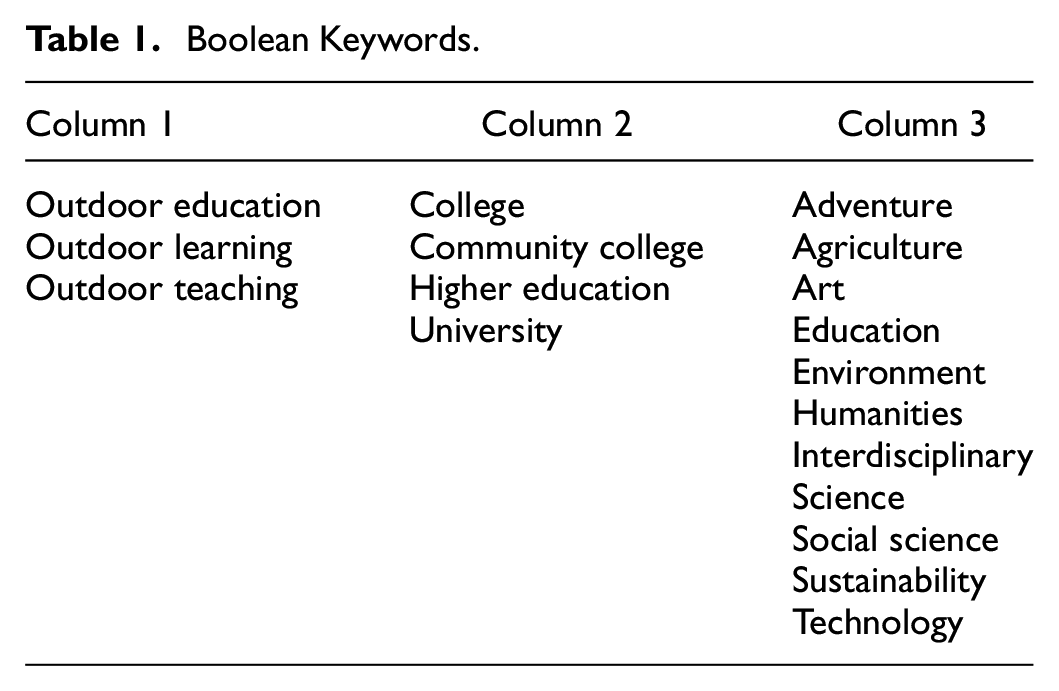
Each article met five structural criteria for inclusion. First, articles had to address learning outdoors at U.S. higher education institutions. Articles had to be published in peer-reviewed journals. Third, articles had to report empirical research. Articles had to be published in the 25 year period from 1996 through 2020. Finally, articles were required to be published in English language. Applying these criteria yielded 183 articles for analysis.
Each article was then read. Twenty-eight quantitative or categorical variables describing article content were measured and coded. Four variables were coded twice at different times to verify coding reliability. Reported data was assumed to be valid.
Coded data was recorded on Excel spreadsheets and analyzed using IBM SPSS Statistics 28.0.0.0 software. Frequencies were compiled for each variable. Since this is a systematic study, inferential statistics were not used.
Results
This section presents tabular data for 26 variables describing outdoor learning at U.S institutions of higher education observed in 183 research articles appearing in English language refereed journals between 1996 and 2020. The 26 tables are organized in seven topical sub-headings. The first research question on the descriptive characteristics of English language refereed articles on outdoor learning (OLR) is addressed in the following topical sub-headings: publication characteristics, primary author and institutional characteristics, and research methods. These characteristics are commonly used descriptors of published academic research. They provide a clear understanding of the research and publication environment. The second research question on the descriptive characteristics of outdoor learning (OL) taking place at institutions of higher education in the United States is addressed in the following topical sub-headings: organizational and learning venue characteristics, disciplinary and interdisciplinary topics and learning objectives, learning methods and processes as well as drivers, barriers, outcomes and benefits. These characteristics are commonly used descriptors of outdoor learning. They provide multiple insights into the nature and scope of outdoor learning. Multiple responses were collected for many variables. The total number of responses for each variable is noted following the table title. Categories within each variable are listed in the tables and discussed in the accompanying narrative.
Publication Characteristics (Research Question 1)
Publication characteristics reported in this study includes publication date, geographic distribution and journal of publication. Table 2 provides the distribution of OLR articles by publication date.
OLR Publication Date Distribution (N = 183).

The total number of publications indicates that outdoor learning is a sustained academic interest. Increased publication frequency over the entire period indicates interest in outdoor learning is growing. Outdoor learning appears to be part of a wider trend to develop learning programs that respond to perceived student and academic research interests. Several academic programs report using outdoor learning to increase course enrollments and student majors (Bradley et al., 2003; Pritts, 2017). Interest in outdoor learning may have plateaued, given the stable publication frequency over the last 15 years. This may indicate that student interest is also stable. The decline during the last 5 year period may be due to indexing delays and the systematic search process used in this research (Karatzoglou, 2013; Weiss & Barth, 2019).
Table 3 summarizes the geographic distribution of published research using U.S. Census regional divisions. Geographic distribution identifies where the research was carried out or, in the case of multi-state research, the location of the primary author. Table 4 identifies the 10 states reporting the largest number of publications.
OLR Publication Distribution by U.S. Census Regional Division (N = 183).

10 Most Frequent States Reporting OLR Publications (N = 183).

Geographic data indicates that OLR takes place in each U.S. geographic region in numbers that positively correlate with U.S. population distribution https://www2.census.gov/geo/pdfs/maps-data/maps/reference/us_regdiv.pdf Also, 6 of the 10 most populous states also rank in the top 10 states for OLR articles. (https://www.50states.com/population-by-state/). This suggests that OLR activity is ubiquitous throughout the U.S.
Table 5 identifies 26 journals which have published two or more OLR articles in higher education. In addition, 55 other publications have published one OLR article. Three publications, HortTechnology, Public Garden, and Tribal College: Journal of American Indian Higher Education, have published collections of case studies on learning outdoors.
OLR Distribution by Article Frequency (N = 128).

The publication pattern for outdoor learning research is broad, but not deep (Barth & Rieckmann, 2017; Menon & Suresh, 2020). Journal titles represent many diverse disciplines and areas of study. The largest disciplinary concentration of titles is in agriculture with 7 of 26 journals. Most scholars, who usually publish on disciplinary or area of study research topics, only occasionally publish articles on outdoor learning. This diffused pattern of publication indicates a wide awareness of outdoor learning, particularly in multidisciplinary fields, the social sciences and agriculture. But it also limits communication of outdoor research findings and development of an interdisciplinary area of study.
Primary Author and Institutional Characteristics (Research Question 1)
Author data in this study is based on the primary author. Unless otherwise indicated, the primary author is the first author listed. Data includes the primary author’s work unit, their working role, such as faculty/researcher or student, the Carnegie Classification and land grant status of the primary author’s institution. Reference is made to representative citations as examples.
Table 6 identifies the OLR primary author’s academic work unit. If multiple authors are involved, only the primary author’s work unit is listed.
OLR Primary Author Work Unit (N = 183).

Most primary authors indicate agriculture (41.5%) or social sciences (29.0%) as their work unit (Duram & Williams, 2015; Pritts, 2017). These work units have conducted outdoor learning longer and more intensively than other types of work units. Authors housed in science and technology units are under-represented (6.5%) compared with the overall size of these units at higher education institutions (Kahl, 2015). This may represent a preference for controlled experiments in science and technology research. It may also be due to a lack of outdoor research funding when compared with funding in other areas. Humanities and arts authors are also under-represented (2.7%) (Jensen, 2015). It may be that these authors are unaware or uninterested in outdoor learning opportunities. The number of authors assigned to interdisciplinary units is not large (8.2%) reflecting the smaller number and size of interdisciplinary units at most higher education institutions (Trencher et al., 2013).
Table 7 reports data related to the primary author’s academic role.
OLR Primary Author Academic Role (N = 183).

Faculty/researchers, including department heads, are the primary authors of most OLR articles (73.2%) (Cessna et al., 2013). This is not surprising given that faculty and researchers have professional and personal incentives for publishing. It is notable that students form the second largest group of authors (7.1%) (Ahee, 2013). Operations staff (4.4%) (Shooter, 2012), administrators (3.3%) (Byers, 1999) and community members (2.2%) (Broussard, 2009) sometimes publish research. The presence of student, staff and community authors often reflects the presence of experiential learning methods that involve non-faculty in leadership as legitimate peripheral participants (Lave & Wenger, 1991; Wenger et al., 2002).
Table 8 provides data on the institutional affiliation of primary authors by Carnegie Classification (Indiana University Center for Postsecondary Research, 2021).
OLR Primary Author Institutional Carnegie Classification (N = 183).
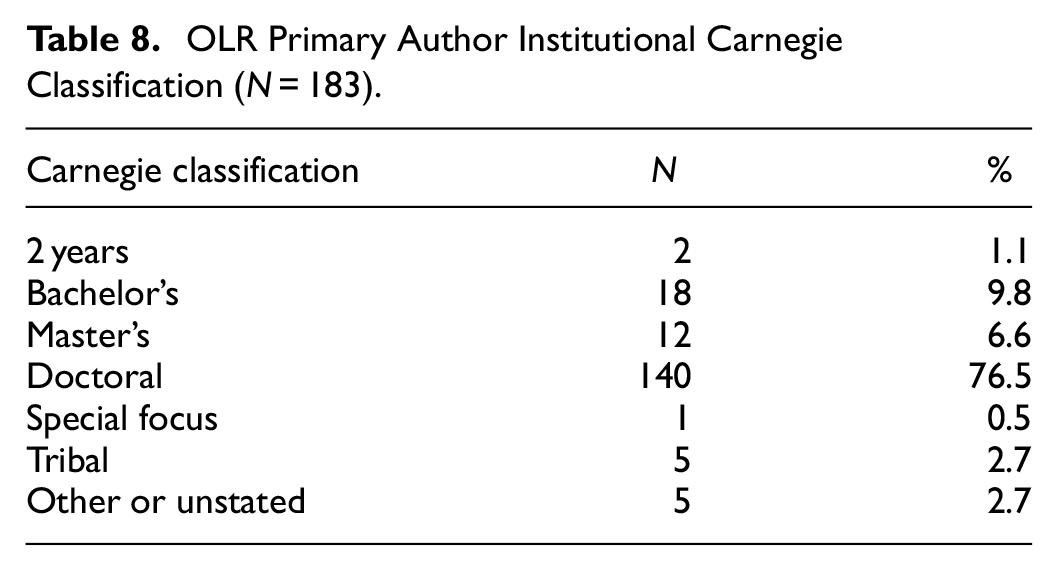
The majority of OLR articles originate at doctoral institutions. This concentration is related to comparative institutional size and the research mission of doctoral institutions. Primary authors are located at 140 Carnegie doctoral institutions (76.5%) (Krasny & Delia, 2014). Bachelor’s (9.8%) (Green et al., 2020) and master’s (6.6%) (Kozel, 2017) institutions are often liberal arts institutions using outdoor learning for liberal arts, general education and/or enrichment. Tribal or Indigenous serving institutions (2.7%) (Carr, 2019; Tyner et al., 2019) build on their cultural tradition of learning outdoors and are also land grant institutions. This distribution indicates that OLR is selective by institution type.
Land grant institutional affiliation is presented in Table 9. Articles originating at land grant institutions comprise 48.6% of the articles (Galt et al., 2012). Articles originating at non-land grant institutions constitute 51.4% of the articles (Pothukuchi, 2012). At first glance, this seems to represent equal effort between land grant and non-land grant institutions. However, when the ratio of publications per institution is computed, it is clear that land grant institutions are more involved in OLR than non-land grant institutions.
OLR Primary Author Land Grant Affiliation/Publication Ratio (N = 183).
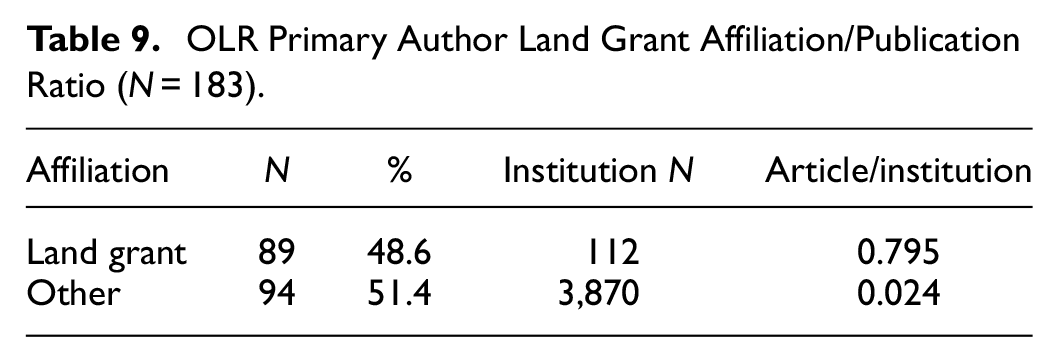
This disparity is due to institutional mission. Land grant missions address outdoor phenomena. Land grant institutions have provided outdoor learning throughout their history. In addition, land grant institutions currently receive funding designated for research and instruction related to the outdoors.
Research Methods (Research Question 1)
This section addresses research methods reported in articles on learning outdoors in Table 10. Reference is made to representative citations as examples.
OLR Research Methods Employed (N = 183).

The majority of published research articles on learning outdoors employ case study research methods (73.3%). Most articles report single case studies (58.5%) (Ryan, 2015). A smaller number of articles (14.8%) (Jacobsen et al., 2012) report multiple cases. A case study emphasis is typical in potential areas of study seeking to identify salient characteristics on which to base theory development and inferential research.
Mixed methods (7.7%) (Harms et al., 2009), qualitative (3.8%) (Grossman et al., 2010) and quantitative (12.6%) (LaCharite, 2016) studies are beginning to provide inferential data on outdoor learning. This inferential data can guide development of more robust theory and practice.
Organization and Learning Venue Characteristics (Research Question 2)
This section addresses organization and venue characteristics reported in 183 articles on learning outdoors. The following organizational characteristics are described: research participants; learning leadership; supporting organizations; sources of additional financial support, and venues. This section also addresses OL venues. The following venue characteristics are discussed: venue type; vegetation type; and location. Reference is made to representative citations as examples.
Table 11 identifies participants in outdoor learning. Participation is defined as engaging in an outdoor learning activity. 178 articles (97.3%) identified participation by 473 participants.
OL Participants (N = 473).

Many groups participate in OL. The common research model involves faculty and researchers (70.3%) conducting research involving undergraduate (81.5%) and graduate (32.0%) student subjects (Krasny & Delia, 2014; Watson et al., 2018). A second research model involves any participant group as learning leaders and/or participants, including community members (34.8%) (Wassenberg et al., 2015), operational staff (30.3%) (Gray et al., 2012) and K-12 students (11.2%) (Rosenthal, 2018) operating as communities of practice (Wenger, 1998).
Table 12 identifies OL learning leaders. Learning leaders are individuals who provide leadership in outdoor learning. They may or may not be the instructor of record. Two hundred fifty-eight learning leaders are identified in 174 articles (95.1%).
OL Learning Leaders (N = 174).

Faculty/researchers (82.8%) (Biernbaum et al., 2006) are the most common OL learning leaders, following the common model of scholarly instruction and research. More interesting is the comparatively large number of undergraduate (13.2%) (Sibthorp et al., 2013) and graduate (10.1%) (Hoffman & Wallach, 2007) students, staff (14.3%) (Goodnough et al. (2009), and community members (5.8%) (Clark et al., 2013) who provide OLR leadership cooperatively with or independently of faculty/researchers. For example, one cited study involves learning leadership by graduate students and operational staff who mentor undergraduates without faculty/researcher involvement (Hoffman & Wallach, 2005).
Table 13 identifies supporting organizations involved in OL. These include organizations directly involved and those that provide funding, personnel, learning venues and other resources. One hundred and eighty articles (98.4%) identified 385 supporting organizations.
OL Supporting Organizations (N = 385).

Academic departments and colleges are the most frequent supporters of outdoor learning and research (87.2%) (Meerts-Brandsma et al., 2019) providing resources, scholar/researchers and students in 157 of 180 OLR articles. Institutional support units (38.3%) (Ryan, 2015) and research centers (22.2%) (Zadik, 2011) are also involved, providing venues, leadership and research support. Student organizations (14.4%) (Riley & Bogue, 2014), both co-curricular and area of study-related, support outdoor learning and research with participants, resources and leadership. Not for profit/volunteer organizations (14.4%) (Grossman et al., 2012), business (14.4%) (Watson et al., 2018), and local government and schools (11.1%) (Rosenthal, 2018) typically provide venues, leadership and funding. Central institutional administration (10.0%) (Savanick et al., 2008) sometimes provide funding and boundary spanning encouragement. In summary, outdoor learning and research support is department/college centric and other support is usually collaborative and often enriching.
Table 14 identifies additional funding sources for OL. Seventy-eight articles (42.6%) identified 110 sources of additional financial support.
Additional Financial Support for OL (N = 110).

Private sources (46.2%) (Stephens, 2006), mostly businesses and foundations, are the most common source of additional funding for outdoor learning and research. Public sources (43.6%) (Pothukuchi & Molnar, 2015) also provide significant additional funding with Federal sources most commonly mentioned. Agricultural and multi-disciplinary learning activities, like organic farming and environmental research, attract a higher proportion of public funding. Most institutional funding (32.1%) (Wallace, 2016) supports specific institutional initiatives like campus sustainability, academic collaboration or service learning. Most community funding (9.0%) (Biernbaum et al., 2006) is related to agricultural activities like community supported agriculture (Falk et al., 2005). The fact that less than half of OLR articles report additional financial support suggests that funding is frequently unsought, unavailable or inadequate. Additional financial support often indicates significant collaboration among organizations and learning leaders operating as communities of practice (CoPs) to raise funds (Wenger, 1998).
Table 15 identifies 287 OL venues cited in 183 articles (100%).
OL Venues (N = 287).

OL venues are diverse and support specific learning activities. Many OL articles use more than one venue. The most common venues for OL are farms and other food production sites, including research centers (51.4%) (LaCharite, 2016). Natural and constructed landscapes are the location for 30.2% of activities (McFarland et al., 2008; Taniguichi et al., 2005). Botanical gardens (22.4%) (Meyer & Michener, 2013) and greenhouses (8.7%) (Morales & Frikics, 2019) are often associated with horticultural programs. Organic gardens and farms (15.8%) (Duram & Williams, 2015) support learning organic agriculture practices. Recreational/leisure venues (8.2%) (D’Amato & Krasny, 2011) and reflection spaces (3.8%) (McGann et al., 2004) are often sites for informal and non-formal learning, frequently adventure learning. Community gardens (7.7%) (Niewolny et al., 2012) and K-12 school gardens (2.2%) (Burns & Miller, 2012) focus on training social scientists and teachers respectively.
Outdoor learning frequently involves vegetation as part of the learning process (Table 16). one hundred and twenty nine OL articles (70.5%) cite 278 instances of plant involvement in seven categories.
OL Vegetation Reported (N = 278).

Most articles report using topically appropriate plants related to the learning objective(s). The largest plant category reported is edible plants (69.0%) (Chollett, 2014), usually at food production sites. Ornamental plants (35.7%) (Stimart, 1999) are used for OL at botanical gardens, campus and natural venues. Herbal (31.8%) (Lund & Orth, 2010) and medicinal (9.3%) (O’Neill et al., 2020) plants are used in botanical gardens as well as greenhouses and food production sites. Native (24.8%) (McKinne & Halfacre, 2008) and woody (39.5%) (Byers, 1999) plants are generally found in natural and constructed landscapes, like campuses, forests, prairies and orchards.
Table 17 reports locations of OL venues. 164 articles (89.6%) reported using 201 venues.
OL Venue Location (N = 201).

OL venues are selected because they support the specific OL being undertaken. Most venues are on campus (56.7%) (Scholl & Gulwadi, 2018), including landscapes and venues designed for specific learning and research activities. Remote locations (44.5%) (Lackstrom & Stroup, 2009) include diverse venues, usually research stations, farms or natural landscapes. Adjacent spaces (19.5%) (Krasny & Delia, 2015) are usually venues for which there is no space on campus.
Disciplinary/Interdisciplinary Topics and Learning Objectives (Research Question 2)
This section addresses OL topics and objectives described in 183 articles. The following are discussed: disciplinary topics; interdisciplinary topics; and learning objectives. Reference is made to representative citations as examples.
Table 18 presents data on the disciplinary learning topics identified in 90 49.2% articles.
OL Disciplinary Topic (N = 90).

Agriculture is the most frequently mentioned disciplinary topic (51.1%) (Waliczek & Zajicek, 2010). Social science (31.1%) (Murakami et al., 2018) ranks second. Humanities and arts (3.3%) (Pelco et al., 2010) and science and technology (6.7%) (Sacco et al., 2014) are not well represented compared to the number of faculty in these units at higher education institutions. Willferth (n.d.) discusses the role of OL, specifically gardening, in the liberal arts and science curriculum.
Table 19 assigns 88 OL interdisciplinary topics to 6 categories.
OL Interdisciplinary Topics (N = 88).

Sustainability studies (43.3%) (Jordan et al., 2005) is the most frequently reported interdisciplinary topic in OL articles. The remaining interdisciplinary topics attain lower frequencies: environment (18.2%) (Barlett, 2011); other (14.8%); organic practices (12.5%) (Delate, 2006); and ecology and biodiversity (10.2%) (Burns et al., 2012) The large “other” category (14.8%) includes topics as diverse as adventure (D’Amato & Krasny, 2011) and green learning (Pelco et al., 2010).
Comparing disciplinary topics in Table 18 and interdisciplinary topics in Table 19 with the primary author’s academic work unit reported in Table 6, it is clear that many authors assigned to disciplinary units are conducting and publishing research on interdisciplinary outdoor learning.
Table 20 presents explores specific learning objectives. One hundred and seventy nine articles (97.8%) identified 851 specific learning objectives in 18 categories. Many articles identified three or more specific learning objectives.
Specific OL Learning Objectives (N = 851).

Several patterns can be identified in specific learning objectives. Course subject content learning, both individual (71.5%) (Roark & Norling, 2010) and collective (50.8%) (Cooley et al., 2015), are the most frequently mentioned specific learning objectives, indicating that outdoor learning is focused on learning topical content first and foremost. Articles also identify behavioral learning objectives, including change (31.8%) (Jacobsen et al., 2012), engagement (29.1%) (Kahl, 2015) and networking (19.6%) (Burns & Miller, 2012), that are related to applying course subject content in communities of practice (Wenger, 1998).
Course subject content which is of high interest to students is frequently included to address student desires and to demonstrate applicability of course subject content. Food (47.5%) (Galt, Parr, & Jagannath, 2013) and quality of life (25.1%) (Mecham & Joiner, 2012) learning objectives address areas of high student interest in order to facilitate course subject content learning. Vocational learning content related to careers, like economics and business (35.2%) (Barlett, 2011), place/brand (11.7%) (Scholl & Gulwali, 2018), and policy (9.5%) (Karsten & O’Connor, 2002) is reported to increase commitment to learning course subject content. Social and humanistic learning objectives, like culture (29.1%) (Elkins et al., 2008), diversity (20.7%) (Becker & Paul, 2015), aesthetics and ethics (20.1%) (Krasny & Delia, 2014), social justice and equity (15.1%) (Gray et al., 2012), green topics (14.5%) (Pelco et al., 2010) and community service (13.4%) (Donahue et al., 2015) are also present in some outdoor learning courses. Health and wellness (20.7%) (Baur, 2020) as well as public health and safety (7.3%) (Pothukuchi, 2012) add to outdoor course subject content in areas like nutrition, physical safety, and wellness.
Learning Methods and Processes (Research Question 2)
This section addresses learning methods described in 183 articles. The following learning method categories are addressed: formal learning, informal learning and non-formal learning. Specific learning techniques are identified in each category. Reference is made to representative citations as examples.
Table 21 identifies the types of learning methods described in 183 (100%) articles. 754 different learning methods are reported as being used.
OL Learning Methods (N = 754).

Formal learning methods (36.6%) (Pritts, 2017) are those using pre-determined learning methods used to reach formally stated learning goals and objectives. Examples include formal courses and degree programs. Informal learning (36.3%) (Parr et al., 2007) refers to learning methods that are not pre-determined, but do address specific learning goals and objectives. Informal learning includes activities like field studies and internships among others. Formal and informal learning usually result in academic credit. Non-formal learning (27.1%) (Griffin, 2019) is learning without pre-determined learning processes or specific goals and objectives. Non-formal learning methods include activities like volunteering and activities in the co-curriculum (Barth & Michelsen, 2013. Several articles broadly discuss learning methods in all three categories (D’Amato & Krasny, 2011; Jacobsen et al., 2012; Parr & Trexler, 2011).
Table 22 presents information on 323 formal learning methods reported in 124 articles (67.8%). This number is higher than the number (276) reported in Table 21 because some authors reported the use of more than one formal learning method.
Formal OL Learning Methods (N = 323).
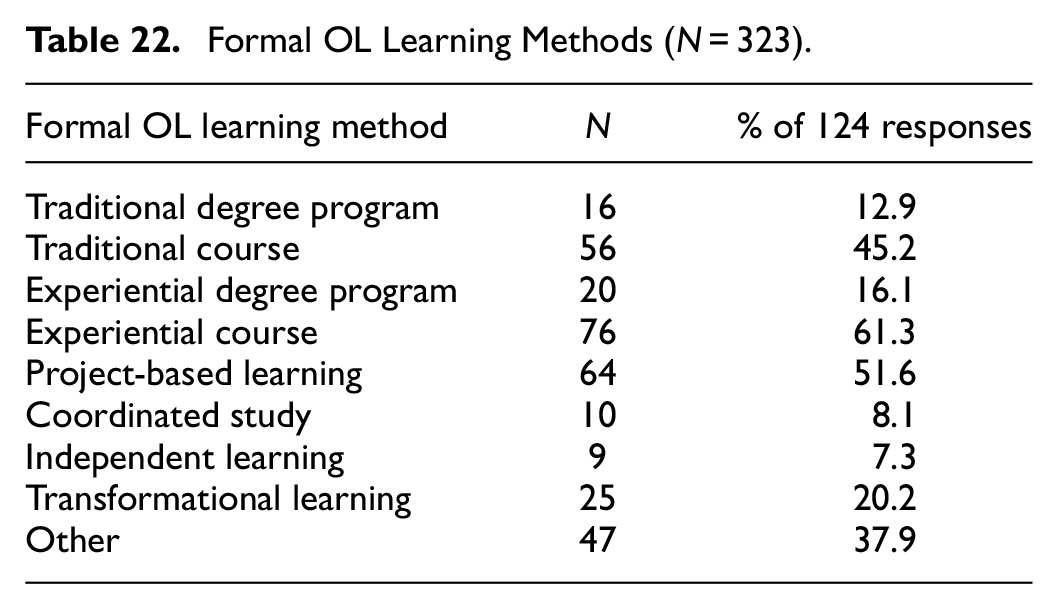
Experiential courses (61.3%) (Lavis & Brannon, 2010), project based learning (51.6%) (Wozniak et al., 2016), transformational learning (20.2%) (Meerts-Brandsma et al., 2020), experiential degree programs (16.1%) (McKim et al., 2017), coordinated study (8.1%) (Delate, 2006), and independent learning (7.3%) (Barton et al., 2010) draw on constructivist principles where students create their own understanding of knowledge within a pre-determined scaffold in a credit course. Scaffolds often involve operating as communities of practice. Behaviorist methods, such as lectures and demonstrations, are common in traditional courses (45.2%) (Pritts, 2017) and traditional degree programs (12.9%) (Hamilton, 1999) where pre-determined content is transferred from instructor to student, usually in the form of lecture and instructor-led discussion.
Table 23 presents information on 325 informal learning methods reported in 122 articles (66.7%). The number of OLR methods is higher than the number (274) reported in Table 21 because some authors reported the use of more than one informal learning method.
Informal OL Learning Methods (N = 325).

Informal learning is usually experiential in nature, uses constructivist principles and is related to or part of a credit course or activity. Informal learning tends to vary by discipline or area of study. Field studies (59.0%) (Beltran et al., 2020), where students collect and analyze data outdoors, are frequently used in agriculture, interdisciplinary and social sciences courses. Service learning – in course (43.4%) (Waliczek & Zajicek, 2010), action learning (41.0%) (Paisley et al., 2008), internships/coop (37.7%) (Reeve et al., 2014) and community service (36.9%) (Gray et al., 2012) are also common in agriculture, interdisciplinary, and social sciences courses. Capstone courses (6.6%) (Watson et al., 2018) tend to be used in science and technology.
Table 24 presents information on 273 non-formal learning methods reported in 95 articles (51.9%). This number is higher than the number (204) reported in Table 21 because some authors reported the use of more than one non-formal learning method.
Non-Formal OL Learning Methods (N = 273).

Non-formal learning methods are almost entirely experiential in nature and do not generally result in academic credit. Community outreach (72.6%) (Griffin, 2019) and co-curricular learning activities like volunteer activities (42.1%) (Bennett, et al., 2013) and student clubs/activities (28.4%) (Aleong, 2018) are the most frequently found forms of non-formal learning. Other non-formal learning takes place in work environments, including service learning—non-course (18.9%) (Parece & Aspaas, 2007) and student employment/work study (13.7%) (Biernbaum et al., 2006). The historical tradition of the outdoor venue serving as a learning experience itself (28.4%) (McFarland et al., 2008; McFarland et al., 2010) is also a non-formal learning method. Non-formal learning also occurs in extension activities (6.3%) (Meyer & Michener, 2013) almost entirely in agriculture. Most articles report the use of other non-formal learning methods (76.8%), usually unique to the specific learning topic or objective, making them difficult to categorize.
Drivers, Barriers and Outcomes and Benefits (Research Question 2)
This section addresses drivers, barriers and outcomes identified in 183 OLR publications. Most authors describe drivers and outcomes/benefits of the outdoor learning activities they studied. Most authors omit mention of barriers. Reference is made to representative citations as examples.
Table 25 describes 246 drivers indicated in 143 OLR articles (78.1%).
OL Drivers (N = 246).

Sustainability imperatives (42.7%) (Jacobsen et al., 2012) and campus sustainability (31.5%) (Green et al., 2020) are the most frequent outdoor learning drivers mentioned in OLR articles. Many authors report a commitment to sustainability efforts in general and particularly in higher education. It is probable that current social and political interest in sustainability encourage these drivers. A second, more traditional academic group of drivers, including scholarly cooperation (18.2%) (Parr et al., 2007), pursuing interdisciplinary topics (15.4%) (Van Der Zanden & Iles, 2013), and research interests (12.6%) (Galt et al., 2012) also encourage outdoor learning in higher education.
Table 26 describes 90 barriers to outdoor learning activities noted in 56 OLR articles (30.6%).
OL Barriers (N = 90).

As is common in academic writing, barrier identification is not common. Of the 183 articles in this study, only 56 (30.6%) mention specific barriers. Additionally, many mentioned barriers are generic to higher education, vague and unsupported with evidence. Disciplinary and institutional resistance (58.9%) (Waliczek & Zajicek, 2010) is the most commonly reported barrier to OLR. “Silo” mentality, present throughout higher education, makes organizational change, like outdoor learning, difficult to achieve. Inadequate funding (37.5%) (Burns & Miller, 2012) is regularly cited as a barrier to outdoor learning and most other innovations in American higher education. Participant continuity and persistence (19.6%) (Markhart, 2006) is an issue, particularly in research involving students whose participation is limited to the 2 to 6 years period they are typically enrolled. Low interest and support (19.6%) (Ryan, 2015) suggests that some participants resist or avoid participation. Other barriers (16.1%) include uneven skill sets among students and disparate course content. Unlike other barriers frequently cited elsewhere in higher education, curriculum requirements (10.7%) (Clark et al., 2013) do not appear to significantly impact outdoor learning.
Table 27 presents the 295 outcomes and benefits of outdoor learning as reported by 167 OLR articles.
OL Outcomes and Benefits (N = 295).

The overarching outcome in OLR is enhanced learning (87.4%) (Meerts-Brandsma et al., 2020). Outdoor learning is reported to be effective in nearly all OLR articles. Since most OLR is applied, improved practices (46.1%) (Parr & Van Horn, 2006), both topical and methodological, are often investigated and reported as significant outcomes. Economic benefits (18.6%) (Hauk et al., 2018), from increased funding and operational effectiveness, are reported regularly. Finally, the development of process and outcomes measures (18.0%) (Beltran et al., 2020) is mentioned as a benefit in some OLR articles.
Discussion—Similarities, Differences, Challenges, and Trends
This literature review provides the first systematic review of outdoor learning research (OLR) and outdoor learning (OL) at U.S. higher education institutions reported in English language refereed research articles published between 1996 and 2020. It addresses two research questions by describing 26 quantitative variables. 28 similarities, 8 differences, 7 challenges and 7 patterns are addressed in the following observations. Reference is made to representative citations as examples.
Outdoor learning is part of current institutional efforts to increase learning effectiveness by addressing topics of academic and student interest using innovative learning methods (Pritts, 2017). OLR articles have grown in frequency over the last 25 years, demonstrating a common, sustained interest in outdoor learning. The geographic distribution of primary authors is similar to that of the U.S. population, indicating a similar level of interest throughout the U.S. OLR articles are published in many different disciplinary and interdisciplinary journals. While this breadth of interest increases exposure to outdoor learning as a higher education innovation, it complicates communication of outdoor learning knowledge and results in unintended duplication of research.
The majority of OLR articles address interdisciplinary topics; but most primary authors are assigned to disciplinary work units in social sciences and agriculture (McGann & Berghage, 2004). This situation is common in higher education making it harder to develop and communicate interdisciplinary research, including outdoor learning (Bettencourt et al., 2011). This slows the development of rigorous research that can lead to the emergence of a recognized area of study. Currently, most OLR articles are based on descriptive research methodologies, frequently in the form of case studies. These case studies are similar in scope. They can inspire proponents and provide useful operational information. Additional inferential research and theory testing is required to support a common understanding of outdoor learning as an interdisciplinary area of study. Most OLR articles originate at research universities, Indigenous serving institutions and some self-selected liberal arts schools. Land grant institutions publish OLR more frequently per institution than other research universities. This publication pattern is persistent and is reinforced by institutional missions, researcher interests and reward systems (Altbach & Finklestein, 2023). Physical evidence in the form of outdoor campuses, gardens and research centers at the remaining 4,000 American institutions of higher education suggests that some outdoor learning takes place at some of these institutions as well (Mecham & Joiner, 2012). However, scholars and participants at these institutions do not publish many OLR articles.
Most outdoor learning is experiential in nature and uses constructivist pedagogies (Kolb & Kolb, 2005). Outdoor learning topics are dynamic, constantly changing to address the evolving interests and needs of students, faculty and other participants (Bertossi & Marangon, 2022). As Guitart et al. (2012) and others have found, the majority of learning topics are interdisciplinary followed by agriculture and social science. Fewer topics are identified in science and technology or arts and humanities. Most specific learning topics relate to the course subject, supporting social behaviors and vocational experience (Pelco et al., 2010). To reach learning objectives, outdoor learning uses formal, informal and, to a lesser extent, nonformal learning methods (Munge et al., 2018). Many different specific individual and collective learning techniques and processes appear in OLR research (Cooley et al., 2015). Most outdoor learning experiences involve a combination of several formal, informal or non-formal learning methods (Bertossi & Marangon, 2022). Learning leaders tend to use methods, techniques and processes which follow the established practices in their topical discipline or area of study, modifying them for use outdoors (Haigh, 2005). Innovative learning methods, based on the unique characteristics of outdoor learning, are not common. Reasons for developing or not developing innovative methods especially suited to outdoor learning have not been identified. These approaches may be similar to learning processes in related areas of study (Lozano et al., 2017).
Undergraduate and graduate students and faculty/researchers are the primary participants in outdoor learning. Staff and community participation is increasing as co-curricular offices, research units, community organizations and businesses join with faculty/researchers and students to provide experiential learning outdoors (Scoggins, 2010). Learning leadership continues to be provided mostly by faculty/researchers. However, students and others increasingly provide learning leadership as collective learning practices are implemented. Murray (2018), for example, identifies several areas where students are providing learning leadership outdoors. CoPs are sometimes adopted to facilitate this growing complexity in participation (Lave & Wegner, 1991).
Support for outdoor learning in the form of personnel, venues and funding comes primarily from departments and colleges and their related research and operational units. Additional support and funding is sometimes provided by public and private sources. Most additional funding supports applied outdoor learning in the areas of agriculture and sustainability. This funding pattern follows standard practices in American higher education (Hillman & Leck, 2023).
Outdoor learning takes place in a wide variety of different venues ranging in size from rooftop gardens to large ecosystems, such as forests and swamps. Food production sites are the most common venues (LaCharite, 2016). Most outdoor learning takes place on campus. Outdoor learning venues are also found adjacent to campus and at remote locations (Scholl & Gulwadi, 2018). Venues and plants are typically selected based on their availability, proximity and ability to support learning objectives. Comparative efficacy of different venues and plants for specific learning goals has not been assessed.
OLR offers few insights on drivers and barriers of outdoor learning. Drivers are mentioned in vague generalities, like undefined sustainability, that frequently lack the specificity necessary to validate them as outdoor learning rationales. Barriers are omitted from most OLR articles. The few that are mentioned deal with generic factors which apply throughout higher education, such as resistance to change or inadequate funding. As a whole, drivers and barriers are inadequately addressed in outdoor learning research (Blanco-Portola et al., 2017; Haigh, 2005).
Student learning, individual and collective, is the most frequently mentioned outcome and benefit of outdoor learning (Draper & Freedman, 2010). Improved learning practices, generally constructivist in theory and experiential in practice, are a strong second. This demonstrates that there is a common commitment to learning and its improvement in OLR articles (Williams & Dixon, 2013). Of concern is that only 18% of OLR articles report measurement and evaluation as an outcome (Galt, Parr, & Jagannath, 2013). Robust effectiveness measures are necessary if outdoor learning is to demonstrate its right to be a recognized interdisciplinary area of study (Mann et al., 2013).
Limitations
This study is limited to research on outdoor learning at U.S. institutions of higher education published in refereed journals between 1996 and 2020. It does not include books, book chapters, articles in non-refereed journals, technical reports and other gray literature. Consequently, the discussion and conclusions may not apply outside the population of refereed articles and the outdoor learning they report.
As a systematic study, this research cannot be generalized. Consequently, inferential statistics have not been generated.
Recommended Action and Research
OLR reveals a number of areas where additional understanding is required if outdoor learning is to become recognized as an interdisciplinary area of study. Additional case studies and descriptive research will be useful for understanding how outdoor learning operates, identifying useful learning topics, documenting methods and processes, describing participant interactions and assessing outcomes. Additional examples of outdoor learning in science and technology as well as arts and humanities are needed in order to understand and guide outdoor learning in these areas. This descriptive research will provide additional guidance for specific outdoor learning activities.
For outdoor learning to be widely recognized as an effective higher education practice, the number of inferential studies must increase in order to create a theoretically-based, empirically supported understanding of outdoor learning. Additional inferential studies need to propose and test outdoor learning theories as well as determine the efficacy of experiential individual and collective learning practices. Potential inferential research topics include theory development and application, individual and collective learning methods, practices and venues that are applicable, leadership development and boundary spanning.
Wider participation and leadership using informal and nonformal education practices and communities of practice (CoP) to involve all participants is increasingly important for effective outdoor learning. Increased understanding of drivers, barriers and outcomes is required in order to demonstrate the effectiveness of outdoor learning. Current funding and recognition will remain piecemeal until departments and funding bodies become convinced of outdoor learning effectiveness and its’ ability advance institutional missions.
There are no comprehensive outdoor learning research centers to prioritize and carry out large scope, “big tent” research, training or outcomes assessment. An overarching CoP composed of outdoor learning leaders is essential to assure communication and boundary spanning, facilitate the development of learning theory and practice, share learning methods and best practices and demonstrate outdoor learning’s contribution to institutional missions and outcomes. Related organizational components, like an outdoor learning-wide professional organization, a journal of record or a designated funding source, may be necessary to assure advances in research, organize research agendas and share research findings. And efforts to demonstrate outdoor learning as a contributor to overall institutional learning effectiveness must be strengthened. These needs must be addressed in order for outdoor learning to be more widely adopted.
Lastly, research needs to demonstrate that outdoor learning contributes to institutional objectives by addressing participant interests with effective learning opportunities. Documentation of learning outcomes and effectiveness are critical to demonstrate outdoor learning effectiveness. Such efforts will help assure that outdoor learning becomes widely adopted as a recognized area of interest in U.S. higher education.
Conclusion
Outdoor learning is an integral part of higher education in the United States. It is evolving to address issues of changing interest and learning effectiveness. Pedagogically, it is adopting new learning models in areas like informal and collective learning. Inferential research and theory testing, while still inadequate, is being undertaken and may lead to a recognized interdisciplinary area of study.
This literature review represents the first effort to describe outdoor learning research and outdoor learning practices throughout higher education in the United States. Unlike previous selective reviews, it includes all institutions, disciplines and interdisciplinary areas of study. The review provides summary information about outdoor research publications, authors and methods. It describes outdoor learning operating characteristics, venues, topics, objectives, methods, and drivers, barriers, outcomes and benefits. As learning leaders and research scholars seek to understand and address growing interest in learning outdoors, this review will provide insights and identify directions for further outdoor learning and research. As institutions seek to increase learning effectiveness by addressing high interest areas, like global warming, food security and adventure among many others, this review will be a useful starting point for developing specific and institution-wide learning initiatives.
Outdoor learning in U.S. higher education is at a critical point in its development. It can continue to address specific learning needs in isolation. Or outdoor learning can be part of broader efforts to address changing learning needs and increase institutional effectiveness in higher education. Outdoor learning research can continue to be a side interest with occasional contributions from scholars whose disciplines or areas of study participate in outdoor learning. Or it can work to become a recognized interdisciplinary field of interest with its own refereed literature and scholarly apparatus.
Supplemental Material
sj-pdf-1-sgo-10.1177_21582440241296784 – Supplemental material for Outdoor Learning at U.S. Higher Education Institutions: A Systematic Review of Research—1996 to 2020
Supplemental material, sj-pdf-1-sgo-10.1177_21582440241296784 for Outdoor Learning at U.S. Higher Education Institutions: A Systematic Review of Research—1996 to 2020 by Charles T. Townley, Maria Emilia Martinez and Brandon A. Clark in SAGE Open
Footnotes
Acknowledgements
The authors acknowledge the assistance of library personnel in collecting articles through local collections and interlibrary loan. The authors acknowledge the suggestions and recommendations made by anonymous readers.
Declaration of Conflicting Interests
The author(s) declared no potential conflicts of interest with respect to the research, authorship, and/or publication of this article.
Funding
The author(s) received no financial support for the research, authorship, and/or publication of this article.
Ethics Statement
Not applicable. See statement from Texas A&M University Kingsville, Office of Research & Graduate Studies, Research Compliance Office, dated March 29, 2022.

Data Availability Statement
Data sharing not applicable to this article as no datasets were generated or analyzed during the current study.
Supplemental Material
Supplemental material for this article is available online.
References
Supplementary Material
Please find the following supplemental material available below.
For Open Access articles published under a Creative Commons License, all supplemental material carries the same license as the article it is associated with.
For non-Open Access articles published, all supplemental material carries a non-exclusive license, and permission requests for re-use of supplemental material or any part of supplemental material shall be sent directly to the copyright owner as specified in the copyright notice associated with the article.
