



Abstract
Emerging virtual reality and augmented reality (VR/AR) technologies in education have the potential to revolutionize the whole educational experience. Studies have shown that before introducing the technology to their pupils, educators should do a thorough assessment of the technology’s viability and possible acceptance in the classroom. However, not much is synthesized from the body of knowledge about the leadership and coupling of VR and AR in education, including its trends and direction of research in other domains. In this article, the bibliometric and content analysis has shown that interest in virtual reality and augmented reality has increased from 2018 to 2022 in the Web of Science database. The patterns formed from Vosviewer in the bibliometric analysis have also portrayed that Virtual reality (VR) and Augmented Reality (AR) are used in many fields, including education, medicine, arts, engineering, business, and marketing. Other results from data mining showed the authors with the most publications in the field, their affiliated universities, and the source of publications. In the wake of the Covid-19 epidemic, these findings may also help improve educational opportunities for all students and the quality of instruction they receive. As implications, Virtual reality (VR) and augmented reality (AR) harness current technology to put digital content in the actual world, enabling consumers to have a more meaningful interaction with it on desktop or hand-held devices. This bibliometric research shows that animation, 3D graphics, and sound may replace more traditional ways of schooling in the future.
Keywords
Introduction
Virtual reality (VR) and augmented reality (AR) are two different types of technologies that have become at the forefront of the entertainment industry. However, these technologies are also being applied in education to help students see things from a new perspective or learn a new skill. By definition, Virtual reality (VR) is a computer-generated simulation of a real-life environment that can be explored and interacted with using head-mounted displays or other devices (Stuchlíková et al., 2017). This immersive environment can be either interactive or non-interactive. Head-mounted displays and other devices that provide virtual reality allow people to experience a simulated world rather than the physical world (Su et al., 2021; Wang & Zhang, 2021). Alternatively, Augmented reality (AR) is the superimposing of digital information on the user’s real-world view through specialized glasses, lenses, or contact lenses, or through an app that projects virtual images overtop of a live camera feed from a mobile device. This is done to augment what would appear to be experiential in the real world (Shanu et al., 2022; Jeřábek et al., 2014). While these technologies take learning to new heights, they are not without limits and can be difficult for teachers to implement (Capone & Lepore, 2020). The emergence of VR/AR in education could change every aspect of teaching and learning by providing an immersive experience (Gandolfi et al., 2018). However, it is important that teachers systematically evaluate the technology’s potential and adoption in their classrooms before implementing it with their students (Faqih & Jaradat, 2021).
In recent years, there has been a substantial increase in research into the use of augmented reality (AR) and virtual reality (VR) in education, with studies examining the potential of these technologies to improve learning experiences. However, there are still certain research gaps that must be filled (Verner et al., 2022). For example, the absence of actual studies comparing the educational impacts of AR and VR is one gap. While studies have looked at the potential advantages of each technology individually, there is a need for additional study that examines their relative usefulness in an educational setting (Solmaz et al., 2021).
Another gap is a paucity of studies on how to employ AR/VR technology to engage kids with special needs like autism spectrum disorder (ASD) (Rega et al., 2018), attention deficit hyperactivity disorder (ADHD) (Goharinejad et al., 2022), dyslexia, or other learning disabilities (Staggini & Cersosimo, 2021). More study into how AR/VR technology may be utilized to facilitate remote learning is also required. Moreover, further study is needed to determine how educators and administrators may successfully use AR/VR technology in their classrooms without having specialized technological skills (Zhang et al., 2022). This involves producing tools and opportunities for educators to build the skills and knowledge required to properly deploy these technologies, as well as offering resources and assistance on integrating AR/VR into current curricula (Choi, 2022).
Based from contemporary literature reviews from the Web of Science (WoS), the next section depicts the background of study on several topics related o AR and VR in education, such as (a) innovation and academic contribution from AR and VR; (b) Difference in the application and effects of VR and AR technology in education; (c) Leading intention of teachers and students in using AR and VR; (d) Classroom teaching and learning mode matching the AR/VR applications; and (e) Conducting assessment of AR/VR’s viability and possible acceptance in the classroom
Innovation and Academic Contribution
Augmented Reality (AR) and Virtual Reality (VR) have the potential to transform education by offering students with new and immersive methods to study and engage with educational information (Guray & Kismet, 2023). AR augments the actual world with digital data, while VR creates an entirely fabricated experience (Verner et al., 2022).
The capacity to create dynamic and compelling experiences that may imitate real-world events is one of the fundamental advances of AR and VR in education. This helps school communities to learn more effectively than conventional ways via hands-on, experiential learning. Furthermore, AR and VR may be utilized to construct virtual field excursions, enabling students to explore and learn about areas that would be difficult or impossible to visit otherwise (Solmaz et al., 2021). For example, Google Earth is a fantastic tool for doing virtual field trips. It enables users to go across the globe by using high-resolution satellite and aerial photos, 3D landscapes and buildings, and street-level views (McDaniel, 2022). Google Earth allows teachers and students to explore various physical elements such as mountains, rivers, and deserts, as well as historical locations and monuments (Hagge, 2021). Google Earth also contains a variety of educational materials, such as guided tours, quiz questions, and information about other countries and civilizations (Albuquerque et al., 2020). In terms of relevance, it is an excellent resource for geography, history, and social studies schools, as well as field excursions and other educational activities (Wang et al., 2022).
Another significant advancement is the use of AR and VR to provide customized learning experiences in which the information is tailored to the individual student’s requirements and skills. This may aid in increasing student engagement and motivation while also addressing the requirements of various student groups (Bucea-Manea-Țoniş et al., 2022). For example, AR and VR technology extends learning beyond memory and observation by providing students with access to realistic information that aids in the comprehension of complex topics (Su et al., 2022). Furthermore, VR offers a more immersive learning experience, allowing educators to scale their curriculum to make learning more enjoyable (Guray & Kismet, 2023).
AR and VR academic contributions in education include research on the usefulness of these technologies in increasing student learning outcomes, as well as the creation of novel pedagogical techniques and instructional material that leverage the characteristics of AR and VR (Solmaz et al., 2021). Furthermore, academics are investigating the application of augmented reality and virtual reality in fields such as language acquisition, STEM education, and special education (Chan et al., 2022). Several studies have compared the learning results of students while utilizing VR to other methodologies such as augmented reality, hands-on experiences, and/or conventional education. Hands-on activities undertaken in virtual and real contexts have equal effects on student learning outcomes, according to research (Bansal et al., 2022).
The research demonstrates learning benefits when comparing the usage of VR to conventional approaches (Zarantonello & Schmitt, 2023). Researchers from China has discovered for example, that students who experimented with virtual environments as part of their lessons had more positive sentiments and than those who did not (Zhang et al., 2022). Furthermore, compared to those who utilized a 2D environment, adding a 3D Virtual Reality Learning Environment increased female students’ physics performance (Verner et al., 2022). Evidently, AR and VR also assist students in understanding people’s unique circumstances all over the globe by giving immersive experiences that are impossible to recreate in regular classrooms. Furthermore, research into the psychological influence of virtual reality on kids recommends that technology should be utilized sparingly and under tight supervision in educational settings to guarantee beneficial student outcomes (Bucea-Manea-Țoniş et al., 2022).
Difference in the Application and Effects of VR and AR Technology in Education
To offer differentiation and clarity for readers, these closely identified terms are compiled from several sources from literature reviews. In terms of comparisons, Virtual Reality merges the real world with cyberspace, creating a simulated environment in which the user can interact with the digital environment (Capone & Lepore, 2020; Wang & Zhang, 2021). Virtual reality also provides an immersive, 3D experience that is distinguishable from regular 2D and 3D imagery (Ouyang et al., 2016). The computer displays images that are often in full motion, giving it a realistic feel. VR can be used to help students learn about topics such as design thinking and engineering design, as well as history and culture (Wang & Zhang, 2021). On the other hand, AR is properly termed augmented reality, which refers to technology that augments the real world (Gandolfi et al., 2018). In other words, Augmented Reality is a concept in which real-world elements are overlaid or supplemented by computer-generated images, sound, or other virtual information (Wang & Zhang, 2021). For example, AR may use the Internet or GPS to create virtual objects on top of real-world ones. Although the topic of virtual reality and augmented reality in education has not been a huge topic of discussion just yet, it is an emerging concept (Capone & Lepore, 2020). This technology can offer new learning opportunities and methods for students both at school and at home (Gudoniene & Rutkauskiene, 2019). The next section will elaborate on how VR or AR is applied in education.
In terms of applications of AR and VR in education, AR enables digital information to be superimposed on the actual environment, such as displaying text, photos, or videos on top of a real-world item (Guray & Kismet, 2023). This may be utilized in areas such as history, science, and art to give students with more context and knowledge. VR, on the other hand, thoroughly immerses pupils in a digital world. This may be used to imitate real-life experiences that would be difficult or impossible to experience in person, such as visiting a distant nation or researching the human body (Morimoto et al., 2022). Generally, both AR and VR may also be utilized to make interactive and gamified learning experiences for students, making the learning process more engaging and pleasurable (Chan et al., 2022). Not only that, augmented reality and virtual reality have the potential to significantly improve the educational experience and make learning more interactive, immersive, and effective (Solmaz et al., 2021).
By comparison, Augmented Reality (AR) technology overlays digital information on the user’s perspective of the actual world, while Virtual Reality (VR) technology immerses the user in a wholly fake environment (Verner et al., 2022). Both VR and AR may be utilized in education for a variety of objectives. Immersive educational experiences, such as virtual field excursions or simulations of historical events, may be created with VR technology (Hagge, 2021). This can help students’ learning become more engaging and interactive (Chan et al., 2022). A virtual reality tour of a historical site, for example, can provide students with a more vivid and realistic understanding of what it was like to be there than a traditional textbook or lecture. In contrast, AR technology can be used to improve students’ understanding of real-world objects and concepts. For example, an AR app could be used to overlay information about the human body on a real person, allowing students to see and interact with the body in ways that a traditional textbook or model would not allow (Bansal et al., 2022).
Overall, VR technology is more immersive and can be used to create completely new educational experiences, whereas AR technology is more focused on enhancing and making the real world more interactive and informative. Both have distinct advantages and can be useful in a variety of educational settings. Table 1 below highlights the similarities and difference of AR/VR including their applications in education.
Difference in the Application and Effects of VR and AR Technology in Education.

In recent years, Virtual Reality (VR) and Augmented Reality (AR) interactions have helped teachers and educators to teach students more effectively in a more interactive way by providing them with a realistic experience of their surroundings (Capone & Lepore, 2020). This impact can be seen throughout various fields such as marketing, fashion design, engineering, medicine, architecture, and general education within high school classrooms (Donatiello et al., 2018; Henriques & Winkler, 2020; Park et al., 2018).
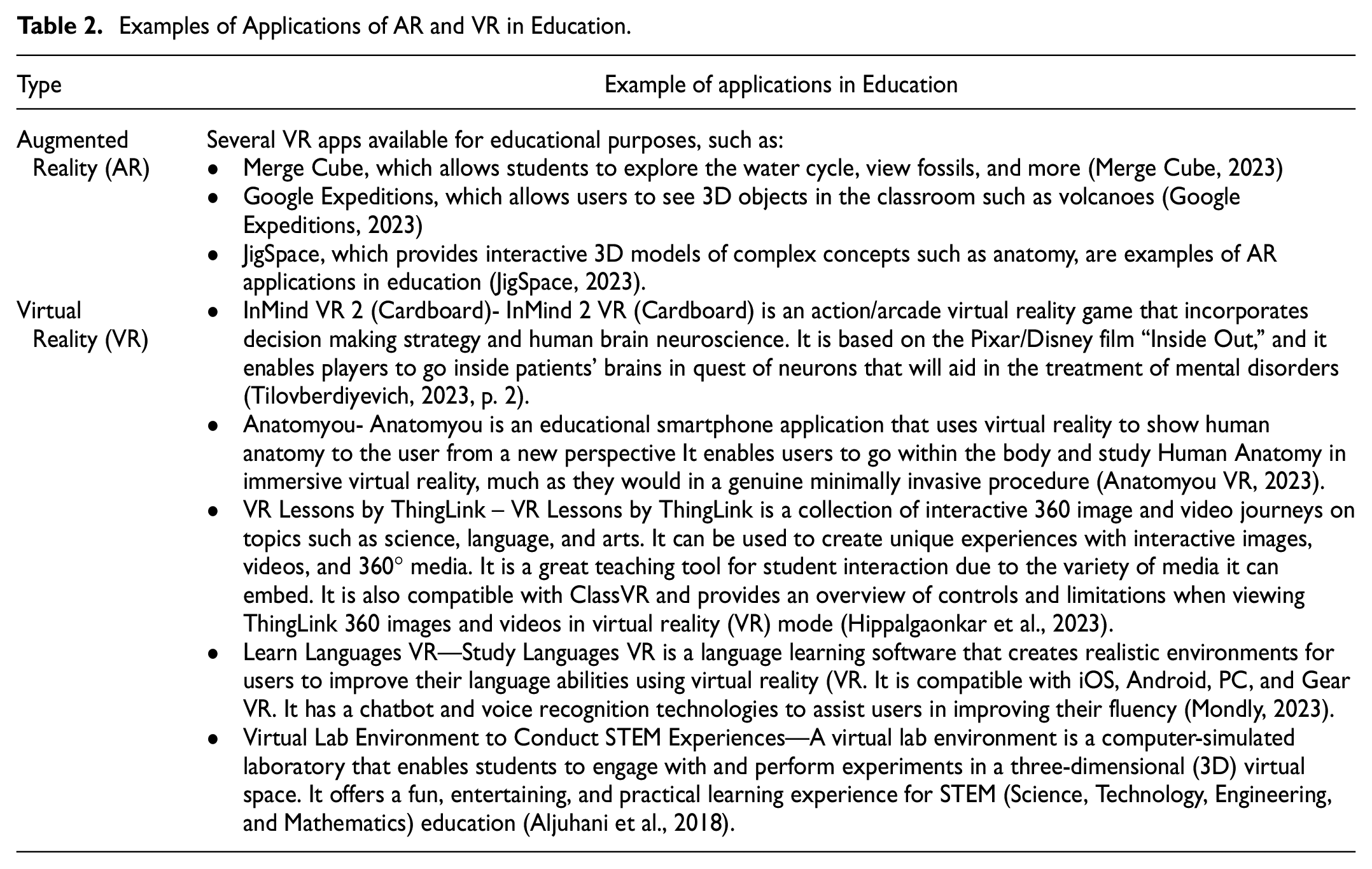
Virtual reality can be used to improve learning in science and art (Capone & Lepore, 2020; Ouyang et al., 2016). For example, students can have a 3D experience in remodeling architecture or seeing how fossils are formed. The visualization of molecular construction can help students see the interaction of atoms and bonds between them, while better understanding the key points that make up a cell membrane (Nersesian et al., 2019). Virtual technology can allow students to experiment with different musical instruments without having to pay for them; they can also learn how to play new types of instruments without having to take lessons from an instructor. Virtual learning environments can also help students understand different cultures by allowing them to view and absorb new techniques and ideas (Christopoulos et al., 2020). In addition, virtual reality can be used for medical training purposes. It can provide patients with realistic reconstructions of their body parts or surgeries. The virtual environment can also be used by physicians to perform procedures remotely or to train personnel on the procedure (Charissis et al., 2008). Alongside, Virtual reality can also be used in the treatment of psychological disorders such as anxiety and depression, PTSD, phobias, eating disorders, and substance abuse (Li et al., 2020; Zeng & He, 2021). Some studies propose that virtual reality therapy provides more positive reinforcement than traditional therapy options due to it focusing on present rather than future goals (Blackwell et al., 2019). Table 2 shows several examples of application of AR and VR in education that are available in the internet at the time of writing.
Examples of Applications of AR and VR in Education.
Leading Intention of Teachers and Students in Using AR and VR
To improve teaching and learning, VR and AR may be utilized by teachers to create immersive and engaging learning environments. This may help pupils become more engaged and the subject more remembered. For example, in a science lesson, a teacher may utilize VR to take students on a virtual field trip to a historical place, or AR to overlay information on a real-world item (Solmaz et al., 2021). VR and AR may be utilized to deliver hands-on learning experiences for students that would be difficult or impossible to reproduce in the classroom. This may help students comprehend complicated topics and make the content more appealing (Choi, 2022). A student, for example, may utilize VR to rehearse a complicated surgical operation or AR to examine a virtual representation of the human body (Bansal et al., 2022). Clearly, teachers and students want to use VR and AR to deliver an immersive, dynamic, and engaging learning experience that may aid to improve comprehension and retention of the subject being taught (Choi, 2022). For further discussions, several ways to improve classroom teaching experience for teachers and students include:
Immersive Learning: Virtual reality and augmented reality may be used to create immersive learning environments in which students can engage with virtual simulations or 3D representations of real-world topics, making the learning experience more engaging and dynamic (Choi, 2022).
Field Excursions: Virtual reality and augmented reality may be used to take students on virtual field trips to sites that would be difficult or impossible to visit in person (Chan et al., 2022).
Collaborative Learning: Virtual reality and augmented reality may be used to build collaborative learning environments in which students can collaborate in virtual worlds to accomplish tasks or solve challenges (Solmaz et al., 2021).
Experiential Learning: VR and AR may be used to create experiential learning sessions in which students actively engage in replicated real-world settings, allowing for hands-on learning (Bansal et al., 2022).
Language Learning: Virtual reality and augmented reality may be utilized to create immersive virtual settings for language learning where students can practice speaking and listening abilities (Chun & Yoo, 2019).
Evidently, the use of VR and AR technologies in the classroom may assist to create more interesting and dynamic learning experiences, making information more accessible, and giving students opportunity to learn in ways that conventional teaching approaches cannot (Zhang et al., 2022). As VR/AR becomes more mainstream and VR headsets become less expensive, it is expected that many students will have access to VR technology (Hsiao et al., 2018). While there are several benefits of having VR headsets available in the classroom, there are also many challenges and obstacles that educators need to consider before implementing this technology (Krauss et al., 2021). One of the biggest challenges is student distraction. The immersive nature of these technologies makes them very distracting which may disrupt other students who are not wearing the headsets (Peng et al., 2019). For teachers, they need to be aware of the following problems:
Developers of augmented reality (AR) and virtual reality (VR) applications have four distinct but interconnected roles: idea designers, interface designers, content writers, and technical developers. From doing an early context study to implementing the final product, a single designer may take on several different responsibilities and encounter a wide range of difficulties (Krauss et al., 2021).
Students will usually focus on the equipment technology rather than the virtual environment. Many different types of VR headsets are available, each with its pros and cons. The type that teachers choose may depend on their budget, student population size, teaching style, and curriculum.
It was also found that students perceived immersion and presence were higher when using VR than using monitor-display (Peng et al., 2019).
The equipment needs to be compatible with the classroom’s computer and projector system. There is also a lot of moving parts involved with the use of virtual reality and augmented reality in the classroom (Charissis et al., 2008).
It takes time to set up the equipment, including connecting it to a computer, downloading VR apps, and setting up lessons and activities for students. There could also be an incompatibility between software and VR/AR gadgets (Rácz & Zilizi, 2019)
One challenge with enhanced learning is that it can cause some people’s learning difficulties to worsen, such as children and those with Autism. Nevertheless, better designs of VR are important to assess and train individuals with Autism Spectrum Disorder (ASD) (Bozgeyikli et al., 2016).
Another hurdle for immersion-based VR experiences is the graphics for software that make it so users feel immersed in their VR experience are not always high quality (Blackwell et al., 2019). There is also a need to design hands-on activities around education so authenticity can be achieved in classrooms while using these technologies.
As more companies work on developing affordable blended learning tools, educators will need to upskill to become better equipped to use VR or AR to provide different types of students with engaging educational experiences (Kandalaft et al., 2013).
Classroom Teaching and Learning Mode Matching the AR/VR Applications
For educational leaders, it is evident that VR and AR are making waves in the education scene since the start of the decade (Arici et al., 2019). In first-world countries, students are already integrating AR into their lessons by using various AR mobile apps as a study aid and using immersive teaching experiences (Naranjo-Torres et al., 2020). On the other hand, teachers have also capitalized on these apps to present multimedia content on any flat surface such as a smartphone screen or tabletop surface that would otherwise not be possible with traditional methods of instruction (Rácz & Zilizi, 2019). For developing and poorer countries, there are still a lot of challenges to access, equity, and quality of education with VR and AR (Hsiao et al., 2018). Educational leaders understood the need to provide students with more access points for engaging with this content and a better understanding of the topic they are studying (King et al., 2018; Militello et al., 2021). From literature reviews, there are several ways to improve classroom teaching experience for teachers and students include:
Immersive Learning: Virtual reality and augmented reality may be used to create immersive learning environments in which students can engage with virtual simulations or 3D representations of real-world topics, making the learning experience more engaging and dynamic (Choi, 2022).
Field Excursions: Virtual reality and augmented reality may be used to take students on virtual field trips to sites that would be difficult or impossible to visit in person (Chan et al., 2022).
Collaborative Learning: Virtual reality and augmented reality may be used to build collaborative learning environments in which students can collaborate in virtual worlds to accomplish tasks or solve challenges (Solmaz et al., 2021).
Experiential Learning: VR and AR may be used to create experiential learning sessions in which students actively engage in replicated real-world settings, allowing for hands-on learning (Bansal et al., 2022).
Language Learning: Virtual reality and augmented reality may be utilized to create immersive virtual settings for language learning where students can practice speaking and listening abilities (Chun & Yoo, 2019).
From the evidence above, the use of VR and AR technologies in the classroom may assist to create more interesting and dynamic learning experiences, making information more accessible, and giving students opportunity to learn in ways that conventional teaching approaches are not able (Zhang et al., 2022).
Conducting Assessment of AR/VR’s Viability and Possible Acceptance in the Classroom
Educators may conduct a comprehensive evaluation of the technology’s practicality and potential adoption in the classroom by taking several aspects into account. For example, they should evaluate the availability of resources such as computers and high-speed internet access. It is not possible to deploy instructional technology if these resources are not accessible (Su et al., 2022).
On the other hand, educators should consider teachers’ opinions and judgments of STEM talent. According to research, teachers ought to identify problems and hurdles to applying STEM pedagogy in their classrooms, thus it is critical for educators to grasp these concerns before integrating new technology, especially AR or VR in the future (Verner et al., 2022).
Third, educators should test students’ grasp of technology in the classroom using strategies such as the Muddiest Point technique. This strategy is asking students to spend a few minutes at the end of class to write down what they found most difficult throughout the lecture. This may assist teachers in identifying areas where students may want further assistance or explanation while utilizing a new technology (Bullock et al., 2018). Alternatively, education leaders should be aware of studies on the Technology Acceptance Model (TAM), which investigates how teachers and students may positively perceive and embrace new technology. TAM can assist teachers in understanding how students may react to new technologies in the classroom and give guidance on how to effectively introduce them (Cheng, 2019; Davis, 1989; Hu et al., 1999).
Purpose of Study
In various areas, research into augmented reality (AR) and virtual reality (VR) in education is limited. One difficulty is teachers’ lack of expertise, as well as inadequate instructional design. Furthermore, there are hurdles to faculty use of AR/VR technologies in minority-serving institutions (MSIs) (Boland et al., 2021). Furthermore, many prospective users are unaware of how AR/VR might assist them and there is a scarcity of economic and network resources for pupils afflicted by the digital divide (Solmaz et al., 2021). It is clear that from the body of knowledge, there is a dearth of concentrated attention and effort given to AR/VR research in education (Choi, 2022). We speculate that AR and VR may be used in the near future to supplement traditional education by giving chances for experiential learning that enhance intellectual and emotional intelligence (Chan et al., 2022). At this point of writing, this paper is not suggesting the substitution of conventional methods of teaching or learning but calls for more efforts to introduce AR/VR from schools to higher education, and thus, technology leaders, educators, policymakers and must address equity, access, efficiency and quality in education (Su et al., 2022). Recent research has shown that virtual reality systems may also assist educators in overcoming typical discipline-based constraints, and extended reality (XR) technologies (Morimoto et al., 2022) such as VR and AR can promise significant value to the learning process (Guray & Kismet, 2023). Therefore, this article justifies the need to bibliometric analysis to indicate the state of the body of knowledge, so that school stakeholders can understand and be ready for VR/AR integration by using technology to guide students in new directions.
As much as the existing body of knowledge is concerned, other research has unveiled how VR or AR is applied and evolved in the education industry and linked to other fields of research. Concerning the information presented in the previous sections, more can be done to mine data from the Web of Science database core collections to understand how and where research on VR/AR is trending in the last 5 years. This attempt can be achieved through bibliometric and content analysis of top trending articles in the Web of Science database. In essence, the problem also lies in the need to highlight potential gaps in areas of content, process and context of AR/VR in education so that future researchers can consider and investigate new objectives and problem-solving in education technology. Therefore, the following research questions are set out in this study:
Question on content: What are the trends of research on Virtual and Augmented Reality in Education according to the Web of Science database?
Question on process: How do educators among top countries lead the use of virtual and augmented reality in Education based on the bibliometric and content analysis from the Web of Science?
Question on context: What are the research gaps to be highlighted for suggestions for future studies on Virtual and Augmented Reality in Education based on the bibliometric and content analysis from the Web of Science?
The findings from the bibliometric analysis are used to address the first research questions, while both bibliometric and content analysis will specifically address the second and third research questions. The process is described in the next section.
Methodology
The process of locating and assessing different types of research outputs is known as bibliometric analysis. The purpose of a bibliometric study is to identify publications or researchers that have produced work that is highly referenced throughout a variety of scientific domains, journals, and topics of study during a certain period (Aria & Cuccurullo, 2017). It seems to reason that the sort of analysis that is most suited for this objective would be a longitudinal one that considers all of the research that has been published on a subject over the preceding century. However, due to the enormous number and diversity of research output that exists on any given subject, doing such an analysis from start would require an amount of time that is inconceivably long to complete (Hallinger & Kovačević, 2019). As such, this study relies on Vosviewer bibliometric software to analyze the trends of information obtained from the Web of Science database (van Eck & Waltman, 2010). Subsequently, several key papers will be studied through content analysis (Downe-Wamboldt, 1992) to extract findings that are related to how educators are leading VR and AR in education around the world.
As a process, Table 3 highlights the key research areas (according to the research questions), the Boolean search command, and the search results obtained from the Web of Science database. The key information is then downloaded to be analyzed by Viewer and content analysis.
Keywords for Search From Web of Science Database.

In essence, bibliometric information on the Web of Science is readily accessible and can be used to assess publication activity in any field of study. By setting the search criteria to the last 5 years and according to the top five countries that produce knowledge in aspects of VR and AR, the voluminous data is reduced and ranked in the list of results. These data are downloaded and then analyzed accordingly. The next section shall present the findings according to each of the research questions.
Findings
Part 1: Bibliometric Analysis
Question 1: What Are the Trends of Research on Virtual and Augmented Reality in Education According to the Web of Science Database?
Bibliometric analysis revealed the following information that helped the authors to narrow down the research inquiry before conducting content analysis. This process is vital for the authors to scoop and explore information (in the form of keywords) from the last 5 years’ publications about the subject in the body of knowledge, identifying the direction, trends of publications, and key authors who publish in the field of Virtual Reality in Education.
As a result, the state of “Virtual Reality in Education” has yielded4,414 results from the Web of Science (WoS) Core Collection. The authors downloaded all the data containing full records and cited references from the WoS for Bibliometric analysis in Vosviewer. The criteria of bibliometric analysis are refined and shown in the following figures (Figure 1).

Analysis of co-occurrence with “all keywords” as the unit of analysis for “Virtual Reality in Education.”
(a) Virtual Reality in Education
With the selection of choices from Vos viewer, 226 sources met the requirement of having at least five occurrences of a keyword from the Web of Science (as seen in Figure 2).

The setting of thresholds of co-occurrence with “all keywords” as a unit of analysis for “Virtual Reality in Education.”
The result of the Bibliographic network visualization is shown in Figure 3.

Bibliographic network visualization for “Virtual Reality in Education” showing co-occurrence with “all keywords” as a unit of analysis.
Subsequently, Figure 4 is presented Bibliographic density visualization to reveal the prominent keywords more clearly as found on the Web of Science.
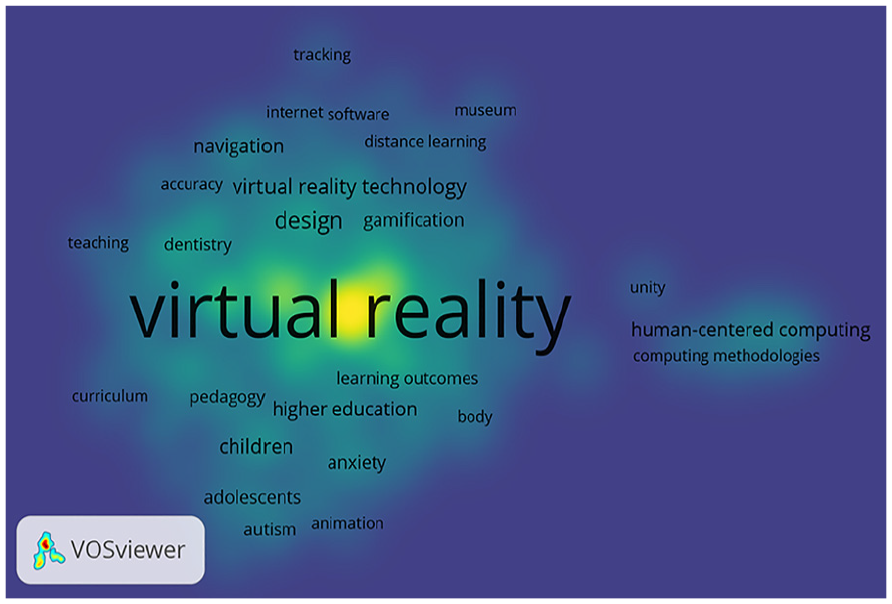
Bibliographic density visualization of “Virtual Reality in Education” showing co-occurrence with “all keywords” as a unit of analysis.
As an explanation for Figures 3 and 4, it is clear from the bibliometric analysis that “Virtual Reality in Education” has overlapping studies with virtual reality technology design, navigation, dentistry, gamification, children, anxiety, higher education, learning outcome, and curriculum. More distant studies connected to virtual reality concerning internet software, distance learning, museum, adolescents, autism, and animation. On the right side, more distant fields of study concerning human-centered computing methodologies. Hence there is evidence from the Web of Science that VR and AR are still trending in the education field, and that it is accumulating in the knowledge base of the Web of Science.
(b) “Augmented Reality in Education.”
The second step in the bibliometric analysis is to investigate: (b) Augmented Reality in Education has yielded 1,969 results from the Web of Science Core Collection. From the total, the authors downloaded the top1,000 articles for Bibliometric analysis in Vosviewer. The criteria of bibliometric analysis are refined and shown in the following figures (Figures 5 and 6).

Analysis of co-occurrence with “all keywords” as unit of analysis for “Augmented Reality in Education.”

The setting of thresholds for analysis of co-occurrence with “all keywords” as a unit of analysis for “Augmented Reality in Education.”
With the selection of choices from Vos viewer, the similar 210 sources met the requirement of having at least five occurrences of a keyword from the Web of Science.
The result of the network analysis is shown in Figure 7.

Bibliographic network visualization showing “Augmented Reality in Education.”
Subsequently, Figure 8 is presented to reveal the prominent keywords clearly as found on the Web of Science.
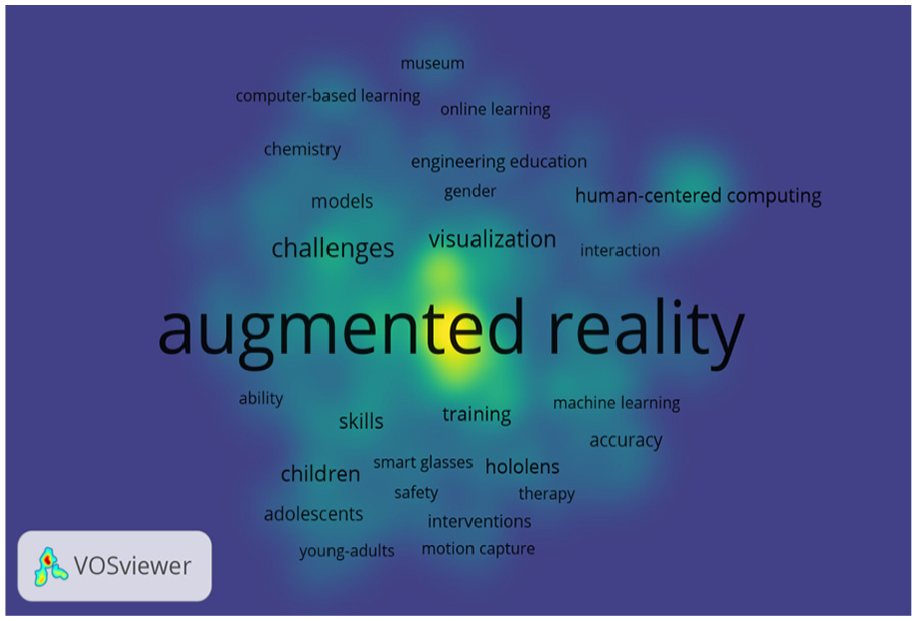
Bibliographic density visualization showing “Augmented Reality in Education.”
As an explanation, it is clear from the bibliometric analysis that “Augmented Reality in Education” are studied along with their impact /on visualization, challenges, human-centered computing, models, engineering education. training, machine learning, smart glasses, hololens children and adolescents. More distant studies are concerning computer-based learning, chemistry, museum and online learning while the lower bottom of the figure highlights interventions and motion capture. As this is a stand-alone search using one term “Augmented Reality in Education” there is no signal to show that “Virtual Reality in Education” is studied alongside this term. As such the next phase of search using “Virtual Reality in Education” OR “Augmented Reality in Education” is important to uncover any evidence and investigate if this coupling is trending or accumulating in the knowledge base of the Web of Science.
(c) “Virtual Reality in Education” OR “Augmented Reality in Education.”
Thirdly, the next step in the bibliometric analysis is to investigate c) “Virtual Reality in Education” OR “Augmented Reality in Education” which has yielded5,231 results from the Web of Science Core Collection. From the total, the authors downloaded the top 1,000 articles for Bibliometric analysis in Vosviewer. The criteria of bibliometric analysis are refined and shown in the following figures (Figures 9 and 10).
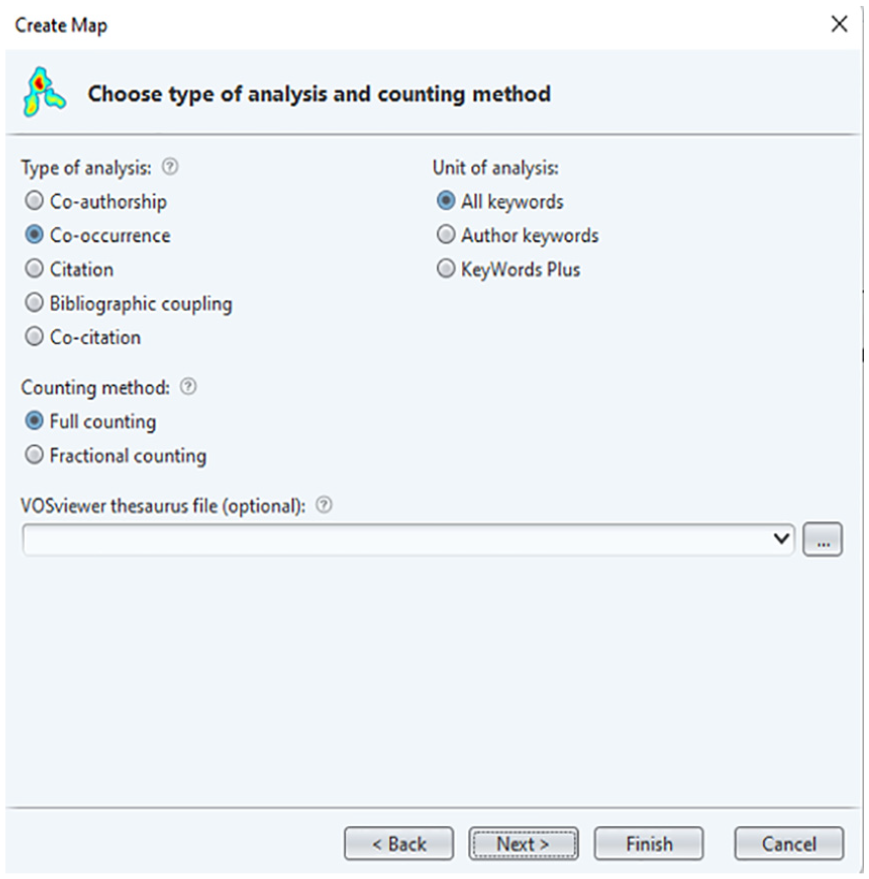
Analysis of co-occurrence with “all keywords” as the unit of analysis for “Virtual Reality in Education” OR “Augmented Reality in Education.”

The setting of thresholds for analysis of co-occurrence with “all keywords” as the unit of analysis for “Virtual Reality in Education” OR “Augmented Reality in Education.”
With the selection of choices from Vos viewer, 212 sources met the requirement of having at least five occurrences of a keyword from the Web of Science.
The result of the network analysis is shown in Figure 11.

Bibliographic network visualization showing “Virtual Reality in Education” OR “Augmented Reality in Education.”
Subsequently, Figure 12 is presented to reveal the prominent keywords clearly as found on the Web of Science.
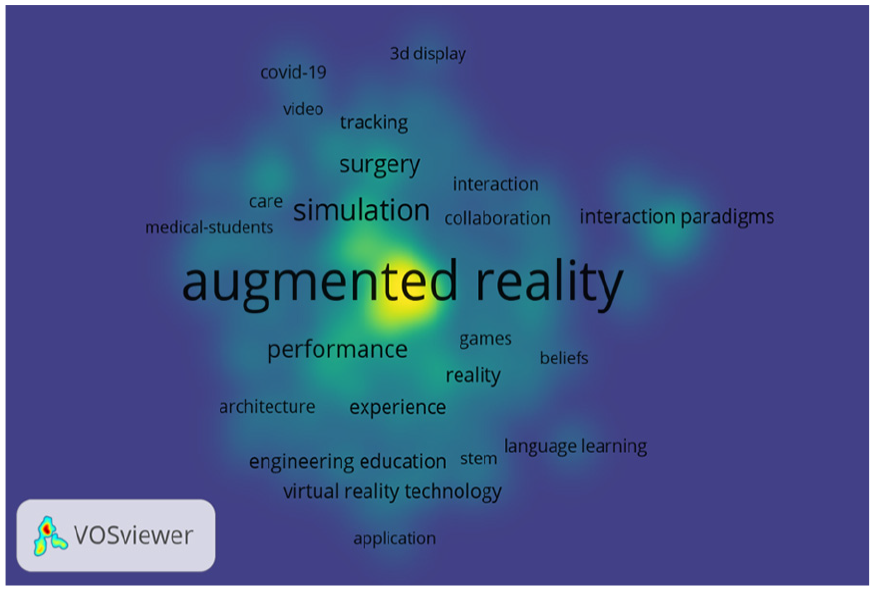
Bibliographic density visualization showing “Virtual Reality in Education” OR “Augmented Reality in Education.”
As an explanation, it is obvious from the bibliometric analysis of “Virtual Reality in Education” OR “Augmented Reality in Education” that these two keywords are mediated by performance, games, experience, engineering education, language learning, STEM, and architecture. In terms of subjects, virtual reality is applied more in engineering education and architecture, while Augmented Reality is applied more in medical studies. Further attempts were also concerning the use of augmented reality in surgery and the Covid-19 pandemic. By comparison, there are more studies concerning AR compared to VR on the Web of Science. As such, there are future gaps for studies in coupling VR and AR and ascertaining if there is any relationship between the two contemporary technological approaches in education. In other words, this finding also indicates the need for a study from China according to the knowledge base in the Web of Science.
Bibliographic Coupling Based on Universities for “Virtual Reality in Education” OR “Augmented Reality in Education”
More efforts were also conducted by the authors in the bibliometric analysis to investigate conceptual and social structure in the body of knowledge. With the data downloaded from the web of science, the authors refine the search to uncover the co-occurrence of keywords and collaboration between scholars from various universities. As a result, the following figures show the findings that would later usher the authors into selecting the right articles for content analysis (Figure 13).

Analysis of Bibliographic coupling based on universities for “Virtual Reality in Education” OR “Augmented Reality in Education.”
Thereafter, the selection threshold is set at a minimum number of five documents per organization (as shown in Figure 14). With the selection in Vos viewer, 73 organizations met the threshold requirement from the Web of Science.

The setting of thresholds for analysis of Bibliographic coupling based on universities for “Virtual Reality in Education” OR “Augmented Reality in Education.”
With the selection of choices from Vos Viewer, the following Figure 15 shows the universities that produced knowledge based on Bibliographic coupling based on universities.

Bibliographic network visualization showing bibliographic coupling based on universities.
Subsequently, Figure 16 is presented to reveal the name of the universities more clearly.

Bibliographic density visualization showing bibliographic coupling based on universities for “Virtual Reality in Education” OR “Augmented Reality in Education.”
As a brief explanation, the bibliometric analysis using bibliographic coupling based on universities has revealed that Technology University Munich, Beijing Normal University, and Ludwig Maximilian University Munich are universities at the forefront of publications in the subjects of VR and AR. The universities that followed are Texas A&M University, Osaka University, Stanford University, Nanyang Technology University, and University Nottingham. Publications in VR and AR are spread between the east and the west as it develops their knowledge base in the Web of Science between 2018 and 2022.
Bibliographic Coupling Based on Authors for “Virtual Reality in Education” OR “Augmented Reality in Education”
Bibliometric analysis is also conducted by the authors to investigate bibliometric coupling among authors in the body of knowledge. With the data downloaded from the web of science, the authors refine the search to uncover the collaboration between scholars all over the world. As a result, the following Figure 17 shows the findings that would later usher the authors into selecting the right articles for content analysis.

Analysis of Bibliographic coupling based on authors for “Virtual Reality in Education” OR “Augmented Reality in Education.”
With the selection of choices from Vos viewer, 25 sources met the requirement of having at least five documents per author from the bibliographic coupling analysis (Figure 18).

The setting of thresholds for analysis of bibliographic coupling based on authors for “Virtual Reality in Education” OR “Augmented Reality in Education”.
The names of the authors are also shown in the next Figure 19.
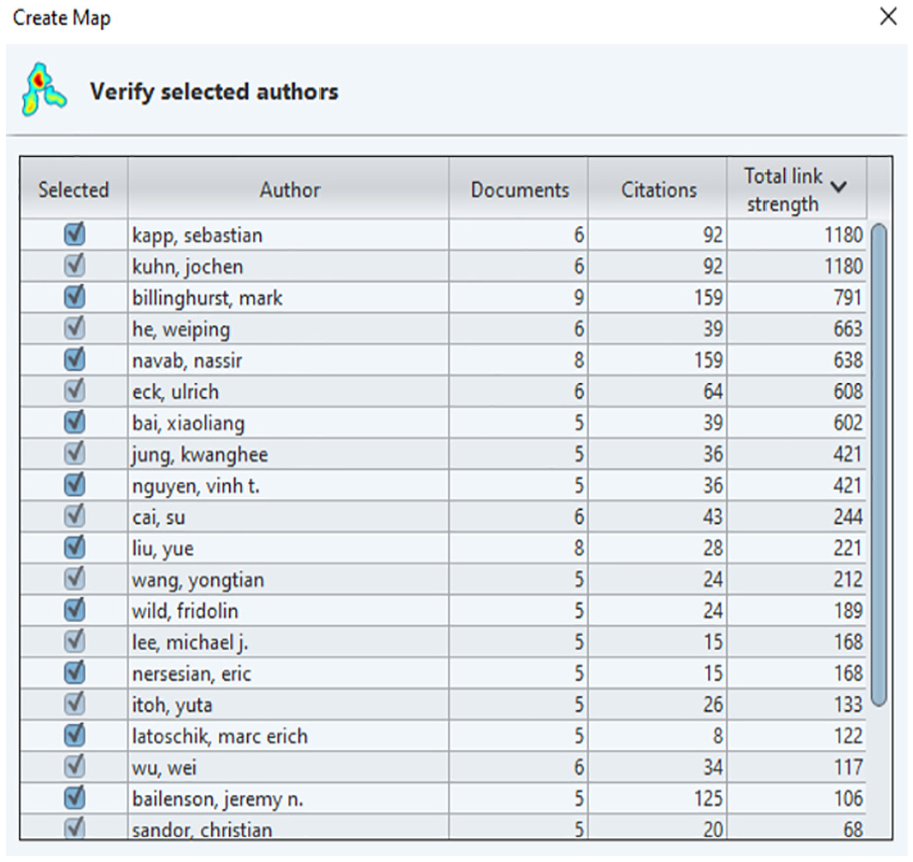
Search results from bibliographic coupling based on authors for “Virtual Reality in Education” OR “Augmented Reality in Education.”
The result of the network analysis is shown in Figure 20.

Bibliographic network visualization showing bibliographic coupling based on authors for “Virtual Reality in Education” OR “Augmented Reality in Education.”
Subsequently, Figure 21 is presented to reveal the authors’ names.

Bibliographic density visualization showing bibliographic coupling based on authors for “Virtual Reality in Education” OR “Augmented Reality in Education.”
Based on Figure 21, bibliometric analysis has found that more scholars are publishing in non-educational areas as compared to the field of education. With further investigation of authors’ profiles from Google Scholar, it was found that the following scholars have published about AR and VR in education:
a. Su Cai (Beijing Normal University, China) -Augmented_reality_in_education)
b. Kwanghee Jung (Texas Tech University)-Quantitative ModelingLearning SciencesBig Data AnalyticsAR/VR Digital Literacy
c. Sebastian Kapp (University of Kaiserslautern)- VR/AR in Physics Education
d. Jee Hyun Lee (Yonsei University, Korea)- Digital fashion design cognition inclusive design education
Subsequently, the rest of the scholars do not have any evidence linked to educational studies:
a. Yue Liu (Beijing Institute of Technology, China)—Virtual reality,electroencephalography,medical signal processing,computer aided instruction,augmented reality,feature extraction, learning (artificial intelligence),neurophysiology,brain-computer interfaces,gesture
b. Nassir Navab (Technische Universität München)
c. Mark Billinghurst (University of South Australia, Auckland Bioengineering Institute)
d. Weiping He (Lab Northwestern Polytechnical University Xi’an, China)- Cyber-Physical Interaction
Bibliographic Coupling Based on Sources of Journals
As the last process of bibliometric analysis, the data downloaded from the web of science prompted the authors to refine the search by examining the sources of publications. As a result, the following Figure 22 shows the findings that would later usher the authors into selecting the right journal for content analysis.

Analysis of Bibliographic coupling based on Journal Sources.
With the selection of choices from Vos viewer, 31 sources met the requirement of having at least five documents per source from the bibliographic coupling analysis (Figure 23).

The setting of thresholds for analysis of bibliographic coupling based on Journal Sources for “Virtual Reality in Education” OR “Augmented Reality in Education.”
The result of the network analysis is shown in Figure 24.

Bibliographic network visualization showing Journal Sources for “Virtual Reality in Education” OR “Augmented Reality in Education.”
Subsequently, Figure 25 is presented to list the name of journals more clearly.

Bibliographic density visualization showing Journal Sources for “Virtual Reality in Education” OR “Augmented Reality in Education.”
As noticed from the density visualization, most publications concerning the topic of “Virtual Reality in Education” OR “Augmented Reality in Education” consists of proceedings from the IEEE conference. From the visualization, it is evident that Interactive Learning Environments, Computers & Education, Anatomical Science Education, Sustainability, Journal of Science Education and Technology, Frontiers in Education, and IEEE access are prominently publishing the topics of VR and AR in education. This analysis has also indicated the acceptable scope and potential journals for future publications for this studies concerning “Virtual Reality in Education” OR “Augmented Reality in Education.”
Part 2: Bibliometric and Content Analysis
Question 2: How Do Educators Among Top Countries Lead the Use of Virtual and Augmented Reality in Education Based on the Bibliometric and Content Analysis From the Web of Science?
The subsequent step is to investigate: (a) state of “Leading Virtual Reality in Education” OR “Leading Augmented Reality in Education” has yielded 885 results from the Web of Science (WoS) Core Collection. The authors downloaded all the data ‘containing full records and cited references from the WoS for Bibliometric analysis in Vosviewer (Figure 26).

Analysis of co-occurrence with “all keywords” as the unit of analysis for “Leading Virtual Reality in Education” OR “Leading Augmented Reality in Education.”
With the selection of choices from Vos viewer, 208 sources met the requirement of having at least five occurrences of a keyword from the Web of Science (as seen in Figure 2) (Figure 27).

The setting of thresholds of co-occurrence with “all keywords” as a unit of analysis for “Leading Virtual Reality in Education” OR “Leading Augmented Reality in Education.”
The result of the Bibliographic network visualization is shown in Figure 3 (Figure 28).

Bibliographic network visualization for “Leading Virtual Reality in Education” OR “Leading Augmented Reality in Education” showing co-occurrence with “all keywords” as a unit of analysis.
Subsequently, Figure 4 is presented Bibliographic density visualization to reveal the prominent keywords more clearly as found on the Web of Science (Figure 29).

Bibliographic density visualization of “Leading Virtual Reality in Education” OR “Leading Augmented Reality in Education” showing co-occurrence with “all keywords” as a unit of analysis.
As an explanation, it is clear from the bibliometric analysis that “Leading Virtual Reality in Education” OR “Leading Augmented Reality in Education” has overlapping studies with the context of Industry 4.0, 3D modeling, and higher education. Educators in top countries lead the use of virtual and augmented reality in medical & health-related studies (EEG, surgical skills, brain, and exercise), simulator, or educational technology. More distant studies concerning leading studies are concerning human-centered computing, human-computer interactions, and interactive learning environment. Hence this evidence pointed out the future directions of research in VR and AR, which also suggest that the knowledge base in the Web of Science is trending and accumulating.
Question 3: What Are the Research Gaps to be Highlighted for Suggestions for Future Studies on Virtual and Augmented Reality in Education Based on the Bibliometric and Content Analysis From the Web of Science?
Globalization and technological development have introduced cutting-edge technology to the education business to improve experiential and immersive learning (Bozgeyikli et al., 2016; Charissis et al., 2008; Li et al., 2020). While using technology in the classroom increases access, equity, and quality education, both Virtual Reality (VR) and Augmented Reality (AR) will keep changing the future of teaching and learning. change learning and teaching. Findings from content analysis on top listed articles in the Web of Science database have revealed several ground-breaking results. Before this study, other scholars have also used bibliometric data of papers about the use of AR in scientific education to uncover research trends published between 2013 and 2018 using content analysis. The findings revealed that most papers during the era have concentrated on topics related to mobile learning and online classrooms. “Education,” “knowledge,” “scientific education,” “experiment,” and “efficacy” were the most frequently used terms in the abstracts. Then, they conclude that research on AR was focused on pupils’ learning and success. It was also the era when mobile apps emerged as the most popular form of AR content, and they have also noticed that quantitative investigations were much more prevalent than qualitative ones in the previous 6 years (Arici et al., 2019).
Another study mentioned that as home-schooling became popular during and after the Covid-19 pandemic, augmented were used to support pupils in first world nations to comprehend course information, while poorer nations’ AR adoption has not been studied extensively (Faqih & Jaradat, 2021). In one study, they suggest that teachers must first understand the mechanics of augmented reality adoption before motivating and inspiring pupils to use it in the classroom (King et al., 2018; Naranjo-Torres et al., 2020). Using theories and instruments of technological adoption, the researchers found that price value has no impact on augmented reality adoption in educational contexts, but task technology fit, performance expectation, effort expectancy, social influence, enabling condition, and hedonic incentive do (Faqih & Jaradat, 2021). These factors predict 49% of the variance in classroom AR usage. With this study, school leaders need to improve their knowledge of the dynamics and behaviors of AR adoption in underdeveloped nations (Faqih & Jaradat, 2021). One particular study indicated that the adoption of cutting-edge technologies is instrumental to drive augmented and virtual reality and that this presents a paradigm for the construction of integrated learning objects. The scholars posit that VR and AR objects will be more effective if they are to be linked to other educational material as learning objects by establishing integrated learning programs, learning scenarios, etc. (Gudoniene & Rutkauskiene, 2019).
Other scholars concluded that augmented reality might create more dynamic classrooms. Even though AR may improve educational achievements, understanding how to develop AR to complement learning is most crucial. When designing the AR classroom, many educational techniques, such as group study or collaborative learning allows students to connect with classmates and course content, which increases understanding and interest. They posit that collaborative AR is promising and should be encouraged in the educational setting because research in this area is still in its infancy (Phon et al., 2014).
Educational Leaders must find ways to improve the use of different software for VR/AR (Krauss et al., 2021). One study concentrated on AR’s potential for math education. The scholars found that GeoGebra AR could easily bridge the gap between physical and abstract math by projecting 3D graphs and objects onto the real environment. For example, this useful program lets students import 3D mathematical objects into their locations and investigate them from all angles, and that guided activities using images help students identify math applications in daily life (Tomaschko, 2020)
In other examples concerning language education, one paper compares pre-service ESL, EFL, and BE teachers’ perceptions, uses, and preferences from two universities (Texas Woman’s University, USA, and University of Cordoba, Spain). Their findings have also shown good sentiments about incorporating AR in ESL/EFL and multilingual environments. According to scholars, AR promotes classroom engagement and focuses differently than conventional teaching approaches, enhancing student motivation and aiding learning. However, access to mobile devices, technological expense, technical problems, and teacher preparation are among AR concerns. There are several obstacles and benefits of AR in ESL/EFL and multilingual environments that must be improved continually (Huertas-Abril et al., 2021)
Focusing on Virtual or Augmented Reality to promote students’ involvement and participation in educational discussion, has the potential to reduce dropouts in university courses (Capone & Lepore, 2020) because augmented reality increases students’ involvement (Gandolfi et al., 2018). Through VR/AR, students may engage in immersive learning that is inclusive of all learning styles, needs, and abilities. Other scholars have also shown that virtual reality and augmented reality will interest and help learners with the following benefits: (1) promoting active rather than passive experience (Peng et al., 2019), (2) participating in an immersive experience without distractions (Naranjo-Torres et al., 2020), (3) encourage immediate engagement that is useful in today’s world of limited attention spans (Bozgeyikli et al., 2016; Tomaschko, 2020), (4) involved in hands-on approach aids learning and retention (Charissis et al., 2008; Nersesian et al., 2019), (5) understand complex subjects/theories/concepts (Nersesian et al., 2019), and (6) address a myriad of learning styles (King et al., 2018).
Therefore, Virtual (VR) and Augmented Reality (AR) assisted interventions have tremendously provided several advantages to education, particularly in achieving fundamental goals. In a more recent development, the massive expansion of Information and Communication Technology (ICT) has led to a new field, Learning Analytics (LA), which advocates collecting “big data” for assessing and evaluating educational processes. On this basis, a universal LA system will be designed and developed to facilitate the conduct and assessment of such interventions in diverse educational environments and scientific domains (Pellas et al., 2020).
By delivering immersive learning experiences for teachers and students, virtual reality (VR) and augmented reality (AR) have the potential to change education. For future studies, AR and VR may be utilized to build dynamic learning environments, while VR can be used to assist students grasp abstract concepts. According to research, VR is more effective for visual instructional information, whereas AR is better for aural learning (Choi, 2022).
In terms of educational contexts or settings, Augmented Reality (AR) and Virtual Reality (VR) may be used in the classroom and higher education to improve student results and help students visualize and grasp difficult subjects (Chan et al., 2022). AR/VR technologies have the potential to significantly improve learning at all levels, from K-12 to higher education. AR/VR, for example, may be used to build interactive classrooms in which students can participate in the creation of educational content (Choi, 2022), as well as simulations for STEM courses, medical training, arts and humanities materials, and technical education (Guray & Kismet, 2023).
There are certain disadvantages to employing AR/VR in the classroom. For example, it is a costly technology that, owing to the digital divide, may not be available to all students. Furthermore, its usefulness in learning is unknown, as is its applicability to student assessment (Verner et al., 2022). As a result, before incorporating AR/VR into their courses, educators must weigh the benefits and drawbacks.
As the final discussion, VR and AR may also give students with compelling classroom learning aids, such as immersive content libraries, experiences tailored to certain courses or learning goals, and tools for kids with learning disabilities (Bailey et al., 2022). Furthermore, these tools may increase student achievements by encouraging creativity and imagination (Chan et al., 2022). As such, they may aid in the improvement of cooperation between professors and students, as well as among students.
Implications of Study
Following the content analysis from literature reviews and also the bibliometric analysis, Table 4 below shows the three implications from this study
Implication From Study.

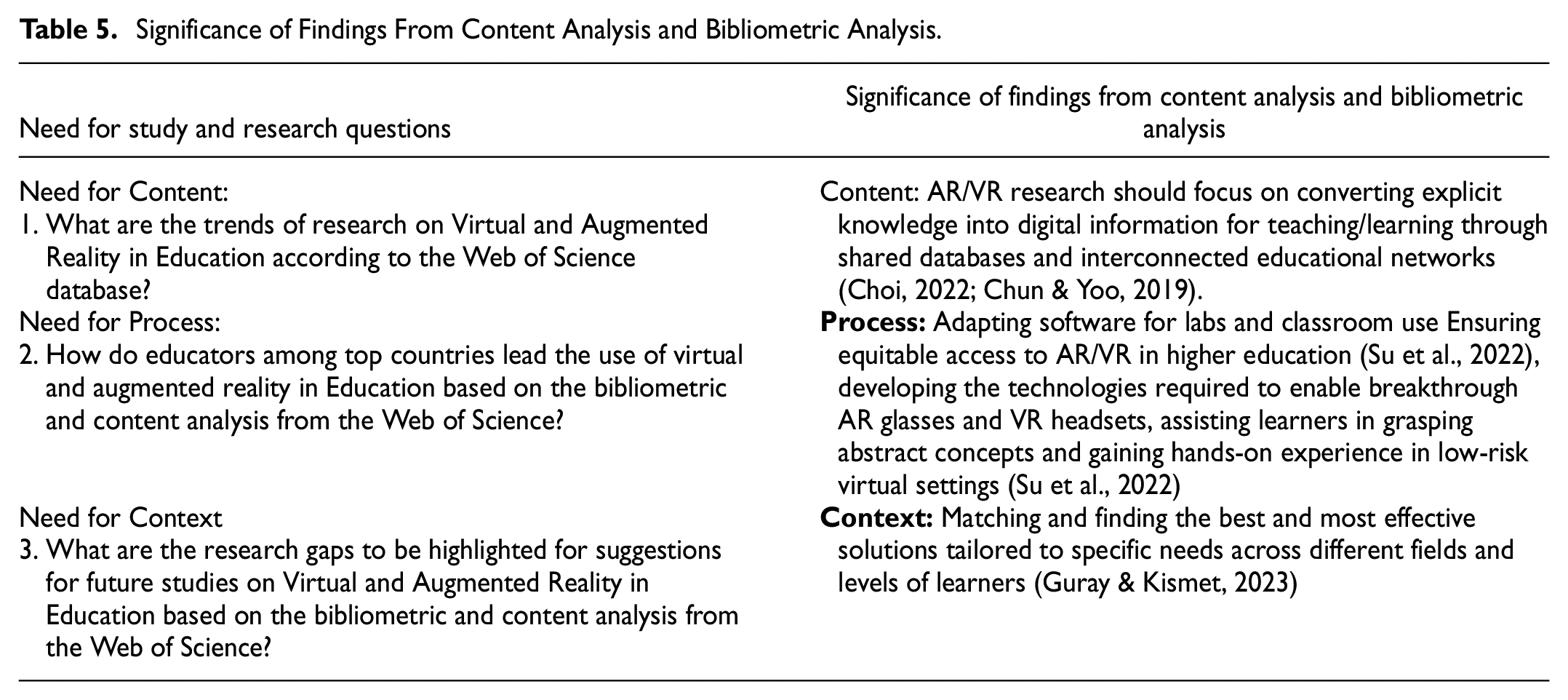
Simultaneously, Table 5 concludes the significance of findings in this content and bibliometric analysis in relation to the research questions
Significance of Findings From Content Analysis and Bibliometric Analysis.
Limitation of Study
In this study, there are limitations in content analysis and bibliometric research due to the data base used. As mentioned, the bibliometric data are only fetched from the Web of Science database as the most prominent source of the database. As justification, the Web of Science is a trustworthy database since it offers a standard search language, navigation environment, and data structure (Zhu et al., 2019) making it the world’s premier scientific citation search and analytical information platform (Khakimov et al., 2019) It covers all scientific topics and only contains the “best” journals, while also offering access to bibliographic citations from diverse domains and enabling users to search through the history of a single article using cited reference searching.
As such it is believed that the bibliometric analysis that was carried out from this database will serve the general global interest because of the recent development of AR and VR in the field of education. Nevertheless, we also suggest several suggestions to improve future research. In this study, although bibliometric analysis is a valuable technique for determining the influence of academic work, it has several drawbacks (Yasin et al., 2021). For example, the Web of Science give a specific picture of the bibliographic universe that may be hampered by variables like language bias, publication type bias, and citation bias. Furthermore, data quality concerns like as missing or erroneous records might have an impact on bibliometric analysis (Liu, 2019)
To resolve these constraints, it is advasble that future studies should undertake bibliometric reviews and analyses using diverse sources such as Scopus or PubMed. To acquire a more full view of the data, they should also analyze additional metrics such as network analysis and research trends (Vergara-Perucich, 2021). Even so, while evaluating bibliometric analysis findings, future researchers should be cautious of possible biases in their data (Mashroofa et al., 2019). As mentioned above, the Web of Science gives a specific picture of the bibliographic universe that may be hampered by variables like language bias, publication type bias, and citation bias (Liu, 2019). Furthermore, data quality concerns like as missing or erroneous records might have an impact on bibliometric analysis (Vergara-Perucich, 2021). We do not foresee any problems with language bias as AR and VR are specific terms, while the keywords, bibliometric metrics including journals, publication year, authors, indexes, and more that are generated from WoS are self-stipulated by the authors themselves. We merely report what is provided by data through cluster analysis that is facilitated by Vosviewer and set by the scope of settings that are already mentioned in the text (van Eck & Waltman, 2010).
Summary
AR and VR technologies have the potential to transform education by enabling immersive learning experiences that are engaging, memorable, and effective for students (Zhang et al., 2022). AR may be used to show instructional text and lesson-specific information on top of a user’s real surroundings, whilst VR can bring academic topics to life by providing students with fresh insights and perspectives (Guray & Kismet, 2023). AR/VR may be more effective learning aids than conventional techniques, according to studies, since they enable learners to experience circumstances that would not be feasible otherwise and act rather than just seeing things (Chan et al., 2022). Furthermore, while students are studying from home, AR/VR technology might assist keep them interested in lectures (Solmaz et al., 2021).
However, studies on the psychological effect of VR indicate that it should be used sparingly and under tight supervision in educational settings. Furthermore, although AR/VR technologies might deliver a more immersive learning experience, they cannot completely replace human contact (Verner et al., 2022). Because learning is inherently a social experience, VR should be utilized with conventional teaching approaches such as discussion groups or one-on-one instruction (Bansal et al., 2022).
Through the bibliometric and content analysis, it is evident that both VR and AR have grown in popularity in recent years from 2018 to 2022. AR has been applied in academic, medical, entertainment, tourism, economic, and promotional domains. Unsurprisingly, tech giants like Google, Microsoft, Apple, Samsung, and Amazon have lately increased their investments in research and development in virtual and augmented reality (Kepuska & Bohouta, 2018; Reis et al., 2018). As implications, this might enhance educational accessibility, equity, and quality of teaching and learn in the post-pandemic era of Covid-19. It is shown from the findings above that VR and AR promote student learning and retention in the classroom. Both VR and AR-based learning use current technology to bring digital content into the real world so users may better connect with it on smartphones and tablets. In addition, the proliferation of Animation, 3D visuals, and music may increase user comprehension. This improves students’ understanding. Augmented reality may replace traditional instructional approaches soon (Tenh et al., 2017).
As also explained, this study provides a literature review and model analysis of virtual and augmented reality classroom systems. The presented model supports the authors’ conclusions and inspires practical recommendations in aspects of technological adoption. For educational leaders, they need to consider factors such as technology fit, performance expectation, effort expectancy, social influence, enabling condition, and hedonic incentive that motivates technological adoption in AR/VR (Faqih & Jaradat, 2021). Alternatively, future educators need to understand how to develop AR to complement learning. Also, most of the literature on collaborative AR is promising and should be encouraged in the educational setting because research in this area is still in its infancy (Phon et al., 2014). Educational Leaders must find ways to improve the use of different software for VR/AR (Tomaschko, 2020) because VR and AR promote classroom engagement and focuses differently than conventional teaching approaches, enhancing student motivation and aiding learning. However, access to mobile devices, technological expense, technical problems, and teacher preparation are among AR concerns in developed and underdeveloped nations (Huertas-Abril et al., 2021).
In conclusion, virtual reality and augmented reality are promising technologies for use in the classroom. Still, there are many hurdles involved with their implementation in the classroom.
Looking ahead, there is a need for VR and AR scientists to develop software that is affordable for schools and provide educators with training on how to teach with these enhanced learning technologies. More innovation should also concentrate on projects that combine VR-enabled low-cost digital gadgets to create a virtual, highly engaging collective learning environment for each student in a class. Therefore, teachers can guide students through the environment and controls the speed and degree of progression to fit the curriculum and student capabilities.
Footnotes
Declaration of Conflicting Interests
The author(s) declared no potential conflicts of interest with respect to the research, authorship, and/or publication of this article.
Funding
The author(s) received no financial support for the research, authorship, and/or publication of this article.

References
