




Abstract
Effective communication and academic writing in English hinge on a solid grasp of grammar, with pronouns representing a pivotal aspect. However, non-native, particularly English as a second language (ESL) students, often find difficulties in employing pronouns effectively, especially in reference to their antecedents within sentences. The current study investigates errors in pronoun-antecedent agreement among ESL students in their academic writing by employing content analysis. By using purposive sampling technique, 40 students from four universities in Karachi city were selected and assigned to write a paragraph on any personality they are familiar with. Subsequently, all of the writing samples were examined thoroughly utilizing a systematic approach. The analysis revealed that errors predominantly occurred with personal pronouns, followed by possessive pronouns, relative pronouns, and demonstrative pronouns. While this study offers valuable insights into the difficulties ESL students face in mastering pronoun-antecedent agreement, it is essential to note limitations. The sample size may not fully represent the diverse range of ESL students, and the focus on academic writing may not capture all contexts in which pronoun-antecedent agreement challenges arise. Despite these limitations, the findings provide important considerations for ESL teachers. The implications of these findings extend to the design of effective language instruction, aimed at enhancing students’ writing skills and mitigating common pronoun-antecedent agreement errors.
Keywords
Introduction
Recognizing the importance of English as an internationally recognized language, acquiring proficiency in English has garnered more attention in contemporary globalized society (Cancino, 2023; Wang, 2023). It is the most extensively used language across diverse fields, such as commerce, education, communication, and technology (Abdelrady & Akram, 2022; Akram et al., 2021). In addition, English language proficiency is crucial for success in higher education and is usually a requirement for admission, as English serves as a medium of instruction in higher educational institutions worldwide. Moreover, English-speaking students have greater advantages when it comes to accessing educational opportunities and are more likely to pursue studies abroad (Shahnazari, 2023). However, students with inadequate English proficiency may encounter difficulties in pursuing their academic pursuits in higher educational institutions, including fulfilling the English language prerequisites for English-taught programs (Akram & Abdelrady, 2023), which may hinder their academic and professional growth (Eckes & Althaus, 2020).
Furthermore, as individuals progress through their academic careers, the ability to write competently in English becomes even more important. Higher education students are expected to write various academic assignments, such as articles, papers, synopses, and thorough research theses, to fulfill their degree requirements. However, students with weak English language skills often struggle while dealing with those assignments (Ayton et al., 2022). As a result, developing a solid command of English is critical for students to effectively communicate their ideas, demonstrate their expertise, and thrive in their academic pursuits (Freiermuth & Ito, 2020). Their ability to effectively articulate ideas, demonstrate a thorough mastery of subjects, and construct intellectual dialogue becomes critical to their academic achievement. Moreover, it improves their knowledge of academic subjects, competence to create research papers, and their capacity to integrate and evaluate complex information from numerous sources (Sadoughvanini & Ghaemi, 2022). Therefore, a strong command of English is not simply a tool but an essential advantage for students hoping to excel in academia.
In relation to the main component, accuracy and clarity constitute essential aspects of academic writing. The author’s ability to successfully explain complicated thoughts and arguments greatly depends on their command of grammatical structures. These structures not only aid in generating sentences but also guide how these sentences might be linked to produce a logical piece of writing. Therefore, a thorough mastery of the fundamental rules of grammar is a prerequisite for anyone aspiring to succeed in effective communication, particularly in academic writing in English (Su & Lu, 2022).
Moreover, grammar is similar to a complex pattern with several critical aspects. These elements enable writers to carefully construct sentences, apply proper grammar, and convey their intended meaning to readers (Jayanti, 2019). The proficient control of pronouns in the English language is a crucial component that holds greater significance in the hierarchy of grammatical features. Pronouns are words used in sentences in place of nouns that serve as an essential instrument in sentence building and enhancing the flow of sentences by reducing excessive repetition of nouns. They help to enhance cohesiveness and coherence of a phrase by decreasing the necessity for the repeated use of nouns (Carvalho et al., 2015). In other words, pronouns help to establish a clear relationship between distinct sections of a sentence or text, resulting in a smooth, straightforward narrative flow, enabling the reader or listener to easily follow the writer’s or speaker’s train of thought.
Understanding the different types of pronouns, including personal, possessive, demonstrative, reflexive, relative, and indefinite pronouns, provides writers with a wide range of grammatical tools. Each type of pronoun serves a specific purpose. For instance, personal pronouns can substitute for people or objects’ names, making sentences simpler and more appealing. Possessive pronouns, such as “his,”“her,” or “their,” indicate ownership, while reflexive pronouns, such as “himself” or “themselves,” emphasize the sentence’s subject. It is essential to note that determiners like “this,”“that,”“these,”“those,” and possessive determiners like “my,”“your,”“our” have corresponding pronoun forms and can serve as either determiners or pronouns. This dual role adds complexity to their usage, requiring a closer examination of their functions in academic writing (Leu, 2015).
Moreover, relative pronouns (such as “who,”“whom,”“whose,”“which,” and “that”) are essential in academic writing because they start relative clauses, allowing the writer to provide further information or clarification. Demonstrative pronouns (“this,”“that,”“these,”“those”) help to direct the reader’s attention to certain parts of the text. Finally, indefinite pronouns (such as “everyone,”“somebody,” and “none”) are important when referring to an indeterminate number of persons or things (Kehler & Rohde, 2019). Understanding the many categories is important, but it is crucial for writers to be aware of the complexities of pronoun usage, such as agreement in number and gender and case sensitivity, and to navigate them expertly. This ensures that the sentences are clear, sophisticated, and grammatically sound. A discrepancy in these agreements can lead to confusion, ambiguity, and erroneous interpretations, underscoring the significance of this aspect (Diab, 2015; Fareed et al., 2016).
Irrespective of whether English is a student’s native language, the problem of pronoun usage in academic writing poses particular difficulties. These difficulties are widespread and stem from several important factors, as highlighted by Severino and Cogie (2016). Firstly, one of the major issues is linked with the pronoun-antecedent agreement usage. According to grammatical rule, a pronoun must be aligned with the antecedent, or the noun it replaces in terms of number, gender, and person. On the other hand, student writers often encounter difficulties in correctly using pronouns after collective nouns, such as “team” or “committee” (Jegede & Akinola, 2021).
Another challenge arises from the use of gender-neutral pronouns (e.g., “they,”“them,”“their”) as singular pronouns. However, the use of “they” as a singular pronoun has gained acceptance as English becomes more inclusive and tolerant of gender diversity. Yet, using “they” in a singular context might feel awkward and lead to agreement mistakes, especially in the non-native setting (Sun et al., 2021). Another important consideration when using pronouns is the transition between formal and casual writing or speaking styles (Latupeirissa & Sayd, 2019). Pronouns are frequently used in casual discussions without carefully following the principles of pronoun-antecedent agreement. However, in professional or academic writing, it is crucial to strictly follow these rules. Therefore, anyone who wants to communicate effectively in English must learn and comprehend these rules thoroughly.
Moreover, Kamlasi and Nokas (2017) pointed out that non-native English speakers might find it challenging to use pronouns correctly because of the influence of their native tongue. Some languages do not differentiate between the pronouns “he” and “she,” while others do not have the concept of “it.” therefore, when these speakers try to use English pronouns, they may become perplexed and make mistakes. Additionally, the correct use of pronouns can be difficult due to the shift in formality between academic writing and spoken English. Academic writing’s tone is frequently more formal and impersonal, which restricts the use of pronouns such as “I,”“we,” and “you.” this depersonalization represents a significant difference from colloquial English, where these pronouns are frequently used. As a result, student writers may struggle to strike the appropriate balance between maintaining an academic tone and ensuring the coherence of their argument (Al-Adawi, 2019).
Given the challenges associated with pronoun usage, it is imperative that ESL students acquire a sound understanding of the conventions and subtleties of pronoun usage for clear, precise, and cohesive academic writing. To this end, teachers should provide specialized instruction to aid students in developing their skills (Napitupulu, 2017). Additionally, students must engage in deliberate practice and revision of their work to improve their grasp of pronoun usage over time.
In Pakistan, several studies have emphasized the persistent issue of incorrect usage of pronouns among higher education students in their academic writing. However, this problem is prevalent across all levels of education and is not limited to any particular level. Fareed et al. (2016) conducted a noteworthy investigation of this issue at the collegiate level and revealed that students faced challenges in using pronouns correctly in their academic writing. One significant issue highlighted in the study was the difficulty students faced in selecting the appropriate pronoun that matches the respective antecedent.
While several earlier studies have acknowledged the challenges that students face with pronoun usage (e.g., Al-Adawi, 2019; Mumtaz, 2021), they tended to focus on specific types of pronoun errors rather than investigating the full range of pronoun-antecedent agreement issues that ESL students encounter in academic writing. To provide a more comprehensive examination of this issue, this study aims to identify prevalent errors and less-explored intricacies in pronoun usage. By doing so, this study hopes to develop a deeper understanding of the challenges that ESL students face in Pakistan. This research seeks to identify specific areas where pronoun-antecedent agreement poses difficulties, providing valuable insights to educators and policymakers to design targeted instructional materials and interventions that cater to the unique needs of ESL students.
Research Question
What are the specific areas where pronoun-antecedent agreement poses difficulties for ESL students’ academic writing?
Theoretical Framework
The Theory of Second Language Acquisition (SLA) provides a comprehensive understanding of how individuals acquire a second language, making it a foundational framework for this study. SLA outlines key principles that shed light on the complex process of language learning, originating from the work of Stephen Krashen (1981).
Central to SLA is the concept of “Interlanguage,” a dynamic and evolving linguistic system that learners construct as they progress toward proficiency. It serves as an intermediate stage in language development, reflecting the learner’s evolving grasp of the target language. Transfer from the first language is a pivotal component of SLA. Learners often draw on the linguistic structures and patterns of their native language when acquiring a second language. This transfer can manifest in both positive and negative ways, impacting the formation of the learner’s Interlanguage. The theory also highlights the phenomenon of overgeneralization, wherein learners may apply grammatical rules from their first language inappropriately to the second language. This process underscores the active role learners play in internalizing and adapting linguistic rules as they navigate the complexities of a new language.
Moreover, SLA recognizes the existence of developmental sequences, suggesting that learners progress through predictable stages in language acquisition. These sequences are characterized by specific linguistic features and structures that emerge and evolve as learners advance in proficiency. In essence, by acknowledging the role of Interlanguage, transfer, overgeneralization, and developmental sequences, SLA offers insights into the varied paths individuals traverse on their journey to language proficiency (Krashen, 2003). The present study employs SLA as a framework to comprehend the intricacies of language development, specifically exploring the interlanguage of ESL students and how they navigate the complexities of pronoun-antecedent agreement within this intermediate linguistic system.
Methodology
This study employed a descriptive qualitative methodology to investigate the complexities of pronoun agreement errors commonly found among ESL learners at the tertiary education level. Descriptive research is useful when exploring a particular occurrence or phenomenon (Kim et al., 2017). The main objective of this study was to examine the characteristics and diversities of pronoun-antecedent agreement errors to identify possible solutions for improvement. To achieve this objective, a content analysis method was employed within the framework of Second Language Acquisition (SLA) principles. Content analysis is a systematic method for evaluating and categorizing extensive textual material, which is essential for achieving the study objectives (Kyngäs, 2020). This approach aligns with SLA’s emphasis on understanding the dynamic and evolving nature of language acquisition, enabling a nuanced examination of pronoun-antecedent agreement challenges within the specific context of language proficiency levels. The study isolated key themes, patterns, or categories from the data and provided a thorough explanation of the results. This approach is applicable to the analysis of a variety of data sources, such as focus groups, interviews, surveys, and written materials.
Sampling
The researchers used a purposive sampling method to select participants for this study, as recommended by Campbell et al. (2020). This approach allowed the researchers to choose participants based on specific characteristics that aligned with the research objectives. Additionally, this method provided a level of control, ensuring that the selected sample possessed the necessary qualities for the study’s goals. Based on the results of the International English Language Testing System (IELTS), the purposive sampling method facilitated the selection of participants with intermediate levels of English proficiency, which is in line with the SLA theoretical framework (Krashen, 2003). This approach enabled an exploration of developmental sequences related to pronoun-antecedent agreement challenges within the Interlanguage. The researchers recruited 40 undergraduate ESL students from four universities in Karachi, Pakistan, including both public and private institutions to account for potential differences in teaching methods or resources. The study participants were aged between 18 and 22 and comprised 60% males and 40% females. The majority of participants were in their first year of undergraduate studies. For further details regarding the participants’ demographics, refer to Table 1.
Participants’ Demographic Overview.

Trustworthiness of the Instrument
In order to determine the degree to which the study’s conclusions are trustworthy and reliable, which is often referred to as rigor or credibility, is crucial in a content analysis. As stated by Creswell and Creswell (2017), an instrument must possess both reliability and validity to be regarded as useful. Additionally, Stahl and King (2020) emphasize the significance of inter-coder dependability, especially when dealing with open-ended study questions. To ensure the dependability of the coding approach and outcomes in this study, three peers and two experts in related fields were selected to evaluate the coding procedure. The level of agreement among these independent researchers and subject-matter authorities exceeds 80%, which deviates from the cutoff point mentioned by Creswell and Creswell (2017) but still indicates a satisfactory level of trustworthiness.
Two tests were subsequently carried out as a crucial component of the pilot plan, but they were later excluded from the final testing. The participants in the qualitative data collection were given a consent letter along with the content analysis test after ensuring the dependability and validity of the analysis procedure. Precautions were taken to ensure that the content analysis procedure adhered to accepted research procedures and was trustworthy.
Measure
The written test was selected as the study’s instrument because it enables the collection of authentic information that is relevant to the students’ writing skills (Jolly & Dalton, 2018). To generate a more genuine writing sample, the students were instructed to write about a familiar subject. An individual was chosen as the subject matter so that students could write about someone they admire or are interested in, which could encourage them to write more persuasively.
The written test was administered in a classroom setting, providing each student with an equal opportunity to complete the test under identical conditions. The 60-minute time restriction was implemented to ensure that students had sufficient time to complete the task without undue pressure that might compromise the quality of their work.
The process of data analysis in this research involved several steps that were modified from Saldaña’s (2021) framework, including the following Figure 1.

Data analysis framework by Saldaña (2021).
Identification
In the content analysis approach, the identification of errors plays a crucial role in analyzing the data. In this step, the data is thoroughly examined in order to identify any errors made by the participants. As part of this study, researchers evaluated the writing examples provided by the students and discovered several instances of pronoun-antecedent agreement errors. They were then underlined to highlight these errors and make them more visible.
Classification
The second stage involves categorizing all the errors found in the study. This step is crucial as it helps to identify trends and patterns in the data, and pinpoint the most common mistakes made by the participants. Accordingly, the researchers carefully grouped the pronoun-antecedent agreement difficulties found in the writing samples provided by the students into different categories based on their various forms.
Tabulation
In the third stage, a comprehensive table was created that displayed the total number of errors made by the ESL students regarding pronoun-antecedent agreement. The table provided a clear visual representation of how the errors were spread across different categories. By identifying the major problems and focusing on correcting the most significant errors, the study became able to arrive at research findings. This meticulous step facilitated a thorough analysis of the data and enabled to extract valuable insights for future research.
Calculation
In the final stage, a detailed analysis of the errors was conducted. This entailed calculating the overall percentage of mistakes made by the ESL students, as well as within each specific category. These calculations provided valuable insights into the magnitude of the problem, identifying common pronoun-antecedent agreement mistakes. Through meticulous calculations, the data was further enriched, contributing to a comprehensive assessment of the research findings.
Findings
After careful assessment of the academic writing samples, the study identified a significant prevalence of problems related to pronoun-antecedent agreement usage. The analysis revealed a total of 198 discrepancies across the samples, which were then categorized into four types of errors: personal, possessive, relative, and demonstrative pronouns, as shown in Table 2.
Summary of Student Pronoun-Antecedent Agreement Problems.

Out of the four categories identified, personal pronoun errors were the most prevalent, accounting for 35% of all mistakes. This suggests that students struggle with using personal pronouns, possibly due to a lack of understanding or incomplete comprehension of their proper usage. Possessive pronoun errors were the second most common, constituting 25% of all mistakes. Relative pronoun errors were the third most frequent, making up 21.2% of the total errors. Lastly, demonstrative pronoun errors were the least common. Despite being the category with the fewest mistakes, the presence of such errors highlights the need for further attention to be given to pronoun usage.
Diving deeper into the findings, it was discerned that students consistently struggled with specific pronouns within each category (see Figure 2). When it came to personal pronouns, the students faced significant challenges in using “I,”“me,”“her,”“it,”“us,”“them,” and “him” appropriately. As for possessive pronouns, these difficulties manifested in the use of “their,”“our,”“mine,”“your,”“its,” and “his.” In the category of relative pronouns, the students grappled with the proper usage of “who,”“whose,”“whom,” and “when.” And in the realm of demonstrative pronouns, students were found to have troubles with “such,”“those,” and “that.” Despite the difference in frequencies, all these errors underscore an underlying struggle to comprehend and accurately use different types of pronouns, which is an essential aspect of English language mastery.
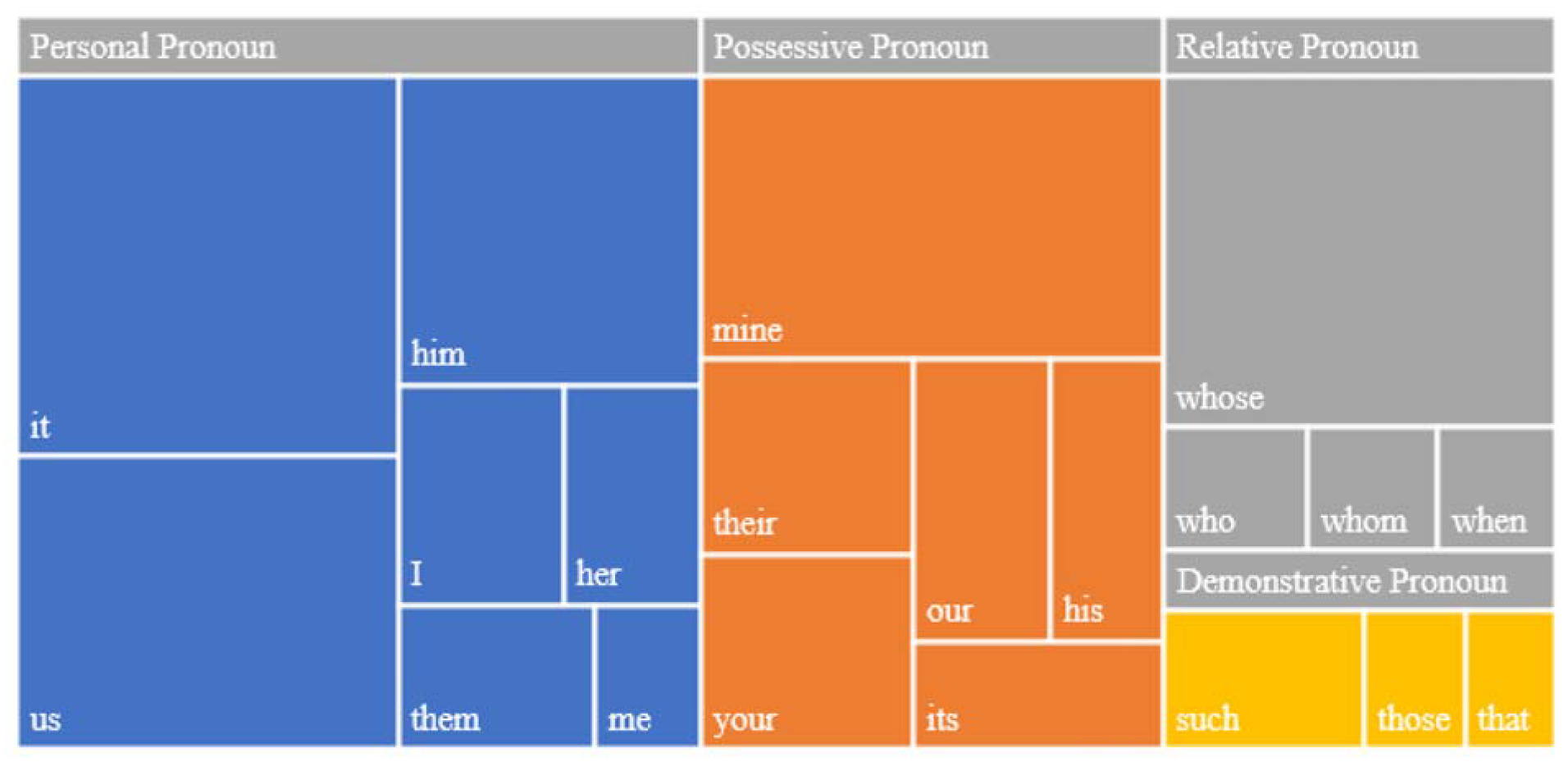
Distribution of pronoun-antecedent agreement errors.
Personal Pronoun Errors
According to the findings, inaccuracies involving personal pronouns were found to be the most common type of error made by the students when it came to ensuring that their pronouns agreed with their antecedents. The high frequency with which these errors occur suggests that pupils have difficulty effectively recognizing the subject or object of the sentence and connecting it with the right pronoun. When students make these kinds of mistakes in their writing, it can lead to ambiguity and make it more difficult for them to communicate effectively with their readers since it can be difficult for readers to determine what the pronoun is supposed to refer to. Some of the mistakes that the students make when using personal pronouns are illustrated by the few examples that follow: Incorrect: He is the most talented cricketer in the entire team, I like them so much. Correct: He is the most talented cricketer in the entire team, I like him so much. Incorrect: She is more intelligent than myself. Correct: She is more intelligent than me. Incorrect: Me and him work hard to pass the examination. Correct: He and I work hard to pass the examination.
Possessive Pronoun Errors
In addition, the research findings showed that errors involving possessive pronouns accounted for 25% of the overall number of errors made by students, making it the second most common type of error. These errors occurred either because students used the wrong possessive pronoun or because they failed to use possessive pronouns when necessary. For instance, students often confused “it’s” with “its” or “their” with “theirs.” moreover, some students omitted possessive pronouns entirely, as shown by the use of “the book cover” instead of “the book’s cover.” examples of possessive pronoun errors made by students are provided below: Incorrect: The country is mine’s Correct: The country is mine. (unnecessary apostrophe and “s”) Incorrect: Ali and their family came to the Pakistan. Correct: Ali and his family came to Pakistan. (using the correct possessive pronoun) Incorrect: Our’s teacher is very strict. Correct: Our teacher is very strict. (removing the unnecessary apostrophe and “s”)
Relative Pronoun Errors
According to the study’s findings, relative pronoun errors accounted for 21.2% of all errors made by students, making it the third most common type of error. These mistakes occur when students fail to connect clauses in their sentences using the correct relative pronoun, such as using “who” instead of “whom” or “which” instead of “who.” misuse of relative pronouns can lead to ambiguity and uncertainty in the sentence’s meaning, which can impair the text’s overall clarity and coherence. Examples of relative pronoun errors made by students include: Incorrect: The person which was talking to him looked unwell. Correct: The person who was talking to him looked unwell. Incorrect: The actor which I saw at the television was very talented. Correct: The actor whom I saw at the television was very talented.
Demonstrative Pronoun
The study found that demonstrative pronoun errors were the least frequent among the different types of pronoun agreement errors, accounting for only 15.6% of the total errors made by ESL students. For instance, students sometimes use “this” instead of “that” or “these” instead of “those” when drafting a sentence. However, using demonstrative pronouns inaccurately can result in ambiguity and confusion for the reader regarding the intended reference. The study cited examples of such errors made by the students.
Incorrect: When I saw again, this car was broken. Correct: When I saw again, that car was broken. Incorrect: There were several birds in the garden, these were beautiful. Correct: There were several birds in the garden, those were beautiful.
Discussion
The analysis of the academic writing samples of the students provides insight into each type of prominent issue associated with pronoun-antecedent agreement. This detailed categorization enables a more precise analysis of the particular areas where ESL students face challenges.
The use of personal pronouns is crucial for effective communication in the English language, as they help to convey ideas clearly and precisely. However, it was observed that errors related to personal pronouns were the most prevalent, accounting for 35% of all errors. This suggests that students struggle disproportionately with the use of personal pronouns, such as “he,”“she,” or “they.” This finding is consistent with the assertions of Suryani and Hidayatullah (2017), who argued that the acquisition and application of personal pronouns are often more challenging for learners than other forms of pronouns. Additionally, Second Language Acquisition (SLA) principles suggest that learners may encounter difficulties in internalizing and applying language rules (Krashen, 2003), especially those related to personal pronouns. Furthermore, non-native English-speaking students may find this particularly challenging due to interference from their first language, as languages vary in how they employ personal pronouns (Al-Sobhi, 2019).
The complexity of personal pronouns in English may be one reason for the prevalent errors among ESL students. Personal pronouns can alter depending on the gender and number as well as the subject, object, or possessive form. Additionally, because personal pronouns are used differently in various circumstances, it can be challenging to learn how to use them effectively (Pratiwi et al., 2019). To enhance communication skills and prevent misunderstandings, it is crucial for teachers and language learners to prioritize the correct usage of personal pronouns. Teachers can provide students with a concise and understandable explanation of the rules and proper usage of personal pronouns in English, along with examples showing how personal pronouns should be used in different settings. They can also design exercises and activities that offer students many opportunities to practice using personal pronouns. For example, teachers may instruct students to write personal pronoun-filled sentences or paragraphs or complete worksheets emphasizing the use of personal pronouns.
Possessive pronouns are another essential aspect of English grammar that can be challenging for ESL learners, as it involves correctly matching the possessive pronoun to its antecedent (i.e., the noun that the pronoun refers to). The prominence of possessive pronoun errors, comprising 25% of all mistakes, highlights another significant challenge. This suggests a difficulty in understanding the grammatical structures that involve showing possession. Such errors might arise from a lack of clarity regarding the distinctions between possessive pronouns and contractions (e.g., “its” versus “it’s”) or confusion over how to use possessive pronouns correctly in sentences. In the context of SLA, this finding may indicate potential hurdles in the transfer of possessive pronoun rules from the students’ first language, contributing to the observed difficulties (Krashen, 2003; Spada & Lightbown, 2019). Other investigations have also noted this difficulty. For instance, Antón-Méndez (2011) discovered that Korean ESL learners struggled to appropriately use possessive pronouns, especially when it came to comprehending the gender marking. Similarly, Anggraini’s (2017) research on Iranian EFL students revealed that possessive pronoun-antecedent agreement was one of the trickiest areas of English grammar for students to acquire. In contrast, Amria (2017) observed that Indonesian junior high school EFL students have an adequate command of the use of possessive pronouns and possessive adjectives.
Another significant aspect of pronouns is relative pronouns, which relate a dependent sentence to a noun or pronoun in an independent clause. It is crucial to ensure agreement between a relative pronoun and its antecedent to achieve clarity, coherence, and precision in language use. Relative pronoun errors, accounting for 21.2% of total errors, represent the third most frequent category, indicating challenges in deploying relative pronouns accurately. Within the SLA framework, this may reflect the complexities of acquiring and applying relative pronoun rules, requiring targeted interventions that consider the linguistic backgrounds and cognitive processes of ESL learners (Hummel, 2021; Krashen, 2003). Dinamika and Hanafiah (2019) study also found that relative pronoun errors were among the most common ones made by Indonesian students, indicating a challenge with understanding this area of English grammar. Similarly, Karim et al. (2015) study demonstrated that relative pronoun-antecedent agreement is one of the most difficult parts of English grammar for beginners and that EFL students in a university in Bangladesh struggle with it. The researchers attributed the learners’ difficulties to factors such as lack of exposure to English-speaking situations, inadequate grammatical teaching, and differences between English and their native language.
Demonstrative pronouns are another essential aspect of pronouns, used in a sentence to identify specific individuals, places, or objects. Matching the demonstrative pronoun with the proper antecedent noun or pronoun is essential for effective and clear communication. Even though errors with demonstrative pronouns are the least common, their presence highlights a specific aspect of pronoun usage that demands attention. From an SLA perspective, addressing these errors involves considering how students form mental representations of demonstrative pronouns and apply them in written expression (Loewen & Sato, 2018). Paturusi (2016) observed that demonstrative pronouns are one of the most difficult components of English grammar for Indonesian EFL students, posing major difficulties for them. Similarly, the study by Ningsih (2023) found that some of the EFL students at an Indonesian institution frequently encountered difficulty using demonstrative pronouns appropriately, which caused misunderstandings and communication issues. The study suggests that the differences between how demonstrative pronouns are used in English and their native tongues may have contributed to the EFL learners’ difficulties using them correctly. In their original language, the usage of demonstrative pronouns is determined by the proximity of the thing being referred to, whereas in English, it depends on the speaker’s estimation of the separation from the object. Consequently, it could be challenging for Indonesian EFL students to adjust to the use of demonstrative pronouns in English. Given this difficulty, it is important to consider these variables when teaching English to Indonesian EFL students, in order to assist them in overcoming this challenge and improving their communication skills.
In essence, the detailed categorization of errors and their prevalence offers actionable insights that can significantly impact language instruction and academic writing enhancement. To enhance students’ mastery of pronoun-antecedent agreement, a multifaceted approach can be employed. Firstly, teachers can engage students in interactive exercises and discussions, providing real-world examples that resonate with their experiences (Webster et al., 2018). Complementing this, the incorporation of visual aids, such as charts and diagrams, can contribute to a clear visual representation of the concept, thereby reinforcing comprehension. In addition, peer review activities among students to assess each other’s writing for proper agreement can be encouraged (Chesnut, 2020). Furthermore, the integration of technology, including online resources and grammar-checking tools, may enhance the learning experience (Lauscher et al., 2022). To ensure the application of the learned concepts, writing exercises that demand the practical use of pronoun-antecedent agreement rules should be incorporated (MacNamara et al., 2017). Finally, providing regular and constructive feedback on written work, along with personalized insights into areas of improvement, contributes to long-term retention and proficiency in using pronouns correctly. These comprehensive strategies not only ensure a holistic understanding but also make the learning experience engaging and effective.
Conclusions
Based on the data analysis, the study reveals that undergraduate students from four universities in Karachi, Pakistan face difficulties in utilizing pronouns correctly in academic writing, especially in personal, possessive, relative, and demonstrative pronouns. These findings emphasize the need for intervention in the teaching and guidance of students’ writing processes. The insights from this research should prompt a re-evaluation of educational strategies and practices, with the goal of equipping students with the necessary skills for impeccable pronoun usage.
While the study provides valuable insights into ESL students’ pronoun-antecedent agreement issues, it is important to acknowledge certain limitations. Firstly, the research sample was limited to undergraduate students from specific universities in Karachi, which may limit the generalizability of the findings to broader ESL student populations. Secondly, the study primarily relied on academic writing samples as its data source, potentially overlooking nuances in spoken language or the specific contexts in which pronoun errors occur. Additionally, the study did not investigate external factors that may contribute to these challenges, such as students’ prior language exposure or individual learning styles. However, despite these limitations, the study’s findings underscore the urgency of addressing pronoun-antecedent agreement difficulties among ESL students. This emphasizes the need for targeted pedagogical interventions and support mechanisms to enhance their command of English in academic writing contexts.
On the other hand, it is important for educators to create a supportive learning environment that allows for constructive feedback, meticulous assessment, and valuable guidance to enhance students’ writing skills. This fosters a culture of continuous growth and improvement, where students are encouraged to revise their work and learn from their mistakes. Lastly, integrating real-world writing tasks such as essays, research papers, and reports into the curriculum can help students appreciate the practical relevance of proper pronoun usage in both academic and non-academic settings.
Footnotes
Declaration of Conflicting Interests
The author(s) declared no potential conflicts of interest with respect to the research, authorship, and/or publication of this article.
Funding
The author(s) disclosed receipt of the following financial support for the research, authorship, and/or publication of this article: This study is supported by the Education and Teaching Research Project of Henan Province, China (Grant No. 2022SYJXLX051), and the Education and Teaching Research Project of the International Cooperation and Exchange Division, Ministry of Education, China. (Grant No. (2023) No. 156). Education and Teaching Research Project North China University of Water Resources and Electric Power (2024SXJGXM057).
Consent to Participate
Informed consent to participate was obtained from all individual participants included in the study.
Consent for Publication
Informed consent for publication was obtained from all individual participants included in the study.

Data Availability Statement
The datasets generated and analyzed during the current study are available from the corresponding author on reasonable request.