




Abstract
A growing trend exists for authors to employ a more informal writing style that uses “we” in academic writing to acknowledge one’s stance and engagement. However, few studies have compared the ways in which the first-person pronoun “we” is used in the abstracts and conclusions of empirical papers. To address this lacuna in the literature, this study conducted a systematic corpus analysis of the use of “we” in the abstracts and conclusions of 400 articles collected from eight leading electrical and electronic (EE) engineering journals. The abstracts and conclusions were extracted to form two subcorpora, and an integrated framework was applied to analyze and seek to explain how we-clusters and we-collocations were employed. Results revealed whether authors’ use of first-person pronouns partially depends on a journal policy. The trend of using “we” showed that a yearly increase occurred in the frequency of “we” in EE journal papers, as well as the existence of three “we-use” types in the article conclusions and abstracts: exclusive, inclusive, and ambiguous. Other possible “we-use” alternatives such as “I” and other personal pronouns were used very rarely—if at all—in either section. These findings also suggest that the present tense was used more in article abstracts, but the present perfect tense was the most preferred tense in article conclusions. Both research and pedagogical implications are proffered and critically discussed.
Introduction
It has long been argued that scientific writing seems hesitating for its personal or impersonal authorial stances (e.g., Harwood, 2005b; Hyland, 2002; Hyland & Jiang, 2018; Pho, 2008). For authors wishing to express themselves more “genuinely,” the academy’s highly impersonal “non-I” writing style can resemble an academic “straight jacket” (Tang & John, 1999). It is also considered uncommon to use first-person pronouns in academic writing (Enago Academy, 2019). A survey of academic writing manuals reveals conflicting opinions regarding the use of first-person pronouns (APA Style, 2020; Bennett, 2009), with some writing centers even admonishing writers to abstain from the use of pronouns altogether in scientific writing (e.g., Enago Academy, 2019; The Writing Center, The University of North Carolina at Chapel Hill, 2020).
Kuo (1999) maintains that the first-person pronoun “we” is used more frequently than other pronouns in scientific journals. Swales and Feak (2012) report that “we” is commonly used in the engineering genre by both single authors and co-authors, whereas the IEEE Authorship Series (published by IEEE, that is, the Institute of Electrical and Electronics Engineers, n.d.) encourages writers to “write in the first-person to make it clear who has done this work and writing” (p. 17).
“I” and “we-use” varies in the academic writing of different fields (Hyland & Jiang, 2018). For example, “I” is less commonly used in computer science papers but more frequently found in philosophy papers (Hyland, 2001a). Harwood (2005a) found that “I” and “we” are used in sociology publications both to identify the methodology as the writer’s own work and to highlight the study’s contributions to the field. Similarly, authors of economics article conclusions use “I” and “we” to stress the innovative aspects and unique qualifications of their research (Harwood, 2005a).
Many authors also use first-person pronouns that do not necessarily refer to the same person(s). Harwood (2005b) argues that the inclusive “we” refers to both writers and readers in academic texts, whereas Tang and John (1999) claim that the first-person pronoun in academic writing is not a homogeneous entity because it plays multiple roles in depicting a writer’s/writers’ stance.
In addition, there is a growing trend for authors to employ a more informal writing style that uses “I” or “we” in academic writing to acknowledge their stance and engagement (Hyland, 2005; Hyland & Jiang, 2017). Hyland (2001b, p. 212) argued that “the pronouns ‘we’ and ‘I’ were the most commonly-used devices for self-representation.” Ige (2010) even points out that “we equals I” is often used by South African writers of English academic articles. According to Ige, the plural personal pronoun “we” supersedes “I” to elucidate the consent of group members in the classroom; however, the singular pronoun “I” tends to become silent when used in group learning contexts.
More researchers examined how people used the first-person pronouns in abstracts (Pho, 2008); however, relatively few studies explored how these pronouns were employed in conclusions. Hence, we set out to investigate both whether the situation of “we equals I” occurred in abstracts and conclusions and whether or not single authors used “we” to represent “I” during the past decade.
First-Person Pronouns and Research Aim
This study aimed to investigate writers’ stance by focusing on the use of the first-person pronoun “we” in the abstracts and conclusions of electrical and electronic (EE) engineering papers (Bunton, 2005). The function of a research article abstract is to present a concise and informative summary of an empirical study by including a succinct report on the gap in the literature that inspired the project, the research method and design employed, the key findings, and the study’s contributions to the field (Bhattil et al., 2019; Samraj, 2014; Swales & Feak, 2012).
For example, the following text [1–12] illustrates how the invisible single author used “we” (i.e., “we is I”) to express the authorial stance in an IEEE abstract as formulated in [1–12]: “In this paper, In this paper, we investigate the general form of the law of importation where is a norm and is a fuzzy implication, for the three main classes of fuzzy implications, i.e., . . . We give necessary and sufficient conditions under which the law of importation holds for XX, YY, and implications. In the case of implications, we investigate some specific families of implications. Also, we investigate the general form of the law of importation in the more general setting of uninorms and operators for the above classes of fuzzy implications. (1–12: Abstract)
In addition, it has been found that the personal pronoun “we” (“We is I”) was employed to express the authorial stance in Abstracts at the outset of this study (see earlier [1–12]). Along the same line, the Conclusion text shows how the single author “we” (= “I”) interacted with the present participle, indicating the humble authorial stance with the completion of the current task by using the pattern, “we have + pp.”: “In this paper, In this paper,
Integrated Framework, Significance, and Research Questions
Numerous studies have examined the pronoun “we” and its collocations in terms of linguistic categorizations, impressionistic views, or descriptive statistics (Hyland & Jiang, 2016; Pho, 2008). The first-person pronoun “we” was found by Kuo (1999) to be used more frequently than other types of personal pronouns in scientific journal articles. The pronoun “we” has been divided into exclusive and inclusive (Harwood, 2005b), with a number of studies having examined “we equals I” use in various genres (Harwood, 2005a; Hyland & Jiang, 2018; Ige, 2010). Nevertheless, it remains difficult to distinguish the precise meanings of the ambiguous “we” in EE journal articles.
There is a dearth of quantitative studies investigating the statistical correlations (Hyland & Jiang, 2018; Oakes, 1998; Perry, 2005) between personal pronoun use in academic article abstracts and conclusions. The present study attempted to address this gap in the literature by, first, exploring the use of first-person pronouns with Zipf’s Law, collocations, log likelihood (LL), and clusters (Ferrer-i-Cancho & Vitevitch, 2018; Gries & Ellis, 2015; Nesselhauf, 2005), and, second, comparing their use in the abstracts and conclusions of electrical engineering journal papers.
We also integrated “key resources of academic interaction” (Hyland, 2005) into a “lexico-grammatical profile” framework, based mainly on O’Keeffe et al. (2007), Hunston and Francis (2000), and Harwood (2005b). These aspects were integrated, quantitatively and qualitatively, along with a mixed-method design (Creswell & Plano Clark, 2007; Szudarski, 2018). The results of the quantitative analysis of the data collection offer information for the qualitative analysis.
On one hand, this study integrated quantitative and qualitative approaches (Pho, 2008) to explore the frequency and the functions of personal pronouns, the interaction between first-person pronouns and the texts in abstracts and conclusions, the inferential statistics and applications of Zipf’s Law to bridge the research gaps and advance the field of academic writing (e.g., Ferrer-i-Cancho & Vitevitch, 2018; Gries & Ellis, 2015). On the other hand, these aspects are significant and play a crucial role in academic writing. Their importance is shown by the amount of research that has focused on the use of first-person pronouns over time (Harwood, 2005a, 2005b; Hyland, 2011; Hyland & Jiang, 2017, etc.).
More specifically, the current study by the authors of EE engineering papers in hopes of shedding new light on the use of first-person pronouns in EE article abstracts and conclusions examined whether the assumption “we equals I” (Ige, 2010) has been empirically upheld (Bhattil et al., 2019). The present study was thus guided by the following research questions (RQs):
Literature Review
Personal Pronouns in Abstracts and Conclusions
According to Martínez (2005), first-person pronouns are used to “play a key role in the construction of the writer’s persona,” which may occur across different sections of journal papers (cf. Hyland & Jiang, 2016). However, the section of abstracts has been ignored in her research. Hyland and Tse (2005) suggested how to indicate the authorial stance in abstracts. Samraj (2014) explored first-person pronouns in abstracts that function as the subject of sentences in terms of move theories. Pho (2008) explored the rhetorical moves of abstracts, the linguistic realizations of moves, and the authorial stances of different abstract moves (self-reference words such as “I, we, my, our, the author, the research”). Swales and Feak (2009, p. 4) proposed self-referring or “metadiscoursal” expression which was used in abstracts (e.g., “In the following section, we offer . . .”). Furthermore, Swales and Feak (2012) even employed genre conventions of academic writings in relation to personal pronoun use in abstracts and conclusions.
As can be seen, the studies on abstract genre have gained attention from many researchers (e.g., Kaya & Yagiz, 2020). However, comparatively fewer researchers often refer to their conclusions by using “I” or “we” as suggested in writing guidelines such as the Thompson Writing Program, Duke University. (n.d.). Likewise, the journal style guides (e.g., IEEE Authorship Series) also have had an influence on first-person pronouns used in both abstracts and conclusions. Moreover, an article’s conclusion (see examples earlier in “First-Person Pronouns and Research Aim” section) offers an overall synthesis of a study that extends beyond simply restating the project’s major findings or regurgitating the information provided in the abstract; rather, it delineates directions for further study and enumerates the study’s limitations. However, in his research on PhD conclusion chapters, Bunton (2005) failed to offer any example relating to first-person pronoun use.
Abstracts and conclusions are, therefore, extracted embodiments of a research project’s pure essence, which is why we consider them to be fertile ground for investigating authorial stance and first-person pronoun “we-use” in EE engineering papers (see Swales & Feak, 2012, p. 22).
Stance and Personal Pronouns
“Stance” in written discourse is defined by Biber and Finegan (1989) as “the lexical and grammatical expression of attitudes, feelings, judgments, or commitment concerning the propositional content of a message” (p. 124). Hyland (2005) purports that writers maintain stance and engagement with readers via the use of selective adverbs, verbs, and adjectives that mark certainty, doubt, emphasis, hedges, necessity, possibility, and prediction (see Figure 1).

Key resources of academic interaction.
Related to hedges, personal pronouns express both authors’ impersonal and personal stances (Hyland, 2005; Kitagawa & Lehrer, 1990). According to Kuo (1999), impersonality is considered a distinctive feature of scientific reporting. Koutsantoni (2006) reports that the collective personal pronoun “we” is more often used than “I” in the hedge research of engineering journal papers. Specifically, the frequently used first-person pronouns (“I” and “we”) serve as the most noticeable expression of authorial stance in academic writing (Hyland, 2012). Among these, the pronoun exclusive “we” (i.e., the author[s] only), the inclusive “we” (i.e., writers and readers), and the ambiguous “we” are the most commonly employed engagement devices binding writers with their readers.
As for self-mention “we”-use, MacIntyre (2019) argued that student writers were unwilling to use personal pronouns because they considered it to show too much authority in their disciplines. However, Hyland and Jiang (2018) indicated how to name the author as the source of the evaluation in terms of the first-person pronoun, for example, “To this end, we note that . . .”; authors in the sciences (e.g., EE and biology) have increased their presence more than ever (Hyland & Jiang, 2016). Indeed, personal pronouns play various pragmatic functional roles (Harwood, 2005b) that allow writers and readers to “argue” via “acknowledgement, text organization and guidance, personal claims, and method and procedure.” They also utilize pronoun functions to connect writers and readers, as well as maintain their authorial presence in the discourse community in question (e.g., “we report that,” and “I will show that”; see Jiang & Hyland, 2015). Likewise, exclusive pronouns fall into the opinion-holder and originator category, with the use of inclusive pronouns being considered a low-risk strategy for the maintenance of an author’s stance (Tang & John, 1999).
Lexico-Grammatical Profile
Table 1 depicts how “we” was analyzed in terms of the framework of lexico-grammatical profiles (Biber & Gray, 2013; O’Keeffe et al., 2007) in light of Hyland’s (2005) Stance-Engagement Model as follows: (a) “we” in wordlists, collocates, clusters, syntactic patterns (Hunston & Francis, 2000); (b) semantic types of “we” (“we”-1: exclusive, “we”-2: inclusive, and “we”-3: ambiguous (Harwood, 2005b); and (c) semantic prosody (Cheng, 2013; Hauser & Schwarz, 2016).
An Analytical Framework for the Lexico-Grammatical Profile of “We.”

Source. Adapted from O’Keeffe et al. (2007, pp. 14–15).
Most lexico-grammatical features of English are “useful indicators of register and communicative task differences” (Biber & Gray, 2013, p. 20). According to O’Keeffe et al. (2007), a word’s lexico-grammatical profile portrays typical contexts in terms of collocates/collocations, chunks/idioms (or clusters), syntactic restrictions, semantic restrictions, and semantic prosody.
Collocation is commonly explored from two perspectives. First, the frequency-based approach is used to define collocation as “the occurrence of two or more words within a short space of each other in a text” (Sinclair, 1991, p. 170). Second, the significance-oriented approach considers collocation as “a type of word combination, most commonly as one that is fixed to some degree but not completely” (Nesselhauf, 2005, p. 12). Both perspectives are equally important in calculating LL, which is used to locate overused and underused phrases or collocations in a corpus to identify nonnormal distribution (Gries & Ellis, 2015; Oakes, 1998; Paul Rayson, 2016, see http://ucrel.lancs.ac.uk/llwizard.html). If the LL score is higher than 3.84 (p < .05), 6.64 (p < .01), or 10.83 (p < .001), the compared items or corpora are considered to be significantly different.
Likewise, Mutual Information (MI) examines the strength of association between two words, and what to look for in a concordance (Gries & Ellis, 2015). If MI scores are greater than 3, the association between two words is said to be significant (Szudarski, 2018). To give more weight to frequent events, the most effective coefficient was the cube of ɑ, yielding the cubic association ratio of MI3 (MI3 = log2a3N / [a + b][a + c]) (Oakes, 1998, p. 172). Then, Zipf’s Law (Ferrer-i-Cancho & Vitevitch, 2018; Gries & Ellis, 2015) is applied to verify whether the frequency of any word in a corpus is inversely proportional to its rank in the frequency table.
Method
Data Collection
As for the journal selection, we consulted three information science professors (IE and EE), who, in turn, selected eight of the world’s leading EE journals according to their high impact factors (2.828–8.785) in the science citation index (SCI) and their variety of genres/topics (Alotaibi, 2019; Hyland & Jiang, 2016), including (J-1) IEEE Transactions on Fuzzy Systems, (J-2) IEEE Transactions on Industrial Electronics, (J-3) IEEE Transactions on Evolutionary Computation, (J-4) IEEE Transactions on Pattern Analysis and Machine Intelligence, (J-5) IEEE Transactions on Power Electronics, (J-6) IEEE Journal of Selected Topics in Quantum Electronics, (J-7) IEEE Transactions on Industrial Informatics, and (J-8) IEEE/ASME Transactions on Mechatronics. Fifty articles were randomly selected from each of these journals, resulting in 400 articles (3,164,942 running words) as the main corpus, and two subcorpora: 400 abstracts (64,586 running words) and 400 conclusions (93,781 running words).
Tools, Data Analysis, and Procedure
WordSmith Tools 8.0 was used to analyze frequency, LL, MI, wordlist, collocates, clusters, and concordances, and SPSS was used to calculate the significant differences between “we-use” in the abstracts and conclusions.
Inferential statistics were applied for significant tests and, as suggested by Perry (2005), nonparametric statistics were used to analyze frequencies, ranked data, and nonnormal distributional data. Spearman’s rank correlation coefficient (Oakes, 1998) was used when both tested variables were ordinal, noncontinuous, or exhibited a combination of ordinal and continuous. This enabled us to ascertain whether the correlation between abstracts and conclusions was significant.
As the pronoun “we” was the most frequently occurring personal pronoun, a dispersion value was presented to display its distribution in the texts, with “the range from 0 (most uneven distribution possible) to 1 (perfectly even distribution throughout the corpus)” (cf. Gries & Ellis, 2015; Oakes, 1998, p. 190).
We approached the current project from both quantitative and qualitative perspectives via the following of a three-stage procedure: In Stage I, eight journals were decided upon according to their high impact factors. A total of 400 papers were downloaded from these journals to construct the main corpus, from which 50 were randomly selected, and their abstracts and conclusions extracted and converted into two subcorpora. We then assigned a coding number to each journal and journal paper.
Stage II comprised the quantitative analysis, which included the use of analytical tools to produce and analyze the wordlists, frequency, clusters, patterns, collocation, statistical correlation and calculation, the LL, the MI3, and the dispersion rate (Gries & Ellis, 2015). Relevant examples, extracted from the corpus, are provided to help explain first-person pronoun use. In Stage III, we analyzed the results and consulted the literature to reinforce the qualitative analysis, which we summarized in the lexico-grammatical profile.
Before we conducted statistical analyses with the two corpora, it was necessary to check whether the number of journal articles collected for the current investigation was sufficient for a further cross comparison. To this end, we applied Zipf’s law (Ferrer-i-Cancho & Vitevitch, 2018; Gries & Ellis, 2015) to examine the extent to which the frequency of words collected in the abstract and conclusion corpora had fulfilled the law’s criteria. After the words in the two corpora were sorted by their frequency and rank, we implemented the log transformation of frequency and rank values for each word and paired the values of log (frequency) and log (rank) for correlation.
Results and Discussions
It is not simply assumed that a single author uses “I” to represent that sole author, but co-authors use “we” to refer to all of the authors as indicated in APA Style (2020; see https://apastyle.apa.org/style-grammar-guidelines/grammar/first-person-pronouns). As illustrated in Figure 2, except for a few cases of very high frequency words (e.g., “a, the, of”), nearly all the words in the two corpora could fall on their corresponding predicted regression lines, and the regression coefficients of the two corpora were found to be identically high and equal: rabstract = rconclusion = .99, p < .001. Thus, the results of Zipf’s law analysis suggest that the abstract and conclusion corpora share very similar features to those of natural language expressions and have the same baseline upon which the use of “we” can be analyzed.

Zipf’s law analysis of the abstract and conclusion corpora.
RQ1: What Is the Trajectory of the Use of “We” in the Abstracts and Conclusions Across the Different EE Journals?
The first-person pronoun (“we”) was used in the eight selected journals to a great extent. Figure 3 shows the general trend of the use of “we” during the past 5 years, demonstrating that the trajectory regarding its frequency (from 2,398 up to 2,973) has increased per year in the EE genre (the solid line). This trend was in line with Hyland and Jiang (2016), who presented the increasing presence of “we” and “I” every 5-year period in EE. In contrast, the frequency of “we equals I” (the dotted line) as written by single authors has become rarely used in comparison with multiple authors and appears to be journal-specific.
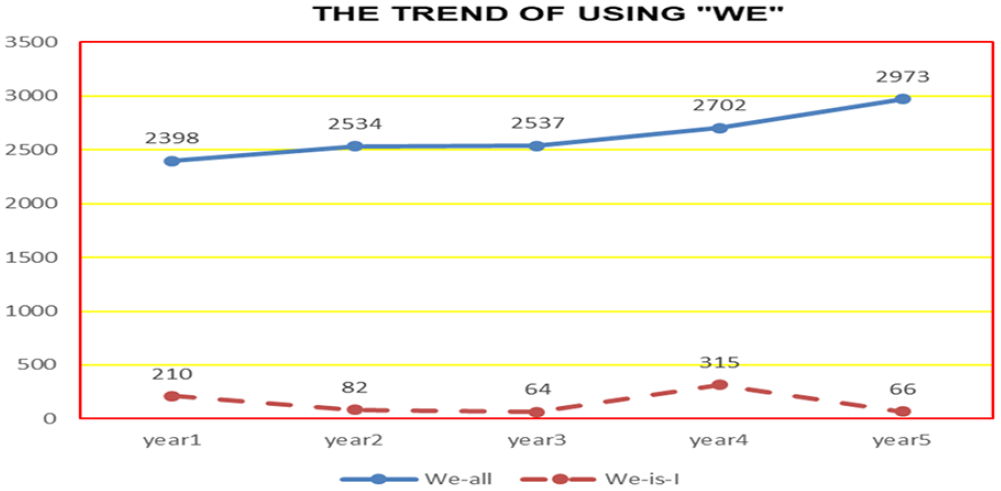
The general trend of using “we” in eight EE journal papers.
Specifically, Table 2 further shows that “we” is strategically used differently in the case of either multi-author or single-author contexts across different types of IEEE journals. For some journals (e.g., J-1, J-3, J-4, and J-7), “we” is used predominantly, whereas for other journals (e.g., J-2, J-5, J-6, and J-8), the occurrence of “we” is nearly zero or completely zero. It, therefore, seems that the use of “we” is very likely conditioned upon the particular preference as customized by some EE journals to the extent that J-5 rarely allowed the use of “we” even in the case of multiple authorship in both abstracts and conclusions.
The Frequency of “We” Used by Single and Multiple Authors.

In addition, it has been presented that the personal pronoun we (“We is I”) was employed to express the authorial stance in Abstracts at the outset of this study (see earlier [1–12] in “First-Person Pronouns and Research Aim” section). Along the same line, the Conclusion text shows how the single author “we” (= “I”) interacted with the present participle, indicating the humble authorial stance with the completion of the current task by using the pattern, “we have + pp.,” for example, “In this paper, In this paper,
RQ2: To What Extent Is “We” Used in the Abstracts and Conclusions of EE Journal Papers?
Table 3 reveals the most frequently used items in the abstracts and conclusions, that is, paper and based, which were both function words. Indeed, the stance pronoun “we” was ranked almost the same in both the abstracts (ranked 16th; 0.60%) and the conclusions (15th; 0.61%). The stance AUX modal can (19th; 0.56%) appears only in the article conclusions, suggesting its frequent collocations with “we” in the conclusions.
Top 20 Words in 400 Electrical and Electronic Abstracts and Conclusions.
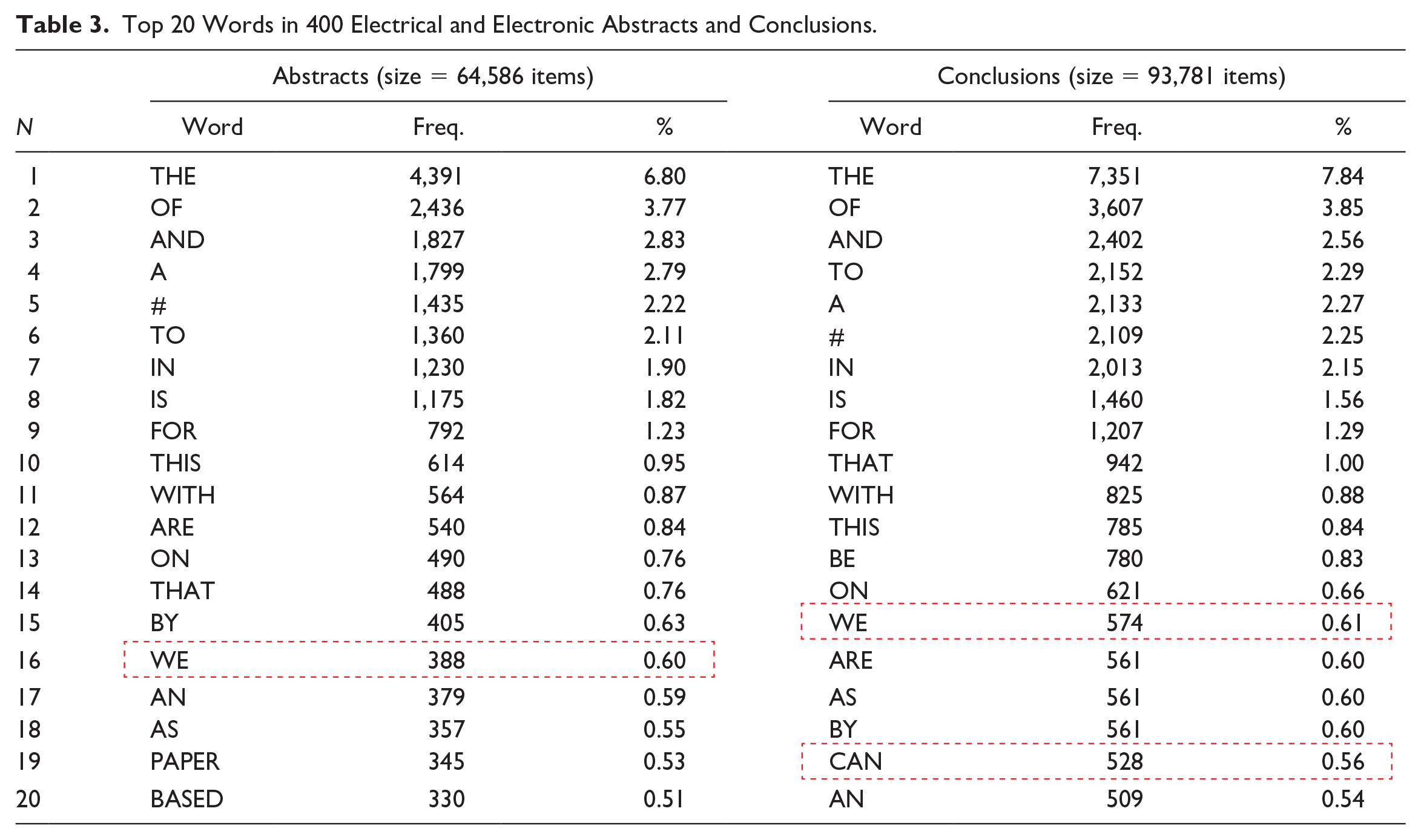
The dispersion of “we” illustrates where the target word “we” is used in (a) abstracts (freq. = 388), (b) conclusions (freq. = 574), and (c) the entire text (freq. = 13,109). The frequency of “we” occurs (i.e., 4.22, 6.35, and 6.30 per 1,000 words) in different subgenres of texts with high dispersion values of 0.795, 0.763, and 0.847, respectively, suggesting a similar dispersion in the bodies of EE journal articles (cf. Gries & Ellis, 2015).
Table 4 illustrates the similarities in the behavior of personal pronouns in the two article sections. The major personal pronouns “we, our and us” constitute the majority, appearing more often than other pronouns in both subcorpora. The total frequency and percentage of the use of “we, our, and us” also demonstrate that the “we” word family is more frequently used in both sections than other pronouns; alternatively, “you, your, he, his, and she” were rarely or never used in the article abstracts and conclusions.
Personal Pronouns Used in Electrical and Electronic Abstracts and Conclusions.

As the frequency is considered nonparametric in corpora (Perry, 2005), Spearman’s rho test was applied to indicate that the use of these 15 pronouns in the abstract and conclusion sections was significantly correlated at the .01 level (ρ = .890**, p < .001). Likewise, Table 4 ascertains that the difference in the usage of “we” in the two sections was significant (p < .05; effect size: Cohen’s d = 0.232) when applied in equal proportion to both the abstracts (0.60%) and conclusions (0.61%).
The other personal pronouns used in the presentation of examples were found to be exceptions. The reader pronoun “you,” for example, seldom or never occurs in either section, and the pronoun “they” (freq. = 67) appears to be an anaphoric use of the pronoun (e.g., “devices, functions, and systems”) that does not, therefore, qualify as indicating a personal purpose.
Other than “we,” most personal pronouns are not used in EE abstracts and conclusions. Hyland (2005) maintains that the self-mention “we” is associated with the application of identity and safeguards authors from offending or threatening others. According to Swales and Feak (2012), “we” is used with increasing frequency in co-authored papers due to the relatively recent proclivity of collaborative, rather than individual, research in engineering.
Table 5 presents a clear contrast regarding the use of “we” in that “we” appears to some extent in the abstracts and conclusions of most journals.
“We” and “We Is I” Occurrence Frequency in the Eight Journals.

However, the authors (n = 163) in J-2 were found to seldom use “we” in their abstracts (freq. = 3) and conclusions (freq. = 8), whereas the authors (n = 166) in J-5 never use “we” in either section. J-6 and J-7 do not exhibit any examples of “we equals I” in the article conclusions. This is possibly a journal-specific convention, which runs contrary to the IEEE Authorship Series’ suggested guidelines. Another important finding is that “we is I” is rarely used (i.e., 0.001% in all of the texts) in either section.
RQ3: In What Ways Is “We” Used Interactively With Impersonal-Authorship Expressions in EE Papers?
Table 6 illustrates the number of authors, ranging from 1 to 17 (1,355 in total), of the 400 EE articles. Only 27 of the papers (6.8%) written by single authors use the pronoun “we” in seven abstracts (1.8%) and eight conclusions (2%), thereby elucidating the rarity of “we-use” in article abstracts and conclusions.
Authors for Papers “With and Without We” in Abstracts and Conclusions.

Scant pronoun “I” use in EE abstracts or conclusions is possibly explained by the fact, as noted, that co-authoring or teamwork is increasingly popular in engineering (Swales & Feak, 2012).
Impersonal authorial stance (single author vs. multiple authors)
Table 7 shows that three keywords (i.e., “paper, study, and research”) are formed, respectively, as clusters to replace first-person pronouns (“I” or “we”) in EE abstracts and conclusions. The keyword “paper” is apparently more frequently used by multiple authors in terms of the patterns such as “This/The paper + reporting verbs (RV)” (e.g., “This paper examines”) in Abstracts or “This/The paper + has + PP. (RV)” (e.g., “This paper has presented”) mainly in Conclusions. Moreover, single authors rarely adopt an impersonal authorial stance across these sections.
The Frequency of Impersonal Authors.

Note. RV = reporting verbs.
Single author vs. multiple authors in abstracts: “We” and Impersonal author
First, Figure 4 shows that the Impersonal author, “This paper,” represents the invisible “I” but not “we” (“we” is not “I”; see 2–30). Then, the Inclusive “we”-2 (= author + readers) in “. . . we can” also represents the single author “I” (see 3–42) interacting with “this paper considers,” represents the invisible “I” (Not “we”). “This paper” also interacts with the exclusive “we”-1 and the inclusive “we”-2 via lexical chains (i.e., the dotted thick lines) in context.
Interaction between impersonal author and We-1 (single author).
According to Hyland (2005), boosters such as “demonstrate” (e.g., “we demonstrate” or “we also demonstrate”) in 3 to 42 allow authors to present their work with heightened assurance and certainty. Moreover, all of the Exclusive “we” (= author only) represent “we is I” in “we discuss,” “we see,” “we demonstrate,” and “we also demonstrate.”
Figure 5 shows that the impersonal subject, “This paper +RV” (with present tense), acts with the authorial stance. The impersonal “This paper proposes” in 1 to 13 interacts with “In this paper, we concentrate,” referring to an exclusive “we”-1. The cluster suggests that “In this paper” represents an exclusive “we”-1 (author only). According to Harwood (2005a), “we” is a self-promotion device used to emphasize authors’ contributions to the field.

The exclusive we and impersonal stance in abstracts (multiple authors).
Single author vs. multiple authors in conclusions: “We” and impersonal author
The present participle “has + pp.” tends to be used in Conclusions (see This paper has provided in 2–37 in Figure 6).

The exclusive “we” and impersonal stance in conclusions (single author).
In addition, Hyland (2005) claims that directives such as “note” in “we note” (3–42) direct the reader to either undergo an action or adopt the author’s viewpoint regarding the phenomenon in question. Finally, the pattern “the Impersonal author + has + pp.” (see “This paper has introduced”) has made a conclusion by introducing a new tool applied to many different types of problems.
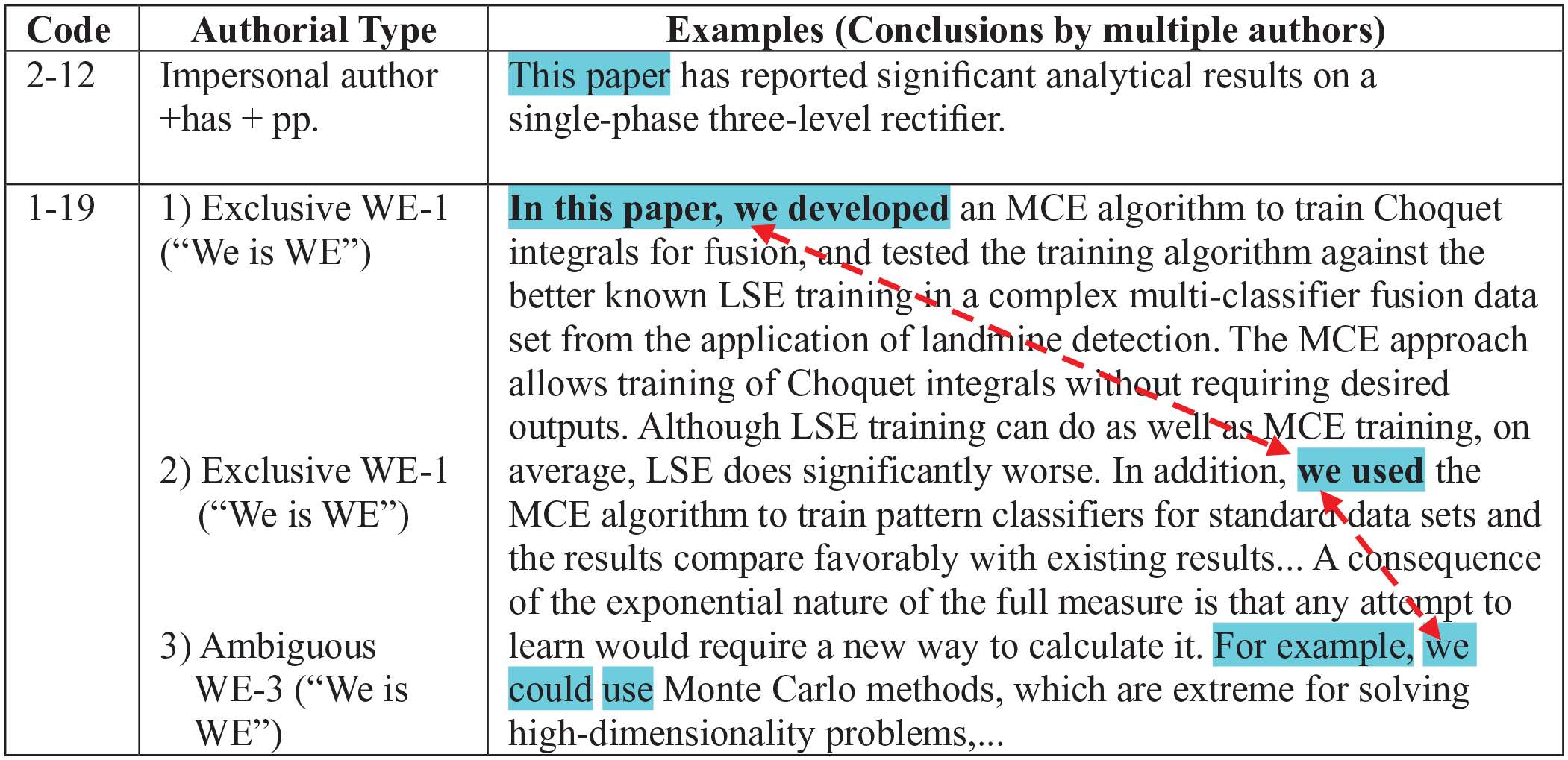
In Figure 7, the interaction between the exclusive “we” (author only: In this paper, “we”) and the ambiguous “we” (see “For example, we could use”) suggests the authorial “we” is either the writer or the reader, a point that has been overlooked by previous studies (Harwood, 2005b).

The exclusive “we,” ambiguous “we,” and impersonal stance (multiple authors).
RQ4: How Does “We” Collocate With Auxiliary Modals, Tense Choice, and Various Salient Word-Clusters in the Abstracts and Conclusions of EE Journal Papers?
Table 8 indicates the auxiliary “can” (freq. = 5) is the only collocation with “we” (LL = 7.46) used in both the abstract (MI3 = 6.29) and conclusion (MI3 = 13.05) sections. However, the first-person pronoun “we” was found to collocate with other auxiliaries such as “will” (MI3 = 9.88), “could” (MI3 = 8.34), “would” (MI3 = 7.91), and “should” (MI3 = 7.34). All are higher than 3, indicating that the strength of association between the two words is significant.
Collocation of “We” + AUX/Modal.

Five auxiliaries were discovered to be used to signify stance for the pattern of “we + __” in the conclusion sections. This suggests that the first-person pronoun “we” is rarely collocated with stance auxiliaries in conclusions and even less so in abstracts, whereas “we” appears more frequently in the bodies of EE journal papers.
Table 9 indicates that stance adverbials, such as “actually, particularly, and generally,” are rarely collocated with “we.” The LL (between groups) demonstrates that the difference of “we” collocating with both “particularly” (LL = 0.20) and “specifically” (LL = 2.25) is not significant across the abstract and conclusion subcorpora, but only (LL = 5.97) is significantly collocated with “we.” However, the MI3 scores (within groups) show that the collocation of these three words with “we” is significant. The results also suggest that EE authors seldom use “we” to collocate with stance adverbials for their research arguments or findings in both sections.
First-Person Pronoun “We” Collocated With Stance Adverbials in the Texts.

Swales and Feak (2012) maintain that there are five types of tense choice. Table 10 indicates three-word “we-clusters” tend to collocate with the present tense in the abstracts, for example, “we propose a” (23), “we present a” (20), and “we show that” (17). Likewise, the three-word clusters found in the conclusions often collocate with the present perfect tense, such as in the following examples: for example, “we have presented” (32), “we have proposed” (19), and “we have shown” (18).
Top 10 “Three-Word of ‘We’-Clusters” in Electrical and Electronic Abstracts and Conclusions.

As for tense choice in Table 11, “we” tends to collocate with present tense verbs in the abstracts. The collocation of “we” varies in the conclusions, including the present perfect “we have + pp.” (freq. = 108; 88.6%), “we + verb with present tense” (freq. = 7; 5.7%), and “we + verb with past tense” (freq. = 7; 5.7%). Moreover, the four-word clusters of “we” in the abstracts tend to collocate with present tense verbs (≃100%), for example, “this paper we propose.” However, most of the four-word clusters of “we” in the conclusions tend to collocate with present perfect tense, for example, “we have proposed a” (88.6%).
Top 10 “Four-Word We-Clusters” in Electrical and Electronic Abstracts and Conclusions.

Table 12 demonstrates that writers employ the present tense (100%) for the five-word we-clusters (e.g., “in this paper we propose”) in the abstracts; however, the present perfect tense for the collocation of “we” (e.g., “in this paper we have + _”) is more frequently used in articles’ conclusion sections. According to these data, we can surmise that “we” collocates more with the present perfect tense than with the past tense.
Top 5 “Five-Word We-Clusters” in Electrical and Electronic Abstracts and Conclusions.

RQ5: How Can Different Types of We-Patterns Be Identified and Categorized in Abstracts and Conclusions?
We discovered that the three major types of “we” (i.e., the exclusive, inclusive, and ambiguous “we”) all occur in EE papers. Figure 8 presents the result of each type in the abstracts and conclusions. In the abstracts, 98.97% of “we” (freq. = 384) are used as the exclusive type, whereas only 1.03% (freq. = 4) belong to the inclusive type, and there is no ambiguous “we.”

Three types of “we” in abstracts and conclusions.
Likewise, in the article conclusions, 91.3% of “we” (freq. = 524) are the exclusive type, whereas 5.74% (freq. = 33) belong to the inclusive type. However, 2.96% of “we” (freq. = 17) are considered ambiguous. The exclusive “we” in the abstracts and conclusions was found to be significantly correlated at the .01 level (ρ = .562**, p < .001). This suggests that the exclusive “we” occurs more frequently than other types of “we” in EE papers.
Various patterns of the first-person pronoun (“we”) in the abstracts
As shown in Figure 3 above, Tables 13 (abstracts) and 14 (conclusions) also portray three major categories of “we” (the exclusive “we,” the inclusive “we,” and the ambiguous “we”) in terms of 13 types of “we”-patterns. However, it is important to note that no ambiguous “we” use was detected in the abstracts.
Semantic Patterns for the Function of “We” in in Abstracts.

Semantic Patterns for the Function of “We” in Conclusions.

Table 10 shows that the pronoun “we” of Patterns 1 to 4 is used to express the research purpose and/or method in the abstract section (Kuo, 1999). For example, Pattern 2 demonstrates the pattern of “we” in “Prepositional phrase (In this article/paper/study/work), we . . .” changes from the impersonal to the personal pronoun by using “we” followed by present tense (Swales & Feak, 2012), such as in “In this paper, we introduce a new way of looking at fuzzy intervals.”
This pattern can be employed as a “testing device” to ensure that an invisible aim is being given here. Therefore, the pattern, “In this paper, we introduce . . .,” can be changed from (1a), (1b), and (1c) (impersonal) to (1d) (personal).
The following examples imply that a research aim is understood by default:
(1a) This paper aims to introduce. . .
(1b) The aim of this paper is to introduce. . .
(1c) The purpose of this paper is to introduce. . .
(1d) In this paper, we aim to introduce. . .
Patterns 5 (2a) and 6 (2b) use present and past participle clauses to indicate how the exclusive “we” is used in texts. In general, according to Swales and Feak (2012), the present participle is preferred for the collocation of “we”:
(2a) (1–12) Following this,
(2b) (8–25) Derived in closed form,
Authors apply transitional signals and stance adverbials using the exclusive “we” to present the sequence of their ideas, ranging from general to specific (GS; Swales & Feak, 2012) in Patterns 7 (First), 8 (Second/Then), and 9 (Specifically).
(3a) (4–16) First,
(3b) (4–16) Second,
(3c) (9–34) Specifically,
In addition, the pronoun “we” in the pattern “First, we + verb” (5a, Pattern 8) is exclusive (authors only), but “we” in “First, we + can” (5b, Pattern 12) becomes inclusive when it is followed by the hedge modal (“can”). Finally, the singular engineer (5c, Pattern 13) transforms into the plural inclusive “we” (author + readers) in the same text (5c, 3–42) to imply that the author is seeking recognition and/or agreement from readers and wishes to express a humble stance when the inclusive “we” is followed by the hedge modal (Harwood, 2005b):
(5a) (2–28)
(5b) (4–16)
(5c) (3–42) The mindset of
Pattern 10 (1–33) presents how the exclusive “we” interacts with its possessive “our”: “In
At first glance, Example (4a) appears to indicate exclusive/inclusive ambivalence; further inspection reveals, however, that the invisible single author “I” uses exclusive “we” to express author only (“I = we”). Put concisely, Patterns 1 to 11 display the authors’ stance via their use of the exclusive “we.” As demonstrated earlier, few authors use “we is I” in either the abstracts or conclusions of EE journal papers:
(4a) (1–12) In the case of implications,
Various patterns of first-person pronoun (“we”) in conclusions
Table 11 indicates that the “we”-patterns in articles’ conclusion sections are similar to those appearing in the article abstracts. However, the more commonly used pattern to express self-mention or authorship is Pattern 1 (6a), “We have + pp” (e.g., “we have presented”), which refers to author(s) only (exclusive “we”). The next common types (Patterns 2 and 3) use prepositional clusters to specify the exclusive “we.” The pronoun “we” in Patterns 1 to 4 (6b) is used to express the research aim, methods, or completion via the present perfect (or present tense). Patterns 5 and 6 (6c) use the present or past participle clauses to indicate the use of the exclusive “we” in texts (cf. Kuo, 1999):
(6a) (7–13)
(6b) (1–6)
(6c) (3–6) Derived in closed form,
Transitional signals and stance adverbial(s) are applied for the exclusive “we” in Patterns 7, 8, and 9 to express the sequence of the authors’ ideas, from general to specific or from specific to general (Swales & Feak, 2012). The exclusive “we” interacts with its possessive “our” in Pattern 10 to identify authorial stance. Put simply, Patterns 1 to 11 are the exclusive “we,” which is used to express authors’ research aims, methods, authorship, and/or sequence of their ideas. Pattern 11 (6d) is a typical example of “we is I” because the pronoun (“we”) is equal to the invisible single author (“I”).
(6d) (8–10)
(6e) (3–39)
(6f) (3–43) By applying heuristics to reorder objectives,
Harwood (2005b) argues that authors vacillate between exclusive and inclusive “we-use” for their own ends, such as making readers feel involved in or more receptive to their claims for rhetorical effect. Thus, Pattern 12 (6e) uses the conditional-if clause to express the inclusive “we” as the author shifts between the exclusive and inclusive “we” to elicit readers’ agreement and/or understanding.
Pattern 13 (6f) depicts the ambiguous “we” (3–43) that skirts the borderline between the exclusive and inclusive types, as exemplified in the conclusions, when followed by the hedge cluster, are able to.
Discussion
In this study, we have presented how the first-person pronoun “we” was integrated into the lexico-grammatical profile framework in Table 15 (note: “we”-1: exclusive, “we”-2: inclusive, “we”-3: ambiguous). Three types of “we” and semantic prosody were already investigated in both the abstract and conclusion subcorpora, the “we”-collocation, clusters, and syntactic patterns. Particularly, it is noted that the semantic prosody after the pattern “we+ __” is often positive. For example, both “a new way” and “a novel two-level” also imply the notion that the author is expressing a positive idea or topic.
Lexico-Grammatical Profile of “We” in Abstracts and Conclusions: Examples.

First, we found that a writer’s guide might suggest that (a) authors write in the first-person for self-mention or self-contribution (e.g., IEEE Authorship Series), and (b) authors refrain from using first-person pronouns, which could be either a specific journal’s policy or journal-specific reasons (e.g., J-2 and J-5). That is, multiple authors never use “we” in J-5 across either abstracts or conclusions; single authors seldom or never use “we” in the two sections (e.g., J-2 and J-5). We also discovered the general tendency of using “we” in EE journals (e.g., J-1, J-4, J-6, J-7, and J-8). A growing trend in line with Hyland and Jiang (2016, 2017) suggests that authors use a more informal writing style to claim their stance, and even use “we” much more frequently than “I” in EE writing.
Likewise, in the second finding, we examined frequently used pronouns and their dispersion values in EE journal abstracts and conclusions. Quantitatively, the occurrence of “we” in these two sections was found to be significantly correlated. The quantitative results strongly support the notion that “we” is the most frequently used pronoun in both sections. The findings also demonstrate the scant use of other personal pronouns in EE journal articles’ conclusions.
Third, we explored how single authors versus multiple authors “behave” in EE papers regarding how they use first-person pronouns to regulate their interactions with readers and display impersonal authorial stance. Four examples were presented to strengthen their interactions. We discovered that a number of “we” as authors, single authors, and “we equals I” are used in EE articles. Moreover, the first-person pronoun “we” is utilized to express authorial stance and reduce personal attributions to express a humble attitude (Hyland, 2001a, 2001b).
Another significant finding is that single authors seldom use “we” in EE abstracts and conclusions. Instances of “we equals I” were not even detected once in the conclusion sections of four of the journals, and “we equals I” was very rarely used (0.001%) in either the article abstracts or conclusions. This begs the question as to why “we” but not “I” is used more often in the two investigated sections of EE academic articles. This may be because teamwork or co-authoring (93.2%) is more prevalent than single-authoring in engineering research projects (Swales & Feak, 2012).
We also explored the use of auxiliary modals, tense choice, and “we”-clusters in RQ4. Our findings reveal that “we”-clusters tend to collocate with present tense verbs in the abstracts, but with the present perfect tense in the article conclusions. The two most frequently used five-word clusters in the abstracts were “in this paper, we propose” and “in this paper, we have + pp,” with the latter appearing the most frequently in article conclusions.
Qualitatively, this study applied integrated perspectives to analyze how stance markers are used with the first-person pronoun “we” in abstracts and conclusions. According to Kuo (1999), “we” is also used to express the study in question’s aim or methods, which can be found in the given examples.
An additional “we” function was detected in the article conclusions: “In this paper, we have + pp,” which expresses what the authors (“we”) have completed in the study. This finding, to our knowledge, has yet to have been reported in the literature.
Furthermore, we exemplified three discourse functions of “we” and “we”-patterns in the two sections. We found that the exclusive “we” was used more frequently than the inclusive “we,” which was rarely used in either section. However, the ambiguous “we” was not at all present in the abstracts, a point which has also been overlooked in previous studies (Harwood, 2005b).
Another contribution of our study is the identification of 13 different “we”-patterns in the two article sections. As argued in Tables 13 and 14, Patterns 1 to 4 were found to express the research aim or method in abstracts, whereas Patterns 5 and 6 used the present and past participle clauses to indicate applications of the exclusive “we.” The present participle was preferred for the collocation of “we,” and transitional signals and stance adverbials are applied from general to specific in Patterns 7, 8 and 9.
Put simply, Patterns 1 to 11 display authorial stance (exclusive “we”). We also discovered that few authors use “we equals I” in either the abstracts or conclusions of EE journal papers. Likewise, Patterns 1 to 11 portray the authorial stance in conclusions. Pattern 12 uses the conditional-if clause to express inclusive we, and Pattern 13 is the ambiguous “we” when followed by hedge clusters.
In addition, we found that “In this paper, we + verb” could be replaced by four testing devices to identify whether the author(s) is/are introducing an implicit goal or mission: “This paper aim(s/ed) to + verb,” “The aim of this paper is/was to + verb,” “The purpose of this paper is/was to + verb,” and “In this paper, we aim(ed) to + verb.” This replacement technique could help reassure readers of the research study’s aims and objectives; few studies, however, have explored this technique.
Conclusion: Findings, Limitations, and Implications
This study has integrated authorial aspects (e.g., Harwood, 2005b; Hyland, 2005) into a lexico-grammatical profile (e.g., O’Keeffe et al., 2007) to explore first-person pronouns in abstracts and conclusions of EE journal papers. Indeed, the reasons whether or not authors use “we” or “I” are various.
We believe the following summary of our main findings proffers instructors invaluable insights into the pedagogical application of writing EE academic journal articles’ abstracts and conclusions. It is our hope that our findings can provide instructors and researchers, alike, with an enlightened understanding of the use of stance pronouns, collocations, and clusters in EE journal articles. Students should, therefore, be encouraged to express their authorial stance for self-promotion or self-mention along the following lines:
The trend of using first-person pronouns shows that more people employ “we” in EE journal papers; however, it is also journal-specific to avoid using “we” in the area of EE (e.g., a journal’s policy).
The example of “we equals I” is rarely used by single authors in EE abstracts and conclusions.
A single author should avoid overusing subjective expressions of “we,” and, instead, employ a variation of impersonal pronouns such as “This paper, This study, or This research” to lend an objective voice of authorship to his or her findings.
The pattern, “In this paper, we . . .,” is commonly used in both sections to imply the research aim and methods; “we” is also a self-promotion device to highlight authors’ innovations to the field. Furthermore, “In this study, we have + pp” is used to express the completion in the conclusion section.
The tense choice for the collocation of “we” with the verbs tends to be present in abstracts, and present perfect in conclusions.
Three semantic types of “we” may or may not appear in both sections of EE journal papers.
The results of the study may, therefore, assist research fellows, as well as students or university professors, to cultivate a heightened awareness of the existence of different move structures in article abstracts and conclusions. Moreover, we hope this study helps researchers become more cognizant of the potential interactions between “we” and different moves and the relevant language use such as collocation, clusters, formulaic sequences, and other common inquiry issues such as when to use personal or impersonal pronouns and how to self-mention in academic writing.
Finally, it should be noted that the subject of this study is concerned with empirical research papers collected from the EE area only. Other genres may have different move structures and linguistic realizations. Further research is needed that examines whether the use of “we” and “I” continues to increase or decline in specifically chosen genres or other disciplines. The present study has shed new light on the use of first-person pronouns in EE journal papers. The results of integrating quantitative data into qualitative analysis are useful in the chosen field for a deeper understanding regarding the trends about the use of authorial stances of academic papers.
Footnotes
Declaration of Conflicting Interests
The author(s) declared no potential conflicts of interest with respect to the research, authorship, and/or publication of this article.
Funding
The author(s) disclosed receipt of the following financial support for the research, authorship, and/or publication of this article: The author(s) received financial support for the research of this article (partially supported by MOST 104-2410-H-011 -022 –MY2).
