



Abstract
The introduction of advanced technology and mobile instant messaging has constituted a novel social milieu which creates opportunities for individuals to initiate interactive and informative communications. Despite the benefits, negative consequences of social media use have been determined, some of which were presented through matters of concerns including isolation, information leaking, social media reliance, and mental devastation. The current study aimed to examine different types of concerns, namely fear of missing out (FoMO), compulsive usage, and privacy concerns, predicting LINE users’ motivations for information sharing intention and information sharing behavior. The data was collected from 562 LINE users with sharing experiences in Thailand. The results of the confirmatory factor analysis (CFA) manifested that all adapted constructs were adequately reliable and valid. The structural modeling analysis (SEM) further revealed that only FoMO and compulsive usage influenced LINE users’ motivations for information sharing intention which in turn influenced their information sharing behavior. However, the three types of concerns did not have a direct relationship with information sharing behavior. In addition, when different types of shared information were examined, greeting messages significantly influenced information sharing behavior. The findings also yielded implications for understanding the roles of concerns on sharing information via mobile instant messaging (MIM).
Keywords
Introduction
The development of technology has considerably promoted social interactions and sharing of information among individuals with less geographical and temporal restrictions. With ubiquitous access to online communication through mobile instant messaging (MIM), information sharing is more prevalent both within and across communities (Kaufmann & Peil, 2020; Pimmer et al., 2018). MIM users tend to be provided with constant exposure to an abundance of information and multiple easy-to-access channels to establish connections with others (Cui, 2016; Tseng et al., 2017). However, there remains a number of drawbacks regarding MIM that substantively exert negative impacts on users’ psychological well-being, such as concerns regarding information breaches (e.g., Oghuma et al., 2016), social exclusion (e.g., Jung et al., 2022), excessive use (e.g., Bahri et al., 2020; Wang et al., 2022), and low emotional support (e.g., Lee et al., 2016).
Despite the different maladaptive behavior and emotional problems caused by these concerns, individuals incrementally approach engage in activities, such as sharing and exchanging information, to compensate for their negative feelings (e.g., anxiety, disappointment, fear of missing out) (Fang et al., 2020; Franchina et al., 2018; Kaufmann & Peil, 2020), and improve psychological well-being (Shensa et al., 2020). For instance, the increase of the fear of missing out (FoMO) can increase the frequency of participation in information sharing activities, which enhances a sense of belonging and social involvement (Plaisime et al., 2020). Therefore, sharing information on MIM may potentially yield both positive and negative consequences on individuals’ mental and behavioral conditions. However, in this study, we specifically investigated different types of concerns which might be possible positive factors related to information sharing intention and behavior on MIM. Scholars, psychologists, and future investigations may benefit from understanding the patterns of how various concerns influence information-related activities on platforms that connect multiple users together. In particular, the emerging patterns would in some way inform them in finding solutions to cope with the unpredictability, stress, and other problems that originate from communication through MIM and thus deteriorating MIM users’ mental health and well-being.
Although previous studies (e.g., Khan & Idris, 2019; H.-S. Kim, 2016; Lutz et al., 2018) have examined various concerns as antecedents influencing information sharing behavior on SNSs, few have explicitly investigated how specific types of concerns, namely, FoMO (e.g., Elhai et al., 2020; Rozgonjuk et al., 2020), compulsive usage (Elhai et al., 2017; Loid et al., 2020), and privacy issues (e.g., Hoyle et al., 2017) structurally relate to sharing online information, especially in the context of MIM. This study specifically focused on sharing information via the LINE platform, particularly among MIM users in Thailand, as it is ranked as one of the most widely used messaging applications across Asian countries, such as Japan, Taiwan, Thailand, and Indonesia (Steinberg, 2020), with over 170 million monthly active users as of September 2021 and approximately 4 billion messages exchanged daily (Iqbal, 2022; Statista, 2021).
This study applied the theory of reasoned action (TRA) to examine how these three concerns predict motivations for sharing intention and in turn sharing behavior among LINE users in Thailand. The structural model in this study extends the current understanding of how MIM users’ concerns originate from their use experiences related to their motivations for information sharing intention and their information sharing behavior.
Literature Review
According to the TRA, an individual’s attitudes are defined as subjective evaluations of and, emotions toward particular objects, people, or activities that affects one’s intention to achieve and, as a consequence, elicit the actual behavior (Ajzen, 2005; Fishbein & Ajzen, 1975). In this study, we refer to “concerns” as a type of “attitudes,” in the sense that the latter involves a person’s mentality and feelings, either positive or negative, which are shaped by various experiences in life (Perloff, 2016), while the former can be understood as an individual’s feeling of anxiety or unease attributable to a person or a specific event. It should be noted that attitudes in this study involve two types of concerns, psychological and behavioral. Psychological concerns include FoMO and privacy concern whereas behavioral concerns involve compulsive technology use.
Notably, although our research focused on sharing information through mobile instant messaging (MIM), the literature that provides explanations of the variables, concepts, and theories employed in this study has concentrated considerably more on social media (SM) than on MIM. We acknowledge this theoretical limitation, but we believe that to gain a better understanding of MIM users’ attitudes, motivations of the intentions to share information, and information-sharing behaviors, it is imperative to review prior studies that provided and examined both the theoretical and empirical backgrounds of the variables of interest in both MIM and SM contexts. It is notable that MIM evidently differs from SM in terms of the degree of specificity of the target audience. While SM allow users to share information through their page feeds rather than through chat boxes or messages, MIM allows users to separate the contexts of its use and limit audience size in accordance with their preferences. Among the many features offered by MIM is the ability to create multiple chat rooms for groups of varying sizes, such as family, friends, colleagues, and classmates. MIM audiences are therefore likely to demonstrate homogenous characteristics in each chat room (Baym & Boyd, 2012; Ihm & Kim, 2018). Despite the differences in terms of the degree of specificity of audiences, we estimated that the findings of previous research conducted in SM contexts may to some extent be comparable and serve as references for the formulation of the hypotheses in this study.
Fear of Missing Out
Fear of missing out (FoMO) is an urge to remain connected to activities or channels, such as communicative events or SM, to avoid negative feelings caused by not being involved in the rewarding outcomes that others experience (Buglass et al., 2017; Przybylski et al., 2013; Scott & Woods, 2018). With the accessibility of internet connections and SM, the experience of FoMO appears increasingly prevalent among SM users (Barry & Wong, 2020). They often have a higher propensity to develop FoMO owing to the affordances that SM and MIM yield, including information sharing, relational maintenance, and escape from undesirable life events (Brown & Kuss, 2020; Coskun & Karayagız Muslu, 2019; C. S. Tang & Koh, 2017).
FoMO is a phenomenon developed from specific events or perceptions, such as losing social connection, and it poses a detrimental impact on individuals. Experiencing FoMO can be temporary, extensive, or permanent, which consequently results in malfunctions in social interactions. The maladaptive usage of SM and MIM further aggravates the condition (Burrow & Rainone, 2017; Casale et al., 2022; Stead & Bibby, 2017). For instance, individuals may unconsciously develop FoMO upon engaging in SM or MIM to compensate for undesirable relational conditions (Billieux et al., 2015; Hayran et al., 2020). Individuals with FoMO tend to exhibit distorted perceptions of social status, sense of belonging, or emotional states.
Moreover, we posit that FoMO also encompasses certain facets of the fear of not being included. Both constructs are potential psychological factors that provoke SM and MIM users, whether teenagers or adults, into mental health problems such as attention deficit, diminished self-esteem, insecurity, anxiety, and paranoid concerns (Buescher, 2018; Casale et al., 2022). The concerns and consequences of social exclusion, whether it occurs via face-to-face, text message, or on social media, affect how people engage in activities such as online information sharing in an ever-changing technological world (Bayer et al., 2019). For example, some people may share more online information to gain acceptance, stay connected with others, and maintain interpersonal relations (Bayer et al., 2019; Greene & Magsamen-Conrad, 2010).
Privacy Concerns
Privacy has been viewed as an individual’s right to manage and take full control over private information without consent from others, thereby being deemed as a process of anonymity preservation (Gupta & Dhami, 2015; Liou et al., 2016). Privacy concerns therefore refer to the concerns that an individual expresses regarding who may have the ability to access personal information or data and how it would be collected and utilized, especially by organizations (Liou et al., 2016; Tan et al., 2012). In addition, the idea of privacy concerns has recently been differentiated from the attitudes toward privacy in that the former seems to be more generic and is basically not restricted to any specific context whereas the latter indicates the contemplation of particular privacy behavior (Kokolakis, 2017). Moreover, studies have discussed the concept of a privacy paradox which refers to a contradiction between how individuals perceive privacy and their actual behaviors (Barth & de Jong, 2017; Dienlin & Trepte, 2015; Norberg et al., 2007; Young & Quan-Haase, 2013). In other words, it depicts the phenomenon in which individuals provide excessive amounts of information and take fewer protective measures despite acknowledging deep concerns that their personal information can be misused (Kokolakis, 2017; Norberg et al., 2007).
In the context of online information sharing, it has been acknowledged that the content that people share reflects and influences their opinions, emotional states, and activities performed in various aspects of life. Often they are less aware of the information being disclosed and how it might be utilized by third parties (Acquisti et al., 2015). Without greater awareness and sufficient knowledge of protective measures, one may feel insecure as to whether their personal identity would be revealed or whether their information would be stolen and subsequently used for certain undesirable purposes (Mitchell & El-Gayar, 2020), considering the nature of information sharing that involves voluntary exchanges of several types of information such as responses or suggestions with multiple unknown parties and geographical or pictorial contents with others (Cannon & Perreault, 1999; Dhir et al., 2017; Rafaeli & Raban, 2005; Y. Tang & Hew, 2022).
Compulsive Technology Usage
Compulsive behavior refers to an irresistibly chronic performance in response to obsessive and recurrent thoughts of activities (James et al., 2017). Such obsessions pertain to psychologically maladaptive reliance and oftentimes trigger detrimental subsequences (Andreassen, 2015; Turel et al., 2011). Compulsive behavior can take place in various daily contexts (e.g., food consumption or use of technology) (Nicholls et al., 2016; Zilberman et al., 2018). In the context of technology use, Clements and Boyle (2018) stated that it is a behavioral addiction in which a person engages with technology for relief, comfort, or stimulation, while discontinuing use results in discomfort or unease. Besides, such compulsive behavior in technology use can be developed persistently despite intention to withdraw or suppress the behavior (Gong et al., 2019).
Moreover, according to Clements and Boyle (2018), compulsive technology use is regarded as a context-driven behavior. For example, someone might be spontaneously checking in on Twitter while in a work meeting if he has become accustomed to sending tweets after work or buffering boredom during the wait of appointments. Also, compulsive technology use is argued to be an “unintentional, unplanned and unreasoned action” (p. 36) For example, one might find himself spontaneously checking in on Twitter during a work meeting, without having the intention to do so. The researchers also believe that compulsive use can occur in conjunction with other appealing and interactive features provided by certain technology platforms, thereby having a greater potential to result in exceptionally high levels of usage.
Research has documented that MIM users who engage frequently in sharing information such as news are likely to be among those who are obsessed with self-presentation, a type of personal characteristics whereby a person enjoys presenting their self-image to others (Ihm & Kim, 2018). Individuals possessing this self-presentation characteristic tend to express compulsions in activities in online social media and communication platforms (James et al., 2017). In particular, given that sharing information online has been considered an activity that helps individuals fulfill their psychological needs, such as relational connection, reduction of anxiety, and improved self-confidence (Coskun & Karayagız Muslu, 2019; Oberst et al., 2017), the development of compulsive usage may be instigated by factors such as information seeking, social recognition, and psychological need satisfaction (Park & Lee, 2011; Throuvala et al., 2019), especially among individuals with unsatisfactory life experiences who often seek compensatory mechanisms (Hsiao, 2017; Wang & Lee, 2020).
Motivations for Information Sharing Intention
According to the theory of reasoned action, an intention is defined as an individual’s willingness to engage in a certain behavior or the level of conscious planning that translates into such behavior (Fishbein & Ajzen, 1975; F.-Y. Pai & Yeh, 2014). It can be shaped by a variety of factors, such as attitudes toward the behavior, subjective norms, and perceived behavioral control (Fishbein & Ajzen, 1975). Moreover, it is common that the formation of behavioral intention is the outcome of generalized motivational processes that lead to the behavior of a person toward some specific aims (Eagly & Chaiken, 1993; Kidwell & Jewell, 2010). Motivational processes may be triggered depending on an individual’s confidence in the ability to perform the behavior successfully (Kidwell & Jewell, 2010). Such processes can also be shaped by rewards, goals, and cognitive controls toward particular objects or activities (S. I. Kim, 2013). In other words, the attitude toward a behavior or subjective norms predicts individuals’ behavior through the mediation of the intention, which are formed by the motivational processes, to undertake that behavior. In the present study, we specifically focused on how different concerns (attitudes) affect motivations for information sharing intention.
In the context of information sharing, MIM or SM users often develop their intention to share information through motivations related to social and supportive benefits (Tseng et al., 2017; Wang et al., 2022), particularly when they believe the act of sharing would benefit themselves and others in some way. This includes exchanging updated information, maintaining social ties and recognition, and receiving promotional rewards (Ji et al., 2022; J. Kim et al., 2020; Liou et al., 2016; Sun et al., 2023). Further, research has shown that individuals tend to develop their motivational intentions to disseminate information when they believe that they can place great trust in the receivers, most of whom tend to be their confidants such as family members or close friends (Liou et al., 2016; Sun et al., 2023), or when they fear that they would miss out or not receive a reply (Lu et al., 2011; Neumann et al., 2023). In addition, Di Carlo et al. (2021) and Wallace (2014) indicated that concerns about compulsive behaviors appeared to be more prevalent among individuals who engage unconsciously in problematic use of the Internet (PUI) which includes sharing information and text messaging excessively. Therefore, in this study, we speculate that both psychological concerns (e.g., privacy concerns and FoMO) and behavioral concerns (compulsive use) may influence the way that MIM users formulated motivational intentions to share information.
Information Sharing Behavior
In general, information sharing is defined as a course of actions performed by individuals to provide information, either in a proactive or responsive manner, to reach intended audiences (Litt & Hargittai, 2016; Sonnenwald, 2006). Sun et al. (2023) asserted that MIM users commonly share a variety of content types, such as news, products, comments, personal experiences, or entertainment with other users for interactional, relational, and professional purposes. Scholars have maintained that information sharing can be situationally dependent, subjective, and unstructured since users perform information sharing differently in order to remain socially connected and updated (Kamboj et al., 2018; Lin & Wang, 2020).
The intensity in sharing information is said to be dependent on several factors such as emotional state or concerns over the consequences of sharing. For example, MIM users who experience positive emotions are likely to share information more frequently (Jung et al., 2022). Alternatively, information sharing can be reduced if one is apprehensive about negative consequences such as mental agitation, workplace conflict, or physical threat (Constant et al., 1994). Moreover, the propensity of reciprocally sharing information is expected to take place more frequently if the trust or interpersonal relationship is established (Kraut et al., 1990; Liou et al., 2016). It is evident that trust and social ties play a significant role in both information sharing intention and behavior.
Hypothesized Model
Despite a number of theoretical and empirical studies on the target variables, the way the three concerns (attitudes) influence motivations for information sharing intention and information sharing behavior, particularly through MIM platforms, remains unclear. We formulated hypothetical relations by synthesizing the literature on sharing information online, the theory of reasoned action (TRA), and the following three types of concerns: FoMO, compulsive usage concerns, and privacy concerns as attitudes according to TRA perspectives.
Empirical studies on the three types of concerns have shown that, first, individuals with high FoMO are inclined to engage in MIM activities, particularly sharing information, more frequently when they feel socially disconnected, lack physical connections or lose a sense of belonging (Blackwell et al., 2017; Brown & Kuss, 2020; Coskun & Karayagız Muslu, 2019). Second, it is likely that individuals who are concerned about reducing their consumption of SM will continue to share information on their social networks in order to satisfy their needs, such as establishing relationships, relieving anxiety, and enhancing their self-esteem (Coskun & Karayagız Muslu, 2019; Oberst et al., 2017). Third, online users who have many concerns about their privacy are less disposed to share information or place trust in platforms and their users (Baruh et al., 2017; Liou et al., 2016). However, it is feasible that online users express fewer concerns about the privacy risks when they do exert full control over the information that is shared (Hajli & Lin, 2016) and may be more likely to share information in the case which they gain trust in the platform that they are using (Buchanan, 2020; Gupta & Dhami, 2015). Therefore, as shown in Figure 1, we hypothesized that both FoMO and compulsive usage (CU) influence information sharing behavior positively (H5 and H6). Further, we postulated that privacy concerns (PC) demonstrate either a direct positive or negative influence on information sharing behavior (ISB) (H7).

Proposed research model and hypotheses.
In the TRA, an individual’s intentions are considered to be a crucial factor in associating attitudes with behaviors. Intentions are determined by attitudes toward behaviors, which influence the likelihood that a behavior will be performed. In this study, our intentions refer specifically to intentions to share information determined by motivations related to social and supportive benefits (Tseng et al., 2017; Wang et al., 2022). Based upon the empirical findings discussed in earlier sections, there may be a propensity for the three types of concerns, FoMO (H1) (Lu et al., 2011; Neumann et al., 2023), privacy concerns (PC) (H2) (Liou et al., 2016; Sun et al., 2023), and compulsive usage (CU) (H3) (Di Carlo et al., 2021; Wallace, 2014) to affect MIM users’ motivations for information sharing intention (MIS). Finally, as research has found that individuals’ intention to share information tends to exert a large influence on information sharing behavior (ISB), particularly in online social network communities (Liou et al., 2016), we assume that MIS (H4) influence ISB positively. Overall, we focused specifically in this study on the way the three concerns (attitudes) manifested in the context of sharing information via the LINE platform influenced users’ information sharing behavior via motivations for information sharing intention.
Methods
Research Design
The current study employed a quantitative research design with a convenience sampling method. This type of sampling method is principally purposed to render understanding of relational patterns existing between variables, as well as to allow researchers to accumulate data within several restrictions, such as temporal constrains, financial support, or geographical access (McMillan & Schumacher, 2010). In this study, we collected data from LINE instant messaging users in Thailand through an online survey and analyzed the data using the structural equation modeling (SEM) approach. As a mobile application, LINE offers synchronous and asynchronous messaging with a variety of content, including texts, photos, stickers, and videos, as well as free-of-charge calls between LINE users. Other features of LINE include file storage, financial management, and group communication (Desjarlais, 2020; Sehl, 2021).
The participants were principally recruited from the LINE contact list and groups from two residential communities. The first community was the LINE group where the primary researcher belonged to. The researcher approached the group, explained the objectives of the study, and administered the link to the online survey to all 460 members, who voluntarily agreed to participate. The completion of the survey required approximately 20 min. From the first group, 351 responses were obtained. The other 224 responses were obtained from a LINE group of a nearby community where the researcher received permission to join from the community leader. Upon the recruitment, the researcher made a self-introduction and explicitly stated the agenda of the participation to 280 members. From the two LINE groups, out of 740 members, 575 surveys were completed and returned for a 77.70% response rate.
Participants and Procedures
This study was conducted in mid-2020 with 575 LINE users with sharing experiences. However, 13 survey results were excluded as they did not provide complete responses, thereby leaving a total of 562 surveys. The participants were Thai citizens residing in the Bangkok metropolitan region. The participants consisted of 143 males (25.44%) and 419 females (74.56%). The gender imbalance reflects the actual proportion of the respondents’ occupations, most of which are female-dominated such as housemakers, educational practitioners, and office personnel. The age of the participants ranged from 18 to 76 years, with an average age of 40.16 years, and was broadly categorized into three groups, namely, 255 young adults (45.4%), 146 middle-aged adults (26%), and 161 older adults (28.6%). The categorization into three age groups was made considering the fact that each of the three groups tends to demonstrate varying levels of concerns (Van Den Broeck et al., 2015) and motivation (Jo et al., 2022) regarding the sharing of information online. Participation in this non-remunerated study was voluntary. Confidentiality was strictly enforced throughout the study. We informed all participants about the research purposes and assigned them a unique identification number to ensure anonymity. They were also asked to review and sign the consent form prior to their participation.
Furthermore, we broadly defined the characteristics of LINE users according to the amount of time spent using the LINE application per day. It was found that 17.3% (n = 97) were light users (less than 1 hr/day), 42.9% (n = 241) were moderate users (around 3 hr/day), and 39.8% (n = 224) were heavy users (around 5 or more hr/day). These three characteristics were applied from research on social media use (Twenge & Campbell, 2019; Twenge & Martin, 2020). Furthermore, the questionnaire asked the participants to provide additional information regarding what they had recently shared with their LINE contacts. The information being shared were classified into four categories: entertainment such as movies, music, and sport (87.01% of the respondents shared entertainment), general information such as news, travel, and promotional discounts (45.20% of respondents), knowledge and education such as health, weight loss, and food recipes (35.47% of respondents), and greeting messages such as daily and holiday wishes (30.25% of the respondents).
Moreover, prior to the survey administration, the researchers translated them into Standard Thai, the participants’ native language. The translated instruments were further verified by experts in translation to ensure the semantic parallelism of both languages. The translated instruments were then pilot-tested with 10 frequent LINE users. In addition, a team of experts reviewed all questionnaire items in several panel meetings. The primary focus of this evaluation was to ascertain that the translated questions were valid, captured the essence of the construct, and did not contain ambiguous meaning (DeVellis, 2017). Comments from the experts and feedback from the pilot test were then applied to the revision process of the survey. Moreover, an interrater reliability for the translated survey was also performed during the final panel discussion. This process involved three people including the first and second authors of the current study and one university lecturer specializing in the translation across English and Thai language. The result of intraclass correlation coefficient (ICC) was .64, indicating that the three raters’ agreement of the translated instruments was of sufficient reliability (Cicchetti & Sparrow, 1981).
Instruments
We adapted valid and reliable items from multiple studies to measure how different types of concerns predict motivations for information sharing intention, and information sharing behavior of LINE users in Thailand. It should be noted that we did not select all items from the originally developed scales due to reliability and validity concerns. We considered the items that evidently measure the concept/facets of the target variable, that have sufficient factor loadings and contain no ambiguous meaning. In other words, the meaning of each selected item should not be understood in multiple ways. The adaptation of the items was performed to respond to the investigated context, such as rewording and inserting the word “LINE.” For example, “I often share various contents in my WeChat Moments to people” was reworded to “I often share messages on LINE.” Each item was rated on a 5-point Likert scale, ranging from (1) strongly disagree to (5) strongly agree. Descriptions of the instruments are briefly described below.
FoMO Scale
Fear of missing out was assessed by a scale modified from Przybylski et al. (2013) with a wording modification to match the investigated context. The scale contained three items. The items were “I am afraid that no one will respond to the message I share (FoMO1),”“I am worried that no one will read the message I share (FoMO2),” and “I am afraid if I will not see someone else messages me (FoMO3).” The internal reliability of the modified scale was sufficiently high (Cronbach’s alpha = .92).
Compulsive Usage
A scale developed by Meerkerk et al. (2009) was adapted to measure compulsive usage in this study. Three items were included in the scale. The items are “I am concerned about trying to cut down on using LINE without success (CU1),”“I am concerned about becoming restless or troubled if I am prohibited from using LINE (CU2),” and “I am concerned about using LINE so much that it has had a negative impact on my family (CU3).” The scale yielded good internal reliability, with Cronbach’s alpha of .79.
Privacy Concerns
Privacy concerns were measured by three items based on a scale modified from Dhir et al. (2017). The items were “I am concerned about my privacy on LINE (PC1),”“I am concerned that the information I submit to LINE could be misused (PC2),” and “I am concerned that a person can find my private information on LINE (PC3).” This adapted short-version scale exhibited high internal reliability (Cronbach’s alpha = .86).
Motivations for Information Sharing Intention
Motivations for information sharing intention were assessed by using five items adapted from Chiu et al. (2006). The items measuring motivations in this scale were modified based on LINE users’ perceived social and supportive benefits. The items are “I believe that sharing information on LINE could consolidate me, my contacts, and connections (MIS1),”“I think if I could share more on LINE, I would be able to strengthen my relationships with others (MIS2),”“I believe that my relationship with others will be closer and tighter from sharing information on LINE (MIS3),”“I believe that I can get a lot of attention and friendship from sharing information on LINE more often (MIS4),” and “I believe that I can make more friends from sharing information on LINE more often (MIS5).” The scale possessed a high internal reliability, with Cronbach’s alpha of .93.
Information Sharing Behavior
Information sharing behavior was evaluated by a scale adapted from Chen et al. (2019). It consisted of three items, including “I often share messages on LINE (ISB1),”“I often upload pictures or videos to LINE (ISB2),” and “I often write down my thoughts, experiences, and opinions on LINE (ISB3).” The internal reliability of the scale was acceptable, with Cronbach’s alpha of .77.
Data Analysis
We performed confirmatory factor analyses (CFA) through a maximum likelihood (ML) estimator to verify the underlying structure and the validity of the adapted constructs. We also used different forms to assess the proposed model’s construct validity and reliability. More specifically, we considered retaining items with factor loadings greater than 0.50. We also estimated the convergent validity of the model by means of composite reliability (CR) >0.07 and average variance extracted (AVE) >0.05 (Fornell & Larcker, 1981; Hair et al., 2019;). In addition, we computed two additional criteria widely adopted in SEM literature to test discriminant validity, namely, the average shared variance (ASV) and the maximum shared variance (MSV). Both ASV and MSV values of all constructs included in the study should not exceed those of AVE (Barclay et al., 1995). These measures are commonly reported for covariance-based (CB) SEM. However, recent studies (e.g., Hair et al., 2017; Voorhees et al., 2016) suggested that the heterotrait-monotrait ratio of correlations (HTMT) can be applied to CB-SEM approach as it is a more precise measure to assess the discriminant validity. Therefore, in this study we also reported the HTMT results as part of the measurement model.
Moreover, we assessed the overall model fit using multiple recommended criteria, namely chi-square (χ2) (significant p-values expected), Tucker-Lewis index (TLI) >0.94, comparative fit index (CFI) >0.94 and root mean square error of approximation (RMSEA) <0.07, and standardized root mean square residual (SRMR) ≤0.08. These recommended goodness-of-fit indices were suitable for a study with the participant number above 250 whereas the number of observed variables were within the range of 12 to 30 (Hair et al., 2019).
Subsequently, we conducted a structural equation modeling (SEM) analysis to examine the relationship among the three types of concerns, motivations for information sharing intention, and information sharing behavior on MIM. In the structural model, we also controlled the following categorical variables: age, gender, and time spent on MIM (Bowe & Wohn, 2015; Coyne et al., 2020; Lin & Wang, 2020) and types of shared information, namely entertainment, general information, knowledge and information, and greeting messages (Buchanan, 2020; S.-E. Kim et al., 2021) as they have been found to affect users’ information sharing behavior.
Results
Assessment of the Measurement Model
A summary of the measurement model’s construct validity and reliability is presented in Table 1. The values of skewness and kurtosis of the retained items were within the range of -1 and +1, suggesting no severe deviation of data from normality (George & Mallery, 2016). The data from the 562 participants were therefore suitable for subsequent analyses. Results of the confirmatory factor analysis indicated that the measurement model demonstrated acceptable fit indices: χ2 = 389.92, df = 125, χ2 / df = 3.12, p < .05, CFI = 0.96, TLI = 0.95, RMSEA = 0.06, and SRMR = 0.04. As a good fitting model was reached on the first attempt of the analysis and the standardized factor loadings of the originally proposed 18 items were greater than the suggested cut-off value of 0.50 (Hair et al., 2019), ranging from 0.65 to 0.93 (p < .001), no further modification of the measurement model was required.
Confirmatory Factor Analysis of the Five Constructs (N = 562).

In addition, the CFA results in Table 1 revealed that the values of composite reliability (CR) ranged from 0.78 to 0.93, exceeding the minimum value of 0.70. (Clark & Watson, 1995). The values of Cronbach’s reliability coefficients (α) were relatively high as well, ranging from 0.77 to 0.93. The values of average variance extracted (AVE) ranged from 0.54 to 0.81, exceeding the recommended cut-off value of 0.50 (Fornell & Larcker, 1981). The convergent validity and reliability of the measurement model were therefore adequate as evidenced by these statistical assessments.
Also noted in Table 1, the CFA results showed that the study constructs have sufficient discriminant validity as the square root of the AVEs exceeds the average shared variance (ASV) and the maximum shared variance (MSV). Moreover, as shown in Table 2, the correlation between any two constructs in the model was in the range of .06 and .65, which does not violate the suggested value of <.80 (Sarstedt et al., 2014). Moreover, as seen in Table 3, the discriminant validity of the model was also confirmed by the HTMT results, ranging from 0.08 to 0.74. This suggests that all constructs were distinguishable as the correlations between all pairs of conceptually different constructs were lower than 0.85 (Henseler et al., 2014).
Results of the Correlations Among the Constructs.
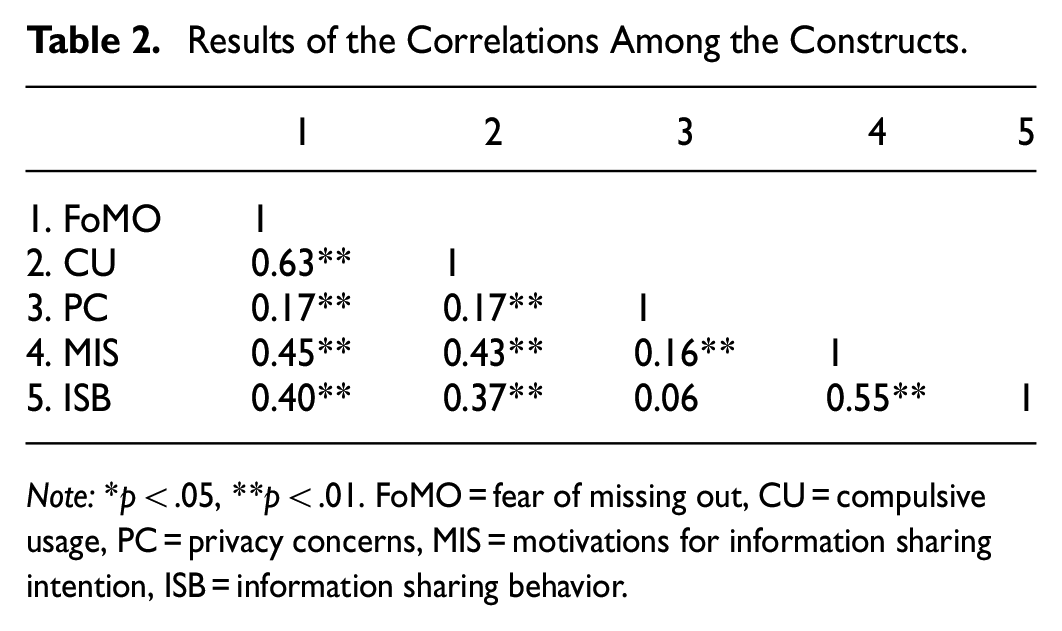
Note:*p < .05, **p < .01. FoMO = fear of missing out, CU = compulsive usage, PC = privacy concerns, MIS = motivations for information sharing intention, ISB = information sharing behavior.
Results of the Heterotrait-Monotrait Ratio of Correlations (HTMT).

Note: FoMO = fear of missing out, CU = compulsive usage, PC = privacy concerns, MIS = motivations for information sharing intention, ISB = information sharing behavior.
Structural Relationships Among the Latent Variables
Results of the SEM analysis revealed that the model fit was considered acceptable (χ2 = 556.85, df = 177, χ2 / df = 3.15, p < .05, CFI = 0.95, TLI = 0.94, RMSEA = 0.05, and SRMR = 0.07). The percentage variance explained in “Motivations for information sharing intention” was 28% and for “Information sharing behavior,” it was 45%. As shown in Figure 2, “FoMO” and “Compulsive usage” were the significant predictors of “motivations for information sharing intention” (path coefficient = 0.20, p < .01 and = 0.35 p < .001, respectively). However, “Privacy concerns” did not show a significant relationship with “motivations for information sharing intention.” The results suggested that individuals who fear that their shared messages may be ignored or receive no responses from their recipients and who use LINE regularly to an excessive amount are more likely to establish sharing intention motivations. Moreover, LINE users who consider data privacy as a primary concern may possess varying behaviors in terms of information sharing. A one-way ANOVA was further conducted to examine the difference among three generations of LINE users. The result demonstrated statistically significant differences between LINE users of the three generations (F = 7.29, p < .01, Table 4). According to a post-hoc analysis using the Scheffé test, middle-aged and older adult users were significantly more concerned about the privacy of their information shared via LINE instant messaging than their young adult counterparts. However, there were no significant differences in the privacy between the middle-aged and older adult groups.

SEM results of the relationships among concerns, motivations for information sharing intention, and information sharing behavior.
Comparisons of LINE Users’ Three Generational Groups on Their Privacy Concern.

Note:*p < .05, **p < .01.
The SEM results also indicated that “Motivations for information sharing intention” was a significant predictor of “Information sharing behavior” (path coefficient = 0.49, p < .001). This result implied that when LINE users possess motivations for information sharing intention, they would further share information and respond to shared messages. These results support the proposed hypotheses H1, H2, and H4.
Furthermore, we investigated the direct relationships between the three types of concerns and the information sharing behavior. The results indicated that “FoMO,”“Compulsive usage,” and “Privacy concerns” had no significant direct relationship with “Information sharing behavior.” The results did not lend support to hypotheses H5, H6, and H7. Overall, three of the seven proposed hypotheses were supported in this study. In addition, although the potential confounding effect of the demographic factors such as age, gender, and time spent on MIM was controlled, we identified that the three factors had no significant confounding effect on the users’ information sharing behavior. Types of shared information were additionally observed. We found that greeting messages was the only type of the shared information which significantly related to the sharing behavior (path coefficient = 0.11, p < .05).
Discussion
The constant development of the internet and mobile technology has resulted in the prevalent connectivity of people regardless of geographical and temporal conditions. Such phenomenon has attracted attention among researchers to examine various facets of utilizations from behavioral and psychological perspectives (e.g., Brown & Kuss, 2020; Li & Lin, 2019). For example, due to the dramatic rise of the use of social media among users of mobile devices worldwide, some studies (e.g., Dhir et al., 2018; Rozgonjuk et al., 2020) examined factors that trigger detrimental psychological states and maladaptive behavior.
Our study further extended theoretical knowledge and understanding of mobile instant messaging and information sharing behavior by specifically investigating different types of concerns as antecedents influencing motivations for information sharing intention and information sharing behavior through LINE. We discuss the findings of the study in the following paragraphs.
The SEM analysis results support our hypothesis that LINE users’ concerns about FoMO (H1) and compulsive usage (H3) can positively predict their motivations for intentionally sharing information online. A possible explanation of our finding could be that LINE users who are concerned about FoMO might be induced to constantly engage in social gatherings, especially through sharing information, to prevent a feeling of disconnection, exclusion, and outdatedness. Moreover, LINE users who are anxious about compulsive usage may still hold positive perceptions of online information sharing. We conjecture that such perceptions could help them formulate positive motivations for sharing intention in the hope that certain consequences of sharing information online would yield benefits on relational formation and consolidation, either interpersonally or socially. In particular, people tend to have the intention to perform different activities on social media, including sharing information, to establish social connection and recognition as well as alleviate negative emotions (Bouffard et al., 2022; Wang & Lee, 2020).
In addition, our hypothesis that LINE users’ motivations for intention to share information can be a significant positive predictor of their actual information sharing behavior (H4) is also supported in this study. This finding is in line with the concept that individuals tend to engage in activities or behavior with positive attitudes if they believe that such performance will generate desirable outcomes (Ajzen & Fishbein, 1980; J. Kim et al., 2020). Considering the characteristics of participants in the present study, more than three-fourths are considered moderate-to-heavy LINE users. Their frequent sharing behavior involves information that is commonly related to greetings. Salutation is a common daily practice in every culture. It is performed to facilitate conversational initiations and relational mediation (Nilsson et al., 2020). In an online environment, contents, including greetings, can be in various forms, such as textual or audiovisual messages and, with technological affordances, they are distributed effortlessly (Klein et al., 2020). Such information can be therefore viewed as tools that potentially trigger individuals to share information through visual platforms to achieve desirable outcome expectations (e.g., building up and consolidating relationships with others or receiving social recognition) (Cai & Shi, 2022; P. Pai & Tsai, 2016).
However, four of the proposed hypotheses were rejected in this study. The findings indicated that there was no significant relationship between LINE users’ privacy concerns and their motivations for sharing intention (H2). Also, we found that all three concerns did not have a direct relation to sharing behavior (H5–H7). In other words, the concerns about compulsive usage and FoMO indirectly influenced information sharing behavior via motivations for information sharing intention. This might be attributed to the possibility that individuals who are concerned with social connections, usage intensity, and informational privacy may be motivated differently to either engage in or refrain from activities on social media and MIM (Dhir et al., 2018; Roberts & David, 2020; Shim et al., 2017), one of which is sharing information. It could also be possible that the participants formulate and possess various perceptions of the three concerns when it comes to sharing information via MIM. Furthermore, with regards to the privacy aspect, we believe that it may not be appropriate to thoroughly assume that LINE users in Thailand do not experience the privacy paradox despite the insignificant results. It is therefore noteworthy that willingness to disclose information is personal- and context-dependent when it is sensitive to privacy or security issues (Hong et al., 2021; John et al., 2011).
Based on the specific observation on the privacy issue among the three user generations in this study, the middle-aged and the older adults appear to express more concerns toward privacy of their shared information than their younger counterparts. This finding is consistent with that of Van Den Broeck et al. (2015). However, there is some controversy about why young adults express fewer concerns about privacy issues than other age groups. Van Den Broeck et al. (2015) hypothesized that this may be attributable to a lack of personal awareness of information sharing and information literacy skills, which include knowledge of privacy protections. Alternatively, other research (e.g., Madden et al., 2013; Tufekci, 2021) has posited that growing up as digital natives, young adults tend to possess a greater capability to tailor their privacy settings in accordance with their own preferences and engage more frequently in privacy-protective behaviors. In some way, these complex privacy characteristics may reflect the privacy paradox phenomenon that occurs commonly among young adult users (Hargitttai & Marwick, 2016). However, additional research is required to validate this conjecture. Moreover, we speculate that there may be other environmental cues contributing to the relationship between privacy concerns and motivations for information sharing intention and behavior among MIM users.
Conclusion, Limitations, and Future Directions
Overall, it was found that, among these concerns, FoMO and compulsive usage significantly predicted LINE users’ motivations for information sharing intention whereas privacy concerns did not. Motivations for information sharing intention further significantly predicted the information sharing behavior. The three concerns, however, did not have a direct relationship with information sharing behavior.
The present study has some limitations. First, the generalization of the findings may be restricted as the data were collected from two specific urban communities in Thailand. As previous studies (e.g., Barry & Wong, 2020; Busch et al., 2021; Fatima et al., 2019) has revealed that people from different regions and cultures are likely to have various perceptions of the three concerns and information sharing behaviors through social media or mobile instant messaging platforms, further examination may be required to determine whether the relational patterns observed in this study are valid in other contexts or in other population groups with different cultural backgrounds.
Second, since the data of the study is based on individuals’ self-reported responses, the findings could be susceptible to bias to some degree while causal relationships could not be established among the variables. Despite these limitations, we decided to use the survey to collect data as it has potential to generate insights from a large number of participants (Cohen et al., 2018). Also, we suggest that additional research may consider employing other methods, such as interviews and observation. This will enable us to gain a deeper understanding of how psychological concerns influence the behavior of MIM users in sharing information.
Third, the scope of this study is limited to testing the structural relationships among the focused variables based on the perspectives of the whole group sample. However, as research has shown that age and gender could have a significant impact on privacy concerns (e.g., Dhir et al., 2017) and on MIM users’ information sharing behavior (e.g., Bowe & Wohn, 2015; Coyne et al., 2020; Lin & Wang, 2020), we suggest that future research may employ a more comprehensive technique, such as multigroup SEM, to examine the structural relations between the three concerns and to identify the role they play in information sharing and behavior across different genders and age groups.
Footnotes
Acknowledgements
The authors would like to acknowledge Shray Presenger and Nicholas O. Awuor for support and encouragement.
Declaration of Conflicting Interests
The author(s) declared no potential conflicts of interest with respect to the research, authorship, and/or publication of this article.
Funding
The author(s) received no financial support for the research, authorship, and/or publication of this article.
Ethics Statement
All procedures in the current study were performed adhering to the ethical standards outlined by the Academic Research Ethics Board at the Navamindradhiraj University and the 1964 Helsinki Declaration and its later amendments or comparable ethical standards. Thorough explanations regarding research purposes, relative procedures, and participatory anonymity were provided to the participants prior to the administration of the questionnaire. They were also informed that they could withdraw at any time. A written consent form was presented at the beginning of the questionnaire. The completion of the questionnaire indicated the acknowledgment and the participatory agreement of the participants.
