




Abstract
The aim of this research was to evaluate attitudes toward the use of technology in education among teachers in training and the relationships with other variables derived from the use of technology and teaching style. The study focused on a Spanish sample of 842 future educational professionals in the training stage, belonging to the Autonomous Community of Valencia, with 54.75% identified as female and 46.25% as male, with a mean age of 41.17 years. The results indicated that a constructivist teaching style is related to more favorable attitudes toward the use of technology in teaching, unlike a traditional style. Various variables linked to the use of technology and that have negative effects on people’s well-being (such as experiences of suffering from cyberbullying or the fear of missing out) are related to less favorable attitudes toward technology in education. The implications of the variables studied as possible differential factors in the inclusion of technologies in their profession by future teachers are discussed.
Plain Language Summary
The purpose of this research was to explorate attitudes toward the use of technology in education among teachers in training and the relationships with other variables derived from the use of technology and teaching style, such as Fear of Missing Out, cybervictimization, and teaching-learning styles. The study focused on a Spanish sample of 842 future educational professionals in the training stage, who respond to a series of self-report quantitative measures. The conclusions shows that constructivist teaching style is related to more favorable attitudes toward the use of technology in teaching, unlike a traditional style. Different variables linked to the use of technology and that have negative effects on people’s well-being (such as experiences of suffering from cyberbullying or the fear of missing out) are related to less favorable attitudes toward technology in education. The implications of the variables studied as possible differential factors in the inclusion of technologies in their profession by future teachers are discussed.
Introduction
In an increasingly globalized world, technology and its use have been recently studied and approached from different perspectives. A large number of citizens, immersed in a tremendously changing world with access to a large amount of information, sometimes fail to understand, process, and effectively manage the changes derived from technology.
According to data provided by Spain” National Statistics Institute (Instituto Nacional de Estadística [INE], 2022), the number of Spanish households with school-age children who need access to Information and Communication Technologies (ICTs) has grown to 95.9% in the last ten years, with 85.8% of them using them daily. This means that 98.2% of households in Madrid have the means to use ICTs to educate children (between the ages of 10 and 15) and that children make very frequent use of ICTs regardless of the purpose for which they are used (INE, 2022). As a result of the multiple uses of ICTs, children and young people benefit greatly when facing their daily tasks, both inside and outside their educational environment. However, there is controversy regarding the suitability of the use of ICTs, as well as the potential risks and problems that may arise among younger students (Reyes, 2018), and the way teachers interpret this issue is of great relevance.
ICTs and Their Growing Involvement in Education: The Role of Teacher Training
In light of the growing concern about the impact of ICTs on young people, it is often said that children make inappropriate, uncontrolled, and even abusive use of these technologies. Moreover, several studies (e.g., Bowes et al., 2012; Parra, 2018) have shown a multitude of potential risks associated with the inappropriate use of ICTs: developmental delay, visual problems, psychological, emotional, social problems, and so on. In particular, psychological wellbeing and social coexistence have been affected in both young people and adults, as evidenced by new problems and phenomena that did not exist until now (Hayran & Anik, 2021).
In this context, educational institutions are once again positioned as instruments to respond to the growing needs derived from the social transformation linked to technology. After the COVID-19 pandemic, the use of ICTs has increased even more and teachers in general feel that they now have more resources, skills, and interest in implementing them in the classroom. However, there are also teachers who admit to having trouble using ICTs and who in the current post-pandemic period have returned to traditional practices, taking into account the potential problems associated with the use of ICTs (Garmendia et al., 2021).
In the last few decades, several international organizations (OECD, 2010; UNESCO, 2014), have supported ICTs as an essential factor for social change by improving training processes for both students and teachers. In this regard, teacher training is a crucial phase, one that should provide food for thought for lifelong learning and should be linked to innovative perspectives that consider teachers in virtual environments. However, including ICTs in teacher training for a merely technical-instrumental use is insufficient, since it is necessary to activate problem-solving skills and innovation abilities (Fainholc, 2016).
In this regard, there are several variables that condition teaching success, of particular relevance being teacher training (Quintero, 2008), as well as teachers’ conceptions and beliefs about certain types of methodologies and how to use them. Empowering teacher training around ICTs offers numerous advantages for educational communities (Liu et al., 2017), facilitating communication beyond the classroom, fostering the creation of collaborative networks operating synchronously and asynchronously, increasing motivation, improving quality and learning climates, optimizing time, creating positive interdependence, better teacher monitoring, among others. However, in spite of these positive aspects, many schools use this methodology only occasionally and others do not use it at all (García-Valcárcel et al., 2014).
In the Spanish educational framework, since the entry into force of the LOMLOE (Organic Law amending the LOE 3/2020, December 29), at least two of the eight key competencies for lifelong learning are now related to the use of digital media: digital competence and citizenship skills. These competences are combined on the basis of the notion of Digital Citizenship, where one of its main implications is related to the educational field and teaching (Richardson & Milovidov, 2019). Consequently, the Digital Literacy process consists of acquiring the necessary skills to be competent in the use of digital media, so that future citizens have equal opportunities (Öztürk, 2021): to access, participate, and exercise their rights and duties in the digital world.
Cybervictimization, the Fear of Missing Out and Their Possible Implications on the Teaching Styles and Attitudes Toward ICTs of Teacher Trainees
Several international studies show a direct relationship between the excessive use of technology and the existence of a series of socioemotional problems (Parra, 2018). Social learning by observation is particularly relevant in children and young people (Bandura, 1982) who tend to repeat behaviors of adults and everything they take as a reference, in this case through ICTs. Therefore, it is particularly relevant to investigate the various learning factors that may have an impact on a healthier and more responsible use of ICTs among young people. From this perspective, a key factor is the training of teachers and the study in future teachers of the role they give to ICT, as well as its implication in the teaching-learning process with students following the related key competences (Tondeur et al., 2019).
Teaching styles represent the various forms adopted by the didactic relationships between the personal elements of the teaching-learning process, both at a technical and communicative level, as well as at the level of organization of the group-class and its emotional relationships, depending on the decisions made by the teaching staff (Aelterman et al., 2019). In this sense, the most traditional teaching styles are still frequently applied by educators (Dimitrios et al., 2013), basing the teaching-learning process on knowledge that is transferred to the students without the latter having an active role but being a mere receiver who uses memorization. On the other hand, particularly in recent years and with the support of ICTs, there are professionals and schools that promote a constructivist teaching style (Alkış Küçükaydın & Gökbulut, 2020). In this style, unlike the traditional one, learning comes from the students themselves (with an active role). The teacher encourages creativity and promotes a competency-based approach, critical thinking and problem solving, and is based on the learner’s motivation.
ICTs are a central element for the development of the constructivist teaching style, since the students’ interaction with them represents a different way of constructing, mastering, and sharing knowledge (Cansiz et al., 2019; Fırat et al., 2021). ICTs offer the capacity for active participation and interaction, where not only messages are produced but also certain aspects related to constructivism can be decided (the sequence of information to be followed, the pace, quantity, and depth of the information desired, choosing the codes with which the relations with the information are established, among others). In the last decade, various research (Gilakjani et al, 2013; Makewa, 2019) has explored the role of technology in constructivist learning, demonstrating that it provides an appropriate creative medium for the learner to express themselves and to demonstrate that they have acquired new knowledge. Teachers with a constructivist teaching style, as opposed to teachers with traditional teaching styles, encourage the use of ICTs for learning (Khamparia & Pandey, 2020; Lam et al., 2021).
As a result of the great growth in the use of technology, the education sector has expressed great concern about its multiple uses and the multiple psychosocial problems derived from it. In the last decade, the use of technology in Spain has increased from 37.3 to 99.8% (INE, 2022) among young people (6–15 years old) and 10.9% say they have suffered cyberbullying in the past year. Moreover, due to the anonymity provided by technology, bullying becomes more extensive in time and with a more universal audience, characteristics that give it its own entity with respect to traditional bullying. Furthermore, teachers have also been affected by cyberbullying practiced with increasing frequency by their students, with the aim of challenging their authority (Kyriacou & Zuin, 2016).
Cyberbullying manifests itself through multiple forms and means, from threats, mockery and impersonation, to more serious expressions such as “sexting,” which consists of sending sexual content, or “happy slapping,” where a victim is assaulted while being filmed and then this is shared on the Internet (Fajardo-Bullón et al., 2021). Students who suffer this form of bullying, may experience cybervictimization (García et al., 2020): the suffering of aggressions through technological means which creates a significant emotional and psychological maladjustment and affects such important areas as satisfaction with life. It is also necessary to consider the possible effects of cybervictimization experiences among teachers during their training and in previous periods, in order to determine their possible relationship with more or less favorable attitudes toward their use in education. Schools are understood as spaces of socialization that are not exempt from conflict (Hernández & Solano, 2007) and should offer ways of approaching and preventing problems such as cyberbullying, through trained professionals. It is necessary to evaluate the beliefs, attitudes, and competencies developed by future educational professionals (Cristancho Vega & Niño Vega, 2020), in order to improve training plans at different stages such as postgraduate studies. Furthermore, it is necessary to consider whether the presence of certain indicators of cybervictimization among prospective teachers may influence the role they give to technology in education. This in turn may be aggravated by the appearance at different levels of problems associated with the use of technology and cybervictimization, such as FoMO (Macaulay et al., 2020; Martínez-Ferrer et al., 2021; Urano et al., 2020).
The objectives of this study are, on the one hand, to study the attitudes of teachers in training toward the use of technology and its usefulness in education and, on the other hand, to investigate the relationship between these attitudes and the teaching styles, cybervictimization and FoMO experienced by educators in training.
Method
Participants
A total of 842 teacher training students from the Autonomous Community of Valencia participated in the study (with a sampling error of ±2.5% and a confidence level of 95%), with 62.70% (n = 528) identified as female and 37.30% (n = 314) identified as male. The average age was 41.17 years (SD = 11.30). Regarding their career stage, 24.7% were at the beginning of their training, 31.9% were at an intermediate stage, while 43.4% were finishing their studies. Regarding the self-perceived social class of the participants, 5.2% of the participants considered themselves to belong to the lower class, 18.9% to the lower-middle class, 54.8% to the middle class, 15.7% to the upper-middle class, and 5.4% to the upper class.
Measures
Self-report measures were employed using a battery of assessment instruments consisting of:
Technology in Education
Ten items were developed (Table 1) that exemplify different situations in which technology is related to education (e.g., the use of technology in education), “Technology improves the quality of student learning”; “The use of technology gives the teacher greater opportunities to adapt their time and educational environment to suit student needs”; “The characteristics of the school in terms of the distribution and use of spaces facilitate the use of technology with students” with the aim of analyzing whether people consider the link between both concepts to be positive or not. Each item was rated on a Likert scale with five anchors, ranging from 1 = Strongly disagree to 5 = Strongly agree (the same response format was used for the other scales used in this study). The higher the scores on the scale, the higher the levels of agreement with a positive link between technology and education.
Descriptive Analysis of Different Statements About Technology in Education.
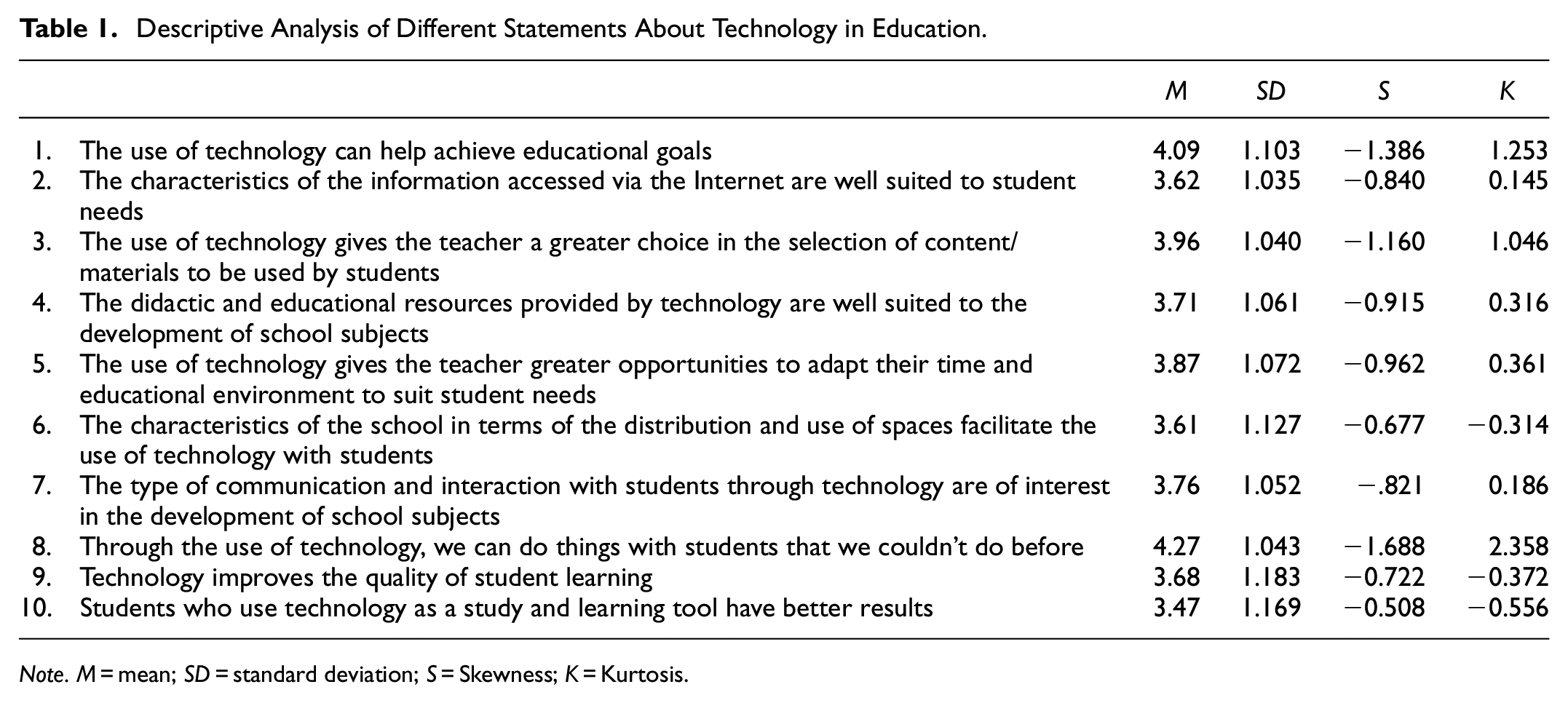
Note. M = mean; SD = standard deviation; S = Skewness; K = Kurtosis.
Critical Thinking Disposition Scale (CTDS). The original scale was composed by two dimensions: Critical Openness and Reflective Skepticism (Sosu, 2013). For our study, we used the 9 item’s dimension Critical Openness (e.g., “I am often on the lookout for new ideas”; “I sometimes find a good argument that challenges some of my firmly held beliefs”; “It’s important to understand other people’s viewpoint on an issue”). Each item was rated on a Likert scale with five anchors, ranging from 1 = Strongly disagree to 5 = Strongly agree (the same response format was used for the other scales used in this study). The higher the score in both dimensions, the higher the levels of Critical Thinking.
Beliefs Related to Constructivist and Traditional Approaches to Teaching and Learning Scale. Based on constructivist and traditional approaches to teaching and learning, the scale was created to represent both constructivist and traditional approaches (Woolley et al., 2004). The scale presents the 30-item divided in two dimensions: Constructivism “Students should be given many opportunities to express their ideas”; “The ideas of students are important and should be carefully considered”; “Good teachers always make their students feel important” and Traditional: “It is best if teachers exercise as much authority as possible in the classroom”; “Good teaching occurs when there is mostly teacher talk in the classroom”; “Learning mainly involves absorbing as much information as possible”. The scale uses a 6-point rating scale ranging from 1 (strongly disagree) to 6 (strongly agree).
Cyber-Bullying/Victimization Experiences Questionnaire (CBVEQ) (Kokkinos & Antoniadou, 2019), a 24-item instrument equally divided into two subscales, for cyber-bullying and cyber-victimization respectively, on a 5-point scale (1 = never to 5 = every day). The scale assesses direct (5 items) and indirect (7 items) cyber-bullying/victimization behaviors, conducted with the use of cell-phones or the Internet, and has adequate psychometric properties (Kokkinos & Antoniadou, 2019). The response format for each item is binary and the possible options are 1. “Yes” and 2. “No,” according to whether or not the action or situation that is posed happened to the participants.
Fear of Missing Out (FoMO) scale
To assess the construct, we proceeded to complete the adaptation and validation of the original version of the scale (Przybylski et al., 2013), composed of 10 items that determine dimension 1, FOM NI (e.g., “I fear my friends have more rewarding experiences than me”) and dimension 2, FOM SO (e.g., “It bothers me when I miss an opportunity to meet up with friends”). Each item was rated on a Likert scale with five anchors, ranging from 1 = Strongly disagree to 5 = Strongly agree (the same response format was used for the other scales used in this study). The higher the score in both dimensions, the higher the levels of FoMO.
Socio-Demographic Data Questionnaire. Information on the gender, age, self-perceived socio-economic level, and highest level of education was collected from the participants.
Procedure and Data Analysis
The inclusion criteria to participate in the study were to be a student of the teacher training program for secondary education or a primary school teacher at one of the universities of the Autonomous Community of Valencia. Participants were previously informed, at the start, about the purpose of the study, the institution responsible for it, and provided with a contact e-mail address in case they required further information. Additionally, they were informed that the data collected in this study would only be used for academic-scientific purposes. The statistical analyses that guided the development of this study were carried out using SPSS for Windows software version 19.0 (George & Mallery, 2019).
Results
First, a series of statements on the use of technology in education were analyzed (Table 1). The degree of agreement with each one of them, the mean and standard deviation, as well as the skewness and kurtosis, were analyzed.
As shown in Table 1, all means are above three, which indicates a tendency to agree on the relationship between technology and education (particularly in statements 1, 3, and 8). However, when observing the levels of skewness and kurtosis, no statistically significant trends were found, that is, the sample is sufficiently heterogeneous with respect to the relationship between technology and education that no biased statements were found, with the exception of number 8, which presents excess kurtosis, so there would not be much variability.
With respect to the participants’ gender, no statistically significant differences were observed between men and women. In terms of age, considering three age ranges (18–32, 33–50, and 51–65), statistically significant differences were found (F = 8.541; p < .001) between two subgroups: on the one hand, the group of participants aged 51 to 65 showed higher levels of technology and education (M = 2.96) while, on the other hand, participants aged 18 to 32 (M = 3.77) and those aged 33 to 50 (M = 3.67) showed lower levels of technology and education.
Next, the relationships between the technology in education construct and other variables that could be linked, such as critical thinking, the constructivist-traditional educational model, and FoMO, were analyzed (Table 2).
Relationships Between Technology in Education and Other Variables.

Note. Cronbach’s alpha in the diagonal.
p < .001. *p < .01.
Table 2 shows significant relationships between the levels of technology in education with critical thinking and the constructivist perspective on teaching-learning. On the contrary, no relationships were observed between technology in education and the traditional teaching-learning perspective and neither with the two dimensions of FoMO.
Finally, the differences between different cyberbullying experiences were analyzed with the perception of technology in education (Table 3).
Differences in the Levels of Technology in Education Based on the Experience of Cyberbullying.

p < .001. *p < .05.
As shown in Table 3, there are statistically significant differences between those who experienced cyberbullying and those who did not, with respect to the link between technology and education. In all cases, people who did not experience such acts are more in favor of the link between technology and education than those who did.
Discussion
Currently, the use of ICTs in education is a means for teachers to enhance and improve the teaching-learning process in their educational communities. Given the numerous potentialities and risks that their use in the classroom may entail, it is necessary to study and develop them in depth during the training of educational professionals. In relation to the first objective of the study, we have analyzed the attitudes and beliefs that a sample of future teachers have about the use of technology and its usefulness for educational work. In general terms, attitudes on average were found to be favorable to the use of technology in education and to the link that should exist between the two in order to enhance teaching. With respect to the second objective of the research, teaching styles and other variables related to the use of technology were analyzed to determine whether these could be a differentiating factor in the attitudes that future professionals have with respect to ICTs. From this perspective, differences were found between these attitudes and cyberbullying situations suffered or not by the students, as well as relationships with other variables derived from technological use and teaching styles, such as FoMO, cybervictimization, and teaching-learning styles.
In this regard, the findings showed that when future teachers feel more in tune with the constructivist teaching-learning style, they show more favorable attitudes toward the use of technology in their educational work. On the other hand, when a greater affinity toward a traditional teaching-learning style is shown, no significant relationships are found in any sense with attitudes toward the educational use of technology. These results are consistent with previous studies (Cansiz et al., 2019; Khamparia & Pandey, 2020), so it is possible to conclude that the constructivist teaching style is more predisposed to the use of technology and therefore might reap its benefits, compared to the traditional teaching style. Along these lines, in future empirical studies and teacher training plans, it is suggested to take into consideration the teaching styles with which future teachers have a greater affinity, since this may have direct implications on their attitudes toward the usefulness of the use of ICTs in education.
Moreover, other recently emerging phenomena such as cybervictimization (derived from cyberbullying) and FoMO are negatively related to attitudes toward the use of technology in education. Both of these issues significantly undermine the overall wellbeing of prospective teachers (Kopecký & Szotkowski, 2017) and in this case, have a negative impact on the value they place on ICTs for their teaching. These phenomena have been extensively studied in students and young people, with results that show a clear relationship between FOMO, cybervictimization, and several indicators that are contrary to their psychosocial wellbeing (O’Connell, 2020; Sun et al., 2022). However, the potential effects on teachers and the attitudes they develop about technology in their teaching have not been fully explored.
It is important to note that in general there is a better attitude toward the use of technology in education among future teachers who have not experienced cyberbullying. However, consistent with previous studies (Macaulay et al., 2018), the differences in such attitudes with respect to those who had indeed experienced cyberbullying, were not homogeneous for all indicators studied. First, the indicators with the greatest impact on the attitudes of future teachers toward the use of ICTs are those that involve public exposure and public denigration through social media (sharing false or real information without their consent). Secondly, other indicators that were important in these differences were those related to suffering from threats, blocking, receiving viruses, and messages. These data indicate that situations in which teachers in training feel exposed to digital media have a greater effect on them, which may affect their confidence in the use of technology in education and the risk they perceive of losing their authority (Kyriacou & Zuin, 2016). Finally, the indicators that had the least impact on the future teachers and their attitudes toward ICTs were those related to the use of their own telephone by other people or the receipt of possible mocking messages. A limitation of the present study was not inquiring specifically about who perpetrated cyberbullying on teacher trainees. In future studies, we suggest analyzing the possible differential impact depending on who the bullies are (students, acquaintances, family members, strangers, among others).
The present study has shown the great relevance of the study of the various factors and variables that could be related to the role given to ICTs by teachers and the use they make of them. In this sense, the study of teachers in training is key to consider the development of certain attitudes and competencies and to have more information to improve them. Both the constructivist teaching-learning style and not having high levels of FoMO, nor having been exposed to cyberbullying, are factors that are favorably related to better attitudes toward the application of ICTs in teaching to improve student learning. In future studies, the inclusion of other psychosocial and training variables (previous training, personality factors, emotional intelligence, literacy and digital competence, among others) is considered relevant in order to continue deepening the analysis of the impact of these variables on future teachers, as well as in the improvement of teacher training plans.
Footnotes
Declaration of Conflicting Interests
The author(s) declared no potential conflicts of interest with respect to the research, authorship, and/or publication of this article.
Funding
The author(s) disclosed receipt of the following financial support for the research, authorship, and/or publication of this article: This research received grants to emerging research groups—GE 2023 of Program for the promotion of scientific research, technological development and innovation in the Valencian Community (Department of Innovation, Universities, Science and Digital Society). Published in resolution of March 3 of 2023, from the Department of Innovation, Universities, Science and Digital Society (DOGV no. 9553 / 03/14/2023). This funding was awarded to the research project: “Socio-emotional competencies of teachers and their relationship with attitudes towards educational inclusion” within the research group: Socio-emotional Competencies, Technology and Educational Inclusion (CSPAIE—Valencian International University—VIU).
Ethics Statement
The study was conducted according to the guidelines of the Declaration of Helsinki and approved by the “CEISH—Committee of Evaluation and Monitoring for Research with Human” of the International University of Valencia (CEID202118, 17 September 2021).

Data Availability Statement
Data sharing not applicable to this article as no datasets were generated or analyzed during the current study.