




Abstract
This study investigates the causal effect of financial knowledge on short- and long-term financial behaviors across gender and age groups in Japan. Using a comprehensive survey conducted by the Bank of Japan, we construct financial knowledge and short- and long-term financial behavior indicators. Our results show that financial knowledge positively impacts short- and long-term financial behaviors. The evidence indicates that women are generally more financially responsible than men, although they are less likely to invest in financial assets. We also find that older individuals tend to practice more responsible financial behavior than younger ones. Additionally, the effects of financial knowledge on most financial behaviors decline as age increases, except for asset investment. We also find that the gender gap in financial behaviors is lower among those with higher financial knowledge. Our findings have significant policy implications for designing financial education programs.
Plain language summary
This study investigates how financial knowledge influences short- and long-term financial behaviors across gender and age groups in Japan. Using a comprehensive survey conducted by the Bank of Japan, we developed indicators for financial knowledge and short- and long-term financial behaviors. Our results indicate that financial knowledge has a positive impact on both short- and long-term financial behaviors. We also find that women generally exhibit more responsible financial behaviors than men, although they are less likely to invest in financial assets. Additionally, older individuals are more likely to engage in more prudent financial behaviors than younger individuals. As age increases, however, the influence of financial knowledge on most financial behaviors tends to diminish. Moreover, we find that the gender gap in financial behaviors narrows among those with higher levels of financial knowledge. These findings highlight the importance of financial education programs in shaping individuals’ financial behaviors and carry important implications for policy development.
Keywords
Introduction
Recent trends, such as rapid changes in the financial system, the shift from defined benefit plans to defined contribution plans, and the proliferation of financial products, require individuals and households to have adequate financial knowledge to manage their day-to-day financial matters and financial planning to ensure their future financial well-being (Comerton-Forde et al., 2022; Sehrawat et al., 2021). Numerous studies have found that financial knowledge has a significant impact on financial behavior, such as improved savings rates, stock market participation, wealth accumulation, or retirement planning (Bernheim et al., 2001; Lusardi & Mitchell, 2008, 2011; Van Rooij et al., 2011) However, some others find that financial knowledge does not have any or weak effects on different financial behavior.
Some studies further argue financial behavior has a “hierarchical” order (Consumer Financial Protection Bureau (CFPB), 2015; Wagner & Walstad, 2019). Some financial behaviors, such as cash-flow management and credit management, have short-term characteristics, while others including saving and investing have longer-term characteristics (CFPB, 2015; Wagner & Walstad, 2019). Several studies examine which types of financial behaviors are influenced by financial knowledge (Fan, 2021; Henager & Cude, 2016, 2019; Wagner & Walstad, 2019). However, the results are mixed. Fan (2021) and Henager and Cude (2016, 2019) find that financial knowledge is positively associated with short- and long-term desired financial behaviors, while Wagner and Walstad (2019) report a positive relationship between financial education and long-term financial behavior but not short-term financial behavior.
Although these insights, most studies neglect the differences across gender and age groups. Moreover, evidence on the effect of financial knowledge and short- and long-term financial behaviors outside the US is limited. Against this background, this study investigates the effect of financial knowledge on short- and long-term financial behaviors across gender and age groups in Japan. Following the literature, short-term financial behaviors include having an emergency fund, paying bills on time, watching financial matters, and monitoring monthly income and expenditure, and long-term financial behaviors include having retirement plans, having plans for other future expenditures, setting long-term financial goals, and investing financial assets.
Using a comprehensive dataset collected in Japan in 2019, we constructed a composite index of financial knowledge from 25 questions. To establish the causal relationship between financial knowledge and financial behavior, we rely on a set of instrument variables. Our empirical results show that financial knowledge has a strong and statistically significant impact on both short-term and long-term financial behaviors. Our results also reveal gender disparities in financial behaviors, with women more likely to practice responsible financial behaviors than men, except in financial asset investment. Additionally, older individuals are more likely to engage in responsible financial behavior than younger individuals, with the effect of financial decline with age, except for financial asset investment. We also find that that the gender gap in financial behaviors is lower among those with higher financial knowledge.
Our study makes some important contributions to the literature. Firstly, we establish a causal relationship between financial knowledge and short- and long-term financial behaviors by employing an instrumental variable approach. This approach addresses potential biases arising from omitted variables and reverse causality, providing robust evidence of the impact of financial knowledge on financial behaviors. Secondly, our large sample of 25,000 observations allows for a detailed analysis of gender differences in financial behaviors across different age groups. The empirical results, therefore, provide valuable insights into how gender influences financial behavior over various life stages. Thirdly, by examining the relationship between financial knowledge and financial behaviors using Japanese data, we offer additional evidence within a distinct cultural and historical context. Japan has undergone a dramatic transformation across various aspects of politics, economics, culture, and demographics since the early 20th century (Lee et al., 2010). The country has emerged from a middle-income and war-torn economy to an advanced economy. The structural transformation contributes to shaping the attitudes regarding gender roles and the division of labor within the family and society. This transformation may also have profound impacts on different generations due to their different experience in their childhood and their life transitions (Piotrowski et al., 2019). Our paper adds to the breadth and depth of knowledge on the subject matter.
The remainder of the paper is organized as follows: Section “Literature Review” reviews the literature. The data and methodology are discussed in Section “Data and Methodology.” The key findings and a discussion of the results are given in Sections “Empirical Results” and “Discussions and Implication.” Finally, Section “Conclusions” concludes the study.
Literature Review
Financial Knowledge and Short- and Long-Term Financial Behavior
Many studies have found that financial knowledge has a statistically significant effect on more responsible financial behaviors regarding saving, investment, wealth accumulation, and retirement planning (Bernheim et al., 2001; Lusardi & Mitchell, 2008, 2011; Van Rooij et al., 2011). However, some others find that financial knowledge does not have any or weak effects on different types of financial behavior (Wagner & Walstad, 2019; Xiao et al., 2014).
The United States Consumer Financial Protection Bureau (CFPB) defines financial behaviors as including both simple and complex financial practices (CFPB, 2015). According to Hilgert et al. (2003), Xiao (2008), and Wagner and Walstad (2019), financial behavior can be categorized into a “hierarchical” order: short-term financial behavior (cash-flow management, credit management) and long-term planning behavior (saving and investing). From this perspective, short-term financial behavior reflects one’s current and potential short-term consequences, while long-term financial behavior is a more intricate and challenging practice (Wagner & Walstad, 2019).
Numerous studies examine the role of financial knowledge on financial behaviors, but only some consider the time dimension of these behaviors. The empirical results also are rather inconclusive. Most studies show a positive and robust effect of financial knowledge on long-term financial behavior such as retirement savings and responsible investment (de Bassa Scheresberg, 2013; Fan, 2021; Henager & Cude, 2016, 2019; Kim et al., 2019; Wagner & Walstad, 2019). However, empirical results are rather mixed concerning short-term money management (i.e., short-term financial behavior). Some studies could find only weak (or even no) evidence on the role of financial knowledge in short-term financial behavior. For example, Robb and Sharpe (2009) and Xiao et al. (2014) could not find a strong correlation between financial knowledge and credit card management among young people. Similarly, Wagner and Walstad (2019) find that those with financial education (i.e., potentially having a higher financial knowledge) may not be different from those not exposed to financial education in practicing short-term financial behaviors. Meanwhile, some studies show that financial knowledge positively correlates with short-term financial behaviors such as emergency saving and responsible borrowing (de Bassa Scheresberg, 2013; Fan, 2021; Henager & Cude, 2019). Lyons (2008) finds that students with a higher level of financial knowledge are less likely to engage in risky financial behavior. While a high level of financial knowledge intuitively helps to guide individuals to practice complex financial behaviors, it may also play an important role in fostering individuals to carry out daily financial behavior to achieve long-term financial goals.
Gender and Short- and Long-Term Financial Behaviors
Managing individual finance has become increasingly complex with a diversity of financial services available. Although many studies have investigated the effects of financial knowledge on financial behavior, the role of gender has not received adequate attention (Sholevar & Harris, 2019). The gender differences in financial behaviors can be explained through several theories. For example, human capital theory suggests that differences in education, knowledge, and skills lead to differences in economic outcomes and behavior. Based on this argument, Lusardi and Mitchell (2014) further posit that financial knowledge is a form of human capital acquired through education, training, and experience. Therefore, gender differences in financial behaviors are due to unequal access to financial education or opportunities to acquire financial knowledge between men and women (Lusardi & Mitchell, 2014). Gender differences in access to adequate financial knowledge, according to the human capital theory, also can result in differing levels of risk-taking behavior (Fisher & Yao, 2017), investment choices (Hira & Loibl, 2008) entrepreneurship opportunities (Ćumurović & Hyll, 2019; R. Li & Qian, 2020), and overall financial decision-making strategies.
The theory of planned behavior can provide further insights. This theory holds that favorable attitudes (formation), social norms, and perceptions of control will lead to favorable intentions to engage in a given behavior (Ajzen, 1991). Gender differences in financial attitudes may lead to disparities in financial behaviors such as savings (Fisher, 2010) or investing (Holden & Tilahun, 2022). Social norms toward women may affect gender differences in financial behavior. Beyer (1990) shows that women usually consider that they have less capability to handle tasks perceived as masculine. Since finance is generally viewed as a math-heavy and male-dominated area (Blaschke, 2022), women’s lower confidence in their financial competence may translate into gender differences in financial behaviors (Bordalo et al., 2019). The gender differences in financial behavior may also understood through various theories such as the lifecycle perspective, social role theory (Eagly & Wood, 2012), or the intersectionality theory (Rosenthal, 2016).
Empirical studies consistently highlight a gender gap in financial behavior, revealing that women generally exhibit less responsible financial behavior compared to men. Wagner and Walstad (2023), using data from the US 2018 NFCS, report that females tend to demonstrate less favorable financial behaviors in both short-term practices, such as paying credit card bills in full and maintaining emergency funds, and long-term behaviors like investing in non-retirement assets and managing independent retirement accounts. In the case of Japan, Yoshino et al. (2017) and Okamoto and Komamura (2021) find lower financial knowledge among Japanese women, contributing to their lower engagement in financial asset investment compared to men. Similarly, Kawamura et al. (2021) show that a higher level of financial knowledge is associated with a higher likelihood of engaging in risky financial practices. Meanwhile, Long and Nguyen (2023) note higher financial satisfaction among Japanese women compared to men, although their financial knowledge is lower than their male counterparts.
Gender Differences in Short- and Long-Term Financial Behaviors Across Age Groups
Age and experience change an individual’s perspective and financial needs over time (Henager & Cude, 2016). Robb et al. (2012) and Zick et al. (2012) document that different age groups display different financial behaviors due to varying perspectives, influences, and pressures. Alhenawi and Elkhal (2013) show that older people are more likely to have higher financial knowledge, possibly due to the accumulation of crystallized intelligence based on experience and habits (Cattell, 1943; Y. Li et al., 2013).
The theoretical foundation for understanding gender differences in financial behavior across age groups is rooted in the life-course perspective. According to this perspective, individuals’ financial behaviors and outcomes are shaped by transitions and events across their lifespan (Mortimer, 2007). Elder’s (1974) seminal work introduced the life-course perspective, which has since become prevalent in various social science disciplines (Mortimer, 2007). This perspective emphasizes the principle of time and place, recognizing that macro-level societal and historical contexts significantly impact human lives. For instance, dramatic historical events can have lasting effects and alter individual life courses (Alwin & McCammon, 2003; Elder, 1974). Elder (1974) found that family hardships during the Great Depression affected preschoolers differently from teenagers, with major implications for their adult lives. Additionally, the principle of lifespan development suggests that life is a series of developmental stages, and transitions between these stages can significantly impact individuals’ identities, relationships, opportunities, and overall well-being (Mortimer, 2007). In the context of financial behavior, gender differences across age groups are influenced by life events or trajectories and life-stage transitions, which affect income, savings, investments, and financial decision-making differently for men and women.
Empirical studies provide some evidence of age-related differences in financial knowledge and financial behavior. Xiao et al. (2015) and Delavande et al. (2008) argue that older individuals tend to possess higher levels of both subjective and objective financial knowledge, thus, they are more confident and have better financial decision-making capabilities than younger individuals. Agarwal et al. (2009) report that middle-aged adults exhibit more efficient borrowing habits than both younger and older adults, highlighting the role of experience over analytical ability. Wagner and Walstad (2023) find significant differences across age groups. For example, they find that younger women (aged 18–34) have scores of financial behaviors 9 to 19 percentage points lower than their male counterparts, while differences among those aged 35 to 54 range from 13 to 18 percentage points. Although gender gaps narrow in older age groups, the differences persist, particularly in areas such as credit card management and emergency savings (Wagner & Walstad, 2023).
Several studies explore the relationship between financial knowledge and financial behavior across age groups and generations. Henager and Cude (2016, 2019) explore the relationship between financial knowledge and financial behaviors across generations using data from the National Financial Capability Study (NFCS). They find that objective financial knowledge influences both short-term (e.g., spending, emergency saving) and long-term (e.g., retirement saving, investing) financial behaviors, with effects varying by age group. Older individuals benefit more from objective financial knowledge in long-term financial planning, whereas younger individuals are more influenced by subjective financial knowledge.
Hypotheses
Based on the previous theoretical foundation and empirical results, we propose the following hypothesis:
H1: A higher financial knowledge level is associated with more short-term financial behaviors.
H2: A higher financial knowledge level is associated with more long-term financial behaviors.
H3a: Females are more likely to engage in short- and long-term financial behavior than males.
H3b: Females are less likely to engage in short- and long-term financial behaviors than males.
H4: Older people are more likely to engage in short- and long-term financial behavior than younger ones.
H5: The gender gap in both short- and long-term financial behaviors reduces as financial knowledge increases.
Data and Methodology
Data
The Bank of Japan conducted the Financial Literacy Survey as an online questionnaire to assess the financial literacy of individuals aged 18 to 79 in Japan (CCFSI, 2016, 2019). The survey aimed to understand their financial knowledge and decision-making skills. The data used for this study was obtained from the 2019 survey. Number of participants in this survey is 25,000 individuals. The participants were chosen in proportion to Japan’s demographic structure. Respondents were allocated based on the composition ratios by prefecture (47 prefectures), age (seven groups), and gender, as shown in the latest 2015 Population Census data.
The survey instrument encompassed 53 standard questions on financial literacy. These questions cover different aspects of financial literacy, such as “financial knowledge and financial decision-making skills” and “characteristics of behavior and attitude.” These questions reflect the Japanese Government’s view on financial literacy and are related to the eight categories of the Financial Literacy Map (see Appendix 1). Nearly half of the 53 standard questions were aligned with questionnaires proposed and used by international agencies such as the U.S. Financial Industry Regulatory Authority (FINRA) and the International Network on Financial Education (INFE) of the Organization for Economic Co-operation and Development (OECD).
In addition to financial literacy questions, the survey collected demographic information such as gender, age, place of residence, occupation, annual income, and experience with financial education. Furthermore, the survey gathered data on using Fintech services and products.
Empirical Approach
To quantify the effect of financial knowledge on practicing short- and long-term financial behavior, we estimated the following equation:

where
The coefficient estimates of the financial knowledge variable may suffer from endogeneity. To deal with the potential endogeneity, two instrumental variables are used. First, we follow Fernandes et al. (2014) and Murendo and Mutsonziwa (2017) to construct an average financial knowledge score at the prefectural level and use it as our first instrumental variable. Following Long et al. (2023), we construct our second instrumental variable using the response to the question, “Are you aware of the reduction in the age of legal adulthood?” The Japanese government passed an amendment to the country’s civil code in 2018, which reduced the legal age of adulthood by 2 years to 18, and the change went into effect on April 1, 2022. This modification is significant for two reasons. First, it impacts young people, their guardians, and their caregivers. Second, the amendment alters a law that had been in effect for over 140 years. By focusing on individuals aware of this change, we can identify those likely to have a greater interest in acquiring socio-economic knowledge. Lusardi and Mitchell (2014) argued that financial knowledge could be viewed as a form of human capital accumulation. Meanwhile, awareness of changes in adulthood is also considered a social knowledge accumulation, and thus it is expected to correlate with financial literacy. At the same time, it may not necessarily correlate with all dependent variables we use in this study (namely, financial assets, indebtedness, and financial satisfaction/dissatisfaction). This variable is in line with other studies that instrument financial knowledge with acquiring other economic and financial knowledge (Hsiao & Tsai, 2018).
Variable Construction
Financial Behaviors
As reviewed earlier, short-term financial behaviors involve a money or credit management task, while long-term financial behaviors involve more planning for the future. Therefore, following Wagner and Walstad (2019), Henager and Cude (2019), and Kim et al. (2019), we construct two financial behavior indices. The short-term financial behavior consists of (i) having an emergency fund, (ii) paying bills on time, (iii) watching financial matters, (iv) not having too much debt; (v) monitoring monthly expenditures, and (vi) monitoring monthly income. These financial behavior indicators are binary variables. The indicator “Having emergency fund” takes the value of one if the respondents answer “Yes, secured” to the question “Have you set aside emergency or rainy-day funds that would cover your expenses for 3 months, in case of sickness, job loss, economic downturn, or other emergencies?” and zero otherwise. The indicator “paying the bills on time” takes the value of one if the respondents agree with the statement “pay my bills on time” and zero otherwise. The indicator “Watching financial matters” would take the value of one if the respondents reported that they agree with the statement “I keep a close personal watch on my financial affairs” and zero otherwise. The indicator “Not having too much debt” takes the value of one if the respondents did not agree with the statement “I have too much debt right now” and zero otherwise. Indicators “monitoring monthly expenditure” and “monitoring monthly income” take the value of one if respondents answer “Yes” to the questions “Are you aware of the amounts of your monthly expenditure?” and “Are you aware of the amounts of your monthly income?” and zero otherwise. These indicators are associated with sound management of personal finances.
Long-term financial behaviors, which involve more planning for the future, comprise of several indicators, including (i) having a retirement plan, (ii) having other expenditure planning (other than retirement), (iii) having financial goals and striving to achieve them, and (iv) investing in financial assets. The long-term financial behavior indicators are also dummy variables. The indicator “having retirement planning” will take the value of one if the respondents reported that they have planned their retirement funds and zero otherwise. The indicator “having other expenditure planning” takes the value of one if respondents said that they have planned for at least one of the following expenditures in the future, including buying a house(s), buying car(s), children’s and/or their own wedding, children’s education, health and nursing care, and others and zero otherwise. The indicator “having financial goals” takes the value of one if respondents agreed to the statement “I set long term financial goals and strive to achieve them” and zero otherwise. The indicator “investing in financial assets” takes the value of one if the respondents reported that they have invested in stocks, trust funds, or foreign exchange and zero otherwise. Our long-term financial behavior indicators are related to wealth building and financial planning and, therefore, are consistent with previous studies such as Wagner and Walstad (2019), Henager and Cude (2019), and Kim et al. (2019).
We calculate short- and long-term financial behavior indices by adding up the short- and long-term financial behavior indicators. Therefore, the maximum value of the short-term financial behavior index will be six, and the long-term financial behavior index will be four. For ease of interpretation, we normalize these indices.
Objective Financial Knowledge
The objective financial knowledge is constructed from a set of 25 questions, comprising 18 questions that assess knowledge regarding transactions, economic and financial concepts, and knowledge of wealth management, insurance, borrowing, and lending and seven questions that gauge financial decision-making abilities, such as managing household budgets, planning for future, and using external expertise (see Appendix 1 for further discussion). The financial knowledge score is determined by counting the correct responses, ranging from 0 to 25. To facilitate interpretation, we compute the z-score of the financial knowledge score.
Descriptive Statistics
Table 1 presents the descriptive statistics of our sample. In our sample, 50.6% are female and 49.4% are male. The average financial knowledge score is 14.15 (standard deviation, SD: 6.87). About 12% of our sample report that they have higher financial knowledge than average. The figures for those who report that they have average and low financial knowledge are 42.0% and 43.3%, respectively. On average, the short- and long-term financial behavior indices are 3.88 (SD: 1.43) and 1.47 (SD: 1.2). While more than half of respondents in our sample engage in almost short-term financial behavior, only 21.6% say that they watch their financial matter. The proportions of individuals engaging in long-term financial behaviors are also low. Only 21.0% of respondents report that they have a financial plan for retirement. The proportions of those who report that they have plans for other expenditures, set long-term financial plans, and invest in financial assets are 36.4%, 48.0%, and 41.3%, respectively.
Descriptive Statistics.

Source: Authors’ calculation.
Empirical Results
Financial Knowledge and Short-Term Financial Behaviors
Benchmark Estimation
Table 2 presents the effects of financial knowledge on short-term and long-term financial behavior indices. Column (1) shows the first stage estimation results and columns 2 and 3 are the 2nd stage for short-term and long-term financial behavior indices, respectively. The first-stage results show that all instrumental variables are related to financial knowledge with statistical significance at the 1% level. In all equations, the Kleibergen–Paap rk LM statistic and Cragg–Donald Wald test statistics indicate that our instrumental variables do not suffer from under-identification or weak instrument problems, respectively. The Sargan test also indicates that our instrumental variables satisfy the overidentification problem.
Effect of Financial Knowledge on Short- and Long-Term Financial Behavior Indices.

Source. Authors’ estimation.
Note. Standard errors are in parentheses. In all specifications, we also control for education level, income groups occupation and prefecture dummies.
, **, and *** indicate significance at the 10%, 5%, and 1% levels, respectively.
Our estimation results show that financial knowledge positively affects both short- and long-term financial behavior. The effects are statistically significant at a 1% level. Specifically, one standard deviation increase in financial knowledge raises the short- and long-term financial behavior indices by 0.37 and 0.30 standard deviations of these variables, respectively. The estimation results also suggest that the effects of financial knowledge seem stronger for short-term financial behavior than long-term financial behavior. Our results also show that those who perceive that their financial knowledge is average or low also have a lower level of short-term and long-term financial behavior indices than those who self-report that their financial knowledge is higher than the average (i.e., the reference group in our estimation). The differences in financial behavior between those with low perceived financial knowledge and those in the reference group are higher than those in the reference group.
Regarding age, we find that older individuals are more likely to have more responsible financial behavior than younger ones. Those aged 55 and older have a higher short-term financial behavior index by 0.24 to 0.53 standard deviation than those aged 18 to 19 (i.e., reference groups in our analysis). Interestingly, those in the 20s and from the 40 to 55 age group have a lower long-term financial behavior index than those in the reference group. Our results also indicate that Japanese males have lower short-term and long-term financial behavior indices than Japanese females in our sample.
The empirical results suggest that those with at least a high school education level have a higher short-term financial index than those with education lower than high school (our reference group). However, there is no difference between those with high school, junior/technical, and college education and those with lower high school education in long-term financial behavior. Only those with graduate degrees have higher long-term financial behavior than those in the reference group. Regarding the income level, we find that those with higher incomes have higher levels of both short-term and long-term financial behavior than those with lower incomes.
Financial Knowledge and Short-Term Financial Behaviors
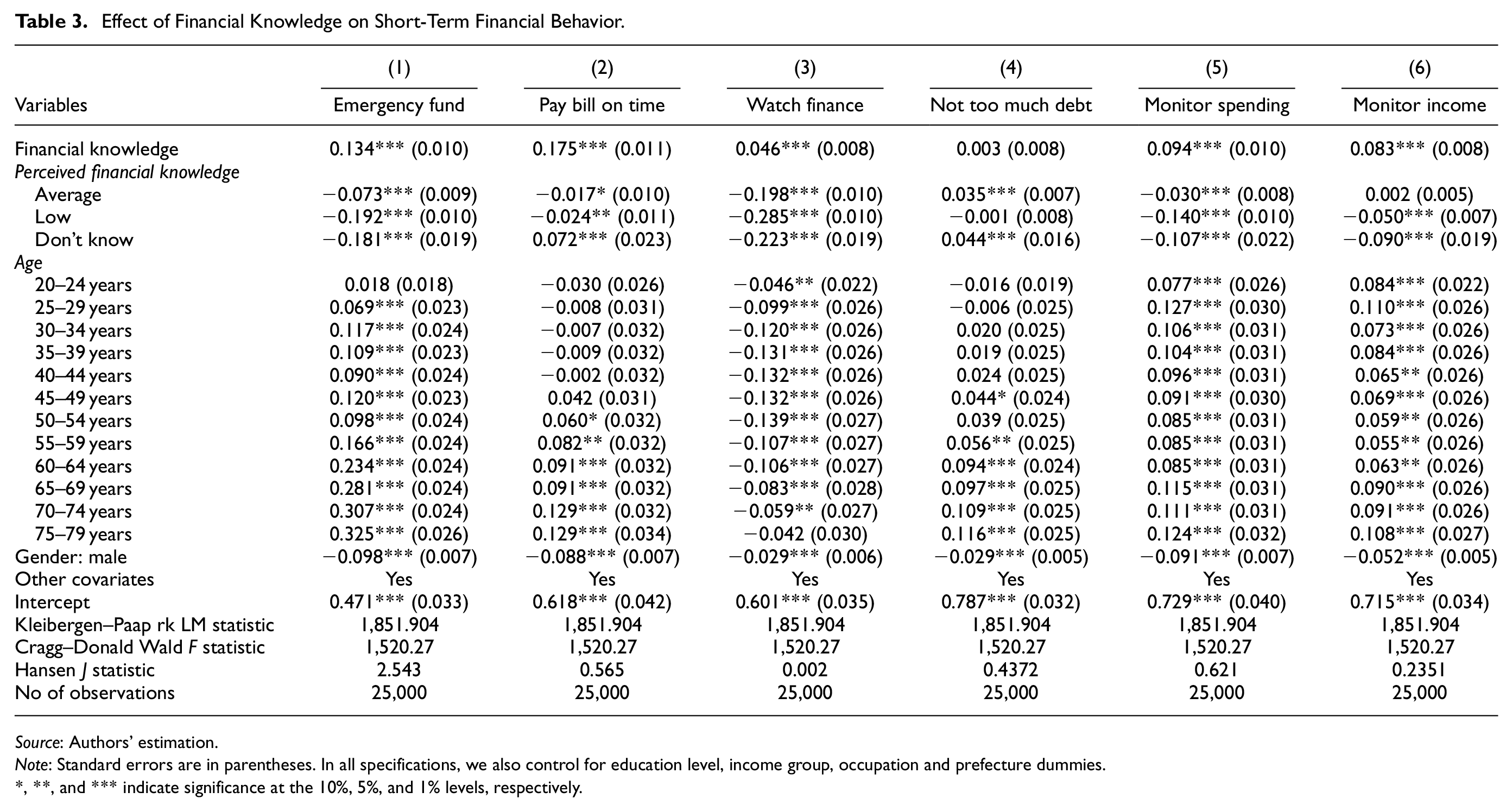
We further estimate the effect of financial knowledge on each indicator in our short-term and long-term financial behavior indices. We use our set of instrumental variables in all specifications. The first-stage regressions for these equations are available upon request. Our instrumental variables statistically satisfy the under-identification, weak instrumental, and overidentification tests.
The results in Table 3 show that financial knowledge has a positive and statistically significant impact on all short-term financial behavior indicators, except for the “not having too much debt” indicator. Specifically, a standard deviation increase in financial knowledge increases the likelihood of having an emergency fund by 13 percentage points. The figures for paying bills on time, watching financial matters, or monitoring spending and income are 17.5, 4.6, 9.4, and 8.3 percentage points, respectively. Meanwhile, financial knowledge is not correlated with the likelihood of “not having too much debt.” We also find that, in general, those who perceived their financial knowledge as above average are more likely to practice short-term financial behavior, except for being indebted, than the remaining ones.
Effect of Financial Knowledge on Short-Term Financial Behavior.
Source: Authors’ estimation.
Note: Standard errors are in parentheses. In all specifications, we also control for education level, income group, occupation and prefecture dummies.
, **, and *** indicate significance at the 10%, 5%, and 1% levels, respectively.
The relationships between age and short-term financial behavior indicators are different from one indicator to another indicator. Specifically, older people seem to have a higher likelihood of having an emergency fund, not being indebted, and monitoring monthly expenditures and income than younger ones. But the older ones are less likely to watch their finances than the younger ones. More interestingly, age is not associated with the likelihood of paying bills on time and not having too much debt among those under 50 or 55. Furthermore, males are less likely to have responsible short-term financial behavior than females.
Financial Knowledge and Long-Term Financial Behaviors
Table 4 shows the effect of financial knowledge on four indicators reflecting long-term financial behavior. The results show a positive and statistically significant effect of financial knowledge on all long-term financial behavior indicators. Specifically, a standard deviation increase in financial knowledge increases the likelihood of having retirement planning, having plans for other future expenditures (rather than retirement), following financial goals, and investing in financial assets by 5.8, 13.5, 8.8, and 7.7 percentage points, respectively. With regards to subjective financial knowledge, those who perceived their financial knowledge as above average tend to practice long-term financial behavior more than those who perceived their financial knowledge as average or below average.
Effect of Financial Knowledge on Long-Term Financial Behavior.

Source. Authors’ estimation.
Note. Standard errors are in parentheses. In all specifications, we also control for education level, income groups, occupation, and prefecture dummies.
, **, and *** indicate significance at the 10%, 5%, and 1% levels, respectively.
Age and the likelihood of practicing different long-term financial behavior are also different from one behavior to another behaviors. Older people (aged 45–75) tend to have a higher likelihood of retirement planning than people in other age groups. Meanwhile, those aged 40 and higher do not have plans for other types of expenditure, such as buying a house or children’s education and marriage, than younger people. Older people are also less likely to follow financial goals than younger ones, but they are more likely to invest in financial assets such as stock or trust funds and foreign exchange. Moreover, males are less likely to have responsible long-term financial behavior than females, except for financial asset investment. Males are more likely to invest in financial assets than females.
Gender Differences Across Age Groups
We further examine the nexus of gender, age, financial knowledge, and financial behavior by examining the differences in the likelihood of having responsible short- and long-term financial behaviors by gender and age group. Figure 1 presents the probability of practicing short- and long-term financial behaviors of different age groups along the distribution of financial knowledge. Panel A represents short-term financial behaviors, while Panel B displays long-term financial behaviors. The probability is calculated from estimation results using the probit regression with instrumental variables. The first stage result is the same as those presented in column 1, Table 1, while the statistical tests are similar to those presented in Table 3.

Probability of (a) short- and (b) long-term financial behavior by age and gender.
Our results show that for short-term financial behaviors, the probability of practicing responsible short-term financial behavior increases with higher financial knowledge across all age groups. Notably, older individuals show a consistently higher probability compared to younger individuals, with probabilities rising alongside increased financial knowledge. This indicates that accumulated experience and financial knowledge contribute significantly to better short-term financial behavior.
Turning to long-term financial behaviors, the probability of planning for retirement, planning for other future expenditures, and investing in financial assets increases with financial knowledge, with older age groups showing higher engagement levels. This highlights the combined impact of age and financial knowledge on financial planning and investment. The result, however, shows that the probability of having financial goals remains relatively flat across different levels of financial knowledge, with little variation across age groups. This suggests that setting financial goals is a behavior less influenced by age and financial knowledge, potentially due to the universal recognition of the importance of goal setting in financial planning.
In a nutshell, our empirical results show that higher financial knowledge generally leads to increased engagement in both short- and long-term financial behaviors across all age groups. Older individuals consistently show higher probabilities of engaging in these behaviors, indicating that age and accumulated experience play a significant role in financial decision-making.
Figures 2 and 3 further illustrate the gender gaps in short- and long-term financial behavior at different levels of financial knowledge. The results in Figure 2 show a gender gap in nearly all aspects of short-term financial behavior in almost aspects of short-term financial behavior. Women tend to have a higher probability of practicing short-term financial behavior than men in all age groups, especially at lower levels of financial knowledge. Older women, especially those aged 60 and above, are more likely to stay informed about their financial affairs and know their monthly expenditures and income. However, the gender gaps tend to narrow as financial knowledge improves.

Gender gaps in short-term financial behavior across age.

Gender gaps in long-term financial behavior across age.
Figure 3 extends the analysis of gender gaps in long-term financial behaviors across various age groups in relation to financial knowledge distribution. Generally, we observe gender differences in nearly all long-term financial behaviors. However, the gender gaps across age groups vary depending on the specific behavior. Regarding retirement planning, the results show that females have a higher probability of engaging in retirement planning at the same level of financial knowledge compared to males. This gap tends to be larger among older age groups and widens as financial knowledge increases. A similar pattern is observed for planning other future expenditures. Women are more likely to plan for future expenditures than men across all age groups, particularly among those aged 30 to 60, and this probability increases with higher financial knowledge. In contrast, the gender gap in having financial goals remains quite consistent across age groups at all levels of financial knowledge, indicating that both men and women are equally likely to set financial goals regardless of age and financial literacy.
Asset investment presents a different trend. Across all age groups and levels of financial knowledge, males are more likely to invest in financial assets than females. Moreover, the gender gap in the probability of investing in financial assets widens with higher financial knowledge. This increase in the gender gap is more pronounced among younger individuals, except for those aged over 70. This indicates that women are less likely to invest in assets compared to men, particularly as their financial knowledge increases.
Discussions and Implication
Discussions
This study examined the effect of financial knowledge on short-term and long-term financial behaviors and the differences between males and females across the age group. We use a large dataset collected in Japan in 2019. Our results provided some interesting results. The instrumental variable approach is used to deal with the potential endogenous issues due to both omitted variable bias and reverse causality.
Firstly, we find a causal relationship between financial knowledge and short-term and long-term financial behavior. Our IV estimation results show that financial knowledge has strong and statistically significant effects on short-term and long-term financial behavior, supporting our hypotheses 1 and 2. This result reinforces previous findings on the correlation between financial knowledge and short-term and long-term financial behavior (Henager & Cude, 2016, 2019; Kim et al., 2019). Financial knowledge has significant effects on almost all short-term and long-term financial practices, such as having emergency funds, paying bills on time, monitoring expenditures, planning for retirement and other future expenditures, and engaging in financial asset investment. However, not having too much debt is not associated with financial knowledge. This finding is consistent with previous studies using Japanese data, which show that individuals with higher financial knowledge tend to engage in riskier financial behaviors, such as overborrowing or gambling. (Kawamura et al., 2021; Long et al., 2023)
Secondly, our results reveal gender gaps in both short-term and long-term financial behaviors. Contrary to previous literature, our results show that women in our sample exhibit more responsible financial behaviors than men in both short-term and long-term contexts, except for investing in financial assets. This supports our hypothesis 3a and contradicts hypothesis 3b. While the finding aligns with the theoretical framework suggesting that gender differences in financial behaviors may stem from differences in financial education and social norms (Beyer, 1990; Lusardi & Mitchell, 2014), several reasons explain the empirical discrepancy with previous literature. Women are often less inclined to participate in risky financial investments and display higher risk aversion, leading them to adopt more responsible financial behaviors (Jianakoplos & Bernasek, 1998; Yoshino et al., 2017). Additionally, Japanese men, due to their higher financial knowledge, tend to be more overconfident and inclined toward riskier financial behaviors (Kawamura et al., 2021; Yoshino et al., 2017).
Thirdly, we find that older individuals are more likely to engage in both short- and long-term financial behaviors compared to younger individuals, supporting our hypothesis 4. Our findings suggest that for older people, practicing responsible financial behavior has become a habit and financial knowledge may not play an important role in individuals’ financial practices. In addition, this can be attributed to accumulated experience, the increased necessity for financial planning as they approach retirement and possibly more stable financial situations. This result is consistent with previous literature that emphasizes the role of age and life stage in financial behavior (Henager & Cude, 2016; Lusardi & Mitchell, 2011).
Fourthly, the results show that the gender gap reduces as financial knowledge increases. The result highlights the critical role of financial literacy in promoting equitable financial behaviors. This finding supports our Hypothesis 5 and aligns with studies by Lusardi and Mitchell (2011) and Van Rooij et al. (2011), which emphasize the importance of financial education in improving financial decision-making for both genders. It also supports the idea that targeted financial education programs can effectively reduce gender differences in financial behaviors (de Bassa Scheresberg, 2013; Fan, 2021). It should be noted that while financial knowledge reduces the gap, men still lead in certain behaviors like asset investment.
Theoretical Implications
Our results have several theoretical implications. Firstly, our study challenges traditional gender stereotypes that associate women with less responsible financial behavior. It highlights the importance of recognizing the diversity within genders and the need to move beyond generalizations. Most previous studies show that females are less likely to engage in responsible financial behavior than males, but our findings indicate that females are more likely to practice desirable financial behavior than males, except in investing. This study expands our understanding of gender dynamics in financial decision-making.
Secondly, our study extends human capital theory by showing that financial knowledge has a significant impact on financial behaviors across different life stages and genders. Younger individuals, who typically start with lower levels of financial knowledge, experience more significant improvements in financial behaviors upon acquiring new knowledge. In contrast, older individuals, who have accumulated financial knowledge and experience, exhibit a plateau effect, indicating diminishing returns on financial education. Moreover, women, despite having lower financial knowledge than men, often engage in more responsible financial behaviors, suggesting the need to refine human capital theory to account for gender-specific dynamics in financial education and behavior.
Thirdly, the findings from this study also emphasize the importance of recognizing contextual variability and lifespan development in understanding financial behavior and the role of financial knowledge. Financial behaviors vary across different contexts and populations with different age groups having varying levels of financial experience, priorities, and goals. The impact of financial knowledge over time differs across age groups due to the cumulative nature of financial knowledge and experience. This suggests that financial decision-making processes evolve through different life stages, and the role of financial knowledge in driving behavior is dynamic and influenced by individuals’ cumulative knowledge base. Moreover, our findings support and extend the lifespan perspective by showing that financial behaviors and the impact of financial knowledge evolve with age. Future theoretical frameworks should account for these multifaceted aspects to provide a more comprehensive understanding of financial behavior dynamics.
Practical Implications
Our study has significant implications for designing effective financial education programs. The age-specific effects of financial knowledge on behavior can help tailor educational content and delivery methods to maximize their effectiveness. Financial educational interventions should address age-specific financial challenges, goals, and concerns in educational interventions to enhance financial decision-making skills and outcomes across the lifespan. Recognizing the importance of both short-term and long-term financial behaviors, financial education programs can emphasize integrating knowledge and skills relevant to both domains. Individuals should be equipped with the necessary tools to make informed decisions and manage their finances effectively in the immediate and long term. This holistic approach can help individuals develop comprehensive financial management practices and foster responsible behaviors across various time frames.
Recognizing that women tend to exhibit more responsible financial behaviors, except in investing, financial knowledge initiatives can focus on empowering women with the knowledge and skills necessary for making informed investment decisions. Similarly, efforts should be made to address any gaps in financial knowledge or confidence among men to promote responsible financial behaviors in various domains. Understanding the factors influencing financial behavior, including psychological and non-psychological characteristics, can also help develop guidelines and approaches tailored to different demographic groups.
Conclusions
This study provides valuable insights into the effect of financial knowledge on short-term and long-term financial behaviors, as well as the differences between genders and age groups. Our results demonstrate that financial knowledge has a strong and statistically significant impact on these behaviors. Additionally, the study reveals that women tend to exhibit more responsible financial behaviors than men, both in the short-term and long-term, except when investing in financial assets. It also highlights the role of age in financial behavior, showing that older individuals are more likely to engage in responsible financial practices, and the impact of financial knowledge varies across different age groups.
These findings have significant implications for designing future financial education programs, which should specifically target different demographic groups. Recognizing the complexity of financial decision-making and considering multiple dimensions and contexts can inform the development of tailored interventions that enhance financial decision-making skills and outcomes across the lifespan.
However, there are some limitations to this study. First, due to the cross-sectional nature of our dataset, we cannot examine how changes in financial knowledge affect changes in financial behavior over time. Future research using panel data could confirm our findings and control for individuals’ fixed effects. Second, the dataset’s limitations prevent us from obtaining continuous age values, restricting our ability to observe certain patterns, such as changes in financial knowledge over the lifespan or comparing retirees and pre-retirees using exact retirement ages. Despite these limitations, this research marks an important milestone for future studies on financial knowledge and financial behaviors.
Footnotes
Appendix 1: Measuring Financial Knowledge
Our financial knowledge index comprises questions from the Bank of Japan’s survey. These questions reflect the Japanese Government’s view on financial literacy and are related to the eight categories of the Financial Literacy Map. This map includes categories, namely (1) Family budget management, (2) Life planning, (3) Financial knowledge, understanding of financial/economic circumstances, and appropriate selection/use of financial products, and (4) Use of outside expertise (CCFSI, 2016, 2019). Among them, financial knowledge, understanding of financial/economic circumstances, and appropriate selection/use of financial products category were further divided into financial transactions, finance and economy, insurance, loans/credit, and wealth-building basics.
As we discussed in Section “Data,” this index can be seen as an extension of the OECD/INFE (2016) index. The Bank of Japan included additional questions that align with their understanding of financial knowledge, which evaluates individuals’ comprehension of finance and their practical management of financial resources (Huston, 2010). These supplementary questions cover topics such as debt and deposits, insurance and risk, and wealth management. Table A1 shows the comprehensive list of the questions used in constructing our financial knowledge index.
Acknowledgements
We would like to thank editors and anonymous reviewers for their helpful comments. The usual disclaimers apply.
Author Contributions
TQL and NDT: conceptualization, data curation, formal analysis; draft preparation and preparation of the final draft. All authors read and approved the final manuscript.
Declaration of Conflicting Interests
The author(s) declared no potential conflicts of interest with respect to the research, authorship, and/or publication of this article.
Funding
The author(s) disclosed receipt of the following financial support for the research, authorship, and/or publication of this article: This research has received a research grant from Vietnam’s National Foundation for Science and Technology Development (502.01-2020.308).
Institutional Review Board Statement
This study uses the data collected by the Financial Service Agency, the Bank of Japan. According to the FSA, before starting data collection, the FSA had obtained approval from the ethnic board at the Bank of Japan. Informed consent was obtained from all subjects involved in the study.

Data Availability Statement
The original data for this study is not allowed to be shared by the authors. However, the interested parties could contact the Bank of Japan’s Financial Services Agency for a copy of the database.