




Abstract
This paper focuses on the analysis of digitalization of enterprises and its performance impact in Albania. Using the World Bank Enterprise Survey of 2019 merged with the ES follow-up on Covid-19 for Albania, we investigate the overall performance of enterprises during Covid-19 pandemic and the role of digitalization. The objective of the survey is to better understand the firm’s experience in the private sector. The collected data are based on firms’ experiences and perception of the environment in which they operate. The paper uses these specific questions to study digitalization prior to and during Covid-19 pandemic. ES questionnaires focus on the following questions: (a) Does the establishment have its own website? (b) Started or increased business activity online? (c) Started or increased remote work arrangement for its workforce? The dependent variable is performance of the enterprises measured in terms of sales growth, employment growth, closure, and production adjustment. While the vector of independent variables is composed by enterprise characteristics such as firm size, ownership structure, legal status, region, etc. Moreover, dummy variables are used to capture access to formal banking service, and gender ownership.
Introduction
Digitalization can speed up progress toward building flexible infrastructure, promoting sustainable industrialization, and encouraging innovation. Moreover, the engagement in the digital economy can foster economic competitiveness and well-being (Kraus et al., 2018).
Digitalization brings with it a variety of risks and opportunities for various sectors of society (Aceto et al. 2018). The role of digitalization has become crucial during the challenges of the pandemic Covid-19. The expansion of digital developments has the potential to help enterprises survive and find new and innovative ways of doing business. Much research attention has been dedicated to the developed countries and still is needed to be done in emerging economies such as Albania (Kalybekova et al., 2021).
Traditionally, enterprises in developing countries such as Albania have encountered higher barriers in connecting and in obtaining access to information from markets (Abedini & Hani, 2017; Balla, 2020; Curraj, 2017). The use of the internet (Clarke & Wallsten, 2006; Clarke, 2008; Ferro, 2011) plays an important role in lowering communication costs and barriers to entering new markets. Empirical evidence shows that increased digitalization contributes to total trade through websites that facilitate communication and trading relationships (Bharadwaj et al., 2013; Giones & Brem, 2017; Nambisan et al., 2019; Ruxho & Ladias, 2022). Therefore, it is important to study the microeconomic relationship between an enterprise’s internet use and economic performance.
The global pandemic crises of Covid-19 have acted as a catalysator for enterprises to face the pressure of the outbreak. Government measures in response to the pandemic affected enterprises activity by decreasing the production capacity, disrupting flows of exports and imports, and seriously pressuring the service sector operation. In this context digitalization may help firms to overcome obstacles and find new opportunities for doing business (Papadopoulos et al., 2020; Ratten, 2021).
According to the findings, although not explicitly during COVID-19, it appears that some research has been done on the digitalization of enterprises in Albania. As a result, it is possible to conclude that there is a broad research gap that should be addressed. In this regard, research might investigate into how COVID-19 has affected the digitalization of business enterprises in Albania, including any obstacles they might have faced, such as limited access to digital infrastructure or new regulations, and the kinds of strategies they used to get past them. This study examines the digitalization of Albanian enterprises during COVID-19, as well as the potential effects associated with it, during the epidemic.
The rest of the paper is organized as follows. The next section presents a literature review while the third section frames the general environment of Albanian enterprises. The link between digitalization and performance is presented in the third section. Conclusions and discussions are summarized in the last section of the study.
Literature Review
This study contributes to the rapidly growing literature of the economic impact of Covid-19 to the enterprise’s performance with a specific focus on the role of digitalization. There are few studies that investigate on the role of digitalization in Albanian enterprises and its impact to their economic performance. Research is mainly focused on the tourism sector (Kushi & Caca, 2010; Kordha et al., 2019; Noti & Tartaraj, 2016; Pano & Gjika, 2020; Vicky, 2011) and financial service sector (Balla, 2020; Tolica et al., 2015) and analyzing the level of digitalization rather than its contribution in enterprises’ economic performance.
According to Curraj (2017) shows that size, age, and location of the enterprises affect performance of Albanian enterprises and are related to business digitalization more than strategy. Moreover, the level of enterprise digitalization is determined by entrepreneurial characteristics. His research gives evidence that there is growing interest in ICT, digitalization of enterprises, but innovation is still low due to the lack of financial and human resources.
Using Enterprise Survey for 2019 for Albania, Kalaj and Merko (2021) show that digitalization affects enterprise labor productivity. The positive result does not hold when it comes to the digitalization impact on sales growth. In their paper digitalization is measured in terms of adoption of high-speed internet and website use by enterprises.
Gërguri-Rashiti et al. (2017) investigate the impact of (ICT) and innovation activities on firm performance. They used Enterprise Survey firm-level data in the three rounds (2002, 2005, and 2008) for nine CEE countries investigating the impact of (ICT) and innovation activities on firm performance. The Probit model results show a significant effect of some of the innovation activities determinants, indicating that larger firms in transition economies tend to carry out more innovation activities than smaller ones.
Analyzing data from 518 Chinese small and medium enterprises Guo (2020), give an empirical frame on the relationship between digitalization and the response of SMEs. Their results show that digitalization not only helped enterprises to effectively respond to the Covid-19 shock but also helped improve their performance. However, their study lacks in describing the ways toward successful digitalization strategies.
From the macroeconomic perspective Myovella et al. (2020) analyses the impact of digitalization to economic growth in Sub Saharan Africa (SSA). This analysis relies in a panel data of 41 SSA and 33 OECD countries. Using GMM estimators they find positive effects in both group of countries. Nevertheless, due to the lower telecommunication infrastructure in SSA the effect is lower in comparison to OECD countries.
Amankwah-Amoah et al. (2021) observe digitalization during COVID-19 pandemic crises focusing on the internal and people dimension. In their study they offer a conceptual model linking the different influences for and against digitalization. They bring an insightful explanation about the so called “psychological dividend” or “nostalgia” of COVID-19 as a powerful barrier in the adoption of new technologies related to the distribution of work.
Besides recent literature about the positive effect of digitalization economy either in micro or macro level, the use of digital techniques from enterprises brings challenges and contradictions related to the organization strategies and management of personal information (Botsaris & Vamvaka, 2012; Papadopoulos et al., 2020; Vasyltsiv et al., 2021). In this frame further investigation is needed to better understand the level of digitalization of enterprises in Albania and how much this digitalization affects their performance.
Background of Albanian Enterprises
Enterprises in Albania cope with obstacles and challenges in their endeavor. According to the World Bank (WB) (2021) the rank of Albania declined to 82 in 2019 from 63 in 2018. Most problematic factors affecting the business environment in Albania are corruption, fiscal policy issues, lack of trained workforce, access to finance, and government bureaucracy (IDRA, 2017; Kalaj & Merko, 2020; Kalaj et al., 2022; Valbona et al., 2021).
According to the Institute of Statistics of Albania (2022) th number of active enterpises declined by 1.5% in comparison to 2019, the time trends are represented in Figure 1. While the number of average employees devided by sectors is shown in Figure 2. In 2020 there has been a decrease of 5.1% in the number of average employees compared to 2019. In the service sector are employed 63.2%, and in the goods sectors are employey 36.8%.
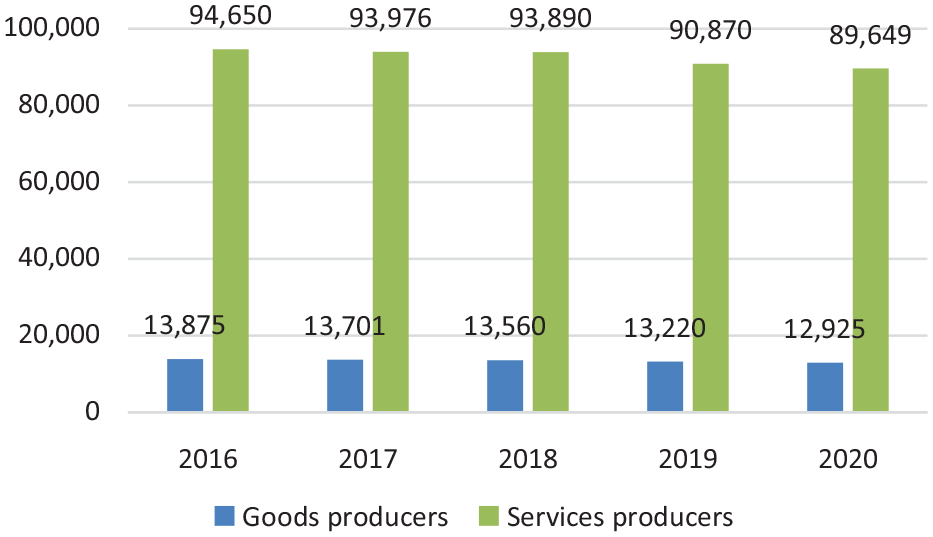
Number of enterprises.
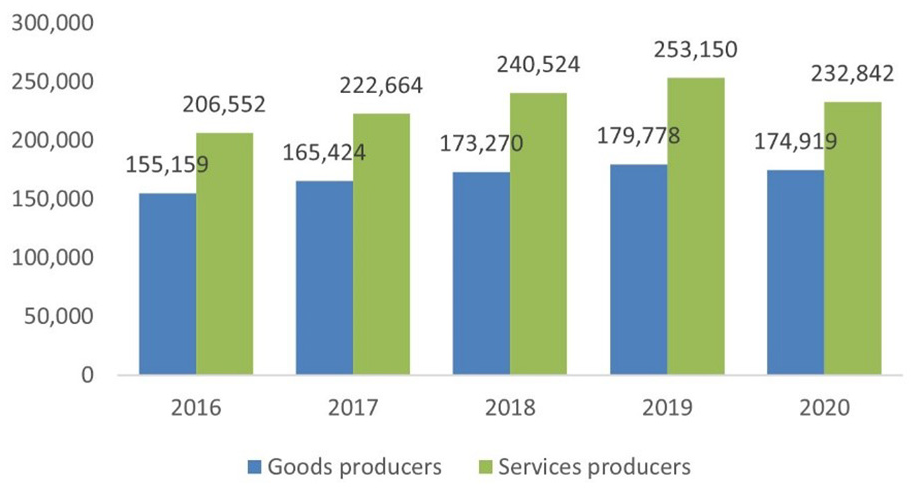
Annual average number of employees.
In Figure 3 we represent the distribution of enterprises by economic activity. The main economic activity in Albania as shown is trade. However, the number of registered enterprises in trade is decreasing by 0.9% if compared to 2019. During the same period there is a lower growth in the number of enterprises offering services.

Number of enterprises by economic activity.
During the period 2019 to 2020 due to the global pandemic lockdown of Covid-19 there is a decrease of 5.1% in 2020 in comparison to 2019, see Figure 4. The only sector representing a positive turnover growth by 0.5% is the construction sector (INSTAT, 2022). The primary characteristics of the pandemic influence on the construction sector include working style and behavioral changes, problems and hazards, and new directions for the sector in the post-pandemic future.
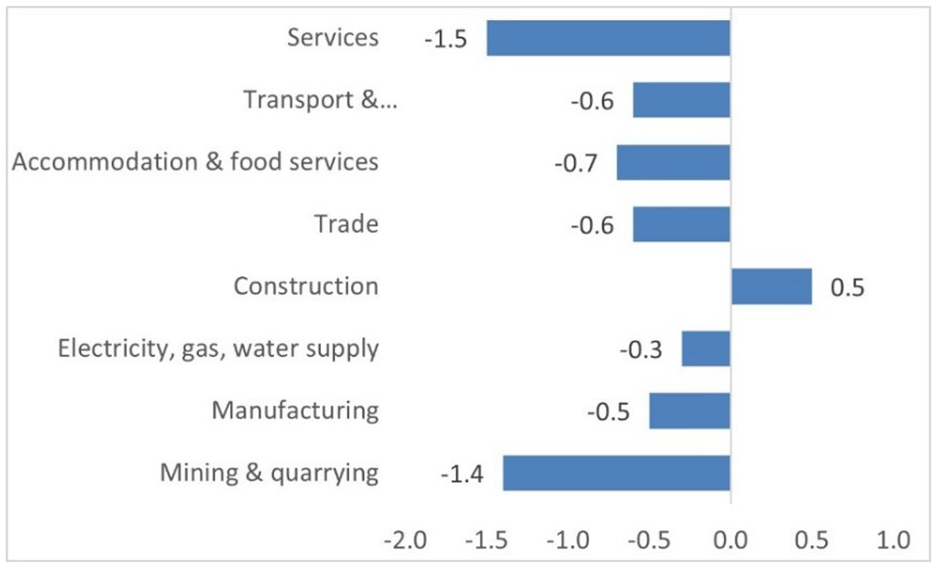
Contribution in the annual turnover growth, 2019–2020.
The main indicators in terms of number, employed, and investments divided by enterprise size are given in Table 1. According to INSTAT (2022), the largest number of enterprises are concentrated in the central part of the country, more precisely the municipality of Tirana, while the lowest number of enterprises is registered in the municipality of Pustec. Female-owned enterprises are 25.5%, with women leading mainly micro enterprises (1–4 employed). Most of foreign partners around 77.8% are from Greece and Italy in the foreign and joint enterprises.
Enterprises by Main Indicators, 2020.

Source. INSTAT, 2022.
Digitalization has been increasing within Albanian enterprises. During 2021 around 45% of enterprises have a website and use it generally to publish the catalog of products and services, but only 38.3& use it to receive orders and online booking (INSTAT, 2021). Moreover, 24.8% use customer relationship management software (CRM) to handle their clients (Figure 5).

Share of enterprises having a website by economic activity, 2021.
Data and Methodology
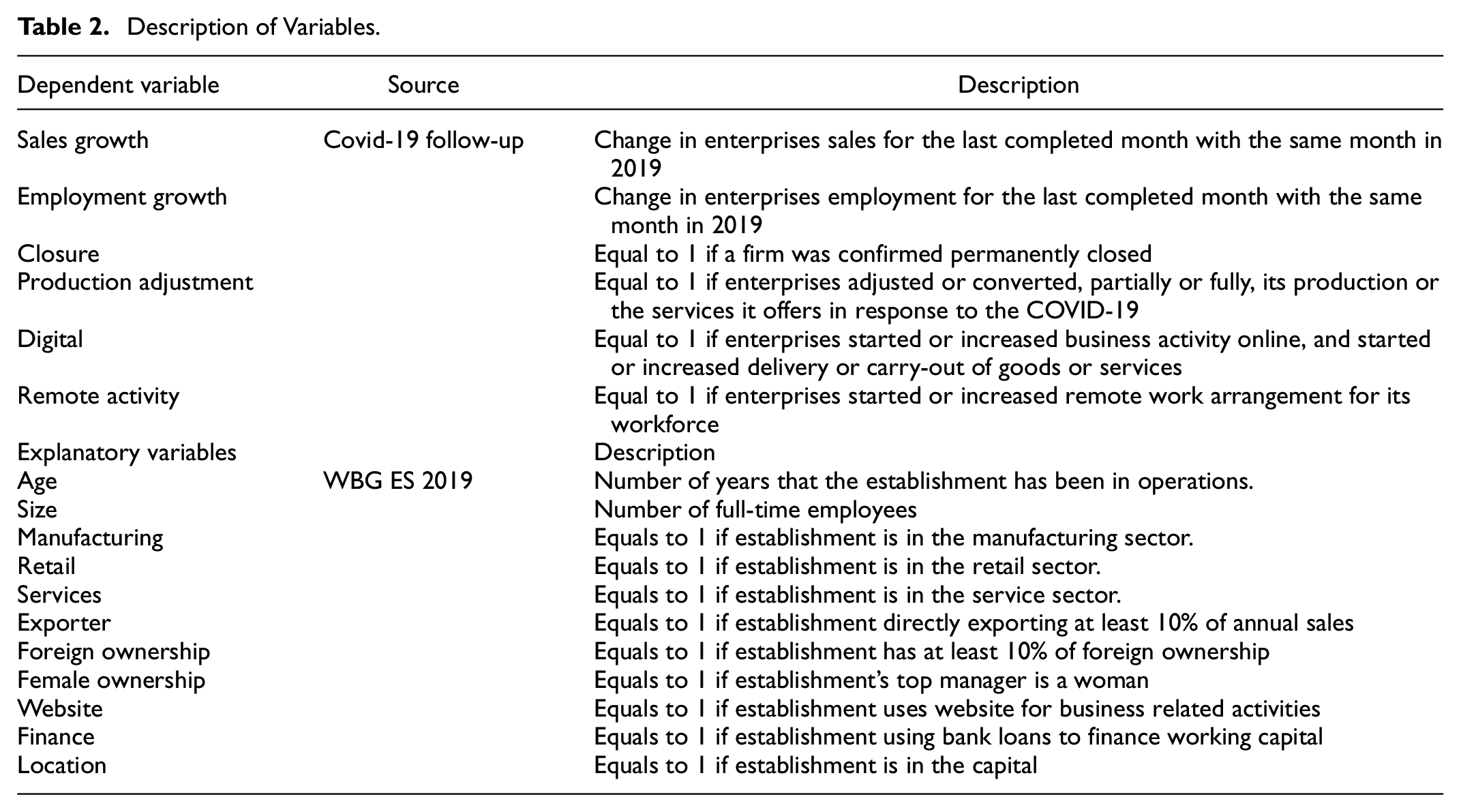
In this paper we use two different sources of data the World Bank Enterprise Survey of 2019 merged with the ES follow-up on Covid-19 for Albania. These short surveys follow the baseline ES of 2019 that contains 377 interviews conducted from January to May 2019 (World Bank (WB), 2019). This dataset is designed to provide information on the impact and adjustments that pandemic has brought for the re-interviewed enterprises. The data are collected in the period between June 5 to June 26, 2020. The target group is all registered establishments with five or more employees that are engaged in the following activities: manufacturing, construction sector, service sector, transport, storage, and communication sector, and information technology. The response rate is 92%, 344 enterprises (Table 2).
Description of Variables.
Our paper uses these specific questions to study digitalization of enterprises. ES questionnaires focus on the following questions: (a) Does the establishment have its own website? (b) Started or increased business activity online? (c) Started or increased remote work arrangement for its workforce? To investigate the impact of digitalization and give answer to our research questions we use the following model:

where:
Yi is one of the components of performance of the firms measured in terms of sales growth, employment growth, closure, and production adjustment.
Digital, Website and Remote are dummy variables to indicate the adoption of Internet or the usage of websites by enterprises,
Xi is vector of variables including: the size, age, status, foreign ownership, location, exporter, and female-ownership etc.
To compute the dependent variable sales growth, we follow Clarke et al (2015) and Gosavi (2017). To have a broader picture of the enterprise’s response during Covid-19 public crises we present some summary statistics (Figures 6, 7).

Sales changes by industry during Covid-19.
Following the responses from 344 enterprises for the Covid-19 follow-up survey we notice that the establishments experiencing sales growth are quite low. The highest percentage of sales growth is around 10% for the sector of services, this result in quite comprehensive.

Converted production/service in response of Covid-19.
Most enterprises converted their production/service activities in response to the pandemic crises of Covid-19. This reflects an evident propensity toward changes or flexibility of enterprises due to exogenous shocks. However, when it comes to the online work arrangements of the working force (Figure 8) and in general business activity online the percentage cannot be considered high, see Figure 9.

Remote work arrangement of working force during Covid-19.

Started or increased business activity online.
As we can notice from Figure 9 manufacturing sector represents the lower percentage of business activity online. Since the survey does not contain questions on reasons related to the low level of digitalization of enterprises we have to further investigate to better understand. Additionally, the lack of digitalization, complicated cash flow, the prevalence of labor-intensive methods, imported materials, and equipment may be considered as the primary causes for the weak resilience of the economy.
If we refer to INSTAT (2021) the share of employees using the computer for work purposes in general can be considered low since it is only 27.2%, and this figure is lower if compared to the previous year. The lowest share of employees using the computer during their business activity is in manufacturing activities with only 8.0% and construction activity with 16.2%. On the other side, computers are used to a greater level by employees of enterprises that perform in information and communication sectors by 75.5%, repair of computers and communication equipment by 73.7% and professional, scientific, and technical activities by 64.9%.
Empirical Results
Depending on the descriptive data on enterprises response during pandemic of Covid-19, we can notice a low level of digitalization. To realize if enterprises that included digitalization in their production/service activity obtained benefits in terms of performance, we run OLS regressions for discreet variables and Logit regressions for the dummy dependent variables.
The econometric results of the regression for employment growth are shown in Table 3. As we can notice from the coefficients, the only statistically significant are digitalization and remote activity. We can conclude that those enterprises that started or increased their business activity online, increased delivery of goods and services, experienced employments growth. Furthermore, websites have a positive but not statistically significant effect on employment growth. This may be related to the effectiveness of websites of enterprises and the way they reflect production/service activity. There is a positive relationship with the following variables: retail sector, exporter enterprises, female ownership, foreign ownership, and the access to finance.
Estimation of Regression Results on Employment Growth.

p < .01. **p < .05. *p < .1.
In Table 4 we represent Logit regression results on the probability to have sales growth during pandemic crises Covid-19. Yet digitalization positively affects sales growth, but the results do not persist when it comes to remote activity of the work force and existence of website. The coefficient is high meaning that enterprises starting or increasing their business activity online enhance the probability of having higher sales by around 1.23%. Foreign ownership is positively related to sales growth during pandemic crises. Sales growth is negatively affected by websites, remote activity, age, manufacturing sector, small and medium enterprises, exporter enterprises.
Estimation of Regression Results on Sales Growth.

p < .01. **p < .05. *p < .1.
According to the regression results of Table 5 we notice the positive effect of digitalization on the production adjustments. This variable is a dummy that takes value 1 if the enterprise adjusted or converted production/service activity during Covid-19. In this case, website has a positive effect but not statistically significant.
Estimation of Regression Results on Production Adjustments.

p < .1. **p < .05. ***p < .01.
According to the regression results only a few coefficients are statistically significant and further research is necessary. Enterprises having websites exhibit higher labor growth than others, and the result is statistically significant, but the magnitude is relatively low. The results are not statistically significant when it comes to sales growth and production adjustments.
Female ownership of enterprises does not mean statistically higher sales or labor growth. However, coefficients have positive signs meaning that there is space for further analyses. These findings are in line with other gender studies in Albania (Kalaj & Merko, 2020). Interesting is the fact that enterprises involved in export activities and foreign ownership increases the propensity to higher economic performance.
Conclusion
This paper is focused on the analyses of the role of digitalization of Albanian enterprises during the pandemic crises of Covid-19. Digitalization is measured as a proxy of business activity online, delivery or carry-on of products or services. To give answer to the research questions, the study relies on two different sources of data the World Bank Enterprise Survey of 2019 merged with the ES follow-up on Covid-19 for Albania. These data are collected in the period between June 5 to June 26, 2020.
In our study enterprises’ performance is measured in terms of employment growth, sales growth, production adjustments, and permanent closure. Since the percentage of permanently closed enterprises in sample is very low, our empirical interpretations are concentrated in the first three variables. Empirical results show that digitalization affects enterprise performance in a statistically significant way. The effect is positive and statistically significant when it comes to sales growth, employment growth and production adjustments in response to Covid-19 pandemic crises. However, in the study we used three different variables as proxy for enterprises digitalization such as the increased business activity online, website existence, remote work force activity.
Finding show that only the business activity has a significant impact on performance improvements of Albanian enterprises. We cannot conclude on the effect of the other two variables such as website and remote working activity since the coefficients are not statistically significant. If compared to other sectors, manufacturing-sector enterprises are less likely to use digital technology in their business activity if compared to the other sector. The manufacturing sector in Albania will undoubtedly be profoundly impacted by the digital transformation. If Albanian companies in the processing sector have undergone sufficient digitalization and are prepared to fully adopt Industry 4.0 principles in the installation of digital solutions throughout all value-chain creation segments, more research is required.
This study contributes to the recently growing literature of digitalization during the pandemic crises related to the effect it might have on enterprises performance. It provides a useful frame for the policy formulation on how to help enterprises on their way toward digitalization. Still, additional research is needed to better understand what consists of online business activity and if enterprises intend to expand their digitalization process in the future regardless of pandemic shocks.
Footnotes
Declaration of Conflicting Interests
The author declared no potential conflicts of interest with respect to the research, authorship, and/or publication of this article.
Funding
The author received no financial support for the research, authorship, and/or publication of this article.

Data Availability Statement
Data sharing not applicable to this article as no datasets were generated or analyzed during the current study.