




Abstract
This paper empirically investigates whether Chinese language learning opportunities abroad have exerted a positive effect on international student mobility (ISM) to China. We utilize both official and self-compiled panel data for 182 countries, spanning a period of 15 years. We use the establishment of Confucius Institutes as an indicator of Chinese language learning opportunities. As our benchmark regressions, we employ fixed effects models with both linear and nonlinear regressors. Our findings provide support for a significant positive impact of language learning opportunities on ISM, with evidence suggesting a diminishing marginal effect. This result is seldom documented in the existing literature. We verify the robustness of our findings in three ways. First, we assess whether the number of international students changes significantly before the exposure to Chinese language learning opportunities. Next, we examine if our main findings remain consistent when controlling for region-specific trends. Finally, we test the robustness of our main results against various changes in the estimation sample. We also find evidence of effect heterogeneity based on countries’ geographic distance to China, the linguistic distance from their official language to Chinese, and their income levels. This paper argues that exposure to the destination country’s language and culture is a critical determinant of students’ decisions to study abroad in that country.
Keywords
Introduction
International student mobility (ISM) is defined as the mobility of individuals who expressly move overseas to study. The phenomenon of ISM has gained significant attention within the framework of globalization, internationalization, and transnationalism. Theories explaining ISM are mostly borrowed from the migration field, the push-pull theory in particular. The push-pull theory originates from Ravenstein’s study on population migration, where he classifies migration factors into push and pull categories (Ravenstein, 1885). Bogue (1958) later proposed the push-pull framework, incorporating external factors. Nearly a decade afterward, Lee (1966) systematically categorized the push-pull theory into four areas: external factors related to origin and destination, intervening obstacles, and personal factors. This framework has since been widely used to analyze the factors and mechanisms influencing population migration. Cummings (1984) was among the first scholars to apply the push-pull theory to ISM, proposing additional push-pull factors specific to ISM. Following this, McMahon (1992) examined push-pull factors for 18 international students in the United States (US). Altbach (1998) further expanded the theory, viewing ISM as the result of both push and pull factors. Soutar and Turner (2002) studied 1,485 Asian students in Australia, detailing the specific contents of these factors. Consequently, the push-pull theory has become a fundamental tool in ISM analysis.
The push-pull theory is traditionally used to analyze the push factors in developing countries and the pull factors in developed countries. With the rise of emerging countries like China, ISM inflows to developing countries have grown rapidly. However, the application of push-pull theory to explain ISM to developing countries remains rare. In the context of ISM to emerging economies, push factors from other countries may include the high cost or low opportunity of higher education, GDP per capita, political environment, and availability of scholarships abroad. Conversely, pull factors might encompass lower education costs or scholarships for foreign students, a quality education system, a favorable socio-economic environment, and opportunities to experience different cultures. In this study, we aim to contribute to the literature on ISM by examining a potential pull factor in emerging economies hosting international students, that is, language and culture learning opportunities. Specifically, we propose the following hypotheses:
H1: The number of CIs in a country has a positive effect on ISM from that country to China.
H2: The effect is heterogeneous depending on countries’ geographic distance to China, the linguistic distance from their official language to Chinese, and their income levels.
The determinants of ISM to emerging countries are multifaceted, involving a complex interplay of rational and emotional factors, socio-economic backgrounds, and academic aspirations. In the process of deciding to study abroad, students’ choices are often influenced by a combination of logical and emotional elements. This interplay, termed as the “rationality-emotion nexus,” is essential to understanding their preference for studying (D. B. Wu & Hou, 2024). It includes striving for intellectual growth, enhanced social and spatial mobility, and extensive cross-regional and international interactions (Lo et al., 2023). Additionally, there is a noticeable shift from focusing solely on academic growth to incorporating non-academic factors. These factors range from gaining international work experience and seeking better job prospects to improving quality of life, fulfilling aspirations of settling and gaining citizenship, and elevating social status or mobility (X. Wu & Tao, 2024). The impact of socio-economic background on a student’s ability to study abroad cannot be overlooked (Y. Yue et al., 2024). Financial challenges often restrict the movement of students, indicating that disparities in international mobility are deeply rooted in social inequities (Glass et al., 2021). For students from developed countries with expensive higher education systems, studying in an emerging country with a quality education system can alleviate the burden of heavy student debt (Yu et al., 2022). Furthermore, there are observable gender and geographical disparities in aspirations and capabilities for international mobility. Students from more affluent regions or “intellectual hubs” have access to superior resources and information to support their international studies compared to their counterparts from less developed intellectual peripheries (C. Yue et al., 2024; Zhai & Moskal, 2022). Huang et al. (2023) is one of the most recent empirical studies examining the determinants of ISM from different levels, where they find push and pull factors work differently for global, Asian-outward, and intra-Asian mobilities. Based on the complexities influencing ISM, we therefore further propose:
H3: The number of CIs in a country has a nonlinear effect on ISM from that country to China.
In this study, we adopt the push-pull theory and assess whether language learning opportunities act as an influential pull factor in emerging countries. The diversity of cultures in developing countries could be one source of pull factors. Therefore, exposure to developing countries’ language and culture learning opportunities could stimulate individuals’ desire to move to those countries to study. We aim to contribute to the push-pull theory in ISM analysis by highlighting the unique pull factor: language and culture learning opportunities. We explore how the pull factor functions differently in the context of ISM to emerging economies compared to developed countries. Our study offers new perspectives on how emerging economies attract international students. Concretely, we investigate the effect of Chinese language learning opportunities, represented by the number of Confucius Institutes (CIs) in a country, on ISM inflow in China. Language learning, specifically the opportunity to learn Chinese, emerges as a significant motivator for international students choosing China. The desire to acquire linguistic and cultural capital by learning Chinese is often intertwined with students’ broader academic and professional goals. This trend is aligned with the global economic relevance of China and the increasing importance of Chinese language skills in the international job market. The language component not only enriches students’ educational experience but also enhances their employability and cultural adaptability in a globalized world.
Since China’s “Going Out Policy,” CIs have been seen as the “brightest brand” in its soft power repertoire (Zhou & Luk, 2016). The Confucius Institute serves as a pivotal institution in China’s cultural diplomacy, aimed at promoting the exchange of language, ideas, and cultural elements. Cultural diplomacy fosters a deeper understanding of a nation’s concepts and institutions among foreign populations, which can ultimately support broader objectives, including economic goals (Maack, 2001). Arndt (2005) emphasizes that cultural interactions—such as student exchanges, trade, and tourism—can develop naturally and organically, with cultural diplomacy guiding and shaping these processes to advance national interests.
Research has shown that opening a CI improves how China is presented in that locality (Brazys & Dukalskis, 2019). Whether this effective grassroots image management approach helped attract young people from the CI operating countries is unclear. A body of literature examines language institutes, defined as institutions that provide language and cultural education, including subsets such as British Council Institutes, Goethe Institutes, Cervantes Institutes, and CIs (Akhtaruzzaman et al., 2017; Ghosh et al., 2017; Huber & Uebelmesser, 2023; Lien et al., 2012, 2014, 2017, 2019; Lien & Co, 2013; Lien & Lo, 2017; Lien & Oh, 2014; Wei et al., 2019). Another strand of literature has investigated the determinants of ISM (Berman et al., 2003; Chiswick & Miller, 1995; Collins, 2008; Dustmann & Fabbri, 2003; Dustmann & Soest, 2001; Findlay, 2011; Hwang et al., 2010; Rodríguez González et al., 2011; Roy et al., 2019; Wei et al., 2019). However, studies on the impact of language institutes on ISM are rare.
The recent US-China trade war, the COVID-19 pandemic, and the Russia-Ukraine war substantially pushed many universities to engage in virtual learning activities. Due to the unforeseen and exogenous nature of those events and the data availability of the different types of international students in China from all over the world, this study focuses on the pre-US-China trade war era. Specifically, the main analysis covers the period from 2004, when the first CI was established, to 2016. Additionally, the period from 2002 to 2016 is considered when we include lags of certain variables in the model.
The remainder of this paper is structured as follows. The second section describes the data and estimation strategy. The third section presents our main results and reports several robustness checks. The fourth section provides analyses that explore potential effects of heterogeneity. The last section concludes.
Data and Empirical Strategy
We use three main data sources. The first data extract consists of annual statistics on country-level international students in China from 2002 to 2016. It contains information on their numbers by type of stay (long-term or short-term study) and country of origin, which are extracted from China’s Foreign Affairs (2003−2017). The data contain information on: (i) the total number of international students in China and their numbers by country of origin, (ii) the number of international students in China for long-term study and their numbers by country of origin, and (iii) the number of international students in China for short-term study and their numbers by country of origin.
The second data source contains information from 2002 to 2016 on the number of CIs abroad by country. We self-compiled these data from the official webpage of Hanban. See Appendix B for more information. Hanban records information on the location of a CI and when it opened. At the country level, data extracts contain information on the total number of institutes in a country at the end of a year in the sampling period 2002 to 2016.
The third from the World Bank and the National Bureau of Statistics of China provides information on demographic and economic characteristics of international students’ countries of origin which could influence the outflow of students to China and the establishment of a CI. These include gross domestic product (GDP) per capita, total population, population aged 15 to 34, and exports to and imports from China.
As shown in Figures 1 and 2, countries with a larger number of institutes per capita tend to send more students to China. Whether opening CIs has contributed to the increasing number of international students, however, is unclear.
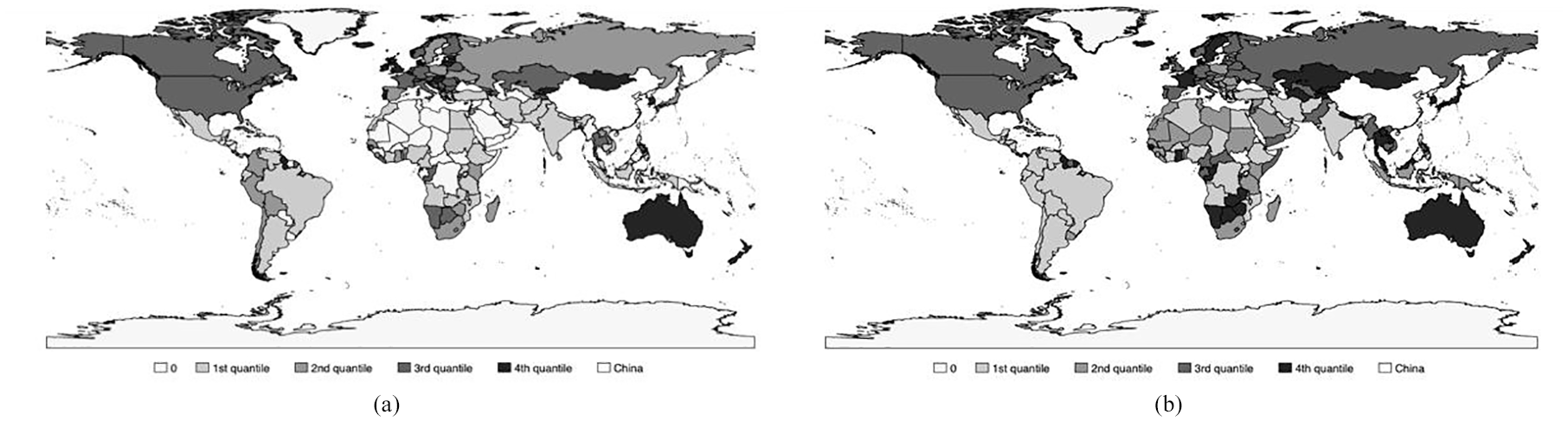
The number of CIs abroad and international students in China in 2016 per 1 million population aged 15 to 34: (a) standardized number of CIs and (b) standardized number of international students.

International students in China and CIs abroad, 2002 to 2016.
Variables
Dependent variables: the number of international students (in total and for long- and short-term study) in China per 1,000,000 population aged 15 to 34 in the country of origin. We only exploit the population aged between 15 and 34 to calculate the population share of international students because they are more likely than people in other age groups to migrate to China to study.
Main independent variable: number of CIs per 1,000,000 population aged 15 to 34 of the host country. The main independent variable in our analysis is an indicator of Chinese learning opportunities abroad, that is, the number of CIs in a country. It is a stock measure taken on the last day per annum in the period 2002 to 2016. We also standardize this measure per 1,000,000 population in the host country aged 15 to 34.
Other covariates: In addition to our main explanatory variable, we control for potential confounders that may influence both the number of international students in China and the establishment of CIs abroad. We consider two types of control variables. First, we employ the logarithm of GDP per capita (in US dollars) of the country of origin of international students as an indicator of its economic condition. Second, we use the logarithms of exports to and imports from China as indicators of the importance of China as a trade partner for a country.
Empirical Strategy
We estimate the following fixed effects model to study the effects of Chinese learning opportunities abroad, as measured by the number of CIs per 1 million capita, on the number of international students in China:


where
The two-way fixed effects model is particularly suitable as a baseline econometric approach for our research, as it effectively controls for both time-invariant and country-invariant unobserved heterogeneity. This is crucial for examining the impact of CIs on ISM. One significant advantage of this model in ISM studies is its ability to mitigate omitted variable bias by controlling for unobserved heterogeneity that may correlate with explanatory variables, ensuring that our findings are not driven by confounding factors. Additionally, the fixed effects approach aligns well with our unbalanced short panel dataset with more countries than years, where within estimators perform effectively. However, it is important to acknowledge the limitation that it does not account for time-varying unobserved factors, which could still influence our results. Despite this limitation, the fixed effects model remains the most appropriate choice given our dataset and research objectives.
Our estimation sample comprises 2,601 observations for 182 countries over 15 years, meaning we dropped 129 (182 * 15 − 2,601) observations with very little country-specific data for those years, about 4.7% of our sample. With a power analysis for a two-sample means test, we use students from countries without CIs as the reference group and students from countries with at least one CI as the comparison group. Our analysis indicates that our estimation sample size is sufficient to ensure the statistical power of our findings. Due to a lack of data on international students in China before 2002, our observation period starts in 2002, two years before the establishment of the first CI. Therefore, in our observation period (2002–2016), all countries recorded some years when they had not yet hosted a CI. We exclude Hong Kong, Macao, and Taiwan from our estimation sample since it is much easier for people from these entities to learn Chinese (Mandarin), and China also considers these entities as an integral part of the People’s Republic of China. Our final estimation sample consists of 2,601 country-year observations for 182 countries in the period 2002 to 2016. Table A.1 in the Appendix lists all countries and years covered in our estimation sample. Table A.2 documents the numbers of countries by the number of CIs they had (ranging from 0 to 112) at the end of the observation period (in 2016). Thirty-three percent of the countries had no institute, and 34% only had one. Countries with 10 or more institutes account for 6.6% of all countries. Table 1 below provides summary statistics for our estimation sample.
Summary Statistics for the Estimation Sample.
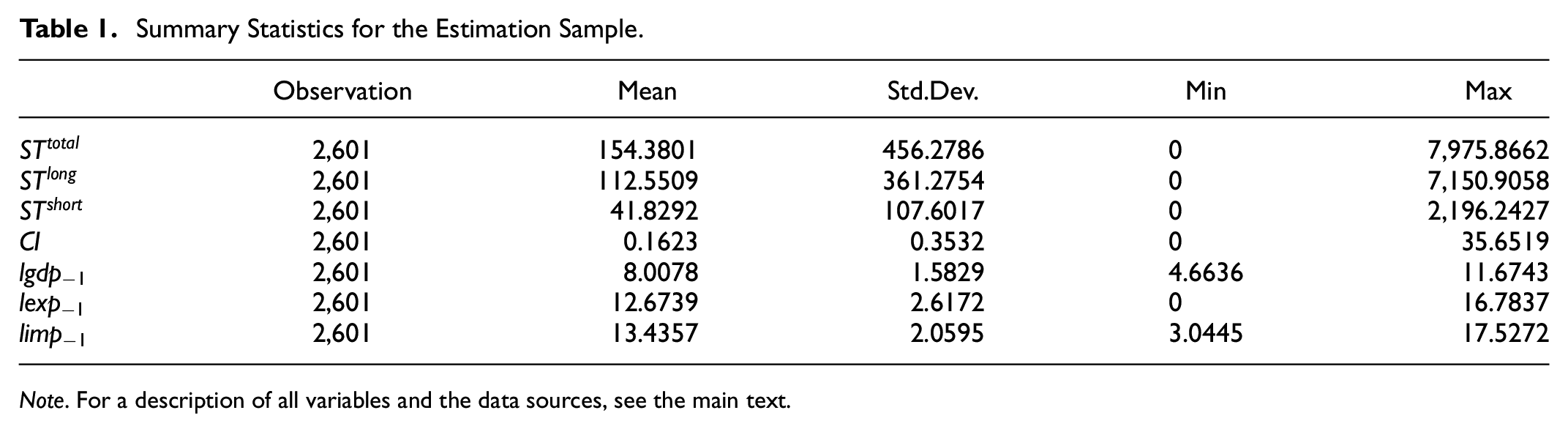
Note. For a description of all variables and the data sources, see the main text.
The identification of our empirical model relies on the assumption that the placement of CIs in various countries is exogenous. There are two primary concerns related to endogeneity. The first is potential reverse causality, where the number of international students could influence the establishment of CIs. However, the data on the number of CIs reflects their official openings, with agreements typically signed several months prior to their operation. As a result, decisions regarding the establishment of CIs are likely made before considering the current number of international students, which mitigates the reverse causality issue. To further address this concern, we conduct a robustness check using the lagged value of CIs in the regression model presented in the section of main results. Additionally, there is no theoretical foundation or convincing argument for a delayed effect of CIs on student numbers. Therefore, we use the contemporaneous value of CIs in the main analysis.
Second, it is essential to acknowledge that the decision to establish a CI may be influenced by various factors, such as the country’s diplomatic relations with China, existing educational collaborations, and the demand for Chinese language and culture education. These factors must be accounted for to ensure the validity of our model and accurately assess the impact of CIs on ISM. Lien and Oh (2014) argue that GDP, population size, geographical distance to China, and English as a major spoken language are the most important determinants for the establishment of a CI. Furthermore, trade and/or FDI and developing country status are shown to have positive, respectively negative, effects on CI openings. Geographic distance, the usage of English in a country, and developing country status are almost constant over time for countries in our observation period and are hence controlled for by the country-fixed effects in our empirical model. Moreover, as we standardize our outcome variables and the main independent variable by population and use GDP and trade measures as covariates in our regression models, we effectively control for the most important factors suggested by Lien and Oh (2014) that determine the opening of CIs. Importantly, these factors are also influence the international mobility of students, as suggested by Rodríguez González et al. (2011).
The number of scholarships provided by the Chinese government to international students, student exchange programs, and international education partnerships may rise over time. If positive changes in such factors are correlated with the evolution of CIs, we may overestimate the effect of CIs on international students. However, the grant of Chinese government scholarships to international students in China is a fair process. One of the most important determinants is the study proposal or study plan of students. Therefore, all international students have the chance to apply for these scholarships and the decision to issue the scholarship is not correlated with the nationality of students. The aggregate trend in the student exchange programs and international education partnership can be controlled for by the year-fixed effects. Nevertheless, such programs may be organized more often between China and some specific countries. To overcome this possible endogeneity issue, we add region-specific trends to the empirical model. Detailed discussion is provided in the section of robustness check.
Results
We first present and discuss our main results in this section. We then discuss potential confounders that may influence the number of international students and CIs and provide several robustness checks.
Main Results
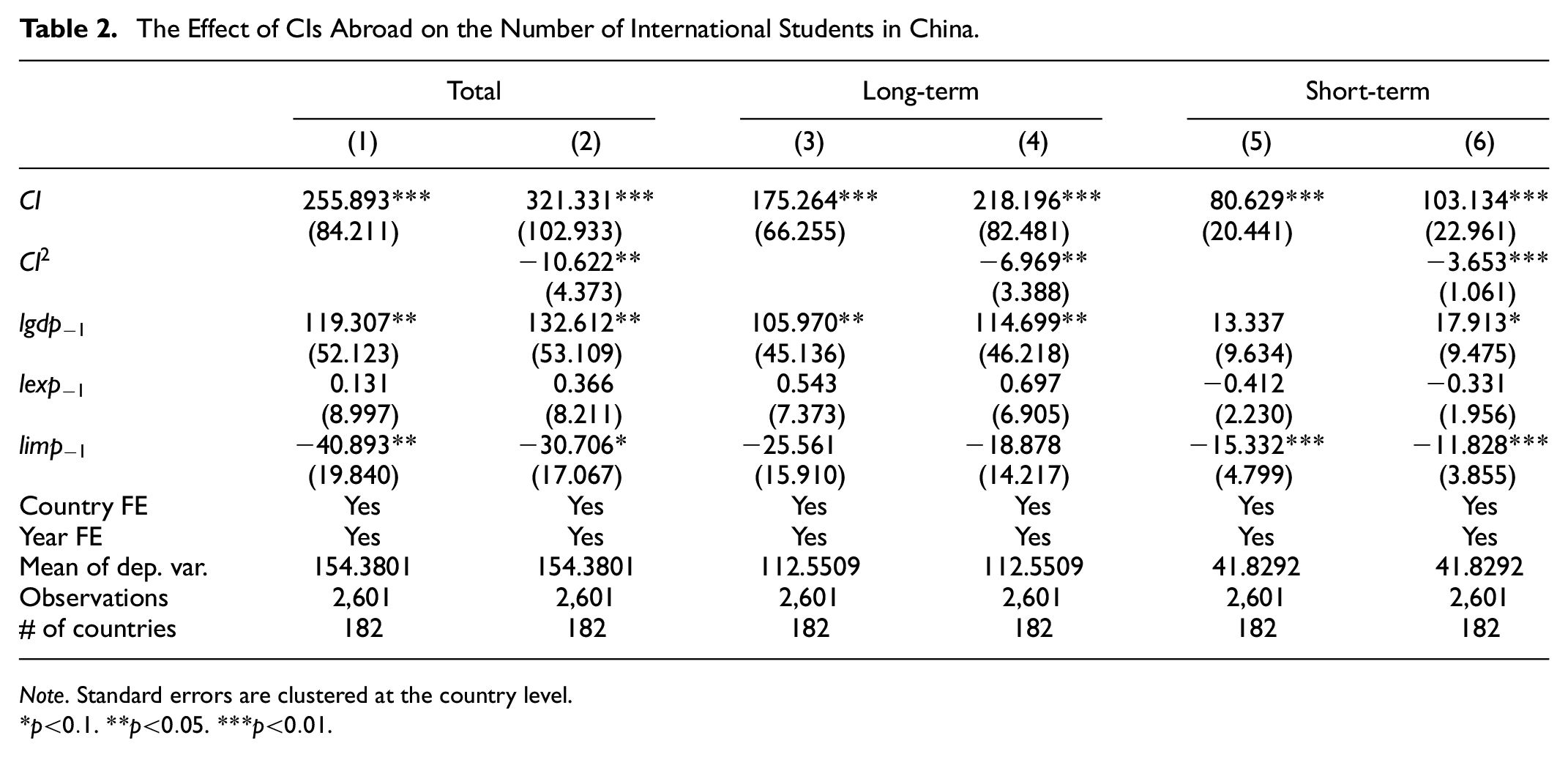
We estimate Equations (1) and (2) for three outcomes (total international students, long- and short-term international students) using a fixed-effects regression model. Table 2 presents the estimation results. Columns (1), (3), and (5) in Table 2 present the regression results for Equation 1, while columns (2), (4), and (6) display the regression results for equation (2). The coefficient on the core independent variable CI is statistically significant at the one per cent significance level and has the expected positive sign for all three outcomes.
The Effect of CIs Abroad on the Number of International Students in China.
Note. Standard errors are clustered at the country level.
If the number of CIs increases by 1, equivalent to an average increase of 0.1001 institutes per 1 million population aged 15 to 34, the total number of international students per 1 million population aged 15 to 34 rises by about 25.6 (=0.1001 × 255.893), which is about 16.6% of its mean value in the observation period. Similarly, an increase in the number of CIs by 1 leads to a rise in the number of long-term international students by 15.6% and a rise in the number of short-term ones by 19.3% relative to their respective means. Since long-term studies require more enthusiasm and dedication to learn the Chinese language and culture than short-term studies, the smaller effect of CIs on long-term students is not surprising.
When controlling for non-linear effects, the magnitude of the immediate effects slightly increases. Specifically, a one-unit increase in the number of CIs per 1 million population aged 15 to 34 results in an increase of about 32 in total ISM per 1 million population aged 15 to 34, with 22 for long-term students and 10 for short-term students. These increases represent approximately 20%, 22%, and 24% of the mean values for total, long-term, and short-term ISM during the observation period, respectively. The negative and significant coefficients of the quadratic terms indicate a diminishing marginal effect of CIs on ISM. This implies that while the initial impact of adding CIs is positive, the effect diminishes as the number of CIs increases, and beyond a certain point, adding more CIs may even reduce ISM.
Figure 3 displays an inverted U-shape representing the predicted values of ISM at different levels of increased CIs, with vertical bars indicating the 95% confidence intervals. As shown in the figure, the predicted total ISM increases as the number of CIs rises from 0 to around 10. However, after reaching a peak at 15 CIs, the predicted total ISM begins to decline. This suggests that beyond a certain point, adding more CIs does not contribute to an increase in ISM and may even have a negative effect, possibly due to diminishing returns or other contextual factors not captured by the model.
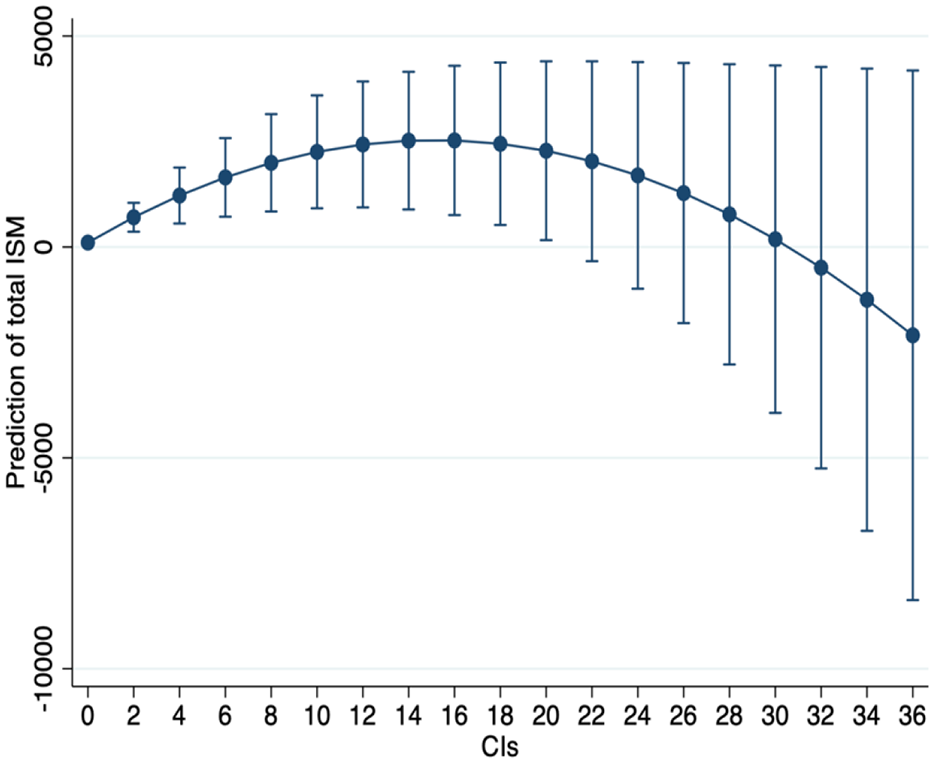
Diminishing marginal effects of CIs on ISM.
GDP per capita shows a significant positive effect on total and long-term international students, which implies that countries with better economic conditions tend to send more people to China to study, especially for the longer term. The effects of exports to and imports from China exert a significant negative effect in some specifications, which seems odd at first glance. However, in all specifications, we also controlled for GDP as an indicator of overall economic conditions. Our model uses GDP, exports to China, and imports from China as covariates, raising potential concerns about multicollinearity. We conducted Variance Inflation Factor (VIF) tests for our main linear specifications, which revealed an average VIF of 6.69. However, the VIF for the “imports from China” variable is 17 due to its high correlation with the GDP and export variables. Excluding the import variable reduces all VIF values to below 10, while the coefficient for the number of institutes remains positive and statistically significant. Despite this, the “imports from China” variable is essential because it represents economic communication between China and the CI-hosting countries, especially those where imports from China constitute a significant portion of GDP. Confucius Institutes (CIs) are more likely to be established in countries with strong economic ties to China, and students from these countries are more likely to study in China. Therefore, we retain the import variable in our model for subsequent analysis.
The results shown in Table 2 suggest a positive average marginal effect of opening CIs on international students in China from 2002 to 2016. However, we should interpret these results with caution. First, there is no theory (or compelling argument) to support an exclusively delayed effect of CIs on students. Indeed, it is possible that students who acquire at least some knowledge of Chinese immediately go to China to study, especially short-term. According to the definitions of long- and short-term studies, joining a 1-year exchange program in a Chinese university is classified as long-term study and the demand for Chinese language skills may not be high, especially when courses at the Chinese university are given partly in English. Therefore, learning just a little Chinese in the home country may prompt students to go immediately to China to study. Nonetheless, a delayed effect may occur if students have mastered a high level of Chinese through long-time study at a CI and decide to go to China to study afterward. In this case, an additional CI may start to influence the number of students only 1 or several years after the opening. Second, no information on the size (capacity) of CIs is available, such as the number of courses or teachers. The marginal effect of opening a CI could also rise over time if more learning opportunities are provided by an institute as time progresses. To gage the relevance of these two arguments, we regress
Our results align with the theoretical framework that pull factors operate differently for developed and developing countries. In developed countries, where English is commonly used in universities and opportunities to learn English are widely available, language and culture learning opportunities are not strong pull factors. Conversely, in emerging and developing countries, where such opportunities are less abundant, enhanced language and culture learning opportunities can serve as significant pull factors, attracting students to the host countries. Our empirical study supports this theory.
In our model, we standardize both the number of students and institutes by annual population. It is therefore possible that the number of institutes (or students) does not change but that the population share of institutes (or students) does change when the population of a country varies over time. Although population changes should be minor, we checked whether our results are sensitive to population changes. To do this, we standardized the number of institutes and students by the 2002 population aged 15 to 34 of a country so that changes in both ratios only originate from variations in the number of institutes and students (see Table A.4). In the following analyses, we use the specifications in equation (1) as the baseline and estimate the population-average effects of the number of CIs abroad on the number of international students in China by weighting the regressions by country populations.
Robustness Checks
In our main analysis, we use a fixed effects model to control for country-specific time-invariant observable and unobservable factors. However, country and time-fixed effects will not suffice for identification in the presence of spatial variation in unobservables that confound the relationship between CIs and international student numbers across countries and time.
Below, we address such causality issues in several ways. First, we check whether the number of international students changes significantly before the opening of CIs. Then we examine whether our main findings still apply if we control for region-specific trends. In addition, we check the robustness of our main results to various changes in the estimation sample.
Number of International Students Before the Opening of a CI
As discussed in the previous section, the most important determinants of CI establishment suggested by Lien and Oh (2014) are already considered in our baseline fixed effects model. However, it is still possible that our findings suffer from bias because of anticipation effects (of closer foreign-country-China ties) or unobserved pre-trends in the demand for international study in China that correlate with (or influence outright) the opening of a CI.
To gauge the importance of such a threat to identification, we check whether the number of international students changes systematically before the establishment of CIs. For this purpose, we construct a series of dummy variables,
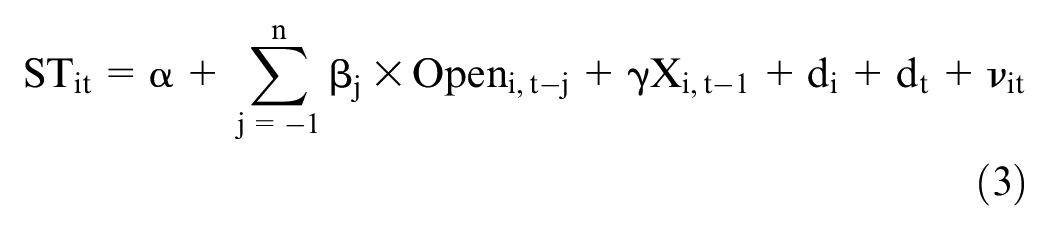
where
We are interested in the
Estimation results for equation (3) are shown in Table 3. The estimated coefficient on the lead variable
Number of ISM in China Before and After the Opening of a CI.

Note. Standard errors are clustered at the country level.
We also re-did the analysis, dropping countries from the estimation sample with no CIs during the observation period to have a more homogeneous set of countries in terms of Chinese language learning opportunities (i.e., countries that are ever treated). We also checked whether the decision to open a CI (which may predate the actual opening by more than 1 year) is influenced by systematic changes in international student numbers 1 to 2 years prior to the establishment of a CI. The results are similar (see Table A.5).
Region-Specific Trends and Nonlinear Effect
The opening of CIs across countries may correlate with region-specific trends in international student numbers in China if the expansion of trade or cultural ties (such as student exchange programs and international education partnerships) with China evolved differently across time in different parts of the world. To gauge the importance of such potentially confounding influences on our baseline results, we re-estimated our specifications for international student numbers in China (total, long- and short-term study), now also controlling for linear or linear-quadratic region-specific trends.
We then classify countries into 22 regions according to their geographic location. The results in Table 4 show that the number of CIs abroad still exerts a statistically significant positive effect on the number of international students in China. Considering specific trends by regions, classified by geographic locations alone, however, may ignore important economic differences between countries in such areas.
The Effect of CIs Abroad on the Number of International Students in China When Controlling for Region-Specific Trends (Linear and Non-linear).

Note. Standard errors are clustered at the country level.
Therefore, based on their geographic locations and income levels, we construct a second regional classification consisting 51 groups of high-, upper-middle-, lower-middle- and low-income countries in different parts of the world. Again, we find a significant positive effect of the number of CIs on the number of international students.
Changes in the Estimation Sample
We check the robustness of our findings by making various changes to the estimation sample to create a more homogeneous set of countries, allowing us to gauge the representativeness of our results and the influence of potentially outlying observations. First, we exclude countries with the most Confucius Institutes (top 5%) during the observation period. Second, we remove countries with no Confucius Institutes during the observation period. Finally, we exclude countries with no international students in China during the observation period. We use our baseline specification for these robustness checks. Table A.6 in the Appendix presents the estimation results for the three restricted samples.
First, we exclude countries with the most Confucius Institutes. As of the end of 2016, 10 countries (top 5%) had at least 12 institutes (see Table A.2 in the Appendix). These include Australia, Canada, Germany, France, the UK, Japan, South Korea, Russia, Thailand, and the US. Excluding these 10 countries, we still find a statistically significant, sizable positive effect of the number of Confucius Institutes abroad on the number of international students in China (see columns (1)–(3) of Table A.6). Second, we remove countries with no Confucius Institutes during the entire observation period. In our original sample, 60 countries never opened a Confucius Institute (see Table A.2) but had some international students in China. As shown in columns (4) to (6) of Table A.6, the mean number of international students in countries with Confucius Institutes during the observation period is larger than in the full sample. Countries with Confucius Institutes, on average, have more international students than those without. The size and statistical significance of the estimated effects of Confucius Institutes on our three student outcome measures for this restricted sample are similar to our main results in Table 2.
Finally, we exclude countries with no international students in China during the observation period. The estimation results are shown in columns (7) to (9) of Table A.6. By construction, the mean values of the dependent variables (the number of international students) in this restricted sample exceed those in the full sample. Nineteen countries in the original full sample have no international students. Dropping these countries, we still find a statistically significant positive effect of the number of Confucius Institutes on the number of international students in China (both for long- and short-term study).
Effect Heterogeneity
In this section, we investigate potential effect heterogeneity. For this purpose, we modify equation (1) by adding interaction terms between CI and indicator variables for certain country features. We first explore potential effect heterogeneity between Asian and non-Asian countries. For Asian countries, we also check for differential effects related to the geographic areas, linguistic distance, and cultural distance. We then consider effect heterogeneity by country income level. Additionally, we investigate whether countries with a large population of Chinese migrants are affected differently by the opening of a CI than countries with few Chinese residents.
Asian and Non-Asian Countries
Geographical proximity implies that the travel costs from home countries are, on average, lower. Opening a CI in an Asian country may, therefore, have a larger effect on the number of international students studying in China. We test for such effect heterogeneity by interacting CI with the indicator variable Asian, which equals 1 if a country is an Asian country and 0 otherwise. There are 45 Asian and 137 non-Asian countries in our sample.
Table 5 shows the regression results for our three student outcome measures. As is evident, CIs exert a statistically significant positive effect on all three international student counts, both in Asian and non-Asian countries, but the effect is statistically significantly larger in magnitude in the former than in the latter. We provide a graphical representation in Figure 4a to illustrate the variation in the effect between Asian and non-Asian countries.
Effect Heterogeneity: Asian and Non-Asian Countries.

Note. Standard errors are clustered at the country level.

The effect of CIs on total ISM by groups: (a) marginal effect by group Asian and (b) marginal effect by group Income.
Among Asian countries, significant diversity may exist across various aspects. Therefore, we examine whether geographic location, linguistic distance, and cultural distance influence the relationship between the number of international students and the number of Confucius Institutes.
We classify Asian countries into five groups: Central Asia, Eastern Asia, South-Eastern Asia, Southern Asia, and Western Asia. We then add interaction terms between the number of CIs and the dummy variables for the five Asian regions to the baseline model. The results, shown in Table A.7, suggest that compared to non-Asian countries, the relationship between the number of international students and the number of CIs is much stronger for Central Asian, Eastern Asian, and South-Eastern Asian countries. These findings further indicate that student flows from countries closer to China are more likely to be influenced by the establishment of CIs.
Language is generally regarded as the carrier of human culture. If the linguistic distance, that is, dissimilarity between languages, is smaller between countries, it is easier for their populations to learn the other’s language and culture. Previous research has produced evidence that linguistic distance has a negative effect on international migration flows (Adserà & Pytliková, 2015; Belot & Hatton, 2012) as well as bilateral trade volumes (Hutchinson, 2005; Isphording & Otten, 2013). If a country’s language has the same roots as Chinese, it is much easier for people from that country to learn Chinese, and their probability of going to China for study is, therefore, likely to be higher. The effect of CIs on the number of international students from countries with close linguistic distance to Chinese may be larger than for other countries. Chinese is a member of the Sino-Tibetan language family. One of the official languages of Singapore is Chinese, and many Singapore residents are ethnic Chinese. The official languages of Bhutan and Myanmar also belong to the Sino-Tibetan language family. We generate a dummy variable for these three countries, Sino-Tibetan, and add, in addition to the interaction between CI and Asian, a triple interaction of CI, Asian, and Sino-Tibetan to our set of controls. The coefficient on this triple interaction term captures the differential effect of CIs by the linguistic closeness of CI-host countries in Asia. The estimation results are shown in Table A.8. For the total number of international students and those on short-term study, the estimated coefficient on the triple interaction term is statistically significant and positive and larger than the estimated coefficient on the double interaction term, which suggests that the linguistic distance to Chinese plays a crucial role for the impact of CIs on the number of international students in China, at least for short-term study.
Finally, we assess the role of cultural distance. Following the methodology of Kogut and Singh (1988), we calculate cultural distance using four dimensions of national culture: power distance, individualism, motivation toward achievement and success, and uncertainty avoidance. Due to missing data in the cultural dimension values, we must exclude 15 Asian countries from our estimation sample. Besides incorporating the interaction term between the number of international students and the dummy variable for Asian countries, we also include a triple interaction term with cultural distance (CD) in the estimation model. The results are presented in Table A.9. Columns (1), (3), and (5) qualitatively mirror the findings in Table 5 for the restricted sample. Results in columns (2), (4), and (6) reveal that the relationship between the number of international students and the number of CIs diminishes for Asian countries with greater cultural distance from China. This finding aligns with the understanding that people are more inclined to move to culturally similar countries because the adjustment process is perceived as easier.
High- and Low-Income Countries
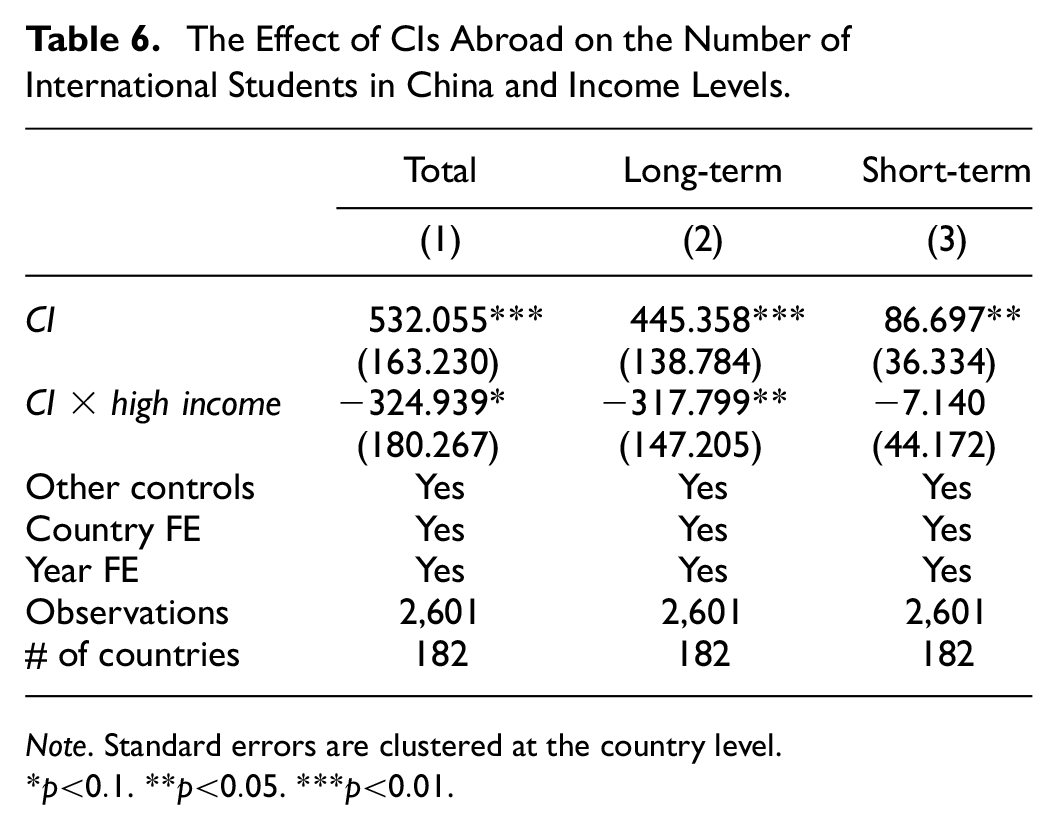
In this section, we investigate whether the effect of CIs abroad on the number of international students in China differs between countries with different income levels. We use the World Bank’s benchmark in 2002, which classified countries into high-, upper-middle-, lower-middle-, and low-income countries (H-, UM-, LM-, and L-income countries, respectively). 39 countries in our estimation sample are classified as H-income countries, 30 as UM-income, 51 as LM -income and 62 as L-income. We generate a dummy variable for relatively high-income countries, high income, which is equal to 1 if the country is classified as an H- or UM -income country and 0 otherwise We include the interaction between this dummy variable and CI in our regression model. Table 6 shows the results.
The Effect of CIs Abroad on the Number of International Students in China and Income Levels.
Note. Standard errors are clustered at the country level.
For all three specifications, the estimated coefficient on CI remains statistically significant and positive. Furthermore, the estimated coefficient on the interaction term is negatively signed, indicating that the opening of a CI in countries with a relatively high-income level tends to exert a smaller effect on the number of international students than an opening in poorer countries. However, this differential effect is statistically significant only for long-term students (see column (2) of Table 7). China has been classified as a UM-income country since 2010 and continues to grow very rapidly economically. For students from L- and LM-income countries, therefore, China appears to be a favorable destination for international study, offering better economic prospects than their country of origin. It is less expensive to study in China than in H-income countries. Students from UM- and H-income countries, by contrast, may have more destination choices for their international study, opening a CI in a relatively high-income country may exert a smaller effect on international student numbers in China. We provide a graphical representation in Figure 4b to illustrate the variation in the effect between H- and L-income countries.
The Effect of CIs Abroad on the Number of International Students in China Among Countries With Large, Respectively Small, Chinese Immigrant Populations.

Note. Standard errors are clustered at the country level.
Countries With Large or Small Population Shares of Chinese
Countries with a large number of Chinese immigrants may have closer relationships and more extensive ties with China, including education exchanges. People from such countries may also have more chances to interact with Chinese people, learn the Chinese language, and get to know the country’s culture. Therefore, as the share of Chinese immigrants becomes larger, the demand for learning the Chinese language and culture could increase, and the outflow of natives to China may also rise. Opening CIs in countries with many Chinese immigrants can lead to large increases in the number of international students in China from such countries if there is apent-up demand for learning Chinese and for international study in China. If there is no such pent-up demand, however, because existing opportunities for learning Chinese in these countries are abundant, as are education exchange programs, the effects of opening a CI on international student numbers from such countries may also fall short of the effects CI openings have in countries with fewer Chinese immigrants. We, therefore, test for differential effects of CIs on international student numbers between countries hosting many, respectively few, Chinese immigrants.
Data on Chinese immigrants are available only for a smaller group of countries and for selective years. We use stock data on Chinese immigrants in 119 countries in 2000. For these countries, we calculate the population share of Chinese immigrants, defined as the number of Chinese immigrants per 1,000,000 population aged 15 to 34 in 2000, and generate the dummy variable, high Chinese migration, which is equal to 1 if a country’s population share of Chinese immigrants is above the median of the 119 countries, and 0 otherwise. Re-estimating equation (1) using this sub-sample of countries for total, long- and short-term international students still produces a sizeable positive effect of CIs on the number of international students. Including the interaction between CI and high Chinese migration in the regression model still delivers a significant positive coefficient estimate of CI. Estimated coefficients on the interaction term vary in sign, but lack significance in all regressions. The effects of CIs on the number of international students, therefore, do not seem to differ systematically between countries with large, and with small Chinese immigrant populations, see Table 7.
Conclusion
Using official and self-compiled data on CIs and international students in China by countries of origin, we find evidence from fixed-effects regressions indicating a positive and diminishing marginal effect of CIs abroad on the number of international students in China. Our findings remain robust through several sensitivity checks. Additionally, our effect heterogeneity analyses reveal that the expansionary impact of CIs on international student numbers is significantly more pronounced for countries in Asia, especially those with languages close to Chinese, and for countries with low or lower-middle income levels. Overall, our results suggest that language institutes abroad can strongly promote bilateral student exchange.
Our study contributes to the push-pull theory in ISM analysis by emphasizing the unique pull factor of language learning opportunities. Such institutes or similar opportunities should be considered in analyses of international student flows. Furthermore, our analysis covers 182 countries and uses population as a weight, indicating that our findings are representative of a significant portion of the global population. The economic benefits of bilateral student exchange may be substantial and enduring. However, the non-linear effect of CIs on the number of international students suggests diminishing returns as more institutes are established. Thus, careful consideration is necessary when planning the establishment of new institutes.
Despite several robustness checks, there may be uncontrolled factors that affect both the number of CIs and the number of international students. Our study is limited by its inability to provide definitive causality. Additionally, our analysis does not account for Chinese learning opportunities outside of CIs or opportunities for learning other languages. Future research should consider these other language learning opportunities if data are available.
Footnotes
Appendix A: Tables Cited in the Main Text
Effect Heterogeneity: Cultural Distance of Asian Countries.

| Total | Long-term | Short-term | ||||
|---|---|---|---|---|---|---|
| (1) | (2) | (3) | (4) | (5) | (6) | |
| 159.682*** | 147.075*** | 98.513*** | 88.708*** | 61.169*** | 58.367*** | |
| (39.078) | (29.327) | (29.871) | (21.780) | (12.814) | (11.572) | |
|
|
936.825*** | 2,348.358*** | 732.823*** | 1,830.597*** | 204.002*** | 517.761*** |
| (199.743) | (612.056) | (161.442) | (579.012) | (53.119) | (178.723) | |
|
|
−483.506** | −376.031** | −107.475* | |||
| (203.788) | (183.105) | (60.073) | ||||
| Other controls | Yes | Yes | Yes | Yes | Yes | Yes |
| Country FE | Yes | Yes | Yes | Yes | Yes | Yes |
| Year FE | Yes | Yes | Yes | Yes | Yes | Yes |
| Observations | 2,379 | 2,379 | 2,379 | 2,379 | 2,379 | 2,379 |
| # of countries | 167 | 167 | 167 | 167 | 167 | 167 |
Note. We calculate the cultural distance index using the formular:
Appendix B: Data on Confucius Institutes
Acknowledgements
This paper has benefited from comments by Michael Kvasnicka, Bernd Süssmuth, and participants of the Annual Conference of the European Society for Population Economics in Bath, the 4th Bamberg-Halle-Jena-Leipzig Workshop on Empirical Microeconomics/Applied Microeconometrics, and seminars at Otto von Guericke University Magdeburg, the University of Leipzig and RWI-Leibniz Institute for Economic Research. All remaining errors are our own.
Author Contributions
The authors contributed equally.
Declaration of Conflicting Interests
The author(s) declared no potential conflicts of interest with respect to the research, authorship, and/or publication of this article.
Funding
The author(s) disclosed receipt of the following financial support for the research, authorship, and/or publication of this article: This research received grants from the Education Department of Jilin Province (Grant number JJKH20241363SK).
Data Availability Statement
Data available on request.
