




Abstract
With the rapid development of economic globalization and educational internationalization, overseas education has emerged as a pivotal trend in the current global education landscape. Employing bibliometric methods, this study conducts co-citation and co-occurrence analyses using VOSviewer and Bibliometrix software to scrutinize 1985 publications related to overseas education retrieved from the Web of Science database from January 2000 to November 2023. Statistical findings reveal a steady growth trend in overseas education research over the past two decades, with the USA, China, and England identified as the highest contributors. Co-citation analysis unveils that the knowledge foundation of overseas education research primarily emanates from the fields of linguistics and education, giving rise to research themes such as language acquisition, identity, and learning experiences. Co-occurrence analysis demonstrates that research hotspots in overseas education are concentrated in six directions: higher education and international students, internationalization and intercultural competence, language acquisition, identity, and study abroad, student mobility, globalization, and internationalization of higher education. Based on bibliometric analysis, this study proposes future research recommendations, including enhancing research on the mobility of specific groups of international students, strengthening studies on the overseas education market, addressing new dynamics in overseas education in the post-COVID-19 era, and intensifying research on the academic achievements of international students. This study provides scholars in the field of overseas education with an in-depth understanding of the knowledge structure and developmental trends, offering a solid foundation for future research.
Plain language summary
In this research, we examined the trends and advancements in overseas education globally. By analyzing nearly 2000 publications from 2000 to 2023 using specialized software, we uncovered a consistent growth in research on this topic. Notably, the USA, China, and England were found to be major contributors. Our analysis revealed that the foundation of knowledge in overseas education research primarily stems from linguistics and education fields, leading to key research themes such as language acquisition, identity, and learning experiences. We identified six main research directions, including higher education and international students, internationalization and intercultural competence, language acquisition, identity, and study abroad, student mobility, globalization, and internationalization of higher education. Based on these findings, we suggest future research areas, such as exploring the mobility of specific groups of international students, investigating the overseas education market, addressing new challenges in the post-COVID-19 era, and delving into the academic achievements of international students. This study serves as a comprehensive guide for scholars in the field of overseas education, providing insights into the current knowledge structure and paving the way for future research.
Keywords
Introduction
Overseas education is a form of education that provides students with opportunities for international learning and cultural exchange. This includes traditional study abroad programs and various forms of transnational online education, aimed at offering students cross-cultural and international academic and life experiences, fostering global, international, and intercultural competencies, and promoting their academic and personal development (Findlay et al., 2012; Gibson et al., 2023). The relative stability of the global political and economic situation has led to the rapid development of international overseas education since the late 1980s. Over the past few decades, many countries and regions have implemented policies and plans to encourage and support the development of overseas education (Abbas et al., 2021). These policies include providing scholarships and subsidies, simplifying visa procedures, and establishing cooperative projects, providing students with more opportunities and convenience for studying abroad (Cosentino et al., 2019; Parey & Waldinger, 2011). Simultaneously, the rapid development of technology has brought unprecedented opportunities to the field of overseas education, especially in the realm of transnational online education (Ahiafor et al., 2023; Malik et al., 2023; Sun et al., 2023). In conclusion, with the sustained development of economic globalization and educational internationalization, overseas education has become a significant trend in the current global education landscape.
The COVID-19 pandemic has had a significant impact on the overseas education market (Ashida & Ishizaka, 2022; Mok et al., 2021). With the World Health Organization declaring on May 5, 2023, that the COVID-19 pandemic no longer constitutes an “international public health emergency,” the overseas education market is expected to gradually recover to its pre-COVID-19 normal state and continue to experience robust growth in the future. Currently, researchers need to address the post-COVID-19 new normal in overseas education, systematically and objectively understand the research progress and trends in this field, and identify research hotspots and frontiers.
While many literature reviews have focused on specific research areas in the field of overseas education, such as the lives of international students, cultural adaptation, academic outcomes, employment, and experiences (Aresi et al., 2016; Armstrong-Mensah et al., 2019; Brown et al., 2016; Browne et al., 2015), or have utilized narrative reviews (C. D. Allen & Barbour, 2016; Block, 2007; Brooks & Waters, 2011) and systematic literature reviews (Brunsting et al., 2023) to assess and study existing literature, there is still a lack of bibliometric analysis to objectively evaluate the scientific knowledge and overall structure of overseas education. This makes it challenging to determine the specific research directions that need special attention.
To comprehensively review the research progress in the field of overseas education and anticipate its future trends, this paper conducts an overall, quantitative, and visual analysis of existing studies on overseas education. We aim to identify research trends and frontiers by quantitatively examining the knowledge base and research hotspots of overseas education research. This endeavor seeks to guide scholars, practitioners, and policymakers in the field of overseas education research and management to identify the right research directions and to engage in theoretical research and practical applications more effectively.
Methodology
Database and Keywords Selection
The Web of Science Core Collection (WoS) is a reliable database widely employed for analyzing academic literature in various fields (Yan & Wang, 2023). Given the interdisciplinary nature of research and practices in overseas education across natural sciences, social sciences, and humanities, this study extracts data simultaneously from three high-quality journal databases within WoS: Science Citation Index Expanded (SCI-EXPANDED)—2000–present, Social Sciences Citation Index (SSCI)—2000–present, and Arts & Humanities Citation Index (AHCI)—2001–present.
During literature retrieval on WoS, the search fields were configured to “Topic (TS)” to ensure the retrieval of essential information from titles, abstracts, and keywords. The search query was defined as “TS= (‘overseas education’ OR ‘study* abroad’ OR ‘overseas study*’ OR ‘overseas student*’)” to capture the keyword characteristics of overseas education. Document types were restricted to Article, Review Article, and Early Access, excluding Book Review, Meeting Abstract, Editorial Material, Proceeding Paper, Letter, etc., to maintain standardized document data formats. The publication date range is set from January 1, 2000, to the present, depending on the publication rights of the author’s institution’s WoS database. Apart from the specified database retrieval settings, no further manual screening of search results was conducted to ensure the replicability of the research methodology. The latest literature retrieval for this study was performed on November 19, 2023, resulting in a total of 1,985 relevant documents collected from January 1, 2000, to November 19, 2023.
Analytical Methods and Tools
Bibliometric analysis is a quantitative method used to analyze the quantity and quality of literature, extensively applied across various fields. In the realm of educational research, bibliometric analysis provides scholars with a systematic, objective, comprehensive perspective and clear visualization, aiding in a deeper understanding of the knowledge structure, research topics, and future trends in rapidly evolving academic disciplines (Akturk, 2022; Bardakci et al., 2022). Scientific mapping can employ various methods, including co-citation, bibliographic coupling, keyword co-occurrence, and co-authorship methods, each offering advantages over conventional summary statistics in bibliometric analysis.
Co-citation analysis is a method used to study citation relationships among academic literature. By examining instances where documents are co-cited, researchers can reveal key themes, important literature, and collaborative relationships among researchers (Aryadoust & Ang, 2021; Chen et al., 2022). Co-citation analysis aids in understanding the knowledge structure and development trends in academic fields (Tang, 2021).
Co-occurrence analysis is a method used to analyze the relationships between keywords, topics, and terms within literature (Lopera-Perez et al., 2021). By examining co-occurrences in these documents, researchers can identify hot topics, key concepts, and developmental trends in a research field (Gong et al., 2018; Wang & Jia, 2023).
This study utilizes the VOSviewer software and the Bibliometrix software package based on the R language as research tools. VOSviewer is a visualization tool based on a similarity visualization technique developed by van Eck and Waltman at Leiden University, designed for data mining, mapping, and visualization of collaborative networks (Waltman et al., 2010). The Bibliometrix bibliometric analysis tool, developed by the team led by Massimo Aria, boasts advantages such as ease of operation, open-source data, and comprehensive statistics, supporting data visualization analysis and generating various knowledge maps to intuitively present the panorama of research areas and changes in research topics (Aria & Cuccurullo, 2017).
The workflow of bibliometric analysis is illustrated in Figure 1.
Phase 1: Data collection and retrieval strategy, preprocessing data.
Phase 2: Statistical and bibliometric analysis of overseas education’s 1985 relevant documents. First, a statistical analysis of publication years and geographical distribution is performed to reveal the developmental trends and regional focuses of overseas education research. Subsequently, utilizing VOSviewer software, full record and cited reference data of the documents are imported for co-citation analysis of cited sources and cited references. Simultaneously, co-occurrence and clustering analyses of author keywords are conducted to gain in-depth insights into hot topics and academic network structures within overseas education research. Additionally, Bibliometrix software’s word cloud technique is applied to visually process the keywords and keywords plus of research papers, highlighting the most prominent keywords or phrases in this study (Kumar et al., 2021). Trends in future overseas education research are also examined using trend topics and keyword growth analysis methods.
Phase 3: Discussion and conclusion. Based on the literature survey data from the Web of Science Core Collection, using bibliometric and visualization analysis methods, comprehensive insights into the current state and trends of overseas education research are developed.

Paper structure overview.
Results
Status Analysis
Publication year analysis
Figure 2 illustrates the number of papers on overseas education during the research period. In 2000, only 17 papers were published in the field of overseas education. However, by 2022, the number increased to 205 papers, marking a 12-fold growth compared to the year 2000. As of November 19, 2023, 122 papers have already been published in the field of overseas education for the year 2023. Analyzing the publication trends, research in overseas education can be categorized into three phases: the exploratory phase (2000–2008), the rapid development phase (2009–2019), and the sustained development phase (2020–present). During the exploratory phase (2000–2008), the annual publication ranged from 9 to 34 papers, indicating relatively fewer publications. In the rapid development phase (2009–2019), annual publications ranged from 53 to 166, showcasing a rapid growth trend. In the sustained development phase (2020–present), annual publications range from 171 to 216, indicating a sustained and high-level development status.

Publication trends analysis.
Geographical Distribution Analysis
Based on the analysis of Countries/Regions for 1,985 records of overseas education research literature in WoS, 95 countries/regions globally engage in overseas education research. Figure 3 outlines the top 10 countries/regions in overseas education research and their annual publication distribution. Among the top contributors, the USA holds the lead (868, 43.750%), followed by China (271, 13.659%), England (199, 10.030%), and Australia (158, 7.964%). Throughout the research period, the USA has consistently been the primary research country, showing a thriving trend in annual research output. In contrast, the development of England and Australia has been relatively stable over the past decade. China, however, has experienced rapid growth since 2018, with an increasing annual publication trend over the last 5 years. Figure 3 presents the top 10 countries/regions in overseas education research, including the USA, China, England, and Australia, which are not only globally renowned destinations for international students but also major contributors to global outbound student mobility. These countries have practical research and practice needs in the field and are significant contributors to overseas education research.

Top 10 productive countries/regions from 2000 to 2023.
Taking the USA as an example, its dominant position in overseas education research can be attributed to several factors. Firstly, a global perspective and multicultural background: The U.S. higher education system attracts students and scholars from around the world, providing a wide range of subjects for overseas education research (Brunsting et al., 2023; Goldstein, 2022; Kinginger, 2011; Wynveen et al., 2012). Secondly, policy and regulatory support: The U.S. government’s policy support for overseas education research, including policies on academic exchange and international student affairs, contributes to its dominant position (Kramer & Wu, 2021; Warwick, 2005). Thirdly, research investment and funding support: Funding support for higher education and research in the USA provides a solid foundation for overseas education research (Li et al., 2019; McManus et al., 2021; Pedersen et al., 2011). Fourthly, research institutions and academic communities: the USA has internationally renowned research institutions and academic communities that facilitate communication and collaboration in the field of overseas education research (Kessler & Kost, 2021; Kinginger, 2013; Soria & Troisi, 2014). Lastly, advanced research methods and technologies: USA researchers widely apply advanced research methods and technologies in overseas education research, enhancing the depth and breadth of the research (Davis & Knight, 2023; Goldstein, 2022). In summary, these factors interact to collectively establish the USA’s dominant position in overseas education research, a complex process involving various factors.
Cited Sources Co-Citation Analysis
Figure 4 presents the co-citation analysis of cited sources, created using VOSviewer. This study selected 32 cited sources with a citation frequency exceeding 170 from the dataset of 28,085 cited sources. The red area in Figure 4 primarily consists of journals in the field of Linguistics, such as Modern Language Journal, Studies in Second Language Acquisition, Language Learning, and Applied Linguistics. The green area comprises journals in the field of Education and Educational Research, including Journal of Studies in International Education and Higher Education. Additionally, high-frequency co-cited sources such as Foreign Language Annals and System belong to both Linguistics and Education and Educational Research. This indicates that the knowledge base of overseas education research primarily stems from the fields of Linguistics and Education and Educational Research.
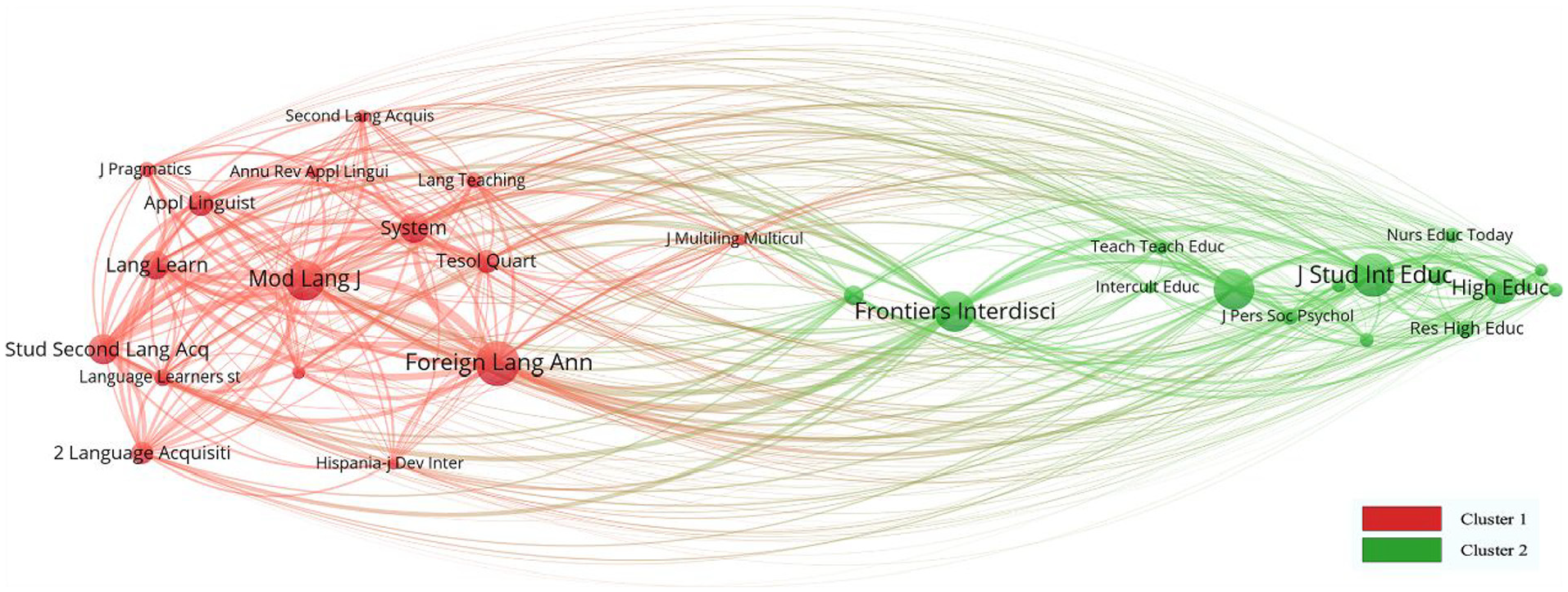
Co-citation analysis of cited sources.
Cited References Co-Citation Analysis
Figure 5, a co-citation analysis of cited references created using VOSviewer software, focuses on 47 cited references with a citation frequency exceeding 40 from a dataset of 61,432 references. In Figure 5, similar colors indicate closely related references, forming three clusters (Cluster 1 in red, Cluster 2 in green, and Cluster 3 in blue), where each cluster’s literature shares common characteristics and associations.
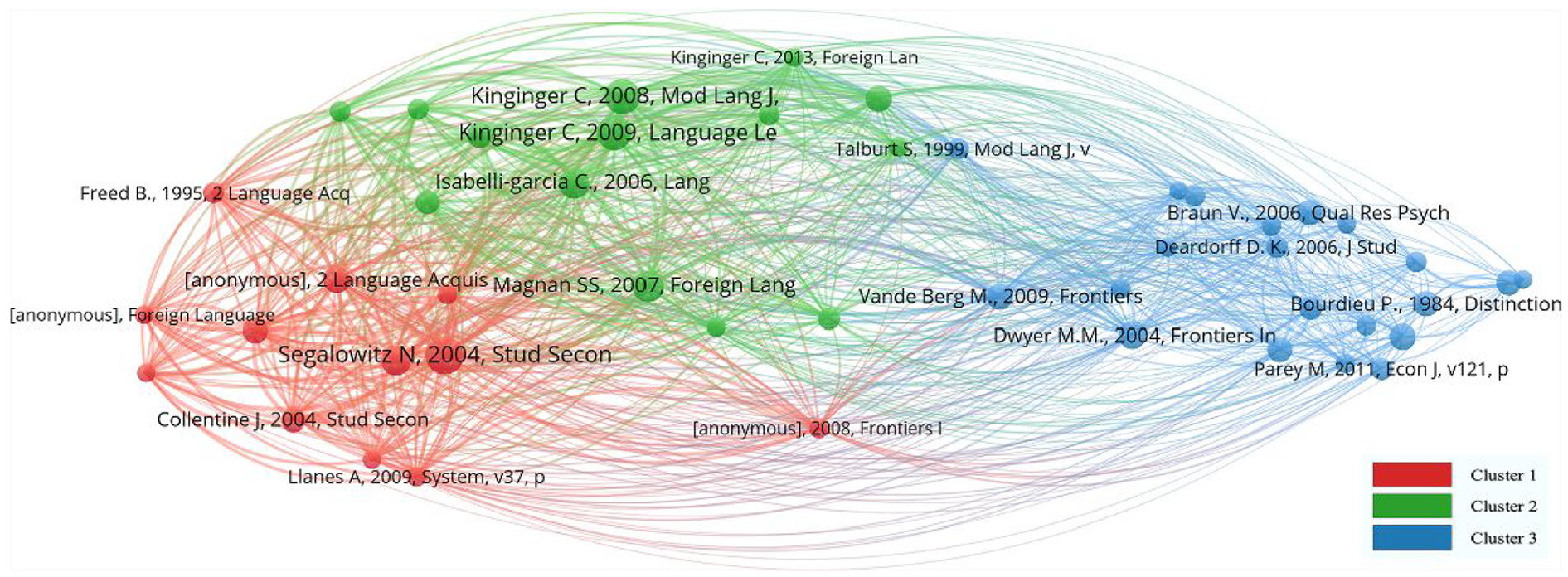
Co-citation analysis of cited references.
Based on the data in Figure 5, excluding references with anonymous authors, the top 20 highly cited references during the research period were statistically analyzed. The references are ranked by the total link strength (TLS) indicator in the VOSviewer software. Table 1 displays the results, where the cluster data corresponds to Figure 5, and the local citation score (LCS) is derived from the citation data in the VOSviewer software, measuring the number of citations among the locally retrieved set of literature. Reflecting the specific field of overseas education research, the most influential literature spans from 1995 to 2010 and includes various types such as articles, books, reviews, and conference proceedings.
Top 20 Highly Cited References by TLS Based on Data From Figure 5.

The common theme in the first cluster’s literature is a focus on language acquisition and language teaching in overseas education. These studies delve into the impact of different language learning environments on students’ language acquisition processes and language performance. Some literature in this cluster emphasizes the influence of different learning environments (study abroad and domestic regular classroom education) on language acquisition and academic performance, determining which environment is more favorable for language acquisition (Brecht et al., 1995; Collentine, 2004; Dewey, 2004; Freed, 1995; Freed, Segalowitz, & Dewey, 2004; Llanes & Muñoz, 2009; Segalowitz & Freed, 2004). These studies provide profound insights into language acquisition in overseas education, emphasizing the significant impact of learning environments on students’ language abilities and academic achievements. Additionally, some literature highlights the close relationship between learning contexts and academic achievement, studying the language motivation and interaction of students in different contexts to explain their language development. This evidence underscores differences between study abroad and domestic intensive course learning, highlighting the importance of social interaction and academic motivation in language skills and academic performance (Brecht et al., 1995; Collentine, 2004; Dewey, 2004; Freed, Segalowitz, & Dewey, 2004; Llanes & Muñoz, 2009; Segalowitz & Freed, 2004). In summary, Cluster 1 literature provides in-depth insights into the complexity and diversity of language acquisition in overseas education.
The second cluster’s literature shares a common focus on language development and identity in the overseas environment, as well as social and cultural factors in study abroad. The research results and theoretical frameworks of these studies have significant implications for further exploration of language teaching, cultural transmission, and cross-cultural communication in overseas education (H. W. Allen & Herron, 2003; Freed, Dewey, et al., 2004; Hernández, 2010; Isabelli-García, 2006; Kinginger, 2008, 2009; Magnan & Back, 2007).
The third cluster’s literature collectively addresses interventions and learning experiences of students studying abroad. These studies primarily explore how various interventions can optimize the academic and social experiences of international students. They focus on factors such as the duration of study abroad programs, students’ academic performance, and cultural adaptation to examine how these factors impact the overall experience of international students (Dwyer, 2004; Vande Berg et al., 2009).
It is worth noting that, although the literature in Figure 5 is divided into three clusters, the relevant literature is not completely isolated from each other. These works collectively form the knowledge base of overseas education research, covering aspects such as language acquisition, identity, and learning experiences.
The Popular Themes of Overseas Education Research
Figure 6 presents the co-occurrence analysis of author keywords using VOSviewer. Before the analysis, a thesaurus file was created in VOSviewer to clean and merge keywords with similar meanings or different spellings. For instance, terms such as “education abroad,” “estudio en el extranjero,” “etudier a l’etranger,” and others were unified as “study abroad.” Author keywords with a co-occurrence frequency exceeding 13 were selected, resulting in 58 keywords out of a total of 4,016 in the dataset. The resulting co-occurrence analysis graph is shown in Figure 6, where nodes represent keywords, and links represent co-occurrence relationships. The node size signifies the co-occurrence frequency of keywords, and link thickness represents the total link strength (TLS) between keywords. Keywords of the same color indicate a close relationship. Figure 6 displays six clusters of author keywords in the field of international education.
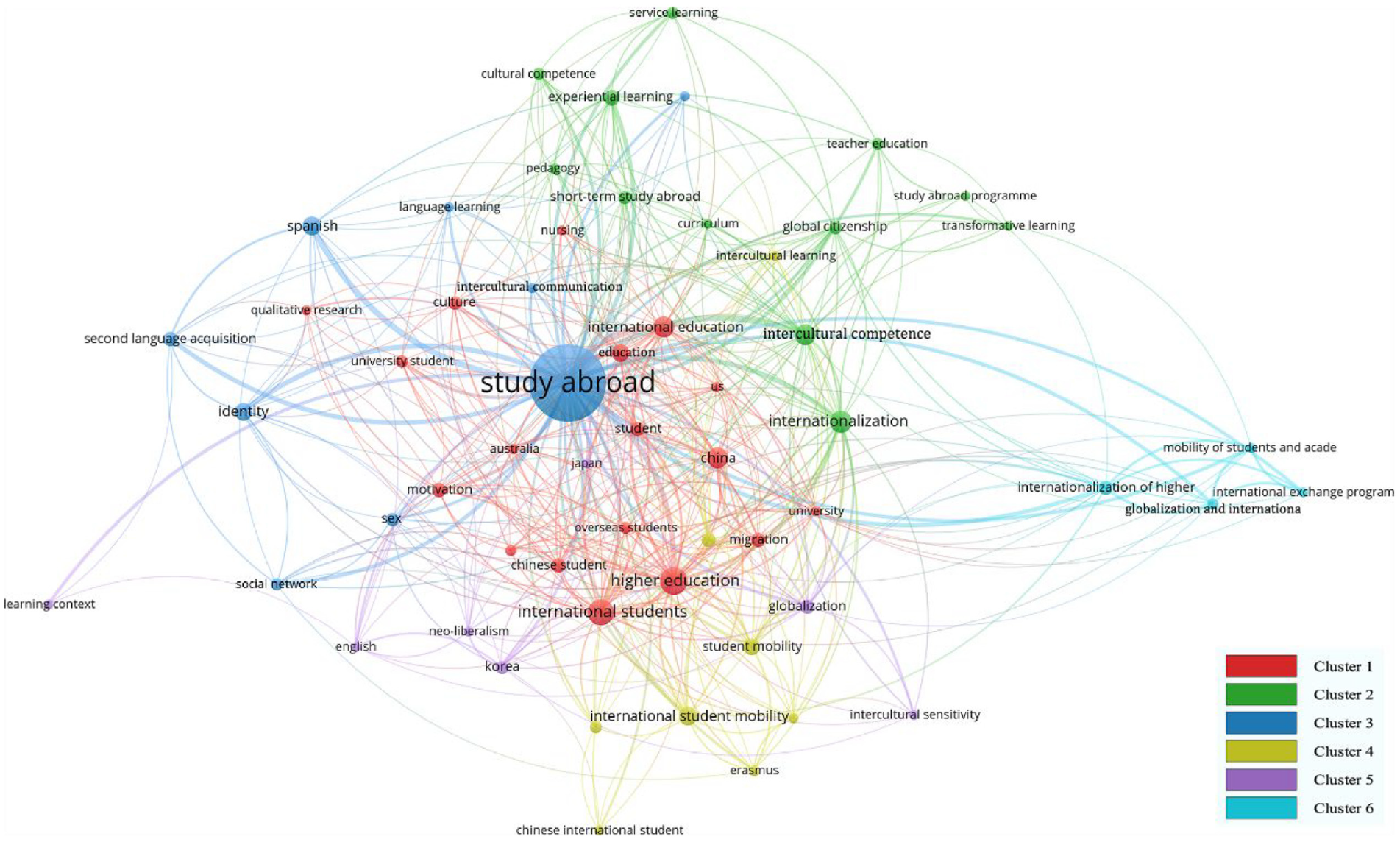
Co-occurrence analysis of author keywords.
Word clouds visually display the most frequently occurring words in an appropriate size, aiding in the rapid identification of prominent terms in the literature. Figure 7 consists of word clouds generated using Bibliometrix for the top 50 author keywords (Figure 7A) and Keywords Plus (Figure 7B), confirming the results from the author keywords’ co-occurrence analysis in Figure 6. The word cloud does not show the keyword “study abroad” as it constitutes the terms used to build the query. Figure 7A illustrates the word cloud for the generated keywords from the search query. Among the keywords used in this study’s search query, the analysis of international students in the field of overseas education is a common topic, and predictive analysis also holds research space due to its emerging significance. “Students” is the most frequently appearing keyword in the list of keywords plus. Besides the keywords used in the search query, frequently occurring keywords from other contexts include education, experiences, abroad, and language.

Most used word clouds: (a) based on the author’s keywords and (b) based on keywords plus.
Based on the clusters in Figure 6, the primary concepts and keyword groups of the six clusters are summarized in Table 2. In Table 2, the colors in the clusters match those in Figure 6. The specific keywords in the keyword groups are ranked by the size of the TLS indicator in the VOSviewer software, and the main concept is an integration of the content characteristics of keyword groups in each cluster, summarizing the research hotspots in the field of overseas education.
Summary of Main Concepts and Keyword Groups in the Six Clusters Based on Figure 6.
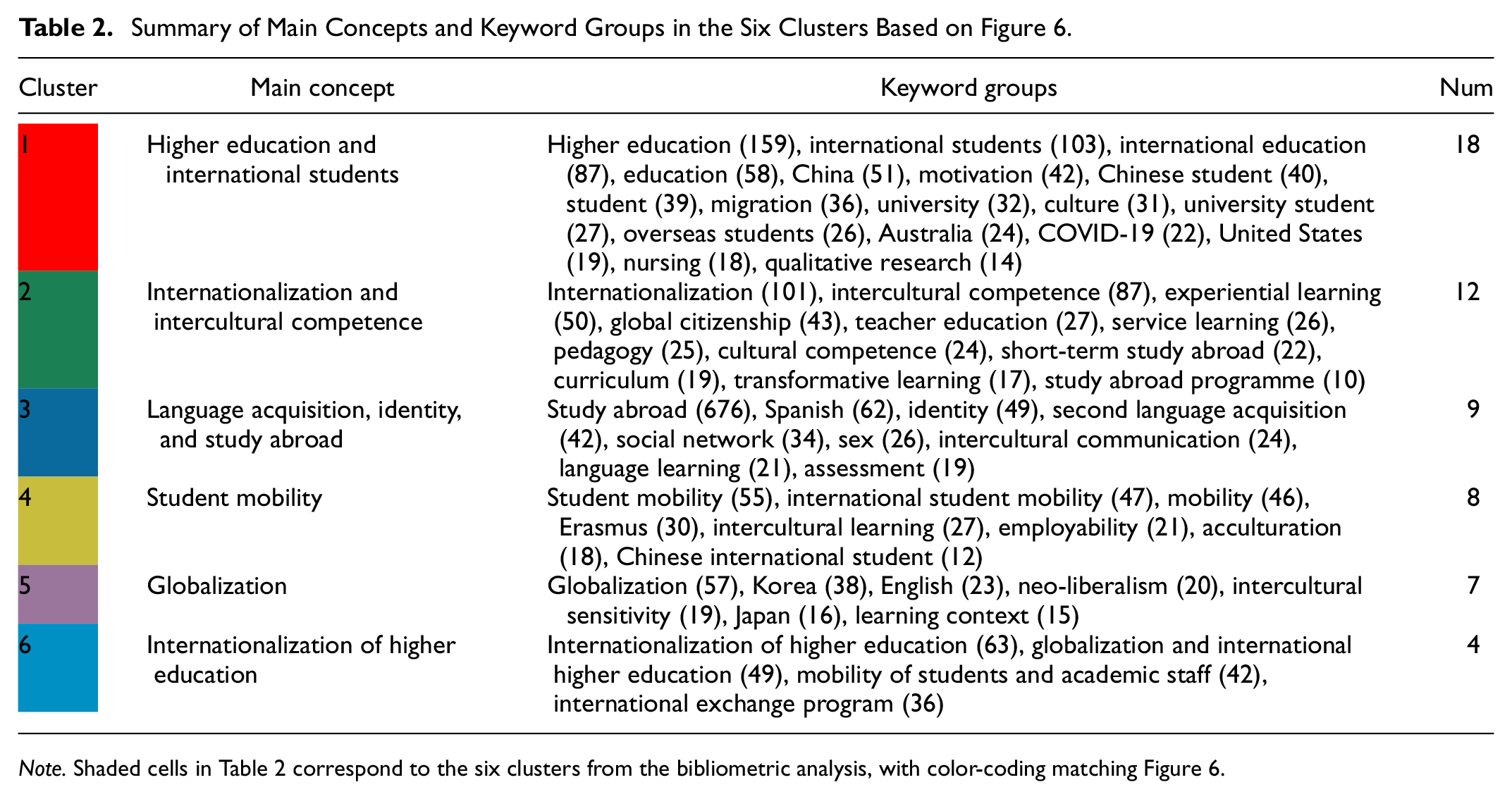

Note. Shaded cells in Table 2 correspond to the six clusters from the bibliometric analysis, with color-coding matching Figure 6.
Higher Education and International Students
Cluster 1 (Red): Cluster 1 in Figure 6 comprises 18 keywords. “Higher education” and “international students” are the two keywords with the highest TLS indicators, reflecting the primary research focus of this cluster. Consequently, we name this cluster “higher education and international students,” representing the first core theme in the study of international education. Specifically, this core theme encompasses three main aspects:
Firstly, international education policies and practices in higher education. Various countries and institutions at different levels globally have consistently made efforts to promote international collaboration, facilitate cross-border mobility, enhance educational quality, and cultivate global talents (Aerts & Van Mol, 2023; Brooks & Waters, 2023; Jonbekova et al., 2023). The continuous advancement of international education policies and practices not only fosters cooperation and communication between nations but also provides international students with broader educational opportunities, enhancing their global perspectives and elevating the international competitiveness of higher education.
Secondly, the diverse experiences of international students in higher education. The experiences of international students in higher education encompass aspects such as cultural adaptation, cross-cultural communication, academic challenges and adaptation, social integration and support, employment and career development, legal and immigration issues, economic and financial considerations, as well as mental health and well-being (Backman et al., 2024; Bartholomew et al., 2022; Chang, 2024; Shkoler & Rabenu, 2023). To ensure the full integration of international students into academic and social life, higher education institutions need to provide comprehensive support services addressing academic, social, legal, economic, and mental health aspects, facilitating the comprehensive development and success of international students.
Thirdly, the impact of global events such as the COVID-19 pandemic. The COVID-19 pandemic has had sustained and multifaceted effects on higher education and international students, including changes in teaching methods, the widespread adoption of online education, challenges to mental health, the promotion of global cooperation, the complexity of study abroad decisions, and profound changes in cultural experiences (Ahiafor et al., 2023; Cheng & Agyeiwaah, 2022; Fanari & Segrin, 2021).
It is worth noting that existing literature on higher education and international students establishes organic connections, with established theories and frameworks such as the multilingual perspective and transformative learning frameworks serving as the foundation for ongoing research (Chang, 2024; Dolce et al., 2023). Additionally, when considering cross-cultural differences, comparative analyses across nations and regions contribute to understanding how factors such as cultural differences, economic conditions, and university attractiveness play varying roles in the decision-making processes of international students in different regions (Abbas et al., 2021; Oldac, 2023). Furthermore, considering the passage of time, the diversity and complexity of international student experiences vary significantly across different contexts and groups under the influence of global events and social changes (Aerts & Van Mol, 2023; Ahiafor et al., 2023). In summary, research within Cluster 1 not only involves the application of established theories and frameworks for analyzing higher education and international students but also provides cross-cultural analyses and considers temporal trends, enriching our understanding of international student experiences.
Internationalization and Intercultural Competence
Cluster 2 (Green): Cluster 2 in Figure 6 consists of 12 keywords. “Internationalization” and “intercultural competence” are the two keywords with the highest TLS indicators, reflecting the primary research focus of this cluster. Therefore, we designate this cluster as “internationalization and intercultural competence,” representing a key research theme in the study of international education. Specifically, this research theme covers three main aspects:
Firstly, the cultivation and development of international students’ intercultural adaptation skills. The cultivation and development of international students’ intercultural adaptation skills constitute a complex and multidimensional process involving factors such as cultural preparation, living environment, language proficiency, intercultural awareness, and social skills (Baker et al., 2022; Genkova et al., 2021; Iskhakova et al., 2022). These factors intertwine to shape the intercultural adaptation experiences of international students.
Secondly, the influence and roles of various stakeholders. In the process of cultivating international students’ intercultural adaptation skills, various stakeholders such as schools and educational institutions, teachers and mentors, peers and colleagues, families and parents, and society and local communities play crucial roles. Their active involvement and support are essential for the successful intercultural adaptation of international students (Abraham, 2021; Ballesteros-Sola & Magomedova, 2023; Peng, 2023).
Thirdly, the impact and roles of different types of study abroad programs. The cultivation of international students’ intercultural adaptation skills involves various types of study abroad programs, including short-term study programs, language learning programs, cultural exchange, and social engagement programs. Key factors influencing international students’ intercultural adaptation skills in different types of study abroad programs include program design, implementation, teaching quality, and the proactive participation of international students (Artamonova, 2023; Barkin, 2018; Iskhakova et al., 2022).
Overall, research within Cluster 2 provides in-depth insights into how to cultivate and develop international students’ intercultural adaptation skills. These studies utilize various theories such as transformative learning theory and cultural intelligence theory (Chwialkowska, 2020; Iskhakova et al., 2022), emphasizing the specific roles of teaching methods, curriculum design, and experiential learning (Chwialkowska, 2020; Goldstein, 2022). This research contributes depth and breadth to our understanding of international students’ intercultural adaptation skills.
Language acquisition, identity, and study abroad
Cluster 3 (Blue): Cluster 3 in Figure 6 comprises 9 keywords, covering “study abroad,” “Spanish,” “identity,” and “second language acquisition,” among others. Among these, “study abroad” is unquestionably the central keyword with the highest TLS indicator in all 58 keywords in Figure 6. However, as the focus of this paper is on international education, interpreting “study abroad” as a separate research theme would disrupt the logical flow of the entire paper. Based on these considerations, we name this cluster “language acquisition, identity, and study abroad,” representing a crucial research theme in international education. Specifically, this research theme covers two main aspects:
Firstly, international students’ language learning and second language acquisition. Research methods for language learning in the study abroad context include activity theory, long-term investigation, case studies, and more (H. W. Allen, 2010; Huensch & Tracy-Ventura, 2017). International students’ language learning is influenced by various factors such as language motivation, self-efficacy, language fluency, and cross-cultural knowledge, providing a comprehensive perspective that aids research and practice in study abroad language education (Czerwionka et al., 2015; Martinez et al., 2024; Yue et al., 2022).
Secondly, individual identities such as gender and nationality of international students. Research methods encompassing multiple theoretical perspectives, narrative methods, and specific group analyses provide rich perspectives for understanding the construction of multilingual identities in cross-cultural environments (Fang et al., 2023; Kim & Brutt-Griffler, 2023; Lee et al., 2023). The combined use of these methods offers a more comprehensive, in-depth, and individualized perspective, contributing to the understanding of the complexity of multilingual identity formation.
In summary, research within Cluster 3 utilizes methods such as activity theory, long-term investigation, case studies, narrative methods, etc., providing an in-depth exploration of international students’ language acquisition, identity development, and study abroad experiences. These studies reveal the influence of multiple factors on international students’ language learning and identity construction.
Student Mobility
Cluster 4 (Yellow): Cluster 4 in Figure 6 includes eight keywords, with “student mobility” being the keyword with the highest TLS indicator. Consequently, we name this cluster “student mobility,” representing a key research theme in the study of international education. Specifically, this research theme covers two main aspects:
Firstly, international mobility of students. The flexibility and mobility of students studying and living globally are influenced by factors such as economics, educational systems, cultural differences, and political situations (Arsenault et al., 2019; Koelbel, 2020; Wilkins & He, 2022). Analyzing motivations for international student mobility, environmental influences, remote education, path selection, pandemic impacts, and more through multidimensional metrics can help governments and educational institutions comprehensively consider these factors when formulating policies and measures to attract and retain international students (Aresi et al., 2018; Gumus et al., 2020).
Secondly, adaptation and career development of international students in different cultural backgrounds. Successful adaptation and career development require international students to possess an open mindset, cross-cultural communication skills, language proficiency, and an understanding of the workplace culture in the target country (Cameron et al., 2019; Fanari et al., 2023; Hu et al., 2022; Tran et al., 2021). These factors contribute to international students integrating and successfully developing in living and working abroad.
In summary, research within Cluster 4 covers diverse and interconnected research areas related to the international mobility, adaptation, and career development of international students. This research contributes to understanding the global mobility and career development status of international students.
Globalization
Cluster 5 (Purple): Cluster 5 in Figure 6 includes seven keywords, with “globalization” being the keyword with the highest TLS indicator. Thus, we designate this cluster “globalization,” representing a key research theme in the study of international education. Specifically, this research theme covers two main aspects:
Firstly, the international language proficiency of international students. Research in this area includes systematic analysis, multiple theoretical perspectives, and critical analysis, covering various research groups and regions, including Chinese international students, global citizenship education, and international students from other countries and regions (Aktas et al., 2017; Fang et al., 2023; Shin, 2016). These studies focus on the development path of language proficiency, as well as the impact of neoliberalism on language education and study choices, revealing the diverse challenges and opportunities faced by international students in terms of international language proficiency.
Secondly, the internationalization experiences of international students. Although studying abroad has a positive impact on the internationalization experiences of international students, this impact is moderated by various factors such as cultural background, duration of study abroad, and task types (Anderson et al., 2006; Fukuda & Chavez, 2021; Gordon & Mwavita, 2018). To more effectively promote the development of international students’ cross-cultural abilities, it is necessary to thoroughly investigate these influencing factors, especially through in-depth research and multi-angle approaches, to fully understand the long-term effects of studying abroad on international students (Sobkowiak, 2019; Tarchi & Surian, 2022).
In summary, research within Cluster 5 focuses on two key aspects: international language proficiency and cross-cultural capabilities of international students, providing in-depth insights into the globalization experiences of international students in a global context.
Internationalization of Higher Education
Cluster 6 (Turquoise): Cluster 6 in Figure 6 consists of four keywords, with “internationalization of higher education” being the keyword with the highest TLS indicator. Therefore, we designate this cluster “internationalization of higher education,” representing a key research theme in the study of international education. Specifically, this research theme covers two main aspects:
Firstly, the internationalization of higher education institutions. Research in this area utilizes critical analysis, in-depth interviews, and case studies to explore key topics related to the internationalization of higher education institutions, including global citizenship education, international students’ cross-cultural experiences, and the implementation of internationalization strategies (Aktas et al., 2017; Baker et al., 2022; Song, 2018). These studies provide valuable insights for guiding strategic planning and practices of higher education institutions seeking to enhance their internationalization efforts.
Secondly, the mobility of students and academic staff. Research in this field utilizes community practice models, the A3 inclusive education model, institutional theory perspectives, and various methods, focusing on social justice, student engagement in project-based learning, the experiences of disabled students studying abroad, institutional perspectives on mobility, and differences in mobility across countries (Campbell & Lavallee, 2020; Fortune et al., 2019; Johnstone & Edwards, 2020; Kouba, 2020). The multidimensional insights provided by these studies contribute to a comprehensive understanding of the mobility of international students and academic staff.
In summary, research within Cluster 6 is concentrated on two key areas: the internationalization of higher education institutions and the mobility of students and academic staff. This research provides valuable experiences and recommendations for guiding the internationalization strategies of higher education institutions, promoting cross-cultural communication, and facilitating academic collaboration.
The Trends of Overseas Education Research in the Future
To supplement the word cloud analysis, we utilized Bibliometrix to conduct keyword trend topics and word growth analysis to reveal future research trends. The sudden increase in the use of keywords by scholars can imply emerging and future research trends (Qian et al., 2019). Keyword Plus is a commonly used additional keyword in academic literature, although it may not necessarily appear in the article titles or author keywords. Serving as additional keyword information, Keyword Plus can provide a more comprehensive research perspective, covering most author keywords and emphasizing research methods and techniques (J. Zhang et al., 2016). Therefore, scholars can use Keyword Plus to identify the development trends in each research area.
According to the trend topics in the study of international education shown in Figure 8, we have obtained the following key findings: higher education, international students, and international education are the core focuses of research, appearing 100, 82, and 59 times, respectively. This reflects scholars’ sustained attention to these topics. In addition, emerging research areas have gradually emerged in recent years, with the “COVID-19 pandemic” becoming a popular keyword, appearing 17 times, highlighting the widespread concern about the profound impact of the global pandemic on international education. Furthermore, keywords involving specific countries or regions include “Germany” (11 times) and “South Korea” (16 times), indicating research attention to the study abroad situations in different countries/regions. These findings reveal the major hotspots and development trends in the study of international education, providing important references for future research. The co-occurrence of keywords such as “Globalization” and “Internationalization” implies that future research may pay more attention to the global perspective and internationalization strategies of international education. Keywords related to cross-cultural communication and social networks suggest that research in international education will focus more on interactions and exchanges among students, as well as the impact of these factors on academic and career development (Figure 9).

Trend topics author’s keyword.

The evolution dynamics of keywords plus over time.
From 2000 to 2023, the keyword themes in the study of international education have undergone significant evolution. In the early years, research topics were mainly focused on “Students,” “Abroad,” and “Language,” reflecting scholars’ initial attention to issues related to the student population, study abroad experiences, and language learning. Over time, the diversity of research keywords gradually increased, reflecting scholars’ deeper and broader research interests in international education. The introduction of keywords such as “Higher-Education,” “Acquisition,” and “Short-Term” highlights the gradual in-depth research on topics related to higher education systems, knowledge acquisition methods, and short-term study abroad. Meanwhile, the addition of keywords such as “Identity” and “Experiential” emphasizes the research interest in topics such as identity recognition and experiential learning among international students. This reflects the gradual expansion of research in international education to multidimensional aspects, including individual experiences and social impacts of international students.
Discussion
According to the above-detailed analysis of the retrieved literature, the discussion of those findings is as follows:
The Status of Overseas Education Research
This study, through a meticulous analysis of literature in the field of international education, has unveiled clear trends and development directions over the past few years. Firstly, in terms of publication, a significant increase in the number of articles published has been observed from 2000 to 2022, indicating a steady upward trend. Particularly noteworthy is the surge in publications to 654 in 2021, possibly associated with the global impact of the COVID-19 pandemic on the education system, prompting heightened scholarly attention to online education and its effectiveness.
The analysis of regional distribution reveals that the USA has consistently been the primary contributor to research in international education, accounting for 43.75% of the total publications. Other major contributing countries include China, England, and Australia. However, in recent years, some developing countries have started to gain prominence, exhibiting a gradual increase in research output, reflecting the diversification and globalization trends in international education research on a global scale.
The dominant position of the USA in international education research results from multiple factors. Firstly, the cultural diversity of the U.S. higher education system attracts global students and scholars, providing a broad range of research subjects and practical foundations for international education studies. Secondly, support from policies and regulations has played a crucial role in advancing international education research. The U.S. government has created a favorable environment for the flourishing of this field by enacting policies related to academic exchanges, international student affairs, and cross-cultural education. Additionally, robust research investments, financial support, and a rich ecosystem of research institutions and academic communities contribute significantly to the USA’ leadership in international education research.
Through co-citation analysis of cited sources, we find that the knowledge foundation of international education research primarily stems from the fields of Linguistics and Education and Educational Research. This includes journals such as Modern Language Journal and Studies in Second Language Acquisition in linguistics, and Journal of Studies in International Education, and Higher Education in education and educational research. This indicates that international education research draws knowledge from various disciplinary domains, forming a complex and diverse interdisciplinary framework.
The co-citation analysis of cited references emphasizes significant clusters of literature in international education research, covering various aspects such as language acquisition, identity formation, and learning experiences. These highly cited works provide a solid theoretical foundation for international education research, delving into the language acquisition processes of students in different learning environments, the influence of sociocultural factors, and the academic and social experiences of international students abroad. Importantly, there are no clear boundaries between these cited works, indicating their interconnectedness and forming a complex and organic knowledge network. This reflects the interdisciplinary nature of international education research, requiring the comprehensive application of theories and methods from disciplines such as linguistics and education.
The Hot Topics in Overseas Education Research
By focusing on high-frequency keywords in the field of overseas education, this paper extracts a conceptual framework covering major aspects of international education research. The high-frequency keywords are categorized into global, national/regional, institutional, and student levels, revealing the overall structure of international education research, as illustrated in Figure 10.
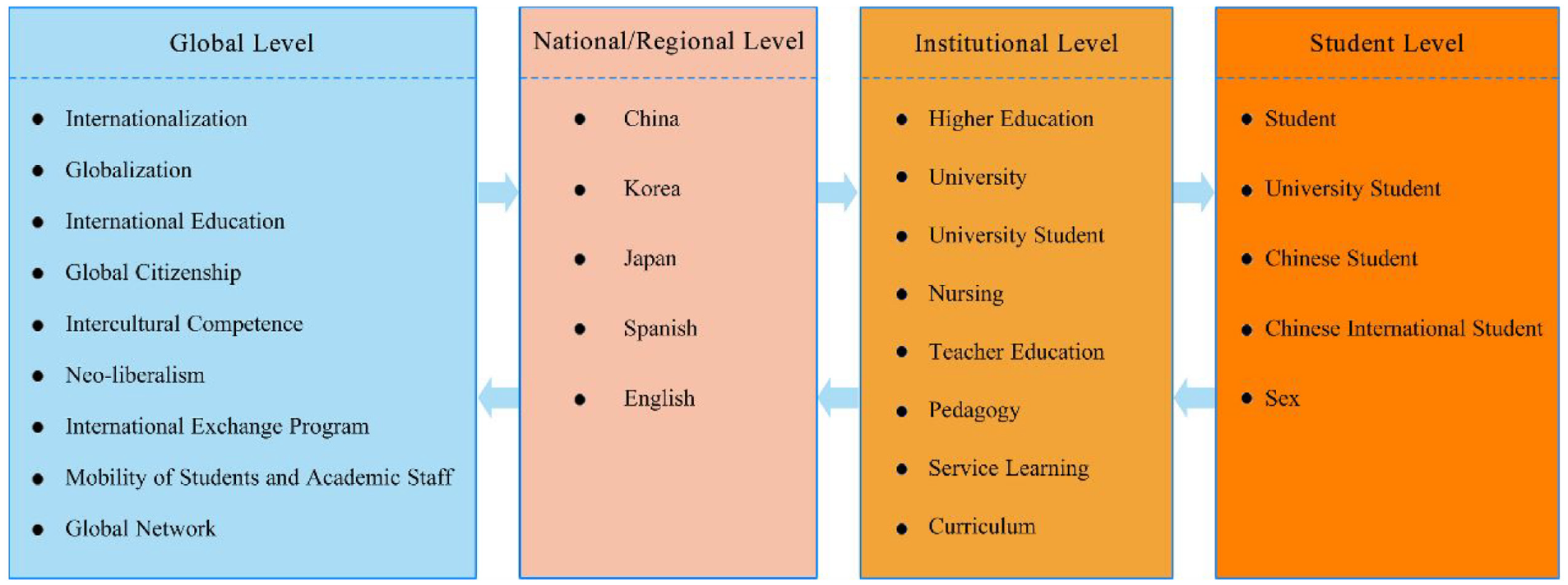
The conceptual framework for overseas education research.
Global Level
Firstly, Internationalization is a core concept in international education research, involving academic collaboration, international exchanges, and multicultural understanding (Gibson et al., 2023). Secondly, Globalization constitutes one of the background factors for international education, signifying a more globalized landscape for educational opportunities and student mobility (Sun et al., 2023). Thirdly, International Education covers a broad spectrum of topics, including transnational education cooperation, international curriculum, and cultural exchange (Katsumoto, 2024). Fourthly, Global Citizenship Education focuses on cultivating awareness of global issues and global citizenship through education (Zarestky et al., 2024). Additionally, at the global level, there are also high-frequency keywords such as Intercultural competence, Neo-liberalism, International Exchange Program, Mobility of Students and Academic Staff, and Global Network.
National/Regional Level
Firstly, National/Regional Specifics examine the situations specific to certain countries/regions, such as China, South Korea, and Japan, which host a significant number of international students and send students abroad (Ahiafor et al., 2023; Mella & Gutierrez, 2023). Secondly, Language Environment studies the impact of different language environments on the learning and communication of international students, including those from English and non-English-speaking countries (Fang et al., 2023; Itoi & Mizukura, 2024). Thirdly, Educational Policies investigate the influence of international education policies on international education and the policy variations across different countries/regions (Li et al., 2023; M. Y. Yang et al., 2024).
Institutional Level
Firstly, Internationalization Strategies explore universities’ strategies for internationalization, including the goals, plans, and implementation of internationalization (Biles & Lindley, 2009; S. C. Zhang & Hasim, 2023). Secondly, Student Support Services focus on the support services provided by universities for international students, including cultural adaptation and academic support (Bartholomew et al., 2022; Eden et al., 2023).
Student Level
Firstly, Student Motivation and Goals study the motivations and goals of different student groups for studying abroad and how these factors influence their study abroad experiences (Sun et al., 2023; Xu & Qiu, 2023). Secondly, Academic and Cultural Adaptation examines the adaptation process of students in academic and cultural aspects and how adaptation influences their study abroad experiences (Fanari et al., 2023; Yu et al., 2023). Thirdly, Gender and Study Abroad Experience focus on the impact of gender on the study abroad experience, investigating how gender factors shape the experiences of international students (Aerts & Van Mol, 2023; Zhu et al., 2023). Fourthly, Chinese Students and International Students receive special attention due to China being one of the largest source countries for international students (Fang et al., 2023; X. Z. Y. Yang & Yang, 2023).
By categorizing high-frequency keywords in international education research into different levels forming a conceptual framework, and linking it to existing literature on international student experiences, we can gain deeper insights into how these studies align or diverge from established theories or models in the field. This categorization enables a clearer understanding of the diversity and complexity of international education research, providing potential directions for future research.
The Recommendations for Future Research in Overseas Education
Summarizing the analysis of relevant literature on overseas education in this paper, we propose four recommendations for future research in international education:
Strengthen Research on the Mobility of Specific Groups of International Students
The mobility of international students has always been a key issue in international education research, but the focus has predominantly been on general international students. We recommend enhancing research on the mobility of specific groups (such as ethnic minorities, racial groups, and marginalized communities) to gain a more comprehensive understanding of their study-abroad experiences.
Firstly, delve into the motivations of specific groups of international students: Utilize in-depth interviews and group research methods to explore the motivations, experiences, and challenges of different specific groups of international students (Aresi et al., 2018; Ganotice et al., 2022). Secondly, employ diverse methods and interdisciplinary research: Emphasize the use of diverse research methods and interdisciplinary research frameworks to comprehensively understand the mobility of specific groups of international students (Backman et al., 2024; Bilecen, 2024). Thirdly, conduct a comprehensive assessment of study experiences and adaptation: In addition to focusing on the motivations for mobility, conduct a comprehensive assessment of the overall study experiences and adaptation processes of specific groups of international students during their study abroad (Aerts & Van Mol, 2023; García-Amaya, 2024). Fourthly, compare differences between different specific groups: Compare the adaptation situations, challenges faced, and attitudes toward mobility among different specific groups of international students in different study destinations (Artamonova, 2023; Bilecen, 2024).
Strengthen Research on the Study-Abroad Market
Research on the study abroad market aims to comprehensively understand the factors influencing international students’ choices and market trends, providing targeted recommendations for policies and strategies. We recommend strengthening research on the study abroad market to more fully reveal global trends and opportunities.
Firstly, conduct in-depth comparisons of emerging study destinations: conduct in-depth comparative studies to reveal the uniqueness and advantages of emerging study destinations in the study abroad market (Gong et al., 2021; Lei et al., 2021). Secondly, study the impact of global political, economic, and cultural environments: Focus on studying the influence of global political, economic, cultural, and social environments on the study abroad market (Backman et al., 2024; Brooks & Waters, 2023). Thirdly, investigate the impact of changes in the study abroad market on choices: Monitor the dynamics of the study abroad market and study how changes in different study abroad markets affect the choices of international students and destinations (Aerts & Van Mol, 2023; Kim et al., 2023). Fourthly, evaluate the effectiveness of policies and strategies: Focus on evaluating the effectiveness of policies and strategies of various countries and universities, providing valuable experiences for other nations to draw upon (Brooks & Waters, 2023; Paynter et al., 2023).
Focus on New Dynamics in Overseas Education in the Post-COVID-19 Era
In the post-COVID-19 era, changes have occurred in education models and policies, especially with the rise of online and blended learning. We recommend that future research delve deeper into the long-term impacts of these changes on overseas education.
Firstly, study the long-term effects of the hybrid learning model: conduct in-depth research on the long-term impact of online and blended learning models on overseas education, including their effects on student academic performance and learning experiences (Ahiafor et al., 2023; Ashida & Ishizaka, 2022). Secondly, investigate adjustments to policies and cooperation mechanisms in various countries: Study the adjustments in education policies and cooperation mechanisms, covering the flexibility of policies, new models of international cooperation, and the level of government support for international students (Malik et al., 2023; Zhou et al., 2023). Thirdly, analyze issues exposed in educational philosophies, policies, and actions: Analyze the issues exposed in different countries’ educational philosophies and policies during the pandemic, including challenges in policy implementation and changes in international collaboration (Ahiafor et al., 2023; Mok et al., 2022). Fourthly, conduct in-depth research on the attitudes and needs of students and parents after the pandemic: Understand the attitudes and needs of students and parents regarding overseas education after the pandemic, predicting the future direction of the study abroad market (Cheng & Agyeiwaah, 2022; Lin & Liu, 2023).
Strengthen Research on the Academic Achievements of International Students
While some studies have focused on the academic achievements of international students during their study abroad, research on the differences in academic achievements among international students in different academic disciplines and study destinations remains insufficient. We recommend enhancing research on the academic achievements of international students to better understand the academic outcomes and values achieved by international students in different contexts.
Firstly, analyze the academic achievements of international students in different academic disciplines: conduct in-depth research into the academic achievements of international students in different academic disciplines, revealing their academic participation and contributions (Abbas et al., 2021; Brunsting et al., 2023). Secondly, research differences in academic achievements among study destinations: Compare differences in academic achievements among international students in different study destinations, understanding the influence of different countries or regions on the academic performance of international students (Chirkov et al., 2008; Leung, 2001). Thirdly, study the long-term impact of study abroad experiences on academic achievement: Explore how study abroad experiences shape the academic development of international students, considering the long-term impact of various background factors on academic planning and success (Aerts & Van Mol, 2023; Granja & Visentin, 2024).
Limitations of the Study
This study has several limitations. Firstly, it exclusively utilized the Web of Science database. While this database is a reliable repository for bibliometric articles, the choice of WoS may result in overlooking other crucial studies related to international education. Future research could incorporate Scopus and other similar databases. Secondly, the study is confined to published journal articles, early access, and review papers. Subsequent research could broaden its scope to include other sources, such as book chapters. Additionally, although this study endeavors to bridge research gaps in bibliometrics, it does not fully consider the potential of big data analysis in interpreting research phenomena. Future studies could employ theoretical construct methods to better understand the role of big data in international education research and offer more profound theoretical contributions (Kar & Dwivedi, 2020). This study provides an opportunity for researchers in international education to discover paths previously taken and serves as a milestone for future research topics.
Conclusion
This study comprehensively analyzed the development of international education from 2011 to 2022 using bibliometric analysis. The findings reveal distinct trends and directions in the field of international education. The number of published papers steadily increased from 2000 to 2023, with a notable surge in 2021, reflecting heightened global attention due to the impact of the COVID-19 pandemic on the education system. The USA dominates international education research, contributing to 43.75% of the total publications, owing to its diverse higher education system and supportive policies. However, research outputs from some developing countries are gradually increasing, indicating a more globalized perspective in international education research. Co-citation analysis of cited sources indicates that the knowledge foundation of international education research primarily stems from the fields of linguistics and education research. Journals such as the Modern Language Journal and the Journal of Studies in International Education play a crucial role in shaping the interdisciplinary nature of international education research, forming a complex and interconnected knowledge network.
Furthermore, the identification of popular themes in international education research provides a conceptual framework, categorizing high-frequency keywords into four main levels: global, national/regional, institutional, and student. These themes encompass key aspects such as internationalization, language environment, education policies, internationalization strategies, student support services, student motivation, academic and cultural adaptation, gender, and Chinese students. The study concludes by proposing recommendations for future international education research, including the investigation of specific student groups, strengthening market research, exploring dynamics in the post-COVID-19 era, and researching academic outcomes. These insights aim to guide future research and provide valuable references for scholars, practitioners, and policymakers in the field of international education.
In summary, this study provides a comprehensive understanding of trends in international education research and offers insights into key areas for future exploration. The identified patterns and recommendations serve as valuable resources for researchers, policymakers, and educators interested in the complexity and diversity of the field of international education.
Footnotes
Acknowledgements
The author would like to thank the editors and anonymous reviewers for their valuable comments to improve the quality of the paper.
Author Contributions
All the authors contributed to the current work. Yong Huang and Qingbo Jiang contributed to the writing and conception of the professional part of the study. Yong Huang, Xiangfeng He, Zhiguang Lian and Zhirong Yang contributed to the implementation of bibliometric methods and mapping. Yong Huang and Xiangfeng He drafted manuscript and performed data analysis. Zhirong Yang and Qingbo Jiang revised the manuscript and made critical suggestions on this work. All authors read and approved the final manuscript.
Declaration of Conflicting Interests
The author(s) declared no potential conflicts of interest with respect to the research, authorship, and/or publication of this article.
Funding
The author(s) disclosed receipt of the following financial support for the research, authorship, and/or publication of this article: This research is supported by the Philosophy and Social Sciences Foundation of Guangdong Province of China (GD21CTS03), the Philosophy and Social Science Research Project for the Year 2023 in Zhuhai City (2023YBA016).
Ethical Approval
Ethics statement for animal and human studies is not applicable.

Availability of Data and Materials
The data presented in this study are available from the corresponding author upon request.