




Abstract
The coronavirus disease (COVID-19) pandemic has accelerated the transformation of educational institutions across the globe by implementing online and blended learning, which becomes an important aspect of the instruction and learning processes. The present study aimed to investigate the impact of both online and blended learning methods on grammatical knowledge and skill acquisition via an experimental approach. The study recruited 76 first-year medical learners to participate in an experiment for 7 weeks. Specifically, the experimental group studied the learning material face-to-face for 7 hours with 8 hours online, while the control group studied the same material online for 15 hours. The data were collected through pre-test and post-test. Although both approaches significantly improved learners’ grammar performance, the study results discovered significantly higher learners’ performance in a blended learning environment compared to solely online learning.
Introduction
The coronavirus disease (COVID-19) outbreak has significantly impacted different spheres of life, including education. When the COVID-19 pandemic was aggravated worldwide, various educational institutions were compelled to cease operations due to the implemented lockdown measures (Schleicher, 2020), which posed huge challenges to respective administrations to continue formal education. Nonetheless, the Saudi Ministry of Education (MOE) recommended the adoption of online instruction and learning processes to continue education safely and securely. Accordingly, above 90% of different educational institutions, including universities, successfully incorporated the online learning model during the first week of face-to-face (FTF) class suspension (Alqurshi, 2020; Ishtiaq Khan et al., 2022). Various online learning platforms and applications, including Blackboard (BB), Zoom, Desire to Learn (D2L), and Webex, were swiftly employed in Saudi institutions.
Despite the feasibility of online educational continuity, the swift transition to online instruction and learning highlighted educational inequity among learners (Rajab et al., 2020). Specifically, the gap between rural or underprivileged students with inferior computer literacy and their more privileged counterparts with higher digital accessibility was exacerbated (Tim et al., 2021), which could hinder access to modern technology resources in supporting online learning. With the pandemic potentially persisting indefinitely and necessitating online learning to prevent educational disruptions (Mukhtar et al., 2020), educational institutions were impelled to be highly prepared in equipping with the necessary tools to adopt online teaching and learning.
Online learning is accessible via the internet, which allows educators to efficiently include reliable information while performing the pertinent modification, dissemination, and collaboration (Huang, 2019). To fulfil diverse students’ learning needs, online learning is relevant in providing learners with higher accessibility and exposure to curricular content and guidance constantly, while promoting immediate academic discourse and sharing (Zubkov, 2020). Online learning is currently being actively and continuously applied in the Saudi Arabian education system (Khan et al., 2018) to foster the learning process (Shahbaz & Khan, 2017). For example, the approaches of computer-assisted language learning (CALL) and mobile learning (M-learning) are actively practiced by teachers and researchers (AlKhunzain & Khan, 2021; Khan et al., 2021) in Saudi educational institutions. Moreover, the recent developments in communication technologies alter learners’ mediums of instruction and training, with various innovative and engaging teaching methodologies offered to satisfy students’ varying learning needs (Burbules et al., 2020).
Digital and web-enhanced teaching platforms assist numerous educational administrations across the world to implement online learning in effectively delivering learning material through educators’ deliberate planning and pertinent tool employment (Agarwal et al., 2021). Accordingly, blended learning, which encompasses online instruction and learning, effectively integrates multiple learning material distribution modes, teaching models, and learning styles to generate a purposeful and systematic method with enhanced FTF engagement attributes through appropriate technology application (Moradimokhles & Hwang, 2022). Blended learning is an innovative hybrid approach combining both online and physical learning with conventional in-person or FTF learning and educational instructions via the internet performed concurrently (Cronje, 2020; Gurley, 2018). Previous studies (Bruggeman et al., 2021; Castro, 2019; Dziuban et al., 2018; Sahni, 2019; Vo et al., 2017) revealed that blended learning positively enhanced the teaching and learning process while fulfilling students’ diverse learning needs and elevating their learning efficiency.
Both online and blended learning methods gain traction among educational institutions to provide relevant training programs (Siemens et al., 2015). Past researchers explored the differences between conventional and online educational instruction methods in different educational settings and in elevating academic achievement. Nevertheless, limited studies were conducted to compare the effectiveness of online and blended learning approaches during the COVID-19 pandemic. With more colleges and private companies offering training courses online or via hybrid methods, recognizing the dissimilitude between blended and online learning is essential to determine effective instruction and learning processes (Borup et al., 2020; Koi-Akrofi et al., 2020). As such, examining the benefits of online and blended learning could assist in bridging the gap between each learning approach in teaching and learning (Smith & Brame, 2017).
Learner involvement is a crucial factor in developing an effective teaching program to improve learning outcomes (Halverson & Graham, 2019). Furthermore, student participation, the learning setting, and the teachers’ role are central to both online and blended learning formats (Halverson, 2016). Given the current educational development in Saudi Arabia, assessing student participation in online classes would be integral to analyzing the significant educational transformation trajectory by comparing it to the educational system before the COVID-19 pandemic (Anas, 2020). Hence, this study sought to investigate the respective impacts of online and blended learning on grammatical knowledge and skill acquisition among Saudi EFL medical students.
Literature Review
An essential web-based innovation to develop an online platform incorporating traditional instruction and learning is the learning management system (LMS). The LMS is a system which provides several resources, such as discussion boards, forums, chat functions, online grade uploading, online review, file sharing, task management, syllabi, scheduling, notifications, and curriculum schedules, to establish and guide the teaching and learning process in a class (Alghafis et al., 2020). For instance, BB was launched as a replacement for physical approaches in most Saudi universities during the COVID-19 pandemic (Al-Nofaie, 2020). The BB could virtually connect learners and their teachers, enhance teaching procedures with efficient tools, enable the web-based interchange of study materials, library tools, and textbooks, and integrate administrative operations with learning activities to enhance classroom practices (AlKhunzain & Khan, 2021).
The subsequent academic generation could gain potential benefits by applying advanced technologies, including the LMS, in varied educational environments to efficiently deliver the content to the students (Colombari & Neirotti, 2021). The LMS encompasses an e-learning platform with other network tools to enable the processing, protecting, and transferring of learning resources, while facilitating management and communication in teaching and learning activities. Particularly, additional resources on the LMS would allow students to synchronize their learning pace and develop an individualized plan of study. Concurrently, the LMS could assist teachers in effectively distributing course materials, following student progress, and increasing e-learning resource accessibility.
Educational institutions could employ the LMS to improve distance learning and enhance conventional teaching methodologies (Alghafis et al., 2020; AlKhunzain & Khan, 2021; Iffat Rahmatullah, 2021; Zia-ur-Rehman et al., 2021). Additional knowledge acquired from the LMS could be exchanged to improve teaching programs (Chan & Zhang, 2021), although multiple elements might influence the LMS implementation, including teachers’ and students’ emotional states, the availability of information technology resources, and institutional aid (Ivanov & Radygin, 2021). Accordingly, teachers would generate a significant impact on determining the LMS effectiveness, performance, or ineffectiveness (Almufarreh et al., 2021; Matarirano et al., 2021). Prior academicians demonstrated the LMS assisted teachers in prioritizing self-efficacy, personal technological competence, and teaching quality standards (Mohammadi et al., 2021).
Graham (2006) delineated that “blended learning systems combine FTF instruction with computer-mediated instruction” (p. 5). Blended learning is an emerging trend (Ożadowicz, 2020), which incorporates traditional classes with the CALL in language learning (Mohammadi et al., 2021) while providing a thriving and productive amalgamation of various subjects and institutional goals. Wright (2017) asserted that blended learning courses expanded substantially and became an essential aspect of college education, which ranged from subjects offering online assignments to complete CALL or MALL incorporation with numerous online activities and ICT to support the FTF instruction. By integrating the advantages of synchronous and asynchronous learning processes, blended techniques allow students to obtain significant academic achievement (Alsalhi et al., 2019). The cognitive load theory could guide the blended learning strategy when beginners might be overloaded with unfamiliar concepts and terminologies (Darabi & Jin, 2013; Kalyuga, 2009).
Both online and blended learning requires suitable planning and instruction. Active instruction and learning are applicable in both learning formats by utilizing a “flipped classroom” or “flipped classroom pedagogy” (Keengwe, 2014). For example, pre-class exercises, such as watching brief pre-recorded lecture videos, could be applied. Furthermore, classroom pedagogy could reinforce the subject matter by solving problems, performing engaging activities, and conducting in-depth conversations (Castro, 2019). Burns et al. (2014) asserted that the typical FTF class, in which students engaged in group activities and performed problem-solving discussions, was supplanted with synchronous online class sessions, namely the “virtual classroom.” Essentially, blended learning comprises five integrated instruction procedures, namely “online and offline learning, interactive and self-paced learning, off-the-shelf custom material, structured and unstructured learning, work and learning, and merging and blending two or more physical styles, styles of learning, and learning platforms with simultaneous usage of the internet tools” (Carman, 2005). Thus, blended teaching is widely applied, due to improved pedagogical effectiveness, enhanced information accessibility, deeper learner involvement, and higher affordability (Graham et al., 2005).
Several temporal and locational benefits rendered blended learning prominent. Recently, academic institutions and private entities allocate more time to incorporate different functions to implement blended learning (Castro, 2019). Blended learning aims to reduce the limitations of distance and online learning while maximizing learner engagement and generating sustainable learning results by applying different teaching approaches with flexible times. Blended learning could be defined differently as follows: (i) “ a learning strategy that makes use of multiple implementation modes to provide significant gains in student learning while reducing instructional expenses” (Smith & Brame, 2017) and (ii) “any combination of classroom teaching methods that includes a mix of traditional and innovative teaching techniques such as virtual classroom, CD-ROM, web archiving, email or conference calls, and online animation or video streaming” (Dziuban et al., 2018). Currently, blended learning is perceived as a viable alternative for facilitating verbal and nonverbal interaction in various stages of the curriculum from FTF learning (Ginns & Ellis, 2007; Wright, 2017). Van Laer and Elen (2017) postulated that the critical aspect of a successful blended learning implementation would be the student’s ability to independently decide and implement the most optimal learning strategies. Organization, consistency, time management, capacity to employ technologies in learning, and self-efficacy to manage learning processes effectively are also required for conducive participation in blended learning courses (Castro, 2019).
Goode et al. (2018) discovered that most learners could achieve a higher performance in FTF courses than in blended learning. Nonetheless, the study effect size was small, which suggested no significant difference between blended learning and the FTF approach. The finding also posited that instructors providing homework to students instead of classroom teaching produced similar academic results as conducting class tests to improve student learning. In addition, instructors in all 50 U.S. states possessed sufficient experience with online learning environments (Gemin et al., 2015), while witnessing the increasing demand for blended learning across the globe (Carman, 2005; Dziuban et al., 2018; Smith & Brame, 2017). Blended learning, which integrates conventional FTF learning and digital learning (Nguyen, 2017), involves students’ independent revision and collaborative learning in the classroom when students performed self-study with their professors. Correspondingly, the LMS is highly pertinent in classroom management since the technology is adequately flexible to keep track of time, location, and learning styles. Blended learning also provides opportunities for learners to simultaneously study through the FTF method and electronic devices, including computers, smartphones, applications, and webinars, with multimedia. Well-organized and systematic lessons would also be highly vital in higher education classes when ineffectively executing assignments could lead to low performance in online learning (Zhang & Zhu, 2020).
Both traditional and informal learning approaches emerged as a core part of contemporary education. The present study analyzed online and blended learning by referring to constructivism or the constructivist theory, which hypothesized that learning was actively produced rather than passively received during instruction and learning, with cognitive processing being constantly flexible in the continuous learning process (Wheatley, 1991). As humans regularly develop knowledge and meaning through encountered experiences, the theory is highly applicable to the education sector. Constructivism is not only frequently employed in science and mathematics education but also in humanities, including linguistics and literature (Fensham et al., 1994). Constructivist methods, which specify instruction procedures, transform learners’ preconceptions and misconceptions for respective learning purposes. Student growth is also envisioned as a focused reframing of the original notions which elicits cognitive dissonance to adopt alternative concepts through idea construction and replace induced misunderstandings. The step generally occurs once the learner has validated the idea authenticity (Skoda & Doulik, 2011).
Blended learning is an innovative educational learning environment with a pedagogical practice incorporating conventional instructional teaching techniques by applying media-rich technology. Aside from traditional classroom instruction, learners could access supplementary learning media, tutorials, or practical classes. Including e-learning materials in didactic lectures is a modern approach to university teaching due to the learning advantages emanating from verbal, visual, and acoustic stimulations generated by online and media tools (Nguyen, 2017). Meanwhile, self-regulation and interactions with teachers are pivotal for students both within and outside the classroom to achieve higher academic performance. Therefore, the present study investigated the impact of blended and online learning on elementary students’ grammatical knowledge and skill acquisition to answer the following research question: “Do significant differences exist in Saudi EFL learners’ grammar scores between blended learning and online learning?” Accordingly, the study proposed that significant differences would not be revealed between blended learning and online learning in Saudi EFL learners’ grammatical knowledge and skill acquisition.
Study Context
The study was performed at Majmaah University in the Deanship of Common First Year (DCFY). All classes were conducted online during the second semester from March to June 2020 before physical classes were resumed with the strict COVID-19 prevention measures in the first semester of the 2020/2021 academic year. The university also allowed students to either attend physical or online classes, especially the DCFY medical students who were required to study English for 15 hours weekly, with 7 hours of FTF learning and 8 hours online. Approximately 50% of the students attended the English FTF classes through an interactive IQ course inculcating with the employment of BB and IQ Online platforms.
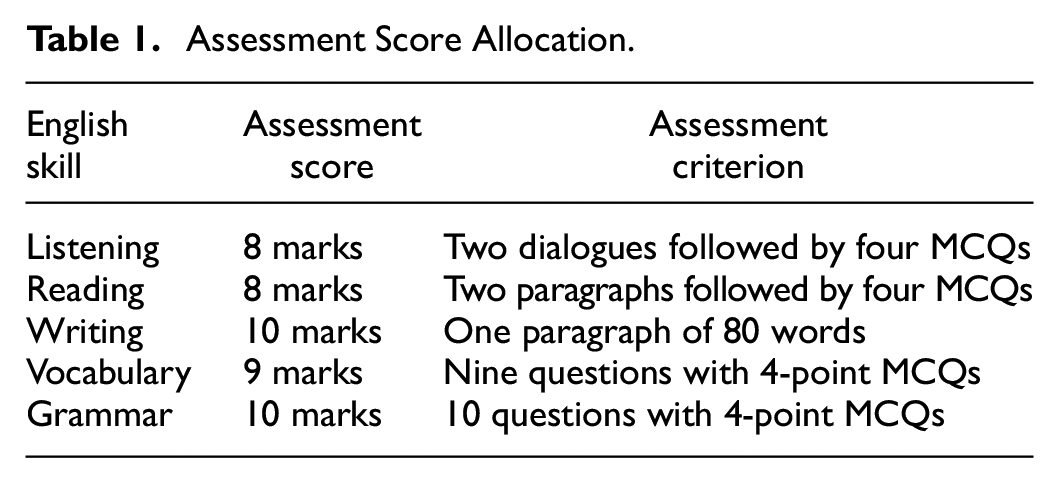
The English course contained various grammar activities in four learning levels, with each level comprised of two skills (reading and writing vs. listening and speaking). The students who decided to study 7 hours on campus were educated through BB with audio and visual aids, with the remaining 8 hours through LMS. Meanwhile, students who completely studied online for 15 hours were educated with the same interactive materials to acquire all four skills through a 3-hour class respectively within a week. The assessment of the inculcated grammatical skills was based on the examination committee’s criteria, as illustrated in Table 1. Although students were allowed to select either physical or online classes, the assessment, mandatory for all students during the second semester, was required to be attended on campus at the stipulated time. Figure 1 describes the lecture delivery process.
Assessment Score Allocation.

The lecture delivery process.
Study Methodology
The study participants were 76 elementary-level medical students who learned English for two semesters before enrolling on college majors based on the English scores. Adequate English knowledge and skill acquisition were essential to pass the assessment, apart from attaining a minimum band score in the IELTS examination. The researcher did not apply any sampling techniques as the students were divided into two experimental groups based on their placement tests. Furthermore, the students who agreed to attend on-campus classes were automatically assigned to the blended-learning group. All participants, aged between 16 and 19 years old, were bilingual males equivalently in Arabic and English determined by the university enrolment administration during registration and placement tests. Participation and data collection consent was also acquired by the examination committee. Table 2 displays the details of the study participants.
The Study Participants.

Study Procedures
The 76 DCFY elementary EFL learners were differentiated into two groups as per personal placement test results and willingness to attend FTF classes, owing to the COVID-19 pandemic. A pre-test was conducted on the third week of the study, which explained online course delivery, learning material, and grammar activities through the LMS for both groups. The control group (online learning) received the recorded videos uploaded by instructors to the LMS. The students were instructed to watch the videos and complete the course as per the provided action plan, while their counterparts in the experimental group (blended learning) received on-campus interactive teaching for 7 weeks before performing web-based learning for 8 hours within a week. Concurrently, the participants were required to complete assignments online. All students participated in a grammar post-test, which included objective MCQs on an answer sheet with each correct response graded as one mark, in the ninth semester week. The order of all test items was shuffled in each study group. The examination score ranged from 0 to 30.
Data Analysis
After calculating the examination scores, the scores were entered into the SPSS file for data analysis. Normality tests were performed to determine the data normality via the Kolmogorov-Smirnov (K-S) test, while the paired t-test, was applied to measure the effects of the learning approaches on grammatical knowledge and skill acquisition.
Results
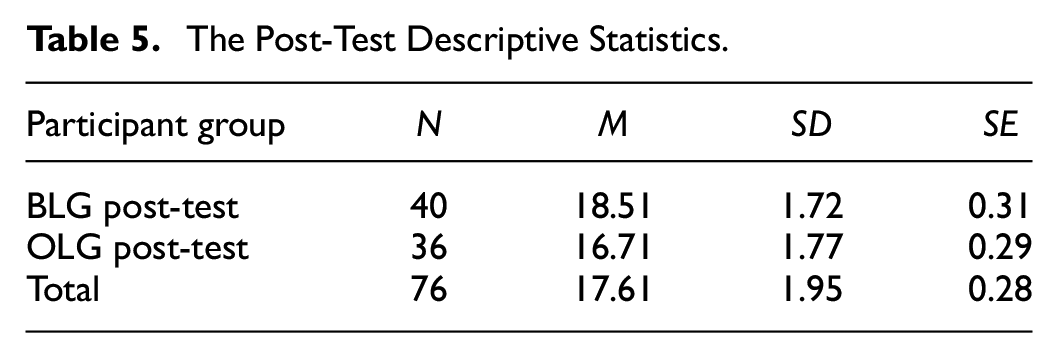
The data normality was determined by checking the data distribution before performing relevant statistical analysis. Particularly, the K-S normality test was conducted on the pre-test and post-test data collected from both groups. Table 3 depicts that the p-values of all data sets are greater than 0.05, which ascertains the data normality in both pre-test and post-test of control and experimental groups respectively. Thus, the parametric test was suitable to be performed in comparing the findings of both study groups. Meanwhile, Table 4 depicts the BLG participants’ average marks (M = 16.12; SD = 1.74) and OLG participants’ mean scores (M = 15.23; SD = 1.78). Table 5 displays the post-test descriptive statistics. A post-test was also performed to discover the grammar performance difference by computing the respective scores of the control and experimental groups. Table 5 demonstrates that the BLG group achieved a mean score of 18.51, while the OLG group obtain an average score of 16.71.
Data Normality.

The Pre-Test Descriptive Statistics.

The Post-Test Descriptive Statistics.
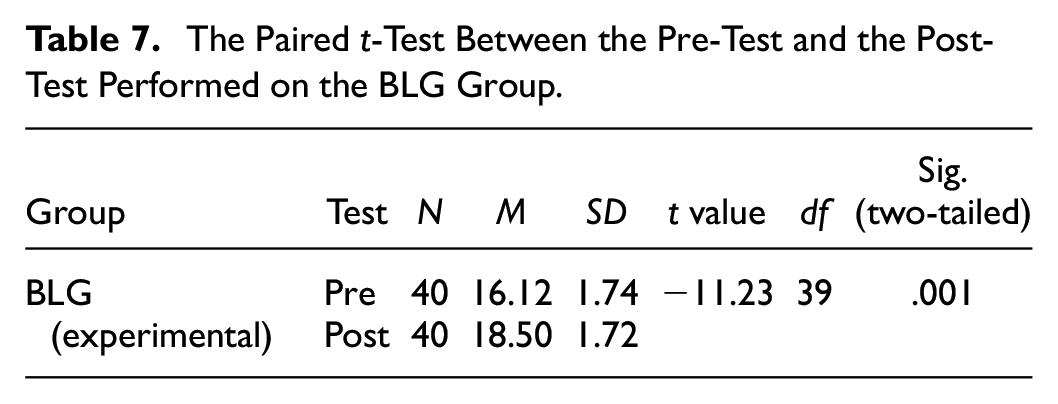
The paired t-test was performed on the respective pre-test and post-test scores of both OLG and BLG groups to discover the statistical difference in the achieved grammar scores. Table 6 displays the paired t-test results in both pre-test and post-test marks of the OLG group. A significant mean score difference (t[35] = −3.49, p = .001) was manifested between the pre-test (M = 15.23, SD = 1.78) and post-test (M = 16.71, SD = 1.77) scores, which revealed that the grammar performance of the OLG group improved from the pre-test to the post-test. Meanwhile, Table 6 illustrated the paired t-test findings in grammar learning of the BLG participants, wherein a significant difference (t[39] = −11.23, p = .001) was unveiled between the pre-test (M = 16.12, SD = 1.74) and the post-test scores. The result highlighted that the grammar performance of the BLG group improved significantly from the pre-test to the post-test, therefore accepting the null hypothesis that no significant difference between the BLG and the OLG approaches (Table 7).
The Paired t-Test Between the Pre-Test and the Post-Test Performed on the OLG Group.

The Paired t-Test Between the Pre-Test and the Post-Test Performed on the BLG Group.
Discussion
The study findings indicated that both blended and online learning approaches positively impacted the grammar learning activities conducted in the English course, although blended learning yielded substantial improvements higher than solely online learning during the COVID-19 pandemic. The results confirmed previous studies (Zhang & Zhu, 2020) revealing the positive influences of both blended and online learning in accomplishing various educational developments. The improved performance via both blended and online learning could result from technology integration, which was essential to the learning experience in enjoying the benefits of technology application. Although learners required certain technical assistance levels to foster the learning process, both BLG and OLG learners perceived the technology usage as engaging and valuable. The findings were consistent with Wright (2017) who observed that blended learning facilitated multiple supportive, attractive, enjoyable, and engaging device activities during material delivery and lecturing. Moreover, the findings were concurrent with Smith and Brame (2017) who demonstrated that technology integration was integral to developing an educational system for native digital learners.
The study findings manifested that blended learning and online instruction allowed learners to acquire knowledge skills independently and through interaction with educators. Castro (2019) discovered that learners could perform the learning process boundaryless and at personal convenience via online platforms. Similarly, Anas (2020) asserted that blended learning could enhance talented learners’ learning process via a personalized learning setting with technology application. Blended learning could also be a valuable interaction source among students and teachers, which served as an essential element in learning. Furthermore, the experimental group, which learned grammar through mixed materials, outperformed the control group receiving solely online education in the current study. The result posited that content delivery via diverse platforms could encourage students’ involvement in various learning activities, when employing digital devices and applications, such as a mobile app, in blended learning (Dziuban et al., 2018). Nonetheless, the difference between BLG and OLG learning performance could be owing to multiple variances, including internet speed, learning environment, study motivation, and learner readiness, during the COVID-19 pandemic (Potra et al., 2021).
The study outcomes indicated that blended learning could resolve time constraints in the classroom for students to practice and complete additional learning activities, which would enable a higher focus on the difficulties yet to be overcome. Zhang and Zhu (2020) affirmed that a blended learning model could assist FTF teachers in effectively delivering learning materials while providing diverse platforms for learners to reflect on their learning. Blended learning could also assist learners in retaining acquired knowledge and skills while providing additional instructional materials (Halverson & Graham, 2019) when learners might explore additional exercises to peruse pre-learned grammatical structures. Additionally, blended learning enabled students to select the most optimal learning method regularly. Meanwhile, the improved grammar performance in the present study suggested that blended learning allowed self-improvement and professional development. Specifically, students who completed coursework under an instructor’s guidance would gain valuable insight into the subject and course contents. The students also acquired practical experience and knowledge from the coursework completion, which could be further applied in the classroom. Teachers who successfully implemented blended learning would benefit from further professional development with the opportunity to provide innovative and high-quality instruction (Darabi & Jin, 2013).
Online courses provided self-testing and assessment of personal capabilities before progressing to more challenging tasks (Burns et al., 2014). Learners could also experience practical exercises, tutorials, and other teaching aids to improve comprehension, memory, and critical thinking. As online courses deliver content electronically, teachers could access the latest research and reliable information to be incorporated into classes to engage and attract students. Teachers could also share detailed information about course objectives, student populations, and study preparation strategies to design engaging courses with adequate challenges in motivating students to perform critical thinking and execute analytical skills. Moreover, online courses deliver course content on digital devices, such as computers, tablets, and other portable devices (Mukhtar et al., 2020), which requires no printed materials or copiers with significant paper cost reduction. Summarily, online learning ensures personal learning convenience without potential classroom disruptions and interruptions, which is especially appealing to working students or frequently occupied individuals.
Although blended learning is more effective than solely online teaching, several limitations exist in the blended learning model (Nguyen, 2017). Nevertheless, experts agree that numerous benefits, including flexibility, eliminating classroom teaching costs, and increased learning opportunities, promote blended learning as a positive alternative to traditional classroom teaching. Prior researchers also indicated that the blended learning benefits, including the overall efficiency in content delivery and instruction quality, outweigh the drawbacks, which tend to be minimal (Koi-Akrofi et al., 2020). Resultantly, incorporating blended learning into the traditional classroom setting and online learning could be a consequential investment for educators and educational institutions in fostering autonomous learning among learners (Khan et al., 2022).
Conclusion
This study examined the influence of online versus blended learning on Saudi EFL students’ grammatical knowledge and skill acquisition. The findings indicated that both blended and online learning produced a considerable beneficial effect on grammar learning activities. Additionally, the results demonstrated that blended learning improved EFL learners’ grammatical knowledge and skills more than online learning, although both learning methods significantly improved students’ grammar. Students were also enthusiastic about the blended learning approach to receive grammatical knowledge and skills, which suggested that online education was preferred over conventional classroom teaching. As such, an effective instructional approach would be conducive to students’ grammar learning and other aspects with sufficient teacher monitoring to constantly motivate learners. Nonetheless, several limitations existed in both blended and online learning during learners’ language development, which called for effective learning management. In certain educational scenarios, online learning platforms did not comprehensively provide learners with sufficient and credible information and resources. For instance, online learning was revealed to be incapable of executing a reliable and automated diagnosis to overcome specific educational challenges. Moreover, certain teachers could not effectively implement online learning due to the lack of technology education in conventional academic activities.
Study Implications
The present study contributed several pedagogical implications, especially for Saudi EFL students at linguistic institutes and universities. The findings also practically assist curriculum developers, training departments, and software developers to effectively deliver content online with fewer hurdles during the COVID-19 pandemic. In this regard, students’ learning performance tracking could be instrumental to gain more detailed operative results. Furthermore, EFL teachers could grasp the significant value of blended learning for EFL medical students’ grammar learning, which would foster the shift toward integrating technology into teaching. The teachers would also transition from instructors to facilitators by repositioning themselves as knowledge guides rather than mere instructors. Meanwhile, the MOE curriculum designers could consider introducing technological tools into various existing curricula to adapt to the challenging COVID-19 situation. Additionally, the MOE could provide computer laboratories and internet access to all educational situations in enhancing technology education. Nevertheless, further studies are recommended to investigate the practicality of blended learning versus online learning in other subject areas. The current study could also be broadened to examine the same research topic in different majors, apart from the medical course among the EFL students.
Footnotes
Declaration of Conflicting Interests
The author(s) declared no potential conflicts of interest with respect to the research, authorship, and/or publication of this article.
Funding
The author(s) received no financial support for the research, authorship, and/or publication of this article.
