




Abstract
Although recent years have seen a growing interest in students’ experiences of boredom in foreign language learning, scant attention has been paid to this negative emotion in online live classes. With a mixed-methods approach, this study investigated what factors were responsible for student boredom in online live classes and what made Chinese students majoring in English more bored in online live classes than in traditional in-person classes. Data were collected through a questionnaire and focus group interviews. Quantitative and qualitative data analyses revealed that the main factors responsible for this negative emotion in online live settings were teacher-centered classes, less engagement and interaction, high task challenges, monotonous and long learning activities, textbook-based activities, students’ lack of self-discipline, peer influences, the absence of emotional support, unreliable internet connection, physical fatigue, a locked-down campus, and a dormitory learning environment. Students’ greater boredom in online live settings than in-person settings arose from student-related factors, technological factors, and environment-related factors. This study sheds light on how to alleviate student boredom in foreign language learning in online live settings.
Plain language summary
With a mixed-methods approach, this study aimed to investigate what factors were responsible for student boredom in online live classes and what made EFL students more bored in online live classes than in traditional in-person classes. Data were collected through a questionnaire and focus group interviews. Quantitative and qualitative data analyses revealed that the main factors responsible for this negative emotion in online live settings were teacher-centered classes, less engagement and interaction, high task challenges, monotonous and long learning activities, textbook-based activities, students’ lack of self-discipline, peer influences, the absence of emotional support, unreliable internet connection, physical fatigue, a locked-down campus, and a dormitory learning environment. Students’ greater boredom in online live settings than offline settings arose from student-related factors, technological factors, and environment-related factors. The findings in this study have implications for practitioners seeking to alleviate this negative feeling in online live classes. To enhance the effectiveness of online live learning, it is important for instructors to provide timely emotional support for students, create a good learning environment, design more interactive activities, change teacher-centered classes into student-centered classes, avoid monotony in teaching methods, design tasks based on students’ needs, decrease screen time, etc. The study has two limitations. First, the sample size was relatively small, which might limit the generalizability of the results. Second, the data were collected at the end of the semester, with students recalling their experience, which might overlook their immediate instances of boredom and their dynamic change of this negative emotion.
Introduction
Boredom is widely recognized in educational settings (Pekrun et al., 2010; Zawodniak et al., 2017), particularly within the realm of foreign language teaching and learning (Chapman, 2013). It has negative influence on students’ learning (Li & Dewaele, 2020). For instance, it can lead students to lose interest in learning, become demotivated to engage in learning tasks, and ultimately withdraw from the learning process (Tvedt et al., 2019). Several empirical studies have addressed boredom in foreign language learning (e.g., Chapman, 2013; Kruk et al., 2021; Li & Han, 2022; Nakamura et al., 2021; Pawlak et al., 2020), which prove that boredom is usually neglected by teachers in traditional in-person classes (Macklem, 2015).
With the convergence of the internet and education and the frequent shift from face-to-face classrooms to emergency online courses during the COVID-19 crisis, online learning has become an increasingly popular option for English as a Foreign Language (EFL) learners. In online settings, it is even more challenging for teachers to identify and address students’ boredom (Derakhshan et al., 2021). In addition, it has been recognized that students experience a higher level of boredom in online settings than in traditional settings (Derakhshan et al., 2021; Li & Dewaele, 2020; Li & Han, 2022; Pawlak et al., 2021). However, with little empirical research undertaken, boredom in online language learning settings remains underappreciated (Derakhshan et al., 2021; Kruk et al., 2022), which creates a need for more studies on online language learning boredom to fill this gap. The objective of this study is to explore the factors contributing to student boredom in online live classes and to identify why students experience greater boredom in online live classes compared to traditional in-person classes.
Literature Review
The Definition of Language Learning Boredom
Boredom was introduced into foreign language research by Chapman (2013). It is defined as “some form of disengagement from classroom activities” caused by several factors (Kruk et al., 2021, p. 18). When students are bored, they feel disengaged, dissatisfied, and less interested in the learning activities (Macklem, 2015). The degree of emotional intensity associated with boredom fluctuates (Derakhshan et al., 2021; Fahlman, 2009). Concerning stability, two basic types of boredom have been identified: trait boredom and state boredom. Trait boredom, a person-based boredom proneness, is relatively stable (Bench & Lench, 2013), while state boredom is a situation-based transient emotion (Vogel-Walcutt et al., 2012). In the present study, boredom is mainly conceptualized as state boredom, “the momentary or transient affective experiences during English lessons or of a single English lesson” (Li, 2021, p. 320).
Factors Responsible for Boredom in Traditional EFL Classrooms
Since the beginning of the 2010s, interest in boredom in traditional EFL classrooms has grown considerably (e.g., Chapman, 2013; Kruk, 2016; Kruk & Zawodniak, 2018, 2020; Nakamura et al., 2021; Pawlak et al., 2020; Zawodniak & Kruk, 2019; Zawodniak et al., 2017, 2021). Some instructors and researchers have mainly concentrated on examining the causes of boredom (e.g., Nakamura et al., 2021).
Several teacher-related factors, task-related factors, and learner-related factors have been found to evoke boredom among EFL learners. According to Chapman (2013), the factors that evoked boredom consisted of under-challenging tasks, coursebook-based activities, emotions regarding the teacher, and disengaged classmates. In another study, five groups of factors that triggered boredom were identified among 115 advanced EFL learners: “language tasks, the teacher, modes of class organization, class components, and others” (Zawodniak et al., 2021, p. 22). Nakamura et al. (2021) further specified nine factors as the antecedents of boredom: “activity mismatch, lack of comprehension, insufficient L2 skills, task difficulty, input overload, and lack of ideas, learners’ physical fatigue, unfavorable appraisals of classroom tasks, and negative behaviors of classmates” (p. 1).
Factors Responsible for Boredom Regarding Online EFL Settings
As the internet and education combine to provide EFL students with more opportunities to learn English, there has been a huge increase in online learning over the past 10 years. In addition, during the COVID-19 crisis, EFL learning has constantly shifted from in-person to emergency online classes. However, boredom in online EFL learning has received little attention from researchers.
Up to now, only a few studies have been directly related to this issue. For example, Derakhshan et al. (2021) investigated the antecedents of boredom among 208 Iranian EFL learners in online classes. They found that boredom mainly arose from “teachers’ monologues, lack of student participation, logistical problems, and carelessly chosen, repetitive tasks” (p. 1). Li and Dewaele (2020) also investigated EFL class boredom in an online setting and its links with trait emotional intelligence and learning achievement perceptions. They highlighted that “boredom is associated with some negative feelings, including lack of interest, restlessness, dislike, sleepiness, depression, tiredness, struggle, guilt, dreariness, helplessness, frustration, anxiety, and dissatisfaction” (p. 34). In another study, Kruk et al. (2022) investigated the causes of boredom under different ecosystemic levels. They found that the main sources of boredom consisted of technology, teachers and peers, online tools, tasks and activities, learning experiences, distractions at home, online platform, the design of curriculum, online platform literacy (p. 1).
Foreign language learning boredom was also indirectly addressed in online emergency English courses in China by Li and Han (2022). They surveyed 348 first-year EFL learners in China and found that students in online classes had a moderate level of boredom and that their boredom levels were rising due to forms of teacher-student interaction, limited learning resources, and technical equipment dependence. In another study, Yang et al. (2021) explored boredom with other achievement emotions experienced by six Chinese EFL students in online settings. Qualitative analysis showed that students felt bored because of poor learning content and monotonous ways of teaching.
The research focus on student boredom related to EFL learning in online settings is similar to that in traditional face-to-face settings. Researchers have concentrated on examining the factors responsible for this negative emotion. However, scant attention has been paid to student boredom in online language learning environments (Li & Dewaele, 2020), especially in online live settings. Although online teaching is a very important teaching form, to date, only a few studies have addressed the boredom of EFL students in a Chinese context. Moreover, few studies have explored why students experience a higher level of boredom in online settings than in offline settings.
Research Questions
To fill this gap and contribute to the understanding of EFL student boredom in online settings, this study aims to explore the factors leading to this negative emotion. Specifically, it seeks to understand why EFL students experience greater boredom in online live settings compared to traditional, in-person settings. The following two questions are addressed:
RQ1: What factors are responsible for student boredom in online live classes?
RQ2: What makes online live classes more boring for students than traditional face-to-face classes?
Theoretical Framework
Many theories and models have explained the phenomenon of boredom from the perspective of its inducing factors. Among these, the forced-effort model, proposed by Hill and Perkins (1985), explains the experience of boredom in educational settings. According to this model, boredom mainly results from repetitive and monotonous tasks, teacher-centered instruction, and students’ degree of autonomy in their learning. Similarly, the control-value theory of achievement emotions (Pekrun, 2006) investigates how students perceive their control over tasks and the value assigned to them. Boredom arises when students lack control over or have difficulty recognizing the value of the tasks that they are engaged in. This theory considers both student-related and task-related factors in its examination of boredom and related emotions. Drawing from the insights of the forced effort model and the control-value theory of achievement emotions, we can ascertain that student boredom is shaped by three dimensions of influencing factors: teachers, tasks, and students. These factors primarily relate to the stimuli triggering boredom among students in traditional classroom settings.
Nevertheless, it is important to note that within an online learning environment, factors associated with the internet or instruments can evoke boredom in EFL classrooms (Derakhshan et al., 2021; Kruk et al., 2022; Wang, 2023). In addition, online learning environments can also induce feelings of boredom (Kruk et al., 2022). Therefore, when exploring boredom in online settings, it is essential to consider both internet or instrument-related boredom and environment-related boredom as significant components. As a result, this study adopts a comprehensive approach by considering factors within five distinct dimensions when examining student boredom in online settings: teacher-related, task-related, student-related, internet-related or instrument-related, and environment-related factors. This holistic framework integrates insights from established theory and model, and existing literature on boredom to offer a thorough understanding of its intricate nature in foreign language learning settings.
Methodology
To address the two research questions, the present study used an explanatory sequential mixed methods approach (Creswell, 2014). Quantitative data can be generalized to a larger population, while qualitative data can provide an in-depth look at personal experiences. Combining the two offers a better understanding of the research questions (Creswell, 2014).
Context
The study was conducted at a university in China. There are 16 weeks in one semester at the university. In the first semester of the year 2022, students attended traditional face-to-face classes for the first 7 weeks. However, the COVID-19 epidemic spread again around week 8. Consequently, all the classes at the university had to change to emergency online live teaching, which lasted for the following 8 weeks. During this period, most teachers taught through Tencent Conference, a platform similar to Zoom. Students used smartphones, tablets, or computers to attend online classes in their dormitories, with each dormitory accommodating six students. For these 8 weeks, students were required to remain on campus, with only limited exceptions for leaving, to protect them from infection with the virus. As the pandemic was under control by week 15, students resumed attending traditional in-person classes in week 16 (Figure 1).
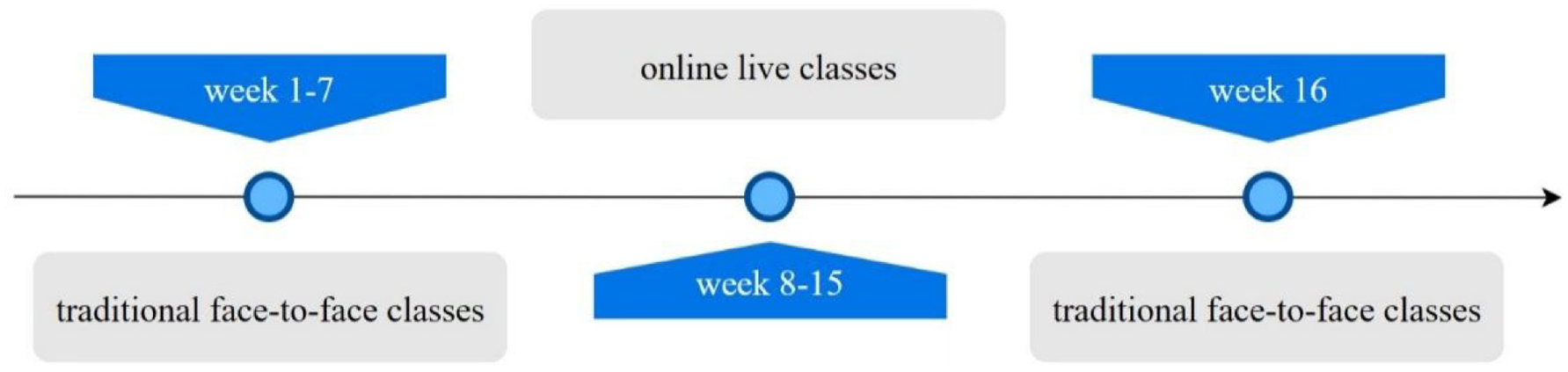
The timeline for switching class modes.
Participants
The participants were English majors, ranging from freshmen to juniors, including both genders, and aged between 18 and 22. Seniors were excluded as they had no classes in their last semester, mainly working on internships, writing their graduation thesis, and preparing for graduation. A total of 169 undergraduate students participated in this study. Among them, 28 questionnaire respondents participated in follow-up interviews. See Table 1 for more demographic information.
Demographic Information of the Participants.

Instruments
A questionnaire and semi-structured focus group interviews were used to collect data. Adapted from The Foreign Language Learning Boredom Scale (Li et al., 2021), the questionnaire was designed to retrieve quantitative data on participants’ demographic information and their experiences of boredom. The questionnaire comprised two main sections (see Supplementary Material). The first section addressed boredom in offline line settings, and the second one in online settings. To evaluate student boredom in offline settings, data were gathered across three dimensions: teacher-related boredom, task-related boredom, and student-related boredom. In addition to these three dimensions, two supplementary dimensions, namely internet-related or instrument-related boredom, and environment-related boredom, were included to capture data unique to the online settings. Therefore, the investigation of differences between online and offline boredom focused on the first three dimensions. All the statements in the questionnaire were in Chinese to avoid misinterpretation. The questionnaire comprised 18 items on a 5-point Likert scale (1 = strongly disagree, 2 = disagree, 3 = neutral, 4 = agree, 5 = strongly agree). The results of Cronbach’s alpha reliability indicated that the questionnaire enjoyed good reliability in the present study (α = .975). The validity of the questionnaire was tested using the KMO and Bartlett’s tests and was analyzed via SPSSAU (https://spssau.com), the online SPSS tool. The results showed that the KMO value of the questionnaire was 0.904, which was higher than 0.8. This indicates that the research data were highly suitable for information extraction, and the questionnaire had good validity.
The semi-structured interview mainly consisted of two questions: (a) What made you feel bored in online live English classes? Please give two examples. (b) What made you feel bored in traditional face-to-face English classes? Please give two examples.
Data Collection and Analysis
The quantitative data were collected first. The online questionnaire was administered at the end of week 16. It was distributed through social media groups among English majors. A total of 169 students took part in the survey; 164 effective questionnaires were obtained. Among the respondents, there were 76 freshmen, 33 sophomores, and 55 juniors; 150 identified as female and 14 as male. Descriptive statistics were conducted using The SPSSAU Project (2022). To detect differences in factors responsible for boredom in the three dimensions (teacher-related boredom, task-related boredom, and student-related boredom) between online live English classes and traditional face-to-face English classes, the paired samples t-test was used.
Then the qualitative data were collected and analyzed. Twenty-eight survey participants expressed their willingness to take part in the follow-up focus group interview. Semi-structured interviews in groups of four were conducted face-to-face, with each interview lasting from 30 min to an hour. The interviews were carried out in Chinese to allow the participants to express their answers freely. With the permission of the participants, the interviews were recorded with a smartphone, transcribed through Xun Fei Yu Ji—a transcription tool—and checked by the researchers. The transcribed text consisted of a total of 32,655 words. The interview data were analyzed with the thematic analysis approach by the two researchers separately. Any discrepancies were resolved through discussion until an agreement was reached. To protect the privacy of interviewees, pseudonyms were used when reporting the results.
Findings
This section presents the results of the questionnaire and interviews from five dimensions: teacher-related boredom, task-related boredom, student-related boredom, internet-related or instrument-related boredom, and environment-related boredom.
Teacher-Related Boredom
There were three items about teacher-related boredom in the questionnaire. Table 2 shows the levels of teacher-related boredom students experienced in online live classes and traditional in-person classes. The mean scores of online live classes were all slightly higher than those of in-person classes, but no statistically significant difference was found. It indicates that there was no difference in the levels of teacher-related boredom between the two different settings.
Differences in Teacher-Related Boredom Between Online Live and Offline Settings.

Regarding item 1, students experienced a low level of boredom in teacher-centered classes, both in online settings and traditional classroom settings, with mean scores of 2.58 and 2.50 respectively. The results show that teachers were still responsible for students’ boredom, whether in online live classes or traditional face-to-face classes. This was supported by the interview findings, which highlighted that in teacher-centered classes, teachers’ monologues contributed to students’ distraction and frustration. The issue is illustrated by the following comments from one interviewee:
In online or offline settings, we were bored when teachers kept talking and did not lead us to participate in any activities during the whole class. It seemed that we were all listening attentively. In fact, our minds wandered away. But the teacher did not notice it and kept talking. (Group Interview 1, Clara)
Lack of interaction and involvement proved equally boring in online live classes and in-person classes, as indicated by almost similar mean scores for item 2 (2.67 and 2.66) and item 3 (2.76 and 2.71). One interviewee also commented:
The teachers should involve us in thinking together. If they do so, we will be happy to learn because we will have a sense of achievement. For example, when our teacher asks us a question and we are able to answer it, it will encourage us to continue to learn. Even if we do not know how to answer the question, we are still motivated to seek out the answer. (Group Interview 5, Rose)
Task-Related Boredom
There were five items regarding task-related boredom. The mean scores of student boredom in online classes for items 4, 5, and 7 were slightly higher than those of in-person classes, although the statistics do not show significant differences (see Table 3). It indicates that activities focusing on learning a textbook, doing the same type of exercises and simple learning tasks caused almost similar levels of boredom both in online classes and offline classes. Regarding item 7, participants experienced comparatively lower levels of boredom when doing simple tasks in both online and offline settings, with mean scores of 2.47 and 2.42 respectively.
Differences in Task-Related Boredom Between Online Live and Offline Settings.
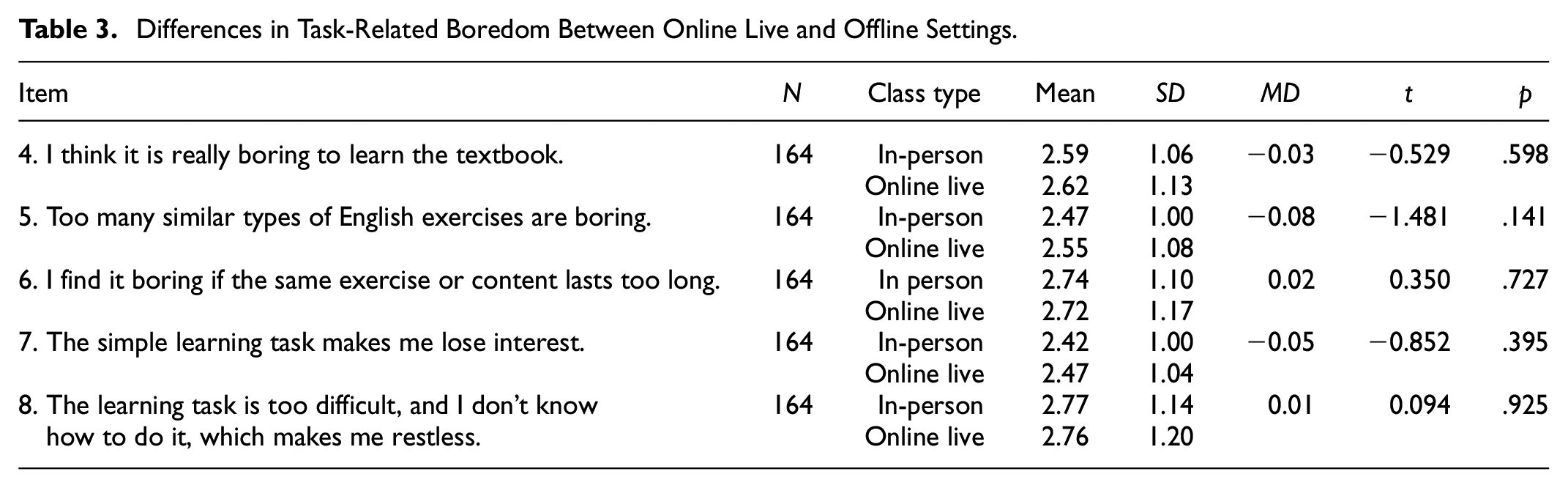
As for items 6 and 8, the mean scores in online settings were slightly lower compared to those in offline settings. However, the statistics also do not show significant differences. In online settings, participants manifested their boredom by engaging in other activities. According to one of the interviewees, although they showed up at the Tencent Conference, they were cyberloafing, chatting with their roommates, or doing other things as the teachers could not see them in online classrooms. In traditional classrooms, however, they could not do these things under the direct supervision of teachers. These things they did in online live classes might relieve their boredom to a certain extent.
It is worth mentioning that the mean score of item 8 was the highest in the traditional classroom (M = 2.77, SD = 1.14), followed by the online classroom (M = 2.76, SD = 1.20). The statistics show that over-challenging tasks were more likely to induce boredom than under-challenging tasks. One of the interviewees mentioned:
When the task was too difficult, I felt bored because I didn’t know how to do it. I was so frustrated that I was unable to concentrate for the rest of the class, which led to more boredom. (Group Interview 4, Alice)
Another interviewee further provided evidence for the notion that greater boredom arose from over-challenging tasks than under-challenging tasks. She said:
The texts we learn in the intensive reading course are too long, and there are many unfamiliar words. It was challenging for me to concentrate when the teacher discussed these texts in class. If the texts are a bit shorter and have fewer unfamiliar words, I probably won’t feel as bored. (Group Interview 7, Amanda)
Student-Related Boredom
Regarding student-related boredom in online live classes and offline classes, the results of the paired samples t-test show significant differences between the two settings (see Table 4, p < .05).
Differences in Student-Related Boredom Between Online Live and Offline Settings.
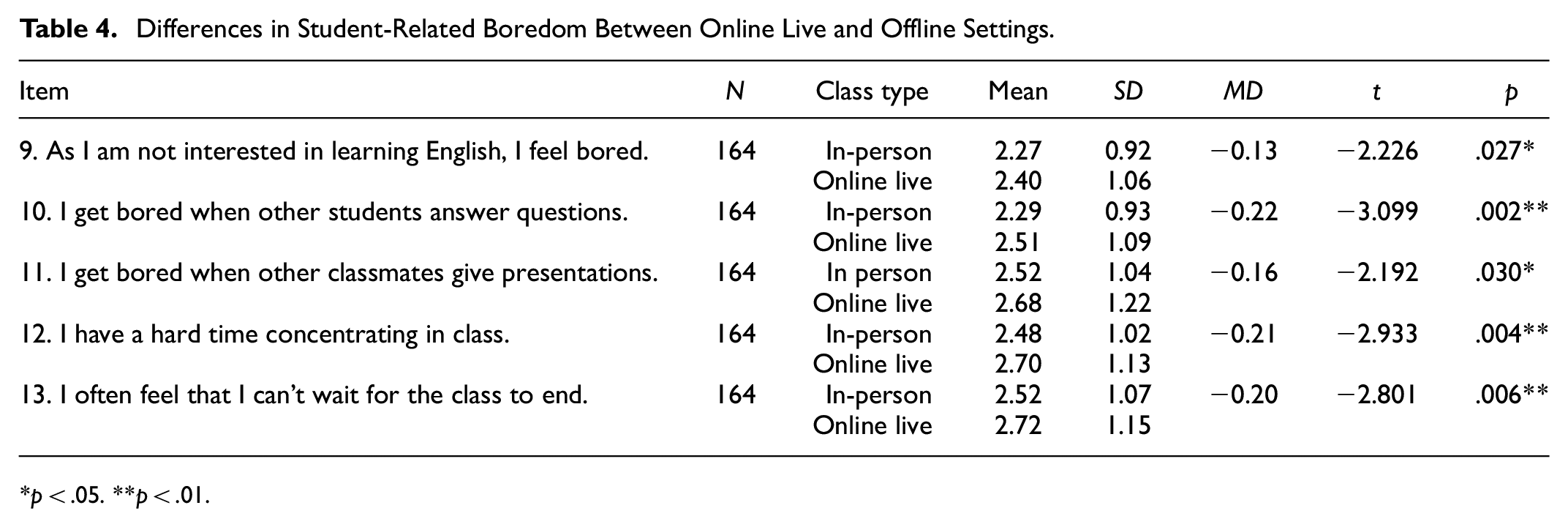
p < .05. **p < .01.
As illustrated for item 9 in Table 4, the boredom levels both in online live settings (M = 2.40, SD = 1.06) and traditional in-person settings (M = 2.27, SD = 0.92) were comparatively low. However, participants who did not like English learning experienced more boredom in online live classes (p < .05).
As for items 10 and 11, when other students answered questions or gave presentations, the rest of the students were more inclined to be bored in online live settings than in offline settings. The following responses in the interviews exemplify this issue:
During online classes, when the teacher asked my classmates instead of me to answer questions, I breathed a sigh of relief. What my classmates said was none of my business. I just sat there, my mind wandering. (Group Interview 3, Jessie) The voices of some of my classmates when answering questions were so low that I couldn’t even figure out what they were saying. It just couldn’t keep me from becoming bored. (Group Interview 2, Taylor) I experienced boredom, especially when the online presentation was poorly prepared. The presenter just read the lines in the PowerPoint to herself. I almost dozed off in my dorm room, waiting for the end of the presentation. (Group Interview 6, Susan)
As for item 12 with a mean score of 2.70 and item 13 with a mean score of 2.72 in online live settings, the difference was remarkable between online live classes and the traditional in-person classes (p < .01). This indicates that it was harder for students to concentrate and that they were less engaged in online live classes. One interviewee mentioned in the interview:
In online classes, I had both my phone and computer in my hand, and the teachers couldn’t see me. It was easier to wander off at this time. Even if I wanted to listen attentively to the teacher, the messages that popped up on my phone were so attractive that I just unconsciously clicked on them, which was likely to distract me from learning in class. (Group Interview 1, Judy)
However, students with higher self-discipline seemed to suffer less boredom than their peers in online classes. They reported a lower level of boredom in online settings. For instance, one of the students in the interview mentioned that she experienced less boredom in her online English classes. Instead of attending online live classes in her dormitory, she went to the library to attend the class with her phone and earphones, and recorded the courses. She noted:
In traditional classrooms, sitting at the back, I couldn’t see the screen clearly. In addition, I couldn’t go back to figure out what I didn’t understand again. With a mobile phone for online classes, the screen was clearer, and I could review the course through the recorded videos. (Group Interview 5, Amy)
Internet-Related or Instrument-Related Boredom
Students experienced a medium level of boredom in online live classes related to the internet or instrument, as shown by the mean scores for item 14 (M = 3.10, SD = 1.27), item 15 (M = 3.09, SD = 1.27), and item 16 (M = 3.07, SD = 1.22; see Table 5).
Students’ Internet-Related or Instrument-Related Boredom in Online Live Classes.

Item 14 got the highest mean score (M = 3.10, SD = 1.27). It indicates that students experienced the most boredom with the poor internet connection. This is also reflected in the following comment from one interviewee:
As almost all students in the school were taking online classes at the same time, it was no surprise to have network congestion. Sometimes, the network got stuck several times in one hour. At that time, I was extremely bored. Even after the internet returned to normal, the boredom remained, affecting my concentration in the rest of the class. (Group Interview 4, Jack)
As for item 15 with a mean score of 3.09, a possible reason was that some students were inclined to get exhausted staring at the small screen of their smartphones since they had to attend the classes online for 4 to 6 hours a day, 5 days a week. One interviewee noted:
My eyes were very tired after attending online live classes all day long. We had at least 4 to 6 hours of online live classes each day from Monday to Friday. Besides, we had to do a lot of online assignments after class. (Group Interview 1, Andy)
Physical tiredness, especially eye tiredness, elicited boredom among students in online live classes. Moreover, in the interview, some participants complained that staying up late and lacking sleep gave rise to boredom, especially in online live classes. In addition, some students mentioned that they were starving near lunchtime, which distracted them from class proceedings.
Regarding item 16 (M = 3.07, SD = 1.22), one significant challenge in the context of online live learning was that the teacher could not see the students through the teaching platform Tencent Meeting, which was responsible for student boredom. The students were unable to receive emotional support due to the lack of eye contact or face-to-face communication between the teacher and the students in the online environment. Some of these issues are illustrated by the following comments:
In traditional face-to-face classes, I got a lot of emotional support from teachers’ smiles, eye contact, and other forms of body language. In online classes, I felt emotionally distant from them. Online learning lacked a human touch. It was easy to feel bored. The time spent attending online classes seemed to pass slowly. (Group Interview 5, Tom)
Environment-Related Boredom
The results of descriptive statistics on students’ environment-related boredom in online live classes are presented in Table 6, which shows participants experienced a medium level of boredom.
Students’ Environment-Related Boredom in Online Live Classes.

As can be seen in Table 6, students’ learning was affected by their dormitory environment (M = 3.10, SD = 1.24). The analysis of the interview data further demonstrates that the misbehavior of roommates in online live classes contributed to student boredom. In the interviews, some students complained that they experienced significant disruptions from their roommates during their online live learning. It is reflected in the following remarks:
During my online learning, I found myself frequently distracted by my roommates. Two of them were from other majors, and our class schedules were different. When I attended the class, I had a hard time concentrating on what the teacher was saying because my roommates were talking loudly, playing video games, or doing other things. They were driving me to boredom. (Group Interview 5, Sarah) When the class began, especially the first class in the morning, some of my roommates did not even get up from bed, and other roommates were having their breakfast. Our teachers knew nothing about this. There was no learning atmosphere in my dorm. (Group Interview 6, Mia)
Interestingly, compared to online learning settings, peers relieved their boredom in traditional in-person settings. It is exemplified by the following excerpt:
In traditional classes, my classmates prevented me from being bored. For example, in group projects, we helped and learned from each other. Besides, when some of us did well, they became role models, which motivated me to do better. (Group Interview 1, Emily)
Moreover, students were restricted from leaving the school during the lockdown period, with only a few exceptions allowed, to protect them from potential virus exposure. The sudden switch to online learning settings exerted mental pressure on students to a certain extent. They suffered a medium level of boredom (M = 2.81, SD = 1.24). Comparatively speaking, the students were less affected by the school environment than by the dormitory setting, and they might have gotten used to the occasional lockdown with the epidemic having been raging for more than 2 years.
In short, the dormitory learning environment, peers, and lockdown campus were all boredom-inducing factors in online live classes.
Discussion
The two research questions of this study aimed to explore what factors were responsible for student boredom in online live classes and what made online live classes more boring for students compared to traditional in-person classes. In the following sections, the findings related to each research question are discussed.
Research Question 1: Factors Responsible for Student Boredom in Online Live Classes
Regarding the factors responsible for student boredom in online live classes, most participants in this study attributed it to teacher-centered classes, less engagement and interaction, high task challenges, monotonous and long learning activities, textbook-based activities, a lack of self-discipline, peer influences, the absence of teacher emotional support, an unreliable internet connection, physical fatigue, the locked-down campus, and the dormitory learning environment.
These findings on boredom-inducing factors largely resonate with those of previous studies, such as teacher-centered classes (Resnik & Dewaele, 2021), less engagement and interaction (Kruk & Zawodniak, 2020), too high task challenges (Zawodniak et al., 2017), monotonous learning activities (Pawlak et al., 2020), textbook-based activities (Chapman, 2013), absence of teacher emotional support (Kruk et al., 2022), an unreliable internet connection (Derakhshan et al., 2021; Kruk et al., 2022 ), peer influences (Derakhshan et al., 2021; Nakamura et al., 2021), physical tiredness (Nakamura et al., 2021; Zawodniak et al., 2021).
Although the results mirror to some extent those obtained in previous studies, conspicuous by its absence is a lack of self-discipline. Participants in this study blamed their experience of boredom on their lack of self-discipline. This parallels the results from Li and Han (2022), who showed that in the absence of external guidance typically provided by the teacher in traditional classroom settings, online learning demanded greater self-regulation ability from students. According to Li and Dewaele (2020), “EFL learners with a high level of self-control are competent in managing boredom-inducing situations” (p. 41).
In this study, peer factors were identified as sources of boredom in online settings, whereas they served as sources of emotional support and collaborative learning in traditional face-to-face settings. Students in traditional classrooms benefited significantly from interactions with their peers under the direct supervision of the teacher. This finding aligns with Gordon et al. (1997), who showed that boredom was situation-dependent.
The participants in this study mainly blamed themselves for their boredom. Conversely, boredom in previous studies was by and large associated with the “negative aspects of lessons and teachers” (Nakamura et al., 2021, p. 4). A possible explanation could be the cultural differences: Chinese students tend to be influenced by China’s long-standing tradition of respecting their teachers.
Moreover, physical tiredness is not perceived as a major factor generating boredom in previous research (e.g., Zawodniak et al., 2021). However, in this study, participants complained that physical tiredness, such as tired eyes, hunger, and lack of sleep, greatly distracted them from online learning.
Research Question 2: What Makes Online Live Classes More Boring for Students
The second research question examined what made live online classes more boring than traditional in-person classes. The participants reported experiencing more boredom in online live classes than in-person classes, mainly because of student-related factors, technological factors, and environment-related factors.
Regarding student-related boredom, the participants tended to blame their experience of boredom in online classes on their lack of self-discipline. For example, during the interviews, many students admitted to struggling with self-control, especially in online live classes, where they found it more challenging to resist the temptation of checking messages on their smartphones. This can be explained by the control-value theory of achievement emotions (Pekrun, 2006). When students lose control over or perceive little value in the learning tasks, their attention will be attracted to something more interesting.
As for teacher-related boredom, students experienced similar levels of teacher-related boredom in online live and traditional in-person settings. The findings are in line with several studies reporting the boredom caused by teacher monologues (e.g., Derakhshan et al., 2021; Pawlak et al., 2021). Students prefer more teacher-student interaction, as teacher monologue is identified as one of the main sources of boredom in online classes (e.g., Derakhshan et al., 2021; Yang et al., 2021). The participants reported that, both in online and offline settings, even when they were bored with the teacher’s monologues, they still pretended that they were listening attentively. This is in line with Kruk and Zawodniak (2018), who found that the majority of students concealed their boredom in the classroom.
Regarding task-related boredom, students experienced similar levels of boredom in both online and offline settings, which is consistent with the findings of Derakhshan et al. (2021), who suggested that over-challenging and under-challenging tasks were primarily responsible for student boredom. However, the findings in this study show that over-challenging tasks were more likely to elicit boredom than under-challenging tasks.
As for internet-related or instrument-related factors unique to online live classes, the findings of this study mirror those of Derakhshan et al. (2021) and Pawlak et al. (2021), indicating that the logistics of online learning, such as poor internet connection, were responsible for this negative feeling.
Finally, the locked-down campus and the dormitory learning environment, as boredom-inducing factors, have not been mentioned in other studies. A possible explanation is that the sudden shift into online emergency learning caught universities unprepared. The outbreak of the pandemic created an urgent need for universities to adapt to the shift from traditional classrooms to online classrooms. Similarly, in other studies (e.g., Kruk et al., 2022), when students attended online classes from home, they reported issues such as interruptions from home phones as sources of boredom and great distractions from learning. This suggests that neither school dormitories nor homes are ideal environments for students’ learning.
Conclusion
The current study used a mixed-methods approach to explore the underlying reasons for the boredom experience of Chinese EFL students in an online live learning environment and to investigate what made online live classes more boring than traditional face-to-face classes for students. Firstly, the main factors responsible for this negative emotion in online live settings were teaching style, less engagement and interaction, highly challenging tasks, monotonous and long learning activities, textbook-based activities, a lack of self-discipline, peer influences, the absence of teacher emotional support, internet connection issues, physical fatigue, a locked-down campus, and the dormitory learning environment. Although the causes of boredom in an online live EFL learning environment are largely consistent with those identified in previous research, the findings in this study allow for a better understanding of such broad reasons for student boredom. Secondly, students experienced more boredom in online live classes than in in-person classes, mainly because of student-related factors. In addition, internet-related or instrument-related factors and environment-related factors unique to online live learning also contributed to more boredom in online settings.
The findings from this study have implications for practitioners seeking to alleviate this negative feeling in online live classes. To enhance the effectiveness of online live learning, it is important for them to provide timely emotional support for students, create a good learning environment, design more interactive activities, change teacher-centered classes into student-centered classes, avoid monotony in teaching methods, design tasks based on students’ needs, reduce screen time, among other strategies.
Although the study sheds light on student boredom in online live EFL classes at the university level, it is acknowledged that the study has two limitations. First, the sample size was relatively small, which might limit the generalizability of the results. Second, the data were collected at the end of the semester, with students recalling their experiences, which might overlook their immediate instances of boredom and their dynamic change of this negative emotion. Based on these findings, there is a need to conduct a longitudinal study to document the changes in student boredom in online live classes over time.
Footnotes
Acknowledgements
The authors genuinely appreciate the insightful and constructive comments raised by the venerable anonymous reviewers.
Declaration of Conflicting Interests
The author(s) declared no potential conflicts of interest with respect to the research, authorship, and/or publication of this article.
Funding
The author(s) disclosed receipt of the following financial support for the research, authorship, and/or publication of this article: This research was supported by National Foreign Language Education Foundation Program (No. ZGWYJYJJ11A126).
Ethical Approval
The studies involving human participants were reviewed and approved by Shandong Women’s University. The participants provided their written informed consent to participate in this study.

Data Availability Statement
All relevant data that support the findings of this study are available from the corresponding author upon reasonable request.
Questionnaire on Foreign Language Learning Boredom
Traditional in-person class
It is difficult for me to concentrate in a teacher-centered class. With little interaction in class, I get bored. My mind begins to wander when I’m unable to participate in class. I think it is really boring to learn the textbook. Too many similar types of English exercises are boring. I find it boring if the same exercise or content lasts too long. The simple learning task makes me lose interest. The learning task is too difficult, and I don’t know how to do it, which makes me restless. As I am not interested in learning English, I feel bored. I get bored when other students answer questions. I get bored when other classmates give presentations. I have a hard time concentrating in class. I often feel that I can’t wait for the class to end.
Online live class
It is difficult for me to concentrate in a teacher-centered class. With little interaction in class, I get bored. My mind begins to wander when I’m unable to participate in class. I think it is really boring to learn the textbook. Too many similar types of English exercises are boring. I find it boring if the same exercise or content lasts too long. The simple learning task makes me lose interest. The learning task is too difficult, and I don’t know how to do it, which makes me restless. As I am not interested in learning English, I feel bored. I get bored when other students answer questions. I get bored when other classmates give presentations. I have a hard time concentrating in class. I often feel that I can’t wait for the class to end. When the Internet is stuck during the classes, I feel agitated. I get bored after long hours learning with my smartphone because my eyes are tired. I feel bored, as there is no face-to-face communication or eye contact with the teacher. In the closed school environment, I was in a bad mood and felt unmotivated to learn in class. As there is no learning atmosphere in my dormitory, my mind tends to wander during class.