




Abstract
While Pay-What-You-Want (PWYW) gives customers pricing control, prior research has primarily emphasized its financial aspects, leaving its impact on non-financial outcomes, such as post-PWYW customer behavior, largely unexplored. In particular, the non-financial effects of PWYW have not been fully examined after controlling for the effects of increased self-efficacy due to pre-payment service use. We hypothesized that customers with higher self-efficacy due to service use and larger payments in PWYW will demonstrate a stronger willingness to participate in value co-creation. Results of online experiments using a hypothetical scenario centered on new-age music confirmed the hypothesis. This study broadens the scope of PWYW studies in two significant ways. First, it suggests that power derived from service experience and confidence should be distinguished from that derived from pricing mechanisms. Controlling for changes in power derived from service use accurately determines the relationship between PWYW and power. Second, this approach explores non-financial outcomes, particularly the influence of the PWYW experience on customers’ willingness to participate in value co-creation, and provides empirical evidence. Additionally, we provide practical insights for companies considering PWYW adoption, emphasizing the influence of the PWYW experience on customer–provider relations.
Plain language summary
This article focuses on the impact of Pay What You Want (PWYW) pricing on customer behavior and on customers’ willingness to participate in value co-creation. PWYW is a unique pricing mechanism in which providers involve their customers in pricing and give them maximum control over a product or service’s final price. We hypothesized that as customers’ confidence and power grow during the service consumption experience, those who paid higher prices under PWYW are more willing to engage in value co-creation activities. After conducting online experiments using a hypothetical scenario centered around new age music to verify our hypothesis, we found that PWYW can promote confident and empowered behavior among customers experiencing an increase in self-efficacy during the payment process. This, in turn, may lead them to evaluate the firm offering the product in a more positive manner and to become more willing to participate in value co-creation. This research contributes to the academic understanding of PWYW’s impact on customer behavior, particularly in terms of non-financial outcomes, and provides practical insights for companies considering PWYW adoption, emphasizing the influence of the PWYW experience on customer–provider relations.
Keywords
Introduction
Today’s customers are increasingly empowered and play a progressively critical role in the decision-making process. Pay-What-You-Want (PWYW) pricing and value co-creation have emerged precisely in response to this trend.
PWYW is a unique pricing mechanism in which providers involve customers in pricing and provide them with maximum control over the final price of a product or service (Kim et al., 2009; Wang et al., 2021). As PWYW gains popularity in business, previous research has primarily focused on its financial outcomes, particularly the antecedents of the payment amount of customers in PWYW (Chao et al., 2019). Researchers have examined the influence of PWYW design and customer preference on payment amounts. This aspect encompasses factors, such as the presence and amount of external reference prices (Armstrong Soule & Madrigal, 2015; Gross et al., 2021; Johnson & Cui, 2013; Weisstein et al., 2019), payment timing (Christopher & Machado, 2019; Kc et al., 2022; Viglia et al., 2019), reciprocity and fairness (Kunter, 2015; Lee et al., 2021; Narwal & Rai, 2022), product satisfaction (Gautier & Klaauw, 2012; Kim et al., 2009), and awareness of competition among participants (Kc et al., 2018).
Conversely, limited attention has been directed toward the non-financial outcomes of PWYW, particularly its impact on the behavior of participating customers after the PWYW experience (Gerpott, 2017). The most significant feature of PWYW, that is, providing customers with complete control over the final price, can change their perception of their power, which can lead to non-financial outcomes such as influencing customer behavior, including word-of-mouth and repeat purchase (Barone et al., 2017; Galinsky et al., 2003; Kim et al., 2014). It may also enable the formation of customer–provider relationships. However, the existing literature has not given sufficient attention to these non-financial outcomes in PWYW (Gerpott, 2017). Thus, investigating the effects of PWYW on customer behavior is essential for improving the existing knowledge of the PWYW experience and its impact on customer–provider relationships. The result, in turn, presents practical implications for firms interested in adopting PWYW or establishing customer–provider relationships.
The value co-creation approach has garnered significant attention in recent marketing research because it emphasizes the active role of customers and the consumption process (Grönroos, 2011). The approach posits that customers uniquely and experientially perceive the value of a product or service during the post-transaction or consumption process (Grönroos & Gummerus, 2014). To improve this perceived value and gain competitive advantage, firms must engage in the consumption process of customers and co-create value by interacting with them (Grönroos & Gummerus, 2014). At the same time, customers must be willing to participate in this interaction if they intend to co-create with firms. Thus, effective value co-creation requires active engagement from firms and customers, who play an important role in the process and must exert effort to interact with each other (Grönroos & Gummerus, 2014). Exploring how to increase the willingness of customers to participate in value co-creation is crucial for firms (Fernandes & Remelhe, 2016; Mustak et al., 2016; Zeng & Mourali, 2021).
Additionally, PWYW can be considered a form of value-based pricing that allows customers to determine the price based on their own perceived value and use of the product or service. Given that both PWYW and value co-creation focus on capturing value for customers, they are well-matched (Read et al., 2019).
Therefore, it would be interesting to investigate the impact of the PWYW experience on customers’ willingness to participate in value co-creation, and the current study aims to reveal this impact.
The academic contribution of this study is to investigate the non-financial impact of PWYW on customer behavior—an aspect that has received limited attention in the existing literature. From a practical perspective, examining how PWYW experience influences customer behavior can offer valuable insights into non-financial outcomes, provide guidance on the adoption of PWYW, and assist companies in developing effective strategies in implementing PWYW.
Theoretical Development
PWYW and Power
PWYW can empower customers by enabling them to set prices for goods or services that providers must accept (Kim et al., 2009; Gneezy et al., 2010). Although it has the potential to influence customer power and behavior, this aspect has not been sufficiently systematically studied (Gerpott, 2017).
Thus far, only two studies have examined the relationship between PWYW and customer power, and both propose an increase in perceived power (Barone et al., 2017; Wagner et al., 2022). Specifically, Wagner et al. (2022) examined the influence of pricing method on perceived control in the context of concert ticket purchases. The authors assigned participants to PWYW and fixed-pricing groups and measured perceived control after virtual ticket purchases. The results demonstrated high levels of perceived control for the PWYW group, which highlighted the impact of the pricing method on the perceived power of customers. Similarly, Barone et al. (2017) found that individuals with low levels of perceived power exhibited higher purchase and recommendation intentions for the goods or services after the PWYW experience than that after payment at a fixed price. Although not explicitly measured, the authors speculated that the results were due to the restoration of customer power via PWYW.
However, Barone et al. (2017) and Wagner et al. (2022) only measured power once and did not examine changes in power before and after service use. In other words, they did not confirm the direct empowering and behavior-promoting effect of PWYW. Prior studies have remained unclear about whether customer empowerment is a result of service consumption and not of the PWYW experience. In contrast, by consuming services, customers may exhibit a stronger purchase intention and a greater willingness to pay a price premium for such services with a decrease in uncertainty (Liu et al., 2015). In the context of PWYW, the reduction in uncertainty as a result of the service experience enhances perceived value for customers, which leads to higher payments at post-consumption compared with at pre-consumption (Viglia et al., 2019). Therefore, it cannot be concluded that the PWYW experience consistently leads to increased perceived power and subsequent changes in customer behavior because uncertainty reduction through consumption could also contribute to this increase in power.
To fill this research gap, it is important to examine whether the effects of trust and power through pricing mechanisms persist after controlling for the effects of power through service experience. Therefore, this study aims to separate the changes in power resulting from service usage, assessed through self-efficacy, from the impact of PWYW experience. Additionally, we will control for these changes when examining the influence of PWYW experience on customers’ willingness to participate in value co-creation.
Impact of PWYW Experience on Willingness to Participate in Value Co-Creation
How does PWYW experience influence behavior when self-efficacy changes occur in pre- and post-consumption? Unlike fixed pricing, where customers choose between buying or not buying, PWYW offers customers with the right to opt from an infinite range of options, which may create difficulty in pricing decisions (Iyengar & Lepper, 2000; Reutskaja et al., 2018, 2021; Wang et al., 2021, 2022).
However, scholars have suggested that high levels of self-efficacy at the time of payment implies a subsequent increase in confidence and power after PWYW even in the context of challenging decision-making inherent to PWYW. Reed et al. (2012) conducted a photo printer choice experiment and found that participants with experimentally derived high levels of self-efficacy desired additional options and sought more information compared with those with low levels of self-efficacy. Additionally, Patall et al. (2014) demonstrated high levels of perceived competence and greater willingness to engage in a task when given choices among individuals with high levels of initial sense of competence compared with those who were not provided with a choice. These findings suggested that when customers experience PWYW with a greater number of choices, they are more likely to feel empowered and confident in their rationalization and decision-making after making a payment, especially when their levels of self-efficacy are high.
Furthermore, Self-Validation Theory states that when individuals perceive their thoughts are valid, they are more influenced by and tend to behave consistently with those thoughts (Briñol & Petty, 2022). In the PWYW context, if PWYW enhances confidence and power, customers may take actions that are more consistent with their thoughts toward both PWYW and the company offering it. The willingness of customers to opt to pay more during the PWYW process demonstrates their cooperative attitude toward service providers. This heightened confidence and empowerment, which are facilitated by PWYW, will guide customers toward behaviors that align with their thoughts about companies. As a result, they will become increasingly inclined to participate in value co-creation activities with the firm. In contrast, fixed pricing is unlikely to have the same effect on customers’ confidence and power, even if the power stemming from the service experience is heightened; thus, it may not motivate customers to engage in value co-creation behaviors to the same extent as PWYW. Based on this line of reasoning, we propose the following hypothesis:
Hypothesis: Customers who perceive increased power stemming from the service experience and choose to make higher payments within the PWYW payment process are more willing to participate in value co-creation activities.
Method
We first developed a validated measure of willingness to participate in value co-creation through a preliminary investigation. We then examined the impact of PWYW versus fixed pricing on the willingness to participate in value co-creation with service providers using an online service experience and a hypothetical payment scenario by conducting an online experiment centered on new-age music.
Preliminary Investigation
Despite a review of existing literature, we couldn’t find a comprehensive scale for willingness to participate in value co-creation. Therefore, we combined items from related scales, engaged in expert discussions to create a new scale, and verified its reliability and validity. Appendix A lists the nine scale items selected from the “consumer co-creation intention” scale by Lazarus et al. (2014), “advocacy” of customer value co-creation behavior by Yi and Gong (2013), and participation intention by Kubota (2006).
We assessed the reliability and validity of the scale using an online survey with a hypothetical scenario related to music downloads. Detailed information on the research procedure and analysis is available in the Supplementary Materials. The results provided empirical evidence supporting the reliability and validity of the proposed Willingness to Participate in Value Co-Creation Scale. We applied it to the current study to test our hypothesis.
Method of Hypothesis Validation
We conducted a hypothetical scenario centered on new-age music to test our hypothesis. Products and services with low marginal costs are well-suited for PWYW; hence, digital content, including music, is frequently cited as an appropriate domain for PWYW (Chen et al., 2017; Kim et al., 2022; Torres et al., 2022). Therefore, to align with this rationale, we specifically chose new-age music, which is instrumental and does not have lyrics. Additionally, we included a comparison of the results with those from fixed pricing in the same survey
Participants
We conducted screening questions to select participants before the main survey. To eliminate bias due to music preferences, we asked the participants to rate their interest in new-age music on a five-point scale. Those who rated themselves as “somewhat interested” (four points) or “very interested” (five points) were selected for the study. To control for the influence of personal sense of power, we used the personal sense of power scale developed by Anderson et al. (2012), selecting the top, and bottom 560 participants based on their responses.
Items
In addition to assessing the “willingness to participate in value co-creation,” we used the self-efficacy scale developed by Miyoshi (2003) to measure participants’ confidence and power resulting from the service consumption experience. The self-efficacy scale consists of seven items, such as “I think I can usually handle whatever comes my way quite well,” rated on a 5-point Likert Scale ranging from 1 (“Strongly Disagree”) to 5 (“Strongly Agree”). Furthermore, we included five listening check items aimed at excluding data from survey participants who were already familiar with the song, knew the composer, or had not answered the questions correctly. The listening check items included questions such as “Have you ever heard this song?” and “Did you hear a piano?” and were measured using a binary response format of “Yes” or “No.” Additionally, we measured annual income using a range of options at regular intervals and asked about their actual monthly expense for music. The study was conducted in Japanese. To ensure the accurate translation of the scale items into English, the co-author and fellow members of the same laboratory, who were fluent in English and Japanese and undergoing social psychology courses at the time, assisted in the translation.
Procedures
As shown in Figure 1, before listening to any music, the participants completed the self-efficacy questionnaire items and demographic variables related to gender and age. They were not given any information about the song that would be used in the study at this point. Then, they read the information about the song used, including the album cover, album name, composer, song list, and album keywords. This information was presented in a format similar to that of popular digital music download platforms such as Amazon. Then, they listened to a 1-min and 30-s song characterized by a slow tempo and no lyrics from the album.

The procedure flow.
Once the listening session was complete, participants were randomly assigned to either the PWYW condition or the fixed pricing condition. In the PWYW condition, participants were asked to enter their desired payment amount (in Japanese yen) in response to the following question: “Suppose you were to buy this song (not the whole album). The composer has set up a system where you can determine the price. That is, you can pay what you want to pay or not pay at all. How much would you pay?”
In contrast, the fixed pricing condition required participants to answer “yes” or “no” to the following question: “Suppose you were to buy this song (not the whole album). The composer has set the price of this song at 250 Japanese yen. Do you think you will buy it?” The fixed price of 250 Japanese yen per song was based on the average price adopted by Amazon’s digital music and iTunes stores in Japan.
After the music listening session, the participants were asked to complete the listening check items. Additionally, they were asked to answer the same self-efficacy items and questions regarding their willingness to participate in value co-creation, annual income and music expenses.
Results
Hypothesis Validation
Using the listening check items, we excluded the data of survey participants who had already heard the song, knew the composer, or had not answered questions correctly. The final dataset used for analysis included 650 participants (30% women, mean age = 53.4, 51.5% PWYW condition).
The Cronbach’s α coefficients of pre-self-efficacy (α = .92), post-self-efficacy (α = .93), and customers’ willingness to participate in value co-creation (α = .95) were high enough; thus, we calculated the mean, and used them in the following analysis. Table 1 presents descriptive statistics and correlations between age, gender, self-efficacy change, payment amounts, and customers’ willingness to participate in value co-creation separately for the PWYW group and the fixed pricing group. The gender variable was coded as 1 for men and 2 for women. For the amount of payment, we used the reported price under the PWYW condition, and we assigned the answer “yes” to 250 and “no” to 0 under the fixed-price condition. Self-efficacy change was calculated by subtracting the pre-self-efficacy score from the post-self-efficacy score. We observed a significant positive correlation between payment amount and willingness to participate in value co-creation (rs = .36, p < .05). This result indicates that customers’ willingness to engage in value co-creation may be related to payment behavior.
Descriptive Statistics and Correlations of Variables of the Pay-What-You-Want (PWYW) and Fixed-Price Groups.

Note. Correlations for the PWYW group are printed below the diagonal, and correlations for the fixed pricing group are printed above the diagonal. WPV = willingness to participate in value co-creation.
p < .01
Prior to testing our hypotheses, we examined whether the payment method condition produced similar levels of change in self-efficacy. A two-way analysis of variance (ANOVA) was conducted to examine the effects of payment method (PWYW vs. fixed pricing, between-subjects) and timing (pre-self-efficacy vs. post-self-efficacy, within-subjects) on self-efficacy. The interaction between payment method and timing of self-efficacy was not significant, with F(1, 648) = 3.04, p = .08, indicating that the change in self-efficacy was the same for the PWYW and fixed pricing groups. The main effect of payment method was not significant, with F(1, 648) = 0.76, p = .38, indicating no difference in self-efficacy between the PWYW and fixed pricing groups. The main effect of the timing of self-efficacy was significant, with F(1, 648) = 17.69, p < .01, indicating an increase in self-efficacy before and after payment (pre-self-efficacy = 2.92, post-self-efficacy = 2.99). These results confirmed that the experience of music listening as a service led to a significant change in self-efficacy, independent of the payment method. In other words, we observed an improvement in self-efficacy as a result of the service consumption experience, irrespective of whether participants paid through PWYW or fixed pricing.
To test the hypothesis, we performed hierarchical multiple regression analyses with change in self-efficacy and payment amount as the independent variable and willingness to participate in value co-creation as the dependent variable for the PWYW and fixed pricing groups. For both groups, we entered the main effects of change in self-efficacy and the payment amount in Step 1, followed by the two-way interaction of change in self-efficacy and payment amount in Step 2. The results are presented in Table 2 (see PWYW and Fix Pricing).
Results of Hierarchical Multiple Regression Analysis Predicting the Willingness to Participate in Value Co-Creation for the PWYW and Fixed-Price Group.

p < .05. **p < .01.
We found a significant two-way interaction in the PWYW condition (β = .11, ΔR 2 = .01, t[331] = 2.15, p < .05). We plotted the interaction and tested the statistical significance of the slope differences using the procedures recommended by Aiken and West (1991). The value of willingness to participate in value co-creation increased significantly as the value of change in self-efficacy increased with a high payment amount (+1SD; β = .17, p < .05; see Figure 2). However, we did not observe significant results when the value of the payment amount was low (−1SD; β = −.11, p = .20; see Figure 2). In the fixed pricing condition, we did not find a significant interaction effect (β = .01, ΔR 2 = .00, t[311] = .11, p = .91).

Two-way interaction of payment amounts and change in self-efficacy in predicting the willingness to participate in value co-creation.
Robustness Test
To check the robustness of the results, we performed further hierarchical multiple regression analyses using two confounder variables, namely, annual income and monthly expense for music, as the independent variables. The assumption is that the two variables may have been uniquely involved in the decision-making process at the time of payment. For example, participants with higher annual incomes may be less affected by the amount of PWYW paid, whereas those who typically spend money on music may not be affected by the payment method. In Step 1, we entered the main effects of the change in self-efficacy, the payment amount, and the respective control variable. Step 2 introduced the two-way interaction between change in self-efficacy and payment amount. Table 2 presents the results under “PWYW (control for annual income)” and “PWYW (control for monthly expense for music).”
Under the PWYW condition, we observed the same significant two-way interaction when controlling for annual income (β = .11, ΔR 2 = .01, t[330] = 4.56, p < .05) or monthly expense for music (β = .10, ΔR 2 = .01, t[330] = 3.94, p < .05). We further plotted this interaction and tested the statistical significance of the slope differences. When controlling for annual income, we found that the willingness to participate in value co-creation significantly increased as the change in self-efficacy values increased with a high payment amount (+1SD; β = .17, p < .05). Conversely, the study found no significant results with a low payment amount (−1SD; β = −.11, p = .21), which is consistent with the results of the hypothesis validation. Similar patterns were evident when controlling for monthly expense for music (+1SD: β = .17, p < .05; −1SD: β = −.09, p = .27). Under the fixed-price condition, we did not observe a significant interaction effect for both control scenarios.
Discussion
Although PWYW enables customers to determine prices and potentially influence their behavior, its impact on customer behavior remains inadequately explored (Gerpott, 2017; Kim et al., 2009; Wang et al., 2021). Therefore, the current study investigated the effect of the PWYW experience on the willingness to participate in value co-creation. Specifically, we identified the potential influence of the interplay between changes in self-efficacy as a result of the service consumption experience and payment amount on the connection between the PWYW experience and the willingness to participate in value co-creation. The results indicated that the PWYW experience can positively influence the willingness of customers to participate in value co-creation through a combination of increased self-efficacy and high payment amount.
Our approach differed from those of previous studies in two ways. Previous research on PWYW and power (Barone et al., 2017; Wagner et al., 2022) measured power at a single time point. This approach mixed power derived from the service use experience with confidence and power as a result of the pricing mechanism and rendered the confirmation of the direct empowering and behavior-promoting effects of PWYW challenging. The present study suggested that confidence and power emerge from the pricing mechanism even after controlling for the effects of power derived from the service experience. The results of two-way ANOVA suggested that the observed changes in self-efficacy are primarily attributable to the service use experience instead of the payment method. This aligns with Viglia et al. (2019), which demonstrated that in PWYW, post-consumption payments tend to be higher than pre-consumption ones due to the reduction of uncertainty resulting from the service experience. By controlling for the change in self-efficacy resulting from the service usage experience and incorporating it as an independent variable, this study provided a more accurate examination of the relationship between PWYW and power.
To date, most studies on PWYW have focused on financial outcomes, particularly the antecedents of the payment amount of customers (e.g., Kc et al., 2022; Kim et al., 2009). Research on the non-financial outcomes of PWYW has been limited, particularly its influence on customer participation behavior after the PWYW experience (Gerpott, 2017). The present study employed the willingness of customers to participate in value co-creation as the dependent variable to explore the influence of the PWYW experience on customer behavior, an area that has received limited scholarly attention. The results of the hierarchical multiple regression analysis were consistent with the hypotheses. In the PWYW group, customers who pay higher prices are more likely to appreciate the service provider and participate in value co-creation as their self-efficacy increased, whereas this effect was not observed in the fixed price group. Research has shown that individuals with increased self-efficacy are inclined toward seeking more options and information, which can enhance their confidence and power (Patall et al., 2014; Reed et al., 2012). Additionally, those who perceive enhanced confidence and power are more likely to act consistently with their values and beliefs (Briñol & Petty, 2022). Therefore, our findings agree with previous ones: if self-efficacy is increased by service usage and customers want to pay more in PWYW, which means that they found value in the firm offering PWYW, the infinite options of PWYW can promote customer confidence and power, leading to greater willingness to participate in value co-creation. In contrast, we did not obtain the same results for the fixed pricing group, which suggests that the relationship between self-efficacy and customers’ willingness to participate in value co-creation may be specific to the PWYW context, where customers have more options regarding the payment amount.
Theoretical and Managerial Contributions
The primary theoretical contribution of this paper is to extend the non-financial outcomes of PWYW by empirically demonstrating how the PWYW experience can impact customers’ willingness to participate in value co-creation. PWYW holds the potential to be a profitable pricing strategy, but its success is dependent on specific conditions. For instance, PWYW is frequently viewed as an effective and profitable model for digital content such as music (Chen et al., 2017; Kim et al., 2022; Torres et al., 2022). Therefore, the application of PWYW to commercial purposes is limited, because it may not be suitable for all scenarios. Hence, emphasizing the utility of PWYW not only through financial outcomes but also through non-financial implications is becoming valuable. Although some empirical research has shown that PWYW may influence follow-up purchases and seller recommendations communicated by buyers to other customers, non-financial outcomes of PWYW, such as behavioral, and attitudinal customer reactions, have remained largely unstudied (Barone et al., 2017; Kim et al., 2014). The present study explores the capacity of PWYW to influence customer behavior, uncover its potential for enhancing customer co-creation, helps to address this lack of research on PWYW by empirically testing the hypotheses.
Specifically, the current study makes a theoretical contribution to the literature by distinguishing between power stemming from the service experience and confidence and power associated with the pricing method. By considering changes in power as a result of service use, this study offers a more precise examination of the relationship between PWYW and power, which enhances the current understanding of pricing mechanisms’ influence on customers’ perception of power.
Empirical evidence poses practical implications for pricing managers. First, it provides insights into the influence of PWYW on customer behavior, particularly the willingness to participate in value co-creation. This understanding can be instrumental in formulating pricing strategies for PWYW that simultaneously consider financial and non-financial outcomes. Second, the study highlights that the impact of PWYW on willingness to participate in value co-creation may vary according to contexts such as service use and payment amount. Therefore, practitioners should recognize that PWYW is a context-specific tool, such that they should explore ways to optimize its effectiveness accordingly.
Limitations and Future Research
A few limitations of this study warrant consideration. First, we conducted a single hypothetical experiment to test the hypothesis, which limits the generalizability of the findings. To realize broad generalizability, we suggest conducting similar studies on real behavior . Second, the study did not directly measure confidence and power stemming from PWYW. Future research should actively explore and develop alternative methods for directly assessing changes in confidence and power resulting from the availability of multiple options offered by PWYW. This would provide a better understanding of how PWYW influences individuals’ confidence and power, which subsequently influences behavior. Finally, customers may invest considerable effort in determining appropriate prices within the PWYW context (Wang et al., 2021, 2022). Higher expected effort perceived by customers can lead to low levels of intention to engage in co-creation activities such as co-creating products (Zeng & Mourali, 2021). Although the study focuses on confidence and power as a result of the PWYW experience and its impact on the willingness to participate in value co-creation, future research should explore the impact of customer effort, which could expand the current understanding of the impact of PWYW on customer behavior.
Supplemental Material
sj-docx-1-sgo-10.1177_21582440241293304 – Supplemental material for The Impact of the Pay-What-You-Want Pricing Experience on Customer Behavior: Focus on Willingness to Participate in Value Co-Creation
Supplemental material, sj-docx-1-sgo-10.1177_21582440241293304 for The Impact of the Pay-What-You-Want Pricing Experience on Customer Behavior: Focus on Willingness to Participate in Value Co-Creation by Zhao Lin and Toshihiko Souma in SAGE Open
Footnotes
Appendix
The Scale of Customers’ Willingness to Participate in Value Co-Creation.
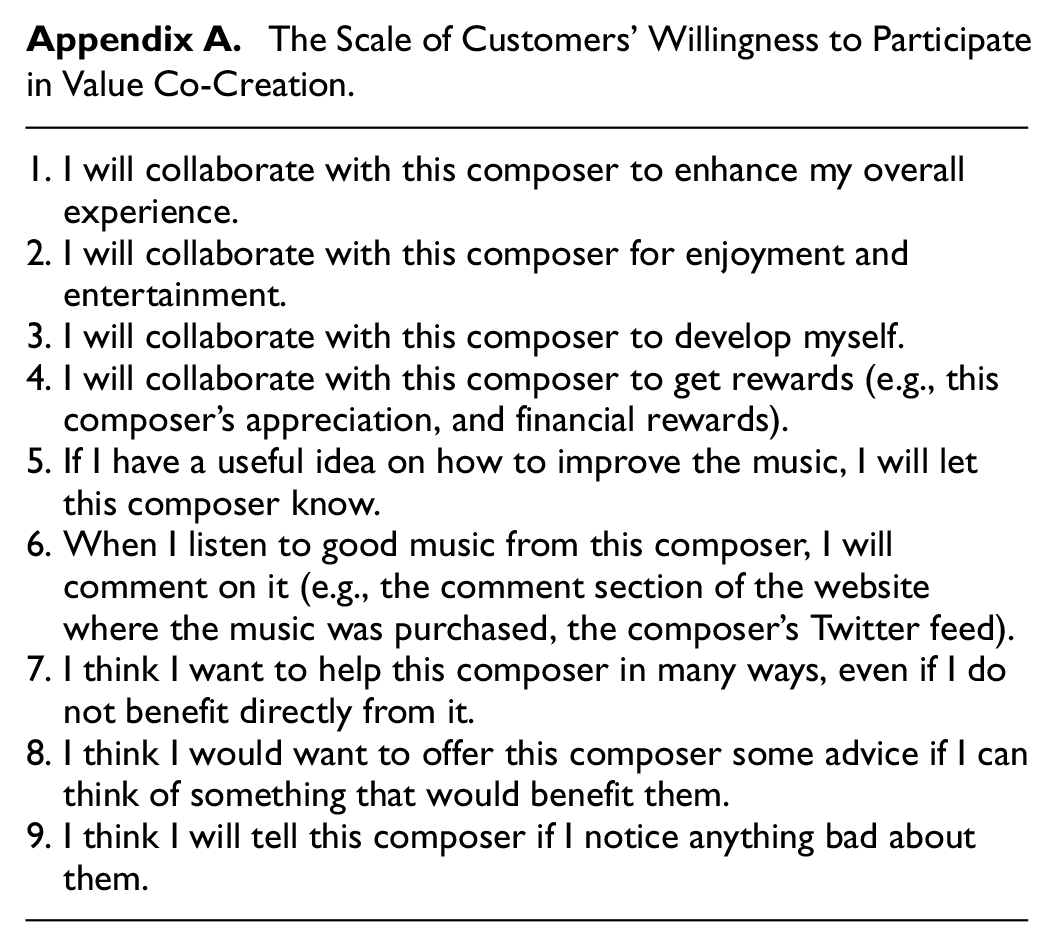
| 1. I will collaborate with this composer to enhance my overall experience. |
| 2. I will collaborate with this composer for enjoyment and entertainment. |
| 3. I will collaborate with this composer to develop myself. |
| 4. I will collaborate with this composer to get rewards (e.g., this composer’s appreciation, and financial rewards). |
| 5. If I have a useful idea on how to improve the music, I will let this composer know. |
| 6. When I listen to good music from this composer, I will comment on it (e.g., the comment section of the website where the music was purchased, the composer’s Twitter feed). |
| 7. I think I want to help this composer in many ways, even if I do not benefit directly from it. |
| 8. I think I would want to offer this composer some advice if I can think of something that would benefit them. |
| 9. I think I will tell this composer if I notice anything bad about them. |
Declaration of Conflicting Interests
The author(s) declared no potential conflicts of interest with respect to the research, authorship, and/or publication of this article.
Funding
The author(s) disclosed receipt of the following financial support for the research, authorship, and/or publication of this article: This work was supported by JSPS KAKENHI Grant Number JP23H01031.

Data Availability Statement
The datasets generated during and/or analyzed during the current study are available from the corresponding author on reasonable request.
Supplemental Material
Supplemental material for this article is available online.
References
Supplementary Material
Please find the following supplemental material available below.
For Open Access articles published under a Creative Commons License, all supplemental material carries the same license as the article it is associated with.
For non-Open Access articles published, all supplemental material carries a non-exclusive license, and permission requests for re-use of supplemental material or any part of supplemental material shall be sent directly to the copyright owner as specified in the copyright notice associated with the article.
