




Abstract
In developing world, most decisions by Micro, Small, and Medium Enterprises (MSMEs) to adopt social media marketing technology (SMMT) rely heavily on study findings from the Western World without much recourse to cross-context differences in structure and managerial capabilities. Thus, the lack of inquiries that provide complete guideline on the adoption of SMMT in developing economies hinders the development of integrated framework(s) that explains MSMEs’ successful adoption. The study used technology–organization–environment (T-O-E) framework as the theoretical basis to examine the critical factors that stimulate MSMEs adoption of SMMT in Nigeria. The adopted methodological choice was qualitative, involving interviews with 20 participants selected from the online directories via purposive and snowball sampling techniques. However, thematic analysis was the data treatment technique; and the study extended the T-O-E framework to provide an understanding into the dominant factors that specifically influence MSMEs’ adoption, without losing sight of vendors who would rely on the extended framework to get audiences continually satisfied.
Introduction
Nigeria has about 41.5 million Micro, Small, and Medium Enterprises (MSMEs) in the country (National Bureau of Statistics [NBS], 2017); in addition to employing about 50% of the working population, they contribute about 50% of the country’s industrial outputs (Ihua, 2009). The breakdown of MSMEs in Nigeria shows that micro-enterprises constitute 99.8%; SMEs make 0.17%; and medium comprises 1,793 businesses (NBS, 2019). Similarly, more than 90% of enterprises in developing countries are MSMEs (Awa, Ukoha, & Igwe, 2017; Jones et al., 2014; Rahayu & Day, 2017), whereas same enterprises in the Western World contribute nearly 90% employment of active workforce (Tob-Ogu et al., 2018). The internet penetration estimate stands at 78.3% in developed countries and 32.4% in the developing countries like Nigeria (Okundaye et al., 2019; Zafar & Mustafa, 2017), suggesting that the widened gap as well as the need to urgently drive the economy call for regular and timely scholarly inquiries to know the underlying adoption enablers and inhibitors. Scholars (Madukua et al., 2016; Shapiro & Varian, 1999; Smutkupt et al., 2010; Zanjani et al., 2013) recommend that the swift socioeconomic potentials of MSMEs and the volatile nature of the environment call for nascent digital frameworks and marketing strategy that “lock-in” customers into the standards to increase trust, interactivity, advocacy, and switching costs.
The implementation of social media marketing in marketing mix program enables firms to promote and advertise their goods and services via web-based facilities; permits real-time and ubiquitous interaction between advertisers and audiences; encourages customer satisfaction and retention; and build, sustain, and/or improve competitive advantage (Eze et al., 2019; Gandomi & Haider, 2015; Jones et al., 2014; Madukua et al., 2016; Shankar et al., 2010). Furthermore, scholars (Doshmanli et al., 2018; Eagleman, 2013; Okundaye et al., 2019; Smutkupt et al., 2010) posit that organizations with social media culture exceptionally extend to clients, create awareness, and increase sales much more than what the traditional marketing can do. However, in spite of the enormous potentials of social media marketing and digital devices in providing a level-playing grounds for all categories of firms, as well as in assisting MSME to speed up their socioeconomic developments; scholars (Awa, 2018; Awa, Ukoha, & Igwe, 2017; Costello et al., 2007) posit that the critical mass of MSMEs in developing economies, especially Nigeria, obviously face adoption limitations. Tobora (2014) posits that most micro-businesses are skeptical to adopt because of perceived inconveniences surrounding the adoption, use, and management. Studies (Gbandi & Amissah, 2014; Yunis et al., 2017) outlined some of the adoption limitations as lack of indigenous frameworks that may guide successful adoption, safety and security issues, uncertainty of use, issues of corporate culture and business mind-set, technical know-how, inadequate internet facilities, and limited finances (Napitupulu et al., 2018; Vlados & Chatzinikolaou, 2019).
However, adoption is made almost mandatory, given that COVID-19 global pandemic and its stringent measures to contain or assuage the spread precipitate all categories of enterprises to minimize brick-and-mortar marketing and to strengthen digital interactions and transactions. COVID-19 pandemic has changed the way of lives of many businesses and has further given credence to fast adoption of digital devices; it has further flattened the ingrained capability gaps between the formal and informal sectors by forcefully repositioning MSMEs to compete effectively with large enterprises, regardless of their limitations. Furthermore, as markets for digital devices get saturated with large enterprises (Awa, 2018; Ramdani et al., 2009; Rodrigues et al., 2016), COVID-19 pandemic forces vendors’ divestiture into other market segments, including MSMEs, given their operational agility and flexibility, and aggression for globalization and sustainability. It is surprising that even with the supposed additional push by COVID-19 experience; micro (in particular), small businesses are yet to exploit the onerous benefits of digital devices and SMMT. Shortly after the COVID-19 lockdowns were relaxed in many states, many small businesses had their stocks expired, owing to their full dependence on traditional brick-and-mortar transactions. This further raises scholarly worries to understand the critical underlying factors that influence digital interactions in developing economies. Unfortunately, the preponderance of studies on SMMT adoption that are supposed to provide insight into the factors, predominantly emanate from the Western World and large organizations (Bulearca & Bulearca, 2010; Rahayu & Day, 2017) and they often use social media devices for commercial and social purposes without recourse to the adoption and implementation process of MSMEs (Federici, 2009; Napitupulu et al., 2018).
Furthermore, many SMMT studies that focused on the developing economies are more of cross-context studies (Derham et al., 2011; Eze et al., 2019; Yunis et al., 2017; Zafar & Mustafa, 2017), given the peculiarities in environments, structures, and managerial and technology capabilities. Such is quite scholarly as it provides myriad of critical and insightful factors that underlie the adoption of SMMT, but a more resounding theoretical contribution than just cross-context inquiries is supposedly built when the factors are factored within the T-O-E framework. This study complements extant studies on adoption of SMMT via building a home-based roadmap that integrates core adoption factors within the T-O-E framework. The core interest is on unveiling the Key Success Factors (KSFs) associated within T-O-E that shape the adoption of SMMT. The criticality of such interest rests on MSMEs in Nigeria having limited knowledge of emerging devices even under COVID-19 pandemic; and as such, any attempts to understand the efficacy of KSFs and how the devices can be fully and maximally utilized improve usage and cause more proactive and strategic decisions (Awa, Ukoha, & Orokor, 2017). This article reviews and analyzes extant literature and proposes a framework, presents the research method and technique, and highlights the findings and presents conclusion.
Literature Review
Social Media Marketing Technology
Social media marketing technology (SMMT) is a flexible and customized digital applications that ensures integration of operations, functions, information, people, and processes via ubiquitous knowledge sharing (Davenport, 1998). The application covers, among others, such IT innovations that involve Facebook, Twitter, telephone calls, E-mails, telegrams, voice notes, SMS texts, Instagram, YouTube, and WhatsApp, where consumers and producers interact and share contents and feedback real time (Dahnil et al., 2014; Kotler, 2011). Furthermore, its adoption is a deliberate socioeconomic process (Orlikowski, 1993); the word deliberate suggests known consequences of efficiency owing to elimination of complex and expensive interfaces among computer systems (Awa et al., 2015). The socioeconomic process involves its adoption to build customer-endorsed satisfaction and/or competitive advantage though adoption decision is often taken by diverse actors, who would normally wish to make informed decisions or consider emerging situations before making decisions (Orlikowski, 1993).
Supposedly, MSMEs are to buy into the SMMT’s potentials faster, the new technologies will offer them the opportunity to build competitive advantage. However, with the rapid spread of COVID-19 pandemic and programs to contain its spread, lockdowns and restriction of movements of people were witnessed globally, and adoption of digital devices such as SMMT becomes imperative to all categories of enterprises. In Nigeria, the COVID-19-induced lockdown is taking tolls on the socioeconomic activities, particularly those of MSME, and forced MSMEs to be in dire need of IT-innovations that assuage their resource limitations, and strengthen collaboration and communications within the value chain, and ultimately improve customer-endorsed services. The SMMT provides a channel through which MSMEs connect with their customers while being physically separated.
MSMEs
It may be thorny to have a universally acceptable definition of MSMEs, because most proposed definitions are predominantly country context and relate to such fundamental measurement metrics as annual turnover, fixed assets, employment figures, and industry type (Awa & Ojiabo, 2016; Napitupulu et al., 2018). According to Organization for Economic Co-operation and Development (2000), SMEs employ about 500 persons; in the Netherlands, 250 employees; in Austria, between 200 employees, and in the United Kingdom, between 1 and 250 (Tilley & Tonge, 2003). In Nigeria, Small and Medium Enterprise Development Agency of Nigeria (2005) grouped SMEs into three categories with some parameters in line with Costello et al. (2007): micro—1–10 employees, small 11–50 employees, and medium 51–250 employees. The Japanese jargon of small is beautiful (Awa et al., 2015) as supposedly supported by Tom Friedman’s the world is flat (Friedman, 2005) presupposes encouraging the informal sector or SMEs, given that they are the key to development and drive employment (Awa, 2018; Ramdani et al., 2009; Trudel et al., 2012). SMEs account(s) for 96% to 99% of enterprises create about 80% of economic growth in most organizations in the Western world (Federici, 2009; Jutla et al., 2002).
In Nigeria, Ihua (2009) estimated that nearly 97% of businesses are SMEs and generate employment and industrial outputs worth 50%. SMEs raise the standard of living and critically contribute to advancement of nations socially and financially. Scholars (Awa, 2018; Eze et al., 2013; Shiau et al., 2009) posit that the limited resources explain why most SMEs respond slowly to the adoption process of new applications. Although government have supported SMEs to enable them tap the potentials of modern IT innovations, it is comparatively known that not much of such business in Nigeria and most developing nations use the applications extensively to design customer-endorsed product-delivery attributes. Although SMMT aids businesses (Eze et al., 2014; Shankar et al., 2010), Leppäniem et al. (2004) recalled that most SMEs in Nigeria have not been able to integrate applications into their marketing strategies.
Hence, this research is essential to in exploring the underlying issues that may lead to the adoption of SMMT by SMEs in Nigeria, given the critical roles of real-time and smooth interactions, and feedbacks, and the attempt to remain strategic and proactive. The vitality of SMMT especially for SMEs stems from awareness creation and business responsiveness, encouragement of patronage and loyalty, and promotion of business growth and popularity.
Technology–Organization–Environment (T-O-E)
The removal of competitive and locational disadvantages amid limited resources makes MSMEs potential targets for vendors of new technologies (Awa, 2018; Eze & Chinedu-Eze, 2018; Wymer & Regan, 2005). Given the need to extend research and to understand and predict adoption factors to make informed decision on strategies and/or tactics, different theories emerged. Among them are the behavioral-based models and intentional-based models (see Ajzen, 1991; Ajzen & Fishbein, 1980; Davis, 1989; Rogers, 1983; Tornatzky & Fleischer, 1990). Scholars (Awa, 2018; Awa & Ojiabo, 2016) emphasized the overlapping and deterministic nature of some of these theories: Theory of reasoned Action (TRA) is attitudinal, Technology Acceptance Model (TAM) undermines the interplay Innovation Diffusion theory (IDT) and Theory of Planned Behavior (TPB) overtly underplay the environmental and technological contexts. The constructs of TAM cross-cut some of those in IDT, just as IDT’s constructs interfaced with T-O-E makes it almost the most robust and populous IS framework. However, T-O-E taxonomies underpin this study for some obvious reasons; first, the taxonomies have pragmatic flexibility to explain and predict ways small enterprises implement fresh technologies (Madukua et al., 2016).
Rui (2007) posits that the T-O-E taxonomies provide useful and less cerebral analytical tool that helps to explore and understand enterprise-level drivers and essential physiognomies of new devices. Second, regardless of its major snag of applying more to large enterprises, the T-O-E framework is effective, most prevailing, and has classic and generic factors that meet the scholarly yearning for more socioeconomic framework (Awa, Ukoha, & Igwe, 2017; Jacobsson & Linderoth, 2010) that pragmatically explains and predicts adoption of new technologies. T-O-E framework is considered more enriched with a wider range of contexts and factors (than other frameworks) in context of this study. Third, the framework has earned enormous cross-context empirical and theoretical supports in different IS domains (see Awa & Ukoha, 2016; Ramdani et al., 2009; Wang et al., 2010) and underpinned many adoption inquiries (Awa & Ojiabo, 2016; Awa, Ukoha, & Igwe, 2017; Eze et al., 2018) more than any other framework. Furthermore, other scholars (see Awa et al., 2015; Awa & Ojiabo, 2016; Hossain & Quaddus, 2011; Musawa & Wahab, 2012) have continually worked on them to broaden their theoretical base. The theory proposes that adoption is shaped by technology, organization, and environment context (Chatterjee et al., 2002). The factors provide critical theoretical direction to scholarships, including those that examined the adoption of SMMT. Technology context consists of tools and procedures and aims at improving enterprise’s output and operational efficiency.
Scholars (Awa & Ojiabo, 2016; Sabherwal et al., 2006) relate it to the pool of technologies and expertise that are significant though within or outside of a firm, and as well as learning and experience curves, pilot-test and experimentation, visibility and imagination, technical and organizational compatibility, infrastructural availability, security and reliability, cost structure, and vendors’ support. The organization perspective deals with the availability and use of internal resources that appear in descriptive measures (Alalwan et al., 2018; Sabherwal et al., 2006). The elements popularly proposed by scholars (Awa & Ojiabo, 2016; Eze at al., 2018; Sabherwal et al., 2006; Tornatzky & Fleischer, 1990) are scope of business operations, top management support, organizational culture, power relations, human and material resources, and IT competence under organizational factors. Finally, the environmental context is linked to forces that operationally enable and/or constrain the adopt decision. Among the factors are market and competitive pressures, industry structure and business location, government enactments and regulations, and technology infrastructure such as availability of vendors and IT consultants (Alalwan et al., 2018; Oliveira & Martins, 2011).
However, these factors provide both adoption opportunities and threats, and in this study, the codes and themes will unveil the factors most critical to the adoption of SMMT by SMEs. The analytical framework for the study in Figure 1 is presented in the following.

Analytical framework.
Research Method
Coverage
Samples were taken from Local Government Authorities (LGAs) in Imo State, Nigeria. Generally, MSME’s operations in Imo State have not met any desired results that would necessitate encouragement of their establishment, sustenance, growth, and even development by the government and other key players. This is because the margin between enterprises that collapse within their 5 years of existence is wider than those that survive within the same period of existence. This limits their essence in terms of employment creation, economies of scale, provision of facilities, and state of peace (Obi et al., 2016). According to the NBS (2019), the zone in Nigeria that has the highest number of performing SMEs is the south-western states compared to Imo state which is among the south-Eastern states. This shows that MSMEs therein are behind in performance, and the perception of such backslide in performance is explained by their inability to adopt effective marketing channel that will aid their marketing performance. In a bid to have insight into the underlying factors that influence SMMT, data were drawn from rounds of interview responses from IT consultancy firms, IT and software developers, security firms, and so on. The participants for the first round were MSME managers, and those for the second round were managers, consultants, IT experts, and business analysts (Table 2 tells better). These caliber of people possess the experience and knowledge that will help the investigators to get accurate and authenticated information about the phenomenon under investigation.
Approach and Sampling
Most studies in technology adoption have relied heavily on testing variables and confirming their findings (William et al., 2009). Although these techniques are widely accepted, Silva (2007) argued that technology adoption studies need to engage more of explanatory theories and methods that aid understanding of phenomena in greater details. A qualitative method is an alternative approach that offers rich and insightful outcomes (Lee, 2003); hence, the study used this approach to understand in details the KSFs that shape the adoption of SMMT by MSMEs. Figure 2 depicts a framework showing step-by-step approach to the study. Extant literature was reviewed to identify the literature gaps and develop research objectives. A study of this type requires discovery and detailed explanations of people’s views and experiences; thus, the need to adopt a purposive sampling technique for data collection. The justification for a purposive sample was to select units of analysis to help make realistic assessment about the research objectives (Eze et al., 2014; Mason, 1996; Schultze & Avital, 2011; Schwarz & Chin, 2007; Silva, 2007). Furthermore, snowball sampling technique was adopted, which complimented the purposive sampling because the initial set of participants helped the researchers to contact others who took part in the interview process. Interviews were conducted into two stages. This involve two rounds of data collection processes using unstructured (first round) and semi-structured (second round) interviews.
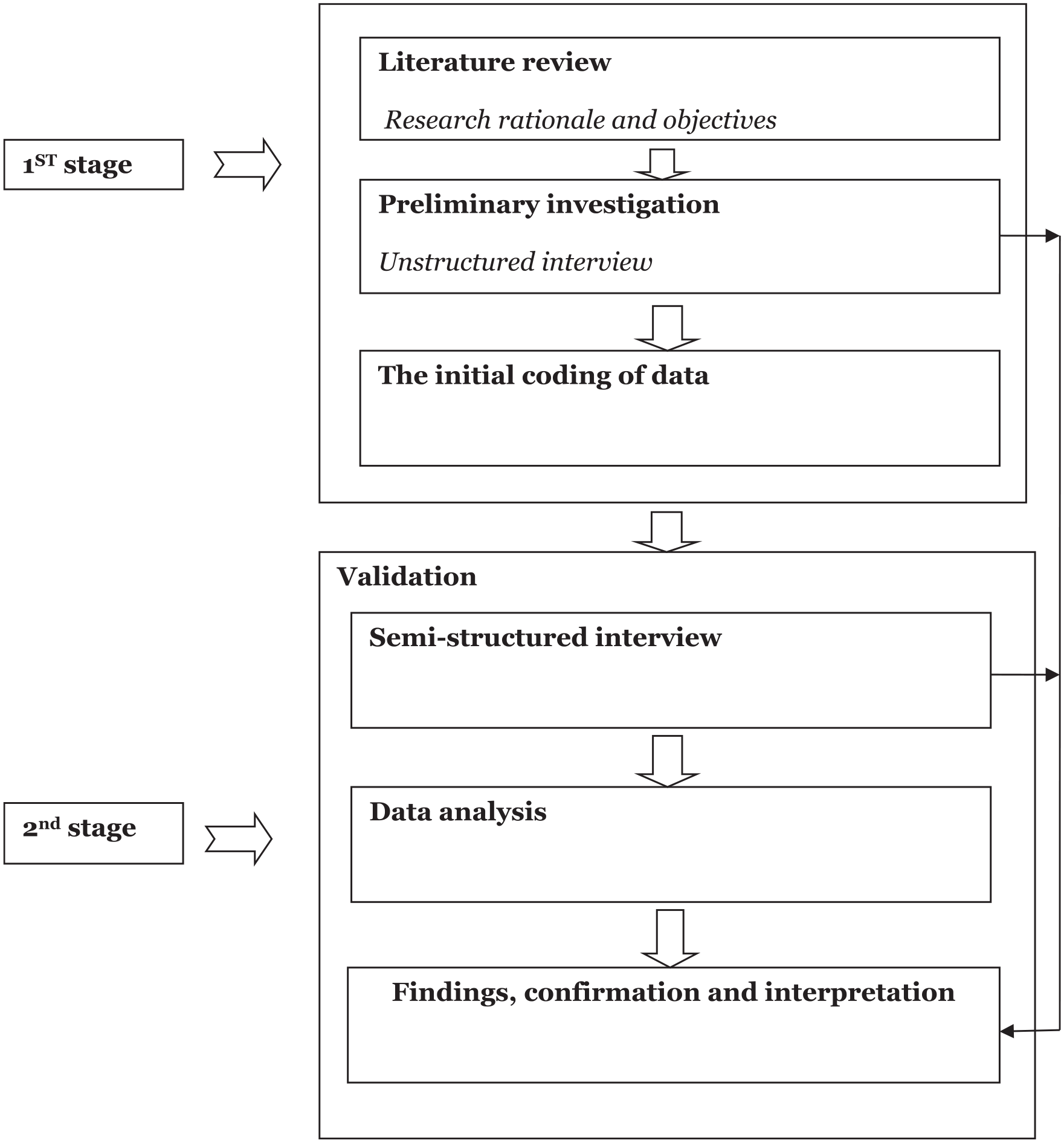
Research process.
In the first stage, four participants were interviewed. This interview was fairly unstructured because it was open, flexible, and experimental in nature involving complex interaction (Mason, 1996). This excise was carried out to know the existing situation of SMMT adoption by MSMEs to have an unrestricted opinion. Also, the interviews were carried out to test and find out how applicable and appropriate the three concepts of T-O-E would be in terms of analyzing and coding the raw data to the appropriate categories when further interviews are conducted. The aim is to ascertain how credible the concepts are before further coding and analysis. However, the inclusion of technology, organization, and environment contexts associated with T-O-E was informed by the initial application of the concepts to the interview data. The sample was produced from Local Business Directories, where 80 MSME owners were selected; and further contacted randomly, whereupon 4 interviewees participated and in interviewed. The condition for sampling was based on SMEs that use one form of SMMT or the other in the last 5 years. The key question at the preliminary stage (preliminary study) of the interview was please explain to us the key factors that influence your business to adopt SMMT. Responses from this initial question spurred further probing questions. Outcomes of the initial stage of the preliminary investigation (unstructured interviews) aid in designing semi-structured interview questions that lead to the second stage of the interview.
At the second stage, 16 semi-structured interviews were carried out. The key questions relate to their current SMMT adoption status—the T-O-E factors that shape SMMT and the impact of such applications on SMEs. Tables 1 and 2 show a summary of interviewee’s profile. These tables show the interview participants (P1 to P20), their roles, company size, sector, and location of the business. It is important to note that before the participants were interviewed, a letter was formally written and sent to them emphasizing the aim and assurance of confidentiality. This exercise lasted for about 1 hr and all the interviews were documented and transliterated.
Interview Profile: Study Participants (Preliminary Study).

The Main Profile of Participants.

The study adopts thematic method of data analysis. Thematic analysis is a technique that encompasses examining, ascertaining, analyzing, recording, and unveiling themes that are relevant to the subject studied (Boyatzis, 1998; Braun & Clarke, 2006). This technique is considered the primary method for analyzing qualitative data because of the core skills it provide for different approaches (Braun & Clarke, 2006) due to the multifaceted nature of analyzing qualitative study. Specifically, the study adopted hybrid approach (see Boyatzis, 1998) because codes were both theoretically (T-O-E factors) and empirically (information context) driven.
The data analysis involved seven stages (see Figure 3). In stages 1 and 2: the concepts of T-O-E were developed initially from literature, and empirically driven codes (communication) which emerged during the analysis was the bases for exploration. In a bid to code the raw data into the appropriate categories, the definitions and descriptions of three context of T-O-E framework were written in simpler language using code names, definition associated with each code. The guideline is shown in Table 3. Stage 3: to ensure that the codes drawn from theory and the one drawn from the raw data would apply to the raw data in Stage 2; four transcribed interviews at the first stage of the research were coded manually into appropriate categories. Subsequently, consistency check was ascertained for all the codes to see how credible and applicable they are for successive raw data. To ascertain reliability, the initial coding exercise of the first four interviews was subjected to judges (colleagues) to relate the codes and supporting evidence against to the categories. The outcome score of the reliability test surpassed 70% yardstick suggested by Miles and Huberman (1994) in Table 4.

The data analysis process.
Reliability Analysis.

Note. SMMT = social media marketing technology.
Guideline for Coding.

Note. SMMT = social media marketing technology.
Stage 4: All the transcribed data at this stage were imported into NVivo. NVivo software facilitated the analysis and organization of enormous amount of data transliterated. Stage 5: at this stage, all the coded data were recovered from NVivo and were practically grouped (see Table 3).
Stage 6: The inter-rate reliability was performed using percent agreement at this stage. This was necessary because validation is constantly required in qualitative study. Hence, the finding (codes and themes) were presented to experts who were originally contacted to compare the codes against the themes that emerged (Boyatzis, 1998). Stage 7: At this stage, codes that were further validated were analyzed and interpreted. This overall process demonstrates how the researchers analyzed, verified and reported the data which is part of the research design shown in Figure 3 below.
Findings
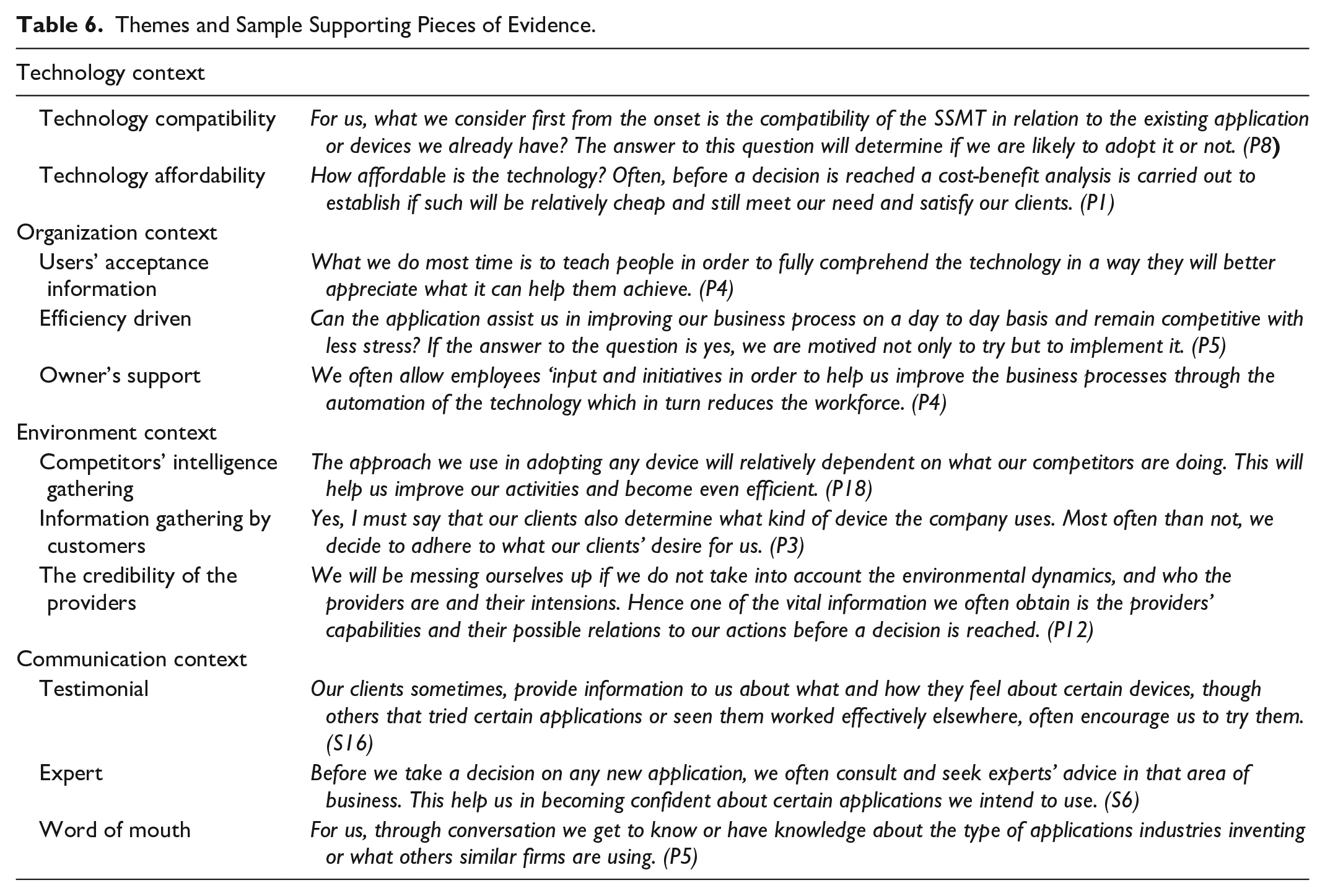
Tables 5 and 6 present findings of the study. Tables 5 and 6 show the factors underlying the adoption of SMMT by MSME with the sample supporting cases and sample supporting evidences, respectively. The findings were grouped based on the codes developed from theory and the empirically driven code. These codes and themes were adopted based on the participants’ own views, opinion, literature, and themes that emerged.
Codes, Themes, and Sample Supporting Cases.

Themes and Sample Supporting Pieces of Evidence.
Proposed Adoption Model
The model in the following depicts factors that influence MSMEs’ adoption of SMMT. Table 6 and Figure 4 report that although T-O-E contexts shape SMMT adoption by MSMEs, the communication context has critical significance in the successful adoption process. This suggests that testimonial, expert knowledge, word-of-mouth publicity or the use of experiential knowledge to reduce or douse the perceived risks of others (especially new adopters) critically influence the adoption of SMMT by MSMEs aside the themes that emerged under the technology, organization, and the environment categories.

SMMT adoption model for MSMEs.
Results and Discussion
Technology Context
Technology compatibility
Technology compatibility considers how SMMT aligns with extant values and experiences, as well as the beliefs of small businesses (Castelo & Thalmann, 2019; Rogers, 2003). Evidence showed that small business owners adopt social media applications if they are cost-effectiveness and compatible with existing beliefs and processes; thus, they show willingness to try applications that are adaptable to the existing organizational arrangement and that are less expensive and require little or no new learning/training and/or experiences. These observations were highlighted by participants and captured in Tables 5 and 6. Refer to the assertions of S8, S3, and S16 and their respective cross-case supports to confirm this finding. The finding suggests that if MSMEs fail to consider compatibility of the technology before adoption, it may result to considerable financial losses. This is similar to some preceding enquiries (see Adomavicius et al., 2008; Investopedia, 2018; Tong et al., 2020). These studies are of the view that small business manager’s inability to comprehend the ability of the technology application make recruitment of workforce with comparable skills difficult during execution.
Technology affordability
Technology affordability explains the gain linked to implementation of SMMT in relation to the cost of acquiring it. The finding shows that the decision of SMMT adoption is shaped by cost-benefit analysis in such a way that the application leads business growth client’s satisfaction, employee efficiency, and productivity of the technology. Tables 5 and 6 report the comments of S1 and S2 and the cross-case supports that affirm this finding. This finding is in line with a number of studies (see Ciechanowski et al., 2019; Nguyen et al., 2015; Seyal & Rahim, 2006) that argued that cost is an important factor considered in the adoption decision process of new technologies by MSMEs. Therefore, attention must be given to the cost implications of any applications before reaching a decision.
Organizational Context
User acceptance information
User acceptance information in this context is defined as the extent employees’ and business owners’ confidence and behavior influence the adoption of SMMT. Evidence revealed that employees, customers, vendors, and other key actors play critical role in policymaking of the new application. Hence, adoption is assumed taken for granted if the interests of key actors are not well captured at the decision-making time. Themes from participants S4 and S6 in Tables 5 and 6 align with this finding and have huge cross-case supports. Thus, interaction of different people either within or outside the business contributes to the success or failure of the adoption of any SMMT. Similarly, studies (Andries & Debackere, 2006; Castelo & Thalmann, 2019; Ciechanowski et al., 2019; Nguyen et al., 2015) confirmed that employees would often abandoned any new applications if their initiatives and input are not considered during adoption decisions process.
Efficiency driven
Sound and effective applications enhance adoption, because MSMEs’ managers are often interested in how an application would assist to automate present procedures and improve the organization’s strategy and customer satisfaction. Themes from participants S5 and S6, and their cross-theme supports in Tables 5 and 6, deal with this finding. Thus, MSMEs often evaluate the opportunities and threats, strengths, and weaknesses offered by SMMT before decisions are reached as the device may assist in cutting cost and improve productivity (De Haan et al., 2018; Dubé et al., 2017; Higón, 2012).
Owner’s support
It was obvious that small business managers have role to play in ensuring that their workers are inspired and encouraged to take part at taking decisions that will aid the adoption of SMMT. This is usually carried out by way of training and support of workers to symposium and other related training that reveal the essence of adopting the emerging application. The themes from participants S4 and S5 and their cross-theme supports as reported in Tables 5 and 6 confirmed this finding. Studies (Economides & Jeziorski, 2017; Ramdani et al., 2009) affirmed that when employees are encouraged to develop themselves along the digital world, decision and implementation of the application are easier. Similarly, it has been argued that IT implementation is always fruitful if the top executives help support its adoption and implementation (Gangwar et al., 2015; Lian et al., 2014).
Environmental Context
Competitor’s intelligence gathering
Competitive advantage is a key driver of SMMT adoption and must not be played down on by MSMEs. MSMEs must consider the environment to know the role new technology plays, and how competitors implemented SMMT and the competitive benefit associated. Implicit is that S18 and S8, and their cross-case supporters, as reported in Tables 5 and 6 confirm this finding. Studies (Lam et al., 2014) show that if businesses fail to continually gather intelligence about competitors, it may be hard to establish the right SMMT that might lead to high performance overtime.
Customer information gathering
Putting together customer information is critical to ensuring new applications’ successful adoption, because satisfying customers’ needs and aspirations guide strategy development (Mehrtens et al., 2001). It is one thing to satisfy customers and it is another to know how the new applications can assist to do that. This was the position of participants S3 and S5 and their supporters (see Table 5 and 6). Scholars (Alshamaila et al., 2013; Beckinsale et al., 2006; Ghobakhloo et al., 2011) emphasized customer sovereignty and customer the king and warned businesses not to neglect customer requirements, especially in times of making decision on the adoption of new applications.
Provider credibility
Evidence revealed that shows that the trustworthiness of the provider’s play significant role in adopting of SMMT. Most times, information gathered from the external context such as suppliers, consultants, and vendors influence the adoption decision; thus, most MSME owners are very cautious in selecting these set of actors that seems trustworthy. Participants S12 and S18 and their cross-case supporters are in line with this finding. This finding synonymous with previous inquiries (Chibelushi & Costello, 2009; Kurnia et al., 2015) that report that SMEs compare the providers’ experience and sincerity, as well as the functionality of the applications as against extant others before an informed and consistent decision is reached.
Informational Context
Testimonial
Information shared among adopters and non-adopters or among peers influence MSMEs’ adoption of SMMT. Such testimonies reduce the perceived risk of the adopters as they are often linked to reviews, experiential knowledge, and commendations by partners who have tried the device. Such assist businesses to appreciate the features of the technology better than the promoters’ message content and designs. When we refer to Tables 5 and 6, participant S16 and his cross-case supporters made obvious claims that affirm this finding. Studies (Ghose et al., 2019; D. Grewal et al., 2017, 2018) show that recommendations from managers with firsthand experience on the use of digital technology have significant impacts on adoption and implementation of digital marketing devices.
Experts
The opinions and know-how of experts such as consultants, IT experts, and vendors are vital for ensuring that the right kind of SMMT is acquired. SMEs see advice to experts in obtaining the right information that might lead to successful adoption of SMMT. In most cases, these experts are linked to IT staff who work with the organization or IT sub-contractors who are contractors to the business. This was echoed and re-echoed in the statements made by S6 and S7 and cross-case supporters in Tables 5 and 6. Choo (2001) found experts’ opinions are key to adopting the required IT application (Auster & Choo, 1993; Salamzadeh et al., 2019).
Word-of-mouth publicity
It was revealed that the value SMEs place on the information gathered from the providers often triggers adoption decisions. The IT providers engage in step-by-step sequence of enlightening MSME owners/managers on any SMMT. Themes from participants S5 and S4 and those of cross-case supporters align with this finding (see Tables 5 and 6). Studies show that word-of-mouth permits MSMEs to obtain updated information relating to the cost-benefit, security, and practical feature of the technology from the providers (Nabwiiso, 2019; Radcliffe, 2018), whereas customers share their cost-free and firsthand experience to reduce the perceived purchase risks of intending customers (Li et al., 2017; Zimmer et al., 2007).
Conclusion
The study explored the KSFs that underlying MSMEs adoption of SMMT in Nigeria. The work developed a conceptual framework underpinned by T-O-E contexts to assist MSMEs to understand the KSFs that underlie their adoption of SMMT. While the study applauds T-O-E framework for its strong theoretical strides, it revealed that other factors outside the T-O-E contexts shape adoption of SMMT; hence, the study proposed an extended T-O-E framework to encapsulate the informational context. The extended framework proposed critical factors that influence SMMT adoption—technology compatibility and technology affordability are critical factors under technology context; users’ acceptance information, efficiency-driven, and owner’s support are those of organizational context; competitor’s intelligence gathering, customer’s information gathering, and provider credibility are of environmental context; and testimonial, experts, and word-of-mouth fall within the informational context.
However, the theoretical contribution of this study strongly stems from the proposed extended framework of T-O-E contexts and factors; a framework that is significantly amenable to MSMEs’ adoption behavior and provides critical analytical scope of SMMT adoption in Nigeria. The framework incorporates informational context and sought to further contribute to the growing robustness of the original T-O-E contexts and factors. The relatively low adoption of SMMT by MSMEs in less developed nations and the cross-context differences of extant findings lay credence to the proposed extended framework, because of the idiosyncratic givens of every economy. In particular, the extended framework provides scholarly direction and knowledge within the context of developing economies and complements the robust body of knowledge from developed economies.
Practically, the environment is obviously volatile and firms seek ways to remain continually competitive using digital applications. The proposed extended framework provides MSMEs with useful grounds to make informed decision to adopt SMMT, without losing grip of the critical factors that would cause such adoption to build competitive advantage. MSMEs could usefully tap into the framework to understand factors underlying SMMT adoption. The vendors may be strategically guided on how to package and promote SMMT programs and models to appeal to the customer audiences, given that the study unveils the critical adoption factors that would reflect on the selling points.
Limitations and Future Research
Finally, we argue that this framework cannot be generalizability because of the number of interviewed conducted for the study. Hence, the formwork is required to be recognized across a larger population. More studies should deploy other technique to test framework across a wider population and use it as a standard for theoretical constructs that guide SMMT adoption. Although the framework may not exactly apply to other third world countries or other states within Nigeria because of differences in the use of these devices, more studies are required to replicate and retest the framework and possibly build a theory. Hence, other factors that may shape the adoption of SMMT to extend the applicability of the framework or ensure cross-context generalization are required. Although studies believe in the appropriateness of thematic data analysis in this kind of study, the framework has drawbacks because the factors are incomplete. There are obviously other factors which may positively underlie the adoption of SMMT; hence, further studies are needed to unravel and incorporate such factors by using diverse research methods.
Footnotes
Declaration of Conflicting Interests
The author(s) declared no potential conflicts of interest with respect to the research, authorship, and/or publication of this article.
Funding
The author(s) received no financial support for the research, authorship, and/or publication of this article.
