




Abstract
Types of ideational metaphor in English considered in this research incorporate nominalization, verbalization, and adjectivization. Previous studies particularly highlighted functions of nominalization, leaving the other types of ideational metaphor unconsidered; in addition, expressions of ideational metaphor are not carefully selected while exploring the functions realized by these expressions. Against this backdrop, functions of ideational metaphor uncovered in previous studies are insufficient of coverage and typicality. Drawing on COCA in this research, a corpus of typical American English, expressions of the three types of ideational metaphor with significant attraction by means of the simple collexeme analysis are employed to analyze the functions that these metaphorical expressions actually realize in their linguistic contexts. The findings demonstrated that expressions of ideational metaphor could realize such interpersonal functions as authoritativeness and objectivity, such ideational functions as conciseness, abstractness, ambiguity, and semantic condensation, and such textual functions as formality and cohesion. Explanations to these realized functions of ideational metaphor are also provided. This research is of great significance in that the documented functions are typical and representative of ideational metaphor in English.
Plain Language Summary
Drawing on COCA in this research, a corpus of typical American English, expressions of the three types of ideational metaphor with significant attraction by means of the simple collexeme analysis are employed to analyze the functions that these metaphorical expressions actually realize in their linguistic contexts. The findings demonstrated that expressions of ideational metaphor could realize such interpersonal functions as authoritativeness and objectivity, such ideational functions as conciseness, abstractness, ambiguity, and semantic condensation, and such textual functions as formality and cohesion. Explanations to these realized functions of ideational metaphor are also provided. This research is of great significance in that the documented functions are typical and representative of ideational metaphor in English.
Introduction
The notion of ideational metaphor in the sense of Halliday (1985) refers to a kind of mismatch between semantics and lexicogrammar whereby a congruent realization of meaning by form, for example process realized by verbal group, is replaced by a metaphorical realization, for example process realized by nominal group. It is one subcategory of grammatical metaphor (the other being interpersonal metaphor) which was initially theorized by Halliday (1985) and furthered by many others, inclusive of Halliday himself (e.g., Halliday, 1988; Halliday & Matthiessen, 1999, 2004, 2014; Hao, 2020; Zhu, 2006). Subtypes of ideational metaphor considered in this research include nominalization (cf. Halliday & Matthiessen, 1999; Hao, 2020; Zhu, 2006), verbalization (cf. Lin, 2017; Zhu, 2006), and adjectivization (Guo & He, 2022; He, 2019; He & Guo, 2021; Lin, 2017). Nominalization as understood in this study is defined as the transcategorization of word classes: for example, processes and qualities are congruently realized by verbs and adjectives respectively, but metaphorically they can be realized by nominal groups. Both congruent expressions and metaphorical expressions share a formal similarity as exists (Zhang & Zhao, 2008), for example, between the congruent form occur and its metaphorical counterpart occurrence in the example (1a). Verbalization refers to instances of ideational metaphor whereby “verbs are employed to substitute for the cases whose meanings are realized by other word classes rather than verbs” (Zhu, 2006, p. 86). As a realization of ideational metaphor, verbalization maps relator onto process (He, 2022a). Adjectivization is defined semantically as the remapping of participant and process onto quality, and lexicogrammatically includes instances of adjectivization realized by nominal group or by participle (He, 2019; Guo & He, 2022; He & Guo, 2021). Nominal group adjectivization involves rank-shifting (He, 2022b, p. 118), and then the further step of downward rank-shifting from nominal groups to adjectives functioning as modifiers or predicates, and is typically realized morphologically “by the adjective suffix -al added to nominalizations or common nouns ending with -ion” (He, 2019, p. 15); participle adjectivization is generally realized by adding past and present participle markers such as -ed and -ing, functioning as modifiers in the groups (He, 2019). Consider the examples in (1a) and (1b).
(1) a. An increase in online trafficking/debate about a specific psychoactive drug typically precedes the occurrence of clinical incidents at the population level and a careful of pregabalin misuse. (COCA_academic_2018)
b. If the experience is allowed, as it were, to wash over the participant without judgment, it can yield compelling results. (COCA_academic_2019)
The verb precedes in (1a) realizes a process as if it had realized a relator which should be congruently realized by the conjunction before, which in Zhu’s (2006) sense creates ideational metaphor of verbalization. Concomitantly, nominal groups increase and occurrence in (1a) that realize entities as if they had realized processes that are congruently realized by their morphologically corresponding verbs increase and occur respectively, and thus ideational metaphor of nominalization is created. In a similar vein, compelling in (1b) realizes a quality as if it had realized a process that is congruently realized by its verbal counterpart compel, which in He and Guo’s (2021) and Guo and He’s (2022) senses creates ideational metaphor of adjectivization, particularly participle adjectivization.
Ideational metaphor is generally created by means of rank-shifting and/or transcategorization (Halliday & Matthiessen, 1999). Such a defining feature of ideational metaphor as rank-shifting is employed to determine whether a grammatical expression is congruent or metaphorical. According to Halliday and Matthiessen (1999), a language phenomenon is anything that can be construed as part of human experience, which is in three different orders in terms of complexity: elementary (i.e., a single element), configurational (configuration of elements, i.e., a figure), and complex (a complex of figures, i.e., a sequence). Ideational metaphor denotes the fact that a grammatical expression is shifted from a higher rank to a lower rank, and thus a downward rank-shifting (Halliday, 1998; Halliday & Matthiessen, 1999, 2004, 2014). Congruently, a sequence in the semantic stratum is realized by a clause complex in the lexico-grammatical stratum, a figure by a clause, and an element by a word. Metaphorically, the sequence is realized by a clause or a group, and the figure by a group or a word. This is evidenced by the examples in (2a) (which is rewritten from (1a)) and (2b). The sequence in (2b) is realized by a clause complex that consists of two clauses and a relator realized by the conjunction before; hence, it is a congruent instance of ideational metaphor. However, the same sequence is realized by a simple clause as exemplified in (2a), whose downward rank-shifting is manifested by the fact that the two clauses before and after the conjunction before in (2b) are shifted into the two nominal groups before and after the verbal group precedes respectively functioning as participants in (2a); hence, the example in (2a) is the metaphorical instance of ideational metaphor.
(2) a. An increase in online trafficking/debate about a specific psychoactive drug typically precedes the occurrence of clinical incidents at the population level and a careful of pregabalin misuse. (COCA_academic_2018)
b. The online trafficking/debate about a specific psychoactive drug increases before clinical incidents at the population level occurs and a careful of pregabalin misuses.
Transcategorization in this research is referred to as the transference of word classes at the word/group rank (cf. Halliday & Matthiessen, 1999; He, 2019; He et al., 2015; He & Yang, 2014); precisely, it is a process of transferences between word classes by certain syntactic and/or morphological means (cf. To et al., 2020). According to Halliday and Matthiessen (1999), it does not necessarily create ideational metaphor; however, if there are semantic junctions or “fusions” of elemental categories (Halliday & Matthiessen, 1999, p. 243), ideational metaphor occurs. Consider the examples in (2a) and (2b) again. Verbal groups, that is, increases and occurs, in (2b) that realize processes are transcategorized into nominal groups, that is, increase and occurrence respectively, in (2a) that realize both processes and entities. Specifically, the transcategorization from verbal groups to nominal groups triggers the occurrence of semantic junction of process and entity, and thus creates ideational metaphor. In this sense, increases and occurs in (2b) are congruent instances of ideational metaphor and increase and occurrence in (2a) are their metaphorical counterparts.
Issues in previous researches, although a plethora of studies have addressed the functions of ideational metaphor in English, are three fold. First, they primarily highlighted the function of ideational metaphor of nominalization (e.g., Dong, 2018; Mao, 2010) and left the other subtypes of ideational metaphor, that is, verbalization and adjectivization, untouched. Second, their discussion of functions of ideational metaphor generally underlies the overall metaphorical instances without demarcating the most typical instances from the most atypical ones (e.g., Dong, 2018; Song & Yang, 2018; H. Zhou & Liu, 2017). For instance, investigation in relation to ideational metaphor of nominalization is a typical one while planarization is an atypical one (cf. J. Zhou, 2023a). An insufficiency, by so doing, might be that identified functions of ideational metaphor are abstracted or concluded from infrequent metaphorical instances which are not capable of representing the meanings that the construction of ideational metaphor typically denotes. For instance, while illustrating the function of textual cohesion that ideational metaphor of nominalization could realize, Dong (2018, p. 49) employed the metaphorical instance “this growth” to exemplify her argument without any further quantitative information about how frequently this instance is employed. In other words, whether the metaphorical instance is capable of illustrating her argument is not quantitatively supported. Third, very few studies to my knowledge addressed the way that instances of ideational metaphor realize particular functions. An exception of this is Tian’s (2017) study which exclusively explored the realization of the objective function by means of instances of ideational metaphor and interpersonal metaphor, leaving the way realized by other functions of ideational metaphors undertheorized.
In order to expressly address the foregoing issues, this research is conducted to fully and systematically document the typical functions realized by subtypes of ideational metaphor by drawing on the simple collexeme analysis (cf. Hilpert, 2014; Stefanowitsch & Gries, 2003; subsection 3.3). The reason of employing the collexeme analysis to facilitate the identification of these typical functions is that the significantly attracted metaphorical instances to the construction of ideational metaphor confirmed by this approach are representative and typical of ideational metaphor; this will further prompt the linguistic fact that functions of ideational metaphor drawn from these metaphorical instances may be also representative and typical. More importantly, this research also intended to expound how these uncovered functions are realized by certain instances of subtypes of ideational metaphor in the linguistic contexts. Accordingly, two research questions are proposed.
RQ1: Based on the ideational metaphors confirmed by the simple collexeme analysis, what typical functions do they realize?
RQ2: How are these functions realized in the linguistic contexts?
The rest of this paper is outlined as follows. Section 2 reviews the functions realized by grammatical metaphor in previous researches. Section 3 introduces the corpus information, the procedure of data collection, and the approaches employed in this research. Section 4 summarizes the typical functions realized by ideational metaphors and expounds at length in what ways these functions are realized. Section 5 concludes this research.
Literature Review
In Systemic Functional Linguistics or SFL, the intrinsic functions fulfilled by language in its social and cultural contexts are conceptualized as different kinds of abstract generalized meaning known as metafunctions, which include ideational, interpersonal, and textual types (Halliday, 1985/1994). The two basic functions of language in relation to our ecological and social environment are the ideational metafunction, concerned with construing human experience in the material and social worlds, and the interpersonal metafunction, concerned with enacting interpersonal relations using language as a resource for interacting with others (Halliday & Matthiessen, 1999, 2004, 2014). These two functions of language are complemented by a third, the textual metafunction, whereby ideational and interpersonal meanings are organized to form coherent texts (Halliday & Matthiessen, 1999). Each metafunction defines networks of systems in the lexicogrammar that operate relatively independently of other metafunctions (Halliday, 1985/1994). The ideational metafunction defines the lexicogrammatical system of Transitivity which is realized by configurations of processes, participants, and circumstances. For example, the clause they needed to allocate one extra packer is composed of a material process construing an experience of doing, needed to allocate, involving two participants, they, and one extra packer. The interpersonal function defines the lexicogrammatical system of Mood realized, for example, by the Subject ^ Finite structure of a declarative clause as opposed to the Finite ^ Subject structure of an interrogative clause; in the foregoing clause, the Subject is they and the Finite is the past tense marking of the verb needed. The textual function defines the lexicogrammatical systems of Theme, and Information, and in addition, as relevant for our discussion of ideational metaphor, the textual system of Cohesion. The system of Theme defines the point of departure for the message conveyed by the clause, also known as Theme, and the rest of the clause following the Theme is Rheme, for example, in the abovementioned clause they is the Theme and needed to allocate one extra packer is Rheme; the system of Information defines the new information, or New, which typically comes at the end of the clause, that is, one extra packer in the above clause, with everything preceding the New classed as Given, that is, they needed to allocate. The system of cohesion defines a number of resources used to relate different parts of the whole text to each other, going across individual clauses. Different instances of ideational metaphor realize one or other of these three metafunctions, as will be discussed in this and the following subsections.
There are many studies exploring the functions realized by ideational metaphor in texts. Mao (2010) characterizes the functions realized by ideational metaphor, particularly nominalization, as including objectivity, technicality, abstractness and generalization, as well as those of expanding and condensing information. Lin (2017) identified the functions realized by ideational metaphor as those of presupposition, objectivity, simplicity, and conciseness. Exploring the use of ideational metaphor, specifically nominalization, in academic writing in the sciences, Dong (2018) showed that nominalization functions both in categorizing concepts when building up knowledge and in expanding the meaning potential through the addition of modifiers. The categorizing function is exemplified by encryption technologies in example (3a) below, where encryption functions as a classifier in the nominal group, therefore becoming a categorized concept; the expanding function is exemplified by rapid development and unparalleled convenience in example (3b), in which the meaning potential of development and convenience are expanded by the addition of the modifiers rapid and unparalleled respectively.
The use of ideational metaphor can also be regarded as realizing an interpersonal function, for example that of objectivity (Dong, 2018). When a clause is rank-shifted into a phrase or a group, its status as a proposition or proposal is lost, and because it cannot be questioned, it may thus express an unarguable objectivity (Halliday & Matthiessen, 2004, p. 645). Similarly, ideational metaphor may also be analyzed as having a textual function, that of cohesion (Dong, 2018). For example, the nominalized expression this growth in (3c) functions as the Theme of the clause, with its congruent form grow appearing as a part of the Rheme in the preceding clause, and this use of nominalization strengthens the cohesive relation between the two clauses.
(3) a. Encryption—the use of mathematics to protect communications from spying—is used for electronic transactions of all types, by governments, firms and private users alike. But a look into the archive of whistleblower Edward Snowden shows that not all encryption technologies live up to what they promise.
b. The rapid development of the internet services brings unparalleled convenience to the world, but at the same time it also brings problems that are hard to cope with.
c. From humble beginning as a project within the U.S. Department of Defense, the net has grown with each technological advance. This growth has required an ever-expanding physical infrastructure of routers, cables, data centers and other hardware (Dong, 2018, pp. 48–49).
A number of other studies foreground the textual functions realized by ideational metaphor. Zhu and Yan (2011, Chapter 4) show how nominalization realizes different textual functions such as categorization, semantic condensation, reference, expansion, logical inference, and discourse optimization. Using legal discourse as data, Z. Wang and Shi (2016) argued that the dynamic unfolding facilitated by nominalization realizes such textual functions as technicalization, rationalization, and interpersonalization. Nominalization plays the function of technicalization in creating technical terms in different fields, the function of rationalization in organizing the whole text through periodicity, and the function of interpersonalization in enabling language users to achieve solidarity or alienation. Other textual functions realized by ideational metaphor have been identified in such genres as academic articles and legal contracts. In the abstracts of academic texts, researchers typically employ instances of ideational metaphor to realize such textual functions as authoritativeness, negotiation, abstraction, and objectivity (H. Zhou & Liu, 2017). Similar textual functions of nominalization are also found in contracts, as well as further functions like formality, simplicity, and precision (Song & Yang, 2018). While all the functions mentioned in these studies are identified from the perspective of how texts are constructed, some of these textual functions could arguably be interpreted in terms of other metafunctions. For example, the kind of interpersonalization identified in Z. Wang and Shi’s (2016) study could be grouped under the interpersonal metafunction, and functions such as simplicity and precision in Song and Yang’s (2018) research could be grouped under the ideational metafunction.
To summarize, the extant studies investigated functions of ideational metaphors based on those metaphorical instances without considering their typicality of occurrence. In addition, these studies highlighted solely ideational metaphors of nominalization, leaving the other subtypes of ideational metaphor, that is, verbalization and adjectivization, unexplored. More importantly, the functions uncovered by previous researches are considered superficially; that is, those functions are only mentioned, and no more information is provided to expound in what way they are realized in the linguistic contexts. Accordingly, this research aimed at exploring what functions are realized by ideational metaphors and how these functions are realized in their linguistic contexts, using instances of ideational metaphor with statistical significance identified by the simple collexeme analysis.
Methodology
This section firstly introduces the corpus from which metaphorical expressions under consideration are sourced and how these metaphorical expressions are retrieved, and then explains the approaches employed in this study.
Corpus
This research employed the Corpus of Contemporary American English or COCA. The reasons are basically three fold. First, COCA is a balanced corpus that is composed of such genres as Blog, General web, Spoken, Fiction, Magazine, Newspaper, and Academic. This research only considered the last five genres in that they constitute a continuum of formality from the most informal spoken discourses to the most formal academic discourses (cf. Davies, 2010; J. Zhou, 2023a). By so doing, instances of ideational metaphor retrieved from COCA are representative of American English and not biased upon informal or formal discourses. Second, it is available online and free of charge to automatically retrieve relevant lexical items and/or grammatical structures by means of writing corresponding search queries; it is also one of the largest online corpora compared with other online corpora such as British National Corpus or BNC. The employment of COCA, instead of BNC, relates to the third reason. Third, it is typical of American English. Yao and Collins (2019) argue that, by exploring developments of grammatical features such as passives and emphatics in varieties of Australian, British, and American English, both British and Australian English are developing toward a global English which is predominantly influenced by American English. This “Americanization” demonstrates that COCA could sufficiently represent features of English in general. Information of genres in COCA considered in this research is presented in Table 1.
Information of Genres Under Consideration in COCA (Adapted From J. Zhou, 2023a, p. 7).

Data Collection
The collection of metaphorical expressions under investigation in terms of subtypes of ideational metaphor is explained in this subsection.
This research focused on the deverbal nominalization suffixed by -ment and -ion, and deadjectival nominalization suffixed by -ness and -ity. This focus is motivated by the fact that they are typical suffixes transferring verbs and adjectives into nouns (cf. Biber, 1988; He & Yang, 2018; Yang, 2020; Hyland & Jiang, 2021; Quirk et al., 1972; Thomson & Droga, 2012; Zhou & Gao, 2021). Although other morphological suffixes such as -al in arrival and -cy in proficiency can also be employed to transfer verbs and adjectives, for example, arrive and proficient, into their corresponding nouns, they only account for a minor proportion of the total nominalizations and are therefore not considered in this research. In order to testify the foregoing assumption, a pilot study was conducted using nominalization suffixes for verbs and adjectives, for example, -ance, -ence, and -th, taken from Table 1 by To et al. (2020, p. 9), I retrieved hits of all these nominal suffixes in COCA, and subsequently carried out the simple collexeme analysis. The results demonstrate that the top one hundred instances of nominalization showing significant attraction are realized by the suffixes -ity, -ion, -ment, and -ness. Accordingly, for retrieving occurrences of nominalization, search queries or SQs 1, 2, 3, and 4 are constructed. SQ1 reads as deverbal nominalizations ending with the suffix -ment, SQ2 deverbal nominalizations ending with -ion, SQ3 deadjectival nominalizations ending with -ity, and SQ4 deadjectival nominalization ending with -ness. They could be illustrated by the examples from (4a) to (4d).
SQ1: [*ment].[nn*]
SQ2: [*ion].[nn*]
SQ3: [*ity].[nn*]
SQ4: [*ness].[nn*]
(4) a. This was often a skill based on experience and depended upon the establishment of a reputation rather than formal training. (COCA_magazine_2013)
b. The violations came during construction of a 321-mile, $2 billion oil pipeline across that state. (COCA_newspaper_2010)
c. The growing complexity of our financial lives flummoxes plenty of people, too. (COCA_newspaper_2015)
d. They can then make changes early to strengthen the competitiveness of the product. (COCA_academic_2012)
Retrieving occurrences of ideational metaphor of verbalization generally draws on the instantiated verbs provided by Martin (1992, 1993), Zhu (2006), and Yu and Miao (2020). These verbs realizing ideational metaphor of verbalization by and large include cause, lead to, come from, emerge from, bring about, give rise to, induce, produce, create, generate, increase, decrease, augment, enhance, elevate, improve, influence, control, determine, facilitate, guide, reinforce, permit, provide, require, direct, regulate, associate with, relate to, correlate with, halt, terminate, inhibit, damage, precede, follow, coincide, accompany, depend (on), determine, etc. It could be exemplified by SQ5 which is constructed to retrieve occurrences of the verb cause, inclusive of all its inflected forms such as caused, causing, and causes. Occurrences of other verbs are obtained by the same retrieving process. However, the implementation of SQ5 without considering its preceding and/or following collocates will definitely obtain occurrences (e.g., caused in 5a) that are not instances of verbalization at all. Therefore, while implementing SQ5, its preceding and/or following collocated prepositions with 5 g were also retrieved (cf. Figure 1). In so doing, a substantial proportion of the observed hits are typical instances of verbalization at issue, which could be illustrated by the examples in (5b-c).
SQ5: [cause].[v*]
(5) a. But that [a DNA test] caused significant unhappiness among some supporters. (COCA_newspaper_2019)
b. Irregular removal of NETs from the organism causes pathological conditions in the macro-organism. (COCA_academic_2019)
c. The strength degradation of stub columns is mainly caused by the deterioration of FRP material. (COCA_academic_2018)
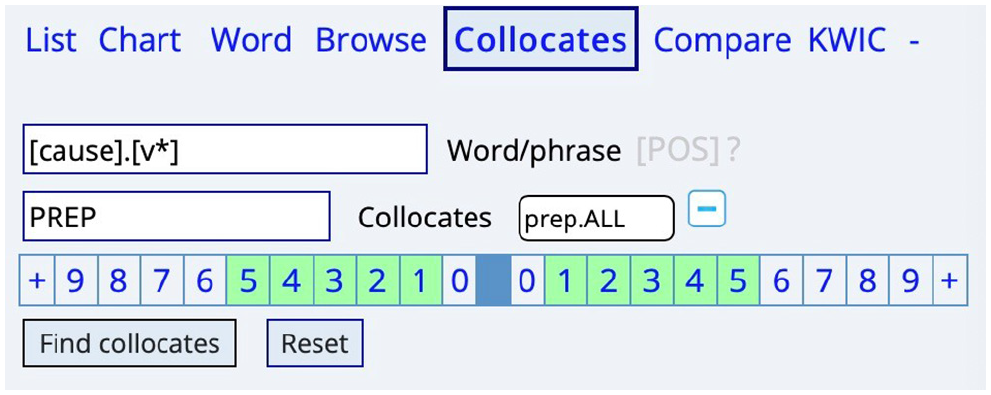
Demonstration of retrieving hits of verbalization.
For retrieving instances of ideational metaphor of adjectivization, SQs 6 to 7 are constructed for retrieving hits of nominal group adjectivization, and SQs 8 to 11 for participial adjectivization. SQ6 reads as the nominal group in the sequence of an adjective that derived from an -ion ending nominalization, and a noun; it retrieves instances of nominal group adjectivization in the modifier use as shown in (6a). SQ7 reads as a construction of an adjective ending with -ional, followed by a period; it is employed to retrieve instances of nominal group adjectivization in the predictive use as shown in (6b). SQs 8 and 9 could be described as any construction that is in the sequence of any adverb, a participial adjective, and a noun, which are exemplified in examples (7a) and (7b) respectively; they are employed to retrieve instances of ideational metaphor of participial adjectivization in the modifier use. SQs 10 and 11 read as any construction that is in the sequence of any form of a be verb or an adverb, and a participial adjective followed by a period in the predictive use, which are instantiated in examples (7c) and (7d) respectively.
SQ6: *ional.[j*] [nn*]
SQ7: *ional.[j*] .
SQ8: [r*] *ing.[j*] [nn*]
SQ9: [r*] *ed.[j*] [nn*]
SQ10: [vb*]|[r*] *ing.[j*] .
SQ11: [vb*]|[r*] *ed.[j*] .
(6) a. Freire believed that teaching was a conversational exchange of information between the teacher and the student. (COCA_academic_2005)
b. Placement alone is not enough for such experiences to be transformational. (COCA_academic_2015)
(7) a. Intrinsically satisfying tasks only impacted helping behavior, while task significance impacted all factors except sportsmanship. (COCA_academic_2006)
b. Now it’s working on software that links visually impaired people to the Internet via a telephone. (COCA_spoken_2005)
c. This could be the only reason that we’re continuing with this because it’s embarrassing. (COCA_spoken_1993)
d. Denying the allegation, various Chechen spokesmen manage all the same to sound extremely satisfied. (COCA_magazine_1999)
Approaches
This research is basically conducted with a mixed approach that consists of both quantitative analysis and qualitative analysis. Quantitatively, drawing on the collexeme analysis, we identified these metaphorical expressions that are significantly attracted to the construction of ideational metaphor underlying the frequencies of these metaphorical expressions under consideration. Qualitatively, we sampled the metaphorical expressions of ideational metaphor that are distributed in the five genres of COCA and manually analyzed the specific function that each instance in its linguistic context might realize. Therefore, this subsection will highlight the operationalization of the collexeme analysis and the procedures of confirming functions of ideational metaphor.
Collexeme analysis is one member of collostructional analysis which was first proposed by Stefanowitsch and Gries (2003) and further expanded by S. T. Gries and Stefanowitsch (2004), Stefanowitsch and Gries (2005), and Hilpert (2014). It is implemented to examine the mutual association strength between lexical items and a certain grammatical pattern. More specifically, it examines which lexical items in a given slot are attracted or repelled by a grammatical pattern (Hilpert, 2014; Stefanowitsch & Gries, 2003). For example, the investigation of attraction or repulsion of nouns in the grammatical pattern N waiting to happen. Nouns that are potential to occur in the grammatical pattern are termed as collexemes (cf. Stefanowitsch & Gries, 2003). Owing to the fact that this research examines the most representative instances of ideational metaphor, only those that reach the significant level of Inf (which means that the association strength between lexical items and the grammatical construction is so strong that it could not be measured by numbers) are further considered. For the exact procedures of computation of collexeme analysis, interested readers may refer to Stefanowitsch and Gries (2003), Hilpert (2014), J. Zhou (2023a, 2023b), and J. Wang and Zhou (2022). The whole computation in this research is completed by the function in R language coll.analysis provided by S. Gries (2014).
Procedures of confirming functions of ideational metaphor are operated as follows. We firstly sampled 100 concordances for each metaphorical expression identified by collexeme analysis; these concordances are evenly taken from the five genres, that is, twenty from each genre at issue. Secondly, all concordances of these metaphorical expressions were manually annotated with a UAM corpus tool. For a certain metaphorical expression, if a specific function could be identified in at least three times (cf. J. Zhou, 2021) of the concordances with a range of 0.78 in genres (range is employed to avoid the case that a metaphorical instance is extremely biased by a specific genre; owing to the fact that “there is no research-recommended value for range” (Gardner & Davies, 2014, p. 315), this research complies with what Gardner and Davies (2014) and Gholaminejad and Anani Sarab (2020 have employed the value of range ratio, i.e., 78%.), it is regarded as the fact that the metaphorical expression is capable of fulfilling the function in question. Finally, we categorized these confirmed functions of ideational metaphor and explained the underlying reasons.
Instances of Ideational Metaphor With Significant Attraction
Drawing on the collexeme analysis and the function coll.analysis in R language, all metaphorical expressions that are significantly attracted to the construction of ideational metaphor and those that reach the significant level of Inf are presented in Appendix Table 1.
Appendix Table 1 demonstrates that, in terms of the significantly attracted metaphorical instances to subtypes of ideational metaphor, typical instances of nominalization includes majority, responsibility, forgiveness, reasonableness, administration, etc. and the total number of metaphorical expressions to this type of ideational metaphor amounts to 161; the total number of metaphorical expressions to ideational metaphor of verbalization amounts to 28, primarily inclusive of provide, create, follow, lead to, decrease, facilitate, regulate, etc.; and the metaphorical expressions to ideational metaphor of adjectivization chiefly include computational, recreational, publicized, complicated, etc., amounting to 130 in total. Drawing on these significantly attracted metaphorical expressions, the following section is conducted to analyze the functions that these expressions of ideational metaphor might realize in linguistic contexts.
Functions of Ideational Metaphor
By means of procedures of confirming functions of ideational metaphor, specific functions that subtypes of ideational metaphor might realize are summarized in Table 2.
Functions of Subtypes of Ideational Metaphor.

According to Table 2, it shows that realization of these functions is displayed considerably differently by expressions of subtypes of ideational metaphor. More precisely, expressions of nominalization under consideration could realize all functions displayed in Table 2 (“+” indicates the presence of a certain function); those of verbalization could only realize such functions as authoritativeness, objectivity, conciseness, abstractness, formality, and semantic condensation (cf. column 4 in Table 2); and those of adjectivization are only capable of realizing conciseness, formality, semantic condensation, and ambiguity (cf. column 5 in Table 2). In the following subsections, specific functions are further exemplified and expounded in more details.
Functions of Ideational Metaphor: Interpersonal
In relation to interpersonal functions, authoritativeness enacts an unequal status between writers/speakers and readers/hearers, and objectivity relates to the modal responsibility realized by the mood elements in the clause. In both cases interpersonal features presented in the congruent forms are omitted or blurred in the metaphorical forms.
Authoritativeness
The function of authoritativeness could be fulfilled by the use of a mood type such as imperative, or by linguistic resources of nominalization and verbalization. That is to say, with respect to subtypes of ideational metaphor, both expressions of nominalization and expressions of verbalization are capable of performing the function of authoritativeness. Expressions of ideational metaphor are an efficient means of rendering authoritative not only formal genres like academic texts but informal genres like spoken texts. The reason for this is that the existence of an event at issue will force readers or hearers to believe that such a happening is to some extent a fact. The force of conveying the fact to putative readers or hearers will definitely foreground the authoritative status of the writers or speakers. Another reason might be that the expressions of nominalization convey the required information in the texts concisely, cohesively, and coherently, which is highly consistent with the authoritativeness embodied in such formal genres as governmental documents and academic texts. Consider the example in (5). Resentment in (5a), which loses the finite element (i.e., the past tense marker), presupposes the existence of the happening of the event and it further prompts the readers or the hearers to believe that such a happening might be a fact. In addition, in (5b) the downward rank-shifting from the clause because racism renders them to be hated and resented by others to the prepositional phrase because of the hatred and resentment of racism in (5a) not only omits the agent but realizes the same propositional meaning more concisely.
(5) a. More trenchantly, middle-class African American women knew that even when they were well-educated, opportunities for employment commensurate with their training often eluded them because of the hatred and resentment of racism. (COCA_academic_1997)
b. More trenchantly, middle-class African American women knew that even when they were well-educated, opportunities for employment commensurate with their training often eluded them, because racism renders them to be hated and resented by others.
Instances of verbalization could also play the function of authoritativeness in that a clause or a nominal group rank-shifted from a clause complex will unavoidably contain a higher semantic density, which will contribute to the authoritativeness of the text. This can be seen in the example in (6).
(6) a. The conversion from native marshland to agricultural land caused significant changes in the vegetation and soil properties, leading to a sharp decrease in biodiversity. (COCA_academic_2019)
b. Because native marshland was conversed to agricultural land, vegetation and soil properties were changed significantly; this led to a sharp decrease in biodiversity.
The meaning realized by a clause complex in (6b) is structurally repacked as a simple clause in (6a) by means of down rank-shifting, and hence the structure is comparatively simplified and the meaning contained in the simple clause becomes comparatively complicated.
Objectivity
The most obvious function played by ideational metaphors, particularly of nominalization, is that of objectivity. Objectivity typically characterizes such formal genres as governmental documents and academic writings and the reason why ideational metaphor renders texts more objective is associated with the mood structure of the clause, as realized by the subject and finite element (Halliday & Matthiessen, 2004, 2014), which plays an important role in negotiating propositions (Martin, 1992). When a clause complex or a clause is rank-shifted into a clause or a nominal group, its mood elements are completely or partially lost, making the proposition non-negotiable. This non-negotiability in turn presents the proposition as an irrefutably objective fact.
The primary function of the subject in the mood structure is to take on responsibility for the validity of proposals and propositions. In the process of rank-shifting, the loss of the finite very commonly leads to the loss of subject. With no explicit element held responsible for the validity of the proposition, it seems that who performs the action is not important and what matters is publicly accepted as an objective fact. The loss of subject means the loss of a reference point or departure point for negotiation and argumentation. Such a condensed proposition can only be doubted in terms of “what is this” and not in terms of “whether” or “why” it is. The other element in the mood system is the finite element, which relates to the event and provides the reference point to associate the proposition with the context (cf. Hu et al., 2005). When a verb is transcategorized into its corresponding nominalized counterpart, the finite element such as tense markers is also lost, which further leads to the loss of negotiability of the proposition thus foregrounding the objectivity of the proposition. Accordingly, if the truth of a proposition realized by a certain linguistic unit cannot be doubted, then the proposition comes across objectively oriented. The loss of mood elements in the proposition leads to the loss of negotiability, which enhances the function of objectivity. Consider the example in (7).
(7) a. Unions responded to our survey by demanding more funding from government and greater protection of frontline staff from employers. (COCA_academic_2010)
b. Unions responded to our survey by demanding that they should be funded more from government and the frontline staff should be protected greatly from employers.
Concerning the examples in (7), protection in (7a) is a nominalization and the verbal group should be protected in (7b) is its congruent counterpart. In (7b), the subject the frontline staff and the finite element should together constitute the mood element of the clause whose main function is to render the proposition negotiable, and hence convey the writer’s subjective meaning. However, in the process of transcategorization from the verbal group should be protected to the nominal group protection the finite element is lost, as is the negotiability of the proposition in question, and the objectivity of the proposition is consequently foregrounded.
Both nominalization and verbalization are capable of performing the function of objectivity. Instances of nominalization were explained in previous paragraphs and exemplified in (7). In the case of verbalization, more semantic information is condensed when rank-shifting from a clause complex as in (8b) to a simple clause as in (8a) in which determine is a metaphorical instance in the collexeme class of “control.” The loss of subject and finite element, that is, us and the present tense marker respectively as shown in (8b), leads to semantic condensation and this in turn causes the loss of the negotiability of the proposition and accordingly foregrounds the objectivity of the proposition in (8a).
(8) a. According to Dependency Locality Theory, the processing difficulty or complexity of a syntactic structure is determined by the computational resources that the structure requires to process. (COCA_academic_2019)
b. According to Gibson’s (1998) Dependency Locality Theory, because the syntactic structure requires the computational resources to process, it is difficult and complex for us to process the syntactic structure.
Functions of Ideational Metaphor: Ideational
In relation to ideational functions, conciseness relates to how clause elements realizing participants and processes in transitivity system are lost or transformed into modifiers of heads and heads of nominal groups respectively. The loss or transformation of such elements may also realize the function of ambiguity. Abstractness relates verbs and adjectives in congruent forms reconstrued more abstractly by their corresponding nominal groups in metaphorical forms. Semantic condensation relates to the use of fewer lexical elements.
Conciseness
Corpus data reveal that three types of ideational metaphor are capable of making the proposition concise. The conciseness of the proposition by means of such ideational metaphors as nominalization, verbalization, and adjectivization is chiefly realized by downward rank-shifting. When rank-shifting from a clause to a nominal group, verbs that realize processes are transcategorized into their corresponding nominalized counterparts functioning as the head in a nominal group. In this process, the partial loss of participants and the complete loss of finite elements renders the proposition in question more concise. Consider the example in (9a), in which the qualifier frontline staff of the nominal group greater protection of frontline staff from employers is rank-shifted from the participant in its congruent counterpart (cf. 9b), and the nominal head protection is derived from the verbal group should be protected in the congruent expression, causing the loss of the finite element should, making the metaphorical expression more concise compared with its congruent form. Similarly, the instance of adjectivization compelling in (9b) is down rank-shifted from the verbal group compel in the clause the results compel to the adjective compelling functioning as the modifier of the head in the nominal group the compelling results, rendering the proposition more concise. Concerning the conciseness in verbalization, when the conjunction that realizes the relator is transcategorized into the verb that realizes the process, the clause complex is downwardly rank-shifted into a simple clause, making the proposition structurally simplified. This could be evidenced in (9c), which is rank-shifted from the clause complex as shown in (9b).
(9) a. Unions responded to our survey by demanding more funding from government and greater protection of frontline staff from employers. (COCA_academic_2010)
b. If the experience is allowed, as it were, to wash over the participant without judgment, it can yield compelling results. (COCA_academic_2019)
c. According to Gibson’s (1998) Dependency Locality Theory, the processing difficulty or complexity of a syntactic structure is determined by the computational resources that the structure requires to process. (COCA_academic_2019)
Abstractness
In transforming congruent forms into metaphorical forms, the abstractness of the meanings of propositions at issue becomes more abstract. The more abstract the meanings of propositions become, the more cognitive effort required in processing (cf. Cong & Wang, 2013). Corpus data reveal that expressions of nominalization are efficient means for realizing the abstractness of propositions, in the case of both process thing and quality thing. In the case of process thing, processes typically realized by verbs are realized by nominalizations, and language users will take more steps to process the meanings that are realized by nominal elements. In this way, the procedure of processing will not only become abstract but also consume more cognitive effort. Similarly, in the case of quality thing, a quality congruently realized by adjectives is easy for us to process than a quality thing realized by de-adjectival nominalizations, in that the mismatch between meanings in the semantic stratum and expressions in the lexico-grammatical stratum makes the whole processing more complicated and it therefore becomes more abstract.
Instances of verbalization also render the proposition more abstractly articulated, in this case in relation to the implicitness of realization of logico-semantic relations. Logico-semantic relations between activities are congruently realized by relators, for example, by such conjunctions as because realizing causal and effect relation and if realizing conditional relation. When the same logico-semantic relation is metaphorically realized by verbalization, the explicit relator is replaced by verbs which prototypically realize processes; thus rendering the logico-semantic relation more abstractly. Consider the examples in (10), wherein the abstractness of the proposition lies in that the temporal relation between the two propositions, that is, implications for practice are discussed and results are reviewed, is realized by the verb follows in (10a) which congruently realizes process, while the same temporal relation is explicitly realized by the conjunction after in (10b). Therefore, propositions in (10a) are more abstractly realized than those in (10b).
(10) a. A discussion of implications for practice follows a review of results. (COCA_academic_2019)
b. After implications for practice are discussed, results are reviewed.
Ambiguity
Ambiguity refers to “the quality of being open to more than one interpretation” (OED) in terms of not only single lexical items but also grammatical constructions. Ambiguity of texts by the use of ideational metaphor is motivated by the semantic reduction of expressions of ideational metaphor. Cong and Wang (2013) subcategorized semantic variation in grammatical metaphor into three types, that is, semantic reduction, semantic expansion, and semantic restructuring, of which we consider only the first type here. From the perspective of efficiency of information transmission and fulfilment of communicative purposes, semantic reduction may have a beneficial as well as a harmful effect in texts. The benefits lie in that the process of semantic reduction, in turning dynamic processes into static entities, enables them to be quantified and modified, thus rendering the language to be of objectivity and authoritativeness as discussed in previous subsections.
The harm of semantic reduction is that it may give rise to semantic blurring or even create ambiguity. Reasons for the occurrence of ambiguity of the texts are threefold. First, participants such as actors and goals and circumstances such as time, place, and manner, after rank-shifting from clauses to groups, are remapped into the modifying elements or even omitted. Deletion of these elements will directly cause the loss of ideational meaning and lead to the occurrence of ambiguity or semantic blurring. Consider the example in (11a), where the metaphorical form the exploration of a teacher’s stress within the sensorimotor modality realizing the participant congruently could be unpacked as [Nagel and Brown] explored a teacher’s stress within the sensorimotor modality. The participant Nagel and Brown in the congruent form is deleted while being transformed to the metaphorical counterpart, which caused the semantic blurring in that it is not obvious for readers who performed the action of exploration.
Second, the use of ideational metaphor may give rise to the loss of semantic elements related to processes, such as tense and aspect, mood, modality, and voice. Although the loss of these semantic elements will foreground the objectivity of the texts as illustrated above, it will also unavoidably lead to the semantic blurring or ambiguity, as can also be exemplified by the example in (11a).
Third, this kind of reason is associated with the first one. Specifically, after participants of actors or goals and circumstances of manner in the congruent form are turned into modifiers in the metaphorical form, the subject-predicate relation and the predicate-object relation are realized metaphorically as a relation between modifiers and heads, causing the occurrence of ambiguity finally. Consider the example in (11b). The metaphorical expression the successful implementation of the OC program could be unpacked into the congruent one with the predicate-object relation [both the master teacher and the school system] implemented the OC program successfully; in addition, the manner realized by successfully in the congruent form is turned into a modifier of the head, that is, the successful implementation. Both means of the loss of predicate-object relation and the transference of manner to modifier will definitely lead to the ambiguity of the proposition under discussion.
(11) a. The exploration of a teacher’s stress within the sensorimotor modality [by Nagel and Brown] is grounded in identifying a specific event and delving into what is seen, heard, and felt in that moment. (COCA_academic_2007)
b. She relied heavily on both the master teacher and the school system for the successful implementation of the OC program and for the essential professional development of her teachers. (COCA_academic_2006)
Semantic Condensation
The process of expressing the same or similar meaning with fewer linguistic expressions is referred to as semantic condensation. Semantic condensation is closely associated with semantic density which refers to the degree to which meaning is compressed in relation to social and cultural behavior (Maton, 2011, 2013, 2014); the stronger the semantic density, the more semantic meaning is compressed, and vice versa. Ideational metaphor is a useful means to achieve the purpose of semantic condensation in that meanings realized by metaphorical forms will cause the loss of finite elements and sometimes the participants, which will unavoidably decrease the number of lexical items and therefore increase the degree of semantic condensation. In relation to the three subtypes of ideational metaphor, verbalization could increase the semantic condensation since when a relator is transformed into the process, clauses in the congruent form will be necessarily rank-shifted to the nominal groups in the metaphorical form realizing the participants; in a similar vein, nominalization and adjectivization could also increase the semantic condensation by means of rank-shifting the clause to the nominal group functioning as the head of the nominal group (i.e., nominalization) or the modifier of the nominal group (i.e., adjectivization).
A metaphorical expression with high semantic condensation requires more cognitive effort to process. This is typically not preferred in informal genres like spoken and fiction texts in that either communicators have less time to process it or the majority of readers are ordinary people who are not well educated. While researchers in the academia value their time greatly and are capable of unpacking linguistic expressions with high semantic condensation even though these expressions require much cognitive effort to process them, and thus expressions of ideational metaphor are frequently employed in formal genres like academic texts. This is also testified by previous studies conducted by such scholars as Halliday (1998), Cong and Wang (2013), He and Yang (2018), etc.
Functions of Ideational Metaphor: Textual
Formality relates to textual functions in that the employment of nominal elements and the increase of lexical density will make the text more formally oriented. Cohesion relates to textual functions in that expressions of ideational metaphor are important means of organizing the different clauses of a text in the context in a cohesive way.
Formality
Formality in formal genres like academic texts is strongly associated with the increase in lexical density, and with the use of nominal elements and impersonal constructions (Hyland, 2008). The former two uses will be discussed under the motif of ideational metaphor, while the latter will be explained later under interpersonal metaphor. The first positive correlation occurs between the use of nominalization and the lexical density and/or nominal elements. Downward rank-shifting either from clause complex to clause or from clause to nominal group leads to an increase in the lexical density of a certain clause, through the use of either deverbal nominalization or deadjectival nominalization. The case of deverbal nominalization is shown in (12a) (rewritten from (10a)), where the rank-shifting from clause complex as shown in (10b) to clause as shown in (12a) also involves rank-shifting from clause to nominal group such as a discussion of implications for practice. In the process of downward rank-shifting, the verbal group discuss is transcategorized into the nominal group discussion, increasing therefore both the number of nominal elements and the lexical density. The second positive correlation occurs between instances of verbalization and the use of lexical density and/or nominal elements. This could also be explained by the fact that downward rank-shifting from clause complex to clause forces the simplification of syntactic structure thus increasing the lexical density; simplification of syntactic structure prompts the use of nominal elements and thus increases the total number of nominal elements in the clause, as shown in example (12a).
(12) a. A discussion of implications for practice follows a review of results. (COCA_academic_2019)
b. Leach does not offer compelling evidence for asserting that Gibbons saga is a translated romance; his thesis is untenable. (COCA_academic_2019)
The third positive correlation occurs between adjectivization, particularly participial adjectivizations, and an increase in lexical density (exclusive of nominal elements). The increase of lexical density in this respect is triggered by the fact that a process realized by a verbal group in the clause is transformed into a modifier realized by a participial adjective, resulting in the loss of finite elements and partially the loss of participants. In this sense, the metaphorical expressions will increase the lexical density of the clause in question. Consider the expression of adjectivization compelling in (12b), whose congruent expression is the evidence is compelling. The lexical density in the metaphorical expression compelling evidence is half that of the congruent expression the evidence is compelling.
Cohesion
Cohesion in SFL is defined as the relation between two or more independent grammatical elements in a text, and can be divided into lexical cohesive devices and grammatical cohesive devices (Halliday & Hasan, 1976). Lexical cohesive devices are further categorized into reiteration or repetition, collocation, etc. and grammatical cohesive devices into reference, ellipsis, substitution, conjunction, etc. As an important linguistic resource, ideational metaphor is also capable of contributing to the cohesion of texts (for a brief examination of this respect, refer to such scholars as Z. Wang & Shi, 2016; Xu, 2011, and H. Zhou and Liu (2017). Ideational metaphor realizes cohesion in texts by means of “anaphoric reconstrual,”“elaborated nominal groups,” and “meaning accumulation” (Liardét, 2013, p. 167). The three means of ideational metaphor could realize cohesion of a text by foregrounding the theme of the text, as explained in the following paragraphs.
Anaphoric reconstrual is defined as “the pattern of referencing previously deployed congruent clause elements as newly reconstrued metaphorical clause elements for building cohesion across the text” (Liardét, 2013, p. 167). Writers or speakers use ideational metaphor to build up an argument by reiterating previous statements to expand subsequent clauses. For example, the congruent process examine in (13) is used to introduce the upcoming new information more effective coping strategies, which, after being metaphorically reconstrued as examination of such factors as hardiness and other coping strategies, is treated as the given information. By so doing, the new information in the second clause employees may be better able to handle stress is naturally introduced into the text, linking together the information contained in the two propositions in a cohesive way.
(13) Nurse managers can use stress management programs to empower their employees to examine more effective coping strategies. Through an examination of such factors as hardiness and other coping strategies, employees may be better able to handle stress. (COCA_academic_1996)
Similar to anaphoric reconstrual, ideational metaphor contributes to the cohesion of the text by means of turning a congruent process into an elaborated nominal group in the metaphorical form. The notion of elaborated nominal group refers to the process whereby “multiple meanings [in previous clauses] are often infused into a single clause element, […] condensing multiple pieces of previously introduced information into a single metaphorical participant” (Liardét, 2013, p. 168). Consider the congruent process examine and the metaphorical entity examination in (14). The congruent process examine is anaphorically reconstrued as the metaphorical entity examination. By so doing, the metaphorical entity examination is capable of being elaborated by further information delimiting the scope of examination, that is, a more in-depth examination.
(14) “Our research is the first to report trends in injury patterns since ‘targeting’ rule changes took effect. Continued surveillance to examine these trends, and a more in-depth examination of how targeting rule changes are impacting injuries both at the targeted site and at other parts of the body needs to be performed to prevent long-term health issues,” said Westermann. (COCA_magazine_2016)
Instances of ideational metaphor can also contribute to the cohesion of a text if the text “involves accumulation of certain meanings through repetition or restatement” (Liardét, 2013, p. 168). By means of repetition or restatement of the same metaphorical entity in a text, speakers or writers are able to link arguments together and comment on the same issue from different perspectives cohesively. For example, the speaker in (15) uses repetition to emphasize the responsibility of the leader, achieving the cohesion between the two propositions in the text.
(15) In any organization, the man at the top must bear the responsibility [of fulfilling his post]. That responsibility, therefore, belongs here, in this office. I [Mr. Nixon] accept it. (COCA_spoken_1994)
Corpus data demonstrate that only instances of nominalization, very rarely of verbalization or adjectivization, are frequently employed to foreground the themes of texts. In this respect, it suffices to explain why previous studies predominantly highlighted the cohesion function that expressions of grammatical metaphor could perform.
Concluding Remarks
Drawing on the collexeme analysis, the significantly attracted metaphorical expressions to the construction of ideational metaphor are identified. Each of these metaphorical expressions is sampled evenly in such genres as spoken texts, fiction, magazines, newspapers, and academic texts, and carefully analyzed what function or functions each sample might realize in its linguistic context. The findings demonstrated that expressions of ideational metaphor could realize such interpersonal functions as authoritativeness and objectivity, such ideational functions as conciseness, abstractness, ambiguity, and semantic condensation, and such textual functions as formality and cohesion.
This research is theoretically significant in that it considered ideational metaphors with statistical significance to explore specifically typical functions realized by these metaphorical expressions, and thus the findings could be to some extent generalized in English. In addition, this research is of full coverage and systematicity in uncovering functions of ideational metaphor. The full coverage lies in that it considers not only the functions of ideational metaphor of nominalization, but also those of both verbalization and adjectivization. The systematicity lies in that all three subtypes of metafunctions (i.e., ideational, interpersonal, and textual) are employed to document the functions realized by instances of ideational metaphor. More importantly, this research provided explanation to these realized functions of ideational metaphor by considering their occurrences in the linguistic contexts, contributing to the understanding of the theory of ideational metaphor in depth. This research is also practically significant in that it could feed into the design of pedagogical materials aimed at guiding learners in reading and writing. Informed by the current study, learners, while reading, will understand why certain instances of ideational metaphor are used and what functions are realized by these metaphorical instances. Similarly, they will also be facilitated by this research in choosing which particular instance of ideational metaphor to realize certain functions while constructing writings properly.
Although this research systematically and fully documented the most typical functions of ideational metaphor, it ignored the analysis of syndrome of functions of ideational metaphor due to the scope and purpose of this research; in other words, a certain sampled metaphorical expression may concomitantly fulfill different functions under consideration. In addition, it does not consider the variable of genre or text type which might employ different functions to build knowledge in a certain genre. These gaps are suggested to be filled in future studies.
Footnotes
Appendix
Instances of Ideational Metaphor That Reach the Significant Level of Inf.

| Ideational metaphor | Expressions |
|---|---|
| Nominalization | Security, activity, majority, authority, responsibility, capacity, minority, diversity, stability, priority, intensity, integrity, disability, reliability, validity, mortality, credibility, productivity, creativity, accountability, density, flexibility, liability, sensitivity, curiosity, inability, obesity, prosperity, fertility, solidarity, proximity, hostility, sustainability, instability, homosexuality, ambiguity, humidity, confidentiality, insecurity, fraternity, connectivity, austerity, consciousness, wilderness, forgiveness, loneliness, reasonableness, information, education, attention, administration, decision, association, organization, election, investigation, collection, discussion, conversation, protection, generation, construction, competition, division, expression, operation, reaction, intervention, communication, location, opposition, instruction, immigration, connection, combination, conclusion, participation, transition, constitution, revolution, depression, distribution, selection, resolution, abortion, evaluation, transportation, expansion, interaction, destruction, interpretation, impression, cooperation, satisfaction, discrimination, evolution, implementation, pollution, inflation, exhibition, permission, motivation, confusion, corruption, concentration, frustration, nomination, recession, invasion, integration, orientation, radiation, collaboration, innovation, correlation, transmission, compensation, regression, prescription, government, development, treatment, management, movement, agreement, assessment, argument, enforcement, achievement, amendment, entertainment, retirement, judgment, settlement, engagement, punishment, excitement, appointment, advertisement, arrangement, assignment, harassment, disappointment, impeachment, enrollment, indictment, endorsement, impairment, resentment, pavement, amusement, compartment, endowment, enlightenment, assortment, imprisonment, procurement, reimbursement, parchment, redevelopment, mismanagement |
| Verbalization | Cause, lead to, come from, emerge from, bring about, give rise to, induce, produce, create, generate, increase, decrease, augment, enhance, elevate, improve, influence, control, determine, facilitate, guide, reinforce, permit, provide, require, direct, regulate, associate with, relate to, correlate with, halt, terminate, inhibit, damage, precede, follow, coincide, accompany, depend (on), determine |
| Adjectivization | Computational, recreational, additional, congressional, constitutional, conventional, correctional, educational, emotional, exceptional, fictional, functional, gestational, gravitational, institutional, instructional, international, motivational, national, nutritional, occasional, occupational, operational, organizational, professional, promotional, regional, three-dimensional, traditional, transitional, vocational, publicized, sophisticated, amazing ., complicated ., transmitted, sensational, misleading ., acclaimed, intentional, inspirational, complicated, compelling, destroyed ., observational, provisional, short-lived ., overrated ., transcriptional, daunting ., congregational, jurisdictional, forthcoming ., deafening ., disgusting ., impaired, resolved ., breathtaking ., compositional, devastating ., confrontational, overwhelming ., fascinating ., horrifying ., attributional, dysfunctional ., intriguing, representational, heartbreaking ., proportional, rotational, overjoyed ., frightening ., satisfying, unprecedented ., disadvantaged, talented, retarded, multidimensional, factional, transformational, exciting ., modified, relieved ., fractional, appalling ., pending ., unprepared ., embarrassed ., appalled ., vexing, daunting, exciting, disabled, overpriced ., syndicated, unparalleled ., terrifying, starving ., prescribed, underfunded ., oversubscribed ., veiled, transactional, delusional ., intimidating ., industrialized, chopped, refreshing ., devastating, overqualified ., overworked ., qualified, advanced, compelling ., annoying ., underutilized ., enriched, outstanding, satisfying ., fascinating, disturbing, embarrassing ., disturbing ., astonishing ., underemployed ., unlisted ., outstanding ., dejected ., unconventional |
Author’s Note
The manuscript, in full or in part, has not been published elsewhere and it is not under consideration by other journals/publishers online or in print.
Declaration of Conflicting Interests
The author declared no potential conflicts of interest with respect to the research, authorship, and/or publication of this article.
Funding
The author(s) disclosed receipt of the following financial support for the research, authorship, and/or publication of this article: This research is funded by China West Normal University (No. XJ2024000103).
Ethical Statement
Ethical statement is not applicable.

Data Availability Statement
Data sharing not applicable to this article as no datasets were generated or analyzed during the current study.