




Abstract
The term “NEET” refers to individuals aged 15 to 34 years who are not involved in education, employment, or training programs. Recent studies have shown that NEET individuals are at a high risk of experiencing lower well-being and mental health issues. This study aimed to examine the relationship between intolerance of uncertainty (IU), meme use (MU), depression emoticon empathy (DEE), and career indecisiveness and anxiety (CIA) in NEETs who were locked down during the COVID-19 pandemic in China. We hypothesize positive interrelations among study variables. Then, mediation path models were carried out to study the relationship between IU and CIA through MU and DEE. We collected data through an online survey from NEETs (N = 1,404) in China, using questionnaires assessing IU, MU, DEE, and CIA, and Structural Equation Modeling analyses were performed to explore the interrelations among them. We found that IU influenced NEET’s CIA primarily through the independent intermediaries of MU and DEE. Additionally, the chain intermediary of MU → DEE was significant. Our study indicated that MU and DEE partially mediated the relationship between IU and CIA, respectively. Digital communications through MU and DEE are playing an important role in the relationship between IU and CIA, respectively. Therefore, MU and DEE as studied in this research may work as alarm to foretell early of the CIA among NEET. Moreover, our findings could be used as a reference for promoting employment and increasing the employment rate among NEET population and might be a potential target for intervention or service delivery.
Plain language summary
This study focuses on NEETs, which are individuals aged 15 to 34 years who are not involved in education, employment, or training programs. The aim of the study is to understand how the uncertainty of the COVID-19 pandemic, the use of memes on social media, and the ability to empathize with others’ depressive emotions are related to career indecisiveness and anxiety among NEETs in China. The study collected data from 1,404 NEETs through an online survey and used statistical analyses to examine the relationships between these variables. The findings show that uncertainty affects career indecisiveness and anxiety among NEETs through the use of memes and the ability to empathize with depressive emotions. The study suggests that monitoring the use of memes and understanding depressive emotions on social media could help identify and support NEETs who are at risk of career indecisiveness and anxiety. These findings have implications for promoting employment and providing targeted interventions for the NEET population.
Keywords
Introduction
The COVID-19 pandemic caused profound changes in life and work conditions due to widespread lockdowns and shutdowns. On March 11, 2020, the World Health Organization (WHO) declared that COVID-19 had spread to almost every country and had reached pandemic proportions (Anand et al., 2020; WHO, 2020). This subsequently caused significant impacts on global politics and the environment, particularly affecting the global economy. According to the International Labor Organization (ILO, 2021), COVID-19 triggered a severe recession that surpassed even the 2009 financial crisis.
The weakened labor market has been recognized as the primary cause of the current economic challenges, with the COVID-19 pandemic exacerbating situation by causing a significant the situation by causing a significant reduction in working hours. The pandemic’s most devastating consequence was the substantial global loss of labor income, resulting in a loss equivalent to approximately 4.4% of GDP globally (ILO, 2021). Additionally, the surge in university enrollment in China, which began in 1998, and the resulting increase in the number of college graduates have contributed to the country’s current employment issues because the rapid expansion of higher education and a lag in employment supply have made it challenging for graduates to secure jobs that align with their skills and expectations (Bai, 2006; Li et al., 2014). Further, a growing number of young people struggle to access higher education or find suitable employment opportunities, earning them the label “NEET: not in education, employment, or training” (Gutiérrez-García et al., 2018; O’Dea et al., 2014; Wanberg, 2012).
The concept of NEET originated from the UK’s revised definition of unemployment and economic activity (Cole, 2008; Reiter & Schlimbach, 2015). And now, the concept of NEET has also exhibited cross-cultural variations worldwide. In China, individuals considered as NEET often use the term “lie down” to describe their state. However, “lie down” does not have the same connotation as “couch potato” in other countries. It is not a Chinese version of the British “NEET,” the Japanese “Teiyokubo Shakai,” or the Korean “Honjok,” term but rather a more complex state (Genda, 2007; Y. Yang, 2020). There are various reasons why individuals become NEET, including: (1) Those who are not willing to work; (2) Those who have experienced involuntary job loss; (3) Those who refuse to settle for any occupation below their ideal career. On the one hand, NEETs in China actively choose to relinquish work, love and marriage, which some young people consider a trendy lifestyle. They are often forced to abandon work, love and even marriage due to significant economic pressures. According to research, the NEET rate in China was 8% in 2012, and there was a higher risk of being NEET among individuals aged 22 to 25 or among women (Y. Yang, 2020). The gender gap in labor force participation among young people aged 16 to 24 was much lower compared to adults. Specifically, the labor force participation rates were 59.6% for young males and 55.1% for young females, while the rates for adult males and adult females were 93.7% and 77.2%, respectively (Schucher, 2017). In a study conducted by O’Dea et al. (2014) in Australia, it was found that NEETs were more likely to be male and had higher levels of depression, as well as a more advanced stage of mental illness compared to those engaged in education, training, or work.
This issue is particularly noteworthy because, according to the ILO, NEETs are characterized by “unemployment, early school leaving, and discouragement from the labor market,” making them more vulnerable and susceptible to greater difficulties in their daily lives. Therefore, in this prolonged state of uncertainty, it is easy to develop intolerance of uncertainty (IU), which is conceptualized as a personality trait characterized by negative beliefs about uncertainty and its consequences (Robichaud et al., 2019).
The COVID-19-pandemic and the resulting lockdowns have had a significant impact on the lives of NEETs. While students and employees have been able to adapt to online courses and telecommuting, NEETs have had to rely solely on online communication to seek empathy and support. Unfortunately, these circumstances have contributed to a marked deterioration in their mental well-being, as evidenced by studies conducted by Hensher (2020) and Sun et al. (2021). In their quest for empathy, memes have emerged as a popular medium for forging online relationships and have been widely disseminated across social networks (Milner, 2016; Miltner, 2014). However, due to fear and situational motives, individuals may exhibit avoidance behaviors towards online information (Sultana et al., 2023). Interestingly, memes use (MU), as one form of online information, has witnessed an increase in usage. People are more prone to embrace negative memes that resonate with their pessimistic outlook (Ghaemi Kerahrodi & Michal, 2020), leading to the generation of depressive emotional resonance (DEE). Such attitudes and behaviors can significantly impact their approach to dealing with occupational anxiety and ultimately exacerbate their employment prospects (Khudaykulov et al., 2024; Mahmud et al., 2021). One prominent manifestation is the emergence of career indecisiveness and anxiety (CIA).
Hence, this research aimed to address the aforementioned issues by examining the mental well-being of NEETs in an unstable environment and exploring the underlying psychological mechanisms. Using a networking perspective, our present study utilized memes and negative emotional resonance as the intervening variables to address the employment quandary faced by NEETs.
Theoretical Foundations and Hypotheses
Theoretical Background
In the context of career decision-making, both the prospect theory and the self-worth theory of motivation, offer a valuable theoretical basis for understanding the impact of intolerance of uncertainty (IU) and career indecisiveness and anxiety (CIA). According to the cognitive psychology of decision-making and prospect theory, individuals are often more motivated by loss aversion than potential gains when making decisions (Kahneman, 2003, 2011). This phenomenon is particularly evident in the job market, where many job seekers prioritize positions they perceive to have a lower likelihood of failure. In an environment marked by instability and uncertainty, the risk of unemployment and job loss also increases, leading to heightened levels of anxiety and indecisiveness among NEETs who are currently unemployed and contemplating their future course of action.
The self-worth theory of motivation, derived from the original theory of achievement motivation, explains how individuals strive to protect their sense of self-worth by avoiding failure and seeking success (Covington, 1992). In the digital era of the COVID-19 pandemic, individuals may exhibit avoidance behaviors towards online information due to fear and situational motives (Sultana et al., 2023). The self-worth theory sheds light on how individuals’ perception of their own value influences their motivation and behavior in online social communication and career development (Covington, 2009; Jia et al., 2021). Memes play a unique role in this context, serving as a significant means of expressing humor and empathy that are tailored to the current environment. Through the use of memes, individuals engage in social interactions, convey emotions, and establish connections, aiming to receive positive feedback and recognition that enhance their self-worth and further motivate them to continue using memes as a mode of social interaction. Understanding the self-worth theory helps us better understand how environmental changes impact individuals’ career development. Positive interactions and recognition received in online social communication strengthen individuals’ confidence and motivation, driving them to pursue their career goals.
Intolerance to Uncertainty and Career Indecisiveness and Anxiety
Environmental differences can significantly impact career factors (Kim et al., 2016; Xu, 2023). Unexpected events, such as the COVID-19 pandemic, have been shown to cause career anxiety and indecisiveness, referred to as CIA (Baruch et al., 2016; L. Chen & Zeng, 2021; Daniels et al., 2011; Z. Zhang, Yu, et al., 2022). Based on the theories of self-worth motivation, the NEETs consists of individuals who are presently unemployed and deliberating their future actions. These individuals may encounter elevated levels of intolerance to uncertainty (IU) and experience career indecisiveness and anxiety (CIA) as a result of the uncertainties they confront. Hence, the primary objective of this study is to explore the correlation between environmental factors, specifically IU, and CIA within the NEET population, thereby addressing this research gap. Intolerance to uncertainty refers to the anxiety and fear that arises from feelings of uncertainty about the future, which can lead to emotional difficulties (Fergus, 2013; Hong & Lee, 2015). Previous research has demonstrated a relationship between IU and CIA (Akkermans et al., 2020; L. Chen & Zeng, 2021; Shihata et al., 2017). Career anxiety refers to the feeling of nervousness about the future when someone is looking for a job (Banerjee, 2020; Mahmud et al., 2021), while career indecisiveness refers to the challenges an individual faces in choosing a career (Osipow, 1999). However, the potential mechanisms between IU and the CIA in the NEET population remain to be explored. Identifying possible mechanisms is essential for developing interventions that could reduce CIA caused by environmental changes. Therefore, we hypothesize that IU would have a positive effect on the CIA of NEETs (H1).
The Mediating Role of Memes Use
Dawkins (1989) popularized the concept of memes in the 1970s, defining them as units of cultural replication or transmission. With the advent of the internet memes can now spread rapidly and on a large scale (Shifman, 2013). The COVID-19 pandemic has led to the emergence of a significant number of humorous memes, films, jokes, and satires about the pandemic (Botha & Reyneke, 2013; Nicholls, 2020), which are being used by NEET groups who are isolated at home (Lupton, 2021; X. Yang & Hayashi, 2021). During this period of physical and social isolation, Chinese individuals have been estimated to spend an average of 7.6 hr per day on social media platforms such as TikTok, Weibo, and WeChat, compared to 27.9 hr per week in 2019 (CNNIC, 2019; QuestMobile, 2020). Therefore, uncertainties and fears regarding the future have spread widely throughout online social environments by exploiting the “viral” nature of memes. Although several studies have shown that IU is positively correlated with meme use (MU) (Barnes et al., 2021; Dynel, 2021; Myrick et al., 2022). However, there is no specialized research on NEETs. In this regard, our present study aims to predict whether IU may positively influence meme use among NEETs.
Memes have been identified as a predictive factor in the context of the CIA. Empirical data analysis shows that memes serve as a cultural unit that performs two social functions through their discourse constructors. Firstly, during the pandemic and virtualization of social relationships, memes act as a means of expressing and channeling social emotions. Secondly, memes can become a resource for increased the manipulation and control of group emotional resources for influencing them. Some studies indicate that stress stemming from isolation and news related to depression and anxiety are top-down stressors (Dhir et al., 2018; Primack et al., 2017; Vannucci et al., 2017; Xiang et al., 2014), highlighting the crucial role that memes play. Therefore, this study employs memes as a mediating variable to explore their role in employment manipulation and influence. Furthermore, Hou et al. (2020) findings suggest that social media use increases depression and anxiety, which may lead to career indecisiveness and anxiety among NEETs. Therefore, we hypothesize that MU may be related to NEET’s CIA, based on which we propose hypothesis 2 (H2).
The Mediating Role of Depression Emoticon Empathy
Emotional empathy refers to an emotional response that arises in individuals from perceiving another person’s emotional state or situation and is congruent with their emotions (Eisenberg & Strayer, 1987). The self-worth theory, by using memes, NEET individuals can establish emotional connections and seek positive feedback and recognition, which enhances their self-worth. This positive reinforcement received through meme-based interactions can alleviate their intolerance to uncertainty, reduce career indecisiveness and anxiety, and motivate them to pursue their career goals with greater confidence and determination. Emotional factors in computer-mediated communication express inner states and reactions, thereby maximizing communication effectiveness and strengthening interpersonal relationships (Jeon, 2022; Quintly, 2017).
However, during the COVID-19 pandemic, NEETs intentionally select media content that meets their needs, particularly negative news, leading to negative emotional resonance (Liao et al., 2020; Parola et al., 2023; H. Wang, Huang, et al., 2022). Studies have reported that stress related to pandemic uncertainty is positively correlated with depression and anxiety symptoms (Ben Salah et al., 2023; X. L. Wang, Gao, et al., 2022). Therefore, it is possible to infer that IU may be related to DEE.
The emotional connection between people and memes is a driving force behind people’s willingness to share them. MU and EDD are relevant, especially when people are isolated at home. In some ways, social media and new forms of media exacerbate the relationship (Bora et al., 2018; Moghanibashi-Mansourieh, 2020; Sharma et al., 2017). Specifically, depression memes are commonly used to express negative emotions, and Google searches for “depression memes” have returned over 343 million hits. Depressive memes can vary in their emotional expression. Some of the most common depressive memes are humorous and cause laughter (Figure 1 the left). Others instead use sad language and black-and-white images to describe the pain (Figure 1 the right). Some studies have shown that internet memes become popular because they resonate emotionally (Milner 2016; Miltner 2014). However, they presently tend to provoke adverse emotional reactions, particularly among NEETs. Therefore, this study hypothesized that meme use might positively predict depression emoticon empathy.
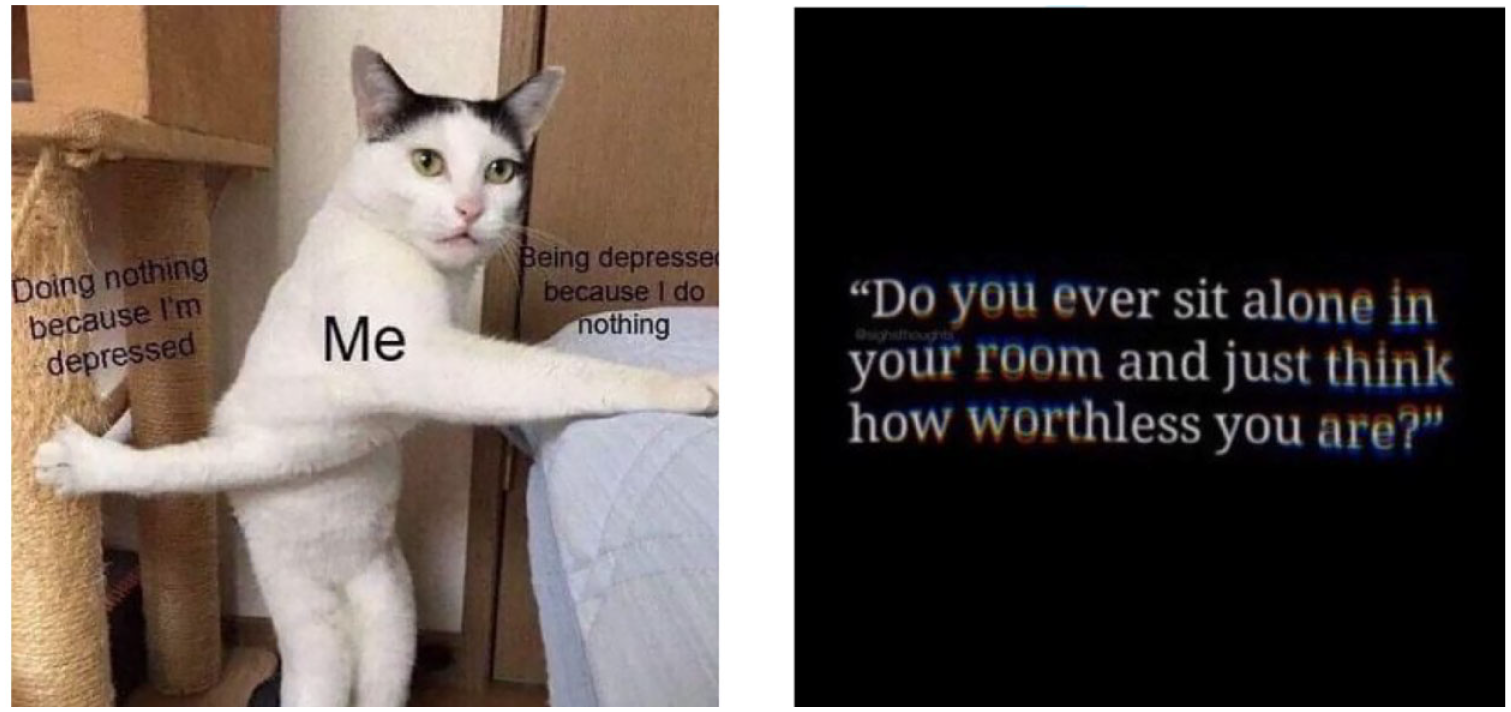
Examples of potentially depression memes.
On the other end of the model, CAI has been considered a possible consequence of DEE. According to self-worth theory, personal emotional resonance can be seen as a motivational factor that protects and enhances individuals’ sense of self-worth in the process of career decision-making. When individuals establish emotional connections with others in the online environment, they experience empathy and emotional resonance, which allows them to connect with others’ emotions and experiences, and in turn, receive validation and positive feedback. This emotional resonance, coupled with empathic responses from others, can strengthen individuals’ self-worth and influence their reactions in career decision-making. Therefore, when individuals experience career indecisiveness and anxiety, it may be due to a lack of or inability to achieve emotional resonance with others, resulting in feelings of insecurity and confusion in the career decision-making process. Recent findings suggest that DEE may be correlated with the CIA (Khudaykulov et al., 2024; Mahmud et al., 2021). Some studies have reported the mediating effect of DEE between IU and other variables, such as alcohol use (Venanzi et al., 2022), aggressive behavior (Y. Zhang, Hou, et al., 2022), and burnout (Murat et al., 2021). It is important to note that DEE is a potential mediator between IU and individual behavior. Thus, DEE may have similar “bridge” effects between IU and CIA. Based on the existing theories and empirical evidence, we hypothesize that DEE might mediate the relationship between IU and CIA (H3).
Research Objective
This study aims to investigate the mediating roles of memes and DEE between IU and CIA in Chinese NEET to expand and consolidate our understanding of the mechanisms between IU and CIA. As stated earlier, memes and DEE can help explain the nature of the CIA.
In sum, the research built a multiple mediation model (Figure 2) to investigate the mediating roles of memes and DEEs between IU and CIA on Chinese NEETs (H4).

The hypothesized research model.
Research Methodology
Participants and Procedures
Data were collected through an online survey using a randomized sampling method across multiple cities nationwide. According to the classification of Klug et al. (2019), the NEETs are considered as young people transitioning from education to employment, as interviewees aged below 30 who were previously students or interns. Leaving education is defined as their first year no longer being a student or intern, and not returning to education in the subsequent year (excluding gap years). After leaving school, for up to 6 years, they were neither permanently employed nor temporarily employed, but rather were referred to as NEETs. Before the measurement began, the participants were given an explanation of the definition of NEET and were asked whether they considered themselves to be in a NEET state. All participants who selected “no” have been excluded from the study. All NEET participants were volunteers and were informed that the study was for academic purposes only, following which they were instructed to read a short prompt, complete the survey and submit it independently. A total of 1,512 questionnaires were recovered, among which 108 invalid data sets were excluded. The final number of valid questionnaires was 1,404, including 768 (54.7%) females and 636 (45.3%) males. Registered residences included 975 (69.4%) from rural areas, and 429 (30.6%) from urban areas. In addition, 1,209 (86.1%) NEETs were from one-child families. Education level: High School and Below, Father: 1,224 (87.2%); Mother: 1,293 (92.1%). Due to the development of education in China, the participants themselves have higher educational levels, with 89.2% having a high school diploma or above.
Survey Questions
Intolerance of Uncertainty Scale (IUS-12)
The original IUS was compiled by Freeston (1994). This study uses a short Chinese version (Carleton et al., 2007; Y. Zhang et al., 2017), which contains 12 items, including “Unforeseen events make me feel very anxious,” with an alpha value of .91 when the scale was compiled. Questionnaires were all scored on a five-point Likert scale ranging from “1 = strongly disagree” to “5 = strongly agree.” The scale’s Cronbach’s alpha coefficient scale was .89.
Emoticon Use (EU-3)
Emoticon use was measured by referring to the items developed by Huang (2008), with an alpha value of .69 when the scale was compiled. The items comprised “When I use mobile instant messaging to communicate, I use plenty of emoticons to represent my feelings or emotions”; “When my friends use mobile instant messaging to communicate with me, they often use emoticons to represent their feelings or emotions”; “Emoticons convey more than just text; other information cues are also conveyed.” In this study, we first enlisted the help of a psychology graduate student and a foreign language department graduate student from our university to translate the original English version into Chinese. They carefully reviewed and modified the translation in terms of language and wording. Then, the revised Chinese draft was submitted to another psychology professor and another English department professor for back-translation and further revisions. After ensuring the accuracy and correctness of the translation, the Chinese questionnaire was administered. The same procedure was followed for handling the mentioned scales. The questionnaires were all scored on a seven-point Likert scale, ranging from 1 to 7 points of “absolutely disagree” to “completely agree.” The scale’s Cronbach’s alpha coefficient was .86.
Emoticon Empathy Scale (EES)
On the basis of the scale compiled by Escalas (2003), we used the one reported by Akil (2022), who selected, five items and ten depression memes. Its alpha was .95 when the scale was compiled. The questionnaires were are scored on a seven-point Likert scale ranging from 1 to 7, corresponding from “definitely disagree” to “completely agree.” A higher score, represented a higher empathy tendency. The scale’s Cronbach’s alpha coefficient was .91, showing good reliability and validity.
Career Factors Inventory (CFI)
The Career Factors Inventory was used to select selected the sections on “General Indecisiveness” and “Career Choice Anxiety” (Chartrand et al., 1990; Kulcsár et al., 2020), The Chinese version of the scale was used (Liu, 2013). Alpha was .87 when the scale was compiled. The questionnaires are all scored on a five-point Likert scale, ranging from 1 to 5 points, corresponding from of “disagree” to “agree.” A higher the score represented a higher career choice anxiety and indecisiveness tendency. The scale’s Cronbach’s alpha coefficient is .92, showing good reliability and validity.
Control Variables
Previous studies have highlighted the link between specific socio-demographic variables and careers, such as gender, registered residence and the number of children (C. P. Chen & Doherty, 2021; Ivbijaro et al., 2021; Mott & Haurin, 1982; Xian et al., 2022). To ensure the transparency and appropriateness of practices of our methodology regarding the control variables, we used the demographic questionnaire from Bernerth (2016). The decision to include specific control variables was based on previous studies (e.g., gender, one-child families, and registered residence).
Analytical Methods
A two-stage approach was used to empirically examine the research hypotheses empirically (Anderson & Gerbing, 1988). The first step was to review the models suitable for measurement and assess their reliability. The second step was to test the hypothesis using SEM. Pathways from the control construct onto endogenous constructs were included in the model. In addition, the effects of different paths were described and analyzed using Process.
Results
Preliminary Analyses
We tested the system measurement error and the commonly used method deviation using the Haman Single-Factor Test (Harman, 1976). All projects were implemented using the SPSS v26.0 software using exploratory factor analysis (EFA). The results showed that all six-factor eigenvalues were above 1, and the first factor explaining the variance was 37.62%, both less than the critical criterion of 50% (Podsakoff et al., 2003). The effect of common method bias on the data results was found to be under control.
Significant correlations were found between all research variables in the expected directions. IU was positively associated with MU, DEE, and CIA (Table 1).
Correlations Among Major Variables.

Note. N = 1,404, all the correlation coefficients were significant (**p < .01).
To test our measurement model, we performed a confirmatory factor analysis using the Mplus 8.3 software package (Muthen & Muthen, 1998). The four-factor model showed an excellent fit to the data (χ2 = 2,378.220, df = 424, CFI = 0.93, TLI = 0.93, RMSEA = 0.06, SRMR = 0.04), with all item loadings being significant and valid results measurements (Table 2). We also estimated several alternative models that could fit the data. First, given that MU and DEE are both users’ perceptions of social media, we merged these two components to compute fit indices for a model. We evaluated the fit of data from a three-factor model by combining MU and DEE into a single model. The findings showed that the three-factor fit was significantly worse than the four-factor fit (Δχ2 = 780.286**, Δdf = 3). Since the IU, MU, and DEE variables were all antecedents of CIA, we examined the goodness of fit of the two-factor model by collapsing these three variables into one factor. Based on the results, the two-factor model demonstrated significantly lower goodness of fit than the four-factor model (Δχ2 = 2,236.064**, Δdf = 7). Lastly, we combined all variables into one variable and calculated the fit quality of the one-factor model. The results showed that the fit of the one-factor model was much lower than that of the four-factor model (Δχ2 = 4,240.960**, Δdf = 10). Upon considering the integration of the models mentioned above, it could be deduced that the initiatives taken in the study capture various constructs.
Model Comparison Results.
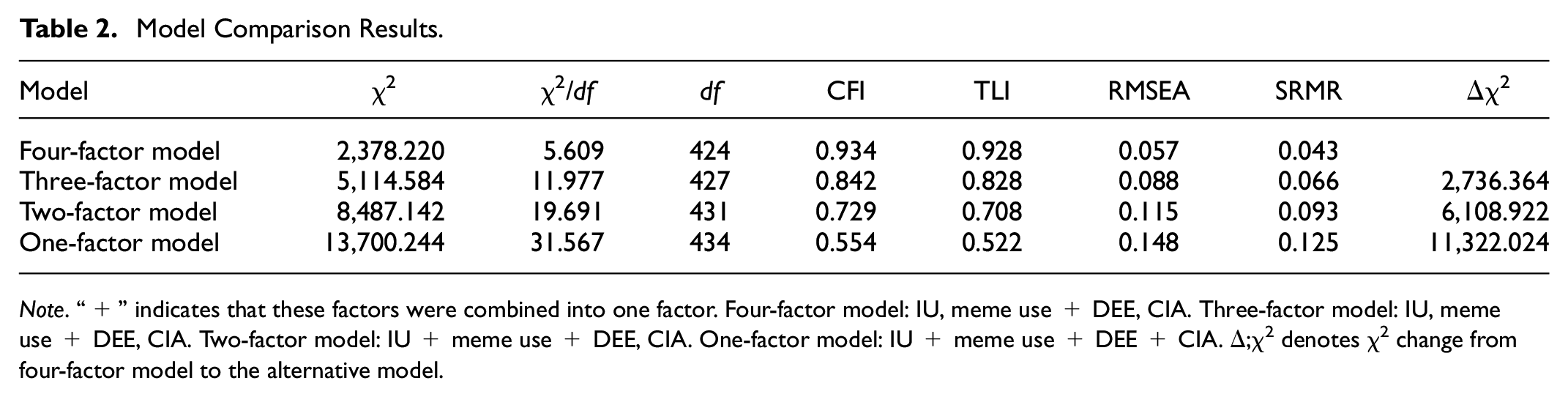
Note. “+” indicates that these factors were combined into one factor. Four-factor model: IU, meme use + DEE, CIA. Three-factor model: IU, meme use + DEE, CIA. Two-factor model: IU + meme use + DEE, CIA. One-factor model: IU + meme use + DEE + CIA. Δ;χ2 denotes χ2 change from four-factor model to the alternative model.
Analytical Strategy
The proposed mediation model was tested using a four-regression model (Figure 3). Given the effects of participants’ registered characteristics such as residence, gender, and one-child family, they were entered into the equation as control variables. To test the following hypotheses, we followed the procedures suggested by Hayes (Hayes & Preacher, 2014; Hayes & Rockwood, 2017), who suggested that confidence intervals not including zero indicate significant effects. Using a chain-mediated model for data analysis, IU was used as the predictive variable input and CIA as the outcome variable input. For these analyses, the SPSS macro program Model 6 (http://www.afhayes.com) was used to examine the multiple effects simultaneously and obtain the conditional indirect effect value. The mediation models were tested using bias-corrected bootstrapping analyses with 5,000 resamples (Hayes, 2018).

Path diagram for the final model.
Testing for the Hypothesized Conceptual Model
Multiple mediator models used IU as the predictor and CIA as the outcome. The results showed that IU had a significant direct effect on CIA (β = .22, p < .001), and positively predicted MU (β = .30, p < .001) and DEE (β = .39, p < .001). Additionally, MU and DEE positively predicted CIA (β = .16, p < .001; β = .35, p < .001), And MU positively predicted DEE (β = .31, p < .001). As a result, the path of the chained mediator was: IU → MU → DEE → CIA, which was also significant in the model. Table 3 and Figure 3 show the regression analysis results.
Regression Analysis.

Note. N = 1,404. All variables in the model were standardized. Demographic variables were used as the control variables. RR = registered residence.
p < .05. ***p < .001.
The analysis results of mediating effect showed that MU and DEE played a mediating role between IU and CIA, with an effect value of 0.32, accounting for 49.92% of the total effects (Table 4 and Figure 3). The specific mediating effect was produced in three ways, namely indirect effect 1 (IU → MU → CIA), indirect effect 2 (IU → DEE → CIA), and indirect effect 3 (IU → MU → DEE → CIA), accounting for 10.90%, 31.60%, and 7.42%, respectively. The 95% confidence range of bootstrap did not include 0 and reached a significant level. All the hypotheses were tested.
Mediation Effect Analysis.

Note. Boot SE, Boot LLCI, and ULCI limits refer to the standard error of indirect effects and lower and upper limits of 95% confidence interval estimated by the offset corrected percentile bootstrap method, respectively.
Discussion
Major Findings
The study aimed to investigate the impact of memes and DEE as essential elements of social media on NEET employment anxiety and indecision during of the COVID-19 pandemic, especially during long-term lockdown and shutdown environments. We found that IU significantly predicted CIA during the lockdown. Additionally, MU and DEE could separately mediate the relationships between IU and CIA, and the path of their mediation by chained equations was significant, which allowed us to test our hypotheses, extending from previous research findings.
Theoretical Implications and Practical Implications
We found that IU significantly predicted CIA during the lockout period. The results were concordant with previous findings (Akkermans et al., 2020; Shihata et al., 2017), thus verifying H1. According to the self-worth theory, individuals’ perception of their own self-worth and the value they place on themselves may contribute to their experience of CIA. People often have to compromise between their preferences and their job opportunities, or significant life events may alter their career path. According to the findings of Krumboltz (2009), uncertainty and adversity in life could facilitate growth and even create new possibilities, suggesting that proper guidance in the current environment is crucial. Thus, it is necessary to find and guide rational subjective explanations in an unstable objective environment.
MU mediates the relationship between IU and CIA (H2). Online social media, the primary channel through which individuals obtain information, significantly impacts the CIA of NEET. Findings from previous studies suggested that memes often pop up on the internet as a reaction to emerging social incidents (Berger & Milkman, 2012; Dynel, 2016). The internet can play a crucial role in providing and disseminating humorous memes, especially during periods of isolation and reduced regular social interaction (Botha & Reyneke, 2013). Pandemic-related memes also became widely available on social media (Barnes et al., 2021; Dynel, 2021). However, current memes are different from conventional impressions. COVID-19 memes are often considered a type of dark humor (Bischetti et al., 2021) inspired by and produced in the context of severe events and subjects, especially concerning death and disease (Dynel & Poppi, 2018). The stress of quarantine and overwhelming current events were found to associate with depression and anxiety (Hou et al., 2020). Therefore, memes could produce an optimistic prediction of the CIA. However, many studies have concluded that memes used during the pandemic were a way to help alleviate negative emotions (Cancelas-Ouviña, 2021; Skórka et al., 2022; Torres-Marín et al., 2022), which was not consistent with our results. One possible explanation for this is observation could be differences between the participants. It is also possible that the CIA is more akin to behavioral factors than to ordinary psychological factors. During a total lockdown, NEETs are jobless and have no opportunities for action. Furthermore, according to the prospect theory, for the unemployed NEET who faces a higher risk of dismissal, loss aversion may further reduce job-seeking willingness and lead to CIA, thereby enriching the research on Internet memes during the pandemic period and expanding our understanding of the psychological mechanisms underlying NEETs’ employment.
We also found support for the hypothesis that DEE can mediate the relationship between IU and CIA. The results of previous studies suggested that uncertainty during the pandemic was positively associated with negative emotions, including depression memes (Ben Salah et al., 2023; Liao et al., 2020; Parola et al., 2023; X. L. Wang, Gao, et al., 2022). According to the self-worth orientation theory, individuals are prone to receiving damaging information from online social activities, and these negative messages enable adolescents to gain approval and acceptance from others, thereby achieving satisfaction and emotional resonance. In addition, COVID-19 has generated a lot of uncertainty in regard to employment. Specifically, the squeezing effect of the job market has been intensified, forcing work conditions to shift from offline to online, leading to negative emotional resonance in online communication and CIA (Khudaykulov et al., 2024; Mahmud et al., 2021). Furthermore, research has indicated that NEET individuals encounter more difficulties in career decision-making (Felaco & Parola, 2023; Xu & Tracey, 2016). To assist NEETs in establishing their career goals, our study emphasizes the importance of providing precise and professional guidance that incorporates both positive and negative information and emotions. Furthermore, we propose that developing appropriate strategies for responding positively to COVID-19 and future uncertain situations may help individuals cope with stress and mitigate the negative effects of economic uncertainty on mental health.
Finally, the findings concerning the mediating chain mediating roles of MU and DEE between IU and CIA indicate that NEET with a high level of MU may also have a high level of DEE. Our findings were similar to previous studies showing a positive correlation between IU and MU (Barnes et al., 2021; Dynel, 2021; Myrick et al., 2022). Furthermore, because MU significantly predicted DEE (Milner, 2016; Miltner, 2014), this may cause them to learn from dark humor, which may lead to a series of resonances of depression (Khudaykulov et al., 2024; Mahmud et al., 2021). Our results suggest that NEETs with high IU are willing to communicate online. The primary manifestations are the increased use of memes and the emotional resonance of depression. Therefore, after gaining a negative emotional experience, NEETs will hold a negative attitude, thereby reducing their motivation to seek employment and creating career indecision and anxiety. Also, the chain-mediated roles of MU and DEE indicate the link between IU and CIA through conversations.
Significance
Research has found that appropriate guidance indeed has the potential to reduce emotional and behavioral polarization on social media (Jarynowski et al., 2021). Overall, this study has expanded and deepened our understanding of the factors influencing career indecision and career anxiety, providing a framework for vocational counseling interventions. The findings demonstrate the significant impact of information use and modes of expression on the vocational psychological states of NEET individuals. In the context of the COVID-19 pandemic and prolonged lockdowns, internet memes and digital expressive elements in social media have played a crucial role in NEET employment anxiety and decision-making dilemmas. The results of this study can also serve as a reference for promoting employment and increasing the employment rate among the NEET population; these complex issues may be the targets for intervention and service provision in these high-risk populations. Therefore, special attention can be given to MU and DEE as important predictive factors in future vocational counseling. If these behavioral tendencies are identified in social media, timely interventions can be implemented to prevent further deterioration, thereby promoting employment development and reducing the occurrence of NEET individuals.
Limitations and Future Research
This study had some limitations. First, we used cross-sectional data, and the results reported in this study did not highlight the underlying causality of career indecisiveness and anxiety among NEETs, thereby urging the necessity for experiments or longitudinal designs in future research to establish causality. Second, the findings are limited to the specific context of China’s epidemic prevention and control policies and cannot be generalized to other countries in China. To address this limitation, future studies could conduct cross-cultural comparative studies with the countries that have implemented different decontrol measures to further explore the impact of such policies on employment issues. Third, while this study successfully investigated employment issues of NEETs, especially increased knowledge about NEET’s IU and CIA, there remains a lack of comparative research on the uniqueness of NEET. Future studies could focus on comparing different subject groups or conducting follow-up studies from graduation to employment and the longitudinal changes in mental health, which could help broaden our understanding of the complex nature of NEETs and their related issues. Fourth, the individual scales used in this study have not yet undergone cross-cultural validation in the Chinese context. Future research could conduct cross-cultural testing specifically for these scales to ensure their validity in China.
Conclusion
This study advances our understanding of the underlying mechanisms linking intolerance of uncertainty to career indecisiveness and anxiety among NEETs. In addition, we explored the mediating role of meme use in this context. The results indicated that memes and depression emoticon empathy partially mediated the relationship between intolerance of uncertainty and career indecisiveness and anxiety, providing novel insight into the complex interplay between intolerance of uncertainty and career decision-making among NEET. These findings may inform the development of targeted interventions to address employment issues during long-term closures and have important implications for theoretical models of career indecisiveness and anxiety in the NEET population.
Footnotes
Declaration of Conflicting Interests
The author(s) declared no potential conflicts of interest with respect to the research, authorship, and/or publication of this article.
Funding
The author(s) received no financial support for the research, authorship, and/or publication of this article.
