




Abstract
This study investigates the impact of cross-cultural adjustment and subjective well-being on the achievements and intentions of Spanish self-initiated expatriates (SIEs) regarding their decision to stay abroad or return to Spain. Using resource conservation theory, the research examines how SIEs’ agency influences their adjustment and well-being, thus affecting their achievement and propensity to repatriate. A tailored online survey was administered to Spanish SIEs, incorporating validated scales to cross-cultural adjustment, subjective well-being, and intention to stay abroad. Using non-probability sampling, a final sample of 309 SIEs was obtained. Data analysis employed partial least squares structural equation modelling (PLS-SEM) to validate the hypotheses. The results show that improved adjustment and well-being of SIEs correlate with improved achievement and reduced likelihood of repatriation. These results underline the importance of cultural adjustment and subjective well-being in shaping SIEs’ expatriation experiences and their intentions to stay abroad. Furthermore, the research lays the groundwork for future comparative studies and underlines the need for home institutions to facilitate the repatriation process. Moreover, the implications of the findings for management offer ideas for improving the experiences of SIEs abroad and recognising their value as assets to both national and global organizations, while addressing the challenges associated with repatriation.
Plain language summary
This study explores the impact of cross-cultural adjustment and subjective well-being on the achievements and intentions of Spanish self-initiated expatriates (SIEs) in deciding to stay abroad or return to Spain. Using resource conservation theory, it examines how SIEs’ agency influences their adjustment and well-being, affecting their achievements and propensity to repatriate. An online survey with validated scales for adjustment, well-being, and intention to stay abroad was administered to 309 Spanish SIEs. Data analysis via PLS-SEM confirmed that improved adjustment and well-being correlate with better achievements and lower repatriation likelihood. The findings highlight the importance of cultural adjustment and well-being in shaping SIEs’ experiences and decisions, suggesting home institutions should support the repatriation process. The research offers management insights for enhancing SIEs’ experiences abroad and recognizing their value to organizations.
Keywords
Introduction
In recent decades, Spain has consistently maintained the highest youth unemployment rate within the European Union, exceeding 23% as of 2022 (EUROSTAT, 2021). This is compelling young graduates to seek career opportunities outside the country (Eremenko & Miyar-Busto, 2020). At the beginning of 2023, the number of Spaniards living abroad reached 2,790,317 (Instituto Nacional de Estadística, 2023), representing an increase of 1.7% (47,712 persons) as compared with the data from 2022. The top five destinations are Argentina, France, the USA, Germany, and the UK. In absolute terms, the highest increases after 2021 were registered in the UK (9,763 more), Mexico (7,122) and France (7,109).
This outflow consists of self-initiated expatriates (SIEs) who independently choose to live and work temporarily in a foreign country for personal or career reasons and to find regular employment (Brewster et al., 2021; Cerdin & Selmer, 2014). In comparison with migrants (MIs) and assigned expatriates (AEs), SIEs are more mobile concerning physical and organizational mobility (Andresen et al., 2015). They are qualified and highly skilled (Cerdin & Selmer, 2014), although SIEs have been more often found in non-managerial roles than AEs (Andresen et al., 2015). The motivations of these SIEs also vary. Some Spanish SIEs are compelled to seek work abroad due to limited employment and career prospects at home (Bermudez & Brey, 2017), while others can feel motivated by the prospect of adventure and travel, quality of life or personal relationships (Doherty et al., 2011; Thorn, 2009).
Unlike migrants, SIEs typically intend to remain abroad temporarily and are thus more inclined to repatriate than migrants (Andresen et al., 2020). This suggests that the ongoing outflow trend in Spain (Eremenko & Miyar-Busto, 2020) would potentially escalate into a significant brain drain issue only if the “best-educated generation” chooses not to return (Bermudez & Brey, 2017). Although migrants and SIEs can return upon retirement or when unhappy with the host destination, SIEs can also become migrants when they stay permanently in their new host country. So far, however, we still do not know how to explain this fungibility (Brewster et al., 2021) nor the factors that can influence the retention of SIEs. Filling this gap, the main objective of this study is to examine how the cross-cultural adjustment and subjective well-being of Spanish SIEs influence their achievements and their intention to stay abroad rather than return to Spain. Specifically—What factors can contribute to an increased intention to stay among SIEs? Does it help them achieve and stay once they experience cross-cultural adjustment (CCA) in their new country and feel better and happier?
This study answers these questions with a sample of 309 Spanish SIEs. It follows earlier calls from Brewster et al. (2021) to extend what we know about SIEs from specific contexts, including the spill-over effects of SIE’s adjustment and well-being on attaining personal outcomes and the intention to stay at the destination. This study draws on the conservation of resources (COR) theory (Hobfoll, 2002) and the expatriate well-being literature (e.g., Biswas et al., 2022; Biswas & Makela, 2020) to test the hypothesis that adjusted and successful Spanish SIEs feeling happy abroad are less willing to return, which can accrue to the brain drain observed in Spain in the past decades (Bermudez & Brey, 2017).
This empirical study makes the following contributions. First, the findings confirm the significance of cross-cultural adjustment among SIEs (e.g., Bhaskar-Shrinivas et al., 2005; Hippler et al., 2014), highlighting the importance of a positive and supportive host environment to retain these international workers and help them perform. The findings suggest new avenues of research on the international human resource management (IHRM) strategies for attracting and retaining SIEs, notably by improving their adjustment and well-being abroad or, concurrently, designing policies aimed at helping them develop their resources at home so they can successfully return and find their international experience recognised through higher chances of employment and career progression.
Second, this study adopts COR as its theoretical framework and contributes to the limited evidence on the well-being of SIEs (Biswas et al., 2022). According to COR theory (Hobfoll, 2002), a lack of resources leads to subjective negative well-being, which can explain why some SIEs leave their home country (Brewster et al., 2021), while when they have resources at their destination, such as cross-cultural adjustment, they are likely to experience positive well-being. Where people choose to live is linked to their social and economic prospects and, thus, to their subjective well-being (López-Ruiz et al., 2021). This study accounts for these aspects by examining Spanish SIEs’ subjective well-being abroad. Subjective well-being, measured by individuals’ overall life satisfaction (Diener, 2000; Kashdan et al., 2008), can be predicted by their cross-cultural adjustment. Furthermore, it directly influences their intentions to remain at the destination and serves as a mediator for the perceived outcomes of SIEs. Consequently, by enhancing our understanding of these patterns among Spanish SIEs, this study contributes to the broader research on well-being as a critical precursor and mediator of significant outcomes (Sonnentag et al., 2023), including performance, retention, and turnover, rather than solely framing it as an adjustment-related outcome.
Finally, by interpreting the findings within the significant Spanish context, our analysis shows how Spanish SIEs’ outcomes, including their adjustment and well-being, impact their willingness to stay abroad, which can limit the talent pool and competitiveness of the Spanish economy (Bartolini et al., 2017). Therefore, the importance of this study lies in its ability to provide new insights into the factors influencing SIEs’ decisions to stay or return, an area little studied in the Spanish context.
The study’s contributions highlight the importance of understanding and improving the cross-cultural adjustment and well-being of expatriates to foster their stay and success abroad, while considering the potential impact on Spain's economy and human capital. The fewer SIEs planning to return to Spain, the fewer qualified people are available for senior management positions. This reduction of returning SIEs limits their ability to bring their international and intercultural skills to Spanish companies, thus diminishing the pool of available national talent with international experience. This situation negatively affects the ability of Spanish firms to successfully internationalise (Bartolini et al., 2017; Headey, 1993). Therefore, the findings of this study are crucial to inform future international business research focused on global workers, including SIEs, beyond individual impacts to address broader economic and social implications of their permanent departure (Bastida et al., 2021). If well-adjusted and happy SIEs who perform well are less likely to return, Spain risks losing the valuable contributions of its most competent and internationally experienced workforce.
This paper starts by tapping into the COR theory (Hobfoll, 2002) and the expatriate well-being literature (Biswas et al., 2022; Biswas & Makela, 2020) to develop a theoretical model linking SIEs’ adjustment and subjective well-being to their achievements and intentions to stay abroad. The methodology is then presented, including a description of the research procedure, measures, sample, and data analysis. Finally, results are described and discussed, along with the main limitations and implications of the study.
Subjective Well-Being and Development of Hypotheses
This study draws upon the COR theory (Hobfoll, 2002) to examine the SWB of Spanish SIEs. This integrated resource theory posits that “people seek to obtain, retain, and protect resources and that stress occurs when resources are threatened with loss or lost or when individuals fail to gain resources after substantive resource investment” (Hobfoll, 2002, p. 312). This theory also posits that resources are individual but sociocultural so that resources can be seen as common among group members and cultures. Additionally, material resources (such as food, safety, and transport) are important and interact with individual resources (such as self-efficacy), influencing individuals’ coping and SWB. One of the key tenets of the COR theory is that resource loss is more salient than resource gain. This means that the resource gains and the accompanying positive emotions that SIEs can experience once they are abroad are increasingly important to prevent stress and poor adjustment, thus potentially increasing their subjective well-being.
Well-being can be examined through eudemonic and hedonistic perspectives (Sonnentag, 2015). The eudemonic perspective centres on ideal well-being, encompassing personal growth and self-realization, authenticity and personal expression, and the pursuit of life meaning, while the hedonistic perspective emphasises well-being as pleasure or happiness (Peiró et al., 2021; Sonnentag, 2015). This study adopts a hedonic view of SWB, representing a broader concept, including judgments about one’s overall life satisfaction (Diener, 2000; Kashdan et al., 2008).
To date, limited research has explored the SWB of SIEs (Biswas et al., 2022; Biswas & Makela, 2020), with most studies relying on indirect indicators to measure AEs’ well-being. For instance, some seminal works have employed job satisfaction as a proxy for expatriate SWB (Biswas et al., 2022), with findings indicating a positive relationship between motivations, job satisfaction and job performance (Madi et al., 2023) and a positive effect of cross-cultural adjustment on job satisfaction (Abdyrakhmanova & Poór, 2023). Other studies have focused on general psychological health, revealing its negative association with expatriates’ work-family conflict (Ballesteros-Leiva, et al., 2017; Fischlmayr & Kollinger, 2010; van der Zee et al., 2005). Consistently with the tenets of the COR theory, past research also identified sociocultural adaptation and perceived organizational support as key determinants of expatriates' psychological well-being (De Paul and Bikos, 2015; Merchant et al., 2023). Additionally, Bastida et al. (2023) found that the well-being of AEs mediates the positive association between their interaction adjustment at the destination and their overall job satisfaction. Moreover, Ballesteros-Leiva et al. (2017) compared the SWB of AEs and SIEs, uncovering that a negative interference between work and non-work domains adversely affected both groups’ subjective and psychological well-being. Therefore, the antecedents of SIEs’ SWB are work and non-work-related, so a poor adjustment at the destination is likely to hinder their SWB.
The cross-cultural adjustment of international workers is a multi-faceted phenomenon (e.g., Caldwell et al., 2024; Selmer & Lauring, 2016) and refers to the degree of psychological comfort with distinct aspects of the host country (Bhaskar-Shrinivas et al., 2005). CCA is necessary for AEs and SIEs, although most studies on the adjustment of SIEs remain descriptive. A notable exception is a work from Pinto et al. (2020), who found that those SIEs who had greater confidence in their ability to live and work abroad were also more likely to pursue performance goals, reporting higher host adjustment and superior professional achievements. These findings are consistent with the COR theory (Hobfoll, 2002). Specifically, SIEs do not wait for stressors to occur in their home countries but act independently and go abroad to foster their circumstances, which will help them gain other resources and become less vulnerable to future resource loss (Shao & Ariss, 2020). The development of their resources is then beneficial not only for their CCA (Abdyrakhmanova & Poór, 2023) but also for attaining their personal goals (Blanco & Golik, 2024; Klug & Maier, 2015), so the following hypothesis is offered:
H1: There is a positive relationship between SIEs’ CCA to the host country and the achievement of personal outcomes.
Biswas and Makela’s (2020) review of the expatriate well-being literature concluded that general well-being among SIEs is more frequently explained by general antecedents, such as spousal support and work-life interference, rather than work-related factors, such as role ambiguity, role novelty, role conflict, and job autonomy. They also found that work adjustment positively predicts expatriates’ SWB. Inversely, the subjective illbeing of academic expatriates was found to affect their adjustment negatively, deterring their performance and job satisfaction (Selmer & Lauring, 2014). The CCA of AEs is positively related to their well-being (e.g., Ballesteros-Leiva et al., 2017; Biswas et al., 2022), so we can also expect a positive association between the CCA of SIEs and their subjective well-being (Presbitero, 2020). Furthermore, the COR theory (Hobfoll, 2002) posits that during highly stressful circumstances, such as during a self-initiated assignment, resource gain cycles are likely to emerge as people seek to identify and mobilise their resources, so a successful cross-cultural adjustment abroad is likely to predict SIEs’ SWB:
H2: A positive relationship exists between SIEs’ CCA and their subjective well-being.
One of the principles of the COR theory is that “resources are linked to other resources” (Hobfoll, 2002, p. 318), which means that key resources, such as SIEs’ CCA and SWB, can facilitate the development and use of other resources, including the achievement of personal outcomes. Consistently, the happy-productive worker thesis states that happy workers are more productive than less happy ones (Sender et al., 2021; Wright & Cropanzano, 2007), and employees’ well-being is often linked to several work-related outcomes (Klug & Maier, 2015; Mäkelä et al., 2022). In the international context, Selmer and Lauring (2014) also found a negative association between the subjective ill-being of expatriate academics and their work-related outcomes. Therefore, SIEs’ SWB in the host country can directly contribute to the achievement of their personal outcomes, so the following hypothesis is offered:
H3: A positive relationship exists between SIEs’ SWB in the host country and the achievement of personal outcomes.
Research from the domestic context has shown that workers’ SWB is linked to lower withdrawal intentions and voluntary turnover (Sender et al., 2021). In the international context, Hussain and Deery (2018) also found that on-the-job embeddedness decreased the turnover intentions of medical SIEs in the United Arab Emirates. We also expect a positive association between SIEs’ SWB and their intentions of staying abroad (Lindsay et al., 2019). According to the COR theory (Hobfoll, 2002), the influence of resources is long-term and tends not to be transient, so SIEs will aim to maximise their newly acquired resources while staying in the host country. Therefore, the following hypothesis is proposed:
H4: A positive relationship exists between SIEs’ SWB in the host country and their intention to stay.
Figure 1 presents the final research model and hypotheses.

Theoretical model and hypotheses.
Methodology
Procedure and Sample
An online survey was designed for this study, using a method particularly suited to reaching a hard-to-reach target population, where the number of participants is unknown and/or the topics under study are sensitive (Dillman, 2000; Gosling & Mason, 2015). The survey instrument included a series of validated scales to measure the main research variables—such as cross-cultural adaptation, subjective well-being, and intention to stay abroad—along with demographic questions (e.g., gender, age, and education) and questions about respondents’ actual international experience (length of stay, country).
To minimise common method bias, the questionnaire design followed the guidelines set by Podsakoff et al. (2012). Survey items were randomly ordered and, where appropriate, reverse-scored to reduce the likelihood of uniform responses. Prior to its widespread deployment, the instrument was pilot-tested with five Spanish returnees (three men and two women) to verify its readability and relevance.
A non-probability purposive sampling technique was used to select participants, focusing exclusively on Spanish citizens working abroad on their own initiative. This method allowed the selection of respondents who specifically responded to the criteria essential to address the research objectives, thus improving the relevance and applicability of the results to self-initiated expatriation contexts. The finalised questionnaire was then administered online, promoted through social and professional networks commonly used by international workers (e.g., LinkedIn and Facebook). An initial presentation was included at the beginning of the survey informing participants of the study’s objectives and assuring them of the confidentiality of the data and that their information would only be used for research purposes.
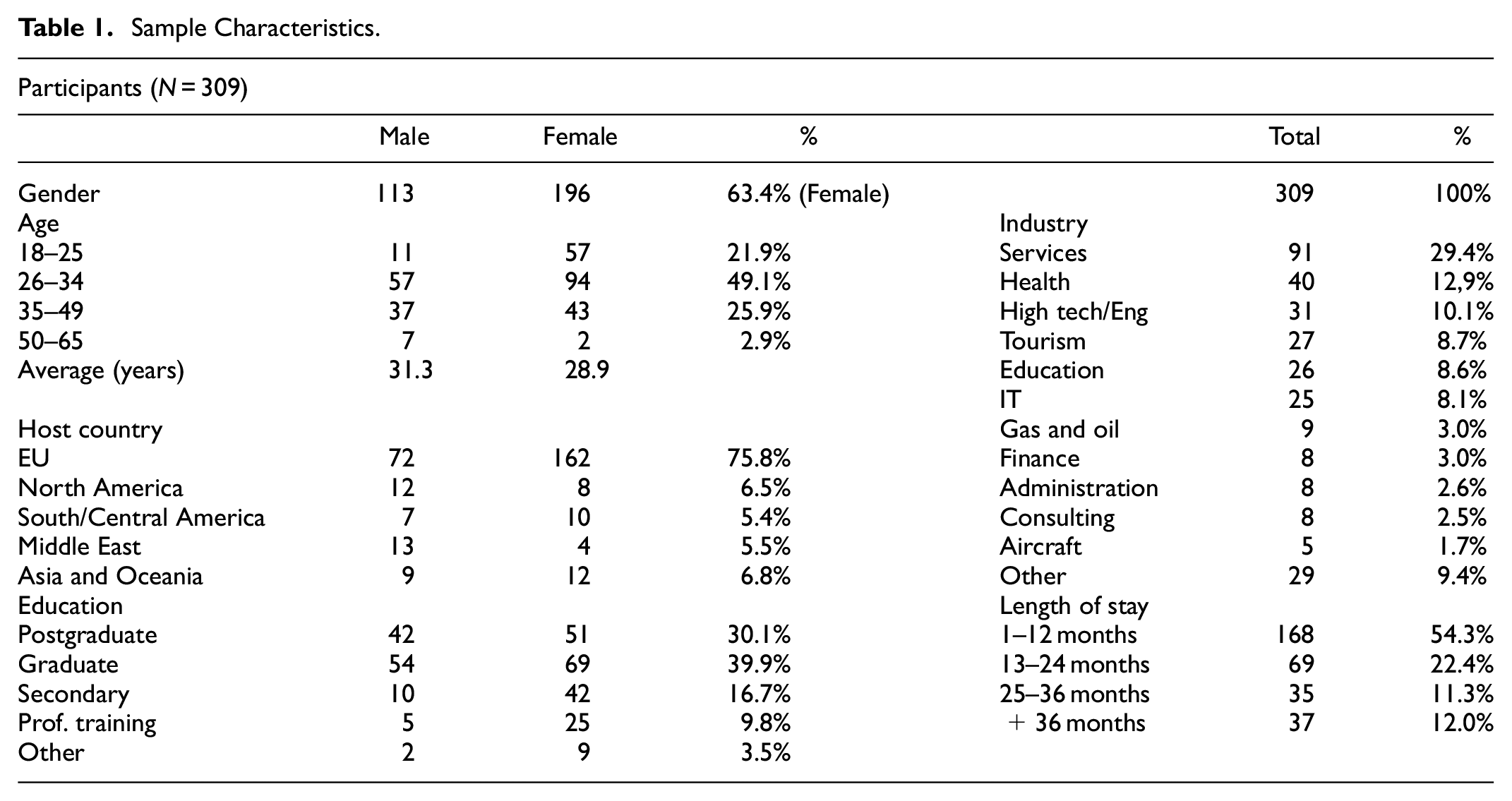
Participation was voluntary and unpaid. Participants were assured that there were no right or wrong answers, emphasising the importance of their individual experiences. Data collection took place between May and September 2021 and targeted only self-assigned Spanish expatriates. After checking the assignment status—specifically, those who were skilled workers temporarily abroad on their own initiative with the intention of regular employment according to Cerdin and Selmer (2014)—and eliminating incomplete responses, the final sample comprised 309 Spanish SIEs (196 women and 113 men). Respondents were on average almost 30 years old and had spent about 16.3 months abroad, predominantly in EU countries (almost 76%). Notably, none had been living abroad for more than 4 years, which is consistent with the criterion that expatriation periods longer than 5 years are usually classified as indefinite international assignments or migratory status (Alshahrani, 2022).
Most participants were university educated (70%) and worked in the service sector (e.g., hotel, catering and retail), reflecting the diversity found in similar studies (Alshahrani, 2022; Brewster et al., 2021), but providing a specific focus on Spanish nationals. The main motivation for moving abroad was job opportunities, with more than half of the participants (50.2%) actively seeking employment outside Spain, and others motivated by the search for new professional experiences (24.6%) or a general desire for professional growth (22.0%). The predominance of career-related motives and the significant educational and professional qualifications of the participants confirm the relevance of this study in assessing the risks associated with the emigration of highly skilled talent from Spain, underlining the critical importance of this research in assessing the potential risks of brain drain from the country.
Table 1 summarizes the profile of the respondents who participated in the study.
Sample Characteristics.
Instruments for Data Collection
To collect data on the main research variables, we used widely accepted scales specifically designed to assess cross-cultural adjustment, personal outcomes, subjective well-being, and intention to stay abroad.
Cross-Cultural Adjustment
It was assessed using the classic scale developed by Black and Stephens (1989), which contains 14 items. Seven items measure the degree of general adjustment, four measure the degree of interaction adjustment, and the remaining three measure the level of work adjustment. Each item was answered on a seven-point Likert scale, ranging from (1) “highly unadjusted” to (7) “highly adjusted.”
Subjective Well-Being
It was measured using Diener et al. (1985) life satisfaction scale, widely used to measure SWB. It consists of five items that score the perception of life satisfaction in a seven-point Likert format. Here, one item (HP1) presented collinearity, so it was eliminated, leaving the final scale with four items: HP2: “The conditions of my life are excellent”; HP3: “I am satisfied with my life”; HP4: “So far, I have gotten the important things I want of my life”; HP5: “If I could live my life over, I would change almost nothing.”
Personal Outcomes
For identifying the perceived outcomes attained with international work experience, the scale designed and validated by Hemmasi et al. (2010) was taken as an initial reference. Since this scale was designed for AEs, an adaptation was made to explore SIEs’ outcomes, that is, those that provide opportunities for improving intercultural skills and capabilities. To this end, all items from the original scale referring to specific corporate business goals were removed. In contrast, the items measuring the perceived achievement of SIEs, such as knowledge of doing business in foreign cultures or improved relational skills, were included. Respondents were asked to rate their perception of achievement, and answers were provided on a seven-point Likert-type scale, ranging from (1) “not at all” to (7) “fully achieved.” After eliminating two items with collinearity, the final scale comprised six items. Sample items included the perceived (i) initiation of professional networks, (ii) the development of new skills and abilities, and (iii) the identification of different ways of doing business in other cultures.
Intention to Stay
An adaptation from the Black and Stephens (1989) measure was used. The original scale measures the intention to leave the assignment with two items adapted to measure the intention of staying at the destination: Ip1: “I do not think too much about coming back home”; Ip2: “I would do anything to stay here.” From the analysis, Ip2 was removed for high collinearity with other items, so the final measure contained a single item, which decreased the ambiguity and captured the essence of the measured construct (Cheah et al., 2018).
Control Variables
Several demographic questions were asked to characterise the sample and then used as control variables. Age was computed in years, and time in the assignment was computed in months. Gender was dummy coded (0 = female, 1 = male). Educational level was initially coded into five categories (i.e., doctorate or master’s degree, bachelor’s degree, secondary education, vocational training, or other studies) and subsequently dummy-coded (0 = No higher education, 1 = higher education). Location was nominal and subsequently recorded by world region (i.e., European Union, North, Central or South America, Middle East, Asia, and Oceania). Finally, participants were asked to indicate their job and industry abroad, as per the classification included in Table 1.
Data Analysis
The measures were operationalised as composites, so PLS-SEM was selected as a suitable tool to test the research model and hypotheses (Henseler, 2017). The composites were computed following the two-step procedure proposed by Henseler et al. (2016): (1) evaluation of the measurement model and (2) evaluation of the structural model. A rough estimation of the model’s goodness of fit was further performed (Henseler et al., 2016). The normalization value of the model’s residual root means square root (SRMR) is 0.007, thus lower than the acceptability threshold set by Hu and Bentler (1998) at 0.008. The significance of the parameters was assessed using the resampling technique known as bootstrap (Chin, 1998), which allows for determining the significance of the fit indices, path coefficients and the weights and loadings of the indicators of each composite. Also, the model’s predictive power was evaluated following the procedure described by Shmueli et al. (2019). The software used was SmartPLS version 3.2.9 (Ringle et al., 2015).
Finally, potential multicollinearity was investigated using variance inflation factors (VIF) and tolerance (Cohen & Cohen, 1983). As the maximum values of VIF were below 3.3 and the values for the tolerance were all close to one, the problem of multicollinearity was ruled out (Kock & Lynn, 2012), permitting the subsequent analysis.
Results
An initial analysis of the validity and reliability of the main research variables was performed. Table 2 shows that the measurement model meets all commonly stipulated requirements. All individual items are reliable, as their standardised loadings exceed 0.7. The individualised analysis of the loadings provides interesting results. Thus, it is observed that the three sub-levels of adjustment are important and have a determining effect on the general adjustment to the destination. However, the interaction adjustment has a greater relative effect.
Validity and Reliability of the Main Research Variables.

p < 0.05; **p < 0.01; ***p < 0.001.
Two sets of items were observed in the composition of perceived personal outcomes. The first set, with loadings above 0.8, comprises outcomes related to acquiring new knowledge and skills, the perceived transferability of these skills and acquiring new knowledge related to doing business in other cultures (IO3, GO3, and IO5, respectively). The second set includes the acquisition of professional competencies, developing skills not available in the host country, and developing a professional network (IO4, IO6, and IO1). Regarding the discriminant validity of each construct, that is, the extent to which every construct differs from the others, the results shown in Table 3 confirm this assumption.
Constructs’ Reliability.

All scores were higher than 0.8, which satisfies the requirement of construct reliability (Henseler et al., 2016). Furthermore, the extracted variance value scores (AVE) exceed the threshold of 0.5, confirming that the composites achieved convergent validity. As shown in Table 4, the HTMT (Heterotrait-Monotrait) indicator is below 0.85, confirming all constructs’ discriminant validity (Hair et al., 2017).
Values of Heterotrait-Monotrait (HTMT).

Descriptive and Correlation Analysis
Table 5 presents the descriptive measures and Pearson’s correlation for the primary research variables. As shown in the diagonal, all constructs are more strongly intercorrelated than are correlated with the other variables, which confirms the hypothesis of discriminant validity.
Descriptive and Correlation Analysis.

Note. The diagonal shows the square root of the AVE following Fornell and Larcker’s (1981) discriminant validity criterion.
Test of Hypothesis
According to Hair et al. (2017), the use of bootstrapping (5,000 resamples) produces standard errors and t-statistics that allow for the assessment of the statistical significance of the expected effects (path), which are presented in Table 6. The 95% confidence interval percentiles confirm that all effects are statistically significant.
Main Effects.
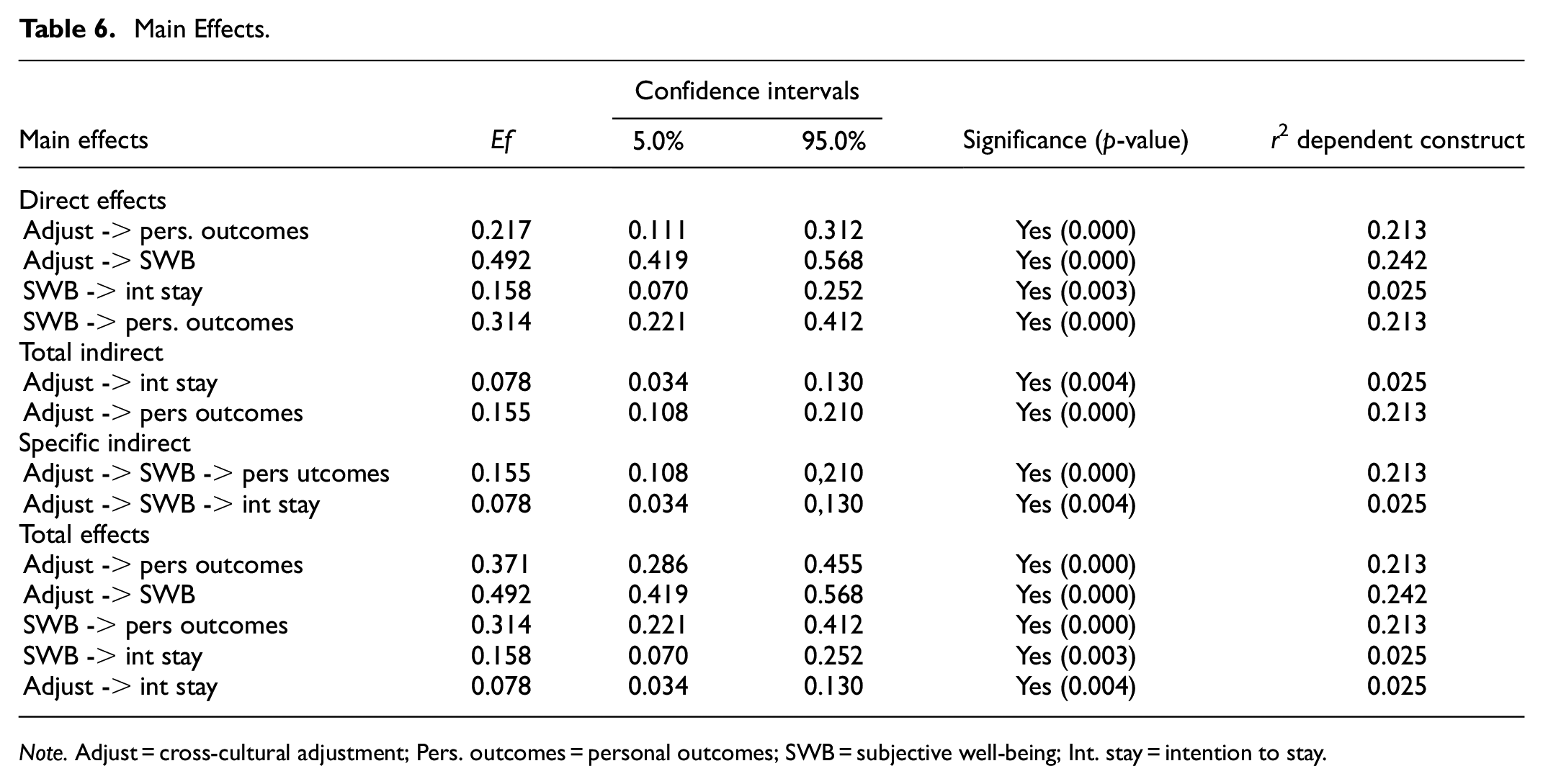
Note. Adjust = cross-cultural adjustment; Pers. outcomes = personal outcomes; SWB = subjective well-being; Int. stay = intention to stay.
The hypothesised research model provided an R2 of 0.213 for the expected association between SIEs’ cross-cultural adjustment and perceived personal outcomes (thus supporting H1), an R2 of 0.242 for the expected association between adjustment and SWB (which supports H2), as well as an R2 of 0.213 for the association between SWB and SIEs’ outcomes (supporting H3). Finally, H4 was also supported as there was a significant positive effect (R2 = .025) between SIEs’ subjective well-being and intention of staying. Table 7 indicates the size of the effects.
Effects Size.

As can be seen, the effect of the adjustment on SWB is moderate (0.15 < f2 < 0.35), and the remaining effects are low (0.02 < f2 < 0.15). Figure 2 presents the final research model. As can be seen, adjustment to the host country explains SIEs’ well-being and the achievement of personal outcomes. In turn, SWB positively affects this perception of achievement and explains SIEs’ intention to stay in the destination country (although this effect is much smaller). All these relationships are statistically significant (*p < .05; **p < .01; ***p < .001, data in parentheses).

Results of structural equation modelling of the final research model.
A check of the goodness of fit regarding the measurement model was performed since this is a requirement for confirmatory analysis with PLS-SEM (Henseler, 2017). Bootstrap-based tests of model fit were calculated, including the geodesic discrepancy between the empirical and model-implied correlation matrix (Dijkstra & Henseler, 2015), the normalised root mean square residual (SRMR) (Henseler et al., 2016), and the unweighted least squares discrepancy (Dijkstra & Henseler, 2015). A model fits well when these values are lower than the 95% or 99% quartiles extracted from the bootstrap (Henseler et al., 2016). Table 8 presents all fit indices in absolute terms and confidence intervals (95% and 99%). A significant fit exists between the empirical data matrix and the proposed model matrix. All three indices met the required conditions, confirming the final model’s goodness fit (Henseler, 2017).
Composite Confirmatory Analysis: Overall Goodness of Fit, Bootstrap-Based.

Note. SRMR = standardised root mean; Duls = unweighted least squares discrepancy; dG = Geodesic discrepancy; Hi95 = percentile 95%; Hi99 = percentile 99%.
Finally, the model’s predictive ability was computed, that is, the extent to which the relationships would hold when entering more data than those in this sample (Shmueli et al., 2019). As shown in Table 9, all predictive Q2 scores are positive. Herein, the RMSE was used to compute the residual errors because of the large symmetry of the error distribution. As can be seen, a large part of the residual errors is higher than the residual errors of the linear regression (LM), confirming our final model’s predictive power (Shmueli et al., 2019).
The Predictive Capacity of the Model.

Discussion
This research was initiated to explore how cross-cultural adjustment and subjective well-being influence the achievements and intentions of Spanish self-initiated expatriates (SIEs) to stay abroad or return to Spain. The results of the study reveal significant aspects in the international context: (i) SIEs’ adjustment to their host countries serves as a fundamental antecedent of their subjective well-being (SWB); (ii) both variables—cross-cultural adjustment and SWB—significantly influence the achievement of personal outcomes, such as the initiation of professional networks, the development of new skills and capabilities, and the identification of different ways of doing business in other cultures; and (iii) SWB plays a critical role in explaining SIEs’ intentions to stay in their destination. Therefore, CCA and SWB play a key role in determining whether Spanish SIEs choose to stay abroad or return to Spain. The findings indicate that better CCA and higher SWB are associated with higher personal achievement and greater intention to stay in the destination country.
The implications of these findings are fourfold. First, our findings contribute significantly to the expatriate literature by confirming the importance of CCA, particularly among SIEs (e.g., Abdyrakhmanova & Poór, 2023; Bhaskar-Shrinivas et al., 2005; Hippler et al., 2014). The results validate previous studies (Albrecht et al., 2018; Dickmann et al., 2018) and support our hypothesis that the success of SIEs’ international work experiences depends on both cross-cultural adjustment and subjective well-being at the destination. This underlines the essential role of a positive and supportive host environment in facilitating effective expatriation experiences (Lindsay et al., 2019).
Second, SWB emerged as a significant mediator between CCA and personal outcomes, which means that happier SIEs are more likely to acquire transferable and global skills (Ballesteros-Leiva et al., 2017; De Paul & Bikos, 2015; Wright & Cropanzano, 2007). This finding is significant because the SWB of SIEs can explain the developmental experiences and personal outcomes they achieve, including their intention to stay abroad. Previous research pointed out that SIEs have significantly higher international mobility than AEs (Andresen et al., 2015), tend to start their international careers earlier (Andresen et al., 2015) and gain greater networks, mobility, self-confidence, skills, and knowledge (Andresen et al., 2021; Jokinen et al., 2008; Suutari et al., 2018). This suggests that SIEs may develop more cumulative career competencies than AEs, thus having the potential to foster their development opportunities further. While this situation is positive, as they undergo personal growth and professional development (Mello et al., 2023), benefiting both individuals and host organizations, our findings highlight the need for further research about the IHRM practices capable of attracting and retaining this talent pool (Presbitero, 2020; Singh et al., 2021).
This points to a third implication. In the Spanish context, SIEs may perceive that their international experience holds greater value abroad (Suutari & Brewster, 2000), enhancing their intention to stay and contributing to the ongoing brain drain phenomenon. Research has suggested, rather than proven, that developing cumulative career capital through international experience increases external employability (Bücker et al., 2016). Furthermore, repatriates report increased employability linked to their international experience (Andresen, 2021; Suutari et al., 2018). However, these results rely on the experiences of repatriated AEs, while studies on the repatriation experiences of SIEs are conspicuously absent (Andresen, 2021). Our findings call for further research on this issue by considering the strategic value of SIEs (Andresen et al., 2021). Under this lens, we argue that SIEs’ skills and competencies enable them to meet the challenges of the international context (Hsieh et al., 2019), which are crucial for increasing firms’ chances of global success (Piaskowska & Trojanowski, 2014). Thus, bringing SIEs back home means opportunities for organizations struggling to find individuals with international experience critical to their global performance (Piaskowska & Trojanowski, 2014), especially given that SIEs have high motivation for achievement (Pinto et al., 2020) and planned for a temporary stay abroad. Such an approach can shape future expatriate research by shifting the focus from individual outcomes in employability and career development to an organizational focus on attracting global talent to improve competency options in a global context.
Finally, our findings show that SIEs’ SWB has a logical impact on their intention to stay in the host country, although this effect was small. This result takes on greater importance considering the profile of the participating SIEs. They were young and highly educated Spaniards in other European countries. Despite the destination, the findings showed that they acknowledged the acquisition of distinctive global skills that they perceived as transferable to other environments. This transference can be particularly relevant and a source of corporate competitive advantage to the Spanish economy once the local firms attract and repatriate the (happiest) SIEs. Future research is needed to investigate the social and institutional resources that domestic economies can provide.
In summary, the main objective of this study was to investigate the influence of CCA and SWB on the achievements and intentions to stay abroad or return to Spain of Spanish SIEs. Our results show that positive adjustment to the host country and elevated levels of SWB contribute to the overall success and achievement of SIEs in their international endeavours.
In addition, we addressed two specific research questions: What factors may contribute to increasing intention to stay among SIEs, and do they help them to do so and stay once they experience CCA in their new country and feel better and happier? According to our results, several factors may contribute to increased intention to stay among Spanish SIEs. First, the effectiveness of CCA plays a key role. SIEs who experience a successful adjustment to their host countries tend to feel more integrated and satisfied with their expatriate experience, thus increasing their willingness to stay abroad. In addition, SWB is another crucial factor. SIEs who report higher SWB tend to have a higher intention to stay in their host countries, as they perceive their overall experience as more positive and satisfying.
Moreover, the achievement of personal outcomes plays a key role in the intention to stay in the destination country. When SIEs succeed in initiating professional networks, developing new skills and abilities, and adapting to diverse ways of doing business in other cultures, they are more likely to see value in continuing their stay abroad. These personal achievements contribute to their sense of fulfilment and satisfaction, reinforcing their intention to stay in the host countries.
In conclusion, factors such as CCA effectiveness, SWB and personal achievements contribute to increased intention to stay among SIEs. When SIEs experience a satisfactory adaptation, feel happier and more fulfilled and achieve personal growth and professional development in their host countries, they are more likely to decide to stay abroad rather than return to Spain.
Limitations and Suggestions for Future Research
Some limitations should be mentioned when interpreting the findings of this study. The primary limitation is methodological, stemming from the cross-sectional design employed, in which all variables were gathered using a single questionnaire. To decrease the possible contamination across inputs and outputs, we followed the recommendations from Podsakoff et al. (2012) regarding the procedures of survey design, data collection, and statistical analysis so the final model can be considered reliable and valid.
A second limitation refers to the sample composition. The survey was limited to a convenience sample of Spanish SIEs with access to the web and who self-selected to participate. While this limits generalization, the sample size was large enough for structural equation modelling (SEM) use. The final research model also builds up our knowledge of Spanish SIEs since previous research has been limited to smaller, mixed-origin samples. This addresses recent calls to use single-origin SIEs (Andresen et al., 2020; Brewster et al., 2021) to report relevant contextual phenomena, and the context is particularly noteworthy due to the elevated youth unemployment rate and the pronounced occurrence of brain drain following the 2007 financial crisis (Bermudez & Brey, 2017). Spain has faced a series of successive crises, making the findings of this research highly promising for comprehending the phenomenon of SIEs. These insights are anticipated to benefit both local SIEs and their employing organization. Therefore, we need more research describing how the personal outcomes attained abroad impact future resources and the longer-term changes in SIEs’ well-being.
Our results deserve further scrutiny, notably by testing the final model with SIEs from other contexts and employing non-cross-sectional research designs. For instance, future studies may include self-reported measures with inputs provided by family members, co-workers, and/or supervisors to document the development of SIEs’ personal outcomes. Also, unlike previous studies (De Paul & Bikos, 2015; Selmer & Lauring, 2014), this one used a direct estimation of well-being, precisely the construct designed by Diener et al. (1985), so other measures of well-being, such as negative and positive work well-being might be employed (Biswas et al., 2022). Moreover, the predictive power of our model suggests that our results resemble those of other types of international workers, which means going beyond the traditional framework of studying AEs and developing a more inclusive understanding of the effects of international mobility. Furthermore, the enduring repercussions for firms, specifically the impact of employing globally talented individuals on companies’ international competitiveness, create opportunities for additional theoretical and empirical advancement in this subject area.
Managerial Contributions
The results of this study also have relevant managerial contributions for policymakers, employers, and SIEs. For policymakers, the results underline the importance of building an innovative and supportive labour market that promotes mobility and knowledge development. The successful repatriation of the (happiest) SIEs is key to the recovery and internationalization of the Spanish economy. For the employer organizations, the results have three main contributions. Firstly, the importance of a supportive environment to facilitate the cross-cultural adjustment and SWB of SIEs at the destination are critical factors for delivering results. Secondly, companies can gain access to professional networks, new competencies and skills, and knowledge of different business methods by attracting and hiring SIEs and tapping into this talent pool in the host country. In other words, when considering opening a subsidiary abroad, companies can choose to post parent-country expatriates and/or find fellow SIEs who are abroad. This choice may save the costs and risks inherent in sending AEs (e.g., travel, settling in, relocation of the family if necessary, or salary costs). Still, it may also facilitate the adjustment and retention of country-national SIEs. Still, it increases the chance of a successful repatriation in the future.
For the Spanish government, the findings warn of the importance of recovering talent dispersed in other countries, corresponding to the expectations and needs of young and well-educated people who have been gradually leaving the country. The departure of highly qualified individuals represents a loss of talent, called brain drain, and a significant waste of their education and training investments. Given that these people acquire valuable business knowledge and skills, they constitute a potentially untapped asset of excellent value once they are persuaded to return and contribute to the home economy. The latter is possible through recruitment at the destination or repatriation and stable collaboration options such as virtual work teams. This would mean reversing the decapitalization inherent in brain drain into a brain gain dynamic, that is, a human capital gain associated with high skill use (Headey, 1993). As a by-product, it also means amortising the investment made in the education and training of these SIEs, as they would ultimately put their talent, knowledge, and skills at the service of the home economy.
Finally, SIEs can learn from the results of this study that the success of their international experience depends largely on their cross-cultural adjustment to the destination and their subjective well-being. However, this can be a double-edged sword, as it may accelerate their professional success abroad while hindering the establishment of strong network connections with key actors at home, thereby reducing the likelihood of a successful return.
Conclusions
This study, which adopts a hedonic view of well-being, represents a pioneering effort to empirically explore the antecedents and consequences of SIEs’ SWB. The results align with the predictions of COR theory, indicating that Spanish SIEs’ resources, particularly their CCA in the host country, contribute significantly to their SWB, personal outcomes and intention to stay abroad. These results highlight that SIEs, who voluntarily decide to live and work temporarily in a foreign country driven by personal or professional goals, often prolong their stay, and some even opt for permanent settlement. This trend is more common among those who experience better adjustment and higher levels of happiness. However, this raises concerns, particularly in countries of origin, as the potential loss of the ‘best educated generation’ could lead to intellectual decapitalization and economic problems.
Our model highlights the imminent risk of a permanent brain drain, especially if no measures are taken to attract and repatriate SIEs. Maintaining a globally talented workforce is crucial for both home and host organizations, as it provides a competitive advantage in today’s dynamic business landscape. Therefore, identifying, attracting, and retaining SIEs can catalyse organizational success, yet presents significant challenges for international companies and IHRM.
While empirical evidence on the effectiveness of organizational interventions to improve employee SWB, especially among SIEs, remains limited so further research in this area is imperative. Such research can unlock the potential of this untapped talent pool and inform strategic interventions to maximise organizational performance and foster the successful integration of SIEs in both home and host environments.
Footnotes
Sample Credit Author Statement
This research will be guided by the ethical principles set out in the codes of ethics applicable to the context and the study sample. Specifically, the ethical principles and code of conduct established by the American Psychological Association (APA) (2003, amendments 2010) will be respected and all aspects of confidentiality established in current legislation will be respected based on the requirements set out in Organic Law 15/99 of 13 December on the Protection of Personal Data. To this end, the General Data Protection Policy of the (BLINDED) which regulates the functions and obligations of staff (NOSI-004) as well as the management of supports (NOSI-003), will be strictly followed. In this way, it is guaranteed that at no time will the research cause any repercussions or prejudice to the people who will make up the study sample.
Author Contribution
Maria Bastida: Conceptualization, Methodology, Formal Analysis, Writing—Original draft preparation, Supervision. Luisa H. Pinto: Writing-draft Visualization, Writing- Reviewing and Editing. Miguel Á. Vazquez Taín: Visualization, Investigation. Marisa del Río: Software, Validation.
Declaration of Conflicting Interests
The author(s) declared no potential conflicts of interest with respect to the research, authorship, and/or publication of this article.
Funding
The author(s) received no financial support for the research, authorship, and/or publication of this article.

Data Availability Statement
Data sharing not applicable to this article as no datasets were generated or analyzed during the current study.