




Abstract
Drawing upon the “happy-productive worker” hypothesis and the Job Demands-Resources model, we examine whether expatriates’ well-being mediates the association between expatriates’ interaction adjustment and job satisfaction; and whether this indirect effect is moderated by expatriates’ perceived accomplishment of the organizational goals for the assignment. Based on responses from 148 assigned expatriates we confirmed the expected indirect influence of expatriates’ well-being and the moderated mediation of expatriates’ accomplishment of organizational goals. This study offers implications for scholars studying subjective well-being in the international work context and organizations aiming to increase their global competitiveness without jeopardizing workers’ well-being.
Introduction
International assignments (IAs) remain a critical staffing practice for companies competing in a global economy despite the threats resulting from trade wars, terrorism, and the global pandemic of COVID-19 (Caligiuri et al., 2020). Global workers, including assigned expatriates (AEs) who voluntarily undertake a temporary international assignment (IA) for specific organizational goals (Harrison et al., 2004), are key to promoting international business and competitive success. These international workers face countless obstacles in a volatile, uncertain, complex, and ambiguous (VUCA) world (Caligiuri et al., 2020), which threatens their safety and well-being (Pinto et al., 2017). Assigned expatriates are, therefore, the focus of the present research, which adopts a hedonic view of well-being to focuses on expatriates’ pleasure or happiness (i.e., feeling good and/or experiencing fulfilment and purpose) during the IA.
Research to date has largely neglected expatriates’ well-being (for a review see Biswas & Makela, 2020). This research gap is surprising, given the well-documented evidence from the domestic context of the benefits of employees’ subjective well-being (SWB) to individual and collective performance, satisfaction, and retention (Bentein et al., 2005; Dewe & Cooper, 2012; Judge et al., 2017). Since the emergence of the “happy-productive worker” hypothesis (Wright & Cropanzano, 2007) scholars have been convinced that SWB is important because “happy-workers” (i.e., those individuals with high SWB) are more productive and satisfied (Cropanzano & Wright, 2001). The extent to which the “happy-productive worker” hypothesis applies to global workers is yet to be expanded. Earlier expatriate studies showed that working effectively with host country nationals (HCNs) influences expatriates’ adjustment (Kraimer et al., 2001), well-being (Ballesteros-Leiva et al., 2017) and performance (Kawai & Chung, 2019; van der Laken et al., 2019), but fewer studies have investigated the antecedents of expatriates’ well-being including their mediating role over other outcomes, which is specifically addressed in this study. Similarly, there are calls to extend the Job Demands-Resources (JD-R) model to predict well-being and performance at work (Demerouti & Bakker, 2011). In particular, it has been required a wider understanding of the job-demands that act as challenge-stressors and those that act as hindrance-stressors (Demerouti & Bakker, 2011). According to the JD-R model, the former has the potential to be seen as rewarding, while the later involve excessive and painful constraints that have the potential to undermine workers’ health and well-being (Van Den Broeck et al., 2010).
Our research model draws upon this distinction and the rational of the “happy-productive worker” hypothesis (Cropanzano & Wright, 2001; Wright & Cropanzano, 2007) to examine how the accomplishment of organizational goals for the IA moderates the indirect effect of expatriates’ interaction adjustment on job satisfaction through expatriates’ subjective well-being. Consistent with the JD-R model, we argue that expatriates’ SWB fully mediates the positive association between expatriates’ interaction adjustment and job satisfaction. Furthermore, we argue that when organizations enforce the attainment of certain strategic organizational goals for the IA, such as representing the image and interests of the parent-organization, transferring knowledge, and serving as a control mechanism, that can escalate expatriates’ job-demands, thereby undermining the positive influence of expatriates’ SWB.
This study adopts an instrument to collect data from Spanish assigned expatriates and uses conditional process analysis (Hayes & Rockwood, 2020) with a mediator (i.e., expatriates’ SWB) and a moderator (i.e., job-demands, such as the organizational goals for the IA) to test the proposed theoretical model.
The outcomes of this study have several noteworthy contributions. Firstly, and to the best of our knowledge, this is the first study that draws upon the “happy-productive worker” hypothesis (Cropanzano & Wright, 2001; Wright & Cropanzano, 2007) and the JD-R model (Demerouti et al., 2001) to tackle expatriates’ SWB. This approach follows recent calls (e.g., Biswas & Makela, 2020; Demerouti & Bakker, 2011) to expand our existing knowledge on how work-related resources (such as interaction adjustment) can spillover and affect expatriates’ SWB and job satisfaction, and how specific job-demands (such as the organizational goals for the IA) moderate the role of expatriates’ SWB. Starting from a predictive-explanatory perspective, the findings show that SWB fully mediates the association between expatriates’ interaction adjustment and job satisfaction, and this mediation is moderated by job-demands. Although these links are not new in the domestic context, they are noteworthy because they clearly document the importance of SWB in the international context.
Secondly, we have followed earlier calls to examine the cross-cultural interaction between expatriates and HCNs to foster the management of global work (e.g., Adler & Aycan, 2018; Fan et al., 2021), and consistently, our findings document the importance of expatriates’ interaction adjustment, in facing the demands and difficulties of working abroad (Koveshnikov et al., 2014). This finding corroborates the ideas of Adler and Aycan (2018), who noted that “the influence of host country nationals (HCNs) on expatriate and overall organizational effectiveness is only now beginning to be studied” (p. 313). Significantly, our findings document that the level of psychological comfort and familiarity in interacting with locals can be a powerful job-resource that directly influences expatriates’ SWB and indirectly promotes expatriates’ job satisfaction. Therefore, international business scholars cannot ignore the importance of cross-cultural interaction with HCNs in promoting expatriates’ well-being and satisfaction, which is turn is likely to determine their individual and collective success.
Thirdly, we have drawn upon the JD-R model (Demerouti et al., 2001) to understand expatriation as a set of job-resources and demands (i.e., Dimitrova et al., 2020; Jonasson et al., 2017) that influence expatriates’ SWB and job satisfaction. Specifically, we followed an extension of the JD-R model that highlights the dual role of job-requirements (Demerouti & Bakker, 2011), to document how the indirect relationship between expatriates’ interaction adjustment and job satisfaction through expatriates’ well-being is contingent on meeting the strategic organizational goals for the IA. This is consistent with domestic research linking goal pursuit and SWB (e.g., Klug & Maier, 2015), although our findings undoubtfully document that once the accomplishments of organizational aims increase, that can deplete expatriates’ well-being and job satisfaction. These findings will doubtless be much scrutinized because they document the counterproductive effects of certain job-demands, such as the enforcement of the strategic organizational goals for the IA, which can undermine expatriates’ experiences of pleasure or happiness abroad, including their job satisfaction. An implication is an extension of the debate on “how high |job-demands| are high” (Demerouti & Bakker, 2011, p. 6), because such effect is likely to impair expatriates’ performance, which in turn may compromise the attainment of the assignment goals. One immediately dependable implication to international business is the urgent need to identify ways of building human capital and global competitiveness without endangering workers’ well-being (Fan et al., 2021).
Finally, this paper makes a methodological contribution by illustrating how moderated mediation analysis can be used to test whether the indirect effect of expatriates’ well-being is conditional on other organizational variables, such as the accomplishment of the organizational goals for the IA (Hayes & Rockwood, 2020). Despite its advantages for modeling complex relationships among variables, moderated mediation has been under-utilized in social sciences (Edwards & Konold, 2020), including international business and expatriate studies. Instead, researchers typically analyze interactions and mechanisms separately, or rely on other outdated methods for testing moderated mediation (Edwards & Konold, 2020). Moderated mediation analysis allowed for a simultaneous test of the mediating effect of expatriates’ well-being and the moderating effect of the accomplishment of the organizational goals for the assignment (Hayes & Rockwood, 2020). The results presented here confirm the adequacy of this methodological approach which can be extended to test other complex models (Hayes & Rockwood, 2020), such as those with multiple mediators and/or multiple moderators of expatriates’ SWB.
This paper is organized as follows. After this introduction, we review the relevant literature pertaining to the fundamentals of the “happy-productive worker” thesis (Cropanzano & Wright, 2001; Wright & Cropanzano, 2007) and the JD-R model (Demerouti et al., 2001) supporting the development of the hypotheses. Next, we present the methodology and the results. Finally, the key findings are discussed, including the main limitations and theoretical and managerial contributions of this research before the conclusion.
Theoretical Development and Hypotheses
Happy-Productive Worker Thesis
In the past decades, the emergence of the field of Positive Psychology resulted in a growing interest in the topic of Happiness at Work, being considered the Holy Grail of management research (Sender et al., 2021; Wright & Cropanzano, 2004). The happy-productive worker thesis highlights that, all things being equal, happy workers are more productive than less happy workers (Wright & Cropanzano, 2007), so employees’ well-being is important for job-performance, job-satisfaction, and retention.
Well-being can be approached from a hedonistic and a eudemonistic perspective (Sonnentag, 2015). The hedonistic facet is more common and regards people’s well-being as pleasure or happiness. The eudaimonic perspective focuses on ideal well-being, in the sense of excellence, and comprises three dimensions: (i) personal growth and self-realization, (ii) authenticity and personal expression, and (iii) pursuit of life-meaning (Peiró et al., 2021; Sonnentag, 2015). The present study adopts a hedonic view of well-being to extend our understanding of the work and non-work factors that impact expatriates’ SWB during the assignment (Biswas & Makela, 2020). Furthermore, well-being is not static (Sonnentag, 2015), so we can say that when expatriates experience high SWB, they experience positive emotions, infrequent negative emotions, and are satisfied with their lives (Diener et al., 1991). In this assertion, subjective well-being—or, interchangeably, happiness—portrays a broader scope of well-being that encompasses the judgments about ones’ life (Diener, 2000; Fisher, 2010; Kashdan et al., 2008).
To date, few studies have focused on the role of happiness, or SWB, in expatriation (for a recent review see Biswas & Makela, 2020), and most studies measured expatriates’ well-being through indirect indicators. For example, seminal works conducted by Nicholson and Imaizumi (1993), and Aryee and Stone (1996), used job satisfaction as an indirect measure of expatriates’ SWB. While the first found that expatriate’s job satisfaction was positively related to job performance, the second reported a positive effect of work adjustment on job satisfaction. Other studies focused on general psychological health, which was negatively associated with expatriates’ work-family conflict (Fischlmayr & Kollinger, 2010; van der Zee et al., 2005). Also, De Paul and Bikos (2015) found that sociocultural adaptation and perceived organizational support from the host and home organizations were major antecedents of expatriates’ psychological well-being. Additionally, Ballesteros-Leiva et al. (2017) compared the SWB of assigned and self-initiated expatriates and found that a negative interference between work and non-work domains had a negative impact on expatriates’ subjective and psychological well-being. Following a different approach, Selmer and Lauring (2014) studied the role of happiness at work among expatriate academics, by analyzing unhappiness through subjective ill-being. They found that subjective ill-being had a strong negative association with several work outcomes, including work adjustment, work performance and effectiveness, and job satisfaction.
In a recent literature review, Biswas and Makela (2020) concluded that expatriates’ general well-being is more often explained by general antecedents (i.e., spousal support, work-to-life interference) than by work-related antecedents (i.e., role ambiguity, role novelty, role conflict, job autonomy) but these job-variables can spillover and influence expatriates’ SWB beyond the work domain. Furthermore, the negative antecedents, such as the lack of job and personal resources (resource loss) are more strongly and negatively correlated with expatriates’ SWB than positive antecedents (resource gain) (Biswas & Makela, 2020). Under this rationale, we can conclude that high levels of job-resources, such as expatriates’ adjustment, can favor well-being at work, and thereafter, organizational performance (Bakker et al., 2007; Nahrgang et al., 2011), while high job-demands, such as the enforcement of organizational goals, can decrease expatriates’ SWB (Biswas & Makela, 2020), which might undermine individual and collective performance (Peccei & Van De Voorde, 2019).
Job Demands–Resources Model
The Job Demands-Resources (JD-R) model (Demerouti et al., 2001) has been extensively used to understand how job characteristics affect workers’ outcomes, including well-being and performance (see Bakker & Demerouti, 2017, for a review). The JD-R model integrates the stress, and the motivation streams of research (Demerouti & Bakker, 2011). The basic assumption of this model is that every occupation has both demands (i.e., stressors) and resources (i.e., motivators). Job-demands pertain to the physical, social, and organizational facets of the job that require sustained physical and/or mental effort; while job-resources refer to physical, psychological, social, or organizational aspects of the job that are motivational and favor employees’ growth (Bakker & Demerouti, 2007, 2014; Demerouti et al., 2001). In this assertion, every IA poses demands and resources that depend on how each job-requirement is individually perceived, so the necessary level of interaction with HCNs and the strategic organizational goals for the assignment can be experienced as demands or resources, depending on the perceived stressor level.
Consistent with the JD-R model, our research model assumes that every IA involves demands and resources that affect expatriates’ well-being and job satisfaction. In particular, we hypothesize that job-resources, such as expatriates’ successful interaction with HCNs (i.e., interaction adjustment) will be a positive predictor of expatriates’ SWB, which in turn will increase expatriates’ job satisfaction. In addition, job-demands, such as the organizational goals for the IA (i.e., general aim), will moderate this mediation, such that when the attainment of organizational goals is high resulting from constant job-demands (e.g., work pressure, workload, irregular working hours etc.) expatriates’ interaction adjustment will have a weaker positive association with job satisfaction through expatriates’ well-being.
Figure 1 depicts the research model and hypothesis, which are further developed below.

Proposed research model.
Job-Resources, Expatriates’ Subjective Well-Being and Job Satisfaction
A second assumption of the JD-R model is that job-related strain and job-motivation originate from a dual process. Job-related strain stems from constant job-demands (e.g., work pressure, workload, irregular working hours) that drain employees’ resources, and then, deplete their energy causing exhaustion and health impairment. Although this degradation may not be immediately observed, in the long run, continued job-drain will eventually lead to ill-being and burnout. Job motivation, on the other hand, is the second process triggered by job-resources (e.g., job autonomy, task significance, social support, feedback) which have a motivational power through high work-engagement. Actually, job-resources play a dual role: an intrinsic motivational role because they foster employees’ development, the so-called coping hypothesis (Bakker et al., 2007; Demerouti & Bakker, 2011), and an extrinsic role because they can alleviate the negative effects of job-demands and encourage the accomplishment of work goals (Bakker et al., 2017; Demerouti & Bakker, 2011; Xanthopoulou et al., 2007, 2013). This second role reflects the buffer hypothesis. Consistently, and among AEs, it has been observed that frequent and unsuccessful interactions with HCNs can be stressful causing poor adjustment and ill-being (Bhaskar-Shrinivas et al., 2005), while pleasing host interactions can be a source of support and relief that contributes to expatriates’ interaction adjustment (van Bakel et al., 2017) and possibly expatriates’ well-being (Biswas & Makela, 2020).
Among expatriates’ resources, cross-cultural adjustment has attained significant academic attention (Bhaskar-Shrinivas et al., 2005; Hechanova et al., 2003; Hemmasi et al., 2010; M. B. Lazarova & Thomas, 2012; Takeuchi, 2010). Defined as a “psychological state of comfort and familiarity” at the destination with little to no strain (Black & Stephens, 1989), cross-cultural adjustment is a multidimensional construct that includes expatriates’ adjustment to the host environment (i.e., general adjustment), adjustment to interacting with HCNs at work and outside (i.e., interaction adjustment), and work-related adjustment (Black et al., 1991). Furthermore, cross-cultural adjustment is positively related to expatriate performance (Kim & Slocum, 2008; Kraimer et al., 2001; Mol et al., 2005; Shay & A Baack, 2004), and general satisfaction with the assignment (Bhaskar-Shrinivas et al., 2005). Although the three types of adjustment are important, subsequent research has stressed the importance of interaction adjustment to favor general and work adjustment (Andresen & Bergdolt, 2021; Malek & Budhwar, 2013), so interaction adjustment is the variable of interest in the present study.
Actually, expatriate research confirms that local and organizational support are effective in increasing expatriates’ cross-cultural adjustment (Bhaskar-Shrinivas et al., 2005; Hechanova et al., 2003), work well-being (Ballesteros-Leiva et al., 2017; De Paul & Bikos, 2015; Stroppa & Spieß, 2011) and job satisfaction (Jonasson et al., 2017). Effective interactions with locals have proven to be especially important in facilitating the expatriates’ life in a foreign country (Andresen & Bergdolt, 2021; Hemmasi et al., 2010; Malek & Budhwar, 2013). Social relationships are key job-resources (Bakker & Demerouti, 2007), so we expect that once expatriates feel comfortable in establishing and maintaining social relationships with HCNs, they will experience higher interaction adjustment, which in turn will improve their SWB. In fact, social relationships are also effective coping strategies that buffer the negative effects of stress (Lazarus & Folkman, 1984), so we expect a positive relationship between expatriates’ interaction adjustment and SWB. Therefore, the following hypothesis is offered:
Traditionally, workers’ happiness was measured as job satisfaction, which is unnecessarily limiting (Wright & Cropanzano, 2007) since well-being is a broader concept (Diener, 2000; Fisher, 2010; Sonnentag, 2015). While having several common predictors, job satisfaction is a work-outcome that has been defined as the emotional state resulting from the evaluation of one’s job experience (Locke, 1976; Peltokorpi & Froese, 2014). Expatriates’ job satisfaction was found to be predicted by work factors (e.g., role clarity and autonomy), and non-work factors, such as work-to-family interference (Biswas & Makela, 2020). Consistently, a meta-analysis from the domestic context (Bowling et al., 2010) found that the causal relationship from SWB to job satisfaction was stronger than the inverse causal relationship, so we also expect a positive association between expatriates’ SWB and job satisfaction. Therefore, the following hypothesis is offered:
Mediating Role of Expatriates’ Subjective Well-Being
A third premise of the JD-R model refers to the so-called coping hypothesis (Bakker et al., 2007; Demerouti & Bakker, 2011), in that job-resources are particularly effective when the job-demands are high, such as during an IA. In other words, the motivational impact of job-resources is potentially higher in challenging work contexts (Demerouti & Cropanzano, 2010). For example, when the job-demands are high, such as during an IA (e.g., high workload and cross-cultural demands), the job resources (e.g., expatriate’s interaction adjustment) will be most beneficial in maintaining expatriates’ well-being and job satisfaction.
Previous domestic studies (e.g., Bakker et al., 2007, 2010; Nahrgang et al., 2011; Zhang et al., 2020) found a fully mediated relationship between job resources and job satisfaction in which employees’ SWB act as the core mediator. Expatriate research has also showed that local and organizational support are effective in increasing expatriates’ cross-cultural adjustment (Bhaskar-Shrinivas et al., 2005; Hechanova et al., 2003), work well-being (Ballesteros-Leiva et al., 2017; De Paul & Bikos, 2015; Stroppa & Spieß, 2011), and job satisfaction (Jonasson et al., 2017). We, therefore, presume the mediation of SWB holds true in the international context, so we posit that expatriates’ subjective well-being mediates the relationship between expatriates’ interaction adjustment and job satisfaction:
Job-Demands as Moderators in the Mediation Model
A fourth assumption of the JD-R model refers to the interplay between job-demands and job-resources (Demerouti & Bakker, 2011). This relationship can affect both the job-strain and the job-motivation processes. The properties of the context, along with certain job-resources and individual characteristics may buffer the effects of job-demands, which may have a synergic effect stimulating personal growth, learning, and development (Bakker, 2011; Bakker et al., 2005). In accordance with this premise, it has been suggested that when expatriates feel more effective and more adjusted in interacting with HCNs both at work and outside, they can be more capable of handling other job-demands (Bhaskar-Shrinivas et al., 2005), including the organizational demands for the IA. However, an according to late developments of the JD-R model (Demerouti & Bakker, 2011; Van Den Broeck et al., 2010), certain job-requirements can have a dual role depending on how workers experience them. Alike job-resources, certain job-demands (e.g., organizational goals for the IA) can act as job-stressors when meeting them require extensive effort and cost or may be energy depleting and stimulating (Van Den Broeck et al., 2010). Somewhat paradoxically, these job-demands may relate positively to stress and burnout as well as to well-being (Sonnentag, 2015; Van Den Broeck et al., 2010).
Earlier research from the domestic context (e.g., Klug & Maier, 2015; Koestner et al., 2002) showed that striving for personal goals is linked to SWB, but only when the goals are personally integrated, and the attainment offers a sense of direction (Klug & Maier, 2015). However, in the international context, it is well known how an IA can be disruptive when expatriates face conflicts due to their double allegiance to the needs of the headquarters and the requirements of the subsidiary (Bonache & Brewster, 2001; Harzing, 2001; Paik & Sohn, 2004). Expatriates are expected to perform job-specific commitments, which traditionally include the accomplishment of specific organizational goals (Edstrom & Galbraith, 1977; Harzing, 2001), such as coordination and control of the subsidiary, and knowledge transfer, which often conflict with their business own views, not to mention the disruption introduced into their family lives (i.e., Bhaskar-Shrinivas et al., 2005; Haslberger et al., 2013; M. Lazarova et al., 2010; Shortland & Cummins, 2007). According to Kraimer et al. (2009), conflicting objectives are an integral part of expatriation, and expatriates can only succeed once they meet the organizational goals (e.g., technical, functional, developmental, or strategic goals) established for the assignment.
In such scenario, and consistently with the predictions of the JD-R model, we hypothesize that these externally defined organizational goals can act as job-demands that can exacerbate expatriates’ feelings of lack of control, including negative feelings of stress and strain, which in turn can undermine the mediating role of SWB. When the attainment of these organizational goals is not personally integrated or does not offer a sense of direction, “striving for more” will just deplete expatriates’ well-being, which will affect the positive relationship between expatriates’ interaction adjustment and job satisfaction. Therefore, the following hypothesis is proposed:
Method
Data Collection and Sample
Electronic questionnaires are well-suited to target expatriates located in distinct countries (Dillman, 2000), so an online questionnaire was used to collect the data, using the Google Forms software. We contacted several private and public international organizations located in Spain requesting their support to an international business research. Following their acceptance, we worked with the HR executives to identify current assigned expatriates to whom they forwarded a cover letter with a link to the survey through their internal mail or email systems. The cover letter provided information about the aims of the study and reassured strict confidentiality and anonymity. Once participants provided an informed consent, they were asked to complete the survey. We targeted expatriates from the same origin because national cultures influence individuals’ emotional processes (Elfenbein & Ambady, 2002), which we aimed to control. Therefore, all materials were designed in Spanish and data were collected between May and September 2018. After the first request, a second follow-up message was sent, after 1 month, to each company representative to obtain a larger sample. This procedure is common in expatriate research (Tharenou, 2017) and was considered cost effective to target assigned expatriates not easily available other way.
The survey contained the research measures, including questions pertaining to the IA (e.g., time-on-assignment, country of destination, tenure) and demographics (e.g., gender, age, and education). Following the recommendations from Podsakoff et al. (2012) the items were randomly ordered, and different response scale formats were used (i.e., reverse-polarity) to reduce the likelihood of common-method variance. The survey was also pilot tested with a few former expatriates, to test the instructions and duration, so some minor amendments were made regarding its clarity.
The sample of this study is formed by 148 Spanish expatriates (55 women and 93 men). The average age was 34.2 years old, and most participants were highly qualified (82.4% had high education). They were predominantly employed in the service sector (54.04%), including engineering, oil & gas (21.78%), health & education (7.26%), tourism (6.45%), and other sectors (10.47%), performing jobs of medium/high complexity. Most expatriates (62.8%) were in Europe, 18.6% were in Western Hemisphere countries, 9.5% were in the Middle East and 14 expatriates were working in Asian countries. On average, they had been abroad for almost 2 years (21.7 months), and 54% had previous international experience. Sample size and demographic characteristics are comparable to other expatriate studies (Tharenou, 2017).
Measures
All study variables were measured using multiple-item validated scales and their reliability was well above 0.70, which is considered very good (Nunnally, 1978).
Interaction Adjustment
Expatriates’ interaction adjustment was assessed by using the four items scale from Black and Stephens (1989), which were answered on a seven-point Likert-type scale ranging from 1 (“very unadjusted”) to 7 (“very adjusted”). Despite some criticism (i.e., Haslberger et al., 2013; Hippler et al., 2014), this scale remains widely used to measure expatriates’ interaction adjustment (i.e., Bhaskar-Shrinivas et al., 2005; Koveshnikov et al., 2014). Sample items were: “How adjusted are you to working with locals outside your company? How adjusted are you to interacting with locals in general?” Cronbach alpha for this scale was very good (α = .88).
Subjective Well-Being
Was measured by the five-items scale from Diener et al. (1985) which has been widely used for measuring SWB and happiness. It measures respondents’ perceptions of life satisfaction on a seven-point Likert scale, ranging from 1 (“strongly disagree”) to 7 (“strongly agree”). Sample items included: “In most ways, my life is close to my ideal”; “So far, I have gotten the important things I want of my life.” The internal consistency estimate (Cronbach’s alpha) was .88.
Job Satisfaction
It was measured using the three-items scale of Overall Job Satisfaction pertaining to the Michigan Organizational Assessment Questionnaire (Cammann et al., 1979). We added two additional items to capture expatriates’ satisfaction with peers and general job satisfaction. The final five-item scale was rated on a seven-point Likert-type scale, ranging from 1 (“strongly disagree”) to 7 (“strongly agree”). Sample items included: “All in all, I am satisfied with my job”; “In general, I like working with my peers.” Following Cammann et al.’s (1979) procedures, the items were averaged to yield an overall job satisfaction score. The Cronbach’s alpha for this five-items scale was .83.
Perceived Accomplishment of the Organizational Goals
Drawing upon Caligiuri et al. (2001) we measured expatriates’ accomplishments during the assignment by their perceived achievements pertaining to the organizational goals for the assignment, employing a three-item scale: “I represent the image and the interest of my organization”; “I serve as a control mechanism”; and “I transfer my knowledge and experience to the |host| organization.” All items were rated on a seven-point Likert-type scale ranging from 1 (“strongly disagree”) to 7 (“strongly agree”). The Cronbach’s alpha for this scale was .76.
Demographics
Participants’ age was computed in years, whereas time in the assignment and tenure in the organization were computed in months. Gender, marital status, and education were dummy-coded (correspondingly 0 = female, 1 = male; 0 = unmarried; 1 = married/living with a partner; 0 = no-high education; 1 = high education). Home and destination countries were first nominal (e.g., listing countries) and next dichotomized in two categories (0 = non-EU; 1 = EU).
Results
Table 1 shows the means, standard deviations, and inter-correlation coefficients for the main variables.
Means, Standard Deviations and Correlations Among Variables.
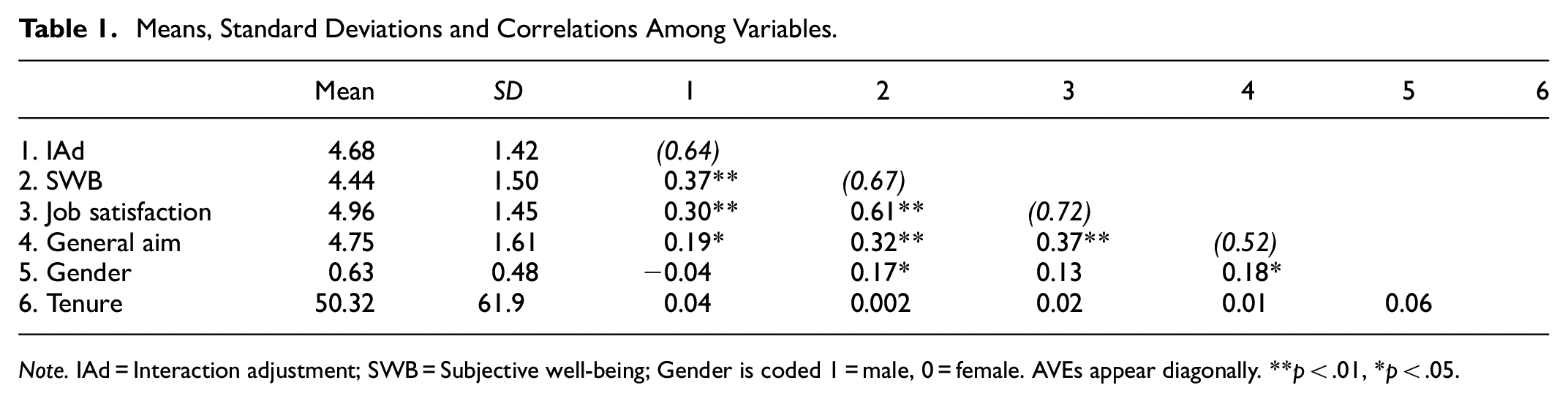
Note. IAd = Interaction adjustment; SWB = Subjective well-being; Gender is coded 1 = male, 0 = female. AVEs appear diagonally. **p < .01, *p < .05.
As can be seen, all variables display moderate to high average values, which suggest that the surveyed expatriates were well-adjusted to interacting with locals and were generally happy and satisfied with their job. Furthermore, the enforcement of the organizational goals for the assignment were also recognized. Correlations among the variables indicate that interaction adjustment is positively correlated with SWB (r = .37, p < .01) and job satisfaction (r = .30, p < .01), and SWB is highly correlated with job satisfaction (r = .61, p < .01). Furthermore, the organizational goals for the IA are positively correlated with interaction adjustment (r = .19, p < .05), SWB (r = .32, p < .01) and job satisfaction (r = .37, p < .01). As for the demographics, male expatriates reported higher SWB and higher perceived accomplishment of the organizational goals for the assignment.
A confirmatory factor analysis (CFA) using AMOS 27.0 was used to assess the latent variables’ properties (Anderson & Gerbing, 1988). The proposed model showed an acceptable fit to the data (χ2 = 172.75; df = 111; p < .01; χ2/df = 1.55; RMSEA = 0.06; TLI = 0.96; CFI = 0.96; IFI = 0.97). All factor loadings were substantial and significant and support the scales’ convergent validity. We followed Voorhees et al. (2016) recommendation to test discriminant validity when using multi-item measures. As seen in Table 2, we used the heterotrait-monotrait (HTMT) method combined with the average variance extracted-shared variance (AVE-SV) comparison (Fornell & Larcker, 1981). The average variance extracted (AVE) estimated for each construct was greater than the squared correlation between the constructs (Table 1), thus discriminant validity was assumed (Fornell & Larcker, 1981). Moreover, as shown in Table 2, results of the HTMT method show that estimates of all constructs are less than 0.85 (Ghasemy et al., 2020), thus discriminant validity was confirmed.
Discriminant Validity Based on HTMT.
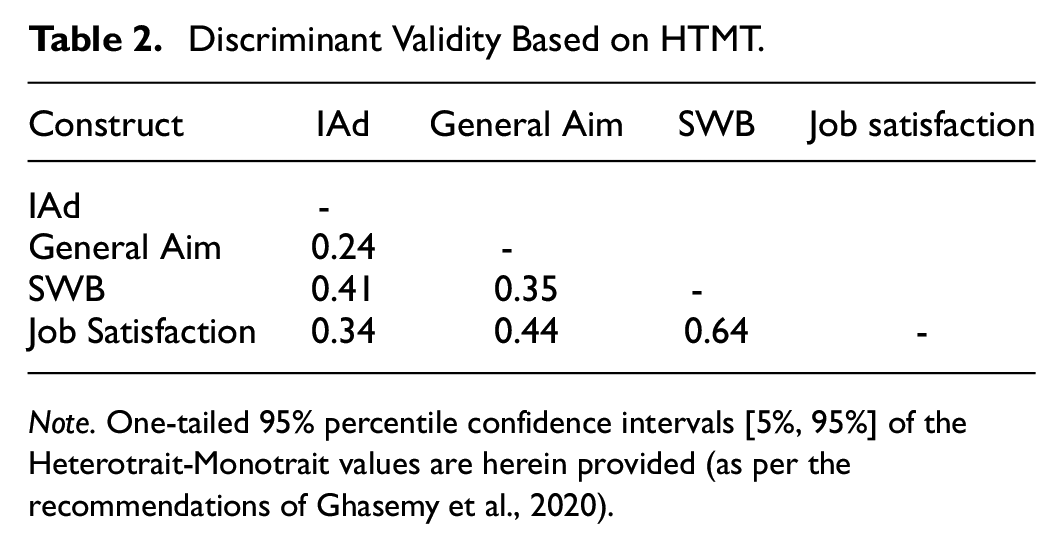
Note. One-tailed 95% percentile confidence intervals [5%, 95%] of the Heterotrait-Monotrait values are herein provided (as per the recommendations of Ghasemy et al., 2020).
Our theoretical model combines mediation and moderation. Specifically, we propose moderated mediation hypotheses, examining how the indirect effect of interaction adjustment on job satisfaction varies for different values of the moderator (accomplishment of organizational goals). The estimation of interactions between latent variables is controversial (for a review see Hayes et al., 2017), and it is advisable to use bootstrap confidence intervals to test indirect effects. However, “obtaining bootstrapped confidence intervals for specific indirect effects could be problematic in majority of SEM programs” (Gürlek & Çemberci, 2020, p. 13), so we decided to use PROCESS macros instead of AMOS to test these relationships, following former recommendations (e.g., Hayes, 2013; Igartua & Hayes, 2021). Thus, we conducted a conditional process analysis, that is, a regression-based analytical strategy used to “examine the extent to which the mechanism(s) by which an effect operates depends on or varies across situation, context, stimulus, or individual differences” (Hayes & Rockwood, 2020, p. 20). A significant advantage of this procedure is that it quantifies the conditional effect through a single inferential test, improving on causal step methods for mediation analysis (Hayes, 2013). Moreover, it is highly recommended when the moderator is a continuous variable as in our case (Igartua & Hayes, 2021).
Table 3 presents the results for the model coefficients for the mediation and conditional process mode.
Model Coefficients for the Mediation and Conditional Process Models. Effects of Interaction Adjustment on Job Satisfaction Through SWB.

Note. IAd = interaction adjustment; SWB = subjective well-being.
p < .01, *p < .05.
Hypothesis 1 predicted a positive association between expatriates’ interaction adjustment and SWB. As indicated in Table 3, results using Ordinary Least Squares show that expatriates’ interaction adjustment predicts SWB (β = .36; p < .01; SE = 0.09), thus confirming hypothesis 1.
Hypothesis 2 predicted a positive association between expatriates’ SWB and job satisfaction, which is also supported (β = .48; p < .01; SE = 0.07).
Hypothesis 3 predicted a mediation effect, in that interaction adjustment was expected to be positively associated to expatriates’ job satisfaction through SWB. This is a simple mediation hypothesis and we used model 4 of the PROCESS Macro in SPSS to test it (Hayes, 2018). A bootstrap analysis (5,000 samples) with a 95% confidence interval yielded a full mediation on the association between interaction adjustment and job satisfaction. In concrete, the statistical significance of the indirect mediation effect of interaction adjustment on job satisfaction through SWB was assessed as the bootstrapped confidence interval did not contain zero (indirect effect: β = .22; SE boot = 0.05; 95% CI = [0.12, 0.33]). In addition, the direct effect of interaction adjustment on job satisfaction became insignificant (β = .08; SE = 0.07; p = .23), indicating that SWB totally mediates the relationship between both variables. Thus, hypothesis 3 is also supported.
With respect to hypothesis 4, the accomplishment of the organizational goals for the assignment were expected to moderate the indirect relationship between interaction adjustment and job satisfaction through SWB. To examine this moderated mediation hypothesis, we used model 58 of the PROCESS Macro (Hayes, 2018). We used the bootstrap method based on5,000 samples to obtain the bias-corrected for 95% confidence intervals. When the confidence intervals do not include the value zero, the indirect effect is considered to be significant.
As shown in Table 3, we found evidence of a moderated mediation by examining the three criteria for establishing the moderated mediation model (Hayes, 2013; Muller et al., 2005). Firstly, the total effect of interaction adjustment on job satisfaction was significant (β = .31; p < .001; SE = 0.08; [0.15; 0.47]). Secondly, the impact of interaction adjustment on SWB (β = .36; p < .001; SE = 0.07) and that of SWB on job satisfaction (β = .48; p < .001; SE = 0.07) were significant. Finally, the interaction effect between the interaction adjustment and the perceived accomplishment of the organizational goals for the assignment (interaction term: β = −.12; p < .05; SE = 0.04) was significant as that of SWB and perceived accomplishment (interaction term: β = −.07; p < .05; SE = 0.03). In concrete, the positive relationship between interaction adjustment and SWB, and the positive relationship between SWB and job satisfaction became weaker (less positive) once the perception of accomplishing the organizational goals for the assignment increase. Thus, the moderated mediation was established, supporting hypothesis 4.
The bias-corrected percentile bootstrap analyses further confirmed the moderated mediation model. This approach is sometimes called the pick-a-point approach and is “the dominant method for probing interactions in a linear model in behavioral sciences” (Hayes, 2012, p. 4). In concrete, we examined the indirect effect of interaction adjustment on job satisfaction for different levels of perceived accomplishment of the organizational goals for the assignment, as shown in Table 4.
Conditional Indirect Effects of IAd on Job Satisfaction Through SWB at Values of General Aim.

Values are for the 10th, 25th, 50th, 75th, and 90th percentiles.
The results of this approach, for the percentiles 10th, 25th, 50th, 75th, and 90th of the accomplishment of the organizational goals, show the conditional effects of interaction adjustment on job satisfaction through SWB. When expatriates perceive that their accomplishment of the organizational goals for the assignment are generally low (10th percentile), the indirect effect of interaction adjustment on job satisfaction is positive and significant (β = .43; SE = 0.10; 95% CI = [0.22, 0.64]). This means that expatriates’ job satisfaction is mainly determined by the mediation of expatriates’ SWB. As predicted, this effect diminishes as the organizational goals for the assignment are further met. Once the strategic organizational goals for the assignment are strongly enforced and attained (above the 6.67 cut-point, 90th percentile), the indirect effect of interaction adjustment on job satisfaction through SWB becomes insignificant (β = .04; SE = 0.04; 95% CI = [−0.02, 0.15]). This means that once the expatriates meet high organizational goals that are potentially too stressful and demanding, these undermine their SWB and job satisfaction. Plots for the significant two-way interactions are displayed in Figures 2 and 3.

Interactive effects of interaction adjustment and general aim on SWB.

Interactive effects of SWB and general aim on job satisfaction.
As shown in Figure 2, the relationship between interaction adjustment and SWB is sharply positive for those expatriates who reported a lower accomplishment of the organizational goals for the IA (β = .81; p < .001), becoming non-significant for those expatriates who reported a higher accomplishment of those organizational goals (β = .1; p > .05).
Similarly, as shown in Figure 3, the strongest positive effect of SWB on job satisfaction takes place when the accomplishment of the organizational goals for the IA are somewhat lower and still challenging (β = .78; p < .001). Once the accomplishment of the organizational goals gets higher that turns out to be a hindrance-stressor, so the positive effect of SWB on job satisfaction gets reduced (β = .33; p < .01).
Discussion
In a VUCA world, there are increasing calls to build human capital and global competitiveness without endangering the global environment and risking workers’ well-being (Caligiuri et al., 2020; Fan et al., 2021). Every year, hundreds of thousands of expatriates are deployed living and working abroad in pursuit of strategic organizational goals. These assigned expatriates are the focus of this research, which aims to examine whether the accomplishment of strategic organizational goals moderates the expected mediation of expatriates’ well-being regarding the association between expatriates’ interaction adjustment and job satisfaction.
Research on expatriates’ well-being is still limited, despite its obvious relevance to international business. There have been calls for further research specifically on the relationship between expatriation-specific work antecedents and general well-being (Biswas & Makela, 2020), including the dual role of expatriation that can act as both a job-challenge and a job-hindrance (Demerouti & Bakker, 2011; Van Den Broeck et al., 2010). The findings confirm the adequacy of our approach by demonstrating the direct and indirect influence of SWB on expatriates’ job satisfaction, which is a unique empirical contribution to the expatriate literature (Biswas & Makela, 2020).
By following earlier calls to examine the cross-cultural interaction between expatriates and HCNs (e.g., Adler & Aycan, 2018; Fan et al., 2021) our findings also stress the importance of expatriates’ interaction adjustment, which is a powerful job-resource that directly influences expatriates’ SWB and indirectly promotes expatriates’ job satisfaction. This is consistent with previous research (Halbesleben, 2006), and indirectly supports the arguments of Adler and Aycan (2018) about the key influence of HCNs on expatriate and overall organizational effectiveness. For example, spouse–family cross-cultural adjustment was found to positively influence expatriates’ overall cross-cultural adjustment (Takeuchi et al., 2002), which is an association that likely extends to spouse-family-expatriate subjective well-being, satisfaction, and performance, and is worthy of further investigation.
In addition, our findings show that the positive association between interaction adjustment and expatriates’ well-being is moderated by the perceived accomplishment of organizational goals. We found that when the perceived accomplishments increase, the positive influence of expatriates’ interaction adjustment decreases, probably because an excessive focus on goals-pursuit deteriorates the interaction with HCNs, which could otherwise facilitate the crossover of fatigue and exhaustion from expatriates to local colleagues (Sonnentag, 2015). Our findings suggest that expatriates can accomplish the organizational aims for the IA at the expense of reducing their SWB and job satisfaction, which is consistent with previous research from the domestic context showing that striving for goals and SWB are linked (Klug & Maier, 2015; Koestner et al., 2002); and this association is weaker when there is a mismatch between personal and externally defined goals (Klug & Maier, 2015). We found that when the perceived accomplishments increase, the positive influence of expatriates’ interaction adjustment decreases, probably because an excessive focus on goal pursuit deteriorates the interaction with HCNs; or alternatively, an interpersonal closeness with the HCNs facilitate the crossover of fatigue and exhaustion from expatriates to local colleagues (Sonnentag, 2015). Both explanations are consistent with the latest developments of the JD-R model (Demerouti & Bakker, 2011; Van Den Broeck et al., 2010), and are worthy of further test in other contexts, thus extending this model to the international context.
Theoretical Implications
The contributions of this study are manyfold. First, this study bridges two research fields—the JD-R literature and the SWB literature—which have developed almost independently and with limited applications in the international context. SWB plays a pivotal role in the domestic workplaces given its associations with several job-demands and outcomes, such as job-performance (Peccei & Van De Voorde, 2019) and satisfaction (Wright & Cropanzano, 2007). This may be particularly true in the international context and among expatriates, since their SWB seems to be more negatively affected by expatriates’ job-demands than by their job-resources (Biswas & Makela, 2020). However, research examining the antecedents and outcomes of expatriates’ SWB remains limited, and the enforcement of organizational goals as specific expatriate-demands have been overlooked, particularly in their interplay with SWB. This is the first contribution of our study, which shows that SWB fully mediates the association between expatriates’ interaction adjustment and job satisfaction, and this mediation is moderated by job-demands.
Second, the findings from this study also documents the importance HCNs can have, specifically through expatriates’ interaction adjustment, which can be a powerful job-resource that spills over and positively influence expatriates’ SWB and job satisfaction. Although the literature offers an adequate understanding of the antecedents and outcomes of expatriates’ adjustment (Bhaskar-Shrinivas et al., 2005), limited work exists regarding the influence of HCNs on expatriates and organizations’ effectiveness (Adler & Aycan, 2018). Multicultural teams are now pervasive, as well as remote work, so one immediate implication of our findings to expatriate research is that these trends represent job-demands but also job-resources that affect expatriates’ well-being and satisfaction, to an extent that is yet to be validated.
Third, this study follows previous calls to extend the JD-R model to predict well-being and performance at work (Demerouti & Bakker, 2011). Although the JD-R framework can be applied to virtually any domain, research in the international context regarding the job-demands that act as challenge-stressors and those that act as hindrance-stressors is scarce and was developed separately (Demerouti & Bakker, 2011). This study extends this debate by linking the enforcement of the organizational goals for the IA to expatriates SWB. From a predictive explanatory perspective, the findings demonstrate that SWB fully mediates the association between expatriates’ interaction adjustment and job satisfaction, and this mediation is moderated by the general aims for the assignment. Although previous studies have shown that high levels of job resources may protect employees from negative effects when job demands are high (Bakker et al., 2005, 2010), we have found instead that the relationship between interaction adjustment (a job resource) and job satisfaction (a job outcome) becomes weaker (less positive) for higher levels of perceived attainment of the organizational goals (high job demands). Once these job-demands increase, the relationship between (i) interaction adjustment and SWB; and (ii) SWB and job satisfaction become less positive despite the presence of job-resources (interaction adjustment). These findings are particularly important because they suggest two alternative paths to expatriates’ job satisfaction (and likely expatriate performance). On the one hand, SWB is an important personal resource in boosting expatriates’ job satisfaction when the perception of accomplishing the organizational goals is low to average: in other words, when job-demands are challenging. On the other hand, however, the positive effect of SWB on job satisfaction decreases once the perceived accomplishment of the organizational goals increases. In other words, when the attainment of these goals act as job-hindrance. These findings extend previous research from the domestic context showing that striving for personal goals, making progress, or attaining personal goals are linked to SWB (Klug & Maier, 2015; Koestner et al., 2002); but this association is weaker when there is a mismatch between goals that are externally defined (Klug & Maier, 2015). Consistently, this study results extend our understanding of these links in the international context and warn against the enforcement of assignment goals that are external and/or excessive and that consequently may undermine expatriates’ SWB and job satisfaction.
A final contribution pertains to the analytical approach employed, because the use of a conditional process analysis (Hayes & Rockwood, 2020) with a mediator (i.e., expatriates’ SWB) and a moderator (i.e., job-demands, such as the accomplishment of the organizational goals for the IA) makes possible the simultaneous test of multiple relationships among variables, with a relatively modest sample size. Future research can productively follow a similar approach to expand our knowledge of other moderators and covariates of expatriates’ SWB.
Managerial Contributions
The findings have several managerial implications for multinational companies (MNCs) and other international employers, including global managers, and expatriates. Our paper contributes to understanding the antecedents and outcomes of expatriates’ SWB, including the moderating role of the perceived accomplishment of organizational goals.
Pertaining to the antecedents and outcomes of expatriates’ SWB there are clear indications here that successful interactions with HCNs will be beneficial to enhance expatriates’ interaction adjustment and SWB, which in turn will increase expatriates’ job-satisfaction. This suggests that organizations can improve the overall effectiveness of the expatriate workforce, at least in terms of subjective well-being and job satisfaction, by increasing opportunities for successful interactions with HCNs. This can be done by creating conditions to activate positive emotions between expatriates and HCNs. This point is particularly important for HR professionals, who may revise their HR practices directed to international workers, especially expatriates’ integration and preparation, to enable successful interactions with HCNs. It is also likely that expatriates are not entirely aware of the importance and the potential of nurturing interactions with HCNs for their SWB, which should be promoted.
Our results also document the importance of expatriates’ accomplishments, which can be perceived as job-challenges or job-hindrances depending on expatriates’ individual and subjective experience. Generally speaking, our results suggest that expatriates’ accomplishments are achieved at the expense of lessening their SWB and job-satisfaction. In other words, any performance gains necessarily imply and involve some loss pertaining to SWB and vice-versa. Based on this finding and considering that personal goals pursuit is linked to SWB (Klug & Maier, 2015; Koestner et al., 2002) managers and HR professionals may enable expatriates’ accomplishments by aligning the personal and organizational goals for the assignment, as a way of promoting expatriates’ SWB and job-satisfaction (Peccei & Van De Voorde, 2019).
In a globalized environment, international workers from different cultures have different capabilities and pursue different personal goals. Thus, the ability to build effective social relationships among them and with HCNs has been asserted as a key antecedent of expatriates’ SWB and job satisfaction. We argue that expatriates’ SWB under VUCA environments has now become more critical than ever before, because developing global human capital is fundamental for MNCs to obtain additional competitive advantage.
Limitations and Future Research Perspectives
This study has some research and methodological limitations that should be noted. The first limitation is that the generalizability of the current results to other global workers has to be demonstrated. In an attempt to address this issue, we sampled expatriates from one single origin but working for different organizations and located in different countries. The Spanish setting is important, because Spanish companies have expanded its global presence in the past decades. However, future research understanding and identifying additional job-demands and resources influencing expatriates’ SWB benefit from examining it in different country settings.
A second limitation pertains to the use of a cross-sectional design, so common method variance could have artificially strengthened the hypothesized links between interaction adjustment, SWB and job satisfaction. To minimize this bias we took several actions, either through the procedures of data collection and the subsequent statistical analysis, which suggest a minor contamination across inputs and outputs. Future research testing the research model might collect data on the independent and dependent variables in separate moments and may also use additional measures of well-being (e.g., work-well-being and psychological well-being) and goals pursuit (e.g., personal, and organizational goals).
A third limitation refers to the relatively small sample size and the procedure of data collection that made it difficult to determine an accurate response rate. This is not unusual in expatriate research (Tharenou, 2017), and we found results consistent with the literature on expatriates’ well-being (Biswas & Makela, 2020), so we trust these limitations do not significantly change our findings. Finally, the sample size was large enough for modeling complex relationships among variables, including the test of moderated mediation (Edwards & Konold, 2020), which is a methodological approach we recommend for testing other antecedents and moderators of expatriates’ SWB.
Future research can expand our research model to include other antecedents of expatriates’ SWB, building upon the developments of the JD-R model, notably to address: (i) expatriation-specific demands, such as job/role clarity and autonomy; and (ii) expatriation-specific resources, like formal mobility policies pertaining to remote work, frequency and duration of host traveling, work-life interface, etc., which expectedly influence the SWB of international workers. For example, there is yet insufficient knowledge about how negative interactions with HCNs affect expatriates’ well-being and how expatriates’ SWB varies during the IA. We still need to know how and when the accomplishment of organizational goals act as a challenging or hindrance-stressor, and which expatriates’ resources like age, gender, origin, occupational experience, personality, cultural intelligence, among others, are significant covariates. In addition, our research model has examined a well-established relationship, at least in domestic workplaces, between workers’ well-being and job satisfaction. The next logical step is the inclusion of expatriates’ performance. If, as shown, exacerbated job demands undermine expatriates’ well-being, and thereafter job satisfaction, then we still need to know more on how SWB spills over to the work domain and influences other variables, such as expatriates’ engagement, performance, and retention.
Finally, and contrary to the vast majority of studies suggesting that role overload should either be treated as a challenging or hindrance-stressor, our study is in accordance with the position of Huang et al. (2021). The authors noted that perceived overload is a complex phenomenon that has components of both hindrance and challenge stressors we need to explore, particularly in the interaction with other external demands, such as war, climate change, COVID-19, remote work (Nemteanu & Dabija, 2021), and big-data driven systems for people management (Harrower, 2019; Olsen, 2019; Pera, 2019).
Conclusion
This study attempted to empirically examine whether expatriates’ well-being mediates the association between expatriates’ interaction adjustment and job satisfaction; and whether this indirect effect is moderated by expatriates’ accomplishment of organizational goals. Our study adopts a hedonic view of well-being (Diener, 2000; Diener et al., 1985) and is one of the first to address the antecedents of expatriates’ well-being including its mediating role. We contribute to the growing body of literature examining expatriates’ SWB by demonstrating how work-related resources, such as expatriates’ interaction adjustment, spillover and affect expatriates’ SWB and job satisfaction, and how work-related demands, such as the organizational goals for the IA, moderate the role of expatriates’ SWB.
This study also contributes to extend the JD-R model to the international context, by breaking down the effects of job-challenges and job-hindrances, a distinction that is critical to promoting expatriates’ subjective well-being and job-satisfaction. We also highlight the relevance of expatriates’ accomplishments during the assignment and suggest goal-pursuit and progress as a lens for further examining expatriates’ SWB, job satisfaction and job-performance.
To summarize, this study points to a counterintuitive relationship between expatriates’ accomplishments and well-being: exacerbated organizational accomplishments impair expatriates’ SWB and job satisfaction, which in turn might affect business performance. This finding poses a fundamental dilemma to global businesses: which job-demands and general aims to enforce, and how much. On another hand, our findings suggest that in a VUCA world, global organizations can proactively influence expatriates’ SWB and job satisfaction by (i) fostering expatriates’ interactions with HCNs; (ii) helping expatriates set meaningful goals for the assignment; (iii) and by monitoring their goal progress. In view of the findings, we can conclude that the “happy-productive worker” hypothesis and the JD-R model are invaluable theoretical frameworks to guide future research and expand our knowledge about global workers
Footnotes
Declaration of Conflicting Interests
The author(s) declared no potential conflicts of interest with respect to the research, authorship, and/or publication of this article.
Funding
The author(s) received no financial support for the research, authorship, and/or publication of this article.
