




Abstract
We analyzed empathy and relationship commitment mechanisms through emojis. We defined emojis based on theoretical reviews and neuroscientific studies as a mind reading process. Perspective taking, inner imitation, and emoji cognition were independent variables. Emotional empathy and emotional response was the mediating variable. Relationship commitment and behavioral response was the dependent variable. Analyzing the relationship between variables indicated emotional empathy and relationship commitment through emojis having positive (+) relationships with “perspective taking” and “inner imitation,” the two dimensions of mind reading (cognitive and emotional) and, among them, a stronger positive (+) relationship with inner imitation, which is simulation theory’s (ST) cognitive process. Relationship commitment through emojis was strongly related to emotional empathy as a mediating factor than being directly related to cognitive processes (perspective taking, inner imitation). Moreover, considering inner imitation’s influence being greater than perspective taking, relationship commitment through emojis is mainly caused by emotional empathy with inner imitation as a mediating factor.
Based on the theoretical review and previous studies in neuroscience, we considered that the cognitive process of emojis is the same as the mind reading process in face-to-face (F2F) situations. By setting the path model for hypothesis on empathy and relationship commitment and analyzing the relationship between the variables, we aimed to identify the mechanism of empathy and relationship commitment through emojis.
Currently, instead of F2F nonverbal expressions, users emotionally interact through emojis in computer-mediated communication (CMC) to sympathize and further engage in relationships. In Korea, emojis are centered on mobile messengers and are increasingly commercialized as they are used as marketing elements by companies and organizations as well as individuals, with various forms being constantly developed. However, emoji commercialization shows the duality of their indiscreet production in line with the tendency to pursue a more differentiated design. What’s more serious is that prior related studies have been reporting different results without providing fundamental guidance in developing various emoji types.
In other words, the type of emoji that causes the highest empathy is often reported as high-context 1 emoji (Yang et al., 2017) and, in others, as dynamic forms such as flash forms (Pei, 2017). This can be a problem as previous studies have been conducted by identifying the type with the highest variable within the limited stimulus. Therefore, while solving these problems by preventing indiscreet emoji production and providing fundamental guidance in developing various emojis, it is necessary to grasp the principle of empathy and relationship commitment through emojis and the key factors involved in it, rather than following a simple consequential approach.
In particular, regarding the structural aspects and principles in developing empathy and relationship commitment through emojis, the recipient’s perception of an emoji is a crucial part. In other words, according to the hierarchy of effects model (Lavidge & Steiner, 1961), empathy and relationship commitment through emojis correspond to emotional and behavioral responses that occur hierarchically in the recipient’s series of cognitive processes, thus having causalities with the results of the recipient’s recognition of the emoji. Therefore, increase in empathy and relationship commitment through emojis should constitute a design that can be well-recognized by the recipients. According to previous studies, there is a difference in the way we process information, with varying results of the actions depending on it. For instance, in the attitude toward a brand and the intention to purchase the product, image information processing, which specifically reconstructs feelings and emotions by activating sensory experiences from the product, has a more positive effect than analytical information processing, which evaluates the product’s properties based on realistic and objective data (Escalas, 2004; MacInnis & Price, 1987).
These studies also show that there may be cognitive differences between recipients when it comes to emojis and that empathy and relationship commitment may vary according to internal factors, such as the recipient’s cognitive style, as well as external stimuli, such as emoji types, and, if that is correct, it is crucial to grasp the characteristics and elements of the cognitive method that can effectively induce and generate empathy and relationship commitment in a structural perspective. However, previous studies related to emojis only reported that the information-processing approach of emojis seems to be an automatic process (Comesaña et al., 2013), but there is no study on the personality characteristics of the emojis’ cognitive method. In addition, to identify this, it is necessary to precede the analysis of the mechanism of empathy and relationship commitment by focusing on the recipient’s cognitive process of emojis.
Theoretical Background
Mind Reading as Emoji Cognition
In today’s CMC, emojis are considered to be nonverbal substitutes for F2F communication (Walther, 2006). In addition, previous studies have reported that the cognitive process and information-processing methods associated with emojis are similar to F2F nonverbal expressions (Huang et al., 2015), as well as that the phenomenon of mirroring has appeared as evidence for facial imitation by the American Standard Code for Information Interchange (ASCII) emoticons, for example, “:)” and “:(” (O’Neil, 2013). Facial imitation is related to communication through nonverbal F2F expressions. Thus, although emojis, which are used in CMC, are not inherently the same as F2F nonverbal expressions, the recognition, and processing methods of emojis, can be considered similar to those of F2F nonverbal expressions (Comesaña et al., 2013). Accordingly, this study assumes that emoji cognition, a substitute for nonverbal expressions in CMC, occurs by reading the mind of another person according to their nonverbal expressions as is done in F2F communications.
The original meaning of mind reading referred to the ability to use information about the mind-set of another person for understanding and predicting that person’s words and actions (Howlin et al., 1999). Cognitive sociologists have explained that mind reading by humans is possible because their minds contain the theory of mind (ToM; Baron-Cohen et al., 2000), which relies both upon the theory of theory (TT) and simulation theory (ST). Here, TT can be considered a method that mentally infers the causal relationship between the mind and behavior of another person through the theory inherent in one’s mind (Gopnik, 1993), whereas ST refers to the method of internally simulating the psychological state of another person’s behavior (Gordon, 1986). Regarding key differences between these two dimensions of mind reading, Goldman (2006) explained that TT represents a theoretical activity that is strictly isolated from the target subject, whereas ST is the process of simulating the mental state of the target subject, who is thus directly involved. Moreover, Goldman (2006) also explained that such contrast becomes the potential evidence for empirically differentiating TT from ST. If there is evidence of mental simulation in the mind reading process, we can determine that mind reading occurred through ST and not TT.
Perspective Taking and Inner Imitation as Cognitive Method of TT and ST
In this study, the cognitive method of TT refers to the separate perception of a perceiving subject and the target subject, and perspective taking is a concept that can empirically measure them. Essentially, perspective taking is the most important cognitive activity to understand and accept others (Iannotti, 1978), where the inner mental state of another person is recognized and understood by considering the surrounding circumstances and environment. These considerations then become the basis for interpersonal relationships and social interactions. Perspective taking, as a cognitive ability, is discussed as a part of the ToM in the broader sense, where perspective taking is used in the process of accepting and understanding external information based on the ToM (Barnes-Holmes, McHugh, & Barnes-Holmes, 2004). Moreover, fMRI recently showed that perspective taking was found in areas of the brain commonly associated with ToM (Schurz et al., 2015).
Conversely, the cognitive method of ST in this study corresponds to “Einfühlung,” 2 regarding other-perception, as explained by Husserl and Lipps. Einfühlung is a German term that combines “ein” and “Fühlung,” which translates as “into + feeling,” that is, Einfühlung refers to essentially recognizing and feeling by deeply digging into the target subject and injecting its own emotions, rather than recognizing the target subject from outside. Particularly, Lipps (1907, 1909) explained that people inherently possess the fundamental qualities that match the expressive movements of others and internally recreate similar experiences through such fundamental qualities, allowing both the other person’s emotions and state of consciousness to be understood. Moreover, an individual’s tendency to trigger the same emotional state, which is present within themselves during this process (imitation impulse), as well as the internal re-creation of such a tendency, are collectively referred to as inner imitation. This concept can be seen as similar to the embodied ST, which states that we infer the mental state of others by simulating their actions and emotions through our sensory-motor system (mirror neurons 3 ). Based on these reasons, Lipps is mentioned as the first supporter of ST (Stueber, 2008).
Empathy as an Emotional Response According to Mind Reading
As the understanding of others progresses from cognitive and emotional perspectives, empathy is also classified into cognitive and emotional, with related empirical studies as a psychosocial response being conducted in various ways, even from a physiological perspective. Specifically, relevant research presents two types of empathy as having different anatomical foundations (Shamay-Tsoory et al., 2009) and the neurocognitive mechanism involved in them is also different (Krämer et al., 2010).
Moreover, neuroscience research confirms that cognitive and emotional empathy, as TT and ST methods, respectively, are generated through both top-down and bottom-up information processing (Bernhardt & Singer, 2012; Walter, 2012). Therefore, Walter’s brain diagram (2012) confirms that cognitive empathy is caused by self-reflection and self-reference to the process (TT method) in which cognitive information about other persons’ affective state is inferred using cognitive ToM as a mechanism (Schnell et al., 2011), corresponding to a cognitive and analytical approach as a top-down information processing. Conversely, affective empathy of the bottom-up information processing, which corresponds to one’s subjective feeling in psychological and cognitive aspects, is generated by mirror neurons simulating the same (ST method) by the “affective signals” in the affective state of others (Walter, 2012); here, affective empathy can reach emotional empathy, which is a more complex emotional response, by combining the functions of affective and cognitive ToM as well as those involved in subjective emotional experiences (Zaki et al., 2009). These information processes correspond to the emotional and imagery of cognitive methods.
Previous studies showed that empathy can be generated through different information-processing approaches, such as cognitive reasoning, using “semantic contextual information” and simulation through “contagious signals” (Frith & Frith, 2008). Regarding emojis, by activating these two processes, the key element of expression, that is, the basis of empathy, is motion. Specifically, motion boosts internal simulation by enhancing the activation of the perceptual-motor cell mirror neuron in the ST method (Fogassi et al., 2005), as well as facilitating emotional recognition and judgment strength in the TT method (Krumhuber et al., 2013), thus playing a key role in emotional reasoning.
Relationship Commitment as a Behavioral Response According to Mind Reading
Emotional expression through emojis in CMC becomes an important element in allowing independent communicators to develop closeness by understanding and experiencing the emotions of their counterparts. Moreover, the intimacy created by this way strengthens the emotions related to relationships, thereby forming relationship commitment. Here, relationship commitment through emojis as a behavioral response from mind reading refers to desire (Moorman et al., 1992) and intention (Geyskens et al., 1996), as an attempt to maintain relationships with others; it is an emotional commitment as an inner psychological state that makes one feel related to the person. According to previous studies, these kinds of relationship commitment are considered to occur mainly through emotional experience. In other words, relationship commitment increases as more nonverbal expressions are shared (Morris, 1977), as well as with greater bonding and relational emotion. In particular, relationship commitment forms through empathy (Ji, 2009).
Method and Hypotheses
Study Model
In this study, we structured the flow of the recipient’s consciousness in cognitive, emotional, and behavioral responses to identify the mechanism of empathy and relationship commitment through emojis. We assumed that the cognition of emojis in CMC takes place through the overarching cognition of mind reading, which is a method equivalent to that used in interpreting F2F nonverbal expressions. Based on this assumption, the study model was established as follows: Perspective taking (regarding the TT method) and inner imitation (regarding the ST method), which are used in the cognition of emojis, were set as independent variables. Emotional empathy, an emotional response, was set as the mediating variable. Relationship commitment, a behavioral response, was set as the dependent variable (Figure 1).

A hypothetical path model for perspective taking and inner imitation (independent variables), emotional empathy (mediating variable), and relationship commitment (dependent variable).
Hypothesis Setting
The first hypothesis: Perspective taking and emotional empathy
Perspective taking generates cognitive empathy through self-reference in the mentalization process (Schnell et al., 2011). Moreover, cognitive and emotional empathy have mutually associated emotional response systems (Stern, 1994). Thus, cognitive empathy can produce emotional empathy through the process of interjecting emotions (Escalas & Stern, 2003). Accordingly, it was hypothesized as follows:
The second hypothesis: Inner imitation and emotional empathy
Facial imitation by mirror neurons is associated with the perceptive ability for processing emotional expressions (Niedenthal et al., 2001). This is a determining aspect of emotional contagion (Sonnby-Borgström, 2002), which is the initial form of emotional empathy. Emotional contagion involves experiencing the same emotions as others (Dimberg & Thunberg, 2012). Moreover, Basch (1983) explained that even if we do not imitate those expressions externally, we can still experience the same emotions as an autonomic response related to such expressions generated internally. Here, the act of internally generating an autonomic response can be viewed as an inner imitation. Accordingly, it was hypothesized as follows:
The third hypothesis: Emotional empathy and relationship commitment
Empathy has a positive influence on peer relationships (Park, 2012). According to T. D. Allen (2001), empathy strengthens emotional commitment, which is an element of organizational commitment (members’ psychological attachment to the organization and the degree to which members of an organization identify themselves with the organization and commit themselves to it; Mowday et al., 1979). In other words, better empathic ability results in higher organizational (Ji, 2009) and emotional commitment (Oh et al., 2013). Based on this, it was hypothesized as follows:
The fourth hypothesis: Perspective taking and relationship commitment
According to previous studies, perspective taking has a positive effect on intimacy related to interpersonal relationships (Chung, 2010) and generates a partial mediation effect in attachment and interpersonal skills (S. H. Jung & Kim, 2016). Moreover, acceptance of perspective has a significant effect on organizational commitment, which consists of emotional commitment (K. T. Jung & Chang, 2012). Accordingly, it was hypothesized as follows:
The fifth hypothesis: Inner imitation and relationship commitment
According to Lee and Kang (2012), relations emotion generated from action by others is associated with the level of emotion-injecting. According to Bless et al. (1996), positive interjecting emotions lead to information processing with only emotional factors instead of factors related to cognitive processing. Positive interjecting emotions strengthen emotional connections, such that there is an increase in the closeness of a relationship. The internal phenomenon that emerges in the process of injecting emotions is inner imitation. Accordingly, it was hypothesized as follows:
Mediating effect of emotional empathy between perspective taking and relationship commitment (sixth hypothesis) and between inner imitation and relationship commitment (seventh hypothesis)
According to the hierarchy of effects model (Lavidge & Steiner, 1961), as a recipient engages in emoji-mediated interaction, the behavioral response, such as the desire or will to continue the relationship with the sender, is generated according to the hierarchy of cognitive-emotional-behavioral responses. Moreover, Yoon (2012) and Choi et al. (2012) reported that empathy occurs as a result of injecting emotion by identifying others’ emotions as their own in the mutual process and that commitment and attachment can be elicited. Based on this, the sixth and seventh hypotheses were set as follows:
Measurement Tools
Nonverbal Expression of Emojis
In F2F, the body language as a core element of communication through nonverbal expression is combined with motion and context to be more meaningful; however, emojis, nonverbal representations in CMC that correspond to a piece of information, are not only categorized into a form in which context and motion are added from a static body language type but are also subdivided into face types, upper and whole-body, and are designed to incorporate various emojis (Jeon, 2019). Nevertheless, considering the aforementioned theoretical reviews, motion among the expression elements of the emojis is a factor that generates empathy as cognitive information and infectious signals in top-down and bottom-up information processing. Therefore, this study added motion to body language based on the emoji of the upper body that expresses nonverbal expression of positive (joyful) emotions, to understand the mechanism of empathy and relationship commitment through emojis in CMC, and manipulated the stimulus (Figure 2).

Moving stimulus.
Measurement and Reliability of Four Main Variables
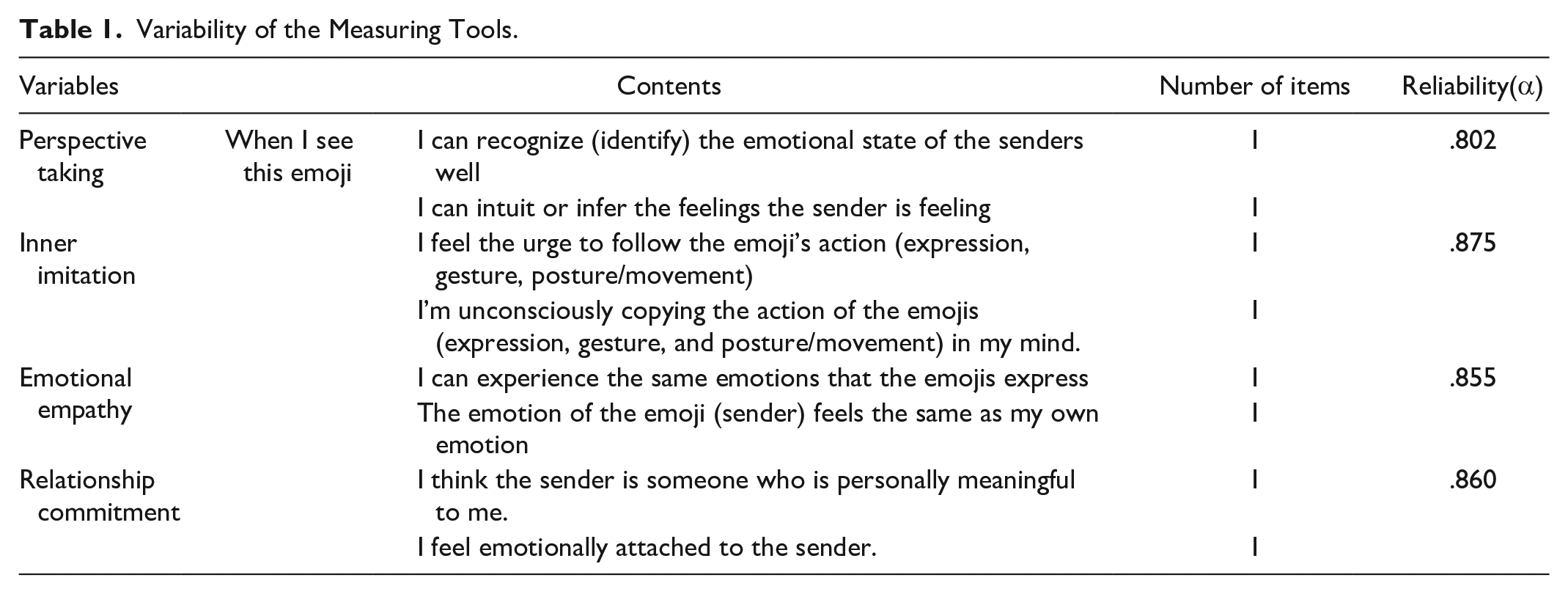
In this study, all main variables were measured using the 5-point Likert-type scale (1 = not at all, 5 = very likely) concerning the following tools for measurement. The Self Dyadic Perspective-Taking Scale (SDPT) by Long and Andrews (1990) was applied to perspective taking; in addition, a survey by Lim (2003), regarding imitation caused by identification with media characters, and surveys by Song (2009) and H.-S. Kim (1995), regarding imitation impulse caused by a violent medium, were modified and applied to this study to measure inner imitation. The items corresponding to emotional empathy in Escalas and Stern’s (2003), Mehrabian and Epstein’s (1972), and Davis’s (1980) empathy scales were consulted for emotional empathy, and the section regarding the measuring of emotional commitment from N. J. Allen and Meyer’s (1990) items were used for emotional commitment. Particularly, to prevent the problem of unfaithful responses due to the fatigue of the respondents in checking emojis and conducting surveys, the study excerpted and modified the two questions that best match the purpose of this study per each variable. To measure the measuring tool’s reliability, Cronbach’s alpha value was analyzed for each component, with the results in Table 1 showing each component’s values as higher than .8, indicating high reliability.
Variability of the Measuring Tools.
Experimental Design and Method
Participants and Stimulus
The participants of this study were university students using KakaoTalk, the most popular mobile messenger in Korea. This was based on the Survey on the Internet Usage (Ministry of Science and ICT & Korea Internet and Security Agency, 2017) that reports that 99.4% of all Koreans use the KakaoTalk application and that the mobile messenger usage rate is the highest among people in their 20s. Moreover, the stimulus was limited to KakaoFriends, KakaoTalk’s emojis that had the highest purchase rate in the survey on the preference of emoji characters in smartphone messenger in Korea (S. H. Kim, 2015) and, among them, the “MUZI & CON” character emoji was used because it is free of charge and has both positive and negative expressions; therefore, it was expected to be frequently encountered by the participants. Furthermore, the survey 4 was designed to be accessible both on PC and mobile for the movement of the emojis to be reproduced and, to provide the participants with a similar feeling to whom emojis are sent, manipulated stimuli were applied to KakaoTalk’s chat room.
The survey was conducted through PC and mobile. The participants were asked to answer questions about the emotions and thoughts they felt when the emojis applied to the chat room in KakaoTalk was presented. In particular, four questions were added that required a specific number to be entered during the response to identify those respondents who randomly chose answers in the survey. In addition, to condition sincerity into the participants when reading and answering the questions, the survey was designed to generate questions one by one after the stimulus was presented, in a way that responses would reveal the next question.
Data Collection and Analysis Method
For data collection, three pilot tests were conducted between May 2017 and January 2018, and data for actual analysis were collected through PC and mobile between February 28, and March 5, 2018. A total of 615 people who passed the prequalification questionnaire were selected (university students living in Korea who have used KakaoTalk) and participated in the survey, with a total of 520 people who passed the questions testing unfaithfulness being finally selected.
First, frequency analysis was performed to confirm the demographic characteristics of the participants; second, Pearson correlation analysis was conducted to confirm the correlation between numbers; third, structural equation modeling was applied to confirm the structural relationship between perspective taking, inner imitation, emotional empathy, and relationship commitment, as well as the relationship between the variables; and fourth, the mediation effect was verified by bootstrapping and common method bias analysis on confirmatory factor analysis was conducted to confirm the problems of the common method bias. SPSS and AMOS programs were used for data analysis and processing.
Analysis of Results
Demographic Characteristics and Descriptive Analysis
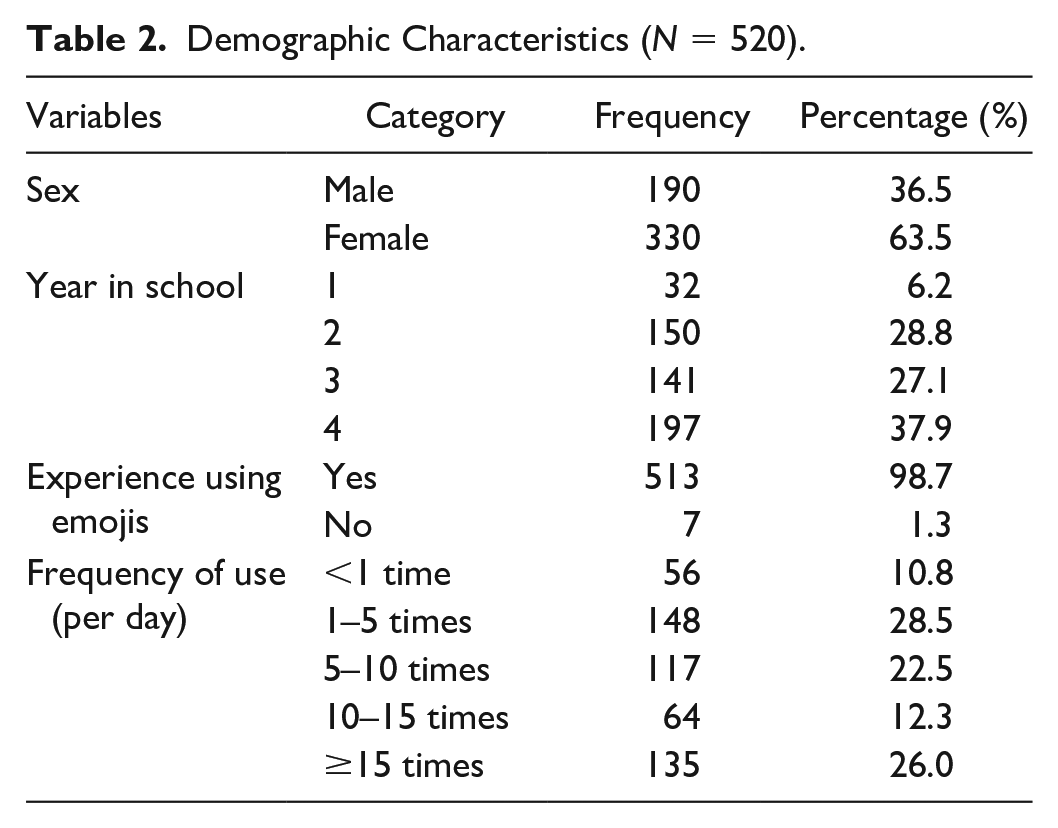
The general characteristics of the participants were as follows: sex: 190 male (36.5%), 330 female (63.5%); university year: 32 freshmen (6.23%), 150 sophomores (28.8%), 141 juniors (27.1%), and 197 seniors (37.9%); and emoji experience: 513 experienced in using emojis, seven inexperienced. The average number of emojis used per day was less than one for 56 participants (10.8%), 1–5 times for 148 participants (28.5%), 5–10 times for 117 participants (22.5%), 10–15 times for 64 participants (12.3%), and more than 15 times for 135 participants (26%; Table 2).
Demographic Characteristics (N = 520).
Descriptive analysis was conducted to identify the mean, standard deviation, and normal distribution level, and the skewness and kurtosis met the criteria of the normal distribution (Table 3).
Descriptive Analysis and Normality Test for Key Variables.

Correlation Between Measurement Variables
Analyzing the relationship between the variables (Table 4), we confirmed that all variables were significantly correlated.
Correlations Between Measurement Variables.

p < .01.
Confirmatory Factor Analysis and Common Method Factor Analysis
Confirmatory factor analysis (Table 5) showed that all factor loadings were significant and were 0.5 or above, indicating that the observed variables reflected the latent variables well. Moreover, convergent validity was good, as composite reliability (CR) was .70 or more and the average variance extracted (AVE) was .50 or more, and discriminant validity was satisfactory as all square of the correlation coefficient values did not exceed the AVE values. In addition, to confirm the common method bias, we analyzed a model that showed the possible path for one latent variable to all observed variables, and the difference in the standardized coefficients between a model reflecting a latent variable and the existing model showed that differences for all coefficients were less than 0.2 (0.027–0.115), confirming that there was no concern with common method factor analysis (Table 6).
Confirmatory Factor Analysis Results.

Note. CR = composite reliability; AVE = average variance extracted.
p < .001.
Correlations Between Latent Variables.

Study Model Goodness of Fit
Before conducting the structural equation model analysis, the goodness of fit (GF) for the measurement model was tested with CFA to confirm whether or not the observed variables sufficiently explain the latent variables. Table 7 lists the GF analysis results. The GF of the measurement models showed χ2(df = 14), root mean square error of approximation (RMSEA), normed fit index (NFI), Tucker–Lewis index (TLI), and comparative fit index (CFI) values at favorable levels, indicating sufficient GF for the measurement models.
Goodness of Fit of the Models.

Note. NFI = normed fit index; TLI = Tucker–Lewis index; CFI = comparative fit index; RMSEA = root mean square error of approximation.
Verification of Hypothesis and Mediating Effect
The standardized coefficients and the path coefficients for the research model are shown in (Table 8) and all paths were found to be significant at the p < .01 level. Regarding the mediating effect, the direct, indirect, and total effects of H6 and H7 were significant at the p < .05 level.
Analysis of Pathways Between Variables.

p < .05. **p < .01. ***p < .001.
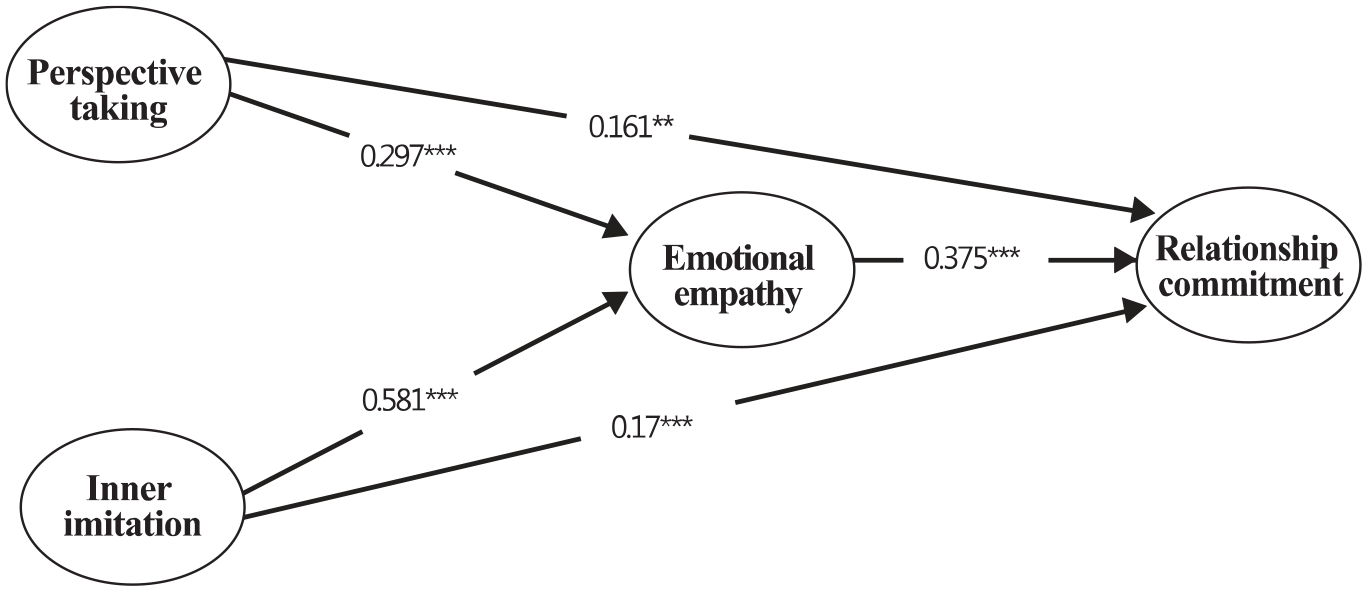
Analysis of pathways between variables.
Discussion and Conclusion
The relationship between the variables through path analysis of hypothesis and mediating effects is as follows.
First, regarding cognitive-emotional processes through emojis, perspective taking and emotional empathy (H1), and inner imitation and emotional empathy (H2), both had positive (+) relationships at a significant level (p < .001) as the emojis expressing emotion through a moving body language facilitates emotion recognition in H1 (Krumhuber et al., 2013), leading to an increased perspective taking of the sender, which increases the emotional empathy with the recipient through cognitive empathy. Moreover, in H2, as the motion signal of the moving emoji strengthens mirroring by mirror neurons, the inner imitation of the recipient on the emoji’s emotional expression increases and, as a result, the recipient was emotionally contagious and the emotional empathy with the sender increased. This reaffirmed that cognitive empathy can be generated by perspective taking (Schnell et al., 2011), leading to emotional empathy (Escalas & Stern, 2003) and that although we do not imitate the other’s emotions externally, we can experience the same emotion by internally generating an autonomous response related to the expression (Basch, 1983). These results show that the recipients’ cognitive process for emojis is not only a process with mind reading capabilities, like the nonverbal expression on a F2F situation, but also shows that the process is not uniform and that there is a systematic difference between recipients. In particular, this study showed that the relationship value of the cognitive-emotional process was in the order of H2 > H1, confirming that emotional empathy is mainly caused by internal imitation, corresponding to the simulation process by mirror neurons, rather than by perspective taking belonging to the mentalization process. The results support previous studies, reporting that emojis are part of an automated process analyzed by event-related potential (Comesaña et al., 2013) and can also be accompanied by facial imitation through mirroring (O’Neil, 2013). Specifically, emojis are primarily perceived through the bottom-up processing where simulation is generated by the mirror neuron, rather than the top-down processing in which the cognitive reasoning is performed, and here, the mirror neuron is part of a biological mechanism that enables the representation of behavior in connection with the motor area when observing the behavior of others and is known as a source for generating a human’s biotic and automatic imitation. Therefore, we can infer that, due to the cognitive characteristics of these emojis, previous studies identified the information processing of emojis as an automatic process, and thereby face imitation by mirroring occurred. Furthermore, the results of this study differ from the fact that, in the social science field, it was confirmed that emoji induced not only external but internal imitation as well.
Second, the emotional-behavioral process through emojis, emotional empathy, and relationship commitment (H3) had a positive (+) relationship at a significant level (p < .001). It seems that, as the narrative of the advertisement helps consumers to form empathy and commitment leading to favorable attitude toward the advertisement (Mattila, 2000), moving emojis form a narrative through a detailed description of the situation and have a positive effect to go from empathy to relationship commitment. This supports a previous study that reported that emotional commitment increased as the perception of empathy increased (Oh et al., 2013).
Third, the cognitive-behavioral process through emojis, perspective taking and relationship commitment (H4, p < .01), and inner imitation and relationship commitment (H5, p < .001) showed positive (+) relationship at the significance level. This reaffirmed that relationship commitment generally occurs through empathy as an emotional response but can also occur in the cognitive-behavioral process. In other words, this is in line with the previous studies that reported that perspective taking has a significant effect on organizational commitment (K. T. Jung & Chang, 2012) and that in the process of injecting emotions to an object, positive emotional intervention further enhances the closeness of the relationship by strengthening the link between emotions without cognitive information processing (Bless et al., 1996). Moreover, as the relationship between cognitive-behavioral process is in the order of H5 > H4, just like the cognitive-emotional process (H2 > H1), we can see that empathy and relationship commitment both increase more in occurrence with inner imitation, an emotional process, rather than with perspective taking, a cognitive process.
Fourth, the mediating effect of emotional empathy between perspective taking and relationship commitment (H6, p < .05) and between inner imitation and relationship commitment (H7, p < .01) was both significant and, in particular, the mediating effect of emotional empathy between inner imitation and relationship commitment was greater than that between perspective taking and relationship commitment. Through this, we reaffirmed that, in the process of mutual interaction with others, empathy arises by equating other people’s feelings with their own and can also elicit promise and attachment through empathy (Choi et al., 2012; Yoon, 2012).
Therefore, by combining the relationship between these variables and identifying the mechanism of empathy and relationship commitment through emojis, we can draw the following conclusions. That is, because the coefficient of the cognitive-emotional process (H1, H2) was higher than the cognitive-behavioral process (H4, H5) and that emotional empathy produced a mediating effect between perspective taking and relationship commitment (H6) and inner imitation and relationship commitment (H7), we can summarize that relationship commitment through emojis is mainly a cognitive-emotional-behavioral process, rather than a cognitive-behavioral process, which occurs through mediating effect of emotional empathy with perspective taking and inner imitation. In addition, considering that emotional empathy had a higher relationship with inner imitation than with perspective taking and that the mediating effect of emotional empathy between inner imitation and relationship commitment was greater, it can be interpreted that relationship commitment through emojis mainly occurs through emotional empathy by inner imitation, which corresponds to ST of mind reading. Finally, based on this mechanism and looking at the previous studies that reported that image processing, rather than analytical processing of information, has a more positive effect on attitudes toward the brand and product purchase intention (Escalas, 2004; MacInnis & Price, 1987), we can infer that, to effectively induce and increase empathy and relationship commitment through emojis, the emojis need to be designed so that the recipient can respond to the emojis and increase inner imitation, an emotional approach. Moreover, inner imitation is an internal phenomenon caused by mirror neurons, which are perceptual-motor cells, and mirror neurons induce facial muscle expressions consistent with emotions in dynamic facial expressions, rather than in static facial expressions (Sato & Yoshikawa, 2007; Weyers et al., 2006), leading to greater facial muscle activity (Rymarczyk et al., 2016). Based on this, we can predict that motion is the most important expression element of emojis to increase the internal imitation of the recipient.
Implications and Limitations
This study on emojis found that recipients reach relationship commitment through emotional empathy by understanding and experiencing emojis through different cognitive methods of perspective taking and inner imitation. Through this, we can confirm that not only the cognitive process of the emojis is conducted as mind reading of nonverbal expression as in F2F situations but also that there is a difference in methods between recipients. In particular, as confirmed in the theoretical reviews, the two cognitive methods have very different characteristics in their methods, so to recognize the emojis well cognitive characteristics between recipients need to be considered when designing the emojis. Moreover, as we confirmed that the relationship between empathy and relationship commitment through emojis was higher with inner imitation than with perspective taking, we identified that it was necessary to increase the internal imitation of the recipient on emojis to effectively induce and generate empathy and relationship commitment. Furthermore, this study suggested a prediction that the key expression element of emojis to increase the internal imitation, considering the mechanism of inner imitation, is motion. However, as this study identified that relationship commitment occurs through mediation with emotional empathy rather than through a direct relationship with inner imitation, even if the motion is a key factor to increase inner imitation, it seems necessary to consider combining with a context that has a positive effect on emotional empathy in a range that does not interfere with inner imitation.
This study is different in that, rather than simply focusing on the results such as classification analysis with a high degree of empathy, its approach was more in terms of the principles and structures that generate the results. In addition, the results can be used as basic data for establishing a principle of emoji designs. In particular, this study identifies the mechanism of the cognitive process, empathy, and relationship commitment of the emojis in the social science field, which has been abstract before. Despite this, this study has certain limitations. First, despite the fact that there are significant variations in the levels of emotional and physical expressions by emojis, we only used upper body emojis expressing positive emotions in our analysis. Therefore, additional studies may be needed on different emoji types, including emojis that convey negative emotions or involve full-body representations. Second, the study population was limited to college students who were expected to have the most experience using emojis. Therefore, the study was unable to verify whether the same results may be obtained from different age groups or populations with low emoji usage experience. Therefore, future studies should compare various types of groups and identify the types and key expression elements that enhance the inner imitation of emojis by analyzing the characteristics of perspective taking and inner imitation as the cognitive method of emojis.
Footnotes
Declaration of Conflicting Interests
The author(s) declared no potential conflicts of interest with respect to the research, authorship, and/or publication of this article.
Funding
The author(s) received no financial support for the research, authorship, and/or publication of this article.
