




Abstract
In recent decades, web-based collaborative writing has become popular as a technical technique for improving collaboration. The study explored the effect of Google-mediated collaborative writing (henceforth GMCW) and face-to-face collaborative writing (henceforth FTFCW) on developing English as a Second Language (henceforth ESL) students’ global and local writing features (organization, development, cohesion, structure, vocabulary, and mechanics). Despite the emphasis English language instructors in Saudi universities place on writing skills, students still face challenges in achieving proficiency in writing. The study included 46 male students at level 3 from the Qassim University English Language Department. An experimental study was used, along with a post-questionnaire, as additional material to collect students’ perceptions. In addition to using the independent t-test to compare the mean in the post-test of the two groups, a paired t-test was used to compare the mean in the pre-test and post-test of the same group. The researcher used a two-by-two mixed ANOVA to examine how students’ global and local writing features (such as organization, development, and cohesion) changed when they collaborated face-to-face or via Google Docs. The results showed that the Google-mediated collaborative writing post-test mean was greater than face-to-face collaborative writing in all writing features, and the difference was statistically significant. The questionnaire revealed that Google-mediated collaborative writing raised confidence, encouraged teamwork, instructed students on how to engage in peer feedback, and increased their willingness to use Google Docs for further assignments. Google-mediated collaborative writing benefited students more in terms of their writing quality (organization, development, and cohesion) than their writing accuracy (mechanics and structure). Google-mediated collaborative writing did not pay attention to form (spelling, punctuation, or structure). In contrast, students’ perceptions of the global and local writing aspects of face-to-face collaborative writing negatively impacted organization, development, and cohesion. The face-to-face collaborative writing students focused more on the essay form (mechanics and structure) than on the content (organization, development, and cohesion).
Plain Language Summary
The use of web-based collaborative writing as a technical tool to enhance teamwork has become more widespread. This study aimed to investigate the effects of face-to-face and Google-mediated collaborative writing on global and local writing features (organization, development, cohesion, structure, vocabulary, and mechanics) as well as the overall writing quality of ESL students. The researcher selected 46 male students at level 3 for this study. He administered two writing tests before and after involving the students in the study. Two raters evaluated the scores to measure the quality and accuracy of writing on a scale ranging from 1 (the lowest score) to 10 (the highest score). The findings indicated that, while students did not pay attention to form (spelling, punctuation, or structure), Google-mediated collaborative writing improved their global writing features (organization, development, and cohesion) more than their local writing features (mechanics and structure). These findings implied that implementing Google-mediated collaborative writing can help ESL students advance and enhance their writing abilities. On the other hand, English teachers ought to focus more on their students’ sentence structure, vocabulary, spelling, and punctuation.
Keywords
Introduction
The collaborative writing process involves two or more individuals working together to finish a piece of writing by doing some activities like collecting ideas, planning, organizing, drafting, revising, and editing (Rice & Huguley, 1994). Online applications have become increasingly popular in recent decades as a means of enhancing collaboration through new collaborative technology (Apple et al., 2011; Koch, 2010; Vodanovich & Piotrowski, 2001). Computer-Assisted Language Learning (CALL) combines technology with its pedagogical application (Warschauer & Healey, 1998). Second-language writing using technology offers “a range of informational, communicative, and publishing tools, now potentially at the fingertips of every student,” along with “the imperative for such use” (Warschauer & Healey, 1998, p. 58). In recent years, online collaboration has gained increasing attention in the areas of CALL and L2 collaborative writing, as it allows learners to focus on a variety of writing skills (Lund, 2008).
Web 1.0 applications, like chat rooms, primarily aid in facilitating discussions in computer-mediated communication. On the other hand, Web 2.0 tools, such as wikis and Google Docs, enable all aspects of writing, including task discussion, language use, collaborative text creation, revision, editing, and the production of the final written product (Li, 2018). Recent years have seen a growth in collaborative writing using technology that uses applications and tools to simplify the process of collaborations such as Wiki (Aydin & Yildiz, 2014; Elola & Oskoz, 2010; Kessler, 2009; Kessler & Bikowski, 2010; Lamb, 2004), blogs (Arslan & Şahin-Kızıl, 2010; Sun & Chang, 2012), and Google Docs (Abrams, 2016; Bikowski & Vithanage, 2016; Cho, 2017; Strobl, 2014). For example, Wang (2015) found that Wiki assisted learners to organize their written drafts, which was different from Hsu and Lo (2018), who did not notice any developments.
After teaching academic writing skills in Al-Qassim University’s English Language and Translation Department for two decades, it has become clear that ESL students are not meeting the planned writing grading objectives at the end of the academic year, despite the particular attention paid by English language instructors in Saudi universities to teaching writing skills. Instructors grade and mark learners’ essays based on their proficiency, accuracy, and quality. Students encounter difficulties with academic writing, and conventional approaches to teaching the English language might not lead to significant improvements in their writing proficiency. Various studies (Elbow, 1973; Graham, 2005; Noël & Robert, 2003; Storch, 1999, 2002, 2005; Williams, 2003) support the finding that collaborative writing enhances the social abilities of learners as well as their writing strategies. One potential solution to their writing issues could be to employ more efficient methods of teaching writing skills, such as using Google-mediated collaborative writing to focus on the development of global and local writing features for ESL students.
Literature Review
It is critical to understand both theoretical and pedagogical perspectives when using small groups when learning a second language (Storch, 2002). From a theoretical perspective, it was Vygotsky’s social constructivist view that provided the basis for collaborative learning in groups (Gillies & Ashman, 2003; Rojas-Drummond & Mercer, 2003; Thousand et al., 1994; Vanderburg, 2006). Peer collaboration in second-language writing relies heavily on the zone of proximal development (ZPD) concept (Vygotsky, 1978). According to the ZPD, there are two levels of development: the actual level, based on the learner’s ability to do something on one’s own, and the possible level, based on a learner’s ability to use assistance from more experienced people such as classmates or an adult (De Guerrero & Villamil, 2000). People can develop thoughts through repeated social interactions with more capable people, according to Vygotsky.
From a pedagogical perspective, it is usually based on communicative language instruction (Storch, 2002). Collaboration in writing is the process of working with some people as a team or as a group of writers. In collaborative writing, individuals work together to develop ideas, create plans, complete drafts, and make edits (Rice & Huguley, 1994). Students who engage in collaborative writing in EFL classes may benefit from social and cognitive learning, according to Storch (2002). Second-language writers involved in collaborative writing may generate ideas and agree or disagree with each other (Graham, 2005).
In terms of Google-mediated collaborative writing, GMCW is one of the most promising new online tools for working together (e.g., Gralla, 2010; Morales & Collins, 2007). Google Docs allows people to collaborate on a single project without the constraints of face-to-face meetings (e.g., Conner, 2008; Holliman & Scanlon, 2006; Perron & Sellers, 2011; Thompson & Coovert, 2003). Everyone can use Google, no matter where they live or whether the internet is available to them (Oishi, 2007). Additionally, Google Docs enable students to contribute when involved in collaborative writing (e.g., Hedin, 2012; Sharp, 2009), build confidence among learners (Bikowski & Vithanage, 2016), increase their desire to use it in other tasks (e.g., Bikowski & Vithanage, 2016; Zhou et al., 2012), activate peer feedback (e.g., Alharbi, 2019; Bradley & Thouësny, 2017; Ebadi & Rahimi, 2017; Hedin, 2012; Saeed & Ghazali, 2017; Semeraro & Moore, 2016; Slavkov, 2015; Villamil & de Guerrero, 2006), peer editing (e.g., Alharbi, 2019; Ebadi & Rahimi, 2017); collaborative revisions (Alharbi, 2019). Moreover, several studies have shown that Google Docs improve learners’ written features, namely content (e.g., Ebadi & Rahimi, 2017; Semeraro & Moore, 2016; Strobl, 2014; Woodard & Babcock, 2014); idea organization (e.g., Ebadi & Rahimi, 2017; Semeraro & Moore, 2016); and meaning rather than form (Kessler et al., 2012). However, Hoang and Hoang (2022) discovered a minor increase in grammar and accuracy but no gain in coherence.
Previous research studied the quality of written texts produced by students in cooperation with their peers compared with that of texts produced individually in terms of accuracy (grammar) and fluency and found collaborative writing helped students write better essays in terms of grammar (e.g., Bikowski & Vithanage, 2016; Elola & Oskoz, 2010; Storch, 1999, 2005; Storch & Wigglesworth, 2007; Strobl, 2014). Only very few studies have compared online peer-editing and face-to-face peer-editing to the IELTS academic writing skills of EFL learners (e.g., Ebadi and Rahimi, 2017). There is no single study that compares online collaborative writing with face-to-face outcomes and perceptions of ESL learners in terms of the global and local writing features of EFL students. The present work differs in crucial aspects, such as the effect of GMCW compared to FTFCW on global features (organization, development, and cohesion) and local features (structure, vocabulary, and mechanics). Most ESL students don’t meet enough goals for success and performance and can’t write qualified and structured essays. One way to help them improve their writing is to use different approaches, such as learner-centered (Blumberg, 2010) and modern approaches (Al-Khairy, 2013).
The purpose of this study is to investigate the impact that Google-mediated collaborative writing has on the development of global and local writing features in ESL students. These features include organization, development, cohesion, structure, vocabulary, and mechanics. At the end of the study, the students’ perspectives are explored to collect data related to the influence of the Google-mediated collaborative writing technique.
Therefore, the study aims to answer the following research questions:
What impact does GMCW have on ESL students’ overall writing quality compared to FTFCW?
What is the impact of GMCW on ESL students’ global and local writing features compared to FTFCW?
Do students prefer GMCW over FTFCW?
Do students perceive GMCW and FTFCW to have an impact on global and local writing features?
Methodology
The Study’s Design
Because the current study seeks to determine whether Google-mediated collaborative writing develops global and local writing features in Saudi EFL students more than face-to-face collaborative writing, an experimental approach was considered appropriate. To acquire evidence that is dependable and convincing, a quantitative experimental strategy (pre- and post-tests for essay writing) was used. In addition, a post-questionnaire was used as additional material. The current study compared two groups: 24 students were randomly assigned to the experimental group represented by Google-mediated collaborative writing (GMCW), while 22 students were assigned to the control group represented by face-to-face collaborative writing (FTFCW). Figure 1 represents the study’s design.

The study design.
The Study’s Sample
The context of the study focuses on English Language and Translation Department (ELTD) students at Qassim University. The department became one of the main departments of the Social Studies College in 1993. This program prepares qualified teachers to teach English to students in grades 1 through 10. By 2022, more than 5,000 students had graduated and acquired a bachelor’s degree in English language and translation.
Participants were 46 male level 3 students aged 20 to 22 in October 2022 who signed consent forms indicating their willingness to participate in the study. Except for five African students, all students are Saudi. Since all English Language Department students must complete the Computer Assistant Language Learning (CALL) course, the age and level of the students make GMCW appropriate.
It was difficult to collect data from the entire population due to several issues, such as availability and time constraints. The researcher conducted the study at Al Qassim University’s English Language Department. Cohen et al. (2018) recommend assigning a small number of participants representative of the entire population to collect data. There are two types of sampling, according to Cohen et al. (2018) and Bryman (2012): probability sampling and non-probability sampling. Due to institutional constraints following COVID-19, the researcher used convenience sampling, a non-probability sampling approach, to collect data.
To achieve a high degree of generalizability, the researcher chose second-year English language department participants as a sample. This ensures that the study can be applied to similar situations in the future, providing external validity and representing ESL students around the world.
Instruments
The study raised four research questions. For answering the first and second research questions of the study, two writing exams were specifically provided before and after engagement in the study. Students were given tests that consisted of 150-word comparative essays. The following subjects were assigned: The pre-test essay was titled, “Some people prefer living in a house, while others prefer living in an apartment. Compare the two opinions by giving examples and evidence to support your answer.” The post-test essay was titled, “Some people prefer eating in a house, while others prefer eating in a restaurant. Compare the two opinions by giving examples and evidence to support your answer.”
For answering the third and fourth research questions, post-questionnaires were provided to students in both groups to give responses using a five-point Likert scale (5 for strongly disagree, 4 for disagree, 3 for undecided, 2 for agree, and 1 for strongly agree). The questionnaire was developed, and items were included based on past research and the author’s extensive experience teaching writing. According to Drown (2001), a questionnaire is “any written instrument that offers respondents a sequence of questions or statements to which they are to reply either by writing down their replies or picking from among existing answers” (p. 6). The present investigation applies the questionnaire for the following reasons: (1) To provide answers to the research questions posed for the study. (2) There are several benefits associated with using the questionnaire, including the ability to save time, money, and effort (Dörnyei, 2010). (3) Participants were allowed to provide honest replies in the research setting. Dörnyei and Taguchi (2010) suggest carefully selecting the questionnaire and providing clear instructions written in simple, easy-to-understand language.
Essay-Grading Criteria
The pre- and post-tests were scored by two judges using Paulus’ (1999) rubric to measure writing quality and accuracy. Paulus’ (1999) rubric evaluates essays using a scale ranging from 1 (lowest score) to 10 (highest score) for six different writing categories, describing both global (organization, development, cohesion/coherence) and local (structure, vocabulary, and mechanics) writing features (Lundstrom & Baker, 2009). The organization category pertains to the coherence and cohesion of concepts and paragraphs. The essay exhibits a coherent structure, with a clearly stated topic sentence and well-connected supporting details that are relevant to one another. The development category develops each point through the use of examples and other types of evidence to support them. Cohesion refers to the accurate usage of word transitions and the connections between ideas. Structure means using grammatical aspects, such as simple presents, accurately and correctly. Vocabulary encompasses the ability to employ words with accuracy and convey meaning with clarity. Mechanics include aspects of spelling and punctuation.
Procedures
The GMCW group participants installed the Google Docs app on their mobile devices and received training on how to use it (e.g., posting, revising, and editing). After the lesson, the teacher divided the participants into small groups of 3 and 4 and supervised their online writing using Google Docs for 6 weeks. In contrast, the FTFCW participants were instructed on working in small groups. The study lasted 6 weeks; Table 1 clarifies the procedures adopted for applying the tests and methods of this study.
Procedures Adopted During the 6 Weeks of the Study.

Data Analysis
Two expert teachers used Paulus’ rubric to score students’ pre- and post-test essays. Higher post-test scores indicate student improvement. In addition to using the independent t-test to compare the mean in the post-test of the two groups, we employed a paired t-test to compare the mean in the pre-test and post-test of the same group. The researcher used a two-by-two mixed ANOVA to look at how students’ global and local writing features (like organization, development, and cohesion) changed when they wrote together face-to-face or through Google. They also looked at structure, vocabulary, and mechanics. The researcher used descriptive statistics to analyze the questionnaire and determine the frequency and mean score for each question.
Results
SPSS software was used to analyze the quantitative data collected from the pre- and post-tests, as in answering the first and second questions. Additionally, SPSS software calculated frequency and descriptive analysis to provide percentages and generate mean scores for the third and fourth questions.
Research Question 1: What Impact Does GMCW Have on ESL Students’ Overall Writing Quality Compared to FTFCW?
Before administering any treatments to two groups that are experiencing distinct situations, it is necessary to first ensure that both groups are comparable to one another. As a result, the researcher subjected the data to quantitative analysis, which involved using two different normality tests: the Kolmogorov-Smirnov test and the Shapiro-Wilk test. As shown in Table 2, The results showed no pre-test differences between the groups that were statistically significant: df (46), p (>.200) in the Kolmogorov–Smirnov, and df (46), p (>.243) in the Shapiro–Wilk test.
Tests of Normality.

Because the alternative hypothesis was rejected and the data in the pre-test were distributed normally, students’ scores could be statistically analyzed in both the GMCW and FTFCW groups.
While an independent t-test was used to compare means between the two groups, a paired t-test was employed to compare means within the same group before and after the treatments, as follows:
Pre- and Post-Test Scores for the Essays of Students in the GMCW Condition
After the students’ involvement in the GMCW condition, their scores in both the pre- and post-test essays were analyzed using a paired t-test. As shown in Table 3, there was a highly significant difference between the students’ scores before and after involvement in the study (t = 17.7, p < .001). Students in this condition obtained a mean score of 21.3 (SD = 7.3) in the pre-test, while in the post-test, the mean score was 37.3 (SD = 6.6). Therefore, the mean difference between the pre- and post-test was 16, which indicated that students got higher scores after involvement in GMCW.
Comparing the Overall Pre- and Post-Test Essay Scores of Students in the GMCW Condition.

Pre- and Post-Test Scores for the Essays of Students in the FTFCW Condition
After students’ involvement in the FTFCW condition, their scores in both pre- and post-test essays were analyzed using a paired t-test. As shown in Table 4, there was a highly significant difference between the students’ scores before and after involvement in the study (t = 8.1, p < .001). In addition, the mean score obtained by students in this group was 21.4 in the pre-test with a standard deviation of 6.3, whereas the mean in the post-test was 31.3 with a 6.0 standard deviation. Therefore, the mean difference between the pre- and post-test was 10.1, which indicated that students got higher scores after involvement in FTFCW.
Comparing Overall Pre- and Post-Test Essay Scores of Students in the FTFCW Condition.

Post-Test Scores for the Students’ Essays in the GMCW and FTFCW Conditions
After the involvement of students from both the GMCW and the FTFCW conditions, their scores on the post-test essays were analyzed using an independent t-test. As indicated in Table 5, there was a highly significant difference between the students’ post-test scores in the GMCW group and those in the FTFCW group (t = 3.1, p < .003). The mean for the students’ post-test scores in the GMCW condition was 37.3 with a standard deviation of 6.6, while the mean for the students’ post-test in the FTFCW condition was 31.5 with a standard deviation of 6.0. As a result, the mean difference was 5.8, which showed that the students’ post-test scores in the GMCW condition were higher than those in the FTFCW condition.
Comparing Post-Test Essay Scores of Students in the GMCW and FTFCW Conditions.

Research Question 2: What Is the Impact of GMCW on ESL Students’ Global and Local Writing Features Compared to FTFCW?
After the students’ involvement in the GMCW and FTFCW conditions, their scores in both the pre- and post-test essays were analyzed using a two-by-two mixed ANOVA to check whether there were any significant differences in global features (organization, development, and cohesion) and local features (structure, vocabulary, and mechanics). According to Andy Field (2009, p. 458),“repeated measures is a term used when the same participants participate in all conditions of an experiment.” For this study, there are within-participant factors at two levels (writing features and pre-post-test) and between-subject factors at two levels (GMCW and FTFCW) that show the sample size of each group, as shown in Tables 7 and 8.
Table 6 and Figure 2 give descriptive statistics for the two groups of students for each scale in the posttest. The descriptive statistics shown are the average, standard deviation, and sample size of each group.
Descriptive Statistics.


The estimated marginal means.
Table 7 is a summary of tests of within-subject effects that showed significant results for within-participant variables (scores), since Sig. (p-value) is less than 0.05 (<.001), which means that there were differences in students’ scores (pre-test and post-test). The interaction between scores (pre- and post-test) and groups (GMCW and FTFCW) is significant (F.14.036), p < .001. This effect shows that the differences in students’ scores between the pre- and post-tests were different in both the GMCW and FTFCW groups. Moreover, the global and local writing features (organization, development, cohesion, vocabulary, structure, and mechanics) were significant (F. 17.396), p < .001, which means that regardless of other variables, there were differences between the six writing features. The interaction between scores (pre- and post-test) and writing features is also significant (p < .001), which means that regardless of the groups, the six writing features were different for students’ scores (pre-test, and post-test).
Tests of Within-Subject Effects.

Table 8 is a summary of tests of between-subject effects that show significant results between groups (GMCW and FTFCW), since the sig. (p-value) is less than .05 (<.041). This indicates that regardless of other variables, the GMCW group was different from the FTFCW group.
Tests of Between-Subject Effects.

Research Question 3: Do Students Prefer GMCW Over FTFCW?
On a scale that ranges from one to five, students provided their responses (5 for strongly disagree, 4 for disagree, 3 for undecided, 2 for agree, and 1 for strongly agree).
Table 9 and Figure 3 demonstrate that students prefer GMCW over FTFCW due to three factors:
The Preference of Students for GMCW Over FTFCW.


Mean scores of GMCW and FTFCW.
Increasing Students’ Preference, Confidence, and Ability to Contribute More and Assist in a Better Final Essay
The GMCW group answered this factor in four questions (1, 2, 3, and 5). 79.2% of the students’ responses indicated that they believed writing their essays through GMCW was better, with a mean score of 4.0. Moreover, 70.9% of the participants felt very confident when writing through GMCW, with a mean score of 3.8. Similarly, 79.2% of students felt that their classmates contributed more when writing through GMCW, with a mean score of 3.9. However, only 45.9% of students thought that they wrote a better final essay after seeking assistance from GMCW, with a mean score of 3.2.
For the FTFCW group, 86.3% of students thought that it was better to write an essay face-to-face, with a mean of 4.2. However, 40.9% of students felt not very confident when writing using FTFCW, and 40.9% were not undecided, with a mean of 2.6. Similarly, 40.9% did not agree that their classmates could contribute more when writing through FTFCW, and 50% were undecided, with a mean of 2.5. Not only that but also 40.9% of the participants did not support the idea that their final essay was better after seeking assistance from FTFCW to assist them in writing a better final essay, with a mean score of 2.6.
Training Students on How to Collaborate and Provide Comments
Questions four and seven addressed this factor. 79.2% of responses showed that team members taught them how to work together after taking part in GMCW, with a mean score of 3.9. In addition, 91.6% of the students felt that colleagues could provide comments on their writing by using GMCW, with a mean score of 4.4.
The FTFCW group only reported that 36.4% of students learned how to collaborate after taking part in FTFCW, with a mean score of 3.1. Furthermore, 45.5% of students believed that colleagues provided comments on their writing through FTFCW.
Continuing to Write More Tasks Through GMCW and FTFCW
As shown in statement six, only 41.7% of respondents indicated that they would prefer to do more assignments with GMCW in the future. However, 45.5% of students in FTFCW wanted to continue writing more assignments through FTFCW, with a mean of 3.2.
Research Question 4: Do Students Perceive GMCW and FTFCW to Have an Impact on Global and Local Writing Features?
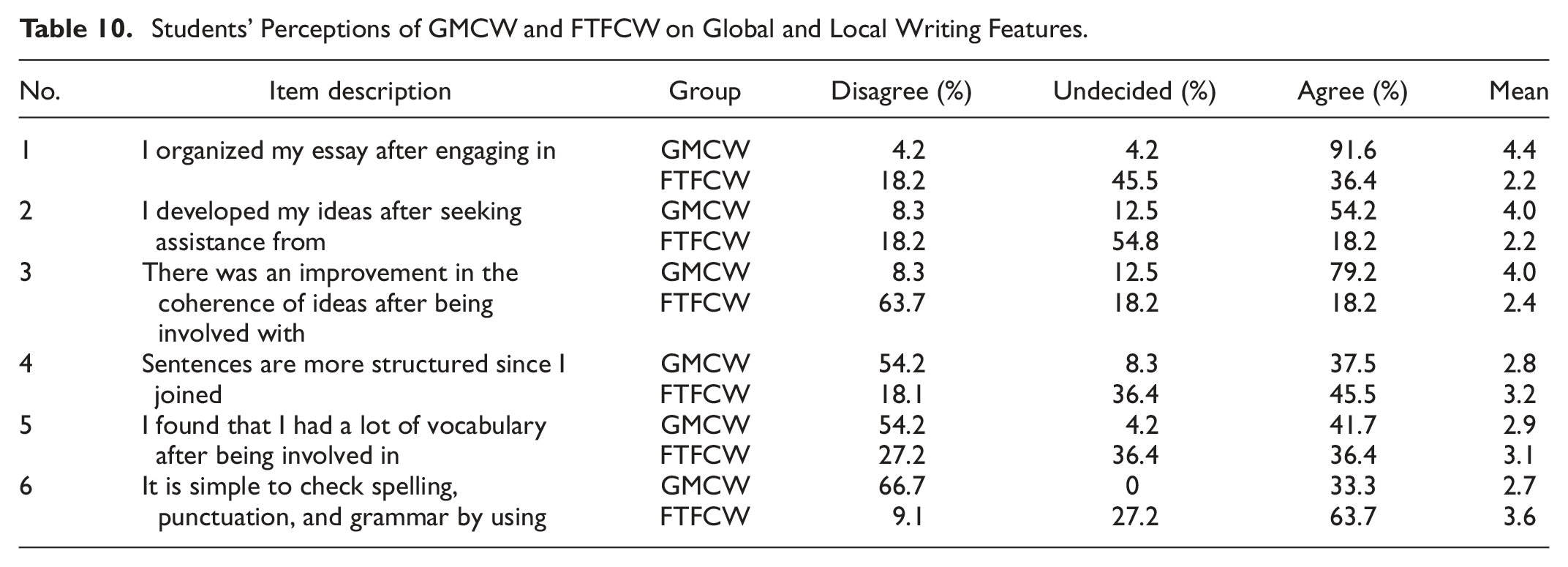
On a scale of one to five, students’ views of the impacts of GMCW and FTFCW on ESL students’ global (organization, development, and coherence) and local (structure, vocabulary, and mechanics) writing features were investigated. Table 10 and Figure 4 show that after participating in GMCM, 91.6% of students in the experimental group believed their essay was organized, with a mean score of 4.4, while only 36.4% of students in the control group agreed that they were able to organize their writing after participating in FTFCW, with a mean score of 2.2.
Students’ Perceptions of GMCW and FTFCW on Global and Local Writing Features.

Mean scores for global and local writing features in the GMCW and FTFCW.
About 54.2% of students in the experimental group agreed with the statement that GMCW helped develop their ideas, with a mean score of 4.0. In contrast, 18.2% of other respondents in the control group said FTFCW may help them develop their ideas, with a mean score of 2.2.
Regarding the coherence feature, 79.2% of students in the first group reported an increase in their ideas’ coherence after participating in GMCW, with a mean score of 4.0, whereas 63.7% of students in the control group said that FTFCW did not enhance their ideas’ coherence, with a mean score of 2.4.
Regarding the structure feature, 54.2% of students in the experimental group thought their sentences were more structured since they joined GMCW, with a mean score of 2.8, whereas 45.5% of students in the control group thought their sentences were more structured after engaging in FTFCW, with a mean score of 3.2.
In terms of vocabulary aspects, 54.2% of students in the experimental group agreed with the statement that they felt they had a lot of vocabulary after participating in GMCW, while 41.7% disagreed, with a mean score of 2.9. On the contrary, 27.2% of students in the control group noticed that they had a lot of vocabulary after participating in FTFCW, whereas 36.4% disagreed, with a mean score of 3.1.
Finally, 66.7% of students in the experimental group did not agree with the statement that it is simple to check spelling, punctuation, and grammar using GMCW, with a mean score of 2.7, whereas 63.7% of students in the control group noticed that FTFCW made it simple to check spelling, punctuation, and grammar, with a mean score of 3.6.
Discussion
The study investigated the effect of Google-mediated collaborative writing on ESL students’ global features (organization, development, and cohesion) and local features (structure, vocabulary, and mechanics) compared to face-to-face collaborative writing. The researchers collected data by administering pre- and post-tests for essay writing, as well as a post-questionnaire as an additional method. The research’s findings can be summarized as follows:
The Impact of GMCW on ESL Students’ Overall Writing Quality Compared to FTFCW
The results of the first research question indicated that the pre- and post-test scores in both the experimental and control groups were significantly different, as shown in Tables 3 and 4. This indicates students’ English academic writing skills have greatly improved after engaging in GMCW and FTFCW activities. The result is in agreement with Ebadi and Rahimi (2017), who noticed that in addition to online peer editing using Google Docs, face-to-face peer editing in the classroom significantly improved academic writing skills among EFL learners.
Moreover, there was a significant difference between the post-test scores of students in the experimental group and those in the control group, as indicated in Table 5. The mean difference between the two conditions was 5.8, which indicates that GMCW students had higher post-test overall scores than FTFCW students. This result is in line with Ebadi and Rahimi (2017) and Hoang and Hoang (2022), who found that students’ academic writing skills improved significantly after engaging in collaborative writing using Google Docs activities at a Vietnamese high school. Similarly, Suwantarathip and Wichadee (2014) found that the ability of students to write using Google Docs outperformed the ability to write in a face-to-face classroom.
The Impact of GMCW on ESL Students’ Global and Local Writing Features Compared to FTFCW
The findings of the second research question, which was about the impact of GMCW on ESL students’ global and local writing features compared to FTFCW, showed that the pre- and post-test scores of students’ global (organization, development, and cohesion) and local (structure, vocabulary, and mechanics) writing features in both the GMCW and the FTFCW groups were significantly different, as indicated in Table 7. In addition, Table 8 showed that there was a significant difference between the post-test scores of students’ global and local writing features in both the GMCW and FTFCW groups. The descriptive statistics indicated that students in the GMCW group improved their global and local writing features more than those in the FTFCW group, as shown in Table 6.
The Preference of Students for GMCW Over FTFCW
The third research question was concerned with students’ preference for GMCW over FTFCW, and the results are shown in Table 9 and Figure 3. Students in the experimental group found GMCW to be more helpful in building confidence. This result is consistent with Bikowski and Vithanage (2016), who found that the collaborative writing process provides opportunities for the group to build confidence as each member edits for the other. Moreover, students collaborated and contributed more when they used Google Docs than in FTFCW. This is similar to Hedin (2012) and Sharp (2009). However, neither GMCW nor FTFCW helped students submit their final draft of the essay.
Moreover, GMCW played a role in facilitating collaboration among students. This result is consistent with Hedin (2012) and Sharp (2009), who believed that Google Docs helps students write collaboratively and has a positive reputation among students. In addition, students in both groups were interested in writing more assignments through GMCW and FTFCW. Bikowski and Vithanage (2016) and Zhou et al. (2012) found that students were interested in using Google Docs for more tasks because it was one of the best collaboration tools.
Peer feedback was found to be positive when students were involved in GMCW, which aligns with Alharbi’s (2019) observation that Google Docs teaches students how to activate peer feedback. In a study related to using wikis, students were able to receive and give feedback when participating in wiki-based approaches (Hsu & Lo, 2018). The study result ensured that feedback may not only come from the writing teacher but also from peers (Bradley & Thouësny, 2017; Ebadi & Rahimi, 2017; Hedin, 2012; Saeed & Ghazali, 2017; Semeraro & Moore, 2016; Slavkov, 2015; Villamil & de Guerrero, 2006).
Students’ Perceptions of GMCW and FTFCW’s Global and Local Writing Features
The results in Table 10 and Figure 4 demonstrate that students perceive GMCW and FTFCW to have a positive impact on global and local writing features, with GMCW particularly enhancing organization, followed by cohesion and development. For the most improved feature in this study, it is clear that the most positive effect of GMCW was on the organization feature, which is similar to Wang’s (2015) findings of using the wiki-based approach. However, the study result is in contrast with Hsu and Lo (2018), who did not find any improvement in the organization feature after using a wiki-based approach.
For the worst-improved feature in this study, mechanics, followed by structure, showed the least improvement in this category. It appears that GMCW does not pay attention to spelling, punctuation mistakes, or grammar. As a result, GMCW benefited students more in terms of their writing quality (organization, development, and cohesion) than their writing accuracy (mechanics and structure). Several researchers, including Ebadi and Rahimi (2017), Semeraro and Moore (2016), Strobl (2014), and Woodard and Babcock (2014), discovered that Google Docs enhanced students’ written content. In similar studies, Ebadi and Rahimi (2017) and Semeraro and Moore (2016) observed improvements in idea organization. Additionally, Kessler (2009) and Kessler et al. (2012) noted that meaning was more significant than form in students’ contributions. However, the current study’s findings contradict those of Hoang and Hoang (2022), who found that grammatical range and correctness only moderately increased, while competence in coherence and cohesion did not improve much.
On the other hand, students’ perceptions of FTFCW’s global and local writing features indicated negatively impacted organization, development, and cohesion. The FTFCW students focused more on the essay form (mechanics and structure) than on the content (organization, development, and cohesion). In line with Storch’s (1999, 2005) studies, Storch compared the accuracy (grammar) and fluency of the written texts that students made with their peers to those that they made on their own and found that collaborative writing helped students write better essays in terms of grammar.
Conclusion
Earlier, it was mentioned that ESL writers, despite the special attention provided by their universities, did not achieve sufficient success and performance in writing qualified and structured essays. To promote their writing features (organization, development, cohesion, structure, vocabulary, and mechanics), integrating web-based tools (e.g., Google Docs) with collaborative writing is an effective method compared to conventional collaborative writing. The current study explored whether GMCW improves Saudi ESL students’ writing features and how their perspectives were different after participating in the Google-mediated collaborative writing technique.
Even though the pre- and post-tests on the global and local writing features were significantly different, which was an indicator of considerable improvement in their writing after involvement in the two conditions, students in the GMCW group improved their global and local writing features more than those in the FTFCW group.
GMCW raised ESL students’ confidence, encouraged teamwork, instructed students on how to engage in peer feedback, and increased their willingness to use Google Docs for further assignments. In addition, most of the students who filled out the questionnaire claimed that GMCW helped them organize their writing more effectively than FTFCW, followed by cohesion and then development. On the contrary, GMCW did not pay attention to form (spelling, punctuation, or structure). Moreover, the majority of the control students thought that FTFCW helped them to focus more on the essay form (mechanics and structure) than on the content (organization, development, and cohesion).
Implications and Recommendations
The findings of the current research indicated that the utilization of Google-mediated collaborative writing was beneficial to ESL learners because it granted them the ability to effectively solve their writing problems. The researchers derived the results of this study from collected filled-out questionnaires and written essays. For instance, the written essays showed that ESL students improved their writing skills by participating in GMCW, compared to students instructed using FTFCW. One implication is to adopt GMCW to assist ESL students in developing and improving their writing skills.
After exploring students’ perceptions of GMCW and FTFCW on global and local writing features, it was found that GMCW focused more on the global features (organization, cohesion, and development) than on the local features. One of the implications of this is that teachers ought to place more emphasis on the structure of sentences, vocabulary, spelling, and punctuation among their students.
Teachers must teach students about group collaboration. Without training, collaborative learning is useless. Without practical collaboration training from teachers, students couldn’t share in groups. Consequently, instructors ought to encourage students to collaborate in groups while clarifying the benefits of collaborative learning. Learners should understand that collaborative learning involves encouraging, taking responsibility, and trusting each other.
Some ESL teachers may be reluctant to provide feedback and corrections on the essays that their students have written due to the number of students in classrooms. There is potential for students to learn how to correct and provide feedback to one another through the use of Google-mediated collaborative writing. Students who receive feedback from their peers exhibit increased levels of self-awareness.
Limitations of the Study
Students were given the questionnaire after the research; nevertheless, the pre-questionnaire should be used to monitor the students’ changes in responses before and after they participated in the study. The research solely employed a quantitative approach, excluding qualitative methods like interviews or observation. Additionally, the study’s focus on the English Language Department at Qassim University in Saudi Arabia may limit the generalizability and applicability of the findings to similar teaching situations. It may affect the generalizability of the findings and the feasibility of applying the study to other similar teaching situations.
An additional study should focus on qualitative case studies that examine GMCW in English in more detail, as the students were delighted with it. Moreover, researchers should employ a quantitative, longitudinal, and experimental research approach. Cohen et al. (2018) defined longitudinal studies as any type of study that collects data with the same population over a short (e.g., several weeks) or long-term (e.g., several years) period to allow them to engage in more collaborative activities. Moreover, providing feedback from teachers normally takes time because of the number of students in classrooms. GMCW could be the best choice for students to give and receive feedback.
Footnotes
Acknowledgements
The researcher would like to thank the Deanship of Graduate Studies and Scientific Research at Qassim University for financial support (QU-APC-2024-9/1).
Declaration of Conflicting Interests
The author declared no potential conflicts of interest with respect to the research, authorship, and/or publication of this article.
Funding
The author received no financial support for the research, authorship, and/or publication of this article.
Ethical Approval
The Ethical Committee of the Deanship of Postgraduate Studies and Scientific Research, Qassim University, Saudi Arabia approved this study on 7 October 2022(Ref. No. 22-76-15).

Data Availability Statement
The data are available on request from the corresponding author; however, they are not publicly available due to privacy or ethical restrictions.