




Abstract
This article focuses on the demand for skills of highly qualified scientific and technical professionals (engineers and researchers) in robotics, on both a global and national level. Information is collected using the text-mining of open-access vacancies for understanding the global trends and in-depth interviews with experts for a more detailed study of national trends. The study explores the combination of hard and soft skills, as well as interdisciplinary skills. Soft skill requirements play an important role in the demanded skill set of the specialist, but the claims for hard skills (including digital) are not becoming less strict. Programming and the knowledge of specialized software packages are the most important skills, but must be combined with practical skills (assembly, welding, soldering). The broad range of application areas for robotic systems creates demand for new multidisciplinary skills (knowledge of artificial intelligence, new materials, and biology). Rapid technological development underlines the growing importance of soft skills, such as communication skills, self-motivation, and a willingness to learn. Lists of the most demanded skills in different countries principally coincide. Results can be applied for developing policies aimed at eliminating the skill gap in prospective technological areas.
Introduction
Robotization and the development of artificial intelligence (AI) are global technological megatrends (Deloitte, 2017, 2020; PwC, 2016), and the field of robotics is rapidly developing and the demand for robots has accelerated considerably. Both industrial and service robotics are growing fast all around the world. The global supply of industrial robots has practically doubled from 159,000 in 2012 to 294,000 in 2016. It has reached 422,000 robot installations in 2018 and is forecasted to grow on average by 12% per year from 2020 to 2022 (International Federation of Robotics [IFR], 2019a; IFR World Robotics, 2017). The annual growth rate of both professional and personal service robot sales during the period from 2020 to 2022 is estimated at 40% to 41% (IFR, 2019b). Robotics is a “technology absorber and supplier” of modern component technologies and is closely related to the development of electronic components (Kumaresan & Miyazaki, 1999; Mayoral et al., 2017). Automation hardware components, such as sensors, processors, and automation software, have become cheaper. The exponential growth in the power of silicon chips, digital sensors, and high-bandwidth communications improves robots, so the cost of robots has declined, which has also increased demand (RBC Global Asset Management, 2014). Keeping that in mind, it would be logical to expect that demand for relevant skills of robotics specialists would also grow.
For robotics to continue to develop and spread worldwide, people capable of creating and maintaining these advanced devices are required. A wide range of applications for robotic devices and systems determine the wide variety of knowledge and skills that robotics professionals must have. Some skills are new and have emerged together with modern technologies, and some have been relevant for a long time already, but are now required in particular combinations (“skill sets”).
Policy-makers all over the world are facing the challenge of improving skill provision systems and upgrading education policies aimed at rapidly increasing the skill levels of individuals of all ages, particularly with regard to both STEM (science, technology, engineering, and mathematics) and non-cognitive soft skills (World Economic Forum, 2018). Markets and industries would not grow, and specific products and services would not be developed without proper human resource management and without putting in place the relevant key institutions and infrastructure. Access to skilled labor provides the capabilities required for productivity growth at both the company and country level (Mertzanis & Said, 2019). Labor supply, education and training, and skill development are among the institutions which allow technological breakthroughs in the field of robotics.
Robotics as a field is determined by a high degree of cooperation between universities, research institutions, and industry. Robotics has a very significant potential for the commercialization of university technology and both formal and informal university–industry knowledge transfer (MacBryde, 1997; Schaeffer et al., 2020). In the United States, there are numerous companies within the robotics industry that are “spin-offs,” or “spin-outs,” of research and development projects conducted at universities (Keisner et al., 2016). Innovative solutions, new knowledge, and new methods can arise, when partners from different domains start collaborating, and university–industry collaboration is considered as an important economic driver (Rajalo & Vadi, 2017).
Many countries and international organizations are implementing major programs aimed at promoting the development of robotics on a national and global scale, for example, the United States founded, in 2011, the National Robotics Initiative (NRI). In 2018, the NRI-2.0 program was built upon the original program to support fundamental research in the United States that would accelerate the development and use of collaborative robots (co-robots) (National Science Foundation, 2018). Among the declared goals of the program are “to lower the barriers for conducting fundamental robotics research” and to “advance the robotics workforce through education pathways” (www.nsf.gov/funding/pgm_summ.jsp?pims_id=503641&org=CISE). It shows that multiple agencies of the federal government are directly interested in increasing the number of employees engaged in the development of robotics. Japan established the Robot Revolution Initiative Council in 2015 as an important driving force to develop the integrated AI and Robotics technologies and to promote the “Robot Revolution.” In 2014, the European Union approved the Partnership for Robotics in Europe (SPARC) program, whose objective is to strengthen Europe’s position as a leader in the field of robotics. As for Russia, in 2017, the state program “Digital Economy of the Russian Federation” was adopted. The key digital technologies specified in the program include robotics and sensorics, as well as technologies like big data, neurotechnology, AI, and wireless technologies, which are closely related to robotics. The main topics of this program are human resource issues, the identification of the most prospective digital competencies, and the training of relevant specialists.
All the programs listed below indicate significant state interest in the formation of human resources (HR) capable of developing modern technologies, among which robotics is one of the main priorities. This interest in robotics at all levels, including governmental and international, generates a corresponding demand for qualified staff. In our article, we focus the most on demand skills of engineers and researchers in robotics, on both a global and national level, comparing skill requirements in a developed (the United States) and a developing robotic market (Russia). The United States was chosen as an example of the worldwide leader in the robotics industry: The United States is among the Top 5 countries that are representing 73% of global robot sales (IFR, 2018). Russia is an example of a country which has set a course for digitization, with robotics considered as one of the main priorities. It should be noted that Russian R&D (research and development) products in the field of robotics do generally match the world level, but the practical application of robotics in industry remains very limited (Efimov, 2014; Russian Association of Robotics, 2016). In the area of automated production systems, Russia mainly remains an importer of finished products (Dezhina & Ponomarev, 2014).
The article focuses on highly qualified scientific and technical professionals, engineers, and researchers in the field of robotics, whose position requires higher education or a doctoral degree. The main hypothesis is that soft skill requirements play an important role in the demanded skill set of the specialist, but the requirements for hard skills are no less crucial and contain many specialized techniques and abilities created by the development of modern digital technologies.
The research questions are as follows:
The article is structured as follows. In section “Literature Review,” the current research agenda in studying engineering skills is addressed, with special focus on the demand for robotics specialists and their skills (including the “skill gap” problem), as well as the current social, economic, and technological trends that are affecting the demand for skills in robotics. Section “Data and Methods” presents the conceptual framework including definitions of skills used for the purpose of this study, methods, and analytical tools: the text-mining of open-access vacancies in the field of robotics for understanding the global trends and a content analysis of interviews with experts for understanding the national specifics. Section “Results” contains two main parts, presenting the results of vacancies’ analysis and the findings from expert interviews. In our study, we pay special attention to digital skills as part of technical knowledge and the abilities of robotics professionals. In section “Conclusion,” the global and country-specific phenomena are outlined.
Literature Review
Identifying and Assessing Engineering Skills
The growing literature about skills is characterized by a lack of a clear definition or taxonomy of skills (Beblavý et al., 2016), and international skill strategies are constantly revised (e.g., Organisation for Economic Co-operation and Development (OECD) Skills Strategy, OECD, 2019a). There are various examples of skills classification and frameworks, among them are such taxonomies as hard versus soft skills, cognitive versus non-cognitive skills, and portable versus unportable skills (Cukier et al., 2015; Kautz et al., 2014; Kureková et al., 2016; Laker & Powell, 2011; OECD, 2012). In this article, we have used the common hard versus soft skills division (Laker & Powell, 2011; OECD, 2016; Toner, 2011) and have divided the examined skills into two main groups: technical knowledge and skills (hard skills) and organizational, managerial, social, and personal skills (or soft skills).
Regardless of the classification or definition used, the skill requirements analysis must be comprehensive and multifaceted. It is not the hard and soft skills separately that are important, but their optimal combinations. The complexity of tasks required, even at the lower end of the skills distribution, increases, and a “package” containing different types of skills is required from the employee (Beblavý et al., 2016). Prospective careers of highly qualified labor also require complex skill sets, with competences acquired not only during university training but also during the lifelong learning process (Shmatko et al., 2020).
The growing demand for workers obtaining interdisciplinary and complex skill sets is a relevant trend in STEM-related fields, including robotics. Along with specialized skills, most STEM professionals nowadays need knowledge in areas that are not typically understood as STEM-related (e.g., humanities, social sciences, management, design) (Hill, 2019; McAuliffe, 2016). Companies increasingly need workers not with STEM but STEAM skills (where A stands for “arts”). The main idea of the STEAM movement is to incorporate, where appropriate, the artistic and design-related skills and thinking processes into STEM. The integration of STEM with arts is a response to the need to prepare young specialists for dealing productively with current global challenges (Clarke, 2019; Taylor, 2016; Wilson & Marnewick, 2018).
Technological and Social Drivers of Change for Robotics Skills Demand
The transition to a digital economy is radically changing the labor market: Along with the proliferation of information technologies into all areas of life, digital skills become crucially important for workers. This has led to the special consideration of digital skills while identifying and studying the demanded skills of the 21st century (OECD, 2019b). Robotics is closely related to the progressing digital technologies (Deutsche Bank Research, 2018; Pham & Pham, 1999) (or even is inseparable from them), including neural networks and AI, computer vision, wireless communication, big data technologies, machine learning, and cloud technologies. Nowadays, robots can not only be an electromechanical machine but also a software-based solution (Aguirre & Rodriguez, 2017). Advances in AI technologies and robotic process automation (RPA) led to the dissemination of software robots which do not have a “body” (unlike hardware robots) and can connect to any device through a network (Alan, 2020; Kim, 2005; van der Aalst et al., 2018). They are applied to automate various rules-based repetitive tasks and business processes (Aguirre & Rodriguez, 2017), for example, provide technical support services to clients, prepare documentation, and carry out various HR-related and other business support service tasks (Lin, 2018; Moffitt et al., 2018; Revel, 2005).
Robotics is not only a matter of science, technology, and innovation policy, but also a social issue (Kaivo-oja et al., 2017). The important feature of robotics, that affects skill requirements from specialists, is that many of these devices and software are interacting directly with people, and a certain level of trust must be ensured. Human–machine interface (HMI) has been a topic of discussion since 1990 (Johannsen, 1995, 1997; Kolski & Le Strugeon, 1998; Koshizuka et al., 1995) and remains extremely important (e.g., Cruz-Benito et al., 2018; Ekman et al., 2018). The actual trend is the creation of robots with such functions as semantic perception, reasoning and actuation, and integration of robotic networks with web services and ambient intelligence technologies (Chibani et al., 2013).
The issue of human–robot interaction arises increasingly more often, such as co-existence of people and robots at work and in everyday life, the consequences of robotization for the labor market, and the regulation of robotics and AI. Roboethics, that investigates social and ethical implications of robotics, is a new prospective field in applied ethics (Veruggio & Operto, 2008). Systems of work are more and more constructed as a socio-technical system consisting of workers, tools, tasks, and work contexts (Sarodnick & Brau, 2006). All these mentioned trends determine the growth of requirements, not only for technical abilities but also for social skills and knowledge of humanities among the robotics employees.
The “Skill Gap” in Robotics
The U.S. Bureau of Labor Statistics pointed out that the global demand for qualified robotics professionals in 2018 grew by more than 13%, and according to the U.S. National Association of Colleges and Employers, robotics is currently one of the most popular engineering areas (Boehm, 2006). The Association for Advancing Automation (2007) quoted the following data in its report (citing Deloitte analytics): up to 80% of industrial U.S. employers are facing problems with filling their vacancies for highly skilled professionals, including robotics, computer vision, motion control, and integration of industrial equipment.
In robotics, and in engineering management in general, the topic of a project team’s shortage of skills is extremely relevant, and a skill gap analysis is an important part of competency-based management (Draganidis & Mentzas, 2006). Project managers find it challenging to assign members to project teams, especially for projects that require expertise rather than for projects that are labor-intensive and need to deal with skill-related project risks (Gongyi & Shin-ichiro, 2015). The support of many already existing systems, ranging from infrastructure to information technology, can become much more difficult due to the loss of critical human skills and the lack of workers with the required skill set (Sandborn & Prabhakar, 2015).
The so-called “skill gap” becomes a critical issue: The lack of workers with required skill sets is practically omnipresent, when the type or level of employee’s skills is different from that required to adequately perform the job (International Labour Organization, 2014). Despite the attention paid to these phenomena and all the proposed solutions, this gap resists all efforts for closure (Oguz & Oguz, 2019). Not only technical skills but also workers’ transferable soft skills are insufficient (soft skill gap) (Kraisuth & Panjakajornsak, 2018; McNamara, 2009). This situation is challenging for engineering and information and communication technology (ICT) also: Gaps between industry expectations and perceptions of graduates’ skill sets are taking place (Chillas et al., 2015; Garousi et al., 2019; Ramadi et al., 2016; Stal & Paliwoda-Pękosz, 2019). Graduating students do not always possess the necessary skills required by employers, and they often lack not only professional knowledge or abilities but also soft skills such as communication, decision-making, problem-solving, leadership, self-motivation, creativity, emotional intelligence, and social ethics skills, as well as the ability to work with people of different backgrounds (Land, 2013; Nair et al., 2009; Radermacher et al., 2014). Young engineers often do not fully realize how important their soft and managerial skills will become in a professional career (Pons, 2015) and show a low level of motivation and satisfaction with soft skill courses (Schipper & van der Stappen, 2018). Traditional curricula sometimes reflect what teachers regard as important, rather than what skills are actually required (Jang, 2016). The existing notable soft skill gap between ICT and engineering students’ preparation and industry requirement is a challenge for the whole education system (Dubey & Tiwari, 2020).
Data and Methods
The subject of the study, conducted between 2016 and 2018, was the robotics organizations’ demand for highly qualified engineering and research personnel and their skill requirements. By skills, we mean the sum of employees’ knowledge, experience, and personal traits which enable them to successfully perform particular job-related responsibilities, on a systematic basis. Skills were divided into two main groups: technical knowledge and skills (hard skills) and organizational, managerial, social, and personal skills (or soft skills). The key criterion for classifying skills into one group or the other was whether they were subject-specific (specialized) or general (universal). In the hard skills group, we included techniques, knowledge, and experience in areas that are relevant to robotics, and in the soft skills group, we looked at workers’ personal and social characteristics unrelated to specific professional areas, which affected the style and productivity of their work. Among hard skills, particular attention was paid to digital skills, which are extremely important for robotics professionals. The study explores not only single and highly specialized skills but also their combinations, including the blend of hard and soft skills, as well as interdisciplinary skills. Both the broad international context and specifically Russian features were taken into account in the course of the skill analysis.
The current demand for skills in robotics was analyzed using open-access job vacancy databases Indeed.com and hh.ru. Online job ads reflect the employer’s views about an ideal candidate, provide actual and objective information, and are a prospective tool for measuring labor demand, investigating skill requirements in particular areas, and identifying skills mismatch (Beblavý et al., 2016; Štefánik, 2012; Tijdens et al., 2018). A search for resources containing representative selection of vacancies suitable for automated collection and processing of textual data was conducted in 2017. In terms of representativeness, aggregator websites turned out to be the best resources: Indeed.com for English-language vacancies and hh.ru for Russian-language vacancies. These websites were selected because they collect data not only from related websites (both general and specialized) but also from other aggregators, so they can be called “super-aggregators.” According to the web analytics provided by the SimilarWeb company, Indeed.com and hh.ru are in the Top 3 most popular job posting sites in the world: They are firmly occupying first and third place, respectively, in Top Sites Ranking, in the Category “Jobs and Employment” (https://www.similarweb.com/top-websites/category/jobs-and-career/jobs-and-employment). It was assumed that vacancies’ vocabulary (especially regarding requirements to candidates and their responsibilities) reflects current demand for skills.
For the collection and processing of textual data (vacancies), Python tools were used. The coding for this specific task was realized using CPython by our colleague mentioned in the “Acknowledgments” section. Using the data acquisition module, all vacancies’ texts for the query “robotics + engineer / researcher” were retrieved from the resources Indeed.com and hh.ru. In total, 960 English-language vacancies (from the United States, Canada, and Great Britain) and 360 Russian vacancies for highly qualified personnel (engineers, researchers) were collected (accessed in August 2017). Based on the obtained corpus of texts, the thesaurus of skills in this area was compiled. The thesaurus included columns with synonymous and categorical relations where possible. The resulting thesaurus contained keywords and phrases in the following categories:
area (e.g., computer science, software engineering, mechanical engineering, industrial automation);
education degree (bachelor, master, PhD, postdoctoral), industrial experience;
hard skills (e.g., programming, testing, welding, programmable logic controller, HMI, robot controller, Robot Operating System);
software (e.g., C++, Python, Excel, AutoCAD, Linux, SolidWorks, Pro/ENGINEER, CATIA, Autodesk Inventor);
soft skills (e.g., communication skills, team player, time management, multitasking).
Next, using the processing module based on the compiled thesaurus, the keywords were extracted from the texts. The frequency of occurrence in certain categories was calculated for keywords, as well as their co-occurrence in particular professions or areas of robotics.
Among the collected English-speaking vacancies, the majority (70%) came from the United States, the acknowledged worldwide leader in the robotics industry. Therefore, the United States was chosen for further comparison as a country with highly developed standards in relation to the skills of robotics specialists.
The increasing application of internet-based recruitment determines the growing reliance of online job postings as a data source about the employers’ requirements (Kureková et al., 2015). However, this data source still has its limitations: Not all positions (especially research or managerial) can be advertised online. The robotics sphere is characterized by a strong cooperation between industry, research centers, and universities (Keisner et al., 2016), so we assume that for some research positions, the employees from R&D organizations will directly recruit students or graduates of partnered universities. This limitation is especially relevant for Russia, where the labor market is characterized by low mobility, and the R&D sphere is characterized by high levels of academic inbreeding (Horta & Yudkevich, 2016). There also exists a limitation that some crucial skill requirements can be considered by employees as so obvious and self-evident that they will be “by default” expected from potential candidates and not directly formulated in the text of job postings.
To overcome the mentioned limitations and complement the conclusions about the skills that robotics professionals are expected to have in Russia, the results of the vacancy analysis were supplemented by qualitative data obtained through in-depth expert interviews with representatives of organizations specializing in robotics (n = 29). Three sectors were represented: industry, research, and higher education. All 29 experts came from different organizations. Interviews were done with industry representatives (production company CEOs), with leading researchers from research institutes, and with representatives of universities (among them being heads of faculties and departments, and leaders of educational and engineering laboratories). All interviewed experts hold high managerial positions and are responsible for corporate strategies.
Experts from the higher education sector are present because they are directly related to training of future robotics professionals and formation of their skills. For highly qualified university researchers, experience in invention-related activities and collaboration with industry partners matter for future academic entrepreneurship and the capacity to contribute to technical advances (D’Este et al., 2012). To fulfill the future demand for skills, the educational system must be oriented not only on current skill demand, but should also take into account global and national trends that will define the prospective skills for the nearest future (5–10 years) and need to be ready for changes and for cooperation with industry.
While conducting interviews, a structured interview guideline was used. The following aspects were emphasized during the interviews:
the demand for professionals of a certain qualification and specialization for the implementation of current research projects;
key criteria when hiring engineers and researchers for positions that demand high qualifications and include R&D activities (hard and soft skills, value of formal education, doctoral degrees, industry experience, etc.);
applied HR strategy: to find a “well-done” professional or to train a young employee within an organization, and methods of additional on-the-job training of specialists;
“nontraditional” combinations of skills from different areas, which may be required from robotics specialists in 5 to 10 years;
measures that need to be taken now to avoid any staff shortage and skill gap in the future.
The duration of one interview was approximately 45 to 60 min.
During a content analysis of the interviews, significant trends were identified; illustrating quotes were selected and provided in the article. For confidentiality reasons, the experts’ names and the names of their organizations were anonymized. For each quotation, the code name of the expert (Expert 1, etc.) is given and the information about his represented sector is provided. For a more complex overview, all quotations were selected from different participants, except in one case (Expert 5 is quoted twice).
Results
Required Skills of Engineers and Researchers in Robotics: Analysis of Vacancies
Technical knowledge and skills (hard skills)
Specific features of robotics, as an employment area, are primarily reflected by specialized professional skills (Table 1). Researchers and engineers in robotics are expected to have an understanding of all stages of the work process: development of new products, design, programming, assembly, and testing. Requirements of professional knowledge and skills specified in Russian and international vacancies were about the same digital skills being the most important ones, and namely programming (of robots and individual components, automation systems, and drivers), mastery of specialized software.
Top 10 Most Required Technical Skills of Engineers and Researchers Specializing in the Field of Robotics in the United States and in Russia (With Frequencies, %).
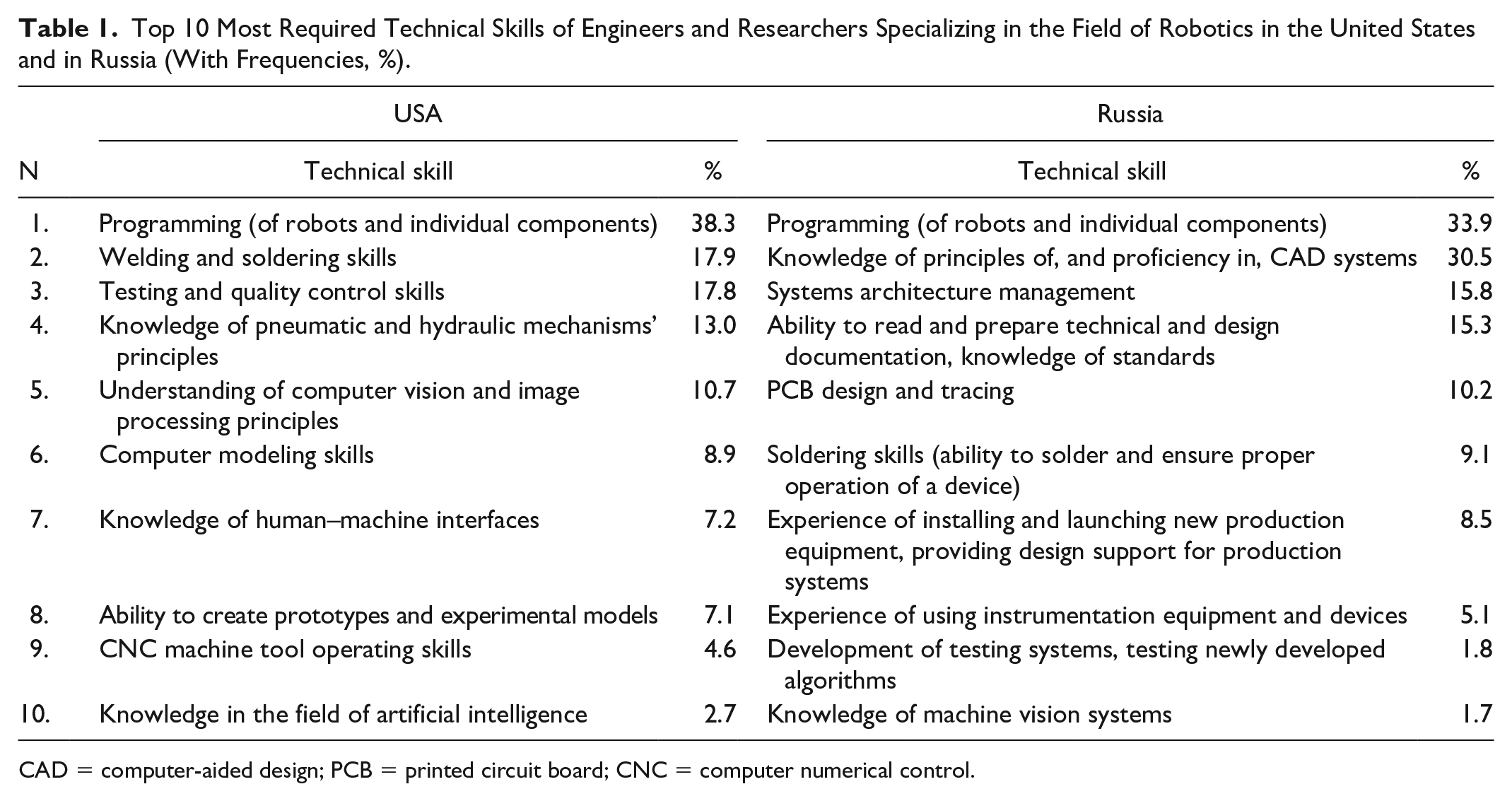
CAD = computer-aided design; PCB = printed circuit board; CNC = computer numerical control.
Programming was very much ahead of all other professional skills in mentioned frequency terms, in Russian and American vacancies alike. New challenges keep emerging in robot programming. On the one hand, robotic systems are getting ever more complex all the time, which of course makes programming them, at the design stage, an increasingly difficult task. On the other hand, managing such systems must be sufficiently simple for end users. For example, in industrial robotics there is demand for automation systems which their operators would find relatively easy to reprogram while using them (Pan et al., 2012). Development of service and home robotics brings to the fore making all-purpose robots capable of interacting with people in everyday life, as opposed to just in specially designed “engineering” environments (Rajan & Saffiotti, 2017). Designing robotic systems involve quite specific objectives for researchers and engineers: controlling and managing systems comprising multiple robots, coordinating their actions in various environments, designing a special class of applications which would “reconcile” various robots’ diverse operating systems, control programs, and sensors (Chibani et al., 2013).
If programming in general is the key professional skill, С/С++ programming language was way ahead of all others in terms of mention, in the United States and in Russia alike (mentioned in 11.4% and 23.7% of job posting, respectively). Corresponding frequencies for Python, the second-popular program programming language, were 7.6% for the United States and 8.5% for Russia. Meanwhile, knowledge of SQL, one of the key requirements in the English-language segment of vacancies, was very rarely mentioned in Russia.
As to proficiency with specialized software tools, AutoCAD, MATLAB, and SolidWorks are most demanded (mentioned in more than 10% of all job postings). Technologies and software tools related to machine vision, image recognition, and processing are also very relevant. There are specifically Russian aspects too: broad application of special Russian computer-aided design (CAD) systems “Kompas,” oriented toward production of technical documentation in line with Russian standards.
American and Russian vacancies alike stress, along with digital skill requirements, the need to be able to handle physical components of robots. Practical skills (assembly, welding, soldering), and the ability to ensure specific devices operate properly, are of great importance.
As to major supra-industry trends affecting development of robotics, AI, big data analysis, machine learning, cloud technologies, swarm intelligence, interaction within robotic systems, computer vision, and new HMI technologies should be mentioned. Accordingly, employers have special requirements for workers’ “digital outlook”: They want their staff to understand principles of modern digital technologies.
Most of the technical skill requirements were the same in the Unites States and in Russia. A specific feature of the Russian vacancies was that while American ones more often mention particular advanced technologies (HMIs, computer vision, etc.), Russian vacancies tend to use more general wording and cite rather basic knowledge requirements (knowledge of mechanics, electronics, circuitry).
Organizational, managerial, social, and personal skills
Having advanced organizational, managerial, social, and personal skills (soft skills) is a common claim in Russia and other countries alike (Table 2).
Top 10 Most Required Soft Skills of Engineers and Researchers Specializing in the Field of Robotics in the United States and in Russia (With Frequencies, %).

Key organizational and management skills include ability to organize work, project work skills, team management experience, information processing skills, time management skills, and multitasking abilities. There is a steadily high demand for professionals capable of making adequate public presentations of their work. Science and Technology project managers are expected to have a number of specialized skills such as experience in analyzing and presenting business projects, organizing negotiations, knowledge of business communications ethics, and willingness to go for business trips. At the same time, such management skills must be supplemented by at least basic technical knowledge and a (preferably engineering) higher education.
The expanding adoption of new computer technologies at work may increase requirements for education, training, and skill levels for the workers (including engineers), but lead to reduction in scope, content, and discretion in their jobs, when the bulk of the tasks has been taken over by computer programs and robotic equipment (Gekara & Nguyen, 2018). For robotic engineers, it is definitely not the case: Demand for technical and digital skills is growing simultaneously with demand for social and personal skills. The most important are communication skills, resistance to stress, ability to concentrate, and flexible thinking. Robotics professionals are expected to be able to deal with unexpectedly emerging unusual issues: The demanded skills include problem-solving skills, responsibility, creativity, and ability to improvise.
In vacancies from the United States, the great importance of the ability for teamwork is noticeable. This requirement not always appears in vacancies posted by Russian employers, who more often emphasize the individual qualities of candidates.
A major specific feature of robotics is its rapid development: Some technologies and techniques become obsolete literally a year later (Kopacek, 2016). A broad professional outlook is important for robotics workers: They must be aware of cutting-edge trends, have knowledge of advanced electronic components, and have understanding of mainline technological processes. Robotics professionals need to be highly motivated and willing to continuously update their knowledge and be able to quickly adapt to changes in the industry.
An important Russia-specific requirement is English language skills (not relevant in the United States, for obvious reasons). By English skills, Russian employers primarily mean ability to read technical texts in English, such as manuals and professional literature, work with English-language software, and communicate in writing. Russian robotics professionals are expected to be willing to actively learn about international experience and interact with colleagues in foreign countries. This all makes English language proficiency an obligatory skill even for specialists who were educated in Russia and intended to work only in Russia. In very few cases, job candidates were also expected to speak German—as Germany is Russia’s traditional industrial partner in the robotics field.
Requirements to Robotics Professionals in Russia: Analysis of Expert Interviews
Technical knowledge and skills (hard skills)
In the course of the expert interviews, heads of organizations were asked the question “In what R&D areas you need the most professionals to carry out your current robotics projects?” (multiple answers were possible). The following areas made up the top 10:
Informatics;
Mechanics;
Automation;
Electronics;
Mathematics;
AI technology;
Optics;
Radio physics;
Radio engineering;
Electrodynamics.
The respondents also mentioned industrial and technical design, neural network technologies, chemistry, and materials.
Russian experts define professional knowledge and skills primarily as decent basic training and fundamental knowledge, which must be supplemented by practical skills such as ability to handle robotic devices and their components.
In reply to a question what kind of staff they would like to hire, representatives of Russian robotics companies frequently noted the importance of basic knowledge and fundamental vocational training. Representatives of companies who conduct robotics-related R&D in Russia named basic disciplines their staff would need to have knowledge of to work productively. In the course of the interview, one of the experts described requirements to basic scientific knowledge in the following way: first of all, workers would definitely need a high level of training in key basic disciplines, such as higher mathematics, and everything to do with programming, informatics, and mathematics. That is the basis for mastering specialized aspects; if people do not have sufficient knowledge in these areas, they would be of no use to us. As to specialized subjects, it is of course control engineering and its newer areas, and adaptive systems theories, intelligent and self-adjusting ones. (Expert 1, a research institute)
Experts recognize the importance of improving digital skills, for example, are willing to send their staff to training courses to master specific software tools. Proficiency in particular software packages is seen rather as a special skill, as opposed to basic knowledge of informatics. The experts’ replies to the questions about digital skills revealed certain specifically Russian features: They mentioned not just CAD systems used worldwide but also the Russian equivalents (CAD packages “Kompas”).
Practical skills are also important: According to the experts, “we need practical guys who can cut and mill, and do what needs to be done with any particular part” (Expert 2, a higher education organization).
The main scientific disciplines robotics professionals need to have knowledge of include mechanics, electronics, mathematics, and programming; design skills are also important: Typically, to make a robot or a mechatronic system you need a designer, an electronics guy, and programmer mathematician. These are the three “whales.” Designer who designs the system, electronics guy who makes the circuitry which controls the drives, mathematician calculates the algorithms and control rules, while programmer implements it all and ensures that data flows smoothly, making the system operational, i.e. manageable. <. . .> Without a good designer you would not get a straight system, without a good programmer your robot will be twisted, and without a decent analyst and mathematician you will never get working algorithms. (Expert 3, a higher education organization)
Organizational, managerial, social, and personal skills
The interviews confirmed growing demand for professionals not only highly trained in relevant basic disciplines (among other things with adequate knowledge of control engineering), but also have such traits as flexibility, willingness to learn, and adapt to meet technological challenges. According to one of the experts, “what we mainly lack these days is ability to learn, and find relevant information <. . .> Ability to make unconventional, creative decisions, suggest unexpected, crazy ideas—we do not have enough of that” (Expert 4, a higher education organization). Important skills include the ability to adapt, work independently, learn, and be highly interested and involved. As one of the managers put it, every six months everything changes <. . .> the programming language more or less stays the same, something or other is improved, but since components, drives, all this changes, becomes miniaturized, various interfaces change, people must keep track of all these changes all the time, stay on top of it. (Expert 5, a production company)
Employers specializing in robotics do not demand their recruits to have managerial skills as such: These should supplement an engineering education or must be combined with understanding relevant technological aspects. At the same time, along with managerial skills workers must be able to think systemically, understand the whole process of making and implementing robotic systems, and have team work skills: We do not have the right kind of robotics project managers. I do not mean salesmen. We have got enough salesmen. What is a project manager? It is a systems manager who can see the whole project all the way through. Who can assign all tasks. Who understands whom they need, exactly. That kind of people I can count on the fingers of one hand, even in our million-strong city. We just do not have such people. Because we never trained them. We have never trained team leaders, managers, technologically savvy project managers, high-tech-aware project managers—we have never trained such people. It must be a technician above everything else. Secondly, it must be an economist. And have a very broad range of interests. You see, there are very few such people around. (Expert 6, a research institute)
Employers note that skilled professionals with a good knowledge of economic aspects of robotics are practically unavailable at this stage. Relevant positions are filled with self-taught workers.
“Unconventional” skill sets and interdisciplinarity
According to the experts, both making and using advanced robots require knowledge of related R&D areas. One of the challenges the robotics industry is facing is “making the systems more intelligent in terms of perceiving the environment, and behaving in it—i.e., it involves a blend of programming, informatics, management, cognitive science, and maybe even psychology” (Expert 5, a production company).
In the course of the interviews, the managers named new professions, “unconventional” skill sets from different areas which may be required in 5 to 10 years’ time, given the current trends in robotics. The following five areas were mentioned most often:
AI, cognitive science;
New materials;
Neural interfaces;
Technical vision;
Medical robotics, microrobotics, a blend of robotics and biotechnology, and neurophysiology.
Agricultural robotics was also mentioned as a prospective interdisciplinary area.
AI was named most frequently: The experts recognize its unquestionable importance and the huge role it will play in “creating robotics of the future.” “AI is really needed at all stages: design, database creation, managing the data, and dealing with a lot of tasks” (Expert 7, a higher education organization). There will be demand for professionals capable of building whole “intelligent production systems” where robots will be exchanging information with each other directly (e.g., “smart home” technologies).
The experts stressed the importance of new materials for development of robotics and a high demand for people with relevant knowledge. “Materials are also one of major national objectives, which would allow us to provide “decent and reliable clothes” for robots” (Expert 8, a research institute).
Biology was mentioned in different contexts: medical robotics, a blend of robotics and biotechnology, and neurophysiology. One of the experts stressed that knowledge of biology was important for robotics professionals: take a “Basic robotics” or “Sensors and information systems” textbook and you will see it begins with something like “let’s take an optical sensor for a robot” or something like that. And it would embark on how the human eye is sensitive to the color green, or red, and how human eyes work and which visible ranges we perceive. That is how it starts, and then goes on to explain how this sensor actually works. Or take an ultrasound sensor—the book will explain how echolocation works, its physical and biological principles, etc. (Expert 9, a higher education organization)
As robotics is developing further and permeating new areas of life, professionals would likely need other interdisciplinary skill sets.
Conclusion
There is a global shortage of professionals with the skills required to work in robotics, and this skill gap is a serious barrier to robotics development. Having an adequate staff training system obviously depends on understanding which skills workers should have, to be in demand in the labor market. However, because of the high rate of technological development, it would not be sensible to train future professionals exclusively on the basis of the skills employers require right now. Of course, employers’ demands must be met, but at the same time education and training organizations should go beyond it and provide a foundation for extending the acquired skill set in the future, adding what may be required in the “Lego mode” (modular education).
Requirements for robotics professionals grow simultaneously in all skills categories, for hard and soft skills. Robotics professionals, both in developed (as the United States) and in developing (as Russia) countries, are expected to have a very wide skill set, with programming skills and proficiency in specialized software being the most important. They must be combined with traditional practical skills, such as handling physical components of robotic systems (assembly, welding, soldering), and the ability to make sure actual devices operate properly. Having a wide range of professional interests is also important for robotics workers, along with an awareness of current trends, knowledge of advanced electronic components, and an understanding of major technological processes. The broad range of application areas for robots and robotic systems creates demand for new multidisciplinary skills: Knowledge of AI, new materials, and biology have particularly good potential. Vacancies from the United States often mention particular advanced information technologies (HMIs, computer vision, etc.): for example, understanding of computer vision principles is in fifth place in the United States and only in 10th in Russia. As for Russia, particular skill requirements include the proficiency in special Russian CAD systems (“Kompas”), oriented toward producing documentation in line with national standards.
Modern robotics can be characterized with a high degree of internationalization: In Russia, the absolute must-have (mentioned in more than 50% of all job postings) is practical English skills—the ability to read professional literature and technical documentation, and communicate with colleagues to be a part of international robotics development.
Employers do not need narrow specialists capable of handling specific robotic devices (though they do mention such skills in vacancies they advertise); they require workers with multidisciplinary knowledge, high motivation, developed analytical abilities, and a willingness to constantly improve and enhance their knowledge and skills. These requirements frequently remain outside the lexicon of advertised job vacancies, but employers do not even consider highly skilled job candidates who do not have such competencies.
The robotics industry has a high level of cooperation between institutes and individual professionals, nationally and internationally (Keisner et al., 2016). In Russia, cooperation with other countries, joint work with international experts, is a common enough format (Russian engineering education remains at a decent level, which allows a productive dialogue with international colleagues), in the course of which participants share knowledge and experience. According to the majority of employers, “importing” foreign specialists and bringing back Russian emigrants and professionals after the end of their employment contract abroad would make only a marginal contribution to solving the skills shortage problem. Due to various reasons, very few foreign experts are hired by Russian organizations, not least because highly skilled robotics professionals are in short supply in developed countries too. The experts believed that upgrading the existing staff’s skills and hiring young engineers and researchers—graduates of doctoral programs in robotics—would be a much better solution.
The representatives of research organizations in the field of robotics are sometimes ready to take specialists even without experience, but with a decent basic training and a high motivation to learn. This situation occurs due to the lack of qualified specialists in the market and the rapid obsolescence of highly specialized knowledge, which makes it more difficult to find a “well-done” specialist than to prepare and train a young specialist inside the organization.
The findings of this study pointed out the necessity of the further development of government policies aimed at eliminating the skills shortage in prospective science and technology areas. The obtained lists of prospective skills can be used as the basis for upgrading the educational programs in robotics. Information about the required skills can provide guidance for already working specialists, in obtaining additional education and advanced training as part of the lifelong learning approach.
Future Directions
A promising direction for further analysis is to take into account other countries (e.g., such recognized world leaders in robotics as Germany, China, or Japan). Another area of improvement and extension is comparing different industries. Our data mostly represent the industrial sector, which remains the leader in terms of robotics application. Key industries in terms of annual installation of industrial robots worldwide are “traditional” ones such as automotive, electrical/electronics, metal, and machinery (IFR, 2019a). Accordingly, these industries determine the main demand for specialists at a country level. However, the application of robotics in many areas (among them transportation, pharma and medicine, and agriculture) is a growing trend, so in the future it will be beneficial to analyze the specifics of skill requirements in different domains.
Footnotes
Acknowledgements
This article is based on results of the research conducted in the framework of the Basic Research Program at the National Research University Higher School of Economics (HSE) and supported by a subsidy provided by the Russian Academic Excellence Project “5–100.” The authors would like to thank our colleague I. Oshchepkov for realizing the tool (Python code) for the collection and processing of textual data.
Declaration of Conflicting Interests
The author(s) declared no potential conflicts of interest with respect to the research, authorship, and/or publication of this article.
Funding
The author(s) received no financial support for the research, authorship, and/or publication of this article.
