




Abstract
Agricultural wastes are highly significant, both economically and environmentally. This study, is intended to raise awareness of economic and social issues that are concentrated upon these attitudes and inclinations of waste producers. In this case study, it was found that vegetable waste was the most common type of waste generated. It was found that producers prefer to give whatever they can sell to the scrap dealer, and they mostly incinerate empty manure packages. While vegetable waste is buried in the soil after harvest, it has been discovered that the rope used in tomato production generates the highest amount of waste. In the 250 holdings selected for research, 13.6% of the nylons to be disposed of are thrown in the trash, 33.2% are sent for recycling, 6.4% are incinerated, 0.8% are buried in the ground, 4% are taken out of the holding area, 0.4% are left inside the holding area, 2% are reused, and 39.6% are scrapped. Producers stated that they want to evaluate agricultural wastes, but this requires extra time and labor. In the field study, 78% of respondents agreed with the statement “disposal of agricultural wastes inside the holding area is a time-consuming process.”
Plain language summary
Economically and environmentally, agricultural wastes are important. This study raises awareness of economic and social issues related to waste producers’ attitudes and inclinations. In this case study, Vegetable waste was the most prevalent. Producers prefer to sell waste to the waste dealer and incinerate empty manure packages. Tomato production rope generates the most waste after harvest. which is buried in the soil. Tomato production rope generates the most waste after harvest, which is buried in the soil. In the 250 holdings studied, 13.6% of nylons are thrown away, 33.2% are recycled, 6.4% are incinerated, 0.8% are buried, 4% are taken out of the holding area, 0.4% are left inside, and 2% are reused, and 39.6% are scrapped. Producers want to evaluate agricultural waste, but it takes time. “Disposal of agricultural waste inside the holding area is a time-consuming process.” 78% of the field study respondents agreed.
Introduction
In many regions of the world, the importance of studies to measure environmental pressures arising from agricultural activities is increasing. In this context, issues like greenhouse gas emissions, agricultural wastes, land degradation (decomposition, degradation), energy, and water consumption are emphasized (Wood et al., 2006). Agricultural waste is generated due to different agricultural operations and is high in both organic and inorganic components (Kumawat et al., 2022). Wastes such as 4.5 t of tomato leaf biomass per week are often disposed of in sanitary landfills, diverted to other waste management sites such as composting facilities, or stored near the manufacturing facility, posing a phytosanitary problem (Dorais & Dubé, 2011). Depending on the type of agricultural produce or product, processing methods, and intended use, each stage of production, processing, and consumption generates a certain amount of solid waste (Adejumo & Adebiyi, 2020). During all stages of the production cycle, natural resources are severely polluted and deteriorated. Today, as people’s welfare and purchasing power have improved, so has the amount of recyclable waste (Tufaner, 2019). Agriculture’s development is becoming increasingly connected with the mechanics of the bioeconomy since biomass, which is a primary agriculture-based resource, is specifically designed for feed and food utilization (Cofas & Bălăceanu, 2023). Without a doubt, agriculture’s role, especially the policies and strategies on the circular economy and bioeconomy, has been transformed by the international regulatory framework on sustainable development (Duque-Acevedo et al., 2020). The importance of processing, reusing, or reusing agricultural wastes for value-added products has also started to be accepted in order to achieve sustainable agriculture and the environment (Koul et al., 2022). On the other hand the concept of socially responsible consumption has risen to prominence (Mezghenni & Zouari, 2016).
A strong economy has sufficient financial means to invest in agricultural research, development, and innovation, which boosts the financial performance of the actors involved, including agricultural producers, providers, consultants, etc. (Coca et al., 2020). Agricultural wastes, like other environmental issues, have an impact not only on the region or country where they occur but also on other cross-border areas. It is an issue of international importance on waste, such as climate change. For example, persistent organic pollutants (POP) used in agricultural activities are Basel Convention, Stockholm Convention, Minimata Convention etc. It is tried to be managed by international conventions (UNEP, 2011, 2019; UNITAR, 2023). Therefore, agricultural wastes should be one of the emerging topics to be searched for because agricultural waste is one of the emerging environmental problem areas. The solid wastes created on farms remain unaddressed, harm residents’ lives, cause environmental contamination, and slow down the country’s economic development (Oncioiu et al., 2021). On the other hand, the environmental and economic value of agricultural waste is a significant topic. Also, agricultural waste materials have high nutritional value (Maji et al., 2020).
There is international attention to Sustainable Development Goal (SDG) target 12.3, which intends to minimize food losses along the production and supply chains, including post-harvest losses, and to reduce global per capita food waste at the retail and consumer levels by half (UNEP, 2021). Also, the European Union Green Deal opens up new concepts related to waste. The EU’s environmental policy places a strong emphasis on managing waste in an eco-friendly way and utilizing the secondary resources it contains (EC, 2023).
Most countries discard agricultural waste because of unawareness or lack of proper channels to transfer and manage it. Agricultural waste management offers many environmental benefits in terms of pollution in the soil, water, and air (Dhamodharan et al., 2022).
In Türkiye it has been observed that in all agricultural practices, including greenhouse management, the necessary importance is not given to the evaluation of plant waste generated as a result of production. These wastes are either collected and incinerated in large areas or dumped into fields and rivers. While plant wastes are collected and burned in an area, they actually harm all living things and organisms in the soil. This causes both the deterioration of the ecosystem and a decrease in the yield of the soil. Vegetable waste thrown into land and rivers can cause pollution. However, if vegetable wastes are evaluated in the form of compost, they cease to be waste and become organic materials with soil healing properties (Güzey & Atılgan, 2015). According to Durmuş and Kizilkaya (2018), composting plant-based agricultural wastes and reintroducing them to agricultural lands and nature is important in terms of both closing the lack of organic matter in the soil and preventing environmental problems.
Waste management has a significant impact on the disposal of waste. In Türkiye, it is the responsibility of the local governments. Municipal waste production increased from 25,277 thousand metric tons in 2010 to 32,324 thousand metric tons in 2020 (TUİK, 2021).
The waste should be categorized on-site as soon as it is created and then routed to the appropriate waste recycling sector, depending on the type (Colmenero Fonseca et al., 2023). Although there is a need for an integrated approach to the management of waste, there are regional or international activities carried out in order for different segments of society to come together and produce a common strategy. Underlying stakeholder relationships and dynamics, as well as the system’s structures, are what motivate a system’s overall behavior (Brinton et al., 2023). In the research conducted by Çolakoğlu (2018), the key actors in the disposal preferences of agricultural wastes are the producers. The content of the wastes formed at the beginning of the production phase and the information about when and in what amount they are evaluated can also be determined by the producers. For this reason, in order to develop appropriate policies on agricultural wastes, field studies should be conducted on the behaviors, thoughts, and tendencies of producers about “agricultural wastes.” The main purpose of this study is to identify environmental wastes from tomato production in the greenhouses and to categorize these wastes to determine their recycling status and the possibilities of economic evaluation. Also, another aim of this study is to draw attention to economic and social factors focused on the behaviors and tendencies of producers in waste.
Materials and Methods
Tomato, which is the subject of greenhouse production in the research, is one of the most economically important vegetables, produced 180 million tons from 5.03 million hectares of land in the world (Kabaş et al., 2022). In the districts within the scope of the study, greenhouse tomato production is carried out intensively. In the determination of the number of producers, the stratified sampling method was used based on the greenhouse areas among the holdings included in the “Greenhouse Registration System.”
Stratified sampling provides more representation of the population by reducing sampling error (Baltaci, 2018). Before calculating the sample size, the enterprises were stratified according to their field widths (Gürsakal, 2013). The population is divided into three strata according to the farm land width. The population is divided into three strata according to the farm land width. Neyman allocation determined the number of sample units drawn from each stratum, and Neyman allocation assigned sample volumes to strata.
In the sampling stage, 250 producers were determined, and a face-to-face survey was conducted with these producers. According to this sampling study, the number of surveys and their distribution by district are given in Table 1 and the total table tomato production per district for 1 year (2019) is shown in Figure 1.
District Frequency Table.

Includes Konyaaltı, Kepez, Döşemealtı, Muratpaşa districts.

Total table tomato production for 1 year (2019) in the study area Antalya (TÜİK, 2019).
The interviewed producers have the lowest 0.75 decares (da) and the highest 119 (da) greenhouse area. 17.6% of the holdings selected for the research were taken from the districts close to city center, 25.6% from Aksu District, 25.6% from Serik District, and 31.2% from Kumluca District (Table 1). Additionally, it should be noted that the study area Antalya province, which is situated in the Mediterranean region of Türkiye, is important in terms of municipal waste amount when compared to other provinces in the same area (Figure 2).
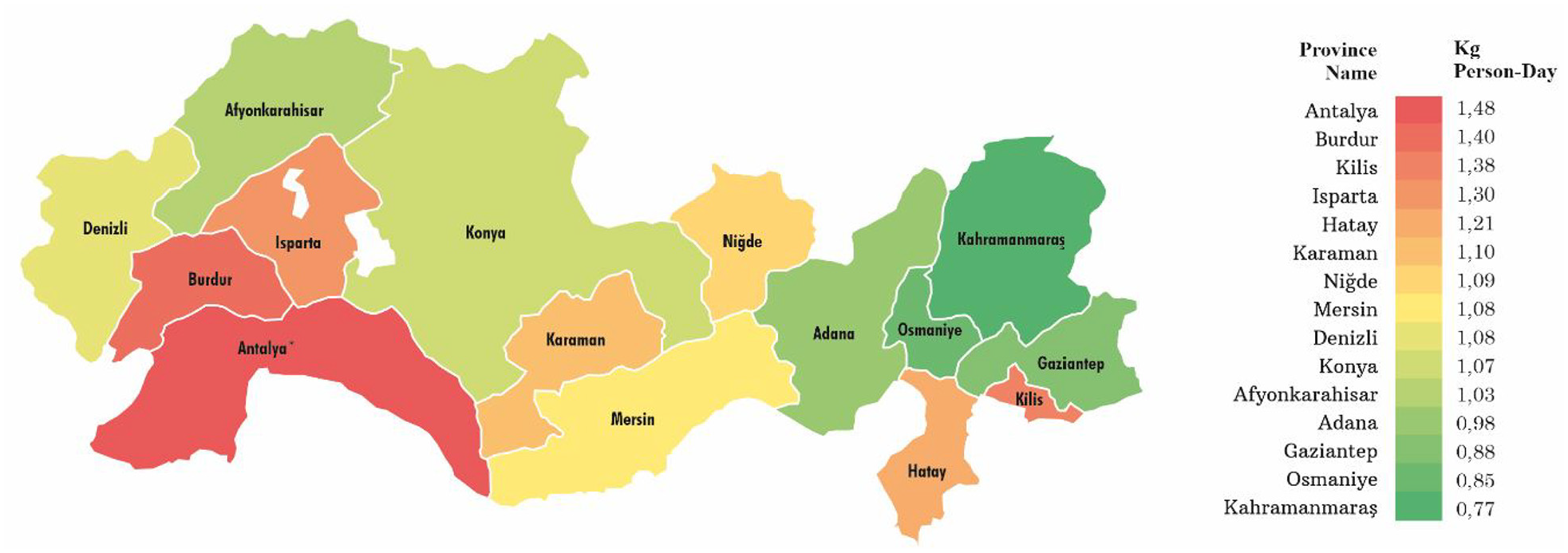
Per capita average municipal waste amount for 1 year (2018) in the Mediterranean region of Türkiye (kg/person-day; TÜIK, 2018).
The data obtained from the producers was converted into a form suitable for evaluation and analyzed with software programs. Before starting the field research and in the application phase of the study, national and international research reports, master’s theses, symposium and congress papers, scientific articles, data sets from statistical institutions, and books were used.
Results and Discussion
According to the form of management and greenhouse gas emissions, the environmental impact, level of environmental efficiency, additional revenue from reduced GHG emissions, and financial value of efficient waste management vary (Türkten & Ceyhan, 2023). As a result of the production in greenhouses, both vegetable waste and other wastes like construction wastes pesticide boxes, plastics, etc. occur intensively. Some agricultural products deteriorate due to failure to consume, store, or transport them in a timely manner, as well as changes in quality or corruption (Akhgar et al., 2019). The composition of waste materials in nature and the rate at which they disappear also vary. The economic life of the wastes, the amount of use, and the destruction period in nature are explained in Figure 3. Seedlings, inserts, viols, and seedlings are transported in boxes used at the beginning of production in the greenhouse. According to the findings of the study, the majority of organic waste is generated during the production and harvesting processes.

The economic life of the wastes generated as a result of the production in the greenhouse, the amount of use, and the extinction period in nature.
The producers have stated that pesticide and fertilizer packages are in second place. Packages typically have an economic life of one production season. The long-term greenhouse cover materials used in greenhouse tomato production are stoves, stove pipes, irrigation pipes, and fertilizer tanks. Long-lasting products are used for more than a year (Figure 3).
Disposal Methods of Waste Generated in the Greenhouse
Produced by the agricultural sector, by-products and waste are extremely diverse and comprise numerous items (Akhgar et al., 2019). The waste disposal methods table shows the distribution of ground cover nylon used in production in the sampled agricultural holdings according to disposal methods. In the 250 holdings selected for research, 13.6% of the nylons to be disposed of are thrown in the trash, 33.2% are sent for recycling, 6.4% are incinerated, 0.8% are buried in the ground, 4% are taken out of the holding area, 0.4% are left inside the holding area, 2% are reused, and 39.6% are scrapped (Table 2).
Producer Choices for Waste Disposal Methods.

Almost all producers (99%) use nylon to scrape the floor. Greenhouse floor nylon is made of polyethylene, and its natural decomposition time is estimated to be at least 250 years (Table 2). Additionally, 44.8% of the winding ropes to be disposed of are thrown in the trash, 6.8% are sent for recycling, 22% are incinerated, 3.6% are buried in the ground, 14.8% are taken out of the holding area, 0.8% are left inside the holding area, 1.6% are reused, and 5.6% are scrapped. 112 of the 250 producers throw away the winding ropes. Since polypropylene products are recyclable plastics, they can be evaluated.
In addition to plastic materials, there are also metal materials, such as stoves in greenhouses. 12.4% of the stoves to be disposed of are thrown in the trash, 24.4% are sent for recycling, 6% are taken out of the holding area, 4.4% are reused, and 49.2% are scrapped. A minority of the holdings (9 only) do not have stoves, and the number of those selling stoves and stove pipes for scrap is 123. In the 250 holdings selected for research, 13.2% of the boxes to be disposed of are thrown in the trash, 38.4% are sent for recycling, 1.6% are incinerated, 0.8% are taken out of the holding area, 11.6% are reused, and 33.6% are scrapped. 24% of the plant wastes to be disposed of are thrown in the trash, 7.2% are sent for recycling, 14% are incinerated, 15.2% are taken out of the holding area, 0.8% are released to the water source, and 0.4% are reused.
12.4% of the stove pipes used in the production phase to be disposed of are thrown in the trash, 29.6% are sent for recycling, 5.2% are taken out of the holding area, 4.4% are reused, and 44.8% are scrapped. In 3.6% of the holdings, stove pipes are not used. 15.6% of the cables to be disposed of are thrown in the trash, 13.6% are sent for recycling, 0.4% are buried in the ground, 8% are taken out of the holding area, 0.4% are left inside the holding area, 4% are reused, and 57.6% are scrapped. 0.4% of holdings do not generate waste. Table 2 shows the distribution of the hose used in the production phase in the sampled agricultural holdings according to the disposal methods. 18% of the hoses to be disposed of are thrown in the trash, 24% are sent for recycling, 0.8% are incinerated, 0.4% are buried in the ground, 6.8% are taken out of the holding area, 0.4% are left inside the holding area, 0.4% are released to a water source, 4% are reused, and 45.2% are scrapped (Table 2).
Main Problem Areas in Agricultural Wastes
Greenhouse tomato producers interviewed in this research were asked whether agricultural wastes have economic value. 52% of the producers stated that they have an economic value. Almost all of the interviewed producers do not compost, but 61.54% of the producers stated that they think that dividing the vegetable waste into small pieces and mixing them into the soil will make the soil more productive. It is expected that the number of composting producers will increase with a possible informative study on composting or an incentive mechanism in this regard.
Plant waste is one of the most common wastes generated during the tomato production process in the greenhouse. The producers’ perspectives on incineration and disposal of the resulting vegetable wastes were obtained. Almost all of the interviewed producers do not compost, but 61.54% of the producers stated that they think that dividing the vegetable wastes into small pieces and mixing them into the soil will make the soil more productive. While 66.24% of the producers are of the opinion that the mixing of animal manure and urine with the soil can disrupt the structure of the soil, the number of producers who do not express an opinion on this issue or say they have no idea is 9%. Producers who think that the use of waste materials as an energy source will not provide economic gains constitute 18% of the study. The percentage of indecisive respondents is 14%, and the percentage of producers who think that they will make economic gains is 68%.
In the survey study, the question of whether there should be a tax exemption for producers who dispose of agricultural and animal wastes in an environmentally friendly manner was asked. 52% of the producers were absolutely against the existence of such an exemption. The reason for this is thought to be that the overwhelming majority of producers do not dispose of the waste properly. The producers were asked whether energy savings could be achieved by the management of agricultural wastes in Türkiye, and 74.83% of the producers stated that they were of the opinion that energy savings would be achieved. Producers who say that the use of agricultural waste does not save energy are around 10%.
Producers stated that they want to evaluate agricultural wastes, but the evaluation requires extra time and labor. On the other hand, in the field study, 72% of them stated that they thought it would require hiring extra labor. With increasing input prices, producers want to work at minimum capacity in terms of labor. Producers who oppose waste evaluation and the use of recycled materials claim that recycling technology in Türkiye is new and thus risky. The idea that recycling activities won’t eliminate diseases and pests is at the outset of the listed risk factors. In other words, producers do not want to recycle and use recycled products because of the suspicion that they could carry diseases and pests. In addition to this view, the rate of producers who do not find the recycling of waste risky is 28%.
Producers stated that they want to evaluate agricultural wastes, but this requires extra time and labor. In the field study, 78% of respondents stated that they agreed with the statement “Disposal of agricultural wastes inside the holding area is a time-consuming process.” Also, producers explained that they have high energy costs for general expenses. 72% of the producers are of the opinion that the use of low-cost energy will be achieved through the management of agricultural wastes.
A big majority of the producers (78.62%) said that they wanted all waste to be managed. They think that this activity should be done by the government or companies. On the other hand, producers are of the opinion that their knowledge of the management and disposal of agricultural wastes is insufficient. 85% of the producers stated that the management of agricultural wastes should be done under the leadership of consulting units and they wanted to be informed about this issue.
Waste and Waste Assessment Knowledge Level
The majority of greenhouse tomato producers in Serik, Kumluca, and Aksu districts of Antalya province do not dispose of their waste in a way that will benefit the environment, human health, and economy. In the questionnaire, it is asked whether there are municipal garbage dumps near their greenhouses. More than half of the producers answered that there are no municipal dumps close to their production sites (Table 3).
Producer Knowledge Level.

Also, the producers (58%) stated that there is no municipal garbage near their greenhouses. In the interviews with the producers, it was concluded that the waste organization of the municipalities was insufficient. They were asked whether they wanted waste organization from the municipalities, and their answers were evaluated. While 80.54% of the producers wanted the municipalities to organize waste, about 20% stated that they did not want such an organization. The reasons why the producers did not want a waste management organization from the municipalities were recorded. The majority of the producers (81.65%) stated that the waste generated as a result of tomato production is not controlled.
It is critical to consider whether agricultural wastes disturb the producers. In the study, 75.52% of the producers claimed that the wastes disturbed them, while only 24.48% claimed that the wastes generated did not disturb them. According to the question that if farmers participated in any training or information activities on the management of agricultural wastes, the producers (78%) stated that they have never participated in any training or information activities on the disposal and evaluation of agricultural wastes. A significant majority of the participating producers stated that the training or information activities on agricultural waste and the environment they participated in were insufficient (Table 3).
Conclusions
There are many materials in nature that are not recognized as a resource from the past to the present or that cannot be utilized despite being known to be an economic good. Wastes obtained as a result of production are also counted among these materials. This study was intended to examine the waste-sorting practices of Turkish tomato farmers. In this field research with literary analysis, there are some suggestions for policymakers and local managers.
Agricultural waste management organizations in villages are needed in order to collect and recycle waste. Making a regional plan for waste management is among the priority issues, and it is recommended to determine the economic value of waste, create an integrated system, reduce waste at its source, and evaluate it while researching the possibilities of recycling. Tomato producers find recycling risky because the technology developed in this regard is new and has not been sufficiently tested. This situation shows the necessity of informing the producers correctly. Some producers refuse to recycle and use recycled products because they believe they may contain diseases and pests. In addition, according to the observations made in the field, it will be more effective to prepare visual materials and give small prizes to the producers.
The technology used is as important as the policies created in waste management. For example, tracking systems can be established for waste generation and use. It will provide transparency for the sector’s stakeholders and managers in order to monitor these systems. If digital visibility can be ensured from where waste is generated to where it is disposed of and where value is created, this will provide long-term economic, environmental, and social benefits.
To summarize, producers are aware of the waste problem, but they are unwilling to take action. Their general tendency and expectation is that the government and municipalities should deal with the waste problem. There is a need for all kinds of studies that can create economic benefits for agricultural wastes and increase their potential to cause various harms to both the environment and the economy when they become “garbage.” While the sense of a circular economy is increasing rapidly, it is thought that agriculture will continue to take its place at the center of this cycle.
Footnotes
Declaration of Conflicting Interests
The author(s) declared no potential conflicts of interest with respect to the research, authorship, and/or publication of this article.
Funding
The author(s) disclosed receipt of the following financial support for the research, authorship, and/or publication of this article: The author would like to thank to Scientific and Technological Research Council of Türkiye (TUBITAK) for supporting the project “Evaluation of producers’ sensitivity on wastes produced in greenhouse tomato production: Case of Antalya Province” with 217K206 code and also to the anonymous reviewers for their valuable comments and suggestions to improve the quality of the research.

Data Availability Statement
Data will be made available on request.