




Abstract
Sharing-based accommodations services are experiencing rapid global growth, driven by their inherent advantages. Nevertheless, alongside the benefits, these services are also accompanied by costs and potential risks. Intriguingly, the factors impeding or restricting consumer adoption of sharing-based accommodations have not been comprehensively investigated thus far. This study utilized innovation resistance theory (IRT) to investigate the influence of various barriers on the intention to use sharing-based lodgings services. Additionally, this study extended IRT by examining the impact of personal characteristics (innovativeness and compatibility) on consumers’ perceived resistance and intention to use sharing-based accommodations services. A quota sample included 493 individuals who were aware of sharing-based accommodations services and had traveled within the past 6 months. Path analysis utilizing structural equation modeling was used to test the research hypotheses. The study’s findings demonstrated that several barriers have a detrimental impact on individuals’ intentions to engage in sharing-based accommodation, except for image barriers and usage barriers. In addition, consumers’ innovativeness and compatibility characteristics negatively impact barriers and positively impact intention to use sharing-based accommodations. Based on these findings, sharing-based accommodations providers, individuals or businesses providing accommodations, and localities providing tourism services can design more effective strategies to attract users.
Plain language summary
Consumer resistance plays a pivotal role in shaping consumer behavior, acting as a potential barrier to the adoption of innovations and influencing the ultimate success or failure of innovative products and services. Despite its significance, there has been limited empirical research examining consumer resistance specifically in the context of purchasing sharing-based accommodations. In this study, we extend the innovation resistance theory by introducing individual difference components, namely innovativeness and compatibility. Our aim is to explore their associations with resistance perception and consumer purchase intention concerning sharing-based accommodations services. To test our hypotheses, we gathered data from a quota sample of 493 consumers, including both those who have and have never used sharing-based accommodations services. The findings reveal that personal innovativeness and compatibility characteristics play a crucial role in diminishing perceived barriers and concurrently increasing the intention to use sharing-based accommodations services. Additionally, our results affirm the applicability of innovation resistance theory in explaining consumer behavior in the context of sharing-based accommodations services.
Keywords
Introduction
The sharing economy refers to businesses that share unused assets and are essentially transactions between service providers and consumers via the internet (Gerwe & Silva, 2020). The sharing economy is a freshly formed business paradigm that has gained significant global traction (Gerwe & Silva, 2020; Li et al., 2023). Forbes (2019) indicated that the worldwide sharing economy achieved a value of 15 billion USD in 2015 and is projected to grow to 335 billion USD by 2025. The sharing economy not only has a great impact on business activities but also affects society worldwide (Cheng, 2016; Lindblom & Lindblom, 2017). The expansion of the sharing economy is propelled by advancements in technology, awareness of minimizing ecological impacts, changing attitudes toward product ownership, as well as consumer demand. users toward social networks (Cheng, 2016). Sharing-based accommodations is a service that falls under the sharing economy category, which includes online platforms such as Airbnb, Couchsurfing, and HomeAway. These platforms enable individuals to lease out rooms, apartments, or houses that are underutilized or not being fully utilized (Belk, 2014). The advent of lodging sharing platforms has significantly influenced the prevailing logic of the industry (Song et al., 2020). Sharing-based accommodations platforms are new business models built on modern internet platforms that give travelers the convenience of home to experience a new location and the relatively low costs are very attractive (Davidson & Infranca, 2015; Guttentag et al., 2018). The growth of sharing-based accommodations in particular and the sharing economy in general has led to both industry and academia being filled with optimism about its bright future development (Lee et al., 2021). However, sharing-based accommodations service is a new type of business, so there are still many concerns from consumers. For example, security concerns when using services such as crime, robbery, and sexual assault (Bever, 2018). Consumers also care about benefit barriers such as accommodation quality. There are also regulatory and legal challenges, as many countries and localities are having to review and adapt how accommodation-based services operate within the context of current legal systems.
The rapid growth and fierce competition between sharing-based accommodations platforms, as well as the competition between sharing-based accommodations and traditional services, have prompted increasing research on usage behavior for consumer sharing-based accommodations platforms. Several different aspects of consumer behavior have been examined, such as reuse intention and loyalty (Tajeddini et al., 2021), usage decision (Lv et al., 2020), discontinuation (Huang et al., 2020) and intention to use (Lee et al., 2021; Yi et al., 2020). Usage intention is one of the important aspects of consumer behavior, it affects their purchasing decisions. Previous studies have examined various aspects related to the popularity of sharing-based accommodations. Considered aspects such as sociodemographic characteristics (Lindblom & Lindblom, 2017), personal values (Piscicelli et al., 2015), and personal motivation or beliefs (Wu et al., 2017). Researchers have also examined service advantages (Guttentag et al., 2018), service provider characteristics (Ert et al., 2016; Wu et al., 2017), and background reputation platforms (Liang et al., 2017). However, in addition to the benefits, sharing-based accommodations services are also associated with costs and risks (price of the service, search costs, risks…). In the context of accommodation sharing services such as Airbnb, So et al. (2018) has confirmed that the only factor that prevents us from using them is insecurity. Meanwhile, Yi et al. (2020) argue that financial risk and privacy risk are two factors that negatively influence consumer intentions to use Airbnb services. Overall, our comprehensive review of the available documentation has revealed a few factors that have a positive impact on the intention of consumers to use sharing-based accommodations from a benefit perspective (lower costs, social benefits, greater flexibility, etc.). However, there are few studies that consider factors that impede consumers’ intentions to use sharing-based accommodations. It is worth noting that the behavior-driven aspects are not very useful in explaining non-acceptance or objection. This suggests that it is necessary to study the factors that counteract the intention of consumers to use sharing-based accommodations.
Consumer resistance plays a crucial role in the buying process as it can impede the acceptance of new ideas and thus impact the outcome of product or service improvements (Heidenreich & Kraemer, 2016; Talwar et al., 2020). Prior studies on the uptake of technology-based services have made substantial use of theories of consumer resistance to examine resistance factors in mobile ticketing services (C.-C. Chen et al., 2022), mobile ticketing services (Chung & Liang, 2020; Kaur et al., 2020) and online travel agency (Talwar et al., 2020). However, there are very few empirical studies that explore consumer resistance to sharing-based accommodations. As a result, we attempted to address this research gap by examining the factors that impeded consumers’ intentions to use sharing-based accommodations. Furthermore, current studies have also looked at how demographic factors (such as gender and age) influence a customer’s intention to use sharing-based accommodations (Quirós et al., 2023; Talwar et al., 2020). However, these studies have overlooked the influence of consumers’ individual personality qualities. Hirschberg (1978) states that personality traits are more stable than demographic characteristics in explaining consumer behavior. Interestingly, current studies in the context of sharing-based accommodation services have not looked at how the role of consumer personality affects their purchasing intentions. To fill this gap, we developed a framework that includes personal characteristics, perceived resistance, and purchase intentions to comprehensively investigate how different emotions influence resistance and intention to use sharing-based accommodations services.
The aim of this study is to improve our understanding of the factors that prevent consumers from using sharing-based accommodation. We adopt the perspective of innovation resistance theory (Ram & Sheth, 1989) to discern various facets of consumers’ perceived resistance toward sharing-based accommodation services. In addition, while consumer characteristics such as innovativeness and compatibility have been extensively explored in diverse fields to elucidate various customer behaviors (e.g., C.-C. Chen et al., 2022; Hansen et al., 2018), their consideration within the context of sharing-based accommodation services has been notably absent. Furthermore, scant research has delved into understanding how these factors influence consumer resistance. Therefore, we extend the innovation resistance theory by introducing innovativeness and compatibility components as individual characteristics, examining their relationships with perceived resistance and purchase intention among consumers engaging with sharing-based accommodation services.
The continuation of the article is organized as follows: Part 2 presents the theoretical review, and Part 3 discusses the research hypotheses as the basis for building a research model. Part 4 discusses research methodologies that include measurement scale selection and data collection procedures. Part 5 presents the research results, and Part 6 discusses the results, the theoretical and practical implications, and the research limitations and future directions.
Theoretical Review
Sharing Economy and Sharing-Based Accommodations
The sharing economy (SE) is a relatively new field with many different concepts that still need to be unified. Botsman (2015) considers SE to be an economic model based on the sharing of unused assets to generate useful financial or non-financial benefits. SE is a decentralized system in which individuals request, enable, or share access to products and services using internet platforms that connect communities. Recently, the concept of SE has changed significantly. Previously, the emphasis was exclusively on transitory access as a substitute for permanent ownership of resources. (e.g., Kathan et al., 2016), there is now a shift toward intermediate system technologies (Y. Chen & Wang, 2019). Gerwe and Silva (2020) argue that SE has four characteristics: (1) These platforms are structured digitally and allow for transactions to occur offline between users; (2) They support direct transactions between persons, where both the supplier and customer are individuals, (3) emphasizes temporary usage rights rather than on property rights, and (4) focuses on the temporary use of capacity time that has not yet been used. From there, Gerwe and Silva (2020) define SE as a socio-economic system that allows peers to be granted temporary use of physical assets and human resources that they have not yet used information through online platforms.
Rapid advancements have been made in the study of the sharing economy, encompassing a wide range of services like sharing a vehicle, transportation, and accommodation sharing… (Xu, 2020). Research on accommodation sharing has discovered many factors that influence consumer intentions and behavior. Factors such as the information described by the owner and the quality of accommodation have a positive impact on the number of bookings on Airbnb (Lv et al., 2020; L. Zhang et al., 2018). In addition, other factors such as the role of trust, perception of authenticity and price have also been shown to affect consumers’ purchase intentions on accommodation sharing platforms (Liang et al., 2017). Regarding barriers to using accommodation-sharing services, Yi et al. (2020) found that the propensity to book a room on Airbnb is negatively impacted by financial risk as well as privacy risks. In addition, a study conducted by So et al. (2018) validated that feelings of insecurity had a detrimental impact on consumers’ inclination to utilize Airbnb. Meanwhile, Yi et al. (2020) argued that concerns about financial risks and privacy risks influenced the usage of Airbnb services. As a result, current research focuses on identifying factors that drive the intention to use shared accommodation services (such as Airbnb). This poses challenges in interpreting consumer behavior, as behavioral motivation aspects are not very useful in explaining non-acceptance or objection (Claudy et al., 2015). This suggests that there is a need to further study the objections related to the intention to use the shared accommodation service. We contribute to the existing body of literature on the intention to utilize accommodation sharing services by examining the factors that restrict the utilization of these services, using the perspective of the innovation resistance theory. Besides, we also consider the role of consumers’ innovativeness and compatibility characteristics.
Innovation Resistance Theory (IRT)
IRT offers a conceptual structure for understanding customer resistance (Ram & Sheth, 1989). Innovation resistance refers to the conduct that arises from logical reasoning and decision-making when considering whether to adopt new products or services, as change can lead to change status and deviations from consumer belief systems (Hew et al., 2019). IRT suggests that there are different types of barriers for any product or service (Kushwah et al., 2019). Ram and Sheth (1989) categorized these barriers into two distinct groups: functional barriers and psychological barriers. Functional barriers encompass obstacles related to utilization, value, and risk that emerge in the adoption of new products or services. Conversely, psychological barriers encompass traditional barriers and image barriers related to novel goods or services (Hew et al., 2019). Consumer resistance can significantly influence the outcome of an innovative product or service, either leading to its success or failure (Ram & Sheth, 1989).
The scope of IRT offers an appropriate structure for examining user opposition to novelty (Ma & Lee, 2019). IRT has been employed to identify obstacles to several user innovations, including online shopping, mobile banking, m-commerce…(A. Gupta & Arora, 2017; Hew et al., 2019; Lian & Yen, 2014). Recently, Kaur et al. (2020) demonstrated that IRT can explain 59% of the variance in intention to accept mobile payments. C.-C. Chen et al. (2022) confirmed that the combination of technological fear, personal innovation characteristics and IRT factors can explain 54.6% of the variance in intention to use mobile ticketing applications. Leong et al. (2021) conducted an analysis of 26 documents related to IRT and found that the factors in IRT have a good ability to explain users’ resistance to innovation.
Thus, IRT theory is suitable to explain users’ intention to use technology-based services. However, as far as we know, there is no study that uses the IRT theory to explain consumer resistance to sharing-based accommodations. In this study, the accommodation sharing service context is considered based on IRT theory. In addition, customer characteristics are also considered to explain the level of resistance as well as the customer’s intention to accept sharing-based accommodations services. Prior research has indicated that personal innovativeness and compatibility are pivotal factors influencing consumers’ acceptance behavior toward innovations (C.-C. Chen et al., 2022; Dhir et al., 2021; He et al., 2018; Ozturk et al., 2017).
Research Model and Hypotheses
Although there is relatively little research that addresses barriers in the context of sharing-based accommodations, there is research that examines various barriers in a number of technology-based contexts both theoretically and experimentally. This study assumes that several factors have a consistent impact on sharing-based accommodations to develop research hypotheses.
Impact of Innovation Resistance Factors on Purchase Intention
Usage Barrier
Consumer resistance often arises due to barriers that hinder usage (Kushwah et al., 2019; Laukkanen, 2016). Usage barriers arise when a product does not fit a consumer’s previous experiences, usage processes, and habits (Ram & Sheth, 1989). This is one of the leading reasons against product/service innovation, it appears when new products change the status quo of customer use (Ram & Sheth, 1989). Prior research has identified a detrimental association between obstacles to usage and the inclination to innovate in many settings, including the utilization of social media (Lin et al., 2012) and mobile commerce (Moorthy et al., 2017). Within the context of online travel agencies, the vast quantity of readily accessible information might potentially perplex users and impact their established habits and usage patterns, thereby heightening hurdles to user engagement (Talwar et al., 2020). Khanra et al. (2021)’s research results confirmed that barriers to use lead to delays in using mobile payment services to pay for travel by consumers. The study by C.-C. Chen et al. (2022) also show that usage barriers affect the intention to use mobile ticketing applications. Nevertheless, a study conducted by Talwar et al. (2020) demonstrates that obstacles to usage have no impact on the inclination to utilize online travel firms. Another study by Mahmud et al. (2023) also found that the barrier to usage did not have a significant effect on algorithm aversion. This is explained by the fact that managers at banks and financial institutions are highly educated and familiar with the use of technology, so they are less concerned about the barriers to its use. Thus, the relationship between user barriers and consumer behavioral intentions may vary depending on the context of the study. In the context of sharing-based accommodations, services are quite new to users, using the service to book accommodation may cause difficulties for some customers, and affect the intention to use the service. Therefore, we develop the following hypothesis:
Value Barrier
Value barriers refer to consumer resistance due to conflicts with perceived values, specifically the balance between the costs of use and learning and the benefits it brings (Morar, 2013). Value barriers occur when customers perceive a new product or service to have lower value compared to an existing one, or when they evaluate the performance and pricing of a new product or service (Kushwah et al., 2019). Value barriers are negatively related to usage intention as revealed in the cases of mobile services, mobile payments and online travel agencies (Kaur et al., 2020; Laukkanen, 2016; Talwar et al., 2020). In the context of tourists using online travel agency services, Talwar et al. (2020) contend that users of this service have the ability to assess many alternatives and select the most advantageous deal. Nevertheless, if customers perceive the advantages offered by this service as inadequate, a conflict of values may emerge, leading to a detrimental effect on their intention to make a purchase. C.-C. Chen et al. (2022) also confirmed the negative relationship between the value barrier and the intention to use mobile ticketing applications. In the context of sharing-based accommodations, when consumers perceive that value is higher than cost, they tend to use the service, and vice versa. So, the hypothesis is as follows:
Risk Barrier
The risk barrier refers to the degree of uncertainty and unpredictability that is linked to a novel product or service, risk barriers depend on customers’ perception or exposure to risk when using new products or innovations (P.-T. Chen & Kuo, 2017). Furthermore, risk is related to consumer perception rather than functional attributes of the product. Perceived risks of technology adoption negatively influence consumer behavior. Within the realm of passengers utilizing online travel agency services, two distinct risk factors have been pinpointed: vulnerability risk and concerns over privacy and security (Talwar et al., 2020). These risks are due to customers using applications to order services and risks that may occur during the process of using service providers. In their study, Yi et al. (2020) investigated the impact of physical risk, financial risk, and privacy risk on users’ intention to utilize Airbnb. The findings indicated that these risks significantly influence users’ decision to use the platform. In this study, privacy risks related to the process of registering services on applications and security risks related to the process of using sharing-based accommodations services are considered.
Privacy risks in this study refer to sharing-based accommodations providers collecting and using users’ personal information with the potential to harm them. Engagement with the Uber service mandates users to divulge extensive personal information, encompassing demographics, social connections, financial particulars, and geographical data. This practice is associated with potential privacy hazards and exerts a detrimental influence on users’ inclination to participate (Dillahunt & Malone, 2015). The term “security risk” in this study pertains to the possible damage that a circumstance can inflict onto users (Kallab & Salloum, 2017). Uber, for instance, has expressed worries regarding responsibility in relation to participating in such services, as its trips may lack insurance coverage against security risks (Ballús-Armet et al., 2014). In a number of different contexts, several studies have identified that risk barriers negatively influence service purchase intention (C.-C. Chen et al., 2022; Yi et al., 2020). However, research by Talwar et al. (2020) shows that risk barriers positively impact the intention to use online travel agencies. Meanwhile, So et al. (2018)’s research results show that perceived risk does not affect both attitude and intention to use Airbnb. Mahmud et al. (2023) also confirms that there is no meaningful relationship between perceived risk and algorithm aversion. Thus, the results of previous studies are still contradictory. However, evidence from IRT theory and some earlier studies suggests that risk barriers have a negative impact on purchase intentions for sharing-based accommodations, leading to the following hypothesis:
Tradition Barrier
Traditional barriers arise due to differences between norms, values and ways of using products/services (Ram & Sheth, 1989). Traditional barriers encompass the hindrances that arise from any innovation, particularly when such innovation brings about alterations in the established habits, culture, and behavior of users (Ram & Sheth, 1989). Research on digitalization has indicated that traditional barriers are inversely related to the likelihood of adopting mobile shopping (M. Gupta et al., 2019), m-commerce (Moorthy et al., 2017) and online banking (Laukkanen, 2016; Park et al., 2017). C.-C. Chen et al. (2022) confirm that traditional barriers are important factors that negatively influence the intention to use mobile ticketing applications. On the contrary, Kaur et al. (2020) has confirmed that there is no meaningful relationship between the tradition barrier and the intention to use mobile payment solutions. The authors have argued that mobile payment solutions have become perfect in India, so there are no traditional barriers in this context. In the context of sharing-based accommodations, consumers may prefer traditional services due to their familiarity with traditional booking services. In addition, when using sharing-based accommodations, users mainly communicate through applications, less directly with service providers, which also leads to traditional barriers affecting consumer participation in sharing-based accommodations. The hypothesis being proposed is as follows:
Image Barrier
Each novel product acquires distinct attributes from its source, encompassing factors such as the nation of production, brand, or product classification (Ram & Sheth, 1989). Image barriers can emerge as a result of any of these unfavorable connections (Laukkanen, 2016). Image barriers address negative impressions of innovations that arise from the perceived complexity of the innovation’s uses and origins (Lian & Yen, 2014). Previous research has reported that image is a barrier that negatively influences user behavior regarding various digitalization initiatives. Research has indicated that barriers related to visual representation, such as images, have a negative impact on individuals’ willingness to use mobile banking (Laukkanen, 2016), mobile services (Joachim et al., 2018), online booking hotels (Tussyadiah & Pesonen, 2018). However, Kaur et al. (2020)’s research in the context of mobile payment solutions shows that there is no meaningful relationship between the image barrier and the intention to buy. In the context of sharing-based accommodations, image barriers can arise from lack of tenant information, unclear origin, failed transactions, and lack of supply from the landlord. This will lead to concerns that it reduces consumers’ intention to use the service. From these findings, the following hypothesis is proposed:
Impact of Consumer Characteristics on Innovation Resistance and Purchase Intention
Personal Innovation Characteristics
Consumer innovativeness refers to the inclination to buy a product or service that has been presented more recently and earlier than most of the market segment (Roehrich, 2004). Highly inventive persons possess a willingness to engage in innovation, have the capacity to handle significant levels of uncertainty that come with innovation, and have a positive attitude toward accepting new idea (Lu et al., 2005). Individuals possessing elevated levels of personal innovation frequently have a propensity for undertaking ventures involving uncertainty or potential hazards (Lewis et al., 2003; Lu et al., 2008), meaning they are more likely to take risks than others. The study of customers’ own innovativeness has been conducted due to its favorable influence on the perception of ease of use and utility (Lu et al., 2005; Shanmugavel & Micheal, 2022). Exerting an impact on attitudes and the inclination to engage in consumption (Hwang et al., 2021; W.-H. Zhang et al., 2022). Personal innovativeness also affects Perceived monetary, perceived risk and electric vehicle purchase intention (He et al., 2018). Individual innovation has been studied in consumer behavior in many different fields, such as mobile ticketing applications (C.-C. Chen et al., 2022), mobile payments (Shankar & Datta, 2018), adoption of electric vehicles (He et al., 2018).
Individual innovativeness is also considered as a trait that influences resistance to change. Yang et al. (2012) reported that individual innovation negatively affects consumers’ perception of the risk of adoption behavior in mobile payment services. C.-C. Chen et al.’s (2022) research in the context of mobile ticketing applications shows that personal innovativeness has a negative effect on usage barriers. Personal innovativeness also negatively affects perceived risk and positively affects the intention to buy electric vehicles (He et al., 2018). The previous discussion suggests that customers with high levels of creativity can influence both the intention to use sharing-based accommodations and resistance to innovation. The hypothesis is constructed in the following manner:
Compatibility Characteristics
Bunker et al. (2007) define compatibility as the degree to which an innovation conforms to the standards and values of the target consumer. According to Al-Jabri and Sohail (2012), compatibility is the degree to which an experience conforms to the preexisting values, beliefs, and requirements of a prospective user. Consumer innovation adoption behavior is significantly influenced by compatibility, as demonstrated by previous studies (Ozturk et al., 2017; Tandon et al., 2021). The study conducted by Giovanis et al. (2012) shown that interoperability has a significant impact on customers’ inclination to utilize online banking. This influence is mediated by the presence of security and privacy threats. The author stated that when a product or service aligns with an individual’s lifestyle, the perceived risk associated with the product diminishes, leading to a sense of security among buyers. Ozturk et al. (2017) found that in the context of NFC-based mobile payments for restaurants, compatibility has a negative impact on risk perception and privacy concerns. The purchasing intention of customers transitioning from offline to online channels is greatly influenced by the perceived Compatibility between the two channels (Amaro & Duarte, 2015). High customer compatibility can have a negative impact on innovation resistance and a positive effect on intention to utilize sharing-based accommodations services, according to the discussion above. And this is how the hypothesis is constructed:
Research Model
The proposed research model includes 20 hypotheses (Figure 1).

Proposed research model.
Research Methods
Measurement and Analysis Method
The measurement model includes nine constructs related to the intention to use sharing-based accommodations services (Figure 1). The concept measurement scale has adapted measurement scales from previous studies in many different contexts and modified them to fit the research context. The questionnaire is designed to include two parts; the first part is designed to filter respondents and collect personal information from customers, including gender, age, occupation, education level, and income. The second part includes observed variables adjusted from previous studies. Specifically, the personal innovativeness scale was developed by Yang et al. (2012), the compatibility scale (four variables) developed by Moore and Benbasat (1991), the usage barrier scale (four variables) developed by Khanra et al. (2021), the value barrier scale developed by Khanra et al. (2021), the privacy risk scale (three variables) developed by Yi et al. (2020), the security risk scale (three variables) developed by Grewal et al. (2003), the tradition barrier scale (three variables) developed by Laukkanen (2016), the image barrier scale (four variables) developed by Laukkanen (2016) and Kaur et al. (2020), and the purchase intention scale developed by So et al. (2018).
Due to differences in the research contexts of previous studies compared to the current study and cultural differences between countries, we conducted qualitative research to refine the scale. In-depth interviews were conducted with six experts (three lecturers in the e-commerce industry and three customers who used sharing-based accommodations), to evaluate the questionnaire and suggest editing. We used this result to make small changes to clarify the questions, and we added two observational variables as suggested by experts, including “I may be bothered by many other companies” and “Traditional services make me more confident.” In addition, we pre-tested 10 consumers who used sharing-based accommodations, who represented consumers in the context of Vietnam’s social characteristics. We conducted the semi-structured interview using a questionnaire that was developed as a sample to evaluate the clarity of the questionnaire. The results of the pre-test and expert input were used to update the questionnaire. Table 2 presents the concept, modified observed variables and scale sources.
The maximum likelihood estimation approach is employed in structural equation modeling (SEM) to make the assumption that the observed data follows a multivariate normal distribution. Confirming a normal distribution indicates that the estimates are both unbiased and efficient. Consequently, initial normal distribution tests were conducted to assess the skewness (<3) and kurtosis (<10) requirements (Kline, 2005). The researchers employed Z-scores with a value of 3.29 to identify and examine potential outliers, as described by Tabachnick and Fidell (2007).
Sample and Data Collection
The overall target of the study was people between the ages of 18 and 44 who were familiar with sharing-based accommodation platforms in Vietnam (specifically Airbnb and Luxstay) and had traveled domestically or internationally in the past 6 months. We selected the age groups from 18 to 44 for the study because they are the most prevalent on online shopping platforms in Vietnam, accounting for about 86% (Nielsen Report, 2023).
A quota sample by age and gender balance has been collected to ensure that the sample is representative. We conducted several surveys from October to November 2023, both face-to-face and online through a linked google form to ensure the necessary sample structure. Approximately 50% of the respondents had experience with sharing-based accommodations, while the remaining 50% had not used such services, aiming to enhance the generalizability of research results. After eliminating inappropriate results due to errors or incomplete filling by customers (Hair et al., 2010), a sample size of 493 valid responses was used in this study. Table 1 results show that, in the research sample, the number of male respondents was lower than female respondents (45.8% compared to 54.2%). Regarding age, respondents had an average age of 27.3 years old, the lowest age participating in the survey was 19 years old and the highest age was 48 years old. The respondents mainly had university degrees (41.6%), followed by intermediate and college degrees (35.1%). In terms of occupation, the majority of respondents are employees (34.5%). In addition, people with income from 10 million VND to 15 million VND account for a high proportion in the sample structure.
Description of Study Sample Characteristics (n = 493).

Source. Author compiled from surveyed data.
Data Analysis and Results
Normal Distribution and Deviation Due to Method
The values of Skewness <10 and Kurtosis <3, thus all observed variables meet the requirements of normal distribution as proposed by Kline (2005). The data have no outliers. Additionally, Harman’s single-factor analysis was employed to evaluate the technique bias problems. Unrotated factor analysis with all measurement constructs extracted 10 factors. The total cumulative variance of the 10 factors is 70.3%. The first element in this analysis only contributes 22.78% of the cumulative variance of the overall model, indicating that method bias is not an important problem (Podsakoff et al., 2003).
Measurement Model
The measurement model’s goodness-of-fit indices are as follows: χ2/df = 1.540, GFI = 0.919, TLI = 0.966, AGFI = 0.901, CFI = 0.970, NFI = 0.920, and RMSEA = 0.033. These indicators all meet the criteria proposed by Tabachnick and Fidell (2007) and Kline (2015), so the measurement model is suitable for the data.
Table 2 demonstrates that all Cronbach’s alpha values above .7, indicating a high level of reliability for the scales of the components in the model (Hair et al., 2011). The assessment of convergent validity included three criteria proposed by Fornell and Larcker (1981). The factor loadings of the variables have a high level of significance (p < .001) and the values of the loading coefficients from 0.633 to 0.862 (Except for 4 observed variables with factor weights less than 0.5 including PERI4, COM4, PR3 and PI5; Table 2). The constructs have a composite reliability (CR) value that exceeds 0.7, the minimum level required by Hair et al. (2010). Furthermore, Table 2 indicates that all average variance extracted (AVE) are greater than 0.5, indicating the convergent validity of the observed variables.
Results of Measurement Model.
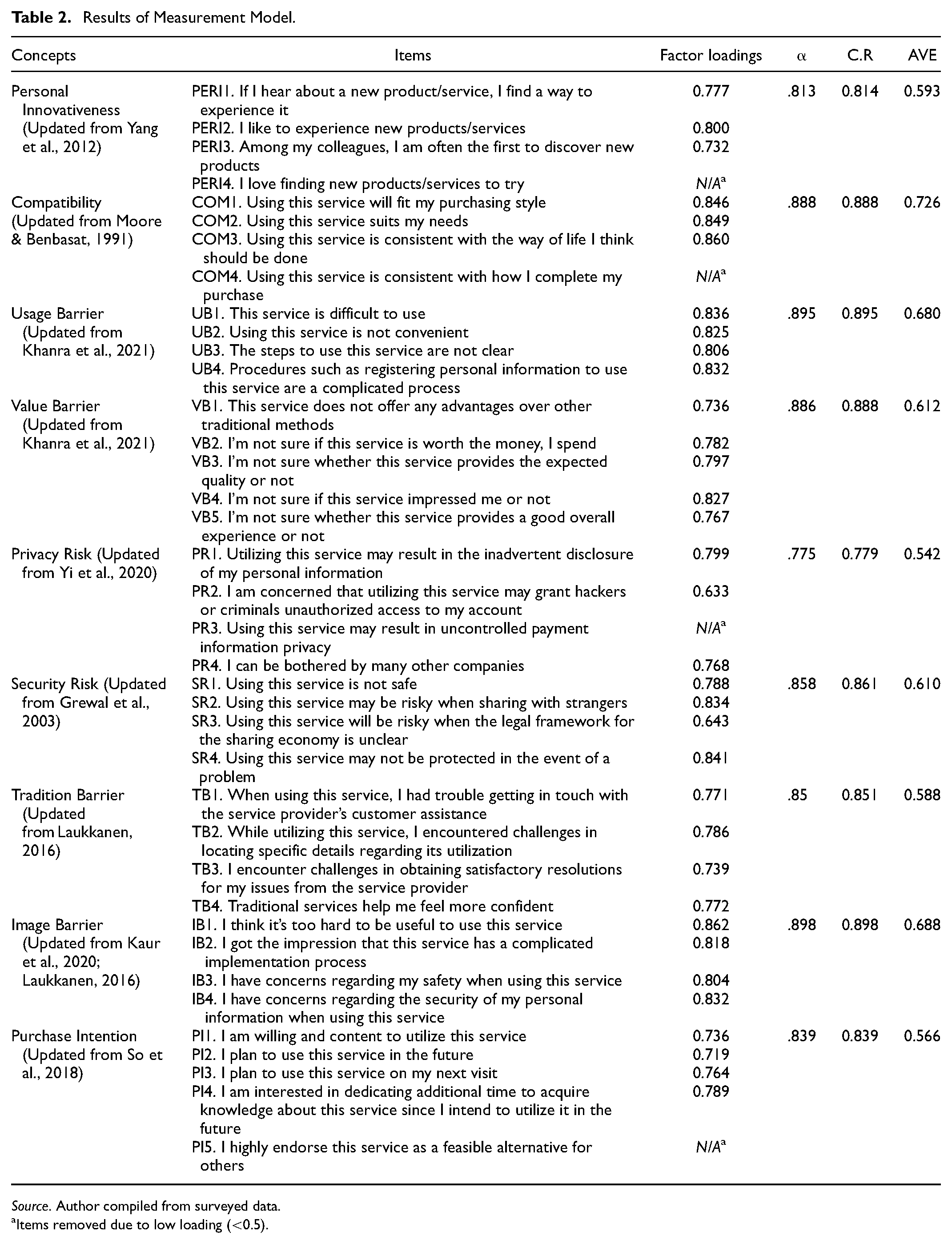
Source. Author compiled from surveyed data.
Items removed due to low loading (<0.5).
In order to assess discriminant validity, we utilized the methodology put forth by Fornell and Larcker’s (1981). They advise that for every construct, the average variance retrieved should have a square root larger than its relationship with any other construct. The results presented in Table 3 are consistent with the previously described criteria, suggesting that the structures in the model possessed significant discriminant capability.
Discriminant Validity.
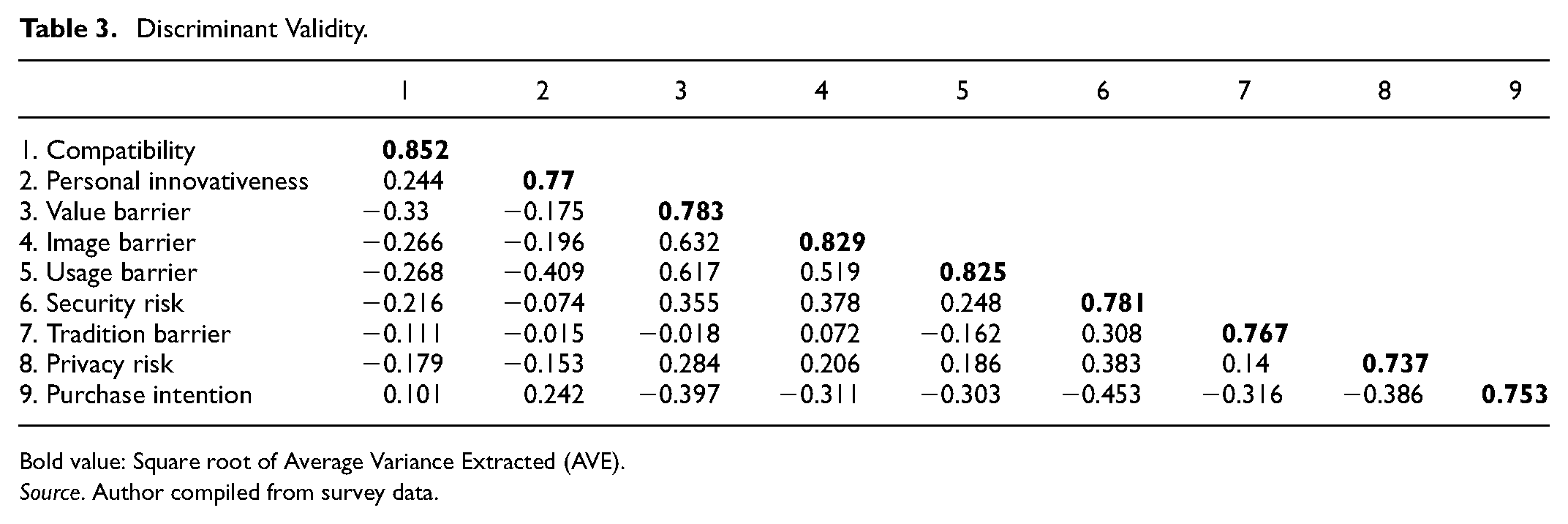
Bold value: Square root of Average Variance Extracted (AVE).
Source. Author compiled from survey data.
Structural Model
The model’s fit indices are calculated as follows: χ2/df = 2.438 (<5); GFI = 0.863 (>0.8), TLI = 0.909 (>0.9), CFI = 0.918 (>0.9), and RMSEA = 0.054 (<0.08). The calculated values suggest that the recognized structural model is suitable for the data (Kline, 2015; Tabachnick & Fidell, 2007).
The results from Table 4 indicate that the majority of the various factors contributing to resistance toward innovation have a substantial and adverse effect on the desire to utilize sharing-based accommodation services (H2→H5), except usage barrier (H1), image barrier (H6). Personal innovativeness negatively affects usage barrier (H7a), value barrier (H7b), privacy risk (H7c), and image barrier (H7f), while positively impacting purchase intention (H7g). However, personal innovativeness does not have an impact on security risk (H7d) and tradition barrier (H7e). In addition, compatibility has a negative impact on usage barrier (H8a), value barrier (H8b), privacy risk (H8c), security risk (H8d), tradition barrier (H8e), image barrier (H8f) and positive impact on purchase intention (H8g).
Hypothesis Test Result.

p < .1. **p < .05. ***p < .01.
The proposed research model explains 15.9% of the variance of privacy risk, 10.1% of the variance of tradition barrier, 16.5% of the variance of security risk, 24.7% of the variance of usage barrier, 23.4% of the variance of image barrier, 27% variance of value barrier and 41% variance of purchase intention. All R2 values show consistent findings, because in consumer behavior research, R2 values exceeding the 10% threshold indicate that endogenous variables are highly likely to be explained by independent variables (Hair et al., 2011). In terms of the level of interpretation of the whole model, the R2 value of the purchase intention is 41%, indicating that the model is interpreted moderately. This study relies on the IRT theory to explore factors that impede the use of sharing-based accommodation services, so the degree of interpretation of the model is considered appropriate.
Discussion and Implications
Discussion
This study explored the influence of individual characteristics and variables of consumer resistance in the context of sharing-based accommodation services. The primary discoveries of this investigation are deliberated about in the subsequent sections.
The study found no evidence to substantiate the notion that usage barriers had a negative impact on the intention to utilize sharing-based accommodation, H1 is not supported. This finding contradicts other previous studies conducted in various research settings (e.g., C.-C. Chen et al., 2022; Moorthy et al., 2017), but is consistent with the results of Talwar et al. (2020) and Mahmud et al. (2023). That implies that customers are not deterred from using sharing-based accommodations due to challenges in using the service. This can be explained by the fact that the purchase of technology-based services is also becoming increasingly popular, and using applications as well as technology-based services is becoming increasingly easy for consumers. In addition, the respondents in this study were already using or interested in the service, so they had certain insights into using the sharing-based accommodation service. This study does not support the H6 hypothesis, which investigates the negative correlation between image barriers and the intention to use sharing-based accommodation services. Once more, our results contradict earlier research on image barriers (C.-C. Chen et al., 2022; Moorthy et al., 2017; Tussyadiah & Pesonen, 2018), but in line with the results of Kaur et al. (2020) in the context of mobile payment solutions. This result indicates that, although consumers may have certain concerns regarding image barriers, such as complexity or perceived safety issues when using the service, these barriers do not affect the intention to use sharing-based accommodation services. This could be attributed to the strong development of several sharing economy services in Vietnam, leading consumers to feel familiar and confident about the sharing-based accommodation service.
Value barriers are thought to have a detrimental impact on people’s intentions to use sharing-based accommodations, H1 is supported. This result has reinforced some previous studies in some cases such as mobile services, mobile payments and online travel agencies (Kaur et al., 2020; Laukkanen, 2016; Talwar et al., 2020). This discovery suggests that the advantages offered by sharing-based accommodation services hold great significance for customers, and the absence of valuable benefits will diminish their inclination to utilize the service. In addition, the negative relationship between privacy risk, security risk and intent to use sharing-based accommodation services is also statistically significant. Thus, H3 and H4 are supported. Once again, the results align with prior studies, indicating that risk barriers have a detrimental impact on the intention to utilize technology-based services (Dillahunt & Malone, 2015; Kaur et al., 2020; Moorthy et al., 2017). However, there are also some studies by Khanra et al. (2021), So et al. (2018) and Talwar et al. (2020) showed that this relationship was not statistically significant or positively correlated. In the context of sharing-based accommodations services, risk barriers are divided into privacy risks when using applications and security risks when using sharing-based accommodations services. Sharing-based accommodations services are still new to many users, so concerns related to risks encountered are inevitable. In addition, in the past there have been risks associated with using this service, so it can affect users’ anxiety.
H5 is proposed that traditional barriers are negatively related to users’ intention to use sharing-based accommodations. Our study’s findings confirm this hypothesis and are in accord with those of earlier studies on mobile banking and internet payments (Laukkanen, 2016; Park et al., 2017). However, this result is contrary to the Kaur et al. (2020) results in the context of mobile payment solutions. Thus, consumers’ current product/service usage habits, culture and consumption behavior hinder the use of innovative products/services, which is a negative sign affecting the development of sharing-based accommodations service in Vietnam. In the context of sharing-based accommodation services, anxiety about the use of technology and changes in accommodation usage and habits will generate consumer resistance to the service.
The research results also support hypotheses H7a, H7b, H7c, H7f and H7g, but do not support hypotheses H7d and H7e. Therefore, personal innovativeness exerts a detrimental impact on customer resistance factors, encompassing usage barriers, value barriers, privacy risks, and image barriers, while simultaneously exerting a positive influence on the intention to utilize sharing-based accommodations. Although there is no research in the context of sharing-based accommodations, these findings are partly consistent with previous studies in other contexts (C.-C. Chen et al., 2022; He et al., 2018). This result may be because people with high levels of personal innovation are able to visualize the benefits that result from innovation, which leads to an underestimation of possible barriers. In addition, they also have a higher tendency to accept innovation. Finally, another consumer characteristic is Compatibility, compatibility negatively affects all factors of consumer resistance to use and positively affects their intention to use sharing-based accommodations, concluding the research results support hypotheses from H8a→H8g. Although no previous research has fully examined the relationships like this study, the results of previous studies also show that compatibility characteristics negatively affect risk barriers (Giovanis et al., 2012; Ozturk et al., 2017) and positively influences purchase intention (Khanra et al., 2021; Ozturk et al., 2017). These findings imply that when sharing-based accommodations fit customers’ lifestyles and are compatible with their needs, customers will feel less resistant to potential barriers, and have a higher demand for services.
Theoretical Contributions
This research enhances the existing body of knowledge by providing insights into the factors influencing the limited adoption of sharing-based accommodations. The following are specific theoretical contributions. Firstly, this work makes a valuable contribution to existing research by enhancing our understanding of consumer resistance in the context of sharing-based accommodations. This is achieved through a comprehensive assessment of the literature on consumer resistance. The significance of this contribution lies in its direct influence on consumer behavior when it comes to purchasing products or services. Therefore, the results of the present investigation are expected to contribute to this evolving yet constrained field of inquiry.
Secondly, this study expands upon the IRT by identifying risk barriers specific to the sharing-based accommodations context. Employing a mixed methods approach, two distinct types of risk barriers were uncovered: privacy risk and security risk. Past research has also adapted IRT to various product types; for instance, Talwar et al. (2020) transformed risk barriers into privacy and security barriers, along with vulnerability barriers, in the realm of online travel agencies. Furthermore, our study sheds light on the applicability of IRT in the context of sharing-based accommodations within an emerging market such as Vietnam. This discovery holds significant implications, given the increasing prominence of emerging markets in the global economy.
Third, this study shows that usage barriers and image barriers do not affect customers’ use of sharing-based accommodations services. This implies that the level of difficulty in using the service and the negative image of sharing-based accommodations do not affect customers’ intention to use sharing-based accommodations. Thus, unlike studies from the previous decade, mobile-based innovation has been increasingly developed and has not encountered resistance from usage as well as from complex and negative images of mobile devices. technology.
Finally, we explore two aspects of consumer personality, including innovativeness and Compatibility, that influence customers’ resistance and intention to use sharing-based accommodations services. The results of this study found that both innovativeness and Compatibility reduce customer resistance and increase intention to use services with them. This implies that consumer resistance to mobile-based service innovation also depends on the personality characteristics of the service user. People with innovativeness and compatibility characteristics will reduce resistance to innovation and increase intention to use these services. This finding provides insight into the impact of customer characteristics on the adoption of sharing-based accommodations.
Contribution to Practice
The study findings offer insights into client attributes and barriers that impede the inclination to utilize sharing-based accommodations, hence assisting sharing-based accommodations service providers in broadening their customer base and enhancing service accessibility. The findings indicate that service providers should prioritize efforts to reduce customers’ perceptions of functional hurdles, such as value barriers, privacy threats, and security risks. Additionally, they should address psychological barriers, including traditional barriers.
Regarding functional barriers, sharing-based accommodations service providers strive to improve services and try to satisfy consumers’ needs, so that they receive high value when using the services provided. grant. Service providers should also have clear regulations on privacy when using services and have strict regulations with service providers to ensure customers are safe and avoid fraud. risks may occur. Reducing these barriers can encourage consumers to use sharing-based accommodations. Understanding functional barriers makes it possible for service providers to convert non-customers into prospects.
Regarding psychological barriers, this study demonstrates that traditional barriers exert a detrimental influence on the intention to engage with sharing-based accommodation services. Consumers find that sharing-based accommodations services will affect their habits, culture, and behavior, so it hinders consumers’ usage intention. To solve this problem, service providers need to improve the service usage process, ensure convenience for consumers, and provide specific instructions. This helps users feel that there is not too much difference in usage habits compared to traditional services in order to promote consumers’ intention to use.
Research findings influence the decision-making process surrounding the marketing of services that involve sharing-based lodging. Privacy issues provide a significant obstacle for users of sharing-based accommodations, as they have apprehensions regarding the safeguarding of their personal information and financial resources. Hence, if providers of sharing-based lodgings just prioritize advertising their services based on convenience, they are unlikely to alleviate visitors’ apprehensions over security and privacy. Possible commodities. Hence, marketing efforts should prioritize addressing risk barriers and traditional obstacles by including them into their advertising campaigns.
Finally, our findings indicate that innovativeness and Compatibility play an important role in reducing barriers and increasing intention to use sharing-based accommodations. Therefore, sharing-based accommodations service providers need to pay attention to service improvements and disseminate these changes to increase consumer attention to the service. Additionally, consumers will use sharing-based accommodations if they think the service fits their lifestyle. Therefore, sharing-based accommodations service providers need to locate target customers, develop services that suit their lifestyle, and implement appropriate advertising and promotion programs to attract customers. attract target customers, aiming to develop services compatible with the characteristics of target customers.
Limitations and Future Research
Firstly, although the model has been better organized than previous studies in linking personality traits, barriers, and intentions to use sharing-based accommodations, However, it is limited to the IRT theory. Therefore, the study may have overlooked other potential barriers. Furthermore, this study examines two characteristics, personal innovation and compatibility, and other characteristics that have not been considered for evaluation. Secondly, the data surveyed to identify the study model as cross-sectional data leads to a few disadvantages, such as the risk of errors and deviations in the data while failing to assess trends in consumer behavior change. Finally, this study employs quota sampling techniques to select samples from the range of sharing-based accommodations. The result is that it’s hard to generalize for specific customer groups as well as generalize to other industries.
Future studies need to explore consumer personality traits other than personal innovation and compatibility. In addition, a few new barriers based on different theories also need to be developed. Future studies could also develop data-based studies to assess changes in consumer behavior over time. Lastly, we need to test and develop this research model in various contexts to evaluate its universality and relevance.
Footnotes
Declaration of Conflicting Interests
The author(s) declared no potential conflicts of interest with respect to the research, authorship, and/or publication of this article.
Funding
The author(s) received no financial support for the research, authorship, and/or publication of this article.
Ethical Statement
No applicable because no animal and human subjects under the Bioethics Act are involved in the study.

Data Availability Statement
Data sharing not applicable to this article as no datasets were generated or analyzed during the current study.