




Abstract
A thorough review of the literature was conducted to identify the practices experts, members of the military, educational institutions, and advocacy groups believe military-friendly institutions of higher education should demonstrate. From the review, we created a list of 73 practices organized into 12 practice areas. A survey of military personnel and higher education administrators who educate large numbers of military college students revealed 48 of the 73 higher education practices as necessary for supporting military learner needs, with 10 practices identified as most critical. The practices may serve as the foundation for developing a flexible, modular, service member–focused educational profile benefitting both higher education institutions and military learners. Higher education institutions can use the tool to ensure they are military friendly, and military learners seeking a higher education degree can use the tool to evaluate higher education institution practices, therefore making a more informed choice about the college they attend.
Colleges and universities often market themselves as military-friendly institutions to presumably increase enrollment. The subjective term (Humphrey, n.d.; Vacchi, 2012) stems from a fractured and ill-defined focus on unique needs according to branch of service, status, and other factors. Multiple web sources, to include U.S. government websites, provide information on various service member–oriented programs and tools with differing perspectives (Callahan & Jarrat, 2014; U.S. Department of Veteran Affairs, 2014). Although veterans potentially benefit from a wide range of educational choices, conflicting definitions of what constitutes military friendliness in terms of observable practices often results in confusion about what service members should expect from colleges and universities (Bauman, 2013; Pope, 2012). The objective of the current study was to begin a dialogue for standardizing the meaning of military friendliness of colleges and universities by identifying the higher education practices most critical to current or past service members seeking a higher education degree. Understanding the most critical practices may serve as a foundation for developing a flexible, modular, military-focused educational profile to inform academic institutions of specific population needs and guide military members in making better informed college decisions.
Background
As a global leader in higher education, America is threatened by a future human capital crisis (Carnevale, Smith, & Strohl, 2010; Soares & Mazzeo, 2008; U.S. Bureau of Labor Statistics, 2013). According to projections, by 2018, our nation will need to fill approximately 46.8 million job openings as a result of vacated and newly created positions (Carnevale et al., 2010; U.S. Bureau of Labor Statistics, 2013). Approximately 29.5 million (63%) of the 46.8 million jobs will need to be filled by individuals with at least a bachelor’s degree (estimated at 15.4 million) or some college education (estimated at 14.1 million). If the United States fails to properly educate its future workforce, the result is prolonged unemployment, less consumer spending (U.S. Bureau of Labor Statistics, 2014), increased mental and physical health problems (Paul & Moser, 2009; Riegle, 1982), among other potential economic issues (Wobbekind, 2012).
In response to the stated problem, we look to an opportunity found in a non-traditional student population—military service members. The U.S. Department of Defense (DoD) has been the largest employer in the nation for decades (Federal Government Jobs, 2015). The DoD has trained and employs millions of service members currently accounting for 7% of the U.S. population (Routon, 2014). Approximately 90% of enlistees enter the military without a bachelor’s degree (McBain, 2008; DoD, 2012). Although some have the intent of a long-term career, many opt to serve for as little as one enlistment term or are involuntarily released. Since 2011, the federal government has expedited plans to shrink the armed forces, with nearly 375,000 members having terminated service contracts on an annual basis (Ryan, Carlstrom, Hughey, & Harris, 2011). If education barriers (commonplace to the military experience) are mitigated, current and past service members seeking a higher education degree could serve as the available sources needed to address future labor needs. These service members could include active duty service members, Reserve and National Guard service members, and prior service members seeking a higher education degree to prepare for the civilian workforce.
Challenges in the Collegiate Setting
Unlike most individuals pursuing a degree, military college students experience uncommon obstacles that can decrease performance, delay graduation, and hinder one’s ability to complete college programs altogether (Ackerman, DiRamio, & Garza Mitchell, 2009). Some challenges include frequent relocations, lack of social and family support, college integration conflicts, and physical and/or psychological disabilities (Ryan et al., 2011). Unresolved setbacks can threaten academic efficacy and inevitably student and university learning outcomes (Callahan & Jarrat, 2014; O’Herrin, 2011; Vacchi, 2012). Although many publications including the Military Times, U.S. News, and Military Advanced Education magazine have rated universities and colleges for military friendliness, a deeper understanding is lacking of what military friendless is.
Schlossberg’s (2011) model is an ideal framework for military student transition. The model highlights the need for student sense of control (situation), motivation development (self), building support networks (support), and developing skills (strategies). Research reveals a critical need for tailored support to enhance service member student transition (Ackerman et al., 2009; Callahan & Jarrat, 2014; Ryan et al., 2011). With clearer understanding of what it means to be military friendly, higher education institutions can craft appropriate support strategies to boost student sense of control when challenges present themselves. The missing link is an open-access standardized rating system that bridges military student needs with relevant support.
A Service Member–Focused Educational Profile (SM-FEP) to Promote Military Readiness
Although institutions of higher education may claim to be military friendly, they may not have the practices in place or thoroughly understand the core needs of service members. Hence, the secretaries of the Military Departments have instituted regulations, policies, and instructions for administering the GI (military veterans) Bill and fair treatment of current or former service members and their family (Office of the Under Secretary of Defense, 2009; DoD, 2011; U.S. Department of Education, 2014a). The guidelines are structured as a check and balance system to ensure service members have access to higher education, whereas institutions of higher education are held to a governed, but subjective, standard of excellence.
The policies instruct educational institutions to communicate clear information regarding financial costs, attendance requirements, and educational outcomes, and provide academic and support services for service members and adult family members (DoD, 2011; U.S. Government Accountability Office 12-367, 2012). Furthermore, the institutions must be accredited and provide programming that leads to degree completion (Public Law 111-377, 2011; DoD, 2011). Institutions must also apply the Servicemembers Opportunity Colleges (SOC) criteria for the transferability of credit (DoD, 2011) and accept transfer of educational assistance to service member dependents as applicable (Office of the Under Secretary of Defense, 2009). The laws are intended to prevent unfair recruiting practices and treatment of service members seeking higher education (Obama, 2012).
Government policy, alone, may not be enough to correct issues related to the GI Bill that could impede degree completion of service members. Other constituents, such as the Council for the Advancement of Standards in Higher Education (CAS; 2015) website, provide a rating scale that gives institutions a means to assess program effectiveness according to the agency’s standards. Although the idea of assessment provides a step in the right direction, the evaluation lacks input from the consumer. Similarly, a rating system exists for evaluating affordability of higher education for financial aid purposes, but lacks real-time flexibility or reporting (U.S. Department of Education, 2014b). A kick-start toolkit created by the American Council on Education (2013) provides guidelines for service member–focused programs, but again, no standardized tool is available for service members to profile institutions for military friendliness under their own terms.
The abovementioned policies provide a framework for colleges and universities to incorporate the appropriate measures for military friendliness. However, as key stakeholders with complex needs, the service member voice should be brought to the forefront to create shared understanding of what is meaningful to reach common goals (Bjørn & Ngwenyama, 2009). An open-access pragmatic tool designed with service member input can provide institutions better understanding of population-specific needs. Equally important, service members can be empowered by use of current data to make informed higher education decisions.
Key Benefits
A well-developed and utilized SM-FEP may help current and past military service members who seek to earn a higher education degree to identify and determine which higher education institutions of interest will meet their unique needs. If the right tool existed, current and past service members would have the capability to objectively compare institutions against observable and measurable best practices that are important to them.
The SM-FEP can serve as an open-access standardized tool for institutions of higher education to deepen understanding of current and past service member needs, develop or refine service member–focused programs and curricula, and track progress over time. Higher education institutions can enhance credibility for their services, retention, and graduation rates of service members. On a larger scale, academic institutions can leverage social responsibility for its service member–focused programming and support government accountability in student outcomes (U.S. Government Accountability Office 12-367, 2012). The U.S. government can demonstrate fiscal responsibility by proactively evaluating how well academic institutions adapt to service members’ unique needs. On a larger scale, the outcome may yield more college-educated individuals, qualified and prepared to enter the demands of a global marketplace.
SM-FEP Tool Characteristics
The primary characteristic of the SM-FEP tool is its flexibility. Because the needs of current and past service members seeking a higher education degree may vary based on multiple factors, the profile can be customized to meet different service members’ unique situations and requirements (i.e., active duty, deployed, retired, disabled, marital status, civilian employment, etc.). Second, the SM-FEP tool is modular. By including best practice areas, educational institutions can strategically use portions of the profile to regularly assess, align, and improve their curricula and support services. Third, the SM-FEP tool will allow for benchmarking. The profile’s standardized metrics provides comparative performance information to stakeholders so they can evaluate a variety of educational institutions on core military-friendly standards. Last, the SM-FEP tool is dynamic. That is, as current and past service members rate institutions, the data can be updated in real time. Ultimately, adopting an industry-wide standardized tool encourages collaboration between the military and academic institutions to update the profile continuously and provide service members with the best educational experience.
To create the pragmatic SM-FEP tool, the researchers designed a two-phase study. Phase 1 was a quantitative descriptive study to describe the higher educational practices that experts, military members, educational institutions, and advocacy groups collectively agree benefit today’s service members. Phase 2 is a quantitative correlational study examining the relationship between higher education institutions’ demonstration of agreed on practices and key service member outcomes (i.e., learning, grades, satisfaction with the educational experience, degree completion).
The current article includes results from Phase 1 of the study, which was guided by one research question: What practices should service member–focused colleges and universities demonstrate to support military learners’ needs? No hypotheses were tested for the first research question, as the intent of Phase 1 was to gather information to factually describe the area of interest, not to make specific conjectures or predictions about the nature or direction of a relationship between variables (Oxburgh, Walsh, & Milne, 2011).
The Study Method
Data-Gathering Procedures
Step 1
Phase 1 began with a systematic and rigorous search of literature, thoroughly reviewing practices experts, members of the military, educational institutions, and advocacy groups believe military-friendly institutions of higher education demonstrate. The first step in the systematic review was to clearly articulate the literature review focus. The focus was to find in the literature practices experts, members of the military, educational institutions, and advocacy groups believe military-friendly colleges and universities should demonstrate to support military learners’ needs. The second step was to identify a thorough list of key words, including variations that would result in a thorough review of the literature. The third step was to search library databases, associations who support military personnel, university websites, and the Internet to find relevant sources. The most relevant information was found on association websites; in books, guides, and briefs; and in journal articles. Table 1 includes an abridged list of hundreds of literature sources reviewed. The review of the literature resulted in 16 single-spaced pages of practices recommended that military-friendly higher education institutions adopt to best meet the needs of current and past military service members seeking a higher education degree.
Sample of Literature Reviewed.

Two researchers separately organized the list of practices by similarity and condensed the list to merge similar practices. After a review of each other’s work, the researchers arrived at a consensus on a final list of approximately 100 practices. The list was then sent to College Educators for Veterans of Higher Education board members. The Board was asked to review the list for comprehensiveness and provide suggestions to improve clarity of wording and identify any missing practices. Some improvements were made to wording, including condensing some of the practices further; no additional practices were recommended. The final list included 73 practices organized into 12 practice areas:
Accreditation practices
Educational program practices
Admission and transfer credit practices
Economic assistance practices
Employment practices
College readiness practices
Academic practices
Transition practices
Health practices
Campus culture practices
Community partnership practices
Family support service practices
Step 2
The first objective was to quantify how important each practice identified in Step 1 was to supporting the needs of military learners, and determine what should be achieved if institutions of higher education are demonstrating practices necessary to meet the needs of military learners. A survey was sent to military personnel and administrators of institutions of higher education who educate large numbers of military personnel. Survey participants were accessed using snowball sampling, a non-probability technique. Individuals known by the researcher, who met the population criteria, were sent an email requesting their participation in the study. The individuals were asked to distribute the email to other individuals who met the population criteria. Participants were also accessed by posting a note on two of the researchers’ Facebook pages.
The University of Phoenix Institutional Review Board (IRB) approved study data were collected using Survey Monkey online survey research software. At the beginning of the survey, respondents were asked to read an informed consent statement. The statement included an explanation of the study purpose; what participation would involve; the voluntary nature of their participation; a statement of confidentiality, including a procedure for withdrawing survey responses study after completion; and contact information for the researcher and the IRB. After reading the informed consent statement, individuals were asked whether they would like to proceed to the survey.
To ensure participants met the study population criteria, individuals responded to two screening questions. The first screening question required potential participants to confirm active, reserve, or former U.S. Military status and/or college administrator status at an institution of higher education that educates large numbers of military personnel. Those who gave affirmative affiliation status to any of the abovementioned roles were asked if they had ever taken college courses. Only those who answered “yes” to the latter question were provided access to the rest of the survey.
Those who did not meet the study criteria were informed they did not meet the study population criteria, thanked for their time, and exited from the survey. Eligible individuals first responded to a series of demographic questions. Then, they reviewed a list of 73 educational practices, organized into 12 practice areas, indicating how important each practice was to supporting the military learners’ needs, using a 5-point Likert-type rating scale (from extremely important to not important at all). Participants were asked to share any practice they believed was missing and why the practice was important. Participants were also asked to rate their agreement that each of the proposed four outcomes for Phase 2 of the study (learning, grades, satisfaction with the educational experience, and degree completion) should be achieved if higher education institutions are demonstrating practices necessary to meet the needs of military learners. Last, participants were asked to share any other outcomes they believed would inform us that an institution of higher education is meeting the needs of military learners. On completing the survey, participants were thanked for their time.
Results
Participants
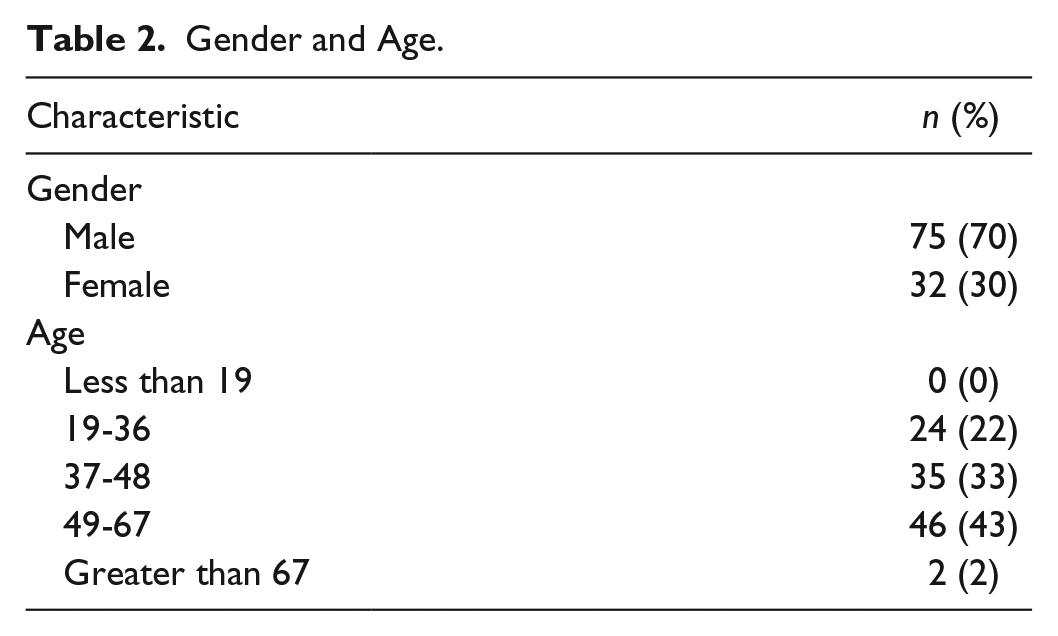
Participants included 107 individuals who currently or in the past had served in the U.S. military. As shown in Table 2, most participants were male (n = 75, 70%) and between the ages of 37 and 67 (n = 81, 76%).
Gender and Age.
As shown in Table 3, most participants were currently serving or in the past had served in the Army or Army Reserve (n = 80, 65%), whereas just more than a quarter of the sample were currently or in the past had served in the Navy or Navy Reserve (n = 28, 26%). All participants had previously or were currently taking college courses.
Military Branch Served In.

Note. Percentages do add to 100% due to experience in more than one branch of service.
As shown in Table 4, equal numbers of participants were and were not serving in the military when they began taking college courses (see Table 4), with 39% (n = 42) completing their college courses while serving in the military. Most participants attended more than one college or university (n = 96, 89%). Most (n = 89, 95%) participants had earned a college degree, with more than half (n = 64, 60%) earning a master’s or doctorate degree. Most participants (n = 44, 71%) had attended a 4-year college.
Education.
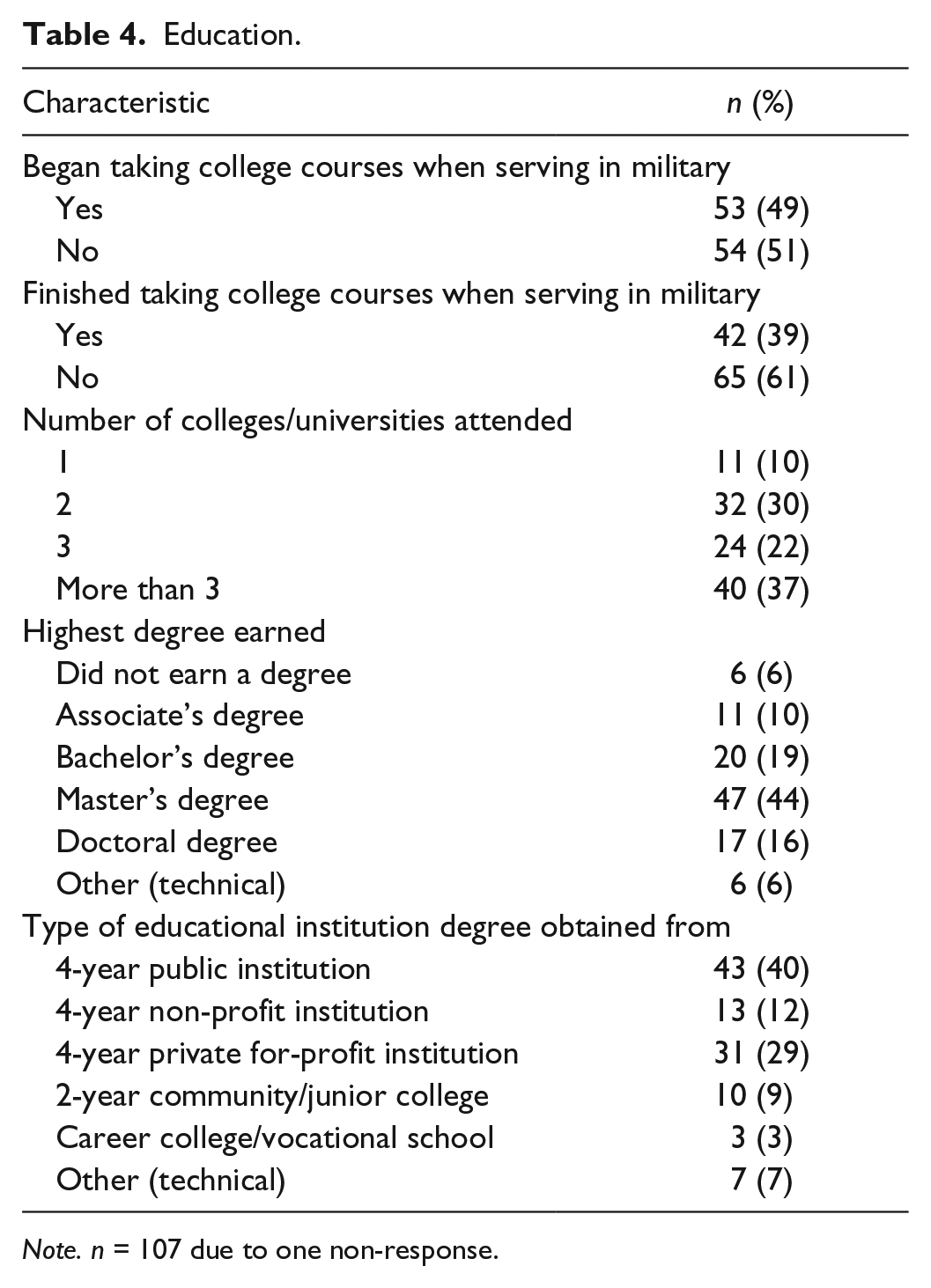
Note. n = 107 due to one non-response.
Service Member–Focused Practices
The 73 educational practices, organized by 12 practice areas, were ranked in terms of how important each practice was to supporting the military learners’ needs (see the appendix). The 12 practice areas were Accreditation, Educational Program, Admission and Transfer Credits, Economic Assistance, Employment, College Readiness, Academic, Transition, Health, Campus Culture, Community Partnership, and Family Support Service Practices. The practices 70% or more participants rated as very important or extremely important met the threshold for necessary practices needed to meet the needs of military learners. Forty-eight of the practices (66%) met the necessary criteria. All of the practices in two practice areas met the 70% threshold (Accreditation Practices and Employment Practices). None of the practices in two of the practice areas met the 70% threshold (Family Support and Community Partnership). The practices 90% or more participants rated as very important or extremely important met the threshold for critical practices. Overall, only 10 practices qualified as most critical practices (see Table 5).
Ten Highest Rated Critical Practices by Importance.

Discussion
The primary contribution of Phase 1 of the current study was to determine what practices military personnel and administrators of institutions of higher education who educate large numbers of military personnel collectively agreed service member–focused colleges and universities should demonstrate to support military learners’ needs. Among the list of 73 practices, study respondents identified 48 as necessary practices (rated by 70% or more study participants as very important or extremely important) and 10 were identified as most critical (rated by 90% or more of the study participants as very important or extremely important). The 10 critical practices came from four practice areas: Accreditation Practices, Educational Program Practices, Admission and Transfer Credit Practices, and Economic Assistance Practices. In light of current literature and based on participant ratings, the most critical practices are examined below.
Area 1: Accreditation Practices
Participant ratings revealed the one most critical practice to support military learner needs is that higher education institutions need to meet acceptable levels of quality, as determined by accreditation agencies. The need for higher education institutions to be approved to enroll students receiving educational benefits ranked fourth among the top critical practices. Miller (2011) stated a college degree not only serves as a bridge between the military and civilian career opportunities, but prepares the non-traditional student for resiliency in a “rapidly shifting landscape of skill requirements” needed for the future (Para. 6). When students complete their degree, they want to know their education comes from a credible source backed by quality education that creates a transition pathway to a civilian career (Wilson, 2014).
From an employer perspective, higher education can address skill problems (Cappelli, 2015) and talent supply shortages (Carnevale et al., 2010; Handelsman, 2015; Soares & Mazzeo, 2008; U.S. Bureau of Labor Statistics, 2013) through access and delivery of quality, accredited programs to more military and veteran students. Through a governmental perspective, improved oversight of veteran educational programs requires clearer communication of outcomes and shared meaning of military benefits (U.S. Government Accountability Office 12-367, 2012). When government and veteran expectations are better understood by higher education, employers may benefit from a college-educated military demographic, and in the end, military veterans have an opportunity at obtaining higher earnings (Wobbekind, 2012).
Area 2: Educational Program Practices
Participant ratings revealed the ninth most critical practice to support military learner needs is that institutions of higher education need to offer a variety of program options to deployed military personnel. Although our study did not reveal data specific to military college students with war-related injuries, the National Center for Post-Traumatic Stress Disorder (PTSD; n.d.) reported approximately 11% to 20% of veterans who served in Operation Iraqi Freedom or Operation Enduring Freedom have PTSD in a given year. Having PTSD, among other psychological or physical injuries, adds stress to a person’s life causing learners to have different needs. Higher education institutions providing a variety of intentional programs for deployed personnel can curb unnecessary stressors that can detract from enrollment and degree completion (McCaslin, Leach, Herbst, & Armstrong, 2013). Scholars suggest critical importance for schools to provide appropriate support and transition services to empower veterans’ ability to adapt and succeed under various conditions (Jones, 2013; Olsen, Badger, & McCuddy, 2014; Pierre, 2012; Wilson, 2014).
Area 3: Admission and Transfer Credit Practices
Participant ratings revealed four of the 10 most critical practices to support military learner needs were related to admission and transfer credit policies. Participant ratings indicated institutions of higher education should have established and enforced service member credit transfer policies, accept credits from military transcripts, participate as a member of SOC, and ensure trained personnel conduct timely and accurate evaluations of military educational records. For decades, the most reputable champion for service member higher education was the SOC consortium. The SOC consortium was created to work with the DoD to liaise between military members and higher education institutions to improve access of educational programs for service members.
In late 2014, Executive Order 13607 dissolved the SOC (2015) government contract. In its place is a DoD Memorandum of Understanding, which codifies expectations of standards of excellence for institutions participating in the military and veterans’ tuition assistance programs (Presidential Documents Federal Register, 2012). The memo serves as a guide that higher education institutions will, in good faith, provide a military-friendly educational experience, which could serve as a success factor for college acclimation and subsequent, civilian work life. Our research suggests that military members want regulated and enforced policies to manage their expectations and not promises. The Veterans of Foreign Wars (2012) made a strong appeal for open information sharing to offset subjectivity of the new standards of excellence.
Area 4: Economic Assistance Practices
Participant ratings revealed three of the 10 most critical practices to support military learner needs were related to economic and assistance practices. Participant ratings indicated it was most critical that institutions of higher education have clearly articulated tuition and fee refund policies; understand the federal policies and programs that guide military higher education; and offer in-state tuition, discounted tuition, scholarships, and flexible payment options for service members and their families. This is not a surprise because military members generally come from a working-class background, often viewing the military as an opportunity for obtaining college money, higher education, and enlistment bonuses (O’Brien, 2008).
The study findings align with the literature. In spite of DoD (2011) eligibility guidelines, Bauman (2013) urged a major barrier to college success is linked to lack of clarity of tuition policies, tuition rates, and payment options. Service members need better communication of policy changes. For example, the new GI Bill provision offers a Yellow Ribbon Program that serves as a “gap” scholarship (New GI Bill.org, 2015, Para. 2). Scholarships are not standardized, and coverage may differ between schools, which may create confusion. Furthermore, colleges that serve veterans must clearly communicate desired outcomes. GI Bill assistance should lead to degree completion (Public Law 111-377, 2011). There is also a need for flexible payment options (Jones, 2013). Bauman (2013) shared service member stories of institutions (brazenly referred as the new enemy) not accepting tuition payments over the phone or requiring in-person re-enrollment when the student was deployed to Afghanistan. The aforementioned obstacles can be distracting and discouraging (DiRamio & Spires, 2009; McCaslin et al., 2013) continuance or completion of an education program.
Among the 10 critical practices, one overarching theme emerged. Service members expect institutional understanding, readiness, and flexibility despite a lack of formal governance. For example, veterans who no longer serve in the military and are not earning a retirement pension or other income may require more financial assistance rather than flexibility. However, a retired veteran with disabilities may require understanding of service-related disabilities over readiness. Meanwhile, a deploying service member may look to flexibility and understanding of late assignments. The Veterans of Foreign Wars (2012) voiced concerns about the monitoring of military voluntary education and support systems. There needs to be some form of accountability on quality. The implementation of a dynamic, open-source higher education rating profile may serve as an instrument for higher institutions to understand military needs in real time, to implement best practices tailored to each school’s locale.
Areas 5 to 12: Less Critical but Relevant
Participant ratings revealed less critical practices (below the 90% threshold) fell into eight categories: Employment, College Readiness, Academic, Transition, Health, Campus Culture, Community Partnerships, and Family Support Services. The practices within these areas meeting a minimum 70% threshold were categorized as necessary. Of these less critical practice areas, Community Partnership and Family Support Service did not have any practices meeting the 70% threshold. Nonetheless, the primary contribution of Phase 1 of the study revealed that all of the 73 educational practices have some degree of relevance to offer support for military learners. A SM-FEP will help academic institutions remain informed on how to make the better decisions to meet the dynamic needs of service member learners.
Study Limitations
Some methodological limitations may affect confidence in the results and our ability to generalize study results. The primary limitations of the current study relate to sample size (N = 107), participant demographics, and the research design. To confidently generalize results from a sample to a population, researchers must ensure the sample is not only large enough to generalize to the study population, but that the sample is representative of the population in characteristics and in number to minimize margin of error and reflect high confidence. The sample size for the current study was relatively small, and the sampling technique was non-probability based—not involving a more stringent sampling methodology such as stratified sampling. Having a larger sample and using a more rigorous probability-based sampling methodology would have resulted in greater precision, ensuring the sample included a probability sample from important strata (e.g., branch of military, gender, age). For example, 71% of the sample for the current study was Army, Army Reserve, or Army National Guard; 70% were male; and 43% were between the ages of 49 and 67. The higher number of responses from Army participants, males, and those between the ages of 49 and 67 may limit the generalizability of the results to other military branches, other age groups, and females. It could be that the most important practices may differ for different groups. Students come to universities with various expectations, experiences, and identities, and have different experiences based on their home economic environment (Brook & Michell, 2012). A 19-year-old female Navy reservist with four dependent children, working part-time, may have different needs than a male retired Army veteran who is receiving a pension and has no family dependents. Therefore, the practices important to that service member may be very different from others.
One potential research design limitation of the current study is the focus on collecting quantitative data. Participants rated the importance of practices using quantitative, Likert-type survey questions. Participants did not respond to open-ended questions, which could have resulted in a deeper understanding of the data and enhanced the study results. Also, when participants provide self-reported data, there may be response bias (providing overly positive or negative responses) or social desirability (falsely choosing answers to please the researcher; Miller & Lovler, 2016) affects. Even if a respondent attempted to answer honestly, he or she may have lacked introspective ability or have been unwilling to put the thoughtfulness required into answer questions. Participants may also have interpreted the rating scale differently, which may have compromised accuracy of measurement.
A final limitation is related to how the sample demographics compare with the demographics of the military. The DoD uses almost 1.5 million active military members in the Army, Air Force, Navy, and Marine Corps, with approximately one million more reserve forces members (Federal Government Jobs, 2015). The breakdown of active military members is approximately 39% for the Army, 24% for the Air Force, 23% for the Navy, and 14% for the Marine Corps (DoD, 2012). The current study resulted in 52% of participants from the Army sector, 7% from the Air Force, 19% from the Navy, and 17% from the Marine Corps. This indicates the demographics of the study sample are not representative of the ratio for the actual demographics of the U.S. military.
Future Research
To gain more confidence in the practices military-friendly colleges and universities should demonstrate, researchers could conduct future research. The practices most important to current or former service members may vary based on a number of factors (e.g., socioeconomic status, family member encouragement while enrolled in college, individual aspirations). Therefore, researchers should carefully identify the factors that may influence practice ratings and collect data on those factors. The results can then be analyzed to determine whether practice importance varies by factor.
Researchers should also design and implement research to address the limitations of the current study. First, researchers might replicate Phase 1 of the study, focusing on including in the study sample a representative and larger group of experts using a more complicated probability sampling technique. With a larger and more representative sample of participants, researchers can conduct additional analyses to determine whether similar results are obtained and to determine whether perspectives of important practices differ by strata (e.g., by branch of military service, by gender, or by age). Second, researchers might consider reviewing and improving the survey directions to address any opportunities that may exist for promoting honest and accurate answering. Third, researchers might consider gathering perspectives using multiple forms of instrumentation (e.g., closed-ended Likert-type items followed by open-ended questions and/or interviews) and triangulating results to increase the credibility and validity of the research findings.
Researchers should also continue with Phase 2 of the research to examine the relationship between higher education institutions’ demonstration of the 48 practices identified in Phase 1 and key service member outcomes (i.e., learning, grades, satisfaction with the educational experience, degree completion). One correlational research question may guide Phase 2: What is the relationship between the frequency of higher education institutions’ demonstration of agreed on practices and key outcomes? Results of a Phase 2 will provide greater clarity surrounding the educational practices that best serve military college students and greater insight for military members to make informed college decisions.
Conclusion
In our ever-changing society, it is important that institutions of higher education demonstrate practices that attract and prepare individuals seeking a higher education degree to meet current and future demands of global employers. Military veterans are an attractive pool of talent, but often experience obstacles that inhibit degree completion or effective preparation for civilian employment. Some challenges include frequent relocations, lack of social and family support, college integration conflicts, lack of clarity of tuition policies and payment options (Bauman, 2013), and physical and/or psychological disabilities (Ryan et al., 2011). Such obstacles can lead to decreased performance in school, delay graduation, and hinder ability to complete college programs altogether (Ackerman et al., 2009). Although not all challenges can be eliminated, colleges and universities can implement meaningful practices (Ackerman et al., 2009; Callahan & Jarrat, 2014; Ryan et al., 2011) that current and former service members believe are most critical to earning a college degree.
A well-developed and accessible educational profile that includes practices that define the military friendliness of colleges and universities would be valuable for multiple stakeholders. Multiple stakeholders could objectively compare institutions against observable and measurable practices, co-defined by service members and institutions. For example, service members could use the profile to rate the military friendliness of educational institutions so they can make more informed educational choices. Institutions of higher education could use the profile to deepen understanding of service member needs to develop or refine programs and curriculum, and track progress over time. As a result, higher education institutions may experience better student outcomes, veterans may have increased opportunities of earning higher income, employers may have access to a larger college-educated workforce, and the government may have better control over its education spending. To ensure the reliability of a first-generation SM-FEP, additional research should be conducted to determine whether the same practices are identified using a larger and more representative sample.
Footnotes
Appendix

| Practices by practice area | Average % very important/extremely important |
|---|---|
| 1. Accreditation Practices | |
| Education offered meets acceptable levels of quality determined by accreditation agencies | 96.08 |
| Institution and programs are approved to enroll students receiving educational benefits | 93.14 |
| Institution maintains partnership with education and military organizations | 82.35 |
| 2. Educational program practices | |
| Institution offers a variety of program options to deployed military personnel | 90.32 |
| Institution delivers online programs to accommodate needs of deployed individuals | 89.24 |
| Institution offers same kind of programs that are offered to non-military students | 88.17 |
| Institution has established and enforced process for maintaining consistent contact with deployed service members to keep military informed of important academic information for military students | 79.57 |
| Institution partners with other organizations to provide staff and faculty with ongoing training on issues related to admission/transfer credit practices and campus culture | 74.20 |
| Institution offers technology training to ensure service members know how to use technology resources | 68.81 a |
| 3. Admission and transfer credit practices | |
| Institution has established and enforced service member credit transfer policy | 92.00 |
| Institution accepts credits from military transcripts | 92.00 |
| Trained personnel conduct timely and accurate evaluations of military educational records | 90.00 |
| Institution participates as a member of Servicemembers Opportunity Colleges | 91.00 |
| Institution offers unique options for deployed students | 86.00 |
| Institution offers military-specific enrollment specialists | 76.00 |
| Institution accepts high school equivalency | 49.00 a |
| 4. Economic assistance practices | |
| Institution has clearly articulated tuition and fee refund policy | 94.73 |
| Institutional administrator understands the federal policies and programs that guide military higher education | 93.69 |
| Institution offers in-state tuition, discounted tuition, scholarships, and flexible payment options for service members and their families | 90.53 |
| Institution directly bills government agencies for tuition and fees | 88.42 |
| Institution proactively provides service members with available non-military financial aid options | 87.37 |
| Institution has clearly established transparent process for resolving financial issues | 86.32 |
| Institution does not assess late fees for other late charges for service members | 85.26 |
| Institution does not prevent service members from for federal education assistance | 85.26 |
| Institution participates in the “yellow ribbon” program | 84.21 |
| Institution certifying official has process in place to ensure military students are informed of how their attendance is verified | 83.16 |
| Institution charges similar tuition and fees across military service groups and considerably less | 82.10 |
| Institution offers an orientation program to help military understand available financial aid | 75.79 |
| Institution suspends tuition and fee payment policies for service members who will be returning to campus after tuition due dates | 67.37 a |
| Institution offers housing options for service members and military families | 43.16 a |
| 5. Employment practices | |
| Institution offers or has partnerships with others to offer pre-employment services to prepare service member for career search | 82.41 |
| When possible, the institution offers career placement services for military students | 78.02 |
| 6. College readiness practices | |
| Institution ensures accepted service members are academically prepared | 81.38 |
| Institution has practices in place to ensure service members understand expectations | 82.36 |
| Institution works with potential students in the military to ensure they understand the time requirements | 79.42 |
| Institution avoids high pressure promotional activities | 64.70 a |
| 7. Academic practices | |
| Institution allows deployed/active-duty service members to transfer credits from other schools and does not require service member to spend final year in residency | 86.02 |
| Institution holds faculty accountable for demonstrating classroom behaviors and actions that do not discriminate against the military | 70.97 |
| Institution has easily accessible faculty and staff reference guide including military culture and language | 62.37 a |
| Institution empowers staff and faculty to serve as informed voices in support of efforts to improve educational opportunity of military students | 60.21 a |
| Institution requires faculty to attend educational workshops to create awareness of the unique experiences and needs of service member students | 60.21 a |
| Institution offers student handbook specifically for service member students | 59.14 a |
| Institution employs admission advisors and academic counselors who were military veterans | 56.99 a |
| Institution offers credit-bearing courses on political and military history, and related topics | 45.16 a |
| 8. Transition practices | |
| Institution has process to warmly welcome and easily assimilate new service member students | 71.00 |
| Institution offers military-specific orientation program | 71.00 |
| Institution offers programs/seminars to address challenges faced by service member students | 71.00 |
| Institution has grievance process to address difficulties service members encounter with professors and administrators | 65.00 a |
| Institution has grievance process in place to address any problems service members encounter | 63.00 a |
| 9. Health practices | |
| Institution has programs and services to specifically address military students with physical disabilities | 75.27 |
| Health facility staff have expertise necessary to diagnose and treat the unique physical and mental health issues experienced by military students | 56.99 a |
| 10. Campus culture practices | |
| Institution website includes easy-to-find, welcoming location where service members can find accurate and comprehensive information on military-specific policies, programs, and committees, including points of contact for questions | 82.98 |
| Institution provides a single point of contact for service member students to help navigate admission, financial aid, and enrollment | 77.66 |
| Institution regularly gathers feedback from military service members | 74.46 |
| Institution president actively supports military attendance | 72.34 |
| Institution has a service member/veteran advisory board to consult with on best practices | 71.28 |
| Institution involves student veterans in long-term strategic planning | 65.95 a |
| Institution provides designed and staffed location for service members to pursue educational opportunities and obtain academic support | 56.39 a |
| Institution sponsors programs to show appreciation to veteran students for service to the United States | 56.38 a |
| Institution has an active campus responsiveness team from key student body members | 52.13 a |
| Institution has active organizations specifically for student veterans | 51.06 a |
| Institution proves designed location for military and family with similar backgrounds to gather | 43.62 a |
| 11. Community partnership practices | |
| Institution partners with other military organizations to help military students transition into civilian life | 67.04 a |
| Institution has an active military advisory council consisting of representatives from the military to ensure programs and services exist to meet diverse educational needs of military | 58.24 a |
| Institution partners with local veterans office to place a counselor on site to meet with military students | 57.14 a |
| Institution has campus-wide efforts to lobby state and federal officials for funding campus programs to meet unique needs of the military students | 56.05 a |
| Institution engages military alumni in programs to support current military | 54.95 a |
| 12. Family support service practices | |
| Military Spouse Career Advancement Accounts program | 63.74 a |
| Institution ensures service member family members are aware of available programs and services | 53.85 a |
| Institution allows and encourages family involvement in military organization activities | 41.75 a |
| Institution offers services, programs, and resources to help service members reintegrate with spouses and families | 40.66 a |
| Institution sponsors family-based committees to work with student military organizations | 38.47 a |
| Institution provides programs and services to service members’ family members | 37.36 a |
Practice did not meet 70% threshold.
Declaration of Conflicting Interests
The author(s) declared no potential conflicts of interest with respect to the research, authorship, and/or publication of this article.
Funding
The author(s) received no financial support for the research and/or authorship of this article.