




Abstract
Most studies on smart residential environments have focused on adopting cutting-edge technologies rather than on user factors. There is little research on interaction with building technologies to support residents’ experiences in smart residential environments. This paper explores the current status of smart residential environment research from the human–building interaction perspective through a critical review of articles published in Q1 journals during 2013 to 2022. For our critical review, we developed an evaluation framework based on our definition of human–building interaction. Our results identified there are limitations in smart residential environments research: a lack of consideration of human-building interaction in the field of the built environment, an excessive focus on the user–technology interaction for performance, and less consideration of urban and architectural design issues regarding human–building interaction. To bridge the gap in the research, the three key points are discussed. Last, we propose a conceptual framework for designing and delivering improved smart residential environments, emphasizing the role of stakeholders in each smart residential environment lifecycle stage to achieve a balanced interaction between the three key elements: users, the built environment, and technologies.
Plain language summary
Most studies on smart residential environments have focused on adopting cutting-edge technologie. There is little research on interaction with building technologies to support residents’ experiences in smart residential environments. This paper explores the status of smart residential environment research from the human–building interaction perspective through a critical review of articles published in Q1 journals during 2013 to 2022. Our results identified limitations in smart residential environments research. The three key points are discussed to bridge the research gap. Last, we propose a conceptual framework for delivering improved smart residential environments to achieve a balanced interaction between the three key elements: users, the built environment, and technologies.
Keywords
Introduction
Accompanying the development of technologies, the notion of a smart residential environment (SRE) is being increasingly adopted in built environments (Thirunavukkarasu et al., 2021). An SRE is defined as a housing environment that provides various services equipped with technologies, and many scholars have explored it from various perspectives. Strengers et al. (2020) have discussed its energy efficiency, whereas Yang et al. (2021) have indicated its benefits by focusing on comfortable and healthy living conditions. Ghorayeb et al. (2021) examined the independence SRE grants to certain groups, such as elders. Guhr et al. (2020) have expressed concern regarding the invasion of privacy through the SRE. However, most of these studies have focused more on technological aspects than user perspectives (Marikyan et al., 2019).
SREs focusing more on technologies than users could lead to the gap between the delivered living environment and users’ needs. In contrast, SREs delivered through a user-centered approach can maximize their operational performance, and, as a result, human well-being can be achieved (Agee et al., 2021). This is because, unlike most existing housing types, SREs enable interactions of users with not only the built environment but also technologies. Nevertheless, many SRE cases have revealed problems of lower usability in applied technologies because of a failure to support adequate users’ positive interactions with them (Han et al., 2021). Thus, the convergent research of SREs with the Human-Building Interaction (HBI) field that commonly considers the interplay between humans and intelligence within a building is important (Becerik-Gerber et al., 2022).
We critically reviewed recently published articles on SRE from the perspective of interactions between users, the built environment, and the technologies embedded in this environment. First, we developed a new evaluation framework, to analyze the research on SRE systematically, focusing on the perspective of user interactions with the built environment and the technologies applied in this environment (Section 3). Second, we performed analyses of (1) the selected articles, adopting our evaluation framework, to identify the factors relevant to the HBI perspective and (2) the conclusion and discussion sections of each article to understand the considerations emphasized by researchers from the perspective of HBI (Section 4). Finally, we discussed ways to deliver sustainable and livable SREs (Section 5). This study consequently offers insights into future considerations that would be useful to academics and practitioners in designing and delivering an improved SRE. Academics will understand trends in SRE research and identify specific areas that require further consideration. Practitioners will be able to recognize their roles in delivering better SREs through collaboration with other stakeholders.
Human-Building Interaction in Architecture
The HBI research field evolved from the Human-Computer Interaction (HCI) field (Nembrini & Lalanne, 2017). HCI is research in the design and use of computer technology that focuses on the interface between humans and computers (Nembrini & Lalanne, 2017). HCI researchers explore effective and innovative interaction between humans and computers, focusing on the enhancement of interface and affordance of technology-based products and devices. In comparison, HBI studies the design and use of computer technology closely associated with the built environment (Alavi et al., 2019). It focuses on the interface between humans and computers, as well as the interaction between humans and the built environment (Alavi et al., 2019). Defining HBI is a challenge because of its interdisciplinary nature (Nembrini & Lalanne, 2017). Consequently, there are multiple definitions in various fields, including design, engineering, computer science, social science, and health science.
The continuous technological implementation into the built environment significantly impacts on human experience associated with physical spaces. It brought the necessity intervention of the HBI concept in SREs, which considers the interactions of humans, technology (computers), and the built environment from a holistic perspective. Alavi et al. (2019) discussed the interface between users and the three main aspects of the built environment: physical, spatial, and social aspects to determine the scope of HBI. They adopted the theory proposed by Hillier (2007), which suggests that all three aspects are key components of a building. According to Hillier (2007), a building is made of physical elements, which can create a space, and a space can offer social value to people who use that space.
Nembrini and Lalanne (2017) emphasized that the consideration of the built structure as an interactive element is the primary concern in HBI research. They suggested that two different dimensions affect HBI: the users’ side and the building side. They included the following in the users’ side: users’ comfort, emotions, behaviors, and building behavior awareness, which is the awareness of fluctuations in a building, such as the opening of windows or the turning on of lights because of, for example, changing weather conditions. In the building side, they included architectural quality, building usability, energy efficiency, and private sphere.
Thirunavukkarasu et al. (2021) addressed the topic of HBI for future housing by focusing on the ways in which an automated home environment lends itself to the needs of inhabitants. They considered user behaviors and user emotions and defined user behavior as “the interaction of users with the building elements and their response to them” and user emotion as “the feelings generated by the user while interacting with a built environment.”Becerik-Gerber et al. (2022) categorized the aspects of HBI as follows: humans, buildings, and technologies. They divided the first category, humans, into the subcategories of human experiences and well-being; the second, buildings, into building design and operations; and technologies into sensing, inference, and awareness. Table 1 summarizes researchers’ interpretations of the key factors of the field of HBI.
Key Factors of HBI Proposed by Researchers.

Method
We reviewed academic articles on SRE in the past 10 years (2013–2022), from the period of various research related to human-centered smart infrastructure and HBI that were actively conducted (Agee et al., 2021) to the time when our study was first undertaken. Our focus was on the individual housing level where residents spend most of the time of the day, rather than at community and urban levels. To select articles that exert great influence in the built environment field, we searched articles in the top quartile (“Q1,” 2021) by SCImago. In SCImago, built environment journals are typically divided into three subcategories: Architecture, Building and Construction, and Urban Studies. We also included articles in the category of Human–Computer Interaction (HCI), because HBI is associated with HCI in terms of urban and architectural design (Becerik-Gerber et al., 2022).
The keyword selection started from the broader literature and was narrowed down to more specific terms. In all, 39 keywords were selected (Table 2). First, an initial selection of articles was performed based on the keywords strongly relevant to SRE in the article titles. Then, following a review of the keywords and abstracts of these selected papers, specific terms were identified.
Keywords for Article Selection.

Searches were conducted between October 2022 and November 2022 on the web search engine Google Scholar and on the selected journals to collect a subset of articles exploring SRE in relation to human perspectives. Google Scholar’s advanced search options enable one to discover the research outcomes specified by the authors’ intentions. Also, Google Scholars are known as a search engine that embraces broader fields of research, while Scopus only covers physical sciences, health sciences, life sciences, social sciences & humanities (Iowa State University, 2024). A total of 1,146 articles—comprising both research articles and review articles—in the following subcategories were selected: 111 articles in the subcategory of Architecture; 493 in Building and Construction; 85 in Urban Studies; and 457 in HCI. Through the screening of the titles, abstracts, and subtitles of each article, those mainly focused on technology-oriented development, such as smart grids and smart systems, without any themes related to human experiences and behaviors, were filtered. After refining the results of this wider search according to the relevance of HBI, 27 articles were selected for the critical review. The detailed selection process for the articles is shown in Figure 1.
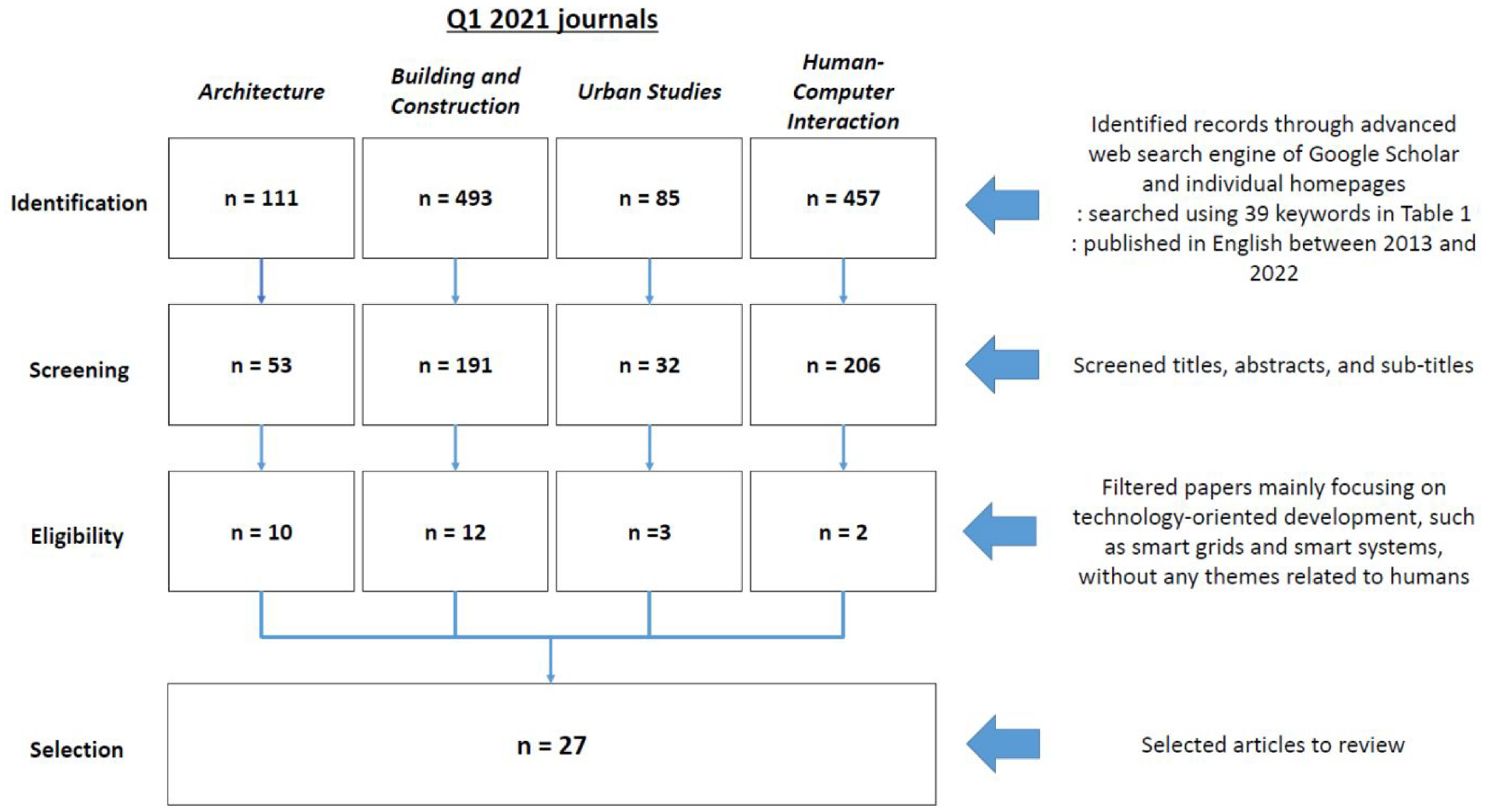
The process to select articles for review.
Evaluation Framework for Smart Residential Environments With a Focus on Human-Building Interaction
As mentioned earlier, considering HBI could, at least in part, resolve the problems that arise in SRE. Accordingly, this paper develops a framework for evaluating SRE research which is based on the HBI perspective. To develop the evaluation framework, we review the literature related to HBI and examine the scope, principle, and definition of HBI. Based on the key factors of HBI proposed by researchers, we define the concept of HBI in the field of urban and architectural design and research as the interdisciplinary domain that considers the interactions between the built environment and the technology itself; the built environment and humans; humans and the technology itself; and humans and the built environment in which technologies are generally applied (Figure 2). The aim of HBI research is to understand how the built environment can positively support the embedding of advanced technologies to create a smart built environment and how the smart built environment can positively influence human performance as well as human experiences, such as emotion and comfort. Human performance refers to a series of behaviors humans execute to accomplish specific outputs and the ways that they adapt positively to the smart built environment.

Main concept of HBI for urban and architectural design and research (by authors).
Based on a contextual analysis of the scope and definition of HBI, we develop an evaluation framework of research relevant to SREs (Table 3). The HBI division is categorized into smart built environment, technology, and human. The smart built environment is composed of three elements: physical, spatial, and social aspects. The technology comprises two factors: product and service. The human element is composed of two main factors: human experience and human performance. Human experience includes physical, psychological, and social experience, whereas human performance includes energy, spatial, and technological performance. The evaluation framework is intended to focus on understanding which and to what extent elements of the HBI concept have been considered in the SREs developed and/or SRE studies conducted.
Evaluation Framework of Research Relevant to SREs Focusing on the HBI Perspective.

Analysis and Evaluation of the Selected Articles
Figure 3 illustrates the analysis of the Q1 articles on SRE that consider humans, by the subcategories of the fields of the built environment. The graph shows that very few articles (27 articles: 2.36%) on SRE have considered human experience and performance. This result is attributable to the lack of studies on SRE focusing on human aspects in the built environment research field. Figure 3 also demonstrates very few studies (10 articles: 9.9%) on SRE considering the human factors in the fields of architecture. Given that SRE is increasingly being adopted in many cities currently (Grand View Research, 2020) and that the fields of architecture have an important role in designing the built environment of SRE, this result indicates that such articles are still limited in terms of both number and proportion.
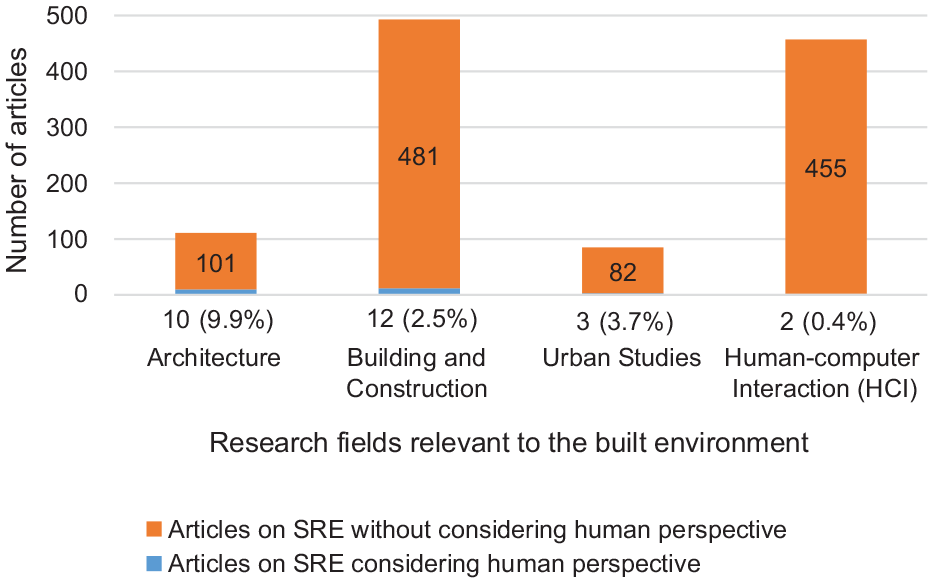
Frequency of the Q1 articles on SRE considering human perspectives by subcategories of the fields of the built environment.
Critical Review of the Smart Residential Environment Research From the Human-Building Interaction Perspective Using the Evaluation Framework
Table 4 summarizes the critical review on the 27 selected articles that consider human experience and performance using the proposed evaluation framework. Table 4 shows the predominance of SRE studies on technology (product and service) and human performance, in particular, energy performance and technological performance focusing on usability and preference rather than human experience, as shaded. Psychological experience (mental comfort, cognitive comfort, and emotional comfort) and social experience (emotional intimacy, physical intimacy, and community engagement) were not covered in the selected articles although they are also key elements of HBI. This could be understood by the difficulties of assessing the psychological and social aspects of user experiences due to its abstract and subjective nature (Williams et al., 2017).
Summary of the Critical Review on the Selected Articles From the Perspective of HBI Using the Proposed Evaluation Framework.

Note. Dots in the table indicate the elements considered in the selected articles.
The SRE studies have overly focused on the relationship between humans and technology, rather than on the interaction of the built environment with humans or technology. Among the articles that dealt with human–technology interaction, the issues of energy performance and technological performance were discussed more often than the issue of spatial performance, such as privacy and security, which is one of important issues related to human rights.
Interaction Between Humans and the Built Environment
A small number of articles (only two out of 27 articles: 7.41%) on the SRE considered the interaction between humans and the built environment. Bitterman and Shach-Pinsly (2015) discussed materials as an important element for the effective interaction between users and the built environment. They argued that the materials in the SRE should be chosen and planned to enable the inherent functioning of technologies, such as sensors, without disruption. They suggested the use of nanotechnology-based smart materials for enabling automatic communication between materials and diverse users under different conditions and in various locations in smart homes. Interestingly, Maalsen and Sadowski (2019) explored the pros and cons of the SRE from the perspective of nontechnical issues, such as finance and insurance relevant to real estate (the built environment), and ethical issues, such as the invasion of privacy and security (spatial performance). They argued that the sectors of finance, insurance, and real estate may become major supporters of the SRE because the technologies embedded in the SRE could be used to communicate with diverse users and manage assets efficiently. However, the use of these technologies poses a risk to the privacy of users and the security of user behavior data, one of the critical issues that should be resolved.
These two articles focused on different elements of user performance in the SRE: technological performance (the issue of the operation of technology) and spatial performance (the issues of the management of the smart home, and the invasion of privacy and security). Nonetheless, both studies discussed the influence of the physical built environment on users in SRE resulting from the unique features of the technologies applied. As clearly shown in many prior studies and in the evaluation framework we developed in this study by using the HBI concept, the SRE can significantly influence not only the user performance but also the user experiences.
Interaction Between Humans and Technologies
The interaction between humans and technologies has been a key topic in recent SRE research, accounting for 96.30% of the selected articles (26 of 27 articles). However, as shown in Table 4, there was less interest in human experiences. Only three of the 27 articles examined the issue of human experience alongside human performance. Malek et al. (2022) examined ways to improve comfort while also minimizing energy consumption and proposed an algorithm based on an experiment in which they varied three parameters: temperature comfort, illumination, and air quality. Yang et al. (2021) proposed a management approach to reduce energy costs and also improve the air quality and temperature in the indoor environment, by exploring the problems related to the management of the indoor environment in smart homes. Agee et al. (2021) identified the needs of users (senior and non-senior) for smart housing and explored the issue of human–technology interaction (user–thermostat interaction) focusing on the technological performance (usability and preferences) and physical experience (thermal comfort) of users.
As regards the interaction of technologies with human performance, there have been two predominant topics. One is the usability and user adoption of technologies for positive technological performance, and the other is the feedback from technologies to humans for positive energy performance. The following subsections detail SRE studies that have addressed these topics.
Usability and User Adoption of Technologies for Positive Technological Performance
More specifically, 16 of the 26 (61.54%) articles related to human–technology interaction discussed the technological performance required to improve the desired SRE for users. All the articles focused on the usability and user adoption of technologies in the SRE. For instance, Wong and Leung (2016) discussed the user adoption of technologies by focusing on both products and services and highlighted that providing easy-to-use appliances was one of the major considerations to improve usability. Balta-Ozkan et al. (2013) identified the barriers to smart home service adoption, such as the reliability, security, and cost of smart home services, and argued the necessity of minimizing them to deliver the more desirable SREs. Wong et al. (2017) explored the preference for the smart home service and its adoption, and found the self-governing and the automatic functions through the positive human-machine interaction was one of the most preferred services and the influential factors in increasing user adoption. Dalprà et al. (2018) highlighted independent living for certain groups including the disabled which could be achieved by a better usability and user adoption of technologies in the SRE.
Feedback From Technologies to Humans for Positive Energy Performance
The second frequently mentioned issue (15 out of 26 articles: 57.69%) was the interaction of technology with users for better energy performance. Fourteen out of the 15 articles significantly considered the issue of energy efficiency focusing on the positive energy consumption pattern facilitated by smart technologies in the SRE. For example, Mascherbauer et al. (2022) explored the energy performance of products and services in an SRE, using the energy consumption and generation pattern. Strengers et al. (2020) proved the significance of the sensitive interaction of residents with technologies, such as smart thermostats and networked lighting to efficiently manage their energy-usage behavior. The convenience of environmental control was one of the main reasons for the benefit of energy saving through the technologies. Regarding this aspect, Jnat et al. (2020) verified a potential of smart technologies, such as monitoring systems, to support residents in making more sustainable decisions, which directly or indirectly affect their energy consumption. That is, feedback provision on energy consumption from the management system in a smart home fosters the reduction of energy use and thus influences residents’ behaviors.
As shown in Table 4, in terms of the human–technology interaction, spatial performance was relatively less discussed in SRE research. Although some scholars discussed the issues related to privacy (Ghorayeb et al., 2021) and security (Balta-Ozkan et al., 2013), the number of research seems to be still smaller compared to other issues such as energy. Given the basic function of housings as a place of rest and stability, research on the spatial performance of SREs, for instance, which could reduce potential problems such as a privacy risk resulting from the HBI is also important.
Interaction Between Technologies and the Built Environment
Only two out of the 27 articles (7.41%) considered the interaction between technologies and the built environment. Bitterman and Shach-Pinsly (2015) reviewed the literature on smart homes and analyzed the problems in terms of usability. Their focus was on particular urban and architectural design issues. They discussed the interoperable built environment with technologies, as the newly required consideration in designing better smart homes. Ma et al. (2022) reviewed the literature on the smart home environment and technology focusing on the views of a particular group: elderly individuals. They analyzed the selected articles using a framework on the smart home modification process and the problem of smart home living for old people: independency. They specifically considered two aspects of the built environment, physical and spatial, as features related to the modification of these individuals’ residences into smart homes. They identified the lack of information on combining smart technologies with architectural design and stressed the necessity of establishing specific guidelines for retrofitting homes into smart homes.
None of the studies we reviewed have directly discussed the interaction between the built environment and advanced technologies. However, two articles argued that it would be necessary to provide the adaptable and interoperable the built environment allowing new technologies in order to deliver the desired SRE. The built environment that enables a positive interaction with technologies allows (1) smart technology performance maximized without being hindered by the built environment and (2) new smart technologies to be applied well to existing and/or newly built environment. To achieve this goal, research in the fields of urban and architectural design should take into account the positive interaction between the built environment and technologies from the HBI perspective.
Considerations Emphasized in the Smart Residential Environment Research From the Human-Building Interaction Perspective
We analyzed the issues presented in the conclusion and discussion section of each of the 27 selected articles to understand the emphasized considerations to deliver SREs from the perspective of HBI by researchers. We categorized these into seven issues: urban and architectural, management and/or maintenance, technological (including device design issue), service and delivery, government and/or policymaker, industry, and research(er) considerations as shown in Figure 4 (for more details, see Table 5). The graph shows the predominant issues related to the government, policy, industry, and technology, as against others, such as urban and architectural design, and management and maintenance.

Analysis of discussion and conclusion sections in the articles selected from the perspective of HBI.
Summary of the Critical Review on the Considerations Emphasized in the Selected Articles From the HBI Perspective.

Note. Dots in the table indicate the considerations emphasized in the selected articles.
Some articles discussed the significance of the roles of policy, the government, and industry in delivering a better SRE in the future through improving the interaction between the SRE and users. For example, Balta-Ozkan et al. (2013) discussed the policy perspective; the industry structure of the electricity supply system; and the housing stock, such as the rate of new housing and renewal housing. In addition, Ghorayeb et al. (2021) suggested that customizing the technologies used in an SRE would make living in the SRE more acceptable to different people. Regarding this issue, Obinna et al. (2017) found that it is vital to involve end-users in developing technologies. Rau et al. (2016) highlighted that industrial designers play a key role in delivering innovative technologies focused on various user needs.
In comparison, fewer studies discussed the issues of urban and architectural design, and management and maintenance to improve the interaction between the SRE and users. Three studies (Agee et al., 2021; Bitterman & Shach-Pinsly, 2015; Ma et al., 2022) discussed the necessity of the considerations in the fields of urban and architectural design. Three studies (Chinthavali et al., 2022; Jnat et al., 2020; Wong & Leung, 2016) stressed energy management issue as a key benefit of SREs. A better urban and architectural design can deliver a better built environment, and therefore can directly and/or indirectly contribute to the positive experiences and behaviors of the users living within it. The element of management and maintenance is also critical because it is significantly related to the efficiency and sustainability of those living in the built environment. Therefore, it would be necessary to focus more on these two elements—urban and architectural design, and management and maintenance—for delivering a better SRE in the future.
Discussion
An SRE that is overly focused on technologies and fails to consider user needs could result in a digital divide that isolates a particular population of the city (Marikyan et al., 2019). Conversely, an SRE that pays less attention to the embedded technologies could lead to a poor interface of the built environment and technologies (Bitterman & Shach-Pinsly, 2015) or challenges in transforming a non-smart home into a smart home (Ma et al., 2022). To overcome such problems, we firstly identified the three key elements of the HBI field for urban and architectural design and research and developed a framework emphasizing a balanced interaction between the three key elements (Table 3). We then analyzed recent articles on SREs from the HBI perspective and identified three key findings.
a lack of studies on SRE considering HBI in the built environment
an excessive focus on topics related to user–technology interaction, and in particular, user performance (technological and energy performance)
less consideration of urban and architectural design to deliver SRE from the HBI perspective.
We found that in the research fields related to the built environment, fewer studies on SREs have considered the HBI concept. Only 27 out of 1,146 articles (2.36%) considered user interaction with elements related to the SRE, including the built environment or technologies. However, the HBI should be considered alongside the design and research of the contemporary built environment, especially of SREs. Urban and architectural design issues from the HBI perspective have been discussed less in the SRE articles than have other issues although the field of urban and architectural design have an important role in delivering SREs.
Considering the Physical Formation of Space by Urban and Architectural Design Through the Intervention of the Human-Building Interaction Perspective
Active interaction between users and the built environment of smart housing is essential, deriving positive experiences and behaviors. An interactive built environment from the users’ perspective can provide a better living experience (Abrams et al., 2012), which influences residential satisfaction (Chen et al., 2013). Built structures, such as volume and opening, and interior elements, such as internal layouts and materials, can affect the performance of technology in SREs (Bitterman & Shach-Pinsly, 2015; Nembrini & Lalanne, 2017). Therefore, a more in-depth design of physical space formed by built structures and interior elements through intervention from an HBI perspective is necessary to provide better SREs.
For example, the physical space of SREs should be designed to not interfere with the technology’s functionality (Bitterman & Shach-Pinsly, 2015). The physical space of SREs should support efficient interaction with technology, regardless of its form and wherever people are in the space. The physical space of SREs needs the ability to convey the conditions of both external and internal environments and, further, the physical and mental states of the people within them to technology. The design of physical space with HBI in mind enables the positive performance of SREs, which in turn influences better user experience and behavior.
Metrics Development Measuring the Degree of Comfort and Sociality of Users in the Smart Residential Environments to Evaluate Human-Building Interaction Associated With User Experience
The SRE research is biased on the user–technology interaction, focusing on user performance, which could be explained by the difficulty of measuring and evaluating HBI, mainly related to user experience in SREs. Measuring user experiences regarding the built environment is challenging owing to its complexity (Francescato, 2002). Evaluating user experience in the SRE is more challenging than in the built environment of conventional housing because of the ambiguity of technology awareness (Yeo, 2023). To bridge the gap of current SRE research, developing metrics to evaluate HBI associated with UX (user experience) would be effective. The UX-HBI metrics need to specifically focus on the three elements of human experience (physical, psychological, and social) which are rarely considered in SRE research, as shown in Table 4.
For example, the UX-HBI metrics should be able to assess the degree of HBI in SREs regarding physical comfort (thermal, visual, and air comfort), psychological comfort (mental, cognitive, and emotional comfort), and social intimacy and engagement (physical and emotional intimacy, and family and community engagement). To gauge the degree of HBI in SREs in terms of UX, developing score and/or new techniques representing it would be necessary. The UX-HBI metrics should specifically classify the various aspects of user-experiences by the demographic characteristics. For this, linking UX-HBI metrics to the personas representing the intended users and the scenario that offers situational context might be useful. Personas generalize the user groups based on individuals’ diverse backgrounds and information, and consequently allow designers to understand users’ perspectives on outcomes and determine better design directions from that (Miaskiewicz & Kozar, 2011).
Transition of Design Methodology Based on the Interdisciplinary Collaboration Between Various Practices Based on the Intervention of the Human-Building Interaction Concept
SREs must consider the convergence of technology into the built environment connecting with users. Urban and architectural design approaches that consider HBI could respond to new emerging phenomena in SREs, for instance, the influence of technology on space and the new forms of interactions in space resulted from technologies such as technology–human interaction and technology–the built environment interaction. Furthermore, urban and architectural design approaches should enable compatibility with processes from other disciplines, such as interaction design. Consequently, this would offer an efficient way to collaborate with other stakeholders of SREs, for example, interaction designers and technicians. To develop a new methodology of urban and architectural design focusing on the HBI concept, interdisciplinary collaboration with other research domains relevant to HBI would be indispensable.
The SREs can be extended to satisfy the requirements of housing in the future that might have re-emerged by epidemics like the COVID-19. For instance, as a consequence of working from home and families spending much time together at home, a post-pandemic smart home would support residents’ well-being in terms of mental and physical health, as discussed by Salmonsen (2020). To design and deliver a livable SRE reflecting HBI as a potential alternative for future housing, a conceptual framework was developed, as shown in Figure 5. The balanced three types of interactions (human–built environment interaction, human–technology interaction, and technology–built environment interaction) can deliver a better livable SRE. For example, positive human–built environment interaction can maximize the harnessing of technology, making SRE the high-performance of the built environment. Positive human–technology interaction is significant, enhancing the usability of devices and services that can influence user experience and performance in SRE. Efficient harnessing of technology leads to better psychological comfort and energy saving in SREs. Positive technology–built environment interaction can offer the interoperable built environment readiness of new technologies, leading to sustainable SREs. This ideal SRE will consequently improve the physical, spatial, and social aspects of future housing. We also highlighted the importance of the interdisciplinary collaboration of architects with other stakeholders relevant to HBI to ideally achieve each type of interaction within SREs.

A conceptual framework for the design and delivery of a more livable SRE (by authors).
Conclusion
This paper has presented a systemic review of recent research on the SRE from an HBI perspective. To understand in more depth the current status of SRE research from the perspective of users’ interactions with the built environment, we conducted a contextual analysis, using an evaluation framework focusing on the HBI concept. This study makes four contributions to urban and architectural design and research for delivering a user-centric SRE. Firstly, a definition of the HBI concept for urban and architectural design and research was proposed (academic contribution). Secondly, a framework to evaluate SRE research based on the HBI definition was developed (methodological contribution). The proposed evaluation framework offers an innovative approach to measure and determine the factors that should receive significant attention for delivering a better SRE. Thirdly, the current status of SRE research from the HBI perspective was identified (empirical contribution). Lastly, a conceptual framework for the design and delivery of a more sustainable and livable SRE was provided (practical contribution).
Through our critical review of SRE research from the HBI perspective, this study offers insights into future considerations that would be useful to academics and practitioners in designing and delivering an improved SRE. For instance, academics could conduct research focusing on important but under-considered topics to deliver better SREs, which this study identified, or focus on the development of metrics for better SRE design, which this study suggested. Practitioners could improve the design approach for better SRE, which would be based on the HBI concept as discussed in this paper. However, we also need to note the limitations of this study. This study reviewed a limited number of articles, given the trend in SRE research to pay less attention to the user perspective (Marikyan et al., 2019). These articles excluded community and urban levels, such as smart cities; thus, future studies on SRE should expand the research scope and target. Research on the interaction between internal and external spaces in SREs from the HBI perspective will be necessary. For a more comprehensive understanding of the interplay between humans, technology, and the built environment, future research exploring the implications of technology on architecture would be needed. In addition, as mentioned earlier, the evaluation framework was developed by a contextual analysis of the scope and definition of HBI, and thus might not provide a complete understanding of practice involved in HBI. Therefore, from a practical perspective, improving the evaluation framework can be conducted for the future work. Lastly, as discussed in this study, collaborative research in the field of the built environment with other fields related to designing and delivering SREs would be beneficial to, at least in part, resolve the problems of current SRE research (i.e., unbalanced and limited research).
Footnotes
Declaration of Conflicting Interests
The author(s) declared no potential conflicts of interest with respect to the research, authorship, and/or publication of this article.
Funding
The author(s) disclosed receipt of the following financial support for the research, authorship, and/or publication of this article: This work was supported by the National Research Foundation of Korea (NRF) grants funded by the Korea government (NRF-2022R1A6A3A01087342; NRF-2023R1A2C2004992).
Ethics Statement
There is no ethics issue, so the ethics statement is not applicable.

Data Availability Statement
The data presented in this study are available from the corresponding author upon request.