




Abstract
A growing body of architectural research has recognized the influence of users on technologies and the various and transformative nature of their use. A particular strand of this research applies actor–network theory (ANT) to highlight how the user is embedded in socio-material relations with technologies and captures the influence of users on design through the creation of relations in scripts and the changes in these relations through translations. These accounts help reveal the varied and dynamic realities of use by uncovering diverse and continually negotiated relations; however, they are still limited. This highlights the need to deploy such approaches and benefit from their potential to tackle the different aspects of use that might not be revealed in traditional research. This article deploys an ANT-inspired ethnographic approach to explore the electric shutters’ use in the residential buildings in Al Rayyan neighborhood. The findings illustrate how users respond to the building scripts of designers through a range of translations that may include support, acceptance, alteration, interference, abandonment, or resistance. They also show how this diversity of responses could transform and extend from one type of response to another, due to changes in knowledge, interest, engagement, circumstances, and technologies as the translation continues and develops. This perspective has significant implications in recognizing new ways for unpacking users’ contributions to design to inform design decisions and potentially influence the diffusion of technologies.
Keywords
Introduction
The use of technologies in buildings has gradually gained attention in architectural research and has lately been recognized as a topic of importance (Cupers, 2013; Hill, 2003). In particular, the influence of users on technologies and the various and transformative nature of their use have triggered research interest and shown the necessity of adopting new approaches to the investigation of this subject. One particular approach that could be used draws on actor–network theory (ANT); this views the sociotechnical world as a network of relations (Latour, 2005; Yaneva, 2022, 2024) and captures the influence of users on design through the creation of and changes in these relations. The significance of this approach lies in its ability to reveal the varied and dynamic realities of use by uncovering diverse and continually negotiated relations (Abi Ghanem, 2008; Sharif, 2016; Sharif & Karvonen, 2021). Despite its potential, the work conducted using this approach is quite limited (Summerton, 2004). This highlights the need to uncover such potential to tackle the different aspects of use that might not be revealed through traditional research.
This article provides a nuanced perspective on identifying user contributions to design, unpacking their variety (the different user contributions to design and the associated typologies) and transformability (the way user contributions to design change and how the typologies might evolve). It deploys a novel approach that relies on ANT-inspired ethnography (Yaneva, 2022, 2024) to explore the electric shutters in the residential buildings in Al Rayyan neighborhood. The shutters are considered a fundamental and frequently-used technology in households for controlling heat and light, providing privacy and security, protecting against weather and unwanted intrusions or damage; similar to manual shutters but with enhanced esthetics, more convenience in use, and lower need for maintenance, being electric The paper provides a focus on specific aspects of the electric shutters that are considered important for their usage, including system control/push button switch, rolling/sliding mechanism, and power/electricity supply. The findings demonstrate the different ways in which users respond to the same electric shutter design as they negotiate issues of control, privacy, security, and protection based on their own knowledge, experience, and interest while relying on specific circumstances and particular aspects of the technology at hand. In addition, the research uncovers the ways in which these responses can transform from one to another through a change in knowledge and expertise; change in interest and/or level of engagement; change in circumstances, unforeseen incidents, and temporary adjustments; and modified technologies; each time, the responses and their transformation recreate the design differently.
The research emphasizes the importance of shifting our focus from design expectations to actual user responses by uncovering the anticipated and changed design–user relations. Through the utilization of a unique perspective applied on an empirical example, it reveals a significant gap in the understanding of the various and transformative user responses to design, responses that can be shown through diverse and continually negotiated relations. Understanding these aspects provides significant value in (i) recognizing the importance of developing new ways to grasp and unpack elaborate and hidden user responses (ii) rethinking the significance of understanding user responses to inform design decisions and potentially influence the technological diffusion. These matters pose further queries on socio-technical aspects of technologies, which mandate further research in this undervalued area.
The Variety and Transformation of User Responses to Technology
Technologies have long been an integral part of daily life because they offer a wide range of services that meet human needs. Designers are concerned with creating specific designs according to their expectations about anticipated user experiences (Akrich, 1995; Savolainen & Hyysalo, 2021). Meanwhile, in reality, users might modify the created designs in ways that differ from the designer’s expectations, and these modifications can be varied and transformative (Kohtala et al., 2020; Summerton, 2004). This calls for more research on and new approaches to understanding the ways in which users influence the making and uptake of technologies and recognizing the various and transformative nature of their use.
The influence of the design of technologies on their usage has long been recognized in research studies. However, the significance of users’ influence on design has gained less attention and has appeared gradually in innovation studies (von Hippel, 2005, 2017), design research (Kohtala et al., 2020), consumption studies (Wallsten & Galis, 2019), information systems (Baskerville & Myers, 2023), and science and technology studies (Jensen & Hyssalo, 2024). These studies show how users contribute not only through single contributions but also through typologies where these contributions vary and extend. Science and technology studies have a specific contribution in this regard (Kohtala et al., 2020) because of their particular view of the sociotechnical world, in which science and technology are embedded in and intertwined with social practices and systems. This notion makes it possible to provide unique perspectives on technologies such as solar collectors and biomass heating systems (Ornetzeder & Rohracher, 2006), thermal comfort control (Velkova et al., 2022), heat pumps (Hyysalo & Juntunen, 2024), smart energy grids (Farhangi et al., 2024), when identifying the capacities and engagements of users.
Actor–network theory (ANT) is a particular strand of science and technology studies that can provide a specific contribution to this area because it views the sociotechnical world as networks of relations between human and non-human actors (Akrich, 2023; Latour, 2005; Yaneva, 2022, 2024). The notion of “script,” introduced by Akrich (1997), is used in this context to refer to the outcome, where designers inscribe their views on technologies based on how they expect those technologies to be used (Yaneva, 2022). In ANT terms, the script refers to the initial creation of a design network with its anticipated set of relations between non-human and human actors (the design and its users). The concept of “translation” is used by ANT theorists to refer to the process of modifying a script through diverse and ongoing modes of adaptation to fit the users’ needs (see Law, 2006). Translation thus refers to the recreation of the design network through the various and transformative changes in inscribed relations between actors (Law, 2009; Yaneva, 2022). Scripts and translations provide theoretical tools for shifting our focus from design expectations to actual user responses by uncovering the anticipated and changed relations. Central to these ANT tools is the ability to reveal the varied and dynamic realities of use by uncovering diverse and continually negotiated relations. This is why ANT provides significant potential in terms of identifying user contributions to design, unpacking their variety and transformability, and the typologies this might entail. Despite its potential, however, work conducted using this approach is quite limited, which restricts the potential to uncover issues of use.
User Responses to Technology in Architecture-Related Fields
In architecture and building-related fields, technologies are inseparable components of buildings and provide irreplaceable services. While these technologies are designed based on envisaged user experiences (Cuff, 1992; Van der Linden et al., 2019), the reality of use is different, with variation and transformation (Cupers, 2013; Hill, 2003). This is why an ANT-inspired approach provides particular perspectives for exploration because it captures the influence of users on a design through the creation of network relations in scripts and changes in these relations through translations. It also reveals the varied and dynamic realities of use by uncovering diverse and continually negotiated relations. This approach makes it possible to provide unique perspectives on technologies used in residential buildings, such as sensors and smart devices (Tironi & Valderrama, 2021), space heating (Summerton, 1992, 2004), photovoltaic technology (Abi Ghanem, 2008), and lighting (Sharif, 2016; Sharif & Karvonen, 2021), and to identify the capacities and engagements of users.
Some of these studies reveal specific user responses that go beyond design expectations. Another aspect of ANT-inspired studies in architecture explores the variety of user contributions to design and reveals some associated typologies (Abi Ghanem, 2008; Sharif, 2016; Sharif & Karvonen, 2021; Tironi & Valderrama, 2021). Sharif and Karvonen (2021), for example, demonstrate different user responses to design scripts and changes in relations through the case of lighting sensors in residential buildings in Masdar Institute in the UAE. Users supported the motion sensor script by tolerating its issues; they tinkered with the script by requesting that the maintenance team make the time delay longer; they adjusted the script by introducing portable lights; and they resisted the script by using the control panel to manage the sensor. Meanwhile, Abi Ghanem (2008) explains how users showed different ways of using photovoltaic technology in two installation projects located in the north of England, through engagement, interest, and non-use depending on the relations between users and the photovoltaic cells. Although these contributions identify user responses and their variety, along with the typologies they entail, there continues to be a need to maintain and expand this exploration. This is significant in light of ANT’s potential not only in unpacking diverse design–user relations but also in realizing their provisionality and continuous negotiation (Sharif, 2016; Sharif & Karvonen, 2021).
Only a few ANT-inspired studies in architecture have explored how user contributions to design may change and how typologies might evolve. Abi Ghanem (2008) mentions user involvement and the trialing of new technologies as potential drivers to transform user responses; this hints at the provisionality of relations and their potential changes. The importance of understanding changes in user responses and the transformation of their typologies lies in, first, the applicability of expanding their variety, and, second, the potential of better comprehension of technological adoption.
Beyond the aforementioned research contributions, this research contributes to ANT studies in the area of architectural production by revealing the various and transformative user responses to technologies or typologies of use as identified through scripts and translations. It demonstrates how the designers developed and deployed the electric shutters (the script) and how users translate and “re-translate” the script through diverse and changing relational patterns.
Methodology: An Ethnographic View of User Responses to the Electric Shutter
To identify user contributions to the design and to unpack their variety and transformability, along with the typologies this might entail, this research adopts an ANT-inspired ethnographic approach to explore the electric shutters’s use in the residential buildings in Al Rayyan neighborhood. The neighborhood, developed in 1985 and located in western Amman, includes multiple residential buildings, part of which were built within the last 5 to 10 years. Manual roller shutters have been used in the area for the last 30 years to provide safety, weather protection, noise reduction, and privacy. Electric-powered roller shutters are a new technology introduced to the newly built homes in the area to provide more convenience, esthetic appeal, and low maintenance.
The choice of a residential neighborhood allows for understanding everyday user responses to technologies where problems of change are interpreted differently and where conflicting perspectives come to the fore. While these residential neighborhoods provide arenas where technologies are inhibited and interpreted, they are regarded as windows into social worlds and reflect wider social forms. The focus on technologies in apartments related the dominance of apartments in the area in specific and in Amman at large, which could inform the challenge of socio-technical systems within and beyond this housing typology. User responses to technologies are made possible to investigate in this specific neighborhood because of the availability of targeted technologies (Electric shutters are located in almost all the new apartments while traditional application of manual shutters are in place in older apartments) and the openness of residents to share (who the researcher knows through family or friends and through their relations with each other). Hence, the selection of this neighborhood meets certain conditions in relation to electric shutters that may also appear in other cases, even though the case is unique and its details are specific. The point is not to present certain technological qualities or typical usage in that case, but rather socio-technical dynamics that could apply to other cases.
Electric roller shutters comprise a system of horizontally aligned, interlocking slats, usually made of PVC or Aluminum, with spaces between them to form a curtain (Ariosto & Memari, 2013). They work by rolling or sliding up and down on tracks or in guide channels. When in use, the slats roll around the roller; this is a tube located within the shutter box and supported at both ends by an end plate, with a tubular motor fitted at one end and a shaft at the opposite end. The motor is fitted with an operational brake to hold the shutter stationary in position. A safety break is provided to prevent the sudden drop of the shutter if the motor fails. The end plates, while supporting the roller and other shutter box internal components, are provided with adequate fixing to take the full load of the shutter and to secure it to the building structure. Electric shutters can be controlled either by a wall-mounted switch or by a remote control, and their operation is stopped automatically by means of a limit switch. Although much has been examined about the roller shutters potential and user-related preferences and interactions in terms of privacy (Elgadra, 2022), shade control (Abdelwahab et al., 2023), solar protection (Roca-Musach et al., 2024), and environmental factors (Pereira & Ramos, 2019), the uniqueness of this study is the adaption of in-depth methodology to investigate the shutter-user interactions.
The importance of electric shutters is in their positioning at the core of comfort household technologies that are collectively negotiated along with building (windows, lights, et) and environmental (view, privacy, light) components. The difference between manual and electric shutter is that the latter reassigns new roles to the technologies (i.e., convenience and modernity) and establishes new dependencies between different systems (i.e., connection to electric supply). Electric shutters include multiple “spaces” for negotiation through their controllability, workability, and connectivity to technologies and users, which allows for different interactions. The electric shutter case comprises multiple scripts and initial relations in its design: for example, system control/push button switch, rolling/sliding mechanism, and power/electricity supply. It also comprises different translations and changes in relations due to different user responses.
The fieldwork adopted an ethnographic approach inspired by ANT to unpack the influence of users on the design (Yaneva, 2022, 2024). This approach differs from traditional ethnography (Sharif, 2023; Sharif & Karvonen, 2021) in that it is concerned with capturing the influence of users on a design through the creation of network relations in scripts and changes in these relations through translations. It also reveals the varied and dynamic realities of use by uncovering diverse and continually negotiated relations. What differentiates an ANT-inspired approach is that it does not consider any reality outside these relations (Harman, 2022), and it strives to follow these relations wherever they lead (Yaneva, 2022, 2024). As Latour (1992, p. 259) puts it: “[W]e are never confronted with science, technology and society, but with a gamut of weaker and stronger associations; thus understanding what facts and machines are is the same task as understanding who people are.” ANT-inspired ethnographies rely on interpretation, where researchers play a key role: that is, other interpretations are not only possible but also desirable (Sharif, 2023). Furthermore, such ethnographies are not concerned with testing a phenomenon or verifying a reality but with interpreting the phenomenon and exploring the multiple realities that emerge and gain specificity in their particular cases. ANT can be used by different authors in different ways to tackle certain issues. However, there is always a risk on how the researcher benefits from its value without losing control over the ever-growing and changing actors, relations, and networks. This is why the design of this research necessitated limiting the actors and relations to the ones directly relevant to the network of each specific theme so that the tracing of the heterogenous components/links and their dynamic becomes more manageable. Some studies suggest that the main drawback of ANT-inspired ethnographies is their inability to extract universal standards or principles. However, the primary focus of generalization in these studies is the identification of the processes and mechanisms rather than the representativeness of the cases (Sharif, 2020a, 2020b; Sharif & Karvonen, 2021). In other words, generalization could have a specific characteristic that has to do with how we identify local relations that impact varieties and dynamics in their own complex environments.
Research tasks mainly comprised desk-based study of the relevant data concerning the residential area and the electric shutters. Data were also collected from June to October 2023 through semi-structured interviews and site observations conducted with 40 users (15–20 min for interviews and 2–3 hr for site observations per day). The selection of users (who were mainly the residents of the neighborhood in apartments with electric shutters) was aimed at representing different groups in terms of gender (40% male, 60% female), age (18–25 (20%), 26–45 (30%), 46–59 (35%), and 60 + (15%)), ownership status (60% own, 40% lease), and level of knowledge of using the technology (20% amateur, 50% intermediate, 30% expert) to reveal different types of electric shutter use. It also covered different locations (within the neighborhood) and property ages (not exceeding 10 years of including the electric shutters). The process of inviting users started by introducing the research to the friends and family members inside the neighborhood and inviting them to participate. Afterward, the invited users recommended other participants through snowballing, where they were invited taking into account the need to diversify them in terms of characteristics and demographics. Investigations took place inside user apartments and at different times of the day or week to allow effective engagement with user responses to the electric shutters. The investigations entailed following what users said and did (Yaneva, 2022, 2024) and understanding how and why (Sharif, 2016) they kept or changed the initial script and translated it in ways that were similar to or differed from the designer’s initial intentions. Interviews and observations were documented either by taking notes, tape-recording, and/or photography. Pseudonyms were used for the interviewees and their images were blurred in or removed from the photographs to ensure their anonymity.
The collected data were analyzed thematically with the aid of qualitative data analysis software (NVivo 10). Data analysis was aimed at familiarizing with the data and generating codes, grouping the codes and identifying themes, and reviewing these and generating the results. The process initially included unpacking the main user responses to the electric shutters (supporting, accepting, altering, interfering, abandoning, and resisting) as users translated the initial script. It also included the multiple ways in which these responses could transform from one shape to another (because of change in knowledge and expertise; change in interest and/or level of engagement; change in circumstances, unforeseen incidents, and temporary adjustments; and modified technologies) through ongoing translations (or re-translations). This demonstrates an in-depth perspective on the variety and changeability of users’ responses, which change the design each time differently.
Findings
Part 1: Variety and Typologies of Contributions
The first part of the empirical findings unpacks the variety of user contributions, and the associated typologies identified through scripts and translations. It provides summaries of how the designers developed and deployed the electric shutter script and how users translated the initial script, as demonstrated through changes in the relational patterns. Three themes are deployed to illustrate these aspects, which highlight the key distinctions between electric and conventional shutters:
System control/push button switch
Rolling/sliding mechanism
Power/electricity supply and connectivity
System Control/Push Button Switch
The push-button switch is a method of electric shutter operation control. It is positioned in an observable place near to the window and is operated by a momentary (continuous press) or latching (single press) action function in the upward or downward direction. User’s convenience and visual appeal are the main goals of this control mechanism. According to one of the original suppliers of electric shutters in the area, this switch control in electric shutters is supposed to provide a more appealing and practical alternative to the belt operation in manual shutters because it does not require effort. Starting from the developers’ intentions for the scripts, various user translations can be traced as they fit the design to their own preferences (Abi Ghanem, 2008; Sharif, 2016; Sharif & Karvonen, 2021).
Some users supported the electric shutter script; this meant that they not only kept but also built their relations with it while encouraging its usage. Ruba said that “operating a large window [electric] shutter with one push of a button is much easier than pulling a [manual] shutter belt.” Huda further pointed out that the electric shutter’s switch “offers less hassle in upkeep and cleaning” compared to the manual shutter’s belt, which was more likely to get soiled or ripped.
Some users accepted the script, maintaining and strengthening their relations with it. Rana did not find any issues with moving to a house with switch-controlled shutters, despite being accustomed to belt-operated shutters in her previous apartment.
Some users altered the script, making minor amendments in their conduct by weakening their relations with possible obstructions and/or strengthening them with potential aids. For example, Hamdan kept an eye on the switches to prevent his children from playing with them. Husna deliberately pulled her window curtains wide enough to hide the adjacent switch. Hind stuck tape over the switch buttons so that her daughter found it harder to play with them (Figure 1A). Hasan procured protective plastic boxes to encase the shutter switches in his apartment; where they could only be accessed from the open top of the box.
Some users interfered with the script; making moderate or extensive amendments by weakening their relations with obstructions, issues, and inconveniences, and/or strengthening their relations with possible solutions and alternatives. Wael decided to invest in replacing all the switches in his apartment with stronger and longer-lasting models with harder and more durable buttons, making them “harder to be tampered with by children or excessive pressure.” Ihsan replaced the buttons that require a single push with those that need to be held down to make them more controllable and less appealing to children.
Some users abandoned the script; they did not maintain their relations with the script and actually weakened them. Nourhan and Asaad used strategies such as covering and replacing the switch to avoid its continuous usage and keep it to a minimum, not only for their children but also for other family members.
Some users resisted the script; they further weakened or even cut their relations with it. Roya considered it unsafe to freely clean the switch using water and detergent. Samia stressed the “headache when buttons get jammed inside when pressed too hard.” Roya and Samia preferred replacing switch-controlled shutters with belt-operated ones due to the latter’s safer and less problematic characteristics.

User responses to electric shutters: (A) Sticking a tape over the switch button (B) Keeping the shutter almost closed (C) Not fixing a broken shutter (D) Leaving the interlocking parts loose (E) Obstructed shutter box.
Rolling/Sliding Mechanism
The rolling mechanism of the shutter depends on a system of interlocking slats that roll or slide along the sidetracks and coil into a box when the shutter is opened and uncoil to extend to the lower guide when closed. Driven by the electric-operated motor, this movement is meant to be consistent and smooth. According to one of the suppliers of the electric shutters in the area, this mechanism is supposed to provide a practical alternative to the manual shutters because of their steady and moderately paced low-noise operation as they slide or stop. While this is how the developers intended the design scripts to work, users translated them in different ways to meet their own needs (Sharif, 2016; Sharif & Karvonen, 2021).
Supporting users such as Aya and Allam admired the consistent and smooth movement of the shutter. They believed that the shutter is designed to serve its function and to withstand heavy usage, “it is a far better and modern alternative to belt-operated shutters,” Allam said. Ghayda added that the electric shutter’s stable and smooth operation solved the misalignment of the slates between the guides, an issue that she faced with manual shutters on wide windows. Jehad mentioned that the electric shutter’s automated movement reduced the problem of the shutter jamming, crashing up or down, or sliding suddenly, which he faced with manual shutters when the belt was pulled or released abruptly.
Accepting users such as Donia commented that designs change and advance, and people need to adapt to such changes and get used to them. Samia commented that this type of shutter was not so different from the previous type, and it required little familiarity to use, care, and maintain it, “let us be honest here, it is not this huge invention!” she said.
Altering users such as Hala called the maintenance team as soon as she noticed that the shutter was moving inconsistently or jerkily, so the problem could be solved directly without causing any further complications. Huda resorted to lubricating the rails to ease the movement of the shutter whenever it became inconsistent or jerky. Khalil retracted the shutter in the opposite direction when he realized that there was a problem and then moved it back in the required direction. In some cases, he gently pushed or pulled the shutter when it was stuck in the middle; he commented that this was what he used to do with manual shutters.
Interfering users such as Khalil called the maintenance team after trying to fix his shutter; he was informed that his continuous pulling, pushing, and attempts to align the shutter had made the situation worse. Jehad faced a similar issue after opening the shutter box to reach the electric motor and trying to fix it.
Abandoning users decided to reduce the shutter’s movement to the minimum and thus lessen any possible issues. Hussam, for example, kept his shutters partly open or closed all the time depending on the size and orientation of the window, room type and function, and his requirement for light, heat, or privacy. Haifa kept her kitchen balcony door shutter or the window shutter above the sink closed; she felt that one opening was enough to let in sufficient light. Khitam kept the shutter almost closed, with just a small opening to accommodate the height of the plant that she kept near the window (Figure 1B). Dahran closed his shutters only when he was traveling.
Resisting users decided not to use the shutters and to rely on alternatives to avoid dealing with any possible issues. Sarah, for example, used heavy curtains and Dirar used louvered blinds to control the light, heat, and view. Sufyan installed external window protection for safety instead of relying on closing the shutter. In other resisting scenarios, Hamad and Halima changed their shutters back to manual ones because of their bad experiences with electric shutters. Dirgham refused to fix his broken shutter, preferring to find a more workable alternative (Figure 1C).
Power/Electricity Supply and Connectivity
The shutter relies on electric power to operate the motor that, according to one of the suppliers of the electric shutters, was favored due to the spread of electricity infrastructure and the availability and continuity of electric power. These factors were behind the developers’ intentions for the design scripts; users, however, translated them by interacting with the design and identifying conflicts (Abi Ghanem, 2008; Sharif, 2016; Sharif & Karvonen, 2021).
Supporting users such as Husna mentioned the technological orientation in households that increasingly rely on electricity; this is a situation that they progressively became accustomed to and valued. Khulda commented on the shutters’ minimal power requirements as well as the distribution and consistency of electricity; these are aspects that made her endorse and rely on them.
Accepting users such as Seral commented that people “understand and accept that progress comes with change, it is definitely not free of issues.” Suma once left the house and forgot her shutters closed. When she returned, she was unable to operate the shutters till late due to a power cut. In another incident, the shutters were left open until the next morning, when power cuts happened at night.
Altering users resorted to a middle option for some of the critical shutters in the house that are affected most by power cuts. For example, Hamed left the interlocking parts between the slats loose (Figure 1D) and Rami left the shutter open a few inches to allow light, air, and/or view in the case of a power cut.
Interfering users relied on more fundamental changes to cope with power cut issues. While Sami left the shutter open a few inches, he tried to manually push it further up and put a pot under it. Rahaf accessed the shutter box to find an option to hold or roll up the shutter to allow light. Husban insisted on an override device to use in case of electrical failure as he could not “remain helpless.” Abdulrahman insisted on the need to install an emergency generator in the building to cope with the long-lasting cuts of the electricity.
Abandoning users avoided relying on shutters because of electrical failures and power cuts. Eisa rarely closed the kitchen shutter because it was critical to be open during the day even if it did not operate to close at night. Hassan did the same with the living and guest room shutters, during summer, to allow in light and air. Muhanna kept the balcony door shutter closed almost all the time because it was very hard to close it for security reasons at night if there was a power cut.
Resisting users such as Muhayya and Murad preferred to keep most shutters open, especially in summer, as they could rely on heavy curtains, internal louvers, or material covering the windows to block out light and the view in case of a power cut. They commented that this was a better solution than operating shutters that, if closed, would not open during the cut of electricity. Rakan deliberately disabled the balcony door shutter as he would not be able to access the balcony if it was closed during an electrical failure or power cut. Emad changed his bedroom shutters to manual ones because they were the most critical to control privacy. Musallam decided to move house because of a problem with his electricity supply and the continuous electrical failures; these affected the operability of the shutter as well as other utilities. Muntaha was also thinking of moving house because of the continuous power cuts in the area.
Summary of Part 1 Findings
The findings demonstrate how the designers produce a script for the electric shutter through system control/push button switch, rolling/sliding mechanism, and power/electricity supply and connectivity, and how users translate this script in different ways (Law, 2009). These include supporting, accepting, altering, interfering, abandoning, and resisting the design script, which suggests a spectrum of user responses. These translations are demonstrated through changes in relational patterns as users either keep or alter them by building/cutting and/or strengthening/weakening. In the case of supporting, users not only keep but also try to build relations with the script while encouraging its usage. In the case of accepting, users maintain and strengthen their relations with the script. Here, we can see a slight difference between the two modes of supporting and accepting. The former accepts the usage of the shutter, as does the latter, but it also supports and encourages its use. In the case of altering, users make minor amendments by weakening their relations with possible obstructions and/or strengthening them with potential aids. In the case of interfering, users make moderate or extensive amendments by weakening their relations with obstructions, issues, and inconveniences, and/or strengthening their relations with possible solutions and alternatives. The main difference between the altering and interfering modes is that altering involves caution and only slight amendments that do not affect the shutter, while interference entails more significant adjustments. In the case of abandoning, users do not maintain their relations with the script and actually weaken them. Resisting entails users further weakening or even cutting their relations with the script. Here, we see a slight difference between the two modes of abandoning and resisting. While the former avoids using the shutter, the latter completely stops using it. Table 1 demonstrates the different user responses to the script (typologies of use), along with the changes in relations.
The Different User Responses to the Script Along With Changes in Relations.

Part 2: Transformations in Typologies of Contributions
The second part of the empirical findings unpacks the transformation of user contributions, and the associated typologies identified through different translations. It provides brief summaries on how users re-translated the initial/modified script and continually changed the relational patterns. Four transformation drivers are explained and demonstrated through the three key themes introduced in the previous section, which best capture how users change their interactions with shutters:
Change in knowledge and expertise
Change in interest and/or level of engagement
Change in circumstances, unforeseen incidents, and temporary adjustments
Modified technologies
Change in Knowledge and Expertise
Users may translate scripts differently when becoming more knowledgeable and experienced in using their technology (Abi Ghanem, 2008; Farhangi et al., 2024) through gaining or exchanging information, ideas, and practices about that technology and its usage in their everyday lives (Orlikowski, 2000). This can be demonstrated through the system control/push button switch theme where Hana saw her neighbors covering the electric shutter switches to stop guests’ children from playing with them and decided to do the same. This caused her to change from an accepting to an altering user. Meanwhile, after Raghad was assured by the maintenance team that the switches could never electrocute users, she had more trust in using and cleaning them, which changed her from a resisting to an accepting user.
Within the rolling/sliding mechanism theme, when Yara’s daughter was away traveling, and as she was unable to manage any problems on her own, she resorted to using the shutters less. This changed her from an accepting to an abandoning user. Meanwhile, when Khalid’s brother moved out, he could no longer find anyone to repair his shutter internally and started resorting to the maintenance team if there were issues, moving from being an interfering to an altering user.
Within the power/electricity supply and connectivity theme, Sameeha agreed with Samar on the necessity of keeping the balcony door shutter open to be able to access the balcony in case of a power cut; she therefore changed from an accepting to an abandoning user. Similarly, Dania installed heavy curtains she had seen in Alia’s bedroom to be able to use them at night if the shutter was open during the power cut; she therefore changed from an accepting to a resisting user. Meanwhile, Mohammad learned in advance about possible power cuts from the building residents’ WhatsApp group, making him more comfortable using his shutters; this changed him from being an abandoning to an accepting user. Table 2 demonstrates the different changes in user responses to the script because of “the change in knowledge and expertise,” along with the changes in relations.
The Different Changes in User Responses to the Script Because of “the Change in Knowledge and Expertise,” Along With the Changes in Relations.

Change in Interest and/or Level of Engagement
Users may translate scripts differently when they become more engaged with the technology and their ongoing interaction with it (Abi Ghanem, 2008; Farhangi et al., 2024). This could reinforce the technology so that it becomes regularized and routinized; repeated use of technology makes it an expedient and habitual response to the daily exigencies of everyday life (Orlikowski, 2000). However, this regularity of usage might have a detrimental effect because of unpreferred routinization, a preference for change, or upcoming knowledge about repetitive issues and/or favorable solutions.
This can be demonstrated through the system control/push button switch theme: Mira’s children kept damaging the switch in their bedroom, until she finally decided to change the shutter to a manual one, moving her from an altering to a resisting user. Meanwhile, after Sana had used the switch buttons regularly for a period of time, she finally became convinced that they never get stuck, as she used to think; this made her more comfortable using them and moved her from an abandoning to an accepting user.
Within the rolling/sliding mechanism theme, after Hammad had faced many repeated issues with opening the balcony door shutter, which got stuck a few centimeters below its housing, he decided to leave it open all the time; this moved him from being an accepting to an abandoning user. Meanwhile, after Hanan got used to opening and closing her guest room shutter, she started to trust the reliability of its operation, which she had previously doubted due to its width; this changed her from an abandoning to a supporting user.
Within the power/electricity supply and connectivity theme, after Ali learned of frequent power cuts from his neighbors, he lost interest in using the shutters, changing him from an accepting to a resisting user. Meanwhile, after Hanada received some favorable comments from her guests about the shutters’ modernity and alignment with current technology, she found it more acceptable to use them, changing her from an abandoning to an accepting user. Table 3 demonstrates the different changes in user responses to the script because of “the change in interest/level of engagement,” along with the changes in relations
The Different Changes in User Responses to the Script Because of “the Change in Interest/Level of Engagement,” Along With the Changes in Relations.

Change in Circumstances, Unforeseen Incidents, and Temporary Adjustments
Users may translate scripts differently because of a change in social, cultural, or environmental influences and because of an inadvertent slippage, unexpected event, or temporary modification that happens either through inattention or error (Orlikowski, 2000).
This can be demonstrated through the system control/push button switch theme. As Marah’s twins grew older and began to play with the shutter switches, she ultimately needed to cover them, which transformed her from an accepting to an altering user. Meanwhile, as Hiba’s children grew up, they became less playful with the shutter switches; this meant she had to keep an eye on her children less and did not have to cover the shutter with curtains, moving her from an altering to an accepting user.
Within the rolling/sliding mechanism theme, Hilal’s kitchen window shutter was broken for a few days, but, after seeing that the light coming in from the balcony door was sufficient, he decided not to repair it and kept it closed; this moved him from being an accepting to a resisting user. Shaima’s living room shutter broke between its slats and fell suddenly, making her realize that it was unsafe to use; this moved her from an accepting to a resisting user. Meanwhile, Hadi’s fan broke, but, as he needed to let fresh air in, he decided to start using the abandoned kitchen window shutter, so this change moved him from an abandoning to an accepting user.
Within the power/electricity supply and connectivity theme, Asma’s new neighbors in the building faced her bedroom, and as she realized that she needed more privacy at night in case of a power cut, she decided to keep the shutter closed all the time. This moved her from being an accepting to an abandoning user. Meanwhile, after Muhanna decided to put plants that needed daylight in the kitchen, he realized the importance of opening the kitchen window shutter, which he had previously kept closed for security reasons. This moved him from an abandoning to an accepting user. Table 4 demonstrates the different changes in user responses to the script because of the “change in circumstances, unforeseen incidents, and temporary adjustments,” along with the changes in relations.
The Different Changes in User Responses to the Script Because of “the Change in Circumstances, Unforeseen Incidents, and Temporary Adjustments,” Along With the Changes in Relations.

Modified Technologies
Users may translate scripts differently because of a deliberate or unintentional modification to the properties of their technology and thus how they interact with it (Orlikowski, 2000).
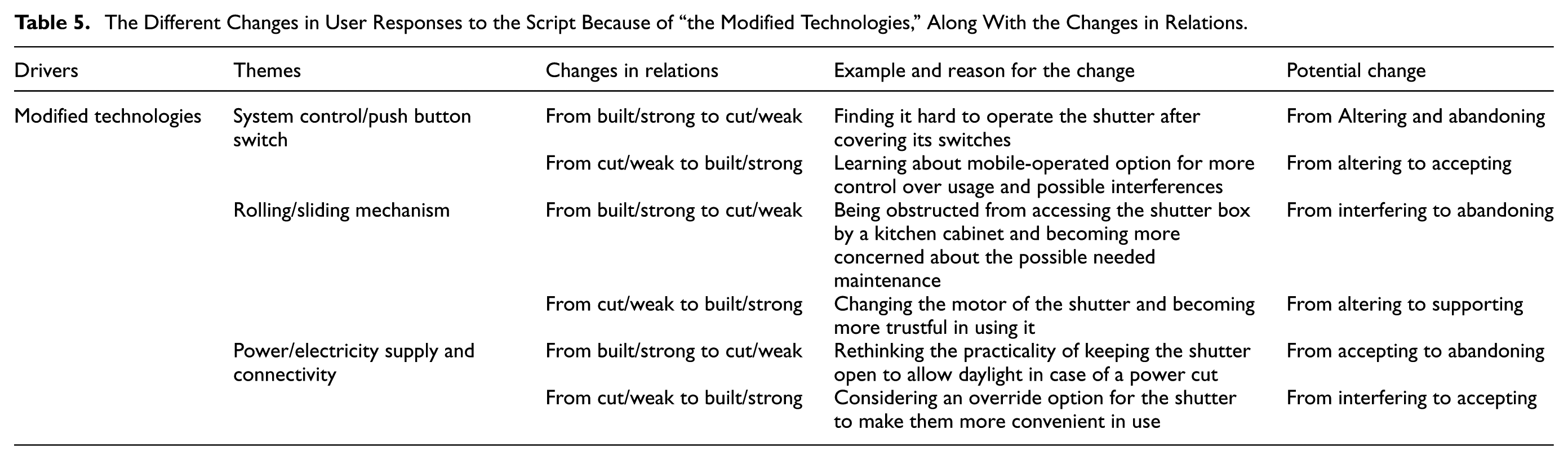
This can be demonstrated through the system control/push button switch theme. For example, after Hind applied tape over the shutter switches to make it harder for her daughter to play with them, she too found them difficult to operate; this changed her from an altering to an abandoning user. Meanwhile, Hamdan was told about the mobile-operated option for operating the shutter, which he believed would provide more control over how it moved and how his children interfered with it, potentially transforming him from an altering to an accepting user.
Within the rolling/sliding mechanism theme, after Ali’s shutter box became inaccessible and obstructed by a kitchen cabinet, he became more careful about using it, turning him from being an interfering to an abandoning user (Figure 1E). And after Anan changed the motor for one of his shutters, he realized that it reduced its issues and increased its reliability, which turned him from an altering to a supporting user.
Within the power/electricity supply and connectivity theme, after Hosni rethought the practicality of keeping his living room shutter open all the time to allow daylight in case of a power cut, he considered replacing this particular shutter with a manual one; this potentially transformed him from an abandoning to a resisting user. Meanwhile, Kholod considered an override option for her shutters to make it more convenient to use them, potentially turning her from an interfering to an accepting user. Table 5 demonstrates the different changes in user responses to the script because of “the modified technologies,” along with the changes in relations.
The Different Changes in User Responses to the Script Because of “the Modified Technologies,” Along With the Changes in Relations.
Summary of Part 2 Findings
The findings demonstrate how users re-translated the electric shutter script (system control/push button switch, rolling/sliding mechanism, and power/electricity supply and connectivity) in different and continuous ways (Law, 2009) to transform into and within different modes or typologies—supporting, accepting, altering, interfering, abandoning, and resisting the design script. This suggests a spectrum of user responses that are not only various but also transformative. The transformation drivers noted above—change in knowledge and expertise; change in interest and/or level of engagement; change in circumstances, unforeseen incidents, and temporary adjustments; and modified technologies—reveal translations of the modified script through an array of evolving reconfigurations (Law, 2009). These translations are demonstrated through the changes in relational patterns that are recreated as users constantly move between and within building/cutting and strengthening/weakening the relations of the already altered script. Scripts and users are continuously recreated by these changes.
Conclusion
The paper has provided a nuanced perspective on identifying user contributions to design, unpacking their variety and transformability, along with the typologies this might entail. The study utilized novel approach which relied on an ANT-inspired ethnography to explore the electric shutters in the residential buildings in Al Rayyan neighborhood, with a focus on the system control/push button switch, rolling/sliding mechanism, and power/electricity supply. This investigation aligns with the works of Abi Ghanem (2008), Sharif (2016), and Sharif and Karvonen (2021) in using similar novel approaches to unpack the heterogenous user responses. The paper also aligns with these works in recognizing how users interpret the same design script and respond through a range of translations. However, it extends their contribution to show how this diversity of responses could transform and extend from one type of response to another as the translation continues and develops.
Recognizing these responses allows us, first, to understand that the use of technology is not a choice among a closed set of predefined possibilities, but a varying and emerging process of constitution. While users of technology may often invoke intended activities or replicate familiar uses, they may also and at any time ignore such conventional uses or invent new ones. Second, it allows us to understand how and why users choose to translate scripts in specific ways (support, accept, alter, interfere, abandon, or resist) to solve problems, preserve status, improve workability, learn, and improvise. While the script of each single technology—the electric shutter in this case—varies (to include system control/push button switch, rolling/sliding mechanism, and power/electricity supply and connectivity), the variety of these translations also multiplies. Third, it allows us to understand how and why users change these translations in response to particular drivers (change in knowledge and expertise; change in interest and/or level of engagement; change in circumstances, unforeseen incidents, and temporary adjustments; and modified technologies) to cope with different circumstances. This lens recognizes the emergence and impermanence of users’ responses to technologies, and the continuous changes in technologies as a result, which in turn lead to different responses. While specific translations of scripts might imply particular uses, there are always continuous translations, and thus there can be no single, invariable, or final way of use.
The influence of users on designs and the various and transformative nature of their use demonstrated through script translations informs design decision through taking into account : (i) creating scripts that are informed by the different translations and re-translations, through learning and reflecting processes based on other examples and cases; (ii) allowing scripts to be flexible enough through their different stages to accommodate different translations; and (iii) supporting new and available scripts to enable smoother and more reliable translations, through involvement processes, effective communication, social learning, and public engagement. These aspects pose further queries on the socio-technical aspects of technologies which mandate further research in this undervalued area.
This research suggested a new way of exploring the variety and transformability of user responses to technologies through the use of specific ANT tools, script and translations. The approach reveals elaborate and, sometimes, hidden relations that might not be identified with traditional research. It also shows that each technological script receives various and dynamic user translations particular to the context where it is implemented, which may be considered to differ among different cases or even within the same case. These insights might be embedded with certain limitations because they mean that we need to examine the particularities of each technology differently, considering that distinct relations could emerge with different patterns of use. Further investigation of practical ways to apply this method is needed, along with a continuous endeavor to understand the novel relations that are created. These limitations pave the way for opportunities for future research, particularly for extending the empirical results of this study to different technologies and contexts, given that user-related studies seem to stimulate a different design orientation toward users’ interactivity and creativity.
Footnotes

Ethical Considerations
No personal information pertaining to research participants were included in the research. All participants names were replaced with pseudonyms to ensure participant anonymity.
Consent to Participate
Informed consent was obtained verbally before participation.
Funding
The author received no financial support for the research, authorship, and/or publication of this article.
Declaration of Conflicting Interests
The author declared no potential conflicts of interest with respect to the research, authorship, and/or publication of this article.
Data Availability Statement
Data pertaining to the research are available with the author upon request.