



Abstract
This study investigated the influence of trait emotional intelligence (EI) and self-efficacy (SE) on English as a Second Language (ESL) teachers’ effectiveness (TE). The study also explored the mediating role of teacher self-efficacy in augmenting the relationship between trait EI and teacher effectiveness. We adopted a quantitative survey design involving both public and private sector higher education institutions (HEIs) of Pakistan. The participants (N = 243 ESL teachers) were selected via convenience sampling. Data were analyzed using Partial Least Squares-Structural Equation Modelling (PLS-SEM) via SmartPLS3 software. Analysis through standard bootstrapping procedure resulted in direct and indirect (mediation analysis) path coefficients. Trait EI predicted ESL teachers’ effectiveness and self-efficacy. However, teacher self-efficacy was found to be more important as it revealed a larger effect on teacher effectiveness than trait EI and also mediated the relationship between trait EI and teacher effectiveness. The findings support previous research that positions emotional intelligence at the core of teaching effectiveness and has highlighted the predominant role that self-efficacy can play in strengthening this relationship. This study is significant as it underscored the importance of trait EI and self-efficacy in facilitating teacher effectiveness at the tertiary level. Implications and directions for future research are discussed.
Keywords
Introduction
Higher education institutions (HEIs) are linked to the global knowledge economy and are determined to prepare students, teachers, and researchers who may thrive transnationally (Brutt-Griffler, 2017). This global communion and knowledge dissemination demand to follow the current advances in higher education (HE) and its policies, among which knowledge of English is a key component necessitating research agenda coalesced around the research in English language teachers’ professional development and English language education (Brutt-Griffler, 2017). Henceforth, universities in Pakistan strive to attain internationally accepted academic quality and status (Parveen et al., 2011; Riaz et al., 2017) essentially through the English language. English as a second language (ESL) HE teachers’ role in assisting learners to come at par in the fast-paced world is undeniable in this quest. Thus, the growing global pressure of continuous competition that HE thrusts upon the HEIs (Hemmings et al., 2012) makes it necessary to identify the factors that may contribute to teacher effectiveness (TE), particularly for ESL teachers. Understanding of such links will help develop professional development programs to prepare more effective ESL teachers.
Nevertheless, “teaching is complex and multi-faceted” (Su & Wood, 2012, p. 153) involving a multitude of factors such as knowledge and skills, expertise, rapport with students, being supportive and approachable, being passionate and inspiring etc. (Su & Wood, 2012). Multi-faceted nature of teaching could influence the teaching-learning process thus, demanding a richer understanding of the concept (Pring et al., 2009; Su & Wood, 2012). Su and Wood (2012) emphasize that higher education teachers encourage and support their learners similarly to the teachers in the school context. Second language teaching is an even more complex phenomenon (Burns & Richards, 2009). It involves organizing favorable learning environment, motivating, and raising self-esteem of the students to become confident learners (Williams & Burden, 1997). Dewaele et al. (2018) believe that the English language teachers teaching at any level (university or school) must possess certain traits such as: Essentially, a good language teacher needs to be in a position to manage the emotional tenor of the classroom. This means not only should they be able to harness the emotions of their learners, but also be able to regulate their own emotions to ensure they are in the right frame of mind to create positive rapport with learners, generate enjoyment and manage any anxieties (p. 126).
Miller and Gkonou (2018) established that the tertiary level English language teachers strive to create friendly learning atmospheres and strong caring relationships with their students. Tertiary English language teachers are constantly involved in reflexive engagement and self-development through gaining a clearer understanding of their emotions with growing experience and practice.
Initial concerns focusing mainly on second language teachers’ cognition and learning (Freeman & Johnson, 1998) have widened, and effective language teachers are considered not just the facilitators of techniques and methodologies to support students in their language learning process (Ellis, 2010). In fact, Borg (2011) states that English language teachers are “active, thinking decision makers whose actions are influenced by the unobservable cognitive (and affective) dimension of teaching” (p. 218). Thus, psychological constructs and socio-affective skills are recognized as significant attributes of effective language teachers (Williams et al., 2016). There is substantial evidence that the teachers generally and language teachers specifically should possess socio-affective skills as well as overall intelligence and personality traits as the best indicators of teaching competence (Mollica & Nuessel, 1997; Sammons et al., 2016). Pertaining to this, research studies have established the importance of teacher self-efficacy (SE) (Ismayilova & Klassen, 2019) and emotional intelligence (EI) (Dewaele, 2018) as prominent variables of psychology closely related with teacher effectiveness (TE) (Klassen & Tze, 2014; Penrose et al., 2007).
“The term teacher effectiveness is used broadly, to mean the collection of characteristics, competencies, and behaviors of teachers at all educational levels that enable students to reach desired outcomes” (Hunt, 2009, p. 1). Although numerous definitions are proposed of TE, yet there exists no consensual definition for the concept (Kim et al., 2019). However, several research studies have associated teacher characteristics (Borg, 2006; Park & Lee, 2006) and teacher beliefs (Thompson & Dooley, 2019; Tschannen-Moran & Hoy, 2001; Wyatt, 2018) with TE at varied educational contexts and levels. The present study concerns ESL teachers at Pakistani HEIs. It is necessary to mention here that although this paper focuses on ESL teacher effectiveness (TE), research studies provide evidence that the concept cannot be considered in isolation from the English language teaching effectiveness (e.g., Alimorad & Tajgozari, 2016; Park & Lee, 2006). It is equally pertinent to state here that language teachers and English language teachers refer to and is used interchangeably with ESL teachers on several occasions in the paper (e.g., Park & Lee, 2006).
Trigwell (2012) asserts that “emotion is ubiquitous” (p. 609), being a key component of both students’ learning as well as teachers’ competencies. EI is defined as “the capacity for recognizing our own feelings and those of others, for motivating ourselves, and for managing emotions well in ourselves and in our relationships” (Goleman, 1998, p. 317). Teachers’ EI skills help them utilize and control emotions in conflicting situations, influence their own motivation and cognition, enhance their students’ learning and perception as well as mental and physical well-being (Sutton & Wheatley, 2003; Ye & Chen, 2015). Thus, EI is one of the most significant factors among the variety of skills and behaviors required of effective English as a Second Language (ESL)/English as a Foreign Language (EFL) teacher (Dewaele, 2018; Dewaele et al., 2018; Kliueva & Tsagari, 2018).
SE is another psychological factor that has proliferated into educational research, with studies establishing its influence on teachers’ performance, career-success and well-being (Ismayilova & Klassen, 2019; Klassen & Tze, 2014; Zee & Koomen, 2016). It helps to improve teachers’ behavior, practice, interest, commitment, and ability to deal with challenging students (Skaalvik & Skaalvik, 2007). Individuals with high SE can successfully accomplish a teaching task which is associated to their affective (emotional) competence (Bandura, 1997). Studies have revealed associations between EI and SE of teachers, with evidence that together, these skills influence teachers’ success and effectiveness (Kostić-Bobanović, 2020; Zhang et al., 2019).
Research studies have extensively explored teachers’ EI (e.g., Alghamdi et al., 2017; Dewaele, 2018), SE (e.g., Ismayilova & Klassen, 2019; Phan & Locke, 2016), and TE (e.g., Bardach & Klassen, 2020; Sehgal et al., 2017). Despite the ubiquity of these psychological variables in educational contexts and for TE, surprisingly, the association between and among these variables is an understudied area, and this paucity of research is more apparent at the HEIs (Fives & Looney, 2009; Hagenauer & Volet, 2014; Ismayilova & Klassen, 2019; Sutton & Wheatley, 2003; Trigwell, 2012). Though research centering on EFL teacher factors showing links with EI and SE have received a marked interest at the school level (Ashraf et al., 2017; Rastegar & Memarpour, 2009) and some attention at the tertiary level (Ghasemboland & Hashim, 2013; Kostić-Bobanović, 2020; Phan & Locke, 2016) however, ESL context remains underexplored (Wyatt, 2018), more specifically at HE level.
Therefore, to address this gap in knowledge, this study explored ESL teachers’ effectiveness and its relationship with EI and SE in Pakistan’s HEIs. The study also investigated the mediating effects of SE on the association of the teachers’ EI and TE, thus adding to the existing literature. This study is noteworthy as it pays attention to the prevailing knowledge gap as well as it addresses the culture-specific and subject-specific need for teacher EI and SE research (Hoang, 2018; Oplatka & Arar, 2018; Uitto et al., 2015; Wyatt, 2018) not only for Asia-Pacific region but for the international audience.
Literature Review and Hypotheses
ESL Teacher Effectiveness
Earlier research studies have explored both universal as well as domain-specific characteristics of effective language teachers in diverse contexts (Alimorad & Tajgozari, 2016; Mohammaditabar et al., 2019; Mollica & Nuessel, 1997; Park & Lee, 2006). Characteristics of effective English language teachers are deemed disciplinary context dependent relating to the nature of the subject, teaching content, teaching methodology, and student-teacher relations (Borg, 2006; Devlin & Samarawickrema, 2010). Hence, Borg (2006) believes that the concept of “language teachers’ characteristics is complex and multi-dimensional” (p. 7) and that this concept can be defined from disparate perspectives. However, Borg and Edmett (2019) assert that there is no specific “universally accepted list of competencies that teachers generally or English language teachers specifically need” (p. 558). Nevertheless, some specifications of target competencies are important to be assigned to evaluate the teachers’ skills and to address the teachers’ developmental needs (Borg & Edmett, 2019).
Supporting their claim, Borg and Edmett (2019) developed the Self-Assessment Tool (SAT) for English language teachers. SAT is a multidimensional construct, suggesting what teachers are supposed to be aware of as professionals. SAT is divided into nine professional practices as attributes of language teachers at different levels and contexts across the globe. Elements in SAT focus on English language teachers’ knowledge and skills of planning lessons and courses; managing lessons; knowing the subject; assessing learning; integrating information and communication technology (IICT); managing resources; using inclusive practices; promoting 21stcentury skills; and understanding learners. The effectiveness of ESL teachers is operationalized through the SAT (Borg & Edmett, 2019) practices. Researchers advocate that teacher self-report is an effective mode to evaluate TE for it considers teachers’ perspectives and includes them in their own evaluation, as they are better aware of their abilities, classroom practices, and curriculum thus can provide better insight than an outside observer (Goe et al., 2008; Marzano & Toth, 2013).
Emotional Intelligence (EI) and Trait Emotional Intelligence (Trait EI)
The early origin of EI is traced back to Thorndike’s (1920) contribution to social intelligence that relates to one’s ability to apprehend and manage relations intelligently with others. The concept of EI was substantially extended by Gardner’s (1983) theory of multiple intelligences via two important personal intelligence constructs—intrapersonal and interpersonal intelligence. Salovey and Mayer (1990) first coined the term emotional intelligence, however, EI was popularized with the publication of Goleman’s (1995) best-seller book. Understanding about the importance of EI led to the appearance of a number of EI definitions, models, and measurements by researchers in the field (e.g., Bar-On, 2006; Mayer & Salovey, 1997; Petrides & Furnham, 2001).
Prominent literature in the field of EI emphasizes two distinct conceptualizations of EI, namely ability models and mixed/trait models (Allen et al., 2014). Ability models theorize EI as a person’s emotion-related cognitive abilities and measured through IQ-type maximum-performance tests (Petrides, 2011). The Four-Branch model by Mayer and Salovey (1997) is the most known ability construct. However, this model has problems as emotions are subjective experiences that cannot be captured through maximum-performance tests (Petrides, 2011). In contrast, mixed/trait models conceptualize EI as a synthesis of personality traits relating to self-perceived and emotion-related ability, a faux intelligence, not acquiescent to measurement through maximum-performance test comparable to IQ-tests, therefore must be measured via self-reported measures (Petrides, 2009, 2011; Petrides & Mavroveli, 2018). Literature has established Ability EI and Trait EI as two distinct concepts and “that the operationalization of one does not have implications for the operationalization of the other” (Petrides, 2011, p. 657).
Petrides and Furnham (2001) developed the trait EI model and instrument centered on the theory of trait EI, which is operationalized via the trait EI Questionnaire (TEIQue). The theory defines trait EI as “a constellation of emotional self-perceptions located at lower levels of personality hierarchies” (Petrides, 2011, p. 660). The TEIQue (Petrides & Furnham, 2001) includes items from the Four-branch ability EI model (Mayer & Salovey, 1997), from personality domain (Goleman, 1995) and items from Gardner’s (1983) intrapersonal, interpersonal, and social intelligences. TEIQue-long form (Petrides & Furnham, 2001) consists of 153 items with 15 facets spread in four broad factors and global items. Later, Petrides (2009) formulated TEIQue-SF (short form) comprising 30 items that measure four broad factors (well-being, self-control, emotionality, and sociability) and global trait EI that directly feeds into the total score of TEIQue-SF. Well-being concerns overall well-being (positivity, happiness, and fulfillment) resulting from past accomplishments and future anticipations. Self-control exhibits control over desires and urges, impulse control, and regulation of stress and pressure. Emotionality is concerned with perceiving and expressing emotions to establish relationships. Sociability emphasizes social relationships, influence, and confidence to communicate with diverse groups.
TEIQue-SF concerns emotion related perceptions about self, measured through self-report questionnaires. The higher-order structure of TEIQue-SF is hypothesized as oblique making it a multifaceted construct (Petrides & Mavroveli, 2018). Within “the hierarchical structure of the TEIQue, the facets are narrower than the factors, which, in turn, are narrower than global trait EI” (Petrides, 2011, p. 663). Interrelated dimensions of well-being, emotionality, self-control, and sociability lie at the first-order level (Petrides, 2009), which are reflective of the higher-order trait EI. TEIQue has frequently been used in research and reported to be a highly valid and reliable instrument in varied research contexts (Mikolajczak & Luminet, 2008; Siegling et al., 2014). Henceforth, taking after the EI literature in EFL and ESL context (Dewaele, 2018; Dewaele et al., 2008; Shahivand & Moradkhani, 2020), the present study is informed by the trait EI model.
Trait Emotional Intelligence and Teacher Effectiveness
An emerging body of literature supports the prerogative that the teachers’ EI impacts their effectiveness (Mérida-López & Extremera, 2017). Ignat and Clipa (2012) concluded that the teachers’ EI plays a pivotal role in the display of positive attitude in them and their satisfaction with work and life, which contributes to their effectiveness as a teacher. Dewaele’s (2018) research involving ESL/EFL teachers from all around the world, with the majority teaching at the university, implied that trait EI enhances TE enabling teachers to deal with their own and their students’ emotions well. Another study on the same data showed that high trait EI of EFL/ESL teachers is positively associated with positive attitudes (Dewaele & Mercer, 2018). The study also implied that people with low EI are unsuitable for the teaching profession. Studies suggest that EI trainings can help bring about positive EI development and EI related behaviors, which in turn may influence teachers’ practice, understanding and relationship with students (Dolev & Leshem, 2017; Shahivand & Moradkhani, 2020).
Kliueva and Tsagari (2018), involving school and university EFL teachers in Cyprus and other countries, investigated the relationship between teachers’ levels of trait EI and the teaching strategies they use in the classroom to develop students’ emotional literacy. They concluded that the educational level has a significant contribution in the use of these strategies. Research studies have also shown associations between EI and English language teacher factors such as teachers’ professional satisfaction (Hekmatzadeh et al., 2016), teacher performance (Ezzi, 2019), professional ethics (Ashraf et al., 2017), teacher agency and emotion labor (Miller & Gkonou, 2018), job satisfaction and organizational commitment (Anari, 2012). Emotions are highly prevalent in HE contexts and are experienced not only by students but equally by teachers influencing the teaching-learning process and performance (Pekrun, 2019). Recent literature highlights the significance of emotions in the teaching and learning process at the HEIs (Asrar-ul-Haq et al., 2017; Pekrun, 2019; Postareff & Lindblom-Ylänne, 2011; Rowe et al., 2015; Trigwell, 2012). However, Postareff and Lindblom-Ylänne (2011) focused that though teaching involves an array of emotions, yet research in this field is limited in the higher education context. The literature presented here suggests the imperative role of EI in teacher factors and effectiveness and also highlights the scarcity of available research in ESL context and HE settings. Thus, in an attempt to support and add to the existing literature, it is hypothesized here that ESL teachers’ trait EI impacts their TE.
H1 Trait EI is positively related to teacher effectiveness.
Self-Efficacy
Positioned in Bandura’s (1997) social cognitive theory, SE is defined as the “beliefs in one’s capabilities to organize and execute the courses of action required to produce given attainments” (p. 3). Self-efficacy beliefs are context-dependent, resilient, and insusceptible to change, unless pre-existing attitudes that one possess about his/her capabilities are challenged (Bandura, 1997; Tschannen-Moran & Johnson, 2011; Woodcock et al., 2019). SE is a context-specific multidimensional construct (Skaalvik & Skaalvik, 2007), and there exists no all-purpose measure of teacher SE (Bandura, 2006) as individuals differ in areas as well as levels in which they cultivate their efficacy (Bandura, 2006). SE is a segregated set of self-beliefs related to different functioning domains; therefore, amalgamating multidimensional constructs leads to confounded results and “leaves much ambiguity about exactly what is being measured or the level of task and situational demands that must be managed” (Bandura, 2006, p. 307). SE affects the approach adopted to accomplish a given task in a specific domain by influencing the amount of effort exerted, predisposition to persevere in an assigned task, and choices made relating to the task (Bandura, 1997). According to Bandura (1997), SE develops in four ways: mastery experience (performance accomplishments, including past experiences), vicarious experience (modeling by others), social persuasion (coaching, verbal persuasion, etc.), and physiological and emotional states (Slovak, 2010).
Trait Emotional Intelligence and Self-Efficacy
Trait EI focuses primarily on how individuals perceive “their emotional world” (Petrides et al., 2016, p. 335). Bandura’s (1997) social cognitive theory represents the SE beliefs in the form of triadic reciprocal causation of the personal (cognitive and affective), behavioral, and environmental determinants. However, an individual’s SE operates as a personal determinant and influences the core components of an individual’s action, implying that people have control over events that affect their lives (Bandura, 2008). Therefore, SE of an individual is their personal impetus that enables exerting required effort and persistence needed to accomplish a given task and assigned goals (Klassen & Tze, 2014). Consequently, trait EI theory has been seen to relate to personality traits that become operative in situations involving social and emotional implications (Alegre et al., 2019). Therefore, the theory (Petrides & Furnham, 2001; Petrides et al., 2007) stresses the intention of integrating the social-cognitive theory (Bandura, 1997) into the trait EI hierarchies “due to their scientific origins and wider scope” (Petrides & Mavroveli, 2018, p. 32). SE can fluctuate with contextual influences, whereas emotions (personality trait, see Pérez-González & Sanchez-Ruiz, 2014) exhibit constant behaviors, as emotions are comparatively less influenced by context than SE (Klassen & Tze, 2014). However, SE theory (Bandura, 1997) stresses that individual’s emotions influence their efficacy judgments and may account for some variance in SE; thus, variation in teacher efficacy is a consequence of the variance in teacher emotions (Sutton & Wheatley, 2003).
The relationship between EI and teacher SE has been well supported in the literature. Chesnut and Cullen (2014) concluded that teachers with high EI and SE are better committed to their profession. Kostić-Bobanović (2020) investigated SE and trait EI among novice and experienced elementary, secondary, and university EFL teachers in the Croatian context. Results revealed that experienced teachers exhibited high self-control and sociability (Trait EI factors) as well as high efficacy in classroom management than novice teachers. Nikoopour et al. (2012) found trait EI sub-constructs significantly associated with teacher SE sub-constructs and total teacher SE. Sarkhosh and Rezaee (2014) investigated this relationship among university teachers and found a significant positive relationship between teachers’ EI and SE beliefs. Similar studies conducted in different contexts with pre-service and in-service teachers revealed positive or strong relationships and links between their EI and SE (Koçoğlu, 2011; Moafian & Ghanizadeh, 2009; Nikoopour et al., 2012; Rastegar & Memarpour, 2009; Wu et al., 2019). However, most of the earlier studies involved English language teachers from EFL school settings or English language institutions, scarcely involving ESL teachers from the HEI context. Empirical findings reveal that teachers’ high trait EI predicts their SE, though this association between teacher SE and trait EI is yet inconclusive (Chen, 2019) and scarce in the HE ESL setting, therefore the following hypothesis is proposed.
H2 Trait EI is positively related to teachers’ self-efficacy.
Teacher Self-Efficacy and Teacher Effectiveness
Tschannen-Moran et al. (1998) define teacher self-efficacy as “the teacher’s belief in his or her capability to organise and execute courses of action required to successfully accomplish a specific teaching task in a particular context” (p. 233). Teacher efficacy belief is underscored as a multidimensional and context specific construct in the prevailing literature (Skaalvik & Skaalvik, 2007; Tschannen-Moran et al., 1998). The multidimensional nature of the construct is evident in the Teacher Sense of Efficacy Scale (TSES) (Tschannen-Moran & Hoy, 2001) that measures SE levels on three factors (1) student engagement, (2) classroom management, and (3) instructional strategies. SE has been attributed as an important facilitator of TE (Klassen & Tze, 2014). Various studies reveal that higher levels of teacher SE impacts TE by influencing teachers’ instructional practices, classroom effectiveness, planning, organization, professional commitment, motivation, behaviors, and emotions, among other factors (Chen, 2019; Skaalvik & Skaalvik, 2007; Tschannen-Moran & Hoy, 2001; Zee & Koomen, 2016). Highly self-efficacious teachers are more likely to use innovative approaches for teaching (Ismayilova & Klassen, 2019) as high SE facilitates effective instruction and teachers readily devote extra effort into their teaching (Tschannen-Moran & Hoy, 2001). Wyatt and Dikilitaş (2021) state that language teachers’ SE is a significant factor in helping them transform their knowledge into action. Few studies have explored the links between English language teachers’ SE and factors that contribute to their effectiveness. Baleghizadeh and Shakouri (2017) explored the significant relationship between university English language instructors’ SE and their teaching styles in the Iranian context. Kurosh et al. (2020) revealed that language teachers’ SE is related to their reflective teaching, though this relationship was not found among teachers of other academic disciplines. Ghonsooly and Ghanizadeh (2013) concluded that EFL teachers’ SE is related to their self-regulation, which influences TE.
Although there has been a marked interest in the school teachers’ SE at different grade levels over the last two decades (Klassen & Tze, 2014), focusing on varied subject teachers, including English language teachers (Chan, 2004; Choi & Lee, 2016; Thompson & Dooley, 2019), specifically in EFL context (Hoang, 2018). However, ESL teachers’ SE in the HEI context is an underexplored area and needs attention (Fives & Looney, 2009; Ismayilova & Klassen, 2019; Kraut et al., 2016). Teaching in HE contexts entails a completely different experience than teaching at the school level due to more autonomy and independence (Fives & Looney, 2009), implying that teacher SE in HEIs operates differently (Ismayilova & Klassen, 2019). Though, this trend is now compromised due to quality assurance assessments in HEIs, which has brought teaching and learning at HEIs under constant scrutiny (Han et al., 2018). At HEIs, teaching is an important component among other tasks such as research and service, collectively termed academic self-efficacy (Fives & Looney, 2009; Hemmings & Kay, 2009). At HEIs, teacher SE is a part of the broader term academic self-efficacy (Fives & Looney, 2009). However, research SE and teacher SE are two independent constructs (Ismayilova & Klassen, 2019). Hemmings et al. (2012) investigated research and teaching SE involving teachers from Education and Arts disciplines in HE context. Results reported higher teaching SE than research and service efficacy among teachers of the HEIs despite the size and contextual differences. Owing to the influence of teachers’ SE on their instructional practices, teaching behaviors, student engagement, classroom management, commitment, and enthusiasm (e.g., Skaalvik & Skaalvik, 2007; Tschannen-Moran & Hoy, 2001) and evidence presented in the review here. The present study intends to investigate the influence of teacher SE on TE manifest in ESL teacher context at HEIs in Pakistan.
H3 Teachers’ self-efficacy is positively related to teacher effectiveness.
Mediating Role of Self-Efficacy
The aforementioned literature draws attention to the importance of psychological constructs, that is, trait EI and SE, in predicting TE. According to the social cognitive theory, SE beliefs cause performance (Bandura, 1986, 1997): teachers who are more efficacious are inclined to perform better and be more effective than those who are less efficacious in a similar setting and context (Tschannen-Moran et al., 1998). On the other hand, Trait EI has been found to predict actual behaviors and imperative outcomes in a range of contexts (Petrides & Mavroveli, 2018). High trait EI has been shown to link with effective performance, as people with high trait EI are great emotional control, are more adaptable and flexible (Petrides & Mavroveli, 2018). Evidence comes from the meta-analyses highlighting the strong influence of trait EI on performance at the job (O’Boyle et al., 2011) and in academic settings (Perera, 2016; Perera & DiGiacomo, 2013). Henceforth, trait EI positively influences the performance as it is linked to SE (Pool & Qualter, 2012; Villanueva & Sanchez, 2007).
Based on the already discussed literature on the relationship of trait EI, SE, and TE, it could be presumed that SE will act as a potential mediator of the trait EI-TE link based on the Social Cognitive Theory (Bandura, 1986). Indeed, considerable research has shown the mediating role of SE for personality traits and teacher factors. Zhang et al. (2019) explored the mediating role of SE in the teaching emotions-teaching styles relationship among academics of HEIs in China. Mohamadi and Asadzadeh (2012) revealed that teachers’ SE beliefs mediate the relationship between sources of efficacy information and students achievement. McLennan et al. (2017) demonstrated the direct and indirect effects of pre-service teachers’ SE on their career adaptability and career optimism, drawing positive relationships. McLennan et al. (2017) assert that SE plays a role of mediator in many conceptual elements in the social cognitive theory; hence it helps to understand the influence of one concept with another. However, to our knowledge, there exists no full investigation of mediating role of SE in the relationship between the concepts under investigation in the present study and context. Thus, we propose that teachers’ SE acts as a mediator in the relationship between ESL teachers’ trait EI and TE (Figure 1).
H4 Teachers’ self-efficacy mediates the relationship between Trait EI and teacher effectiveness.

Visual model of the hypothesized relationships among ESL teachers’ trait EI, self-efficacy, teacher effectiveness.
Methodology
Participants and Procedure
We adopted a quantitative survey design involving HEIs in Pakistan, including both public and private sector universities and colleges. These HEIs offer English as a compulsory subject at the undergraduate level, focusing on basic language and communication skills. The participants included 243 ESL teachers, 81 (33.3%) males and 162 (66.7%) females. Participating teachers taught English at HEIs in Pakistan. All of them held English related academic credentials (Graduate, Post-Graduate, and PhD in English Literature, English Linguistics, TESL, TESOL, ESP, TEFL, ELT). Teachers’ teaching experience varied from 1 to 2 years to more than 10 years, and their age ranged between 21 and 60 years or above. In order to ensure representative sample, participation from each province of Pakistan was ensured. Teachers’ selection was based on homogeneous convenience sampling (Jager et al., 2017), and participation was completely voluntary (see Table 1 for demographic details). In contrast to conventional convenience sampling, homogeneous convenience sampling involves a population (sample ultimately) that is homogeneous in terms of one or more sociodemographic factors (e.g., the population includes all the teachers from similar HEI contexts). Homogeneous sampling has an advantage over conventional convenience sampling as it offers clearer generalizability as the chance of sampling bias is reduced by constraining the sampling frame to specific sociodemographic characteristics. Another advantage of homogeneous convenience sampling is its adoption to study underrepresented subpopulations (e.g., ESL teachers in Pakistan). As the present study intends to test the truth about proposed theoretical effects, thus the use of a convenience sample is justified (Hulland et al., 2018). Total 265 responses were received from which 243 were retained after deleting the missing cases and outliers for final data analysis. Detailed demography is given in Table 1.
Respondent Demographics.

Instrumentation
This study adopted multidimensional constructs considering that multidimensional constructs consist of several diverse but related dimensions taken as one theoretical concept (Law et al., 1998). An open access anonymous online research survey questionnaire was developed and forwarded to the ESL teachers teaching at HEIs across the country through emails. Psychometric properties of the online version of the questionnaires are comparable to the pen-and-paper type (Denissen et al., 2010). The research survey questionnaire consisted of four sections. The first section probed demographic details, and the remaining three sections were based on three established scales used in the study. The demographic section of the survey questionnaire sought to gather information such as gender, age, experience, academic qualification of the participants.
Section two of the survey was based on the questionnaire assessing TE through Self-Assessment Tool (SAT) for English language teachers developed by Borg and Edmett (2019). The SAT was acquired from the developers through an email request for study purpose. Reliability of individual factors (professional practices) in all nine sections of the tool ranged between 0.74 and 0.89 (Borg & Edmett, 2019). Following seven SAT professional practices were retained for the purpose of the present study: (1) Planning lessons and courses (PLC); (2) Managing the lesson (ML); (3) Assessing learning (AL); (4) Knowing the subject (KS); (5) Managing resources (MR); (6) Using inclusive practices (UIP); and (7) Understanding your learners (UYL). However, two of the SAT practices, that is, “IICT” and “Promoting 21st century skills,” were excluded as being less relevant to the present context and respondents of the study. Pakistan, being a developing nation, has limited resources and funding for HEIs. Owing to this, very few HEIs enjoy ICT facilities, specifically in the public sector. Even if teachers have access and knowledge to use ICT, students from underprivileged backgrounds cannot afford such a luxury. Therefore, the use of ICT for teaching purposes is extremely limited and not generalizable for the entire target population. Likewise, 21st century skills, which include critical thinking, problem solving, leadership, and personal development, are less discussed within the English language teaching (ELT) domain, making teachers feel less competent in this area (Borg & Edmett, 2019) internationally. When it comes to the Pakistani educational context, ESL teachers are less aware of this professional practice. The inclusion of these two practices would have led to unreliable responses. An item stating “I involve parents, learners and any other relevant persons in an inclusive learning environment” was also excluded from the professional practice UIP, as it was not relevant to the HE context. Therefore, 36 items were retained in SAT for the present study, with most of the professional practices having five elements, except for “knowing the subject (KS),” which had seven elements. However, reliability (Cronbach’s alpha) remained the same as for the entire scale (i.e., .94). Teachers were supposed to assess themselves on a 5-point scale.
Third section of the survey questionnaire comprised the Teachers’ Sense of Efficacy Scale (TSES- long form) developed by Tschannen-Moran and Hoy (2001). TSES long-form is a 24-item scale with three factors and eight questions designed for each factor:(1) Efficacy in student engagement (ESE); (2) Efficacy in instructional strategies (EIS); and (3) Efficacy in classroom management (ECM). Each factor loads equally on eight items, and each item is measured on a 9-point Likert scale anchored within “nothing, very little, some influence, quite a bit, a great deal.” This scale has been reported to have high reliability (Cronbach’s alpha) of .94 for overall TSES. In this study, the total reliability of TSES was found to be .95. However, in order for TSES to represent the HEI students and environment, individual items were slightly reworded following Fives and Looney (2009). In the TSES, item number 3, 15, and 21 state “How much can you do to control disruptive behavior in the classroom?”, “How much can you do to calm a student who is disruptive or noisy?”, “How well can you respond to defiant students?” respectively. Mention of “disruptive” and “defiant” student or behavior is justifiable here as ESL classes, being compulsory and more communicative, give students a chance to adopt such behavior, especially if students attend classes to only secure attendance without motivation. TSES has been previously used in HE contexts, both generally as well as with English language teachers (see Baleghizadeh & Shakouri, 2017; Fives & Looney, 2009; Kostić-Bobanović, 2020; Sarkhosh & Rezaee, 2014).
The fourth section of the survey comprised TEIQue-Short Form (Petrides, 2009), composed of four EI factors: well-being, self-control, emotionality, and sociability. Further, each EI factor is assessed through six items, while emotionality has eight items for its score. Four items in the scale (3, 14, 18, and 29) represent global trait EI and directly feed into the total trait EI score. TEIQue-SF is a 7-point Likert scale, where 1 = strongly disagree and 7 = strongly agree. Research has evidence of good reliability of TEIQue-SF total score of around 0.70 (Petrides, 2009), as the internal reliability of the assessment is mostly above 0.80 and has never evidenced below 0.70 in research studies (Shao et al., 2013). In this study, TEIQue-SF total revealed reliability (Cronbach’s alpha) of .903 with Global items included and .885 without Global items (See Table 2).
Measurement Model Quality.

Note. TE (SAT) = teacher effectiveness (self-assessment tool); ESE = efficacy in student engagement; EIS = efficacy in instructional strategies; ECM = efficacy in classroom management; TSES = teachers’ sense of efficacy scale; TEIQue = trait emotional intelligence questionnaire. Abbreviations used for each construct and its dimensions in the table are followed throughout to refer to same construct and its dimensions. CR = composite reliability; AVE = average variance extracted. Second order constructs (Bolded).
Analysis
Data was analyzed using Partial Least Squares-Structural Equation Modelling (PLS-SEM) (Hair et al., 2017) via deploying SmartPLS3 software (Ringle et al., 2015). The adoption of multidimensional constructs led to a more advanced model design in PLS-SEM for the present study using higher-order model or hierarchical component models (HCMs) (Ringle et al., 2020). A higher-order model facilitates in modeling construct on an abstract dimension, termed as higher-order components (HOCs), and the same abstract dimension is represented by its more concrete sub-dimensions, which are termed as lower-order components (LOCs) (Sarstedt et al., 2019). HOCs are utilized in order to reduce the number of path model relationships and make the model more parsimonious (Becker et al., 2012).
The Reflective-reflective type model is specified for the study as the LOCs are reflectively measured latent variables which are distinct but correlated (Becker et al., 2012). In a reflective measurement model, the indicators represent the underlying construct, and the connection is pointed to the indicators (Hair et al., 2017). Such a model facilitates the study objective “to find the common factor of several related, yet distinct constructs” (Becker et al., 2012, p. 363). Further, a two-stage approach is assigned to the HOCs in the model (Ringle et al., 2012). As for the evaluation of the higher-order models, similar criteria applies as for usual PLS-SEM analysis. However, two additional measurement models are considered: (1) measuring LOCs and (2) measuring HOCs all-over, reflecting relationships between HOCs and its LOCs (Sarstedt et al., 2019).
Results
Preliminary Analysis
Prior to assessing the model in SmartPLS3, normality was confirmed with the skewness and kurtosis of all the sub-scales and total scores of trait EI (TEIQue), SE (TSES), and TE (SAT) within the approved limits of ±1 (Gravetter & Wallnau, 2014) see Table 2. As data were collected employing a single source, therefore Common Method Bias issue was tested as suggested by Kock and Lynn (2012), and Kock (2015) through testing the full collinearity. This method involves regressing all the variables against a common variable, and if the VIF ≤ 5, then there is no bias from the single source data. The analysis generated VIF of less than 5, implying that single source bias was not a serious issue with the present data.
Measurement Model Quality: Reliability and Validity Tests
Standard criteria are applicable to assess reliability and validity for LOCs and three HOCs, namely trait EI (TEIQue), SE (TSES), and TE (SAT). Referring to Hair et al. (2017), indicator reliability was established through the standardized loadings, and items loading between 0.4 and 0.7 were considered for deletion. Items with loading less than 0.5 were omitted among LOC dimensions. Internal consistency reliability was ensured through composite reliability (CR) score for each LOC and HOC, which was found to be above the recommended 0.7 (Hair et al., 2019). Convergent validity, through assessing average variance extracted (AVE) scores, for each LOC and HOC was ensured with AVE observed above 0.5 (Hair et al., 2019). See Table 2 for measurement model quality of the LOCs and HOCs (given in bold) and Figures 2 and 3 for measurement model loadings.
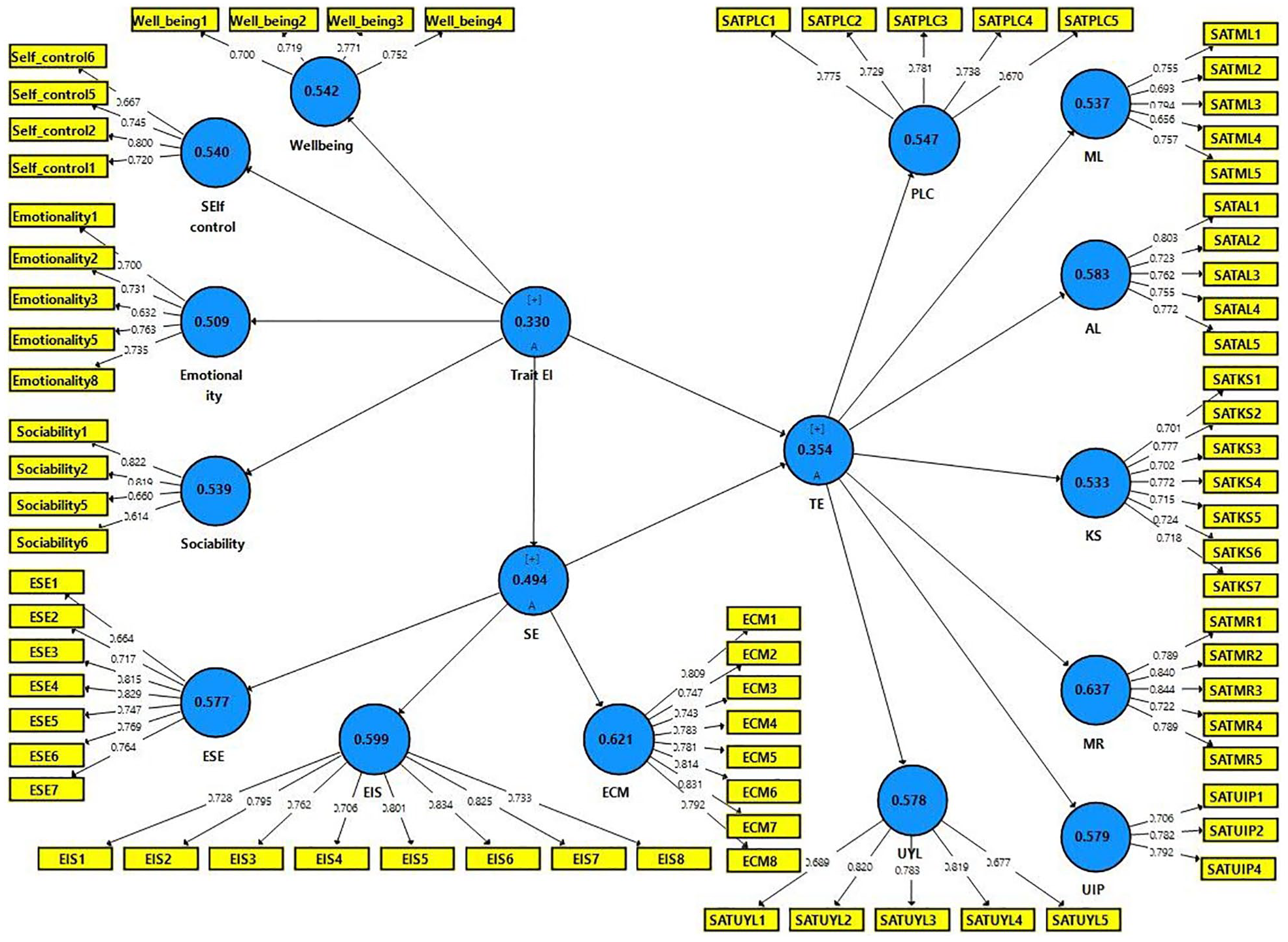
Measurement model lower-order constructs. Note: Well_being1-4, Self_control (1, 2, 5, 6), Emotionality (1, 2, 3, 5, 6), and Sociability (1, 2, 5, 6) are observed items related to the latent variables Well-being, Self-control, Emotionality, and Sociability respectively (sub-constructs of TEIQue); ESE1-ESE7, EIS1-EIS8, and ECM1-ECM8 are observed items of latent variables Efficacy in Student Engagement, Efficacy in Instructional Strategies, and Efficacy in Classroom Management respectively (Sub-constructs of TSES); SATPLC1-5, SATML1-5, SATAL1-5, SATKS1-7, SATMR1-5, SATUIP1, 2, 4, and SATUYL1-5 are observed items of latent variables Planning Lessons and Courses(PLC), Managing Learning (ML), Assessing Learning (AL), Subject Knowledge (KS), Managing Resources (MR), Using Inclusive Practices (UIP), and Understanding Your Learners (UYL) respectively (Sub-constructs of Self-Assessment Tool used for Teacher Effectiveness).

Measurement model of higher-order constructs. Note. TEIQue latent variable is accompanied by four observed variables, Self-Efficacy (TSES) latent variable is accompanied by three observed variables; Teacher Effectiveness (SAT) is accompanied by seven observed variables.
Discriminant validity of the LOCs and HOCs were assessed through the HTMT values which should be ≤0.85, the stricter criterion, and the mode lenient criterion is it should be ≤0.90 (Henseler et al., 2015). Values of HTMT were all lower than the stricter criterion of ≤0.85 implying that the respondents understood that 14 sub-constructs are distinct. See Tables 3 and 4 for HTMT values of LOCs HOCs, respectively. HOC measurement model was also valid and reliable (Figure 3). Latent variable scores of the LOCs obtained from the first stage were used to create and estimate the stage two model.
Discriminant Validity Assessment of the Lower-Order Constructs (HTMT).

Note. HTMT = heterotrait-monotrait ratio; ESE = efficacy in student Engagement; EIS = efficacy in instructional strategies; ECM = efficacy in classroom management; PLC = planning lessons and courses; ML = managing lesson; AL = assessing learning; KS = subject knowledge; MR = managing resources; UIP = using inclusive practices; UYL = understanding learners.
Discriminant Validity (HTMT) HOCs.

Structural Model
Path coefficients assessment
A standard PLS-SEM criterion is applied to assess the structural model of the HOCs (Becker et al., 2012). Thus, in order to assess the significance of the path coefficients standard bootstrapping procedure was run with 5,000 samples (Hair et al., 2017) using SmartPLS3 software, resulting in direct and indirect (mediation analysis) path coefficients (Figure 4).

Structural model of the StudyNote. Inner model presenting path coefficients and t-values; Outer model displaying t-values; R square for constructs shown within circles.
H1, ESL teachers’ trait EI is positively related to TE found empirical support (β = .157, t = 2.913, p = .002). Influence of trait EI on teacher SE (H2) was also empirically supported (β = .570, t = 13.568, p = .000). Lastly, the hypothesis that teacher SE is related to and influences TE (H3) found empirical support as well (β = .580, t = 11.477, p = .000). Path coefficient results are presented in Table 5.
Structural Model Assessment.

Predictive power of the model
The coefficient of determination (R2) helps to understand the variation explained in the dependent variables of the study (Hair et al., 2017). However, the r-squared value could vary across different fields of study. In Social Sciences research domains, a minimum of .10 R2 is agreeable (Falk & Miller, 1992). The study found R2 values of .325 and .465 for teacher SE and TE, respectively, considered moderate but acceptable values (Chin, 1998). Effect size, f-squared (f2) of trait EI on TE revealed weak effect (f2 = 0.031), however trait EI exerted large effect over SE (f2 = 0.481) and SE exerted large effect (f2 = 0.425) over TE (Chin, 1998).
In order to assess the predictive relevance of the study blindfolding procedure was run (Geisser, 1974; Stone, 1974), which suggests that cross validation redundancy measure Q2 value should be greater than zero (Chin, 1998). Consequently, the Q2 values for both endogenous variables (i.e., SE and TE) were found to be greater than zero, see Table 6.
Predictive Capability of the Model.

Mediation analysis
Teachers’ SE mediates the relationship between trait EI and TE (H4) found empirical support as well. Indirect effect of teacher SE over TE revealed the mediating role of SE (β = .331, t = 9.012, p = .000). It was also found that the indirect effect (LL = 0.273, UL = 0.393) does not straddle a 0 in between (Preacher & Hayes, 2008), refer Table 7.
Path Assessment for Mediating Effect of Self-Efficacy.

Discussion
The overarching aim of this study was to investigate the ESL teachers’ trait EI and SE as precursors to their TE. This research suggests that trait EI and SE leads to improved TE as positive relationships among the variables were found. The test of the four hypotheses through a higher-order model in an SEM bears the evidence. The study hypothesized that trait EI is positively related to TE (H1). The study is centered upon trait EI theory (Petrides & Furnham, 2001) and is operationalized through its four sub-constructs (well-being, self-control, sociability, and emotionality), placed as the lower-order components in the HOC model of the study. These observed indicators played a key role in explaining the total effect of the trait EI on TE. However, weak effect size (f2 = 0.031) of trait EI on TE in the study indicates that other factors might be influencing this relationship and need exploration. The results advance previous studies which emphasize the importance of EI as a pre-requisite for an effective teacher (Oplatka & Arar, 2018; Trigwell, 2012; Uitto et al., 2015).
A positive relationship was found between trait EI and SE, which confirmed the study H2 as well. Findings corroborate the results of the previous studies on the relationship between EI and SE as an important factor in achieving teaching success (Kostić-Bobanović, 2020; Moafian & Ghanizadeh, 2009; Sarkhosh & Rezaee, 2014). As a latent variable, teacher SE was operationalized through its three sub-constructs: classroom management, student engagement, and instructional strategies. The relationship between trait EI and teacher SE is of significance as asserted by the large effect size (f2 = 0.48) of trait EI on SE, indicating important role that trait EI plays in establishing high SE of the teachers. Teachers with high levels of SE have confidence in their ability to attain high levels of performance and are able to welcome challenging tasks resulting in effective performance (Bandura, 1997; Tschannen-Moran et al., 1998).
The study also predicted a positive relationship between teacher SE and TE hence landing support to H3 of the study. The large effect size (f2 = 0.425) of teacher SE on TE indicates a promising role that SE plays in predicating TE and outcomes (Klassen & Tze, 2014; Sehgal et al., 2017). The study results corroborate the conclusions reported by previous research involving pre-service teachers and teachers in school contexts (Chen, 2019; Klassen & Chiu, 2010; Liu et al., 2018) which emphasized that SE is a crucial factor for TE. At the HE level limited studies have investigated the importance of teachers’ SE for their professional effectiveness relating to their teaching styles, cultural context, and perceptions, etc. (Baleghizadeh & Shakouri, 2017; Chang et al., 2011; Fives & Looney, 2009; Phan & Locke, 2016). However, no prior research appears to have particularly investigated the relationship between ESL teachers’ SE and TE in HE settings. Thus, the results of this study highlight the significance of this relationship for future researchers and ESL teachers in HEIs.
SE as a mediating variable between trait EI and TE plays a significant role, confirming the H4 of the study, and proved to be consistent with the SE theory of Bandura (1997). Literature bears no evidence of studies that have investigated the role of teacher SE as a mediator in the association between trait EI and TE. However, as reviewed earlier, previous research reveals that teacher SE played a key role in mediating the relationship among various teacher attributes of pre-service and HE teachers (McLennan et al., 2017; Mohamadi & Asadzadeh, 2012; Zhang et al., 2019). Therefore, the mediating role of teacher SE in the relationship between trait EI and TE confirmed in the study have sound support, therefore is reasonable.
Theoretical Implications
The present study contributes to the existing body of literature through establishing the link between the three crucial variables together and assessing their relationship. The significance of trait EI for HEI teachers was an underexplored area; this study has contributed to highlighting the key role that trait EI plays for overall TE. This lends support to Petrides et al. (2007) claim that trait EI is an important personality trait for success and adaptation at the workplace. Also, in line with previous research, the study contributes to the literature on the significance of teacher SE and on the role of SE as a mediator most predominant in the social cognition tradition (Bandura, 1986). However, SE is linked to show its influence on ESL TE and to mediate the relationship between trait EI and TE, which was not explored earlier, to the best of our knowledge. This implies that teachers with strong SE beliefs (Bandura, 1997) are likely to utilize their trait EI better for becoming effective performers. They would be able to relate better with their students and surrounding situations and would tend to produce promising outcomes.
Furthermore, the study has confirmed the significant contribution of affective dimensions toward TE (Borg, 2011). This suggests that effective teachers are not just the holders of subject knowledge and professional practices (Borg & Edmett, 2019), but must also possess emotional well-being, self-control, social skills, and SE. An important contribution is also the context of the study, that is, ESL teachers teaching at HEIs in an Asian context, an underrepresented and underexplored context until now. However, at broader level study results might also prove to be beneficial for other ESL contexts and also for second/foreign languages other than English.
Practical Implications
Kubanyiova and Crookes (2016) state that though the 21st century has led to enriched understanding in all fields, the roles of language teachers are not sufficiently supported by work contexts and societal expectations. They emphasized that teachers should be equipped with the required knowledge through teacher training opportunities. Study findings provide useful, practical implications for ESL/EFL context researchers specifically and to teacher education researchers more broadly. Results encourage researchers to revisit the field of teacher education and explore connections between TE and affective factors. These outcomes emphasize the importance of incorporating trait EI training as part of teacher education programs in general and in ESL/EFL contexts specifically. Though results suggest trait EI training of HEI teachers, implications are equally pertinent at all levels of education (Dewaele, 2018). Trait EI and SE can be developed through training, professional development programs, and self-awareness sessions (Dewaele, 2018; Klassen & Tze, 2014; Rimm-Kaufman & Hamre, 2010). Henceforth, it is suggested that educational administrators, stakeholders, and policymakers pay emphasis to these factors. Study findings have important implications within the context, as teacher training programs and educational policies require attention to focus on EI and SE development for the success of HE in Pakistan and the Asia-Pacific region.
Limitations and Future Directions
First, the cross-sectional design of the study limits the causal inferences of the results. Thus, a longitudinal design is suggested to investigate and highlight considerable variations and developments among the study variables with greater certainty. Second, moderating role of the demographic profile factors such as age, gender, teaching experience, and highest education could have given a better understanding of the relationships in focus. The third limitation concerns the measurement methodology for the study variables. TE was operationalized through teacher self-assessment report. However, in future, student feedback and classroom observation protocols could be used alongside self-report data (Goe et al., 2008).
Moreover, the study model explained 32.5% of the total variance in teacher SE and 46.5% of the total variance in TE. Therefore, future studies may consider explaining the remaining 67.5% and 53.5% of variance for SE and TE with other potential variables that may be influencing TE. In the present work, sub-constructs of the higher-order latent variables, trait EI, SE, and TE, were not considered to assess the individual effect and relationships with other sub-constructs at the lower or higher orders in the model. Future studies could also consider this aspect, as this will help explain the complex relationships and influence of specific sub-constructs on other variables in the study model. Study limitations suggest that the present results should not be excessively generalized. Further investigations should strive to overcome the mentioned limitations as much as possible.
Conclusion
The present study significantly contributes to the existing body of knowledge in that it relates ESL teachers’ trait EI directly to TE and SE and SE to TE. The study has also provided insight into the mediating role of SE in the relationship between trait EI and TE. Results of the study have provided considerable support to the important theoretical propositions by successfully supporting all the research hypotheses. However, teacher SE was found to be more significant as it revealed larger effect on teacher effectiveness than trait EI and also mediated the relationship between trait EI and teacher effectiveness. The theoretical framework of the study has contributed to the domains of trait EI theory and social cognitive theory in relation to TE.
Additionally, the study is of significance to the administrators, teacher educators, and teachers interested in understanding the underlying psychological mechanism that could facilitate TE, particularly in the HEIs. The study has added theoretical and practical implications to contribute to the body of research, for international and local contexts, along with limitations and future research suggestions. We look forward to future research that would further investigate the phenomenon.
Footnotes
Acknowledgements
We would like to acknowledge Dr. Valerie Haugen, Director VoxPacis International Development USA, for the language and editorial feedback and Dr Amtul Qayoom, Associate Professor, NED University of Engineering & Technology for her technical guidance during the initial stages of the research process.
Availability of Data and Material
Will be made available upon request.
Code Availability
SmartPLS3 Software and SPSS version 22.
Declaration of Conflicting Interests
The author(s) declared no potential conflicts of interest with respect to the research, authorship, and/or publication of this article.
Ethics Statement
Informed consent was obtained from all individual participants included in the study.
Funding
The author(s) received no financial support for the research, authorship, and/or publication of this article.
