




Abstract
In the ever-changing landscape of China’s digital economy, comprehending the transition drivers from latent to active participation in entrepreneurship is critical. This research explores the factors shaping the decisions of latent entrepreneurs to become active entrepreneurs in a digital context. Using simple random sampling, this study randomly selected 18 industries within China’s major cities. This study collected cross-sectional data from 485 respondents in high-tech and low-tech industries across six major Chinese cities and tested the model using partial least structural equation modeling (PLS-SEM). Statistical findings conducted by SmartPLS reveal a nuanced interplay between personal factors and external traits in shaping the transition to active entrepreneurship. In particular, entrepreneurial competence, digital skills and literacy, and adaptability are crucial personal factors influencing this transition. Access to the necessary technology, startup cost, market and customer base, and government support are external traits found to significantly shape individual decisions to venture into digital entrepreneurship. Surprisingly, Logistics and Transportation (LAT) had no substantial impact on the transformation. This investigation strengthens entrepreneurship theory while also providing policymakers and industry actors with practical insights. Personalized training for entrepreneurs, spending on digital infrastructure, evidence-based regulations, and enhanced business innovation initiatives are among the recommendations.
Plain language summary
This study investigates why some people in China go from dreaming about starting a business to actually executing it, particularly in the digital sphere. This study investigated elements that impact this transition, which include personal factors and external traits. To do that this study randomly selected 485 persons from various industries and cities in China and evaluated their data using a method known as partial least structural equation modeling. In this study, we discovered that personal factors such as individual skills in digital technology, personal competence, and adaptability have a significant impact on their decision to establish a business. External forces including access to technology, enough funding, establishing markets and customers and political assistance are also significant. Interestingly, the study discovered that the logistics and transportation industry had no influence on whether or not someone became an active entrepreneur. Overall, this research improves our understanding of entrepreneurship and makes recommendations for how governments and corporations may assist people who wish to establish digital firms. This study advocates for tailored entrepreneur training, investments in digital technology, evidence-based policymaking, and supporting more innovative business practices.
Introduction
The modern entrepreneurial landscape is experiencing substantial change, partly due to the rising incorporation of digital technologies into the operations of businesses (Kraus et al. 2019). This dramatic change in the digital landscape is influencing not only how we interact but also how business ambitions manifest. The shift from latent entrepreneurship, in which individuals retain hopes of entering the business world, to the development of successful entrepreneurs has recently taken on a new dimension. Thus understanding the drivers of latent entrepreneurial transition becomes critical in the arena where pixels meet paychecks.
Entrepreneurship, a field that was previously limited to traditional models and physical stores, is now fully submerged in the digital domain. This transition has resulted in the democratization of entrepreneurship, allowing people from many backgrounds to examine and get involved in business activity (Sahut et al., 2021). Digital technology provides flexible work arrangements and remote cooperation, yielding major benefits to people with latent entrepreneurial aspirations who want to develop their initiatives while managing other duties (Kraus et al., 2019). It enables latent entrepreneurs to interact with potential customers, test out new ideas, and launch businesses with little initial capital by providing them with an array of platforms and advanced tools (Aloulou et al., 2024; Taeuscher & Rothe, 2024). For instance, the advent of online marketplaces such as WeChat and Douyin (TikTok) have emerged as critical instruments for marketing, consumer engagement, and developing brands, shaping latent entrepreneurs’ decisions to launch active businesses. The widespread use of social media and the growth of crowdfunding websites further give latent entrepreneurs ways to showcase their goods and services and obtain valuable feedback, and financial resources (Brown et al., 2018). This transforming landscape not only provides a fertile foundation for growing firms but inspires a wide spectrum of individuals to embark on entrepreneurial adventures, enhancing the entrepreneurial ecosystem with new viewpoints and innovative ideas.
Despite the plethora of research on entrepreneurship and the digital economy, there exists a significant vacuum in understanding the transition drivers of latent entrepreneurship in a digital context. Recent research has extensively examined the influence of digital technology on entrepreneurship, emphasizing the importance of online marketplaces, social media marketing, and remote communication tools (Aloulou et al., 2024; Kraus et al., 2019). However, the emphasis has frequently been on the effect of entrepreneurial activity rather than the essential period of moving from latent intents to apparent operations. For example, Shane and Venkataraman (2000) proposed the notion of entrepreneurial opportunities as the motivating factor underlying venture development. While this paradigm has been useful in comprehending the process of opportunity perception and exploitation, it fails to elucidate the precise elements that move individuals from pondering entrepreneurial concepts to realizing those concepts in the digital domain. Similarly, Davidsson and Honig’s (2003) research stressed the importance of personal characteristics and motives in entrepreneurial decision-making. While these discoveries have been extremely beneficial for comprehending entrepreneurs’ mindsets, they fail to adequately capture the distinctive factors shaping the transition from latent aspirations to entrepreneurial ventures within the digital context. This study seeks to bridge this gap by answering the question: what factors influence the transition from latent to emergent entrepreneurship in the digital age? it is inspired by the synthesis of the above most widely recognized researched works by Davidsson and Honig (2003) and Shane and Venkataraman (2000). Prior research has provided valuable insights into the personal traits and external factors that impact the process of entrepreneurship. However, these studies have not fully explored the intricate relationship between these drivers and the transformation of latent entrepreneurial aspirations into tangible business ventures. The primary focus of this study is to reveal the factors contributing to the shift from latent to active entrepreneurship in the digital era.
Building on prior literature, this study considers personal factors including digital skills and literacy, entrepreneurial competence, and adaptability as factors affecting the transition of latent entrepreneurship in a digital economy. This study further considers market and customer focus, startup cost, access to the necessary technology, government support as well as logistics and transportation as external traits shaping the decision of latent entrepreneurs to become active entrepreneurs in the digital economy. Prior studies highlight the pivotal role of digital skills and online networking in generating entrepreneurial goals (Gielnik et al., 2017; Obschonka et al., 2020). Market and customer base are also proven to be at the heart of entrepreneurship in the digital environment (Sahut et al., 2021). The capacity of latent entrepreneurs to collect, evaluate, and decipher digital data is essential since it offers perceptions of customer behavior and market trends, which in turn impacts corporate choices (Zaheer et al., 2022). Individuals who can easily identify digital demands and opportunities and are ready to place user experience and customer happiness first in their anticipated business have higher success chances (Yadav & Pavlou, 2020).
This study’s finding addresses a critical theoretical hole by putting light on the transition of latent entrepreneurship dynamics in the digital context. This study offers a unique contribution by offering a comprehensive framework that integrates personal factors and external traits within the concept of latent entrepreneurship transition in the digital economy. This study advances the literature on digital entrepreneurship from a global perspective by exploring deeper into the transition process that investigates how personal factors such as digital literacy, entrepreneurial competence, and adaptability interact with external traits including market focus, startup costs, technology access, government regulation, and logistics and transportation. For example, This study advances comparative research findings conducted in Europe and Asia on latent entrepreneurship in transition economies by Atasoy (2015), shedding light on the obstacles posed by underdeveloped financial markets and political instability. Similarly, it advances the research findings of Van der Zwan’s socioeconomic analysis using entrepreneurs’ survey data from the United States and 32 countries in Europe and Asia, emphasizing the impact of gender, age, education, and family background on entrepreneurial engagement (Van der Zwan et al., 2016). Understanding the underlying drivers shaping this transition in the digital domain helps to a more comprehensive theoretical framework. This study’s findings can be used by policymakers to create more targeted policies that foster the creation of digital businesses, taking into account individual needs at the early stage of the entrepreneurship process. Furthermore, latent and emergent entrepreneurs can use the practical insights gained from this study to design strategies for navigating the hurdles of moving to the digital environment, taking into account the interaction of elements. This study will proceed with a theoretical framework and a brief examination of relevant literature on latent and emergent entrepreneurship in the process of developing a hypothesis related to the study model. This will be followed by methods, results, and discussion. lastly, theoretical and practical implications and research limits will be discussed. Based on this theory, this study considers
Theoretical Framework and Literature Review
In the dynamic landscape of the digital economy, the transition from latent to emergent entrepreneurship is a delicate process compared to the traditional economy. Studies have shown that numerous business activities have been shaped by the dynamic landscape of the digital context (Parida et al., 2019; Ritter & Lund, 2020). For example, the role of technology in modifying organizations’ business models offers numerous new forms of corporation among different organizations in the form of digital platforms, leading to the creation of new startup ventures, and the change in customer and employee relationships (Nicoletti et al., 2020; Pitoyo & Suharyanto, 2020; Yadav & Pavlou, 2020). This modification in entrepreneurial processes generated by the influx of digital technology is anticipated to make a considerable difference in the actions and behaviors of individuals regarding occupational choice.
China is among the world’s leaders in digital technology adoption, with a thriving startup culture and a sizable market of tech-savvy customers (Keane et al., 2020). The growing usage of mobile devices, in addition to internet access, has generated a fertile environment for digital platform-based entrepreneurial initiatives (Wang et al., 2024). Based on McKinsey research, the Chinese digital economy will account for 22% of its GDP in 2025, underlining digital technology’s vital function in fueling economic growth and innovation. The growing adoption of digital technology by Chinese consumers and enterprises along with China’s massive market size, diverse customer demographics, and vibrant corporate ecosystem offered an ideal environment for aspiring entrepreneurs to launch novel goods and services (Keane et al., 2020; Wang and Yang, 2024). These factors not only shape the evolution of entrepreneurship in the country but also distinguish it from other Asian countries (Aloulou et al., 2024; Keane et al., 2020).
Prior studies have attempted to evaluate factors that determine the choice of becoming self-employed based on the influence of various factors. For example, Blau et al. (1956) introduce the concept of the occupational model that attempts to explain how individuals choose to work in various occupations. This model stressed that when it comes to occupational choice, each individual has two options: entrepreneurial activities or wage employment (Blau et al., 1956). Scholars disagree with what motivates people to choose between entrepreneurship and wage employment. They argued that individual abilities, risk aversion, production, firm size, and technologies are the different basic assumptions that differentiate various occupational choice models (Medrano-Adán et al., 2019; Thewissen & Rueda 2019; Villena-Martínez et al., 2024). For instance, Medrano-Adán et al. (2019) believe firm size and productivity as the basis for an individual to choose between being self-employed or wage-earning. De Vries et al. (2020) consider entrepreneurial abilities as the basis for an individual to choose to be an entrepreneur instead of wage-paid jobs. While Barone et al. (2021) and Villena-Martínez et al. (2024) believe in the level of individual differences in risk aversion, Thewissen & Rueda (2019) believe in technological change. Justo et al. (2021) stressed that being an entrepreneur is associated with more satisfaction in contrast to remaining inactive because of retirees and homemakers. Other studies considered being self-employed as a necessary choice (Ceular-Villamandos et al., 2021; Ferrín, 2023), environmental influence (Usman & Sun, 2022), personal character like age, sex, and education among others (Abuhashesh, 2019; Cowling et al., 2019; Garima, 2017; Khan Breitenecker & Schwarz, 2014) and a livelihood choice in which the choice depends on the stock of initial wealth distribution (Banerjee & Newman, 1993; Colovic & Mehrotra, 2020). Axelrad and Tur-Sinai (2021) considered retirement as a factor leading to becoming self-employed. However, there is still no consensus among scholars on the factors determining the transition of latent entrepreneurship both in traditional and digital contexts. In addition, these studies frequently examine the transition determinants in isolation, ignoring the interaction of several factors. Thus, identifying factors that determine the transition of latent entrepreneurship in the digital context is critical for enriching the literature on entrepreneurship and developing policies that could enhance the process of entrepreneurship development.
To fill the outline research gap, this study proposes that personal factors and external traits are the drivers determining individuals’ choice to leave their wage-paid jobs into entrepreneurs in the digital contexts. while personal factors include digital skills and literacy, entrepreneurial competence, and adaptability, external traits include market and customer focus, startup cost, access to the necessary technology, government support, and logistics and transportation. Figure 1 depicts the structural framework of this research.

Research structure.
Conceptual Framework
Figure 1 depicts the research’s structural framework and the correlations between the identified variables. This model seeks to shed light on the intricate processes that influence the transition to entrepreneurship in the digital age, filling a critical gap in the literature and guiding policy interventions aimed at promoting entrepreneurship development. Recent research has underlined the importance of individual traits including entrepreneurial competence and adaptability in achieving entrepreneurial success (Lee, 2024; Mokbel Al Koliby et al., 2024). Entrepreneurial competency is essential for persons pursuing a career in business development, especially in innovative businesses (De Vries et al., 2020; Mokbel Al Koliby et al., 2024). Previous studies have underscored the critical importance of digital competencies in driving individuals’ desire to become entrepreneurs (Bachmann et al., 2024; Ip, 2024). Persons with digital skills are more inclined to anticipate and pursue business prospects in the digital economy (Ip, 2024). Furthermore, digital literacy has been shown to influence social entrepreneurship goals among students and practitioners (Ip, 2024). Digital skills and literacy are useful in a variety of industries and organizational sizes, particularly in tech-driven sectors such as IT, e-commerce, and digital marketing (Bachmann et al., 2024; Centobelli et al., 2020). However, there is still a void in the literature on the specific impact of these personal traits in shaping latent entrepreneurs’ transition into active entrepreneurs in a digital context.
Furthermore, external factors like market and customer focus have been recognized as important predictors of entrepreneurial initiatives (Taeuscher & Rothe, 2024). Individuals aiming for digital markets, e-commerce platforms, and online consumer segments would benefit greatly from a market and customer emphasis (Aloulou et al., 2024; Taeuscher & Rothe, 2024). Access to necessary technologies, startup costs, government regulations, and logistics concerns further significantly impact the business landscape (Chalmers et al., 2020; Pavone et al., 2024). Access to the necessary technology is critical in supporting the transition from latent to active entrepreneurship, allowing for operations in digital areas such as app development, online services, and digital products (Bansal et al., 2024). This model proposes the importance of startup costs for individuals across industries, with a specific emphasis on tech startups and digital ventures, while the factor of government regulation applies to businesses traversing digital laws and regulations (Zhao & Liu, 2024).
The proposed model fills a gap in the literature by giving a thorough explanation of the factors influencing latent entrepreneurial transformation in the digital economy. The model sheds light on the intricate interactions that influence entrepreneurial decision-making processes by combining personal and external attributes. Prior studies have frequently neglected the nuanced interaction of individual competencies and contextual elements in influencing entrepreneurial shifts, especially in the digital domain. Thus, this study holds that digital skills and literacy, entrepreneurial competence, adaptability, access to necessary technology, startup costs, market and customer base, logistics and transportation, and government support are the factors shaping the transition from latent to active participation in entrepreneurship in a digital domain. This study furthers the connection between each variable with being a digital entrepreneur in the next section.
Development Hypothesis
Digital Skills and Literacy
The development of digital skills and literacy is critical for entrepreneurs looking to migrate from latent to active entrepreneurship in the digital context, providing a path to effectively capitalize on the opportunities given by the digital world. Digital skills and literacy means individuals’ capacity to utilize digital tools and technologies for a variety of tasks, including collaborating online, digital marketing, data mining, and interaction (IP, 2024). Digital literacy and skills are critical for those who work in tech-intensive or digital fields, like electronic commerce, digital advertisement, software development, and internet-based services. Neumeyer et al. (2020) identified three different aspects of digital literacy. First, is the social dimension, which involves interacting and communicating with online stakeholders. The second is the technical dimension, which involves using digital tools and devices. Finally, involves questioning, summarizing, and synthesizing information relevant to the technology of interest called the cognitive dimension. According to research, digital literacy is an important element influencing social entrepreneurship goals and activities. Digitally literate entrepreneurs are more suited to negotiate the intricacies of the digital ecosystem, facilitating the transition from latent to active entrepreneurship (IP, 2024). Ji and Zhuang (2023) found digital skills and literacy to be an important component of the impact path toward boosting farmers’ entrepreneurial activity in the digital economy. Digital skills are essential for negotiating the complexity of digitally converting entrepreneurs, demonstrating the broad significance of digital literacy in entrepreneurship (Zahoor et al., 2023). Higher degrees of digital literacy correspond to enhanced skills networks and information technology for businesses in a variety of fields. This proficiency improves entrepreneurs’ capacity to exploit digital resources for entrepreneurship efforts, accelerating their transition from latent to active entrepreneurship (Yang et al., 2023). For instance, digitally literate entrepreneurs are better equipped to communicate with stakeholders using online platforms and tools and can analyze data to help with decision-making, support business operations, and mitigate operational hazards. The ability to communicate with stakeholders using social media and other online tools can make it easier to find and acquire information, therefore having these skills becomes essential to the process of developing a business venture (Olanrewaju et al., 2020). It was also evident that using digital technologies effectively has a greater impact on the entrepreneurial behavior of farmers who possess higher degrees of digital literacy. This emphasizes how digital literacy can affect the way that one shapes their entrepreneurial behaviors (Bai et al., 2023). Thus this study proposes its first hypothesis:
Adaptability and Learning
Adaptability is the ability of individuals and institutions to navigate the challenges found in business operations (Browder et al., 2023; Usman & Sun, 2022). It is particularly useful for businesses in constantly and rapidly changing businesses, including tech startups, digital startups, and innovative enterprises, and during periods of upheaval, technical advancement, market transformations, or regulatory reform (Espinoza-Benavides & Guerrero, 2024). In the digital world, adaptability and continuous learning are essentials for entrepreneurs. Adaptability lays the groundwork for lifelong learning and evolution (Audretsch et al., 2023). In the digital business landscape, latent entrepreneurs must constantly learn online marketing and e-commerce strategies. This is because learning in online marketing and e-commerce involves cultivating a flexible response to adaptation as much as obtaining knowledge (Browder et al., 2023). Thus latent entrepreneurs who approach learning with agility are better equipped to execute fresh e-commerce approaches, easing the move from latent desires to actionable strategies. Furthermore, running an effective online business in today’s rapid and ever-changing digital marketplace requires beyond simply a fantastic product or service. Having the capacity to adjust and adapt to innovation is critical for remaining ahead of the trajectory, satisfying consumer demands, and grabbing new possibilities (Khurana & Dutta, 2021). Therefore, latent entrepreneurs must be able to pivot, adapt to change, and adjust quickly to market conditions to transform into active entrepreneurs. Prior studies show that technology is driving innovation and reshaping businesses in the digital business world (Yang et al., 2023; Matzler et al., 2016). Fostering adaptability can help latent entrepreneurs keep up with technological advances, allowing them to use novel instruments, platforms, and methods to turn their ideas into concrete business operations. Thus when adopting emerging technology like artificial intelligence or utilizing the potential of data analytics, being adaptive may help latent entrepreneurs stay viable and turn their ideas into action plans (Browder et al., 2023). Resilience and adaptability are two important features of success within the digital business landscape (Browder et al., 2023). Being adaptive enables entrepreneurs to quickly pivot in the face of unanticipated problems or market adjustments (Browder et al., 2023; Yang et al., 2023). Adaptability allows entrepreneurs to make well-informed choices based on real-time data and alter their transition plans appropriately. Consequently, embracing adaptability and continuous learning can assist latent entrepreneurs in weathering storms, recuperating difficulties, and emerging stronger to become active entrepreneurs (Audretsch et al., 2023). Having the capacity to adapt and continuously learn allows entrepreneurs to traverse digital changes, enabling durability and adaptability amid adversities (Usman & Sun, 2022). Hence, this study proposes its second hypothesis:
Entrepreneurial Competence
The transition of Latent entrepreneurs into the active phase of digital entrepreneurship is assumed to be inextricably linked to entrepreneurial competence in online marketing and strategic e-commerce methods. This relationship is critical for those hoping to realize their entrepreneurial ideas in the ever-changing digital environment (Satar et al., 2023). The concept of entrepreneurial competence has been defined by various scholars due to its ambiguity in the literature on entrepreneurship and management (Mitchelmore & Rowley, 2010). Garima (2017) describes entrepreneurial competence as a set of skills, knowledge, and attitudes required to carry out a task successfully. Entrepreneurial competence as defined by Tsai et al. (2008) is the capacity to identify, develop, and seize opportunities. This implies that latent entrepreneurs must be able to recognize and capitalize on opportunities in the external environment to start a new venture. In essence, entrepreneurial ability is the ability and qualities needed by latent entrepreneurs to launch a business and become self-employed. These abilities include recognizing the link between entrepreneurship capacities and competitive edge (Alvarez & Busenitz, 2001) and actively searching for a wide range of assets and competencies to optimally set up resources and start a new venture (Fan et al., 2019; Siu & Bao, 2008). In the context of the digital business landscape, latent entrepreneurs must possess strategic competency in online marketing to navigate the digital realm effectively. This is because leveraging digital marketing channels, developing intriguing material, and using social media all transform critical competencies (Satar et al., 2023). This strategic online marketing competence acts as an engine for influencing the ideas of latent entrepreneurs into actionable initiatives. Moreover, competency in executing online commerce tactics such as user-friendly website design, secure payment gateways, and good management of supply chains could induce latent entrepreneurs to turn their digital ideas into practical online businesses (Khurana & Dutta, 2021). Entrepreneurial competence in online marketing and e-commerce strategies has been evident in contributing to a cohesive approach (Garima, 2017; Khurana & Dutta, 2021). Thus latent entrepreneurs that can integrate these competencies effortlessly are better positioned to solve digital problems, providing a smoother transition from latent to emergent entrepreneurship. As a result, the next study hypothesis is set as:
Startup Cost
Startup costs are the expenses incurred while starting a new business (Bryan & Hovenkamp, 2020). Since every business is unique, various sorts of startup costs are required. Startup costs such as equipment, registration fees, insurance, tax bills, and wage bills are one-time expenses that raise the barriers to entry into venture creation (Darnihamedani et al., 2018). The infusion of digital technology into various aspects of innovation and entrepreneurship has transformed the nature of entrepreneurial processes (Nambisan, 2017) leading to a drastic cut in costs for business startups. For instance, the use of technology diminishes the number of employees required in business functions, enabling new startups to avoid paying labor costs and employee benefits (Sun & Zhang, 2022; Usman & Sun, 2022). However, some mixed findings were discovered in the context of startup costs. While the positive impact of lower start-up costs on individual decisions to start new businesses has previously been documented in the literature, a few studies have suggested that high startup costs have a positive impact on individual decisions to start a new venture, especially for innovative entrepreneurs (Darnihamedani et al., 2018; Monteiro & Assunção, 2012). For instance, Darnihamedani et al. (2018) stressed that the influence of high startup costs varies according to different types of entrepreneurship. They argued that high start-up costs may lead to a positive selection of individuals who are highly motivated and expect high incomes from entrepreneurship (Darnihamedani et al., 2018). On the other hand, Fonseca et al. (2001) discovered that higher startup costs dissuade entrepreneurs and increase the proportion of people to become workers. They argued that Job creation is hampered, and employment levels stabilize. Therefore, this study presumes that low startup costs brought by digital technology will induce latent entrepreneurs to start their new ventures. It was evident that digital technology enables new startup enterprises to streamline their communication channels (Scalingi et al., 2018). Latent entrepreneurs can saturate the international markets with their messages by utilizing a variety of information technology forms of communication using digital platform ecosystems (Usman & Sun, 2022), free online texting, Emails, websites, and apps, for example, making it easier to communicate with customers at very low or no cost. Thus the next study hypothesis is set as:
Market and Customer Base
In the digital world, the transition from latent to emergent entrepreneurship is inextricably linked to market and consumer base prowess. This connection is critical as the digital landscape alters corporate dynamics, highlighting the importance of recognizing market needs and adapting to customer preferences (Hanh & Chen, 2022; Patel & Chugan, 2018). Market and consumer focus refers to Individuals’ focus on comprehending, addressing, and fulfilling the demands, tastes, and behaviors of their intended audiences and consumers (Patel & Chugan, 2018). It applies to firms in a variety of business sectors that depend on client demand and market dynamics to provide their goods or services (Zahara et al., 2023). The digital technology has led to the creation of digital marketplaces for new and existing business enterprises. These marketplaces facilitated by digital technology, allow new startup enterprises to sell their products and services not only locally, but also to regional, national, and international markets at a low cost (Scalingi et al., 2018; Srinivasan et al., 2002). It also enables vendors access to a practical sales channel and a sizeable audience while cutting expenses for operation and marketing (Patel & Chugan, 2018). However, in the digital landscape, understanding and discovering latent client demands requires the use of technology (Zahara et al., 2023). A critical factor is the deployment of digital marketing skills. Experiential market learning and vicarious market learning are two techniques that can help find and handle latent business opportunities in the digital realm (Bao et al., 2020). Entrepreneurs who adopt customer-focused digital marketing may efficiently contact and interact with their intended consumer base, hence facilitating the transition from latent to emergent entrepreneurship (Zahara et al., 2023). Latent entrepreneurs can actively engage with client demands, and use digital channels to acquire data to improve their transition processes (Stanley et al., 1995; Zhou et al., 2005). According to research, the digital market offers a customer base that has a considerable positive impact on SME performance (Cavallo & Ghezzi, 2018; Zahara et al., 2023). The deployment of the market via digital platform ecosystems enables entrepreneurs to engage with a larger market and cater to varied consumer groups by using the digital landscape’s huge reach (Usman & Sun, 2022). By prioritizing consumer requirements, entrepreneurs can strengthen their market position, facilitating the transition from latent to active entrepreneurship in the digital landscape (Zahara et al., 2023). Moreover, the study of Zhou et al. (2005) shows that entrepreneurial decisions are influenced by the institutional context, which includes market conditions. Latent entrepreneurs must match their initiatives with the market and consumer base, taking into account the impact of the larger institutional framework on the transition process (Zhou et al., 2005). The development of the digital market presents a consumer base, a fantastic investment opportunity due to the exponentially rising demand for them. For example, the acceleration of digital technology due to the influence of the recent global pandemic crisis has led to the establishment of new startup enterprises (Usman & Sun, 2022). Thus the next study hypothesis is set as:
Access to the Necessary Technology
The existence of a solid technological infrastructure serves as the bedrock for digital businesses. Access to necessary technology can be termed as the accessibility and affordability of critical digital instruments, hardware and software, and infrastructures needed for business operations and creativity (Zahara et al., 2023). It is extremely useful for organizations in tech-intensive industries like IT, software development, electronic commerce, social media, and internet-based services (Yang et al., 2023). The development of the business landscape comprising high-speed internet, cloud computing, and enhanced communication tools, benefits the transition process of latent entrepreneurs (Yadav & Pavlou, 2020). Technology resources make it easier to learn digital marketing, data analytics, and e-commerce methods (Zahara et al., 2023; Zhou et al., 2005). Armed with these skills, latent entrepreneurs are better able to negotiate the challenges of the digital economy and successfully shift their entrepreneurial pursuits. Moreover, the availability of technical resources allows latent entrepreneurs to gain access to a variety of digital venues. Technology enables small businesses to gain access to a worldwide market. Entrepreneurs can exhibit their products or services to a large audience via digital platforms and e-commerce tactics, expediting the move from local or latent entrepreneurship to a larger, emergent stage (Yang et al., 2023; Nambisan, 2017; Usman & Sun, 2022). By offering a dependable and flexible environment for digital business activities, this infrastructure helps to speed up the process of transition from latent to active participation in entrepreneurship. Studies have shown that the accessibility of technological resources encourages innovation and flexibility (Khurana & Dutta, 2021). Latent entrepreneurs can use digital tools to validate ideas, conduct market research, and react to changing market trends. This flexibility is critical for a smooth transition in the dynamic digital environment. Leveraging digital platforms, cloud services, and automation tools improves efficiency in operations while lowering costs and enhancing overall financial stability (Matzler et al., 2016; Pitoyo & Suharyanto, 2020). This, in turn, leads to a more seamless transition from latent entrepreneurship to functioning, viable digital businesses (Khurana & Dutta, 2021). Thus, access to necessary technology acts as an equalizer, enabling people with latent entrepreneurial ambitions to conquer traditional hurdles to become self-employed. Hence, the next study hypothesis is set as:
Logistics and Transportation
The exchange of goods and services is the most important aspect of a business. One of the biggest problems that hinders business startups is the flow of purchases and means of delivery of goods and services (Chung, 2021). However, the link between customers and online entrepreneurs has been stimulated by the flow of information made possible by digital technology (Kreuzer et al., 2022). As entrepreneurs go from the latent to active stages, the effectiveness of logistics and transportation networks becomes critical. Effective distribution networks backed by robust transportation infrastructure may unleash the latent potential for entrepreneurship by lowering market entry barriers and facilitating prompt delivery of goods (Audretsch et al., 2021). Logistics and transportation involve controlling the flow of purchased goods from online entrepreneurial shops on a given platform to distribution points to satisfy customers’ and enterprise demands (Dobrovnik et al., 2018; Felche et al., 2019). Logistics is the lifeblood of the business because it allows for the complete exchange of goods and services (Mikl et al., 2020). A good can be distributed individually, in bulk, or to a single client at a time. Studies have shown that investments in logistics start-ups have increased steadily over the past ten years, with an increase of about US$3.5 billion in 2017 alone with the rapid advancement of digital technology (Wyman, 2017). In the absence of the flow of goods and services, transactions and profits cannot exist. Thus in the transition from latent to emergent entrepreneurship, logistics practices evolve as catalysts. This is because logistics not only minimizes congestion, accelerates the delivery process, and ensures time but also leads to improved financial performance and cost savings for supply chain participants, fostering the creation of entrepreneurs (Baah et al., 2021; Giunipero et al., 2005). Furthermore, infrastructure for transportation is critical in affecting decisions regarding entrepreneurship. A well-developed infrastructure, for example, influences entrepreneurs’ actions by enabling them to investigate and leverage market possibilities more efficiently (Wong & Yip, 2019). However, the incorporation of digital technologies improves the operational efficiency of circular supply chains, allowing businesses to effectively address difficulties. This adoption of technology acts as a link between latent entrepreneurial ideas to forming operational strategies (Romagnoli et al., 2023). Thus the next hypothesis is set as:
Government Support
The role of government policies in the development of entrepreneurship is necessary for most latent entrepreneurs due to their scarce funding resources and lack of information (Friedman, 2011; Mason & Brown, 2013; Seo & Lee, 2019). Government support refers to the imposed rules, policies, laws, and regulations that affect business formation, operation, and development (Grosfeld & Zhuravskaya, 2013). According to a GEM report, promoting entrepreneurship and improving the entrepreneurial evolution of a country should be a key component of any government’s commitment to strengthening economic prosperity (Reynolds, 2000). Some of the main government support is the provision of infrastructural facilities, entrepreneurial education, and vital information for new venture startups, as well as simplifying the registration process and removing entry barriers in the market among others (Jegede & Nieuwenhuizen, 2020; Seo & Lee, 2019; Soluk et al., 2021). According to Neoclassical economics, lower regulations for business startups boast entrepreneurial activities (Djankov, 2017). A supportive government that allows the free market to operate according to demand and supply laws can foster entrepreneurial activities (Feindt et al., 2002; J. Zhao & Liu, 2024). This is because restrictive regulations, crippling tariffs, and taxes can stymie not only the transition of latent entrepreneurship but any entrepreneurial effort. However, with the rapid acceleration of digital technology, scholars have stressed the need for the government to encourage digital transformation of the economy (Taylor-Wesselink & Teulon, 2021), and make crowdfunding easier for new startups by relaxing regulations on local banks and angel investors that provide startup resources to latent entrepreneurs and solve financial difficulties for startups (Hopp & Stephan, 2012; Motohashi, 2013). The study of Yakovlev and Zhuravskaya (2013) demonstrates that a change in the rules and regulations for new startups raises competition and total productivity. Therefore, government policies related to entrepreneurship must be successfully implemented regardless of which administration is in power to achieve the goals of the guidelines, which are frequently lacking in emerging economies (Pals, 2006). Thus this study proposes its next hypothesis:
Methodology
The rapid expansion of China’s sharing economy and the creation of digital businesses underline the importance of understanding how people migrate from conventional jobs to digital entrepreneurship. This research seeks to address this gap by investigating the factors that influence latent entrepreneurs’ decisions to launch digital businesses. Identifying these traits is critical for industry stakeholders, policymakers, and prospective entrepreneurs looking to promote creativity, economic development, and the creation of jobs in the country’s digital environment. This study employs a quantitative approach to examine the relationship among variables by collecting and analyzing the survey data to test its hypotheses as well as achieve research objectives and answer research questions. This section discusses data and samples, including the selection criterion, how data were acquired, measurement variables, and strategies of common method bias.
Sample and Data Collection
This study collected cross-sectional data using simple random sampling from 485 individuals who are currently in paid jobs but prefer to become digital entrepreneurs in China to examine the relationship between the transition factors and being an entrepreneur in a digital context by testing the hypotheses. China and latent entrepreneurs were chosen for two reasons. First, China is a booming sharing economy in the world and digital businesses have emerged as one important economic driver in the country. Second, pressing need to examine the role of digital technology in shaping the process of entrepreneurship and innovation. Specifically, the impact of the digital landscape shapes individuals’ decisions to start new ventures, contributing to the country’s digital economy and the growth of domestic products.
The selection criterion for responding individuals was that an individual must be currently on a paid job and have the latent desire to become an entrepreneur. These individual groups are always searching for an opportunity to exit their paid jobs to start their own business. The data were primarily collected through a web-based survey. This study considers latent entrepreneurs in high-tech and low-tech firms and also within six major industrial cities in China (Beijing, Guangzhou, Shenzhen, Shanghai, Shenyang, and Shandong). We use purposeful selection sampling to select these major cities and simple random sampling to select the industries within the six major cities. These cities were chosen due to the following reasons: first, the existence of a large number of firms in the country which is an impossibility to cover them all. Second, these cities represent key markets within China’s digital economy and have the presence of high-tech and low-tech industries. Third, regional diversity and the number of populations of more than one and a half million in each city. Fourth, these cities cover a wide range of businesses, from tech hotspots in Shenzhen to financial centers in Shanghai, offering a complete picture of China’s entrepreneurial landscape. On the other hand, we use simple random sampling to select the major cities and industries within the six major cities. The firm list and contract were obtained from the Chamber of Commerce of China. We began by compiling an extensive list of industries that operate in each of China’s six largest cities, taking into account a variety of sectors including manufacturing, technology, e-commerce and retail, shipping and logistics, media and advertising, services, healthcare, finance, tourism and hospitality, food processing, and more, to ensure that our list covered each city’s diverse economic landscape. Second, we use an online random numbers generator (random.org) to allocate an exclusive number to each industry on the compiled list and randomly select the required number of industries to distribute our questionnaire among the major cities. We randomly selected three different industries from each major city, making a total of 18 various industries. Third, we double-checked the industries picked to confirm that they met the study’s criteria. Finally, a cover letter and online survey questionnaire link were sent to QQ and WeChat groups of potential respondents in various industries. A total of 359 (74.02%) were correctly filled and valid for further analysis out of 485 collected questionnaires. Following Armstrong and Overton (1977), a t-test for non-response bias (NRB) was computed in this study. The results show that there is no significant difference between the early and late waves (responses). As a result, NRB is regarded as a minor issue in this study.
Measures
The survey instruments of this study were developed based on a comprehensive investigation of the previous studies and interviews with experts who have extensive knowledge of entrepreneurship and digital technology. Some questionnaire items were renowned to suit latent entrepreneurial transition in a digital context as shown in Table 1. These measurement variables include Being an entrepreneur, digital Skills and literacy, adaptability and learning, entrepreneurial competence, startup cost, market, and customer base, access to necessary technology, logistics and transportation, and government support.
Questionnaire.

This study developed seven items to measure Being an Entrepreneur based on a five-point Likert scale ranging from 1 = strongly disagree to 5 = strongly agree. To measure digital skills and literacy as well as adaptability and learning, this study adopted the measures of Browder et al. (2023) and Yang et al. (2023) respectively. There were five items for access to necessary technology that were measured using a five-point Likert scale. Regarding entrepreneurial competence, this study develops four measures from the work of Fan et al. (2019). Market and customer base measurement items for this study were developed following Hanh and Chen (2017) and Srinivasan et al. (2002). Five items were developed and measured based on a five-point Likert scale. While logistics and transportation were developed from the work of Mikl et al. (2020), government support was developed based on the work of Jegede and Nieuwenhuizen (2020) and Soluk et al. (2021). However, measurement items of being an entrepreneur and startup cost were developed by this study’s authors based on a comprehensive study of past studies. There were seven items for Being an entrepreneur and five items for both incubators and startup costs.
Furthermore, we controlled for the following variables that could have an impact on our findings: the age of the respondents, gender, education level, professional status, and earnings. These control variables were selected based on previous studies on latent entrepreneurship. Previous research has found that the age and educational background of the owner have an impact on the platform-based transition from latent entrepreneurs to emergent entrepreneurs (Beckman et al., 2012). working age, number of employees, and venture size were all controlled variables because they could influence the latent entrepreneur’s transition into emergent digital entrepreneurs (Atasoy et al., 2013; Grilo & Thurik, 2005).
Profile of the Respondents
The detailed sample profile of the control variables in this study is depicted in Table 2. In essence, 184 (51.3%) of respondents had a university degree. 174 (48.5%) of the respondents were men. In terms of earnings, 140 (39.0%) of the respondents in our sample have (6,000–15,000) yuan as their monthly income. Furthermore, 129 employees (35.9%) have been in wage-paid jobs for (2–6) years. Furthermore, the proportion of the respondents from various technology industries operating in China was based in six cities: Guangzhou (99 or 27.6%), Shenzhen (75 or 20.9%), Shengyang (62 or 17.3%), Shangdong (51 or 14.2%) and Shanghai (31 or 8.6%). The remainder were dispersed across several locations.
Data for Control Variables.

Common Method Variance
This study uses Harman’s single-factor test to determine the existence of the common method variance (CMV). This is because the study’s data on endogenous and exogenous constructs came out of the same source (latent entrepreneurs at various firms), enabling us to assess the potential bias from CMV (Podsakoff et al., 2003). Harman’s single-factor test equation is a simple factor analysis with all variables assigned to a single factor. If a single component explains a significant amount of the variance in the data, it indicates the presence of CMV. The equation of the CMV will be structured like Harman’s single-factor test, with a single latent component (CMV factor) included to compensate for the common method variance shared by the observed variables. The CMB equation for this study can be represented as follows:




Whereas
Researchers often used SPSS software to test for the CMV. If a single factor contributes to more than half of the covariance between the measurements (>50%), it is assumed that a significant degree of CMB exists. In this study, we compared the results of being an entrepreneur and all the proposed factors that are shaping the transition from latent to active entrepreneurship. The results of Harman’s test produced nine different factors that explained 70% of the variance, and the first factor’s explanation of the total variance accounted for 36.88%, which fell short of the required 50%. As a result, the finding shows that common method bias isn’t an issue in the data that was gathered.
Data Analysis
In this study, data screening, respondent profiling, and common method variance were tested using SPSS version 24. However, to test the research hypotheses, the partial least square (PLS) structural equation modeling (SEM) approach was applied using smartPLS software 3.2.9 version in this study. PLS is a second-generation multivariate technique that is used for the generation of adequate statistical power. It simultaneously measures the relationship between the outer and inner models to reduce the error variance (Hair et al., 2019). PLS is applied in this study because it helps to estimate complex models with several constructs, indicator variables, and structural paths that are less sensitive to residual distributions (Hair et al., 2019). This study employed two steps analytical approach. First, we ran the PLS algorithm to evaluate the measurement model to confirm its convergent validity (factor loadings, Cronbach’s alpha, composite reliability, average variance explained), and discriminant validity (Fornell and Larcker cross-loadings and Heterotrait–Monotrait correlation). Next, the structural model was validated using a 5,000-sample bootstrapping procedure, which confirmed the predictive power (R2), path coefficient (β), and statistical significance. The specifics are covered in the following sections.
Measurement Model
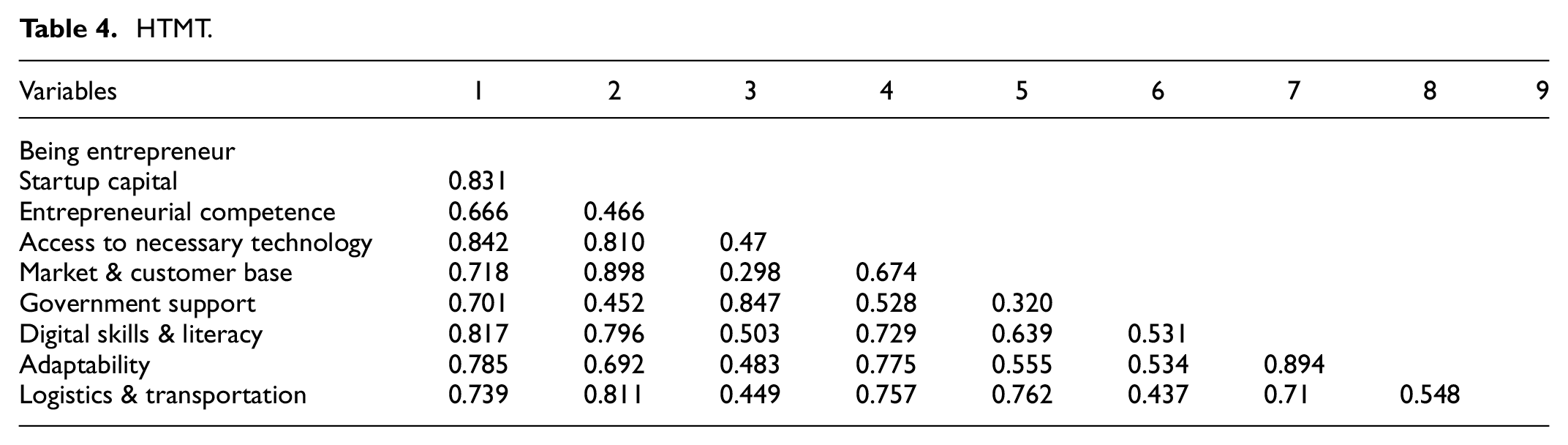
In this study, the PLS algorithm was used to evaluate the measurement model to verify its validity and reliability. Table 3 shows the findings of the construct validity and reliability analyses for the important factors in this research that relate to entrepreneurial transition in the digital context. Being Entrepreneur (BENT), Entrepreneurial Competence (EC), Digital Skills and Literacy (DSL), Adaptability (ADT), Market and Customer Base (MCB), Logistics and Transportation (LAT), Access to Necessary Technology (ANC), and Government Support (GS) are among the constructs being investigated. We first verified the convergent validity of the PLS algorithm by assessing the factor loadings of each item, Cronbach’s alpha (CR), and average variance extracted (AVE) (Hair et al., 2019), and then confirmed the discriminant validity of the algorithm through the Heterotrait–Monotrait (HTMT).
Construct Validity and Reliability of All Constructs.

Note. Items removed are indicator items below 0.4: DSL2, EC5, MCB4, MCB5, BENT5, BENT7, and ADT3, GS4.
To assess indicator reliability, factor loadings (FL) were used. Factor loading assesses the strength of the association between each observed variable (measurement item) and its latent construct. Higher factor loading suggests a more robust relationship (Hair et al. 1998). A factor loading (FL) value of 0.50 or higher is considered good and significant, 0.45 is considered fair (Hair et al., 1998), while a factor loading value less than 0.4 is considerably insignificant (Ramayah et al., 2018). In this study, all FL values (0.532–0.850) exceeded the permissible limits of 0.45, indicating that the observed variables accurately represent their respective constructs. The average variance extracted (AVE) denotes the average amount of variance recorded by each indicator for the latent construct. A value of 0.5 or higher is recommended for AVE (Fornell & Larcker, 1981). However, if Cronbach’s alpha is greater than .7, an AVE value below 0.5 is acceptable (Fornell & Larcker, 1981). Cronbach’s alpha (CR) measures the construct’s internal consistency or reliability, with values greater than 0.7 being appropriate. Higher values for CR indicate that the variables can reliably assess the latent component. Table 3 shows that the tolerable limits for CR (0.718–0.849), and all AVE values (0.517–0.688) were met, indicating excellent convergent validity. Hence, this higher level of construct validity assures that the measurement variables adequately reflect the theoretical concept of the latent entrepreneur’s transition in the digital context and the higher CR suggests reliable measures, increasing confidence in the consistency of the study outcomes.
Moreover, the Hetrotrait Monotrait (HTMT) ratio was used to determine discriminant validity. The Heterotrait-Monotrait (HTMT) ratio analyzes correlations between constructs to those within constructs (Benitez et al., 2020). It is employed for assessing whether a construct is separate from others in the model. According to Benitez et al. (2020), the acceptable limit for HTMT in a well-fitted model should be 0.9 or less. Table 4 shows that the HTMT values (0.437–0.898) were within the acceptable range. Thus, it is concluded that the study model is free of reliability and validity concerns. These comprehensive statistical analyses confirm the reliability and validity of our findings, laying the groundwork for understanding the underlying drivers of entrepreneurial transition in the digital context.
HTMT.
Empirical Findings
To test the hypothesized relationships, a bootstrapping procedure with 5,000 re-samples was used. Table 5 and Figure 2 show the results of the hypothesis testing with the bootstrapping procedure. The findings reported in Table 5 and Figure 2 provide useful insights into the links between the key factors in this study, enabling a structured examination of the hypotheses produced from our research questions. Each hypothesis expresses a precise assertion about the impact of one variable on another, representing the theoretical framework that guides this inquiry. The path coefficients in Table 5 show the degree and trajectory of the links between the predictors (digital skills and literacy, entrepreneurial competence, adaptability, startup costs, access to necessary technology, market and customer focus, logistics and transportation, and government support) and the result “Being Entrepreneur” (BENT). A positive coefficient indicates a positive association, which means that increasing the predictor variable leads to a rise in the outcome variable. In contrast, a negative coefficient shows that there is a negative link. In this study, path coefficients are supported by t-values and significance levels (p < .05) to indicate the statistical importance of each association. Table 5 and Figure 2 provide a detailed overview of the factors driving the transition from latent to active participation in entrepreneurship in China’s digital landscape. This study divides these components into two categories: personal characteristics (H1–H3) and external influences (H4–H8), each of which plays a unique part in this entrepreneurial path.
Hypotheses Testing Result.

Denotes significant at p < .05.

Result of hypotheses testing.
Personnel Factors
Hypotheses H1 to H3, covering Digital Skills and Literacy (DSL), Entrepreneurial Competence (EC), and Adaptability (ADT), reflect the personal characteristics of people traversing the digital entrepreneurial terrain. These elements are crucial to the person’s strengths and traits, which also have an immediate effect on their potential to transition from latent to actively participating entrepreneurs. Table 5 depicts that DSL is statistically significant DSL (β = .116, t = 2.203, p-value = .028). Similarly, entrepreneurial competence (EC) and adaptability (ADT) are statistically significant EC (β = .119, t = 2.322, p-value = .020) and ADT (β = .134, t = 2.506, p-value = .012) respectively. This result indicates that these personal factors have a considerable impact on the transition to active participation in entrepreneurship. Specifically, the positive path coefficients show that increasing DSL, EC, and ADT are connected with a higher likelihood of shifting to active entrepreneurial enterprises in China’s digital economy. This shows that persons with excellent digital abilities, a high level of entrepreneurial competence, and an innate capacity to adapt are more inclined to embrace chances and turn their latent desires to be entrepreneurs into concrete business endeavors in today’s changing digital environment.
External Traits
Hypotheses H4 to H8, on the other hand, are concerned with external factors that define the business environment and impact the transition from latent to active participation in entrepreneurship. These elements are Market and Customer Base (MCB), Access to Necessary Technology (ANC), Startup Costs (SC), Market and Customer Base (MCB), Logistics and Transportation (LAT), and Government Support (GS). The findings in Table 5 and Figure 2 suggest that these external traits have a big impact on the process of starting a business as well. Specifically, the positive path coefficients for ANC (β = .213, t = 4.046, p-value = .000), SC (β = .132, t = 2.226, p-value = .026), MCB (β = .121, t = 2.033, p-value = .042), and GS (β = .147, t = 3.297, p-value = .001) were all statistically significant. This study’s outcomes indicate that the shift from latent to active participation in entrepreneurship is facilitated by favorable conditions like easy accessibility to technology, lowering costs of business startups, an established marketplace and clientele, and encouraging government policies.
However, it is important to note that this study’s findings didn’t support hypothesis H7, which shows a relationship between LAT and “Being Entrepreneur” (BENT). This suggests that the digital landscape frequently facilitates remote work, transactions via the Internet, and virtual cooperation, reducing the immediate effect of physical logistics on the creation of digital business. Startups can use digital platforms and resources to reach a worldwide audience while avoiding regional constraints.
Moreover, the structural model’s predictive accuracy (R2) was evaluated. R2 and Adjusted (R2) evaluate the model’s explanatory power based on the variance explained. They indicate how much of the variance in the transition to entrepreneurship is explained by the predictive model. A greater R2 indicates that more of the variation in the dependent variable can be explained by the model. Table 5 and Figure 2 show that the structural model explains 62.9%of the variance in being an entrepreneur, indicating a collective contribution of personal and external factors in explaining why individuals transition from a latent entrepreneurial mindset to actively engaging in entrepreneurial activities in the digital economy. Specifically, this indicates that programs or policies that focus on boosting digital skills, encouraging entrepreneurial competence, urging adaptability, guaranteeing access to technology, broadening the market, enhancing logistical support, and fortifying governmental support can have a significant impact on the transition to active entrepreneurship in the Chinese digital ecosystem.
Discussion
The process of transitioning from latent to active participation in entrepreneurship within the dynamic landscape of the digital economy is complicated and driven by a variety of factors. This study deconstructs and comprehends these factors, which were divided into personal attributes and external impacts. The findings add weight to the theoretical model, shed light on both anticipated and surprising findings, and offer important insights into the driving forces behind this shift.
The findings of this study provide strong support for the importance of personality factors in facilitating the shift to active entrepreneurship in the digital domain. Hypotheses H1 to H3, which focus on digital skills and literacy, entrepreneurial competence, and adaptability, demonstrate the critical role of individual capacities in managing the intricacies of the digital entrepreneurial world. The positive path coefficients related to these personal attributes suggest that people with good digital abilities, a substantial degree of entrepreneurial competency, and the flexibility to adapt to shifting situations are more inclined to move from latent to active entrepreneurs. This study’s results are consistent with prior research investigations that have highlighted the importance of human capital, capabilities, and an entrepreneurial attitude in business success (Shane & Venkataraman, 2000; Zhao & Seibert, 2006). This study outcomes further consisted of Autio et al. (2014) and Nambisan and Baron (2013) research on the impact of digital literacy and entrepreneurial competence in leveraging digital technologies to achieve entrepreneurial growth. This study’s findings are also in line with Browder et al. (2023) and Usman and Sun (2022) who discovered how the adoption of technology might boost organizational resilience when traditional organizations encounter crises. Ip (2024) and Ji and Zhuang (2023) further discovered the effect of digital skills and literacy on farmers’ entrepreneurial performance and entrepreneurial intention and nascent behavior.
However, this research also explores the effect of external traits on the path of entrepreneurship in the digital domain. Hypotheses H4 to H8, which focus on startup costs, access to necessary technology, startup costs, market and customer base, logistics and transportation, and government support, provide insights into the structural and environmental elements that influence entrepreneurship. Although most external traits have a considerable beneficial influence, one surprising conclusion emerges: this study finding does not support hypothesis H7 regarding logistics and transportation. This result finding doesn’t support the previous studies of Mikl et al. (2020) that discuss the significant positive impact of digital logistics and transportation on the startup business. Hence, this finding calls for more research into the shifting significance of physical logistics in today’s digital world, and it shows that entrepreneurs may be less dependent on traditional transportation infrastructure for business operations in the digital age. Furthermore, prior literature has shown that external variables, such as government support and access to markets, play a significant effect. Various studies have highlighted the influence of legislative frameworks and market conditions on entrepreneurship, including those by Acs and Audretsch (2010), Baptista and Karaöz (2017), and Seo and Lee (2019). The findings of this study are in line with those of Darnihamedani et al. (2018) and Gupta et al. (2019), which highlight the impact of startup expenses, market dynamics, and customer base on entrepreneurs’ capacity to innovate and effectively establish a new venture. However, this result goes against the findings of Sebora et al. (2008), who found that government support has no impact on entrepreneurial success in the digital domain. Thus there a contradicting results on the effect of government support in the entrepreneurship literature.
This study identifies a comprehensive answer to the question raised by analyzing the interplay between personal factors and external traits. The results unequivocally demonstrate that personal attributes such as proficiency in digital skills and literacy, entrepreneurial competence, and adaptability are essential foundations for those seeking to transition into active entrepreneurship in the digital realm. Moreover, the significant effects of external factors such as market opportunities, startup costs, technical availability, and government support emphasize the importance of creating a favorable environment for entrepreneurial success (Mishra, 2019; Zhao & Liu, 2024). From an economic perspective, these findings have significant effects on the growth and long-term viability of digital entrepreneurial environments. The recognition of the fundamental drivers shaping the decision-making process of individuals empowers individuals and organizations with vested interests in such endeavors to effectively distribute resources and create conducive environments that foster the growth and progress of enterprises (Browder et al., 2023). The present investigation stresses the importance of digital entrepreneurship as a driver for economic advancement and social transformation. Mikl et al. (2020) and Radojicic et al. (2022) hold the view that digital entrepreneurship possesses the capacity to generate employment opportunities, mitigate disparities in digital resource accessibility, and foster technologically driven economic and social advancement. Hence, this investigation stresses the need to maintain investments in entrepreneurship education, digital literacy campaigns, and human capital development to ensure long-term viability and facilitate the transition from latent to active engagement in entrepreneurial activities. Additionally, this study suggests the need for cooperation between academic institutions, businesses, and governmental bodies, driving mutual beneficiary outcomes that foster the creation of a thriving environment favorable for the transition of latent entrepreneurs in a digital context,
Conclusion
This study offers an advanced understanding of the factors that impact the shift from dormant to active engagement in entrepreneurship within China’s digital environment. This study offers stakeholders a blueprint for creating a welcoming environment that encourages entrepreneurial ambitions, stimulates innovation, and sparks economic development in the modern digital era by delineating the functions of individual characteristics and environmental factors. As the digital landscape progresses, these concepts operate as a compass for converting business ideas into actions, navigating the challenges of entrepreneurship, fostering resilience, and achieving the greatest possible impact of digital entrepreneurship for the betterment of society.
Theoretical Implications
This study offers three theoretical contributions. First, theoretical frameworks frequently lack depth in contextualizing the field of digital entrepreneurship, particularly at the early stage of entrepreneurial development. There exists a theoretical gap in understanding the effect of contextual factors on the entrepreneurial process inside the digital sphere. Most studies on the factors that influence the transition from latent to active entrepreneurs have been conducted in traditional settings and have focused solely on individual characteristics such as age, experience, earnings, gender, and location (Atasoy, 2015; Grilo & Thurik, 2005; Lin et al., 2000; Wagner, 2003). However, the findings of this study highlight the critical role of digital context in facilitating the transition from latent to active participation in entrepreneurship. The outcomes of this study provide the foundation to construct a comprehensive framework for digital entrepreneurship. Researchers can enhance this paradigm by classifying transition drivers into personal factors and external traits and doing further investigation into the precise mechanisms that elucidate how these elements influence performance results in entrepreneurship. This method has the potential to serve as a fundamental basis for future investigations into the intricacies of becoming an entrepreneur in the realm of technology.
Second, this research contributes to the field of entrepreneurship theory by demonstrating the complex interplay between personal traits and external traits in the shift from potential to actual entrepreneurship in the digital environment. This perspective enhances existing theoretical frameworks, such as the Resource-Based View (Barney, 1991), by emphasizing the significance of digital skills, entrepreneurial acumen, and contextual factors in influencing entrepreneurial behavior. It complements the current literature on the impact of internal resources on entrepreneurship. Existing research emphasizes the significance of internal talents as determinants of business performance. However, this study emphasizes the crucial requirement for the intricate interplay of personal variables and external attributes for achieving success in entrepreneurship within the digital context. This research emphasizes the relevance of digital proficiency in structuring entrepreneurial ventures in the digital context and the need for individuals to have enough digital capabilities to successfully traverse the entrepreneurial landscape. The findings further underline the importance of competencies and adaptability, in addition to digital capabilities, in driving the transition from latent to emergent entrepreneurship.
Third, while previous research emphasizes the crucial influence of logistics and transportation on the development of entrepreneurship (Li & Jia, 2024), this study presents conflicting results. This unverified theory regarding Logistics and Transportation motivates researchers to explore the changing dynamics of business models in the era of digital technologies. The findings of this study present new opportunities for examining the role of online infrastructure, the digitalization of supply chains, and innovative distribution channels in digital enterprises. These findings motivate academics to utilize conventional transportation and logistics concepts in the context of the digital domain.
Practical Implications
Apart from the theoretical contributions mentioned above, this study has significant practical implications for policymakers and relevant agencies that want to enhance entrepreneurial activities in emerging economies. Businesses and policymakers can use this study’s insights about the relevance of digital skills and literacy to create programs for skill development that enable individuals to successfully transition from wage-paid jobs to entrepreneurship in the digital age. Second, entrepreneurial support organizations, such as incubators and government initiatives, might use the findings of this study to improve their offerings. This entails creating an ecosystem that promotes technical access, lowers beginning costs, and stimulates market development. This study’s findings can also benefit educational institutions in designing entrepreneurship programs that stress not only digital skills but also entrepreneurial acumen and agility. This comprehensive method prepares people for the various problems of entrepreneurship in the digital age.
Limitations and Further Study
This study’s findings offer useful insights into the issue of transition from latent to emergent entrepreneurship in the digital context. However, it is critical to admit certain limits and propose future paths to better our understanding of this dynamic subject. The nature of the transition from latent to emergent entrepreneurship in a digital context may change over time, possibly due to advances in technology and changes in public opinion, and the current findings might not adequately reflect this. Thus, future studies could offer a more thorough grasp of the temporal elements through longitudinal studies. Moreover, this research employs cross-sectional data, which limits our capacity to drive the causal correlations between the variables over time. Limited research may help future studies by examining the dynamic nature of latent entrepreneurial transformation over a long period of time.
Footnotes
Declaration of Conflicting Interests
The author(s) declared no potential conflicts of interest with respect to the research, authorship, and/or publication of this article.
Funding
The author(s) disclosed receipt of the following financial support for the research, authorship, and/or publication of this article: This study was funded by the Key Project of the National Natural Science Foundation of China (72332001) and the General Project of the National Natural Science Foundation of China (72172031).

Data Availability Statement
The survey data associated with the study will be made available based on the request.