




Abstract
This paper proposes a personalized teaching strategy based on Total Physical Response (TPR) to acquire new words. TPR combines target language items with semantically corresponding gestures conducive to learners understanding and memorizing them by repeatedly executing commands from their teachers. One limitation of TPR is that it does not allow students any freedom to creatively execute an order in ways that seem to be more interesting and meaningful to them. To address these disadvantages, we have integrated the TPR teaching strategy with a personalized teaching strategy. The participants of the experimental group (EG) performed their movements creatively; they integrated the movements with the target words to produce video productions. The participants in the control group (CG) followed the dance video supplied with the textbook. The results of the study demonstrated that the personalized TPR teaching strategy is effective and helpful for recalling the meaning of English vocabulary for higher-level students. The results of this study can benefit K-12 teachers to determine and incorporate best TPR practices for students of different levels.
Plain language summary
The purpose of this paper is to propose a personalized teaching strategy that combines Total Physical Response (TPR) with creative movements to acquire new words. The aim is to improve vocabulary learning and recall for higher-level students. The study integrates TPR with personalized teaching strategies. In the experimental group (EG), participants performed creative movements and produced video productions that integrated the movements with target words. In the control group (CG), participants followed a dance video provided with the textbook. The study compared the effectiveness of the personalized TPR strategy with the traditional approach. The results of the study demonstrate that the personalized TPR teaching strategy is effective and helpful for recalling the meaning of English vocabulary for higher-level students. The integration of creative movements and personalized video productions enhanced vocabulary development. The findings of this study have broader implications for language educational techniques. Incorporating personalized TPR practices can enhance vocabulary development and improve student performance. K-12 teachers can benefit from these results to determine and incorporate the best TPR practices for students of different levels. One limitation of TPR mentioned in the paper is that it restricts students’ freedom to creatively execute orders in more interesting and meaningful ways. Additionally, the study selected a limited number of target words due to availability and time constraints, which suggests the need for larger database studies to ensure the validity of the approach.
Keywords
Introduction
Background of the Study
Vocabulary plays a significant role in language acquisition for young learners of English as a foreign language (EFL) (Sari & Aminatun, 2021). The research reveals that EFL teachers commonly observe learners’ difficulties in acquiring vocabulary (Abdelrady et al., 2022; Nasri, 2022; Patra et al., 2022). According to Nordlund (2016), in order to gain vocabulary knowledge and securely anchor the words in long-term memory, vocabulary storage may be represented as a network, where links between words will be more or less strong based on learners’ past experiences and interactions with them. Therefore, teachers can enhance students’ learning by using mnemonics when explicitly teaching vocabulary in an EFL class (Kridis, 2023).
Total Physical Response (TPR) is a teaching strategy that uses gestures to interpret vocabulary. With the application of this strategy, it is hoped that students can enjoy learning English without being stuck in space and time (Ekawati, 2022; Rahim, 2018). The TPR teaching strategy developed by Dr. James Asher attempts to introduce some language skills via actions. In these actions, the teacher plays three roles: order taker, model provider and action monitor. Asher’s method, which emphasizes the need for an extended period of listening and following commands before speaking, is another addition to the growing number of audio-lingual alternatives, such as the Silent Way and Counseling- Learning (Sutherland, 1988). It can be concluded that using the TPR teaching strategy can help students understand the vocabulary included in their textbook, because it incorporates the body movements that children are interested in, and can make the class more active and enjoyable (Asher, 1965, 2003, 2007).
Statement of the Problem
TPR is an intriguing strategy for teaching children, teens and adults since they practice the command directly by executing physical actions (Lin et al., 2022; Rokhayani, 2017; Sumarni et al., 2022). However, in a traditional TPR teaching context, the teacher’s main role is to give commands and monitor students’ actions, to ensure that the TPR sequence proceeds efficiently (Kuo et al., 2014). Students are not given the opportunity to share their ideas and opinions in a creative manner, because they only respond to what the teacher instructs. Some students feel more comfortable responding without thinking too much (Ikhsan, 2020; Irawati, 2017; Kusumoriny et al., 2017; Pratiwi, 2018; Putri, 2016), but others feel bored or confused by the procedure and are not accustomed to learning by repetition only (Bahtiar, 2017). Safitri et al., (2017) further observed that there were some commands that could not be performed correctly by some students either because there was confusion in delivering the commands or the students did not pay attention to the teacher’s instructions. As a result, students may have difficulty converting teachers’ actions into vocabulary knowledge because they only saw and followed what the instructor did. The lack of familiarity with vocabulary meaning and learning difficulties may be caused by the teacher’s design of physical actions instead of allowing students to engage in the process themselves.
Some research indicates that the closer the context of the problem is to students’ real-life situations, the more likely they will be able to comprehend and solve the problem (Choi & Hannafin, 1997; Ulfah et al., 2020). This research suggests that when students are working with vocabulary memorization, they may perform better when the learning context is familiar than when it is more abstract. Therefore, personalizing learning by using content that is familiar to the students may be an effective way to help them comprehend and learn the meaning of vocabulary. However, there are notable gaps in the research on using personalized teaching strategies to teach English as a second language. Limited research has been conducted on the utilization of personalized teaching strategies in TPR compared with traditional TRP for learning English vocabulary.
Purpose of the Study
To address the disadvantages of traditional TPR, we have integrated the TPR teaching strategy with a personalized teaching strategy. As Ikhsan (2020) states, previous knowledge and information-processing abilities of an individual learner should be considered internal variables influencing his or her capacity to grasp the meaning of words. Personalized learning aims to enhance students’ learning by customizing the educational environment to each student’s abilities and interests (Groff, 2017). Students can take ownership of their own learning, and their performance can be improved through personalized learning, such as by incorporating personal preferences and interests (Ku et al., 2007; Ku & Sullivan, 2000, 2002; Walkington et al., 2013). The following research questions were addressed:
(1) Compared to the traditional TPR teaching strategy, how effective is personalized TPR in developing vocabulary knowledge of higher- and lower-ability students?
(2) Compared to the traditional TPR teaching strategy, how effective is personalized TPR in developing learning attitudes of higher- and lower-ability students?
Literature Review
Total Physical Response for Language Learning
After observing the interactions between parents and children, Asher noticed the sequence often took the form of initial speech from the parent followed by a physical response from the child (Shah, 2019). This creates a positive parent-child feedback loop, and trust is developed (Ross et al., 2017). Asher made three hypotheses based on his observations: first, that language is learned primarily by listening; second, that language learning must engage the right hemisphere of the brain; and third, that language learning should not involve any stress (Allen & Cowdery, 2014; Shah, 2019). According to Asher’s second hypotheses, effective vocabulary learning must engage the right hemisphere of the brain. The brain’s right hemisphere controls physical movement, and Asher sees the combination of movement with language comprehension as the most important factor in language acquisition (Ikhsan, 2020; Irawati, 2017; Kusumoriny et al., 2017; Nair et al., 2017; Putri, 2016; Shah, 2019).
TPR has been used to enhance vocabulary learning and improve vocabulary performance (Alhomaidan & Alshammari, 2016; Bahtiar, 2017; Chen, 2022; Fahrurrozi, 2017; Nuraeni, 2019; Qiu, 2016; Safitri et al., 2017). Nuraeni (2019) and Qiu (2016) studied the impact of using the TPR teaching strategy and traditional teaching strategies on young EFL learners’ vocabulary learning. Research by Nuraeni (2019) showed that while utilizing the TPR teaching strategy, children loved and were involved in their English learning. In addition, according to the findings of Qiu (2016), in terms of vocabulary spelling ability, the experimental group demonstrated superior performance compared to the control group, indicating that physical actions can effectively stimulate students’ interest in learning. Drawing from the studies conducted by Nuraeni (2019) and Qiu (2016), it has been found that the implementation of the TPR teaching strategy fosters a more relaxed classroom environment, allowing students to learn the language with reduced pressure. Consequently, the vocabulary taught in this instructional approach predominantly focuses on verbs, and is presented through visual aids that incorporate both words and corresponding body movements.
Both Bahtiar (2017) and Fahrurrozi (2017) used the TPR teaching strategy to improve the learning of verbs by Indonesian elementary school students. The research design adopted in this study is collaborative action research, which includes steps of planning actions, implementing actions, observing actions, and reflecting. This process is a cyclic model of cycles and spirals. During the research, the researchers worked with the English teacher to solve the students’ problems in learning English vocabulary during the teaching process.
Safitri et al. (2017) found that after processing vocabulary through the TPR teaching strategy, students are more likely to obtain nouns than verbs. The researchers suggested that if the command mode is verbs and nouns, teachers can classify the verbs’ tactile sense, and the nouns of these words are different, so students can easily understand and remember. Teaching TPR should start with verbs that include imperative verbs, and specific nouns, so that language learners can more easily perform and observe actions.
TPR with Personalized Learning and Student-Centered Learning
Teachers have many roles when using traditional TPR, such as controllers and models. From the beginning to the end, the teacher acts as the controller who manages all teaching activities. Through practice in the classroom, teachers also become role models for students; they use the TPR teaching strategy to discover the students’ role learning activities; that is, as members, listeners, and performers. Students who are members must actively participate in classroom learning activities and follow the instructions of the teacher. The students as the audience are listening to all the materials taught by the teacher and understanding what is being taught. The students as performers are receiving the guidance of the teacher, and the students are practicing through physical exercise (Miskiyah & Amalia, 2020).
Because students play the role of TPR listeners and imitate the teacher’s example, this strategy cannot allow students to express their thoughts in an innovative way. Creativity is a natural skill that is present in every young learner (Dere, 2019; Ritter et al., 2020). According to Bloom’s revised taxonomy, creativity is developed when students can analyze the information they have learned, make new connections with that knowledge, generate new ideas, and assess their options. In the revised Bloom taxonomy, the creation of original or substantially novel content is considered the highest level of thinking.
Using the revised taxonomy to provide learners with clear goals will help them establish a connection between past and new learning. In this process, support is needed for learners, and the taxonomy allows instructors to guide development and learning (Gul et al., 2020; Stevani & Tarigan, 2023). Unfortunately, traditional TPR classrooms do not always value creativity, and sometimes even hinder it.
Consequently, the use of personalized learning can address the limitations of the TPR teaching strategy. Personalized learning aims to meet each student’s particular requirements, talents, and interests by adjusting the teaching environment, thereby accelerating the students’ learning speed. Moreover, students can study independently (Groff, 2017). Personalized instructions are inherently more motivating for students because they can attract and maintain attention to the text. Students create powerful and memorable codes, thereby increasing the irretrievability of the related materials (Ku et al., 2007).
The success of personalized teaching in research has become a potential technology for teaching (Bernacki & Walkington, 2018; Ku et al., 2007; Ku & Sullivan, 2000, 2002; Walkington et al., 2013). Ku and Sullivan (2002) and Walkington et al. (2013) studied the impact of personalized teaching on students’ achievement and attitudes on mathematical vocabulary problems. Compared with non-personalized questions, subjects performed much better on personalized post-test questions. This level of familiarity with the problem scenario is thought to lessen students’ cognitive load in comprehending and processing problem aspects, so that students can easily solve them. This kind of explanation can also help illustrate the stronger consensus that is clearly easy to reach on the issues under the personalized theme.Ku et al. (2007) further applied this strategy to a computer-based teaching programme. Attitude data clearly showed students’ preference for personalized teaching. The different results for students receiving personalized and non-personalized teaching indicated that the personalized programme had many familiar themes, the programme was easy, and the students liked it. These findings reflect the expected nature of the personalized plan, which can make learning easier and foster the learner’s attitude toward returning to the task.
Methodology
Participants
The participants for this study were selected as intact classes using non-probability sampling. The selection was facilitated by an ongoing collaboration between the researchers and a local elementary school, which allowed for their cooperation in this study. The participants in this study were Taiwanese elementary school students, aged 7 to 9 years. The students had studied English for at least one year and had each acquired about 200 words. The students in the experimental group performed their dance movements in a creative way, and integrated the movements with the target words. In addition, they could use a wider range of reactions to express their understanding. The students in the control group performed a series of dance steps starting from the dance video provided by the textbook publisher. The groups were split into higher ability and lower ability based on their scores following a vocabulary pre-test. The final numbers of participants by ability levels were 36 higher-ability participants (EG: N = 16; CG: N = 20), and 36 lower-ability participants (EG: N = 16; CG: N = 20).
Instruments
Vocabulary Recognition Pre-Test and Post-Test
The participants took part in the Vocabulary Recognition test (see Appendix A as an example), where they were instructed to observe the presented vocabulary and record the corresponding numbers based on the sequence in which the vocabulary was spoken by the teacher. The test comprises 40 target words were selected from six nursery songs accompanied by lyrics: (1) Itsy-bitsy spider, (2) The little teapot, (3) Six ducks, (4) The old man, (5) Three blind mice, and (6) Pat a cake. The selection of target vocabulary involves considering several criteria to ensure its effectiveness in language learning. Firstly, frequency is an important factor, focusing on words that are commonly used in the language and have high occurrence rates across different texts and contexts. Secondly, relevance plays a crucial role, with vocabulary selected based on the learners’ needs, interests, and goals. Additionally, the learner-friendly aspect is taken into account, ensuring that the selected words are appropriate for the learners’ proficiency level and align with their learning goals. A total of 100 points were awarded for the 40 question items, with 2.5 points awarded for each targeted word.
The test-retest reliability of the test was .82. The researchers also asked other researchers with a deep understanding of research methods to judge the face validity of tests to ensure that the tests have good validity. To prevent the test effect when utilizing identical pre-test and post-test formats and items, the researchers took specific measures. They extended the time interval between the pre-test and post-test, allowing ample time for students to forget the specific content of the pre-test. This deliberate gap aimed to mitigate the impact of the test effect. Additionally, the researchers meticulously organized the questions in the pre- and post-tests to minimize the likelihood of the test effect.
TPR Instructional Dance Videos
The videos were provided by the Little Sprout Readers book series for young learners (Molarcher, 2016a). The dance videos corresponded with the six nursery songs, created to teach English language skills through both music and meaningful movement demonstrated by native-speaker children, with a meaning-based action for every phrase (Figure 2). The participants in the control group watched and followed the demonstration as they sang songs and enacted the lyrics through gesture and dance.
Traditional and Personalized TPR Instruction
The second researcher who taught the participants was their class teacher. The researchers used the three stages of Sevik’s “Listen and Do songs” (2012, as cited in Dzanic & Pejic, 2016) for instruction: (1) pre-teaching, (2) while-teaching, and (3) follow-up post-teaching activities.
Stage 1 Pre-teaching activities: This step is important for preparing participants for what they will hear. In this stage, the instructor showed the animation story and the nursery song with lyrics to both EG and CG participants. Then, the researchers read and explained the meanings of new words from the young learners’ books from the Little Sprout Readers book series (Molarcher, 2016a).
Stage 2 While-teaching activities: In this stage, participants were required to participate actively while they listened to the song. For the traditional TPR group, the teacher played the song again and directed the CG participants by singing and doing the motions that she had previously taught them. The participants were asked to just listen and perform the actions under the guidance from the dance videos. For the personalized TPR group, the EG participants created their own gestures for the target words (see Figure 3); they were asked to sing the song on their own and record it with a cell phone.
Stage 3 Post-teaching activities: For the traditional TPR group, the instructor divided the class into groups; he or she then instructed the groups to sing along with the song while doing the motions. For the personalized TPR group, the instructor asked the participants to present individual performance.
TPR Attitude Questionnaires
The aim of utilizing the questionnaires, which were adapted from the research of Zhen (2011) research, was to explore the participants’ perceptions of the TPR teaching strategy (see Table 1 for the questionnaires). Each group, both experimental and control, responded to six questionnaire items employing a 5-point Likert scale. The initial question aimed to assess the level of interest generated by the TPR teaching strategy. The second query sought to determine if TPR could effectively sustain participants’ attention over an extended period. The third question provided evidence of TPR’s efficacy in teaching the meaning of English words. In relation to the fourth item, the objective was to ascertain whether the TPR session stimulated participants’ interest in learning English. The fifth question addressed the ease of retaining the meaning of English words taught through the TPR teaching strategy. Lastly, the sixth inquiry aimed to gauge participants’ satisfaction with the TPR-based lesson.
Higher-Ability and Lower-Ability Participants’ Perceptions of the Different TPR Teaching Strategies.

Because the participants were very young (aged 7–9) and the wording of the questionnaires would be highly challenging even for a native speaker at this age with complex vocabulary like “recalling, lengthening, promote, satisfied, attention, effective,” the survey was completed on paper and the items were translated into the children’s native language, that is, Mandarin Chinese. The instructor helped to explain the questions to the participants in more basic language, and the wording was simplified so that a child could understand it. For example, the item, “Is it useful to lengthen your attention time in the TPR lesson?” and, “When I do the TPR class activity, I pay more attention to the lesson.”
Procedure
The vocabulary pre-test was administered to all the participants in the first week. The participants were from two intact classes, one the control group and the other the experimental group. Following the completion of the pre-tests, the participants were divided within each class by their pre-test scores into either higher-ability or lower-ability students.
From weeks 2 to 7, the six sets of vocabulary learning material were implemented in six 50-min class periods, carried out in the classroom. For the traditional TPR group, the participants were asked to just listen and do the actions under the guidance of the dance videos. For the personalized TPR group, the participants created their own gestures for the target words and were asked to sing the song. The contrastive paired pictures are provided on Figures 1 and 2. After the treatment period, all participants were administered the post-test in week 8, and then filled out the TPR Attitude Questionnaire in the following week (see Figure 3).

Example of a TPR instructional dance video.

Example of personalized TPR created by the participants.

The schedule of the experimental design.
Results
The Effect of Traditional TPR and Personalized TPR Teaching Strategy on Vocabulary Performance
The Vocabulary Recognition test was conducted to represent the prior knowledge of English. The mean score of the EG group was 11.85 and the CG group was 12.43. The result indicated that there was no statistically significant difference between the EG and CG groups in the pre-test (t = −0.25, p = .81). These two groups had similar vocabulary ability prior to the experiment. The students were further grouped by their pre-test scores into different ability groups. Guided by the quartile deviation formula (Mangal, 2010), students who score in the top 25% of the pre-test was identified as higher-ability and those who scored at or below the 25th percentile were identified as lower-ability learners.
This resulted in 32 participants in the personalized treatment (higher-ability N = 16, lower- ability N = 16) and 40 in the traditional treatment (higher-ability: N = 20, lower-ability: N = 20). Table 2 shows the descriptive data for the higher-ability and lower-ability participants of the EG and the CG on the pre-test and post-test (Tables 3 and 4).
Descriptive Data of the Different Ability Participants on Treatments of the Tests.

Note. Total possible score equals 100 points for the 40-item vocabulary recognition test.
ANOVA Tests of Within-Subjects Effects.

The Post Hoc HSD Analysis.

p < .05.
Table 2 shows the post-test performance for the two forms of treatment (control group vs. experimental group) and the two vocabulary knowledge levels (low ability vs. high ability students). A 2 × 2 ANOVA yielded significant differences for English entering knowledge, but not for personalization treatment. Those with higher-ability English entering knowledge outperformed participants with lower-ability English entering knowledge in terms of English entering knowledge level (M = 59.44 and M = 11.81, respectively), F(1, 72) = 149.02, MS = 43,505.02, p = .00*. For Personalization TPR, the mean scores were 47.34 for the personalized participants and 26.25 for the Traditional TPR participants, F(1, 72) = 12.75, MS = 7,910.16, p = .00*. The 2 × 2 ANOVA also yielded a significant two-way interaction for treatment by English vocabulary knowledge, F(1, 72) = 16.52, MS = 4,821.68, p = .00*. This two-way interaction reflected the fact that Personalized TPR higher-ability participants had considerably higher scores than Traditional TPR higher-ability participants (M = 80.31 vs. M = 42.75), but Personalized TPR lower-ability participants had a similar score (M = 14.38 vs. M = 9.75) on the post-test (see Figure 4).
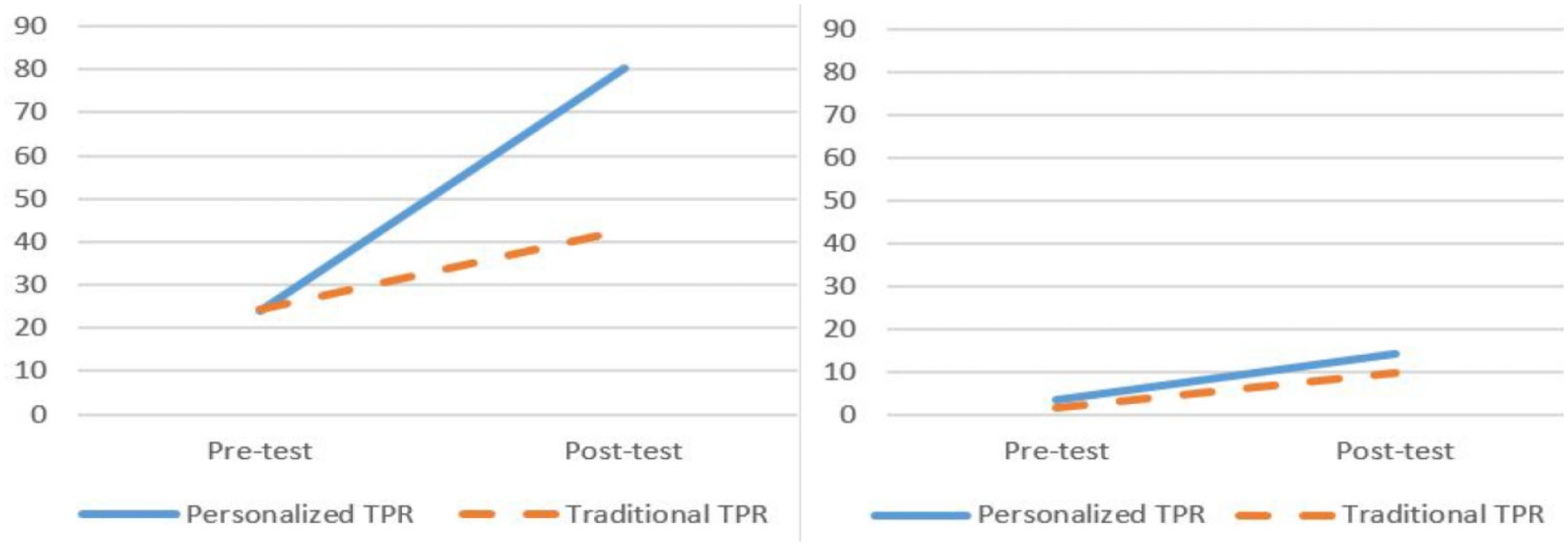
Higher (left) and lower ability (right) participants on different treatments of the pre- and post-tests.
A post hoc Tukey HSD analysis indicated that the modest difference in post-test results by treatment for participants with lower ability was not statistically significant as a follow-up to the two-way interaction (F = .38, p = .54), whereas the difference in scores favoring Personalized TPR over Traditional TPR treatment for participants with higher-ability was significant (F = 28.19, p = .00*).
The Effect of Traditional TPR and Personalized TPR Teaching Strategy on the Learning Attitude
In the EG, the higher-ability participants showed higher attitude scores than the lower ones on all survey questions. For the higher-ability participants, the two highest-rated statements on the survey were “Q5: Do you think the TPR strategy is helpful for recalling the meaning of English vocabulary? ” (M = 4.88) and “Q3: Do you think the TPR strategy is effective for teaching English vocabulary? ” (M = 4.63). In the CG, the lower-ability participants showed higher attitude scores than the higher-ability students on all survey questions. The results showed that the higher-ability participants preferred personalized TPR treatment whereas lower-ability participants preferred traditional TPR. For the lower-ability participants, the two highest-rated statements on the survey were “Q4: Does the TPR strategy promote your interest in learning English vocabulary? ” (M = 4.60) and “Q2: Is it useful to lengthen your attention time in the TPR lesson? ” (M = 4.50). For the higher-ability participants in the CG, their lowest score was for “Q4: Does the TPR strategy promote your interest in learning English vocabulary?.” However, the response to Q4 was the lower-ability participants’ highest ranking survey question.
Discussion and Conclusion
This study suggests a customized learning strategy for learning English vocabulary using Personalized Total Physical Response (TPR). The participants in the experimental group gave inventive performances of their movements, fusing them with the target words to create video compositions. The participants in the control group mimicked the choreography in the textbook’s included dance videos. The results showed that tailored TPR training is efficient and useful for remembering English meaning.
In terms of participants’ achievement, the results also revealed a significant two-way interaction. Bernacki and Walkington (2018) suggested that participants who already experienced greater situational interest in personalization of learning content, demonstrated greater concentration and less boredom when learning content, and made deeper connections to their prior knowledge about their interest. In this study, the Personalized TPR allowed students to create their movements. It also reduced students pressure and created an enjoyable atmosphere.
Specifically, personalized TPR higher-ability participants had significantly higher post-test scores than participants of traditional TPR, but personalized TPR lower-ability participants and traditional TPR participants had similar scores in the post-test. The higher ability students could likely comprehend and understand the words more quickly and therefore liked the creative aspect more as they could quickly create their own dance; the lower ability students may have preferred the “follow along” TPR as they were still trying to acquire the words.
One possible reason why the personalized treatment produced a significant achievement effect for high-ability students in this study might be because it provided the children with the opportunity to express themselves in a creative manner. Learning, according to many experts, happens when people are encouraged to engage in effective learning activities (de Jong, 2005; Kirschner, Sweller, & Clark, 2006; Liu & Chen, 2015; Mayer, 2003, 2004). However, in traditional TPR treatment, where students play the role of listeners and imitate the teacher’s example, this does not allow higher-ability students to express their thoughts in an innovative way.
To construct vocabulary creatively with learners’ own experience, learners in the personalized TPR learning group were asked to think about the meanings of the vocabulary and create their own gestures when taking videos using their own cameras. As a result, learners who copied and used solely the instructor-provided videos had more possibilities to learn independently.
Creativity is a natural skill that is present in every young learner. According to Bloom’s revised taxonomy, creativity is developed when students can analyze the information they have learned, make new connections with that knowledge, generate new ideas, and assess their options. In the revised Bloom’s taxonomy, the creation of original or substantially novel content is considered the highest level of thinking. Meanwhile, students’ creation of their own physical gestures for the target vocabulary is more challenging and time-consuming than copying the instructor’s commands.
However, thinking in novel ways is facilitated when people are willing to spend time thinking of new ways in advance, which is a learning characteristic of high-ability students. Sternberg (2006) discovered that while solving tough, novel-reasoning issues, stronger thinkers spend more time than lower-ability learners in up-front meta componential planning. Lower-ability students, on the other hand, tend to spend more time on simple activities.
The analysis of the results of the TPR attitude questionnaire revealed that most higher-ability students in the EG exhibited a higher positive attitude than the lower-ability students, toward the questions in all dimensions. The situation was exactly the opposite in the CG. The participants in both groups had good reactions to the physical response exercises and expressed a willingness to participate in them.
The attitude data clearly revealed that higher-ability students preferred individualized TPR training, a finding that is consistent with prior research (Bernacki & Walkington, 2018; Ku et al., 2007; Ku & Sullivan, 2000, 2002; Walkington et al., 2013). The most significant disparities between students who received customized vs non-personalized TPR training were that higher-ability students in the personalized TPR group enjoyed the treatment more than those in the traditional TPR group, whereas the lower-ability students favored the traditional TPR treatment.
The current findings have consequences for language educational techniques in general. Personalized TPR instruction is effective and helpful for recalling the meaning of English vocabulary for higher-level students more than the lower-ability students. The results of this study can benefit K-12 teachers to determine and incorporate best TPR practices for students of different levels, and further improve student performance. Future study might look at the efficacy of tailored TPR training in areas other than vocabulary development. Finally, it is intended that this study will give more information on the impact of individualized video-recording teaching on student success and attitudes.
Despite the positive results of this study, there are some limitations that should be noted. For example, we selected only 40 target words from the six nursery songs with lyrics for the EG students to create their own gestures because of the limitations of availability and time. As a result, larger database studies are needed to add more categories to ensure the validity of the methodological approach. The findings of this study have broader implications for language educational techniques. Incorporating personalized TPR practices can enhance vocabulary development and improve student performance. Educators and language instructors can consider implementing personalized TPR strategies in their teaching practices to support language learning and enhance student outcomes.
Footnotes
Appendix
Vocabulary Test.
Please Write Down the Numbers from 1 to 40 According to the Sequence; Each Word will be Repeated Twice.

| ____ itsy-bitsy | ____ short | ____ stout | ____ little | ____ fat |
| ____ skinny | ____ fair | ____ old | ____ fast | ____ blind |
| ____ climbed | ____ washed | ____ hear | ____ tip | ____ pour |
| ____ knew | ____ snoring | ____ bumped | ____ bake | ____ put |
| ____ spider | ____ rain | ____ teapot | ____ handle | ____ feather |
| ____ back | ____ head | ____ oven | ____ farmer | ____ knife |
| ____ steam | ____ pat | ____ get up | ____ roll | ____ out |
| ____ spout | ____ man | ____ morning | ____ mice | ____ baker |
Declaration of Conflicting Interests
The author(s) declared no potential conflicts of interest with respect to the research, authorship, and/or publication of this article.
Funding
The author(s) received no financial support for the research, authorship, and/or publication of this article.

Data Availability Statement
Data sharing not applicable to this article as no datasets were generated or analyzed during the current study.