




Abstract
This study investigates the active role of commitment in explaining loyalty programs when customers get their satisfaction and trust through a Mobile Shopping Application (MSA). Moreover, it reveals the staging process of satisfaction and trust, nesting in customers’ commitment before affecting loyalty. This study challenges freshness. Firstly, it criticizes that customers’ loyalty, as suggested by some extant research, depends on their direct benefits from loyalty programs but because of their involvement with them. Secondly, it offers a new alternative model by complementing the extant research, which discusses loyalty programs, inducing the users’ enhanced commitment. Thirdly, it proposes that research designed using cognitive behavioral therapy (CBT), which influences the users’ commitment, results in validity in conclusion by implementing the measurements of general and multidimensional commitments. Moreover, multidimensional commitment outperforms the general one. Finally, this research contributes that the functional role of users’ commitment has mediated between satisfaction and trust, and loyalty programs in using an MSA. Commitment requires satisfaction and trust but must also be developed through user loyalty. Furthermore, CBT’s interactional role is in developing customers’ commitment as the second contribution due to gaining some benefits from the firm that facilitated them.
Plain language summary
Purpose—This study investigates how users changed their cognitive processes to develop loyal behavior from their involvement. Furthermore, this study investigates the users’ cognitive staging changes to enhance their commitment to using an MSA. Method—This study employed two research methods. The first was a survey, and the other a quasi-experiment. This study used two approaches to investigate the users’ commitment: general and multidimensional commitments. Finally, this study was conducted sequentially on the three models in a mutually exclusive test. Conclusion—This study accomplished its three research objectives. The first was to present evidence that the existence and occurrence of customer commitment play a critical role in determining users’ loyalty. It means that customer satisfaction and trust affect their commitment first. Then, customer commitment influences their loyalty after they increase their commitment. Secondly, this research presented evidence that two types of customer commitment supported the causality between satisfaction, trust and loyalty. General and multidimensional commitment have a role in determining customers’ loyalty. This study inferred that although the types are different, they explain that their cognition influences customers’ loyalty, manifested in commitment. Implication—This research implies that an effective loyalty program makes social media users experience emotional bonding and commitment. This commitment improved when the users received rewards from the service providers. The users got enjoyment, entertainment, visual appeal, and social affiliation to reflect experiential values. Theoretically, this research implied that the loyalty program literature comprehended the e-commerce users’ commitment through a multidimensional approach with users’ identification and internalization of the loyalty program had to be loyal. Limitation—The measurements of general and multidimensional commitments possibly relate to the users’ personalities and cultures, creating doubt. Users’ personalities could influence the users’ commitment due to the varying levels of openness, introversion, masculinity, and other factors. Meanwhile, culture probably influences the users’ commitment because of variations in customs, mores, vogues, manners, and other communities adhere to. Moreover, this study did not control for the users’ income levels. The income per capita could affect the motivation for commitment.
Introduction
This study investigates loyalty programs when customers are committed to using a Mobile Shopping App (MSA). Loyalty programs are marketing tools a firm uses to develop and maintain customers’ satisfaction and trust (Islam et al., 2021; Mayer et al., 1995; Rita et al., 2019). Most extant research has investigated the antecedent factors for customers in loyalty programs (Islam et al., 2021; Meyer-Waarden, 2015; Meyer-Waarden et al., 2013; Mimouni-Chaabane & Volle, 2010; Stathopoulou & Balabanis, 2016). From another viewpoint, the extant research argues that loyalty programs help create and develop customers’ satisfaction and trust (Danaher et al., 2016; Ngubelanga & Duffett, 2021; Rita et al., 2019; Steinhoff & Palmatier, 2016; Uzir et al., 2021). Nevertheless, the previous research has only focused on the benefits gained by the users from loyalty programs, without investigating how users changed their cognitive processes to develop loyal behavior from their involvement. Furthermore, this study investigates the users’ cognitive staging changes to enhance their commitment to using an MSA.
This study presents a challenging freshness in three critical reasoning areas because it shows an alternative explanation that Stathopoulou and Balabanis (2016) suggested. Firstly, this study criticizes most extant ideas that customers’ loyalty depends on them receiving benefits from loyalty programs directly, but because of their satisfaction with and trust in the programs due to their involvement with them. Other research in the e-commerce context argued that satisfaction and trust directly influenced the users’ loyalty (Al-Adwan & Al-Horani, 2019; Al-Adwan et al., 2020). This study argues that getting direct services is an over-generalization, with such extant research concluding too soon. Therefore, this study investigates the users’ cognitive changes using cognitive behavioral therapy (CBT) (Beatty & Kahle, 1988; Torous et al., 2017; Wathieu, 2004), manifested in commitment. By this means, commitment is the users’ emotional bond that starts from the original idea of being loyal (Bakker & Rickard, 2019; Wathieu, 2004). In other words, this study induced the users’ commitment to explain their loyalty-changing process when using an MSA.
Secondly, this study offers a new alternative model by complementing the extant research, which discusses loyalty programs. This new model induces the users’ commitment, explaining the loyalty’s development and enhancement (Cheng et al., 2020). This study demonstrates that the users’ commitment makes them shop again using their MSA due to their emotional bond. It means that the users experience enjoyment, pleasure, and other feelings from the loyalty program (Cheng et al., 2020; López-Miguens & Vázquez, 2017), followed by their identification with its internalization (Kacen & Lee, 2002; Kelman, 1958). From another perspective, this study posits Hew et al. (2016) that the users’ identification and internalization could boost their loyalty. Thirdly, this study proposes that research designed using CBT, which influences the users’ commitment (Nadeem et al., 2020), results in conclusion validity when implementing two measurements, general commitment designed by Izogo (2015) and multidimensional constructed by Kelman (1958) and Kacen and Lee (2002). Moreover, this study’s robustness is supported by implementing two research methods, that is, a survey for general and multidimensional commitment and quasi-experiments for general commitment affected by information and procedure failures. This study argues that two models explain the customers’ emotional bond nesting in their general and multidimensional commitment. Then, we discuss how customer satisfaction and trust influence commitment before affecting loyalty.
This research uses two grouped theories and their sequential logical reasoning. The first is the social influence theory (Kacen & Lee, 2002; Kelman, 1958; Viswanathan et al., 2017) and relationship marketing theory (Gilaninia et al., 2011; Shahin Sharifi & Rahim Esfidani, 2014). This social influence theory explains that individuals use an MSA to assess their identification, internalization, and commitment. Furthermore, firms should continue developing and maintaining customers’ intimacy in long-term relationships (Gilaninia et al., 2011; Shahin Sharifi & Rahim Esfidani, 2014; Wongkitrungrueng et al., 2020). Therefore, individuals create their commitments with updated information from an MSA. The second theory combines CBT (Bakker & Rickard, 2019; Beatty & Kahle, 1988; Torous et al., 2017; Wathieu, 2004) and the social influence theory (Kacen & Lee, 2002; Kelman, 1958; Viswanathan et al., 2017; Wright & Rowe, 2011). This theory explains that an MSA program affects users’ cognition by offering prospective benefits. Consequently, MSA users will gain satisfaction and trust and finally commit to re-use the MSA. In addition, an MSA with its loyalty programs convinces users to re-use it and buy more things.
This research contributes that the functional role of users’ commitment has mediated between satisfaction and trust and loyalty programs using an MSA. Commitment requires satisfaction and trust but must also be developed through user loyalty. This study argues that customers who do not show commitment would not get satisfaction because they did not get the MSA’s benefits. In other words, if a firm fails to create customer commitment, its customers’ loyalty will also be questionable. The second contribution of this research is CBT’s interactional role in developing users’ commitment. Users would enhance their commitment, whether or not they are provided with some benefits by the firm that facilitated them. Therefore, customers have changed their beliefs, values, attitudes, preferences, behavior, and other things after accepting the benefits of using their MSA. Thirdly, this study could identify the types of commitment that explain the users’ behavior to increase their loyalty. The increased loyalty means the increased users’ commitment due to CBT is identical to the enhancement of their loyalty. This research posits Wachyudy and Sumiyana (2018) to compare the models. Moreover, it argues that multidimensional commitment (Kacen & Lee, 2002; Nadeem et al., 2020) could explain how users enhance their commitment. Meanwhile, general commitment (Izogo, 2015) also describes how users change their commitment through loyalty. Therefore, this study proposes that extant research should be criticized when using different commitment types.
Literature Review
Social Influence Theory
Kelman (1958) and Kacen and Lee (2002) introduced the social influence theory, explaining individual behavior to identify, internalize, and commit. Individuals get the identification process when they can create a satisfying relationship with another person or group. This identification process identifies which crucial matter enhances the relationship’s closeness. After placing it, individuals continue to internalize this matter into their cognition. In other words, an individual undertakes an internalization process. Therefore, they recognize this matter as a value that increases their intrinsic motivation. Finally, an individual finds compliance when conducting the identification and internalization processes. By these means, an individual reacts positively to information others or groups send. Then, an individual will engage in either an informational or normative commitment. These social influences could change the structure of individuals’ beliefs, attitudes, and behaviors (Shen et al., 2011; Venkatesh et al., 2003).
The social influence theory describes how others influence people to adopt new typical behavior in their social network (Trenz et al., 2018; Venkatesh & Brown, 2001). Meanwhile, Hwang (2016) explained how individuals get a different commitment to change their attitudes and behavior. When an individual achieves their commitment, Deutsch and Gerard (1955), Lee et al. (2011), and Trenz et al. (2018) explain that people can get informational social influences, influencing them and confirmed by others. However, normative social results illustrate that others influence people because they have group or organizational expectations. Thus, normative effects occur in groups and maintain group or organizational harmony, usually supported by positive evaluations. Consequently, people would always like to be in their position because they are recommended by the other group members (Kaplan & Miller, 1987; Wright & Rowe, 2011). This study posits Kelman (1958), Allaway et al. (2003), Kacen and Lee (2002), Viswanathan et al. (2017), and Nadeem et al. (2020) to construct and investigate the social influences which are triggered by loyalty programs. In other words, this study investigates the process of users’ spatial diffusion from loyalty programs. Furthermore, it analyses user commitment changes due to loyalty programs. Therefore, it infers that a loyalty program cannot directly enhance users’ loyalty except through the commitment process and a loyalty program.
Relationship Marketing Theory (MRT)
MRT focuses on managing and improving customers’ loyalty in a long-term intimate relationship (Gilaninia et al., 2011; Shahin Sharifi & Rahim Esfidani, 2014; Wongkitrungrueng et al., 2020). Furthermore, Shahin Sharifi and Rahim Esfidani (2014) showed that long-term intimacy between a firm and its customers could reduce cognitive distortion and dissonance. This intimacy occurs after the post-purchase phase. Thus, it can increase customer satisfaction and loyalty through perceived trust. Moreover, people always seek a reason to remain loyal, although their loyalty is not guaranteed because satisfied people can switch to other providers (Gilaninia et al., 2011). In other words, growing customer loyalty is the primary goal of long-term customer relations. This research posits Berry (2002), Gilaninia et al. (2011), Shahin Sharifi and Rahim Esfidani (2014), and Wongkitrungrueng et al. (2020) to explain how firms use their loyalty programs, which are utilized to enhance their customers’ satisfaction and trust. Furthermore, customers can develop loyalty by themselves. Therefore, we argue that relationship marketing is a tool that some firms use to influence customers’ loyalty. At the end of the program, customers would always be committed to using an MSA.
Loyalty, Loyalty Programs, and CBT’s End-Result on Satisfaction, Trust, and Commitment
Loyalty is the customers’ continuance in consuming certain products (Dick & Basu, 1994; Jones & Sasser, 1995). Loyalty manifests users’ commitment and indicates they want to consistently repurchase favored products or services (Islam et al., 2021; Oliver, 1999). This strong commitment reflects that consumers remain loyal, even though they face situational influences and marketing efforts that potentially can cause them to shift their behavior. Furthermore, McGoldrick and Andre (1997), Gustafsson et al. (2005), and Nadeem et al. (2020) suggested that consumers increase their loyalty, reflect their ongoing commitment, and avoid simple preferences. Thus, this study infers that all these increases show the presence of CBT’s end-results. Therefore, intense intimacy exists between the customers’ attitudes and intention to re-buy using the MSA.
Sharp and Sharp (1997) suggested that a firm make a loyalty program to maintain, reward, and encourage customer behavior through incentives. Loyalty programs are marketing strategies, including gift-giving, reward cards, tiered service levels, individual support contacts, and others intended to improve the customers’ attitudes and behavior (López-Miguens & Vázquez, 2017; Steinhoff & Palmatier, 2016). Furthermore, Meyer-Waarden and Benavent (2009) and Rita et al. (2019) suggested that loyalty programs increase customer loyalty through personal relationships by stimulating buying behavior. Thus, a loyalty program helps companies enhance, build, and maintain customer intimacy (Uncles et al., 2003). In addition, a loyalty program has consequences for customers’ satisfaction and trust. In addition, Gustafsson et al. (2005) and Ngubelanga and Duffett (2021) concluded that customers comprehensively evaluate their satisfaction after purchasing. Therefore, the authors argue that satisfaction is a feeling, or reaction, of fulfilment when service performance meets the expected level of service (Allaway et al., 2003; Izogo, 2015; Sur, 2011). Hence, satisfaction with loyalty programs results from confirming or not the overall benefits.
Meanwhile, this study proposes that loyalty programs affect customers’ trust. Trust can be separated into (a) trusting beliefs (Ganesan, 1994; Gefen et al., 2003) or (b) trusting intentions (Hosmer, 1995; McKnight et al., 2002; Mittal & Kamakura, 2001). Customers’ trust occurs when they have confidence in a firm due to the integrity of the services offered by this firm. It means that customers create trust whether the loyalty program treats them well or not. In short, customers believe that the firm is trustworthy, reliable, and has high integrity. Moreover, it is also related to service qualities such as consistency, responsibility, competence, fairness, honesty, and goodness (Kassim & Abdullah, 2010; Nadeem et al., 2020; Rotter, 1967). Therefore, this study argues that customer satisfaction and trust cause customers to be loyal (Al-Adwan & Al-Horani, 2019; Al-Adwan et al., 2020; Nadeem et al., 2020). In addition, customers can increase their commitment because satisfaction and trust create high-value exchange relationships (Bakker & Rickard, 2019; Morgan & Hunt, 1994; Torous et al., 2017). Hence, this research demonstrates that customers get satisfaction and trust from loyalty programs, representing the sequential order of CBT’s end-results.
Commitment to Using MSAs: CBT Presence
This study defines commitment as the customers’ psychological attachment because they enjoy and benefit from the firms (Sur, 2011). Commitment is the customers’ emotional bond that develops before loyalty (Al-Adwan et al., 2020; Beatty & Kahle, 1988; Wathieu, 2004). Furthermore, Morgan and Hunt (1994) and Nadeem et al. (2020) suggested that commitment is vital in relationship marketing and the relationships between companies and partners, such as suppliers and customers. Moreover, Moorman et al. (1992) and Islam et al. (2021) argued that committed customers are always motivated to maintain relationships because of their beliefs, attitudes, and behavior. Consequently, if customers are committed, the marketing activities will run continuously. Therefore, the committed customers will make new purchases and recommend others using the MSA.
This study considered that the users’ commitment is crucial for maintaining future cash inflows of the firm issuing an MSA. Meanwhile, it has identified two types of general commitment (Izogo, 2015) and multidimensional commitment (Kacen & Lee, 2002; Kelman, 1958). Furthermore, these commitment types demonstrate CBT inducing customers’ cognition, comprehensively leading to commitment (Bakker & Rickard, 2019; Fullerton, 2005; Shahin Sharifi & Rahim Esfidani, 2014). Therefore, this study uses both the general and multidimensional types of commitment to explain customers’ behavioral changes through satisfaction and trust. Additionally, multidimensional commitment has worked with CBT because of sequentially ordered end users’ commitment stages. Hence, two types of commitment are needed to investigate the real meaning of customer loyalty when using an MSA.
Hypotheses Development
Satisfaction Within Loyalty Programs and Commitment to Using MSAs
Satisfaction reflects the users’ positive reactions to their expected benefits. Customers who participate in a loyalty program expect future benefits (Stathopoulou & Balabanis, 2016). Furthermore, Mimouni-Chaabane and Volle (2010) and Viswanathan et al. (2017) suggested that customers are usually satisfied with firms’ loyalty programs because they benefit greatly from them. Therefore, this study considered how satisfaction affected loyalty in retail businesses (Tsai et al., 2010) and the GSM cellular phone business (Aydin et al., 2005). Likewise, other extant studies showed that satisfaction influenced customer retention (Bolton & Lemon, 1999; Gustafsson et al., 2005), new purchase intention (Brown et al., 2005; McKnight et al., 2002) and new purchase behavior (Kacen & Lee, 2002; Mittal & Kamakura, 2001). In addition, Brown et al. (2005) suggested that customers will get a higher level of satisfaction, leading to a more significant commitment (Ngubelanga & Duffett, 2021). Consequently, when customers’ expectations are met, they will emotionally attach to the loyalty program they follow (Al-Adwan et al., 2020; Tsai et al., 2010; Uzir et al., 2021). Therefore, this study argues that when customers are satisfied, they continue using an MSA. Moreover, customers would probably use MSAs because they carry out a confirmation or rebuttal process based on what they expected. Thus, this study builds the first hypothesis for Model-1 below.
H1: Satisfaction with the loyalty program positively affects the users’ commitment to using MSAs.
Trust Within Loyalty Programs and Commitment to Using MSAs
Trust reflects an individual’s belief that switching is risky due to future risks. Meanwhile, loyalty programs have risks and uncertainties. Furthermore, Bagozzi and Lee (2002) and Stathopoulou and Balabanis (2016) explained that the customers’ risk comes from their personal information registered with the firm, although they could benefit from its loyalty program. Moreover, customers believe these firms will protect and keep their personal information safe, although they could use their customers’ data to develop relationship closeness. Likewise, Morgan and Hunt (1994), Sur (2011), and Nadeem et al. (2020) explained that trust could affect the users’ commitment, strengthened by belief in the firm’s integrity and competence in handling personal data. Therefore, this study argues that trust is essential in business relationships. In addition, it also proposes that trust and belief encourage customer commitment. Through image, when a firm organizes its customers’ data in a highly reliable and secure manner in its loyalty programs, they believes that its loyalty program guarantees that it will continue to make purchases through the MSA. This study, therefore, developed the second hypothesis for Model-1 below.
H2: Trust within the loyalty program positively affects the users’ commitment to using MSAs.
Commitment to an MSA and an MSA’s Loyalty
Meyer-Waarden et al. (2013) explained that a firm could develop its customers’ emotional attachment within its loyalty program to affect their loyalty positively. Furthermore, loyalty programs can create emotional ties for the users by offering them personal treatment (Steinhoff & Palmatier, 2016; Tsai et al., 2010; Uzir et al., 2021), rewards (Wirtz et al., 2007), as well as meeting their functional expectations and needs (Fullerton, 2005; Torous et al., 2017; Wirtz et al., 2013). Therefore, this study proposes that customers will increase their loyalty because of their commitment. In other words, loyalty programs motivate consumers to maintain long-term intimacy. Moreover, this intimacy between a firm and its customers via its loyalty programs affects their loyalty, culminating in MSA usage continuously. From another perspective, it considered the customer relationship management’s view; that loyalty and commitment are a sequential process. Thus, this study constructed the third hypothesis for Model-1 below.
H3: Users’ commitment positively affects their loyalty to using MSAs.
Identification
Individuals conduct an identification process because they belong to and are group members (Zhou & Li, 2014). This identification could change individuals’ behavior by building and maintaining relationships with others or groups (Kacen & Lee, 2002; Kelman, 1958). Furthermore, the social influence theory suggests that others drive a person’s self-esteem to strengthen another person’s self-esteem (Bagozzi & Lee, 2002; Shen et al., 2011; Viswanathan et al., 2017). For example, Chu and Li (2012) explained that consumers maintain a good relationship with a company due to its benefits. In short, for consumers, this identification can make them indebted. Therefore, this study argues that the sense of belonging to a loyalty program means that companies must pay attention to their customers’ identification processes. Thus, it proposes that customers will gain more significant satisfaction levels, with some benefits, when they participate in a loyalty program as long as they strongly identify with using their MSA. In another paradigm, they will strengthen their trust in the loyalty program if they strongly identify the potential benefits in using MSA. Therefore, this study developed the hypotheses for Model-2 below.
H1a: Customers’ satisfaction with loyalty programs positively affects their identification.
H2a: Customers’ trust in loyalty programs positively affects their identification.
Internalization
Customers use their internalization process to decide the suitability of other people’s or groups’ values (Bagozzi & Lee, 2002; Kelman, 1958; Lee et al., 2011). Furthermore, they internalize what other people reflect, how other people assimilate and incorporate, and induce information into their beliefs (Al-Adwan & Al-Horani, 2019; Kaplan & Miller, 1987; Zhou & Li, 2014). Shortly, a high internalization process occurs when individuals receive satisfaction and trust that will further change their behavior publicly and privately (Kacen & Lee, 2002; Kassim & Abdullah, 2010; Kelman, 1958). Therefore, this study employs the same logical reasoning for developing hypotheses H1b and H2b as H1a and H2a presented in Model-2 below.
H1b: Customers’ satisfaction with the loyalty program positively affects their internalization.
H2b: Customers’ trust in the loyalty program positively affects their internalization.
Customers’ Identification, Internalization, and Compliance
Deutsch and Gerard (1955) and Trenz et al. (2018) suggested that social influence alone cannot be observed because of a psychological process. However, users’ beliefs, attitudes, and behavior can change due to their social environment’s specific considerations. For example, compliance indicates that someone adheres to other users’ opinions and is usually used to get a prize or avoid punishment (Danaher et al., 2016; Wirtz et al., 2007; Zhou & Li, 2014). Compliance occurs when individuals agree with other people’s views, even though they hold different beliefs (Bagozzi & Lee, 2002; Kacen & Lee, 2002; Kelman, 1958). Likewise, T. Wang et al. (2015); Hwang (2016) suggested that identification helps users meet their emotional needs. As a result, a strong sense of customer identification can foster belonging and encourage loyalty (Kim & Ahn, 2017; Shen et al., 2011). Moreover, users will enthusiastically commit and voluntarily recommend firms’ products to others (Brown et al., 2005; Venkatesh & Brown, 2001). Additionally, Zhou and Li (2014) explained that when users have reliable identification, they build relationships with the application platform and continue using it. It means that they show that their use sustains their internalization. Therefore, this study argues that when group norms are similar to users’ motives, they usually use cellular phones. By the mean, users tend to interact and socialize with others about the loyalty programs that they follow. Hence, this research constructs that customers’ identification and internalization have been influenced initially by their satisfaction and trust in the loyalty programs they belong to. Furthermore, customers always desire to use their MSA. Thus, this study developed the hypotheses for Model-2 below.
H4: Customers’ identification affects their compliance positively.
H5: Customers’ internalization affects their compliance positively.
Compliance and MSA’s Loyalty
This study posits Kelman (1958), Meyer-Waarden et al. (2013), and Bakker and Rickard (2019) explained that a firm could develop its customers’ emotional attachments within its loyalty programs, probably affecting their loyalty. Therefore, this study inferred that it affects customer commitment similarly, applying the same logical reasoning for developing Hypothesis H3. Therefore, this study developed its sixth hypothesis for Model-2 below.
H3: Customers’ compliance affects their loyalty to using MSAs positively.
From all the hypotheses developed, this study constructed two models. Research Model-1 has customer commitment intervening to explain their loyalty to using an MSA. Meanwhile, Model-2 emphasizes the customers’ multidimensional commitment to demonstrate their loyalty to using an MSA. In addition, it posits Wachyudy and Sumiyana (2018) for the model comparisons, as exhibited by the two models (Figures 1 and 2).

Research Model-1.
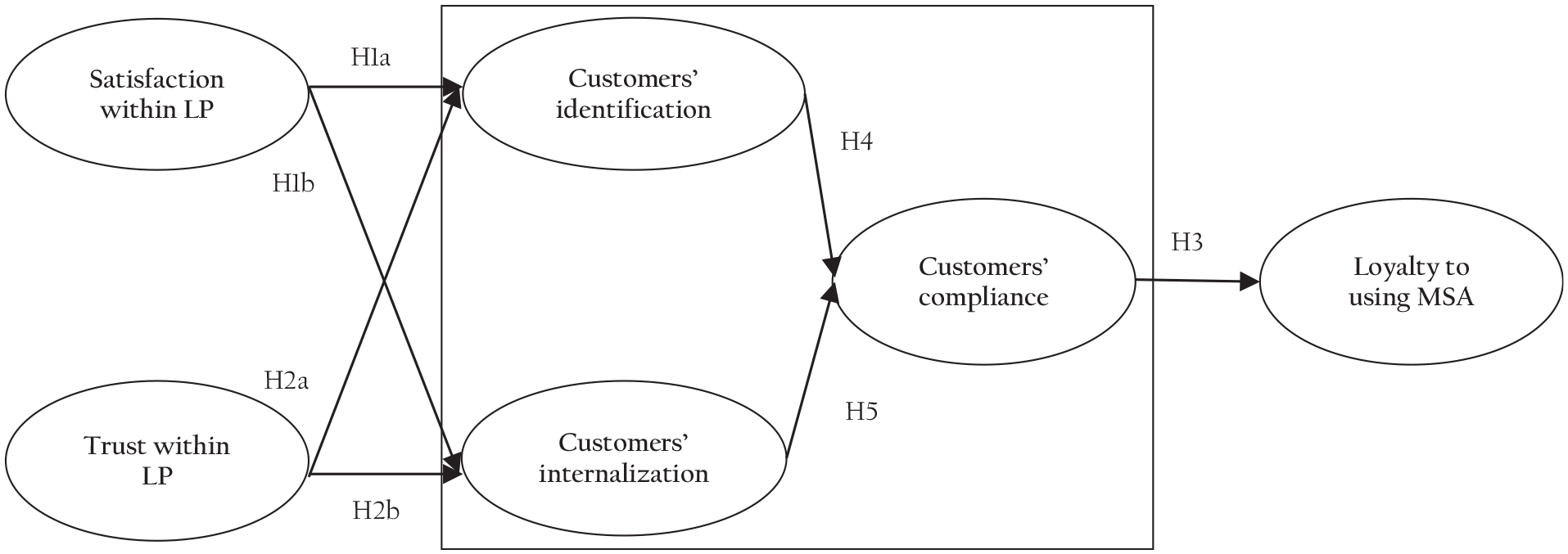
Research Model-2.
This study continued to investigate by using CBT presence robustly. It constructed an additional model, Model-3, which examines the change in the users’ commitment. The first commitment (MSA_t0) was mediated by problematic cases first, and the commitment changed (MSA_t1); it showed that the users’ commitment was a mediation of the relationship between satisfaction and trust in loyalty. This model is intended to validate behavioral therapy’s existence (Bakker & Rickard, 2019; Torous et al., 2017) and the occurrence of users’ commitment (Izogo, 2015), which this study refers to as general commitment. We argue that the highest validity of this relationship and its mediating process is at the theory level: satisfaction and trust must affect commitment first, then loyalty. Due to a mental interruption, the users’ commitment and loyalty to their MSA will change. This study presents Model-3 (Figure 3).
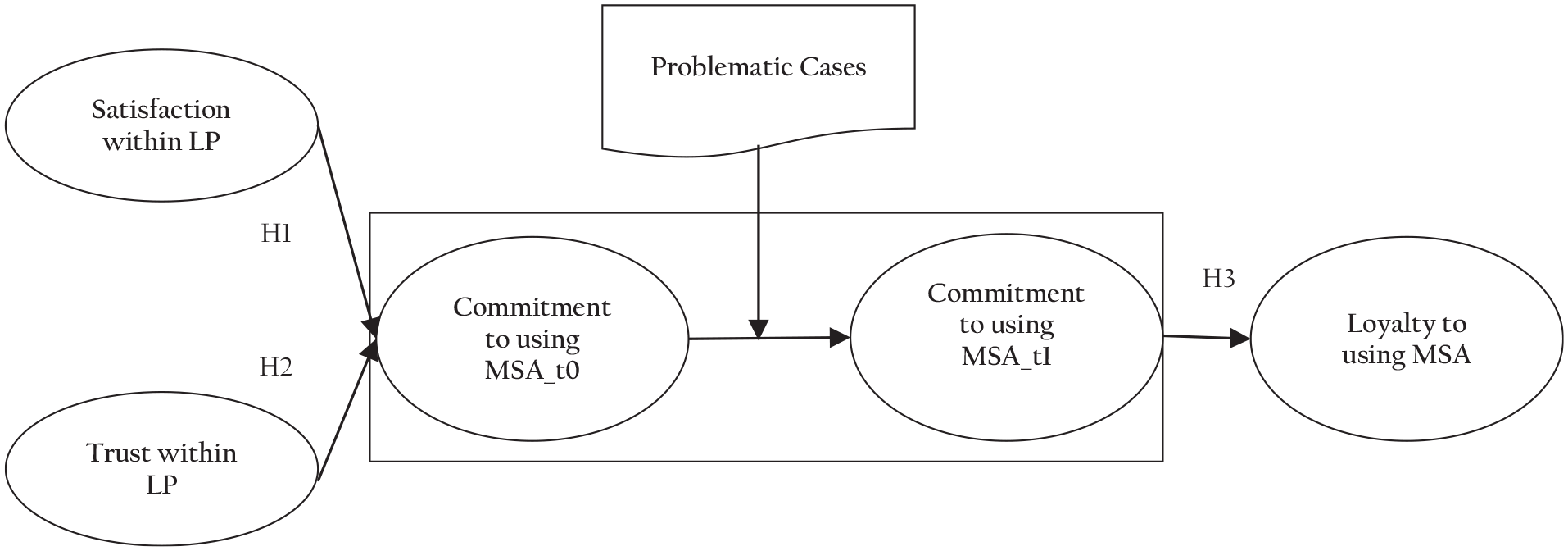
Research Model-3.
Research Method
Sample and Measurement
The population of this study were MSA users who participated in the “Shopee Shake” loyalty program. This study designed a criterion as not all the app users follow the loyalty program. We developed the following criterion: MSA users’ involvement in Shoppe’s loyalty program, especially Shoppe Shake. Our criterion was bias-free due to the focus on capturing behavioral cognition. Following this purpose, this study sought to explain how customers benefit from a firm’s loyalty plan and then increase their loyalty. Therefore, the respondents must follow the loyalty program. We noted that all the respondents were Indonesian Shopee-users. Questionnaires were randomly distributed to the respondents throughout Indonesia. Initially, the respondents supplied information about their background and agreement to complete the survey. This survey assured all the respondents that they would remain anonymous. The authors informed them that their data were guaranteed to remain confidential. This survey used Google Forms, and the collected data were saved in the researchers’ drive. Thus, only the researchers could use the data for analysis. Thus, this study had 33 item indicators, so the minimum sample should be at least 330.
This study employed two research methods. The first was a survey, and the other a quasi-experiment. This study used two approaches to investigate the users’ commitment: a general (Izogo, 2015) and a multidimensional commitment (Kacen & Lee, 2002; Kelman, 1958). This research conducted a quasi-experiment using the second method to reveal the users’ cognitive therapy (see Appendix B), complementing the survey methods. Moreover, it designed a questionnaire with cases where the respondents experienced information and procedure failures. Appendix B designed complex cases that contained information and procedure failures used in the quasi-experiment to determine any change in the users’ general commitment. Therefore, these measurements represent CBT theory by demonstrating users’ general and multidimensional commitments using MSA through questionnaires and several problematic cases as quasi-treatments, culminating in users’ nested commitments. Meanwhile, the questions used for forming the constructs are in Appendix A. This questionnaire consisted of 33-item questions. All the questions were designed to be closed-ended with a 5-point Likert scale (1 strongly disagree to 5 strongly agree). All the variables in this study are reflective latent variables. These variables showed that some previous studies had tested the face and content validities. However, this study made slight modifications to fit the questionnaire’s items with this research’s content, as presented in Table 1.
Variables Definition.

Data Collection and Analysis
This study collected data using a web survey with a structured online questionnaire. The URL of the web survey was distributed throughout Indonesia through colleagues to be forwarded and shared via social media randomly. We employed this technique because it is convenient to get variations in the respondents’ spirits, motivation, education, total money deposited, job, and age. In other words, this research accommodates the respondents’ criteria. In addition, this study noted that MSA users were found in all parts of Indonesia. The questionnaire was designed with four sections (Appendix A). The first section was for general information, which contains information about the company and the benefits offered by the loyalty programs (hedonic, utilitarian, and symbolic) and includes information about any membership requirements. This study presented item questions in the second section according to each variable. Finally, the third section offered an experimental case (Appendix B).
This study was conducted sequentially on the three models in a mutually exclusive test. It meant that the models were not related. By testing the data’s reliability and validity, this research measured each model’s goodness of fit to assess its goodness of fit compared with normative-standard values. This research took into account that chi-squared statistics determines the goodness of fit-standardized models, the root mean square error of approximation (RMSEA), the goodness of fit index (GFI), the minimum discrepancy function (CMIN/DF), Tucker–Lewis index (TLI), comparative fit index (CFI), and Akaike information criterion.
Result and Discussion
Descriptive Statistics
This research started conducting its survey in April 2020. To ensure the responses were reliable, the researchers screened the respondents to see if they participated in the “Shopee Shake” program. If the participants did not follow the loyalty program, they were excluded. This study initially had 468 respondents. Forty respondents were excluded because they did not fit the research criterion, so the final number of respondents used in this research was 428. Female respondents dominated this research data, comprising 71% of the respondents. Approximately 78% of the respondents were between 21 and 30 years old. When the data were categorized by their educational degrees, those holding bachelor’s degrees made up 53%.
Meanwhile, the student and college respondents categories comprised 42% of the respondents. Those respondents who claimed to “always use an MSA” comprised 68% of the respondents. Therefore, this study infers that the Shopee Shake MSA users were young (aged 21 to 30) and in college. Table 2 presents the respondents’ demographic information.
Respondents’ Demographics.

Table 3 discloses the descriptive statistics that show the research data for each variable, with the values of minimum, maximum, mean, median, and standard deviations. The data showed that most variables had mean values of more than 3.00, except for customer identification. All the mean values are below their median. This study infers that it would be problematic when each variable was related to its identification and vice versa.
Descriptive Statistics.

Note. n = 428.
Results of Reliability and Validity Tests
This study tested the research variable with convergent and discriminant validities using confirmatory factor analysis (CFA). These variables have convergent validities whenever their factor loading values are above 0.50. Moreover, the AVE results fulfilled the criteria for convergent validity, as all the measurements were above 0.50. Thus, this study concluded that the item questions had convergent validity. Furthermore, the study measured the discriminant validity with corrected item-total correlation. Then, it inferred that each variable had discriminant validity because the corrected item-total correlation was above the cut-off standard’s value.
On the other hand, this research used Cronbach’s alpha and composite reliability to test the data’s reliability. As a result, it considered that all the variables were reliable because Cronbach’s alpha and composite reliability values were more than .70 (Hair et al., 2013). Moreover, Jöreskog’s rhô’s values were higher than 0.90 for all the variables, providing further reliability. Table 4 presents the detailed test results of the reliability, convergent, and discriminant validities.
Results of Reliability and Validity.

Structural Equation Model Analysis
The Goodness of Fit Test
Data analysis showed that Model-3 had the goodness of fit compared to Model-1. The values of CMNI/DF and RMSEA met the standard criteria. In another measure, the values for TLI and CFI were close to the cut-off standards. The statistical results showed that Model-3 had a CMNI/DF value of 3.260, lower than Model-1 (6.608). Model-3 had a lower RMSEA value of 0.073 than Model-1 (0.114). Furthermore, Model-3 had better TLI and CFI values than those in Model-1. In another measurement, the value of AIC in Model-3 was higher than that for Model-1. The difference in the AIC value was 130.167 (≥10). This study posits Hilbe (2011), who suggested that the AIC value difference between the two models is more significant if greater than 10%. It indicates that the higher value is a better fit. Thus, it inferred that Model-3 was a better fit than Model-1. It also considers that the Shopee Shake loyalty program can push users to increase their commitment.
In another test result, this study presented a detailed comparison between Model-1 and Model-2. This result showed that Model-2, a model of Kelman’s multidimensional commitment, did not always show the highest values in all criteria compared with Model-1. However, it meant that Model-2 could explain the role of customer commitment quite well. Moreover, if Model-2 demonstrated the users’ commitment, the multidimensional commitment was equivalent to the general one. Table 5 presents the models’ analysis results.
Goodness of Fit Model.

Causality Tests and Discussions
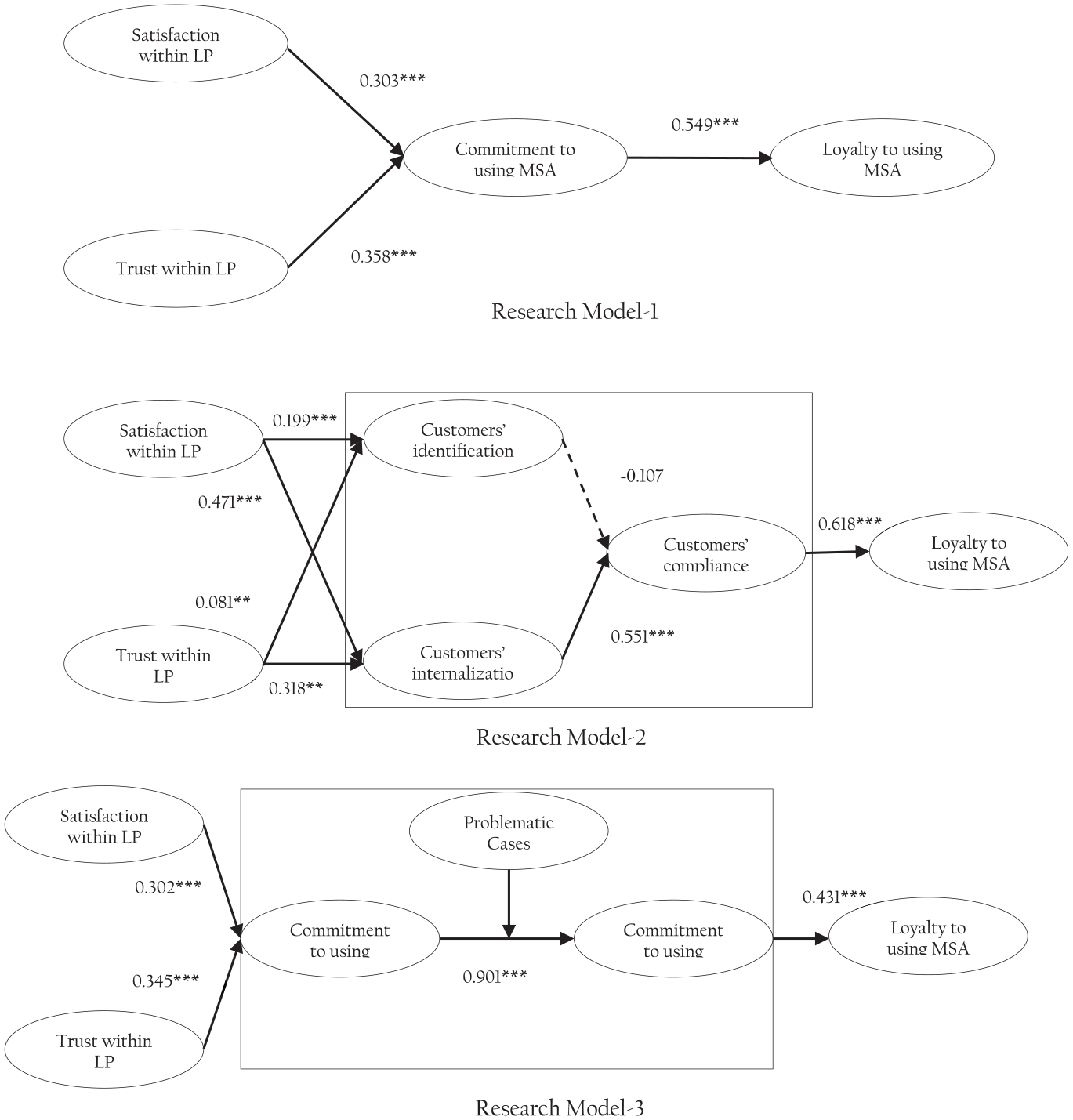
Table 6 and Figure 4 show the results of the causality tests, which this study had hypothesized. Almost all of the hypotheses were supported, except for H4 in Model-2. Hypothesis H1 proposed that satisfaction within the loyalty program affects the users’ commitment to using an MSA. It was positively supported by the coefficient and the CR-value, which were 0.303 (5.253). Hypothesis H2 proposed that trust in the loyalty program affects the users’ commitment to using an MSA. It was positively supported by the coefficient and the CR-value, which were 0.358 (6.462). Hypothesis H3 proposed that users’ commitment affects their loyalty to using an MSA. The coefficient and the CR-value, 0.549 (10.331), positively supported this hypothesis. This study supported all the hypotheses in Model-1. Customers perceive that they can get more incredible benefits and believe that the firm’s loyalty program guarantees their data’s security. Therefore, customers would be emotionally attached (Ngubelanga & Duffett, 2021; Stathopoulou & Balabanis, 2016).
Results of Hypotheses Tests.

Note. Satisfaction within LP; Tru = trust within LP; Comm = users’ commitment; Ide = customers’ identification; Int = customers’ internalization; Comp = customers’ compliance; MSAL = MSA loyalty; Comm_t0 = users’ commitment before cases; Comm_t1 = users’ commitment after cases.
Asterisk signs are *p < .10. **p < .05.***p < .01.
Results of hypotheses tests.
This statistical result showed that loyalty programs could maintain consumers’ intimate relationships through commitment as a sequential process (Sur, 2011). It proved the setting of customer commitment as an intervening variable to explain their loyalty to using MSAs. This study raised the issue that the model by Stathopoulou and Balabanis (2016) is an over-generalization. It meant that satisfaction and trust could not initially affect customers’ loyalty. Firstly, satisfaction and trust should affect customer commitment (Mittal & Kamakura, 2001), influencing loyalty.
Hypotheses H1a and H2a for Model-2 proposed that customers’ satisfaction with and trust in loyalty programs affected their identification. Furthermore, hypothesis H1a was supported by the coefficient, while the CR-value was 0.199 (5.965), which was significant at 1%. Likewise, hypothesis H2a was supported since its coefficient (CR-value) was 0.081 (2.294). Therefore, this hypothesis was supported at a level of 5%. As a result, customers received higher satisfaction and benefits when participating in its loyalty program. Therefore, this study concluded that the customers’ identification with their MSA was more vigorous. Equivalent to H1a and H2a, hypotheses H1b and H2b proposed that customers’ satisfaction with and trust in loyalty programs affected their internalization. The coefficient supported Hypothesis H1b, and the CR-value was 0.471 (7.994), while the coefficient supported H2b, and the CR-value was 0.318 (4.542). In other words, this study infers the hypothesis that the internalization process occurs when individuals feel satisfaction and trust (Bagozzi & Lee, 2002). Thus, it supports (Kacen & Lee, 2002; Kassim & Abdullah, 2010; Kelman, 1958) opinion that these individuals will change their behavior publicly and privately.
Furthermore, hypotheses H4 and H5 proposed that customers’ identification and internalization positively affect their compliance. Contradicting H4’s prediction, Hypothesis H4 showed that the beta coefficient was negative since its coefficient (CR-value) was −0.107 (−1.221). Therefore, it is the only hypothesis that was not supported. This study had guessed that Hypothesis H4 would not be supported. The reason is that the users of Shopee Shake are younger and state that they “always use it.” Therefore, it meant that the users of Shopee Shake did not need an identification process when they used this MSA. On the other hand, Hypothesis H5 was supported by the coefficient and the CR-value, which were 0.551 (10.881). It meant that the users’ identification did not help them meet their emotional needs (T. Wang et al., 2015), foster a sense of belonging or encourage them to be loyal (Kim & Ahn, 2017; Shen et al., 2011). However, this study can prove that the users’ internalization would make them continue to use an MSA. Similarly, this study ascertained that the customers’ internalization affected their compliance due to habitual users (Bagozzi & Lee, 2002). In other words, Shopee Shake users have internalized themselves through frequent, habitual MSA use.
Like Model-1, Hypothesis H3 for Model-2 proposed that users’ compliance positively affected their loyalty to use their MSA. The result was also supported by the coefficient and the CR-value, 0.618 (16.435). Thus, this study supports Meyer-Waarden et al. (2013), who explained that a firm could develop its customers’ emotional attachment within its loyalty programs since they have probably already affected their loyalty.
Finally, Model-3 conducted a quasi-experiment investigating user commitment change due to a problematic case. This model was designed to test customers’ cognition. In other words, this model highlighted the existence and occurrence of cognitive-behavioral therapy (Beatty & Kahle, 1988; Torous et al., 2017; Wathieu, 2004). The users’ commitment and loyalty to an MSA would change due to a cognitive interruption. These statistical results showed that a problematic case affected the customers’ commitment with a coefficient (CR-value) of 0.909 (15.158) and was significant at 1%. By the mean, it explained that customer commitment before the problematic case was associated with their commitment after the case. In other words, a complicated issue affects customers’ behavior regarding their loyalty to using their MSA. We concluded that the quasi-experiments differentiated between the pre- and post-measurement of general commitment. In other words, this result was similar to the posthoc test, where the quasi-experiment explained the existence and occurrence of the users’ cognitive change. The association between customer commitment and loyalty decreased because of the problematic cases. Therefore, this study inferred that users’ cognition is dynamic, and their emotional and cognitive patterns are probably laid in their commitment.
The existence and occurrence of cognitive customer changes showed decreased coefficients (CR-values) from Model-1 to Model-3. The decreases were from 0.549 (10.331) to 0.431 (10.076). They were all statistically significant at the level of 1%. This study inferred that a problematic case damaged the customers’ cognition, so their commitment to using an MSA decreased. It means that users’ commitment exists and influences their loyalty (Izogo, 2015). From another perspective, a company could use CBT (Bakker & Rickard, 2019; Beatty & Kahle, 1988; Shahin Sharifi & Rahim Esfidani, 2014) to influence its customers’ behavior.
Managerial and Theoretical Implications
This research implies that an effective loyalty program makes social media users experience emotional bonding and commitment. In other words, a loyalty program could be therapied by enhancing its users’ commitment. This commitment improved when the users received rewards from the service providers. The users got enjoyment, entertainment, visual appeal, and social affiliation to reflect experiential values (Evans, 2001; Greussing & Boomgaarden, 2019; S. Wang et al., 2018; Z. Wang et al., 2018; Wei & Lu, 2014). Furthermore, this study contributes to managers’ and marketers’ concerns about the probable failure of the users’ commitment. A loyalty program’s design has to create and then facilitate the users to continue using these MSAs on their mobile phones. A loyalty program should consider the e-commerce users changing to other MSAs. It must also ensure that the e-commerce users get their expected rewards (Kim & Ahn, 2017; Wirtz et al., 2007) intrinsically or non-intrinsically (Danaher et al., 2016; Zhou & Li, 2014). On the other hand, managers and marketers build customer intimacy, which means customer relationships. This intimacy could be achieved if the e-commerce service facilitated the users without asymmetrical information. The e-commerce service enabled in its loyalty program is what the customers receive. Therefore, e-commerce users improved their commitment to using the MSAs to fulfil their needed activities (Fullerton, 2005; Wirtz et al., 2013).
Theoretically, this research implied that the loyalty program literature comprehended the e-commerce users’ commitment through a multidimensional approach with users’ identification and internalization of the loyalty program had to be loyal (Kim & Ahn, 2017; Shen et al., 2011). Furthermore, it implied that CBT is superior in demonstrating users’ emotional bond with MSAs, contributing to the prior body of knowledge. Therefore, this study inferred that a marketing strategy focusing on a loyalty program fosters users’ multidimensional commitment. The second theoretical implication is that e-commerce services should offer therapy to their users. This therapy is intended to assist the users with their cognitive change, commitment, and loyalty. It significantly enhances the users’ commitment to bonding with the MSA program, meaning continuous use. Users bond to MSAs without interruptions when triggered to sustain business ties (Nadeem et al., 2020; Ngubelanga & Duffett, 2021; Steinhoff & Palmatier, 2016). The latest theoretical implication is that the e-commerce service could assist its users in getting experiential values. An e-commerce service such as Shopee helps users learn distinctively about their purchases so they do not migrate to other MSAs. Thus, the MSA users would enhance their commitment by getting experiential values because they are a cognitive fit.
Concluding Remarks
This study accomplished its three research objectives. The first was to present evidence that the existence and occurrence of customer commitment play a critical role in determining users’ loyalty. It means that customer satisfaction and trust affect their commitment first. Then, customer commitment influences their loyalty after they increase their commitment. By employing a suitable research method, this study argues that customer commitment is an intervening variable in explaining the association between satisfaction and trust with loyalty. Second, this study competed with all previous research that directly associated satisfaction and trust with customers’ loyalty. Third, this research shows that their commitment could determine customers’ loyalty. In other words, users’ satisfaction and trust should be first nested in their commitment before influencing their loyalty. Therefore, by showing the role of customer commitment, this study explained the critical reasoning about the role commitment has in determining loyalty. This reasoning is that customers’ satisfaction and trust are likely to be of a fixed determination, which cannot be adjusted when choosing commitment. However, this study argued that customers’ satisfaction and trust are adjustable when deciding the users’ cognition. Then, this cognitive adjustment process is manifested in customer commitment.
Secondly, this research presented evidence that two types of customer commitment supported the causality between satisfaction, trust and loyalty. General and multidimensional commitment have a role in determining customers’ loyalty. This study inferred that although the types are different, they explain that their cognition influences customers’ loyalty, manifested in commitment. Users’ cognition is in the form of an emotional bond to continue using their MSA or not. This study argues that the users’ emotional bond is with their commitment. Moreover, the customers’ emotional bond could be explained by multidimensional commitment. This study infers that customers first identified and internalized their satisfaction and trust and developed their commitment consecutively, although it could not document the role of identification in this process. Therefore, it concludes that multidimensional commitment offers a better explanation than general because the users’ cognitive change is genuine in the internalization process. Thirdly, this research considers the objective evidence of the existence and occurrence of commitment, both the general and multidimensional types. It, then, infers that cognitive-behavioral therapy is relevant to adjust users’ cognition. Finally, it argues that CBT could further induce customer commitment to developing their loyalty. CBT could be induced through either the customers’ general or multidimensional commitment. However, this study concludes that multidimensional commitment works better than general because CBT is probably passed on through identification and internalization.
This study has several limitations. The measurements of general and multidimensional commitments possibly relate to the users’ personalities and cultures, creating doubt. Users’ personalities could influence the users’ commitment due to the varying levels of openness, introversion, masculinity, and other factors. Meanwhile, culture probably influences the users’ commitment because of variations in customs, mores, vogues, manners, and other communities adhere to. Moreover, this study did not control for the users’ income levels. The income per capita could affect the motivation for commitment. This study argues that a high or low income supports the users’ reaction in developing their commitment process. Therefore, this study opens possibilities for future research, considering all the factors inducted by this model. For example, it could be improved by inducing multi-trait personalities, multicultural themes, and income levels. From another perspective, future studies could improve the research method by employing specific experimental designs. For example, future research would be a methodological refinement. For example, the new research design could determine whether customers obtained gains or losses from using the Shopee MSA. In short, the obtained gains or losses can influence users’ commitment or loyalty. Therefore, with this new research, the role of commitment in explaining customers’ loyalty as an intervening variable would be robust.
Appendices
Appendix A: Questionnaire Items
Satisfaction Within LP (Stathopoulou & Balabanis, 2016)
I made a good choice when I decided to participate in the program “Shopee Shake.”
My overall evaluation of the program “Shopee Shake” is good.
Being a member of the “Shopee Shake” program has the advantage that I receive in meeting my expectations.
All in all, I am satisfied with the program “Shopee Shake.”
Trust Within LP (Stathopoulou & Balabanis, 2016)
The program “Shopee Shake” is trustworthy for handling my personal information.
The program “Shopee Shake” would tell the truth and fulfil its promises related to personal information.
I trust that the “Shopee Shake” program would consider my best interests when dealing with my personal information.
The program “Shopee Shake” is predictable and consistent regarding the usage of personal information.
The program “Shopee Shake” is always honest with customers when using the personal information they would provide.
Commitment to MSA (Izogo, 2015; Sur, 2011)
I feel emotionally attached to my Shopee Mobile Shopping App.
I feel a sense of belonging with my Shopee Mobile Shopping App.
I feel a sense of identification with my Shopee Mobile Shopping App.
My Shopee Mobile Shopping App has a great deal of personal meaning.
I feel a sense of partnership with my Shopee Mobile Shopping App.
Customers’ Identification (Kacen & Lee, 2002; Kelman, 1958; Shen et al., 2011; T. Wang et al., 2015)
My self-image overlaps with the group identity I use to collaborate through my Shopee Mobile Shopping App.
How attached are you to the group you collaborate with through your Shopee Mobile Shopping App?
How strong would you say your feelings of belongingness are toward the group?
I am a valuable member of the group.
I am an important member of the group.
Customers’ Internalization (Bagozzi & Lee, 2002; Chu & Li, 2012; Kelman, 1958; Meyer-Waarden & Benavent, 2009; Shen et al., 2011)
Using the Shopee Mobile Shopping App for group collaborations can be considered a goal. Would you please estimate the strength to which each of the members in your group holds the purpose? (5-point “weak-strong” scale)
Strength of the shared goal by yourself.
The average strength of the shared goal by the other members.
Customers’ Compliance (Bagozzi & Lee, 2002; Kelman, 1958; Meyer-Waarden & Benavent, 2009; Shen et al., 2011)
Most people who are important to me think that I should use the Shopee Mobile Shopping App.
Most people who are important to me would approve of me using the Shopee Mobile Shopping App.
MSA Loyalty (Islam et al., 2021; Oliver, 1999)
I will likely say a positive thing about the Shopee Mobile Shopping App to other people.
I would recommend the Shopee Mobile Shopping App to someone who seeks my advice.
I would encourage my friends and relatives to purchase Shopee Mobile Shopping App items.
The Shopee Mobile Shopping App is my first choice for buying the appropriate products.
I will likely continue purchasing from the Shopee Mobile Shopping App in the next few years.
Appendix B: The Quasi-Experimental Questionnaire
General Information
Shopee is an electronic trading platform headquartered in Singapore. Shopee was established in 2009 under the SEA Group. Shopee expanded into Malaysia, Thailand, Taiwan, Indonesia, Vietnam, and the Philippines in 2015. In addition to its web-based electronic trading platform. Shopee also launched a mobile shopping app using the same name. Because the Shopee elements are built according to global electronic commerce, it is one of the five “most disruptive e-commerce startups,” published by Tech in Asia.
Shopee has more than 70 courier service providers across its markets to provide logistical support for its users. In addition, Shopee collaborates with various logistics, payment services, and online transportation providers. The integrated business model aims to make online shopping easy and safe for sellers and buyers.
2017, Shopee recorded 80 million app downloads and more than 180 million active products from more than 4 million entrepreneurs. Shopee became Malaysia’s 3rd most visited electronic trading portal in 2017, replacing Lelong and exceeding Lazada’s ranking as the best application on Google Play and the App Store iOS. Based on a survey conducted by The Asian Parent in December 2017, Shopee is the first choice mobile shopping app in Indonesia, with almost 73% of the market. It is followed by Tokopedia (54%), Lazada (51%), and Instagram (50%).
Shopee still strives to pay attention to its customers as a popular mobile shopping app. Through the “Shopee Shake” loyalty program. Shopee provides exclusive rewards to customers who take part in the program. Customers are asked to fill out a personal data form and agree to the terms and conditions for creating an account after downloading the Shopee application. However, this can raise concerns about the personal data submitted. Shopee provides monetary savings benefits through discount points and vouchers. Points can be collected through a fun “Shopee Shake” game. Moreover, through the “Shopee Shake” group, companies provide recognition and social benefits to consumers through the loyalty program, such as social status, ownership, special treatment, social approval, and company recognition. Thus, it is not surprising that Shopee won several awards, including: • Largest E-commerce in Southeast Asia (2018) • Netizen Brand Choice Award (2017) • Marketing Award (2017) • Bright Awards Indonesia (2017)
Problematic Cases
Case 1: CS Shopee Less Responsive Rampant Fraud Mode
My brother bought a gadget/handphone via Shopee. The product purchased was the Samsung A5-2017 at a price of IDR750,000. However, until now, the item has not been sent yet. Would you please allow Shopee management to act against such sellers so there are no future victims? When I checked the perpetrator’s cellphone number and identity, it turned out that they used a fake ID. Be careful with sellers who sell cheap products because of cheap goods and the black market, or you lose.
Case 2: Shopee-Style Batman Traps, Items Intentionally Not Sent, Deliberately Changed Deadlines
I got a 40k discount promo for shopping at the Shopee Mall via social media, so I decided to buy from the Shopee Mall even though the price of goods was 25k to 30k higher. There has been no more news for a week, and I have resentment. I contacted Shopee’s customer service (Wirtz et al., 2007) via Twitter and uploaded proof screenshots. CS only argued that the sender’s deadline is the 25th, not the 20th, as the Shopee client shows. I submitted a cancellation request because the seller clearly did not intend to send my order. Still, the details for the cancellation of goods that are in “container status” could only be approved if there was agreement from the seller, and even though the status was online, it was still ignored. After waiting a while, I again contacted Shopee’s customer service via a tweet for help. Shopee’s customer service asked for a re-report and re-upload; this is already bad for the customer, a sign of bad management, and you will lose in the end.
Cancellation does not happen. Shopee’s customer service has still not responded. IDR400,000 is still stuck, so I am faced with two choices:
Forced to buy products through Shopee at prices higher than other e-commerce operations.
Money is held forever in a Shopee account, assuming no expiration.
Hopefully, this teaches others not to be immediately tempted by a promo voucher without looking at the company’s background quality.
Case 3: Poor Return Complaint System at Shopee
I purchased a Shopee item, and after a few days, the item arrived. I immediately checked the goods, but it turned out that only one piece had been sent. Ten other items were missing, with no confirmation from the seller. Before I ordered, the chat response was very fast. However, after it was ordered, the chat was not returned. Shopee’s complaints menu shows that the seller has until August 16, 2018 to send the item. It is crazy that Shopee takes 12 days to wait for an uncooperative seller’s response like this. Until now, the seller has not replied to my chat. Should I lose IDR950,000 for the 10 items not shipped?
Case 4: Poor Shopee Service
I have experienced bad service at Shopee several times. This time, I bought a trusted seller’s perfume for IDR1,625,000. It turned out that the seller said that the item was out of stock. So, I cancelled the transaction. However, Shopee’s customer service has not processed the refund process because it is still shown as a collectable on my bill, even though I cancelled on May 28, 2018, and the print date of the bill was June 20, 2018. Then, I contacted Shopee’s customer service and responded by ignoring the bill and not paying, if asked, for interest, as Shopee would be responsible. Finally, on July 20, 2018, I received a bill from the bank for the bill + interest from the transaction. I finally went to the bank and explained because I felt I was being punished for not buying the item. It turns out that Shopee had not processed the refund.
Footnotes
Author’s Note
This article is the comprehending master thesis of the second author in the Master of Science and Doctoral Student, Faculty of Economics and Business, Gadjah Mada University, Indonesia.
Declaration of Conflicting Interests
The author(s) declared no potential conflicts of interest with respect to the research, authorship, and/or publication of this article.
Funding
The author(s) disclosed receipt of the following financial support for the research, authorship, and/or publication of this article: Gadjah Mada University’s Research Directorate of 2021 financed this research up to publication.
Ethical Approval
This study has no ethical issues due to not using human bodies, plants, and animals.

Data Availability Statement
The datasets generated during and/or analyzed during the current study are available from the corresponding author upon reasonable request.