




Abstract
In a highly competitive market, online stores are requested to identify key factors to implement customers’ trust and commitment, which are vital determinants of high-quality relationships. As online transactions are witnessing increasing risks of cybercrimes and abuse incidents, offering ethical online services has become crucial in building robust and sustainable relationships with customers. The current study has been conducted in this context and its objective is twofold: on the one hand, it aims at understanding the effects of online retailers’ perceived ethics on e-trust and e-commitment, which in turn predict repetitive purchases, and on the other hand, it seeks to test the moderator role of reputation in the relationship between e-trust, e-commitment, and repetitive purchases. The Structural Equation Modeling (SEM) method was employed to analyze the data collected from a web survey conducted in Saudi Arabia involving 328 online shoppers. The results showed that all ethical dimensions influence e-trust and e-commitment in a significant way, hence predicting repetitive purchases from the same e-service platforms. The reputation of online retailers also plays a significant moderator role in the relationships between e-trust and repetitive purchases, as well as between e-commitment and repetitive purchases. This study is interesting for three main reasons. First, it is the earliest of its kind to assess online retailers’ ethical practices through seven dimensions in the context of the business-to-consumer (B2C) market. Second, it constitutes a further extension of the trust-commitment theory by testing the moderating role of online retailer reputation. Third, the findings provide relevant managerial implications for online retailers to enhance the loyalty of their consumers based on their ethical practices.
Introduction
In the first quarter of the 21st century, e-commerce has become a critical alternative to physical commerce (Ghali, 2021). In this context of business in a virtual space, customers are required to interact with technological interfaces rather than with salespeople in a physical space (Greblikaite & Pervazaite, 2014). In other words, they must interact with online shopping platforms rather than with salespersons (Antwi, 2021; Bush et al., 2000). Therefore, it has become necessary for online retailers to prove their integrity and honesty, reassure their buyers, and build their trust and engagement with their online platforms (Skippari et al., 2021; Yuniarti et al., 2022). In the context of business-to-customer transactions, the ethics of online retailers are embedded in complex, evolving, ambiguous, and multidimensional concepts (Aboul-Dahab et al., 2021; Zhang et al., 2011). Indeed, while the Internet is offering unlimited opportunities, as the number of Internet users keeps rising worldwide (4.66 billion users in January 2021 according to Johnson, 2021), it has equally proved to trigger opportunistic behaviors and unethical conduct (L. Lee & Charles, 2021). The incredible growth of electronic transactions has actually raised ethical issues that are not perceived in physical sets (Agag, 2017; L. Lee & Charles, 2021).
Ethics is defined as a moral principle that expresses people’s behaviors from the perspective of their rightness and wrongness in a given social situation (Ahamed & Pham, 2021; Gaski, 1999). It is also a set of principled beliefs and moral values that drive human behavior (Agag et al., 2016). Seeing its importance in the success of relationships between individuals, ethics has extended to the domains of business and e-business (Ghali-Zinoubi, 2021). Roman (2007) was the first to investigate the measures of perceived ethics in the online retailing sector. The author distinguished four dimensions of ethical practices, namely, privacy, security, reliability, and non-deception. Taking this finding into consideration, Agag et al. (2016) extended the measurement scales of customers’ perceived ethics of online retailers (CPEOR) by adding two new dimensions, namely shared values and service recovery. Following this, an additional dimension referred to as “communication” was confirmed by Agag (2016) as a significant ethical dimension in e-retailing practices. This scale of Agag (2016), which encompasses seven dimensions, was used in the context of this study to investigate the impact of ethics on trust and commitment relationships.
Numerous prior studies have combined the assessment of CPEOR with trust and commitment factors, which are considered the cornerstones of successful commercial relationships (Chang & Guo, 2021; Yang et al., 2019). Morgan and Hunt (1994) were the first to argue that trust and commitment constitute significant mediators between transactional partners. Accordingly, both trust and commitment are key drivers of robust and sustainable relationships between e-retailers and e-buyers (Zhang et al., 2011). Other studies have measured the impact of some ethical practices (especially security and privacy) of online retailers on the implementation of structural relationships with buyers (Chang & Guo, 2021; Cheung & To, 2020; Ghali, 2021). However, to the best of our knowledge, the present study is among the earliest of its kind to try to understand the impact of the seven dimensions of perceived ethics of online retailers on e-trust and e-commitment, which in turn predict repetitive purchases. Accordingly, the first objective of this research is to study the relationships between perceived ethical practices of online retailers, e-trust, e-commitment, and repetitive purchases according to Morgan and Hunt’s theory.
Among the various aspects of electronic business, the reputation of e-retailers appears to be a central factor in the consumer decision-making process and a driver of electronic trust (Broutsou & Fitsilis, 2012). Its role is crucial in attracting customers, particularly those who lack experience with commercial websites (Broutsou & Fitsilis, 2012; Varma et al., 2020). Besides, it reduces the perceived risks of online transactions (J. Kim & Lennon, 2013), and provides more assurance to online shoppers (Yang et al., 2019; Ziaullah et al., 2016). Although much attention has been paid to the predictors of e-loyalty towards online retailers, few studies have focused on reputation. Furthermore, in the existing literature on this concept, the associations between e-retailer reputation and other relational variables such as satisfaction, trust, commitment, and repetitive purchase, remain ambiguous as long as scholars have not yet found a compromise on the strength of these relationships. For example, while some researchers showed that reputation strengthens purchase intention (Casalo et al., 2007; Castellano & Dutot, 2017), others asserted that it should be mediated by trust (Keh & Xie, 2009; Olaleye et al., 2018), or tested as a moderator that mitigates the effect of perceived company negative actions (Bennett & Gabriel, 2001; Liu et al., 2019). The current research work aims to test the effect of reputation on trust and commitment through a moderation relationship. Thus, the second objective of this research is to extend the Morgan and Hunt (1994) trust-commitment approach through the testing of the moderating role of online retailers’ reputation in the relationship between e-trust, e-commitment, and repurchase intention.
From a theoretical perspective, the present study enriches the existing literature by measuring and testing the multiple (seven) ethical practices of e-retailers from the perspective of consumers. Moreover, it extends the trust-commitment approach of Morgan and Hunt (1994) by introducing the reputation of the online retailer as a moderator. From a managerial perspective, this study provides interesting recommendations for e-service providers to build robust and durable relationships with customers, based on their ethical practices.
Literature Review
Commitment-Trust Theory
The commitment-trust theory of Morgan and Hunt (1994) is among the main theories of relational marketing that focus on relationship quality. This theory stipulates that trust and commitment are indirect drivers of cooperative behavior and are critical producers of efficient, effective, and productive outcomes. Accordingly, trust and commitment are central factors that contribute to successful sustainable relationships between partners in a commercial transaction (Keh & Xie, 2009). According to Chang and Guo (2021), trust and commitment are key indicators of relationship quality that reflect the degree to which retailers can meet the expectations of consumers and translate into a strong relationship between the two partners in a transaction. In the online environment, trust reflects the degree of confidence in retailers’ offers, whereas commitment reflects the willingness to establish and maintain a relationship with online retailers (Elbeltagi & Agag, 2016). High commitment gives consumers a strong willingness to maintain relationships with e-service providers (Chang & Guo, 2021). Moreover, Morgan and Hunt (1994) found that trust and commitment are key mediating variables between partners for a successful commercial transaction and a stabilizer of a robust and durable relationship. Unlike the ethical theories which present ethics as guidance for people when making a decision (beneficence, least harm, respect for autonomy, justice, right, deontology, utilitarianism, and virtue), the commitment-trust theory presents central factors (trust, commitment) that play a major role in translating the effect of ethical practices on the decision to purchase and repurchase from the same platform. Therefore, to test the role of online retailers’ perceived ethics in the development of long-term relationships with consumers, the trust-commitment approach was found to be appropriate.
E-Trust and e-Commitment Relationship
The growth of relational marketing has made trust a central concept because of its importance in the formation of strong cooperative relationships between the partners of an exchange. A substantial amount of research studies from different disciplines have been generated about the concept of trust. They found that trust is a complex concept, with multiple meanings and dimensions. The common point between all definitions is that trust implies one party having confidence in another party to fulfill its obligations. According to the trust-commitment theory, trust reflects the reliability and integrity that should exist in the relationship between exchange partners. In the online environment, commercial exchanges have witnessed many cases of electronic crimes and abuse incidents (Ghali, 2021; Saidi & Ghali-Zinoubi, 2021). Therefore, paying and buying through online platforms are considered risky and uncertain (Antwi, 2021; Elbeltagi & Agag, 2016; Flavian & Cuinaliu, 2006; D. J. Kim et al., 2008). Trust was found to be a central factor in characterizing a quality relationship between a company and its customers and fostering a personal association between e-buyers and e-service providers (Chang & Guo, 2021). As for commitment, it is defined as an exchange partner’s willingness to maintain a valuable ongoing exchange (Keh & Xie, 2009; Morgan & Hunt, 1994). It also translates the positive emotions that a buyer can feel toward a retailer, which reflects a friendship relationship between the former and the latter (Ogba & Tan, 2009). In this regard, e-commitment reflects resistance to change and a desire to maintain a constant relationship with an online service provider (Antwi, 2021).
Ethics: Related Concepts and Dimensions
Ethics and Related Concepts
Ethics is defined as a critical and structured philosophy that drives human behavior and focuses on what is right and what is wrong (Chitrangda, 2014). In this regard, ethics is a critical philosophy because it examines a set of principled beliefs that drive particular human behavior. It is structured because it unifies multiple viewpoints into a set of ethical common standards rather than focuses on an individual perspective. Ethics expresses people’s behaviors conforming to the viewpoint of their rightness and wrongness (Gaski, 1999). It also reflects the goodness of acts that translate into a set of values and moral principles that can drive human behavior (Sherwin, 1983). According to Popa (2002, p. 131), morality, norms, law, and ethics are related concepts but not similar ones. The law is objective ethics and is expressed in terms of a universal set of rules and regulations created by an authority (like a government) to govern the behavior of individuals, and whoever does not obey the law will be punished (Fuller, 1958). Norms are also related to ethics and reflect people’s opinions about what individuals should or should not do in a community. Norms include obligations that can arise from social interactions (i.e., etiquette obligations), customs and reasons (i.e., ethics and morals), state institutional acts (i.e., laws), commercial relationships (i.e., trade customs), and private habits (i.e., family traditions or sporting rules). Compared to ethics, norms deal with societal standards and principles, whereas ethics deal with rules based on a shared moral code (Sheppard, 2019).
In e-commerce, ethics is a relatively new concept (Yuniarti et al., 2022). Aboul-Dahab et al. (2021) defined it as “the purchasers’ perceptions of the conduct of online retailers who treat buyers in a private, reasonable, honest and trustworthy way that eventually reassures them” (p. 2). Scholars have addressed the vital role of ethics in the success of online transactions as it is paramount in building trust between partners (Bhattacharya et al., 2021). As ethical issues in online business arise with the steady growth of e-transactions, online retailers are requested to demonstrate their integrity, honesty, and sincerity, as well as to deal with customers through fair, secure, confidential, and reliable websites (Agag et al., 2016; Yang et al., 2019). In 2007, Roman published a pioneering article on customer perceptions regarding the ethics of online retailers (CPEOR). He considered it the responsibility and integrity of an organization to protect the interests of its customers by protecting their privacy and confidentiality, showing honesty, clarity, and fairness, and keeping its promises in terms of service recovery and information shared about the products. Similarly, Agag et al. (2016) and Cheng et al. (2014) also studied CPEOR and defined it as the consumer’s perceptions of confidentiality, honesty, sincerity, and fairness of online retailers’ behavior. Online ethics are multidimensional, complex, and exceptionally conceptual (Aboul-Dahab et al., 2021; Bhattacharya et al., 2021).
Dimensions of Ethics of Online Retailers
Previous studies argued that CPEOR is a multidimensional concept (Aboul-Dahab et al., 2021). Roman (2007) measured it using a four-dimensional scale that includes security, privacy, non-deception, and fulfillment/reliability. Further research studies are needed to test this scale and develop it, though. In the e-commerce context, Agag and Elbeltagi (2013) added corporate social responsibility. In 2016, Agag and his co-authors added new dimensions of e-commerce ethics, namely, service recovery and value sharing. In a more recent study, Agag (2019) added a new dimension referred to as “communication” to propose a measurement scale of CPEOR with the following seven dimensions: security, privacy, reliability/fulfillment, non-deception, shared value, communication, and service recovery.
Scholars have confirmed these variables as dimensions of ethics for several reasons. First, online retailers should adopt policies to protect user privacy and implement rules to preserve the confidentiality of user personal information. Therefore, they do not have the right to divulge, use, sell, or transfer personal data to thirds, without the authorization of customers (Aboul-Dahab et al., 2021; Chang & Guo, 2021). Protecting the privacy of customers is indeed considered the ethical responsibility of the online retailer (Agag et al., 2016). Second, security refers to computer and financial information safety (Aboul-Dahab et al., 2021). This reflects the necessity to protect users from all risks of loss of their financial information (e.g., credit card details) while interacting with online shopping platforms (Aboul-Dahab et al., 2021). Hence the necessity to implement technological data-protection devices (Chang & Guo, 2021). Roman (2007) argued that securing personal data across the payment process from any kind of robbery, loss, or transfer is encompassed in online retailers’ ethics. Aboul-Dahab et al. (2021) and Brusch et al. (2019) stated that even if online service providers guarantee a logical assessment of the security of their websites based on a set of technical arrangements and lawful rules, customers are still given a sense of security as an ethical responsibility and consider it as an adequate criterion of trust. Third, reliability is considered a dimension of online retailer ethics because it reflects the level of consistency and credibility while displaying products and their features on network platforms (Ghali, 2021; Roman & Cuestas, 2008). To consider a website reliable, consumers should perceive that the goods received are similar or bear an acceptable difference from those ordered on that website (Aboul-Dahab et al., 2021; Agag, 2017). Fourth, non-deception reflects the credibility of the product and the transaction information provided on a website (Chang & Guo, 2021). To ensure that customers evolve safely through the buying process and avoid deception, data must be fully and correctly disclosed (Roman, 2007). Fifth, service recovery is proof of the seriousness and genuineness of the effort provided by the online retailer when restoring payments for returned products (Aboul-Dahab et al., 2021). Roman and Cuestas (2008) added the on-time delivery of goods as a component of the non-deception dimension. Sixth, shared value is one more ethical dimension of online retailers’ practices, as it emphasizes the principles of ethics, such as giving customers a choice to keep their email addresses in their mailing lists for further promotional campaigns (Agag et al., 2016; Morgan & Hunt, 1994). Seventh, communication counts among the critical ethical practices of online retailers (Agag, 2019). This is because communicating credible, true, accurate, and reliable information about the goods offered and their features remains a vital ethical practice for online retailers (Agag, 2017; Chang & Guo, 2021; Friman et al., 2002).
The Impact of Perceived Ethics of e-Retailers on e-Trust and e-Commitment
Privacy
Protecting the privacy of customers in an online environment implies protecting personal information such as payment card numbers, phone numbers, and other information about personal life (Bart et al., 2005). The disclosure of their privacy constitutes a major concern for customers while buying goods from online platforms (Roman, 2007). Since confidentiality is preserved, customers feel more confident while sharing their data on retailing websites (Aboul-Dahab et al., 2021; Chang & Guo, 2021). Therefore, many online retailers are asked to certify their websites to ensure privacy, accountability, and compliance with privacy policies (Agag et al., 2016). While investigating the relationship between privacy, trust, and commitment in online shopping, scholars found that the more confidence customers have in the confidentiality of commercial websites, the more likely they are to trust and revisit these websites for further purchases (Ghali, 2021; D. J. Kim et al., 2008). Accordingly:
Perceived Security
Ghali (2021) found that security is the most important factor in ensuring online transactions. In this sense, customers must believe that the site is safe from financial fraud, intrusion, and privacy divulgation before processing buying behavior (Aboul-Dahab et al., 2021; Antwi, 2021; Bhattacharya et al., 2021). The importance of service security is accounted for by the high level of risk perceived by online buyers when paying and disclosing their personal information (Flavian & Cuinaliu, 2006). Therefore, customers prefer e-retailers whom they trust. In this regard, by being confident in the reliability of the services of a given online retailer, customers may decide to purchase again from this same retailer and engage in long-term relationships (Casalo et al., 2007; Flavian & Cuinaliu, 2006; Ghali, 2021). Accordingly:
Non-Deception
Deception is a critical issue in the e-retailing context (Limbu et al., 2011). It refers to the use of deceptive tactics and misleading practices like “the exaggeration” of the characteristics and the benefits of an offer (Agag, 2017; Riquelme & Roman, 2014; Roman, 2010). Consumers perceive deception when they become aware of the seller’s manipulation of the information about or the representation of the product to motivate them to change their decisions and behaviors into desired actions, even if these actions are not beneficial for them (Riquelme & Roman, 2014). Thus, we propose the following hypotheses:
Reliability
The reliability of services in online shopping is defined as the delivery of the right goods, at the right promised time, and with accurate information about products (Agag et al., 2016; Ghali, 2021; Wolfinbarger & Gilly, 2003). In this sense, the reliable service of the e-retailer reflects accuracy when treating the request of the customer, leading to the delivery of exactly what the latter ordered (Bhattacharya et al., 2021; Chang & Guo, 2021). Therefore, handling and shipping products constitute a significant challenge for the success of online retailers’ services. The authors found that customers can trust and engage in a durable relationship with online retailers only if they have the right products in their hands at a convenient time (Kim et al., 2009). Therefore, online retailers must keep their promises regarding products and information about them, and fulfill consumers’ expectations in terms of product quality, as promised while ordering (Chang & Guo, 2021; Saidi & Ghali-Zinoubi, 2021). Accordingly,
Service Recovery
Service recovery translates to the perceptions of customers of the seriousness and rationality of the effort provided by online retailers when restoring payment for returned products (Aboul-Dahab et al., 2021). Roman and Cuestas (2008), on their part, considered the on-time delivery of products as an aspect of the non-deception dimension. In the context of online shopping, service recovery is a vital condition for customer trust (Bhattacharya et al., 2021; Pizzutti & Fernandes, 2010; Saidi & Ghali-Zinoubi, 2021). In this regard, the more rigorous the e-service provider is in recovering operations, the more trustful customers become in these e-retailers and the more willing they are to maintain their relationship with them (Cheng et al., 2019; Elbeltagi & Agag, 2016). Hence:
Communication
Communication is a particularly important factor in e-retailing settings since consumers rely on the information provided concerning the characteristics of a product (price, availability, delivery) to make a purchase decision. In such settings, many issues regarding communication have been identified, such as information asymmetry caused by the physical and temporal distance between buyers and sellers (Pavlou et al., 2007). This dimension indicates the perception of the quality of information shared between the company and the consumer in terms of relevancy, reliability, and time (Agag 2017; Morgan & Hunt, 1994). Thus, communication is a strong determinant of trust (Agag, 2017; Friman et al, 2002). E-trust can also be strengthened through friendly communication (Al-Adwan & Al-Horani, 2019). Thus,
Shared Value
According to Morgan and Hunt (1994, p. 25), shared value is defined as “the extent to which partners have beliefs in common, about what behaviors goals and policies are important or unimportant, appropriate or inappropriate and right or wrong.” The perception of shared value contributes to the establishment of commitment and trust (Agag, 2017; Agag et al., 2016; Morgan & Hunt, 1994; Mukherjee & Nath, 2007). Hence, promoting an ethical culture that fosters positive shared values between customers and suppliers leads to the development of trustworthy relationships (Agag et al., 2016).
E-Trust, e-Commitment, and Repurchase Intention
According to Limbu et al. (2012), and Huy et al. (2019), trust is a significant predictor of repetitive customer purchases. It is also a vital factor driving purchase intention in the case of a high level of uncertainty related to online transactions (Antwi, 2021; Chang et al., 2021). Other researchers have confirmed a positive association between trust and repetitive purchases (Chang & Guo, 2021) and commitment (Agag, 2019; Faraoni et al., 2018; Morgan & Hunt, 1994). Furthermore, according to the trust-commitment theory, e-trust has a significant impact on e-commitment. In other words, the customer’s confidence in online retailers can result in continued purchases from their websites (Saidi & Ghali-Zinoubi, 2021). The literature considers that customer commitment toward e-retailer websites motivates the intention to repurchase (Chen et al., 2003; Gabarino & Johnson, 1999, Keh & Xie, 2009). Other scholars have also supported this claim by confirming that a customer committed to an online retailer will continue to buy from the same website (Antwi, 2021; Chang & Guo, 2021). Accordingly:
The Moderating Role of Online Retailer Reputation
In a business context, reputation refers to the extent to which consumers demonstrate esteem toward a seller (D. J. Kim et al., 2008). Company reputation plays a key role in attracting customers, particularly when they have no experience with commercial websites (Broutsou & Fitsilis, 2012; Varma et al., 2020).
The concept of reputation has been commonly linked to the concept of consumer trust. Indeed, reputation was examined as a contributing factor to the development of trust (Casalo et al., 2007; Jalilvand et al., 2017; Keh & Xie, 2009; D. J. Kim et al., 2008).
In the online context, online reputation is determined through “customer-generated review ratings” that evaluate the aptitude of the firm in delivering high-quality products and services (Luo et al., 2022). In a broader sense, it refers to how stakeholders perceive organizational activities that are conducted online (Castellano & Dutot, 2017). Thus, to assess buyer trustworthiness on the Internet, consumers use the information provided by a variety of resources such as reputation systems (Wu et al., 2011), social networks, blogs, and consumer forums. Reputation is also perceived through word-of-mouth, reference groups like friends and relatives, and marketer-dominated data sources (e.g. e-retailer advertisements) (Walczuch & Lundgren, 2004)
To sum up, the reputation of an online retailer is a determinant of customer purchase intention (Olaleye et al., 2018; Tahir et al., 2017; Ziaullah et al., 2016) as it reduces perceived risks (J. Kim & Lennon, 2013; Yuniarti et al., 2022), reassures consumers (Agag, 2016), and enhances e-trust (Ahamed & Pham, 2021). More particularly, the literature has shown a significant correlation between online retailers’ reputation and e-trust (Agag & El-Masry, 2016; Olaleye et al., 2018; Qalati et al., 2021; Varma et al., 2020; Wandoko et al., 2020). In this regard, e-trust strengthens when the online retailer has a good reputation (Casalo et al., 2007; Wandoko et al., 2020). However, the literature has an almost integrated reputation as an antecedent of trust without regard to the exploration of possible moderation/mediation effects of the repetitive purchase relationship (Keh & Xie, 2009). Some argued that considering only the antecedent role of the dimensions of e-retailer reputation is a gap that needs to be addressed (Ahamed & Pham, 2021). Moreover, Y. Kim and Peterson (2017) concluded that research limitations should be addressed through the exploration of online trust-related relationships beyond the simple direct links incorporating antecedents and consequences, suggesting that further research should consider moderators.
From this point of view, we intend to extend past findings by investigating the moderating effect of website reputation on the link between e-trust and repetitive purchases, on the one hand, and e-commitment and repetitive purchases on the other. Hence, we posit that the reputation of the e-retailer moderates the relationship between e-trust and repetitive purchases. This means that, for a more reputable website, the association between e-trust and repetitive purchases is stronger. Thus, we propose the following hypothesis:
The different research hypotheses can be schematized in the following Figure 1.

Hypothesized conceptual model.
Research Methodology
Questionnaire Development and Data Collection
The present research paper aims to study the perceptions of the ethics of online retailers and the impact of these ethics on e-trust, e-commitment, and repetitive purchases while examining the moderating role of online retailer reputation. A quantitative study is conducted to test the hypotheses. Data are collected using a web survey. The technique recommended by ElBeltagi and Agag (2016) is to reach online shoppers.
The survey instrument encompasses two main sections. The first section of the questionnaire is dedicated to the socio-demographic profile of the participants (age, gender, education, marital status, and monthly income). A question about the frequency of online shopping during the last semester is also included. In this regard, only participants who had already purchased at least once from online retailers have been considered. This allowed us to ensure that the respondents had already shopped online from online retailers in the Saudi market.
The second section measures the different variables considered in this study: CPEOR, trust, commitment, repetitive purchase, and reputation. The different indicators (items) used were created and validated in previous studies. The 5-point Likert-type items range from totally disagree (1) to strongly agree (5).
The seven dimensions of CPEOR are measured through 25-item indicators adapted from Agag et al. (2016), Morgan and Hunt (1994), and Mukherjee and Nath (2007). E-trust is measured using Gabarino and Johnson’s (1999) 3-item scale. E-commitment is assessed using the three-item scale originally developed by Mukherjee and Nath (2007). Repetitive purchases are assessed using the three-item scale developed by Khalifa and Liu (2007) and Chiu et al. (2014). Finally, Doney and Cannon (1997) used 3 items to measure reputation; these were adapted to the online context by J. Kim and Lennon (2013). The items for the different constructs are listed in Table 2.
Convenience sampling was used to collect data from the Saudi market. The questionnaire was administered to the respondents using a link created via Google Form Media, shared on social networks, such as LinkedIn, Facebook, WhatsApp, and dispatched via e-mail. Several reminders were sent to encourage additional responses. Approximately 381 responses were received, most of which were via e-mail (65.87%). Only 328 responses have been used in this study because the others were not valid, as they included identical responses for all questions. This sample size is considered acceptable according to Kline (2005), who argued that for Structural Equation Modelling (SEM), a sample-sized over 200 is considered large enough to be valid. Data were collected over 5 weeks, from September 7th to October 11th, 2021.
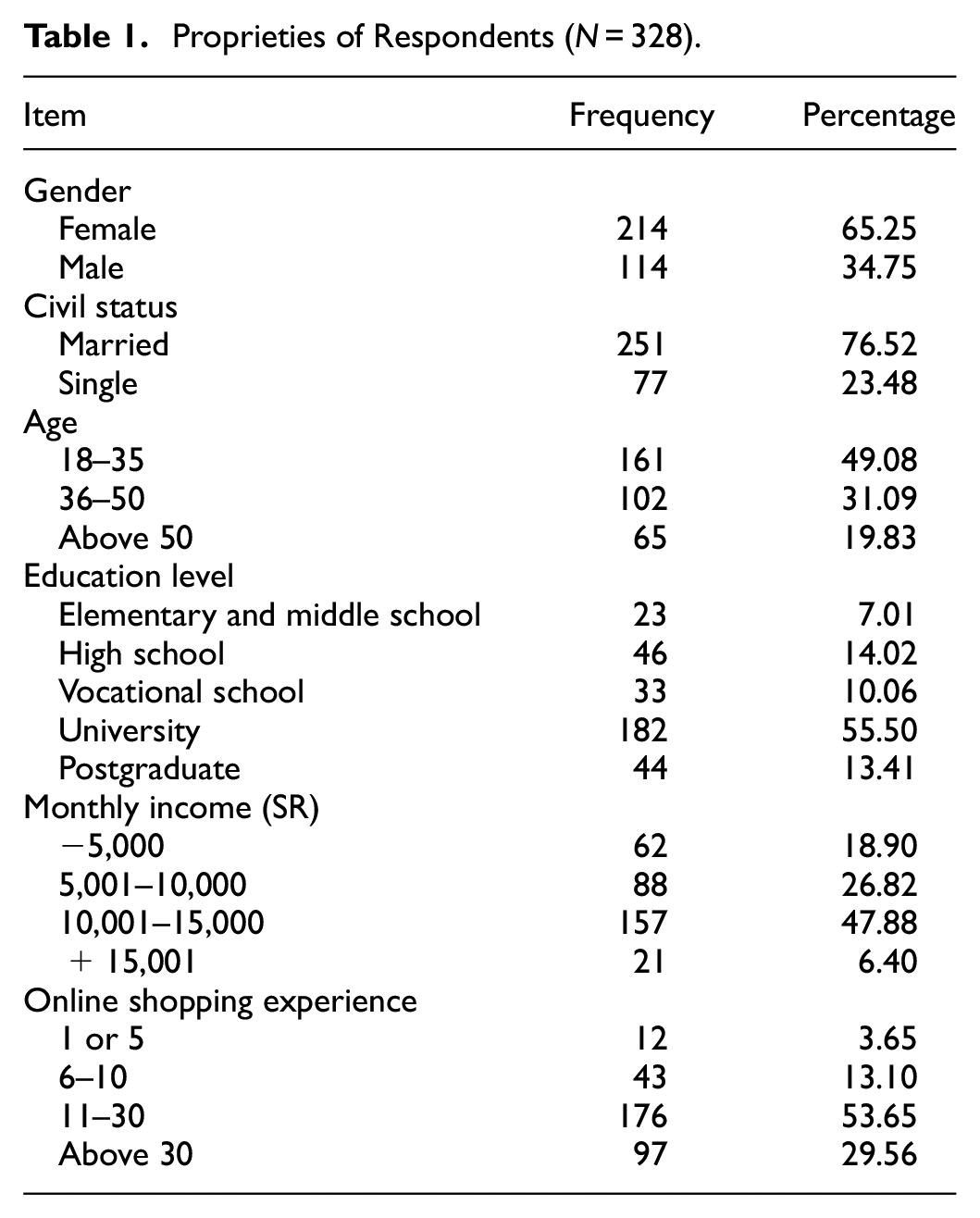
The results showed that more than half of the responses came from female respondents (65.25%), most of whom were married (76.52%). As for their age, 49, 31, and 19.83% were aged 18–35, 36–50, and over 50 years, respectively. Concerning their level of education, 7, 14, 10, 55.5, and 13.4% were in elementary and middle school, high school, vocational school, university, and postgraduate, respectively. As regards monthly income, the majority of the respondents (73%) earned from 5,000 to 15,000 SR a month. The last question in this sample profile section is about the experience in online shopping. Over 83% of the respondents stated that they had purchased at least 11 times from commercial websites during the last 6 months. This high level of online shopping rate can be accounted for by two factors. On the one hand, the statistics showed that the Saudi market is the most important market for online shopping in the MENA region (Ghali, 2021). On the other hand, the survey was distributed during the COVID-19 pandemic period, which affected most nations across the world, leading to a rapid increase in all types of online shopping (groceries, apparel, technologies, etc.). More details about the socio-demographic properties of the respondents are presented in Table 1.
Proprieties of Respondents (N = 328).
Measurement Model Tests
Data Analysis
Structural Equation Modeling (SEM) was employed using software LISREL 8.52 to test the relationship between latent variables and consequently analyze the different objectives assigned (Byrne, 1998). This method consisted of two stages. The test of the measurement model constitutes the first stage of the analysis, and the test of the structural model that leads to hypotheses verification is the second stage.
Measurement Model Assessment
At this stage of analysis, several criteria were considered to assess common method bias (CMB), reliability, convergent and discriminant validity, and model explanatory power.
As the survey was used as a tool to collect data for both independent and dependent variables, the assessment of common method bias (CMB) is recommended. In the context of this study, CMB was assessed according to the approach of Harman’s one-factor test, which consists of the test of total variance extracted by one factor. Using SPSS, the value found for CMB is 34.283%, less than the recommended threshold of 50% (Aguirre-Urreta & Hu, 2019). Thus, there is no risk of common method bias.
According to the findings, Cronbach’s α values ranged from .721 to .937 and indicated a strong correlation between indicators and their factors, except for the third item of the e-commitment relationship (EC3): “I feel a sense of belonging to the online retailer I transact with” which had a low correlation (.473) with its factor, we consequently removed it. This can be understood by the fact that e-customers consider the relationship with e-service providers to be more an association than a belonging. For all remaining indicators, the composite reliability (CR) had acceptable values (above .7). Furthermore, the loading values for all indicators ranged from .721 to .937, which was significant, according to Fornell and Larcker (1981). Accordingly, the reliability of each item for the different factors was confirmed. Convergent validity was measured using the average variance extracted (AVE). All scores (ranging from .711 to .891) exceeded the acceptable level (.70) (Hair et al., 2010). These results were satisfactory and confirmed convergent validity. Table 2 presents the results.
Test of the Measurement Model.

To assess the model’s explanatory power, we used the R square, also called R2 or the coefficient of determination analysis. R square measures the percentage of variance explained by the model (Mathew et al., 2020). According to our findings, the R2 value for the e-trust construct was 0.38. This means that 38% of the trust variance is explained by its predictors (perceived ethics dimensions). For e-commitment, the R2 was 0.41. This signifies that 41% of the e-commitment variance is accounted for by its predictors (perceived ethics dimensions). For repetitive purchases, the R2 was out of 0.62. This signifies that 62% of the repetitive purchase variance is explained by e-trust and e-commitment. In sum, for the three dependent variables, the R square values are acceptable and indicate the significance of the determinant variables to the respective criterion variables (Falk & Miller, 1992).
Discriminant validity was also confirmed for every construct, as the square roots of the average variances extracted (AVEs) were higher than all other cross-correlations (Fornell & Larcker 1981). The results are presented in Table 3.
Fornell-Larcker Discriminant Validity Test.

Note. Values in bold are square roots of AVEs.
Structural Model Assessment and Discussion of Results
At this stage of the analysis, we examined the relationship between the variables of the conceptual model. The structural equation model via LISREL 8.52 was used to assess the overall model fit as well as the causal relationships between the constructs.
Test of Model Fit
All indices used to test the model fit showed acceptable values (Schumacker & Lomax, 2010). The results of the model fit indicators are summarized in Table 4.
Model Fit Goodness.

According to these results, the model fits the data well. We then tested the hypothesized relationships between the latent variables of the conceptual model.
Structural Model Assessment
The findings showed that e-trust was significantly predicted by privacy (β = .752), security (β = .733), reliability (β = .528), service recovery (β = .218), non-deception (β = .433), communication (β = .133), and shared value (β = .264). Therefore, H1a, H2a, H3a, H4a, H5a, H6a, and H7a were supported. E-commitment relationships are also significantly predicted by privacy (β = .628), security (β = .738), reliability (β = .438), service recovery (β = .238), non-deception (β = .688), communication (β = .203), and shared value (β = .133). Hence, H1b, H2b, H3b, H4b, H5b, H6b, and H7b were supported. E-commitment was significantly predicted by e-trust (β = .569). Hence H8 is supported. Repetitive purchases are also found to be significantly predicted by both e-trust (β = .433) and e-commitment (β = .216). Hence, H9 and H 10 were supported.
The moderating role of e-retailer reputation was also tested. The findings showed significant and positive effects with the following values (e-trust × reputation: β = .682; e-commitment × reputation: β = .619). Hence, H11a and H11b were supported.
More details on the structural relationships between the latent variables of the conceptual model are presented in Table 5.
Path Analysis and Hypotheses Testing.

Note. *p ≤ .01. **p ≤ .05.
Discussion
The current study investigated the impact of online retailers’ perceived ethics on e-trust and e-commitment, which, in turn, predict repetitive purchases. The moderating role of the reputation of online retailers was also examined. Findings indicated that the different ethical dimensions studied in this context have a significant influence on both e-trust and e-commitment, yet to a varying degree. Security and privacy were found to be the most important drivers of e-trust and e-commitment (H1a,b; H2a.b). These results are in line with the findings of Yuan et al. (2019) and Ghali (2021). This can be explained by the fact that within an online environment, characterized by a high risk of ethical issues (hacking attempts, illegal disclosure of personal information, and credit card information leakage), shoppers tend to be more doubtful and worried. They cannot trust an e-retailer or engage in online transactions before ensuring guaranteed privacy and safe transactions. However, our findings do not fit those of Nugroho et al. (2015), who argued that security and privacy have become a point of parity since all shopping websites behave similarly. Furthermore, according to these authors, ensuring the safety of online transactions and protecting consumers’ personal data do not constitute a privilege, but a necessity for all online stores. If these dimensions were missing, mistrust and failed online transactions would result. Agag (2017) also found that privacy in the B2B context has no effect on the relationship quality of SMEs’ B2B websites, and the importance of privacy and security is weak because corporate information that should be secured is generated at the moment of the transaction.
Reliability is also considered a significant predictor of both e-trust and e-commitment (H3a,b). Hence, to trust an online store and engage in a relationship with it, consumers need to make sure that they will receive what they ordered at a convenient time and with the right billed price. This finding is similar to that reported by Pennanen et al. (2007). Working in the same context, Agag et al. (2016) found that reliability is the strongest predictor of trust with non-deception.
The fourth ethical dimension of online stores developed in this study is service recovery. The findings indicate that it also has a significant impact on both e-trust and e-commitment (H4a,b), which is similar to the findings of Pizzutti and Fernandes (2010) and Agag et al. (2016). This finding indicates that the quality-of-service recovery in case of delayed delivery, clients’ claims, and goods’ returns play an important role in raising e-trust and e-commitment in consumers. Therefore, online stores must implement tracking mechanisms, complaint procedures, and service recovery policies to reassure consumers and build a sustainable relationship with them (Agag et al., 2016).
Our findings also confirmed the significant association between non-deception as a dimension of online retailers’ ethics, e-trust, and e-commitment (H5a, b), similarly to the findings of Agag et al. (2016). To avoid deceiving shoppers, online stores must be accurate, honest, and fair when describing the features of the products they offer for sale. In this sense, they are called to avoid exaggeration when communicating about the products and their benefits, to avoid forcing non-experienced consumers into purchasing products that they do not need, and to avoid any kind of dishonest comparison with the other offers on the market (Bart et al., 2005).
Communication has also been discovered to be important in improving the quality of relationships through its role in building e-trust and e-commitment in customers (H6a, b). Online service providers should provide buyers with accurate, reliable, and precise information. This finding is consistent with those of Agag (2017) and Al-Adwan and Al-Horani (2019). Shared value also plays a significant role in implementing both e-trust and e-commitment (H7a, b) in consumers. In this sense, shared values build a long-term associative bond and consolidate the consumers’ sense of belonging. Therefore, e-retailers must foster an ethical culture that instills good shared values into their interactions to establish trust-based relationships. These findings are in line with those of Agag et al. (2016) and Agag (2017).
Concerning the relationship between e-trust, e-commitment, and repetitive purchases, the findings are similar to those of Morgan and Hunt (1994) in their trust-commitment approach. In other words, e-trust has a significant impact on both e-commitment (H8) and repetitive purchases (H9). E-commitment also leads to strong repetitive purchase behavior (H9). These results are also similar to those of Hsu et al. (2015), Y. Kim and Peterson (2017), S. B. Lee et al. (2019), and Faraoni et al. (2018), authors who argued that trust and commitment are among the drivers of robust and structural relationships with customers.
The moderating role of e-retailer reputation was also tested (H11a and H11b). The findings showed significant and positive effects on the relationship between e-trust/repetitive purchases and e-commitment/repetitive purchases. These findings extend the literature by showing that the reputation of the e-retailer exerts a strong impact on the relationship between trust, commitment, and repurchase intention. The higher the reputation of e-retailers is, the more important trust and commitment towards them are, and the more likely the repurchase intention becomes. This conclusion is in line with the work of Jalilvand et al. (2017), Bennett and Gabriel (2001), and Liu et al. (2019). In this sense, the reputation of online stores strengthens the effect of both e-trust and e-commitment on repetitive purchase behavior because it reduces perceived risks and provides more assurance of security and reliability to e-users (Agag, 2016; Ziaullah et al., 2016). In fact, according to Morgan and Hunt (1994), consumers who trust and are committed to a brand or a product will inevitably have an intention to purchase. To strengthen this intention to purchase from the same platform, consumers need to hear from other stakeholders (other customers, community, etc.) about how they perceive this platform and what opinions they have based on their past experiences. In this sense, the reputation of online retailers was found to play a significant role in closing the gap between trust and commitment (determinants of intentional behavior) and repetitive purchases (actual behavior). Thus, consumers who trust an online platform and are willing to maintain a relationship with it are more likely to effectively repurchase from the same online platform if it is well-reputed.
Implications
This study brings three main contributions to the marketing literature. First, it enriches the existing literature by adopting the trust-commitment theory of Morgan and Hunt (1994) in the context of online retailing. Several studies have already confirmed the robustness and pertinence of this theory in understanding the quality of the relationship in commercial transactions in several economies (Chen et al., 2003; Tonder, 2016). Other studies have adopted this approach in the B2B context (Agag et al., 2016). However, this study is among the earliest of its kind to adopt the trust-commitment theory for B2C relationships and in the online environment. Moreover, this study extends this theory by examining the moderating role of reputation in the relationship between trust, commitment, and repetitive purchases. Several prior studies supported the hypothesis that reputation is a significant predictor of trust and commitment (Ahamed & Pham, 2021; Olaleye et al., 2018, Tahir et al., 2017). Other studies have examined reputation as an independent or mediator variable in relationship networks between commercial partners (Bennett & Gabriel, 2001; Keh & Xie, 2009). However, the present study adds to the existing literature by testing its role as a moderator that significantly strengthens the relationships between trust, commitment, and repetitive purchase. This means that to close the gap between trust and commitment (as intentional behavior) on the one side, and repetitive purchase, on the other side, corporate reputation was found to play a significant role.
Second, this study enhances the existing literature by validating the scale of the perceived ethics of the online retailers (CPEOR), which includes 7 items in a B2C context. Several studies have measured the CPEOR as a multidimensional concept (Ahamed & Pham, 2021). Roman (2007) initiated a scale of four dimensions (security, privacy, non-deception, and reliability), Agag et al. (2016) added two other dimensions (service recovery and shared value), and Agag (2019) supplemented a seventh dimension (communication) and tested the validity of this scale in B2B context. To the best of our knowledge, the present study is the first to test this seven-dimensional CPEOR scale in a B2C context. Results showed that the seven dimensions are significant motives for relationship quality (e-trust and e-commitment).
The conclusions reached by this study also provide managers and marketers in the e-commerce context with a set of recommendations to enhance consumer loyalty. First, managers and marketers of online platforms must understand how the ethical practices of online transactions influence consumers’ e-trust and e-commitment which predict the sustainable purchasing behavior of consumers. Such behavior becomes a central factor in gaining the battle for competitiveness in a market with low barriers to entry and a high number of competitors. This competition battle sharpened during the COVID-19 pandemic when online shopping has become the single alternative for many consumers worldwide (Polas et al., 2022). To build trust and commitment in e-users, online retailers are required to develop an ethical atmosphere through several features. First, e-retailers are required to ensure consumer security, which has been identified as the most critical factor in online transactions. Indeed, e-shoppers will only buy and pay through websites when they are sure that it is secure to disclose their personal information (Ghali, 2021). As a result, online retailers are urged to raise barriers against hackers by linking mobile phone numbers or e-mail addresses to shopping accounts, and by sending a new code at every access. Besides, online retailers must invest heavily in the conservation, renewal, and encryption of the customers’ personal information to guarantee safe transactions and payments. Second, online retailers should protect consumer privacy by explaining their privacy policies, which will increase the consumer’s willingness to provide personal data to online transaction websites and, as a result, buy from online stores. Third, online retailers should work on their reliability, this additional facet of the e-ethical retailer’s standards plays a critical role in building customer trust and loyalty. In general, the accuracy of product presentation on a website and the timely delivery of the product are determinants of reliability. Online platform designers should implement the correct technological functionalities that enable a quick, convenient, and smooth online buying experience to incorporate these elements. E-retailers should also be well equipped to enable quick service recovery and, as a result, increase client trust (Phan et al., 2021). Furthermore, a prompt and effective response from e-service providers showing their interest, sincerity, and seriousness in solving their customers’ problems can reinforce their honesty and integrity. Fourth, service recovery seems mandatory for building the trust and commitment of customers and their repetitive purchases. This is a meaningful post-sales service that influences customers’ future transactions. Therefore, e-retailers are required to provide recovery services to guarantee good quality and durable relationships with customers. This study shows that communication also plays a considerable role in building customers’ trust and commitment. This means that e-service providers should provide a transparent return policy and clear procedures when products and policies are not delivered on time. In addition, e-retailers should promptly deal with the inquiries and complaints of customers while they are shopping on their websites. Ethical practices in the online context must be rooted and incorporated into the online retailers’ ethical culture. In other words, these practices should be part of the established ethical programs and ethical codes.
Finally, according to the findings of this study, the reputation of online retailers strengthens consumers’ trust in online retailers and enhances their commitment to sustaining the relationship. Therefore, to maintain a strong and durable relationship with consumers, which has become a central factor in gaining a competitive advantage in a highly competitive market, online retailers are required to cultivate their reputation (J. Kim & Lennon, 2013). This is possible by sharing value-forwarding content, showing earnestness when displaying the values of services, developing and maintaining brand identity, following feedback, listening to opinions and suggestions of customers and being consistent while serving them, and encouraging them to leave reviews.
Limitations and Future Research Directions
Although the set of issues to be considered has actually been addressed in this study, some limitations remain and should be underlined. First, the data were collected using convenience sampling, which is an inappropriate method to generalize the results. Moreover, data were collected through social networks (such as Facebook), which cannot be considered a sufficiently credible tool according to Aboul-Dahab et al. (2021). Further studies can use a probabilistic sampling method and collect data through more credible channels (professional e-mails, phone calls, etc.) to give results generalizability and accuracy. Second, although the used sample size is considered satisfactory for some approaches, such as Kline (2005), other scholars argued that it is rather a small-sized sample for a Structural Equation Modeling analysis (Green, 1991; Hair et al., 2010; Kline, 2016). The sampling limitations were essentially due to time constraints, sampling cost, and the low level of response. Third, as reliability and validity (convergent and discriminant) were confirmed for all constructs, the threat of common method biases had not been assessed. However, prior studies showed that as long as the survey is used as an instrument to collect data, a common method of bias assessment remains necessary (Baumgartner et al., 2021; Kock et al., 2021). Fourth, trust and commitment are investigated as one-dimensional constructs. However, marketing scholars have distinguished mainly two facets of e-trust, which are trust in online service providers and websites (Hsu et al., 2014). The e-commitment relationship is also a multidimensional concept, as it encompasses emotive, continuance, calculative, cognitive, and normative commitments (Nusair et al., 2010). Future research endeavors should examine the various components of trust and commitment as well as the impact of each dimension on repetitive purchases. Finally, information was gathered in a single country (Saudi Arabia) where e-commerce started to witness steady growth, especially in the era of the coronavirus pandemic. Future studies should explore the generalizability of the results by investigating the conceptual model developed in this study in other markets.
Footnotes
Declaration of Conflicting interests
The author declared no potential conflicts of interest with respect to the research, authorship, and/or publication of this article.
Funding
The author received no financial support for the research, authorship, and/or publication of this article.

Data Availability Statement
Data sharing not applicable to this article as no datasets were generated or analyzed during the current study.