




Abstract
In times of the rise of the “A4 waist” trend on social networks (SNs), concerns have been raised over appearance-related content’s adverse effects on body image and well-being in parasocial relationships. We conducted a survey on Chinese college students (N = 333) to examine the effects of comparison targets (same-gender acquaintances, celebrities, and online strangers) based on social comparison theory. The results indicate that, in line with construal-level theory, students paid more attention to the appearance-related content of same-gender acquaintances than that of the other two target groups. Surprisingly, small gaps in physical attraction between the students and acquaintances generated more appearance concern than the huge gaps between the students and celebrities, which could be explained by the “narcissism of small differences” theory. We developed existing comparison target studies by including the impact of online strangers to adapt to the current SN environment. Although the students paid the least attention to strangers’ SN appearance-related content, exposure to such content had a positive correlation with appearance concern. Regarding gender differences, females devoted more to SN appearance-related content than males across all three target groups, but the concern generated from viewing such content differed only when the targets were celebrities (females > males). The present study expands social comparison theory by introducing a two-dimensional (similarity and interaction forms) concept of “social distance.” Our findings suggest that socially close targets received more attention and comparisons and generated more concern about appearance.
Plain language summary
We carried out a survey among Chinese college students to look into their concern about appearance when exposed to appearance-related posts on social networks. Three groups were compared: same-gender acquaintances, same-gender celebrities, and same-gender online strangers. The students tended to focus more on acquaintances’ appearances and felt more concerned when viewing acquaintances’ appearance-related posts compared to celebrities and online strangers. We added online strangers as a comparison target, and the study found that viewing strangers’ posts made students concerned about their own looks even if there were no existing relationships between the two groups. Females were more engaged in SN appearance-related content than males, but the concern generated from viewing the post differed only when comparing themselves to celebrities. This study introduces the idea of “social distance,” indicating that people are more affected by those they feel closer to socially when comparing appearances on social networks.
Introduction
Recently, the term “appearance anxiety” (“rongmaojiaolv” in Chinese) has been gaining momentum in the news and social media. “Appearance anxiety” or “concern about appearance” is defined as the fear of being negatively evaluated for one’s appearance, and it relates to social anxiety, body image dissatisfaction, and body dysmorphic disorder (Boursier et al., 2020). Popular challenges on social media among young people, such as “A4 waist” and “coins on collarbone,” 1 conveyed the image of thin bodies and the advantages of being thin. Articles and videos teach the audience how to use makeup, dress, and choose suitable beauty surgery, promoting unattainable beauty standards, and making users feel dissatisfied about their bodies (Fioravanti et al., 2022). While there have been “body positivity movements” advocating for accepting all body types on Chinese social media, existing research indicates that such movements on social networks (SNs) maintain an appearance focus and may encourage self-objectification, leading to negative consequences including body shame and disordered eating (Cohen et al., 2020; Lazuka et al., 2020). A survey of 1,301 Chinese college students suggests that 61.6% of the respondents were unsatisfied with their body image (Yong et al., 2021), and an earlier study of 425 Chinese college students shows a greater number—87.1% of the respondents were unsatisfied with their body image (K. Wang et al., 2018). The preference for thinness in Chinese culture may partially explain these findings, as thin and fragile female figures with narrow waists were praised in classical literature and historical legends (Jackson et al., 2016; Leung et al., 2001).
Existing research indicates that sociocultural factors—such as influences from mass media, peers, siblings, parents, and partners—contribute to body image dissatisfaction (Keery et al., 2004; Roberts et al., 2022; Rodgers & Rousseau, 2022; Thompson et al., 1999). The comparison is a mediator of sociocultural factors and body satisfaction (Jarman et al., 2022; Jung et al., 2022; Seekis et al., 2020; Tylka et al., 2023). The present study examines the effects of different comparison targets on Chinese college students’ appearance concerns.
Social Comparison Theory and Comparison Targets
Social comparison theory explains the “sociocultural factors-comparison-body dissatisfaction” mediation process by suggesting that people compare themselves with individuals due to the drive for self-evaluation, especially when lacking available objective criteria, and they generate dissatisfaction with the self when the comparison shows a great difference between the self and the comparison target (Brown & Tiggemann, 2016; Festinger, 1954; Lee & Lee, 2021). Comparison frequency and consequences vary with targets. Fardouly and Vartanian (2015) found that Australian female university students compared their appearance most often with distant peers on Facebook, just as frequently to close friends and celebrities, and least frequently to female family members. In terms of the consequence of comparison with different targets, Leahey and Crowther (2008) found that upward and downward comparisons with peers were respectively associated with more and less appearance esteem than with media images. Brown and Tiggeman (2016) conducted an experimental study among Australian female undergraduate students and found that exposure to peers’ Instagram images and exposure to celebrities’ Instagram images lead to no significant differences in negative mood and dissatisfaction. An ecological momentary assessment (EMA) study also suggested no relative differences in the associations between upward comparisons to different target groups (peers, celebrities and strangers) and appearance satisfaction (Fardouly et al., 2021). The above EMA research included all forms of medium (social media, Internet, traditional media such as magazine/television/billboard and in person), and most of the comparisons were made in person (621 times out of 876 times in total), leaving social media’s situation not fully investigated.
Previous studies developed body image research by focusing on comparison targets, but three aspects needed extended research. The first is to include online strangers on SNs as targets. Online strangers consist of all the users encountered in SNs with names and identities being unknown. Their social networking content is usually presented in users’ timelines because of algorithmic recommendations rather than subscriptions. Before users stumble across online strangers’ content on SNs, they have no “relationship” with them (Hernández-Ortega, 2018). Such a “non-existent relationship” between users and online strangers is an ideal contrast to the “parasocial relationship” between users and celebrities and the “real-life relationship” between users and acquaintances in the current context of SNs. The second aspect is to investigate gender differences. The studies listed above all focused on females. We would like to uncover whether males and females differed in appearance-related SN use behaviors (exposure to and viewing the details of appearance-related information), comparison frequency, and concern about appearance. The third aspect is that that previous research on the effects of comparison targets has primarily been conducted in the United States (Leahey & Crowther, 2008) and Australia (Fardouly et al., 2021; Fardouly & Vartanian, 2015). It’s essential to investigate the comparison targets’ impact in China’s unique social media environment. In China, popular social media platforms include WeChat and Weibo, and short video apps such as Douyin (TikTok in China) and Kuaishou also have social functions. Chinese college students could obtain access to appearance-related content through these channels. The WeChat Moment page only presents content posted by contacts in the address book of WeChat. While all of the other SN platforms present content from both algorithm recommendation and subscription, enabling users to access content posted by celebrities and online strangers. Different combinations of SN use affect the frequency of exposure to different comparison targets, which in turn affects body dissatisfaction.
Comparison Targets Categorized by Social Distance in the Context of SNs
The present study focused on Chinese college students’ SN use behaviors and reactions related to three target groups: same-gender acquaintances, including friends, classmates, teachers, and other elders; same-gender celebrities, including stars, fashion models and SN influencers (Brown & Tiggemann, 2016; Lou, 2022); and same-gender online strangers. The social distance to respondents could distinguish the three target groups.
“Social distance” is a multidisciplinary concept involving anthropology, sociology, psychology, marketing, and communication. Some researchers used similarity to measure social distance (Liviatan et al., 2008; McLean et al., 2016), and some used the forms of interaction (face-to-face interaction or parasocial interaction) to measure it (Horton & Wohl, 1956; Konijn & Hoorn, 2017). Drawing on the theory of social distance, we distinguished three target groups from the following two dimensions. The first dimension was similarity in physical attractiveness. In this dimension, the distance between college students and celebrities was greater than between college students and the other two groups because stars’ and SN influencers’ appearances and figures tended to be above average. The second dimension was the relationships built on interaction forms. There was no existing relationship between college students and online strangers. In terms of celebrities, college students could build parasocial relationships with them through the media. Horton and Wohl (1956) described parasocial relationship as an “illusion to face-to-face relation” created by the mass media, which was unidirectional (the audience is familiar with and engaged with mass media personalities). In the context of social media, parasocial relationships with celebrities were turning to bidirectional (Lou, 2022), and it could beneficially influence users’ well-being by enhancing self-perception and feelings of connection and community, but also adversely influenced users through self-comparisons (Hoffner & Bond, 2022; Tukachinsky & Stever, 2019). In terms of acquaintances, college students were linked to them through real-life social networks. Face-to-face and bidirectional interactions were more available in the relationship with acquaintances than with celebrities. However, we cannot conclude that the social distance between college students and acquaintances in the interaction dimension is definitely narrower than that between college students and celebrities, because the parasocial relationship between college students and celebrities through SN could be strong or weak. In strong parasocial relationships, individuals exhibit similar emotional and behavioral responses to media characters as they would in real-life situations (Hu et al., 2021; Stein et al., 2022). In some cases, they can even develop romantic feelings and attachment towards celebrities through the media (Stever, 2011). In summary, regarding interaction forms, the social distance between college students and strangers was further than between acquaintances and celebrities.
Social distance affects individuals’ perceptions. Construal-level theory (Trope et al., 2007) assumes that people use general, decontextualized features to explain psychologically distant objects (dissimilar or powerful) for insufficient details or unreliable information. Previous studies suggested that individuals emotionally invested more in (Andersen et al., 1998) and were attracted more by (Byrne, 1997) socially close individuals than distant individuals. They also tended to choose people with similar abilities and opinions as comparison targets to evaluate themselves precisely (Festinger, 1954). Thus, we proposed the following hypotheses:
H1a: Compared to celebrities’ SN appearance-related content, college students view the details of acquaintances’ SN appearance-related content more frequently.
H1b: Compared to online strangers’ SN appearance-related content, college students view the details of acquaintances’ SN appearance-related content more frequently.
H2a: College students compare appearance-related content with acquaintances’ SN content more frequently than with celebrities’ SN content.
H2b: College students compare appearance-related content with acquaintances’ SN content more frequently than with online strangers’ SN content.
SN Usage and Concern About Appearance
Chinese college students are increasingly relying on social media as a vital aspect of their daily routine. A study conducted across 220 universities in China (N = 5,118) found that 99.39% of respondents use social media on a daily basis. Of these individuals, 74.96% spend over four hours per day on social media platforms (China Youth Daily, 2022).
Existing experiments suggested that exposure to thin-ideal media images would reduce body satisfaction (Groesz et al., 2002). Extended studies found that respondents who engaged more in appearance-related activities in SNs reported higher levels of body dissatisfaction (Fardouly et al., 2018; Jarman & Marques et al., 2021; Lee & Lee, 2021; McLean et al., 2015). In China’s case, Liang et al. (2020) found a positive relationship between Chinese female undergraduates’ short-video use and depression, and body satisfaction acted as a mediator. Y. Wang et al. (2022) found that Chinese college students’ SN body talk was positively related to body dissatisfaction. This relationship was mediated by thin-ideal internalization and muscular-ideal internalization. Based on previous studies, we hypothesized that more exposure and engagement would lead to more concern about appearance. The hypotheses are stated as follows:
H3a: The frequency of exposure to the SN appearance-related contents of three target groups would be positively linked to concern about appearance.
H3b: The frequency of viewing the details of SN appearance-related contents of three target groups would be positively linked to concern about appearance.
We also focused on respondents’ concerns generated from viewing appearance-related content on SNs differentiated by target groups, and we proposed the following question:
RQ1: Do college students rate the concern about appearance generated from viewing SN appearance-related contents differently according to different target groups? If so, among acquaintances, celebrities, and strangers, which target group would respondents rate as generating the highest level of concern about appearance?
Social Comparison’s Mediating Role and Gender
Correlational and experimental research suggested that appearance-focused media use was related to lower body satisfaction, with comparison playing a mediating role (Groesz et al., 2002; Holland & Tiggemann, 2016; Jarman & McLean et al., 2021; Want, 2009). Based on previous studies, we proposed the following hypotheses and one research question:
H4a: The positive link between view frequency and appearance concerns would be mediated by the frequency of appearance comparison with the three target groups.
H4b: The positive link from detailed viewing frequency to concern about appearance would be mediated by the frequency of appearance comparison with three target groups.
The gender difference was also examined. Previous studies showed that women’s body and weight dissatisfaction were greater than men at most weight categories (Pingitore et al., 1997) and that comparison’ mediating effect only applied only to females, but not to males (Tiggemann & Anderberg, 2020; Tylka et al., 2023). The present study examined whether SN use behaviors, comparison frequency, and concern varied between genders. Gender’s moderating role was also examined in the mediation models (Figure 1).

A hypothetical model: relationships between SN use behaviors and concern about appearance.
Methods
Participants and Procedure
A presurvey was conducted in April 2022, and 36 samples were collected by means of convenience sampling. After examining the reliability and validity of the scales and revising the questionnaire, we conducted the formal survey from May to August 2022. We collected 333 valid samples through snowball sampling selection, 93.1% of whom were aged between 18 and 26 years old (M = 21.90, SD = 3.47). The sample consisted of 110 males (33.03%) and 223 females. In terms of education level, 71.11% of the participants were undergraduate and junior college students, 23.42% were postgraduate students, and 4.8% were doctoral students. The college participants attended were in 17 provinces and municipalities of China. A total of 30.90% of participants attended colleges in Shandong Province, and 14.4%, 11.7%, 7.5%, and 7.5% were in Henan, Liaoning, Shanxi, and Fujian Provinces, respectively. The sample distribution is scattered.
Measures
Exposure Frequency and Detailed Viewing Frequency
We listed nine popular apps (Figure 2) in the questionnaire, and respondents were asked whether they could obtain access to appearance-related content in these apps. Exposure frequency to SN appearance-related SN content was measured by a question: How often are you exposed to following people’s (same-gender acquaintances, celebrities, and online strangers) photos and videos about their appearances and bodies in social networks? Participants rated their exposure frequency using a 5-point scale (1 = never to 5 = almost every time). The detailed viewing frequency was measured by the question: When exposed to appearance-related photos or videos of the following people (same-gender acquaintances, celebrities, and online strangers) in a social network, how often do you view the details? (Viewing details refers to clicking on the picture, expanding it to a larger image, or playing the video in its entirety.) Participants responded to a 5-point response scale (1 = never to 5 = almost every time). This variable measured people’s proactivity and curiosity when exposed to different targets’ SN appearance-related information.
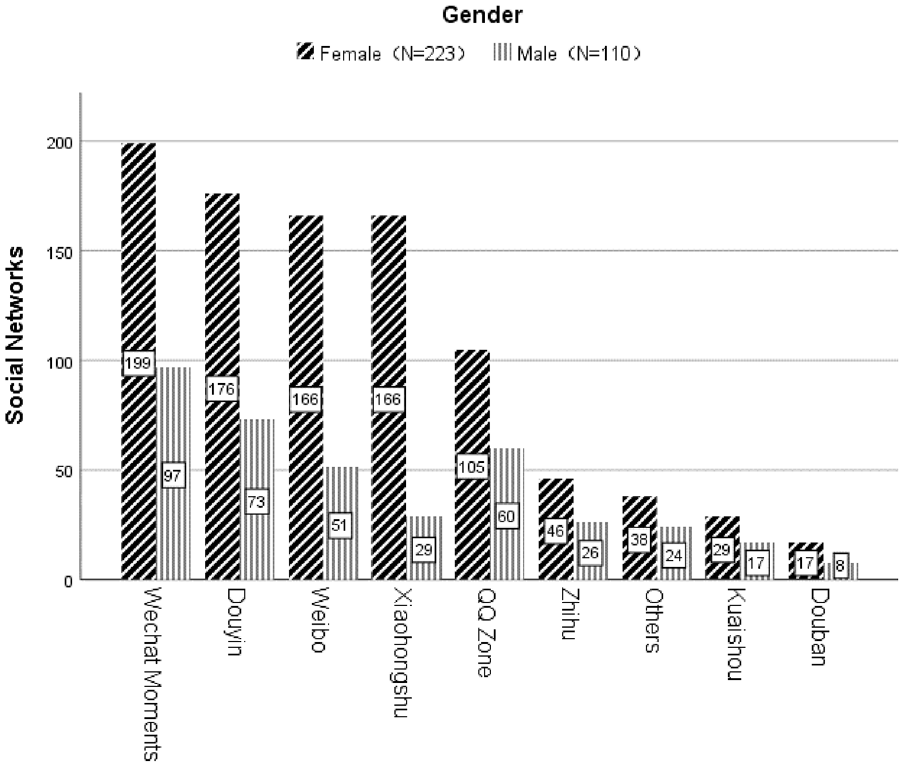
Respondents exposed to appearance-related information through following social networks.
Appearance Comparison Frequency
The frequency of appearance comparison was measured by an item modified from the Social Comparison Questionnaire (Schutz et al., 2002): When exposed to appearance-related photos or videos of the following people (acquaintances/celebrities/online strangers) in social networks, how often do you compare your own appearance with those whose images and videos? Participants responded to a 5-point response scale (1 = never to 5 = almost every time).
Concern about Appearance
Concern about Appearance was measured using an eight-item scale from two aspects: willingness to improve body shape or appearance and concern about self-image on the internet (Appendix A). Two items were about the former aspect: I think it is necessary for me to change my figure (e.g., lose weight, gain muscle, etc.), and I have used, or I might use, cosmetic surgery to improve my appearance in the future. These items were adopted from the Negative Physical Self Scale (NPS) (Chen et al., 2006), which assessed the motives for change to evaluate body image concerns. Six items adopted from the Questionnaire for Assessing Concern About Appearance on Social Networks (CONAPP) (González-Nuevo et al., 2021) were included in the scale to measure the concern about self-image on the internet from three aspects: social comparison, photo preparation, and concern about social media presence. The relationship between comparison and concern about appearance was stated before. We used four items: If I see someone/acquaintances/celebrities/online strangers of my gender posting pictures or videos more beautiful than mine, I feel bad about myself. to measure the concern generated from viewing appearance-related content in SNs and comparison. We also compared correspondents’ scores on three of the above items to measure if the concern generated from viewing appearance-related SN content of acquaintances, celebrities, and online strangers was different. Photo-editing behavior might reflect body image concerns (Lee & Lee, 2021). We used the item: I think it is necessary to use photographic programs to edit my photographs or videos before I post them on social media. to measure the concern from the perspective of photo preparation. The number of likes on SNs was regarded as a form of peer influence and it could lead to comparison, which further caused concern about appearance (González-Nuevo et al., 2021; Tiggemann et al., 2018). We used the item: In regard to posting pictures and videos about my appearance and body on social media, I worry about the number of likes being low. to measure the concern about social media presence. The Cronbach’s α of the scale was.78.
Data Analysis
SPSS was used to analyze the survey data, and statistical significance was set at p < .05. We first counted respondents’ access to eight social networks prevalent in China through which respondents view appearance-related information. The correlation between the counts and appearance-related information exposure frequency was tested. Next, we analyzed differences in exposure frequency, detailed viewing frequency, comparison frequency, and concern about appearance generated from viewing appearance-related information. The differences in concern about appearance between genders and among the three social distance groups were also tested. Some of the variables did not fit a normal distribution (the statistical significance of Kolmogorov–Smirnov test < .05.), so we adopted nonparametric analysis: Spearman’s rank correlation test, the Mann–Whitney U test, and the two-sample Wilcoxon signed-rank test. Third, the PROCESS add-on for SPSS (Model 4) (Hayes, 2017) was used to test the mediating role of appearance comparison frequency. Finally, Model 59 of the PROCESS macro was used to test the role of gender in the mediation model. The bootstrapping technique was used to test the significance of the direct and indirect effects by repeatedly sampling cases from the data and estimating the model in each resampling. Our study generated 95% bias-corrected confidence intervals (CIs) based on 5,000 bootstrap samples to estimate the effects.
Results
Appearance-Related SN Usage
As Figure 2 shows, WeChat Moments page (88.89% chose “yes”), Douyin (74.77% chose “yes”), Weibo (65.17% chose “yes”), Xiaohongshu (58.56% chose “yes”), and QQ zone (49.55% chose “yes”) were the five apps respondents chose most. The usage of Xiaohongshu showed gender differences, with 74.43% of females gaining access to portrayals through this channel, but only 26.36% of males chose this channel.
The correlation between SN usage and the frequency of exposure to appearance-related contents was tested. Spearman’s rank correlation shows that the use of WeChat Moments is positively related to the frequency of exposure to acquaintances (ρ = .25, p < .01). The usage of Weibo is positively associated with the frequency of exposure to celebrities (ρ = .20, p < .01) and online strangers (ρ = .13, p < .05). The usage of Douyin and Xiaohongshu was positively related to the frequency of exposure in all three groups.
Testing for Differences Related to Targets and Gender
Differences in exposure frequency and reactions to three social distance groups were tested. The results suggest that no significant difference exists between the frequency of exposure to same-gender acquaintances’ SN contents and those of same-gender celebrities. However, the frequency of exposure to online strangers’ appearance-related content was significantly lower than that in the other two groups. The feed mechanism of the SNs could explain this result. Respondents could obtain access to online strangers’ appearance-related content only through algorithms, but they could view acquaintances’ appearance-related information through the WeChat Moment page (the most frequently used media through which respondents were exposed to appearance-related information) and subscriptions in other social networks and view celebrities’ information through both subscriptions and algorithms.
In terms of detailed viewing frequency, the three paired comparisons all showed significant differences. The frequency of viewing the details of SN appearance-related content ranks as follows: acquaintances > celebrities > online strangers. H1a and H2a were supported by the statistics.
The frequency of appearance comparison with same-gender acquaintances and the concern about appearance generated from viewing acquaintances’ contents are significantly higher than the other two groups, with no significant difference existing between the celebrities and online strangers (RQ1). H2a and H2b were supported by the statistics (Table 1).
Wilcoxon Signed Rank Test Among Three Social Distance Target Groups.

Note. Concern = Concern about appearance generated from viewing appearance-related content in SNs.
p < .05. **p < .01.
Differences were tested between males and females. The results of the Mann–Whitney U test (Appendix B) suggest that females were exposed to and viewed the details of SN appearance-related information more frequently and compared more frequently than males. Regarding the concern about appearance generated from viewing appearance-related information, significant differences between males and females exist only when the targets are celebrities.
Testing for Mediation Effects
Correlations within social distance groups are examined in Table 2. The relationship between exposure frequency and concern about appearance and the relationship between details viewing frequency and concern about appearance were significant for all target groups, and the correlation coefficients were positive. H3a and H3b were supported.
Correlations Between Studied Variables Within Social Distance Groups.

p < .01.
We aimed to examine whether appearance comparison frequency could mediate the association between exposure frequency and concern about appearance and the association between details viewing frequency and concern about appearance.
As shown in Appendix C, within the three social distance groups, exposure frequency is significantly and positively related to comparison frequency (Model 1, Model 2, and Model 3). Detailed viewing frequency is significantly and positively related to comparison frequency (Model 7, Model 8, and Model 9), and comparison frequency is significantly and positively related to concern about appearance (Model 4, Model 5, Model 6, Model 10, Model 11, and Model 12).
For indirect effects, as presented in Table 3, the indirect effects were significant for all three groups. Comparison frequency mediated the relationship between exposure frequency and concern about appearance and the relationship between details viewing frequency and concern about appearance. H4a and H4b were supported. When the targets were acquaintances’ SN photos and videos, the comparison’s mediating effect was most obvious (indirect effect accounted for 93.36% of the total effect in the “exposure-comparison-concern about appearance” model and 88.73% in the “detailed viewing- comparison- concern about appearance” model).
Testing the Indirect Effects (N = 333).

Note. (A) = acquaintances’ appearance-related content in SNs; (C) = celebrities’ appearance-related content in SNs; (S) = online strangers’ appearance-related content in SNs.
The moderating roles of gender in the indirect associations between exposure/detailed viewing and concern about appearance were examined. The indirect effect of comparison was significant for both males and females. Gender’s moderating effect was insignificant in all paths (95% CI for the index of moderated mediation contains zero) (Appendix D).
Discussion
The present study examined Chinese college students’ SN use behaviors (exposure to and viewing the details of appearance-related contents), comparison behavior, and concern about appearance regarding three target groups: same-gender acquaintances, celebrities, and online strangers. The results suggest that exposure to and detailed viewing of all three target groups were positively associated with concern about appearance, and these positive relationships were mediated by comparison, which was in accordance with previous studies under social comparison theory (Jung et al., 2022; Mink & Szymanski, 2022; Roberts et al., 2022).
According to the findings, Chinese college students tended to pay greater attention to same-gender acquaintances than celebrities and online strangers, for respondents viewed the details of and compared with same-gender acquaintances’ SN appearance-related contents most frequently. Considering that the social distance between college students and acquaintances as a whole was closer than that between college students and celebrities (in the dimension of similarity) and that between college students and online strangers (in the dimension of interaction forms), the results supported the construal-level theory that people’s attention and devotion to appearance-related SN contents were related to the existing relationship between the objects and oneself.
Celebrities’ detailed viewing frequency was higher than online strangers’, and it could be explained by the parasocial relationship between respondents and celebrities, which generated a sense of intimacy and connection (Hoffner & Bond, 2022; Lou, 2022). However, there was no significant difference between celebrities and online strangers in comparison frequency. Two possible reasons related to the similarity might hinder respondents from comparing themselves with same-gender celebrities. One possible reason was to avoid upward comparisons (comparisons to others believed to be more attractive) with celebrities, which could reduce self-evaluation and damage body image (Seekis & Kennedy, 2023; Tylka et al., 2023). Another reason was unattainability. Existing research suggests that attainability in upward comparisons lifts one’s positive feelings by eliciting feelings of inspiration and self-improvement. People were more willing to compare with attainable targets (Bue & Harrison, 2020; Eckler et al., 2017). The difference in physical attractiveness between the respondents and celebrities was great, making celebrities unattainable benchmarks for self-improvement.
The present study may enrich social comparison theory by revealing that socially closer comparison targets have a greater impact on individuals. Appearance-related contents from acquaintances were rated as causing more concern about appearance than those from celebrities and online strangers, with no significant difference between the latter two targets. This result does not conform to the existing studies about upward comparisons. Celebrities’ appearance was rated more attractive than acquaintances (Fardouly et al., 2021), and upward appearance comparisons were deemed more detrimental to body image than downward comparisons (Seekis & Kennedy, 2023). According to the above theory, viewing same-gender celebrities’ SN contents should generate more concern about appearance, and existing research indicated that celebrities were “particularly harmful comparison targets” in contrast with other targets (Fardouly et al., 2021). However, our research showed an opposite result. Why? We proposed two possible explanations for the greater negative impact of same-gender acquaintances than celebrities. One reason was that there were other psychological behaviors besides comparison affecting the “SN use behaviors-concern about appearance” process, and such psychological behaviors were not necessarily detrimental to body image. Table 3 shows that the mediation effect of comparison was most obvious when the targets were acquaintances’ SN appearance-related contents and least obvious when the targets were celebrities’ contents. Brown and Tiggemann (2022) found that celebrity worship played a moderate role in the “exposure-body dissatisfaction” relationship. “Worship” was conceptualized as considering celebrities “important” and “relevant,” similar to our research’s interaction dimension of social distance. Women with lower levels of celebrity worship felt less dissatisfied after viewing celebrity images than women with higher levels of celebrity worship (Brown & Tiggemann, 2016), which might explain our results. Another reason was that small gaps in comparisons were more harmful than huge gaps. Tesser et al. (1988) proposed that, in the comparison process of the self-evaluation maintenance (SEM) model, when an individual is outperformed by the other one, the closer the other, the greater the threat. Other research proposed that “narcissism of small differences” (Freud, 1917) led to violence and tension between proximate groups rather than between significantly distant groups (Karakayali, 2009).
Previous studies demonstrated that irrelevant comparison targets shed no impact on participants’ self-ratings (Fardouly et al., 2015; Lockwood & Kunda, 1997). However, the present study suggested a significant positive relationship between SN use behaviors with online strangers as targets and concern about appearance, which was mediated by comparison. We explain this result by refusing the idea that online strangers were completely irrelevant targets. Though there was no existing relationship between college students and online strangers, college students could feel a sense of belonging when the strangers were peers. Such feeling generated from online interaction was much like the feelings of inclusion provided by real-life friends (Paravati et al., 2022), so students’ reactions to peer strangers’ appearance-related SN contents would be similar to the reactions to acquaintances.
Gender differences were also investigated in the present study. The results showed that females were exposed to three groups’ SN appearance-related information more frequently than males, and they viewed details and made comparisons more frequently. Females also scored higher on the Concern about Appearance Scale. The above results are in accordance with the existing research suggesting that females are more frequently exposed to idealized body images (Buote et al., 2011) and make more upward comparisons (Myers & Crowther, 2009). In terms of the concern generated from viewing appearance-related information, we found that the gender difference only existed when viewing celebrities’ appearance-related content, in which females were more concerned than males. Although the present research suggests the mediating role of comparison, we do not think that comparison could explain the above difference between genders, for the mediation effect of comparison was not moderated by gender. One possible explanation is that females generally built stronger parasocial relationships with celebrities via SNs than males (Tukachinsky et al., 2020), which means females paid more attention to and were influenced more by celebrities’ media figures than males (Tukachinsky & Stever, 2019).
The present study made contributions in the following aspects. Firstly, the study enriched body image studies by introducing online strangers on SNs as comparison targets. In the context of social media, users are accessible to strangers’ posted information randomly recommended by the algorithm, whose effect on body image has rarely been investigated. By comparing respondents’ reactions to same-gender acquaintances, celebrities and online strangers, we could reveal social distance’s effect on the “SN use behaviors-concern about appearance” relationship. Secondly, previous studies used a single dimension of relevance (Heinberg & Thompson, 1992), similarity (Leahey & Crowther, 2008), attainability (Fardouly et al., 2021), or worship (Tresna et al., 2021) to explain variations among comparison targets. The present study integrated the above factors into a two-dimensional (similarity and interaction forms) concept “social distance,” making the theory framework of comparison targets studies more adaptable to the current SN environment. Thirdly, previous studies paid more attention to females’ reactions to different target groups (Brown & Tiggemann, 2016; Fardouly et al., 2021; Fardouly & Vartanian, 2015), but we cared about both genders and investigated gender differences in SN behaviors, comparison behaviors, and concern generated from viewing three target groups’ SN content. Lastly, there were few studies revealing comparison targets’ effect on body image in China’s context. We investigated Chinese college students’ SN behaviors and reactions connected with three target groups’ appearance-related contents, further research in this field is still needed in China.
Conclusion and Future Work
The results suggested that compared with same-gender celebrities and online strangers as targets, Chinese college students devoted more to same-gender acquaintances’ SN appearance-related SN content. Concern about appearance generated from viewing same-gender acquaintances’ SN appearance-related contents was also higher than the other two targets, indicating that same-gender celebrities are the most harmful target for Chinese college students on SNs. In terms of gender differences in concern about appearance generated from viewing SN content, when the targets and respondents had real-life links (acquaintances) or had “non-existing” relationships (online strangers), gender differences were not significant; only when the targets and respondents were bonded by parasocial relationships (celebrities), gender difference was significant.
Some limitations should be addressed in the present study, and future work could complement these aspects. First, the subjects of the study were Chinese college students, but the sample size did not fully reflect the present structure of education level, with excessive postgraduate students and doctoral students and an imbalanced male-female ratio. This deficiency did not harm the validity of the study, however, because education level or age was not the core variance of the study, and we separately investigated males’ and females’ conditions. Second, the present study was a cross-sectional study; therefore, we are unable to infer causation. It may be that college students who view the details and compare more are more concerned about their appearance or that students who are more concerned about their appearance view details and make comparisons more frequently. Further experimental or longitudinal analysis research is needed to examine causal relationships. Third, in the relationships between SN use behaviors and concern about appearance, more mediators other than comparison frequency are to be explored. Last but not least, we categorized three target groups using the concept of “social distance” to interpret the results. Although this division is consistent with existing theory and common sense, future studies can extend the present comparison target research by accurately measuring the social distance with scales and testing the moderating effect of social distance in the “SN behaviors-comparation-concern about appearance” relationship.
Footnotes
Appendix
Testing the Conditional Indirect Effects (N = 333).

| Path | Indirect effect | SE | 95% CI | Index of moderated meditation | 95% CI for index |
|---|---|---|---|---|---|
| Exposure frequency (A)- comparison frequency (A)- concern about appearance scale (males) | 0.09 | 0.04 | [0.03, 0.17] | −0.03 | [−0.11, 0.04] |
| Exposure frequency (A)- comparison frequency (A)- concern about appearance scale (females) | 0.06 | 0.02 | [0.02, 0.10] | ||
| Exposure frequency (C)- comparison frequency (C)- concern about appearance scale (males) | 0.10 | 0.03 | [0.05, 0.16] | −0.06 | [−0.12, 0.01] |
| Exposure frequency (C)- comparison frequency (C)- concern about appearance scale (females) | 0.05 | 0.02 | [0.01, 0.08] | ||
| Exposure frequency (S)- comparison frequency (S)- concern about appearance scale (males) | 0.11 | 0.04 | [0.05, 0.19] | −0.05 | [−0.13, 0.03] |
| Exposure frequency (S)- comparison frequency (S)- concern about appearance scale (females) | 0.07 | 0.02 | [0.04, 0.10] | ||
| Detailed viewing frequency (A)- comparison frequency (A)- concern about appearance scale (males) | 0.08 | 0.02 | [0.04, 0.12] | −0.01 | [−0.06, 0.04] |
| Detailed viewing frequency (A)- comparison frequency (A)- concern about appearance scale (females) | 0.07 | 0.02 | [0.04, 0.10] | ||
| Detailed viewing frequency (C)- comparison frequency (C)- concern about appearance scale (males) | 0.09 | 0.02 | [0.04, 0.14] | −0.03 | [−0.09, 0.02] |
| Detailed viewing frequency (C)- comparison frequency (C)- concern about appearance scale (females) | 0.05 | 0.02 | [0.02, 0.09] | ||
| Detailed viewing frequency (S)- comparison frequency (S)- concern about appearance scale (males) | 0.09 | 0.02 | [0.04, 0.14] | −0.03 | [−0.09, 0.02] |
| Detailed viewing frequency (S)- comparison frequency (S)- concern about appearance scale (females) | 0.05 | 0.02 | [0.02, 0.09] |
Note. (A) = acquaintances’ appearance-related content in SNs; (C) = celebrities’ appearance-related content in SNs; (S) = online strangers’ appearance-related content in SNs.
Acknowledgements
Not applicable.
Author Contributions
Tong Yayun: conceptualization, methodology, investigation, data curation, formal analysis and writing-original draft
Chen Xi: conceptualization, investigation, and writing- review & editing
Cui Jiayong: methodology
Zhao Na: conceptualization, investigation, and writing- review & editing
Wang Xiling: methodology and review
Declaration of Conflicting Interests
The author(s) declared no potential conflicts of interest with respect to the research, authorship, and/or publication of this article.
Funding
The author(s) received financial support for the research, authorship, and/or publication of this article.This research was supported by the National Social Science Foundation of China [grant number 20AXW002]
Ethical Approval
Not applicable.

Data Availability Statement
The data supporting the findings of this study are available from the corresponding author upon reasonable request.