




Abstract
Manure utilization in China is below optimum due to the inconsistency between farmers’ behavior and their intention to apply manure to their crops. With increasing constraints on the availability of chemical fertilizer and their impact on the environment, understanding how farmers’ perceptions affect their intention and behavior toward manure application is an issue for the implementation of sustainable agricultural development. This study uses primary survey data from 653 farmers. A probit model was used to assess the influence of cognition on farmers’ intentions, behavior, and the inconsistency between them in the use of manure application. Heterogeneity analysis was conducted to identify differences between farmers with different education levels and operation scales. The results showed that enhancing subjective norms, perceived behavioral control, and behavioral attitudes could increase their intention and behavior. Furthermore, improving the perceived behavioral control and behavioral attitudes of farmers would reduce the inconsistency between behavior and intention. In addition, some differences were identified in the role of farmers’ cognition with different education levels and operation scales. In general, it is necessary to enhance farmers’ comprehensive cognition of the value of manure through publicity and popularization of technology, reduce farmers’ perceptions about difficulties in applying manure through new policies and subsidies, and stimulate farmers’ enthusiasm to participate in the practice.
Keywords
Introduction
Issues related to agricultural non-point source pollution caused by excessive application of chemical fertilizer have become increasingly serious (Islam et al., 2022), and currently, improper fertilizer use by farmers is the main cause of this phenomenon. Currently, the chemical fertilizer application intensity in China is approximately 362.41 kg/hm2, which is above the globally accepted safety limit (Zheng et al., 2022). The area of polluted farmland caused by the over-application of fertilizer has exceeded 100,000 km2 in China (Ou & Wu, 2015).
Reducing rural environmental pollution by optimizing farmers’ fertilizer use has been widely discussed. Using organic fertilizer as a substitute for some mineral counterparts is a necessary agricultural practice (Al-Suhaibani et al., 2020), and manure is one of the options. Livestock manure provides the main raw materials for organic fertilizer production (Ravindran & Mnkeni, 2016; T. Zhang et al., 2022a) and is well-recognized because of its low carbon-to-nitrogen ratio (Awasthi et al., 2022). Hence, manure application can improve the content of soil organic matter (Al-Suhaibani et al., 2020), avoid soil compaction (Loyon, 2017), regulate soil properties (B. Li et al., 2021b; Xia et al., 2017), and reduce manure waste emissions from the livestock breeding industry (Y. Wang et al., 2021), improving the rural environment and promoting the combination of farming and breeding.
The Chinese government has made many efforts to promote the use of manure (T. Zhang et al., 2022a). Policies, including the Pilot Policy on Green Recycling Agriculture, the Work Plan for the County-wide Project to Promote the Utilization of Livestock Waste Resources, and the Measures for the Prevention and Control of Pollution from Livestock Breeding have been implemented for many years to encourage the substitution of chemical fertilizer with manure on farms (Ministry of Agriculture and Rural Affairs of the People’s Republic of China (MARA), 2015) and to optimize the use of manure on farmland (MARA, 2017). However, until 2019, the proportion of manure nitrogen returned to Chinese farmland remained low (about 35%) (T. Zhang et al., 2022a). This means that farmers still have limited enthusiasm for using manure, and manure application in agricultural practice is not as common as the government expected. The main reason is that for a long time, Chinese rural areas have been working under a single environmental management system (W. Li & Wang, 2019) based on the power of village collectives. Typically, farmers would be the ones in charge of making decisions regarding rural activities. However, their limited opportunities for engagement have had adverse effects on their cognition and knowledge (Yang & Gong, 2021). In a normal context, where farmers are the primary decision-makers, they would be motivated to develop their critical thinking, which is essential for promoting a comprehensive understanding and effective manure use in agricultural production and fertilizer management in China (Zheng et al., 2022).
The effect of cognition on green agricultural production intention and behavior has garnered concern. The current dominant view is that the enhancement of cognition inevitably leads to reasonable intention and desired behavior (Ackermann et al., 2016; Wossink & van Wenum, 2003; Xiong et al., 2022). However, some studies have suggested that farmers’ overall environmental awareness is weak, the influencing factors are complex, and positive and negative evaluations of the same phenomenon exist simultaneously (Setala et al., 2014). Hence, awareness enhancement does not automatically lead to the expected behavioral responses (Yang & Gong, 2021).
Existing studies have provided many experimental results and references to explain the relationship between cognition, intention, and behavior. This relationship has also been analyzed in the agricultural sector (Bagheri et al., 2019; Xu et al., 2022b). Our study applies the concept and theory of planned behavior to the use of manure in China. The present study analyzed the effect of farmers’ cognition on intention and behavior concerning manure application and the inconsistency between both. Furthermore, this study analyzed the effect of cognition from the perspective of farmer differentiation and pointed out the differences in various farmer groups. The study is based on an empirical analysis with data primarily collected from farmers. The sample was further analyzed by dividing the data into groups with farmers of different levels of education and operation scales. Considering that intention, behavior, and inconsistency are all binary discrete variables, the probit model is more efficient for estimating such variables, so it was the model of choice for this study. The research results are expected to provide suggestions for effectively guiding farmers to comply with their intention and actively apply manure.
Theoretical Background and Conceptual Framework
Theoretical Background
The theory of planned behavior (TPB) can significantly improve the predictive and explanatory power of behaviors and is the most famous behavioral attitude relationship theory in social psychology (W.-J. Zhang et al., 2022b). According to this theoretical approach, an individual’s cognition of a certain phenomenon or matter would change his/her subjective attitude or view of the phenomenon and then affect the final behavior. In the TPB, individual cognition is mainly represented by behavioral attitudes, subjective norms, and perceived behavioral control, which are independent and correlated with each other (D. Zhang et al., 2020; Yang & Gong, 2021).
Ajzen (1991) explains that, according to the TPB, behavior is most directly affected by intention, and behavioral attitude, subjective norm, and perceived control jointly affect the actor’s intention. Subjective norm (SN) refers to the social pressure perceived by individuals when deciding whether to implement a certain behavior (Tama et al., 2021). This reflects the perceptions people have of the views and actions of important others or groups. In this study, subjective norms represent the influence of individuals or groups on farmers’ manure application behavior and intention to make decisions. Farmers inevitably tend to consider the opinions of their families in the decision-making process, and farmers who attach importance to the environment of their acquaintances would also be affected by the behavior and attitude of other villagers. In addition, village cadres, as direct promoters and practitioners of rural policies, play an important role in guiding farmers’ decision-making (Liu et al., 2022).
Perceived behavioral control (PBC) refers to an individual’s perception of how easy and controllable it is to perform a particular action (Xu et al., 2022b). In this study, perceived behavioral control represents the degree of control and influence that farmers’ perceptions of personal endowments have on manure application, as well as farmers’ judgment on whether they can apply manure. The more resources and abilities they believe they possess and the fewer obstacles they anticipate, the stronger the perceived control over their behavior (Borges et al., 2014)).
Behavioral attitude (BA) refers to the emotional judgment of the subject after estimating the value of a specific behavior (Borges et al., 2014). In this study, behavioral attitudes represent the subjective recognition and value judgment of farmers on the expected benefits of manure application, which may produce positive or negative attitudes due to different cognitive levels. The behavioral attitude is mainly measured according to farmers’ values on the three aspects of manure application. If farmers think that applying manure can produce greater economic value, social value, and environmental value, they are likely to have a positive attitude; otherwise, a negative attitude would be triggered.
Conceptual Framework
The TPB has been widely studied and applied in the field of behavioral decision-making. Its theoretical model assumes that an actor’s behavior is most directly affected by intention, but this assumption is not completely correct (Z. Wang et al., 2018). Although intention is the premise of behavior, when the transformation from intention to behavior is hindered, the actual behavior will often deviate from the intention direction. Thereby an improved conceptual framework is constructed (Figure 1), in which intention does not lead to behavior but is inconsistent with it (R. He et al., 2023; Y. Wang & Li, 2022). Different studies have found that intention cannot completely predict behavior (ölander & ThØgersen, 1995). Armitage et al. (1999) have pointed out that behavioral attitudes, subjective norms, and perceived behavioral control can only explain part of the intention and behavior variations in different domains. In addition, the actor’s focus of consideration can considerably change between the generation of the intention and the final occurrence of the behavior. These perspectives prove that the three pre-factors in the TPB can themselves also lead to inconsistency between intention and behavior (IBI).

Conception framework.
Specifically, when conducting agricultural production, farmers consider whether the returns generated by various production behaviors can meet their expectations and then make further decisions on behaviors (Miyake et al., 2022). If farmers believe that the expected benefits of manure application are not high, the difficulty of the goal of manure application will increase (Sheeran et al., 2003), with the realism of the intention decreasing (Avishai et al., 2019), then the intention cannot be converted into behavior, and inconsistency occurs.
Furthermore, if cognition does not reflect a farmer’s attitude toward expected returns, it does not affect the degree to which willingness predicts behavior. The expected benefit is determined by the expected cost of, and expected income from, production behavior. In the three dimensions of TPB, subjective norm, perceived behavioral control, and attitude, farmers’ cognition of expected production costs and income can determine whether their actual behavior is coherent with willingness. Meanwhile, some studies believe that subjective norms, perceived behavioral control, and behavioral attitudes reflect the motivation consistency of the actor (Sheeran & Conner, 2019; Conner & Norman, 2022). Motivation coherence is the main factor explaining the intention-behavior gap (Sheeran & Conner, 2017).
The differentiation of farmers caused by social development is also considered in the conceptual framework. With the reform of agricultural institutions and the continuous development of modern agriculture in China, the degree of differentiation between farmers is gradually deepening (De Brauw et al., 2004). Specifically, agricultural institution reform allows farmland lease and transfer among farmers. Farmers with a strong production capacity for specialized agriculture concentrate on farmlands to engage in large-scale agricultural cultivation (Y. Wang & Wang, 2022; Xu et al., 2022a). These farmers have more abundant production factors, and their operation mode and philosophy are different from those of traditional small-scale farmers (Chen et al., 2022). Manure application is a kind of green agricultural production technology. Large-scale and small-scale farmers have different cognition of it, and this cognitive difference is reflected in their specific use of fertilizer. In addition, the current Chinese government is vigorously developing modern agriculture and encouraging well-educated and capable migrant workers to return to their hometown villages to start businesses and engage in agricultural production (Hu, 2015; Hyytinen et al., 2013) which has changed the previous agricultural operation pattern, and the proportion of highly educated farmers is increasing. People with various education levels also have different cognition. When analyzing the influence of farmers’ cognition on manure application, an effect mechanism for different education levels and operation scales is needed.
Based on the aforementioned perspectives, this study establishes a conceptual framework to analyze the impact of farmers’ cognition on their intention, behavior, and IBI in manure application. Figure 1 is a visual representation of the conceptual framework. Based on this, the empirical strategy of this study is divided into two steps: (a) an analysis of the impact of farmers’ cognition (including three dimensions of subjective norms, perceived behavior control, and behavioral attitude) on intention, behavior, and IBI, and (b) differentiation analysis based on the division of farmers into different groups representing different levels of education and operational scale.
Data Sources and Model Setting
Field Survey and Sample
The data used in this empirical research study were obtained by the research team from a field survey conducted in Jiangsu Province from October to November 2022. Located in the eastern coastal region of China, Jiangsu Province has flat terrains, fertile soils, and favorable climatic conditions for crop farming. Currently, the region is one of the major grain production areas in China. For this reason, Jiangsu Province was selected as the sampling region for the empirical data processed in this study, which aims to examine the manure application behavior of farmers.
Given that the main raw material of manure stems from the excreta of livestock, the sampling areas should have a solid farming foundation and history. According to the above requirements for data collection, the top nine counties (districts) for livestock and poultry in Jiangsu Province were also selected based on the public provincial official data of slaughter volume (http://tj.jiangsu.gov.cn/2021/nj20/nj2007.htm). These counties (districts) include Tongshan District and Suining County in Xuzhou City; Dongtai City, Dafeng District, and Funing County in Yancheng City; Guannan County, Guanyun County, and Donghai County in Lianyungang City; and Shuyang County in Suqian City and are shown in Figure 2. In each of these counties (districts), two to four towns were selected; in each town, five villages were selected; and in each village, seven farmers were selected randomly as data survey respondents. A total of 686 questionnaires were collected through one-on-one interviews with local farmers. After removing the questionnaires with missing core variables, 653 valid questionnaires were acquired, with more than 95% meeting the data requirements for empirical analysis.

Sample region.
Variables and Empirical Model
Dependent Variables
The dependent variables include farmers’ intention to apply manure, farmers’ behavior of manure application, and the inconsistency between farmers’ intention and behavior. All the dependent variables are dummy variables. Referring to relevant research to define the variable (B. Li et al., 2021a), farmers’ intention was used to analyze their manure application behavior trends. Considering that this study aims to promote manure use in agricultural practice, there is more focus on farmers who are willing to use manure. Farmers with an intention to use manure and subsequently do implement have a behavior that is consistent with stated intention, otherwise their behavior is inconsistent.
Independent Variable
The independent variable is farmers’ subjective cognition of manure application. According to the theory of planned behavior, the following three main subjective cognitions would determine farmers’ behavioral intentions: Subjective Norms, Perceived Behavioral control, and Behavioral Attitudes.
The measurement of Subjective Norms (SN) is usually achieved through group norms of farmers’ families, exemplary norms of others, and directive norms of the government. Therefore, this study chooses “family support” to measure the variable of “group norms,”“villagers’ approval” to measure the variable of “exemplary norms,” and “village officials’ encouragement” to measure the variable of “institutional norm.”
Second, Perceived Behavioral Control (PBC) can be measured through personal capability. In this study, the perceived ability of individuals was divided into (a) economic ability and (b) non-economic ability, which are measured in terms of farmers’ tolerance of “financial cost” and “time and energy cost” incurred in manure application.
Finally, Behavioral Attitudes (BA) can be measured by farmers’ perceptions of economic, environmental, and social values to examine their attitudes toward manure application. The survey asked whether “manure application can boost crop yields and quality” to measure the perceptions of economic value, and asked whether “manure application can help reduce agricultural pollution and/or improve soil quality” to measure farmers’ perception of the environmental value generated by manure application. Then, the survey also asked whether “manure application can improve rural habitats” to measure the perceptions of social value.
Control Variables
Manure application is an agricultural production activity influenced by farmers’ personal, household, and operational possibilities and characteristics (T. Zhang et al., 2021). Previous studies have shown that individual characteristics such as farmers’ age, education, and experience would affect production (Gebrezgabher et al., 2015). Therefore, regarding personal characteristics, we consider the gender, age, and education of agricultural decision-makers. Family-based production is the main form of agricultural production (Lowder et al., 2021), and China is no exception. Sometimes, family members make production decisions together, whether on-farm or off-farm. Therefore, it is also necessary to use family characteristics as control variables, and the labor population and income can respectively represent the population and capital factors invested in the production process. In the household category, we include the agricultural workforce population and household income. Given the extensive part-time workforce in China, we outlined a definition of the workforce engaged in agricultural production and only considered workers that have been active for at least 6 months. Finally, the operational characteristics are also considered to be key factors affecting farmers’ decision-making. In this characteristic, agricultural operation scale and planting structure are included. On one hand, the farm scale reflects the input of land in the production process. This variable is also often included in studies on technology adoption (Gebrezgabher et al., 2015). Due to the large variability in the operational sizethe logarithmic transformation of the variable is used in the analysis. The planting structure variable refers to the type of planting on a farm to differentiate between cash crop farms and grain crop farms. The fertilizer response is different per crops resulting in adapted fertilization behaviors of farmers. In addition, manure application entails a series of different steps, for example, fermenting, rotting, and ploughing, which are different from the application steps for conventional fertilizer and shall be regarded as a kind of fertilizer implementation technology. Extension services and neighborhood social networks are the main approaches for farmers to obtain information, and they are also the main means of accessing agricultural technologies (G. Wang et al., 2020). In empirical research on farmers’ technology adoption, these two aspects are often included in models (G. Wang et al., 2020). In this study, we also introduce the use of technical environmental characteristics as control variables in our proposed model. The technical environmental characteristics comprised technology promotion and neighborhood technology demonstration.
Table 1 shows the meaning of all the above variables.
Meanings of Variables.

Empirical Model
The probit model is one of the most commonly used modes for the analysis of agricultural technology adoption studies (Deressa et al., 2011). Compared with OLS estimation, Probit is more adapted for the situation where the dependent variable is discrete. In the analysis of behavior and intention, the probit model is frequently employed due to the binary nature of both the presence of intention and the implementation of behavior (Jan & Akram, 2018; K. He et al., 2020; X. Li et al., 2021c). This study focuses on investigating the influence of farmers’ cognition on manure application, including the influence on manure application intention, manure application behavior, and inconsistency between intention and behavior. All the dependent variables are dummy variables. Since the Probit model can better estimate binary choice problems, it is chosen as the empirical analysis model, with the following specific settings:

Where i denotes the farmers in the sample; y denotes the dependent variables, including manure application intention, manure application behavior, and inconsistency between the intention and behavior; X is the key independent variable, that is, farmers’ perceptions of manure application; Controls represent a series of control variables, including farmers’ personal, household, and operational characteristics; β0 is a constant term; βm and
Descriptive Statistics
Table 2 shows the descriptive statistics for variables. 73% of the 653 farmers surveyed have the intention to apply manure, indicating that most agricultural producers have a strong intention for manure application. However, only 44% of the entire sample shows the actual behavior of manure production. Furthermore, 40% of the 477 farmers who have the willingness to apply manure have not converted the intention into actual behavior, so there is an inconsistency between both. Overall, the data distribution for each variable is random, with good variability, thus meeting the basic requirements of quantitative analysis.
Descriptive Statistics.

The core independent variables of SN1-BA4 were set as scale items. To ensure reliability and validity, the scales had to be tested for reliability and validity using SPSS 26 software, particularly for the scales SN1-BA4, and results are shown in Tables 3 and 4. The test results demonstrate that Cronbach’s α coefficient of the scales as a whole is .800, so the outcome of the reliability test is satisfactory (Bruijnis et al., 2013). The results of the questionnaire survey also meet the test requirements for the model’s stability and consistency. Furthermore, the KMO value of the scales as a whole is 0.792, the approximate chi-square value of Bartlett’s sphericity test is 2, and the significance level is 0.000, indicating that the scales are suitable for factor analysis. Principal component analysis is used to extract principal components from the scale, and three common factors are extracted. The cumulative variance explained rate is 70.198%, which is relatively high. As is shown in Table 4, all the items are distributed across three factors, which accord with the dimension design of this study. And the factor load for each item is greater than 0.5, indicating that the measurement of each variable adopted in this study has good validity.
Results of the Reliability Test.

Orthogonal Rotation Component Matrix.

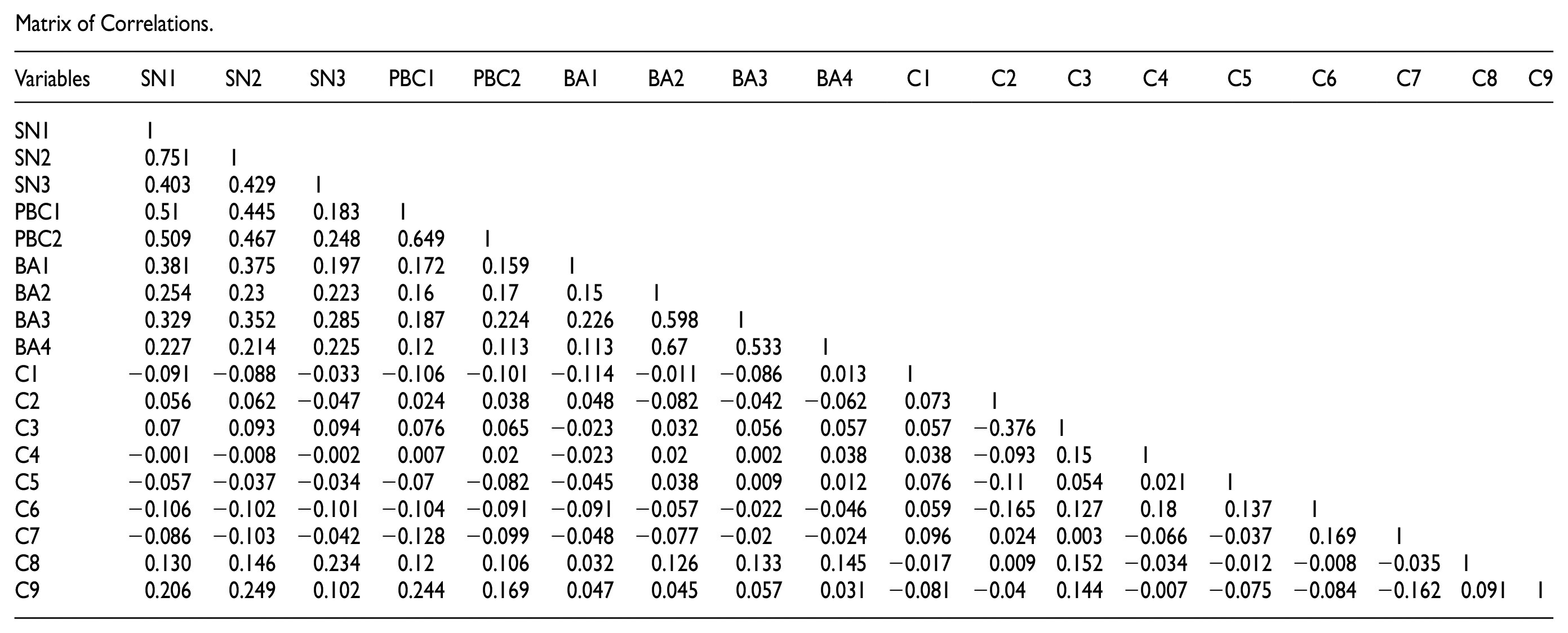
In addition, before the estimation of the quantitative model, the possible presence of multicollinearity had to be tested. Based on the outcomes of previous literature (Bi et al., 2022; Lee, 2006), it is assumed that if the correlation coefficients of the dependent variables are all below 0.85, no serious multicollinearity exists between the variables. Appendix A shows the matrix of the correlation coefficients between the variables, where the largest correlation coefficient is .751, which is less than .85. The variance inflation factor (VIF) is also the main basis for determining whether there is multicollinearity exists between variables. If each variable’s VIF is less than 5, it can be considered that no serious collinearity problem exists and the model can be further estimated (Jr et al., 2011). Appendix B shows that the VIFs are all less than 5. Thus, the results indicate that there is no collinearity issue among the variables, so model estimation can be performed.
Analysis of Results
Stata 17.0 is used to perform the probit model regression, and the regression results are presented in Table 5. As illustrated, all the models have passed the chi-square test. The dependent variables in Models 1, 2, and 3 are willingness toward manure application, the behavior of manure application, and the inconsistency between the behavior and intention, respectively.
Results of baseline regression.

Note.*, **, and *** indicate significance at the 10%, 5%, and 1% levels, respectively.
The Effect of Farmers’ Perceptions on the Intention for Manure Application
Model 1 shows the influence of farmers’ perceptions on their intention to apply manure. According to the results of Model 1, SN, PBC, and BA have all delivered significant effects on farmers’ intentions. Specifically, in terms of SN, if farmers’ perceived family support is at the 1% level, willingness toward manure application will be significantly promoted. However, the regression coefficients of the two variables for other villagers’ views and village officials’ encouragement were not significant, indicating that these two factors would not considerably affect farmers’ intention to apply manure. Although SN contains three dimensions, only one of the variables significantly affects farmers’ intentions, and the coefficient of this variable is as high as 0.669. The reason behind this phenomenon is that, currently, Chinese agricultural operations are still household-based, and decisions about agricultural activities are mainly made based on the perceptions and judgments inside farmers’ households. The attitudes of the subjects outside households (including villagers at the same level and village officials with more authority) would not form the core basis for changing farmers’ intentions. In terms of PBC, the variable of PBC1 imposes a significant positive effect on farmers’ intention to apply manure, indicating that from their perspective, if they have enough time and energy, they would unquestionably be more willing to apply manure. The regression coefficient of PBC2 is not significant, indicating that farmers’ judgment of their economic ability would not affect their willingness to apply manure. In terms of BA, the regression coefficient of BA3 is significantly positive at the 5% level. Since BA3 measures farmers’ perceptions of the environmental value generated from manure application, this result indicates that when farmers strongly recognize the degree of improvement in the soil environment from manure application, they are more likely to apply manure. However, the perception of economic and social values does not significantly influence farmers’ intention, probably because in the process of forming willingness, farmers would perceive manure application more as a green and pro-environmental act to improve soil conditions than as an economy-oriented agricultural production process. Therefore, the perception of social and economic value is not a major factor in boosting manure application.
With respect to the control variables, only the technical environmental characteristic has a significant influence on farmers’ intentions. Especially, C8 (whether they have participated in technology training for manure application) has a positive effect at the 1% significance level, indicating that technology training is essential to promote technology transfer. In addition, C9 (neighborhood demonstration) can significantly enhance farmers’ intention at the 1% level, suggesting that the behavior of surrounding people can impact farmers’ attitudes. Furthermore, it is evident that the variables of SN2 and C9 have different meanings: SN2 stresses the attitudes of other villagers toward manure application, while C9 showcases the number of farmers who have applied manure. Thus, the former emphasizes attitude, while the latter focuses on behavior. Although farming operations in China are household-based, social networks are equally important to farmers’ production decisions. In particular, actual manure application behavior is more likely to boost farmers’ intention and behavior to apply manure than simple word-of-mouth propaganda, because actual behavior can generate practical drivers and demonstration effects.
The Effect of Farmers’ Perceptions on Manure Application Behavior
The independent variable in Model 2 relates to whether farmers have practiced the behavior of manure application. According to the regression results, SN, PBC, and BA would all have significant effects on farmers’ behavior. Similar to Model 1, in terms of SN, only SN1 has a significant positive effect on the independent variable, indicating that the mechanism of SN’s influence on farmers’ manure application behavior is similar to that in Model 1.
In terms of PBC, unlike the influence mechanism for intention, farmers’ perceptions of their non-economic ability (PBC1) and economic ability (PBC2) would positively influence their manure application behavior at the 1% significance level. This indicates that in the actual agricultural production process, farmers tend to comprehensively weigh the costs to ensure they make realistic decisions. In this case, the cost would include not only non-economic features, for example, time and energy, but also the actual financial costs. Only when operators can bear the comprehensive cost, can they successfully implement the corresponding behavior in practice. This finding is also consistent with the “economic man” hypothesis (Tverdohleb, 2012) in economics.
Furthermore, the influence of BA on farmers’ manure application behavior is also different from that of their willingness. Among the four variables of BA, only BA1 affects manure application behavior at the 5% level, while the regression coefficients of other variables are not significant. BA1 demonstrates farmers’ perception of the economic value of manure application, that is, the degree of agreement on whether manure application can improve crop yield and quality. This perception is directly related to farmers’ expectations of earnings from their farming operations. In this context, economic benefits might not affect willingness but can influence their actual behavior. In addition, farmers’ perceptions of the environmental value of manure only affect their willingness but do not guide the implementation of their behavior. This finding reinforces the “economic man” hypothesis (Tverdohleb, 2012), indicating that farmers’ behavioral decisions are mainly determined by the benefits and costs of their behavior.
The regression results of the control variables indicate that younger household decision-makers are more likely to apply manure, which may be related to the fact that manure differs from conventional chemical fertilizers that can be spread onto fields using agricultural machinery. Manure specifically requires rotting and fermenting, with a tedious application process, heavy energy input, and high labor capacity. Thus, younger workers are more qualified for the labor requirements of manure application. Second, manure application is a complex technology, which means that younger people are more likely to adapt to it and feel more motivated to learn about it.
The variable C7 negatively affects manure application behavior, showing that the greater the proportion of grain cultivation, the lower the likelihood of manure application by farmers. This is probably because the unit price of manure is higher than that for chemical fertilizers, which would imply higher economic costs for manure application. Moreover, the price of grain is lower than that of cash crops, with narrower profit margins. As a result, if high-priced fertilizer is applied in the process of grain cultivation, it will further reduce profits. Thus, grain-growing farmers tend not to apply manure.
Furthermore, participation in technical training can promote manure application by farmers, indicating that technical guidance would boost farmers’ comprehensive understanding of manure and thus motivate them to behave accordingly. The regression coefficient of C9 is significantly positive, indicating that if a farmer knows more people who apply manure, it is likely that he/she will follow such behavior. According to the Herd Effect (H. Wang et al., 2022), humans tend to follow the herd mentality; in other words, the application of manure by others around them will drive farmers to do the same.
The Effect of Farmers’ Perceptions on the Inconsistency Between the Behavior and Intention to Apply Manure
Model 3 reveals the effect of perceptions on the inconsistency between behavior and intention. In our study, the independent variable is binary: the value of IBI is 1 when there is an inconsistency between farmers’ behavior and intention, and the value of this variable is 0 when farmers’ behavior is consistent with their intention. As shown in the results, PBC and BA tend to significantly affect whether farmers would fulfill their willingness.
First, the regression coefficients of both dimensions of PBC are negative at the 1% significance level, indicating that farmers’ perceptions of their ability will affect the inconsistency between their intention and behavior. This means that when a farmer believes that he/she lacks ability to apply manure, the possibility of applying manure will be reduced, thus resulting in inconsistency from their intention. Among the four variables of BA, farmers’ perceptions of the economic value of manure application are more likely to significantly influence the inconsistency, indicating that if farmers believe in the role of manure application in promoting crop yield and quality, they are more likely to apply manure in actual production on the precondition of having the willingness to do so. In other words, the possibility of inconsistency between their behavior and intention will be lowered.
The effect of other perception variables on the inconsistency is not significant, indicating that whether farmers with intention would implement the specific behavior is mainly determined by their internal judgment of economic costs and benefits. If the costs and benefits meet their internal expectations, their behavior will accord with their willingness; otherwise, inconsistency will occur. However, SN, perception of social value, and perception of environmental value do not tend to become the basis for farmers’ behavior to align with their intention.
In terms of the control variables, the age of household heads, planting structures, technology promotion, and neighborhood technology demonstration are likely to have significant effects on the inconsistency between farmers’ behavior and intention. Inconsistency is more likely to occur in households with older decision-makers. In general, older farmers are less receptive to new technologies than younger farmers; therefore, the older a farmer is, the less likely he/she is to convert manure application willingness into actual behavior.
The regression coefficient of the planting structure is significantly positive, indicating that farmers who grow grain are more likely to generate inconsistency between behavior and intention. The possible reason for this phenomenon is that, although grain growers want to apply manure, the high operational costs cannot be compensated for by the sale of grain, which negatively influences manure application behavior.
The technology promotion variable has a significantly negative effect on inconsistency, indicating that technical guidance would drive up the likelihood that farmers’ manure application behavior is consistent with their willingness. Similarly, the regression coefficient of neighborhood technology demonstration is negative at the 1% significance level, indicating that farmers may imitate and learn from those around them to urge the transformation of their willingness for manure application into actual behavior.
Results of Heterogeneity Analysis: Group Differences
Based on the above analysis, the significant effect of farmers’ cognition on the inconsistency is confirmed. In this part, the heterogeneity of this effect among various farmer groups is analyzed. Farmers’ cognition varies with their education and income (Xue et al., 2021; Ren & Jiang, 2022). For farmers who depend on agricultural operations for their livelihood, operation scale can directly reflect their financial and income level in the group, and large-scale production is the symbol of rich farmers (Z. Li et al., 2022). In addition, manure application is a kind of green agricultural production technology, and its acceptance in practice also needs to consider the learning ability and operation of farmers (Ren & Jiang, 2022). We subdivided the sample data from two aspects, that is, the education level and the operation scale, to estimate the effects of farmers’ perceptions on different types of farm households. The results are shown in Table 6.
Results of Heterogeneity Analysis.

Note.*, **, and *** indicate significance at the 10%, 5%, and 1% levels, respectively.
The farmers were divided into a high literacy group and a low one based on their education level for separate regressions. Due to the 9-year compulsory education policy in China, education below the senior high school level is sponsored by the government, with no tuition fees for students. Therefore, farmers with high school diplomas are among the highly educated people in rural areas. Therefore, the possession of a high school diploma was used as the basis for classifying farmers’ literacy levels in this study.
Model 4 demonstrates the regression results for farmers in the high-education group. As shown, the perception variables have no significant effects on the inconsistency between behavior and intention. The p-value of the chi-square test for Model 4 is 0.211, which is well above 0.05, indicating that Model 4 as a whole has failed to pass the chi-square test, so the regression coefficients are not referable. Poor data distribution is a possible reason for this outcome. There were a total of 123 respondents in the high-education group, among which only 30% produced the inconsistency between intention and behavior, indicating that behavior tends to be consistent with willingness for the majority of farmers with high education levels. The data for the high-education group are not distributed evenly, with a smaller sample, which may have contributed to insignificant regression results.
Model 5 delivers the regression results for the low-education group of farmers. It was concluded that PBC and BA have a significant effect on the dependent variables. Similar to the effect mechanism of the overall sample in Model 3, the variables of PBC1, PBC2, and BA1 all have significant negative effects on the dependent variables. Meanwhile, BA4 in Model 5 negatively affects the dependent variables at the 10% significance level, indicating that improving the perception of low-education farmers on the social value of manure application can enhance the probability of them applying manure.
Second, the results of Models 6 and 7 demonstrate the role of farmers’ perceptions at different operation scales. Generally, farming operations in China are household-based, with each farming household acquiring about 10 mu of farmland from village collectives. At present, there is no clear scope given by the academic community for large-scale operations in China. After the sample farmers’ operation scales were ranked from small to large, the median of 30 mu was taken as the boundary between the large-scale and small-scale groups. Model 6 demonstrates the regression results for the sample of farmers whose operation scales exceed 30 mu.
As proved by the model, only the effect of BA perception on inconsistency is significant. Different from Model 3, the regression coefficients of both PBC1 and PBC2 are not significant, indicating that PBC, that is, the perception of one’s ability, would not affect the behavior of large-scale farmers; possibly because the farmers who can operate a large area of land tend to have stronger production and management capabilities as well as better control over production costs, than small-scale farmers. As a result, the cost is not likely to be a main factor affecting their agricultural decisions. Instead, they are more concerned about the economic benefits of their decisions.
This phenomenon can also explain why the coefficient of BA1 is significantly negative. In addition, unlike the regression results for the overall sample, the coefficient of BA4 for the large-scale farmer group is significantly negative at the 10% level, indicating that the larger the scale of operation, the greater the role of farmers’ perception of the social value of manure. The sample for Model 7 consists of small-scale farmers, whose perceptions have a different mechanism of effect than those of large-scale farmers. Both of the two variables of PBC deliver a significant negative effect on the inconsistency between small-scale farmers’ behavior and manure application intention, indicating that the smaller the scale of operation, the greater the role of perception of personal ability, which is a reflection of farmers’ cost prediction.
Furthermore, due to the small scale of operation, the upper limit of farmers’ income is very low, so they tend to maintain their profits by controlling costs. As a result, they are very sensitive to costs, and the lack of confidence in their manure application ability will reduce the likelihood of them taking up this behavior. In terms of BA, the regression coefficient of BA3 is significantly negative, indicating that small-scale farmers’ perceptions of the impact of manure on improving soil quality would affect their behavior. This is due to the fact that, in China, the size of land owned by each household is institutionally limited resulting in the fact that if a farmer wants to operate on a large scale, he/she can only achieve this by renting others’ land. Consequently, most of the land cultivated by large-scale farmers is often owned by others; however, small-scale farmers enjoy more complete property rights to the land they cultivate. Now that manure application is a kind of land investment behavior to improve soil fertility, farmers would be more willing to invest in their land rather than in others’ land. Therefore, the variable of BA3 has a significant effect on the small-scale farmer group.
Discussion
There are many practical examples of improving the impact of cognition on manure application through policy implementation.
Field guidance, machinery services, and financial support are seen as effective policies (T. Zhang et al., 2022a). Lack of sufficient information is often considered a key obstacle to manure application (Hijbeek et al., 2019; W. Zhang et al., 2016). In general, technical guidance provides farmers with accurate information about manure application, and machinery services offer them manure application services through the development of socialized service enterprises. By benefiting from these policies, farmers save their own labor and investment costs in manure practice. These two policies would change farmers’ cognition (especially PBC1) and reduce their doubts about their abilities, thereby promoting the transformation of manure application intention into behavior. The subsidy is one of the most common financial support policies. The government provides subsidies for farmers to purchase manure (T. Zhang et al., 2021). According to the Chinese market situation in recent years, the price of manure is between 600 to 2,000 Yuan/Ton, and in some regions, farmers can get a subsidy of 150 to 480 Yuan when buying manure (T. Zhang et al., 2022a). Subsidies increase farmers’ capital holdings and enhance identification with their economic capabilities (PBC2), which can help to promote the use of manure.
Product certification policy, especially eco-certification, organic certification, etc., can increase the economic benefits gained by farmers in the production process. This supports their intention to increase economic value (BA1) and psychologically affirms the economic benefits achieved through the manure application, so as to achieve consistency. The practice has shown that organic certification can promote the adoption of clean farms and the use of organic fertilizer in southeastern Colombia (Ibanez & Blackman, 2016) and Costa Rica (Blackman & Naranjo, 2012).
In addition, the results also show that technical environmental variables can lead to inconsistency between intention and behavior. Extension services are significant in promoting technology adoption and are the main source of agricultural information for farmers (G. Wang et al., 2020). Extension services improve the technology environment and enhance the availability of technology to incentivize farmers to use manure in agricultural practices.
Conclusion
In this study, a probit model was constructed to empirically analyze the relationship between farmers’ cognition, intention, behavior, and the inconsistency between intention and behavior (IBI). The results confirm that: (a) subjective norms (SN), perceived behavioral control (PBC), and behavioral attitudes (BA) positively affected farmers’ intention, with family attitude, self-non-economic ability, and the environmental value of manure having the most significant effects; (b) SN, PBC, and BA also affected behavior, but the influence mechanism is different—family attitude, self-ability, and the economic value of manure application stimulate farmers’ behavior; (c) PBC and BA were identified as the drivers of IBI, with the enhancement of farmers’ cognition about self-ability and the economic value of manure likely to weaken IBI; (d) cognition plays different roles among different farmers, with cognitive enhancement reducing IBI for low-educated farmers, BA enhancement being more effective for large-scale farmers, and PBC enhancement being more effective for small-scale farmers.
Based on the above conclusions, the following policy recommendations are proposed: Strengthen the promotion of manure application technology and optimize farmers’ production behaviors. Train farmers in manure application to enhance their awareness of its role. Utilize agricultural technology publicity stations, network media, and other promotion platforms to increase farmers’ understanding of manure and encourage them to use manure instead of chemical fertilizer. Leverage the demonstration role of farming experts to guide other farmers toward better production habits, effectively transforming intention into behavior.
Improve the conditions for manure application, increase farmers’ expected income, and reduce cost constraints. Stabilize manure prices through subsidy policies, price adjustment policies, and production support policies, making the product more affordable for farmers. Narrow the price gap between manure and chemical fertilizers to encourage more widespread use of manure.
Identify differences between farmers and provide targeted services. Strengthen basic cognitive training for low-educated farmers and improve product support and resources for small-scale farmers. Offer organic product certification for large-scale farms to enhance farmers’ overall recognition of manure value.
It is important to note the limitations of this study. The sample in this study is based on one province where the planting and breeding industries are relatively developed. The conclusions of this study can provide a reference for similar areas, but more a specific analysis is needed for special areas. In the future, the research can be expanded to a wider area. The analysis focuses solely on the role of cognition, and although some characteristics and variables are included as control variables, this is not comprehensive. Various other factors affect farmers’ behavior and intentions. Future studies should aim for more in-depth and comprehensive analyses.
Footnotes
Appendix A
Matrix of Correlations.
| Variables | SN1 | SN2 | SN3 | PBC1 | PBC2 | BA1 | BA2 | BA3 | BA4 | C1 | C2 | C3 | C4 | C5 | C6 | C7 | C8 | C9 |
|---|---|---|---|---|---|---|---|---|---|---|---|---|---|---|---|---|---|---|
| SN1 | 1 | |||||||||||||||||
| SN2 | 0.751 | 1 | ||||||||||||||||
| SN3 | 0.403 | 0.429 | 1 | |||||||||||||||
| PBC1 | 0.51 | 0.445 | 0.183 | 1 | ||||||||||||||
| PBC2 | 0.509 | 0.467 | 0.248 | 0.649 | 1 | |||||||||||||
| BA1 | 0.381 | 0.375 | 0.197 | 0.172 | 0.159 | 1 | ||||||||||||
| BA2 | 0.254 | 0.23 | 0.223 | 0.16 | 0.17 | 0.15 | 1 | |||||||||||
| BA3 | 0.329 | 0.352 | 0.285 | 0.187 | 0.224 | 0.226 | 0.598 | 1 | ||||||||||
| BA4 | 0.227 | 0.214 | 0.225 | 0.12 | 0.113 | 0.113 | 0.67 | 0.533 | 1 | |||||||||
| C1 | −0.091 | −0.088 | −0.033 | −0.106 | −0.101 | −0.114 | −0.011 | −0.086 | 0.013 | 1 | ||||||||
| C2 | 0.056 | 0.062 | −0.047 | 0.024 | 0.038 | 0.048 | −0.082 | −0.042 | −0.062 | 0.073 | 1 | |||||||
| C3 | 0.07 | 0.093 | 0.094 | 0.076 | 0.065 | −0.023 | 0.032 | 0.056 | 0.057 | 0.057 | −0.376 | 1 | ||||||
| C4 | −0.001 | −0.008 | −0.002 | 0.007 | 0.02 | −0.023 | 0.02 | 0.002 | 0.038 | 0.038 | −0.093 | 0.15 | 1 | |||||
| C5 | −0.057 | −0.037 | −0.034 | −0.07 | −0.082 | −0.045 | 0.038 | 0.009 | 0.012 | 0.076 | −0.11 | 0.054 | 0.021 | 1 | ||||
| C6 | −0.106 | −0.102 | −0.101 | −0.104 | −0.091 | −0.091 | −0.057 | −0.022 | −0.046 | 0.059 | −0.165 | 0.127 | 0.18 | 0.137 | 1 | |||
| C7 | −0.086 | −0.103 | −0.042 | −0.128 | −0.099 | −0.048 | −0.077 | −0.02 | −0.024 | 0.096 | 0.024 | 0.003 | −0.066 | −0.037 | 0.169 | 1 | ||
| C8 | 0.130 | 0.146 | 0.234 | 0.12 | 0.106 | 0.032 | 0.126 | 0.133 | 0.145 | −0.017 | 0.009 | 0.152 | −0.034 | −0.012 | −0.008 | −0.035 | 1 | |
| C9 | 0.206 | 0.249 | 0.102 | 0.244 | 0.169 | 0.047 | 0.045 | 0.057 | 0.031 | −0.081 | −0.04 | 0.144 | −0.007 | −0.075 | −0.084 | −0.162 | 0.091 | 1 |
Appendix B

| Variable | VIF | 1/VIF |
|---|---|---|
| SN1 | 2.72 | 0.37 |
| SN2 | 2.63 | 0.38 |
| SN3 | 1.35 | 0.74 |
| PBC1 | 1.94 | 0.51 |
| PBC2 | 1.92 | 0.52 |
| BA1 | 1.23 | 0.81 |
| BA2 | 2.17 | 0.46 |
| BA3 | 1.82 | 0.55 |
| BA4 | 1.94 | 0.51 |
| C1 | 1.08 | 0.93 |
| C2 | 1.34 | 0.75 |
| C3 | 1.27 | 0.78 |
| C4 | 1.09 | 0.92 |
| C5 | 1.08 | 0.93 |
| C6 | 1.38 | 0.73 |
| C7 | 1.12 | 0.89 |
| C8 | 1.11 | 0.90 |
| C9 | 1.15 | 0.87 |
| Mean VIF | 1.58 |
Acknowledgements
This research was financially support by the National Natural Science Foundation of China. We thank Prof. Jeroen Buysse from Department of Agricultural Economics, Ghent University for assistance in manuscript improvement.
Declaration of Conflicting Interests
The author(s) declared no potential conflicts of interest with respect to the research, authorship, and/or publication of this article.
Funding
The author(s) disclosed receipt of the following financial support for the research, authorship, and/or publication of this article: This research was funded by National Natural Science Foundation of China [grant number 42071221].
